Sunday, July 11, 2021

Southern Music

Our trip south this spring to Memphis, Mississippi, Arkansas and Alabama got us an amazing opportunity to immerse ourselves in the struggle for Civil Rights that took place in the 1950s and 1960s. There are a significant number of important sites within reasonable driving distance of each other that can be visited in a little more than a week. We knew a trip like that would be difficult and painful and would not necessarily bring us much hope or joy. We were really right about that last part.

Our route from Memphis into Mississippi and Arkansas and across into northern Alabama would bring us face to face with another reason to be in that area of the country: music. There is perhaps no other place in the United States (or the world, for that matter) more responsible for the music that most of the world listens to today than Mississippi, Memphis and northern Alabama. It is the birthplace of that most crucial American music* born out of the pain of slavery that rocked juke joints that was originally unabashedly about sex and love that became what just about every child and teenager and adult listens to today (yes, I'm differentiating children from teenagers). It has been transformed a million different ways by a million different artists in a million different places including the places where it started. Rock and roll. Soul. Funk. Punk. Pop. Grunge. Disco. Heavy metal. Folk. Alternative. Whatever you want to call it. It was born, nurtured and taken to some of its highest forms in Mississippi, Memphis and northern Alabama. 

Need some proof? How about this list? B.B. King. Muddy Waters. The Rolling Stones. Dusty Springfield. Otis Redding. Johnny Cash. Sonny Boy Williamson. Wilson Pickett. Aretha Franklin. Linda Ronstadt. Paul Simon. Elvis Presley. William Bell. Albert King. Robert Johnson. Booker T and the MGs. Rod Stewart. Jerry Lee Lewis. Roy Orbison. Isaac Hayes. Carl Perkins. Bob Dylan. Levon Helm. Ike Turner. Howlin' Wolf. The Staple Singers. John Lee Hooker. Elmore James. Sam and Dave. Duane Allman. Bob Seger. Percy Sledge. Lynyrd Skynyrd. U2.

All of those artists and way more have connections to the area we visited. There are signs and monuments and houses and museums all over the place that tell their story. There are also four incredibly important recording studios that starting in the 1950s put the music recorded in this area down on records and cassettes and 8-tracks and compact discs and influenced the history of music in immeasurable ways. We visited all four. Two in Memphis and two in Muscle Shoals, Alabama. And they did bring us hope and joy. Lots of it!


Sun Studio
When you go to Sun, expect a lot about Elvis. It's understandable. He was the biggest thing to happen to that record company. But it's not the whole story. And you will also get more than just Elvis when you are there.

On January 3 of 1950, just about as few days into the 1950s as you could get, a new recording studio opened in Memphis with the very, very imaginative name of the Memphis Recording Service. It was the brainchild of 27 year old Sam Phillips, who wanted to be part of the recording industry in a more significant way than his job as a local disc jockey broadcasting out of Memphis' famous Peabody Hotel allowed him to be. Instead of just playing the songs recorded in the Memphis area, Sam would start putting some tracks onto vinyl.

Initially, the Memphis Recording Service was a contractor for other in town and out of town record labels that wanted musicians from Memphis and the Mississippi Delta recorded on their labels for local and national distribution. Sam cut tracks for the likes of B.B. King, Howlin' Wolf, Sleepy John Estes and Rufus Thomas out of his studio on Union Avenue. But when he recorded Jackie Brenston with his Delta Cats record "Rocket 88" he started to think maybe he should quit his job as a DJ and start a record label of his own.

If you don't know the song that Jackie Brenston recorded at Sun, that's OK, but it's considered by many people to be the first true rock and roll record. Jackie's band wasn't really Jackie's band at all; their real name was Ike Turner and his Kings of Rhythm but I guess that's not necessarily relevant to the story. On the day they recorded "Rocket 88", they damaged one of their amplifiers pulling it out of the car and under a time crunch to get the thing repaired, Sam Phillips suggested they stuff some newspaper inside to keep the woofer and cone inside the amp in place. It produced a distorted sound that Phillips loved and made the song unique to that point. Hello, rock and roll!!

Either me or Larry Mullen, Jr. at Sun Studio.
The second significant story about Sun Studio is the discovery of Elvis Presley which probably had more influence on the history of rock music than "Rocket 88". I'm not being sarcastic with that sentence. "Rocket 88" was hugely influential. When I write "probably", I mean it, in spite of Elvis' obvious importance to the history of music.

As a means of making some extra money and getting some local talent in the door without a lot of expense, Sam Phillips offered to record anyone who walked in the door at Sun for the cost of $4 for two tracks. Sam wasn't there the day Elvis Presley walked in to record "My Happiness" for his mother but his receptionist Marion Kessler was astute enough to make a second copy of Elvis' recording. About a year later with constant prompting from Marion, Elvis is back in the studio at Sam's request to record sone songs with bassist Bill Black and guitarist Scotty Moore. And it just wasn't working until Sam called a halt to the whole thing and Elvis started messing around with an old Arthur "Big Boy" Crudup song called "That's All Right" when the recording had stopped. Phillips loved it, offered some edits, recorded it and delivered it to local DJ Dewey Phillips. Dewey played it 14 times in a three hour show. The rest is history.

The single studio at Sun is pretty much exactly the way it was in the early 1950s. There is even some tape on the floor where Bill Black and Scotty Moore placed their instruments when recording "That's All Right". It's tiny and it looks like it's been put together with spare parts and has no chance of anything significant happening there ever. But the artists that recorded just for Sun Records (not counting B.B. King etc.) is astounding: Elvis, of course, but also Jerry Lee Lewis, Carl Perkins, Johnny Cash and Roy Orbison. Are you kidding me? All cranking out songs in that cramped studio on Union Avenue. There is some serious music history coming out of that room.

The Sun Studio sat dormant for years but recently (and maybe not so recently with the album I'm about to name drop) it has been used on a regular basis again. The drum set in the photograph above was left over from U2 recording their 1988 release Rattle and Hum.

Marion Kessler, by the way, was directly and indirectly responsible for signing Cash and Orbison. Johnny was an appliance salesman when Marion met him and he later found Roy on tour in Texas. The history of Sun Studio is not all about Sam Phillips.


Stax Records
Meanwhile in Memphis to the south of downtown...

Making records in the 1950s must have been a crazy scene. It seems like anyone with a little know how and some adventurousness could have started a record label back then. While Sam Phillips was setting up shop and cranking out hit after hit with legendary artists in downtown Memphis, Jim Stewart decided to start the Satellite Record Company in his wife's uncle's garage about 20 miles east of Memphis in Brunswick, Tennessee. Eight years later, after moving to Memphis and being threatened with a lawsuit by another Satellite Records, Stewart had a more permanent studio on McLemore Avenue with the help of his sister Estelle Axton. The first two letters of each of their last names made up the new label's name: Stax Records.

The original Stax Records building is long gone. It was demolished in the 1970s after the original label went out of business. If you want to make a Stax pilgrimage these days, you'll have to satisfy yourself with a visit to the Stax Museum of American Soul Music. It's on the same site as the original studio and it is actually very satisfying and definitely worth a visit or two or more. The soul that came out of this block in Memphis was just spectacular music.

This was not my first visit to the Stax Museum. I visited way back in 2006 when I had no idea what Stax was or what amazing music came out of the place. This time I was way more educated which made this 2021 visit way more special. Since that first visit, I've dipped my toes into the Stax waters a bunch of times with a bunch of different artists. This time I was visiting as a fan.


There is one significant and obvious difference between Sun and Stax as a recording studio and that is Stax had its own house band that was hugely important to its success. And you can't really talk about how great the music on that record label was without giving a huge amount of credit to the band who backed almost every artist who recorded in their building on McLemore Avenue (at least in the label's infancy). Pianist Booker T. Jones, bassist Lewie Steinberg (and later Donald "Duck" Dunn), drummer Al Jackson, Jr. and guitarist Steve Cropper (they also recorded by themselves as Booker T. and The MGs) with a horn section called The Memphis Horns featuring Wayne Jackson and Andrew Love. 

The house band appearing on almost every record produced by the label created a Stax Records sound. Sure, Rufus Thomas and Carla Thomas and William Bell and Bobby Marchan and Otis Redding and The Veltones and Eddie Floyd and David Porter all were different artists with different styles but the house band at Stax provided a common feel. Motown did the exact same thing up in Detroit but just started a couple of years after Stax. There is an obvious comparison between Motown and Stax. They were both soul-focused music labels that emerged in the 1950s and 1960s with house bands and in house songwriters made up in large part of people just from the neighborhood. I feel it is unfortunate that Stax's artists are probably less well known than Motown's. They are every bit as good.

The Stax house band is important in another respect. In the mid-1960s Atlantic Records entered into a national distribution deal with Atlantic Records. The deal was good in theory for Stax because it would extend their distribution network, although it ended up being a terrible contract for the label. From Atlantic's side of things, it got owner Jerry Wexler access to a band who was perfect for backing his soul music artists for Atlantic's emerging soul catalog. Atlantic's partnership with Stax didn't last long (just about three years) but if nothing else, it produced Wilson Pickett's "In The Midnight Hour" (that Steve Cropper co-wrote). 

There's a reason I mention this. This is not the end of Jerry Wexler in this post.

The Booker T. and The MGs display at the Stax Museum of American Soul Music.
The experience at Stax today is completely different from the other three studios we visited. While there is some sort of museum type experience at the other three, the primary focus of the visit is the studio (or studios) where the music was recorded. Because the original Stax building and studio are long gone, there is none of that at Stax.

Now sure, there is a recreation of the original studio built to the specifications of the original space (a former theater as it turned out so the floor of the re-creation slopes just like the original theater floor) and there are some original instruments used on the recordings in display cases but it's not the same as the original studio itself. Ironically, the studio space in the museum lacks the kind of soul I was seeking in these visits. Having said that, if I lived in Memphis, I'd go here a lot, way more than Sun Studio. There is so much in that museum to explore.


FAME Studios
When Jim Stewart terminated the contract between Stax and Atlantic, Jerry Wexler went searching for another studio that offered what he briefly had in Stax: a recording studio in the south with a kickass house band. He found Rick Hall's FAME (yes, all caps; an acronym for Florence Alabama Music Enterprises) Studios in Muscle Shoals, a small town in northern Alabama on the Tennessee River that would have an an almost inappropriate (and I mean that in the very best way) influence on the history of music. 

Rick Hall founded FAME (but not the current studio) in 1959 with partners Billy Sherrill and Tom Stafford in nearby Florence, AL. That partnership didn't last long. Sherrill and Stafford found out pretty quickly they didn't want to work with Hall too long and split, which ended up working out fine for Hall just the same. The original FAME studio was built in a space over a drug store and Hall struck it rich when Arthur Alexander (who was a bellhop at a local hotel who somehow knew Hall) recorded his song "You Better Move On". The proceeds from that record allowed him to build the current studio pictured above.

FAME is all about the hard work of Rick Hall. He persevered through a (I guess...) failed partnership; built his own ideal studio; worked the release of the first song ("Steal Away" by Jimmy Hughes) recorded in that building by personally driving the completed record to record studios himself; and assembled the band (keyboardist Barry Beckett, drummer Roger Hawkins, bassist David Hood and guitarist Jimmy Johnson; the Muscle Shoals Rhythm Section) that made Wexler turn his attention to Muscle Shoals. But visiting these studios for me was important so I could stand in the spaces where some of the music I love so much was created. For me at FAME, that meant Aretha Franklin.

Wurlitzer. FAME. Aretha. Special stuff.
Aretha signed her first recording contract with Columbia Records at age 18. When that contract expired six years later, Jerry Wexler convinced her to move to Atlantic Records and when she did, he sent her down to Muscle Shoals to record with the Muscle Shoals Rhythm Section. The result was two songs on her I Never Loved A Man The Way I Loved You album: the title song and the Dan Penn / Chips Moman song "Do Right Woman, Do Right Man". These two recordings were the primary reason I was at FAME in May of this year. Being in that space and standing next to the actual Wurlitzer organ used on those recordings was one of those "knees weak" moments for me.

Aretha recorded those two songs in FAME's Studio A, which was the only recording studio in the building at that time. That studio was clearly the most well put together studio we visited. There was none of the DIY aesthetic that we got at Sun Studio; this was a professionally put together space that reflected (as I see it anyway) Rick Hall's professional approach to making music.

There is a second studio (Studio B) at FAME which is less polished. The first band to record anything in that studio were the Allman Brothers Band, which got me another significant connection to my own music collection that I didn't expect out of this trip. In fact, if it weren't for Duane Allman camping out in the FAME parking lot insisting he get a chance to play there (and on Wilson Pickett's "Hey Jude"), he might never have met Berry Oakley and Jaimoe Johanon which might have changed the course of music for the worse forever. FAME is important.


Muscle Shoals Sound Studios
There is Sun, there is Stax, there is FAME and they are all special in their own way. But the Muscle Shoals Sound Studio is an entirely different place whatsoever. This was THE place I wanted to go on this trip. I know that visits to places where music was created are special on different levels for different people. Muscle Shoals Sound Studio is on an entire different planet from the other three for me, even with Albert King and Otis Redding at Stax and Aretha at FAME.

If being in the same room where Aretha recorded two songs in 1967 got me some weak knees, standing in the single recording studio at the Muscle Shoals Sound Studios made me want to spend days or weeks there soaking up all the good vibes and mojo from everyone that I love having recorded in that one room over the years.

And yes, Jerry Wexler had something to do with it again. And this time he maximized his involvement. Rick Hall was presented with an exclusive contract with Capitol Records which he decided to sign. Capitol in, Atlantic out! Hall thought this was great news but when he informed the Muscle Shoals Rhythm Section, they didn't feel the same way. So they split and started their own studio. And Wexler went with them. This place wouldn't have existed without that decision.


The search for a new studio space took the Rhythm Section to an old casket salesroom with its own recording studio already partially set up. Apparently the owner of the casket business was interested in recording choir music and set something up. That got the studio up and running by 1969 and continued until its closure in 1978. That's not a long time. Fortunately, just like Sun, interest in recording in a such an historic place has reopened the studio. Which means it's available for recording and for tours.

The first album recorded in the brand new Muscle Shoals Sound Studios was Cher's 3614 Jackson Highway, which also happens to be the street address of the studio. But pretty soon after that, Jerry Wexler convinced the Rolling Stones, who had no legal right to record music while touring on a work visa issued for that purpose and that purpose alone, to stop by and cut a couple of tracks. This is the reason I came here, because the songs they cut ended up on my favorite album of all time: Sticky Fingers.

The Stones intended to record just one song in their time in Muscle Shoals, a cover of the Reverend Gary Davis' song "You Gotta Move".  But faced with a quick completion of that track and some time on their hands in what was then a dry county, they got back to work and completed writing and recording from start to finish two pretty important songs in their catalog: "Brown Sugar" and "Wild Horses". I know it's a little silly but being in the place where Mick finished "Brown Sugar" and Keith finally worked out everything on "Wild Horses" (in the bathroom of all places) is some goosebumps type stuff. I felt it in Liverpool in 2018 in the McCartney family living room; the feeling in Muscle Shoals was pretty much the same thing. History happened here. History that affects me every year. What would have happened if the Stones hadn't visited Muscle Shoals? Chilling stuff, I'm telling you.

After the Stones, the guest list is a who's who of rock and roll, with many of these artists occupying a spot in my own music collection: Linda Ronstadt, Paul Simon, Lynyrd Skynyrd, Bob Seger, Rod Stewart, The Staple Singers, Bob Dylan, Willie Nelson, Cat Stevens. The piano that still sits in the center of the studio was used to record Paul Simon's "Kodachrome" and was the genesis of the piano intro to Lynyrd Skynyrd's "Freebird" by then roadie Billy Powell.

There is a good deal of good fortune in the history of this building. After the initial closure of the studio in 1978, future owners of the building did not demolish the studio nor did they remove the recording equipment from the sound booth, meaning reconstructing the space for tours and business was a significantly easier endeavor than it might have been otherwise. The instruments were removed in 1978 but most have been reclaimed or recovered and now sit in their former places which were documented in David Hood's personal photograph collection.


Our trip to Muscle Shoals Sound Studio was for me, by far, the highlight of our mini recording studio tour itinerary. And not only because of the Stones and the other artists that had recorded there. Two final thoughts here.

First, it was the only place where we got inside the control room. Not that I know necessarily what all the slides, knobs and buttons do but this is the machine that recorded the music that I love so much. Without this machine, maybe nothing quite works out the same.

Second and finally, and maybe as an indication of how big the world that we lived in was back then and how small it is today, our guide (who grew up seven miles from the Studio and who at 13 years of age when the Studio was originally active was absolutely crazy about music) had no clue at all that this amazing music was being laid down less than 10 miles from where she lived. I think it's kind of cool that in the 1970s some of the most famous musicians on the planet could be recording some of the best tracks ever made in a small town in northern Alabama. Imagine rolling by this place in 1969 and seeing Keith Richards and Mick Jagger hanging out on the back porch (because apparently that's where the musicians used to hang out). How wild is that? Definitely worth a pilgrimage to this place.

The Stones' bill for their recording time, by the way, was $1,009.75. I'd say that was money well spent, even if there was no alcohol available.

How We Did It

Sun Studio is open seven days a week beginning at 10 a.m. daily. They run tours (which is the only way you can walk beyond the gift shop) every hour on the half hour. They are open until 5:15 p.m. every day except Friday and Saturday when they are open for an additional hour. Tours are first come, first served. We got the first one of the day and there were about 15 people in line when we got there. Parking is street parking. Our whole experience took about 45 minutes.

The Stax Museum of American Soul Music is open Tuesday through Sunday 10 a.m. to 5 p.m. It took us about two hours to get through the whole museum and we read a lot but certainly not more than half of the exhibits there. You could easily spend a half a day here if you read every word on every display. There is a huge parking lot behind the building dedicated to the museum.

FAME Studios runs tours through its studios twice daily Monday through Friday at 9 a.m. and 4 p.m. On Saturdays, they run five tours hourly from 10 a.m. to 2 p.m. Advance reservations are available online. We called to see if we really needed a reservation and were told we probably didn't. I mean how many people are coming through Muscle Shoals, Alabama to tour FAME Studios on any given day? When we got there, we found that our tour group was maybe 15-20 people. If I had to do it all over again, I would have made a reservation, even though it worked out for us. There is a parking lot either side of the building. You might be rushed out of Studio A. They still record during the daytime there.

Muscle Shoals Sound Studios runs six tours each day Monday through Saturday starting at 10:30 a.m. and every hour after that. Advance reservations are also available here which we did make. There's no way we were not getting into this place. There's a parking lot on the right side of the building. If you are wondering if you can take the 2:30 p.m. tour at Muscle Shoals Sound Studio and still make the 4 p.m. tour at FAME, the answer is yes, you will have tons of time. You will even have time to make the trip up to the Hampton Inn in Florence to see the "Mick Jagger Slept Here" sign as well.

* There is an asterisk in this post. That's because I didn't invent the term "most crucial American music." I swiped it from page 49 of Warren Zanes' excellent book called Dusty In Memphis, about the album of the same name. Dusty In Memphis was another Jerry Wexler project, this time with Wexler sending English singer Dusty Springfield over to Chips Moman's American Music Studio in Memphis. That studio is long gone. Dusty In Memphis is a top five album ever made for me.


Wednesday, June 30, 2021

Root, Root, Root For The Biscuits!


Baseball is a simple game. Pitch the ball, hit the ball, catch the ball, throw the ball. But if the ball drops, run the bases and hope you reach base safely and score some runs. Three strikes and you are out (unless the catcher drops the third strike), three outs to an inning, nine innings per game. If the home team is ahead in the middle of the ninth, they get to go home early. As does everyone, I guess. Game over. But if the home side does come up to bat in the ninth inning in Montgomery, Alabama, you better believe somewhere in Riverwalk Stadium there's a dude dressed up as a baker riding a barnyard animal. It's rally chicken time! 

On May 14 of this year, we made our way toward the riverside in Montgomery, paid our $14 each for the best seats in the house and went to see the hometown Montgomery Biscuits (yes, that's the actual team name) take on the visiting Chattanooga Lookouts. The Biscuits were decked out in their "Gump" uniforms that night, celebrating Forrest Gump's fictional hometown in Greenbow, Alabama, and the Lookouts had on their brown colored "Nooga" unis (why abbreviate your city name that way?). And sure enough, there we were almost four hours into a nine inning, ten pitcher game with hundreds of fellow Biscuit fans getting fired up by the rally chicken in hopes of a late game comeback.

It didn't work. 

Yes, they had a reasonable shot at a comeback in the ninth but it was a just not a good night for the Biscuits. Four errors in the field squandered an early 1-0 lead as they struggled to find the right solution on the mound. At one point, they even had their third baseman take a shot at firing balls and strikes toward home plate. Their performance in the field and in the batter's box was not enough, even with a grown man in a baker's costume riding a chicken throwing out biscuits in the stands trying to will the team to a come from behind victory. Game over!

One of Montgomery's former train sheds - now part of Riverwalk Stadium.
Sports in large cities and small cities and large towns and small towns are important to community pride and togetherness. Even if the team stinks for years and years and years. Local sports offer a cause to rally around for individuals and families, and people from all walks of life in the community can come together and cheer for a common cause, just like they were this past May at Riverwalk Stadium. That sounds totally corny but I completely believe in it. So much so that the whole premise of my Master's thesis in college was centered around this very idea. 

There are many great professional sports leagues and systems in the United States but none have the reach of baseball. And by "reach", I mean no sport has been around in so many communities all over this country for so long. No professional sport has been a part of more people's lives over the last let's say 150 years quite the same way baseball has. Not basketball, not soccer, not hockey, not football. Baseball is it. And baseball is especially important in small cities and large towns and small towns. Large cities have all sorts of access to live professional sports. Everywhere else? Not so much, which is why Minor League Baseball is so important to sports in this country. It touches more spots in the United States than any other sporting league below whatever the top league is.

But that dynamic may be changing. Two years ago there were 160 teams in the Minor League Baseball (MiLB) system. Most of those clubs were owned and operated by local interests, with Major League Baseball (MLB) teams providing the players. In December 2019, MLB decided they wanted to shake that up, meaning cut some costs and cut some teams out of the system. A lot of teams. Like 43. Earlier this year, they did just that.

Now, that doesn't mean that 43 minor league baseball teams ceased to exist, but it might mean something close to that soon. Without the Majors providing players, teams are forced to look for their own squads, something they didn't need the resources to do just two years ago. MLB is also removing one of the big perks of attending minor league ball, the idea that you can see a future superstar right there in your own town. With no players on Major League payrolls, that possibility, however remote, becomes almost not really possible at all. This is critical-level small city and town survival type stuff.

Friday night minor league ball in Memphis: Let's go Redbirds!!!
I got a little hung up on this whole thing last year. And maybe I still am this year. Here's a group of 30 sports franchises that pull in (by one estimate I read) $10 billion per year looking to cut minor league sports out of 43 cities and towns to save less than $25 million annually. How does that make any sense? I'm all for free enterprise but less than $1 million savings per team against that kind of revenue total (assuming the numbers I read are reasonably accurate) seems like it might be worth it to keep baseball in some places of the country that are far, far from any other professional team. Take the little bit of a loss to keep teams in their communities.

So who cares, really? Well, besides me, I think a lot of people. I really do believe having a professional ball team in town is healthy for towns and cities. Some of these teams have been around a long, long time. The Chattanooga team was founded in 1885 and the Lookouts name dates to 1909. That makes them older than 22 of the 30 teams that currently play baseball at its highest level in this country (and Canada). Think that's worth something? I do. Especially since the Lookouts were on the original cut list from MLB (they survived, perhaps obviously).

Unfortunately for me last year, there were very few ways to act on my MiLB fixation since the 2020 MiLB season (but not the MLB season; too much money at stake to let a pandemic get in the way) was canceled in total. So last year, I could not go to a game to cheer on my local minor league team in Richmond, VA or Salisbury, MD. But I did buy some swag based on some trips we took in 2020, including caps from the Vermont Lake Monsters and Missoula Paddleheads and a shirt from the Boise Hawks (actually the Boise Papas Fritas but we'll get to that). I had to support these teams somehow if I couldn't do it at the box office.

But this year, Minor League ball is back. And by happy coincidence, all three cities where we stayed overnight on our tour of the American South not only have MiLB franchises, but all three had games in town at least one night we were also in town. Play ball!

The train rolls past Montgomery's Riverwalk Stadium a few times per night.
We managed to take in two games in our time down south: one in Memphis watching the hometown Redbirds battle (and I use that term loosely here; we left with the Redbirds down 10-1 in the seventh) the visiting Durham Bulls and the May 14 contest between Montgomery and Chattanooga down in Alabama. Both were glorious experiences.

There are a few things that fascinate me about Minor League Baseball. Number one is the connections that the team makes with the local community. This is manifested in so many ways, and not just in the enthusiasm of the adults and kids in the stands. It's in everything from the local food sold at the ballpark to the (sometimes corny) local advertisements and sponsorships to the theme nights with custom one-night-only uniforms to the design of the stadiums. I drank local beer and ate chicken biscuits at the game in Montgomery while three or four trains rumbled by on the freight rail tracks that run right past the stadium. The train is such a huge part of the history of most towns in this country and Montgomery is no exception; a portion of Riverwalk Stadium is a train shed converted into offices and retail space. This connection through their baseball park is huge.

One of the other reasons I love watching Minor League ball is the players on the field in front of you are literally chasing their dreams. Players at this level (AAA in Memphis, one step below the big leagues and AA in Montgomery, one rung further down) are not in it for their weekly wages while they are at the plate or on the mound in places like Pensacola or Biloxi or Norfolk or Louisville. If you are making it in triple-A ball, you are likely pulling in a cool $700 a week (remember this is part time job) and it goes down from there. Double A players earn just $600 each week; that's $15 an hour assuming a 40 hour week. This is poverty line level stuff. The only reason these players are toughing it out in small cities and towns wherever they may be in America is that there is some hope of making it big. These guys are going for it. 

Finally, there are the team names. I'm a huge believer in site-specific nicknames for sports teams and the minor leagues generally crush this concept big time. Biscuits in Montgomery, Storm Chasers in Omaha, Isotopes in Albuquerque, Blue Claws on the Jersey Shore, Kernels in Cedar Rapids, Lake Monsters in Vermont, Flying Squirrels in Richmond, Hops in Hillsboro, OR. The creativity is off the charts here and the teams will do everything and anything to sell merch, including numerous rebrands throughout the season (hence the Boise Papas Fritas, part of MiLB's annual celebration of latino influence on the sport). So Redbirds isn't so amazing, especially considering they are the AAA affiliate of the St. Louis Cardinals. But the hats are awesome just the same.

Beer in Memphis (still under COVID protocols during that game!)...
and biscuits in Montgomery. I mean, OF COURSE!!!

Neither the Redbirds nor the Biscuits won the games we attended, which as a Washington Wizards and New York Jets fan seemed perfectly in keeping with my typical sports experience. It really didn't matter. I felt a connection to an important American tradition, one that I sincerely hope will continue for a long, long time. Although maybe not in the 43 spots where the Majors pulled a team from earlier this year. 

Two years ago at this time, there were professional baseball teams in Lowell, Massachusetts and Port Charlotte, Florida. Neither of those teams exist anymore. The Spinners and Stone Crabs are both gone, victims of the cost savings measures imposed by Major League Baseball. The three teams in Vermont, Missoula and Boise that I elected to support last year by mail-ordering some swag were all stripped of their affiliations this year. In fact, every team in Montana (all three of them) lost their MLB sponsorship this year. Only time will tell what that lack of support will do to these teams in the communities of Great Falls, Missoula and Billings. And Burlington and Boise, for that matter. The effects are already obvious (to me) by checking out the Lake Monsters' website. 

Sporting teams being removed from communities by wealthy men looking to save a couple of extra bucks is not a good situation. Fortunately for us this year, there were teams in both Memphis and Montgomery still around for us to spend a few hours watching young men chase their dreams hard. It's a totally different experience from attending a Major League game. The talent level differential is so obvious, but somehow it seems more meaningful standing during the seventh inning stretch in Montgomery, Alabama singing "Take Me Out To The Ball Game" with the line "root, root, root for the Biscuits". I can't wait for my next minor league game. Something tells me I won't have to wait long. Unless Major League Baseball decides they want to save a whole lot more money.

And if they do, I'll always remember the rally chicken!!!


How We Did It

If you are staying in downtown Memphis or Montgomery (I know, it's a small downtown in Montgomery) and the Redbirds or Biscuits are in town, I'd highly recommend spending three hours or so on a summer night rooting for the home team. Both stadiums are right downtown and walkable from a number of hotels. Plus the tickets are super, super cheap. We paid $14 for the best seats in Montgomery. We splurged a bit more in Memphis (bigger city; better players in theory) and spent $28 each for our seats there.

Because there were limited seats available due to the COVID pandemic, we bought tickets ahead of time for the Redbirds game. I don't think we really needed to. In Montgomery, we just walked up to the box office and got some really great seats. The best part about taking in a game in a place as small as Montgomery, Alabama is that there's really no bad seat in the house.

There are 138 other teams in Minor League Baseball. If you can't make it to Memphis or Montgomery on your next trip, there are plenty of other places to take in a game. Just don't try to do it in Montana this year.


Wednesday, June 23, 2021

Southern Food


The above photograph is the truth.

Now that we are through the Civil Rights blog posts that formed the basis of our trip to the American South, let's talk about something we were really looking forward to out of our May vacation: the food. I'm serious. I've never really explored southern food in its element and this trip was an opportunity to do just that. We were prepared for some down home, finger-licking, butter-filled, deep-fried, artery-clogging goodness. Well, maybe not goodness in the artery-clogging department but we were looking forward to eating some stuff that tasted super good at just about every meal. Tons. Of. Flavor.

I went south with a list. Fried green tomatoes. Fried chicken. Biscuits. Greens. Barbeque. And maybe a few other things mixed in there that I either for sure loved or felt pretty darned confident that I would love. I did my research on where to eat online, on Netflix, in guidebooks and from memory, and laid out what I thought would be a pretty good list of places to stop and chow down.

I was right. We had some amazing eats. We also had some misses both in terms of restaurants serving what I thought were sub-par versions of foods that we sought and in terms of restaurants that we would never return to based on our one stop there. It was bound to happen. There are too many different opinions and palates out there; not everybody is going to agree on what the best food is. Here are a few words about the best stuff I thought we ate in in our 10 days in Tennessee, Mississippi, Alabama and Arkansas. I'm highlighting the best of each type of food we had as I go.

And spoiler alert: there's no banana pudding on this list. I'm not going anywhere and deliberately eating anything banana flavored. Except maybe when it comes to actual bananas, and then only in the tropics but definitely in Ecuador.

Biscuits

I have to tell you, there are some foods in this world that I just don't get what all the fuss is about. And biscuits are on that list. If there was a redemption story possibility for a food on this trip, it was the biscuit. I took a trip to Texas in 2013 to see if I really did actually like barbeque (turns out I do!); this trip had the potential to do for the biscuit what Texas did for BBQ in '13.

I still don't get the fuss. I used to make biscuits at home on weekends and have them with jam for breakfast and I thought those were pretty good. Every other biscuit, including most on this trip: meh! I find them stodgy and heavy and that's about it. And if you want to make them worse for me, throw on some sausage gravy. I had some gravy on this trip at a somewhat famous restaurant in Memphis that was like paste. Paste is not good.

This trip didn't save biscuits for me. However, I did find one that I would try again. Best biscuit: Nashville Biscuit House, Nashville, TN.
Fried Chicken

The best meal we had on this trip (hands down) was at Gus's World Famous Fried Chicken in Memphis. The second best meal we had on this trip was also at Gus's.

By my count, I had fried chicken eight times on this trip, including twice for breakfast, in a sandwich, in wing form, twice in a biscuit and twice at Gus's. There is just one I'd go back to in a heartbeat and that's (obviously) Gus's. I don't know how they make the batter so light (with that hint of hot sauce) and keep that chicken so juicy. It's pretty much perfect. If there's a better piece of fried chicken out there, I don't know what it is. This stuff is the best.

OK, so truth be told, I'd been to Gus's before and I knew it was good. I just didn't know we'd end up there twice in a five night stay in Memphis. Best fried chicken: Gus's World Famous Fried Chicken, Memphis TN. And it's not even close!! I do feel that Saw's Soul Kitchen in Birmingham, AL deserves a shout out here. I had the fried chicken sandwich and I'd eat it again although I will say there's more tolerance for lack of perfection with a sandwich than a piece of chicken by itself. But I'd still order it again.

Fried Green Tomatoes

Yeah, yeah, yeah, I know, the picture above looks like a burger. That's because it is.

If there's one food I convinced myself I would love on this trip, it was fried green tomatoes, despite not having really any experience with this southern staple. Looking back on things, I'm thinking maybe I confused fried green tomatoes with pickled green tomatoes. 

I ate fried green tomatoes twice in sandwiches (including the burger shown above and an actual fried green tomato sandwich) and once as a side on this trip. For the sake of accurate comparison, I did remove the FGTs from the two sandwiches so I could taste them on their own.

I have to say I'm not thrilled, although the ones on the burger above had the most flavor and the most tanginess. Maybe a little heavy on the batter but still with good flavor. The other two just tasted like oil. Soft pass on these things in the future. Best fried green tomatoes: Cahawba House, Montgomery, AL. Yes, it's the burger above.

Barbeque

There are a ton of barbeque traditions in this country and they all have their own distinct tastes. Go to North Carolina or Texas or Kansas City or St. Louis and you'll find dishes that have a common theme (meat cooked slowly over wood or coals) but have completely different taste profiles. We managed just two true barbeque meals in our time down south and both were in Memphis, which happens to have both dry (meaning dry rubbed with spices and served with or without sauce) and wet (meaning flavored with sauce during the cooking process) varieties of barbeque.

We chose two barbeque joints in Memphis. One offered both dry and wet options; the other had only wet. And like Gus's, I had been to one of these two (the one with the dry and wet options) before.

Barbeque is inherently messy. Sauce gets everywhere. So a dry-rubbed and smoked rack of ribs is refreshingly non-messy. Being able to strip meat off a rack of pork ribs with your teeth while getting incredible flavor and no sauce all over your hands and face is a good thing. A really good thing. I have to say that my memory of dry rubbed barbeque in Memphis from my trip in 2018 was better than this year but I'd still opt for dry over wet any day. Best barbeque: Central BBQ, Memphis, TN.

Greens

I don't know what it is that makes greens so good. I mean this is about the least appetizing side in the world. It's just chopped up leaves in liquid. But it can be so, so good.

I made it a point of pride on this trip to eat greens whenever I could, which meant I discriminated not at all. There was no advance research on best greens in the four states we visited, I just jumped in every time I found them. I didn't keep track of the number of times I ate greens on this trip (and it was mostly collard greens by the way) but I'm pretty sure it was close to the number of times I had fried chicken, although admittedly I didn't eat greens for breakfast.

If I had to describe my perfect greens, I'd have them made them juicy and rich and slightly bitter with a little spice thrown in via maybe some red pepper flakes. The greens in the photograph with the ribs two pictures up matched that description and maybe because I'd already had them at Central BBQ three years ago that way, they became a self-fulfilling prophecy as my ideal greens (turnip greens, by the way; the only ones we found on this trip). But I was surprised once in our week down south to be served some collards that were decidedly sweet (the photo above) in downtown Montgomery. Totally different than Central's turnip greens but equal in a completely alternate universe way. When I think of greens from this trip, those are the two dishes I remember best. Best greens: Central BBQ, Memphis, TN and Cahawba House, Montgomery, AL.

Tamales

Why are there tamales in the South east of the Mississippi River, you might ask. Well, apparently the story is that Mexican immigrant workers brought tamales with them when they came to work in the fields in the Mississippi delta after the end of the Civil War and they caught on. So these days there are tamale shacks all over Memphis and down into Mississippi. You won't find them in corn husks like the traditional versions in Mexico. More likely you'll get them in wax paper which works just as well for steaming.

A tamale is a pretty simple dish: it's just corn masa with some kind of meat filling. In our pre-vacation planning research we found a lot of ground beef and ground turkey tamales and not much else. We opted for our single meal of tamales at Doe's Eat Place in Little Rock, which I realize is not in the delta but the original's Doe's is. We figured a franchise of an original classic would deliver the same experience and Doe's is legendary in Little Rock, with photos of celebs and politicians (including Bill Clinton, who we have followed culinarily before in Iceland and Germany).

We opted to share a dozen beef tamales with chili at Doe's. They were hot and filling and corn-y and we found the chili essential to counter the density of the tamales. This is comfort food. I'd go back if I were ever in Little Rock. We also managed to stuff down some corn fritters and hush puppies (I can highly recommend both). This was not a healthy meal. Best Tamales: Doe's Eat Place, Little Rock, AR. This is not a by default rating; these things were good.

Pimento Cheese

Let's get one thing out of the way right away in this section of this post. I LOVE pimento cheese. I know it's not a natural food and I don't care. This stuff is so cheesy and spicy (and how is there really anything much better than that) and honestly, I'm not sure I've ever had pimento cheese that I didn't like. I still remember one of my best meals ever as a pimento cheese sandwich in Bardstown, Kentucky and that meal was nothing more than a cold sandwich on plain bread. The pimento cheese is everything.

Not familiar with pimento cheese? Three mandatory ingredients: some sort of cheddar, mayonnaise and pimento, which is generally a roasted red pepper cut small. It sounds amazing, right? Even if it doesn't, it is. Trust me.

My pimento cheese on this trip was confined to one state: Alabama. It was worth the wait. I had it on a sandwich, on a burger (see the fried green tomato section above) and in pure unadulterated way-more-than-I-should-have-eaten form with some flatbread (that's the picture above). The spiciness definitely came through the best when I ate it just by itself but that may have been because there was nothing else competing with the pimento cheese gorgeousness (or it may have been some cayenne in the mix). Best pimento cheese: EVERYWHERE! But specifically Saw's Soul Kitchen, Birmingham, AL; Central Restaurant, Montgomery, AL; and Cahawba House, Montgomery, AL. The picture above is from Central.

White Chocolate Ducks

OK, so there's no way chocolate mousse-filled white chocolate ducks were on my list before arriving in Memphis. But on our first morning in town we hit up the Peabody Deli & Desserts for breakfast and these things caught my eye. And after a couple of more breakfast stops, I figured we may as well spring for one each of these on our last night in the hotel. It's not every day we stay at the Peabody so why not.

So, honestly, how could this not be really good? While the white chocolate was not as sweet as I'm used to, the mousse was a perfect filling for the duck. These are overindulgent and overpriced but I'd honestly suggest anyone staying at the Peabody spring for one if you deserve a treat while in Memphis. Best white chocolate ducks: Peabody Deli & Desserts, Memphis, TN. Duh!!!

Fried chicken sandwich with pimento cheese and collard greens. Pretty much the perfect dish.

That's my food report for this trip. Almost. There are a few last odds and ends to address.

If there's one regional specialty that is a glaring omission from this list, it's macaroni and cheese. I absolutely love mac and cheese and for some reason we ate zero of this dish on this trip. None. Not a single forkful or bite. Too distracted by the greens, I'm guessing. I didn't miss it in any way. And I'm shocked to be writing those words. 

Despite the absence of mac and cheese, we did have a couple of pasta dishes on the trip and I'll never be able to understand the appeal of spaghetti with barbeque sauce. Who knows, maybe there's only one restaurant in the world that serves this dish but if that's true, we went there and I just don't get it. Barbeque sauce does not belong on spaghetti in any world that I can imagine.

Finally, I think a shoutout is appropriate to a spot where we didn't expect to find anything good food-wise and that's Tupelo, Mississippi. We hit up Tupelo to visit the Elvis Presley Birthplace on the way from Memphis to Birmingham. Our plan was to grab a sandwich from the Peabody Deli and stop somewhere along the way at a park or picnic table somewhere but we decided not to do that and instead stop wherever we got hungry. That place turned out to be Tupelo.

By sheer chance, we picked pretty much the first place we came to and that was Kermit's Soul Kitchen (formerly Kermit's Outlaw Kitchen). The lunch we had here was amazing and Kermit himself was serving up food when we walked in. If we'd known about this spot, I'd have even considered staying in Tupelo just so I could eat a couple of times here. I'd love to explore the rest of Kermit's menu based on the one meal we had.


How We Did It

There are ten photographs in this post from seven separate restaurants (I'm not counting the Peabody Deli & Desserts). Here's the scoop on each one. Click the name of each to visit their website.

Gus's World Famous Fried Chicken (photos one and three): Gus's is located just a bit off Beale Street in downtown Memphis. It's worth the walk (twice) to get their chicken. There might be a wait. Give them your number, sit on one of the benches outside and wait for a text. You won't regret it.

Nashville Biscuit House (photo two): We didn't really visit Nashville on this trip. We just flew there and drove straight to Memphis. But we needed breakfast and stopped at the Biscuit House. It's on a sketchy looking road with lots of similar businesses with bars on the windows. It looked deserted from the outside but we found it packed on the inside. Can't explain that quite.

Cahawba House (photos four and six): That messy looking burger was almost just that. I don't understand the Texas toast instead of the bun. It doesn't do the same job as the bun in terms of keeping the filling between the bread. But I'll give them a pass based on the fried green tomatoes, the pimento cheese and the greens. Cahawba House is my one food regret from this trip. Their breakfast menu looks amazing. We just ran out of time to start our day there one morning.

Central BBQ (photo five): The whole plate of food at Central BBQ was awesome. The ribs. The onion rings. The greens. All of it. I'd go here every time I was in Memphis if I visited the city often (and after I had at least one meal at Gus's, of course). Central BBQ is a block away from the National Civil Rights Museum. Highly recommend a visit here. You can even leave the Museum and go back in after a meal if you want. We did. 

Doe's Eat Place (photo seven): The original Doe's is located in Greenville, Mississippi. We considered making the trip to Greenville on our Mississippi day but knew we'd have to cut out a couple of things on an already really long day if we did so we figured we'd wait until Little Rock. There are a number of other Doe's all around the area.

Central Restaurant (photo eight): We picked Central (not to be confused in any way with Central BBQ) as our fancy restaurant on this trip. We ate out back in the alley, which was definitely a great place for a meal if we didn't have to see the undesirable political flags on the deck of an adjacent building. If you order the pimento cheese appetizer, share it with someone. I didn't and it was really way too much food.

Saw's Soul Kitchen (photo ten): There are several Saw's restaurants in Birmingham. We picked the Soul Kitchen in the Avondale section of town (which took us past the awesome Sloss Furnaces site) based on their menu. The food here was good. I mean I had pimento cheese on fried chicken with greens on the side. After we were done at Saw's, we grabbed a couple of beers at the adjacent Avondale Brewing. If you have this same idea, I'd think twice. I thought both beers were forgettable.


Tuesday, June 22, 2021

53

Today is my 53rd birthday. I haven't been out of the United States in 17 months and I haven't left North America for 21 months. But I am mask-free, vaccinated and have been healthy throughout a global pandemic that's lasted over a year. All things considered, I count all of that as very, very good news. I'm also so lucky that I haven't suffered any lasting personal loss due to this pandemic. I know there are so very many people out there, including some co-workers, who are not anywhere near as lucky as I have been. I count myself as very, very fortunate on this day.

About a year and a half ago, I would have guessed on this date that I'd be reminiscing about a trip to see some of California's most amazing National Parks and describing how life-changing an encounter with wild gorillas was during the past year. That ain't happening. We scuttled those two trips a long time ago as well as a couple of others we had planned even before I reached birthday number 52. 

Despite the risks and the fact that I worked 14 months at home after never having worked a full day at home before in my life, we did decide to travel during these past 12 months. Our decision to do this was not made lightly and we took what I consider to be precautions over and above what we needed to take to get where we decided to go. We also scrapped some planned trips when COVID cases started to spike. There's no way we were taking those kinds of risks. And, yes, we were travel shamed when we got back. I'll be glad when that cultural trend is in the rear view mirror.

I can't tell you how many possibilities we investigated before settling on the four trips (plus a weekend in Richmond and one in Pennsylvania) we packed into the last year in the United States. We looked at all sorts of scenarios in California; Boston to Rhode Island to Maine (before Maine decided to exclude tourists); Kansas City to Tulsa with maybe an extension down through Arkansas; countless variations of trips combining stops in Memphis, Alabama, Mississippi and maybe some other places; Los Angeles to Joshua Tree and back; the Hudson Valley; a northern Arizona jaunt; flying to Denver and driving to Mount Rushmore with a return trip through Nebraska; Chicago to Milwaukee to Iowa; and many more. I'm pretty much set for domestic trip ideas for the foreseeable future. And if four trips (plus weekends) seems a lot to be taking in a pandemic, maybe it was. But it was way less actual time on the road than we would have normally spent. And we did it way differently than we have traveled before.

So where did we end up? In splendid isolation out in National Parks in the Utah desert and Colorado mountains; in more National Parks in Wyoming and Montana; on three driving trips (we NEVER drive to vacations) to Vermont and Pennsylvania and Richmond; and a post-vaccine-waiting-period road trip through the American South. All USA trips. They were just the safest options. We could have gone further. We just didn't think that was worth the risk.

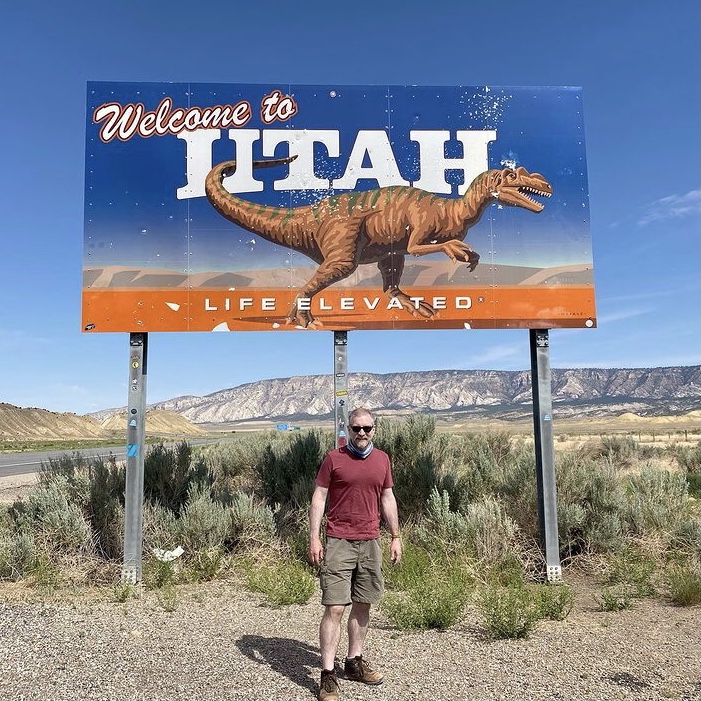
Standing on the Utah-Colorado border near Dinosaur, Colorado.
So an annual ritual on my birthday is taking stock of my goals for the current five year period. Not surprisingly, I have not made much progress, although there was some. Last year at this time I had two goals left: visit Angkor Wat in Cambodia and visit the remaining states in this country that I hadn't yet set foot in. I did not make it to Cambodia this past year (shocker, I know!) but I did manage one new state (Arkansas). One new state may not seem like a lot but when it takes your states remaining total from four to three, it's pretty significant. Watch out Nebraska, Kansas and Oklahoma. Can't wait to see which is the last one. I have two more years.

The birthday post is also an opportunity to reflect on the best of the best in the past year and look forward to some exciting possibilities in the coming 12 months. Staying domestic didn't diminish the excitement in any way this past year. Highlights for me since last June 22 were our hike to Delicate Arch in Arches National Park; every single minute of our time in Rocky Mountain National Park, Yellowstone National Park and Grand Teton National Park; learning about maple syrup in Vermont; hanging out in Jackson, Wyoming; and cheesesteaks at Pat's in Philly and fried chicken at Gus' in Memphis. Not too shabby I'd say.

So what's the next year hold? Honestly, I'm not completely sure. I'm pretty confident we'll proceed with a trip to Maine this summer that's already booked and we have a notion about Vienna, Austria much later this year. Other than that? It's a bit of a fuzzy canvas, although it appears I will finally make it to Mies van der Rohe's Farnsworth House and I can't wait for my next cheesesteak at Pat's. If there's one way this pandemic has affected our travel, it's that we've delayed committing. At this point in past years, I'm sure we would already have trips for the next year already booked. This year, it's a bit more wait and see. I'm sure we'll be fine. And I already have like 12 or 14 domestic trips outlined ready to go at a moment's notice.

In many ways, we should count our blessings that if there was a country to be confined to and explore on a limited basis for 12 plus months, we had the United States. Yes, the federal government handled this pandemic disastrously, but the variety and quantity of amazing places to visit in our country is truly astonishing. We were able to get such varied experiences in a year limited to our nation's borders. Can't think of too many other places on this planet where we could have done that.

So that's it. Onward! Let's start seeing what's out there in year 54. I'm optimistic I'll be using my passport to travel somewhere soon. Just where it is I have no firm idea. Happy birthday to me!

Coplay Cement Company kilns in Pennsylvania. Didn't blog about these but still one of the cooler sites we visited last year.

Sunday, June 20, 2021

Lynching


On February 1, 1893, a crowd estimated as at least 5,000 strong gathered at a train station in Texarkana, Arkansas to capture Henry Smith, a 17 year-old black handyman accused of murdering a three year-old white girl in Paris, Texas. Perhaps "capture" is the wrong word here. Law enforcement had already captured Smith; the crowd was looking to take possession of him and kill him, their minds already made up about the girl's death without really understanding any facts of the case. 

Faced with an angry mob representing overwhelming odds, the police guarding Smith handed him over, although he begged the officers to just shoot him rather than release him to the mob. The crowd took Smith and placed him in a cart, which they dragged through town to a custom-built scaffold erected specifically for his execution. They tied him to a stake and burned his body with hot irons, including gouging his eyes out and shoving a hot iron rod down his throat. They then (with Smith still alive) poured kerosene over his body and set the scaffold ablaze. At this point the crowd was significantly larger than 5,000, with some estimates putting the number of spectators cheering the events of that night at 15,000.

I believe travel is valuable because it brings you face to face with experiences and histories that you normally wouldn't encounter. That's not the only reason I travel but it's a big part of it. And sure, it's a lot more fun searching for wildlife in Africa or exploring ancient ruins in Mexico or South America or watching and playing sports in England and France or exploring food the world over than it is learning about the history of lynching in the United States. But sometimes the destinations and the subjects of those trips choose you.

If you had asked me six months ago to describe a typical lynching (I know...why would you ask me that but just go with this for a minute), I would have described it as a few white men (let's say two to four total) kidnapping a black man under cover of darkness and accused of some bogus crime and taking him to an isolated spot in the woods where there was no chance of anybody witnessing the murder. The murder, by the way, would always be a hanging. And the isolated spot would be involved so that by the time the body was found, there would be no chance of the lynchers being caught.

I now know that I am right. And that I am way wrong.


Lynching is one of the most disgusting parts of the history of the United States. It is exactly what I thought it was six months ago and it is way more brutal. I never would have conceived of a lynching like Henry Smith went through. Couldn't imagine. The sad part is Smith's lynching was short. He was tortured for just 50 minutes before he was killed. Others weren't so lucky. Some torturings were much more lengthy. 

Shootings. Being burned alive. Hangings. Beatings. Torture. Castration. In darkness. In daylight. By one or two men alone. By gangs of people including men, women and boys. With spectators. With photographers to sell postcards as souvenirs (sometimes body parts of the lynched people were sold as souvenirs also). And the targets of the lynching? Could be one man. Could be a group of men. Could be a woman or women. Could be children. Could be whole families, including babies. Could be anyone of dark complexion accused rightfully or wrongfully of any slight or crime or breaking of societal norms including not showing sufficient respect for any white person they encountered. I'm sure the words in this paragraph don't cover everything. Are you feeling sick yet?

The reckoning of America's lynching history has long been ignored. Go to the Legacy Museum and the National Memorial for Peace and Justice in Montgomery, Alabama and you won't be able to ignore it any more.


In 1985, after graduating from Harvard Law School, 25 year old Bryan Stevenson headed south to work for the Southern Center for Human Rights, a non-profit law firm dedicated to fighting for the rights of people incarcerated in the South. Stevenson was assigned to the Alabama office. 10 years later he founded the Equal Justice Initiative in Montgomery and guaranteed the defense of any inmate in the state on death row. Alabama at that time was the only state that did not automatically provide funding for the defense of inmates on death row. It also led the nation in death row sentences per capita.

According to their website, the Equal Justice Initiative (or EJI) has successfully altered 135 wrongful convictions for inmates on death row in Alabama. The EJI has also successfully argued in some cases all the way to the United States Supreme Court for changes in the treatment and rights of prisoners suffering from dementia and life without parole sentences for children under the age of 18. If Stevenson's name rings a bell, maybe it's because Michael B. Jordan played him alongside Jamie Foxx as Walter McMillian in the movie Just Cause. McMillian was one of the first overturned convictions secured by Stevenson and the EJI.

Three years ago, the EJI opened two new cultural institutes: the Legacy Museum, an exhibit space centered around the principle that slavery and segregation has led to an historic imbalance in attitudes toward the guilt of black people in society reflected in disproportionate levels of incarceration, and the National Memorial for Peace and Justice, which is probably best described as a lynching memorial.

Strange though it may sound, the National Memorial for Peace and Justice was one of the first sites we put on our list when we contemplated a trip to the American South. Yes, we picked Montgomery, without really understanding what else there was to do there or around there, because there was a memorial to people who were lynched. I know, not a fun getaway destination attraction. This trip was about putting something other than fun first.


The Legacy Museum is a must see in downtown Montgomery. It addresses the issue of slavery translating to segregation and then to the creation of two distinct Americas - one white and one not white - through a fundamentally different lens than museums like the National Civil Rights Museum. It's not an accident. The focus is different. While both museums might start at the same point in time with the Middle Passage of the slave trade, their end points are not the same and their addressing truths about the role of race in our society is handled with a different narrative. Neither is wrong. They are telling a story which looks similar but ultimately is not.

There were two parts of the Legacy Museum that hit me hard, likely because even though we had toured sites and museums that talked about horrors of slavery and segregation, the Legacy Museum presented us with new information. The first of these was an interactive map of the southern portion of the United States, telling the story of more than 4,000 separate lynchings that had been uncovered by the EJI. Click on your state and then your county and you can find out who was lynched where and when. We live in Arlington County, Virginia and there are plenty of lynching sites in our state. It brought us no comfort to find that there were none documented in our county.

The second exhibit was a video of the EJI's work to improve conditions for inmates at St. Clair Correctional Facility in the county of the same name in Alabama. St. Clair is a maximum security, state penitentiary with a deserved reputation as one of the most violent, overcrowded and understaffed prisons in the United States. Honestly, it sounds like a free-for-all, where guards have abdicated responsibility for maintaining law and order in favor of allowing inmates to participate in a kind of survival of the fittest sort of exercise. Murders, shankings and inmates assigned way above their crime level on a temporary basis combined with guards providing some inmates with knives can't be what anyone in responsible charge of anything intended. Good for EJI here for trying to make a difference. The fact that someone has been convicted of a crime doesn't mean they deserve this kind of living environment, and that's assuming the conviction is the right verdict in the first place.

There is plenty to get upset about in the Legacy Museum. But the National Memorial for Peace and Justice is a complete gut punch. 


The National Memorial for Peace and Justice, unlike the Legacy Museum, is not located in downtown Montgomery, but instead maybe three quarters of a mile outside of town to the south on a bit of a hill. Truth be told, Montgomery is just not that big a city but the outside of town-ness is noticeable when heading to the Memorial. It removes all context when you enter the Memorial. 

Like most monuments or memorials, the concept behind the National Memorial for Peace and Justice is fairly simple. There's a winding path leading up a hill (albeit past a sculpture depicting a group of African men and women chained like animals and ready for sale, which is chilling) to a structure that appears square or C-shaped in plan with a series of rectangular boxes hanging from beneath the roof.

As you move closer to the Memorial, the boxes start to become more defined. They are what they appeared to be from afar: simple rectangular prisms maybe about six feet or more high and maybe 18" by 30" in the other two dimensions. They are made from COR-TEN steel that has rusted to the trademark burnt orange of that material. And there are words punched into one side of the boxes. At the top of each box is a county and state name; below that there are names of people, each with a date below the name. 

There is actually one box for every county in every southern state where the EJI has confirmed a lynching has taken place. The names and dates on the boxes are the names of victims and the dates they were lynched. The simplicity of that gesture of displaying the names of those who were unjustly murdered is powerful. It forces all of us to bear witness to the crimes committed and for those people to never be forgotten. There are more names than you can possibly read as you start walking through the field of COR-TEN pillars. The numbers hit you.


As you turn the first corner in the Memorial, the floor starts to slope down. But the boxes don't drop with the floor. They stay suspended from the roof at the same level. The effect is that you are walking through a field of boxes that are being raised slowly as you walk down the slope of the floor. You are walking through and then ultimately beneath the same kind of objects that you had ten minutes ago just been walking through at ground level. The hanging analogy is obvious and humbling.

By the time you make the second turn, you are maybe nine or ten feet below where you started and faced with a field of hanging boxes above you and all around you. The transformation is complete. The etched boxes which you started walking among on a equal footing are now completely suspended. They are now removed from you, you easily understand that these might be people and not just boxes.

As you make the walk down towards the third and final turn, there are accounts of lynchings on the walls on either side of you. William Stephens and Jefferson Cole lynched in Texas for refusing to abandon their land to white people. Caleb Gadly lynched in Kentucky for walking behind the wife of his white boss. Jack Brownlee lynched in Alabama for having a man arrested for attempting to assault his daughter. Warren Powell, aged 14, lynched in Georgia for frightening a white girl. Bud Spears lynched in Mississippi for protesting the lynching of another man. Jim Eastman lynched in Tennessee for not allowing a white man to beat him in a fight. 

None of that is about finding a punishment to fit a crime, and not just because there are no crimes committed by the murdered parties in the paragraph above. It's all done to let black people know their place in society. And that's most of what all lynching was about anyway.


The feeling I got from the Memorial was one of tacit confrontation. It's in your face because it's right there. There's no ignoring that these murders happened everywhere. It's factual and non-emotional while at the same time being a completely emotional and visceral experience. It's shameful to those people who look like me. Or at least it ought to be. Even if I (as an immigrant to this country in 1979) nor any of my ancestors had anything to do with these lynchings directly.

We attempted to find some counties in Virginia near to where we live and unfortunately there were some. There are documented lynchings in Loudoun County, which is less than 20 miles away from where we live. We found Loudoun County's COR-TEN box during a walk through the courtyard after our tour of the interior (meaning under the roof) portion of the Memorial. There are three names on it, which is three too many.

If you ever visit the Memorial and can't find your county or one near to you, don't worry. There are replica versions of all the hanging boxes laid down like coffins and organized by state along the exit walkway. There's plenty of time to read each and every name in each and every county where these crimes have occurred. It came as no surprise to us that the county where we were at the time, Montgomery County, Alabama, had a very long list of names.


I think there's a delicate balance to sites like this. There has to be enough information to get the point across but not too much that there becomes too much horror which would make you either terminate your experience early or end up just tuning out. I think the Memorial gets this balance right. It's not a complicated memorial but it gets its point across very effectively. There's an art to getting this stuff right.

Two years after opening the Legacy Museum and the Memorial for Peace and Justice, EJI opened a new Legacy Pavilion just slightly north of downtown Montgomery. There's a cafeteria and some other memorials out there. We made a point to stop by there so we'd have the complete EJI experience but neither the Pavilion nor the Museum match the straightforward power of the Memorial, although I wouldn't even think about skipping the Museum. It's a perfect precursor from a content and background point of view to a visit to the Memorial.

This is the last post I'm writing about racial inequality based on our trip to Memphis, Mississippi, Little Rock and Alabama this May. These have been difficult posts to write. There's not a lot of fun and joy in them. There's not even any justice in a site like the Memorial for Peace and Justice, despite its name. In my view, it's there to remind us not to forget and to memorialize those who did nothing really to deserve the fate that they received.

I don't really know what else to say here or how to close this one. I will say in many ways Montgomery was a completely normal and nice and livable small city. They have museums and monuments and great restaurants in an historic downtown. But it's got this history that is so despicable from the day it was founded all the way to today. The Legacy Museum is located in a former warehouse on a site where slaves used to be held for auction and there are signs in town noting Montgomery's place in the slave trade right next to a fountain that stands where the auctions used to take place. It has to be rough for anyone living and working there to get past that. Or maybe you get used to it, I don't really know. I don't think I could. There's probably no return trip to Montgomery in my future (although I have said that about places before and have gone back) and I know it wasn't a fun destination but the Memorial for Peace and Justice did turn out to be just what we expected, and that was a good thing here.


How We Did It

The Legacy Museum and Memorial for Peace and Justice are both open Wednesday through Sunday. We needed timed tickets in advance before visiting either site, although that may have been pandemic-related. The tickets were free with a donation option (we did donate). The Legacy Pavilion keeps the same hours as the Museum and Memorial. We had some good food out there. Get the deep fried pork chop and avoid over-eating. There is a shuttle bus which operates between all three sites, although we believe it was not working this past May that we visited.

We allocated a full day to the experience of visiting all three EJI buildings, We started at 9 a.m. and it took us about four to five hours or so to get through all three sites. We definitely didn't need all day even though I think we covered all three sites in a fairly comprehensive manner with our 1 p.m. finish. The trip to these few sites is definitely worth it. There were few sites in the South that moved us in the way these three did.