Showing posts with label Siem Reap. Show all posts

Wednesday, April 3, 2024

Tomb Raiders


When we arrived at Angkor Wat temple last month after traveling halfway around (and a good bit down) the Earth to Siem Reap, Cambodia, I expected I would find a magnificent ruin just barely hanging on and standing upright. I figured some ancient structure surrounded and subsumed by the jungle of Southeast Asia. I expected tight quarters, constricted views, plenty of exotic carvings and lots and lots of vines and tropical plants. I was thinking a plundered maze-like shrine that looked like Raiders of the Lost Ark or Tomb Raider or something like that. 

Why did I expect this? Well honestly, because I remembered seeing photos in books and on line that looked like I described above. I couldn't wait to get there myself. Maybe if we were really lucky (and I know this is placing a western bias into the fantasy that I've set up for myself), we'd see an orange-clad Buddhist monk walking through those old halls reminding us of the tradition and purpose for the place. Angkor Wat was number one on my travel list for years for all those reasons. I wanted to breathe and take and drink it all in. Is that all too much to ask?

Apparently it was. Waaaaay too much.

Jungle? Vines? Barely hanging on? Struggling to stand upright? Umm...no. Angkor Wat looks nothing like I imagined or wasted a few minutes putting keyboard to screen to place into the first two paragraphs of this post. Was it incredible? Oh, yeah! Was it what I expected? Not really, no. It lacked the romanticism. It lacked the mystery. It lacked the danger. It lacked the uncertain structural stability. It lacked the monks (at least when we were there). Indiana Jones? Lara Croft? Nope. Not at Angkor Wat. Not there. Totally NOT that place.


But Ankgor Wat is not the only temple near Siem Reap. The Khmers built around 1,000 or so in their ancient capital of Angkor. They are literally everywhere you look when you are driving or riding around in the right spots in the outskirts of Siem Reap. After all, the Khmers spent about 600 years building these things one after the other. Why they needed all these temples is beyond me but I know enough to know that pretty much every new ruler in a certain period of time built himself at least one new temple. These things add up.

Then in the year 1431, the Khmers picked up and moved town to a spot to the south and east which is about where the current Cambodian capital of Phnom Penh stands. Why the move? Better crop growing conditions. Better access to the Mekong River. Further from the Thais, who decidedly did not get along with the Khmers. It was a win-win-win. Seems like a no brainer to me.

When Angkor was abandoned, much of what the Khmers had built fell into disrepair. Over time, their houses and temples and everything else they constructed became forgotten by the rest of the world. And yes, a lot of it got overgrown and overtaken by Mother Nature. Not Ankgor Wat, which continued to operate as a Buddhist Temple even though the Empire that built it had left it behind. But yes to some of the others. So that image of a centuries-old temple buried deep in the jungle of Southeast Asia filled with treasure and danger? It existed. And exists. Today.

We signed up for a tour of Angkor Wat that started at 4:30 in the morning. When were done exploring that temple, our guide took us to lunch (or maybe it was a late breakfast; tough to tell when you start your tour at 4:30). Then we walked across the road, climbed up a temporary wooden staircase spanning a stone wall and down the other side and entered a place called Ta Prohm. This is what I was looking for.


Ta Prohm was built by the Khmer King Jayavarman VII. Construction started in the year 1186. Jayavarman was the nephew of Suryavarman II who 65 years or so earlier started building Angkor Wat. From the conditions of the two sites today, it is incredible that Ta Prohm is younger than Angkor Wat. And, I know, there's not really much of a difference between 835 years old and 900 years old when it comes right down to it but Ta Prohm just feels so much older. And old isn't really the right word, it feels more ancient. It's the jungle, I am sure, that does this. It feels like Ta Prohm has emerged out of time. Ankgor Wat doesn't quite feel that way.

Ta Prohm is really big. Not quite as big as its more famous cousin over at Angkor Wat (which is about 150% bigger) but it's still big. The outside wall that we climbed over is rectangular in plan and measures 650 meters on the short side by 1,000 meters on the long side. That's about 5-1/2 football fields (with end zones) by 9 football fields (again, with end zones) for those of you that do your measuring in football fields. 160 acres. Big. So big that there used to be 12,500 people living inside its walls. That's big, right?

Within Ta Prohm's outer walls there is a lot of space. Today it is filled with jungle. No formal paths or wide open spaces here. Just jungle. There is clearly a lot of forested area that used to be open back in the day which is now just filled with whatever has grown naturally over the last almost six centuries. 

Towards the back of the property there were four additional concentric walls, all square in plan, that enclosed the heart of the temple. We entered at the opposite side of the temple property from the temple proper so I'm considering the side we entered to be the front. I could be wrong on this one and I'm not sure it matters other than to say that we got to the deepest part of the temple last in our tour. We started in the jungle.

Just a note on the first paragraph of this section. I am pretty confident that Jayavarman VII did nothing personally to "build" Ta Prohm. I am sure (like his uncle before him) that all the work on this place was done by local labor that either donated, were convinced to donate, or were forced to donate their time to moving and placing giant pieces of stone to glorify their ruler. That and a few thousand elephants, no doubt.

The very interior of Ta Prohm. Headless Buddha. Lots of these in Cambodia.
I have a little bit of a confession to make about our time at Ta Prohm.

One of the ways I remember facts and feelings and anything sensory from our travels is by taking notes. I'm serious. I take a lot of notes on vacation. When we are being led around somewhere like Ta Prohm (or just walking around on our own), I'm usually typing furiously in the Notes app on my iPhone 8 (go ahead and laugh!) so I can remember everything I'm experiencing. Or some of it anyway. It really does help.

I didn't do that so much at Ta Prohm. It happens sometimes when something gets in the way that either distracts me or takes my attention away from my iPhone (written ironically, I hope, this way deliberately; we DO spend too much time on our phones). At Ta Prohm, it was two things that did this for or to me.

First, there is so much to see. The scale and the scope of ruin and wonder at this place is just incredible. Everywhere you turn or look in every viewshed or around every corner is out of some amazing fantasy. It's sensory overload. It's all I could do to keep up with everything my mind was taking in.

Second, it was hot. Like hotter than I've ever really experienced hot. Like distractingly, I-have-to-focus-on-putting-one-foot-in-front-of-the-other-and-take-it-all-in-and-there's-no-time-for-note-taking hot. Not so much with the sun as with the air temperature and the humidity. I'm not saying it was this way just at Ta Prohm. We found this to be the case everywhere in Cambodia. It's just a hot, hot place. I wore long pants because we were visiting an active temple (for respect) and we were in the jungle (to protect the legs). It was so hot that the knees of my pants were sweated through. I'm a sweaty guy in general but my knees??? It was hot. Notes took a back seat. 


The reason why I write that is really as a disclaimer for the lack of facts and details in this post. It's more feelings. I don't necessarily feel that is a problem. For me, Ta Prohm was very visceral. It was all about feelings and emotions and discoveries. Ta Prohm has character and untold secrets oozing from it. It has soul. But for this post, we'll have to live with lots of pictures and lots of feelings and maybe a story or two sprinkled in.

There is one fact about Ta Prohm that is worth noting because it totally reinforces its situation. And once again, we have to bring Angkor Wat into the narrative. 

Angkor Wat was built as a physical metaphor for Mount Meru, where the Hindu gods were said to dwell. Because it was designed that way, when you visit that temple you are constantly walking up until you reach the summit way above the ground plane where you started. Ta Prohm isn't designed and built with that same intent. It's flat. When you are standing in the middle of the temple you are no higher on the face of the Earth than when you entered the property. 

For the knees and the sweating (sorry...had to get that in there again), this is a huge advantage. I can walk a lot longer a lot cooler around some place that's flat than I can when I'm constantly climbing stairs. For Ta Prohm itself, its elevation (or lack thereof) has allowed it to be absorbed and conquered by the jungle much more easily than it would have if it had resembled Angkor Wat. The trees are clearly taller than the structure that the Khmers left behind. There's no competition. It's like it was made to be overgrown by the jungle. It wanted to be consumed.


So about those feelings...

It took us about 10 or 15 minutes of walking Ta Prohm's property to get to something man-made beyond the first wall we climbed over. It's the building shown two photographs up in this post. I honestly have no idea what the building was used for but it fit into what I was looking for: a clearly abandoned, really old building that had been grown on and around to almost become part of the jungle. The stone is weathered; the place looks a little unsafe; and there's enough living stuff on its walls and roofs to fit the picture in my mind's eye. To top it all off, right in front there's a tree that looks like it was thrown down from above and its roots are just the lower half of the tree just smushed on top of the Earth.

It got a bit crazy from there. We entered the main portion of the temple after that.

Have you ever seen a tree growing on top of a building? I don't mean like in a planter or on a landscaped roof terrace or something like that put in place specifically for that purpose. I mean a tree growing on top of a building. No soil, no pots, no real way for a tree to survive. On top of a stone building. You can see that at Ta Prohm. And not just once. This happens all over the place. And they are the most unusual trees. More vine or even creature than tree. Thick naked, no bark limbs and roots everywhere. Growing, grabbing, cascading down the very structures they are sitting upon. 


Part of what makes Ta Prohm so enchanting is this juxtaposition between manmade and nature while also understanding that it is nature which is really in command here. Every turn you take, everywhere you look, every step you take and every arch you walk through and ruin you pass it's nature slowly taking apart what man put in place.

There are piles of rock everywhere, presumably demolished by the slow advance of plants that swell and move and push aside stone as they grow. But there are also joints filled with roots and limbs that are destined for future destruction just as soon as the vines and trees that are slowly consuming the place decide that it's time to take down another portion. There is scene after scene after scene of this stuff as you move through the place. Each view you get is more improbable than the last. Look at this! Can you believe what's happening here? What is with this giant tree? It's the stuff of fantasy. It's just incredible to see. And everything I hoped we would see before we set off halfway around the globe to get here.

And those walls that enclosed the inner portions of the temple? I am sure we walked past or through or over those things but there were no discernible barriers as far as I was concerned. The jungle took them all.


There are two specific story memories I have from Ta Prohm. One is about the entrances to Ta Prohm. The other is about the stegosaurus. 

What's that, you say? Stegosaurus? Yep. Stegosaurus. Let's start with that.

Take a look at the picture below. In a corner of Ta Prohm at about chest height or maybe a little lower if I'm remembering right (and there's no way I could really tell you exactly where this thing is), you will find a carving of a stegosaurus. On many levels, this is really pretty cool. There are other creatures carved into the walls of the ruined temple but this one has to be the most amazing one. I mean, who doesn't love dinosaurs.

It was only until a couple of days later that I really started to be astonished by what I'd seen. Were people in 12th century Cambodia digging up fossils of dinosaurs or is something weirder going on? So I looked it up. Sure enough, the first stegosaurus discovery (at least in the western world) was documented in 1877. What on Earth did this carved dinosaur in the jungle of Southeast Asia mean? 

Were there stegosauruses (or is it stegosauri?) roaming the planet in some spots when man was around? There are apparently some conspiracy theorists who believe that's exactly what it means. The truth of the matter is that while scholars cannot agree on what kind of animal is represented here, it's not a stegosaurus. The "back plates" of the animal are likely just abstract representations of leaves. 

It did keep me guessing for a few days, though. Or maybe a couple of weeks.


Lastly there are the entrances. If it seems strange to write about the entrance last, that's because there are four of them and they serve as both the entrances and the exits to the property.

When we climbed over the outside wall of Ta Prohm at the beginning of our visit, we did it not because there was no entrance on that side of the temple, but because the entrance pavilion was under reconstruction and was closed. The wooden staircase replaced the entrance. There was no other way to get in. I also (and I'm blaming the heat here) didn't pay attention to what was below the scaffolding that the workers were standing on. Didn't even notice the gate.

But I did notice it on the way out. It's the cover picture of this post. You can see how big it is by the person standing just in the shadows of the doorway on the facing opening. You can also see two of the four faces on the pavilion. 

This is a motif we'd see again on our day roaming around some of the temples of Angkor, notably at Bayon Temple, which has a total of 216 faces. Depending on your beliefs, the faces either represent the four faces of the Hindu god Brahma or the four Buddhist virtues of equanimity, loving kindness, compassion and sympathetic joy. Pick one. Or pick both. I kind of prefer both here. Of all the structures we saw at Ta Prohm, this last piece, despite its slightly battered condition, is probably by far the most intact and serves for me as the most vivid memory of the workmanship that made up this magnificent temple.

Finally (which I suppose comes after lastly)...if you are a huge tomb raider fan, the original Lara Croft: Tomb Raider movie was actually filmed in part at Ta Prohm. We didn't know that when we visited but it totally fits. This place is enchanting. It gave me everything I hoped I would find in Siem Reap, just in a different location than I thought I would actually find it. It's all good. I got what I came for. I'm happy. 
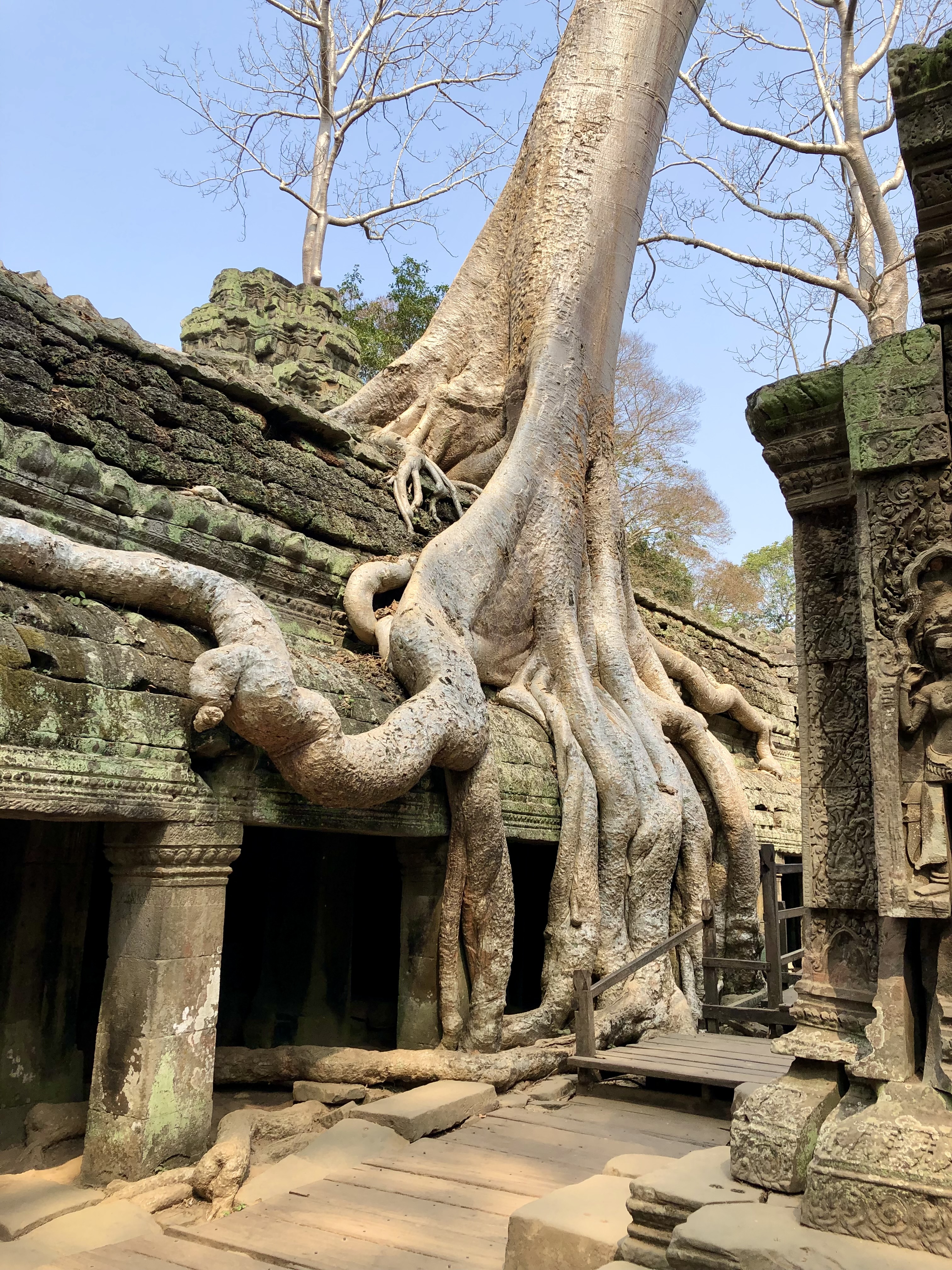
The craziest tree at Ta Prohm. How is this thing even surviving?

Wednesday, March 20, 2024

Hero Rats


I have blogged about a lot of different subjects since I started this project 10 plus years ago. Rats has never been one of them and honestly I never thought I would ever, ever blog about these creatures. Now, admittedly, I've seen plenty of these creatures in the last 10 years. In New York City on various trips up there and one or two on a very short trip to Costa Rica. But blogging about them? No. Never really considered that as a possibility.

That changes today.

OK so now that's out of the way...how is all that related to the cover picture of this post displaying a map of Cambodia showing landmine removal progress throughout the country? Well...read on.

If there was one thing that my choice of travel destinations last year did for me, it was to make me appreciate how valuable safety and security is in the place where you call home. Or maybe not so much home as the places we travel (since I don't feel unsafe at home really ever, thank God). Last year we visited two countries (Rwanda and Croatia) where 30 or so years ago there was a good chance that you would not be safe walking down the streets of a town or city. Not as a tourist. Not as a resident. Not as anything. 

In 1991, Croatia was locked in a struggle for independence from Yugoslavia and its cities and citizens faced assaults in the form of munitions shelling from the Yugoslav army. Want to stroll the walls of Dubrovnik in the fall of 1991 like we did last year? Couldn't do it. Not unless you wanted to risk getting hit by a very large projectile that would likely kill you on the spot. The cost of Croatian independence? About 20,000 lives.

A little less than three years after the Croatian War of Independence, Rwanda had it way worse. Genocide. Tutsi and Hutu neighbors and countrymen killing each other hand to hand with weapons as crude and as brutal as machetes because they apparently were different enough to someone with a voice loud enough to call for the extermination of the other group. No 20,000 lives here. 500,000 to 1,000,000 killed. And in the most brutal way. Over nothing really.

Think about all that for a moment. Just a bit more than 30 years ago these places would not have been safe. But we were fine last year. We walked around Kigali and Split and Dubrovnik without a problem. No more killing. No more danger. Not in the way that it was in the early 1990s.

15 or so years before violence in Rwanda and Croatia was raging out of control, something similar was happening in Cambodia, which we recently visited as part of our major trip of 2024. 

Cambodia had it bad in the 1970s. Really bad. Mostly it was due to the Khmer Rouge, a communist guerilla group which took power in the country in 1975 and which was insistent on abandoning anything resembling 20th century advances in industry, medicine, technology and relations with foreign countries and restoring Cambodia to a self-reliant agrarian society. Their methods of getting there? Executions. Torture. Genocide. How about wiping out one quarter of the entire population of Cambodia. One quarter of the entire country's population!!!! For what? Being educated. Practicing western medicine. Being a civil servant in the overthrown government. Being labeled a subversive. Something else like one of those reasons.

The rise and reign of the Khmer Rouge was bookmarked on either side by the civil war in neighboring Vietnam before the Khmer Rouge seized power and a civil war in Cambodia once the Khmer Rouge established power. All of that is long over today but it's not forgotten. It can't be. Because while the effects of civil war and ethnic violence in Rwanda and Croatia are not felt with continued violence and destruction today, that's not the case in Cambodia. 

In 2024, Cambodia looks as peaceful and welcoming as Rwanda or Croatia were in 2023. But the conflict in Cambodia is still felt. Not by men with weapons shooting each other but through detonated landmines. From the Vietnam War through the coup by the Khmer Rouge to the Cambodian Civil War there were a ton of landmines placed everywhere in Cambodia. No markings. No labels. No responsibility for future casualties. But plenty of danger. Everywhere. And a lot of them are still there. Waiting to explode.

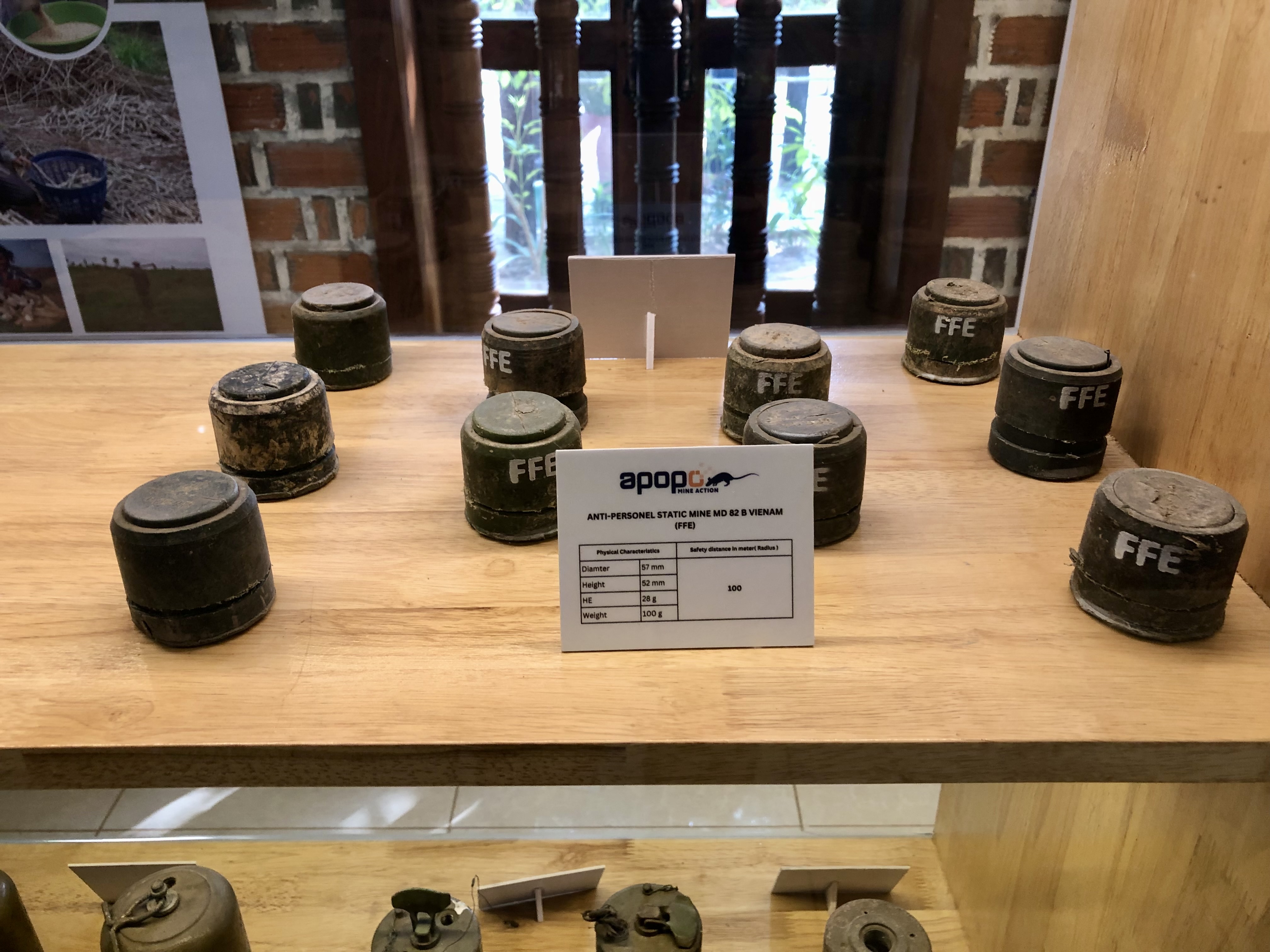
Mines removed from Cambodia. Amazing how small these things are. Cupcake sized killers.

Between 1979 and 2002, 20,000 people in Cambodia were killed by landmines. 20,000 people. That's a bit more than 800 per year. How many in somewhere like the United States? I'm guessing (and this truly is an unresearched guess) about zero. 800 in a place as small as Cambodia is a lot. Like a ton. Cambodia also has one of the highest per capita number of amputees of any country in the world and the number one culprit is landmines. According to a 2023 article in Time Magazine, there are 40,000 amputees in the country of 16.6 million. That's one in every 415 people with amputated something. That sounds high also, doesn't it? It does to me.

How does this happen? Well, by someone walking through an area of the country which is loaded up with mines. Nothing complicated. Just hidden danger everywhere. Maybe it's a tripwire, maybe it's body weight, but something sets these things off in places where nobody has any idea that there's any real danger. It could be a farmer. It could be someone taking a shortcut through the woods. It could be a tourist like you and me. It could be a kid playing near a village. Wrong place. Simple as that. The worst part is most mines aren't designed to kill; they are designed to maim, with some throwing shrapnel 200 meters or so (that's about two football fields with end zones). So you live with limbs removed. And likely pain every day. Got the picture yet? Well, let's keep going anyway.

Maybe you step on a tank mine and get lucky because those types of mines aren't set off by something as light as the weight of a person. You will never know. But a tractor works on a tank mine. Maybe a farmer driving a tractor gets really unlucky and sets off a stacked mine which is a series of mines laid on top of each other that detonate simultaneously. A tank mine is designed to stop a tank. What do you think it does to a tractor? These things can be anywhere. They were laid a long, long time ago by people indiscriminately looking to stop someone else getting near them. No records. No maps. No responsibility. Just danger.

So I know what you are probably thinking: why don't the Cambodians just remove these things. Sure! Great idea! How are you going to propose doing that? Metal detectors? Some of these things are made of plastic. Do you want to volunteer to enter a mined zone with a metal detector when there might be plastic mines out there? Yeah...me either.

This is where the rats come in.

In the mid-1990s, a Belgian and pet owner named Bart Weetjens was thinking in his spare time (I'm speculating a bit here...) about the global landmine problem that faced this world of ours and he wondered if rodents, with their heightened sense of smell, might be a solution to that problem. It appears based on a little internet searching that he started with gerbils but eventually settled on rats. Plentiful and reasonably intelligent and trainable seemed to be the logic here.

The problem? It would likely take up to a year to train a rat to reliably identify the explosive ingredient in landmines (TNT, if you must know) and European rats lived around 3 years. Not a good return on investment in terms of time or money. Lots of training. Relatively short career doing what they were trained to do.

Fortunately for this story, Bart didn't abandon the rats idea. Instead, he starting searching for different kinds of rats. And he found some. African giant pouched rats in Tanzania apparently live for up to nine years. Now nine years vs. three years may not seem like a lot of difference but if you are going to invest a year training a rat to detect TNT, well then two years of regular rat life vs. eight years of African giant pouch rat life is huge. 

At the risk of selling a complex and involved story very, very short, from there the Belgian government got on board and the APOPO organization was formed. APOPO, which stands for Anti-Persoonsmijen Ontmijnende Product Ontwikkeling (it's in Flemish) is now involved in mine and unexploded ordnance removal (and admittedly Cambodia also still has a good amount of mostly American unexploded cluster bombs along with their mines) in a number of locations around the globe. They started working on mine removal in Mozambique with great success and in 2010 turned their attention to southeast Asia. In 2016, they moved operations into Cambodia and in 2018 they opened center in Siem Reap.

And that's where we come in. Well, six years after that date anyway.

The map at APOPO detailing their global reach. Not all spots are landmine clearances.

APOPO's center in Siem Reap is used as their base of operations in Cambodia and is also open for visitors. It's apparently very popular. The place was packed when we got there in the middle of the afternoon and we delayed our arrival an hour or 90 minutes or so based on calling earlier in the day and finding them unable to accommodate any more visitors at our originally planned arrival time.

A visit to APOPO involves some static displays detailing their global footprint and the details behind the work that they do followed by a quick tour which includes some videos about the importance of their work and a demonstration of how their rats find mines. The last piece there is clearly the star attraction.

While the most visible and publicized aspect of APOPO's work involves deploying rats in minefields to detect TNT, the organization uses both rats and dogs in their mine clearing operations and also uses the rats as a means of early tuberculosis detection. I guess it's like a side gig that uses similar principles (sense of smell) to achieve similar results as detecting the presence of explosives. The dogs are trained in Europe and the rats are trained in Tanzania.

So how do you clear an area of mines with dogs and rats? Well based on what our guide, Mankay (guessing at the spelling a bit...), told us the initial identification occurs through intel from local populations followed by an area sweep from a team with dogs. This verifies that there are mines in the area but doesn't pinpoint the location or facilitate their removal.

Based on that initial identification, the area is prepared for detection by the rats. Pathways are cleared in the area about eight feet or so apart by a dude driving what was described to us as basically a heavily armored lawnmower that then allows installation of a setup for the rats to get to work. And no, they don't just unleash a whole bunch of rats in the area. There are currently only 43 trained rats in Cambodia and eight of those work at the APOPO visitor center showing off for tourists. The rats are leashed and walked deliberately back and forth between two handlers until they find a mine. The humans take over from there, carefully excavating and removing the explosive.

Mine detection demonstration. Without live mines. 

This visit definitely drove home both the seriousness of the landmine problem in Cambodia and how scary the prospect of stepping on a landmine and being maimed or killed can be. Or even worse probably having it happen to a family member or loved one. I mean can you imagine living in some rural area of Cambodia living day to day as a farmer and knowing that if you or your family or your kids wander off in the wrong area that you could have a limb blown off? And because of what? Some conflict 40 or 50 years old that is long resolved? I mean the lack of responsibility in laying these booby traps (or having someone else, including kids, do it for you...) is just atrocious. 

The outdoor demonstration portion of the tour gave us a great overview of how invisible these things are from the surface of the Earth and how deliberate and careful the rats are in their work. But it's the removed mines in the display cases in the visitor center and the stories on the walls of the place that are truly chilling. I don't think I'd even seen a mine in real life in a museum before (although I could be wrong) but the quantity and variety of below grade explosives on display at APOPO was truly chilling. Particularly because they were all removed from forests or rice paddies or villages in Cambodia that I'm sure don't look much different than the land around Siem Reap that we traveled through to get there. It's pretty creepy and disgusting actually. 

I do believe it's important we visit places like this when we travel. We could hide behind the walls of a hotel or all-inclusive resort but what's the point? Isn't part of the reason we travel to understand what life is like in other parts of the world. It's not all rainbows and unicorns out there as much as we might like it to be. There are wonderful amazing sights to see in the places we visit but there are also very real problems that are different than what we might experience at home. It's important to understand all of that when we travel someplace new, I think. Learning about the devastating affects of landmines left and forgotten decades ago is part of life in Cambodia. Visiting APOPO was important and not just so they could take the money we paid and put it to good use. 

It costs about 6,000 Euros to train one rat. Just saying...

Mankay pointing out telltale signs of hidden landmines. Again, not live mines.

I can't imagine how stressful it is to clear minefields for a living. And here I'm talking about the humans for a moment, not the rats. I don't want any job where there's a legitimate risk of getting blown to pieces on any workday. I think my job is taxing sometimes. All I do is sit in meetings and try to convince people to see things my way. I have no real context for clearing minefields with an African giant pouch rat or two as my guides. 

Apparently, the rats aren't super enthusiastic about it either. They only work from 6 a.m. to 9 a.m. and then they quit for the day. I guess a tired rat isn't very motivated from what we were told on our tour. But who can blame them? They are nocturnal, can't see in the daytime and are prone to sunburn on certain parts of their body that lack hair to protect them (ears and tails). Would you want to work beyond 9 a.m. with those limitations in a hot and generally pretty sunny place?

But regardless of the satisfaction of APOPO's workers (both humans and rats...and dogs), the real measure of success here is are they making a difference. The answer is yes. Both on the landmine removal side of the equation and the survivability of their workers side of things. Both the dogs and the rats that are trained and deployed by APOPO go through rigorous zero-tolerance-for-mistakes training and redundant teams of rats are deployed during mine detection operations to verify findings and eliminate mistakes. Someone on our tour asked if anyone had been killed de-mining places in Cambodia and Mankay's answer was basically "would people continue to work here if people had died?" Good question. And answer. 

I can't imagine how much work is ahead of APOPO. The map in the cover photo of this post has a lot of red indicating remaining minefields. That represents a lot more work and a lot more dogs and rats and I'm sure it's all going to go extremely slowly. We contributed to APOPO through our visit but also through a donation before we set out on our trip to Cambodia. A little goes a long way here. A donation of $30 clears 30 square meters of minefield. That seems like it's money well spent to me.

More unearthed mines. Chilling every time I see these. 

Sunday, March 10, 2024

Home Cookin'


I don't know what it is about me and farms when I travel but I seem to end up on these things way more frequently than I would ever imagine. Maple syrup farm in Vermont. Cork farm in Portugal. Truffle hunting on a farm in Tuscany. Spice farm in Zanzibar. Wineries in the Napa Valley. Although I'm not sure how much wineries count as farms. They probably don't at all. 

I can't remember the last time I went to a farm anywhere around my home unless it was a sunflower farm. And I'm not sure sunflower farms count as farms any more than wineries do. In fact, they probably count less. But suggest to me that I should go to a farm when I'm traveling and somehow I'm all in. Including in Cambodia. I mean, why not? We are supposed to do different things on vacation that we do at home, right? Even if that means visiting farms, I guess.

Now in my defense on this one on this trip, I was sort of tricked into going to a Cambodian farm. At least that's my story and I'm sticking to it. And if you don't believe that flimsy excuse or explanation, you'll probably believe it even less when I tell you I went to the same farm on two different days. I did say flimsy, right?

An astonishing array of dried fish, Siem Reap market.
Here's the thing: I am generally fascinated with where our food comes from so when I saw that the hotel we picked in Siem Reap offered food tours as part of their amenities or features or whatever, I couldn't resist. I mean we were only in Cambodia for three nights (meaning just two full days) so if there was any way to jump start getting involved in that country's cuisine (which I was completely ignorant about) then I was all for whatever I could do. Taking a couple of food tours through the hotel seemed like a great way to do that. 

So we did. 

The premise of both of these tours was pretty much the same: hop in a tuk-tuk; travel 45 minutes or so to a local village; watch and learn how some traditional Cambodian food or meal is harvested or prepared; then come back to the hotel (again, by tuk-tuk) and have the hotel's kitchen cook a specially prepared meal drawing on our farm experience for dinner. Night one featured a traditional Cambodian rice noodle dish that I had never really heard of called num bahn chok; night two highlighted the use of palm sugar, something I'd either never really heard of or never really thought about that much. It's good to explore and taste things you've never heard of sometimes. Another awesome benefit of travel.

But before we talk about what we found at the farm (and it was the same farm both nights), let's talk tuk-tuks, shall we?

We have seen tuk-tuks before in our travels. Kenya. Peru. Zanzibar. Maybe one or two other places. They are three-wheeled semi-enclosed vehicles typically without doors that are driven like a motorcycle of sorts, meaning the accelerator and the brakes are on the handles of the steering column. Usually the tops of these funny little vehicles are some sort of canvas or other flexible covering and you thank God they don't go at much of a top speed because if you ever got in an accident in one of these things...well, good luck I guess. I was thrilled by my first ride in one of these things in Zanzibar last March.

Tuk-tuk. At least anywhere but Cambodia it's a tuk-tuk.
In Cambodia, that is NOT a tuk-tuk. It's a PassApp, so named because there's a phone app out there called PassApp that you use to hail these types of vehicles. It's sort of like Uber or Lyft, right? Just for that type of transport (which is decidedly not a tuk-tuk in Cambodia).

The Cambodian tuk-tuks we took to the farm both nights were full sized motorcycles towing a two-wheeled cart. Maybe a little sturdier and safer but still with no doors but with decidedly more space. Like way more space. I feel like I'm crammed into a regular tuk-tuk (excuse me...PassApp) with just the two of us in the back seat. The Cambodian tuk-tuk is relatively palatial, sitting the two of us in the back of the carriage while our guide both nights sat facing backwards in the second seat opposite us. I'm sure we would have felt the limitations in comfort on a 40 minute PassApp rider; not so on the Cambodian tuk-tuk. Smooth sailing past all the rice paddies and villages and night markets. 

I did ask one of our tuk-tuk drivers what PassApps were called before the PassApp app existed. I mean they had to be called something right? And they didn't just pop up en masse when someone invented an app, right?  He didn't know. This isn't going to keep me up at night but I'm still curious.

Cambodian tuk-tuk.
So...palm sugar and num bahn chok, although the farm visit part of the num bahn chok tour was really about making rice noodles and not necessarily the whole dish. 

It is amazing to me how people make food. Like why would you ever think about making noodles out of rice? What's wrong with actual rice? It has to be way less complicated and labor intensive to eat rice as it is rather than trying to make it into noodles. Don't know how they make rice into rice noodles? Neither did I, but I'll explain in a few paragraphs. Most of this is just discovery or accident, right? I'm sure that one day someone accidentally cut a palm tree and tasted the sap and found it sticky and bit sweet and decided to harvest it deliberately. But rice noodles? Too many steps it seems to be for this to be an accident. 

The family that owns and runs the farm we visited is clearly adept at both harvesting palm sugar and at making noodles from rice. From what we could tell, it's a husband and wife plus the wife's sister and their kids (and at least one grandkid) who are still at home. Both of these visits were a team effort between all members of the family. I have to say I was actually a little nervous about the rice noodles thing. I've had rice noodles in a few spots around my home in Northern Virginia and I have never liked what I've tasted. But maybe this dish in Cambodia is different than in the United States.

Spoiler alert: it was!

Num bahn chok, anyone?
On the basis of the description of the two tours on the hotel's website (the Park Hyatt Siem Reap, if you must know...), I would have thought I'd have found the num bahn chok tour way more interesting. I was wrong here. They both were super interesting. But on the premise of my original thought, let's talk palm sugar first shall we?

I would liken the harvesting of palm sugar to maple syrup tapping. I remember our tour around Baird Farm in Vermont in 2020. Stick a tap into a maple tree at the right time of the year and the sap runs out of the tree with no added effort. Refine it the right way by reducing it in an evaporator and maybe a couple of other steps and you are good to go with those pancakes or waffles or French toast or whatever else you want to pour the stuff over.

Harvesting palm sugar follows a similar process but with a little more athleticism involved. 

Maple syrup tapping takes place maybe four feet off the surface of the Earth. You or I or anyone else can do it easily as long as we have a tap and a hammer and can apply enough force to pound the tap into the trunk and hang a bucket or attach a hose to the tap. Palm sugar tapping takes place at the top of the tree. How do you get up there? You climb.

Have you ever seen a palm tree? There are no branches on any palm tree I've seen. It's a very tall, sometimes gently curved trunk topped by some leaves. Climbing it isn't easy, especially when you are taking up containers to tap the sap of the palm. No hoses here. Homemade bamboo containers need to be carried up by hand (although they admittedly are lowered down by rope).

Sounds difficult, right? It is. The dude (who was the husband / father / grandfather of the family we visited) we watched climb the tree was up in less than 30 seconds. Sure he had a rope ladder of sorts attached to the tree but it was very impressive. He does this twice per day. It took him all of ten minutes to get up there, remove and lower the filled bamboo containers, re-tap the tree and place new bamboo containers and then descend. OK, so 15 minutes max. Probably somewhere in between.


Climbing, tapping and the product. The wood chip apparently prevents bitterness.
This whole process was pretty darned impressive. And I have to tell you that this dude that climbed this tree was cut. I mean there's not an ounce of fat on this guy's body and he's older than me by like eight or ten years. My first comment when he came down from the tree was something to the effect of "I hope I look that good when I'm his age." Who am I kidding? I don't look that good now. I didn't look that good ten years ago. I was impressed. What can I say? Maybe I'm jealous a little. Or a lot. I mean I have like no useful life skills and am out of shape from sitting at desk 40 hours or so a week at work. This guy is climbing a palm tree twice a day. And not just one palm tree. Eleven!!!! And hauling in like 10 kilograms of this sap per day. Crazy!!!!!

It is just in the dry season which is about three months long, but still...eleven palm trees twice a day.

So what now? We down the sweet sap as a shot or pour it over some ice cream or something? Umm...no. While it can be drunk unrefined (and apparently gives a monster hangover after about two shots) it will turn sour pretty quickly and needs reducing and refining right away. And by right away, I mean like right after it's brought down from the tree. 

We were, by the way, offered some shots of the unrefined sap. We passed. I've never been one to shy away from any sort of alcoholic beverage but the hangover you get from this stuff isn't from alcohol. Maybe that will end up on the very short list of travel regrets but I doubt it. 

When we were in Vermont in 2020, we were talked through the process of refining the maple sap. The majority of the work took place in a large heated and temperature-controlled trough to reduce the water content to make the sap into syrup. The process in rural Cambodia is basically the same, although it takes place in a shallow metal bowl over an open flame with lots of vigorous stirring by hand. And it's quick.

45 minutes after this process started, we were eating refined palm sugar. 

I am sure we are missing something about the pain caused to countless lives on sugar cane plantations over the centuries and I'm pretty sure it's related to the scale of production. But if you can get sugar by climbing a palm tree and not enslaving people or engaging in backbreaking (literally) work every day of the week, why wouldn't you do that? I know, I make it sound easy and it's not and I'm sure the yield from eleven palm trees twice a day isn't going to supply enough sugar for the world but this stuff is delicious. I've never had palm sugar before in my life but I'm all in on this stuff. 


Refining and putting into molds and cooling down.
Now about those noodles. This is too long to explain. So let me sum up. And again...I'm not sure why rice isn't good enough but here's what happens to get rice made into rice noodles. And I'll use pictures. 

Step one: Grind the rice. There's a pretty large, human-powered machine here that involves wood and stone parts. And yes, the tourists can work this.

Step two: Dry the ground rice into something pretty solid and like bowling ball sized or maybe a bit smaller.

Step three: Boil the bowling ball sized lump of dried ground rice. At this point it's like a smooth solid white ball. 

Step four: Pound the boiled, dried ground rice into a dough using a pretty large, human-powered, wooden machine. Tourists can participate here too. This really does transform the dried rice into a kneadable dough. It's pretty incredible to see. It's also pretty incredible to see a woman repeatedly moving the dough around while someone else works a very large wooden pounding thing right over her hands moving the dough.

Step five: Knead the dough by hand, adding water to make it more pliable (or actually extrudable). 

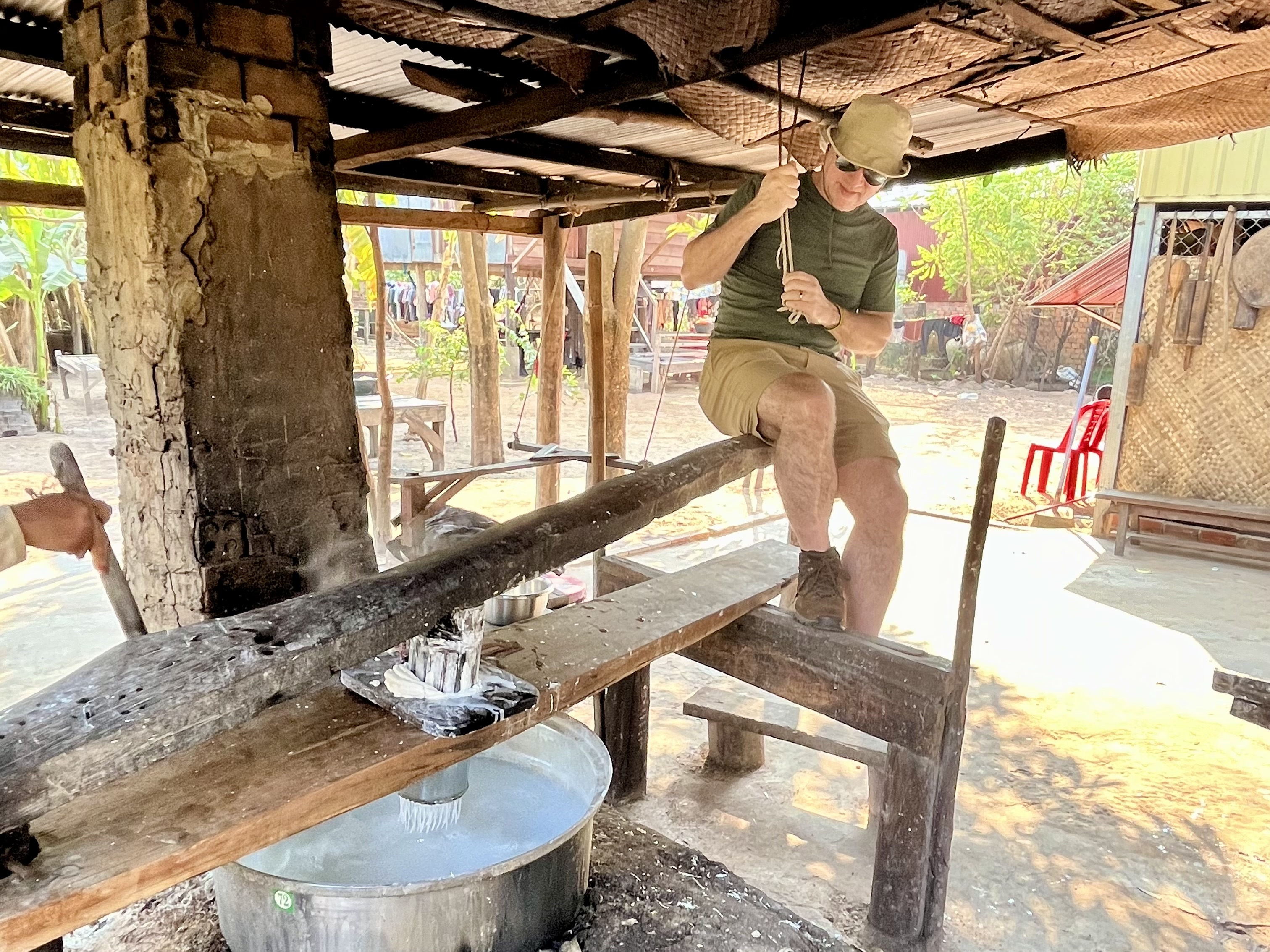
Step six: Load the kneaded dough into a mold with a sieve on the bottom of it and load the mold (in cylindrical form) into a pretty large wooden machine with a large lever on one end. 

Step seven: Boil some water below the mold and find the heaviest possible person to sit on the end of the lever. On the day we were out there, that would be me. Our guide took a guess at 70 kilograms. I countered with 90. She told me I didn't look that...(she wanted to say heavy? or fat?). I took her comment as a compliment. But that dough did get extruded pretty fast. I need to lose weight.

Step eight: Remove the cooked noodles from the water and bundle them ready to serve.

I still believe that a lot of food innovations happen by accident. Something gets left out and transforms or someone tries some mistake of cooking and it works out better than what was originally intended. But I can't see how making noodles from rice fits into this category. 


When we were done with the watching part of each of our visits, we were supposed to head back to the hotel and have the chef make us a meal featuring the ingredients we had just watched harvested or manufactured. It totally worked out that way with the palm sugar. But not the num bahn chok. For that meal, we took our shoes off, climbed onto a wooden platform and were served the meal right there and then.

I'm not sure that I have ever eaten a meal in quite this environment before, meaning on a dusty farm in the middle of nowhere halfway around the world using ingredients that have just been made fresh and in part due to my own weight. The noodles were delicious. They didn't taste like other rice noodles I've eaten. They mostly tasted like rice, not that rice has a super strong flavor or anything. They came served in a cool broth of coconut milk, finger tamarinds, lemongrass and turmeric with optional chiles, lime and salt and accompanied with pieces of longbean. 

Believe it or not, this dish is most popular at breakfast. I can't imagine eating it that way, but I know that's my western bias coming out and it's not like I've never eaten noodles for breakfast before (I can recall at least one meal of spaghetti for breakfast in my life...). 

I am really pretty confident that left to my own devices in Cambodia, I would never had ventured out of our hotel and eaten num bahn chok or any meal focused around palm sugar. If I could even have found these kinds of dishes, I'm pretty sure I would have opted for something less edgy and more familiar. And with only two full days in Cambodia, I really feel like I would have missed something amazing here in both the food and the experience we had by joining these two tours. 

These are two experiences that will live with me forever. And if I ever get back to Cambodia, I'll know at least a little something to look for. In the meantime, I will pledge to continue to visit farms while traveling if they can get me a little or a lot closer to the places I'm visiting.

Dinner is served.