Showing posts with label Civil Rights. Show all posts

Sunday, June 13, 2021

The March (1965)

Americans like to talk a lot about freedom. Ever since I arrived in this country at the age of 11, I've been told over and over again that the United States is the most free country in the world. We have freedom of speech, freedom of the press, the right to bear arms, democratic governments that are fairly elected and on and on and on. When it comes to talking about freedom, Americans are all in. In America you can do anything and go anywhere. It's completely free. Or so the talking points go.

So notwithstanding the fact that (1) there are plenty of other countries with similar freedoms all over the world; (2) that the United States has a brutal history of denying fundamental human rights to the people who were here before anyone else (Native Americans were not even granted citizenship until 1924!); and (3) the United States has the highest rate of incarceration of any country on the planet, you expressly cannot do anything and go anywhere in this country. Just like all other countries in the world, there are rules and you (generally speaking) have to follow them.

One of the rights that Americans love to point to as evidence of the fundamental best freedoms of this country of ours is the right to vote. One person, one vote is how the saying goes, right? And so it's with great irony that I have to point out that the United States has and continues to find all sort of ways to deny people the right to vote. What was that about being the most free, again?

The Fifteenth Amendment to the United States Constitution prohibited discrimination in voting on the basis of race or previous condition of servitude. This Amendment, which was ratified in 1870, was intended to grant the right to vote to newly freed black men (not women; women were not guaranteed the right to vote until 1920!!). So just about as soon as the Fifteenth Amendment was passed (and black men started voting in some numbers), states in the South starting finding other ways to deny the vote to those new voters who tended to vote for different candidates than those already in power. 

How did the states do that? How about by requiring fees (or poll taxes) be paid; or by enforcing literacy tests; or by only allowing people to vote if their grandfather had voted. Restricting the vote wasn't based on race, the states claimed. Can't pay the fee? Can't answer the questions? Can't prove your grandfather voted? Well, then you can't vote either. Not race-based, was the story.

How many black men in the late 1800s had grandfathers who had voted? Not too many because their grandfathers were enslaved. Couldn't they just study and answer the questions, you might ask? I've seen some of the questions on these tests back then. I couldn't answer most of them and I'm not counting the "how many jellybeans in the jar?" and "how many bubbles in the bar of soap?" questions. Not kidding about those questions. They were actually on the test sometimes. And even if you DID get those questions right, the ultimate authority for agreeing with your answer was the state-appointed (white and likely segregationist) registrar.

30 or 40 years after the Civil War, pretty much the only citizens who were voting were wealthy and powerful white men who very much wanted to hold on to the power they already had. Heck, in 1965 in Alabama's Lowndes County whose population was 81% black, not a single black person was registered to vote. Not a single person. 95 years after the Fifteenth Amendment. 

By the 1960s, one of the biggest Civil Rights issues in the United States, and particularly the South, was black men and women, despite being legally permitted to vote, couldn't vote. Something had to be done.

So, before you think "wasn't the Civil Rights Act of 1964 passed one year before the statistic you (meaning I) quoted?", well yes, it was. But the Civil Rights Act of 1964 did nothing to register black voters or prevent states from imposing other silly rules to deny people the right to vote.

Brown Chapel A.M.E. Church, Selma, AL. The start point for the third march.
So starting in the late 1950s, the Dallas County (Alabama) Voters League initiated an effort to increase voter registration in Dallas County. It didn't work very well. Registration was denied by registrars. DCVL leaders were beaten and almost killed by the Ku Klux Klan. Black businesses were boycotted. People trying to register to vote were arrested. Laws were passed prohibiting any group of people larger than two having a discussion about Civil Rights (that's not fiction by the way; there was such a law). Jobs were threatened. Or worse; when 32 black school teachers arrived at the County Courthouse in Selma to register to vote, they were all fired by the all-white School Board. In 1961, there were 15,000 or so eligible black voters in Dallas County. 130 of them were registered to vote. In a county that was 57% black.

Something else had to be done. 

In neighboring Perry County, a march was proposed. A night march. And, of course, things quickly got out of hand. Perry County officials made the decision to shut off all the streetlights that night. Then they called in the Alabama State Troopers who, with darkness to conceal their actions, proceeded to beat up the marchers. At some point a protestor named Jimmie Lee Jackson fled the march with his mother and grandfather. Troopers followed them into a cafe and started assaulting his mother and grandfather. When he blocked their path to protect his family, the Troopers shot him in the stomach. Eight days later he was dead.

A new march was proposed. This one from Selma all the way to the State Capitol in Montgomery. 54 miles. Longer march, greater visibility. March 7, 1965. Sunday.

The marchers knew they would be in violation of the injunction preventing three or more people gathering for the purposes of discussing Civil Rights. There were over 500 of them. They did it anyway. That law had no place in American democracy in the first place. And sure enough, those in power responded. Governor George Wallace ordered the march to be stopped by any means necessary, citing a danger to traffic. County Sheriff Jim Clark ordered all white men over 21 to report to the county courthouse and be deputized. That group, fully armed, along with Alabama State Troopers, gathered on the other side of the Alabama River from downtown Selma and waited for the marchers to cross the Edmund Pettus Bridge.

The Edmund Pettus Bridge. Selma, Alabama.
What happened next turned March 7, 1965 into Bloody Sunday. When the marchers reached the other side of the Pettus Bridge they were told to turn back. Then, with no warning and no provocation other than they were just there, they were attacked by the police with tear gas and nightsticks. Some were beaten unconscious after being knocked down. Men, women, 14 year old girls. Didn't matter. They were all attacked. 17 people were hospitalized after being beaten by law enforcement. The whole thing was photographed and was worldwide the next morning.

While it brought widespread outrage in the United States, Bloody Sunday didn't solve anything. So the march organizers intended to try again two days later, along with a court order to prohibit police stopping the marchers. The appeal for the court order didn't go as planned. Instead of getting a piece of paper preventing the police from interfering, the marchers got hit with a restraining order preventing them from walking. The Johnson administration tried to negotiate a compromise: have the march but turn back after reaching the other side of the river. That's what happened and that didn't solve anything either. The marchers felt betrayed by the agreement they had no part in negotiating.

Apparently, there were others who were angered by the march on "Turnaround Tuesday". That night, four Ku Klux Klan members armed with clubs beat a group of white ministers in town to support the marchers as punishment for just being in Alabama. One of the ministers, James Reeb, was beaten so badly that he slipped into a coma. Two days later he was dead. I know I've written before in this blog that I have no idea how someone can beat another person to the point of non-responsiveness when they are not fighting back but I just can't imagine how someone could do that. The four men who murdered Reeb were found, indicted and tried. It took a jury less than 90 minutes to acquit all four. The jury was all-white, if that really needed explaining.

The nation, shocked by the murder of a white man in Alabama (but not by the murder of a black man in pretty much the same location three weeks earlier), was moved to action. Within days of Beeb's death, President Johnson demanded passage of the Voting Rights Act. Two days later the court order protecting the marchers (which was sought but denied for the second march) was received along with a message for the State of Alabama that they had no right to deny assembly for the purposes of protest.

On March 21, 1965, the third march started from the Brown Chapel A.M.E. Church in Selma. This time, they made it all the way to Montgomery. It took five days but they made it all the way to the State Capitol.

The Alabama State Capitol, Montgomery.
Today, the March route from Selma to Montgomery is still anchored at one end by the Brown Chapel A.M.E. Church and by the Alabama State Capitol at the other. The Edmund Pettus Bridge, perhaps the most recognizable and visible symbol of the events of all three marches (particularly because that is the site of Bloody Sunday) is also still standing spanning the Alabama River. We set out one Friday morning this May from Montgomery for Selma so we could trace the same route that the marchers took in 1965, although honestly, there was no way we were walking. Toyota Camry gets the job done much quicker.

Selma, like some other towns in Alabama that we visited in our time down south, looks like a place that time has passed by. The historic Broad Street that defines the center of town is occupied by businesses that fill every other or maybe every third storefront. Empty shops and offices boarded up or just there with broken glass where windows used to be make up the rest of the street front. Step off Broad Street and things aren't much different, although the odds of finding structures overcome by trees or vines definitely increases significantly. 

A walk across the Pettus Bridge (Edmund Pettus, by the way, was an officer in the Confederate States Army and a Grand Dragon of the Ku Klux Klan; just saying...) is a rite of passage for anyone retracing the Selma to Montgomery march. We started there, just after stopping in to the Selma Interpretive Center, the westernmost point of the National Park Service's Selma to Montgomery National Historic Trail. It was the most walking we did in the entire day and I suppose there's some irony in that but we managed to get some sense of what the start of all three marches was like. Of course, in our case, there was no line of angry, all-white police blocking the way from what is really a pretty narrow four-lane bridge. It would have been incredibly easy for not that many law enforcement officers (and newly deputized whites who could legally drink) to block off one end of the bridge.

The map from Selma to Montgomery. From the Lowndes County Interpretive Center.

From Selma (and with the Selma Interpretive Center mostly closed and the Voting Rights Museum on the other side of the Pettus Bridge fully closed...global pandemic, you know...), we headed east back towards Montgomery. Most of the 54 miles walked by the marchers were along U.S. Highway 80, a two lane each way highway passing through absolutely nothing except Alabama countryside. Maybe there's a house or farm or two along the way but it's easy today to imagine what it would have been like in 1965 because I'm pretty sure there was lots of nothing on either side of the road back then. Other than widening the highway, I'm not sure much has changed.

Since the march was planned to take parts of five days, the marchers walking from Selma to Montgomery would need to stop for the night. Or four nights. Given the landscape we saw on our drive along the march route, that meant camping in fields, which presumably were privately owned which meant that the marchers would need the consent of property owners along the way. They found at least three: David Hill (night one), Rosie Steele (night two) and Robert Gardner (night three). There is a sign on each property today noting their part in supporting the marchers with their hospitality. The fourth night was spent on the campus of Saint Jude Hospital near Montgomery.

There was risk to those who hosted the marchers. Allowing any accommodation to a group of people trying to raise awareness of the voting rights of black people deep into Klan country was a dangerous decision. Threats of violence from neighbors and strangers alike were not uncommon. Rosie Steele's store (where she also lived) was burned down some time after the march. Retribution, I'm sure. For letting people camp on her property.


The signs for Campsites 1 and 2. Along Highway 80.
Other than the signs indicating the marchers camped at each site, there is no evidence of anything from 1965 happening at each property. I mean why would there be? These were temporary, one-night camps on private property for a small number of people (the marchers were limited to 300 along the single lane road portion of the route where campsites one through three were located). There was nothing remarkable to save after each night. Even at the City of Saint Jude, which hosted a concert featuring Nina Simone, Harry Belafonte, Joan Baez and others the night the marchers passed through, needed to be restored to its pre-camp condition so it could continue to function as a hospital.

Despite the fact that there is nothing really to see, we stopped at all four sites along the way, in addition to the Lowndes County Interpretive Center (which was unfortunately closed when we visited) about mid-way en route. I think it was important we try to connect with each place along the way, even if that meant pulling a couple of U-turns on the way back to see a sign on the other side of the highway.


The signs for campsites 3 and 4.
Our trip from Selma to Montgomery ended just where it did for the marchers in March 1965: the Alabama State Capitol. After the marchers passed the City of St. Jude, they picked up a lot of supporters. No longer was this a pack of people limited to 300 by judicial ruling; the crowd that approached the Capitol was more like 25,000 strong over the last five miles or so.

The Alabama State Capitol is just like most other state capitols: a white, neoclassical building topped by a dome erected on some sort of hill or rise. To the west of the building there sits the Alabama Bicentennial Park, which features a series of bronze plaques detailing the history of the State of Alabama from its founding to the date of the Park dedication in 2019. To their credit, there are two plaques that talk about segregation and Civil Rights and while both discuss those two issues in a non-emotional and not really apologetic tone, they are at least there. Of course, there's also a statue of Jefferson Davis, who led the fight against the United States government during his time as President of the Confederate States of America so there's that too...

We didn't enter the Capitol building. The marchers weren't permitted inside in 1965 so we didn't feel the need to take a walk around anyway. I'm sure there's been much more happened inside that building that we'd object to than we'd be in favor of. Really didn't have any interest. While a line of policemen didn't block our path like they did for the marchers, the result was the same.

"Marching To Montgomery" sculpture in front of the City of St. Jude, site of the last camp for the Selma marchers.
On August 6. 1965, the Voting Rights Act of 1965 was signed into law. That act, which generally prohibits racial discrimination in voting, was likely a direct consequence of the events of Bloody Sunday in Selma. 56 years later, we still haven't solved the issue. Maybe one day.

This is the last post of our trip to the South that is about the events of the Civil Rights Movement of then 1950s and 1960s. I know I've only written five posts total. I tried to capture the more violent, senseless and shocking events (to me) in the last four I've written and provide an overview of everything else we saw in the first. In many ways, the events in Selma provided a direct and noticeable change and I guess that makes it more satisfying than the murder of Emmitt Till, the fight to keep the Little Rock Nine out of high school and the senseless acts of violence committed against the Freedom Riders. But if there's one thing the events of 2020 proved to us, it's that this issue is still around today.

I think if there's a frustration with visiting most all of the Civil Rights sites we drove to in early May, it's that there's very little "there" there. The events that led to the passage of the Civil Rights Act of 1964 and the Voting Rights Act of 1965 were ephemeral. Most events took place in open fields or on street corners or in front of churches or government buildings. If there was actual evidence of the fight to move towards the end of racial discrimination or the crimes committed to prevent that, most all of it has been swept under the rug in shame or a desire to cover things up. Sometimes that doesn't make for good pictures in blog posts.

Despite all that, I continue to think it is worthwhile to see where these events happened, if for no other reason that just to bear witness to history after the fact. The drive to Selma and back to Montgomery for me in May reinforced the length of the march and the obstacles the marchers faced along the way. And just like driving through rural Mississippi a few days prior, I again got that vibe that something was incredibly off here not too far in the past. I'm sure it was my imagination, just like it was in Mississippi. Or maybe not.


If you do ever make that same drive we made last month, I hope there are more places open. I particularly regret the two National Park Service Interpretive Centers being not fully open. I also hope you stop at two other spots along the way: memorials to Viola Liuzzo and Elmore Bolling.

Viola Luizzo was a housewife from Detroit who drove down from Michigan to assist with the march from Selma to Montgomery. She volunteered to drive people arriving into the area to participate in the march from bus stations and airports to the march sites. On the night of March 25, 1965 she was pursued in her car by four members of the Ku Klux Klan (actually three members of the Klan and an FBI informant) who shot and murdered her from their vehicle. Voila was 39 years old.

Elmore Bolling (whose memorial sign is shown in the photograph above) was the successful owner of a store and trucking business. According to the sign, Bolling's success was deemed by whites in the area to be "too successful to be a Negro." So on December 4, 1947, Bolling was shot dead with pistol and shotgun I guess so his murderers would feel better about their own place in the world. Elmore, like Viola, was 39 years old.

How We Did It

When I pulled together our agenda for our drive to Selma and then back to Montgomery, I had six sites on my list: the Brown Chapel A.M.E. Church; the Pettus Bridge; the National Voting Rights Museum and Institute; the National Park Service Selma and Lowndes County Interpretive Centers; and the Alabama State Capitol. We knew the Brown Chapel A.M.E. Church would not be open to visitors and unfortunately the Voting Rights Museum and the Lowndes County Interpretive Center were closed due to the global pandemic and the Selma Interpretive Center was closed beyond the gift shop and bathrooms for the same reason. Oh well.

Despite being mostly closed, our 15 or 20 minutes or so inside the Selma Interpretive Center were invaluable. We learned there about the four campsites and the memorials to Viola Liuzzo (even though we didn't find her) and Elmore Bolling. The quick discussion and orientation we got there made our day so much more informative. If that Center had been closed, our day would have consisted of nothing between Selma and the State Capitol. The understanding of what happened between the start and end wouldn't have been the same without stopping at the campsites, even though there is basically nothing to see there. It's all about being there.

The two interpretive centers in Selma and Lowndes County are both normally (in non-pandemic situations) open Monday through Saturday between 9 a.m. and 4:30 p.m. Check the situation before you head out. Current opening status can be found on the National Park Service's Selma To Montgomery National Historic Trail website.

In case these places are closed, or you visit on a Sunday, the four campsites and Liuzzo and Bolling memorials can be found as follows:
  • Campsite 1 is located maybe a half a mile off U.S. Highway 80. While traveling towards Montgomery, take a right on Dallas County Route 67 then take the first left. The sign for Campsite 1 is located on a property a little way down on the right. You can't really miss it. 
  • Campsite 2 is located between mile markers 108 and 109 on the opposite side of U.S. Highway 80 when traveling in the Selma to Montgomery direction. It's pretty much right after the Lowndes County Interpretive Center. 
  • The Voila Liuzzo Monument is located on the side of U.S. Highway 80 in the Selma to Montgomery direction near mile marker 111. 
  • The Elmore Bolling sign is located on the side of U.S. Highway 80 in the Selma to Montgomery direction near mile marker 114.
  • Campsite 3 is located on the side of U.S. Highway 80 in the Selma to Montgomery direction at the intersection of the Highway and Frederick Douglass Road in Burkeville, Alabama.
  • Campsite 4 can be found by plugging "City of St. Jude Montgomery Alabama" into Google Maps and then going where the app tells you to go.


Monday, June 7, 2021

Hallelujah, I'm A Travelin' (1961)


As I've been writing about the history we learned about and saw on our visit to the American South this past May, I've been adding a year (in parentheses) to the title of each blog post. That's not to suggest that what I'm writing about in each post is a discrete event confined to just that year. More often than not, events in the 1950s and 1960s that moved the Civil Rights Movement incrementally forward were years in the making. But they did ultimately result in an end point of some sort, and hence the date attached to each post. 

Plus it allows me to keep the timing straight in what I find to be a confusing and complicated chronology. Which brings us to 1961. And the Freedom Rides.

Just like my posts about the murder of Emmett Till and the disgraceful reaction to some high school children trying to get a better education in Arkansas, this post about the Freedom Rides is full of what I consider to be shocking, vicious and just out and out cruel and hate-filled violence towards strangers really doing nothing to anybody at all. It also unfortunately contains a good amount of courtroom ennui. Bear with me on that last part. Again. 

Let's handle that courts stuff first, shall we?

In 1896, the United States Supreme Court dealt an enormous blow to non-white people in this country by ruling that states, cities and towns that segregated facilities on the basis of race were not violating the Fourteenth Amendment to the United States Constitution, which provided equal protections under the law regardless of race. The case of Plessy v. Ferguson argued before the Court was specifically about train cars in New Orleans based on a law passed by the Louisiana Legislature six years earlier, but the ruling allowed widespread segregation everywhere immediately. Anything and everything white people didn't want to share with black people got separated. The Court's ruling specifically addressed separate "but equal" accommodations, but local jurisdictions didn't worry too much about the equal part of it.

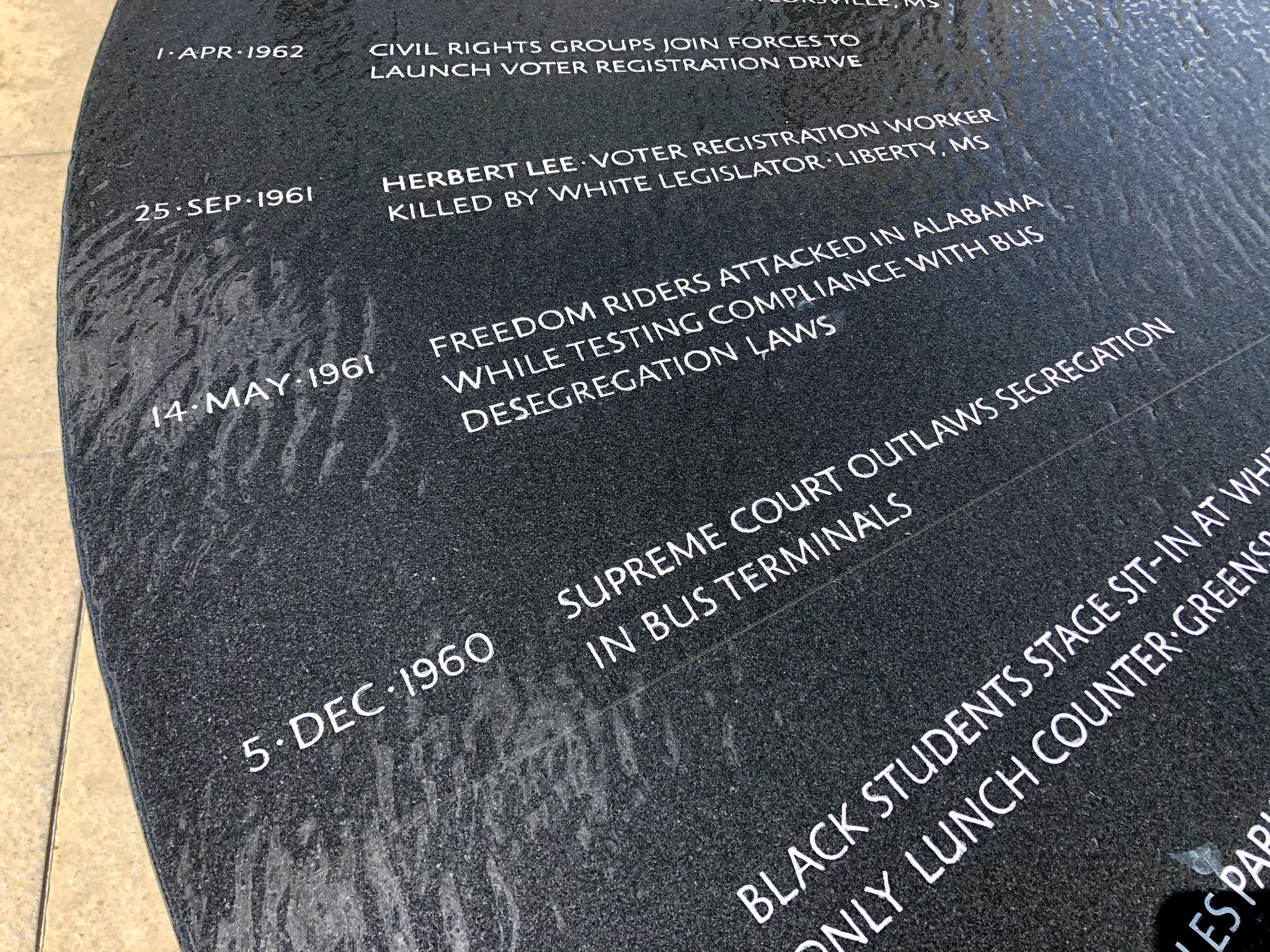
Civil Rights Memorial. Montgomery, Alabama.
I think one of the things about the South's history of segregation that is the most upsetting for me is this history of separate but equal (but really unequal) accommodations for white and black (or "colored" as the signs back then would say) people. Drinking fountains. Hotels. Restaurants. Entrances to buildings. Waiting rooms in bus stations. You name it. It is a concept that is laced with passive aggression that continually let one group of people know they were not in any way in charge. It's uncomfortable. It's demeaning. It's obviously not right. We saw some of this in museums, particularly in the Birmingham (Alabama) Civil Rights Institute. The only place we really saw this in person was in our time chasing the story of the Freedom Riders. But we'll get to that soon.

Eventually, other lawsuits not related to states and towns and the Fourteenth Amendment (since there was already legal precedent from Plessy v. Ferguson) started to make their way through the legal system and some of these also found their way to the highest court in the land. In 1946, in the case of Morgan v. Virginia, the Supreme Court agreed with the NAACP's argument that segregated seating sections on a Greyhound bus that crossed state lines (key distinction there) violated the Interstate Commerce Clause of the Constitution. As of that ruling, separate but equal or unequal or just plain separate seating sections based on race on interstate buses were no longer legal anywhere. Problem solved, right? 

Not so much. A decision of the United States Supreme Court was one thing. Actually getting states to change the rules was another. Nothing changed. Because nobody forced any change.

Fourteen years after Morgan v. Virginia came Boynton v. Virginia. The ruling by the Supreme Court in that case held that separate eating facilities in bus stations serving interstate travel violated the Interstate Commerce Act. So in addition to separate seating areas on buses being illegal, so were separate accommodations in stations, including waiting areas, restaurants, bathrooms and drinking fountains. Now the problem was solved, right? 

Still no. Nothing changed because nobody in the south was inclined to change anything. States from Virginia on south continued to enforce separate facilities based on race just because that's what they were accustomed to and it was what they believed was right. And the Federal Government wasn't really inclined to make them change.

The corner of Fourth Avenue and 19th Street North, Birmingham, AL.
So if the Feds weren't going to do anything, the Congress of Racial Equality (or CORE), a civil rights organization founded in Chicago in 1942, thought it might be a good idea to force the hand of the Federal Government a bit by deliberately complying with the rulings of Morgan v. Virginia and Boynton v. Virginia. That would mean sending black and white volunteers into the South sitting side by side on buses crossing state lines. And having black volunteers sit up front where custom dictated only whites should sit. And when they got to bus stations in the South, they would ignore the illegal separate accommodations and use the same waiting areas and eat at the same restaurants and use the same restrooms.

On May 4, 1961, 13 volunteers (including future United States Congressman John Lewis) boarded two buses (one Greyhound bus and one Trailways bus) in Washington, D.C. bound for New Orleans. Those 13 were the first Freedom Riders. They passed through Virginia, North Carolina, South Carolina and Georgia before crossing into Alabama. Things got bad when they got to Alabama. Not that there weren't incidents before that. But when they passed into Alabama it got really bad.

Those first Freedom Riders were a deliberately diverse group. They were black and white, men and women and ranged in age from 18 to 61. That diversity was important. This was not one segment of society taking a stand. Plus they needed people of different skin colors to they could deliberately sit next to one another.

The first stop in Alabama was in the town of Anniston. The Ku Klux Klan lay in wait; they were determined to not let the Freedom Riders leave the state of Alabama, which really meant they intended to kill them. For riding a bus.

When the Trailways bus arrived in Anniston, eight Klan members boarded the bus and beat some of the Freedom Riders unconscious. Just like that. Hand to hand beating of some people who didn't fight back until they were no longer conscious. The Greyhound bus and its riders weren't so lucky. That bus had its tires slashed in Anniston and was stopped a bit outside of the town. 30 to 40 cars (!!!) worth of Klan members following the bus threw a firebomb into the disabled vehicle and then barred the door so the Riders couldn't escape. It didn't work; everyone got out. But the Klan intended to burn people alive inside a bus for doing absolutely nothing except riding that bus. 

We didn't visit Anniston. We just didn't have time. But in the aftermath of the bombing, a 12 year old girl got the Freedom Riders some water after they escaped the bus. The Klan discussed retribution against the girl but ultimately decided she was too young. It is a measure of the character of the people in the KKK, I think, that they even had a discussion. How many years too young was she for a group of grown men in hoods to hold off punishing her? One? Two? I'm thinking it's not much more than that. And what would be the punishment? Lynching? The Klan liked lynchings. Or maybe burn her parents' house down? That was another Klan favorite.

Burned out Greyhound bus. National Civil Rights Museum, Memphis.
There is a marker on the corner of Fourth Avenue and 19th Street North in Birmingham to mark where the Trailways bus from Anniston arrived in Birmingham. It is an ordinary street corner in a city today. But when the bus carrying the Freedom Riders arrived there in May 1961, it was the scene of one of the more vicious confrontations in the whole Civil Rights Movement. A group of Klansmen was waiting for the Freedom Riders with baseball bats, pipes, bicycle chains and if nothing else just their fists. And the Klan just beat the Freedom Riders near to death when they exited the bus.

I can't wrap my brain around how you attack another person with this level of violence for doing nothing except riding a bus with someone of a different skin color who you happen to feel is unequal. I don't know what makes someone continue to beat another human being who is not fighting back at all. To the point of death if necessary. 

Eventually, the Birmingham police showed up. They had coordinated with the Klan to allow them 15 minutes to do whatever they wanted to do to the Riders. The FBI had infiltrated the Klan in Alabama and also knew what was going to happen and did nothing. Let me repeat that: the FBI knew there was going to be an attack on defenseless people doing nothing more than following a federal law that Anniston and Birmingham were refusing to endorse and they didn't stop it.

I think we often think of John F. Kennedy as a progressive, compassionate, forward-thinking president. And maybe he was for his time. The press coverage of the attacks in Anniston and Birmingham forced him to act but he wasn't happy about it. He considered the Freedom Riders unpatriotic and resented that the Riders were making the United States look bad on the world stage. He tried to make it go away by convincing those organizing the Freedom Rides to stop. They wouldn't. The first Freedom Rides did stop in Birmingham after the attacks in Anniston and Birmingham but less than two weeks later, 20 students from Nashville boarded a Greyhound bus in Birmingham bound for New Orleans. Kennedy arranged for the Alabama State Highway Patrol to provide an escort.  

The old Greyhound bus station in Montgomery, AL. Now the Freedom Rides Museum.
When the bus reached the Montgomery city limits, the escort disappeared. The Montgomery police, which had promised to protect the Freedom Riders, were not at the Greyhound station when the bus arrived there at 10:23 a.m. on Saturday, May 20. But a lot of white people were. John Lewis described the scene this way:
"Out of nowhere, from every direction, came people. White people. Hundreds of them...as if they'd been let out of a gate. They carried every makeshift weapon imaginable. Baseball bats, wooden boards, bricks, chains, tire irons, pipes, even garden tools - hoes and rakes."
Of course the result was the same as it was in Birmingham: white people beating black and white bus riders who were offering no defense. Jim Zwerg, a white college student from Fisk University, was beaten unconscious and had his teeth knocked out. When John Siegenthaler, an assistant to United States Attorney General Robert Kennedy who was sent to Montgomery by the Kennedy administration, attempted to intervene to assist two of the Riders, he was knocked unconscious by a man with a metal pipe.

There was one difference between Birmingham and Montgomery: the press was out in force in Montgomery. So the crowd took care to smash any equipment that would record the events that happened outside the Greyhound station before they started their assault. Then there was no difference between Birmingham and Montgomery. Although Montgomery lasted longer.


The beatings encountered by the Freedom Riders in Montgomery on May 20, 1961 was the last of its kind. After that day, the Kennedy administration made a deal with the governors of Alabama and Mississippi whereby law enforcement would protect the Riders from mob violence in exchange for those states being able to arrest the Riders for breaking local laws. Yes, you read that right. The federal government agreed to allow people breaking local laws (that were in violation of federal laws) to be arrested.

Standing in the Freedom Rides museum in downtown Montgomery today learning about all this history is just crazy. It's crazy that any of it had to happen at all but the hatred involved and the sheer viciousness in these attacks is just shocking. It's also incomprehensible to me that the federal government has to agree to let states violate federal law just to stop violent mobs beating people doing no harm and complying with the law.

The other perspective I gained from the Freedom Rides Museum is standing in a place that was once segregated and being able to see where white people were allowed to go that black people were not. When you first walk into the Museum there is a floor plan of the original bus station on the wall. From that spot you can see where the white waiting room was and the "colored" waiting room was. You can do the same for the bathrooms. Just feeling where those invisible barriers were that were rigorously enforced was pretty creepy. This was less than 60 years ago that this stuff was in place. 

If you look at the front facade of the old Greyhound station today, there is an entrance door just to right of the center of the building covered with a canopy. To the left of that there is another opening that looks like it has been closed up. You can still see the stone trim that defined the edge of the opening. That was the "colored" entrance (no canopy of course). Different skin color. Different door. It's craziness. All to let one group of people know that they were inferior in the eyes of those making the decisions in our society. We got this perspective nowhere else on our trip. Nowhere else did we feel this aura of separation from 50 or 60 years ago in quite the same way.

The former "colored" entrance to the Montgomery Greyhound bus station.
After May 20, the Kennedy administration wanted the Freedom Rides to go on hold for a while. Just sweep it under the rug for a while. CORE and SNCC (or Student Non-Violent Coordinating Committee) didn't agree. They continued to send Riders throughout the summer and most all of those people ended up unjustly arrested and held in Parchman Farm, Mississippi's maximum security prison. 

I think it's worth thinking about the situation the Riders were putting themselves in. At best, they'd end up arrested and sent to prison. And a really dangerous prison at that. At worst, they would end up being beaten within an inch of their lives or actually dead. Some of them actually made sure they had an up to date last will and testament in place in the event they were killed. For riding a bus. The reward was ending desegregation in bus stations in the South. For this, they were willing to die.

On November 1, 1961, under threat of demonstrators descending on Washington, D.C., and after CORE and SNCC had sent hundreds of Freedom Riders into Mississippi prisons, the Interstate Commerce Commission finally issued direction to desegregate bus stations. Who knows how long it would have taken for this to happen if the Kennedy administration and the federal government had convinced the Freedom Rides organizers to pause or stop. Finally those signs in bus stations in Virginia and points south separating people by skin color would be coming down. I imagine the days those signs actually were removed felt like a little bit of a victory.

I keep thinking about what the atmosphere on those buses must have been like. Think about it. When and how and where was the next attack coming from would be all I'd be thinking about. And if I'd make it out alive or be sleeping in a hospital bed that night. And how much pain I'd be in after being beaten. These are not things I want to think about. There is a long list of people associated with the Civil Rights Movement whose courage I admire. The people that took those bus rides into the South in 1961 knowing they might never come back are definitely on that list. 

The Freedom Riders sang songs on the buses to help them through the rides and (I'm just speculating here) put off some of those thoughts that I would be wondering about while seated on one of those buses. One of those songs was called Hallelujah, I'm A Travelin' which is why it's the title of this blog post.

How We Did It

A search for sites related to the Freedom Riders is not going to turn up a whole lot. Sure, there are exhibits in museums like the National Civil Rights Museum in Memphis and the Birmingham Civil Rights Institute that cover the subject matter and provide essential background. In many ways, a tour of multiple cities and sites (and museums) in a few days reinforces stories like the Freedom Rides where little physical evidence of what took place actually exists. There is a brand new (as of this writing) Freedom Riders National Monument in Anniston with two sites (the old Greyhound station and the location where the bus was firebombed) but neither site right now is anything more than a drive by.

We chased the Freedom Riders in two cities: Birmingham and Montgomery, both in Alabama. There is little more in Birmingham than the Freedom Riders sign shown in the blog post above but if you are in town anyway to visit the Civil Rights Institute, Kelly Ingram Park or the 16th Street Baptist Church, it's worth a stop for a quick picture.

In Montgomery, we spent some time walking through the Freedom Rides Museum on South Court Street about a half a mile from the Alabama State Capitol. The Museum is open Tuesday through Friday from 11 a.m. to 4 p.m. and noon to 4 p.m. on Saturday. It's a pretty small museum; really just one room with a series of narrative exhibits. But the real value for me was standing in a building still bearing the evidence (albeit very difficult to interpret) of a segregated station. I found it way worth the visit for that sensation alone.


Tuesday, June 1, 2021

Separate But Unequal (1957)


This post will take a while to get to the point. Lots of legal stuff. Bear with me.

At the end of the American Civil War, the Congress of the United States passed three amendments to the Constitution. The Thirteenth Amendment abolished slavery, except for those convicted of criminal offenses; the Fourteenth Amendment redefined citizenship for former slaves and addressed equal protections under the law; and the Fifteenth Amendment prohibited discrimination in voting on the basis of race or previous conditions of servitude. If it seemed like these sorts of amendments might have been opposed by those states which joined the Confederacy...well, they lost the War so...

Despite these Amendments (which were fully ratified by 1870), the Louisiana State Legislature in 1890 passed the Separate Car Act, which required "equal, but separate" train cars for white and black people. Some folks thought this law might violate the Fourteenth Amendment.

Enter Homer Plessy, a New Orleans resident whose ancestry was 1/8 African, who bought a first class train ticket in June of 1892, took a seat in the whites only car and then deliberately revealed his 1/8 African ancestry to the conductor. The resulting series of lawsuits from Plessy's arrest ended up in the United States Supreme Court as Plessy v. Ferguson. Homer lost his case and the resulting verdict, that states had the right to require separate but equal accommodations for whites and blacks, set the Civil Rights Movement back decades. Sanctioned segregation would become the law of the land in the South.

Exhibit at the Birmingham Civil Rights Institute.
But things weren't equal. Separate, yes. Equal, no way. And starting in the 1930s, the National Association for the Advancement of Colored People (NAACP) started to challenge segregation in public education. Their efforts ended up in 1954 in front of the United States Supreme Court as Brown v. Board of Education of Topeka. That case was actually a collection of five similar cases filed in various locations, including one in Virginia related to the student walkout at Moton High School in Farmville, VA which we visited back in February of this year (love it when different trips interrelate!).  

The Brown verdict was a landslide. A 9-0 ruling in favor of the plaintiffs, with a finding that racial segregation in public schools was unconstitutional because it violated the Fourteenth Amendment to the Constitution. However, in their ruling, the Court didn't spell out how to end the current segregation in place. I guess maybe they assumed all segregated schools would just integrate the next day?

So a follow up case was brought before the Court the very next year to address the timeline for desegregation. Their ruling this time? That integration should happen "with all deliberate speed". Gee, that helps a lot. Thanks for clarifying that. Effectively, the Court's ruling created the means for those so motivated to challenge racial segregation in their schools, but unless a town or city saw fit to desegregate on their own (and some did), then desegregation might take a while. Or forever even.

Which brings us to Little Rock, Arkansas in 1957. Which also brought us to Little Rock in 2021. For a visit to the Little Rock Central High School.

Little Rock Central High School.
Little Rock Central is an active high school so a visit there is not necessarily all it could be. We visited on a Tuesday in May which meant that class was in session while we were walking around campus. Because of its historic significance in the Civil Rights Movement, the National Park Service offers educational tours of the property. The NPS has also constructed a Visitor Center and owns the old Mobil station that the press used while covering the events of the beginning of the 1957 school year. The Mobil station (which is now the NPS's conference center) is across the street from the High School's property; the Visitor Center is across the street from the gas station.

Under normal circumstances (meaning non-global pandemic circumstances), the NPS tours include a visit inside the school. Considering we are in a public health emergency, their tours are strictly exterior right now, although we did have about an hour of classroom learning with audience participation to reconstruct the timeline of the Civil Rights Movement from the arrival of the first slave ship in the New World up to 1957 before setting out on our tour. Not kidding. We seriously were in a classroom with markerboard with Ranger Rebecca in the teacher's spot. It was actually really fun and informative. Thank God we had been to the National Civil Rights Museum in Memphis the very day before so we knew some of the answers.

We knew we wouldn't be able to get inside before we went to Little Rock. Despite the fact we were limited to strictly exterior access, we still found it way worth the trip. There is most often great value in being there, wherever "there" happens to be. We found this rule applied even when we only walked about one city block on the outside of a building.

The desegregation of Little Rock Central High School was ugly. Maybe it was destined to be that way but it certainly seems to me that the actions of adults in responsible charge made it way worse than it had to be. 

In the March of 1955, the Superintendent of Schools, Virgil Blossom, submitted a plan for the integration of schools in Little Rock. After some loopholes were added, and maybe a little school district gerrymandering, the city was ready to proceed with a plan for integration in 1957. 200 black students applied for enrollment, which shocked the school board. The board claimed there was not enough capacity for that many additional students in a school built for 3,000 students that in 1956 held just 1,500 (math not a strong suit of the Little Rock school board in the mid-50s, apparently).

So they changed the rules. Perfect grades and perfect attendance were added as requirements. That got 200 or so down to 17. Then extracurricular activities were banned. So was retaliation if the students choosing to integrate were attacked in any way. 17 was reduced to 10. Then the list of the 10 was leaked to the press and then to the general public. Threats of violence and threats against employment for parents were made. 10 was reduced to nine. That number stuck: the Little Rock Nine.

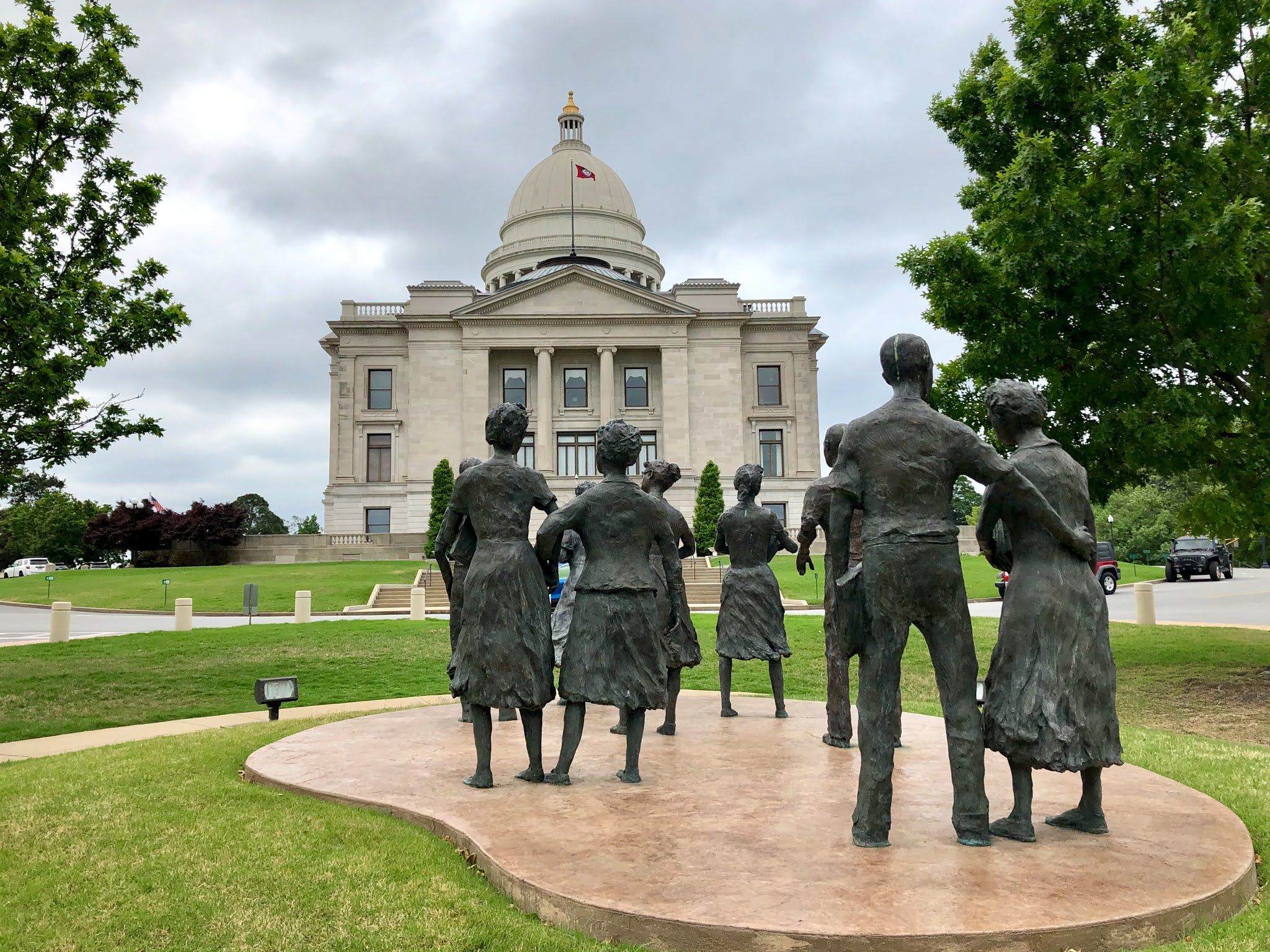
Testament: The Little Rock Nine Monument. Outside the Arkansas State Capitol. 
The first day of the 1957 school year was set for September 3, the Tuesday after Labor Day, and classes at Little Rock Central High School did start that day. But not for the Little Rock Nine. They were advised to stay home for their own protection on September 3. They gave it a shot the next day and failed. In fact it would be all the way until September 23 until any one of them set foot inside the school. And then only under the escort of armed members of the Little Rock Police and Arkansas State Troopers. Armed escort. To get into school. To learn. Kids.

What could possibly have delayed the entrance into High School of nine kids looking to do nothing more than get an education? How about Orval Faubus, the governor of Arkansas, interrupting the Labor Day broadcast of I Love Lucy to claim that "caravans" of white supremacists were on their way to Little Rock to demonstrate outside the school? How about the Arkansas National Guard being called out to deal with threats of violence but then being ordered to keep anyone not white (including kitchen and maintenance staff as it turned out) out of the building? How about lawsuits? How about the President of the United States getting involved? All this because nine kids from the absolute bottom of the social structure in our country wanted to go to a better school.

Those "caravans" by the way? Didn't exist. But white supremacists DID show up after the Governor claimed they were already there. And threats of violence? The Governor claimed he had evidence but just declined to produce it. Sound familiar? Hmmm...I wonder.

That was the first three weeks of the school year. It would be October 24 before an armed escort would NOT be necessary for the Little Rock Nine to enter school. One month later!!!

I can't imagine what that first year was like for those nine kids. All they were trying to do was get an education and learn. The "no retaliation" condition of admittance must have been equivalent to state sanctioned bullying. Over their first year there would be student strikes; bomb threats; bullying; beatings and tauntings by both white students and parents; boycotts of local newspapers supporting integration; kids jumping out of windows; suspensions. All because nine kids wanted an education.

All of the Nine did not make it through year one but none of them dropped out. Minniejean Brown was suspended in December of 1957 for spilling chili on two boys blocking her way. She was then expelled in February of 1958 for calling some girls "white trash" who threw a purse filled with locks at her. After she was expelled some students distributed cards with the slogan "One Down..Eight To Go". I can't imagine the pain.

As if all that weren't bad enough, the next year they didn't have school at all. It was cancelled. The whole year. The idea of more than 1,500 white kids sharing a school with fewer than ten black kids scared people so damned badly that they just cancelled the whole school year. Think about that: people were so upset about nine black children getting a good education that they denied everyone the opportunity to learn. How messed up is that?

Little Rock Central High School exhibits at the National Civil Rights Museum, Memphis.
I got all that out of our visit to Little Rock Central. But that's not really what I got out of being there. There's always a "being there" part and the story from being there that will stick with me forever is the story of Elizabeth Eckford.

When the Little Rock Nine were advised to stay home for their own safety on September 3, Daisy Bates, the co-owner of the local Arkansas State Press newspaper and advocate for the desegregation, coordinated a plan whereby all of the Nine would meet at her house and then walk, escorted, together to the school on the morning of September 4. She managed to coordinate this plan the night before with the exception of looping in Elizabeth, whose family did not have a telephone. She figured she'd get a hold of Elizabeth the next morning somehow.

She forgot. So Elizabeth Eckford got on the school bus near her home and got off to find the school surrounded by the Arkansas National Guard, all of whom were under orders to not let her into the school.

Elizabeth, all of 15 years old on September 4, 1957, described her attempts to enter the school being met with refusal by armed Guardsmen with rifles and bayonets while being surrounded by white children and adults chanting anti-integration rhymes and threatening lynching (there are estimates that there were 400 protestors outside the school that day). She's a 15 year old girl who looks utterly unlike the crowd around her and she's carrying books to try to get an education and she's met with every sort of scaring and hatred you can imagine. At one point, she sees a woman who looks like she has a sympathetic face so she heads towards her only to be spat on by this woman. Which causes other members of the crowd to spit on her and the dress she made specially for this first day of school as well. 

I know we are almost 64 years removed from that September day but I shudder to think that nobody in that crowd wondered what exactly it was about a high school girl that caused them to threaten, bully, intimidate and just generally behave this way towards another person. If they did, they certainly didn't do anything to stop it.

Display from the Little Rock Central High School National Historic Site Visitor Center. Original photograph by Will Counts.
Not knowing quite what else to do after being turned away from a day of high school by soldiers because of the color of her skin (just writing that sounds crazy), Elizabeth decided to walk right past the School to the corner of South Park Street and West 16th Street where she knew she could catch a bus at some point and go right back home. She first tried to enter the drug store across the street but the owner of the store locked the door when he saw her approaching. So she sat on a bench on that corner and waited. With a mob of white people all around her yelling at her.

That walk from the time Elizabeth got off the bus until she sat down on that bench must have seemed interminable. It's one block but it is a long, long block. Almost a quarter of a mile. We walked it one day last month in our guided visit to the High School site while not having our path blocked or having our lives threatened or being spit at. We didn't get to do too much else but that walk was enough to understand just how long and painful that walk must have been for Elizabeth Eckford. It feels a little strange writing a whole blog post based on a one block walk but ultimately that act made some of the events of that September day sink in.

For Elizabeth, this was day one. There was still an entire school year to go of this sort of stuff, albeit without the adults participating for the most part. One of the most frustrating parts of our Civil Rights trip was the acts of violence or intimidation directed towards those that are the most powerless and certainly children fit first and foremost in that definition. Even if those perpetuating the violence were also children.

The added irony of the hatred and violence these nine kids endured in Little Rock is it likely would not have been as bad if it weren't for the Governor of Arkansas, the highest elected official in the state, getting involved. It might be easy in 2021 to assume integration of schools in the 1950s seems like a concept that was doomed to fail, but it had already taken place without incident in many places of the country, including in the South and in the state of Arkansas. Seriously. In Arkansas, Charleston and Fayetteville had integrated even before the Brown v. Board of Education decision; Bentonville began integration in 1955; and the town of Hoxie had to go to court to get an injunction from a court of law IN FAVOR of desegregation. I'm not saying things in Little Rock in 1957 would have gone smoothly, but the Governor certainly made it worse and likely did it for his own political gain. Again...sounding familiar? 

Elizabeth Eckford Bus Bench. The Little Rock Central High School is visible behind.
Just three of the Little Rock Nine ended up graduating from Little Rock Central High School. Ernest Green, the only senior enrolled in 1957, got his diploma in 1958 (and even had Dr. Martin Luther King, Jr. attend his graduation). Ernest was followed by Carlotta Walls Nier and Jefferson Thomas in 1960. School closure in the 1958-1959 school year and transfers and expulsions prevented the others from completing their academics at Little Rock Central.

In 2005, a sculpture featuring all nine members of the Little Rock Nine was unveiled on the grounds of the Arkansas Capitol. I've already named Minnijean Brown, Elizabeth Eckford, Ernest Green, Carlotta Walls Nier and Jefferson Thomas. The other four were Melba Patillo Beals, Gloria Ray Karlmark, Thelma Mothershed and Terrence Roberts. There are quotes from each of the Nine around the perimeter of the sculpture. I couldn't help thinking how ironic it was that we are relying on these (former) kids to teach us about tolerance and acceptance after all they have been through.

The spot where Elizabeth Eckford sat on a bench surrounded by an aggressive mob now holds another bench named in Elizabeth's honor. There's a quote from Elizabeth on a plaque next to the bench about the importance of standing up for others who are being harassed and despised just based on the fact that they look different. Again, we are relying on those who have been harassed and despised to deliver messages to the rest of us.

One of the more frustrating aspects of this trip we took this May was the knowledge that there were people who had to suffer or die to advance society those tiny little steps forward. In cases like those of Emmett Till, the suffering was clear to see; he was straight up tortured and murdered. But make no mistake there was plenty of suffering endured by the Little Rock Nine as well. All nine of these kids had their lives affected by the mental, emotional and physical abuse suffered while attending (in some cases) just one year of school at Little Rock Central. Some still bear actual physical scars and if proof beyond that is necessary, look no further than Elizabeth Eckford's two attempts to take her life. 

I think there's a tendency to dismiss the suffering of the Little Rock Nine as "if they didn't do this, someone else would have had to" but I can't stop thinking about Orval Faubus' completely unnecessary and blatantly untruthful press conference. What would have happened if he hadn't done that? And I guess honestly we'll never know.

I believe our time in Little Rock was worthwhile. Sure, access into the school was off limits and that was unfortunate. But just like roaming around rural Mississippi in search of Emmett Till, I think we owed it to these kids and the change they helped bring about to go to Little Rock and learn. I think there is also a lot of value in hitting up multiple Civil Rights sites in one trip. The constant repetition really emphasizes causes and effects within the Movement which I think is super valuable. The concepts discussed in Ranger Rebecca's "class" were echoed in the National Civil Rights Museum in Memphis and the Birmingham Civil Rights Museum.


How We Did It

The Little Rock Central High School National Historic Site is open daily with guided Streetscape Tours offered twice daily with a 48 hour advance reservation requirement (although honestly, I think we could have done ours without advance reservations, although I'm not 100% sure that would have been allowed). There may be days (like Federal Holidays and school breaks) when tours are discontinued. Best to check the website for the latest information, particularly because if we ever truly come out of this pandemic, all the rules for everything may change. There is a museum exhibit inside the Visitor Center; it took us about 45 minutes to an hour to get through everything there pretty thoroughly.

The National Historic Site website has a list of sites related to the history of the events of September 1957 which you can drive by. We elected not to do this and instead head over to the Testament statue on the grounds of the State Capitol. It's on the south side of the Capitol building and there are free parking spots nearby for Capitol visits. We assumed our visit to Testament counted as a Capitol visit.