I swear one day I'll stop writing about trips that were cancelled by the COVID-19 pandemic in 2020 and 2021. Today is not that day.
In March 2020, we were supposed to take our first trip to Costa Rica. Our plan was to journey to Tortuguero National Park on the Caribbean coast for a couple of nights and see as many toucans and sloths as we could, and maybe, if we got lucky, watch a turtle or two laying eggs or maybe a brood of new baby turtles hatching and making it the sea. Nine days before we were scheduled to depart for that trip, I started working at home so I wouldn't get sick with COVID. I figured it would be a couple of weeks long thing. Then the whole world of travel stopped. No Costa Rica in 2020.
We briefly flirted with going to Costa Rica last October. But the requirement to test negative for COVID before coming back to the United States scared us a bit and we decided to head to Portugal instead based on their pretty much world-high COVID vaccination rate. No Costa Rica in 2021 either. But the third time, as it turned out, was the charm. We finally made it this year.
Rather than get fancy with a different itinerary or second guess ourselves or something like that, we decided to pretty much match our original 2020 itinerary but with an additional day added on as some sort of emotional compensation for finally making it two and a half years after we originally intended. Now, sure, weather conditions in Costa Rica in October are not the same as weather conditions in March, but it seemed to us that temperature and rainfall and turtle activity seemed to be close enough on the Caribbean coast between those two months. Tortuguero was still the destination. We were all in!
 |
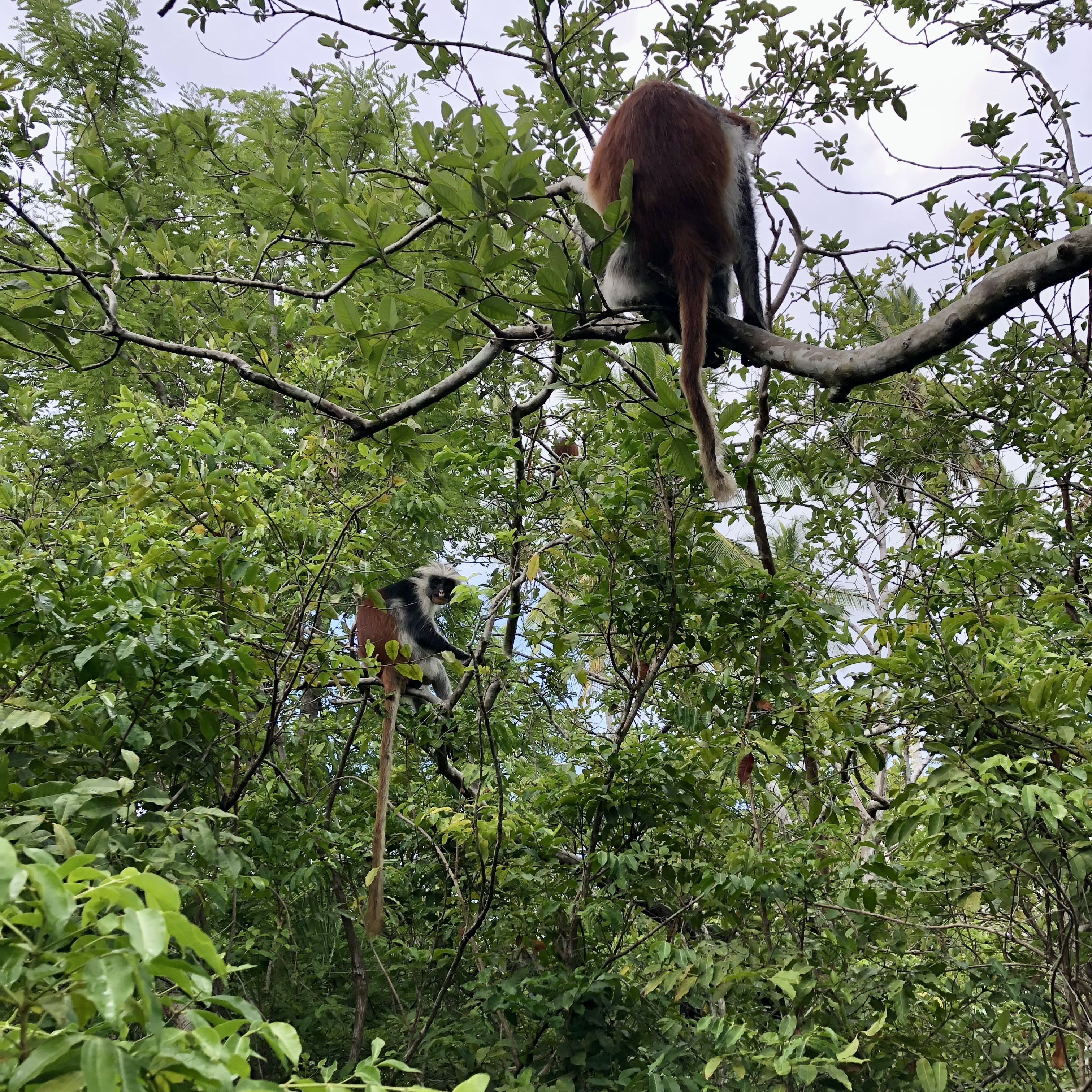
| Yes, we saw lots of monkeys in Costa Rica. |
Tortuguero National Park is basically a big mangrove swamp. We'd been to mangrove swamps before, probably most notably in Florida's Everglades National Park, so we knew we'd be looking up into trees and at roots along the edges of water for a lot of reptiles, amphibians and birds, rather than the mammals that make destinations like sub-Saharan Africa so popular. That was fine with me. If there's one love I've found over the last few years traveling and staying at home for months at a time during a global pandemic, it's birdwatching. And I was fairly positive I'd see some new species of birds that I'd never seen before in Tortuguero.
And, yes, I do realize the two pictures that have appeared on this post to this point are both pictures of mammals. So, we did actually see mammals.
Tortuguero covers a pretty big area. Not Everglades big (it's about 1/6 the size of the Everglades) but certainly way big enough to keep us plenty busy for about two days over its approximately 77,000 acres of land (that's a bit more than five times the area of Manhattan for those of us who sometimes measure things in terms of New York City distances or sizes). We would definitely not run out of territory to explore in the time we were there, either on land or by boat (because we did end up spending time exploring on foot and on water).
Our journey to the Park started out in a van in Costa Rica's capital city of San Jose but it certainly wouldn't end up in that vehicle because quite simply, you can't drive to Tortuguero. It's completely cut off from the rest of Costa Rica by water. You can only get there by boat or by plane. So ultimately, we'd have to leave the van and board a long, flat-bottomed boat and travel the rivers and canals around and within the Park over the last hour or so to arrive at Turtle Beach Lodge, our choice of lodging for the next two nights.
 |
| Boat ride: Rio Colorado and the glass-like Caño Palma. |
Our jungle experience in Tortuguero really started the moment we stepped off the beach we had been driven to and onto the boat that would take us deep into the Park. Our boat ride (and it would certainly not be the last boat ride of the trip) would take us over and through the muddy and very shallow Rio Suerte to the equally muddy but maybe not so shallow (in most parts) Rio Colorado before taking a left onto the deep and deep black Caño Palma. Our trip down the Rio Suerte was an effort in switching from side to side of the river to avoid the shallows and we saw the effects of not doing that when we passed a similar boat to ours on the Colorado that had run aground and was being pushed by two of the boat's occupants who were not even waist deep in the water.
The highlight of our trip to Turtle Beach Lodge, though, came once we got off the main river and onto the canals. The water is so still on the Caño Palma and the color of the water is so black that it perfectly reflects whatever is above the water onto the surface of the canal. Intuitively, you know that the water is the thoroughfare and image on its surface is just a reflection, but when you are moving along the top of the water it feels like you are floating through a corridor where the top and bottom are identical images of each other. And when the engine starts cranking and the speed builds, it's like traveling through a kaleidoscope. It's a little freaky and impossible to represent in photographs, but it's a phenomenon uniquely created by the color and stillness of the water itself.
Eventually, we reached our lodging. Welcome to Turtle Beach Lodge.
 |
| Iguana near the entrance to Turtle Beach Lodge. |
Before we get to what we saw (and there was a lot), let me say that I know we got super lucky with our choice of properties in Tortuguero and when we visited. Sure, Turtle Beach Lodge was comfortable and safe and clean and the staff was amazing (as was the wildlife). And yes, it was also the off-season along the Caribbean coast which may have kept occupancy a bit lower at the Lodge. But the effects of the global pandemic are still being felt in parts of Costa Rica, so in a resort that can comfortably hold 120 guests, we found ourselves among ten total.
That situation gave us an un-natural amount of space and freedom on the property and got us a level of attention that we normally, I am sure, shouldn't expect. It added a ton to our experience and while I feel for the owners in terms of lost revenue and the staff in terms of lost tips, I know we benefitted a lot here. There have been times when we have traveled to places when they have been emptier of humans than we have expected, and it always works out well for us.
Having said all that, the place keeps you busy and they provide you with excellent guides for all your experiences. Our agenda for our stay included time on the property, nature walks, boat safaris (if that's the right word) and a visit to the village of Tortuguero, which I expected would be a tourist trap but which turned out to offer one of the gems of our trip in terms of wildlife sightings. Our guide for all of that, Don Fernando, was as skilled as they come and he definitely elevated our experience so much. I know I've written a long time ago about the importance of a great guide, but every time it happens, I feel fortunate to be in the care of someone skilled. Don Fernando was one of the best we've had, right up there with our guides in Africa and the Galapagos on our other great wildlife trips abroad.
 |
| Caimans. Tortuguero National Park. |
I didn't visit Tortuguero with a detailed list of what I wanted to see. Yes, we had toucans and sloths and turtles on a wish list of sorts but on a first visit to this part of the world, I figured I'd take it as it came, much like we did on our first trip to sub-Saharan Africa in 2015. When I have done that in the past, I find you end up with some sort of signature wildlife experience that sticks with you from the place you've been, and Tortuguero yielded one of these on the very first day: spider monkeys.
I expected that we would see wildlife on the hotel property (I figured lots of birds) and I expected that we would see monkeys on this trip (there are three types of monkeys in Tortuguero: spider monkeys, howler monkeys and white-faced capuchins). I just didn't expect that we would get a clear look at any sort of primates at our hotel. I was wrong. Spider monkeys were everywhere.
I love watching all sorts of creatures in the wild. Take me any place where there is wildlife more complicated than squirrels, chipmunks and deer and I'm a happy guy. But there is a more distinct thrill in watching species with more complex social interactions. Elephants and lions fall into this category, but I knew we weren't seeing any of those on this trip. So do monkeys and apes. The opportunity to see a troop of spider monkeys interact on the very property where we slept was special.
We did, by the way, get some interaction with howler monkeys on this trip, but that interaction was pretty much limited to very loud calls from those primates at 4 o'clock in the morning. We struck out on capuchins entirely.
Viewing spider monkeys in Costa Rica involves a lot of looking up. And also, looking up is sometimes a really good thing. To paraphrase Don Fernando...it may seem like it's raining but it is not really raining. Stay alert, folks. Look up!
If you do spend time looking up at these monkeys, you will see what makes observing these creatures in the wild so rewarding. You will see playing, chasing, fighting (not serious fighting, just play fighting), eating (LOTS of eating), just general lounging around in trees and interactions between mothers and babies. Do not expect spider monkeys to drop to the ground. They are clearly more comfortable (from our very limited observations) in the safety of the trees. And I'm cool with that considering the time we had available to us to keep finding them in the trees.
One of the fascinating aspects of watching spider monkeys is how they use their tails. We have seen vervet monkeys (definitely my favorite monkey FWIW) and baboons and other kids of monkeys in Africa and have never seen the tail used as a fifth limb the way spider monkeys use their tails. They literally use these things to support their entire bodies while snacking on some leaves or just moving through the treetops. Sometimes, it's the small things about watching wildlife that make an impression.
There was a lot of snacking on leaves by the way, but in what seemed to us to be a very responsible way. There was no de-nuding of branches. Maybe leaves taste better when eaten from different spots but to me, it appeared these monkeys were smarter about resource usage than we humans. Probably no surprise there.
It also seemed like there were a lot of monkeys either pregnant or just full up on leaves. Not sure what the deal there was. I don't think we got a good picture of what was really the situation but there were some chunky monkeys in the trees at Turtle Beach Lodge for sure.
In addition to the spider monkeys, there were a few other species at Tortuguero that we got to see in some detail that were on my radar along with others that were not really. We saw our first poison dart frogs (a variety sometimes called blue jeans frogs because of their blue legs) on our late morning nature walk in the jungle one day. We also managed to see a basilisk (sometimes known as a Jesus Christ lizard) run across the water as we cruised past its sunning location on our boat. I'd never seen either of those animals before and certainly had never seen a lizard run across water.
We also saw plenty of birds in our time on property at Turtle Beach Lodge; while skimming over the canals and rivers within the Park; and at Tortuguero village. I never would have expected to see birds of any note in our time in the village but we got a great look at a flock of great green macaws sitting in an almond tree feeding. Apparently, these birds only live in this one spot in the entirety of Costa Rica. Good thing we took the camera. Why I didn't expect to see birds in a place just because humans have set up a town in a spot is beyond me. My attitude didn't make much sense there at all.
I was also struck on this trip by how well creatures can be camouflaged in the wild. I'm all on board with natural selection and gene mutation throughout history bringing advantages to certain member of species who by virtue of their mutation have a greater chance of survival, but this idea hit home in Costa Rica. The great green macaws, for example, while noisy and very visible when they are flying, are next to invisible when they are eating almonds out of a tree. Their plumage is almost exactly the same color as the leaves of the tree. It took trying to take some closeup pictures of these birds for that fact to become obvious.
But the macaws were not the champions of camouflage on this trip. That title has to go to the two groups of long-nosed bats that we came across on our early morning boat ride on our second day in Tortuguero.
These little grey bats are active at night and during the day they just hang out and sleep on a tree trunk by the edge of the water. Not buried deep in the jungle or in a cave or under a leaf or something. Right out in the open on the trunks of trees in the broad daylight. But here's the thing: they are pretty much impossible to see. They look like pieces of bark that are peeling off the tree all in a row. Our guide Don Fernando pointed them out to us from feet away (like two feet, not twenty feet) and I still couldn't see them. I blamed me not being able to see them from super close up on my sunglasses at first but even when I switched to my regular glasses I still couldn't wrap my head around that what I was looking at was an animal rather than a flake or two of bark.
If we hadn't been accompanied by Don Fernando, we would have missed these things entirely, which I guess is exactly their intent. I eventually understood what I was looking at by zooming in on the bumps on the tree trunk with our camera. Sure enough, they were not flakes of bark but eight or ten or however many there were just hanging out in a row on the tree. I am not going to claim I've seen all sorts of camouflaged creatures in my life but if there's anything out there better than these little bats (they are really all of like 3" long), I want to see those too.
 |
| The bats in the top picture are underneath the large trunk in the lower half of the picture. |
But enough about all these wonderful random species, we came to see toucans and sloths and nesting turtles. Let's get to that.
So, the simplest species to address here is the sloths. We didn't see any in Tortuguero National Park because plain and simple they don't live there. We saw one in downtown San Jose and three on the way to Tortuguero but none in the Park itself. I guess those few were enough. There could be more trips to central America sometime in the future I guess.
Next up: nesting turtles. Yes, we saw some but no, there are no pictures because (1) we went turtle spotting at night by the light of the moon and (2) no cameras are allowed because any light, including the glow of an iPhone screen, is potentially distracting to the turtles.
I don't know quite how to capture our experience on the beach that night. We saw two adult female turtles looking to nest. We also saw some newly-hatched baby turtles making their way to the sea to get a chance at life. The babies hatching was undeniably thrilling. Watching those little turtles power their way over the sand to the water was a very uplifting experience.
I suppose one of the first threats any hatchling will face is the prospect of predators on the beach en route to the waves. That was a non-issue on the beach that night (despite the calls of a yellow-crowned night heron in the distance) because there was a corridor of about 25 humans on either side of the turtles' path. Seeing the babies drop into the waves and disappear into the sea felt like a moment of triumph. In reality, they have just passed the first of countless threats to their lives that they are about to fight for. We were told the odds of survival were one in a thousand. I'd like to think that the little guy we saw make it to the water is still out there fighting but the math is certainly stacked against him or her.
 |
| Two kingfishers: ringed (top) and Amazon (bottom), both at Turtle Beach Lodge. |
The attempts at the two turtles nesting was less uplifting. One failed to lay eggs at all. She roamed around the beach for a while trying to find a spot to nest before heading back to the water. There is a chance her failure to lay eggs that night was affected at least in part due to the 25 or so people milling around the beach, including the three of us. If that's true, I certainly don't feel good about playing a part in that failure. It was cool to see a massive adult green turtle enter the sea from the beach, but the circumstances of that act definitely dampened the excitement.
The other turtle we were tracking that night did nest and she did lay some eggs. We managed to see that up close before she aborted and abandoned the nest and decided to head back to the sea. But here's the thing about that: once a turtle starts laying eggs, she has to lay them all. So the fact that she decided to leave the nest and move to the water meant that she kept laying eggs while moving and left a trail of unprotected ping pong ball-sized eggs leading from the nest site to where she met the waves. Those eggs are dead on discovery. They would have surely been eaten by a raccoon or a bird or a coatimundi as soon as one of those animals found them. There's also a good chance that the rest of the nest could have been unearthed also, meaning all of the babies are dead. This is part of the reason why the odds of survival are so low and why a single female turtle might lay 600 or more eggs in a season. The memory of that trail of eggs is honestly heartbreaking to think about.
Here again, there is a reasonable chance that the mother abandoning the next was caused by us humans. Our guide actually moved aside the rear flipper of the turtle so we could watch the eggs drop into the nest, something we were told later he wasn't supposed to do and something we didn't really need to have done for us. Sure, we did move to the edge of the nest when we were told to do so because we wanted to see the egg-laying but if someone had told us there was a chance the turtle might prematurely leave the nest due to our presence, we would have been happy to have just stayed away.
Our night on the beach with the turtles was definitely a roller coaster of emotions ranging between hope for the future and just devastation about knowing we might have participated in causing hundreds of baby turtles to lose their chance at life before they had any chance at all. As uplifting as it was to see baby turtles reach the water (and I would love to see more of that), I definitely don't need to see mother turtles nesting ever again. I think I'll leave nature alone on that one.
 |
| Basilisk (top) and slaty-tailed trogon (bottom), Tortuguero National Park. |
And then we have the toucans, which were my number one species to spot in Costa Rica. I was looking forward to multiple sightings of keel-billed and yellow-throated toucans on this trip. Unfortunately, after this vacation, toucans may end up being in the same category as flamingoes and penguins. Lots of hope, but ultimately elusive in the numbers I hoped for. In our two or so days in Tortuguero, we saw one yellow-throated toucan. And that was from a great distance.
Now, we did see a number of collared aricari, which are very, very close relatives of the toucans. We had two excellent sightings of these birds, one on our morning boat ride at the tops of some trees by the side of the water and one right at Turtle Beach Lodge. In both instances, we saw a number of these birds (they typically travel in flocks; we saw up to six at one time) for a good amount of time and got some great pictures. We saw them flying and feeding with the feeding being within feet of where we were standing on our hotel property.
These are truly gorgeous birds and it was a complete thrill to see them for the first time at a pretty good distance in the jungle and then later so close to us on our property. I actually love the last of the three photos below of these birds better than all other pictures I took on this trip. But they are not true toucans. They are smaller and, for all the shades of red, yellow, black and brown on their bodies and beaks, less spectacularly colored than the keel-billed and yellow-throated toucans that I craved.


The last planned daytime activity in our stay at Turtle Beach Lodge was a couple of hours trip to the Tortuguero village (the same trip that got us our great green macaw sighting) and it got me the toucan encounter that I was seeking. As we made our way back gently along the Caño Palma in the late afternoon, we heard a bird calling ringing out through the jungle, a call that our guide Don Fernando immediately pegged as a yellow-throated toucan. We stopped the boat and listened. And looked.
We eventually did spot one toucan and it was for sure the exact species that Don Fernando had promised. It took us a while to locate him (I'm assuming it was a him based on his calling out across the treetops) but this was probably my favorite encounter of the entire trip despite its brevity and distance. I am sure it was because this was the creature I most wanted to see but sitting there on the boat on the water just listening to the sound of one bird calling out over and over in the silence of the jungle was just an incredibly intimate experience. It forced us to listen and look and take the whole thing in, just focused on one species by sound alone until we actually spied him.
You would think it would be fairly easy to spot a bird with a bright yellow throat, a red patch on its body and an enormous brown bill in a mostly green forest canopy but it is not. Green leaves and the shade and shadow thrown by those leaves and the branches they sprout from can disguise even the most colorful bird. And it did take us a while to spot the toucan that was cawing into the jungle. Below is the best evidence of our maybe quarter of an hour listening and looking for this bird. It is not the best photograph I took on this trip but it's the hardest earned and the one that gave me the most satisfaction. In the absolute last moment we could possibly have seen a toucan on this trip in Tortuguero, we did.
I'll take it, but it leaves me wanting more. More toucans that is.
That picture may seem underwhelming. But I still love it. It would be better for you, I'm sure, if you could have sat on the water and listened and found the bird knowing that it is exactly what you wanted on this trip. I loved Costa Rica. After two and a half years it definitely paid off spectacularly and I'm convinced our decision to go to Tortuguero for our first Costa Rica trip was absolutely the right choice.
I am also confident that there will be future opportunities to find toucans in central America. Belize, Guatemala and Panama are all still on my list and a return trip to Costa Rica is not out of the question in the future. This trip was absolutely not just about finding toucans and the variety and quality of the wildlife sightings we got should be obvious over and above all my whining about not seeing tons of toucans from feet away.
I loved Costa Rica. Mucho gusto! Pura vida!
How We Did It
We booked our stay at Turtle Beach Lodge as an independent adventure through G Adventures, our favorite travel company which has taken us to Peru, Ecuador, Tanzania, Kenya and Portugal in the past. From there, Turtle Beach Lodge took care of everything. They picked us up in San Jose, got to us the Park, fed us and arranged all our trips (wildlife watching and otherwise) during our stay and took us back to San Jose. They were absolutely awesome from start to finish from our guide, Don Fernando, to our bartender, Gustavo, and everyone in between. I can't say enough good things about them.
You don't have to book a stay with Turtle Beach Lodge through G Adventures. You can do it direct through them and it's probably going to be a little cheaper and you can pick your own hotel in San Jose. We didn't figure this out when we first booked this trip in early 2020 but we did between the first booking and today. We would likely have just booked direct if we had known way back three or so years ago.
Two last thoughts here: (1) it is hot and it is humid in the jungle; if you sweat remotely like I sweat, consider taking some additional shirtwear with you over and above one per day; and (2) the breakfast you will get on the way to Tortuguero is amazing; get the grilled cheese and ask for some salsa Lizano.