
Quiz time.
Who out there knows what a cinnamon tree looks like? No? Nobody? How about nutmeg? Could you identify a nutmeg fruit on a tree? Are you even confident cinnamon and nutmeg comes from trees? No? Or no idea?
How about a different question: what about turmeric? Any idea what a turmeric plant looks like? Black pepper? Ginger? I mean I can tell you what a ginger root looks like at the grocery store, but a ginger plant from above ground? Could you pick that out? Cloves? Lemongrass? Vanilla? Vanilla is a yes, right? It's the shriveled black beans that you see in the jars at the grocery store. But...they are green on the plant. Didn't know that? Neither did I. I mean, it makes sense, but I still didn't know.
Spices were once a big deal. I mean a bigger deal than they are today on like an econonic, world domination level. Like there were wars waged over the capture and control of these food flavorings. Sounds nuts, right? But it's true. This turned out to be particularly true of nutmeg and cloves, with the Portuguese going to great lengths, including conquering whole islands in southeast Asia in the 16th century, to control the worldwide distribution of those two spices. It worked for a while with nutmeg, but cloves were too widely distributed by the time the Portuguese decided to try to take over that market, although the value of cloves continued to be high until very recently because there were so few places in the world that it could grow easily.
Most of these spices which were historically and are today highly coveted from a culinary standpoint grow well on tropical islands located around the Indian Ocean, which coincidentally exactly describes the island of Zanzibar (I know...Zanzibar has 52 islands) where we happened to be in March of this year. While Zanzibar was not an original location of many of the spices that men and countries fought over centuries ago, there is a thriving economy based on spice production today because the farming of spices was introduced by an Omani Sultan in the nineteenth century. We figured while we were on the island, we may as well see if we can track down some locations where folks grow spices today.
Spice farm time!

 |
| Turmeric: the plant (top) and the root (bottom) showing that familiar yellow color. And yes, it stains in root form, too. |
As it turns out, visiting a spice farm in Zanzibar today is exceedingly easy. There are a TON of them. We made our way to the Jambo Spice Farm as part of a packaged day trip but I guess you could just grab a taxi (or your own rental car, I guess) and just show up on your own. They clearly from our point of view based on our visit (and the efficiency of which they paired up people arriving in multiple different cabs simultaneously) are well set up to receive a ton of visitors.
If you decide to go, plan on staying a while. We got there first thing-ish in the morning. We left about three and a half hours later. Not a typo. And it was awesome.
The term "spice farm" might be a bit of a misnomer. There are so many things growing there that are not spices. Namely fruits. Like tons and tons of fruits. And if you get on the same tour as we took, you'll be eating lunch there with the main course adequately spiced with (I assume) various crops grown on the property and you'll finish up with some dessert. Spoiler alert: it's fruit!
Spices have been around on Zanzibar for hundreds and hundreds of years. And growth and production of spices there has been around pretty much that entire length of time. They were brought there by traders from Asia, Africa and all over the Indian Ocean looking to swap their wares for gold, minerals, cloth, ivory or even slaves. Once you have the right parts of these spices in hand, it's fairly easy to grow them for your own use and to make your own money off their production if you have the right climate. And Zanzibar does. It's pretty much exactly like the place where most of these plants come from originally.
But the large scale farming of spices as a cash crop (or crops) really didn't get going in a serious way until the Sultan of Oman, Sayyid Said bin Sultan al-Busaid, introduced organized spice farming as an industry. The trade of spices on Zanzibar is so significant to its history that even today the export of cloves and the price of that crop for export is controlled by the government. Cloves! Can you believe it? I get that it's powerful stuff but who needs cloves in their food that badly? Incredibly, cloves are the second most valuable industry in Zanzibar after tourism.

 |
| Papayas (top) and bananas (bottom). Papayas were not in season but no way I'm taking a pic of a papaya and NOT putting it on this post. |
Visiting the Jambo Spice Farm is like being on some sort of walking quiz tour. What kind of tree is this? What does this leaf smell like? Identify this fruit or vine or plant. What was that heavy fruit that just fell out of a tree about a foot from you? What is this spice used for? It's non-stop but that's how they teach you about all this stuff, I guess. It worked, actually. We learned a ton. We had no idea what we didn't know about spices.
And do watch for falling fruit if you go. Especially the avocados. These are no soft, fist-sized brown avocados that you see at the grocery store, either. These things are about double that size, green and rock hard. They would hurt when dropped onto you from a plant about ten or twelve feet high. Thankfully, we didn't have to find this out.
Our guides for our test on foot around the farm were two guys named Black and Cappuccino. They are the two guys in the excellent photograph at the top of this post. Cappuccino is on the left and Black is on the right. I'm fairly confident that these are not their names given at birth but I'm not positive. We met some dudes with some unusual names like Good Luck and Monday in both Zanzibar and Uganda on this trip so it's wholly possible I'm wrong on this point. Broadly speaking, Black was the guy that told us everything about what we were seeing and smelling and tasting and avoiding from above while Cappuccino went and got us samples of whatever it was we were learning about at the time while also weaving some elaborate headdresses out of palm leaves for us to wear at the end of the tour. Cappuccino was the show; Black was the tell.

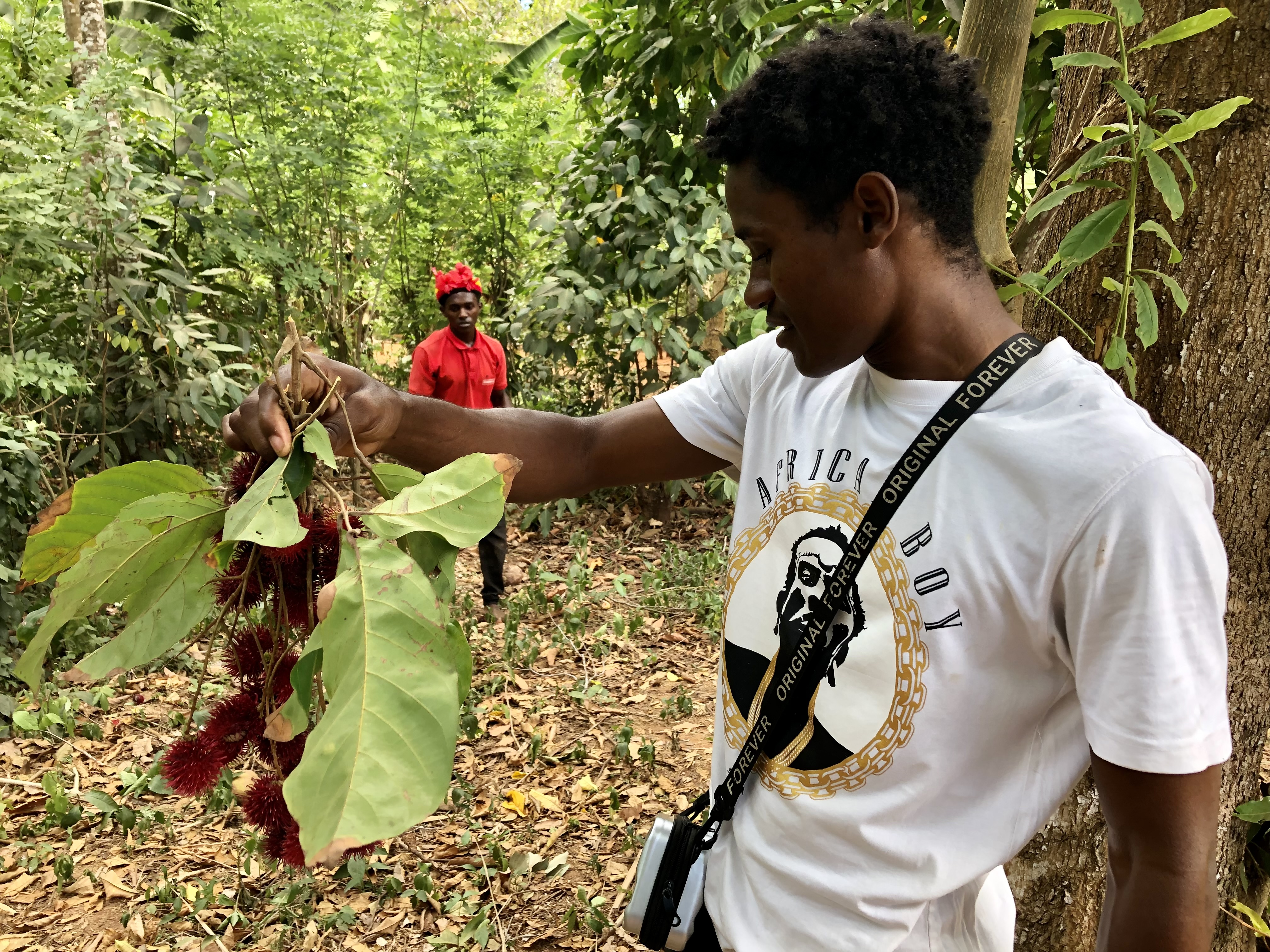 |
| Black with a pile of coconuts (used as fertilizer) and a bough of lychees cut down by Cappuccino. |
The amount of knowledge we got here was staggering. Indulge me just a little bit here.
Black pepper and vanilla? Both parasites whose vines grow up and around other plants for support.
The turmeric that we buy in the supermarket (or wherever else you buy spices) is made from the root of the plan and dried and then ground. When the leaves of the plant turn yellow, the root is ready to be harvested. Traditionally, it's been used (other than for flavoring) to help with stomach ailments, memory and skin care.
The ready when it's yellow came up again and again on this tour. We were told that as a general rule, fruits are ripe when they turn yellow or red and not while they are green. Fruits but clearly not vegetables. And I guess there are exceptions (like limes).
A banana tree takes a year to grow. To harvest the bananas, the tree is cut down because the tree is not strong enough to support the weight of a man climbing it.
Lemon leaves smell like lemon, clove leaves smell like cloves and cinnamon bark smells like cinnamon (because the stick cinnamon is actually pieces of the bark). Cloves have been used to treat fever and diarrhea. Cinnamon is also used for healing; apparently the roots smell like Vick's, not that things that smell like Vick's are automatically good for you but I guess cinnamon root is. Or is believed to be.
Ginger is used to increase endurance. Lemongrass is used to repel mosquitos. Cardamom is used to mask the smell of alcohol and marijuana by Zanzibari teens. I question how effective this last one is. Their parents have to have used this spice for sort of stuff also, right? What do they think when their kids come home smelling like cardamom? That they have been hanging out on a spice farm? Or cooking? I don't think so.
Breadfruit is used like potatoes on Zanzibar. It's also used as a laxative.
We did also see a durian tree, the spiky fruit (which resembled breadfruit) with a custard-like filling inside that is super smelly (some feel it smells like rotting meat). I guess it's not in season in March but we were told it's prohibited in Zanzibar to sell this fruit in town or even take it on public transportation. It smells THAT bad. One day maybe I'll find out. Never had durian.
That's quite a lot, right? There was a lot more. I kept notes while we were walking but am not putting all of those in this post.


 |
| Cinnamon (top), iodine (center) and vanilla (bottom). |
But we do have to spend a little bit of time here talking about nutmeg because honestly, this plant blew me away.
So first of all, nutmeg trees are big. And they are full of fruit that looks like little round peach colored balls. I never would have imagined this, probably because to me, whole nutmeg looks like a nut. I figured they would look like walnuts on a tree. Or more accurately, I figured they would look like walnuts on a maybe four foot high tree, not something 20 feet tall or so. And yes, I realize that I'm basing my preconceived impression of what a whole nutmeg plant looks like based on knowing what a nutmeg looks like but disabusing ourselves of notions like this is part of why I travel. I know this one is really pretty small compared to some other realizations I've had while abroad but they all add up.
Cut into that nutmeg fruit and you'll find the nutmeg that I would have recognized as a whole nutmeg that I could find in a spice or grocery store. But...it's not hard, it's soft. You can cut right into it with a sharp knife, revealing something that looks like a piece of brain (or maybe a chestnut is a better point of reference here all things considered) coated with a dark brown membrane. This thing, minus the cover I guess, is the nutmeg that I'm thinking of, although the one I thought about was in its dried state.
This little ball in the center of this fruit, by the way, was the object of the Portuguese launching fleets of ships to conquer the islands where this spice grew so they could control the world market in this stuff. This little thing that we had cut open for us on our last vacation one afternoon. It's crazy to think that something like this could have started a war or at least an armed takeover of several islands in the Indian Ocean.
But nutmeg doesn't stop there. When you first cut it open before you cut the nutmeg in half, you'll find a vivid red netting looking thing (I don't know how else to describe it) surrounding the heart of the fruit. This is nutmeg's last surprise. It's mace.
I have never used mace to flavor food with but I knew it existed. And honestly, I'd never given any thought to where mace came from, just like I'd really never given much thought to what a nutmeg tree or a cinnamon tree or a turmeric plant or anything else that is in my spice drawer really looks like in the wild. But the fact that it comes from the same plant as nutmeg just blows me away. I don't know why it does but it does for sure. I'm telling you...the stuff you learn when you get out of your own house a bit. It's mind-blowing.


 |
| Nutmeg. Nutmeg and mace. And nutmeg. |
I think that's about it for spices for this post. Let's spend a little bit of time on Jambo's other bounty: fruit.
There are a ton of fruit trees at the Jambo Spice Farm and for some of these where we wanted a sample and the fruit was yellow or red, Cappuccino indulged us and climbed the tree and threw us down some fruit. I had my first star fruit ever (it's good!) and we reacquainted ourselves with some lychees that I first had from close to the tree in Costa Rica last fall (Costa Rica's were better, maybe it was the season). But there's one fruit that Cappuccino didn't go get for us: coconuts. The trees are just too tall for him to climb. I'm not knocking his ability, here. No way am I getting even two feet up a coconut tree, let alone all the way up.
That's not to say that we didn't have fresh coconuts minutes or hours removed from the palm, because we did. Just that Cappuccino wasn't going to get them for us. We needed a specialist. Enter the Banana Man, who climbs palm trees with no tools other than a length of rope that he uses to tie his feet around the tree while he shimmies up to coconut height. This is a thing to behold. Look I get that he does this every day and has honed this skill (I'm guessing) over years and years and years but it was still incredible. To watch a dude climb straight up a branchless tree trunk with zero tools other than some rope and not even rope in his hands? Astonishing!
If I had some doubt about Black and Cappuccino being their real names, by the way, there's no doubt about Banana Man. No way did his parents name him Banana Man. Probably.
 |
| Banana Man climbing a coconut palm. |
There are few things more refreshing than drinking the water from a fresh coconut. I had my first one from a roadside stand in Costa Rica (complete with straw) last October. This one was just as good as soon as Banana Man had stripped it and chopped a hole suitable for making the whole thing into a giant drinking vessel. No straw this time which was totally OK. I have a thing against straws anyway.
We made full use of those coconuts. Or I guess Banana Man did it for us. We drank the water, then he carved out the meat and we had some of that. Then he found a young coconut and scooped out the young meat, which is sort of like floppy raw fish but raw fish is actually pleasing to me (at least in sushi) so maybe it's the floppy part that makes what I ate in Zanzibar texturally objectionable to me. I'm clearly not super enthusiastic about that part of the snack but I'm all in on the coconut water and the meat. We certainly didn't expect that we'd be partaking in fresh coconuts on our visit to the spice farm but fresh coconut is always welcome in my world. Just not the young coconuts necessarily.

So after walking past turmeric, papaya, avocado, banana, coconut, pineapple, vanilla, black pepper, cinnamon, star fruit, orange, lemon, durian, passion fruit, breadfruit, nutmeg, cacao, clove, ginger, coffee, aloe, lemongrass, lychee and cardamom plants, trees or vines, our time at Jambo Spice Farm was about done. All we had left was lunch. The main course was a tasty dish of rice, vegetables and chicken but not on my list of best meals ever. I appreciate the fact that pretty much everything was grown locally.
The highlight here was dessert.
Generally, I am not much of a fruit guy. I like limes, I love pineapples and I'll eat papaya any time we are in the tropics, but I can pretty much pass on the rest. But I have to tell you, the fruit we had served to us at this spice farm was some of the best I've ever had. Plus I got to try some new stuff. It was the first time for me really eating jackfruit or passion fruit. I always appreciate the opportunity to try something new, although it in no way made up for my disappointment that papaya apparently is not in season in Africa in March.
Those weren't the highlights.
If I have ever been served a sweeter juicier pineapple in my life, I don't know where it is. My standard go tos for breakfast when we are traveling in Africa and South or Central America are pineapple and papaya but I have never had pineapple that tasted like the stuff they handed out to us for dessert at Jambo. I know I just said this a couple of paragraphs ago but I do really love pineapple. I didn't really understand how good this fruit was before my day walking around a spice farm in Zanzibar. I don't want to say that this experience ruined pineapple for me because I've been perfectly happy (apparently) eating sub-par pineapple for 54 plus years and will continue to do so, but this stuff was the best ever.
The last piece of fruit they handed to us as the finale to our meal was a slice of mango. Now, mango I don't love. It's too peachy for me. It's not a pronounced peachiness but it's in there. And if you know me, you know I do not love stone fruit of any kind (cherries don't count as stone fruit here). I have never had a piece of mango as juicy and sweet and non-peachy as I had at the Jambo Spice Farm. Honestly, if every mango out there tasted like that one I ate on that day, I'd be eating mangos all the time. It was absolutely phenomenal. I need to possibly take another look at this fruit from now on.
 |
| First jackfruit ever for me. |
This is the last post I'm writing about our Africa 2023 trip. I think it's a great way to end things. Three and a half hours learning about all sorts of spices I use every time I cook (black pepper allows me to make this statement) along with some I've never even contemplated using while discovering the best pineapple and mango I've ever put in my mouth was for sure a morning and early afternoon very well spent on our first day in Zanzibar.
When we visited Portugal about 15 months before this trip I wrote that I couldn't believe I visited a farm on vacation. The cork farm we visited in Montemor-O-Novo in the fall of 2021 wasn't the first time I'd set foot on a farm in our travels around the world. I'm pretty confident that our visit to the Jambo Spice Farm won't be the last one.
How We Did It
We made our way to the Jambo Spice Farm as part of a larger tour called Spice Tour + Stone Town Tour + Prison Island that we found on Viator. I wrote about the second part of this particular tour (the walk through Stone Town) on my Zanzibar blog post earlier this month.
If you take this same tour, it might help you to understand that the dude who picks you up at the hotel is a driver only. Other than saying hi and (I guess although I'm not sure I specifically remember this) asking us to follow him to his vehicle, he didn't really tell us where we were going. If it seems sort of odd for us to blindly follow a stranger and get in a car with him on our first day in place we'd never been before, maybe you are right. We asked him where we were headed first and he told us that he was taking us to a spice farm so that made us feel more confident we were with the right dude.
Also understand when you get to the spice farm itself, there are likely going to be a number of people who help you get around the farm and learn about spice production on Zanzibar that day. Roughly speaking, there is someone to walk you around the place (in our case, Black); someone to go get fruit from various trees and to make you each a crown out of palm leaves (that would be Cappuccino for us); someone to get you some coconuts (Banana Man); someone to serve you lunch; and finally someone to carve the most amazing-tasting fruit ever right in front of you. And that's not counting your driver. Bring some small bills for tips. We weren't as prepared as we could have been and had to make change at the store at the end of our time on the farm and asked Black to hand out some money to Banana Man.
This last paragraph applies if you just show up at Jambo Spice Farm on your own. Or any of the other spice farms on Zanzibar. I imagine they are all pretty much the same. There seemed to be a number of different choices right on the road we drove along. Tip your guides, folks!
Finally be prepared to spend quite a while there and learn a lot. And enjoy it.


