Showing posts with label Peru. Show all posts

Friday, May 29, 2020

The Archives


Any post on this blog that starts with a closeup of a glass of beer has to be a good post. This is certainly not the first and likely won't be the last post that's started that way. Shocker, I know! This delicious pint of Fuller's Black Cab Stout in the matching glass (the way it's supposed to come) was captured on film (or maybe not film, exactly)  and then downed lovingly at The Hydrant pub in London right near The Monument in 2016. Yummy! Give me English beer over any other nation's beer any day!

It's now been more than nine weeks since my cancelled trip to Costa Rica was due to depart but didn't, a casualty of the global pandemic we now still find ourselves in more than two months after I was supposed to board a southbound flight at Dulles Airport. Last week, I cancelled my second trip of 2020, a long weekend in New Mexico visiting a site that I should have visited 19 years ago but which I missed because I just didn't get how big the Land of Enchantment is. Go figure! I guess now it's going to be 20 years at least.

Since I've been grounded, I've been combing through my picture archives from the last almost seven years that I've been traveling in a deliberate way and writing about it in this blog. I thought it might give me some hope for the day I can go somewhere new on this rock of ours if I posted some pictures of a great past memory. I've been doing that on Twitter every day since March 26, the day I was supposed to go to Costa Rica. As of today, I'm up to day 65. I'm going to keep going until I take my next trip, whenever and wherever that might be.

Some of the pictures I've posted over the last couple of months have appeared on this blog. Others have not. For whatever reason, they ended up on the cutting room floor, likely because I either elected not to write about that day or moment in time that I took the picture or just couldn't find a way to work them into a post. I miss writing about traveling, so for this post (and since I'm not going anywhere right now), I thought I'd write a few words about some of the photographs I've unearthed this spring. They are presented in the order I tweeted them. And, no, I'm not covering all 65 days.


Hawaii (2016)
One of the most disappointing experiences we've had over the last seven years was in Hawaii. I know, right? Who'd have thought? I sound completely spoiled. But it's true. 

We decided to spend the better part of one of our days on the island of Maui in February of 2016 by driving from Kahului to Hana on a road appropriately named the Road to Hana. It's a twisty, turny highway right along the ocean front with tons of pullouts and scenic views and secluded hikes to waterfalls along the way. It sounded cool as hell, especially when we had rented a Jeep Wrangler to get there.

It sucked. Honestly for us it was almost a complete waste of time. Sure we enjoyed a hike into the woods but other than that it was literally just a drive to a hardware store. A long, long drive to a hardware store. And I really do mean a hardware store. That's what's at the end of the road. Seriously. And nothing else. We got there, were supremely disappointed and headed back, without stops on the return journey.

So why am I reminiscing about a day that was almost a complete waste of time? Because "almost" is the key word. Along the way we stopped at Aunty Sandy's, a roadside stand selling hot, fresh banana bread, for breakfast. We walked down to the ocean and sat while we ate our loaf of banana bread and looked out at the view above. If there's ever been a breakfast I've eaten with a better view, I can't remember it. We were literally in paradise. We got nothing out of that drive except that view. And ultimately, that was enough because I'm remembering it four years later.


Venice (2015)
If there's something every first time tourist has to do in Venice, it's take a gondola ride along the Grand Canal. Sure it's overpriced, too short and a little cheesy. A complete tourist trap in other words. We did it anyway. How could we not? The Grand Canal is one of the great boulevards in Europe, albeit the only one made out of water. We have a picture in our house of us in the gondola with our gondolier smiling giving us two thumbs up after our ride. It was completely awesome, despite the fact that it's a total tourist trap.

When I was paging through my old directories of past trips, I found the picture above, which shows a series of gondolas in the foreground and Andrea Palladio's San Giorgio Maggiore church in the background across the water. For me, that church and those boats bring me back to Venice instantly. They are enduring symbols of that city. To find a picture with both in them at once brought back the three days we spent there in vivid detail. This photograph must have been taken late in the day because the gondolas are closed up for the day and the sun is hitting the west side of the church as it is setting.

I loved Venice. I thought it would be flooded and overcrowded with both tourists and pigeons. It was none of those things. I could have spent a week or more just wandering around the canals and streets of this place. It's definitely on the would love to go back list. But then again, so are a lot of places.


Brú na Bóinne, Ireland (2019)
Every so often I write almost an entire blog post about a place and then discard it. My post about Brú na Bóinne from the end of last year is the latest one of these posts to be started and never see the light of day. Sometimes I lose inspiration about a post or can't find enough to say or am just forcing things and decide to give up rather than completing something that's not worth the time and effort. With Brú na Bóinne, it just came down to not many interesting photographs. 

I've been to some pretty ancient places over the last seven years or so. Prehistoric petroglyphs in the American southwest. All sorts of Roman ruins. Stonehenge. Machu Picchu. I never would have thought the most ancient site with construction at the hand of man would be in Ireland but Brú na Bóinne beats all those other places handily in the age department. 

What we saw that day in the Irish countryside was a passage tomb, a stone structure beneath a mound of earth that's stood in place for 3,200 years. Stepping inside this place and hearing our guide talk about the history of the place and its relationship to the solstices was just amazing. The amount of labor that must have gone into putting this place together so precisely must have been staggering.

I love this picture as a reminder of what we experienced that day but I also love it because it's about the most green photograph I've ever taken in my life. It's perfect as a memento of Ireland which shone so brightly on some days and disappointed us so badly on others. A day at Brú na Bóinne was not one of the disappointing days.


Mount Fuji, Japan (2017)
When I first made my list of must sees for my one and only (so far) trip to Japan, it needed some serious editing. There's often a dilemma with me between getting into one spot in a country super deep vs. moving around and seeing a lot at the risk of spreading myself too thin. In the end, I think I sort of split the baby on Japan. Mount Fuji made the initial list and survived the cut down.

There's not much to a visit to Mount Fuji unless you are intending to take a hike right to the summit, which in mid-May we weren't planning doing. We hopped on a bus for an hour or two and got dropped off about halfway up the slope on the north side. There's a store and some food vendors and (of course) a Shinto shrine but not much else. You just sort of do what you can until the next bus shows up to take you home or wherever the next stop is that you have a ticket for.

But there's something about Fuji. It's a picture perfect single volcanic peak and its shape couldn't be a more idealized cone shape. It's like a cartoon image but its presence and meaning in the lives of the Japanese is huge. It was important to me to stand on the mountain on my first visit to Japan. So we did. 

The day we were there it was about impossible to photograph the mountain either because of the cloud cover or we weren't standing in the right spot or there was some object or human in the way. This picture is my favorite of the day, taken from the front steps of the Komitake Shrine where I purchased what is now my niece's goshuin-cho and then half filled it with goshuin, the calligraphy and temple seal artworks that you can collect from each temple or shrine you visit in the country. To me, this picture reminds me of how cold and isolated and spiritual it was on Fuji and it also shows off the peak of the mountain which I love.

I can almost guarantee the reason why this picture hasn't appeared on this blog before this post is that it has a portrait orientation and plain and simple I usually use landscape orientation or square photographs in this blog. Today, that doesn't matter.


Roosevelt Island, New York City (2019)
I am pretty sure without really checking too closely that I've visited New York City more than any other destination in the past seven years. I don't think there's really any need to check. I just know it's true. Despite all the time I've spent in the Big Apple, I've only written one post about my experiences there, a 2015 visit to the Statue of Liberty's crown.

The reason for this is simple: we are usually in New York to do the same things we love doing over and over again and by that I mean Broadway shows, trips to Kalustyan's to stock up on spices and chutney and our new tradition of dinners of chicken skewers at the excellent, excellent Tori Shin restaurant in Hell's Kitchen. Simply put...New York is where we would live if we could afford to live in the manner we want to live there. We can't. So we don't.

Every so often I do something in New York that approaches post-worthy status. My trip to Roosevelt Island in the middle of the East River last year almost made it. As many times as I've been to New York, I'd never been there before last summer to see the ruins of the old smallpox hospital and Louis Kahn's Four Freedoms State Park, which was executed posthumously (and therefore in my opinion not the way Kahn would have done it; the great architects always tweak during construction). It's totally worth a trip.

One of the best parts of this day was getting to the island, which can be visited by bus, Subway or ferry. Or you can take the tram, which takes you above the city from 2nd Avenue to the middle of the East River. You'll get some killer views of the City as you ride alongside the Queensboro Bridge for the low, low price of a Subway ride. The picture above shows the tram approaching the Roosevelt Island terminal. Do this if you are in New York, even if you turn right back around and go back to Manhattan.


Ollantaytambo, Peru (2019)
Last year we spent about a week deep in the heart of the Andes exploring the cities and towns and citadels of the Incan Empire. Our trip took us from Lima on the coast of Peru up to the Incan capital of Cusco and then over to a spot where we hiked for a day to the royal retreat called Machu Picchu.

When the Spanish conquistadors "discovered" the Incan Empire in 1526, they took what they wanted almost from day one. The Incas proved no match for the Spanish from the very first engagement although it was really the horses that they couldn't compete with. A man who has never seen a horse before in his life is no match for a trained and heavily armed soldier on the back of a 2,000 pound animal. Almost every engagement the Spanish had with the native Peruvians resulted in a victory for the Europeans except one: Manco Inca's stand at Ollantaytambo, a fortified hilltop between Cusco and Machu Picchu.

Today Ollantaytambo is one of many sites with ruined but mostly intact Incan masonry structures, a testament to the timeless quality of Incan construction. And like some of those other sites, the remains of building at Ollantayambo are in what seem like the most remote and most inaccessible locations you can possibly imagine. 

This photograph of some abandoned grain warehouses is my favorite of our partial day stop in town. I appreciate the way these old buildings are just clinging to the most precarious of slopes and blend in perfectly with the mountainside. We didn't have time that day to explore these ruins but I got as far as I reasonably thought I could from our tour group to get a picture I thought I'd be happy with. And I am.


Kyoto, Japan (2017)
I know, I know, I already put a picture of Japan on this post. What can I say? Japan was simply one of the most amazing places I've ever been. I can't wait to go back. And yes, it's ahead of Venice. Way ahead.

It's difficult to describe all the ways I love Japan from my week and a half or so there in 2017. It's a place with so many details. Tradition. Respect. Humility. Incredible food. Gorgeous nature. Spiritualism. Cutting edge modern anything. Boozy late nights of karaoke. The markets. The temples. The bars. Cleanliness. Order. Speed. Crowds. There are so many sights and smells and tastes and sounds to take in.

As we walked around Kyoto, which is the traditional capital of shogun-era Japan, I couldn't help but notice these red paper lanterns with birds on them. They seemed to be everywhere in that city as we roamed the streets and alleys in search of geishas or gyoza or street markets or temples. I took this picture because I wanted to find one of these lanterns in a store and bring it back and hang it in our home. We never found a paper lantern store. But this is still one of my favorite details of Kyoto.


Serengeti National Park, Tanzania (2018)
We've been fortunate in the last five years to have taken two safari trips to sub-Saharan Africa. We spent less than a week in primarily Zimbabwe and Botswana in 2015 to get our feet wet and then really did it right a couple of years ago by spending a week each in Kenya and Tanzania. The diversity of wildlife and the almost completely untouched environment is like no other place on Earth I've been.

In 2015 we didn't know what to expect. We were happy to see anything that we'd only ever previously seen in a zoo somewhere. Fortunately, elephants, hippos and lions featured heavily. In 2018, I went with a top 10 list of species that we hadn't been able to find on our first trip. I think we got seven of the ten. Maybe eight.

Never in my wildest imaginings would I have expected to find the birds in Kenya and Tanzania to be one of the more fascinating aspects of that trip. I've never been much of a birds guy (ostriches and storks and things like that don't really count here) but those two weeks in eastern Africa, particularly at Lake Manyara and Serengeti National Park, really opened my eyes and I fell in love. Who knew lilac-breasted rollers and carmine bee-eaters could be so interesting? The picture above shows four superb starlings. I love how the colors pop against the thorny gray tree (always with the thorns in Africa...) they are roosting in and I love that I got a group of four all in one shot. I have no idea how this didn't make my Serengeti post. Too focused on the wildebeest and zebras in that location I guess.

One day soon, I'm hoping that I'll be writing again about some new places I've visited. I have to find a way to do some low risk traveling sometime in the next three months and hopefully I won't be cancelling any more flights or hotels. I'll leave this post with a black-backed jackal at Lake Nakuru in Kenya. Haven't posted this one to Twitter yet but I'm sure it's going to be there if this thing goes on long enough. Stay safe out there.

Wednesday, July 10, 2019

Salt Of The Earth


Of all the seasonings, herbs and spices man has found to put on food to make it taste better, salt is the most essential. Skip the parsley, sage, rosemary and thyme along with the black pepper and achiote (random, I know...) but don't skip the salt. Not only does it enhance the flavor of pretty much everything, it's also vital for good human health. Low amounts of salt in the human body have been linked to unhealthy levels of cholesterol and triglycerides. We have to have salt in our diets in some way and some foods just don't contain enough so we have to add it from elsewhere. 

And yes, of course, too much and...maybe not so good for the blood pressure.

Salt is easy to get a hold of if you live near the coast. Just capture some seawater and evaporate the liquid to leave the salt behind. But how do you get some if you live in the Andes? Well I guess that involves mining (salts are trapped underground by long ago evaporations of seas and lakes), which is a whole lot more work, or stumbling across a stream that has salt in it and finding a way to extract the salt from the water like they do at the beach. And that's exactly what the Incas and their ancestors did at a place called Maras, about a 45 minute or so drive from Cusco.

I am fascinated by how mankind processes food. The simpler the product, the more I am intrigued. And salt has to be one of the simplest but most necessary foods out there. So with a free day at our disposal at the end of our epic Peru trip, I had to take a trip out to Maras to see how salt is farmed in the Andes. Had to!

The salineras de Maras. The most gorgeous brown landscape I've ever seen.
The town of Maras sits within the Maras District of Peru and it's pretty remote. There are a mere 7,500 or so people living out there in about 53 or so square miles. Most of these people to us seemed to be concentrated in the town center area, which is marked by a series of large but seemingly run down or abandoned mansion sized houses with elaborately carved door frames at their entrances.

The place where the salt is farmed is just a bit north of town in a clay valley. Take the winding road to the salineras and you will come across about the most gorgeous mostly brown landscape I have ever laid my eyes on. At the bottom of the canyon is a series of maybe 3,000 or so mostly rectangular pools of water subdivided with walls, paths and channels to make a giant farm where salt is extracted seemingly from the very Earth itself.

Nobody knows how long these pools have been here. And by nobody I mean I couldn't find it on the internet and Paul, our guide for the day, didn't know either. Paul did offer the opinion that maras might mean salt and mentioned that the Quechua (the language of the Incas) word for salt was kachi. That fact seemed to indicate to him that the site pre-dates the Incas, meaning before 1425 or so. He then dropped a potential origin date of 1000 to 1500 B.C. That's a long time to be farming salt.

Who knows whether the information in the previous paragraph is true or not. I couldn't find any information to refute it. Still, take it with a grain of, well, you know...

The first pool. The rock in the lower left just above the stream is a key.
So how's this whole thing work? Well, first you find a stream that's flowing out of a mountain that tastes salty. And not salty like the sea. Not fishy. And not rotten egg / sulfur smelling salty or laden with iron salty due to those chemicals being present in some mined salts. No. I mean salty, like fresh water mixed with a  little salt ripe for the harvesting. Like the stream flowing out of the southwest corner of the canyon near Maras. Yes, we tasted. And yes, it didn't taste like seawater. It tasted like water in the kitchen that's been salted. Seawater makes me choke sometimes it's got so much salt in it; the salt stream at the salineras de Maras did not.

Oh, and it helps if the stream you find will run for like a couple of three or four thousand years. If you are going to set something up on this scale, it better be worth it.

Stream coming out of mountain. Got that? Good. Not so easy to find but they got one at Maras.

The evaporation part is simple. Just isolate some of the running water into an area where the water can lie still and let it bake in the sun. Eventually, all the water will be sucked away and you'll be left with some salt. Just don't do it so much in the rainy season. Sound simple enough?

How about some questions.

What's the right substrate for the pools so the water doesn't all just leak out? Or soak into the dirt on the bottom and sides? How do you get the water easily and efficiently from a running stream into a still pool? How do you get to the pools to harvest the salt? And when you've got a thick layer of salt sitting in a mud rectangle (or close enough) how do you scrape it all up without getting a whole bunch of soil in there so that folks will want to season their food with it. Salt: good. Dirt: not so good.

The edge of the salineras with the clay cliff beyond.
More salt pools. The one with the wavy lines is in the process of being prepared for filling.
The Andean people who've been living in Maras for a long long time figured all this out.

An ideal material to form the bottom and sides of each pool is clay. It holds water pretty well and as luck would have it, there's a whole hillside of it in the canyon wall facing the pools. We could hear the SLAP! SLAP! slapping of men extracting and then softening the clay while we were there. The pools are resurfaced on the bottom after each harvest. 

To get the water to each pool, you just need a complicated web of canals and sub-canals to feed each and every pool. So that's exactly what's been built. Each pool also has a key or piece of stone wedged into a small channel at its edge which can be removed to allow the constantly flowing water to seep into the empty (and fully prepared for holding salt water) clay-lined rectangle. All full? Replace the stone key and lock out new water, allowing it to continue to serve other pools.

After about a week or so (or three to four weeks during the rainy season), you'll have yourself a cake of salt on a mud bed. Get to it by walking along the walkways which resemble balance beams in some spots and start harvesting, which you do in three levels. 

The first level of salt at the top is fine and can be used in your typical household salt shaker. The level below that is courser; if it were in France it would be called fleur de sel or flower of salt. You can pick up almost 9 oz. of this stuff at Williams-Sonoma for $14.95 plus tax and shipping. Here in the Andes it's called flor de sal and at Maras it costs 2 Soles for a whole 9 oz. In case you are comparison shopping, 2 Soles is about 60 cents.

The third and bottom layer is the stuff that's got the clay in it and it's just not suitable for consumption at the dinner table so it's reserved for medical use according to Paul. We didn't ask what medical use. We were far more interested in the food thing.

The main tourist path with pools on both side. The woman on the right is cleaning salt layer three from a pool.
A typical harvest from one of these family-owned pools yields about 50 to 60 pounds of salt. It doesn't seem like it should be that much but volume is deceiving sometimes. There's a refinery or factory of some sort directly on site which bags the salt into pouches weighing a few ounces to sacks weighing 50 kilograms. 

Some advanced planning, a little work preparing the beds, a week or month or so of waiting, a harvest and some processing gets you salt. In a part of the world completely separated from the ocean by miles and miles across and up. This place was pretty incredible to see. It's so simple and ingenious. It's just science at its most basic level. I would have loved to have seen someone figure this whole thing out.

At one time in human history, salt was worth a fortune. Those mansions I mentioned earlier in the town of Maras? All financed by their salt operation. Those fancy carved door frames? Symbols of their affluence and wealth. So what happened?

Well obviously salt is no longer as valuable as it once was. Now it's a commodity, not a luxury item. We can get more than a pound and a half of salt for about a buck fifty at our local Safeway store whenever we want (ironically still more expensive than what we picked up at Maras, although it's admittedly a quicker trip to Safeway). There's never been a run on salt at the store based on a pending shortage that I know of.

But according to Paul, Maras was a victim of a vicious rumor that alleged the salt from that location caused the growth of goiters (of all things). People stayed away and got their salt elsewhere and the wealth of the town collapsed, leaving those once impressive mansions looking like they do today, abandoned in the middle of a very harsh climate but still radiating a little piece of their faded glory. As with all of Paul's stories, our fact-checking proved useless so those grains of salt I alluded to earlier? Take a lot of them.


We looked pretty hard for a way to fill our free day in the Andes. We considered a trek to the Rainbow Mountain which seemed to leave way too early (like 4 a.m.), involve too much hiking (like a couple of hours) at too high an altitude (like 13,000 plus feet above sea level). We also almost bit at a condor watching expedition before realizing it involved a similar start time and about as much walking in as hostile an environment as the Rainbow Mountain deal. When I saw photographs of the brown pools of Maras I knew we had to go there. It's not often in life I'm drawn to brown but it happens sometimes and sometimes I fall hard.

I have not had much of an opportunity to experience a place like this but I have plenty more spice places on my list which is for-sure-definitely-not-no-way a bucket list. Our time in Maras was short. We were on a schedule and we were hustled out of there. But I'm honestly not sure what else I would have lingered for at this place. Our short time seemed enough. This place is so simple and so valuable at the same time. Now I just need to go somewhere black pepper is grown.


How We Did It 
Maras is an easy drive from Cusco and admission to the property is easy enough. There's an entrance booth where you pay your 20 Soles (about $6 US as of this writing) and from there you can make your way to the canyon and check the place out.

Since we like to drive as little as humanly possible on vacation, we traveled to Maras with Inkayni Peru Tours on their Maras-Moray-Chinchero half day tour. We found these guys through Viator but there's no reason you need to go through that website. Just save the cost of the service charge you'll pay to Viator or better yet, tip your guide or driver or both a little extra. Yeah, I know I already said this exact same thing when talking about the Chinchero portion of that excursion but you can never remember enough to tip when you are on these tours. And don't forget the driver! He's working too!!

Inkayni Peru Tours were great to us and I'd highly recommend their service. The best part about the tour we took is that it's private so you don't have to share it with anyone else.  Sure it costs a little more but it allows you a little bit of control over the agenda. No matter how you get there, I'm confident Maras will be amazing for you.

Saturday, July 6, 2019

Mercado Nro. 1


Before we headed up into the Andes to visit Cusco and Machu Picchu, we spent a day in Lima. Just one. We figured we weren't really going to Peru to see Lima but couldn't just fly in one night and leave the very next morning either. So...what to do in 24 hours in Peru's capital city founded way back in 1535 by the conquistador Francisco Pizarro? Visit the historic center? Get out of town to see the Nazca Lines? Check out some pre-Inca ruins? Go surfing? Swimming with sea lions?

Nah, none of that. We decided to just go to the market and shop for groceries.

So, not really. But sort of. We really signed up for a cooking class. We knew when we booked this activity that we'd be heading to a market to find some foods we'd probably never heard of or seen before and then to a restaurant to prepare some food. We just didn't expect that the restaurant would be right in the middle of the market. Not that there was anything wrong with that. In fact, it might have been better to have stayed in the market.

I've been making latin food for a while now, ever since I taught myself to cook a little in upstate New York with a very limited Central and South American pantry before moving down to the Washington, D.C. area and finding that chiles (beyond serrano and jalapeño) and achiote and banana leaves and things like that really did exist in this country. But Peruvian food? Never really got that far south. I was excited to find some local ingredients and make something more indigenous to Lima.

Gotta have fish for ceviche. A couple of damselfish (or chromis chromis if you want to get technical) please!
Cooking might have been a bit of a misnomer for what we chose to sign up for. We didn't actually use any flames or heat to make our lunch. We also didn't just settle for making a Peruvian sandwich. On the menu? A quick pisco sour, one of Peru's signature drinks, followed by some ceviche, which is probably the dish linked more with Lima than any other. I've made ceviche at home once before, but it was made with a decidedly Mexican emphasis, which is where I've tended to stop more than anywhere else in my cooking adventures. Let's do this one Peruvian style.

But first, some shopping. Welcome to the Surquillo district of Lima. Welcome to Mercado No. 1 (or Nro. 1 in Spanish).


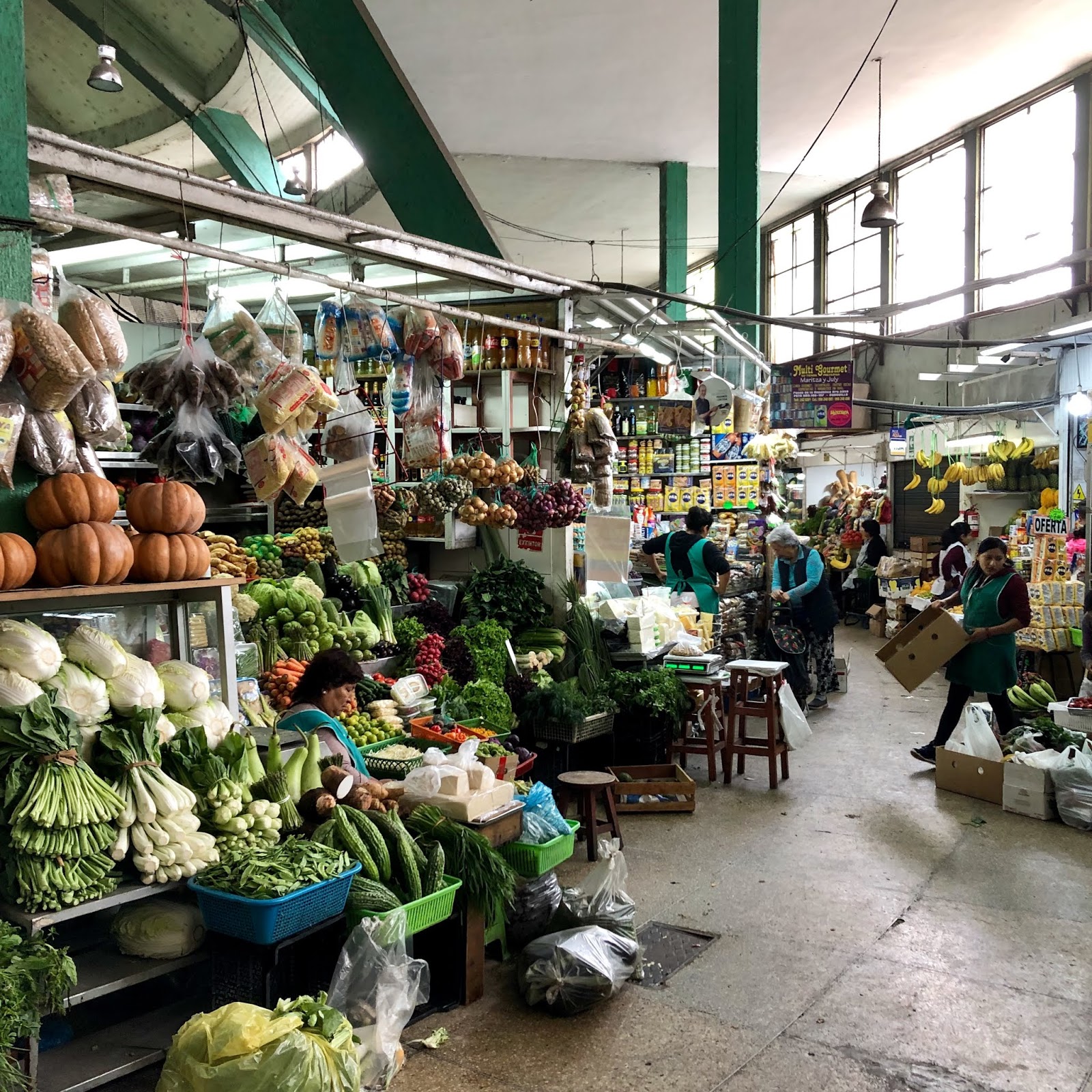
This is definitely not your standard American supermarket. Or even your local farmers' market. For a start, there's a map. I mean I guess it's a good idea because the place is pretty big. Think city block sized with a couple of concentric rings of stalls and stands and restaurants making up the place. And you can get everything there. I think if it walks or grows or swims in or off the shore of Peru, they will have it at Mercado No. 1 at some time during the year.

We didn't buy meat in our quick morning shopping trip but we could have had our choice. Chickens? Got those! With head or without? Which ever way you want. Shellfish? Plenty! Fish fish? Yep, plenty of that too; after all, how else are you going to make ceviche without fish? To clarify here, we did use fish but just didn't shop for it. How about some beef? The only answer here is which part? Because you can get every part of the animal. We didn't check out all the choice cuts suitable for aging in a gourmet steakhouse back home but we did get a good long look at the stomach (tripe), tongue, liver, heart, lungs and some other parts which wouldn't be my first choice for dinner on a weekday. Or any day, for that matter.

But if I was taken aback a little by things that aren't available in the Safeway down the street from me in the butchery, at least I could recognize the animals. The fruits and vegetables were a different story.

Not sure I've ever seen cow lungs (second from left) just hanging from a hook before...
or purple corn. Who knew there was such a thing?
I like to think that the foods that I've cooked and the places I've been to have exposed me to a pretty broad range of things that grow on or under the surface of the Earth as well as on vines or trees. The very first food we tried in the market was a prickly pear fruit (otherwise known as a tuna) and I was proud to raise my hand when our guide asked if anyone had ever eaten one before (I made prickly pear sorbet once a long time ago). It was all downhill from there.

Purple corn? Who knew? Dried mushrooms that I can't recognize. And all artichokes don't look the same? What's up with that? Jars of stevia leaves? That's what goes in the little green packets in the diner, right? The sugar substitute that's not Nutrasweet? Maca? Caigua? I mean...what? Cherimoya? Roots that don't look anything like any sort of root I've ever seen except maybe for taro (which is delicious...yummy taro!). Chiles and citrus fruits that don't look like the ones we get at home. And sweet cucumber? That can't be good if tastes like anything resembling a cucumber. Yuck! to cucumbers. How are there all these foods I've never seen before in this one little market in Lima?

And that wasn't even exploring Peru's 4,000 different varieties of potatoes. 4,000 is NOT a typo!

Pineapples, artichokes, some kind of squash (spaghetti maybe?), aji amarillo, eggplant and a root.
A whole lot of cherimoya.
After a quick circuit around pretty much every stall in the market (with a stop for a taste of some prickly pear tuna!) it was time to stop looking and time to start cooking. One cherimoya, a couple of aji limo, a sweet cucumber (please let it taste good!!!), some cilantro and a couple of red onions (thank God I know what something is that we are dealing with) and were are off to El Cevichano, a ceviche stand in the center of the market, where we met up with our other ingredients for the day: some pre-chopped damselfish, a bottle of pisco (Cuatro Gallos brand, if that means anything to you), a bottle of simple syrup, some eggs and a whole lot of lime juice. And I do mean a whole lot.

When I travel, I usually have a list of foods, drinks and dishes that I want to try. My Peru list had pretty much five things on it: a pisco sour drink, some chicha, alpaca, lomo saltado and ceviche. We were about to make two of those five. The one ingredient I hoped we'd cook with was an aji amarillo, or yellow chile, because it was the only Peruvian cooking ingredient that I could recognize. We saw some, but didn't use them; the aji limo was used instead. Aji,by the way, means chile. Didn't know that. Now I do.

First up: some fruit and a refreshing pisco sour. Pisco is a distilled spirit made from grapes. In other words, a brandy. It's pretty much the national drink of Peru. Or it is in my eyes anyway and it was a must have for me when visiting the country both straight out of the bottle and in mixed drink form. We used the modern 3-1-1 formula for making a sour, meaning three parts pisco to one part each simple syrup (sugar water) and lime. Add an egg white (I was asked if I know how to separate an egg for this like it's a skill that most 50 year old men do not possess), shake with ice, strain and finish with few drops of bitters. One pisco sour coming up!

Pisco, by the way, was invented when the importation of Peruvian wines was banned into Spain because the quality was too high. It was killing the Spanish wine industry. Faced with losing their product in the hot Peruvian summers, the winemakers decided to try their hand at distilling. And pisco was born.

And I do know how to separate an egg. I can't fix hardly anything that breaks around the house but I know how to separate eggs. And much more.

Pisco sour. What I traveled thousands of miles to taste. Had one later at a bar. That one was better than mine.
I thought I might bring myself back a bottle of pisco as a souvenir and a rare foray into the duty free shop on the way home. After a sip of Cuatros Gallos which I'd characterize as a mild flavored liquor that didn't burn on the swallow but didn't leave me craving more, I decided I'd pass. And the pisco sour? The first thing I blurted out was that it tastes like a margarita. Excuse me for being Mexico-centric but it did. It was good. I don't need one any more than I need a margarita. There's a time and a place.

The traditional way by the way to make a pisco sour? 4-1-1. Maybe I should have tried that.

Our fruit with our pisco sour? The sweet cucumber and our cherimoya, also known as the custard apple. Thank God the sweet cucumber was melon-y with very little actual taste rather than cucumber-y. Other than that it was forgettable. But the cherimoya? Pretty UN-forgettable. First, it's soft, almost liquid-like I guess (maybe smooth pear or...could it be custard?) with dense black inedible seeds. The taste is like Granny Smith-Jolly Rancher with hints of pear; sour and very, very intense. I'm not sure I'm eating a whole one of these ever but it was good. Very tasty.

Alejandro slicing into the custard apple. Sweet cucumber on the left.
Now that we were warmed up, it was time to make some ceviche. Our group (the two of us plus three other travelers from Australia and England) teamed up to slice some aji limo and the red onion and pick some cilantro off the stalks we had bought. If there was one dish we tried to track down at a restaurant in Lima and make a reservation before we landed, it was ceviche. I'd read about the many, many cevicherias all over town but found most only operated at lunch time since Peruvians generally choose to eat ceviche for lunch. 

The problem with this is that we'd be cooking during our only noon-time while we were in the city. Lucky then that we'd be making the very dish we were seeking out. Maybe not as good or inventive as we could have eaten in a top cevicheria but there's something about making dishes yourself which is extremely satisfying.

Ready to start making ceviche. The purple liquid in the glass is chicha morada, a drink made from purple corn.
We winged it. We made the whole thing by taste and sight. No recipe. Just trial and error. And I know that if you know me, this made me a little uneasy (HAVE to follow the recipe!). A couple of spoons of damselfish, a little aji limo, some onion, a dash or two or three of garlic-ginger mixture and a sprinkling of salt and white pepper. And lots of lime to cook the fish and some cilantro to finish.

That's right. The lime is our cooking agent here. I already said no flame remember. That's what makes ceviche ceviche. The acid in the lime juice changes the protein of the fish to make it appear and feel like it's been cooked. It took maybe five or six minutes for the fish to turn opaque and look like it was no longer raw. Taste. Adjust. Taste. Adjust. Repeat until just right. Then eat.

Chromis chromis with onions, cilantro, aji and lots of lime.
The fish-chile-onion variant of ceviche is typically Peruvian. No avocado or tomato like you might find somewhere more north like Central America. This is the dish classically prepared in the area of the world where it was thought to have been first invented. I've tried hard to find these types of dishes in my travels. I've just never had one that I've made myself before.

This is the first time I've traveled somewhere and cooked the local cuisine. I consider cooking to be a serious hobby and I'm glad I did this. If there's a complaint to be made, it's that the dish was fairly straightforward and simple. Not that there's anything wrong with that, but I'd love to try this again with something more advanced. 

The big thrill for me here was walking the market and marveling at kinds of foods I either couldn't identify or those that I'd never seen the way they were displayed in Mercado Nro. 1. I sometimes leave a lot of pictures on the cutting room floor when I write these blog posts. Among the ones that didn't get posted were a freshly cleaned pile of cow bones, multiples pictures of chickens hanging upside down with their heads attached or not attached and vats of spicy sauces. I could have done this by myself I guess but it wouldn't have had the same pace and level of discussion. And no way would I have bought myself a custard apple.

Mercado Nro. 1, Surquillo District, Lima.

How We Did It
Mercado Nro. 1 is located in the Surquillo District of Lima. If you are staying in the Miraflores District (where a lot of tourists stay), it's just about an easy kilometer's walk from John F. Kennedy Park. It's open to all and walking around and buying produce was super simple.


If you opt to pick up some groceries, you probably can't sit yourself down and make your own ceviche at El Cevichano like we did unless you arrange it in advance. The only way  I know to do that is to go through Best Bite Peru, which is exactly what we did. While our tour was a little bit different than described on their website (I believe we booked the "Cooking In Local Market" tour), it was nonetheless a great way to spend half a day in Lima. If you get Alejandro as your guide, tell him we said hi.

Sunday, June 30, 2019

Scritti Politti


I guess this makes two posts in a row where I'm writing about walls in Peru. Very different kinds of walls. But walls nonetheless.

I have so many great memories of my week in Peru. Some of those are perspective-altering, monumental experiences I will carry with me for the rest of my life. Seeing Machu Picchu, the lost city of the Incas, for the first time, and then exploring it the next day. Hiking almost eight hours on a path laid down by the Incas more than a half a millennium ago. Exploring a farm that's been extracting salt from the same stream for hundreds of years. Flying over the Andes and then driving and walking on them the next day. Eating foods that I've never heard of and some that I certainly can't get on a menu at home. Alpaca, anyone?

And then there are some others that are, shall we say, a little more pedestrian, but which nevertheless form an essential part of my memory and an enduring image of Peru. Dogs roaming the streets in packs of two to five animals; apparently pets let out for the day but the best behaved dogs I've seen maybe in my life. Pairs of tiny clay bulls or "toritos" on the ridgeline of every house you drive by; ages-old idols to protect against lightning hurled down from the gods above. And walls just about everywhere painted with political party slogans and logos and names of candidates. I thought they were cool works of art although I may just have a signs fetish. So here's blog post number two in a row about walls in Peru.

The rainbow flag has been adopted as a symbol of the Andean people and can be seen everywhere. 
Politics seems to be a pretty popular topic of conversations with Peruvians. We got an earful from every taxi driver and tour guide we seemed to run into or walk with or ride a bus with. And with good reason. They have to have one of the most dysfunctional governments that is still a legitimate democracy.

I know that if you are American you have to be laughing right now. I mean how could any society really have a system more broken than the one we have in Washington right now? I mean literally, nothing is getting done right now. One half of Congress is passing bill after bill and the other half is just refusing to take any action at all. It's insane that we are paying these people to work for us.

Anyway...think we got problems? Talk to a Peruvian taxi driver.

Tired of a two-party system? Try more than 30. Fed up with politicians taking money from special interests instead of representing the people that elected them? How about having all your living ex-presidents in jail for money-laundering, bribery and corruption? Does that sound bad? It is. And it's not like there's just one ex-president still alive. There are three! And one of them has his wife in jail with him.

The yellow house with the pink roof is one of my favorites, often with Elvis right next to it. Assuming not Presley.
It actually gets worse. There would have been a fourth living ex-president in custody right now if he hadn't killed himself earlier this year to avoid arrest. All told, there have been six presidents since 1986 in Peru (not counting the current president) and five of the six were indicted or arrested or convicted or jailed or something. The only one that wasn't was an interim president whose only job in office was to find the next president. Where's all this bribery come from, you might ask? Apparently...Brazil. It's a real problem.

Emotions run deep here. And not in the ways you might think. Some people actually feel that some ex-presidents despite obvious wrongdoing should be walking free. Especially when it comes to Alberto Fujimori who served as head of the country for 10 years from 1990 to 2000. In his time in office, Fujimori legitimately did some good for the country, especially in stabilizing the economy and defeating insurgent groups within Peru, most notably the Shining Path, a Maoist revolutionary army of sorts. 

But apparently Fujimori was a little too zealous in his pursuit of wiping out the rebels because he got some non-rebels killed in the process. Which led to human rights violations accusations, a self-imposed exile in Japan, an impeachment, an arrest during a trip to neighboring Chile (I mean, why go to Chile when you are wanted in Peru?), a conviction, jail, a pardon by a successor president and an overturn of that pardon by the legislature which kept him in jail which is where he is today. And despite all that, there are a significant number of Peruvians today with a positive opinion of Mr. Fujimori, including the driver that took us from the airport to our Lima hotel and think he's done enough good to offset the whole corruption thing. Politics is complicated in Peru.

But that's not what this post is about. Not really.

Avengers Party? Not really, although at least two of our guides made reference to the A meaning that in jest.
So about those 30 plus political parties, which seemed chaotic at first but which I might welcome right now based on how stagnant our government here at home is. One of the benefits of having that many parties in Peru for someone infatuated with painted signs is that there are a whole lot of different colored signs by the sides of the road to look at and take pictures of. And they are not just here and there. Once we left the historic city center of Cusco they seemed to be everywhere. And I do mean everywhere. 

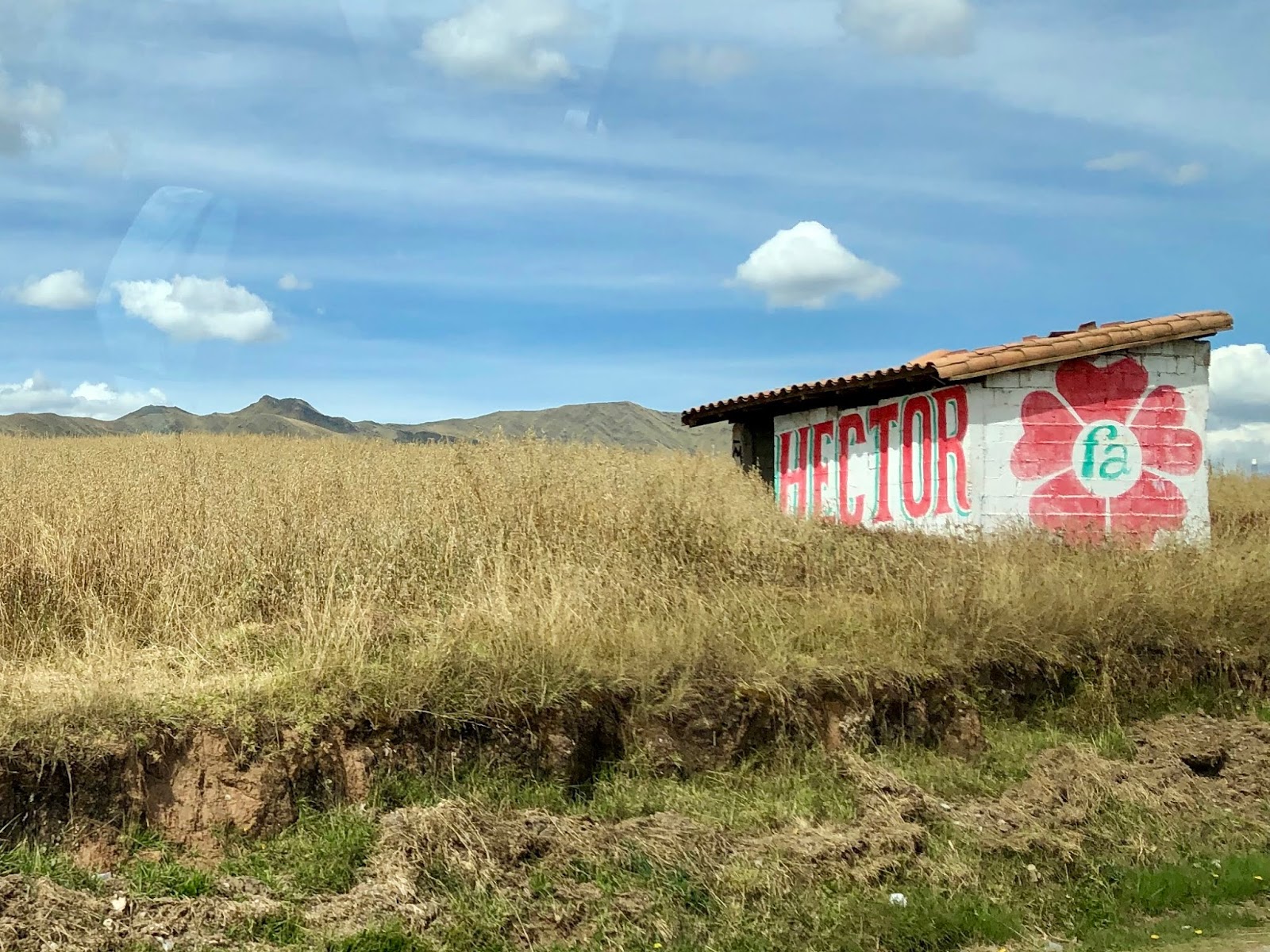
As graphic statements a lot of these signs are simple and powerful. Most feature the name of one or more political candidates along with a symbol of the party they represent. The names are always written (or painted really I guess) in the exact same colors and font. The symbols next to the names vary: a football (meaning soccer ball) or a shovel or a flower or a rainbow flag or an Andean head or a heart or any other sort of symbol that might become enough of a brand that could become associated with a name.

Football behind the lamppost.
I love how simple and straightforward the designs are and how different parties use different colors so that every color in the spectrum is collectively represented (although I guess all you need there is the rainbow flag sign to really do just that). They have to be simple so that they can be replicated over and over by many different people painting their own houses. And yes, that's what happens. Apparently people willingly decide to go to the hardware store (or wherever one buys paint in Peru) and buy their own paint so they can make the wall of their house or garden into a political advertisement. We were told that most people hope for favors after their candidate wins. Not sure how that works out.

There's also a story about the symbols. As attractive and graphically powerful as they are, they sort of seem unnecessary, unless you consider that significant parts of the population of the country are illiterate. Can't read your candidate's name? Just vote for the shovel! Or the rainbow flag or whatever else it is. How this process works on election day I'm not quite sure. Does the ballot have names and symbols next to the names? Didn't ask that question I guess.

I know, I know, all this sounds very complicated, right? Why wouldn't someone just not bother voting and take their chance with whatever party gets elected? I mean the odds that one of the more than 30 parties will get a majority is astronomical, right? There has to be a coalition or consensus of some kind to get things done, right? Surely someone sitting out a vote every now and then because they can't read couldn't hurt, right?

Wrong! Voting is mandatory in Peru. If you don't vote, you get fined. How awesome is that? Some politicians go to great lengths in my country to make it extremely difficult for some people to vote. Peru made it a requirement. Love it! Thus the flower and the football and everything else.

Vote for the flower!!!! Whatever that means in terms of the candidate (Hector, I guess?) that would be elected. 
I didn't actually take the time to track down what each sign meant or how things worked on election day with the whole pictures thing. I figured that would spoil the whole magic of this entire experience for me. Once I start getting entangled with politics, I'm not sure anything could save me. Better that I just appreciate these signs for their graphic quality. That's what drew me to them in the first place after all.

It is rare that I encounter something unexpected that intrigues me like this. Far too often on trips, I think of writing about these things too late (still regret missing the boat on the Yule Lads in Iceland...) so I'm glad I didn't let this opportunity slip by this time. 

Some of the pictures in this post are less perfect than I would want. If you'd noticed that (or more likely you hadn't) it's because I took every one of them from inside of a moving vehicle with a pane of glass between me and my subject. I'm pretty happy with the way they turned out even if I missed a few (regrets on missing the shovel especially...). But realistically, how many pictures of these signs could I have really posted? In case you think six is too few, here are two more to close this post.

I'm not exactly sure the llama logos (hidden behind the tuk-tuks in the last photo) are part of a political campaign. I didn't see these anywhere other than in the town of Chinchero. But they were one of my favorites so I couldn't pass up sharing them. May your next trip be full of surprises that bring you joy the way these did for me. 


How We Did It
Take a ride in any sort of vehicle outside of the historic center of Cusco and you are bound to find one or two of these signs. Keep going and you'll find more. Keep going further and you'll find more still. The best part of this part of our trip? It didn't cost us anything extra. If you want better photos than I got, ask you driver to stop and let you out. Just ask them to wait for you though. Happy hunting!