Showing posts with label Bee-Eaters. Show all posts

Sunday, March 3, 2024

Bengal Floricans


The temperature is a little north of 85 degrees and the sun is just starting to clear the early morning Cambodian haze and we know the humidity that comes every day in this place is coming as soon as the sun really clears the horizon properly. We are in the middle of nowhere (seriously...nowhere) walking in a dried-up rice paddy that seems to go on forever. It's dried-up because it's the dry season and if it weren't there's no way we would be where we are. Dry means dry in Cambodia. That concept is reinforced with every step as the leftover rice stalks or whatever it is we are stepping on try to scratch our legs above the ankles. Thank Buddha I wore my boots out here.

We are here to watch birds and this is supposed to be fun. We're on vacation after all. We are specifically searching for something that looks like a large-ish chicken called a Bengal florican. It's not really a chicken; it's actually a bustard. And despite the fact that there seems to be about no cover to hide them, we can't find a single one of these things. What are we doing miles from civilization and a good distance from our car tramping over the dried earth and finding nothing in the middle of southeast Asia?

So, yeah...we are birdwatchers. There's no doubt about it now. This seed was planted in Tanzania's Lake Manyara National Park way back in 2018 and nudged along a bit during our trip to New Zealand about a year later. Then the COVID-19 global pandemic struck and we started watching what was going on bird-wise in our own back yard. Surprise, surprise, we found more than just the two or three brown species of birds that we thought were out there. We've been hooked ever since. We've been taking one or two trips every month since last summer to local spots around our house. Seemed logical we'd see what was out there in Cambodia, right?

Still...those Bengal floricans. Where were those things? It's getting hot out here.

Dirt track near dry rice fields, Cambodia. 6:09 a.m. also known as "breakfast time".

It's day two of our Cambodia journey. We have just three nights and two full days in country with a bit of a day on either side so day two is really day last. We have planned to pack a lot into those two full days. That's not unusual for us. On Cambodia day one, we got picked up at our hotel at 4:30 a.m. to make a long overdue pilgrimage to Angkor Wat at sunrise and beyond. On Cambodia day two we went birdwatching. Pickup time for day two? You guessed it: 4:30 a.m. It's hot in Cambodia. Like really hot and very humid. Starting early is a good idea. 

We made it to our hotel lobby a couple of minutes before pickup time. Hang, our guide for the day, is already there. He's way upbeat. That's good, I guess. We are still so jet lagged that we don't know if we feel tired or not at 4:30 a.m. We pile into his car with the driver, make a stop to pick up breakfast to go and we are off heading east for parts unknown. We honestly have only the foggiest idea where we are going. East, Hang says. If you feel good about getting picked up in the middle of the night by a stranger in Cambodia and loaded into a car (we did!), east is about all we need to know.

The ride to wherever we ended up (and I am in no way confident I could tell you exactly where we were that morning) took about an hour and a half. To pass the time, Hang told us about what we would see, filled us in on any questions we had about life in Cambodia and told us corny jokes. I am not equipped with a memory bank of jokes. I've tried to remember some from our travels. Hang crushed me with his joke portfolio. 

Q: What did the fish say when he swam into a wall? A: "Dam!"

Q: What do you call a fake noodle? A: Im-pasta.

I know...they are terrible. And that's all I remembered. There were a lot more. By the way, a photograph of a sign with a Bengal florican picture on it is below. That's what we were looking for. Not a chicken; it's a bustard. And yes, the picture below is in color. I guess the Cambodian sun fades signs eventually. Or quickly maybe.
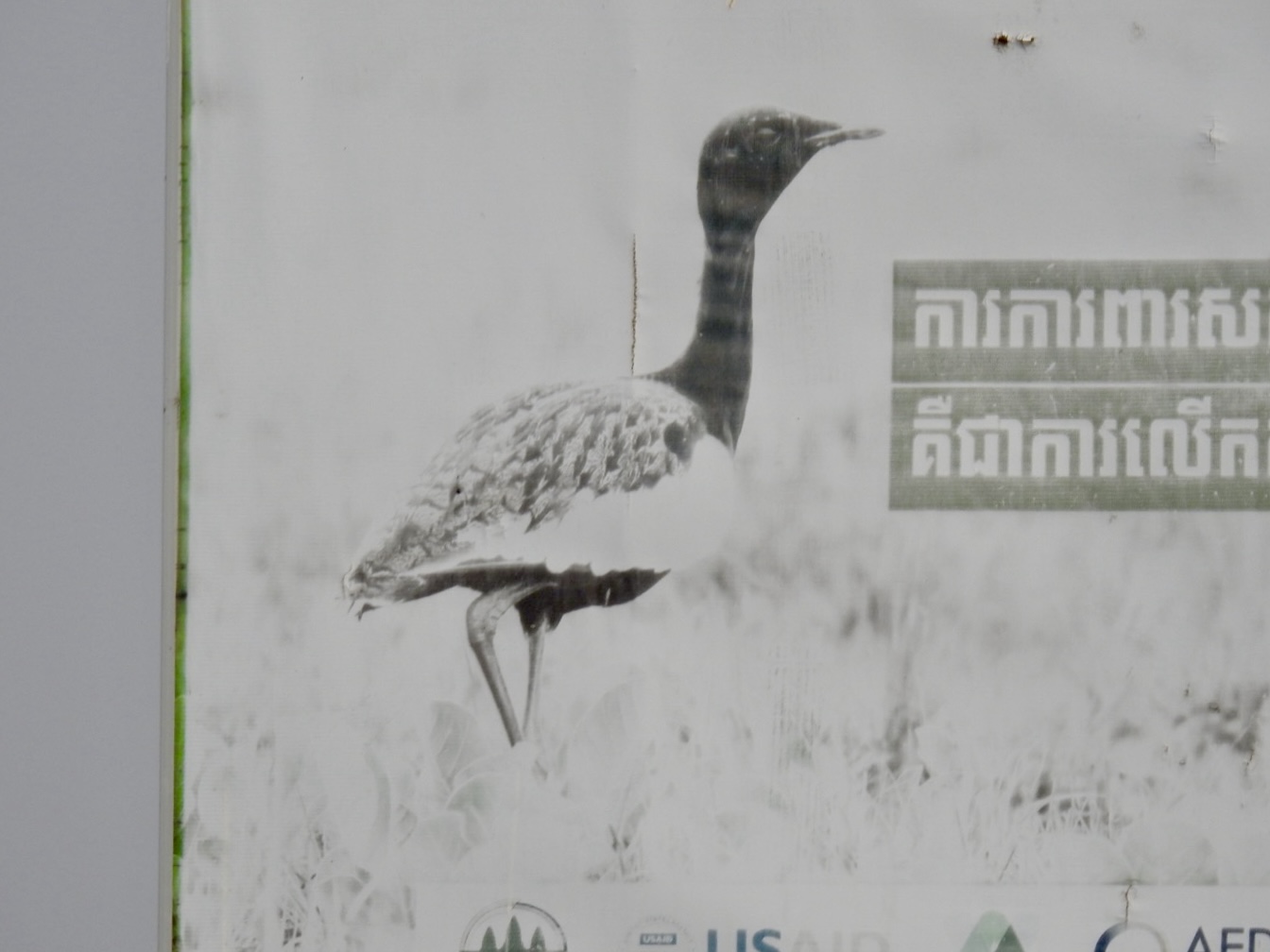
There are not many Bengal floricans in this world. The species is listed as critically endangered because as of 2017, it was estimated that there were fewer than 1,000 of these birds alive in the world. If you want to try to find one in the wild, you'll have to do it in one of two parts of the world: an area in northeast India and Nepal stretching into Bangladesh or a spot in Cambodia possibly stretching into Vietnam. I know, those areas sound huge and if there are only 1,000 (maximum) spread out over those giant areas, finding one on a February morning in a rice paddy in rural Cambodia (which is not a small place) sounds like quite a chore. 

So why are these bustards so rare? Well, like most species that are in decline, habitat destruction seems to be a big reason. Floricans occupy a space on the planet which humans would rather use to cultivate rice. But here, it appears that the florican could co-exist with man as long as man would just leave them alone. Which, of course, we don't. People in Cambodia need to eat and in some parts of Cambodia, there's just not a lot of food. And Bengal floricans have been traditionally very easy to catch and kill and eat. They draw attention to themselves during mating season and they nest on the ground.

There may be some hope. There is a program set up in Cambodia to reward farmers for finding and protecting florican nests. Find a nest, report it, have it verified and then keep protecting it while the nest is active gets you money. The earlier you find it and the longer it is an active nest under your protection, the more money you get. People are essentially being paid to resist eating something that they have found. Hang didn't really tell us or speculate on how the program was affecting the population but there is some information out there on the internet (dangerous to rely on this stuff, I know) that suggests the current numbers are more robust than the 2017 numbers. Still, even if the number is double (and I am completely making that up), the totals are still very small.

Finding a Bengal florican in a rice paddy would be difficult. There just aren't a lot of them anywhere.

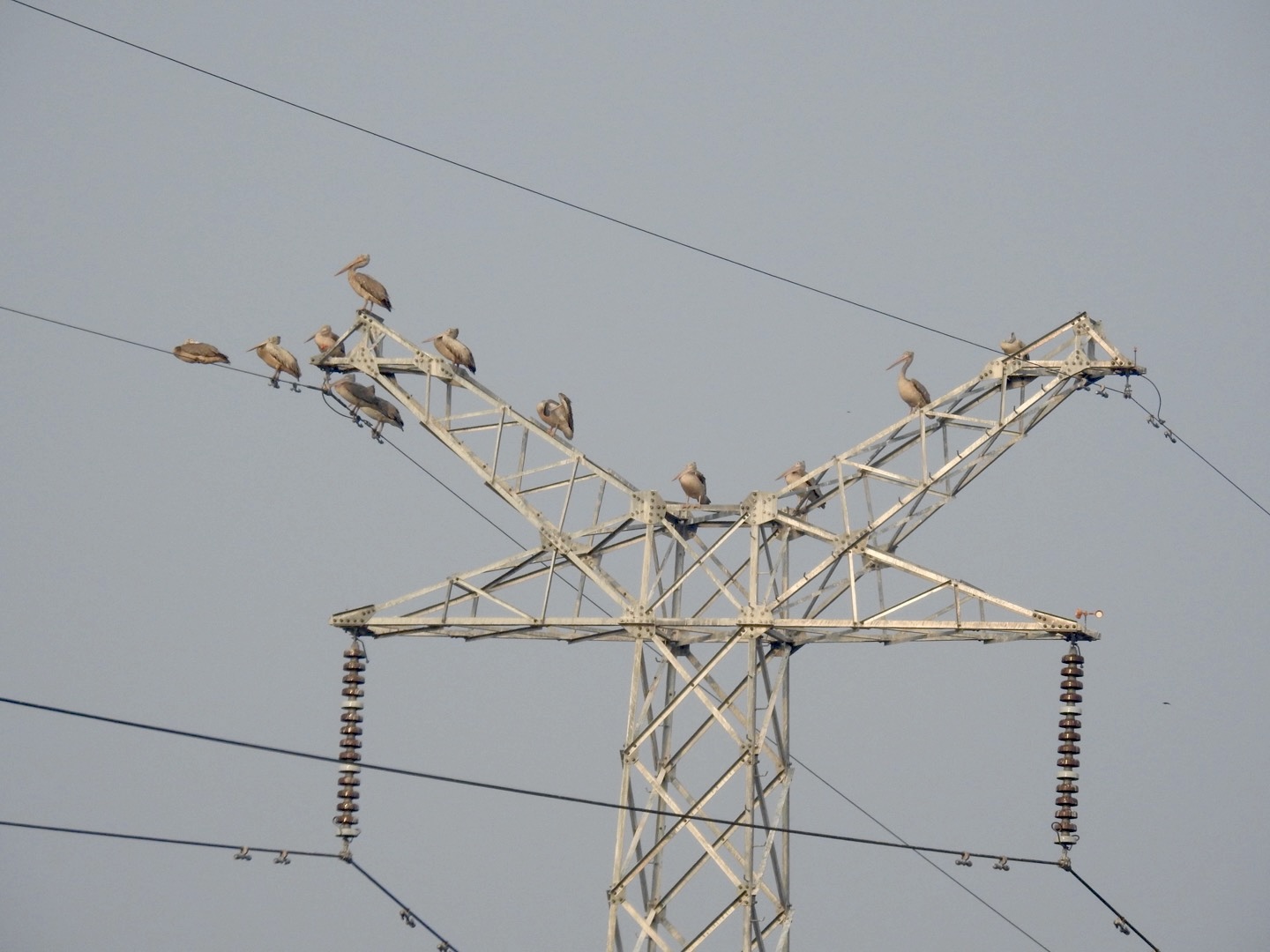
Our team of bird-spotters that morning ultimately swelled to six: the two of us, Hang, our driver and two dudes on motos (that's Cambodian-English for motorcycle) who joined us about the time we parked the car on the dirt track we'd been driving along after leaving the main road. Now legitimately, there was a lot of bird activity in the spot we stopped. Not Bengal florican activity but tons of small birds flittering about and refusing to stay still long enough for me to get a good photograph.

Of course, that's what I'm after, right? I do want to see birds but I also want some souvenirs, which means crystal-clear pictures of colorful little creatures that we can't see at home. I am not a binoculars user. I can't work them with my glasses on and my eyes are so bad that I can't get binoculars adjusted to allow me to see. So my binoculars are the 83x zoom camera we've been dragging all over the world with us since 2017. It allows me to see things at a distance and if I'm quick enough, I can snap a fuzzy or gorgeous picture in the moment. Hopefully gorgeous.

That first hour looking for Bengal floricans got me the two pictures above. Literally, those are the only two worth showing anyone and I have no idea what the little bird is. It's not even clear enough for me to get Merlin to say what it is. Obviously the other is a pile of pelicans on a telephone line, which is something I couldn't even have imagined ever happening until I saw it in real life. 

These pictures in no way reflect what was going on around us. Harriers. Egrets. Storks. Cuckoos. Bee-eaters. All there. They just wouldn't sit still or were so far away that the haze coming off the Earth didn't make for anything like a quality sighting or picture (and those two are of course the same). And of course, no Bengal floricans. None. Not a one.

Time to move. Off the road (meaning the dirt track) and into the rice paddies. 

It worked. Sort of. We ended up positioned at the edge of a paddy near a couple of bushes and a sort of overnight shelter on stilts. I'd call it a blind but I'm not sure that's what it was. I think it was probably built to house rice field workers, not to watch birds. But we got more results here. Pied bushchat (above). Black drongo (above above). Brown shrike. House sparrow (not exciting but seriously). Pied starling (below). Black-collared starling (below below). All sitting on poles that man had installed at some point or on top of one of the two bushes or even on some leftover rice stalks. 

But still...no Bengal floricans. This likely wasn't our day to see these birds. All the same, we started walking into those dried rice paddies. 85 plus degrees. Haze clearing. Humidity coming. Those stalks scratching over the tops of our boots.


And then...one of our spotters swore he saw a Bengal florican somewhere in the paddy. He'd seen it through his binoculars and pointed us to more or less where it was. Let's fan out and walk in a straight line to flush it out. This sounded like some results. I ran point. I was told that it was right in front of me and all I had to do was walk to where Hang was pointing. I followed instructions.

All four of us walked step after step more or less in line, scanning in the brush that we passed as we came to it. There was no way. No way was there a couple of feet high bird out in this place and I swear that we walked further than Hang told us to. No Bengal florican. Not here. Not today.

And right after I was about to give up, there was a flutter and a rustle. Not from in front of us. Not from along side us. From BEHIND us. Bengal florican aloft and flying away from us. 10 or 15 feet off the surface. Camera up. No time to focus. Just point and shoot and hope before it lands. Boom! Bengal florican photograph. Seen it!

I know. It's not a great photograph. It's hazy. You can barely see the bird but it's clearly there, although it's not clearly a Bengal florican closeup but what other species would it be. Was this worth it? Are we satisfied with this? Not remotely. But you know what the best part was? 

We saw where it landed.

I kept my eyes on that spot and walked towards it with so much purpose. No way was I going to miss it like before. And I got there with no bird fleeing to somewhere that I couldn't reach or anything like that. But I'm telling you, this thing disappeared. I didn't get close enough to one of these things to know really how big they are, but based on the photograph above, we are clearly talking about a bird that's about two feet or so high and about the same length back to front. But it was absolutely nowhere to be found. And there just wasn't that much cover. But it was gone. Disappeared into thin air.

We quit. We signed up for a morning of birdwatching and we needed to get back to Siem Reap. We had a planned stop to see some spotted owlets in a tree where they hang out but that would be it. One Bengal florican, some starlings and an assortment of other small birds, including some distant looks at bee-eaters. And if you know anything about me, you know I love the bee-eaters from a couple of trips to Africa.

Look, there are no guarantees with nature. We know this. We know we are at the mercy of whatever Mother Nature wants to allow us to see.


The rest of our morning was incredible. We were NOT done.

The owlets were awesome. We expected one. We got two. They were extremely active. They fought. Or from our perspective they at least quarreled. They were loud. And they seemed to keep looking down at us like we were bothering them, which we probably were. But it made for some great photographs. This was almost like a staged encounter and that's totally OK. I can totally get the concept of seeing birds where they usually hang out. Not sure I'd ever seen an owlet before so this was special.

Also, our Bengal florican encounters were not at an end. Our spotters had found a pair right before the spot where the owlets hang out and we moved back into the rice paddies, although we had to move a herd of cows a bit out of the way to get there.

I'm not going to blow-by-blow our second trip into the paddies. It wasn't a whole lot different from the first encounter with these birds except: (1) we didn't walk past any floricans this time and (2) there were two and not one. 

So the proof of our second encounter is below and it's actually the best of three pictures I took of one bird (I completely missed the other). Three pictures. Got that? I don't know that this necessarily fulfilled us florican-wise on this day trip but I think there are two things to keep in mind as I think back on this day. With nature there is no guarantee (I know I already said that but it bears repeating). We've been out there looking for wildlife all over the planet and have had amazing encounters and have been disappointed. Expect the latter and hope for the former. 

And if there are just 1,000 of these birds on the planet, we just saw 0.3 percent of the entire remaining population in one half day trip from Siem Reap with not much effort. Think about that. We may have seen 3 of the remaining 1,000 of an entire species anywhere. In a rice paddy which we didn't even cover anywhere near comprehensively in about four hours. How lucky are we to have had these results?


Now, if the picture above and a couple of photos of spotted owlets seems a bit underwhelming to have me label the rest of our birdwatching experience "incredible", you would be correct. 

To me, a great birding experience comes with a couple of signature encounters. They might not be what you came for and they might not even have to be a brand new species. But if there's a connection made with a species that is unlike any other past trip you been on and had with that type of bird, then it can be amazing. It might be something small, it might be something transformational. You know it when you find it.

Checking out the spotted owlets and finally, finally finding a Bengal florican or two were definitely two looks at birds we have never had before, but the quality and intimacy of the florican sightings left a lot to be desired. So we needed something more to put this day over the top. 

Enter the bee-eaters.

I saw my first bee-eater in Lake Manyara National Park in 2018. I realize I already talked about that trip as sort of the genesis as my serious interest in birdwatching. We followed up that introduction with two different species of these birds on a day cruise along the Kazinga Channel that connects Lakes Edward and George in Uganda. That was just last year, less than 12 months ago. Bee-eaters fast became one of my favorite kinds of birds. They are so colorful and well put-together; never a feather out of place. They are not toucans or hornbills but they might be on par with kingfishers and eagles and things like that.

When we moved off the dirt track and onto to the rice paddies for the first time we saw one green bee-eater from a distance and managed to get just-at-the-camera's-range picture which I have found to usually yield a little bit fuzzy and slightly unsatisfying results (I'm not posting that one). But at least we got one. Then on our way over to see the owls (and before our detour to find the two additional floricans), we found a couple of blue-tailed bee-eaters just sitting on a small plant near the ground and managed to get the pictures below.


This is a gorgeous look. They stood still. They posed. I love how colorful these birds are. I love their black beaks that continue going onto their heads as black masks of sorts. And I love the red eye that's visible in the last of the three pictures. Very cool sighting. These couple of minutes with these two birds definitely made this trip worthwhile. On top of seeing in person what has to be one of the rarest birds in the world. 

This whole trip took about eight hours. 4:30 a.m. to about half after noon. With 90 minutes to two hours for each leg of the trip, that got us about 5-1/2 hours in the field looking for birds and getting these 13 pictures of what we found. Totally worth it. Our ride for the day was set up through the Sam Veasna Conservation Tours which runs birding tours to various points in and around Siem Reap. I'd have nothing but good things to say about our day with Hang and the rest of the guys who helped us along that day and I'd do something else with this company if I ever found myself back in Cambodia any time in the future, as remote as that seems right now. 

I know that 4:30 a.m. pickup time sounds rough. But when you only have two days to spend in a country, there's one big advantage to starting that early: you get to do other stuff later in the day. As long as you can find a way to stay out of the Cambodian afternoon heat. 

Friday, April 28, 2023

From Edward To George


Our trip to Uganda earlier this year was the third safari trip we have been on in the last eight years. If I'm predicting the future here, this will not be the last one. There are at least one or two more out there in next few years, I'm thinking. Yeah, I know I said that in my last post also.

This trip was a little bit different from the last two times we've set foot on Africa. Many of our days this year involved seeking out a single species in a specific location, rather than venturing out into a landscape inhabited by a variety of animals to see what we could find. That resulted in three days devoted almost exclusively to chimpanzees, gorillas and shoebills. All good stuff, but at some point we wanted some real variety and the opportunity to see multiple species co-existing next to each other. We hoped we would have that opportunity on two safari drives in Queen Elizabeth National Park scheduled in the middle of our itinerary.

Sometimes nature cooperates spectacularly and sometimes it doesn't. And quite honestly, it didn't at Queen Elizabeth. Yes, we saw lots of Ugandan kobs and buffalo and waterbucks and some hippos and a few lions from a distance doing not much at all, but we also spent time driving through a scorched earth part of the park on our second drive with no wildlife to speak of. In defense of QENP here, our first drive did feature some excellent looks at a family of elephants, but by and large, we didn't get what I expected out of two trips into the park.

I realize I am spoiled here. Excellent looks at a family of elephants is considered a sort of failure. Hey, I wanted more.

After our morning drive on our second day at Queen Elizabeth, our schedule had us taking a boat trip on the Kazinga Channel, which I honestly knew nothing about. It was an optional activity which I read as not essential (I mean I know that is what optional means...) because the quality and quantity of what one would see on such a trip would not measure up to what was in the Park. Of course, we went anyway. Why would we not? It's not like we are going to skip some experience in a place we will likely never visit again.

Good thing we did. THIS was the safari experience we needed on this trip. 


A pod of hippos (including one albino) and an hadada ibis.
On Uganda's western border, the one it shares with the Democratic Republic of the Congo, there sit two lakes: Lake Albert (named in 1864 after Queen Victoria of Britain's deceased husband, Albert) and Lake Edward (named in 1888 after Queen Victoria's son, who later became King Edward VII). Neither of these names, of course, are the original names of the lakes. They were given those monikers after being "discovered" by British explorers in the nineteenth century. 

Just east of Lake Edward, there is a smaller lake located entirely within the borders of Uganda called Lake George. This one too is named after a British monarch, Queen Victoria's grandson, who later became King George V. Lake George is also not the original name of this lake. Like Lake Edward, Lake George got its current name in 1888. In fact, it was the same person, Henry Morton Stanley, who named both lakes.

I know that's altogether too many royals. For the record, the original names of these lakes, which are still used by some, are Mwitanzige (Albert), Rwitanzigye or Rweru (Edward) and Katunguru (George). I always think it's important to recognize the names given to places by the people who were there first. It should also be noted here that Idi Amin Dada, who served as the third president of Uganda, re-named Lake Edward after himself in the 1970s but, well, he didn't last very long after that and when he was deposed, I believe his name was erased from pretty much everything. That tends to happen with deposed dictators. But that's a whole other story and one that won't be told on this particular blog.

Queen Elizabeth National Park, the one that produced less excitement than hoped for us in terms of safari drive wildlife sightings, surrounds the entirety of the Uganda side of Lake Edward and extends eastward all the way to Lake George. Between the two lakes and entirely within the park, there is a 40 kilometer (25 miles for those of us who don't speak metric) or so long waterway called the Kazinga Channel. The channel is about 500 to 600 meters wide (about a third of a mile) and isn't that deep at about nine to ten meters (30 feet) at its deepest point. It's a perfect habitat for a number of species of animals and birds, and particularly for two of Africa's largest mammals. 

Maybe that's where all the animals we didn't find in the Park were.


A totally different pod of hippos (with some African buffalo) and a Nile crocodile.
Our cruise vessel for our afternoon on the Kazinga Channel was a not-so-sleek looking green boat with a canvas canopy supported on some poles mounted to the outside of the port and starboard sides. Other than the fact that it pretty much perfectly seated our group of 12, there was nothing ideal or remarkable about this craft. We added a driver (Eddie) and a guide (Monday) and we set sail. We were not setting any speed records in this boat but then that was never the point to begin with. Let's go find some animals.

Before we do, though, let me say that I may have our guide's name wrong. I usually write down peoples' names when we meet them in the Notes app on my iPhone. I neglected to do so here. I know our guide was named after a day of the week and I know it wasn't Wednesday through Saturday, but there's a chance his name was Sunday or Tuesday.

He was amazing, by the way. As was Eddie. These guys worked very hard to get everyone on our boat some incredible looks at and pictures of wildlife. And the boat that I just mocked? It was awesome too. It took us close to some animals and brought us back and remained afloat. What else did we really need?

It may seem counterintuitive to be excited about a water safari. I mean, you might be thinking what happens if the animals move away from shore and onto the land? And while sure that's an issue, the same question is valid when you are in a vehicle on land. You can only drive in certain parts of the parks. It's not like you can follow a lion or a herd of elephants somewhere if they move away from where you are watching them from. If they decide to move away from the road, you cannot chase. 

There are a few advantages to a water safari. 

First, you can see animals in the water or along the shore that you can't see on land. You aren't likely to see crocodiles or wading birds like herons or storks or ibis in the middle of the savannah. There's no food there for any of those animals and they might themselves become just that for some other predator. Before you roll your eyes at crocodiles and birds, let me say you haven't seen true beauty in a reptile until you have laid eyes in person on the Nile crocodile and its gorgeous light green skin. Just beautiful.

Second, animals which venture down to the water often stay there for a while. There is little that is going to move some of them out voluntarily. Water is life, after all.

Finally, animals don't typically attack in the water. There are some exceptions but it's difficult for animals to move quickly in water and maintain speed. Quite simply, you can get closer most times that you ever would on land.


It didn't take long after we set off from the dock to find our first major wildlife sighting. Right along the edge of the channel was a very large pod of hippos cooling themselves off in the midday sun. Included in their number was an albino hippo, the first time I have ever seen such a thing. Sunburn is a problem for hippos in general in Africa. I can't imagine the peril if there is less pigment in the skin. 

When we first traveled to sub-Saharan Africa, one of the animals I wanted to see more than most was a hippo. These things are huge and I wanted to get up close and personal with one or more than one to the greatest extent possible. An adult male can weigh up to 3,500 kilograms. That's almost 8,000 pounds. And all they eat is vegetation. They are crazy big.

We definitely saw lots of hippos along the Chobe River in 2015. We also found out that they don't particularly do much. They just sort of cluster together in the water with their heads above the surface and float or stand there. They generally don't get out of the water, they don't interact with each other and they don't do much moving around, at least not until it's pitch black at night and you can't see them at all. The luster around hippos that I had before that first trip fast faded away.

We didn't spend a lot of time watching hippos on that first safari trip. We found a lot but we didn't linger for one reason and one reason alone: they are very territorial and can be very aggressive. So, yes, I know I wrote earlier about animals not attacking in the water. The hippopotamus is definitely an exception to that rule. If you are in a small boat, like we were on the Chobe seven plus years ago, the prospect of an adult male hippo moving deceptively quickly in the water in your direction is a scary thought. But in a larger boat that's clearly larger than the largest male? They are not so tough. In a larger vessel, you can linger and watch. 

That first group of hippos we saw in the Kazinga Channel wasn't the only pod we saw. That first group (and I'm going from memory and counting heads on pictures) was maybe 15 or 20. The next group we found was probably double that size. We did have one male from that second group charge our boat but he bailed out before he got close to us. He knew he wasn't going to overturn us and eventually, I guess, he figured we were probably not going to harm him or his pod. So he went back to being a hippo. Which is all we really wanted.

We encountered some incredible hippo things on the Kazinga Channel. We saw what was probably the smallest baby hippo that we will ever see. Monday told us it was born just two days earlier. It was so new, that the placenta was still clinging to its mother's body. TMI I am sure there but this baby was super, super small. Of course, it was already in the water. You can see its back and the back of its head next to its mother's head in the last picture above.

We also witnessed a bit of a hippo fight, although it appeared in the end to be a misunderstanding and not a fight between males for dominance or something like that. There is nothing like a hippo or two or three clashing in the water to draw your attention to them. These things are giant (I know I already said that) and they displace a ton of water when they move quickly.

The last thing I'll say here about hippos is about that baby. Just before we headed back to the dock, a crocodile slid into the water near the baby. The mother moved in between the croc and her newborn and essentially escorted the crocodile back to shore. The crocodile did not fight that escort.


So, hippos were obviously one of the two "Africa's largest mammals" in the Kazinga Channel that I referenced earlier in this post. The other was also equally obviously the elephant.

So here's the thing about elephants and water. They need a lot of it every day. An adult elephant needs about 180 to 220 liters of water per day (in addition to about 650 pounds of food per day) so when they get to a spot where they can drink, they are liable to stay there for a while. And when they do, they are completely exposed to view. Both those things are great for elephant watching. They also can't hide any members of their group (like babies) in quite the same way they can when they are traveling from place to place. Everyone drinks, so if you are elephant watching, you get to see all of the herd.

Hippos might charge a boat, even if they have no chance of toppling it, but elephants don't. They just aren't fast enough in water. So while they may perceive us tourists as some kind of threat, they don't see us as scary enough to move away and they don't have the ability to attack beyond some kind of on-land bluffing and blustering (we did get this behavior from one bull who shows us ears-out how tough he was going to be in the future but ultimately, he ran away). It's a perfect situation for watching and learning, particularly because the nervousness at being out in the open causes the herd to behave in unique ways, particularly as it relates to sheltering their young (see the picture below where the very tiny baby is drinking wholly underneath its mother).

Truth be told here on this boat cruise, we had a good idea that we'd see a lot of elephants because after we were done eating lunch that day, we saw about 30 or 40 elephants drinking at various times with a boat really close to them. We figured (correctly) that we would likely be on the same boat later that same day. When we watched from the shore, the elephants kept coming, more and more one after the other. There were an astonishing number there for us to see. The photographs below are from that viewing before we boarded the boat. 

There's one other advantage to watching elephants from the water: the viewing angle is better. I'm serious. You are generally closer to the ground sitting in a boat than you are standing in a vehicle. Add to that the fact that the boat is likely usually sitting lower than the shore and you pretty much have a perspective with these animals like you would have if you were standing next to them. But without actually standing next to them. So...longer looks, more open looks, better perspective. Being on the water is the way to go.

We had a couple of really intimate experiences that stand out on this boat ride. And yes, intimate applies to elephants like it does for gorillas and chimpanzees. There is some real high intelligence looking back at you. 

In addition to the young bull who tried to scare us off, we spent a good amount of time watching an older bull feed while standing in the water. Monday estimated his age at 25 years (the oldest recorded elephant age in the wild is 89) and we could definitely see some scars as a result of those years, mostly in the rips and tears in his ears which we were close enough to see without binoculars or zoom lenses. There is something incredible and peaceful about watching an elephant just eat. The way they use the tips of their trunks to pluck vegetation off the plant or out of the ground then spoon it into their mouths while looking around and showing enough size to make anything the size of a boat know how much power there is there. I could honestly just watch all day.


The one real drawback to a water safari is there are some species you just aren't going to see much at all if ever. Cats and other predators are probably not spending time at the river during the middle of the day. Too hot and too much work. Now, seven or eight years ago, I would have been thrilled with a whole host of hippos and elephants with a few crocodiles and buffalo thrown in for good measure. But to make a water safari truly special today, there has to be something other than hippos and elephants. Ours had birds.

I know, I know. I get it. It's always about the birds with me lately. But this trip was a true bonanza. I went to Africa this year with hopes that we would see some kingfishers and some bee-eaters. We saw three species of the former and two of the latter on this one cruise through the Kazinga Channel alone. But better than just seeing them, we saw them being active and we saw some species in pairs or groups rather than just one bird by itself.

So...bee-eaters. These birds, as their name suggests, exist on a diet of bees, wasps and hornets. They are brightly colored and have curved beaks which I can only imagine is specially shaped somehow to catch their favorite foods. We watched one blue-cheeked bee-eater dart back and forth from its perch on a thorny tree to dive over the channel and repeat and repeat. They are tiny and fast and about impossible to photograph because they are seemingly constantly on the move. We did manage to get a couple of good snaps of a pair of cinnamon-chested bee-eaters (behind some vines) before they flew off and we never saw them again. The blue-cheeked bee-eater also managed to stay still just long enough for me to get one or two good pictures. 

I should note here that taking pictures on a rocking boat is way more difficult than on a stationary vehicle on land. Also, Eddie, our driver, was instrumental in a lot of these bird sightings. Huge kudos to him there.


On the kingfisher side of things, we saw three different species of kingfisher in our week in Uganda in the Mabamba Swamp, the Queen Elizabeth National Park and at the Kazinga Channel. Those three would be the brightly colored malachite kingfisher, the black-and-white pied kingfisher and the woodland kingfisher. The malachite is incredibly difficult to get on film. Or it was the day we cruised the Channel. Explaining why there are no pics of that one on here.

There were far more pied kingfishers to see that afternoon than any other species. We managed to see them perched in ones, twos and threes and also fishing. Threesome of pieds seemed to be really common, with at least two of them fighting while the other watched. Males competing for females, maybe? 

We also managed to see a woodland kingfisher catch a fish that seemed to be about the size of its head, bash the fish on the tree that it was perched on (to kill it, I guess) and then down it in on smooth gulp. I love these sorts of looks at birds and animals because they don't happen every day on every trip. Observing behaviors is definitely a cumulative experience that requires a lot of luck and/or a lot of trips. I'm up for both. Now I just need a lot more time off.


In addition to the bee-eaters and the kingfishers on our Kazinga Channel cruise, we saw ibis and lapwings and Egyptian geese on the shores and red-billed oxpeckers picking at open wounds on the backs of one or two hippos (lovely stuff, I know...). We also found a pair of my most favorite birds of prey, the African fish eagle.

If there's a more perfectly put together bird of prey out there than the fish eagle, I don't know what it is. We first saw these birds along the Chobe River in 2015 and then again at Lake Manyara National Park in Tanzania in 2018 (the same place we first saw our first bee-eater) and I fell in love both times. You might think they look very much like the bald eagles that you can see in the United States and you wouldn't necessarily be wrong. They both have dark bodies with white heads, they both build massive nests and they both have yellow beaks with striking eyes. Yes, I realize the massive nests doesn't describe either species of bird at all.

The difference for me (and where the fish eagle separates from the bald eagle) is in the details. The fish eagle is sleeker than the bald eagle; its shoulders are not so obvious as its American counterpart and its head tapers into the body in a much more elegant way. The coloring is also far more striking. The fish eagle's head is whiter and extends further down its torso; its beak is a much deeper yellow and tipped in black; and its eyes are dead black. The bald eagle is more muted, with almost blond eyes. Fish eagle wins hands down here. It is one of the most put together, while also being a vicious hunter, birds out there.


The best safari trips are those with amazing, unfettered views of amazing wildlife. By every measure, this cruise on the water between Lakes Edward and George fit into that category with flying colors. Put me on a boat surrounded by elephants with some Nile crocodiles, some kingfishers and a pair of African fish eagles thrown in and I'll be a happy man every day. And that's not even considering the bee-eaters and the hippos. I could spend all day on the water just watching the birdlife. Africa is chock full of incredible-looking birds. I need to spend a lot more time than we have just being there and watching. There's a lot of time left to do that, I'm sure.

I know better to say this but I'm going to say it anyway. I've been on a lot of wildlife watching trips in my life. Sometimes nature cooperates spectacularly and sometimes it doesn't. I can't imagine any way that our trip on the Kazinga Channel was atypical. I have to believe that hippos and elephants bob in the water or visit the shores every day and I believe there are incredible bird sightings along with them. I know the odds of me ever visiting this part of the world is super remote, but I am sure to tell anyone that has any option to take this cruise to say yes and never look back. No cats? Who cares? This was the best safari we took on this trip and it was totally unexpected. I'll treasure this forever.


Young elephant. Tough guy. So very cute. 


How We Did It

Like our day visiting gorillas in Mgahinga National Park and finding chimpanzees in Kibale National Park, our afternoon on a boat on the Kazinga Channel was one stop on our Gorilla Treks & Safari Drives tour package through Uganda and into Rwanda with G Adventures. There are many places on this world we want to travel and while we wouldn't necessarily rule out other travel companies, I believe G Adventures will always be our first stop.

This tour was an optional activity on our itinerary. If I'm remembering right, it was an extra $30. I can't imagine skipping it. It was (in case it wasn't obvious) one of the most spectacular experiences on our entire tour. For what it's worth, I have provided feedback to G Adventures about making this just a part of the standard itinerary.

This is my last post about Uganda on this blog. Possibly forever. Who knows? There are so many places on my list and the list seems to get bigger every year. I'm not saying I'm never going to go back to the same place ever again but there are a whole lot of places easier to get to than Uganda. I'll say two things in wrapping up our Uganda experience: (1) everyone we met in Uganda was awesome and the country is just gorgeous; and (2) our guides Arthur and Nixon both said their favorite place in Uganda was Murchison Falls National Park. If there's ever a return trip to the Pearl of Africa, it has to include a stop at Murchison Falls.


Saturday, April 22, 2023

Top 10 Species List

When we embarked on our first sub-Saharan African safari trip in 2015, we didn't know what exactly to expect. I mean, sure, we knew we'd see some animals. Elephants, hopefully. Giraffes and lions, maybe. I don't know what else. Buffalo? Leopards? Hippos? We didn't really think too much about what we'd see in specific because at that point we hadn't seen anything ever outside of some sort of zoo. The first elephant we'd see would be the first wild elephant we'd ever seen. Same for giraffes, lions, buffalo, leopards, hippos and everything else on the entire continent of Africa. In essence, we were ready to take what we could get and we'd be perfectly happy with whatever we saw.

That changed with our second safari trip. On our 2018 vacation to Kenya and Tanzania, we had a top ten list of animals we'd never seen in the wild. I'm not sure of the exact order but (and I'm going from memory here), I believe we had leopard, rhino, zebra, painted dog, ostrich, secretary bird, cheetah, gerenuk, hyena and pangolin on the list. We saw seven of the ten and went home extremely happy, missing only the painted dog (extremely rare in Kenya and Tanzania), the gerenuk (not where we went in 2018) and the pangolin (nocturnal). Seven out of ten ain't bad as far as I'm concerned.

So fast forward to 2023 and our trip to Uganda, a trip we had scheduled for October 2020 before the world and viruses had other ideas. And OF COURSE, we had another top ten list. After all, doing it one time in 2018 meant we couldn't back off and not do it this time, right? 

Here's how we fared against this year's top ten list. Spoiler alert: we didn't do quite as well as we did in 2018.

1. Mountain Gorillas

OK, OK, so this is a complete softball of sorts. I mean gorillas were the main attraction on this trip. We couldn't NOT see these primates up close and personal, could we? That's like going to see Taylor Swift and having the show end after beabadoobee and Gracie Abrams are done with their sets. 

And yes, I had to look at who was opening for Taylor Swift and no, we didn't get tickets. 

So of course, we did see gorillas in Uganda from feet away on foot with nothing between us and them and it was amazing. The intimacy was just all around. There was real creature to creature connection here, and by that I mean connection between human creatures and some of the nine gorillas we trekked to see. The trip delivered what it promised to deliver. Nature sometimes throws you a curveball and you don't get to see what you came to see. Fortunately, that wasn't the story on this trip. Number one checked off!

2. Chimpanzees

Yep, also a bit of a softball, here. Our chimpanzee trek in the Kibale National Park was incredible and totally unexpected in its awesomeness. No, it didn't beat seeing the gorillas in the wild from feet away but that day, I wondered how seeing gorillas could possibly be better than seeing chimpanzees.

Before we left home for Uganda, I actually didn't consider seeing chimps in the wild a slam dunk. I did actually think we could strike out (to continue the mixed sports allusions) on this walk and see absolutely nothing whatsoever. I loved this day. The intelligence and human-ness of the chimpanzees we got close to really shone through in a way watching few other species could possibly have done.

I love the picture of the chimpanzee above by the way. I see it as very Planet of the Apes like. The smarts absolutely come through loud and clear.

3. Shoebills

OK, so three for my first three. This one was not a gimme and we only saw one but we did lay eyes on one of these giant birds in person in the Mabamba Swamp. While there was absolutely a very high chance we could venture out on our shoebill day and not see a single one of these creatures, the shoebill was third on my list because we made a specific trip to see this bird. That was sort of a theme on this trip; we took three species-specific safari days, one each for gorillas, chimpanzees and shoebills. These were the top three things we targeted on this trip that we had never seen before. We got lucky and got all three.

Considering we saw maybe about seven or eight gorillas, thirty or so chimpanzees and just one shoebill, I know we had some luck on our side this day. Never feel like you are entitled to a show when nature is involved.

4. Painted Dogs

No picture on this one because quite simply, we didn't see any. No encounter, no picture. That's how this post is going to roll. Yes, this is a repeat (and a miss) from 2018.

When we first visited sub-Saharan Africa, we had no idea there was such a thing as a painted dog (sometimes called African wild dog). We saw one of those yellow, diamond-shaped road signs warning of the presence of painted dogs on our way from the Victoria Falls airport to our hotel on the first day we ever spent in sub-Saharan Africa and we actually mocked it (like...who wants to see a painted dog?). How stupid and ignorant were we back then? But legitimately, we didn't understand what these things were. Never heard of them.

Painted dogs are for sure an apex predator in Africa. They are not the same as hyenas, which sort of fill a role somewhere between hunter and scavenger on the savannah. These things are fast, intelligent, coordinated, aggressive pack hunters who relentlessly pursue their prey until they kill it. They are impressively scary. But they weren't where we went in Uganda. Nowhere close really.

That sign that we saw in Zimbabwe in 2015 was maybe not the closest we got to seeing these animals live. We actually went on two off-road wild goose chases looking for painted dogs on our way to and from Chobe National Park on that trip with neither yielding a sighting for me (although our guide claimed he'd seen some in the headlights on the night off-roading adventure). 

5. Gerenuks

No gerenuk picture either on this post. A gerenuk (also on my 2018 top 10 list) is often called a giraffe-gazelle, so named because it's a gazelle with a long neck (duh...). Its neck length allows it to reach medium-hanging leaves that animals like impalas and kudus can't reach because their mouths never get to that height off the ground. If its neck weren't enough of an advantage, the gerenuk can also stand on its hind legs to get even more elevation.

Because these lists of species that I make are often emotional, I didn't check out if all the animals that made the list actually live in the places we were traveling. There are no gerenuks in Uganda. Their range is further east in eastern Kenya, eastern Ethiopia, Somalia and northeastern Tanzania. I'm definitely not putting them on any future list (if there ever is one) unless I'm in one of those spots in the future. 

FYI, Somalia is not on any sort of travel list for me at all. 

6. Great Blue Turacos

So from what I just wrote about gerenuks not being anywhere close to where we were headed, I may have given the impression that I pulled together this list without any research whatsoever. Not exactly true. Some of my wish list was emotional and impulsive (hence, the gerenuk and yes, rare for me, I know) but I did do a little homework ahead of time, although much of that didn't extend beyond studying the East African Birds pamphlet shown in the cover picture of this post. But that is how I found the great blue turaco.

There are not a ton of super-colorful medium to large birds in Africa, so when I saw the great blue turaco in our wildlife guides and the noticed they live in forests where we'd be heading for the first time in Africa ever, I thought there might be a chance. The great blue turaco is a bit more than two feet from head to tail when fully grown so we are not talking about a small bird here. It's brightly colored from the tip of its beak to the tip of its tail so this seemed like a bird worth looking out for.

We didn't really have to do much looking out. While we were wrapping up lunch after our chimpanzee trek, we saw five or six or these birds fly into a tree right next to the gazebo where we were eating. The lighting wasn't great. It was about high noon and the sun being almost directly overhead didn't allow me to take any pictures that weren't significantly backlit. Still...great blue turaco sighting in the books.

We did actually see a few more of these birds right after lunch when we took a stroll around the Bigodi Swamp but the lighting on that spotting was even worse than at lunch.

7. Kingfishers

I've been a little kingfisher fixated lately. We saw three different species down in Costa Rica last October and it whetted my appetite for some more sightings on this trip to Africa. I put kingfishers on the list here because I knew we'd be taking two boat rides on this vacation that might get us a look or two. It worked. We found these birds on both of those boat rides and on safari in the middle of Queen Elizabeth National Park. No shortage of kingfisher sightings on this trip. We even saw one at our hotel on Zanzibar one afternoon.

We managed to lay eyes on three different types of kingfisher in Uganda. On our trip to find shoebills in the Mabamba Swamp, we came across the black and white pied kingfishers both in the Swamp and over Lake Victoria along with the multi-colored malachite kingfishers when we arrived at the Swamp. The bird above is a woodland kingfisher that we found in the middle of Queen Elizabeth National Park nowhere near water. These birds eat fish to survive. No idea what it was doing in the middle of landscape populated almost exclusively by candelabra cacti. 

According to the Encyclopedia Britannica, there are about 90 species of kingfishers distributed throughout the world. I have a lot of work to do. That also means there's a lot of places where I can find these things in the future.

8. Bee-Eaters

The place where I really fell in love with small birds, and which made me into an avid birdwatcher wherever we've been since, was Lake Manyara National Park in Tanzania. Among the many birds we saw in that Park was a carmine bee-eater. I managed to capture one sitting on a thorny branch of a tree and it's one of my favorite photographs from that trip. I thought since we saw one in Tanzania, maybe we'd be able to see some in Uganda also. We did.

Bee-eaters are little, brightly colored birds with curved beaks and a stripe that extends from their beaks to the back of their heads. They are quick and acrobatic flyers which eat (perhaps quite obviously here) bees, wasps and hornets. We only saw bee-eaters on one day on our trip but we did see two different species. The one above is (I believe) a blue-cheeked bee-eater which is generally found in northern Africa and the Middle East but which sometimes winters further south between the tropics.

Appropriately, the bee-eater above is sitting in a thorny tree. Always with the thorny trees these birds in Africa. 

9. Pangolins / 10. Aardvarks

Pangolins (like painted dogs and gerenuks) were on my 2018 list so I had to carry it forward, right? I knew there was basically no chance of seeing this nocturnal anteater so I thought I'd double down and add another nocturnal anteater, the aardvark, to round out the list in the number 10 spot. Yeah...didn't see either. I mean not even close.

So...10 species. Six seen, including multiple species of kingfishers and bee-eaters. I don't think that's too bad considering this was our third safari and we've pretty much seen every animal and bird that's an obvious and well-known African species. Sure we are missing some from the list above and there are some species of some animals (notably hyenas and zebras) that we haven't yet seen, but we've covered all the big and famous stuff by now.

I see a few more safaris in our future. I'd say at least two more on mainland Africa. Maybe more. Who knows. At least something that touches South Africa in some way and maybe a trip through the Namib Desert. Those would be my top two.

When and if either of those two (or a different one) happens, I'm not sure I'm going with a top ten list of species we want to see. I think going forward I'd prefer to take a trip to find a specific species that is missing off our list and we'll take whatever else we can see while we are on that trip. So I think the next one of these we take has to target the painted dog in a serious way. That's the one species we long to see more than any other. Sure there are some experiences we'd like to see like lions finishing a hunt or a leopard carrying a dead impala or something like that up a tree but we can't guarantee those things happening even if we see those animals. Next safari trip to Africa: painted dog has to the be target.

But that's the future. For 2023...six of ten on our list seen. I'll take that.

Malachite kingfisher, Kazinga Channel, Uganda.