Showing posts with label Virginia. Show all posts

Saturday, December 14, 2024

Virginia Way


2024 is almost over. On to my last post of this calendar year and then on to 2025. Not that I'm wishing away my life or anything...

I know I said this earlier this month when I wrote about finding art in the New York City subway but I have to say (again) that I don't want another travel year like 2024 any time soon. Taking just two week-or-more trips with a lot of small business trips and a (very) few weekend getaways just ain't going to cut it from a travel perspective for me. Too much time on the road for too little sustained really-being-on-vacation time. Never again. 2025 will be much different, I'm sure. Particularly because we have three one week trips already booked and are working on a fourth.

One of the effects of so much work travel punctuated by so few real getaways this year was me creating little pockets of down time and exploration when I was really doing something different in an effort to replace lost real travel. In some cases, those eventually added up to real connected experiences. On the road for work, that meant finding interesting restaurants or exploring New York's nighttime attractions or ultimately venturing underground for a world-class art viewing experience one or two pieces at a time. When I was at home, that meant heading out to a series of spots around Northern Virginia or maybe as far south as Richmond to go indulge my new favorite at-home hobby of birdwatching.

Now, before 2020, I never would have thought of (1) considering anywhere I could day trip to as an honest to God vacation (and therefore worthy of this blog) and (2) exploring birdwatching beyond traveling halfway around the world. I know, that last one sounded strange. This year, those two things formed an important part of my travel narrative and one thing allowed that to happen: COVID-19.

Red-shouldered hawk, Three Lakes Park, Richmond. November 2024.
That's right: the global COVID pandemic that hit in 2020 and lasted realistically and dangerously at least until late 2021 changed my attitude both towards local travel and local birdwatching. 

On the travel side of things, it got me looking more closer at home for places to explore where I could realistically drive pretty easily for a few days or a whole week. The fact that I couldn't very safely get on a plane within the United States or get on a plane at all and come back from overseas travel without a negative COVID test (if I could even enter another country at all) forced me to look at the thing in my driveway or garage that usually was only used on travel to get me to the airport. 

That year, I made all sorts of local travel plans and took a couple of them, including a trip to Vermont in August of 2020 followed up by long weekends to Bethlehem, PA and Richmond, VA in the few months after that. Bethlehem? Richmond? Are you kidding me? I traded Costa Rica, Uganda, the Napa Valley and New Mexico in 2020 for suburban Philly and the former capital of the Confederacy? Are you kidding me? For real?

Yes. For real.

But you know what? It worked. It changed my attitude about value in places more locally. It removed my snobbery around having to get on a plane or a train to take a "real" vacation or getaway. There is a ton to do that's interesting without having to travel thousands of miles. Did it make me prefer southeastern Pennsylvania to sub-Saharan Africa? Not at all. But it's a heck of a lot easier to get to Bethlehem than Johannesburg. Places within driving distance can provide meaningful travel experiences. Shocker!!

Pileated woodpecker (with chick), Huntley Meadows Park, Alexandria. June 2024.
So let's talk how COVID changed how I look at birds, shall we? I wrote earlier that before 2020, we'd happily go birdwatching in just about any place that we could go on a plane...but...not here at home. Why is that? Well, honestly, because it was pretty easy to see birds that are different and usually way, way more exotic while out of town than we could see at home. Parrots in New Zealand? We are in! Bee-eaters and fish eagles in Africa? Oh yes!! But birds at home...meh! What's interesting about that?

In early 2020, I had never worked a full day at home in my life. In March that year I started doing it full time. And in between things like conference calls and checking fee proposals and following up on whatever I had asked people to do, I looked out the window occasionally. Not to deliberately see birds, because had I even thought about it, I figured there would be some sparrows, starlings, crows, robins and the occasional cardinal and that would be it. Ho-hum! But when I looked out, I did see birds. And they weren't all boring. What was that little brown bird making all that noise? Why does that sparrow-looking bird have a red head? And is that a woodpecker? And a different kind of woodpecker? All this in our back yard?

I didn't really need to go to the other side of the world to see some birds that were interesting. We have some right here at home. I started noticing.

White-breasted nuthatch, Fort C.F. Smith Park, Arlington. October 2024.
So how did we put all that change in attitude into action? Well, this year, it got us enjoying day trips or quick overnight or weekend trips to various parks within Virginia to build a continuous experience over pretty much every month of the year and mostly multiple times per month. And that's important for birdwatching in any one spot anywhere on the globe, because this is very much a seasonal experience. And by that, I mean the experience varies with the season. When we venture away from home, we get whatever birds might happen to be there whenever we happen to be traveling. Not so when we decide to do this at home. We can get continuity over the entire 12 months.

It also chilled us out a lot from the weekly rat race. It's definitely something we are going to continue to do and we are likely to continue to travel to different places within Virginia to do it. I'm also not likely to blog about this again. Not here in VA. This is my shot at this experience.

Great blue heron, Theodore Roosevelt Island, Arlington. October 2024.
This post is really not about searching for birds in Virginia, by the way. It's really about searching for birds around Washington, DC and Richmond. Not anywhere near even the whole state, you say? That's right. There's a lot more to explore still. And we will. We just didn't get there quite this year.

So what's so great about birding in two tiny little areas of Virginia? How about cedar waxwings in January? How about hawks pretty much everywhere we go? How about one of the largest populations of bald eagles in the world? How about all sorts of birds stopping to feed along annual migration routes? How about shorebirds and river birds? How about multiple species of owls and woodpeckers? 

This is definitely a hobby that takes patience and research and study and moving around to where you might have the best shot at seeing what you want and love to see. That last piece is where travel comes in. Because as thrilled we were at seeing Carolina wrens and house finches and downy woodpeckers and even a yellow-bellied sapsucker one time in our tiny little plot of fenced land out in back of our townhouse, we can't see all of that other stuff without traveling. At least a few miles anyway. And the more we move to different places, the greater our experience.

Great horned owl, Dyke Marsh Wildlife Preserve, Alexandria. February 2024.
Near our home in Arlington, we spend our birdwatching time mostly in four spots: Theodore Roosevelt Island off the George Washington Parkway in Arlington; Fort C.F. Smith Park off of Lorcum Lane in Arlington; Dyke Marsh Wildlife Preserve in Alexandria; and Huntley Meadows Park in Alexandria. We've tried other places locally, including Roaches Run Waterfowl Sanctuary, Great Falls Park, Monticello Park and Occoquan Wildlife Refuge but for proximity and birdlife, we like the first four the best.

So why these four? We can reliably see herons and ducks at Theodore Roosevelt and in the summer there's the odd greater egret and even an indigo bunting or two. At Dyke Marsh, there's a pair of nesting bald eagles there year round and I think we've seen at least one on every trip we've made there. C.F. Smith is about a mile from our house and so it's particularly my fallback if I want to go for a wander; I'm not likely to see something incredible there but there are a ton of (non-pileated) woodpeckers and a good variety of thrushes in the woods. Huntley Meadows is by far the best of the four. There's everything in that park. It's also the furthest away but that place is fantastic every time we've been.

And I do mean fantastic. And if I'm being totally honest, we saw a pileated woodpecker at C.F. Smith one time.

For the most part, our experiences in these parks are mostly the same thing over and over again. We keep adding species to our list (so I guess that's not really the same...) and we keep taking pictures of the same birds over and over again. But here's the thing about this hobby: the perfect picture is never going to exist. So as many cardinals and nuthatches and white-throated sparrows we have seen, we are likely to keep chasing the perfect picture of these birds for a long, long time. And I'll bet we've seen easily 100 species of birds in our trips in Virginia alone. And some (hi, kinglets) will not sit still and are about impossible to get any sort of reasonable picture of. The perfect picture is going to take a while with some species.

Then in late summer of 2023 (I know, it's not this year), something happened that changed a lot for us. I was up at C.F. Smith trying to see what I could find and I saw some small bird flitting around a tree at the southwest side of the property where the foliage is a little more dense. Looked like a sparrow but maybe smaller and it would not stay in one place. I managed to get a pic or two: yellow-rumped warbler. 

Say what? What the heck is a warbler?

Yellow-rumped warbler, Three Lakes Park, Richmond. November 2024.
Warblers are like the Easter eggs of birdwatching in Northern Virginia. Is seeing kingfishers or killdeers or ospreys or hawks or red-winged blackbirds in their native environments fun? Sure it is and they are obvious and out in the open and doing stuff worth watching and worth photographing. But in between all those birds in trees and on grass and water and in reeds and wherever else you can find things with wings, warblers lurk. Not out in the open. Not standing still. Difficult to find.

Why are warblers awesome? Because they generally only show up around our house in NoVA during migration season and they are hard to spot but when you see them, they are these exquisite little frenetic birds that are brightly and colorfully patterned and there are so many different kinds. Yellow-rumped. Yellow-throated. Pine. Blackburnian. Prothonotary. Palm. Cerulean. Hooded. Black-throated. Black-throated gray. Black-throated green. Black and white. American redstart. Kentucky. Nashville. I could go on and on and on here.

Finding one of these birds in a spot near to our own backyard was special. Then we took a weekend trip down to Dutch Gap Conservation Area near Richmond on our anniversary weekend (yes, we went to Richmond for our anniversary) in late April and found a number of other species of these little jeweled birds. This is the stuff!!! I thought it was exciting seeing a bald eagle. Warblers...I'm just saying...


Yellow-throated warbler (top) and prothonotary warbler (bottom), Dutch Gap Conservation Area, near Richmond. April 2024.
If birdwatching is really pretty satisfying and interesting near where we live, it is way more so near our state capital. I often think about Richmond being a big city, but it's not at all. The population of Richmond proper is about the same as the population of Arlington, which is all of 25.8 square miles (Richmond is about 2.5 times that size). And around Richmond, it's just rural. Which means lots of parks. And when that much open area is combined with the mighty James River flowing through town, that means birds aplenty.

This year we went down to Richmond on two separate long weekend trips to go birdwatching in the morning (there's other stuff to do in the afternoon when the birds are done being active). I expect next year, we'll probably do the same thing. 

House wren, Fort C.F. Smith Park, Arlington. July 2024.
Dutch Gap Conservation Area is a giant, 810 acres strong piece of land just down the James River to the south and east of Richmond. You could spend days exploring this place. We spent about five hours or so early in the morning until just about noonish. We weren't the only people. We ran into a number of other folks boating and fishing and yes...birdwatching. 

It was admittedly bigger than we possibly thought it could be. We figured we'd walk the loop trail that appeared to be a few miles long. We didn't get close. We can spend hours on the swamp trail at Theodore Roosevelt Island and that's less than two miles or maybe even a mile and a half long. We didn't stand a chance at Dutch Gap, particularly because birdwatching is not a speed hobby. 

We picked up some warbler sightings early in our time there and managed some waxwings and a woodpecker or two along with some distant ospreys. I'll remember this place for the warblers and the vast size of the place. Maybe there's a return trip but that place is daunting in its size.

We paired Dutch Gap in a weekend with Robious Landing Park on the west side of the city where we got more warbler sightings (although no great pictures) along with our most incredible owl sighting in our travels. The barred owl at the top of this post spent 20 or 30 minutes watching us and its two chicks that were exploring the forest. I'm sure it kept watching the chicks after we left. The way its head swiveled and its eyes followed our every movement was powerful. I have no doubt if we'd have made any move towards the two fluff balls under its watch that we'd have been divebombed and we would not have done well. Pretty cool watching something watching you that intently.

We also got a lot of value out of Three Lakes Park towards the north side of the city this fall. Some of these outdoor spaces that have been created around the city are just such great places to walk and see what you can find. When we visited in November the place was flush with ruby and golden-crowned kinglets and tufted titmice along with some cormorants and a spectacular look at a red-shouldered hawk. Probably the best viewing we've had of one of those birds. It helps when the birds are right on top of the swing set.

Greater yellowlegs, Huntley Meadows Park, Alexandria. September 2024.
There is no doubt we've just scratched the surface on birdwatching in and around Richmond, let alone in the rest of the state. There are so many great parks and open spaces to discover and so many birds out there on the "not seen" list. On the November trip to Richmond we stopped by the Potomac River in Westmoreland County to try to find some migrated loons but with no luck. And we've still got a ton of different warbler species to find.

I know I've already laid out why I've written this post as part of my travel journey in 2024. These weekend day trips and weekends away are not the best way to unwind and find some relief and wonder in this world. But for the time we are in these parks looking, we are generally relaxed and fascinated by what we find, even if we don't always see what we want in the way that we want it. I know I've written many a time on this blog that nature trips are a crap shoot and we've frequently been disappointed by what we have not found in parts around the globe. The great thing here about our birdwatching travels this year close to home is we are rarely disappointed. And if we are, there's always the next weekend or the weekend after that to have a do-over.

These next (almost) two paragraphs put a wrap on this post and for blogging in total for calendar year 2024. I am confident there are many more treks into nature to find birds, both in our home state and as far away as other continents. Of those three week-plus-long trips (with a fourth pending) that we have already planned in 2025, I'll be taking the big camera and doing some birdwatching on three of those four. But I'm also looking forward to our next trip to Richmond to uncover some new spot that we will fall in love with. And maybe one or two other places in Virginia. Who knows.

These last two posts this year have been different travel experiences than I've had in past years. But they are every bit a part of our 2024 travel experience as spending Lunar New Year in Singapore, completing our 50 U.S. states quest and roaming around the coast of Cornwall. I see a lot of this stuff in Virginia in our future. I just don't see me blogging about it. Happy new year! Bring on 2025.

Belted Kingfisher, Huntley Meadows Park, Alexandria. October 2024.
I'd be remiss if I didn't give some credit to some resources that have helped us a lot in our birdwatching this year. So here's a shoutout to a couple of organizations that have pointed us in the right direction a lot over the past year.

First, the Virginia Department of Wildlife Resources has an excellent website featuring a Virginia Bird & Wildlife page that will give you all sorts of options for finding birds all over the Commonwealth. We've used this to find parks and sites locally and when we've traveled within Virginia, both in Richmond and other spots.

Secondly, there's Merlin, the app produced by the Cornell University Ornithology Lab that will identify birds by sight and sound for you. I most always have the app on when we are walking and I'm checking it frequently. It's allowed us to find all sorts of cool birds when we've been traveling and we are very appreciative of the Lab for keeping this sort of resource up to date.

If you have any interest in traveling anywhere to see birds in Virginia, I'd recommend using those two resources to make your travels easier. Happy hunting!

Wednesday, March 10, 2021

No Monuments

This post is about a trip to see nothing. But it's also about something that's really pretty important.

Most of the trips I've blogged about in the last almost eight years have involved me traveling hundreds of miles from home, usually by getting on a plane and traveling over most or all of a continent or even further over some body of water. Sure, admittedly I've made some trips by rail or by getting in a car and driving but those are the exceptions. In other words, I'm typically writing about places not near to where I live. I've never really thought about blogging about somewhere I could go on a day trip. Until now, that is.

Richmond, Virginia is a bit less than a two hour drive from where we live. Under normal public health circumstances I never would have thought about heading somewhere as close as Richmond for a getaway. But with the seven day rolling national average of new COVID-19 cases just a bit higher than I'm comfortable with right now, there's no way I was getting on any sort of shared transportation and going far away. Plus, we had $100 of Best Western gift cards with March expiration dates. Better to use them to defray the cost of going somewhere new than lose them. So Richmond it was. And because we stayed overnight, I'm still not writing about a day trip.

So as I already said, this post is about a trip to see nothing.

It is about nothing because one of the reasons we traveled to Richmond was to see some things that are no longer there. They are gone. And it is the very fact that they are gone that is important. But we really wanted to not see them.

But first some context. History time.

In April of 1861, the Commonwealth of Virginia seceded from the United States. They followed the lead of South Carolina, Mississippi, Florida, Alabama, Georgia, Louisiana and Texas and were followed by Arkansas, North Carolina and Tennessee. Those eleven states formed the Confederate States of America. The governors of Kentucky and Missouri tried to join them but their citizens were having none of it. When it came time to pick a capital, those eleven states picked Richmond. So yeah...we visited the former capital of the Confederate States of America for a weekend. Nothing like a little sedition on a winter weekend.

The Civil War between the Union and the Confederacy that followed secession by the southern states was about slavery, or the rights of one (white) human being to own as property other (black forced violently against their will from their homes in Africa) human beings. I thought it was important to state that as plainly as possible. Some folks out there will insist the War was about states' rights. Sure, maybe it was. But if you want to spin it that way then the specific right that was being fought over was the right of one human being to own as property other human beings. The War was about slavery.

It was also a treasonous rebellion and those who took part in the War for the South fought against their own country. I thought it was important to state that as plainly as possible too.

It is sometimes difficult for me to imagine Virginia where I live today as part of a breakaway state wanting no part of the United States hell bent on insisting that slavery was just and right. But I'm sure it was pretty fanatical about that idea back in the 1860s and I'm sure there were plenty of folks in Richmond that believed that the idea that black people were inferior to and should be enslaved by white people was for sure worth going to war about. 

Ultimately the South was on the wrong side of history and of human decency and their war didn't work. They lasted as a nation until May 5, 1865, when President Andrew Johnson declared the Confederacy dead after the surrender of most of their forces to Union Generals Ulysses S. Grant and William Tecumseh Sherman over the prior month. The South started a war they couldn't finish. The North was happy to finish it for them.

Then in the decades following the Confederacy's defeat, there started to emerge a legend in the South called the Lost Cause, an idea that the reason for secession and war was just and righteous. This idea was adopted by former Confederate officers and politicians in the South and was amplified by organizations such as the Daughters of the Confederacy. The idea here was that the actions of the leaders of the South, which in reality was nothing but out and out treason against the United States government, was not only justified, but was the right and correct thing to do. And so was slavery.

In many cities and towns in the South, this idea drove citizens to erect monuments to the people who fought in rebellion for the Confederacy. Richmond was no exception. In 1890, the city unveiled a monument to General Robert E. Lee, the commander of the Army of Northern Virginia. Imagine a country allowing one of its cities to erect a monument to celebrate the life of a traitor against his own government. It happened. In Richmond and a whole host of other places. 

Imagine also how former slaves would feel about somewhere they live celebrating the life and "achievements" of someone who went to war to keep them enslaved. That also happened. In Richmond and a whole host of other places.

Richmond didn't stop with the Lee statue. No sir! Over the next 39 years, the city put up statues celebrating J.E.B. Stuart, Jefferson Davis, Stonewall Jackson and Matthew Fontaine Maury. Not fully familiar with all of those names? Don't worry, I'll tell you a little about them later. Together the statues made up a stretch of one of the most prestigious streets in the city named Monument Avenue.

Monument Avenue was my number one reason to visit Richmond. Not to see the statues. But to see nothing. To see where they used to be. Because most of them are no longer there. Finally a small part of the United States has come to its senses. Mostly. 

I told you this post was about nothing and something really important at the same time. 

Stonewall Jackson was here. Monument Avenue and Arthur Ashe Boulevard.

So before we get to that, let's learn a little about who we didn't see, shall we? And I know some readers here will be thinking that it was a different time and we can't apply 21st century norms to something like betraying your country to participate in a war about slavery and it was history that actually happened and the statues should remain as part of the historical narrative of the South. Three thoughts here: 

(1) I don't think there are too many statues of Adolf Hitler in Germany or Saddam Hussein in Iraq or Benedict Arnold or King George III of England over here in the United States. Countries don't generally erect statues to commemorate defeated foes or traitors or leaders who lead their country to ruin. 

(2) The idea that slavery was wrong was actually around back in the 1860s. It's not, believe it or not, a 21st century notion. There were plenty of abolitionists around trying to stop it forever in this country and elsewhere in the world. If that doesn't convince you, think about how you would feel if you and your family were someone's property to treat however they liked; they could abuse, starve, beat, rape, work to death or even on a whim kill you or your family for no reason and with no consequences. They might also sell some of you and keep others of you. How would you feel about that? Ready to celebrate the leaders of a war to preserve that idea?

(3) Yes, we can. 

So about those monuments.

Of the five statues on Monument Avenue, Confederate generals Robert E. Lee and Thomas "Stonewall" Jackson are probably the best known. Waging war on your own country has a way of making people famous, I guess. Both owned slaves (I'm sure that's a shocker!) and both willingly joined the Confederacy. I'm sure if you dug a little on line, you'll find all sorts of articles and accounts out there that neither man really made his feelings about slavery known. Those same articles might say that both men were devout Christians; that Jackson braved breaking the law by teaching slaves to read; and that Lee eventually may have shown abolitionist tendencies.

Don't believe it! It's a crock! The fact that neither man made their feelings about slavery known to all who they met doesn't mean they were against it. Their actions spoke volumes. I mean if you need any more proof than they were slave owners and that they took up arms against their own country to preserve that right, then I'm not sure what to tell you. So Jackson "only" owned six slaves maybe. That means he claimed as property six other human beings. Six!!! One is too many. He had six. 

And Lee's "abolitionist tendencies"? Let's hear from the man himself in an 1856 letter:

"The blacks are immeasurably better off here than in Africa, morally, socially & physically. The painful discipline they are undergoing, is necessary for their instruction as a race, & I hope will prepare & lead them to better things. How long their subjugation may be necessary is known and ordered by a wise Merciful Providence."

So it's God's fault, is that correct? Seems it works that way for Jackson, too. Apologists for Jackson point to his Calvinist beliefs (that everything on Earth is as it was desired by God and that if slavery exists then it must be the will of God) that prevented him from questioning the very institution of slavery. Those same beliefs didn't lead him to believe that it was wrong for the South to secede for some reason. I mean before he participated in that it was part of the United States. Remember two things: these two owned slaves and they took up arms against the United States so they could continue to do so.

J.E.B. Stuart was here. Monument Avenue and Stuart Circle.

If Lee and Jackson are the most recognizable names on Monument Avenue, J.E.B Stuart and Matthew Fontaine Maury are likely the most obscure. Both were Virginians who resigned their commissions from the United States military when their home state seceded from the Union. Stuart became a General in the Confederate army. Maury was in charge of the Navy. Both, of course, like Lee and Jackson, fought like hell against their own country's government. Maury actually accomplished something notable in his career before he opted to join the South in rebellion: he made significant advances in naval meteorology and navigation. He's probably worthy of a statue if it wasn't for that whole being a traitor thing. You know...THAT.

Unlike Lee and Jackson, neither Stuart nor Maury owned slaves, although there is some debate about Stuart (he may have owned two and freed them before the Civil War started). But Maury did have some pretty out there ideas about preserving the economic boon of slavery (read: free labor) while removing the guilt of slave owners in the South. His idea? Move all the slaves to Brazil and set up plantations as money making ventures for American plantation owners. Keep the slaves in slavery; just move them elsewhere. Not sure this is what I consider enlightened.

And then there's Jefferson Davis, the President of the Confederacy. Davis was a former United States Army officer; plantation owner; United States Congressman; United States Senator; and Secretary of War under President Franklin Pierce who resigned his Senate post when the State of Mississippi seceded. Shortly thereafter, he was elected President of the Confederacy.

Like Lee and Jackson and Stuart and Maury, Davis willingly fought against the United States of America. Also like Lee and Jackson, he was a slaveowner, apparently at one time owning more than 100 slaves. More than 100 human beings. Think about that. Davis did think about it. A lot. Some of his thoughts are in the quote below.

"African slavery, as it exists in the United States, is a moral, a social, and a political blessing. You cannot transform the negro into anything one-tenth as useful or as good as what slavery enables them to be."

Do these guys deserve statues in prominent places in American cities? Not in my view they don't. And apparently, not in Richmond's view either in 2020 and 2021, although I'm sure there's less than unanimous consensus about that. 

Matthew Maury was here. Monument Avenue and North Belmont Avenue. 

So why are these statues no longer on public display in Richmond? Well, on June 10 of last year, the statue of Jefferson Davis on Monument Avenue was torn down by a crowd of people protesting the murder of George Floyd by the Minneapolis Police Department. It was followed less than a month later by the City-ordered removal of the statues of Jackson, Maury and Stuart under a new law that allowed cities in Virginia to remove Confederate statues starting in July 2020. The removal of Lee's statue was ordered six days before the removal of Davis' but it's still there. Apparently it's coming down for real this summer.

What I expected to find in Richmond on our tour of Monument Avenue on the first Saturday of March this year was something similar to the last three pictures posted above. Simple monumental pedestals with their statues gone. I expected they would be the rough shape and size they are in the case of Stonewall Jackson and J.E.B. Stuart because those two were topped with equestrian statues. I expected evidence of a little graffiti long since removed, although I was a little surprised to find some still in place on Stuart's pedestal.

I also expected to find some untruths. I got one of those at Stuart Circle. According to the inscription on the now untapped pedestal, Stuart "gave his life for his country." OK, sure. I'd say he lost his life in rebellion fighting against his country but shades of grey maybe. Or maybe not. Won't debate it here. In my visit to see the spots where Jackson, Maury and Stuart used to be on display, I got exactly what I expected.

At the monuments to Jefferson Davis and Robert E. Lee, I got something I didn't expect.

The Jefferson Davis Monument, without Davis but not much diminished.

The first monument we stopped at was the one to Jefferson Davis. We didn't plan it that way. We just hit Monument Avenue pretty close to it and so went there first. It is a shocking monument. I can't remember being this offended by something like this ever. Clearly visible on the center column of the monument are the words "President of the Confederate States of America." This is not just a monument to Jefferson Davis, it's clearly a celebration of the presidency of the Confederate States of America, a "country" that went to war with the United States. The monument is located in Richmond in the Commonwealth of Virginia. And last I checked, Virginia is part of the United States. 

To me, the Davis monument is different than the other three discussed earlier in this post. It's celebrating the existence of a nation that fought against the United States to maintain separation from our country because they wanted to keep black people as slaves. The Jackson, Maury and Stuart monuments are less clear about what those people did. Davis' monument is celebrating the idea of secession. How is that allowed?

There's one other thing that unnerved me about the Davis monument. Unlike the statue-less bases of Jackson, Maury and Stuart which look silly in their plain-ness without their namesake likenesses, Jefferson Davis' monument doesn't suffer much from the missing statue which I assume was mounted on the top of the column in the photograph above. The monuments to Jackson, Maury and Stuart are clearly diminished by the lack of the statues. The Davis monument isn't. It looks like it's still complete. If it were me in charge of Richmond or Virginia, I'd be looking to take more of this thing down. The removal of the statues of Jackson, Maury and Stuart shames the legacy of those men. More needs to be done to Davis' monument to get there.

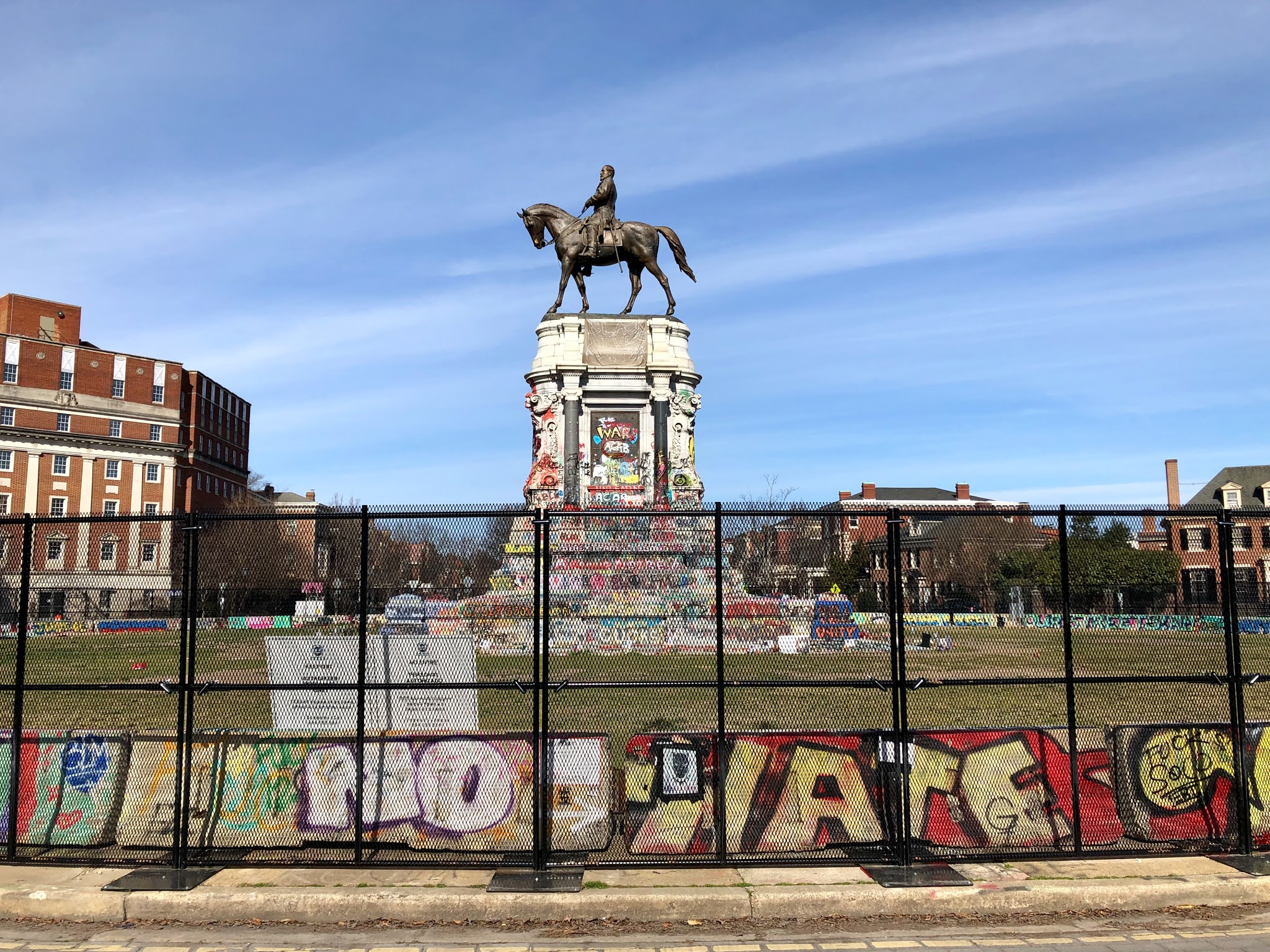
Looking north up Monument Avenue towards the Robert E. Lee Memorial.

Then there's Robert E. Lee.

The Lee Memorial is the biggest of the five on Monument Avenue and it's located on the biggest plot of land, a massive traffic circle at the intersection of Monument Avenue and North Allen Avenue. It was the first erected and it's clearly the most important. It's also today the only one that still has its statue and it's the only one you cannot walk up to, because there's a fairly sturdy metal fence erected at the perimeter of the traffic circle.

Like the monuments to Davis, Jackson, Maury and Stuart, the Lee Memorial was defaced with graffiti. Unlike the other four, the graffiti hasn't been removed. Neither has the Black Lives Matter banner been stripped from just below the statue. And it's glorious. It's absolutely uplifting in its democracy.

Robert E. Lee was in charge of an army that fought against the United States. If he had won, he would have preserved the institution of slavery and helped establish a nation with that belief at its core, that black people were inferior to white people and they deserved to be owned as property. Some folks have made their thoughts known about this at every level of his Memorial in a rainbow of lurid colors.

But there are other truths about our society spray-painted on the Lee Memorial that have nothing to do with the Civil War necessarily. The idea that it's OK to discriminate against people that some folks may be uncomfortable around. The idea that some of society's institutions either deliberately or unconsciously work to preserve the current power structure. The idea that politicians are openly and unabashedly working to disadvantage people unlike themselves. There are a lot of different messages written on the Lee Memorial. Some of them are rude. Some of them are obscene. But almost every word of it rings true to me. I'm not going to re-write them in this blog but I'm sure you can zoom in and read some of them. Look up the ones that aren't familiar to you.

The Lee statue is still in place. I'll be happier when it comes down if that really happens this summer. I hope the city doesn't clean the rest of the Memorial or the concrete barriers spray-painted around the perimeter of the circle. I expect that they will. I can't imagine a city being OK with swear words written large and clearly on its public monuments.

I think the great thing about what's happened to the Lee Memorial is that it has been transformed from something inherently objectionable into something really powerful and optimistic. The defacing of the Memorial is a clear and obvious rejection of everything it stood for originally and the point of the thing has been completely re-messaged. It's more powerful to me leaving it in place as is (without the statue of course) than tearing it down completely. This is public art that really means something. I hope it stays but I'm not counting on it.


So that's what we saw on Monument Avenue. Before we left Richmond, though, we wanted to take a look at one more statue. 

The no longer available for public viewing J.E.B. Stuart statue is notable from a composition standpoint. Stuart's horse, were it still in place, is facing south with its head tilted slightly to the left and its front right hoof raised, which traditionally means the rider died as a result of wounds sustained in battle (which Stuart did). Stuart atop his horse, again...were he still in place, is not looking forward as he is mounted but instead his torso is twisted and he's facing west which allows the viewer to see his entire torso and face unblocked by any other part of the statue. Its a dramatic pose that you wouldn't normally see a rider strike.

In September of 2019, a second statue with this same pose was erected in Richmond in direct response to the artistry of Stuart's statue. This one, titled Rumors of War, was commissioned by the Virginia Museum of Fine Arts and stands just in front and to the right of their building just west of the Fan District. The horse's pose is identical to Stuart's horse, right down to the angle of the head and the full extension of the tail. The rider strikes a similar pose to Stuart but the likeness is quite different. Instead of a white man fighting to preserve slavery, Rumors of War features a young, dreadlocked black man in a hoodie and Nike sneakers.

Rumors of War was sculpted by Kehinde Wiley, the same artist who painted President Obama's portrait that hangs in the National Portrait Gallery in Washington, D.C. It is of course intended as a direct response and contradiction to everything that Stuart's statue represents and it completely works, in a similar way to the graffiti and Black Lives Matter banner that you can see at the Lee Memorial. The irony is lost just a little bit now that Stuart's statue is no longer in place but that's really not a good enough reason to allow Stuart to return.


I think art that references past works directly or indirectly to provide a different interpretation of the original subject is so smart. Both Wiley's work and what the people of Richmond have done to the Lee Memorial do exactly that. And in completely different ways. The message is powerful in both cases, although it's a lot easier to see in the case of the Lee Memorial. Time will fade the full meaning of Rumors of War. The longer Stuart's statue is gone, the more difficult it will be to remember what the statue is referencing and refuting.

I'll be interested to see what happens in the near future to the Lee Memorial. How long will Richmond allow a vandalized, obscenity covered public monument to stay the way it is now? Will they actually take down the statue this summer? And if they do, will they use that opportunity to clean off the pedestal? Either way, will they continue to leave in place the concrete barriers, spray-painted or not, and the metal fence around the perimeter of the circle? Removing the graffiti or removing the pedestal entirely and re-purposing the circle might be more attractive, but erasing what's happened to something that never should have been there in the first place would be disappointing, I think. It's powerful the way it is. Remove the statue and erase what probably never should have been done in the first place but leave the rest please.

Not particularly elegant in its expression but neither is fighting to preserve slavery.

How We Did It

There is nothing complicated about finding the five monuments or former monuments on Monument Avenue. Just make your way to that street in your preferred mode of transportation and start heading either north or south. You can't miss them. They range from Stuart Circle on the south end to Arthur Ashe Boulevard on the north end. In sequence south to north you'll find Stuart, Lee, Davis, Maury and then Jackson.

If you want to see Rumors or War, might as well do it before or after you see (or don't see, I suppose) Stonewall Jackson. The Virginia Museum of Fine Arts is located on Arthur Ashe Boulevard about a quarter of a mile west of where Jackson used to be. 

One of the best things about this tour is that it's all free. It took us a little more than an hour to see all six. We definitely spent the most time at Lee's Memorial. It definitely has way more to look at and take in than the other five.