Showing posts with label Singapore. Show all posts

Tuesday, June 4, 2024

Dangerously Addictive


OK, so I'm going to do something here that's probably a little short-sighted, maybe a bit ignorant and possibly just altogether wrong. It's food post time and I'm going to just smush all the food we ate in Southeast Asia together into one post. That means just one post for Cambodia, Singapore and Malaysia combined. Is food in those countries all really the same? Honestly...no it is not. There is a great diversity and variety in what is eaten between those three nations. They are in no way the same. There's no excuse for me doing this post this way. 

Having said that (so here comes the excuse...), I do feel based on my whole two weeks over in that area of the planet, that there is enough overlap in some areas and I'm also not going to highlight much about Cambodia. So given the lack of focus on Cambodia, I feel (again...based on my whole all of two weeks there) that Singapore and Malaysia are close enough to one another to get away with this concept. Plus, I'm not writing three posts about food from one trip. Or two, even, because Cambodia certainly has an important, albeit small, part to play here. So here goes...my food post from the entirety of Southeast Asia that we visited in 2024.

And, yes, I'm drinking my beer with a straw in the photograph above. I'm wearing gloves and my hands are slippery. Not risking dropping beer.

So first of all, before I get to specific dishes or plates or whatever, let me say that my two favorite meals on this trip were in Malaysia and it's not even close. Overall (meaning not just for the food), I'd rank the three countries from top to bottom as Cambodia first, Singapore second and Malaysia a distant (and I do mean distant) third. But food-wise, the dishes I long for from this trip are two that I ate in Kuala Lumpur.

One of the two was a dish called nyonya laksa, a shrimp and tofu, spicy coconut milk noodle dish that just hit all the notes I want in a lunch dish (or any other sort of meal for that matter). We got it at the Old China Cafe in Chinatown in Kuala Lumpur and it was just awesome. I tried very hard on this trip to eat dishes that I really wasn't familiar with and nyonya laksa definitely checked that box. I really had very little idea what I was actually ordering. Maybe I got super lucky. If I did, it wasn't the only time I got that sort of lucky in Malaysia. 

I'll save the other dish that I loved for last. Let's get to what else I found on the other side of the planet.

Nasi Lemak

Let's start this post off in earnest with the greatest hits. If there were one or two classic, can't miss dishes that we HAD to have in Singapore and Malaysia, one was definitely something called nasi lemak (and the other is the next dish in this post). And if you didn't know it, nasi lemak is the national dish of Malaysia, not that labeling it as that explains the dish in any way.

Sometimes the best sorts of food are simple, simple, simple. Nasi lemak for sure is one of those. Rice cooked in coconut milk; cucumbers (or you might skip those things if you are not pro-cucumber); a dried anchovies and peanuts concoction called ikan bilis; and an egg of some sort (we ate this dish with both fried and halved hard-boiled eggs, although not at the same time) along with some sambal on the side pretty much forms the base of a typical nasi lemak plate.

Much like the ubiquitous rice and beans in Costa Rica, nasi lemak can make up any sort of meal, be it breakfast, lunch or dinner. Maybe it's eaten just plain for breakfast and maybe you add some chicken or a banana-leaf-wrapped otah (or spiced fish cake) for the later meals but nasi lemak is eligible for a place on the table at any Malaysian or Singaporean mealtime.

Best nasi lemak on our trip? In Singapore, but that's probably because we didn't eat it in Malaysia except at our hotel. There's something about this coconut rice. The toppings can for sure affect the quality of the dish, especially if you get a perfectly fried and juicy chicken wing on the side, but that coconut rice...whoever invented that stuff was onto something for sure. 

The picture above is from The Coconut Club in Singapore. It was definitely the best nasi lemak of the trip, although it would have been better with the chicken wing from Selera Rasa Nasi Lemak at the Adam Road Food Centre. Coconut Club's chicken was a touch dry.

Chili Crab

This was my food splurge in Southeast Asia. I knew a meal of chili crab was going to cost me a lot and I ignored it anyway. I also knew it was going to be super messy. Whatever. 

Chili crab is basically a cooked Singaporean mud crab doused in some kind of spicy tomato sauce. You get the entire animal chopped up into pieces, shell and all, and just pound away at this thing until it's all gone. It's some tough going at some points. Despite providing you with a hefty set of crab crackers to open that shell, there's some work here involved. I've eaten other meals of crabs in shells but I've never seen any shell as thick as these mud crabs. I'm estimating the thickness of the claws approached 1/16 of an inch. It's basically like cracking a thick piece of strong plastic. No easy task.

A whole lot of research about where to get some really excellent chili crab led me to Keng Eng Kee (or K.E.K. for short) Seafood. It's one of their specialties; they have been around since the 1970s; they are on their third generation of ownership; they are Anthony Bourdain-endorsed; and they are not in a super accessible area with tons of tourist foot traffic. Seemed like a good combination.

There's no doubt in my mind that this was a good choice. It was open-air. It was packed. There were plastic chairs. There was a time limit to the table. And we were looked at with some skepticism when we showed up and asked if we had a reservation. We did. Of course we did. And I swear someone somewhere started the clock as soon as we sat down.

We didn't use all our time. We can eat quickly. Even if it's a whole crab that requires cracking.

I think as a dining splurge, this was worth doing once. I've said it before and I'll say it again...I don't understand why crab costs so much (with the possible exception of Dungeness crab). This was a good meal and it was tasty (although sweet more than spicy) and it was completely authentically Singaporean. But at a $95 SG per kilo price (that's about $70 or so US), I feel I can get something better for less. 

My crab weighed about 0.9 kilograms. Do the math on the cost, if you are so inclined.

Hawker Markets

Some of our food experience on this trip required a lot of research and a lot of looking to find the best, the most traditional, the most Southeast Asian food we could find. Some...but not all. One thing that was obvious to us before we even booked our flights to Singapore and Malaysia and everywhere else we stopped was that our culinary experience in Singapore had to include a lot of eating at the country's various hawker markets.

Why hawker markets? Well, because it seems like every TV show we watched, every blog post we clicked on and every travel guide we read said we had to get to these places at mealtimes. Heck, Newton Food Centre is the first place that Nick Young and Rachel Chu go to get some food in Crazy Rich Asians after they get picked up at Changi Airport. Hawker markets are in vogue. Hawker markets are hip. We had to get to multiple, multiple hawker markets in Singapore. There was no question or no option really about this. This was going to be a project in and of itself.

Maybe I ought to take a step backwards here and explain what a hawker market is. Quite simply, it's an open air market with multiple stalls which usually feature one or two signature dishes and each stall only serves those particular dishes. Sounds simple, right? It's not. It's way, way deeper than that. I am sure there are people out there who would hail hawker markets as the keepers of traditional Singaporean (with all its Malaysian, Indian, Chinese, etc. influences) dishes. And those people wouldn't be wrong. Hawker markets are for sure preserving the area's culinary traditions. And they are doing it at insanely low prices, and that includes the stalls which have been Michelin listed or Michelin starred. Not kidding. Looking for cheap and amazing food in Singapore? Put some hawker markets on your list.

We did. Our itinerary for this trip had four hawker markets on it and we made it to all four. There are more. We just picked four that were closest to the other things we were looking to do while in Singapore.


Chicken rice from Maxwell Food Centre (top); Paneer Tikka from Tekka Centre (bottom).

We tried to mix it up at the hawker markets. 

We went with the internet's advice at the Maxwell Food Centre and Adam Road Food Centre and got the chicken rice and nasi lemak, respectively, which is supposed to be the top of the top dishes (although admittedly the internet seemed to be split on the best stall at Adam Road). We stood in a very long line at Maxwell that went very quickly on our first day in Singapore and we stood in a fairly short line at Adam Road that took about 45 minutes between the time we started queuing and when we got our food.

At the other two spots, we winged it and just picked what looked or sounded good. No advance research, just pick a spot and go with it. Usually the conventional wisdom was to go with the longest line on the supposition that people know where the good stuff is. We didn't do any of that. Standing in two lines was enough. 

In two of the four places, I picked something that I really was completely unfamiliar with. There were two things on my nasi lemak plate at Adam Road that I just ate without understanding what I was eating and I ordered a carrot cake at Newton Food Centre with really no clue what I'd be handed, although I was pretty sure it wasn't some brown cake with carrot shreds, walnut and cream cheese frosting. It wasn't. It was basically a white radish omelet with a side of spicy red sauce (picture below).

And I did figure out what one of the two mystery items on my nasi lemak plate was. It was the aforementioned spiced fish cake or otah. I still don't know what the other thing was. 

So was it good? Absolutely. Everything we ate at all four hawker markets was really good, quick and fresh and totally unlike anything we can get quickly at a restaurant or stall here at home. And it was all super, super cheap. The paneer tikka in the picture above cost me $4 SG, and that included the made to order garlic naan. I was lamenting that we didn't have enough cash in the nasi lemak line because I couldn't believe the thing that I was about to ordered cost $4. I thought the sign said $14.

Was food from a hawker market the best thing I ate on this trip? No it was not. But for the cost, it blew almost every other dish that we ate out of the water and it wasn't even close. I could easily eat three solid meals a day from hawker markets and expect to spend less than $15 US total for the whole day. And that's not, by the way, a bad strategy for staying well fed in Singapore I'm sure.

Sugar Cane Juice

One of the peculiar things about eating at the hawker markets is you can't get both your food and drinks at the same stalls. We found food at about 90% of the stalls and the other 10% were drinks only. And here's where I found one of my food quests for this vacation: sugar cane juice.

Order a cup of sugar cane juice and the stall owner will whip out a few stalks of bamboo-looking things (spoiler alert: it's sugar cane), split them in half and then feed them through a machine that squeezes all the juice from the sticks. The juice goes into a metal container just below the machine; the rest of the woody cane goes into the trash, although a little of the pulp ends up with the juice. The juice then gets run through a very fine mesh sieve (don't want to drink the pulp) and then poured over ice. Voila: sugar cane juice.

This was actually refreshing and not too sweet (I imagined it would be super sweet). I'd have this stuff on its own or as a dessert drink. I'm not sure it was the best accompaniment to my carrot cake but this was a successful quest. When else am I going to drink freshly pulped sugar cane?

Salted Egg Fish Skins

There are foods out there that are just so unusual and tantalizing (and not always in a "wow that sounds incredible!" way) that I just have to sample them when I travel. I don't mean like monkey's brains or some other sort of offal or something really disgusting like the chicken with cream clam sauce burger that we found in a 7-11 in Singapore. I mean something simpler. Something that just makes you wonder why would anyone ever make this and stick it in a bag on a food shelf somewhere. On this trip, that food was salted egg fish skins.

And yes, the chicken with cream clam sauce burger was real. Why? It's like someone just picked a bunch of ingredients and just put them together with no thought whatsoever as to whether it would be good.

So there's nothing mysterious about salted egg fish skins. They are what they sound like. They are pieces of fish skin dipped in salted duck egg yolks and cooked before being sealed into a bag and placed on a grocery store shelf. They are like potato chips. Only made with fish skins instead of potatoes.

Singaporeans apparently love these things. I do not, although I did eat the whole bag. They weren't objectionable or anything. Maybe it's a cultural thing or a practice makes perfect thing but I'm just not conditioned to crave fish skins as a snack. Glad I did this once. Probably not a repeat customer. It's not like the sugar cane juice.

Durian

OK...so it had to happen sooner or later that I'd finally sample durian while traveling. I wasn't going to. I swear. They have pieces of fresh durian very visible and very, very securely wrapped on market stalls in Singapore's Chinatown and I had no inclination to pick up a packet and try it. The airport got me here.

If you don't know what durian is, it's a fruit that grows in the tropics that some people describe as custardy and others (to be clear here...most others) describe as having the smell and flavor of rotting meat. Durians are banned on the Singapore MRT system because of the risk of their smell. Singapore's not alone in this kind of prohibition. We found the same sort of ban on the buses in Zanzibar last winter. I have really no desire to try a fruit that smells like rotting meat, but clearly people must like this stuff. I mean, they do seem to have a lot for sale in some spots.

Which brings us to the Kuala Lumpur airport with a little time to kill.

I'm sure if you've traveled to anywhere international you are familiar with the stores at the airport that sell chocolates or whatever it is that has some sort of connection to the country you are leaving. They had a couple of these stalls at the KL airport and among the various boxes of goodies, there was a display of durian filled dark chocolates. And there were samples.

Of all the durian experiences I could imagine, eating a tiny candy that is pretty much equal parts dark chocolate and durian was about the best-case scenario I could ever cook up. Plus it's free. There was something about this situation that I couldn't say no to. I picked up one of the individually-wrapped chocolates, opened the tiny little packet, smelled it and then popped it into my mouth and bit down.

I'll say this: it's a good thing they had a lot of other individually-wrapped candies hanging around the airport because I needed about five or six other types of chocolate samples to erase that memory. And quick. Rotting meat? I'm not sure about that but something not good was in my mouth. If this my reaction to about as little durian as you could ever have, I'm passing in the future. Including in airports.

Pandan

Believe it or not, most of what I've described that sat before us on tables or counters before it made its way to my mouth was familiar in some form. I knew about sugar cane juice and durian and even salted egg fish skins before leaving home. I had no idea that something called pandan even existed. We found out about it on our first day in Cambodia when we ordered some pandan sticky rice with mango. We love sticky rice with mango. Had to have this.

When our sticky rice arrived, it looked like the picture above. Rice? Check! Mango? Check!! Sauce made from something coconut-y? Check!!! What's the green stuff. Must be the pandan, right? Right!!!!

Pandan is basically Southeast Asia's version of vanilla. It's a bright green leaf used to flavor food. We found some when we were on a hike on Singapore's Pulau Ubin island looking for hornbills and other winged creatures. And it's just awesome. We stayed three nights in Cambodia. We ate pandan sticky rice four times in our stay at our hotel. We also found plenty of pandan treats in Malaysia and ate it pretty much every time we saw it. This was a revelation. And it's not strictly like vanilla. I'd describe it as a more herbaceous version of vanilla, for what that's worth.

More pandan treats? Yes, please!!!

So after all that eating, there's one more thing to talk about: the best meal of our trip (for me, at least). And this is going to sound a bit crazy.

When we got to Kuala Lumpur, it was before check-in time at the Hilton so we dropped our bags and asked the hotel staff if there was someplace close we could get something to eat. They gave us a couple of options, one of which was something called NU Sentral, which sounded like it was some sort of hawker market-type thing that had a number of options. The directions were easy enough and it didn't involve walking outside in the heat so we picked that.

It turned out that we were sent to a shopping mall food court and it appeared that the air conditioning in the building stopped at the perimeter of the food court. Oh well. We were there and hungry, let's just pick something and this will be a throwaway meal. After looking at all the stalls, I picked a place labeled Chili Pan Mee. I just wanted to try something I'd never heard of. After trying to order just simple chili pan mee (whatever that was...) and not being able to convince the dude at the register that I didn't also want the side of dumplings, I acquiesced and just paid for what he wanted me to get (it was less than $3.50 US).

Usually when I get a meal that might be notable while traveling, I take a picture before eating. I didn't here. I took a picture of the stall (below) just so I could remember the name of the dish.

I don't know what they put in that bowl but it was phenomenal. I know there was pork and anchovies and probably some fish sauce and spices but this meal was just amazing. It was so rich with flavor and had the best sort of spicy heat to it. The broth was fantastic. The side of dumplings was good too but that chili pan mee...I mean just wow! At a mall food court for less than $3.50!!!! What are we doing wrong in this world over here that I can't get this stuff at our local mall? I feel embarrassed a bit here. We went to world-renowned hawker markets in Singapore and at least one Michelin-starred restaurant on this trip and I love something from the mall food court. It was that good.

So that's it. That's my Southeast Asia food rundown. I will say that I've tried to find a reasonably good chili pan mee in New York since I got back and I do very much like the version that Pig and Khao makes (they also have amazing coconut rice) but it's not the mall food court in KL. It's just not.

Tuesday, May 28, 2024

Gardens By The Bay


This is the last post from our Southeast Asia trip focused solely on Singapore. I'll get straight to the point here: Gardens By The Bay is my favorite place in Singapore.

Seriously! Have I been to every place in Singapore? No, I certainly have not. But of all the places we set foot in that island / city / country earlier this year, GBTB (I cannot keep writing Gardens By The Bay every time so allow me to abbreviate about half the time from now on) was the best of the best. Maybe one day on a future visit, I will amend my "favorite place" statement about Singapore, but for now, I'm sticking with the opening statement of this post. 

If you are one of the three or four people who reads this blog regularly and actually retains the information, you may be thinking that I already wrote the best thing we did in Singapore was celebrate the dawning of the Year of the Dragon. What gives? Well, that's still true, but that celebration occurred over many venues. It involved Chinatown and our hotel and a couple of restaurants and the Marina Bay Sands casino and really the entire city, including some part of it happening at Gardens By The Bay. There's a difference here between best thing and best place and GBTB was the best place, hands down. 

I'll get into all the reasons why I think the Gardens was the best place we visited but for now just consider this: we spent eight nights in Singapore and we visited this place five times. Granted, some of it was Lunar New Year related but that certainly wasn't the case for every stop we made here. We went there a lot.


Gardens By The Bay was opened in 2011 as Singapore's newest national garden. The first of their national gardens, the Singapore Botanic Gardens, was established way back in 1859 when the place was still under British rule. It is still intact today with a variety of different natural habitats and tons of walking / jogging trails in addition to housing the world's largest collection of orchids. Two things about the Botanic Gardens: (1) the orchid collection is just stunning and (2) yes, people were somehow jogging and surviving in the February heat in Singapore. 

Singapore stuck with that single national garden for a while. Like pretty much a century and a half. They added their second, the Jurong Lake Gardens, in 2006 around the lake of the same name that was created in the 1970s when the city dammed the Sungei Jurong River. After that, they picked up the pace a little. GBTB was opened just five years later just south of the main downtown area and right adjacent to (surprise, surprise...) Marina Bay. 

Size-wise, Gardens By The Bay is the biggest of the three gardens, measuring in at just about 250 acres. If you need a point of comparison (and if you measure distance and area in New York City terminology), that's about 30% of the size of Central Park. That may not seem that big by comparison but if you've spent any appreciable amount of time in Central Park, you'll know it's massive. 250 acres is more than enough, especially in February in a humid place just north of the equator. It kept us plenty busy and sometimes plenty sweaty in our five visits. 

Gardens By The Bay as seen from the roof deck of the Marina Bay Sands. Looking south.
We saw and did a lot in Gardens By The Bay. We looked at plants. We walked a ton. We visited River Hongbao set up for Lunar New Year. We searched for otters. We ate. We took in a whole sculptural menagerie of tons of different animals multiple times. And we got lost more than once on a quest to find one single attraction. It's not super well signposted in places, although the River Hongbao thing may have complicated that. And yes, we saw one otter. Just one. And just the head. It still counts.

We also missed a lot in Gardens By The Bay. Of the five major attractions in the park that require admission fees, we missed three of them, including the Cloud Forest and the Supertree Observatory, both of which I had on my list before we set foot in Singapore. We also missed a lot of the park areas that didn't require admission, including most, if not all, of the heritage gardens that honor four different cultures that make Singapore what it is today. I said the place was big. You are bound to miss some stuff in just a week in town where you only visit once every other day.

With the possible exception of our meal at Satay By The Bay, we pretty much loved everything we did in GBTB, but I did have three favorites. And just so I can remember what I got out of this place, here goes my favorite stuff to do in my favorite place in Singapore. At least until I go back and find something MORE favorite.


Flower Dome

There are two massive greenhouses at Gardens By The Bay. You can see them both in the overhead view photograph a couple of pics before this paragraph. We planned to visit both but found ourselves short on time. Faced with only visiting one of the two, we opted for Flower Dome and passed on Cloud Forest.

Now, given a normal week in Singapore (meaning NOT Lunar New Year) I think I would have opted (and I am wrongly assuming I am the only decision maker here) for the Cloud Forest. Forests appeal to me in a way that flowers do not necessarily. Or maybe it's that when it comes to greenhouses, the ordinary sometimes for me beats out the extraordinary. But the Flower Dome, which features a series of rotating seasonal exhibits focused on (you guessed it...) flowers, was in full-on Lunar New Year celebration mode featuring a series of incredible looking dragons. Thus...Flower Dome won out.

Now, for sure, the dahlias (which before I wrote this post I had no idea were native to Mexico and Central America) were spectacular and the dragons just blew us away. But I found something else in the Flower Dome that had nothing to do with flowers: a baobab tree. Or actually, a number of baobab trees. I'm fascinated by these things. I remember the first one I ever saw in person near the immigration station or hut or whatever it was in Namibia. 

I love how strange these trees are, with massive trunks to retain water for years or even decades with tiny little branches with even tinier leaves. I've been in love with these trees ever since I read The Little Prince. They still amaze me today. The ones in the flower dome weren't quite the size of those in the wild in Africa, but I'll take laying eyes on a baobab tree any day. I feel there is unfinished business out there with me and baobabs, but that's in an as yet unplanned trip.

Next time: Cloud Forest. Have to!


Kingfisher Wetlands

On some level here's how we viewed Gardens By The Bay: it's a giant open space with lots of trees and plants and the occasional body of water. Sounded like the perfect opportunity to see what kind of birds we could find in Singapore. We'd been on a quest for unique birdlife on a guided tour the previous week in Cambodia. Why not see what kind of avian life there was in GBTB. But this time we'd just do it ourselves. 

We picked a spot called Kingfisher Wetlands. They should have kingfishers in Kingfisher Wetlands, yes? Made sense to us.

And I get it...we are a little obsessed with birdwatching. But hey...if there are some species we can't see at home, why not. Plus it's free! And let's face it, this is like one of the big attractions of birdwatching. It costs pretty much nothing.

We set out one morning with our good camera bright and early and hopped on the Singapore MRT down to the Bayfront station and started walking. The wetlands (which are, of course, wholly manmade) are towards the south side of the Gardens, and even though it was an early hour, we still got pretty hot and sweaty on the way there. Or at least I did. Now, bring on the kingfishers.


The pond at Kingfisher Wetlands (top) and not the kingfisher we came to see (bottom).
We know full well that when it comes to birdwatching, the early bird definitely does get the worm. When the sun gets too high in the sky and day is bright and the temperatures are a bit uncomfortable, the birds tend to hide. It was early when we got to Kingfisher Wetlands but it was no longer cool. No kingfishers at Kingfisher Wetlands. Whether it was the heat and the light or something else...nothing. Just a couple of very large metal kingfisher sculptures. 

I'll admit, this was not the best birdwatching trip we've had either on vacation or at home. But we did get a great look at a black-naped oriole and one or maybe two yellow-vented bulbuls. These are not birds we see at home. Curiously the yellow-vented bulbul has about as much yellow as the yellow-rumped warbler here in Virginia, which is to say not a whole lot. Whoever named these species had to have had some color blindness. Or some wishful thinking.

Yellow-vented bulbul. I guess there's some yellow towards the tail area.
I am confident that there are a whole lot more birds available for the spotting in cooler times at GBTB. Maybe next time. We did manage to spy an olive sunbird with its characteristic iridescent feathers and long curved bill, but it was at a significant distance and like other sunbirds, tended not to stay still very long for a good picture. Next time, maybe. Always with the next time.


Supertrees

The stars of Gardens By The Bay, though, are probably the Supertrees. These massive metal structures that are covered in living greenery dominate the views within the Gardens, and each of the three groves of these things is a landmark of sorts within the property. And when I write that they are probably the stars, I don't just mean for us. I mean for everyone. They are without question the symbol of the Gardens. 

There are a total of 18 Supertrees within the confines of the Gardens: 12 in the main grove towards the center of the park and two smaller groves of three each to the east and south of the main grove. At their tallest, they tower about 500 feet above the surface of the paths that connect the parts of GBTB. Some are equipped with solar panels to harvest energy from the sun and all are covered with plants that do not require soil to grow. This last point is not necessarily obvious without a closeup look at the Trees. When you do get one, you may find some of the plants are zip-tied onto the structure along with the irrigation system that supplies the plants with water. 

I guess these things can glom onto trees in the wild but cannot attach themselves to the smooth metal of the Supertrees.


Supertrees: close-up and super, super close-up.
The Supertrees are the focus of two of the Gardens' signature paid admission experiences: the Supertree Observatory and the OCBC Skyway (OCBC is the sponsor of the Skyway). Like the two greenhouses on property, we intended to do both of these things but ran out of time in our five visits. We ended up just doing the Skyway, which is a suspended walkway that takes you between and around a few of the Supertrees in the central grove. 

I always value seeing the world from different perspectives and the very short walk on the Skyway got that for me (after we were called off the Skyway due to a flash lightning storm, that is and had to sort of argue our way back on since we'd been on the Skyway less than five minutes). You get to see the tops of the Supertrees up close, get to look down on a part of the park and its patrons and get an unobscured view of the Marina Bay Sands casino to the north of the Gardens. I'm not saying the Skyway added a ton to our GBTB experience, but I'm glad we did it.

View from the OCBC Skyway.
The best thing that happens with the Supertrees, and likely the main draw to the Gardens at nightfall, is the nightly light and music show centered around the main grove of trees in the center of the property. If there's one thing that is a must, must see at GBTB, it's the nighttime Supertree show. 

I don't know what it is about light shows and fireworks and things like that, but people are suckers for this type of entertainment. And I'm counting myself in here without question. One of the reasons we kept visiting the Gardens was to see the light show. Three of our visits were centered around this attraction, and it's not the same show every night. The lights, the colors, the sequence of illuminations and the music really has to be one of the best free attractions in the city of Singapore. It was absolutely spectacular every time we saw it, although we found it to be best right in the middle of the grove and not on the outskirts. Yes, it's crowded but it's worth it and the crowd disperses fast. We found a lot of people lost focus on the show and left halfway through. 

Pro tip here: the two non-central groves of Supertrees do NOT light up night. We made that mistake the first time we were there and had to hustle to get to the center of the Gardens to catch most of the show. 

The pictures we got from our three Supertree shows are some of the best of the two plus weeks we spent in Southeast Asia. It's appropriate therefore that I am starting and ending this post with two very differently colored shots of these shows. It's also appropriate that I am ending the Singapore focused posts in this blog with a nighttime view of the Supertrees. 

Now I just need to go back to Singapore and try to find something better. I have no doubt that left to our own devices and given enough time and money from this point forward, we will definitely go back to Singapore. Just have to see how fast it gets to the top of the list again. This place is incredible.

Saturday, May 4, 2024

Don't Do It

When we decided on Singapore as the hub of our Southeast Asia vacation earlier this year, we finally had something to get excited about and plan, other than some temple time in Cambodia, that is, which was the main point of this trip. Oddly enough, one of the first reactions we got from a number of people about our choice of destinations was "don't break the law; don't they cane people there?"

Why...yes they do cane people. And we had exactly the same thought. 

Now, ordinarily, the last thing we would think about doing on a trip is breaking the law, but Singapore has some mighty strict laws so there were definitely some obscure and seemingly benign rules that we could easily and inadvertently find ourselves on the wrong side of. Did you know chewing gum is illegal there? It is. And it's not the only thing. Who knows what else is forbidden. I'm don't know what the punishment is for chewing gum in Singapore but I know for damn certain I didn't want to find out.

So why did people (including the two of us) have this reaction? Well, in September of 1993, an American teenager named Michael Fay decided to have some fun in Singapore and spent a few days stealing some road signs and vandalizing some cars. Good fun? Maybe for some. Good idea? Mmm...probably not. Not for him. Not in Singapore. He was convicted of violating Singapore's Vandalism Act. The punishment? Six lashes with a cane. 

Some people in the United States freaked out. Corporal punishment? For a little minor theft and a little damage to some cars? How dare Singapore do this to an American citizen? And just a teenager at that.

Hey...don't do the crime if you can't do the time. His reduced sentence (four lashes) was carried out on May 5, 1994. I'm guessing he never stole any more signs or vandalized any more cars again. At least not in Singapore, anyway. Singapore don't play with crimes.

Now, to be clear here, I am not equating chewing gum to vandalizing cars and I am confident in stating (without actually looking it up) that the Singapore judicial system doesn't impose caning sentences for chewing gum. But gum IS, without question, prohibited. It's on the Immigration and Checkpoints Authority list of prohibited items to bring into the country.

Know what else is on that list? I mean I'm sure you don't so I'll tell you: concealed weapons; all manner of nicotine products including snuff, chewing tobacco and e-cigarettes; obscene publications; endangered species; controlled drugs; and seditious materials. To me, gum is clearly the odd man (or odd thing, I guess) out on this list. Nonetheless, we discarded any gum (read: contraband) we had in our possession before we boarded our plane for SIN at Haneda Airport just outside of Tokyo. No rule breaking for us. Not in Singapore. No way!


So I don't know if the hype before this trip made us extra sensitive to rules in Singapore, but I'm sure it helped us pay attention to a lot of posted signs in a way that we wouldn't have if Michael Fay hadn't been caned 30 years ago. There are a lot of rules in that city all over the place. I'm sure there are in any major city, but we looked extra hard I am sure and we found some guidelines that we wouldn't necessarily see at home.

Like what, you may ask?

Like no durian (that famously stinky tropical custardy fruit that some say smells like rotten meat) on the subway system. This wasn't a surprise to us necessarily because we had been told that durains are forbidden on public buses in Zanzibar when we were there last year. I do think it's interesting that the no durians rule on the subway is posted next to no smoking, no eating/drinking and no flammable goods and that all three of those offenses carry fines but having a durian doesn't. I guess just don't walk around with durians is the message. 

There were certainly lots of other rules posted everywhere.

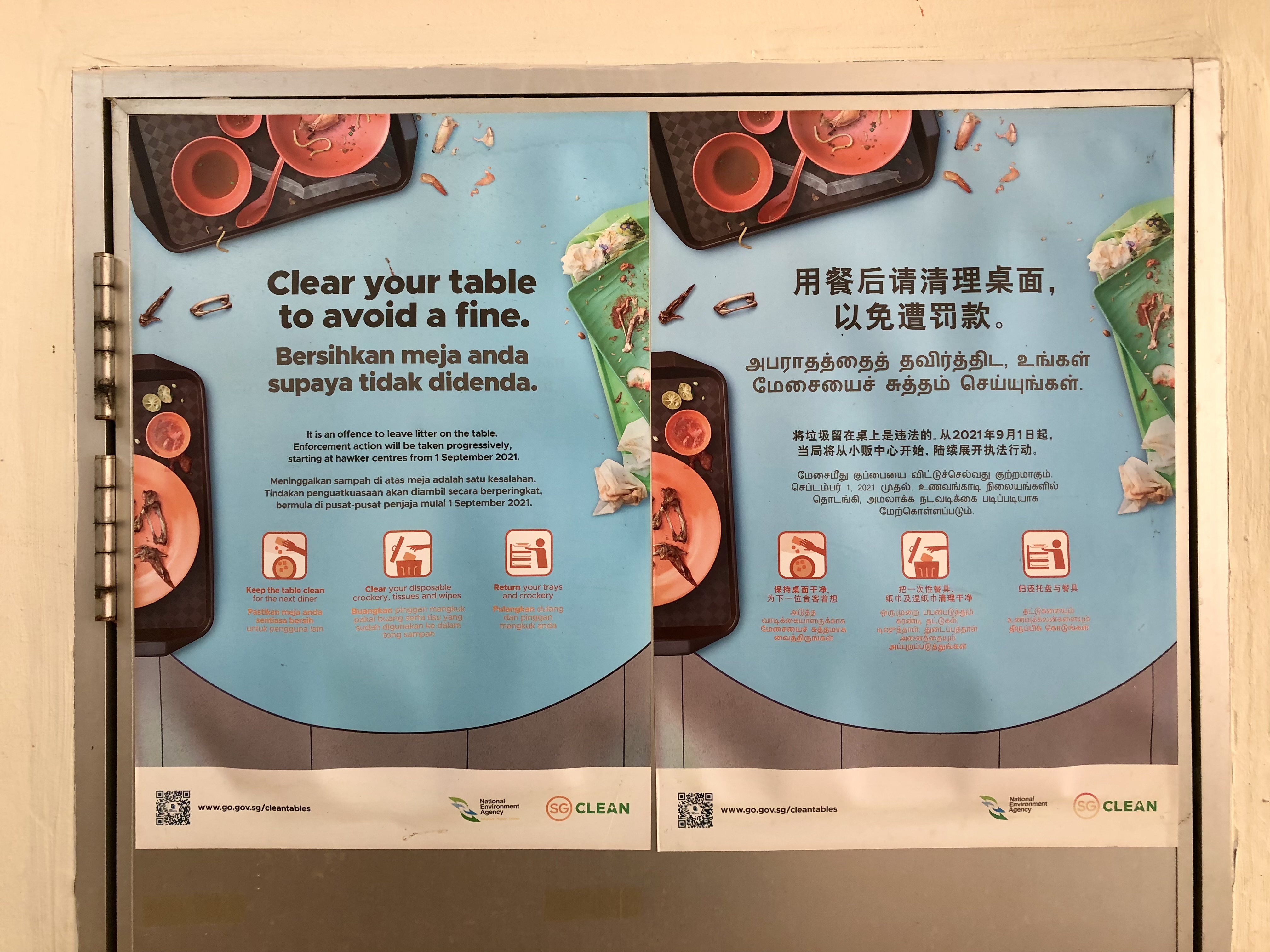
No admittance. No chasing the otters. No feeding the monkeys. No jaywalking. Although actually, it's STRICTLY no jaywalking. Fines for not clearing your tables at the hawker markets. No fighting (or "voluntarily causing hurt", if you prefer). No exercising in groups (individual exercise seemed to be fine). And definitely, definitely, no gum, although we didn't actually see any signs prohibiting gum. Or spitting, which is also apparently illegal, although I'm not sure why you would spit in Singapore because it's so hot there I would think you'd need every but of saliva to hydrate your body.

There were some scary signs there, too, like those that had images of a person with their hands up with another person pointing a rifle at them. These signs prohibited photography of the building behind the fence that the sign was attached to and also directed us to not even take a picture of the sign itself. And not wishing to incur the wrath of the Singapore government (coming home un-caned matters to me), I did not take pictures of those signs.


By the way, I think our favorite rule from this trip is the "Exercising in groups is not permitted in this area" sign. I think every time we have been out in a park or just on the street since we came back from Singapore and we've see a bunch of people jogging or doing yoga or whatever, we ask each other if exercising in groups is permitted wherever we happen to be.

You know what we didn't see in Singapore? Cops. I guess everyone knows how to behave, maybe? The citizens of Singapore must have normalized law-abiding behavior to preserve harmony in their communities in a way that most American towns or villages or cities never would. I love that. The yearning for absolute and complete freedom to do anything at any time even if it threatens or makes others uncomfortable is subjugated so that society as a whole is more orderly, safer and good for everyone. I'm a fan. Take notice, America.

But seriously, we honestly didn't see really any police presence at any normal time in our time in Singapore. Sure, there were cops hanging around the subway system during Lunar New Year's Eve (and the early morning of Lunar New Year's Day) but they seemed to be there more to direct people as to where to go than to arrest folks for crimes. And yes, we also saw some (again in the subway system) before and after the opening ceremony of the River Hongbao event at Gardens By The Bay. But that was it. 

Now, I have no doubt that people are watching. Just check out the picture below taken at an entrance to one of Singapore's subway stations. There are plentiful cameras around and I think everyone there knows they are at risk of being on tape at any moment. You might think it's sinister or big brother-y but I didn't feel it. I like law and order. I like rules, even if it means we have to give up chewing gum. I have no issue with anything that Singapore permits or prohibits. But then again, we weren't looking to (and didn't) break any laws. No caning for us!

Tuesday, April 30, 2024

Ride Across The River


Before we started looking into how we would spend six or seven days in Singapore, I had this vision of the whole place just being one giant, continuous city with no breaks from buildings or roads or sidewalks or anything. I imagined something like Coruscant in the Star Wars movies, a planet covered entirely by city, although in this case just a tiny, 283.5 square mile portion of our particular planet. I'm not sure why I had this impression. Maybe it's the fact that Singapore is both a city and a country unto itself and it's supposed to be super modern? I know...it doesn't make complete sense. Or any sense really.

So understandably, when we started scratching the surface on Signapore, we found out there was a lot more to the place than just man-made stuff. There often is in cities. I mean, I've been to New York City I don't know how many times and for sure there's more to that place than just built stuff, and I'm not just referring to the giant park in the middle of Manhattan. That place is dotted with little green oases all over Manhattan and beyond.

Singapore is no different than New York City in that regard. Like I said, my initial attitude on this sort of stuff didn't make any sense at all. As we started adding must sees to our Singapore itinerary and to break up our "city time", we started adding some parks to the list.

We ultimately planned a lot of park time, including excursions on the main island of Singapore to their Botanic Gardens (largest collection of orchids in the world!); the TreeTop Walk in MacRitchie Park (very long and mostly disappointing); and their iconic Gardens By The Bay (feeling a post dedicated to just that park coming on soon). But despite all that we also felt an urge to go someplace wilder and maybe even leave the main island and get onto one of the smaller islands that dot the perimeter of Singapore Island. We settled on a place called Pulau Ubin.

On the Sensory Trail.
Pulau Ubin is an island located in the strait between Singapore and the mainland of Malaysia to the north. It's a former granite quarry site that supplied the stone that built a lot of old Singapore. Today, it is mostly devoted to public use as a green space. The majority of the island is covered in jungle and other natural landscapes that provide a home for birds, mammals, reptiles and other sorts of creatures. 

Oh, and there are some humans that live there too. 
 
The people on the island are a bit of throwback community, living in houses using somewhat traditional construction methods (although admittedly mixed with modern materials) with no running water or hard wired electricity (power is provided by generators). By throwback I mean 1960s throwback, not centuries-old throwback. 

The main settlement on Pulau Ubin is on the south side of the island near the jetty where tourists like us and folks that have business with the community are dropped off every day. If you visit, you'll find stores, restaurants, some taxis, lots of bicycles for rent as well as houses and temples used by the local population.

The major appeal for us to get to Pulau Ubin was natural and specifically wildlife and (surprise, surprise) a little birdwatching. But I'd be lying if I said I didn't want to see how people were living there and building shelter for themselves. I am still an architect, after all. 


Bumboats (top) and the jetty and gateway to Pulau Ubin.
We hit Pulau Ubin first thing in the morning. We figured we'd get in and out before it got really hot. And by the time the day came to visit this island, we knew that it gets hot every day in Singapore in February. And I do mean every day. It's not quite like Cambodia, but the heat is still oppressive without you even having to do anything at all. It just melts you while you stand there. The sun doesn't matter. It's just hot in a way that I've never experienced before. 

An early rise. A quick breakfast at what became our usual breakfast spot in the underground mall attached to the Andaz Singapore. Found a car on the Grab app (Singapore's version of Lyft) that we used to get pretty much everywhere in Singapore that had decent cell service. And we were off. Changi Ferry Terminal to catch a bumboat (apparently it comes from the Dutch word for boat added to the word in English for boat, which is "boat" so it means boat boat) to take us over to Pulau Ubin.

The process to get on one of these bumboats isn't at first exactly clear. There's a ferry terminal that (despite the complete lack of signage that tells you where to actually find the boats) looks super official. It appears organized and there's what appears to be a customs clearing facility on site. There's also a line that we dutifully stood in and waited for an attendant or government official or boat captain or whomever to summon us towards the next bumboat departing for the island.

It doesn't work like that. Basically each boat captain comes to the line and takes a boatload of people. But not always from the front. The first boat that got to the dock after we eventually found the line took a group of 10 or 12 people from about six deep in the line. There weren't enough people there other than the large group to fill his boat so he just took the big group, regardless of their place in line. I guess they have to fill their boat to maximize their earnings which I can understand. 

Ultimately, the wait wasn't that bad. We got on the next boat, handed over our $4 SG per person and we were on our way.


Local Pulau Ubin architecture.
Our agenda for the day was to start with the island's Sensory Trail, a brief walk through some jungle adjacent to the jetty, followed by a tour through the town to get an idea of how the locals live. We figured if things were going OK (meaning we were seeing things that interested us) that we'd keep going and maybe take a ride out to the Chek Jawa Wetlands on the east side of the island. That seemed to be a popular spot to spend some time.

One of the main attractions of the Sensory Trail was a series of planted exhibits featuring local fruits and vegetables grown in that part of the world and used in traditional food dishes. Jackfruit. Durian. Bananas. That sort of thing. It was sort of a miniature version of the spice farm we visited in Zanzibar in the early part of 2023 but with way, way fewer species and actual plants. This sort of stuff is always a little fascinating because we can't possibly see these kinds of crops at home. I think the highlight was a pandan plant, sometimes called the Asian vanilla because of its resemblance to that bean as a flavoring agent. Ordinarily, this might not have been a serious source of intrigue but we had fallen in love with pandan in Cambodia earlier in our trip to Southeast Asia. Our hotel served a pandan sticky rice with mango. We were only in Cambodia for three nights and we managed to order that dish at four separate meals. Good stuff!!!

Pandan. Some good stuff in these leaves.
We expected that beyond the sensory part of the Sensory Trail that we'd get a great look at a lot of exotic looking birds. Emphasis on great! And here our sights may have been set unreasonably high because there just weren't that many around. Yes, we got a good look at some blue-tailed bee-eaters (below) and what I believe was a purple heron (also below) and there were one or two kingfishers spotted but by and large, the jungle part of the trail was empty of birds. We only found these species near the couple of spots of water on the Trail.

Sure, we did manage to see a very, very large water monitor on the path in front of us walking to the water and that was about enough to make us believe that going elsewhere on the island might be valuable. So after strolling through the town and finding mostly houses, restaurants (not hungry when we were in the village) and one temple, we decided we'd find a way out to Chek Jawa. Now I don't know about everyone else looking at these bicycles for the 5 or 7 kilometer ride out to the Wetlands, but we had no interest in pedaling our way there in high 80s temperatures with low 90s humidity. Taxi for us. $15 SG each way. Let's roll.

If the Sensory Trail left us satisfied with the flora but a little let down on the fauna side of things, Chek Jawa was the Sensory Trail amplified by a factor of four or five. Tons and tons of plants and trees everywhere over a couple of different ecosystems but just nothing in terms of wildlife at all. True, we did see a sea eagle flying overhead but that was about it. It was super disappointing because the promise of this trail is huge. There's actually an extended section of boardwalk that goes out into the strait between Singapore and Malaysia which would seem to offer a great look at something out there that's alive. We got nothing.


Chek Jawa boardwalk; bee-eaters; purple heron; and a very large water monitor (top to bottom).
Were we disappointed in our time on Palau Ubin? Yeah...maybe a little. But you don't think I'd be writing about this place if all we got was a look at a few birds, a tasty plant that we ate in Cambodia and a couple of buildings, do you? We had a quest on Palau Ubin. And we found what we were looking for. Only just. But we did.

Not all birds are created equal. I don't mean that on a survivability scale or anything like that. I mean, clearly, some birds (the dodo comes to mind, here) weren't created to last long once people started colonizing the world and brought with them predators that could easily kill local winged creatures. No...by equal, I mean in my eyes (it's all about me, after all). There's a pecking order, here. Flamingoes are better than robins. Herons are better than cuckoos. Birds of prey are better than sparrows and finches. Towards the top of my list right now are toucans. I'm still itching based on our mostly misses in Costa Rica looking for those things. But slightly below toucans, there are species like kingfishers and bee-eaters and hornbills. We went to Pulau Ubin because they have hornbills.

There is one species of hornbill on Pulau Ubin: the oriental pied hornbill. They are medium-ish sized hornbills colored black-blue and really pale yellow with an added piece (not sure how else to describe it) on top of the horn-shaped bill that all hornbills sport and which give these birds their name.

And so we were done with the Sensory Trail and headed back to the town when we stopped to look at some sort of dwelling or other building made by the island's occupants. And in the time it took us to stop and check out the construction of that building as so often happens in birdwatching, the object of our search showed up in our (and by our, I mean my wife's) peripheral vision. Hornbill!!!


There was only one. And lest you think this is headed to a whole flock or something like that, it ain't. One hornbill is all we got here. We tracked him (I'm assuming it was a male) for maybe 20 minutes or so as he flew and hopped between trees and tree branches. The photos are not amazing. They are in no way as good as the bee-eater or heron pictures. They aren't probably even as good as the sea eagle picture which I decided wasn't good enough to put on this blog post.

But it's what we came for. And there's something about finding the object of your search that makes everything else that wasn't what you hoped for in a day out on vacation melt away into irrelevance. Or maybe less relevance, because I do believe a lot of what we saw and found and encountered in our half day over to and on Palau Ubin was extremely worthwhile. 

This was our first live sighting of this species of hornbill ever and it was special. I'd trade the two pictures above for the pose in the upper picture at the range of the second picture but sometimes we don't get our pick on those kinds of details in nature. We are at its mercy most always. It's both frustrating and rewarding at the same time. You can spend the better part of a day looking for wildlife finding not much at all only for the whole day to be salvaged by a single encounter. This one hornbill did that for us here.

It took a lot of looking and a lot of luck for us to find this hornbill. It would not be our last on this trip. We'd see one later in the week at the Singapore Botanic Gardens (the one with the spectacular orchids) and one after we left Singapore towards the west coast of Malaysia. Both of those hornbills were in flight, which is an incredible thing to see because they look way more put together on the wing than in a tree. This was the only one we got a sustained look (of all of five minutes total maybe) at to take in. Pulau Ubin. That's why we went there. I love it when a plan comes together. 

Just.