From 1861 to 1865, the United States was split apart and engaged in a brutal Civil War, with 11 states in the south of the country attempting to set up a new nation. These states called their new country the Confederate States of America. The secession from the Union and dispute with the federal government, they claimed, was about states' rights, although let's be clear here and not mince words: the specific right that these states went to war over was the right of white people to own black people as property. Pretty disgusting stuff.
Thankfully, it didn't work. The Confederacy went ahead and started things on April 12, 1861 by firing shots on Fort Sumter in South Carolina. The Union ended it on their terms almost four years later to the day on April 9, 1865 at the village of Appomattox Court House when General Ulysses S. Grant forced the surrender of the Army of Northern Virginia. The end of the war ended slavery in this country, although by no means were former slaves in the south in any sense of the word free.
For the first 20 months or so of the war, the Union and Confederacy engaged in a system of prisoner exchanges which allowed released prisoners of war to return to their units on the other side of the lines. The official rules of these exchanges were formalized by the Dix Hill Cartel in July of 1862 and this system worked. For a while.
Then in September of 1862, President Abraham Lincoln called for the enlistment of black soldiers in the Union Army. Three months after that, Confederate President Jefferson Davis responded to Lincoln's call by declaring the South would not exchange black soldiers according to the provisions of the Dix Hill Cartel, instead preferring to either kill or enslave these men. In July 1863, the South made this policy a reality, refusing to swap black soldiers captured in the assault on Fort Wagner in South Carolina. That would be the end of prisoner exchanges during the Civil War. Forever.
 |
| The old north gate. Still called the north gate even after the expansion of the compound to the north. |
The end of POW swaps in 1863 meant more facilities would be required to hold an increasing number of prisoners on both sides of the battle lines. In the North, the Union predominantly turned to existing forts and prisons to hold the overflow of captured Confederate soldiers. This strategy wouldn't work in the South; the infrastructure to support such a plan just wasn't available. Instead, makeshift and wholly inadequate prison camps sprung up in the deep south as the prisoners piled up: Camp Ford in Texas in August 1863; Florence Stockade in South Carolina in September 1864; and Blackshear Prison in Georgia in November 1864.
The most notorious of the new Civil War prison camps was Camp Sumter, opened by the Confederacy in February 1864 in the town of Andersonville, Georgia. I'm not sure how I first became aware of Camp Sumter but I remember distinctly seeing the images of skeleton-like emaciated men like the one at the top of this post years ago and being horrified by the stories of the conditions in the camp. So after a long weekend of doing nothing responsible or respectable at a racetrack in Alabama, I thought I owed myself and all the men who died at Andersonville a side trip down to south Georgia to learn a little more about what happened there. And hopefully never have it happen again. Not that I have a lot of control over that.
I went south to Andersonville armed with a book, the diary of John Ransom, a Union soldier who spent the better part of a year as a prisoner of war in the Confederate prison system. He managed to last at Andersonville from the time he was relocated there in March 1864 to September of that same year. I thought a first hand account of what the camp was like would help me when I got to the site and found what would likely be just an empty open field.
The former camp location, which is now a National Historic Site, sits about a half mile walk from the railroad tracks which delivered prisoners to the site 150 years ago. This same railroad now pretty much defines the eastern edge of the town of Andersonville, population 255 according to the last census and all of 1.3 square miles in area. We visited the old camp on two consecutive days in late October. After a couple of sunny days at a racetrack in Talladega, the weather had turned with our trip south into rural Georgia. It was misty, wet and colder, seeming somewhat perfect for the place we had come. There's been a lot of misery at this place over time. It shouldn't bring us any joy either.
Sure enough, just like I expected, the camp site is now more or less an open field. It's a little more than 26 acres in total size and about twice as long in the north-south direction as it is east to west. The field slopes down from the north and the south towards a small stream in a valley which was supposed to serve as the source of water (and the sewer) for the men held here. When the camp was in operation, the place was surrounded by a ten or twelve foot high wooden fence and was completely empty except for the makeshift shelters the men constructed for themselves. You read that right: except for what the men made for themselves, no housing of any sort was provided. They had to make shelter out of what they had, which was not much, to protect themselves from the sun and rain. And although it may not seem that way to those of us who live in houses and condos, sustained exposure to water and the sun can be brutal.

Standing in the open field today, you can get an idea of what the camp must have looked like in its fully enclosed state because there's a small part of the fence reconstructed at the northeast corner and at the location of the old north gate, which sits at the west center of the camp site (it was called the north gate because the camp was at first about half its final size; the camp originally ended just to the north of the stream where this gate was built). The corner of the fence in the north of the site is especially illustrative, because the National Park Service has put in place for us 21st century tourists some examples of the makeshift shelters the prisoners called home, mostly tattered canvas or flimsy sheets barely supported by branches salvaged from trees in the area. I'm sure these mockups are actually way more substantial than the real thing.
The reconstructed northeast corner is chilling. And not just because you can get some sort of impression of how inadequate the place was to support human life. The tents, if you can call them that, are all held a distance of about ten feet from the interior of the camp fence. This perimeter, defined back in the day by a series of sticks with string or rope spanning between them and today by a series of white posts running all around the site, was called the dead line, a no mans land that meant death from a sentry's gun if any prisoner set as much as one toe over it. Ironically this was not the least pleasant death one could find at Andersonville.
So it sounds pretty bad, right? 30,000 men (not a typo) packed together in an area way too small for that number with no shelter and a zone where you might or rather will get shot instantly? It was. Life at the camp was tenuous at best. An estimated 45,000 prisoners passed through between the time it opened and the end of the war. Of those, an estimated 13,000 died there, an astonishing (and Civil War record) 28% of the total prisoners. That's more than one in four who didn't get out alive.
Ironically, the design of the camp was actually pretty well intentioned. But the execution of the construction was sort of a textbook example of project management gone wrong. The concept of setting up a prison in an open field with a freshwater stream running through the middle to serve as a water supply and a conduit for waste makes a ton of sense, for the time we are talking about. I mean as much as such a concept can make sense. But things started to go wrong almost immediately.
First, the fence around the stockade which was placed right on top of the stream was installed with too little space between fencing members, reducing the flow of the stream from barely enough to pretty much nothing at all. This caused the already small stream to slow to a trickle and stagnate and thus not carry all the human waste away from the site. Second, the folks who oversaw the construction of the entire camp compound decided to place both the bakery for the camp and the guards quarters upstream of the prison. And yes, both facilities also used the stream as a waste disposal, ensuring the stream (now a trickle, remember) would be absolutely not suitable for drinking by the time it got past the stockade fence.
The result? No healthy drinking water, vermin, disease and death. Combine that with not enough food, substandard (even for the 1860s) medical care and totally inadequate funding and you have a looming full scale disaster on your hands. The misery that these prisoners felt and died with is illustrated quite well in Ransom's diary: scurvy, dropsy, loose teeth from malnutrition, lice, using sand to wash themselves in an infected stream. Just the concept of having loose teeth from lack of adequate food is enough to make my skin crawl.
But in case you needed any more reassurance that things were really really bad and just so I would have a more complete picture of the misery endured by some to most of these men, I looked up dropsy and scurvy because I really didn't understand what happens if you have one or the other. Dropsy (or edema) is an accumulation of fluid between the skin and the cavities of the body. It apparently causes swelling and significant pain, which I can imagine is absolutely true. Compared to scurvy, it sounds like a walk in the park.
Scurvy is caused by a deficiency of vitamin C. I guess I knew that. What I didn't understand was the symptoms and effects. They are brutal: dry mouth, pain in the gums, dry eyes, shortness of breath, bone pain, easy bruising, loose teeth, poor wound healing, fever and convulsions. I imagine poor wound healing is not something you can really tolerate very well in the middle of a sewage and lice filled 1860s field. Ransom wrote in his diary "Only those who are here will ever know what Andersonville is." I am fairly sure there's no way I can conceive of the misery and suffering that took place on that field in rural Georgia.
Ultimately, Camp Sumter, which was always intended as a temporary camp, didn't last long. The south moved everyone who could walk out of the place in September of 1864, just seven months or so after it opened. The decision to close the camp was spurred by the Union army getting too close to Andersonville. The Confederacy didn't want 30,000 men released to the enemy all at once but I imagine they also didn't want to let the North see the conditions under which they were holding prisoners of war. Ransom, who could only walk with the help of his fellow captives, was relocated to a hospital in Savannah where he recovered enough to live for a long long time. When he was captured, he estimated his weight at between 170 and 180 pounds. When he walked out of Andersonville, he weighed less than 100.
I also can't imagine being a guard at Camp Sumter and being able to live with myself for overseeing what went on there. Maybe I'm being naïve and thinking that the southern soldier back then had the luxury of choosing to just walk away from a situation like that. But ultimately someone was in charge of this whole mess. That someone was Captain Henry Wirz, a Swiss born officer in the Confederate army who enlisted as a private in 1861. According to Ransom, most all the prisoners in the camp would have killed Wirz given the opportunity easily.
After the war, the United States government did just that, sentencing him to death by hanging for war crimes, which included his role in charge of the camp at Andersonville but also his personal participation in the murder of prisoners there by revolver, stomping and beating in addition to him allowing the use of attack dogs in re-capturing escapees from the camp. There are some who felt Wirz received an unfair trial. That might very well be true. In every war, I imagine there are scapegoats on the losing side who are unjustly punished. War is cruel. And the victors often get to dictate terms to the losers.
But in a small sign of just how divided our great country is today, Wirz is held up as a hero in present day Andersonville. There is an obelisk shaped monument to Wirz standing in the center of town which was erected in 1908 by The United Daughters of the Confederacy. The base of the monument decries the fate of the Captain and places some measure of blame for the conditions at Fort Sumter on the north's General Grant because he refused to re-initiate prisoner swaps towards the end of the war when the south desperately needed more troops. Don't start a war if you aren't prepared to deal with the consequences is the message here.
The Wirz Monument sits near The Confederate restaurant in town which, yep you guessed it, is proudly flying the Stars and Bars outside its door. There's a sign nearby advertising the annual re-enactment of the funeral of Captain Wirz to celebrate his life. You have got to be kidding me. Wirz may have been unfairly tried. He may also have just been following orders. There's no doubt in my mind that he was also likely way underfunded by a rebellion that had pretty much no capital. But a hero this man was not. No way. No how. I can't believe the community of Andersonville allows this to continue. The priorities seem way off here. There's still a big rift out there between the north and the south in the U.S. which is pretty troubling. We have a lot of work to do.
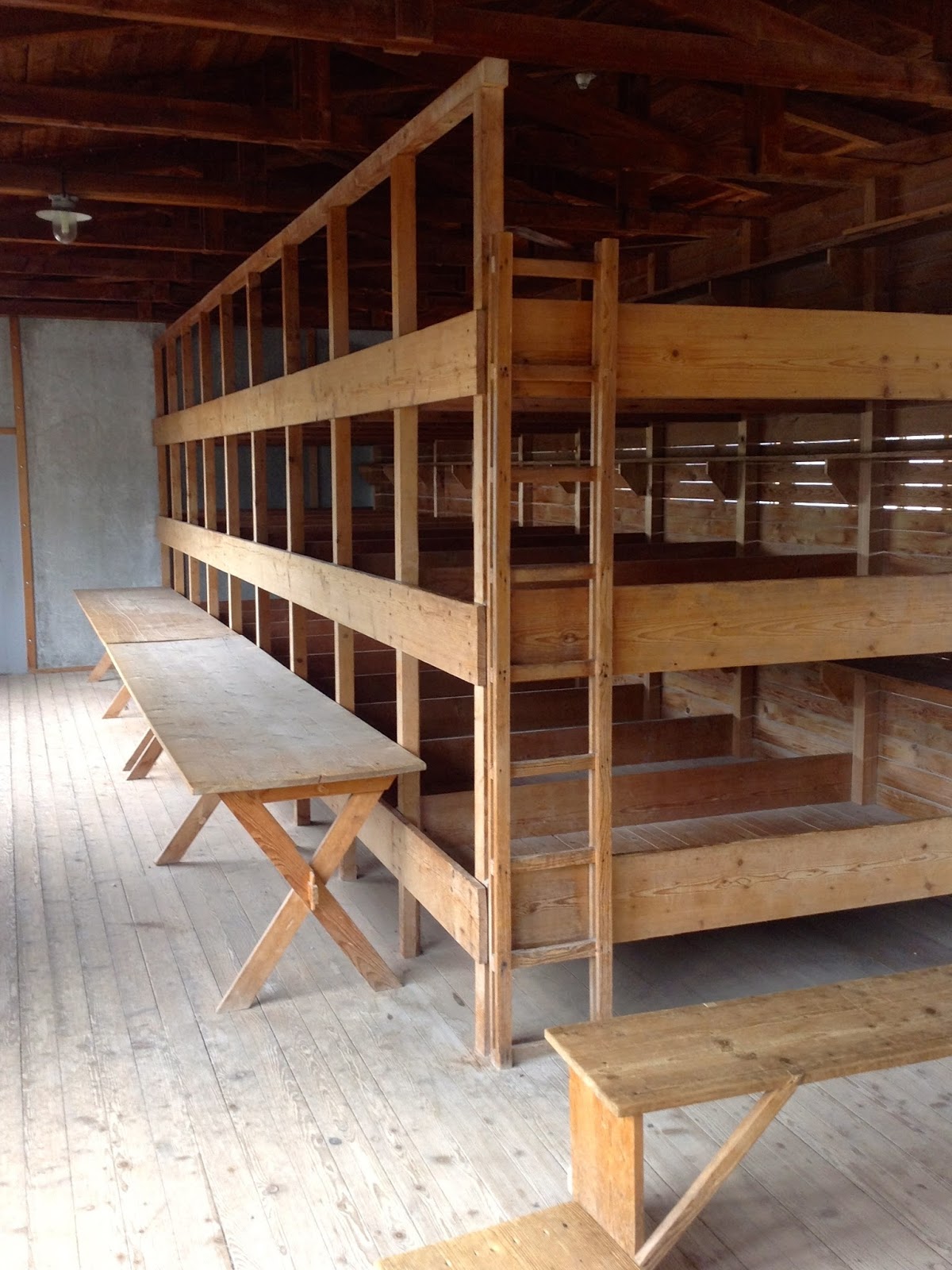
This is not the first spot I've visited on this five year quest to see more of our world that held men against their will under deplorable conditions. We should have known better than to allow this to happen in the 1860s and for sure we shouldn't have tolerated this sort of stuff in Dachau, where I found myself a couple of years ago on my first trip of this journey. But we can't seem to stop doing this, either in this country (Japanese-American internment camps during World War II come to mind) or elsewhere (I'm sure the current refugee camps for displaced Syrians are pretty horrendous right now). Maybe one day we'll stop doing stuff like this.
There's a cemetery at Andersonville which holds all the men who died in captivity at Camp Sumter. It's a national cemetery so there are generations of Americans who served our country in the military after the Civil War buried there also. There is not much space between the headstones here; a lot of men are buried in very tight quarters. The cemetery at Andersonville was the last stop of this blog for 2015. I'm almost 2-1/2 years into this thing; December 22 will mark the halfway point for me. Hard to believe. My next trip has to be way more uplifting than my time in Georgia. But the two partial days I spent in an open field in Andersonville were well worth it. Never forget.
The former camp location, which is now a National Historic Site, sits about a half mile walk from the railroad tracks which delivered prisoners to the site 150 years ago. This same railroad now pretty much defines the eastern edge of the town of Andersonville, population 255 according to the last census and all of 1.3 square miles in area. We visited the old camp on two consecutive days in late October. After a couple of sunny days at a racetrack in Talladega, the weather had turned with our trip south into rural Georgia. It was misty, wet and colder, seeming somewhat perfect for the place we had come. There's been a lot of misery at this place over time. It shouldn't bring us any joy either.
Sure enough, just like I expected, the camp site is now more or less an open field. It's a little more than 26 acres in total size and about twice as long in the north-south direction as it is east to west. The field slopes down from the north and the south towards a small stream in a valley which was supposed to serve as the source of water (and the sewer) for the men held here. When the camp was in operation, the place was surrounded by a ten or twelve foot high wooden fence and was completely empty except for the makeshift shelters the men constructed for themselves. You read that right: except for what the men made for themselves, no housing of any sort was provided. They had to make shelter out of what they had, which was not much, to protect themselves from the sun and rain. And although it may not seem that way to those of us who live in houses and condos, sustained exposure to water and the sun can be brutal.

Standing in the open field today, you can get an idea of what the camp must have looked like in its fully enclosed state because there's a small part of the fence reconstructed at the northeast corner and at the location of the old north gate, which sits at the west center of the camp site (it was called the north gate because the camp was at first about half its final size; the camp originally ended just to the north of the stream where this gate was built). The corner of the fence in the north of the site is especially illustrative, because the National Park Service has put in place for us 21st century tourists some examples of the makeshift shelters the prisoners called home, mostly tattered canvas or flimsy sheets barely supported by branches salvaged from trees in the area. I'm sure these mockups are actually way more substantial than the real thing.
The reconstructed northeast corner is chilling. And not just because you can get some sort of impression of how inadequate the place was to support human life. The tents, if you can call them that, are all held a distance of about ten feet from the interior of the camp fence. This perimeter, defined back in the day by a series of sticks with string or rope spanning between them and today by a series of white posts running all around the site, was called the dead line, a no mans land that meant death from a sentry's gun if any prisoner set as much as one toe over it. Ironically this was not the least pleasant death one could find at Andersonville.
So it sounds pretty bad, right? 30,000 men (not a typo) packed together in an area way too small for that number with no shelter and a zone where you might or rather will get shot instantly? It was. Life at the camp was tenuous at best. An estimated 45,000 prisoners passed through between the time it opened and the end of the war. Of those, an estimated 13,000 died there, an astonishing (and Civil War record) 28% of the total prisoners. That's more than one in four who didn't get out alive.
 |
| The stream running through the center of Camp Sumter. Not enough water for 30,000 men. |
First, the fence around the stockade which was placed right on top of the stream was installed with too little space between fencing members, reducing the flow of the stream from barely enough to pretty much nothing at all. This caused the already small stream to slow to a trickle and stagnate and thus not carry all the human waste away from the site. Second, the folks who oversaw the construction of the entire camp compound decided to place both the bakery for the camp and the guards quarters upstream of the prison. And yes, both facilities also used the stream as a waste disposal, ensuring the stream (now a trickle, remember) would be absolutely not suitable for drinking by the time it got past the stockade fence.
The result? No healthy drinking water, vermin, disease and death. Combine that with not enough food, substandard (even for the 1860s) medical care and totally inadequate funding and you have a looming full scale disaster on your hands. The misery that these prisoners felt and died with is illustrated quite well in Ransom's diary: scurvy, dropsy, loose teeth from malnutrition, lice, using sand to wash themselves in an infected stream. Just the concept of having loose teeth from lack of adequate food is enough to make my skin crawl.
But in case you needed any more reassurance that things were really really bad and just so I would have a more complete picture of the misery endured by some to most of these men, I looked up dropsy and scurvy because I really didn't understand what happens if you have one or the other. Dropsy (or edema) is an accumulation of fluid between the skin and the cavities of the body. It apparently causes swelling and significant pain, which I can imagine is absolutely true. Compared to scurvy, it sounds like a walk in the park.
Scurvy is caused by a deficiency of vitamin C. I guess I knew that. What I didn't understand was the symptoms and effects. They are brutal: dry mouth, pain in the gums, dry eyes, shortness of breath, bone pain, easy bruising, loose teeth, poor wound healing, fever and convulsions. I imagine poor wound healing is not something you can really tolerate very well in the middle of a sewage and lice filled 1860s field. Ransom wrote in his diary "Only those who are here will ever know what Andersonville is." I am fairly sure there's no way I can conceive of the misery and suffering that took place on that field in rural Georgia.
Ultimately, Camp Sumter, which was always intended as a temporary camp, didn't last long. The south moved everyone who could walk out of the place in September of 1864, just seven months or so after it opened. The decision to close the camp was spurred by the Union army getting too close to Andersonville. The Confederacy didn't want 30,000 men released to the enemy all at once but I imagine they also didn't want to let the North see the conditions under which they were holding prisoners of war. Ransom, who could only walk with the help of his fellow captives, was relocated to a hospital in Savannah where he recovered enough to live for a long long time. When he was captured, he estimated his weight at between 170 and 180 pounds. When he walked out of Andersonville, he weighed less than 100.
 |
| The center of Andersonville, Georgia, with the Wirz Monument in the middle of the street. |
After the war, the United States government did just that, sentencing him to death by hanging for war crimes, which included his role in charge of the camp at Andersonville but also his personal participation in the murder of prisoners there by revolver, stomping and beating in addition to him allowing the use of attack dogs in re-capturing escapees from the camp. There are some who felt Wirz received an unfair trial. That might very well be true. In every war, I imagine there are scapegoats on the losing side who are unjustly punished. War is cruel. And the victors often get to dictate terms to the losers.
But in a small sign of just how divided our great country is today, Wirz is held up as a hero in present day Andersonville. There is an obelisk shaped monument to Wirz standing in the center of town which was erected in 1908 by The United Daughters of the Confederacy. The base of the monument decries the fate of the Captain and places some measure of blame for the conditions at Fort Sumter on the north's General Grant because he refused to re-initiate prisoner swaps towards the end of the war when the south desperately needed more troops. Don't start a war if you aren't prepared to deal with the consequences is the message here.
The Wirz Monument sits near The Confederate restaurant in town which, yep you guessed it, is proudly flying the Stars and Bars outside its door. There's a sign nearby advertising the annual re-enactment of the funeral of Captain Wirz to celebrate his life. You have got to be kidding me. Wirz may have been unfairly tried. He may also have just been following orders. There's no doubt in my mind that he was also likely way underfunded by a rebellion that had pretty much no capital. But a hero this man was not. No way. No how. I can't believe the community of Andersonville allows this to continue. The priorities seem way off here. There's still a big rift out there between the north and the south in the U.S. which is pretty troubling. We have a lot of work to do.
 |
| The State of Michigan's monument to their dead at Andersonville. John Ransom was a Michigander. |
There's a cemetery at Andersonville which holds all the men who died in captivity at Camp Sumter. It's a national cemetery so there are generations of Americans who served our country in the military after the Civil War buried there also. There is not much space between the headstones here; a lot of men are buried in very tight quarters. The cemetery at Andersonville was the last stop of this blog for 2015. I'm almost 2-1/2 years into this thing; December 22 will mark the halfway point for me. Hard to believe. My next trip has to be way more uplifting than my time in Georgia. But the two partial days I spent in an open field in Andersonville were well worth it. Never forget.
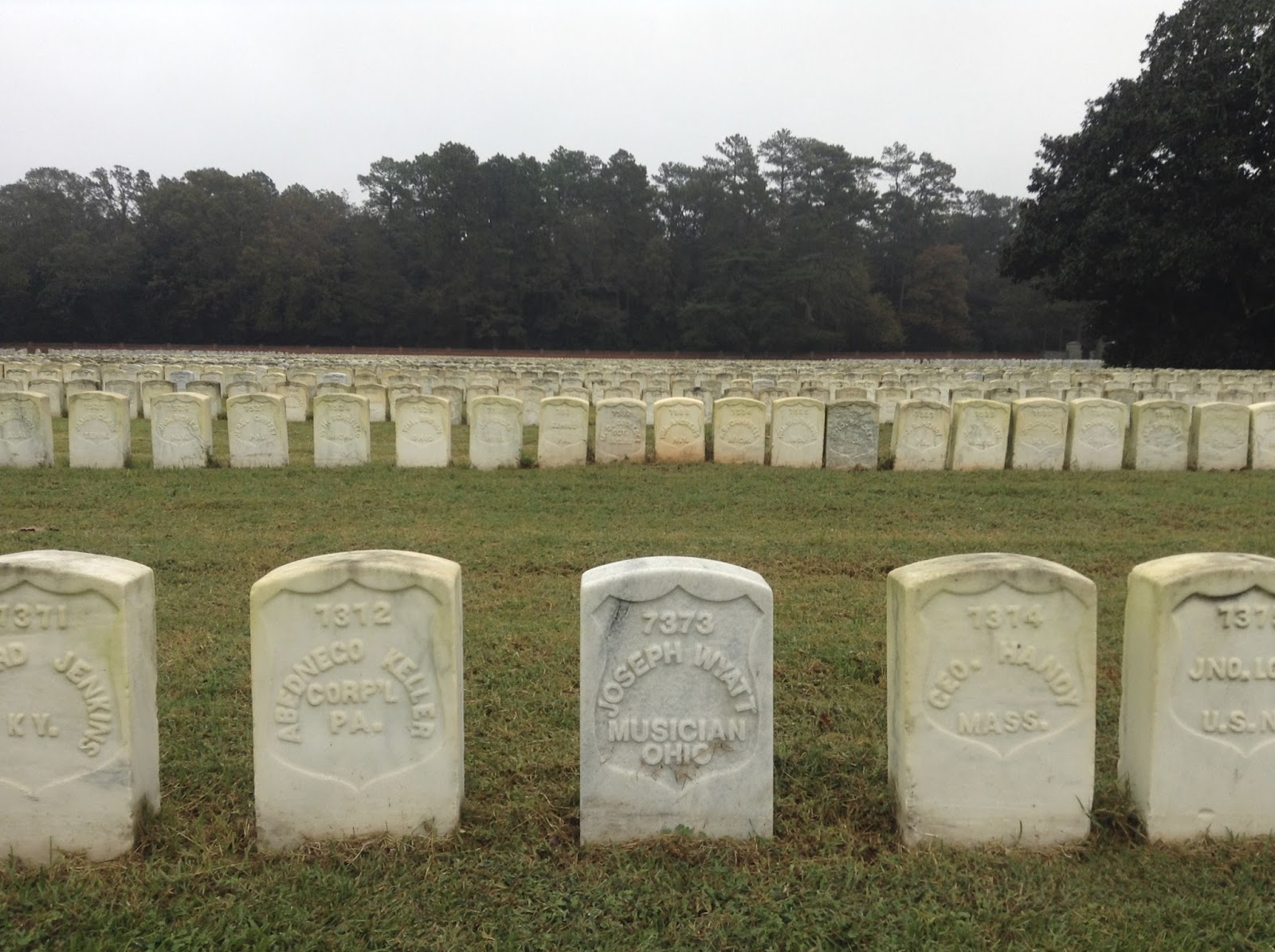 |
| The cemetery at Andersonville. These graves are spaced awfully close together. |