Showing posts with label Coyote. Show all posts

Tuesday, November 10, 2020

From The Tetons To Yellowstone


It is very strange for us to spend an entire week of vacation the way we spent a week in Grand Teton and Yellowstone National Parks. Generally speaking, we crave variety when we travel and spend our days rushing from one different thing to the next different thing to take in as much as possible. Call it attention deficit disorder or a fear of being bored or impatience or wanting to suck the marrow out of life every day we are not at work, but the notion of spending a week focused on just two National Parks is craziness for us. But that's just what we did. 

Not that Yellowstone and Grand Teton are lacking in variety.

We definitely had an agenda. Elk. Moose. Bison. Geysers. We felt pretty sure we'd get all of these and we were right, although the quality and quantity of moose sightings exceeded our expectations and was definitely very much appreciated. But we also didn't want to be too myopic on this trip and lose sight of the big picture. We wanted to see more wildlife than just elk, moose and bison. We wanted to exist in a place that man has left largely untouched. We wanted to be awed and relaxed and forget about how badly our species has messed up this planet. At least for a week.

We got all of that.


One of the reasons we could stand to spend a week out in northwest Wyoming was simple: these places are enormous. There's just a whole lot of territory to cover. And that means that filling a day is easy, especially when some drive times to the places we wanted to go are 2-1/2 hours or more. I knew this before I went out there because I'd spent a little more than a day in Yellowstone nine years ago and missed a ton. But it really hit home when we spent the better part of two days in the Tetons and pretty much four whole days in Yellowstone and STILL missed a ton. Maybe MORE than a ton.

I asked some friends before we left for this trip for some advice on must dos in Grand Teton. A boat trip across Jenny Lake sounded like a can't miss thing to put on our list and then check off at some point in our couple of days in the Tetons. But honestly, we just didn't have time. And it was probably due to the hours we spent down Moose-Wilson Road watching moose and bears. We also missed about half the length of Antelope Flats Road, all of Mormon Row in the same area and a whole bunch of turnoffs and side roads that could have really been worth exploring. We also didn't do any hiking in the Tetons.

I think we did a better job of covering ground in Yellowstone, although we didn't drive between Lake Village and West Thumb (in favor of another pass through Hayden Valley) and the road between Canyon Village and Tower-Roosevelt was closed to all traffic (it's closed all of 2020 and 2021). We missed a side road here and there I'm sure, especially when we were in thermal areas information overload mode. It makes sense we'd cover Yellowstone more comprehensively. We did spend almost three times as long in that Park than in Grand Teton.

I could easily have spent probably two more days, most of it in Grand Teton, than we did. I'm shocked to be writing those words. 

The Teton Range looking west from the Mormon Row area.

The Grand Canyon of the Yellowstone, Yellowstone National Park.

So how did we spend our time? Mostly driving around and gazing at the scenery and the wildlife.  Pretty simple.

On the scenery side of things, Grand Teton is dominated by the Teton Range on the west side of the Park. These peaks are so striking and they seem to be visible from just about everywhere you go in the Park. They form a sort of staged backdrop to the incredible landscape in the main part of the Park and they are reflected in the Snake River and other bodies of water you encounter as you make your way around the loop in the south section. They are without doubt the singular most distinct memory I have of Grand Teton.

Yellowstone is completely different. Whereas the Tetons are fairly homogeneous, Yellowstone is like a theme park with different worlds seemingly invented by a park designer to get the visitor the maximum range of landscape experiences. Geyser basins, valleys, rivers, canyons, mud pots, cliffs, mountains, scorched vistas, water containing multicolored collections of microscopic organisms and one really, really big lake. Yellowstone has all of that and way more.

We traveled most of Yellowstone for the first time in the dark, getting up before dawn to get to Hayden Valley or Lamar Valley before the wildlife got moving off the wide open spaces and into the Park's forested areas. It was astonishing to see some of the places we'd driven and how close to the edges of roads with some sheer drops. It sounds like a stupid statement but Yellowstone is way more varied than it looks at night but one of the aspects of Yellowstone that I found fascinating was the fact that we traveled through such diverse landscapes in the dark without realizing it.

The Teton Range reflected in the Snake River near Schwabacher Landing, Grand Teton National Park.
First mountain goat I've seen in the wild. Yellowstone National Park.
The river valleys in both Parks were some of my favorite places to hang out. This year has in many ways been one where we've visited river after river all over the west of the United States and the Snake and Yellowstone and Madison Rivers we saw out in Wyoming were just as striking as any others we've seen. I love the way the valleys are so broad with a lazy waterway winding its way down the middle with mountains or forests on one or both sides. It also doesn't hurt to have a bison or elk or two or three or ten dotting the valley.

I also appreciated the mountains. I mean we were in the Rockies for crying out loud. I loved the very small mountain area of Yellowstone for a number of reasons, not the least of which is we managed to spot a couple of mountain goats hanging out among the rocks. And it's difficult not to gaze in wonder at the Tetons at every opportunity. These things look like God just deposited a series of perfectly crafted peaks on a great plateau in the Rockies. We couldn't help taking picture after picture of these mountains from about every spot in the Park we could see them.

And of course, nothing could be further from the truth about how the Tetons got where they are. They came from below through tectonic action, not from above by divine act.
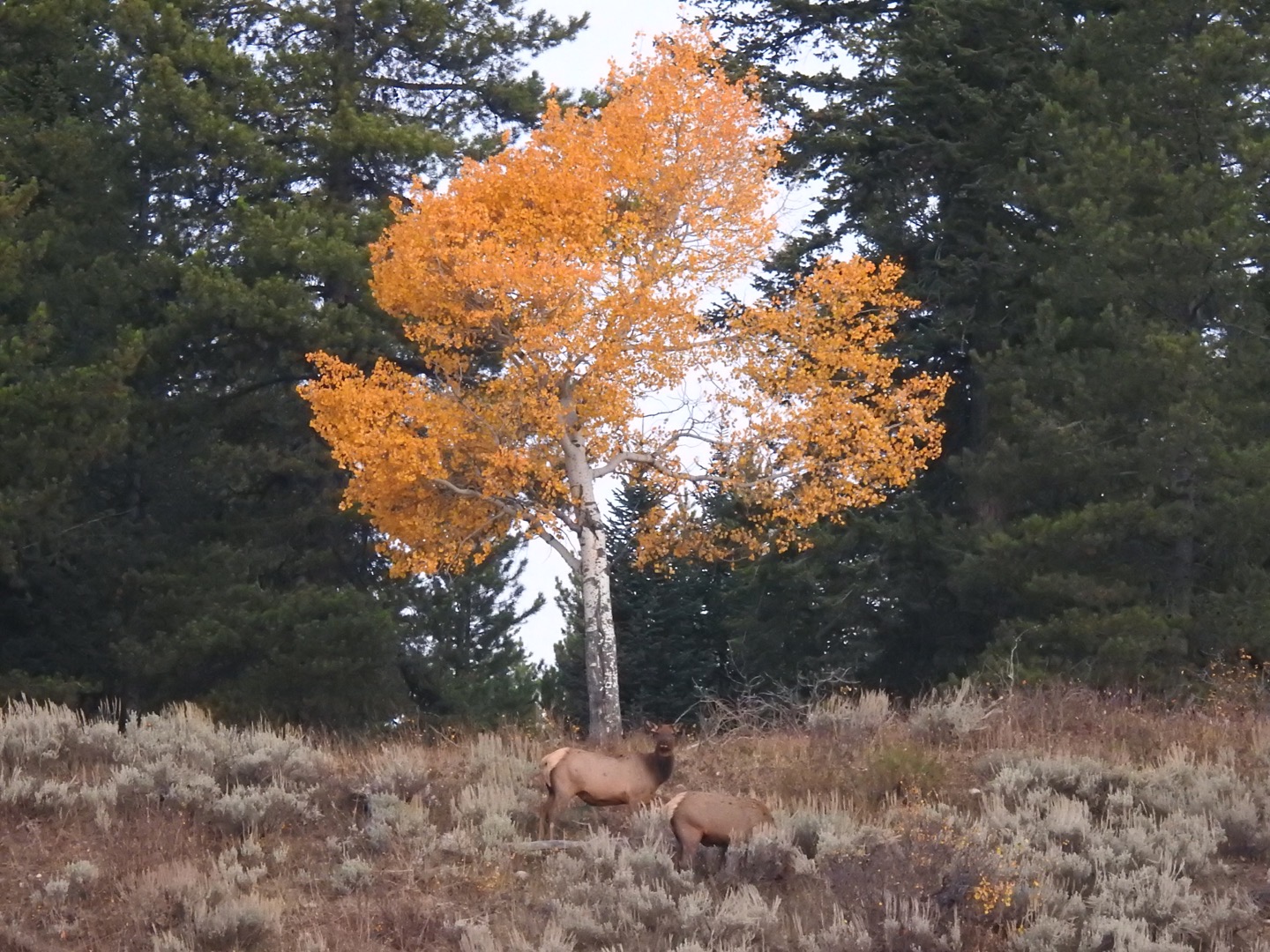
Fall colors with two elk. Grand Teton National Park.
Coyote. Lamar Valley. Yellowstone National Park.

I also think that visiting in the fall helped our trip. The last time I was in Yellowstone it was as green as can be from the grass in the valleys to the evergreens and deciduous trees everywhere else where anything could grow. In the fall, there are trees here and there with bright oranges and yellows to inject a dash of color into the sameness in the forests and the grass in the valleys is a pale straw color, which among other things is perfect for hiding coyotes.

I don't know why I am still amazed at nature's camouflage. I have watched lions the color of grass and leopards in trees in Africa and marveled at how the colors and shadows of their natural environments hide those animals. I've also written just last month how the color of the bark and the darkness of the trees in Yellowstone obscure animals as massive as elk. I guess I just didn't expect coyotes to be so invisible in the fall grasslands of Yellowstone. Maybe it's the Road Runner cartoons.

Ultimately, we did spend the majority of our time in both Grand Teton and Yellowstone either watching wildlife or moving from one place to the next in hopes of seeing wildlife. I've already written about the moose, elk and bison we saw last month in separate posts because those were the most visible species. But that wasn't all we saw. 

Bald eagle in flight over the Snake River. Grand Teton National Park.
Bear no. 2. Grand Teton National Park.
If there was a hope we had in our animal search in Yellowstone and the Tetons, it was that we would see plenty of bears. By plenty here, I don't mean plenty like we saw plenty of elk or bison. Maybe 10 was a stretch goal? We saw three earlier this year in Rocky Mountain National Park in a single day in a park where bears aren't that common. I felt I was being realistic in hoping to exceed that total in six days in a place where there are more bears. And by that I mean more total quantity (although the precise numbers in RMNP aren't known) and more species (two vs. one). There are more than 700 grizzly bears in Yellowstone alone; Rocky Mountain likely has less than 1/4 of that total number of just black bears. Of course, it's a bigger area. Much bigger.

If there's one thing we pretty much counted on not seeing, it was wolves. Wolves were re-introduced to Yellowstone in 1995 and their numbers as of the date of our visit were reported to be 99 total. I'd seen every species we hoped to see in Grand Teton and Yellowstone before with the exception of mountain goats and wolves. No way did I hope to see either. I didn't even realize there were goats in Yellowstone or the Tetons, or at least not visible from a car, but we saw our first couple ever. But wolves? The odds seemed stacked way against us. Yellowstone was full of surprises.

There were really no disappointments on this trip but if there was an unpleasant surprise, it was that we only saw two bears in the whole week we were roaming around the Parks. They were both pretty poor looks. The best photograph we got of either bear (and frankly they may have been the same bear in the same area of Grand Teton at two different times) is above. We struck out entirely in Yellowstone.

I know. I know. I'm whining. Or Crying. Wahhhh!!!!! I didn't see more than two bears on my week trip to one of the premier destinations in the United States. But it's true. We wanted more bears. We thought we'd see more than two. For the record (and based on the narrative of people around us who may or may not know what they were talking about), it was either a grizzly and a black bear or two different black bears or the same black bear twice. Personally, I'm leaning towards a grizzly and a black bear, although the best photographic evidence of bear no. 1 (the "grizzly") is below. That bear, by the way, was moving fast. Good thing it was a good distance away.

Grizzly or black bear? I'm leaning towards grizzly.
But we did see wolves.

I know I've already said this but I thought there was no way we were going to see any wolves whatsoever. We're talking 99 dogs in an area almost twice the size of Rhode Island. What are the odds?

But we didn't just see one or two wolves. We saw a lot of wolves. On three different days in two separate locations in Yellowstone National Park.

My first tip for seeing wolves in Yellowstone based on our very, very limited exposure is to visit the Lamar Valley in the northeast corner of the Park. I know, it's remote and if you are staying in West Yellowstone, Montana (like we were), you'll need to get up super early to get over there when the wolves are still active in the morning (we left one morning at about 5:30 a.m.). But we were two for two in Lamar. Two visits, two sightings of multiple wolves.

Admittedly, both sightings were at a very great distance. Probably at least half a mile away. The animals were like ants on the landscape, even when using binoculars or the zoom lens on our camera which we have been so impressed with in the past. But they were clearly wolves and it was remarkable to see them move across the landscape as a pack, not in a group like I expected but single file with a really good amount of space between them. I think one of the most remarkable benefits of observing wildlife with your own eyes in a natural environment is seeing behaviors that wouldn't necessarily stand out if you were told about those behaviors in a TV show or something like that. How wolves move is indelibly stamped on my brain from our visits to Lamar Valley.

If you do go to Lamar Valley, or anywhere else in the Park really, be prepared to share space with people with some fantastic and very large zoom lenses and telescopes. Their equipment dwarfed what we thought was the ultimate travel camera for seeing and photographing wildlife. Their gear was much better than ours. Although I wouldn't want to lug their stuff on a plane as cabin baggage. 

Wolves in Lamar Valley. Yellowstone National Park.
Lone wolf. Hayden Valley. Yellowstone National Park.

My second tip for seeing wolves in Yellowstone is to get lucky. I know...it's a terrible tip. But in a way it applies to all wildlife watching. We didn't get lucky with bears. We got super lucky with wolves.

We always have an itinerary for our trips. Most of the time, we follow those agendas to the letter and build in enough float to linger or improvise. Sometimes, we read the conditions on the ground and decide to go a different way. We did the latter in Yellowstone and it completely paid off. Our original plan for Yellowstone had one trip to the Hayden Valley, but after driving through once, we not only adjusted our route back to our hotel to take another pass on the same day but we decided an early morning visit on a different day might pay off somehow. That's where we got to see a wolf at a distance of about 20 feet.

There were a number of wolf false alarms (or was it crying wolf?) in our time in Yellowstone. There were at least four or five or maybe more times when we heard someone calling a coyote a wolf. So on our second day in the Hayden Valley we were not quite ready to believe that the dog-like creature trotting about ten feet off the road just before the sun was really up was a wolf. But after a second or two lapse of brain processing time, it was.

Right there in front of us (and a caravan of 15 or so cars) was a yearling wolf separated from her pack. Super close. Way closer than the 100 yards of separation recommended by the Park for this kind of an animal (although that doesn't really count when you are in a car). Honestly, this was such a thrilling sight that for the 20 minutes or so we followed this wolf, we forgot all about the whole no bears thing. This is one of the apex predators in the Park and it's right there in front of us.

This was absolutely amazing. So amazing in fact that our fellow tourists stopped their cars as close as they could and piled out of their passenger side and driver and back seats to snap the best possible pictures. I'd love to say that we exercised a little more caution (and I think we did - keeping the car between us and the wolf or opening the door but standing on the step of our SUV) but it's super easy to get excited and lose track of what the rules are. I mean it's a wolf less than 30 or maybe even 10 yards away.

Wolf. Carcass. Hayden Valley. Yellowstone National Park.

If there has to be a singular experience that represents this trip (and I'm not sure there has to be), this was it. To get this good a view of a wild wolf is something that's not going to happen each time you visit Yellowstone. It truly was so lucky, although getting up early was definitely a part of making our own luck.

We don't have great pictures of our lone wolf. The lighting was not ideal and she moved pretty fast which made taking amazing pictures with our camera a little difficult. I still think we got a couple of pics that I'm proud of for us to remember what we saw.

Two Parks. Six days. It's still crazy to me that (1) we spend this much time doing sort of the same thing over and over again and (2) that we still missed so much. No hikes. No Jenny Lake. No bears (well...two), no Tower-Roosevelt, tons of missed side roads and drives. But wolves, fighting elk, moose, herds of bison, geysers, multicolored pools and those gorgeous Tetons in the fall? Tremendous. What a week. 

Everyone should go to Yellowstone at least once in their life. If you go, make your own luck. Get up early and stay for multiple days.

One last look at the Tetons. From Mount Moran Turnout. Grand Teton National Park.

How We Did It

Both Grand Teton and Yellowstone National Parks are open all year round but access to certain parts of both Parks are severely limited in the winter season. Check their websites for current conditions by clicking the names of each park earlier in this paragraph.

Both Parks charge admission, although there are days of the year when admission is waived. You might also save a few bucks by purchasing U.S. Parks Annual Pass which will get you into all National Park Service properties and a whole host of other sites for free. The Pass, which we purchased last November, costs $80 as of this writing. The 2020 entrance fee for Grand Teton is $35 and you can add another $35 for Yellowstone. It won't take but one more Park visit somewhere else to make buying a Pass worthwhile. The $35 admission fees to both Parks are good for seven days each.

Note there is a large amount of territory in the south end of Grand Teton that is outside of the entrance gates so depending on where you want to go, you might be able to visit Grand Teton for free. You can get to our favorite moose and bear watching spot down on Moose-Wilson Road without paying. Or at least you can if you are traveling from the south.

We found the best places to see wildlife in Yellowstone to be Lamar Valley and Hayden Valley. Get up early for the best sightings or stick around until dusk. We considered hiring a guide for a day to help us find wolves but found pricing to be north of $500 per day. We took our chances on our own and I think we made out pretty well. We actually followed a couple of guided tours in Grand Teton for a while and they didn't seem to have any better luck finding animals than we did. I guess a huge advantage of being with a guide is that they likely have better gear than you do. I'm happy with the $500+ that's still in my bank account.

We also found it really useful to ask what people were looking at. We got a lot of help from strangers pointing out what they were focused on when we were just lost. You might not have that long to see some of these animals. They have a way of disappearing into forests quickly. Ask for help.

You can see that gorgeous Teton mountain range from just about any spot in Grand Teton south of Jackson Lake.


Tuesday, September 22, 2020

Yellowstone

It's been almost three years since I've pre-blogged about a destination. I figure it's about time for one of those posts in advance of next month's travel plans.

In 2011, I spent two weeks with my friends Mike and Bryan driving across the United States from my home in Arlington, Virginia all the way to Portland, Oregon. It was the first time I'd ever driven across the entire continent and it's a kind of trip that I won't likely ever make again. 

I actually probably shouldn't make statements like that. If there's one thing that 2020 has taught me, it's that things I never expected to happen will happen whether I like it or not. So yeah...never say never or even won't likely ever.

One of the highlights of that long distance drive was a two night stop at Yellowstone National Park. We arrived there in the afternoon from the east after traveling 12 plus hours from Deadwood, South Dakota, and left maybe about 40 hours later to the west en route to Seattle. With so far to go in just two weeks, there just wasn't much time to linger, but we did think it was important to get in a whole day in the Park. That meant two nights.

In our one full day there, we set out first thing in the morning from our hotel in Lake Village and headed north and counter-clockwise around the Great Loop, hitting the Grand Canyon of the Yellowstone, the Tower-Roosevelt area and Mammoth Hot Springs, before heading south to Old Faithful and then back around to the hotel. If there's one thing to be said about our time in Yellowstone, it's that we didn't run out of sights to see. 

The main reason we didn't run out of stuff to do in a single day is Yellowstone National Park is massive. At almost 3,500 square miles, it's bigger than the entire state of Delaware by about 40% and it's more than twice the size of Rhode Island. Maybe you don't think of Rhode Island and Delaware as being big but we're comparing the size of an entire state to the size of a single National Park. This place is big. Too big, in fact, to cover in a single day. One day I figured I'd have to go back and do it right.

The Grand Canyon of the Yellowstone.

2020 has been littered with cancelled trips. Costa Rica in March. New Mexico in May. California in June. Maine in July and (again) in August. England later in August. And most recently we made the decision to give up on a trip to Rwanda, Uganda and Zanzibar in October. That last one hurt, but there was really no other option.

It hasn't all been doom and gloom this year. We have both been healthy all year long and we've been able to transform some of those cancelled trips into reasonable facsimiles of the original intent. A national parks trip to California got morphed into a national parks trip in Utah and Colorado. Maine got replaced with Vermont, although Maine was really a substitute for Costa Rica so Vermont didn't stand a chance of coming close to the original deal there. New Mexico and England? Well...some other time maybe.

But when it came time to think about if we should even try to replace a trip where we'd be trekking into the mountains to see gorillas in the wild, driving around Queen Elizabeth National Park on safari and walking through the jungles of Zanzibar looking for monkeys, we were a little lost. We thought about a trip up to Churchill, Manitoba to see polar bears but the fact that Canada is not admitting Americans to their country right now killed that one pretty quickly. Ultimately, we decided if we were going to replace an animal watching trip with something similar that had to be in the United States, we should head out to a place where we could see the greatest collection of wild wildlife in our country. And that meant just one place: Yellowstone. Looks like that return trip I thought about in 2011 is happening this year.

This time we are doing it right. No 40 hours in the Park this year. We are dedicating three whole days plus whatever time we can squeeze in from a fourth day driving up through Grand Teton National Park starting early in the morning. We'll be hitting parts of the Park like the North and South Entrances, but most especially the Lamar Valley, that I didn't get a chance to visit in 2011. I have to say I'm pretty excited about that last part.

When I visited Yellowstone in 2011, my greatest hope was that I'd see a bison. Just one would have been enough. At that time I knew precious little about the Park, including that seeing a bison was pretty much a sure thing. We saw one strolling down the middle of the road in front of our car within the first half hour we were in the park. After that, we saw them everywhere. Our car was even surrounded by them on the way out of the west entrance. I need not have worried about seeing a bison. 

I was incredibly casual about looking for animals back then. I didn't make a deliberate effort to find the spots with the greatest concentration of wildlife or go out looking at dawn or dusk when I now know the chances of spotting creatures is the greatest. We just roamed at a time that was convenient for us. And honestly, while we saw a grizzly bear and tons of bison, we really didn't see much else. There are supposedly more elk in the park than any other mammal species and we saw one. And at a great distance at that. I'd forgotten we spotted a coyote until I looked through my pictures from that trip while writing this post. The 2011 trip to Yellowstone was all about that one grizzly and the many, many bison.

This year will be way different. I'm certain. Or at least I'm hoping since I'm way, way more prepared. There's no way we aren't seeing much, much more wildlife this time around. 


2011 in Yellowstone: grizzly bear, elk and coyote. And a whole lot of landscape.

Wildlife wasn't the only reason I put Yellowstone on our 2011 westward journey. I also went for the scenery and for the volcanic action, including a stop to watch Old Faithful geyser erupt surrounded by hundreds if not thousands of other people. Here again, we just scratched the surface nine years ago. I was impressed by the colors and landscape at our stop at Mammoth Hot Springs and the Rockies are amazing. But in the last month I found out we missed as many impressive spots as we saw, if not more, including Grand Prismatic Spring. No way are we missing that this year, not even if its guarded by a few grizzlies and a pack or two of wolves. 

I might chalk the animals and the geysers and hot pools we missed up to a mistake or two. But honestly, we didn't have any time to spare in our one day anyway. Three whole days seems much more sensible. 

2011 is a long time ago. I've changed so much in the way I travel since nine years ago, from the knowledge I carry with me, to my travel habits, to the technology that I've embraced. I've gathered together the most spectacular photographs from nine plus years ago that I could for this post and I'm not thrilled. My photos of animals likely stretched the capabilities of my Blackberry to the max and my landscapes aren't much better. I even managed to cut the top of Old Faithful off with my beginner camera skills. 

There were also fewer than about 30 total pictures to choose from. If there's one definite improvement I've made in my picture-taking habits, it's to take pictures in bunches. If I come back from this trip with fewer than 500 pics of Yellowstone I'll be surprised.

I'm lucky to be able to have a second shot at Yellowstone, even as I continue to whine about being (mostly) confined to the United States. I get that our country's government has badly bungled the response to this global pandemic and by the time it's all over or close to it, I'll have abandoned international travel for 12 months or probably more. Yellowstone won't be Rwanda, Uganda and Zanzibar but it will likely still be an incredible natural showcase. I'm excited to see it again and for a lot longer and in a different season. And not just for the wildlife. I know we missed some incredible sights or made short stops at others in 2011 which are now on my list for this year.

Yellowstone in an American icon. And I think it's going to be spectacular the second time around.