Showing posts with label David Livingstone. Show all posts

Thursday, May 11, 2023

Zanzibar

The first time we visited sub-Saharan Africa in 2015, we stayed for just six nights. Most people we knew told us we were crazy to go all that way for less than a week. They were probably right. We won't likely ever do that again. I think any trip to that continent where we go further than Western Africa has to be at least a two-weeker. So after eight nights in Uganda and an extra one in Rwanda, we couldn't go home just yet. We had to go somewhere else for a few nights. We picked Zanzibar.

Zanzibar for us meant two things: (1) a gorgeous white beach fronting onto the endless pale blue Indian Ocean and (2) plenty of history. We scheduled five days for all of that, four of which involved the beach and the ocean and a lot of doing not much at all. That part of the agenda would have to wait until a day after we landed on Zanzibar, though. We started our time on the west coast in a place called Stone Town.

In case the name Zanzibar doesn't mean anything to you, it is an archipelago of 52 islands in the Indian Ocean off the east coast of the African continent. It's a semi-autonomous part of Tanzania which was absorbed into that country's territory in 1964, a move so significant that it changed the name of the country from Tanganyika to Tanzania (Tanzania is a smushing together of Tanganyika and Zanzibar). We knew all that before we landed in Zanzibar because we did our homework ahead of time, but if you think I am boasting about that, read on.

Most people in Zanzibar live on one of the two largest islands, Unguja and Pemba. Most people refer to Unguja informally as Zanzibar but that's technically incorrect. We didn't know that before we set foot on Unguja. No homework done, there. The capital city of Zanzibar is Zanzibar City and its historical center is known as Stone Town. We didn't know that either before we visited; we thought the name of the city itself was Stone Town.

How great are these names, by the way? Zanzibar sounds like something out of a centuries old romantic poem and Stone Town belongs somewhere in the Game of Thrones books, I'm sure. Actually, both have nothing to do with anything like that. Zanzibar got its name from Arab and Persian explorers who named the place after what they saw when they arrived. Zanjibār in Arabic and Zang-bār in Persian means black coast. And Stone Town refers to the buildings there being constructed from...ready for this...stone.

The rooftops of Stone Town at sunset.
But before we get to Zanzibar in 2023, let's go back to that 2015 trip just for a few paragraphs.

When we landed in Africa and actually exited an airport on that trip, we found ourselves in Victoria Falls, Zimbabwe. Not a very African sounding place, right? Nothing like Zanzibar or Unguja. That's because the town of Victoria Falls was named after the famous waterfall which was named after Queen Victoria of England who ruled Britain and the rest of the British Empire in various parts of the world from 1837 to 1901. The reason a waterfall in sub-Saharan Africa is named after a British monarch is the dude that named the Falls happened to be British. His name was David Livingstone.

Before we planned that 2015 trip that started in Zimbabwe, I didn't know a whole lot about David Livingstone. I thought he was an explorer, some dude sent along with some sort of army or at least a few troops to conquer territory in far off lands for Britain so that nation could extract valuable assets out of the land they had just taken by force. Some of that is true. He was an explorer. But he didn't go with an army of any sort. He was actually there as a missionary and what he did with the many, many years he spent in Africa in his life had nothing whatsoever to do with Britain exploiting the lands and people in present day Zimbabwe and other colonies held by his mother nation.

I'm not saying Britain didn't do that. Just that Livingstone wasn't there for that.

If you ever make it to Victoria Falls National Park, you will likely come across an oversized statue of David Livingstone. There are a series of words around the base of that statue, including "Explorer" and "Missionary". One of other words around the base of the statue is "Liberator". I am sure it is that word that would most honor Livingstone's life's work because most of his time on this planet was spent trying to end the slave trade in that part of the world. He was convinced, right or wrong, that opening Southern Africa to equitable trade would end the practice of tribal leaders selling people into slavery as a means to enrich themselves. We can debate the merits of that theory, but he tried like hell to do anything he could to stop slavery.

Since that 2015 trip to Victoria Falls, we have bumped into Livingstone in a couple of different spots. We visited his grave in Westminster Abbey in 2016 and we made a pilgrimage to his childhood home last year just outside of Glasgow, Scotland. Zanzibar would be another opportunity to check in with David Livingstone because Zanzibar was a center of international trade on the African side of the Indian Ocean. And one of its main commodities available for purchase was slaves.


Livingstone first set foot in Zanzibar in 1864, 24 years after he first set sail for Africa. When he arrived there, Zanzibar was under control of the first Sultan of Zanzibar, Sayyid Majid bin Said Al-Busaid. His father was the Sultan of Oman, who made the decision that upon his death that Omani territory be divided between two of his sons; his third son became the Sultan of Oman and his sixth, Majid, became the Sultan of Zanzibar. 

Now, lest you think Majid got the short end of this stick here, consider this: his father valued Zanzibar's location so much that he relocated the country's capital from Muscat to Stone Town. Zanzibar was that important as a port of trade between Europe; all the lands around the Indian Ocean (including Persia, the Middle East and India) and the east coast of Africa. Think about all the riches pouring through this tiny series of islands off Africa's coast. Silk. Cloth. Spices. Fruit. Ivory. Gold. Slaves. It was this sort of bonanza that led the Omanis to take it from the Portuguese in 1698.

Of course, the Portuguese knew all this too. They started looking for a means to import goods from the Silk Road and other riches from Asia when the Ottoman Empire imposed impossibly high tariffs on goods transported through their territory after they seized Constantinople in 1453. With land routes to Persia, India and beyond no longer economically feasible, the Portuguese turned to the sea and found Zanzibar to be perfect for use a base of operations from which to operate their Indian Ocean trading post.

The Portuguese took Zanzibar from its Swahili-speaking natives who had established the islands as the trading post they became by the time the Portuguese arrived in the early 1500s. Swahili speakers were the first to trade African goods for those from Asia and some of the frequent visitors from Persia, India, China and the Arabian peninsula settled and intermarried, making Zanzibar one of the first true melting pots of different peoples in the world.

Of course, those "African goods" included slaves.


If you know where to look, a walk around Stone Town will get you an insight into a lot of Zanzibar's centuries of history. If you can keep your bearings about you. If you can avoid the motorcycles and tuk-tuks and dudes pulling very large carts by hand. And if you can manage not to get lost, that is. The place is a maze of thin streets, small squares and narrow alleys defined by remarkably similar (but admittedly sometimes ornate) stone buildings with wooden trim and balconies holding hotels and museums and offices and souvenir stores and anything else that an historic economic center of an entire coast of a continent needs to operate.

And if you don't know where to look on your walk or are worried about getting lost, there are plenty of guides available to show you. Keep up and you won't get lost at all. Providing you keep up. We found a good one and we did keep up, although there were a couple of spots where we had to hustle because he had gone in front of us and disappeared around one too many corners. It happens. We found him again. Just.

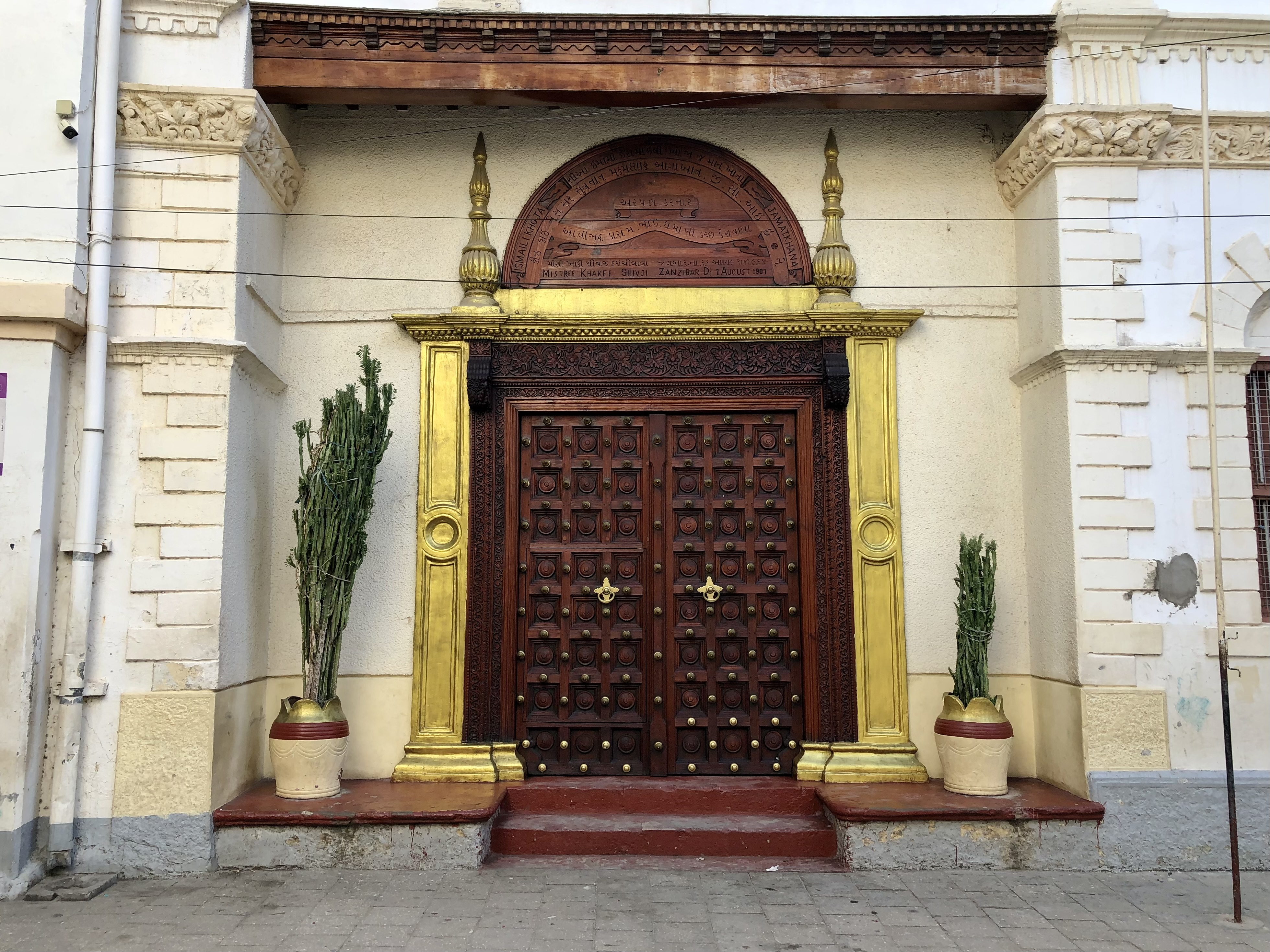
Walking the streets of Stone Town, you can see the wealth accumulated by the city's residents over hundreds of years of trade in the elaborately carved doors and door frames throughout the city. You can see the mix of religions and nationalities in the 52 mosques, four Hindu temples and two Christian cathedrals. You can see memories of the now banned ivory trade that passed through Zanzibar on the walls of the Dhow Palace Hotel, itself richly adorned with fantastic wood carvings around its entryways. You can see the massive fortress erected by the Sultans of Oman to protect their hard won and extremely important treasure of a town. And I suppose if you listen, you can hear the melting pot in Swahili, English, Arabic, Persian, Hindi and Swahinglish. 

You just won't likely hear it in Portuguese. Despite holding Zanzibar for 200 or so years, all memory of those times have been blown away over the Indian Ocean. They were that hated.

And you know what? You can probably even take in all of that if you do get lost. Is there really any such thing as getting lost any more when everyone has some sort of navigation app on their phone?


The Dhow Palace Hotel, Stone Town. Full of historical photographs of the ivory trade through Zanzibar.

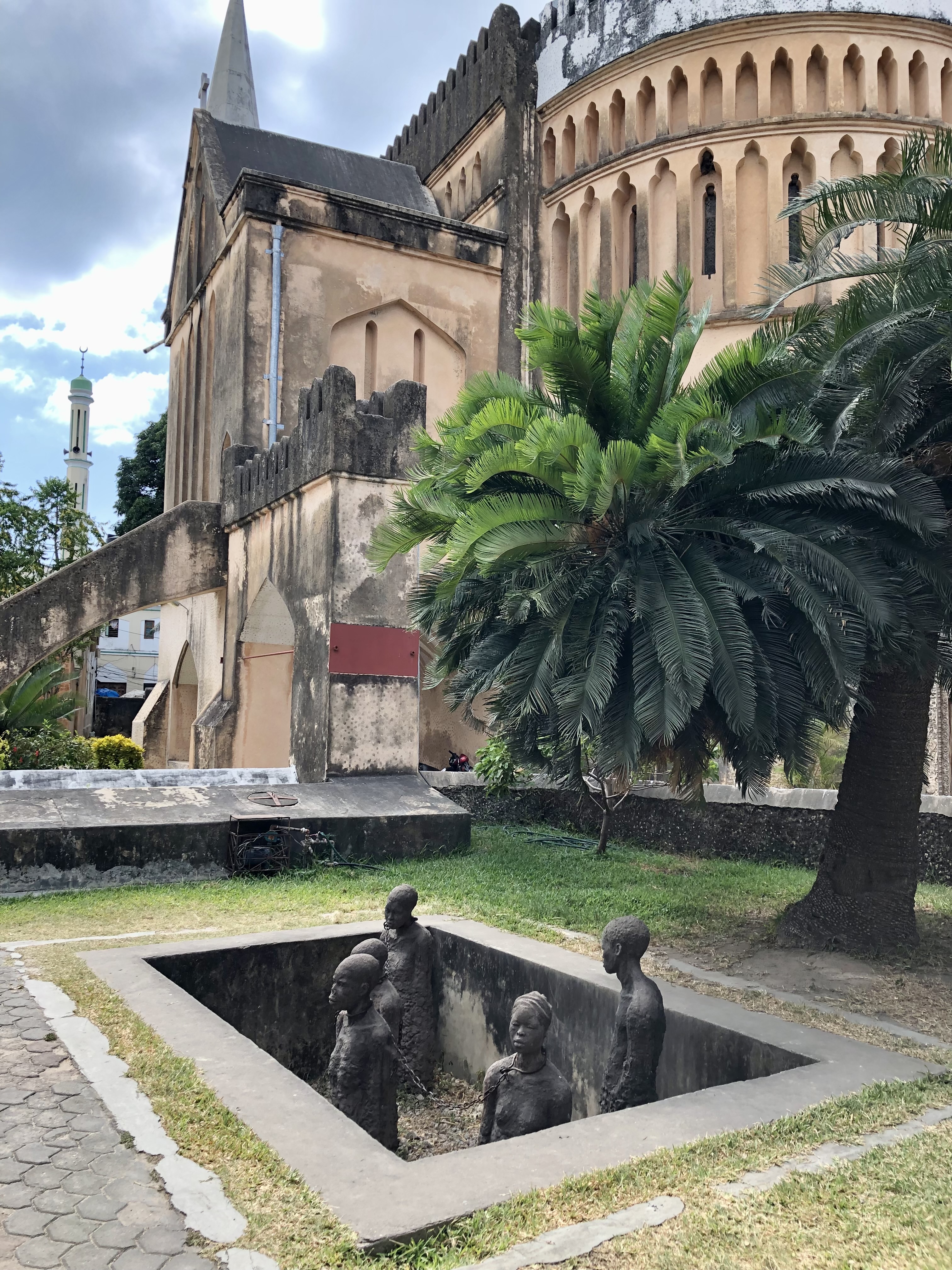
A remnant of Zanzibar's slave market is still around too. Most of where it used to stand was taken and used for the construction of the Anglican cathedral in town. Walk inside that house of worship and you'll see a reddish stone circle in the flooring right in front of the altar. That's the spot where the whipping post stood in the market. It's forever immortalized in the flooring of the cathedral so we don't forget. 

Outside the cathedral, there's a small Slaves Monument, statues of four chained Africans waiting to be sold at auction while being watched over by fifth statue of a slave master, a black man afforded some measure of freedom to drive and punish people who looked like him on behalf of the slaves' owners, a sort of double humiliation for the slaves and the slave master alike while sparing the people who owned these people the trouble of meting out discipline. It's completely twisted but very carefully conceived, I am sure.

We have, by the way, seen all too many of these statues of black people chained up ready for sale over the last few years of our travels. The shock never really wears off. Neither does the shame, really.

But the really disturbing place to visit in this part of town is below the cathedral, two underground rooms with little light or ventilation that were used to hold slaves prior to auction. The tiny rooms held 50 men in one room and 75 women and children in the other. These places are so tight. It must have been about as excruciatingly hot and uncomfortable and unsanitary as you could make a place. Even the geometry of the rooms was worked out to I am sure impose more pain on the occupants. There is no way for a fully grown man to stand comfortably and the room is not a single height, which meant that even if most of the people packed into these places wanted to stand, there is not enough floor space to allow them to do so. It's so sickening and creepy being in a place like that knowing somebody probably designed these places to impart a great deal of discomfort over a long period of time on whoever was confined here.  

There are varying accounts of the number of people captured and sold into slavery through Zanzibar. I've read numbers as high as 8 million people over a couple of hundred years, but that was for the entire east coast of Africa. Our guide walking us around Stone Town put the number through that place at 1.2 million. Most ended up in homes in Oman or on plantations in Brazil, Mauritius or right there in Zanzibar. Apparently, spice farming was labor intensive in the 1800s. I can't even begin to imagine the hopelessness these people felt. 


David Livingstone made several trips to Zanzibar in his lifetime. Every time he visited, he knew the East African slave trade was alive and thriving on the island. He never saw the end of it. Livingstone died in 1873 from malaria and bleeding caused by dysentery in present day Zambia. He was 60 years old. The very next year, the British government, mostly through threats of force, brokered a treaty to close the slave market in Zanzibar. I am confident in saying that all trade in slaves did not end in 1874, either in Zanzibar or over the Indian Ocean. Our guide told us there was a slave market north of Stone Town on Unguja that was still operational until 1909. But 1874 may have been the beginning of the end of open trade in slaves.

After Livingstone's death, his two companions Chuma and Susi prepared his body for transport to England. He was ultimately laid to rest in Westminster Abbey where we found his grave some seven or so years ago. During the preparation of Livingstone's body, his heart was removed from his body and buried under the tree that he died beneath.

Earlier in this post I mentioned that Zanzibar was another opportunity for us to check in with David Livingstone, but it was not just by visiting a place where he had spent time trying to end the slave trade in that part of the world. The connection to Livingstone that we sought in Stone Town was through that tree he was buried under in Zambia. Enter the Anglican cathedral and look to the left side of the altar in the crossing of the church and you'll find a simple wooden cross. That cross was made from Livingstone's death tree. This was the connection that we sought in Zanzibar. That cross.


The former location of the whipping post is marked with a stone circle in the floor (top). Livingston's cross (bottom).

We spent altogether too little time in Stone Town. Slightly less than 24 hours is not enough time by any stretch of the imagination to spend in that place. We spent our one day on an organized tour which included our walk around Stone Town but it also included about half of the time on the full day tour outside of town. We missed the Freddie Mercury Museum. We missed Prison Island. We missed the night market in Forodhani Park. We missed a lot.

What I've chosen to write down in this blog post about Stone Town is not by any means all we got out of our time there. Sometimes for us, trips connect in ways that enrich our understanding of the world, the region or even the history of humankind. Sometimes those connections are wonderful and thrilling and uplifting. The connections described in this blog post are not in that category but they are important to make nonetheless.

We had an awesome time in Stone Town. The place is magical and enchanting. Everyone we met there treated us well and enriched our stay there. We also had some of the best food of our trip and for sure stayed in the best and most comfortable hotel of our 14 nights spent in Africa. I also managed to enjoy my first ride in a tuk-tuk anywhere in the world. We've seen these vehicles in places like Kenya and Peru but I've never actually taken a ride. After a walk around Stone Town for a couple of hours in 90+ degree temperatures, a ride home at the end of the day in a tuk-tuk was extremely welcome. Sometimes it's the small things.

Tuk-tuk ride home.

How We Did It

Our walk around Stone Town was a portion of an organized tour we found on Viator.com before we left home for our couple of weeks in Africa. The full itinerary on this tour took us to a spice farm outside of Stone Town; got us our visit to the old slave market site and about a million other things; and ended at Prison Island, where there is a colony of giant tortoises. We cut the tour short before Prison Island so we could take a taxi over to the east side of the island for our four days on the beach. There are many tours like this on Viator. We ended up on the Spice Tour + Stone Town Tour + Prison Island tour. No complaints from me on this tour. Everything went seamlessly. 

I think my one regret about our time in Stone Town was that we didn't spend enough time there. There are choices we make when we travel to spend time in many places. Ultimately we decided to prioritize as many nights in one place as possible on Zanzibar. That decision got us just a single night in Stone Town. I will say that from walking around Stone Town for a couple of hours, the place seemed manageable and walkable and comfortable. At no time did we feel unsafe or in any danger whatsoever. If you want to stay in a hotel that will pamper you without breaking the bank, check out the Spice Tree Hotel by Turaco. It's a Marriott property now but it wasn't when we visited. The breakfast spread is just incredible. 


Thursday, September 10, 2015

The Smoke That Thunders


On December 8, 1840, a 27 year old missionary named David Livingstone departed his native England on an expedition funded by the London Missionary Society to bring Christianity to southern Africa. He wouldn't return home until December 9, 1856. In the sixteen years he was gone, he had established three missions (all destroyed); met with and befriended a number of native tribes and chiefs in a way no other white man had; converted almost nobody to Christianity; and walked across the entire continent from his landing point at Luanda, Angola to the end of his journey at Quilimane, Mozambique. Along the way, on November 16, 1855, he discovered a great waterfall, which he named Victoria Falls after England's reigning monarch at the time of his journey.

Of course, Livingstone's discovery is a matter of perspective. He was certainly not the first person to lay eyes on what he named Victoria Falls; people living around the the Zambezi River had known about and feared the Falls for generations and stone age tools as old as 50,000 years have been discovered near its location so it's not like folks didn't know it was there. Livingstone was merely the first European man to see the falls, which we white people naturally have a tendency to confuse with actual discovery, although I'm sure Livingstone would not think this way. It is very likely that he knew exactly when he was going to find it since the natives he had stayed with on his trek likely told him all about it, using the name they had given the place: Mosi-Oa-Tunya or "the smoke that thunders."

On August 20 of this year, a 47 year old architect (me) departed his adopted United States for Africa on a trip that promised to be a vacation of a lifetime (so far). And Mosi-Oa-Tunya was my first stop after arriving at my final destination. Like pretty much literally my first stop. A quick check in at the hotel for a clean shirt and we were off on the half mile trip (we drove...or more accurately rode) to the famous Falls. It didn't take a 15 year journey, although the 28 hour plus trip might have seemed that way to me at the time (and hence the clean shirt), and for darned sure I was in no way any sort of discoverer of anything other than myself on this trip. But two hours after arriving in Zimbabwe, I was on my way to a place that meant the start of an eye-opening journey for me.


When I think of amazing waterfalls, I think of Niagara Falls, probably because that was the only truly awe inspiring waterfall I'd visited in person prior to last month. And by Niagara, I mean a wide river flowing fast and deep over a massive drop into a large-ish body of water all of which is in plain view. Basically a cliff with a ton of water flowing over every second and minute. Pretty much your classic waterfall.

Victoria Falls is not Niagara. And by that I mean my preconceived notion of what this waterfall would look like was nothing like my ideal large waterfall based on my past experience. Instead of falling off a large drop into an open pool like the water at Niagara does, the water at Victoria Falls drops into a slice in the Earth and then zigzags down a tight fast canyon which snakes its way along the border between Zimbabwe to the south and Zambia to the north. I'll try my best to explain how this happens and how it's not as easy to appreciate as Niagara.

The land under the Zambezi River (which is the river that drops over the falls) is made up of alternating vertical layers of basalt and sandstone which form "stripes" perpendicular to the flow of the river. These "stripes" of course are not visible to the eye below the river but sure enough they are there. I'm not sure why it is this way but somehow, somewhere way back in time some sort of geological action must have formed this sort of phenomenon.

Basalt is hard. Sandstone is not. So over the millions of years that the Zambezi has been flowing over the riverbed, the action of the water is gradually eroding the sandstone layers. The result at the location of the Falls is that the softer sandstone has been washed away to form canyons which the river dives into while the basalt around the sandstone remains in place. This appears to the first time tourist as a gash in the land about 350 feet below the upper riverbed everywhere there used to be the softer stone.

Looking east at the Falls from just west of the Devil's Cataract.
The way Mosi-Oa-Tunya was formed makes it extremely difficult to understand for the first time visitor and I spent the majority of my time walking through the national park on the Zimbabwe side trying to wrap my head around how this part of the waterway was created. The park itself is one of the basalt layers that make up some of the riverbed and millions and millions of years ago, the Zambezi actually flowed over where you are walking. It doesn't now because time eventually caught up with the sandstone layer north of the park and created a new canyon for the Falls to drop into. Make sense? If not look at the picture above the one above. Hopefully that helps.

Victoria Falls is neither the highest nor the widest waterfall in the world yet it claims to be the largest. At its highest point of 360 feet it is more than twice as tall as Niagara which tops out at just less than 170 feet but it is nowhere near the largest drop of over 2,600 feet you can find at Angel Falls in Venezuela. And despite it being just over a mile wide (Niagara is about 25% narrower), it is significantly smaller than Iguazu Falls which separates Brazil from Argentina and is over 1.5 times as wide.

So why is it the largest? Well that's just not clear to me but I suppose it has something to do with the amount of water dropping at any one time which would be a combination of height, width and depth. Despite searching for hours on the internet, I was unable to find a satisfying answer. I can say having been there that Victoria Falls is so wide and the viewing angles are so few that it is really hard to comprehend just how big the Falls is. It would be a lot simpler if the drop was just like it is at Niagara. But the fact that the water dies into a canyon so suddenly makes it almost impossible to see the whole thing from one spot on foot. I was more impressed by Niagara.

The Main Falls. Pretty strong in winter. Imagine the flow in summer.
For those of you reading this post who have made a visit to Niagara Falls and hate it, please understand that I love Niagara. I could stare for hours at the enormous amount of water flowing over the Canadian side of those falls. And the geography there makes that viewing angle which is so awesome just so perfect. You don't get that same view of Victoria Falls and so it doesn't seem as powerful. Don't get me wrong here, Victoria Falls was gorgeous and there are so many different places to see the Falls from and it just keeps going and going as you walk through the park. And I've also never seen so many rainbows in my life. But it didn't impress me like Niagara always has. Maybe I need to go back to the U.S.-Canadian border to make sure I'm remembering things correctly.

I suppose at this point I may need to offer a disclaimer. One of the difficulties for us in visiting southern Africa to see Victoria Falls and also spend time on safari was that those two concepts are fundamentally opposed. To see the animals I grew up loving in zoos and books, you need to go in August to September when the water levels on the Zambezi and Chobe Rivers are low. The lack of water in the bush draws wildlife to the riverbanks  for ideal game viewing. To see Victoria Falls at its most powerful, you really need to visit in April when the rains have been falling for a few months and the Zambezi is at its highest water level.

We visited Zimbabwe after essentially three to four months of solid drought so it shouldn't have been any surprise to me that the Falls were less impressive than they could have been. I can imagine if we went at a different time of the year, I would have come away from the Falls a lot more enthusiastic. You can see where the water flows in wetter times by looking at the face of the drop; anywhere the rock is without plant life is a spot where there is water in the summer months (August is winter in the southern hemisphere). There were a lot of plant-less areas on the basalt face, especially on the Zambian side. I can imagine just how powerful the curtain of water is at full force. You apparently get soaking wet during this time, which I suppose is an advantage to when we visited.

The east side of the Falls, getting close to Zambia and no winter flow.
The town of Victoria Falls is all about "the smoke that thunders." It is clear from spending a day or two there that this is a unique spot on the African continent and the entire economy revolves around tourists coming to look at the Falls, or raft the lower Zambezi or bungee jump off the Victoria Falls Bridge (350 feet down? uh, no thank you). I suppose if the Falls weren't there, the local Zimbabweans would survive off the game that is all around the river and sometimes found wandering around town. I still think it's odd to find baboons and warthogs roaming the streets. I can imagine it would be a little freaky seeing an elephant or hippo on the sidewalk on the way home from a bar. We stuck to the hotel at night.

Our choice (or maybe better said as what was chosen for us) of hotel in Victoria Falls was the Ilala Lodge, which is located about a half a mile from the Falls. The balcony in our room looked toward the Falls and from the moment that you opened the balcony doors in the morning to the time you closed them at night, you can hear the rush of water from Mosi-Oa-Tunya. Coming from the United States it's easy to mistake it for the roar of traffic, only there isn't any traffic to make such a noise. The spray from the drop apparently can rise a half a kilometer or more into the air and I completely believe that. We got up before sunrise the second day we were in town to look for wildlife on the hotel lawn before daybreak. We were disappointed in the animals (just more warthogs…sigh!) but the spray was always visible, shifting like smoke in the air against the emerging light.

Early morning view of "the smoke that thunders."
In addition to the natural wonder of the Falls, there's something else to see in the national park adjacent the waterfall: a statue of David Livingstone. I think it's worth spending a few moments considering Livingstone's presence in Africa. 

Before I started researching this trip, I always thought of Livingstone as an explorer who "discovered" Victoria Falls and crossed Africa for the glory of Britain. I honestly had no idea that he was a missionary. Call me ignorant. Last September I visited the outside of the Royal Geographical Society in London which features a statue of Livingstone prominently in a niche on the outside of their headquarters which reinforced my impression.

In the late nineteenth century, David Livingstone acquired almost mythological status in Great Britain. While he was away, the public was fed stories about his complete isolation for years in a foreign world; accounts of the distances he traveled and things he saw; and too good to be true tales like him surviving a lion attack (true, by the way). For a population that rarely had any opportunity to leave their hometown let alone the small island they lived on, I can imagine how their imaginations were captured by Livingstone.

Statue of David Livingstone at Mosi-Oa-Tunya.
Livingstone was a missionary AND an explorer. His initial visits to the dark continent were funded by the London Missionary Society; later on, when he could no longer secure cash from his first sponsor, the Royal Geographical Society picked up the tab. From reading stories about Livingstone before leaving home for Africa last month, I believe he genuinely believed in the good of Christianity and went to Africa with the intent to convert as many people to the faith as he possibly could. I'm not convinced he ever really wanted to explore and find things for the glory of queen and country, however.

But his real reason for spending so much time away from home was that he firmly believed opening the continent to trading in goods unique to that land would be able to halt the east African slave trade. And this really became his life's work. Indeed his first trek across Africa was to find an overland route for passage of goods which could bring the tribal chiefs who were selling their own people into slavery the riches that they so desperately sought.

Livingstone made three major trips to Africa. The first one may have started out as a missionary trip but there's no doubt the end of that journey and the entirety of the last two were to find any way to halt the movement of humans from the African mainland to the slave market at Zanzibar off the coast of present day Tanzania. Over the course of his life, he tried to find new paths for trade, gave speeches that fell mostly on deaf ears on his return trips home and eventually found a way to try to embarrass the crown into taking action by feeding accounts of the government's inaction to the New York Herald via Henry Morton Stanley, who found Livingstone when everyone thought he was dead with the now famous greeting "Dr. Livingstone, I presume?" 

Eventually his efforts paid off, but he wouldn't be around to see it. He died on May 1, 1873 from malaria and dysentery in present day Zambia. In 1874, the British government, mostly through threats of force, brokered a treaty with Zanzibar to close the slave market on the island and end the trade in that portion of the world. Four years later, all human trade had been essentially squashed. Livingstone was an integral part of that effort and I'm sure he would be prouder of the progress he made toward that goal than anything else he accomplished in his lifetime. His statue at Victoria Falls has a series of words around the base, including "Explorer" and "Missionary." The most signifiant is "Liberator."

Victoria Falls was a great way to start our Africa trip but it's sometimes difficult to have it all. Since I returned to the U.S. I've looked for aerial shots of the Falls online and they truly are spectacular. Maybe one day I'll get to go back at a different time of the year and see the full force of the Falls. Or if I ever make it back in winter, I'll have to take a helicopter ride above the Zambezi to get the view of the whole thing that you can't get from the ground. It's only $162 for a 12-13 minute ride. A bargain, right?