
This is not my first post about food on this blog, nor do I expect it will be my last. I absolutely love to eat and an integral part of any good trip for me either abroad or here at home features an enthusiastic investigation of local cuisine. Now admittedly, I typically do more exploring on this subject when I travel outside of the United States because food tends to be more different when I use my passport to travel. When I stay domestic, I usually find one or two local or regional dishes along with foods that I might eat every day or week while I'm at home. It seems like everywhere I go in the U.S. has a similar sort of baseline of American or adopted American fare.
Everywhere, that is, except for Hawaii. Hawaiian food is really like nothing else in the United States. Like it's totally different. Compared to the rest of the country, it's complete chaos. And it's mostly related to who lives there now and how they got there. So to understand the food on Hawaii, you have to understand a little bit of the islands' history. Or more precisely, a little bit of their sugar plantation history. So here comes your history lesson for this post.
Until the late 1700s, Hawaii was about as isolated from the rest of the world as it could have possibly been (mostly due to the fact that it's in the middle of the Pacific Ocean). As a result, the diet for the islands' inhabitants was fairly limited. Food choices for the locals at that time consisted of whatever the initial settlers brought with them when they sailed there from Polynesia added to whatever existed before they got there. Their grocery list back then included taro, bananas, sweet potatoes, fish, ferns (yes, ferns), coconuts and some other odds and ends.
Then in about the mid-1800s, some Americans, most of whose families had come to Hawaii as missionaries, decided they could make a whole lot of money growing sugar cane. It seemed to them that Hawaii's climate was ideal to facilitate large scale sugar production and they were right. The big problem? Running a sugar cane plantation requires a lot of manual labor and there just simply weren't enough people in the islands at that time to make such an operation work. So they started looking around for sources of labor. Around the globe, that is.
The Chinese were the first takers. They started arriving in 1850 to work the land. And that worked for a while until the plantation owners decided there might be a risk of labor unrest if there were too many people from a single national origin. In the 1860s, the plantations started bringing people from Japan to supplement their Chinese workforce. Then it was the Portuguese in the 1870s. This sort of stuff went on for the next 30 or more years. The Koreans were next. Then the Filipinos. And each time a new group of foreigners arrived on Hawaiian soil, they brought their own food traditions. And some of them stuck.
The result of all this? A unique menu which over time became sort of endemic: part Polynesian, part Chinese, part Japanese, part American, part whoever else happened to show up to the party. Nowhere else in the U.S. will you find such a mix of dishes as we found in Hawaii last month. Hawaiian pidgin for absolute deliciousness is "broke da mouth." Here are some things that broke our mouths in February on Oahu, The Big Island and Maui, along with some foods that decidedly did not.
Everywhere, that is, except for Hawaii. Hawaiian food is really like nothing else in the United States. Like it's totally different. Compared to the rest of the country, it's complete chaos. And it's mostly related to who lives there now and how they got there. So to understand the food on Hawaii, you have to understand a little bit of the islands' history. Or more precisely, a little bit of their sugar plantation history. So here comes your history lesson for this post.
Until the late 1700s, Hawaii was about as isolated from the rest of the world as it could have possibly been (mostly due to the fact that it's in the middle of the Pacific Ocean). As a result, the diet for the islands' inhabitants was fairly limited. Food choices for the locals at that time consisted of whatever the initial settlers brought with them when they sailed there from Polynesia added to whatever existed before they got there. Their grocery list back then included taro, bananas, sweet potatoes, fish, ferns (yes, ferns), coconuts and some other odds and ends.
Then in about the mid-1800s, some Americans, most of whose families had come to Hawaii as missionaries, decided they could make a whole lot of money growing sugar cane. It seemed to them that Hawaii's climate was ideal to facilitate large scale sugar production and they were right. The big problem? Running a sugar cane plantation requires a lot of manual labor and there just simply weren't enough people in the islands at that time to make such an operation work. So they started looking around for sources of labor. Around the globe, that is.
The Chinese were the first takers. They started arriving in 1850 to work the land. And that worked for a while until the plantation owners decided there might be a risk of labor unrest if there were too many people from a single national origin. In the 1860s, the plantations started bringing people from Japan to supplement their Chinese workforce. Then it was the Portuguese in the 1870s. This sort of stuff went on for the next 30 or more years. The Koreans were next. Then the Filipinos. And each time a new group of foreigners arrived on Hawaiian soil, they brought their own food traditions. And some of them stuck.
The result of all this? A unique menu which over time became sort of endemic: part Polynesian, part Chinese, part Japanese, part American, part whoever else happened to show up to the party. Nowhere else in the U.S. will you find such a mix of dishes as we found in Hawaii last month. Hawaiian pidgin for absolute deliciousness is "broke da mouth." Here are some things that broke our mouths in February on Oahu, The Big Island and Maui, along with some foods that decidedly did not.
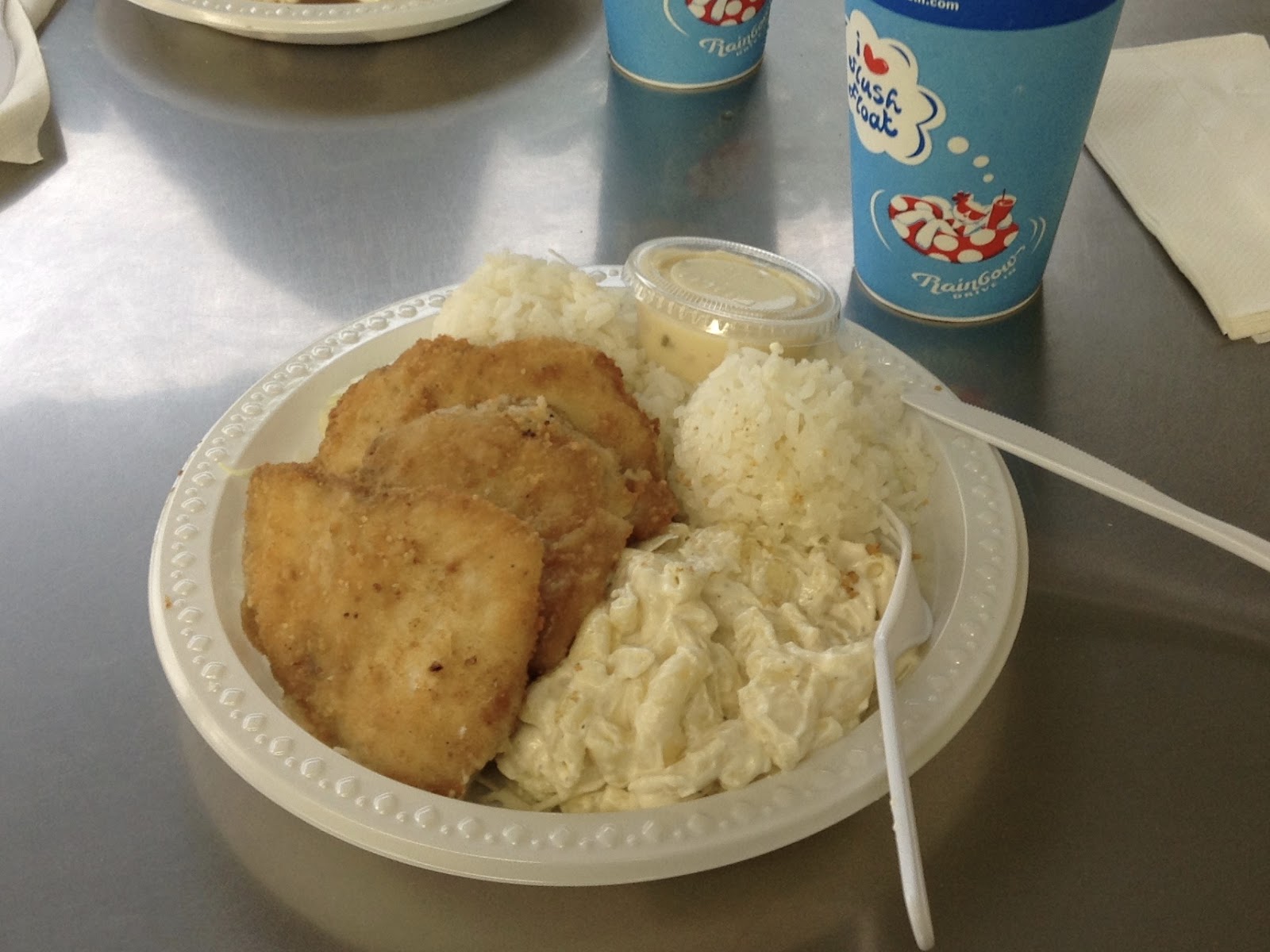
Plate Lunch
Plate lunches are a Hawaiian staple. There's no other way to put it than that. Our first meal about two hours after we landed in Honolulu was our first plate lunch and it would not be the last. There would be four more to follow over the next nine days. Plate lunches are about the simplest kind of food you can find, which in a way presaged a lot of our experience with food on the islands. Take two scoops of rice, one scoop of macaroni salad, add a protein and maybe some sauce or gravy, and you have yourself a plate lunch. Need to eat a lot really cheap in Hawaii? Have at least one plate lunch per day.
Roast pork. Mahi mahi. Shoyu chicken. Beef curry. Chopped steak. Ham steak. Kalbi ribs. Eggs. Lau lau. Think of any kind of protein and you can likely either make a plate lunch out of it or find a restaurant somewhere on one of the islands that already has it on a menu. It's as versatile as it is simple. We ate plate lunches on picnic tables, in covered porches of restaurants and sitting on the grassed in curb area of a grocery store parking lot. And we never paid more than about $8 for any of these meals.
The invention of the plate lunch is a bit of a mystery. I'm not even going to try and track that down for this post. But I'm craving some mac salad with some sort of protein while I'm writing this. The mac salad, we found, was (with one exception) about the best part of these meals, especially if mixed with a little shoyu chicken sauce. Eat as much as or more than I did if you go. And plan on some exercise afterwards.

Malasadas
How a group of people from Portugal decided that the way to jumpstart their lives was to travel across the Atlantic Ocean, sail around South America's Cape Horn and land on some tiny islands in the middle of the biggest ocean on Earth to work on a sugar cane plantation is absolutely beyond me. But I'm glad they did. Because if they didn't, Hawaii wouldn't have malasadas.
Think donut here but not quite cooked all the way through and rolled in plenty of sugar. That's a malasada (which literally means under-cooked) in its truest form. Admittedly, some folks fill them with flavored cream these days but we opted for the original and stopped there. Malasadas in Portugal were traditionally a Mardi Gras food; in an effort to use up all their butter and sugar before the beginning of Lent, the Portuguese made malasadas in profusion. Can't say I blame them. These things are good. As a result, Fat Tuesday is actually known as Malasada Day in Hawaii.
Our single malasada experience was at Champion Malasadas in Honolulu, about 12 hours after our first plate lunch (it was a healthy first 24 hours). We stopped there at the beginning of our first full day of sightseeing on our way out of town and grabbed ourselves a couple of 85 cent (yes, you read that right) fried puffs of goodness each. Our malasadas were handed to us in a wax paper bag inside a brown paper bag and we were cautioned to let them cool down a bit first. These things were so pillowy soft that they almost deflated on the first bite. A little more time got them to a perfectly delicious temperature and texture. I shoveled mine down in about five minutes. The picture above which seems to show me eating them as if they were in a feedbag is pretty much correct. Plan on more exercise.

Poke
If there's one food I crave more than any other from our Hawaii trip, it's poke (pronounced poh-kay). Poke (the name is from the Hawaiian word for "cut") is cubes of raw fish (traditionally tuna) or other sea creature (traditionally octopus and not raw) flavored with some sort of mixture of ingredients that might include oils, vegetables (predominantly some kind of onions) and spices. The dish was originally prepared from the spare cuttings of fish after they had been butchered. Today, of course, people use premium cuts of fish specifically to make poke. And why not, the stuff is generally just awesome.
The most popular base ingredient for poke that we encountered in Hawaii was ahi tuna, which was just fine by me because I love raw tuna. We ate poke from a sushi restaurant, a take out poke place (seriously) and a supermarket (not kidding). At each place we paid vastly different prices, from market price ($32 per pound as it turned out) at Da Poke Shack in Kailua-Kona to $14 for a small plate with macadamia nuts at Banzai Sushi Bar in Haleiwa to $14 per pound for California roll poke at Foodland in Kihei.
While prepping for this trip, we bought a Lonely Planet guide to Hawaii to get us ready to take maximum advantage of our time in the islands. One of the places or maybe THE place that guidebook pointed us for poke was to Foodland, claiming the supermarket chain offered some of the best in the state, complete with free tastings for the asking. Considering the source (I trust Lonely Planet a lot), we humored ourselves and put a stop at one of their stores on our agenda. I still didn't really believe their poke would be better than a place like Da Poke Shack, whose fish was ultra fresh.
It was a kind of an apples and oranges comparison. Foodland's California roll poke is flavored to taste like a (no surprise here) California roll whereas Da Poke Shack's flavors are designed to let the fish shine. Both were delicious but Foodland's arguably had more flavor. And considering the price point, I have to say if I lived in Hawaii, I'd be shopping at Foodland for poke a lot. This stuff was amazing. And all things considered, fairly darned cheap. For sure right now as I write this, it's Foodland's poke I'm craving.

Kalua Pig
Kalua pig or kalua pork is likely one of the biggest misnomers on most menus in the state of Hawaii. The word "kalua" literally means to cook in an underground oven, yet today most pork labeled as kalua pig is not, in fact, cooked underground at all. The process of slow cooking, braising or smoking is way more likely to be used to cook your pig in most Hawaiian restaurants today.
Kalua pig today is most likely found as the centerpiece of a luau meal. A typical imu (or underground oven) is a pit dug in the earth where wood is used to heat up lava rocks which will be used to cook the meat. Once the wood used to start the fire is burned up, the pit is lined with banana leaves and some of the hot rocks are removed from the pit and placed inside the pig. The meat is then seasoned with sea salt and wrapped in more banana and ti leaves and the pig placed in the pit and covered, first with a barrier to retain the moisture, like burlap, and then sand. The result is a super hot slow cooking oven. About 12 hours later, dinner is ready.
According to the menus I read, I allegedly ate kalua pig three times in a week in Hawaii: once on what was surely a frozen pizza; once as part of a plate lunch; and once out of a genuine imu. I'm not a big believer in pork as a tasty meat. Mostly I see it as a protein vehicle to carry other flavors and in the case of my pizza and plate lunch, that's exactly what it was. I got nothing out of those meals except sustenance.
But the kalua pig I had out of the imu was absolutely delicious and I was shocked it was so good. The meat was succulent and perfectly salted to bring out the flavor of the pork. I'm not sure I've had simply salted pork this good in my life. The Old Lahaina Luau deserves a lot of credit here. I'll remember that meat for a while.

Taro / Poi
How to begin with the story of taro? Well, I ate it in solid form twice when I was in Hawaii, once as an accompaniment to a dish of mahi mahi and once as a starch in a helping (or two) of taro leaf stew. Both times, I thought it was delicious. Taste-wise it's sort of like a nutty sweet potato flavor, although not quite as sweet. Texturally, I thought it was like an upgraded potato, not as starchy and stodgy as I find that vegetable to be sometimes. I had never before had taro in my life and I was really really pleasantly surprised. I'd eat this stuff all the time if I could get it locally and learned how to cook it properly (which can't be that difficult). All that is not why I'm writing about taro here in this post.
Taro is a starchy root vegetable with leaves that grows best in flooded conditions. It was imported to Hawaii when the first Polynesians set out to settle the island and it formed the core of the diet of those people both before and after they arrived in Hawaii. Both the root and the leaves are edible (as suggested in the previous paragraph). Roasting, boiling, baking and frying all work to get taro root from its raw form to the deliciousness I experienced while on vacation last month. But in Hawaii, taro is more famous in another form: poi!
If there's one food I knew I had to try but I was definitely not looking forward to eating in Hawaii, it was poi, a purple barely runny liquid made by adding water to cooked taro that is continually mashed until it achieves a paste-like consistency. Sounds yummy, right? How people get food to this point is beyond me. Did someone one day just decide to pound on a cooked taro root to see what would happen and then taste when it turned purple?
Taro isn't eaten in poi form any other place than Hawaii and after eating it, I can understand why. It's totally tasteless, feels like cold-ish rubbery raw egg whites in your mouth and is quite likely the least satisfying food I have ever eaten in my life. I imagine it tastes like the amino acid goop that Neo and Morpheus' crew ate on their ship in The Matrix, although that might actually taste better. I managed to swallow a half a small paper cup (and I mean like one of those small paper ketchup cups they make you use at Wendy's) of this stuff and that was enough. Forever. I have no use for this "food" ever again.

Hilo Farmers Market
No, Hilo Farmers Market is not a food but we did have some of the tastiest morsels all trip there and we could have eaten a lot more. For those reasons, I thought spending a few paragraphs on this place was worth it. Here's my tip about this place: GO! Especially on a Wednesday or Saturday (we went on Wednesday) when the place expands into a super duper food and crafts market.
I love the idea of markets and food markets and try to hit them when I travel if I can. I always have this idea of these wonderful places where cheery vendors sell fresh fruits and vegetables with other stalls hawking artisanal foods that smell and look wonderful and that have samples that make you want to buy, buy, buy. I've visited markets or farmers markets in Italy, Germany and England in the past few years and have been mostly disappointed, sometimes coming away with a bite or two or maybe a full-ish meal that sort of satisfies.
If I imagined the perfect farmers market in the world, one that satisfied everything I've dreamed of in one of these, the Hilo Farmers Market is it. Maybe it's the exotic and tropical foods for sale. Maybe it's the fact that there are folks selling fruits and vegetables alongside stalls with homemade macadamia nut butter, local goat cheese and jams like habanero pineapple. Maybe it's the amazing craft stalls with soaps and pearls for sale. Maybe it's all of it. We parked in a two hour parking spot and, honestly, we needed all that time and could have stayed longer. We almost used all the float in our schedule for one day in this spot.

We planned to hit the Hilo Farmers Market just before lunch. We hoped we'd be able to find something tasty for lunch to keep us going for the entire afternoon (quick drive north to 'Akaka Falls) and maybe into the night (the most amazing stargazing EVER near the peak of Mauna Kea). We found what we were looking for in a small outdoor food court with picnic tables across the street from the main food stalls. Just like plate lunches, once again our meal proved to be extremely affordable; unlike some of our plate lunches, the food here was amazing.
I ended up mixing and matching food vendors for my meal, opting for a $6 green papaya salad paired with a $3.50 pork skewer. The pork was brushed with some sweet glaze and sliced thin so it cooked quickly which rendered off some, but not all, of the fat; what remained were crusty and tender inside pieces of meat with a little moist fat around the edges. I thought this paired well with my papaya salad which had about two whole papayas and some chiles to make it "hot" on the spiciness scale. I chickened out on the highest spice level ("Thai hot") which was smart. I don't often back down to heat but my instincts proved correct here. I ate slowly, letting the heat from each lime-y spicy bite cool down before proceeding.
Our trip to this farmers market was one of the pleasant surprises of this trip. It far exceeded our expectations. There may be some ordering from some vendors later on this year.

Shave Ice
For most readers of this blog ("most" here being about four people), the picture above appears to show me eating a snow cone. Say that to someone in Hawaii and there are likely to be some tense words exchanged. There's a big difference between a snow cone, which is made with crushed ice drizzled with sweetened syrup, and shave ice, which as the name suggests is made from shaved ice and then drenched (meaning a lot more) in the same sort of sweetened syrup used in a snow cone. The result of shaving ice (which starts as a big block of ice dropped into a shaving machine) is a snow like consistency which holds the syrup better than does crushed ice. It's different for sure.
There are a number of stories about the origins of shave ice, but the one that makes the most sense to me is that it was invented in Japan and brought to Hawaii starting with the Japanese immigration to work the sugar plantations in the 1860s and transformed from there. Told you it was all about the sugar plantations. The tradition of shaving ice, rather than crushing, is the Japanese influence. The flavoring syrups (and let's face it the flavored sugary liquid is why we're eating these things) make shave ice uniquely Hawaiian.
Shave ice comes in various sizes, sometimes has ice cream or azuki bean paste somewhere in the assemblage and can be saturated with one or more mind blowing flavors in various wild colors. I opted for a plain shave ice in coconut, pickled mango and tiger's blood (a cherry / coconut mixture) flavors. I've never been much of a snow cone guy, mostly because I don't like eating ice and the syrup never seems to last. Shave ice was a definite improvement and it's not even close. But I'm not dying for another one of these. Give me some ice cream anyday.
There are a number of stories about the origins of shave ice, but the one that makes the most sense to me is that it was invented in Japan and brought to Hawaii starting with the Japanese immigration to work the sugar plantations in the 1860s and transformed from there. Told you it was all about the sugar plantations. The tradition of shaving ice, rather than crushing, is the Japanese influence. The flavoring syrups (and let's face it the flavored sugary liquid is why we're eating these things) make shave ice uniquely Hawaiian.
Shave ice comes in various sizes, sometimes has ice cream or azuki bean paste somewhere in the assemblage and can be saturated with one or more mind blowing flavors in various wild colors. I opted for a plain shave ice in coconut, pickled mango and tiger's blood (a cherry / coconut mixture) flavors. I've never been much of a snow cone guy, mostly because I don't like eating ice and the syrup never seems to last. Shave ice was a definite improvement and it's not even close. But I'm not dying for another one of these. Give me some ice cream anyday.

Maui Brewing Company
A few months ago, I stopped by my local beer store to stock up on beers for the Christmas holidays and to see if there was anything else interesting until we got to December 25. Among my haul that day was a six pack each of Coconut Porter and Kihei Kolsch from Maui Brewing Company. I knew I was headed to Hawaii in a couple of months and thought why not get a head start on both drinking local beers and the holidays, I guess.
To that point in life, my Hawaiian beer experience was limited to Kona Brewing Company's various offerings, in which I had been historically disappointed. Maui Brewing Company changed my opinion of Hawaii beers as soon as I took a single sip of Coconut Porter. From that moment on, stopping by Maui Brewing Company was on my itinerary for last month's vacation to paradise.
Maui Brewing Company's brewery and beer patio is located in an industrial park on the east side of Piilani Highway in Kihei. Their tap list is huge and it features both the brews that I can get in cans at my local beer store here in northern Virginia (Norm's Beer and Wine, if you must know) and all the other beers they make in keg form only. And by all the other beers, I mean like 12 or 15 types I had never even heard of. I feel like I struck gold.
One of the things I love about Maui Brewing Company is how their beers really really specifically and obviously reference their point of origin. Mana Wheat Beer is sweetened with pineapple juice (it works!) and the Coconut Porter is finished with toasted coconut, which gives the beer a nice tasty finish to follow the rich, exactly-what-a-porter-should-be flavor. Their on-tap offerings continue this theme and in some cases, ramp it up a bit.
Because we had limited time (it's a crime, I know...), I opted for a sampler tray (shown above) and then a full glass of whatever won the sample test accompanied by a couple of Maui Cookie Lady cookies (total surprise but the Grown Up Samoa...OMG! good). Clockwise from the upper left in my sampler: Hot Blonde (MBC's Bikini Blond brewed with comapeno peppers); Haleakala Sunryes Rye IPA; Barefoot Brew (amber with local honey); 'Uala Pale Ale (made with Maui grown sweet potatoes); Ka'anapali Coffee Porter; and Imperial Coconut Porter (made with MORE coconut than the standard Coconut Porter).
I expected the Imperial Coconut Porter would win the sampling because (a) I love porter and (b) I love imperial stout. I expected this beer would be the best of both varieties with the same sort of delicious finish as MBC's standard Coconut Porter. But the extra sweetness for me made the beer too sweet and heavy for a porter (porter is my favorite beer variety, hands down). I'll stick with the standard non-imperial variety of this one.
The actual winner turned out to be the 'Uala Pale Ale which is brewed with sweet potatoes (also known as 'uala). Surprised this could be really good? So was I. The 'uala imparted a gentle sweetness to the beer and Maui Brewing Company laid off on the hops enough to create a beer that strikes a great balance between flavor and hoppiness. It's still clearly a pale ale, but it's like none that I've ever had. Pale ale purists probably wouldn't approve. I went home happy. Now I just need to get back over to Norm's sometime soon so I can keep drinking Maui's beer.

Loco Moco
So I realize some of you reading this post may be getting ready to call me out at this point. Let me save you the trouble. Yes, I realize loco moco, a dish featuring hamburger patties, rice, macaroni salad, gravy and fried eggs (yikes!) is technically a plate lunch. But I'm giving it some special attention here for two reasons: (1) it's an absolutely over the top cholesterol bomb that you just can't eat too many of without really getting yourself into a significant health crisis and (2) it wasn't always so plate lunch-like.
According to Hawaiian legend (it seems like all origin stories in Hawaii have become legends), the dish might have been created in 1949 as a hamburger, rice and gravy concoction at the suggestion of some kids looking for a cheap meal from the now out of business Lincoln Grill. The name loco moco was allegedly applied because the owner of the Grill, Richard Inouye, told his wife that the kids were crazy or loco. The egg, apparently, came later. Somehow, somewhere along the way, some mac salad was thrown in there, making it part of the plate lunch family.
So what's it like eating all this fat and carbs? Well, for us it depended on how the hamburgers were treated. Get a little crust on those things like we had at Aloha Mixed Plate in Lahaina and it's a pretty tasty dish. I'm not sure how I feel about the gravy on rice; that's not quite a combination I was really ready for. There's also no doubt I felt a little sluggish after downing a loco moco. There are some foods in Hawaii I'd jump at having again. Not sure I feel that way about this one.
My plate of loco moco was the last true Hawaiian food I ate in state. It capped a full week plus of pigging out on the unique fare you can find in the islands. Having said that, we barely scratched the surface. We didn't even touch other signature dishes like Spam musabi, saimin, lomi salmon or chicken longrice and there must be a dozen or more signature plate lunches that we didn't get to.
There's a lot of writing in this post and I didn't cover everything we ate. Having said that there isn't a lot that's fancy on this list. That's deliberate. I wanted my eating in Hawaii to explore the variety of everyday dishes that are local to Hawaii and very few other places. The unique mini-melting pot that is our 50th state has taken its input from every food culture that has touched it throughout its history and has spit out something very different than you can find anywhere else.
In that vein, we tried to stick to places that served food in as traditional a way as we could find. But we did seek out a couple of spots that seemed to be taking a new spin on Hawaii's food history. Of these places, I thought the best meal we had all week was at Town Restaurant in Honolulu. They source all their ingredients locally and historically, referencing Hawaiian food while updating it into something more modern. If you are on Oahu, I'd highly recommend stopping by. I'd go back for dinner if I ever had the chance. Probably after some takeout poke from Foodland. And a couple of malasadas for breakfast. Now about that exercise...
 |
| Umm...yeah, we definitely like poke! |


