This post is about a trip to see nothing. But it's also about something that's really pretty important.
Most of the trips I've blogged about in the last almost eight years have involved me traveling hundreds of miles from home, usually by getting on a plane and traveling over most or all of a continent or even further over some body of water. Sure, admittedly I've made some trips by rail or by getting in a car and driving but those are the exceptions. In other words, I'm typically writing about places not near to where I live. I've never really thought about blogging about somewhere I could go on a day trip. Until now, that is.
Richmond, Virginia is a bit less than a two hour drive from where we live. Under normal public health circumstances I never would have thought about heading somewhere as close as Richmond for a getaway. But with the seven day rolling national average of new COVID-19 cases just a bit higher than I'm comfortable with right now, there's no way I was getting on any sort of shared transportation and going far away. Plus, we had $100 of Best Western gift cards with March expiration dates. Better to use them to defray the cost of going somewhere new than lose them. So Richmond it was. And because we stayed overnight, I'm still not writing about a day trip.
So as I already said, this post is about a trip to see nothing.
It is about nothing because one of the reasons we traveled to Richmond was to see some things that are no longer there. They are gone. And it is the very fact that they are gone that is important. But we really wanted to not see them.

But first some context. History time.
In April of 1861, the Commonwealth of Virginia seceded from the United States. They followed the lead of South Carolina, Mississippi, Florida, Alabama, Georgia, Louisiana and Texas and were followed by Arkansas, North Carolina and Tennessee. Those eleven states formed the Confederate States of America. The governors of Kentucky and Missouri tried to join them but their citizens were having none of it. When it came time to pick a capital, those eleven states picked Richmond. So yeah...we visited the former capital of the Confederate States of America for a weekend. Nothing like a little sedition on a winter weekend.
The Civil War between the Union and the Confederacy that followed secession by the southern states was about slavery, or the rights of one (white) human being to own as property other (black forced violently against their will from their homes in Africa) human beings. I thought it was important to state that as plainly as possible. Some folks out there will insist the War was about states' rights. Sure, maybe it was. But if you want to spin it that way then the specific right that was being fought over was the right of one human being to own as property other human beings. The War was about slavery.
It was also a treasonous rebellion and those who took part in the War for the South fought against their own country. I thought it was important to state that as plainly as possible too.
It is sometimes difficult for me to imagine Virginia where I live today as part of a breakaway state wanting no part of the United States hell bent on insisting that slavery was just and right. But I'm sure it was pretty fanatical about that idea back in the 1860s and I'm sure there were plenty of folks in Richmond that believed that the idea that black people were inferior to and should be enslaved by white people was for sure worth going to war about.
Ultimately the South was on the wrong side of history and of human decency and their war didn't work. They lasted as a nation until May 5, 1865, when President Andrew Johnson declared the Confederacy dead after the surrender of most of their forces to Union Generals Ulysses S. Grant and William Tecumseh Sherman over the prior month. The South started a war they couldn't finish. The North was happy to finish it for them.

Then in the decades following the Confederacy's defeat, there started to emerge a legend in the South called the Lost Cause, an idea that the reason for secession and war was just and righteous. This idea was adopted by former Confederate officers and politicians in the South and was amplified by organizations such as the Daughters of the Confederacy. The idea here was that the actions of the leaders of the South, which in reality was nothing but out and out treason against the United States government, was not only justified, but was the right and correct thing to do. And so was slavery.
In many cities and towns in the South, this idea drove citizens to erect monuments to the people who fought in rebellion for the Confederacy. Richmond was no exception. In 1890, the city unveiled a monument to General Robert E. Lee, the commander of the Army of Northern Virginia. Imagine a country allowing one of its cities to erect a monument to celebrate the life of a traitor against his own government. It happened. In Richmond and a whole host of other places.
Imagine also how former slaves would feel about somewhere they live celebrating the life and "achievements" of someone who went to war to keep them enslaved. That also happened. In Richmond and a whole host of other places.
Richmond didn't stop with the Lee statue. No sir! Over the next 39 years, the city put up statues celebrating J.E.B. Stuart, Jefferson Davis, Stonewall Jackson and Matthew Fontaine Maury. Not fully familiar with all of those names? Don't worry, I'll tell you a little about them later. Together the statues made up a stretch of one of the most prestigious streets in the city named Monument Avenue.
Monument Avenue was my number one reason to visit Richmond. Not to see the statues. But to see nothing. To see where they used to be. Because most of them are no longer there. Finally a small part of the United States has come to its senses. Mostly.
I told you this post was about nothing and something really important at the same time.
 |
| Stonewall Jackson was here. Monument Avenue and Arthur Ashe Boulevard. |
So before we get to that, let's learn a little about who we didn't see, shall we? And I know some readers here will be thinking that it was a different time and we can't apply 21st century norms to something like betraying your country to participate in a war about slavery and it was history that actually happened and the statues should remain as part of the historical narrative of the South. Three thoughts here:
(1) I don't think there are too many statues of Adolf Hitler in Germany or Saddam Hussein in Iraq or Benedict Arnold or King George III of England over here in the United States. Countries don't generally erect statues to commemorate defeated foes or traitors or leaders who lead their country to ruin.
(2) The idea that slavery was wrong was actually around back in the 1860s. It's not, believe it or not, a 21st century notion. There were plenty of abolitionists around trying to stop it forever in this country and elsewhere in the world. If that doesn't convince you, think about how you would feel if you and your family were someone's property to treat however they liked; they could abuse, starve, beat, rape, work to death or even on a whim kill you or your family for no reason and with no consequences. They might also sell some of you and keep others of you. How would you feel about that? Ready to celebrate the leaders of a war to preserve that idea?
(3) Yes, we can.
So about those monuments.
Of the five statues on Monument Avenue, Confederate generals Robert E. Lee and Thomas "Stonewall" Jackson are probably the best known. Waging war on your own country has a way of making people famous, I guess. Both owned slaves (I'm sure that's a shocker!) and both willingly joined the Confederacy. I'm sure if you dug a little on line, you'll find all sorts of articles and accounts out there that neither man really made his feelings about slavery known. Those same articles might say that both men were devout Christians; that Jackson braved breaking the law by teaching slaves to read; and that Lee eventually may have shown abolitionist tendencies.
Don't believe it! It's a crock! The fact that neither man made their feelings about slavery known to all who they met doesn't mean they were against it. Their actions spoke volumes. I mean if you need any more proof than they were slave owners and that they took up arms against their own country to preserve that right, then I'm not sure what to tell you. So Jackson "only" owned six slaves maybe. That means he claimed as property six other human beings. Six!!! One is too many. He had six.
And Lee's "abolitionist tendencies"? Let's hear from the man himself in an 1856 letter:
"The blacks are immeasurably better off here than in Africa, morally, socially & physically. The painful discipline they are undergoing, is necessary for their instruction as a race, & I hope will prepare & lead them to better things. How long their subjugation may be necessary is known and ordered by a wise Merciful Providence."
So it's God's fault, is that correct? Seems it works that way for Jackson, too. Apologists for Jackson point to his Calvinist beliefs (that everything on Earth is as it was desired by God and that if slavery exists then it must be the will of God) that prevented him from questioning the very institution of slavery. Those same beliefs didn't lead him to believe that it was wrong for the South to secede for some reason. I mean before he participated in that it was part of the United States. Remember two things: these two owned slaves and they took up arms against the United States so they could continue to do so.
 |
| J.E.B. Stuart was here. Monument Avenue and Stuart Circle. |
If Lee and Jackson are the most recognizable names on Monument Avenue, J.E.B Stuart and Matthew Fontaine Maury are likely the most obscure. Both were Virginians who resigned their commissions from the United States military when their home state seceded from the Union. Stuart became a General in the Confederate army. Maury was in charge of the Navy. Both, of course, like Lee and Jackson, fought like hell against their own country's government. Maury actually accomplished something notable in his career before he opted to join the South in rebellion: he made significant advances in naval meteorology and navigation. He's probably worthy of a statue if it wasn't for that whole being a traitor thing. You know...THAT.
Unlike Lee and Jackson, neither Stuart nor Maury owned slaves, although there is some debate about Stuart (he may have owned two and freed them before the Civil War started). But Maury did have some pretty out there ideas about preserving the economic boon of slavery (read: free labor) while removing the guilt of slave owners in the South. His idea? Move all the slaves to Brazil and set up plantations as money making ventures for American plantation owners. Keep the slaves in slavery; just move them elsewhere. Not sure this is what I consider enlightened.
And then there's Jefferson Davis, the President of the Confederacy. Davis was a former United States Army officer; plantation owner; United States Congressman; United States Senator; and Secretary of War under President Franklin Pierce who resigned his Senate post when the State of Mississippi seceded. Shortly thereafter, he was elected President of the Confederacy.
Like Lee and Jackson and Stuart and Maury, Davis willingly fought against the United States of America. Also like Lee and Jackson, he was a slaveowner, apparently at one time owning more than 100 slaves. More than 100 human beings. Think about that. Davis did think about it. A lot. Some of his thoughts are in the quote below.
"African slavery, as it exists in the United States, is a moral, a social, and a political blessing. You cannot transform the negro into anything one-tenth as useful or as good as what slavery enables them to be."
Do these guys deserve statues in prominent places in American cities? Not in my view they don't. And apparently, not in Richmond's view either in 2020 and 2021, although I'm sure there's less than unanimous consensus about that.
 |
| Matthew Maury was here. Monument Avenue and North Belmont Avenue. |
So why are these statues no longer on public display in Richmond? Well, on June 10 of last year, the statue of Jefferson Davis on Monument Avenue was torn down by a crowd of people protesting the murder of George Floyd by the Minneapolis Police Department. It was followed less than a month later by the City-ordered removal of the statues of Jackson, Maury and Stuart under a new law that allowed cities in Virginia to remove Confederate statues starting in July 2020. The removal of Lee's statue was ordered six days before the removal of Davis' but it's still there. Apparently it's coming down for real this summer.
What I expected to find in Richmond on our tour of Monument Avenue on the first Saturday of March this year was something similar to the last three pictures posted above. Simple monumental pedestals with their statues gone. I expected they would be the rough shape and size they are in the case of Stonewall Jackson and J.E.B. Stuart because those two were topped with equestrian statues. I expected evidence of a little graffiti long since removed, although I was a little surprised to find some still in place on Stuart's pedestal.
I also expected to find some untruths. I got one of those at Stuart Circle. According to the inscription on the now untapped pedestal, Stuart "gave his life for his country." OK, sure. I'd say he lost his life in rebellion fighting against his country but shades of grey maybe. Or maybe not. Won't debate it here. In my visit to see the spots where Jackson, Maury and Stuart used to be on display, I got exactly what I expected.
At the monuments to Jefferson Davis and Robert E. Lee, I got something I didn't expect.
 |
| The Jefferson Davis Monument, without Davis but not much diminished. |
The first monument we stopped at was the one to Jefferson Davis. We didn't plan it that way. We just hit Monument Avenue pretty close to it and so went there first. It is a shocking monument. I can't remember being this offended by something like this ever. Clearly visible on the center column of the monument are the words "President of the Confederate States of America." This is not just a monument to Jefferson Davis, it's clearly a celebration of the presidency of the Confederate States of America, a "country" that went to war with the United States. The monument is located in Richmond in the Commonwealth of Virginia. And last I checked, Virginia is part of the United States.
To me, the Davis monument is different than the other three discussed earlier in this post. It's celebrating the existence of a nation that fought against the United States to maintain separation from our country because they wanted to keep black people as slaves. The Jackson, Maury and Stuart monuments are less clear about what those people did. Davis' monument is celebrating the idea of secession. How is that allowed?
There's one other thing that unnerved me about the Davis monument. Unlike the statue-less bases of Jackson, Maury and Stuart which look silly in their plain-ness without their namesake likenesses, Jefferson Davis' monument doesn't suffer much from the missing statue which I assume was mounted on the top of the column in the photograph above. The monuments to Jackson, Maury and Stuart are clearly diminished by the lack of the statues. The Davis monument isn't. It looks like it's still complete. If it were me in charge of Richmond or Virginia, I'd be looking to take more of this thing down. The removal of the statues of Jackson, Maury and Stuart shames the legacy of those men. More needs to be done to Davis' monument to get there.
 |
| Looking north up Monument Avenue towards the Robert E. Lee Memorial. |
Then there's Robert E. Lee.
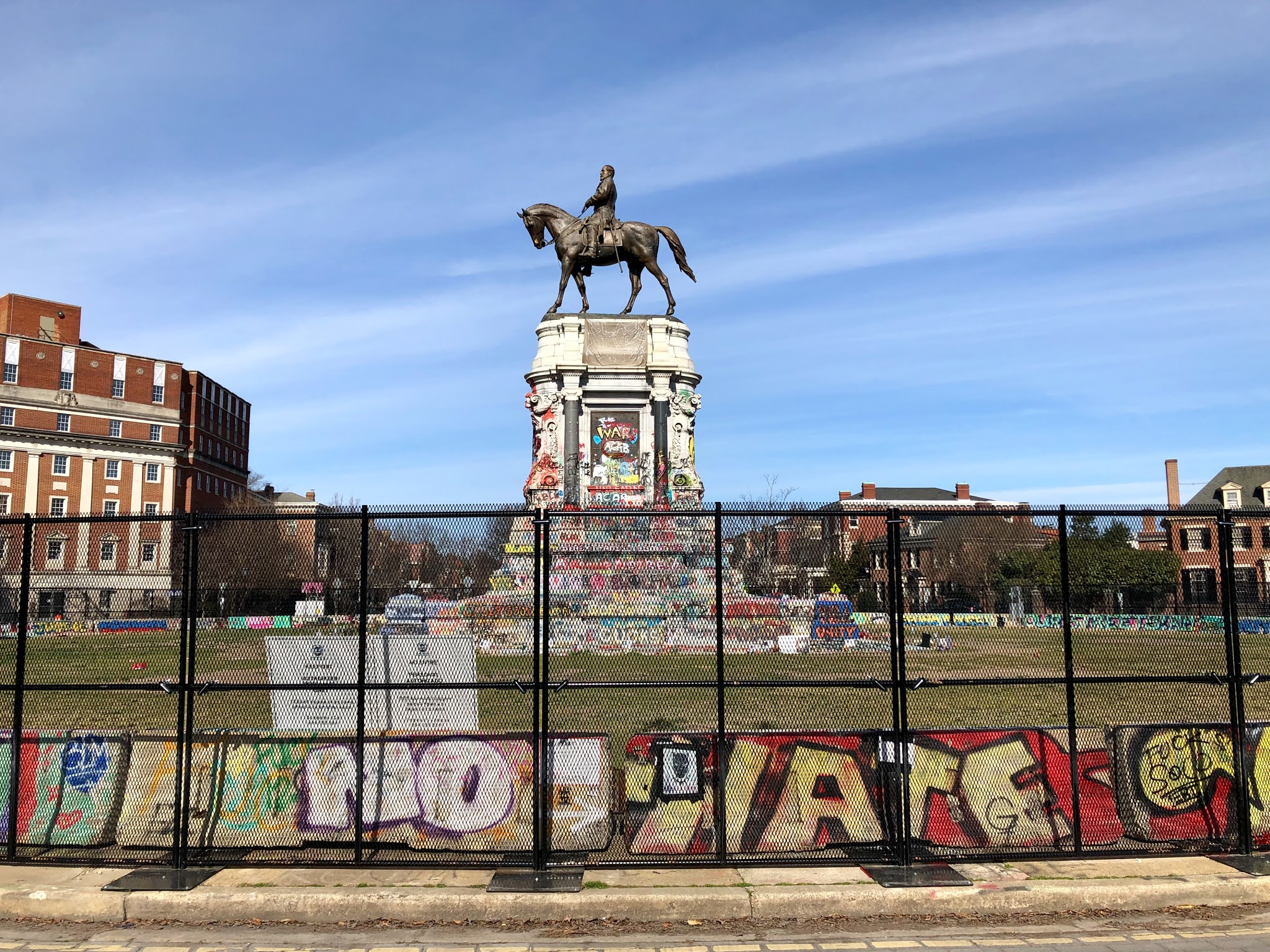
The Lee Memorial is the biggest of the five on Monument Avenue and it's located on the biggest plot of land, a massive traffic circle at the intersection of Monument Avenue and North Allen Avenue. It was the first erected and it's clearly the most important. It's also today the only one that still has its statue and it's the only one you cannot walk up to, because there's a fairly sturdy metal fence erected at the perimeter of the traffic circle.
Like the monuments to Davis, Jackson, Maury and Stuart, the Lee Memorial was defaced with graffiti. Unlike the other four, the graffiti hasn't been removed. Neither has the Black Lives Matter banner been stripped from just below the statue. And it's glorious. It's absolutely uplifting in its democracy.

Robert E. Lee was in charge of an army that fought against the United States. If he had won, he would have preserved the institution of slavery and helped establish a nation with that belief at its core, that black people were inferior to white people and they deserved to be owned as property. Some folks have made their thoughts known about this at every level of his Memorial in a rainbow of lurid colors.
But there are other truths about our society spray-painted on the Lee Memorial that have nothing to do with the Civil War necessarily. The idea that it's OK to discriminate against people that some folks may be uncomfortable around. The idea that some of society's institutions either deliberately or unconsciously work to preserve the current power structure. The idea that politicians are openly and unabashedly working to disadvantage people unlike themselves. There are a lot of different messages written on the Lee Memorial. Some of them are rude. Some of them are obscene. But almost every word of it rings true to me. I'm not going to re-write them in this blog but I'm sure you can zoom in and read some of them. Look up the ones that aren't familiar to you.
The Lee statue is still in place. I'll be happier when it comes down if that really happens this summer. I hope the city doesn't clean the rest of the Memorial or the concrete barriers spray-painted around the perimeter of the circle. I expect that they will. I can't imagine a city being OK with swear words written large and clearly on its public monuments.
I think the great thing about what's happened to the Lee Memorial is that it has been transformed from something inherently objectionable into something really powerful and optimistic. The defacing of the Memorial is a clear and obvious rejection of everything it stood for originally and the point of the thing has been completely re-messaged. It's more powerful to me leaving it in place as is (without the statue of course) than tearing it down completely. This is public art that really means something. I hope it stays but I'm not counting on it.

So that's what we saw on Monument Avenue. Before we left Richmond, though, we wanted to take a look at one more statue.
The no longer available for public viewing J.E.B. Stuart statue is notable from a composition standpoint. Stuart's horse, were it still in place, is facing south with its head tilted slightly to the left and its front right hoof raised, which traditionally means the rider died as a result of wounds sustained in battle (which Stuart did). Stuart atop his horse, again...were he still in place, is not looking forward as he is mounted but instead his torso is twisted and he's facing west which allows the viewer to see his entire torso and face unblocked by any other part of the statue. Its a dramatic pose that you wouldn't normally see a rider strike.
In September of 2019, a second statue with this same pose was erected in Richmond in direct response to the artistry of Stuart's statue. This one, titled Rumors of War, was commissioned by the Virginia Museum of Fine Arts and stands just in front and to the right of their building just west of the Fan District. The horse's pose is identical to Stuart's horse, right down to the angle of the head and the full extension of the tail. The rider strikes a similar pose to Stuart but the likeness is quite different. Instead of a white man fighting to preserve slavery, Rumors of War features a young, dreadlocked black man in a hoodie and Nike sneakers.
Rumors of War was sculpted by Kehinde Wiley, the same artist who painted President Obama's portrait that hangs in the National Portrait Gallery in Washington, D.C. It is of course intended as a direct response and contradiction to everything that Stuart's statue represents and it completely works, in a similar way to the graffiti and Black Lives Matter banner that you can see at the Lee Memorial. The irony is lost just a little bit now that Stuart's statue is no longer in place but that's really not a good enough reason to allow Stuart to return.


I'll be interested to see what happens in the near future to the Lee Memorial. How long will Richmond allow a vandalized, obscenity covered public monument to stay the way it is now? Will they actually take down the statue this summer? And if they do, will they use that opportunity to clean off the pedestal? Either way, will they continue to leave in place the concrete barriers, spray-painted or not, and the metal fence around the perimeter of the circle? Removing the graffiti or removing the pedestal entirely and re-purposing the circle might be more attractive, but erasing what's happened to something that never should have been there in the first place would be disappointing, I think. It's powerful the way it is. Remove the statue and erase what probably never should have been done in the first place but leave the rest please.
 |
| Not particularly elegant in its expression but neither is fighting to preserve slavery. |