Showing posts with label Czechia. Show all posts

Saturday, February 25, 2023

The Glass Room


In the late summer of 2021, we took a long weekend trip through the midwestern United States: Milwaukee, over to Iowa and then back east to Chicago. We went on that vacation to get out of town after just being too long IN town for the middle part of 2021. We ended up unexpectedly falling in love with Milwaukee and got rewarded at the end of it by rekindling our love for Chicago with a couple of nights in one of our favorite cities that we probably don't visit often enough.

On the way from Cedar Rapids to Chicago, we stopped at Mies van der Rohe's Farnsworth House, one of two houses that Mies, who is generally acknowledged as one of the best architects of the 20th century, designed in his life. The Farnsworth House property is now open to the public under the guardianship of the National Trust for Historic Preservation. 

That stop in the Illinois countryside was intended to be the first of a two-part series in late 2021. Three months after that, we were supposed to have visited Mies' second (but earlier) house in Brno, Czechia, the incomparable (or so I assumed) Villa Tugendhat designed for the Tugendhat family between the two World Wars and which is also now open to the public for tours. We didn't go in 2021. COVID pushed our plans a year. But last December we did make it to Brno to complete our Mies doubleheader. Sometimes life makes you wait for the good stuff.

In my post about the Farnsworth House that I wrote about 18 months ago, I started with an account of the emotions of visiting a famous building that I'd admired for a long time and then went on to decry Mies' place in the canon of the greats of modern architecture. I'm going to do no such thing this time for two reasons: (1) I've already covered the emotional part and suffice it to say there was no less excitement or anticipation on our approach to the Villa Tugendhat than there was in Plano, IL in 2021; and (2) the Farnsworth House changed my opinion of Mies; I'm still not on board with him being at the very top of any sorts of lists out there but he has my respect.

The Farnsworth House put me in a very different state of mind for my visit to the Villa Tugendhat. I was very much looking forward to this one.


We actually got lucky with our trip to Villa Tugendhat.

When we finalized (before ultimately postponing) our trip to Vienna in 2021, Villa Tugendhat was one of the first agenda items I added to our itinerary even though it was in a completely different country than Vienna and it was historically off limits behind the Iron Curtain, the very real barrier set up by the Soviet Union after World War II to cut off eastern Europe from the rest of the world. The Iron Curtain turned out to be no barrier in 2022, as I suspect it would have been a similar non-barrier a year earlier. Brno is extremely accessible by train at about an hour's ride from Vienna's Hauptbanhof and the public transportation infrastructure within Brno itself was extremely easy and convenient to use.

But we definitely benefitted from the year's postponement in one very significant way. When we were finalizing the schedule for our trip in 2021, I hemmed and hawed so much with the date that when we nailed down our plans to get to Brno, all the English language tour slots of the Villa were sold out for the duration of our time in Vienna. A year later, I planned better and grabbed a slot as soon as tours for the month of December were added to the calendar. If we hadn't had to postpone the trip by a year, we wouldn't have visited the Villa Tugendhat at all.


Details: door handle, light switches, door stop.

When I committed to writing this post about the Villa Tugendhat, I considered consciously NOT writing a comparison piece between the two Mies-designed houses. It turned out to be virtually impossible to approach this post that way. We are dealing with two houses designed by the same world-famous architect for two wealthy patrons. There is no doubt that the average client would struggle to afford these luxury residences that were created deliberately for their owners as non-traditional living spaces.

Beyond that though, the circumstances surrounding the creation of the two buildings were extremely different. One was a weekend house that slept one in the middle of the country in the United States. The other was a primary residence for a family with two kids, a nanny and a houseful of servants in a city that was destined to be invaded and then freed and then kept hostage by its liberators in and around one of the worst events in human history. The design intent and siting and historical context are night and day.

They were also both very different commissions for the architect involved. The Farnsworth House was very much a side project for Mies (and maybe also for Edith Farnsworth) which he dabbled in while hoping he would have ultimate control over every detail (he didn't!). The commission involved a lot of fighting, a lot of dishonesty (particularly about the construction cost) and ultimately at least one lawsuit from both sides.

Not so with the Villa Tugendhat. The house was a wedding gift from Greta Tugendhat's parents who (it appears from walking through the house) spared no expense. Mies operated without restraint on this one, procuring the most luxurious materials from wherever he wanted. Sure, there were some attempts by Fritz Tugendhat to influence the design (notably the full height doors that Mies insisted on) but those objections soon disappeared when Mies threatened to walk. What is with these architects?

Bathroom (above) and bathroom detail (below).

Edith Farnsworth lived in her Mies van der Rohe-designed weekend house on and off for a little more than 20 years before she sold the place and moved to Italy full time in 1982. The Tugendhats lasted eight years after their house was finished in 1930. They didn't sell. They didn't find a responsible owner to take care of what they had created. They didn't take anything inside the house when they left. They fled. For their lives.

Both Fritz and Greta Tugendhat were Jewish. Admittedly non-practicing but they didn't figure (and they were probably correct) that a detail like that would amount to much in the eyes of the Nazis who took control of the Sudetenland portion of Czechoslovakia after the signature of the Munich Agreement in September 1938. They fled to Switzerland and then to Venezuela, abandoning their lives and their property and all connection they had to their pasts. They were probably, all things considered, very lucky they could do that, even as horrific as it might have been to have to leave everything behind and just go. Certainly, Josef and Josefine Eckstein were not as lucky, as we found out when we visited the Beethoven Pasqualithaus museum later in the week.

I think it would be crass to lament the fate of an architectural icon like the Villa Tugendhat following the departure of its owners, particularly considering what the house looks like today, which is very much a fully restored masterpiece. I've certainly been in famous houses that would struggle to live up to the Villa's current condition. So I won't do any lamenting here. But after the Tugendhats left Czechoslovakia, the place did have a bit of a patchwork history.

When the Nazis finally occupied Brno in a semi-permanent way, they moved into the Villa. Later, they turned it over to the Messerschmitt company (the one that made airplanes for the Nazis) where Willy Messerschmitt himself actually lived (Messerschmitt probably saved one of the house's marquee design elements but we'll get to that...). When the Red Army rid Brno of the Nazis, they used the Villa for soldiers' housing. The soldiers quartered there used the Tugendhat's furniture as firewood.

After the war, the house became some things different entirely than the place was intended to be, including a children's physiotherapy center and a dance studio. Ultimately, it survived intact until 1993 when the Friends of the Tugendhat House (which included as a member one Greta Tugendhat) was formed.  They made sure they got involved in preserving the house as a museum, which of course it still is to this date.


Garage (top) and entrance hall with full height rosewood paneling (bottom).

When we got out of our car at the Farnsworth House property in Illinois, we crossed over the Fox River and walked down a wooded path along that same river until the house revealed itself to us. We did no such thing at Villa Tugendhat. Take the bus from central Brno and you are in a neighborhood that looks like it was at one time made up entirely of very similar-looking nineteenth century houses. And most of them, in fact, are still there. Take a right at the end the road and the Villa Tugendhat is obviously there because it is obviously different from all the other houses in the neighborhood. It is clearly non-traditional and in many senses a lot more private that its neighbors. The Villa Tugendhat does not look out over the street it is sited on.

The house itself is upside down. Or maybe not, depending on your perspective. Maybe it's just slid down the hill a bit. You enter on the bedroom level and then go downstairs to the main living floor of the house. Maybe you just enter the house upside down. It's a little odd to go past bedrooms to get to someone's living room, I suppose.

The entrance level of the Villa Tugendhat is interesting but maybe nothing more than that. If there's anything to get excited about here it's the outside terrace that surrounds the bedroom level, with some bedrooms opening directly onto the patio that wraps the house and overlooks the garden and the city of Brno. The view is admittedly spectacular.

I know, I know...I totally just pooh-poohed one half of one of the most lauded Modern architecture residences ever built. It's my blog and that's how I felt.


The Villa Tugendhat master bedroom suite. Two rooms, of course. I mean, why would you sleep with your spouse?

The good stuff is downstairs.

The living level (for lack of a better term here) of the Villa Tugendhat has to be one of the most famous and influential floors of a private residence ever to come out of the 20th century. There are no real rooms on the floor. Space is defined by a series of carefully placed walls and a grid of Mies' famous cruciform columns.

It totally works. 

There are two main seating areas plus a library area and dining area in the main space of the living level. There is also a winter garden flanking one side of the floor. The winter garden and dining area are defined with fairly traditional methods of dividing space, namely a glazed wall and a curved, wood-clad partition. While they don't necessarily relate to the building structure in a traditional way, they nonetheless define space by imposing a barrier that you cannot walk through. It's straightforward and obvious as to what is going on. 

The main seating areas are defined spatially by the chrome-clad, cruciform-shaped columns and the onyx wall that separates the window side of the space from the non-window side (or the side that is buried beneath the street where the main entrance to the property is). It is odd to think that the tiniest corner formed by these mirrored columns can actually define and confine space in any way but it does. These things actually do define corners on the spaces on either side of the wall, which for its part actually extends beyond the column grid. I'm telling you...it totally works.


You also get a sense of the amount of money poured into this residence. The main floor of the Villa Tugendhat is huge. It's about 2,800 square feet, which is almost 20% larger than the entire three-story townhouse that I live in. That's comparing one level of a house with no bedrooms or kitchen to my entire dwelling. It's enormous. The library shelves, relatively inconsequential in terms of the character of the spaces on the floor, are made from Macassar ebony wood, which is sourced from a single island in Indonesia.

But the costliest piece of the entire house is that onyx wall, which is a beige-yellow color at most times but apparently glows a fiery red-orange when the sunlight hits it just right. It came from closer than Indonesia. Mies found the stone in Morocco's Atlas Mountains. The reported price of the onyx was 250,000 Czech Crowns, which at the time the Villa Tugendhat was built was the cost of about five entire homes. One wall in one room cost five times the amount required to purchase a house in the surrounding area. Crazy, right?

After the Tugendhats left the house in 1938, there was a lot in the house that was pillaged and sold or burned so its transient residents could stay warm in the winter. But the onyx wall, which was worth far more than most men could earn in years of work or maybe even a whole lifetime stayed intact. We might have Willy Messerschmitt to thank for that. Seems Willy covered the wall in wood when he left town so that whoever found the house wouldn't be able to see how spectacular and spectacularly valuable that wall was. Turns out it worked. He may have made machines that destroyed a lot of Europe during World War II, but at least he saved a wall made out of stone in a house in Brno.

The very thin and very expensive onyx wall.

Now as an architect I should have gushed the most about the way space is defined on the Villa Tugendhat's main floor. But I'm not going to. The main takeaway from the Villa Tugendhat for me and by far the best thing about the house is window wall and the view and the way that Mies frames that view from the main room.

So, no, I'm not giving the architect credit for the view. Not really. I mean, it's pretty obvious that it's there and it's pretty obvious that the house should be oriented so that you are looking at the view from pretty much anywhere in the house that it can be seen. But I do think you can still appreciate the way that the view is framed and how much the Villa Tugendhat pushed the limits of materials in the 1930s. 

Check out the first picture below. How large is that pane of glass? I struggle to imagine another building either of this house's vintage or anywhere else for that matter with a piece of glazing that size. The view is framed by the floor, the ceiling and as few columns as possible. It's incredible. All the focus is where it should be. Namely...outside.

I know...that pesky horizontal railing gets in the way. BUT that was a later add-on to the house. Mies' original design didn't have any such rail to obscure (no matter how small a distraction it might have been) that amazing vista. The railing, by the way, was added not to prevent someone from walking into the glass, but to prevent someone out of the house itself if the window is open.

You read that right. That ginormous pane of glass opens. By retracting into the floor. This notion in and of itself seems ludicrous but it's true. Those windows open. Down. We didn't get to see them that way. We had no expectation that we would in mid-December. I don't know if they ever open these things for tours. Given the fragile nature of some of the contents of the Villa Tugendhat, I can't imagine they ever do. But the audacity to pull this off is just impressive.

That window wall and what it frames. Spectacular. 

There are shades integral to the exterior wall system to block the sun also. I'd love to see those in action as much as I'd love to see those windows disappear into the floor.


Before we visited the Farnsworth House, I read Alex Beam's book, Broken Glass, detailing the history of the house and the relationship between Edith Farnsworth and Mies van der Rohe. When we decided to visit Vienna in 2020, I bought Simon Mawer's book, The Glass Room, and read that in the month or so before we visited the Villa Tugendhat. The Glass Room is not a book about the design and creation of the Villa Tugendhat. Nor is it about Mies van der Rohe or the Tugendhats. Not really. Although it totally is really. 

The book is a work of fiction about a family (the Landauers) living in an avant garde house in Mesto, Czechoslovakia (there is no actual city of Mesto) with their housekeepers and nanny who have to leave behind their house in the face of the advancing Nazi army. While there is an acknowledgment that the house in the book is the Villa Tugendhat (without naming the house itself), the rest of the story is labeled as fiction, right down to the house being used as a dance studio and a children's hospital after the Landauers flee the German army.

It's a great introduction to the house and there are so many parts that mirror the actual history of the house that I found it extremely useful to know so of the history without having checked out how much of the alleged fictional story actually mimicked reality. Simon Mawer does an excellent job in that book and not just with evoking the spirit of that house. There is a lot that is extremely unpleasant in that book to read and I couldn't put down at all. The Villa Tugendhat exceeded my expectations set by the descriptions of the Landauer House, however. It was lighter and brighter and more open than I ever imagined it would be either from reading that book or by learning about the place earlier in my life in architecture school.

My recommendation is if you are anywhere near Brno and you are remotely interested in modern architecture, you should go here.

The Villa Tugendhat winter garden.


How We Did It

Visiting the Villa Tugendhat likely requires that you make reservations some time ahead of your actual visit via their website. There are two tour options: Basic and Extended. The Basic tour lasts 60 minutes and gets you into the bedroom and living room levels. The Extended tour gets you onto the third level (called the technical floor) which houses some of the back of house spaces including the mechanical spaces and an exhibit about the house. It lasts 30 minutes longer than the Basic. Both tours end up outside in the garden. From there you are on your own and can take as much time as you want looking around the exterior of the Villa. We opted for the Extended Tour (of course we did) which costs as of this writing 400 Czech Crowns per person which is about $18. The Basic tour is 100 Crowns cheaper.

Tours are offered in Czech, English and German and they sell out quickly. If you select the tour you want to take, the website will tell you when that particular date and time is on sale. That's different than how the site operated when we bought our tickets. The current setup seems to allow better planning by indication the exact day and time when tours are on sale.

Photography is not supposed to be permitted on the tour without the purchase of a photography pass which gives you a sticker to wear to indicate you have purchased the right to take pics. I bought one for 300 Crowns but there were plenty of others who didn't buy and still took photographs anyway. Our guide didn't seem interested in enforcing the rule. Call me a sucker for paying when I didn't have to but I'm happy to give the house an additional $14 or so. I'm sure they need it for something. On a sunny day, the house photographs beautifully. I hope that's evident by the pictures on this post.

Getting to the Villa by public transportation is super easy. We walked into the center of Brno from the main train station and then hopped on the Number 9 tram which runs every 10 minutes. It's about a 12 minute ride.


Saturday, December 31, 2022

Christkindlmarkts Food


When we made the decision a couple of years ago to visit Vienna's world-famous Christmas markets as the main focus of an eight day-long trip to Austria's capital, we were under no illusion that these things would occupy our time for an entire week. We knew we had to plan on more than just hanging out in front of the city hall or a palace or two or a few churches looking at endless Christmas tree ornament and handicraft stalls. So, plan we did. We ended up with a packed agenda which included day trips out of town; stops at museums; concerts in historical spots in the city on a couple of nights; and more architecture from the last 150 years or so than you could shake a stick at.

But we also knew that we wanted to linger at the Christmas markets beyond the time it took to check out each vendor's stall and pick up some souvenirs here and there. We knew we wanted to take in every possible bit of ambience at as many of the markets as we could. We wanted to revel in the atmosphere of a centuries-old tradition and feel what the people of Vienna get to feel every late November all the way through to the following new year. So, in addition to shopping and people-watching and checking out rides and skating rinks and nativity displays, we knew we'd have to do one more thing in our time at the Christkindlmarkts: eat and drink. Or maybe that's two more things.

After all, shopping is hungry and thirsty work, right?

Christmas market food. Brno, Czechia.

Let's start with the drinking portion, shall we? After all, one of the traditions I was most looking forward to at these markets was mulling around a Christmas market or two with a cup of hot mulled wine in some intimate square in the old city or a grand plaza in front of an enormous church along the Ringstrasse, or maybe even a palace a bit further out of town. And maybe, just maybe, if I got really lucky, I'd find a mug in one of the markets that I loved so I could take it home as the ultimate souvenir of our trip to Vienna at this time of year. 

Before we departed for Vienna, I made it my mission to find a mug. Yes, I know I talked about this in my first Christmas markets post but it bears repeating here. This was a quest! Here's how it works: buy a drink of glühwein or punsch (pronounced puuuuunsch as I was corrected at one stall...) at one of the many, many markets sprinkled all over the city and you are likely to end up paying about 8 Euros or so for a regular sized mug of liquid. Seem like a steep price to pay for about 4 or 5 fluid ounces of hot drink? It is. That's because half the price of the drink is for what you'll imbibe and the other half is a deposit on the mug.

We did this quite a few times both to have something tasty to warm us up and to try to find the perfect mug to take home. We ended up with two mugs. One is what I'd describe as a regular mug-shaped mug decorated with the Karlskirche and caricatures of some of the handmade wares from the Art Advent Christmas Market at the Karlsplatz. The other was the mug below, which was decidedly more delicate and glazed with a shell that was decidedly not resistant to the water pressure in the mug-washing machines at each market (you can perhaps see a large missing piece of glaze on the handle below).

Ultimately, we got what we came for here: a unique mug each, both in pretty good to perfect condition with the name of the market we got it from. I'd consider our mug quest a success.


But this part of this post is not supposed to be about the mug. It's supposed to be about what's inside the mug. And that? Well, a total mixed bag.

So first of all, and I know I already wrote this, I was really, really looking forward to this part of our Christmas market experience. I'd never honestly had hot mulled wine or punch outdoors in about freezing temperatures and they serve this stuff every year so it had to be good, right? Right? It must (with emphasis on MUST) enhance the Christmas market experience, right? Right?

Not so much. I gave it a shot, I swear. I made sure to have two mugs-full of glühwein and one of punsch and I really, really tried to like this stuff. My advice if you absolutely have to try glühwein: stay away from the white and stick to the red. The red was palatable. I believe I could use that term for it. Heck, in a pinch, I'd have some again and I'd probably say the same for the himbeerpunsch I ordered and drank all of. But the white? Never again. I'd describe it as tasting like Theraflu but that really would be doing Theraflu a disservice. It was really pretty disgusting. I ended up pouring out the last quarter or so. Couldn't do it.

Fortunately, they serve beer and wine at most markets so if you can't stand the hot stuff, you can still get something to drink while you wander around the market stalls. My personal wine quest for this trip was to find some grüner veltliner, an Austrian dry white wine which I would (in my very un-worldly wine way) describe as a lighter version of a chardonnay. I found it at the first market we visited. It's fantastic. Last year I found vinho verde in Portugal, this year I found grüner veltliner in Austria. I love both these wines and I did not limit my intake to Christmas markets. You can find this wine everywhere and that's a very, very good thing.

Three last things on the drinks before I move on. (1) I'm not sure how much alcohol any of this glühwein or punsch has in it. (2) Hot drinks don't stay hot long when it's a couple of degrees below freezing. And (3) I ordered himbeerpunsch figuring I had a greater chance of liking that drink because it's beer-based. It isn't and I have no idea why I was so stupid. Beer in German is berry. It was better than the glühwein but the wine and beer was still better. Just my take.

A glass of delicious grüner veltliner next to a mohn (poppy seed) pastry. Melk, Austria.
Now for the food.

I didn't particularly expect to get amazing food at the Christmas markets we visited this month. It's not like we were sitting down at a Michelin starred restaurant for some innovative, ground-breaking cuisine. On some level, in fact, one could argue that the food for sale at outdoor stalls all over Vienna during the holiday season is essentially no better than fair food. 

Indeed, this very thought and maybe something worse was running through my head when I was a couple of bites into what was probably one of the worst pretzels I've ever had in my life at the Altes AKH Christmas Market at the University of Vienna. I should have known it was not going to be so good as soon as they put it into the microwave before serving us.

We did actually plan to eat at some of the Christmas markets we visited. Like a whole meal. I figured we'd grab a table and bring back bite after bite from assorted stalls to eventually comprise a three course or whatever meal, which we'd accompany with some delicious glühwein or punsch. This is before I tasted said glühwein or punsch, remember. Yeah, that plan just didn't work very well at all. Our meals at the markets turned into a whole lot of snacking, sometimes at a table outside a food stall and sometimes food in hand while browsing for some Christmas loot.

I guess that was to be expected. After all, you don't need a table to eat the classic Christmas snack of chestnuts or a crispy, chewy, salty spiral cut potato on a skewer or a packet of potato slices with some garlic aioli. These foods are made for walking around. In fact, if you were to take these three bites back to a table I'm not sure how the table would actually help you. All three of those by the way: good stuff for shopping and eating.

But ultimately, we wanted more. And hunt long enough and you are bound to find some decent Christmas market food that you actually might want to eat over and over. We did.


Potatoes (spiral cut in Vienna and pancake in Brno, Czechia) and the world's least tasty pretzels.
Before we get to my favorite bites, let me say that if I were looking to eat a whole meal at one of the markets we visited, I would probably do it in Brno, Czechia. They had dishes which it looked like you could actually pair with each other to make a fairly nutritious table setting. I'm talking about skewers of braised meats and vegetables on the side (not the greasy potato pancake shown above, necessarily) and some quality desserts. 

Now, admittedly, the key words in the previous paragraph are "looked like" because we didn't actually do much food tasting in Brno on account of what seemed to be our enormous daily breakfast at our hotel in Vienna. But if I were to go back to one market that we didn't eat a meal at to do so, it would have been at Brno. Bring your appetite because the portions are giant. We watched three dudes purchase a skewer of chicken to split between the three of them and it didn't look like any of them would go hungry. 

I can also vouch for the Christmas cake with custard and a brandied cherry you'll find here. I had to sheepishly admit to my mother that I had this dish because I generally pass on her homemade Christmas cake every December. Hers doesn't come with custard and a brandied cherry, though.


Chestnuts in Vienna and Christmas cake in Brno, Czechia.
I'm not sure if it's fate or whatever, but the best food we had at Christmas markets in Vienna (or anywhere else) this month were two of the exact same markets where we found the best overall market experience, namely the Karlsplatz Christmas Market and the Christmas Market at Schönbrunn Palace. These two markets had some of the best atmosphere, the best backdrops to the market and for sure the best food. If I only had time to visit two markets in Vienna, it would have to be these two, with a shoutout to the Old Viennese Christmas Market on Freyung, which served us some pretty good spiralkartoffel (shown above), which was also the cheapest we found by a lot.

I guess in a perfect world, I would not have left Vienna without downing some local sauerkraut as part of a meal, but on the second to last day in town, I don't think I'd even seen any in a restaurant or a market stall or anywhere else. Until we stopped at the Schönbrunn Palace, that is. We had made it about three quarters of the way around the market and it was about sunset time when we found a stall with food we hadn't seen at any other market we'd visited: potato dumplings filled with meat or veg and served with a side of sauerkraut. 

These things were amazing. The dish was warm and comforting and it stayed that way until we polished the whole thing off which gave us a little fuel to make it around the rest of the market. They were also topped with some crispy bits which gave it texture and spice and they went perfectly with a cold beer. Plus they checked the box on the "perfect world" checklist for Vienna.


Dumplings with beer at the Schönbrunn Palace (top) and authentic French crepes at the Karlsplatz (bottom).
The Market at Schönbrunn Palace was actually my number one market overall of the 14 that we visited in our eight days in and around Vienna. But food-wise, the Art Advent Christmas Market on the Karlsplatz took the cake (so to speak). The Market on the Karlsplatz strives to be a cut above some of the other markets. Securing a stall selling Christmas wares in the market requires a juried approval and all of the food and drink is organic. 

Now, I recognize that sometimes labeling something as organic often amounts to nothing more than a gimmick to sell you food or drink at a marked-up price (that's the very rarely seen cynical side of me coming out) but the food we ate on the Karlsplatz was honestly the best market food of the trip. The chestnuts were good, the potato slices with garlic aioli were satisfying and they had a killer authentically French (OK, so they were just speaking French and maybe not actually from France...) stand that served up some very good chocolate and hazelnut crepes.

They also had raclette. 

I guess I had sort of a loose form of a checklist of what I wanted to eat in Vienna. Schnitzel, Sachertorte, bergkäse and maybe a few others. But raclette was probably the only thing that I specifically wanted to eat at a Christmas market. If raclette doesn't ring any bells, it's an alpine cheese that melts easily and smoothly which is served heated as a side to other foods or just simply by itself over something like a slice of bread. It comes in big wheels (doesn't all the best cheese come in big wheels?) and is heated over a flame until the top of the cheese is melty and just scooped right off. This was my Christmas market food quest.


And sure enough, when we first arrived at the Karlsplatz, we saw a stall selling raclette on bread with or without ham. I made a beeline and ordered a slice of bread with cheese, no ham. I wanted my raclette experience to be unsullied by other flavors. 

Raclette. Bread. That's all I needed. Well, maybe some toppings...

Part of the charm of this particular dish is watching the assembly. The stall had five cheese melters (not sure what else to call these machines) each capable of producing the required gooey, delicious raclette for a slice of bread or so. You order, your slice of bread gets placed on a bread-sized, cardboard tray and popped on top of a melter waiting for the cheese to get to the right consistency before it's ready to be scraped onto your slice and handed over. The wait is mouth-watering. There were a couple of orders ahead of mine and I wanted to grab each one as it was delivered to the counter.

There are a series of condiments on the counter. When my order was ready, I added some diced raw onions, salt and pepper. I passed on the paprika and everything else. What could be better than raw onions, salt and pepper on top of melted cheese? Let's find a spot to eat.


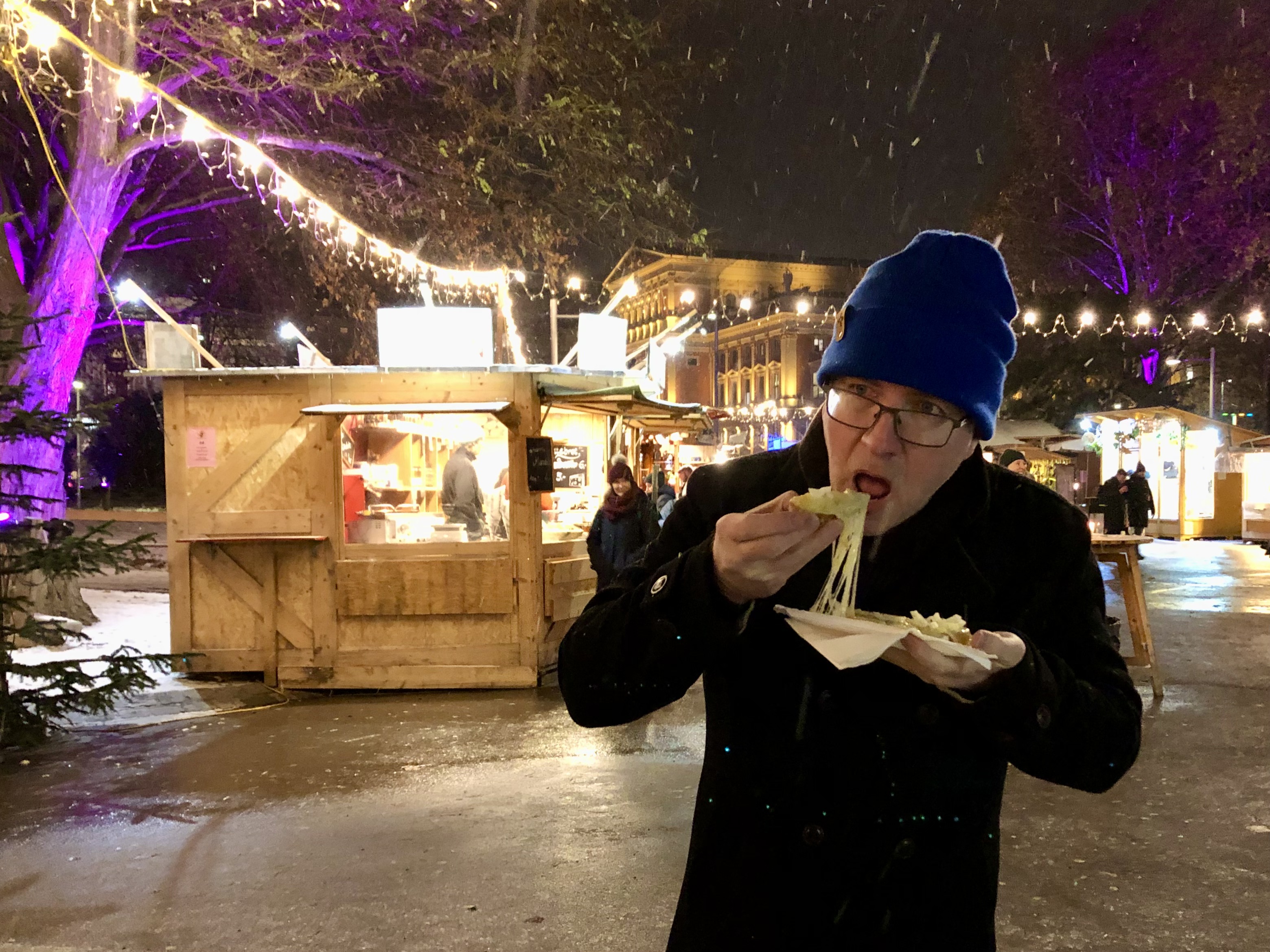
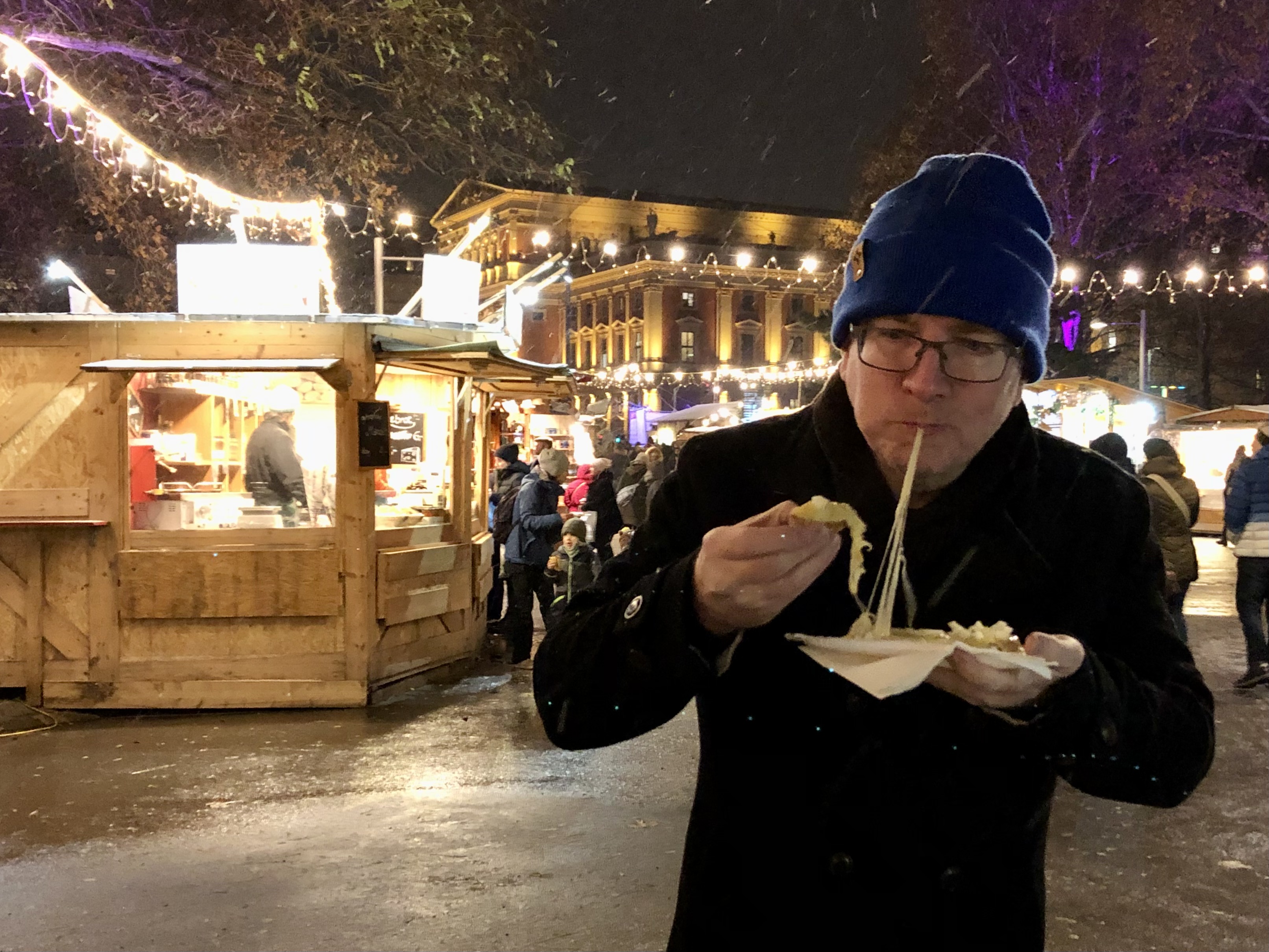
Raclette is difficult to eat by hand standing up off a cardboard tray, did you know that? 

It's so good though. Just that mild but clearly cheesy and totally smooth cheese with the salt and pepper and the raw onions. This is what I came all the way to Vienna to find. OK, maybe not JUST that but this was the Christmas market food experience I wanted. I have never had cheese on bread quite this way before and with the possible exception of eating a hunk of blue cheese on baguette while seated on a street corner in Paris, this was the best cheese and bread experience of my life. It was perfect.

I think we got exactly what we wanted and expected out of our 14 Christmas market visits over eight days. Maybe not the specifics of how and when and where but the overall effect was what we wanted and needed out of this trip. The shopping, the atmosphere, the tradition, the mugs (!!!), the history, the gorgeous backdrops formed by famous buildings and places, and yes...the food. I can't imagine we'll take another trip this focused on Christmas markets ever and that's truly OK with me. Not to say that we'll never find ourselves here at home or abroad visiting a market before the holidays but how could another trip top Vienna?


How We Did It

My comments here are largely the same as those I posted at the end of my Christkindlmarkts post. 

Visit Vienna from late November to early January and you are going to be hard pressed to NOT visit a Christmas market, even if you don't want to. These things are literally everywhere, especially between the Ringstrasse (or maybe just outside the Ringstrasse) and the Danube River. Based on our experience this month, the same is true of markets in the towns and cities around Vienna. 

We spent a lot of time planning our visits to the markets in Vienna. I found the site Visiting Vienna to be an essential guide for most things planning relative to Vienna, but especially for Christmas market visiting. Click on the link in the previous sentence for that site's 2022 Christmas markets post. I should note most markets have their own website. Rather than listing all those here in this post, I'd suggest you just start with Visiting Vienna. There's a list of markets on the right side of post linked in this paragraph. We visited the first 11 on the list.

It is difficult to get a sense of the food quality in these markets from their websites and it's a little different going to eat than it is going to shop. Presumably, if you are going to eat it's because you are hungry and don't want to NOT eat. Generally speaking, I'd say that the internet buzz about the stalls in a particular market matched their food quality. I'm not sure this is an all-pervasive observation but we found the best quality food at the markets described as having higher quality goods for sale. 

Finally and maybe most importantly: browsing is free and most of the food we ate was relatively low cost. I think you will struggle to spend more than 10 Euros at a time here. 


Friday, December 23, 2022

Christkindlmarkts

In late 2020, we decided we HAD to take a December trip to Vienna. HAD to. Someday. One day. Somehow. Some way. We honestly tried our best last year, but a late November decision by the city of Vienna to pretty much shut down the entire city due to a surging COVID outbreak changed our mind. We didn't go. Why would we risk sitting around in a hotel in Austria's capital city for a week when we could be somewhere (New Mexico, as it turned out) actually having fun? So, we punted last year's trip to this year. December in Vienna...here we come!!!!

Vienna had been on my list for years. It is (or was, I guess, now) pretty much the last un-visited (by me) city of major importance to the Art Nouveau movement of the late 19th and early 20th centuries. Brussels, Paris, Helsinki, Glasgow, Barcelona...all visited. In 2022, it was Vienna's turn. I knew one day I would make it there and see works by Wagner, Klimt and Olbrich firsthand. 2022 turned out to be the year.

But Vienna's Jugendstil Art Nouveau movement was not the impetus for this trip. Oh no...the reason we went to Vienna right before Christmas this year was The Hallmark Channel. There's no other explanation, reasonable or unreasonable, for this trip.

I'm not joking. Towards the end of 2020, before COVID vaccines were available to the general public, nightly viewing in our household involved The Hallmark Channel's incomparable run of formulaic Christmas specials, including the masterpiece, Christmas In Vienna. Did you know that there were a ton of Christmas markets (or Christkindlmarkts) in Vienna where you can find the spirit of the season along with maybe true love and eternal happiness? We didn't. Not before December 2020. 

Fortunately for us, true love and eternal happiness are already taken care of in our lives, but we still had to go check out this whole Vienna Christmas scene. What other choice did we really have?

Hallmark Channel...I'm telling you.


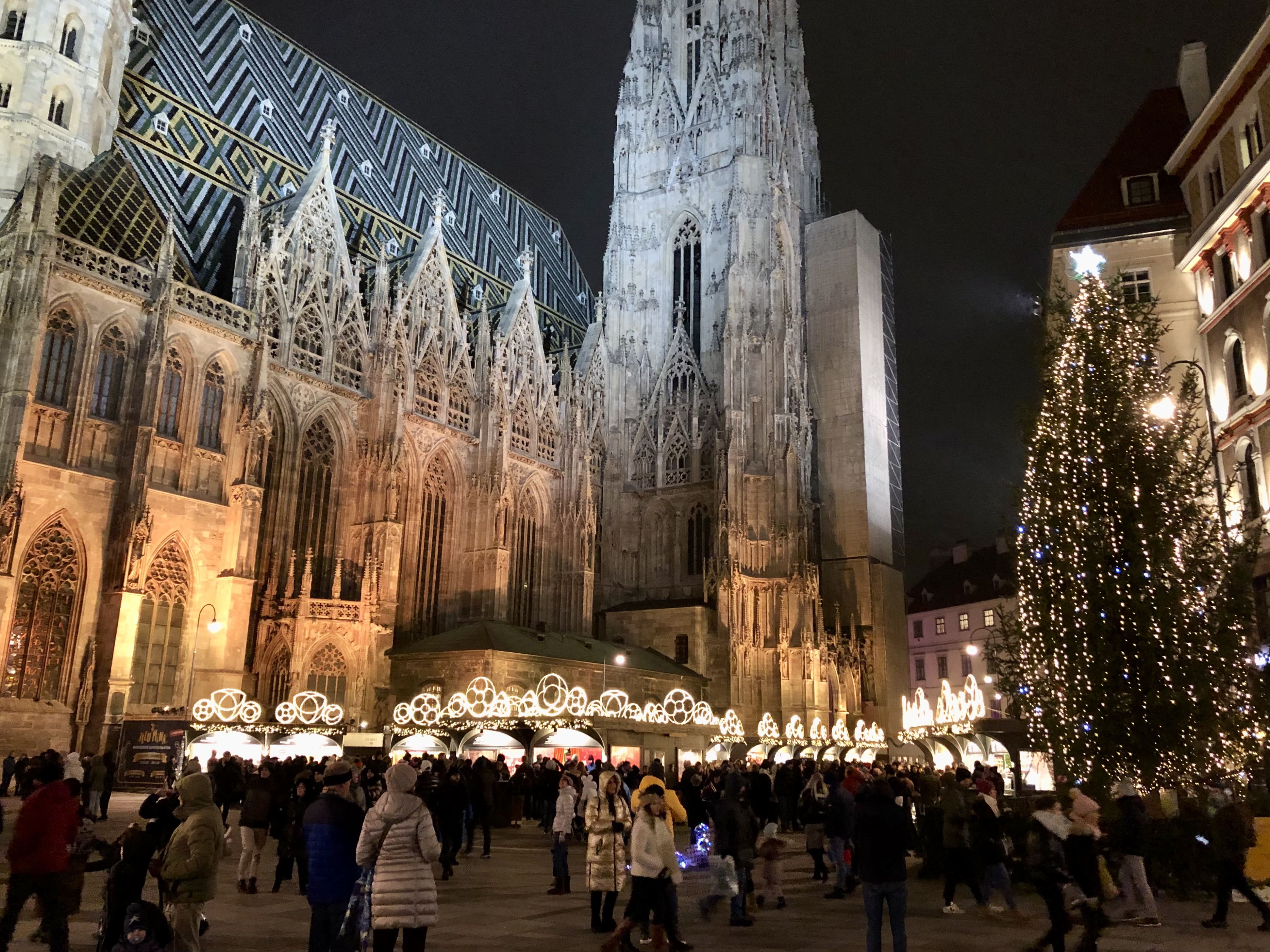
Christmas Village Stephansplatz (top) and on Maria Theresien Square (bottom).

Now, if you know anything about me, you know I rarely do things halfway. If we were traveling all the way across the Atlantic Ocean and most of the way across Europe to go Christmas shopping outdoors, we would not be stopping at just one or two Vienna Christmas markets. We made a list; we checked it twice (or maybe three or four or eighteen or so times); and ended up with an itinerary that got us to two Christmas markets on our very first day in Vienna. We added two more (and different) Vienna Christmas markets on day two and two more (and yes, different) ones on day three.

All told, we put 11 Christmas markets in Vienna on our itinerary. And yes, we made it to all 11. And to three others outside of Vienna in Melk (Austria), Bratislava (Slovakia) and Brno (Czechia). We actually found out when we checked into our hotel that there were at least two MORE Christmas markets in Vienna that we didn't even know about before we arrived. We could have pushed the total visited to at least 16 between Vienna and daytrips out of town. We figured 14 was enough. You have to draw the line somewhere. We probably actually missed more than just two in Vienna.

Before you conclude we are absolutely nuts for making this sort of thing the focus of a trip across an ocean, these markets are a huge deal (and not just in Vienna but in Europe in general). Before we departed Dulles Airport at the end of the first week of December, our hotel emailed us a cheat sheet of Christmas markets to visit. When we checked in, they handed us a completely different booklet containing a guide to six or seven more. Gigantic deal!


Ornament stall at the Christmas Dream Market (top); Belvedere Christmas Market (bottom).

So why would I do this? Why would I travel eight plus hours on an airplane (in economy) just so I could go shopping for stuff that I probably don't need and which will probably break on the trip home anyway? And aren't there plenty of perfectly good and fine Christmas markets right here in the USA where I could do just the same thing but for a lot less money and in a whole lot less time?

The answer to all that (other than just stating that I don't think I could realistically find 14 Christmas markets in and around any American city) is that this isn't just shopping. This is an experience. It's a part of European winter ritual that stretches back centuries in some locations. Sure, there are a lot of trinkets for sale and yes, we bought our fair share of these (all of which arrived home totally intact and unbroken) but the real value in these markets is lingering and taking in everything that there is to take in for as long as you can. Or at least until it gets too cold to be outside anymore. There's some magic here. That's reason enough to go!

The 11 markets we had on our list for Vienna offered a great variety in terms of location, size and scale. Some appeared to be local spots tucked into small city squares or tight alleys whereas others were clearly way more grand than that. We felt it was important to visit a number of different markets that would get us more than one kind of perspective on the city just before Christmas. But we also saw the Christmas Dream Market in the main square in front of the Rathaus (or city hall) as THE Christmas market in town and so we felt it was important to make an early visit to that one in case we needed to come back time and time again. 

We did, by the way. Three total visits to that one.

Christmas Dream Market: the Rathaus with Christmas tree (top) and skating (bottom).
The Christmas Dream Market is gigantic. It was way bigger in every way than every other market we visited either in Vienna or on our three daytrips. It covered a greater area; it appeared to have more stalls to buy Christmas swag than any other market; it had more lights; and on a Saturday night when we first visited, it had easily way, way more people milling around it and shopping and drinking and eating than any other place we went to. If there is an alpha dog Christmas market in the city of Vienna, this is it. 

And it ain't all about the shopping at the Rathaus. 

There were many markets that we visited in our week plus in Vienna that offered attractions other than shopping and eating. The Christmas Dream Market definitely had more of those than any other market we stopped at. The east side of the square in front of the Rathaus is devoted to a giant skating area consisting of a reasonably sized rink connected to a series of one way, sloping and climbing iced runs filled with packs of Austrian children racing around the place on their skates. Or at least there were when we first arrived here on Saturday night. Skating here is honestly a bit of a challenge. I'd never skated on sloped surfaces before and while it's pretty easy to coast downhill, there's the whole stopping thing to consider which would definitely be more challenging when faced with packs of Austrian kids whizzing around you. 

We did skate, by the way. We had to. It seemed like the romantic thing to do and it was truly awesome. We just didn't do it at night on a Saturday when we first visited (just way, way too chaotic). We picked 10 a.m. on a Friday morning which in the daylight is not quite so magical as doing it under the twinkling Christmas lights. But look, staying upright on a sheet of ice is just about all the magic I need sometimes when abroad and Friday morning worked just fine.

If you are not a huge fan of crowds, the Christmas Dream Market is maybe not the place to be on a Saturday night. Just saying. We went one other night and the market was way more digestable with a lot fewer people at it.

Besides the skating area, the Christmas Dream Market offered rides, including a Ferris wheel and a carousel, as well as a walking path taking you by lighted trees (one filled with red, lighted hearts), oversized reindeer sculptures (also lighted) and a giant advent calendar that seemed to be just an enormous advertisement for the adjacent Vienna Lottery ticket booth (we passed on the lottery). There's also a nativity display pathway which on first impression seemed to be showing various scenes from the life of Jesus Christ by different artisans but which really ended up to be just different manifestations of the same famous nativity scene plus one display where Jesus, Mary and Joseph were either fishing or swimming or both. Didn't quite understand that last one but that's what it was.


Ferris wheel and tree at the Christmas Dream Market (top) and artisan stalls at the Am Hof Market (bottom).
We would end up spending more time at the Christmas Dream Market than any other market in Vienna or any other place we visited this month. We also probably bought more Christmas loot there than any other market. If you only have time to make it to one market in your visit to Vienna, this is probably the one to prioritize. It really is a special experience. You'll get a great overview of the European Christmas market experience for sure.

But the beauty of being in town for a bit more than a week meant that we didn't have to settle for just one. We got the chance to explore. And when we did that, we found that there were places we preferred to the main market in front of city hall. Each of these markets has a vibe, a feel, a sense of character that is unique. And honestly, we liked some better than others. Given all that is out there, why would you realistically visit just one?

I should mention that there is a very small sameness about some of these places. You will likely find one or two vendors who show up at every market (we see you, Original Vienna Snowglobe Factory...). But they are by no means all the same. I don't think I could reasonably equate the feel of one market we visited to any one other market. They are all different just like we humans are all different so it's natural some are going to appeal to some people more than others.

Having written all that, and understanding it's probably not productive to give a detailed rundown of EVERY market we visited, here are my top three, in the order we visited.


Old Viennese Christmas Market on Freyung

The Freyung is a triangular square (is that possible?) in the middle of the historic center of Vienna. It was first established in the 1300s when it was created as an open space in front of a monastery with Scottish roots (of all things). The monastery is still there today, defining the majority of the north side of the square. So a good portion of the fabric surrounding the plaza is seven hundred or so years old. Places with this kind of history are inherently very cool for me.

Over the centuries, the square became a favored spot for the Austrian aristocracy due to its proximity to the Hofburg Palace, where the emperor maintained his summer residence in the city. Because of that, the buildings on the perimeter of the square which are not the monastery are of a certain well-designed character. Historical fabric is all around you when you are in the Freyung. 

The name of the square, by the way, stems from the fact that the monastery was free (or "frey") from taxation by the local ruler of Vienna when the building was first erected.

The Freyung. The old monastery is in the background in the center of the photograph.
What we found at the Freyung Market was a manageable number of high-quality vendor stalls arranged around the perimeter of the plaza with a couple of beverage vendors in the center of the square bookending a small open space with tables for gathering, talking and drinking. Drinking and eating are very definitely central to the Vienna Christmas Market experience and the sense of togetherness and community in some of these markets comes across loud and clear. They appear to be frequented by locals and not just tourists which for sure adds a different character to the interactions between market-goers. We got a great sense of this at the Freyung.

Part of what made the Freyung so special for us was that it was the first market we visited. It was the closest market to our hotel and a mere ten minute or so walk from our front door. The act of grabbing a glass of wine (grüner veltliner, if you must know) and walking from stall to stall got us right into the spirit of these markets in the most ideal way, especially since the glass lasted the entire walk around the square.

But it wasn't JUST the fact that it was the first. The historic character; the backdrop of the buildings around the square; and the closeness and intimacy shone through in a way here at the Freyung that we didn't get in any other place. It was the perfect place to start. And sure, the first one is always special in some way.

Karlsplatz Christmas Market

Three days and eight Christmas markets later, we wandered into the Karlsplatz in front of the massive Karlskirche (or St. Charles Church, if you must have the English translation) for a quick shop and some dinner before our trip to the Vienna Opera. On a scale level, the Art Advent Christmas Market on the Karlsplatz dwarfs the tiny collection of booths on the Freyung and comes pretty close to the size of that on the plaza in front of the Rathaus. It is also set in a vast open square in front of one of the city's most important churches and not in a tight urban setting. Completely different environment.

The jewel of this market is clearly the Karlskirche itself. It is the singular object that provides focus for all the market stalls. Everything revolves around the Karlskirche in the Karlsplatz, and the installation of a few dozen or so wooden huts selling Christmas loot and all sorts of market snacks does not change that in any way.

What makes the Karlsplatz Christmas Market unique is the fact that the application process for selling in the market involves a juried review, meaning what's being sold there needs to be local and handmade (or organic in the case of food and beverages). The stalls offered different goods than we found elsewhere, particularly a higher quality (and price) of what was being sold. We didn't buy anything here (well, I did buy one thing...), but we did see some different vendors. Except for the Original Vienna Snowglobe Factory, that is.


The Karlsplatz Christmas Market was also where I found my Vienna Christmas market mug.

Perhaps THE essential Vienna Christmas market souvenir is the mug. When you buy a drink at the markets, it is served in a ceramic mug which is usually unique to both the market and the year. The price of the drink includes a deposit for the mug of a few Euros. If you return the mug, you get your deposit back. But if you like the mug and want to take it home, you can do that also. You just trade your deposit for a souvenir which is both site and time specific. I needed a mug from this trip.

I thought the mug at the Karlsplatz Christmas Market was the best of the trip so the one I got filled with a hot himbeerpunsch is now sitting in the mug cabinet in our kitchen. It's a matte black mug with purple line drawings of the Karlskirche and some of the handcrafted wares available for purchase at the market along with (of course) the year 2022. It appropriately represents the zeitgeist (if we are using German words) of that market and it could absolutely not be passed up.

Great architecture, high quality crafts, organic food (we'll get to that part...) and THE essential souvenir of a Vienna pre-Christmas trip? Yep, the Karlsplatz Market was definitely one of the best. Maybe not quite as good as the Freyung, but there's not much in it.


Christmas Market at Schönbrunn Palace

I didn't expect to have the Schönbrunn Palace on my list of favorite Christmas markets in Vienna. Maybe it's my generally anti-royal stance but we deliberately didn't visit either royal place in the city of Vienna on this trip. We just didn't think we needed to. After all, we'd been to Versailles. How much different could it be?

The Schönbrunn was the last Christmas market we visited. It was also my favorite. And it wasn't even close. I mean this place blew all the other ones away. It lacked the Freyung's intimacy, but it overcame that easily.

So first of all, I thought the vendors here were the best. Yes, the Original Vienna Snowglobe Factory was here like it was at the Freyung and the Karlsplatz (and others...), but we saw some stuff for sale here that we hadn't seen at any of the prior 13 we'd visited. We could have bought a lot here, but ultimately, we restrained ourselves. After all, there's only so much stuff we could buy before we got into "do you really need that?" territory.


But it was the dramatic stage set that separated the Schönbrunn from the rest of the markets.

We visited a number of Christmas markets in and around Vienna that had some incredible backdrops. Certainly the Karlsplatz fits into this category with the ornate Karlskirche as the focal point for an incredible experience that happens at each end of the year. I could also say something similar about the markets at the Belvedere Museum, the Maria Thereisen Square and the Rathaus. These are clearly important historical buildings which anchor their respective markets (the building being the statue of Maria Theresa in the case of Maria Thereisen Square) and which glow impressively under the lights at night.

Schönbrunn blew them all away. I think it's the vastness, the spread and the golden color that do it when you are standing or walking in the market, either with or without food, a mug of something warm or a bag or two of Christmas loot. But it's also the approach. I imagine that most visitors to the market take the U to the Palace which forces a path frontally towards the entire width of the palace. It is literally like this giant expansive glowing golden curtain that backs up an intimate and wonderful Christmas market. The view just blows you away and you get it from the instant you see the market from afar to all the way until you leave. I wrote earlier in this post that there is magic here and I meant it. I felt it the most at the Schönbrunn.


A stall at the Maria Theresien Square (top) and Melk (bottom).

You might have noticed most of the pictures on this post are taken at night. It's deliberate. That magic I felt at Schönbrunn and the Karlsplatz and the Freyung and every other market we visited was turned up to 11 at night. In the light of day, you can see all the warts on the markets. Sometimes the wood used to make the stalls is a little ragged; or the square or plaza or grassy areas that make up the market are dirty or muddy; or there is trash or whatever else on the ground. Nighttime erases all that. Once the sun goes down it's all twinkling lights and wonderlust. It's a totally different world. 

If you need convincing of this fact, just check out the two pictures below of the Altes AKH Christmas Market at the University of Vienna, which we found a quick couple of tram rides from our hotel. The daytime photograph to me looks grey and beige and dull. I see a large grey path and dark gray tree trunks and a Christmas tree made out of beige sleds which looks like it's ready to be lit on fire or something like that. The scene looks like something waiting to happen.

Contrast that with the second photograph. All I see is lights. I see a red Christmas tree made of sleighs and twinkling lights overhead that guide you through the market and a green glow on the market stalls. Even the dark grey trees are transformed through the red lights. The dark and the lights completely transform the scene. The magic is turned on.


We visited Vienna in December to see these markets. When we got back home we discussed what we liked best about this trip and far and away the best thing for both of us was spending time at the various Christmas markets we visited. It is really rewarding when the star attraction of the trip measures up to expectations. In this case, I think the markets cleared that bar with flying colors.

We spent time at a Christmas market every day we were actively sightseeing on this trip. Most days, we were at two or more. We passed through or past or were exploring one every night. I don't think I've ever done something that so comprehensively permeated every day and night of a vacation. It was all so worth it.

I have tried to include pictures of as many Christmas markets as I could in this post while also prioritizing the photos which I feel are most spectacular, which inevitably are the night shots. For almost all of the 11 markets we visited within the city of Vienna, we were able to coordinate our schedule to put us at each market at night (the exception being the Michaelerplatz Christmas Market). For daytrips to Melk, Bratislava and Brno, though, we had to make do with daytime visits. I am confident these three markets would be every bit as magical as their counterparts in Vienna had we been there at night.

There are Christmas markets all over Europe. Some are older and more famous than those in Vienna but I can't imagine a pre-Christmas trip anywhere in the world that would get us a better market experience than our eight days in Austria. I'm not sure we are ever going to seek out Christmas markets in December quite the way we did on this trip ever again. There are too many places to go in this world to take two Christmas market obsessed trips. But no regrets on this trip. I think we got what we wanted and way, way more based on our Christmas In Vienna Hallmark Channel impulse. This will last a lifetime.


Brno (top) and the Michaelerplatz Christmas Market in Vienna (bottom). Night time is better.


How We Did It

Visit Vienna from late November to early January and you are going to be hard pressed to NOT visit a Christmas market, even if you don't want to. These things are literally everywhere, especially between the Ringstrasse (or maybe just outside the Ringstrasse) and the Danube River. Based on our experience this month, the same is true of markets in the towns and cities around Vienna. 

We spent a lot of time planning our visits to the markets in Vienna. I found the site Visiting Vienna to be an essential guide for most things planning relative to Vienna, but especially for Christmas market visiting. Click on the link in the previous sentence for that site's 2022 Christmas markets post. I should note most markets have their own website. Rather than listing all those here in this post, I'd suggest you just start with Visiting Vienna. There's a list of markets on the right side of post linked in this paragraph. We visited the first 11 on the list.

We spent zero time planning our visits to the markets in Melk, Bratislava and Brno and found all three very easily. I'm not sure if there's a real lesson in there or not but my takeaway is that if you visit a smaller town or city in December, you are pretty much destined to find a Christmas market pretty easily. 

Finally and maybe most importantly: admission is free. That's not to say that you get to skate in front of the Rathaus for free or get free drinks or food but getting into these places doesn't cost a penny and there is so much to take in at every stop. This is for sure a low cost attraction, even if you elect to get some food or a drink or two.