
Our trip to Scotland in late June and early July of this year lasted almost exactly two weeks. I mean that quite literally. We spent 14 days there almost to the hour from the time we crossed the Scottish border heading north to Glasgow to crossing the same line heading back south to England. That's about 336 hours of time, if you are inclined to do the math. Clearly, I was.
Of those 336 hours north of the border, we spent an awful lot of time on boats. Like an astonishing amount of time. We sailed (sailing here means a boat with a motor; there were no actual sails involved on this trip) on small boats with about 10 other people to massive boats seemingly capable of spending long hours at sea in all sorts of weather. We left the shore in search of puffins, gannets and other sorts of birds; floated past world famous whisky distilleries right on the shoreline; and roamed around the largest loch in Scotland (and largest body of water by far in Britain) in search of monsters that never bothered to have the common courtesy to surface right next to our vessel and make us internationally famous.
But of all the boats we set foot on during this trip, we spent by far the most amount of time on ferries moving us back and forth between the mainland of Scotland and the Hebrides, the string of islands on the west coast of the country. By my count, we spent about 16 hours either on these ferries or waiting to get on these ferries. And they were worth pretty much every minute of it, and not just because we needed them to take us and our trusty Honda Jazz to some amazing places.
So I'm thinking the ferries deserve a post, right? I mean almost 5% of our total trip was spent on these things. I wrote a post about gannets and our looks at those birds lasted less than an hour. And to be completely frank, we probably spent more than 16 hours with the wait times. We are always early, after all.

 |
| Early morning sail from Islay to the mainland (top); and leaving Ullapool en route to Lewis (bottom). |
So honestly, if we really wanted to go to the islands of Islay, Mull and Lewis (and we did), we pretty much had to take ferries to get around. Sure, we could have flown to each island, leaving our car at whatever airport on the mainland we flew from and picking up some sort of transport on the islands, but that seemed way more complicated. The ferries (all of which were operated by Caledonian MacBrayne, or CalMac for short) were an essential part of our trip that ultimately probably crossed that line from necessary commodity to beloved travel partner by the end of our time in the Hebrides.
Maybe "beloved" is a bit of stretch but there was for sure a special kind of kinship with the CalMac ferries that we picked up during our first week in country. Part of that love (or whatever it is) is the romance associated with certain types of travel. Most of our time getting away is probably spent in planes and cars, two decidedly non-romantic types of travel, unless we are talking about a seaplane or something like that (like the one that took us to Dry Tortugas National Park in 2014). But if we start talking about moving from place to place on a boat or a train, now we are talking about a mode of travel that definitely makes me happier and more relaxed.
There is something about being on a boat on the open water (and to clarify, we are talking calm water here) that is relaxing and peaceful. Just the ocean or sea as far as you can see with specks of land in the distance marking your departure point and destination or just an island or shore that you are passing by. It's slow. It's serene. It's exhilarating being out on deck watching it all. It's amazing.


I know...it's not a sailboat. It's a ferry. It has a pace to it that's plodding and unexciting on the surface. And those big engines are working hard and probably using all too much energy to get us from port to port.
But there is a throwback quality to ferries that appeals to me. They are not fancy but they are the ultimate short and mid-distance people movers on the water that have been around for a long, long time. It's even better if you get to drive your car on and off them (which we did on six of the seven CalMac ferries we rode). There's something cool about putting your entire vehicle onto a boat and just driving it off on the other side. For all the places I've ever been, I'm not sure I've ever driven a car onto a ferry. That sounds crazy but I think it's true. Although, not any more.
About that driving onto the boat, though. You definitely need to pay attention when you are doing it. Most of the ferries we took had a single level of parking for cars; getting on and off those was pretty straightforward. The ferry between Ullapool and Stornoway (on the Isle of Lewis), though, had a second level of parking in its hold on each side of the boat towards the exterior. The second deck was accessed by a ramp on each end that was raised after it was full and then lowered to allow disembarkation.
We were unlucky enough to park on the upper deck both ways on that trip. I say unlucky here because they let the upper decks off last; it's kind of difficult to lower the ramps to the upper decks when there are cars below. But we were not as unlucky as one person next to us who managed to drive their front wheel off the side of the ramp down from the upper deck. I don't know how long that mess took to get sorted out because we got off as soon as we could. Just watch where you are driving when getting on and off ferries is the message here.

 |
| The ferry to Islay opening up their vehicle "door" (top); and driving on at Ullapool (bottom). |
One of the great things about boat travel is there is generally enough room to move around some (or a lot) and there's usually some stuff to do. Exploring a boat this size can take some time and we are not talking about open ocean travel here so there's typically something to look at while you are going wherever the boat is taking you. Plus, if you need a meal, there's a full galley. None of this is like a plane or train where you are confined to a relatively small space for the duration of your journey. More room is better.
We did manage to see some pretty amazing things looking overboard, from a very fleeting look at some dolphins (or maybe they were porpoises); to lots of birdlife, like gannets plunging into the water in search of food; to seaside distilleries on Islay; to a few ruins or a lighthouse or two or maybe even a castle. There are some great views of Duart Castle on Mull from the CalMac from Oban to Craignure. Duart is not a medieval castle; it was re-built in the early 20th century. But you still get a great view from the water. People pay for tours to see these sights. You get it all on the ferry for free.
And that food? Pretty good. At least for breakfast. We actually ate breakfast twice on the ferries. I'd highly recommend the bacon and tomato breakfast sandwich. I'll also say that we got the sense that the staff working in the galley really cared. If your order wasn't ready at the counter then someone would find you in the dining room and bring it. I got the sense that the job is not viewed as a stepping stone to something else. We saw when we got back home that the BBC is making a reality series about life working on the CalMac ferries. HAVE to find a way to watch that when it gets released next year.
Oh, there's also a full bar on board in case you need a dram of whisky. Just not at breakfast time. Islay is well represented, appropriately enough.
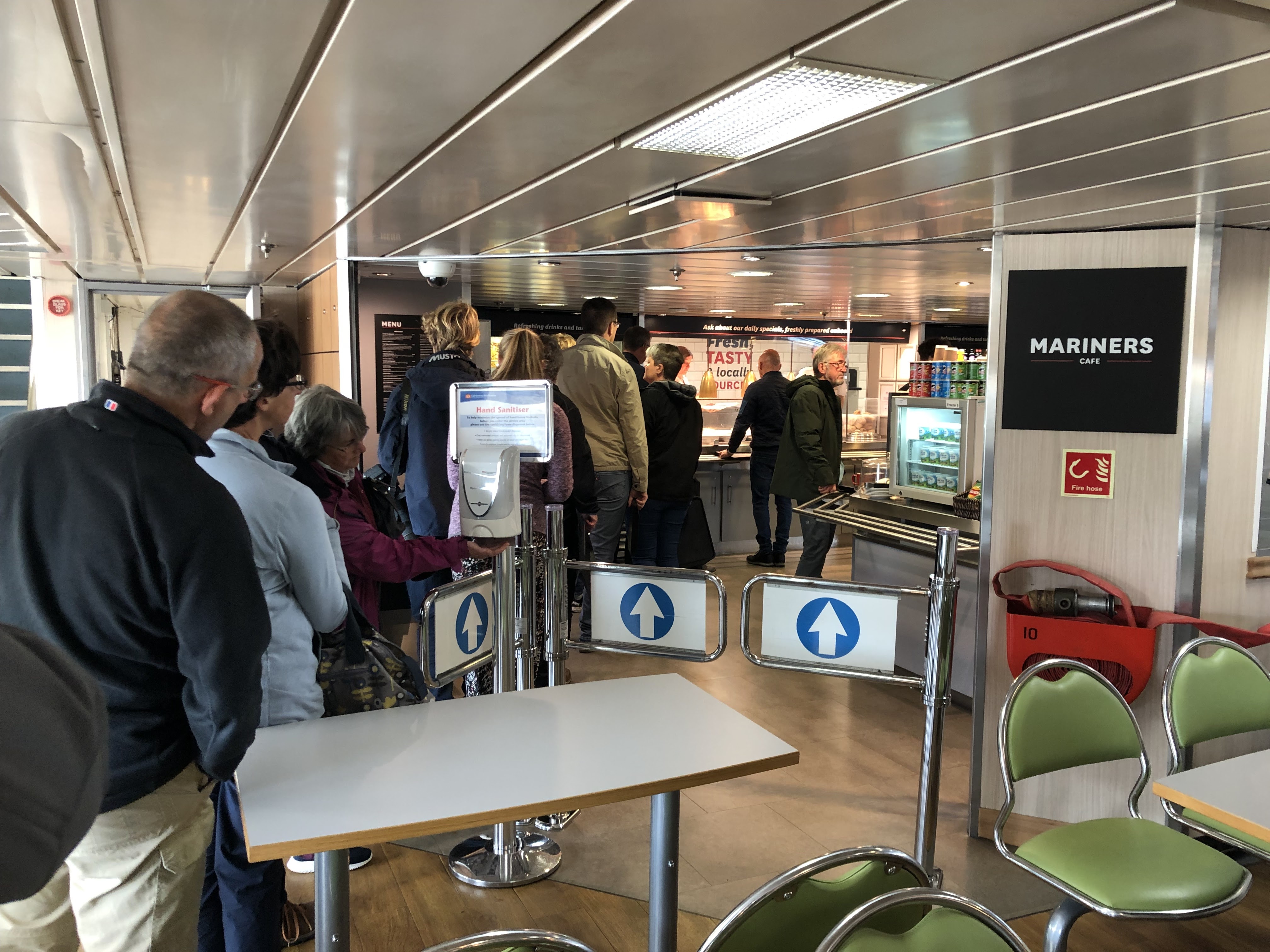
 |
| Waiting for breakfast (top) and I'm counting six types of Islay whisky at the bar (bottom). |
As I've already said, we pretty much had to take these ferries to get where we were going but there is actually a benefit to getting to some of the departure points. These places could be seen as a necessity to get where we really wanted to go on the other side of the water, but we used the opportunity to explore a bit and appreciate the drives that it took to get there, wherever there happened to be.
We left for Mull from Oban, which is a bustling ferry hub. There are boats coming in and out of there all day so it would stand to reason that there would be something going on. Our destination here was lunch, which turned out to be a bite to eat at the sketchily named Oban Seafood Hut, a green painted stall right on the water. The shrimp sandwich was great but I'd steer clear of the rubbery whelks. It's the animal, not the place of business. Who likes whelks? I can't imagine.
Our other two points of departure (Kennacraig and Ullapool) took us by some of the best scenery we drove past on this trip. The road to Kennacraig took us past the shoreline of the west coast of Scotland. The road to Ullapool took us through the highlands. Both were amazing drives and the best part was they were just a bonus. We weren't there to drive through spectacular scenery at all; they were just throw ins for free on a drive of necessity.
Ullapool, where we departed to Lewis from, is a gorgeous little town of rowhouses lined up facing the harbor. I can't imagine what people in Ullapool do for work because it seemed to be utterly remote, but the place is really well put together. I suppose the ferry brings a lot of business to the town. We ate at the local chippy here before we boarded and found a couple of Scottish fish and chip shop delicacies that we had no concept of what they might actually be. We stuck to the fish but looked up the king rib and the red pudding later. Glad we got the fish.


 |
| Scenes from the ferries: Port Ellen, the islands on the way to Stornoway, and Duart Castle. |
The longest ferry we took on this trip was between Ullapool and Stornoway which was two and half hours (or maybe just a bit longer on the way there) each way. The shortest we took was from Iona to Fionnphort on Mull which was all of 15 minutes long. The ferry from Iona was mercifully short but the ferry to Stornoway was probably the best ride we took, despite the length. The weather was perfectly sunny on that 7 p.m. trip and the islands we motored past were just so picturesque. It was almost worth the price of admission for that view alone.
Speaking of admission and despite the title of this post (I have to search for song titles, right?) we did pay the ferryman here. And before we got to the other side. These things are not cheap, particularly with a vehicle to pay for. We were whale watching (or more accurately staring at the water) in the morning on Lewis talking to a dude from Salisbury, England and complaining about the cost of the ferries. He summed it up well (and I'm paraphrasing here): the cost of taking a car on the ferries is not cheap, but if you want to get to what's on the other side, you just have to pay for it. He was right. The CalMacs got us to some incredible places. I can't imagine doing it any other way.
 |
| The menu at Deli-Ca-Sea Fish and Chip Bar, Ullapool. Red pudding anyone? |


