Showing posts with label Cars. Show all posts

Tuesday, June 14, 2022

Carhenge

As of the beginning of last month, I had just three states left to visit to lay claim to having set foot in all 50 of our United States. Then we visited Nebraska. Now I have just two remaining. Kansas and Oklahoma, if you must know.

It is not enough for me to cross a state's border, get out of the car and declare myself having crossed one more state off the list. No!!! For me, I have to have done something or visited somewhere significant in my time there to truly claim that I have been there. This is sometimes difficult, especially when we get down to Nebraska, Kansas and Oklahoma on the "to visit" list. Not dissing those states exactly, but it's not like we are heading to New York or Los Angeles or somewhere like that.

Finding something meaningful to do becomes even more difficult when we aren't really visiting the state that we try to cross off the list, which is what happened with Nebraska. If we wanted to visit Nebraska to just get credit for having spent time in Nebraska, we probably would have flown to Omaha, downed a steak dinner and a Reuben sandwich (it was invented there) for lunch the next day and gone home. But we weren't visiting Nebraska; our trip last month was to South Dakota, but our itinerary would take us to within 45 miles of the northwest Nebraska border.

Come on...we had to make it to Nebraska. All we had to do was find something significant in the northwest corner of the state. And grabbing lunch at Runza would not count.

We settled on Carhenge. Yes, Carhenge.

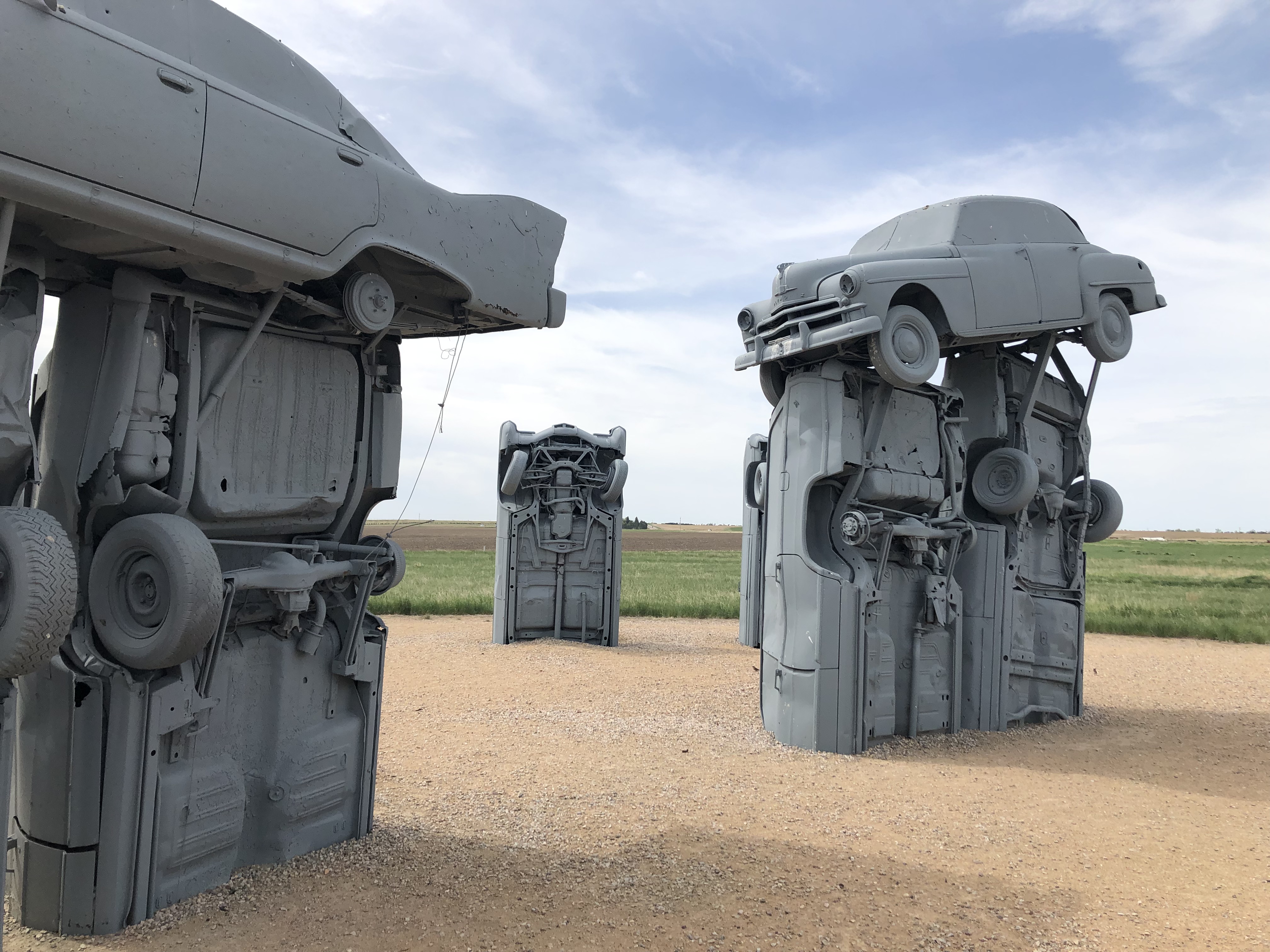
The best car (in my opinion) at Carhenge. The 1954 or 1956 Cadillac used as a lintel atop two Ford wagons.
And second best...the 1950 Chrysler DeSoto.

There is something uniquely American about building a replica of Stonehenge out of cars in the middle of the United States. I know that makes relatively little sense but I don't think you could really get away with doing something this simultaneously pointless and awesome at the same time in any other country in the world. And the central part of our country seems to be peppered with these types of things. World's largest ball of twine. The Blue Whale of Catoosa. World's largest pistachio (there are a lot of "world's largest" out there...). Muffler men. Cadillac Ranch. They and many others like them of varying quality and interest are all part of the American road trip experience. Or something like that. When they work, they are amazing. 

Carhenge is the brainchild of Jim Reinders, an engineer from Alliance, Nebraska who spent seven years of his life working in England. When he returned home, somehow he decided he needed to create what he referred to as "Stonehenge West" and his medium of choice happened to be cars. 

Apparently Jim had a lot of cars lying around and I guess it's way easier to move cars to a field in rural Nebraska than it is to move giant slabs of stone. He started with 25 cars and managed to get all of them into place in a six-day long family reunion over the summer solstice in 1987. Can you imagine showing up to a weeklong gathering with family and finding out that someone's got an idea that you are going to be standing cars in the ground and placing others on top of them in an effort to personalize your cousin Jim's field? That must have been a fun week.

Keep in mind here that it's not just putting cars in place as is. All the windows are covered with sheet steel (I'm assuming it's steel...also assuming they were covered for safety reasons) and then the whole things are painted grey to match the actual stone circle on Salisbury Plain. I guess those things are a fairly light lift compared to the actual moving of the cars.

Random American cars topped by a 1975 Gremlin (left) and 1962 Plymouth Valiant (right).
1960 Ford Galaxie (left) and 1961 Cadillac DeVille (right) emerging from the ground.

Now, if you know anything about me and cars, you'll know I'm not much of a cars guy. But I do have a love for specific models and a certain era of automobile design from the 1950s to the 1970s. And Carhenge has a number of these. How Jim Reimers decided the best use of a 1950 Chrysler DeSoto or a mid-50s Cadillac was to blow out the windows, paint them solid grey and make them part of his backyard sculpture is beyond me. Of course, I don't have the benefit of knowing the condition of these vehicles before he moved them to his field and started stacking them on top of each other.

I do appreciate the fact that he seems to have kept the most interesting models for use as the lintels in the circle and used the more generic sedans and wagons to hold those more distinctive automobile bodies on full display. I'd love to have most of these cars in great condition in my driveway. Even the 1975 AMC Gremlin on the north side of the circle. Of course, I can't drive my own car that I'm in love with often enough these days to even put 500 miles on the odometer in a single year. Clearly my theoretical collection of classic cars would need a much bigger stable than my current garage and driveway setup.

And if you are being impressed with me spouting off years and models of cars painted all the same color, don't be. The gift store sells a map of the sculpture with all the cars identified.

Check out the tail fins on the 1957 Plymouth (I believe) on the right. Damn those things are gorgeous.
How I know what I know about cars at Carhenge.

It may seem crazy to you that I drove (...or more accurately sat in the passenger seat...I drove back) 2-1/2 hours to get to a field with a bunch of cars altered and painted and stuck in the ground in a circle. It is for sure a serious drive from Rapid City, but it got me a new state and it's free. I can legitimately claim I've now visited Nebraska and I didn't spend that much to get there. Just $4.50 or whatever it was that weekend per gallon of gas.

It also works. Somehow it makes sense. It's well enough done and doesn't look sloppy. I'd debate the precision of its similarity to the actual Stonehenge but I suppose precision is not really the point here. It really doesn't possess any of the presence or mystery of Stonehenge either, but you can at least walk around and between the henge and touch the cars, all of which you can't do at the real thing. It's all pretty much stupid, I know. But it's completely middle American and I love it. 

The gift shop is also awesome. In addition to the map of the place identifying all the cars, we will have a brand new Carhenge Christmas tree ornament hanging from a branch on our fake Christmas tree this December. How cool is that?

Lest you think a visit to Carhenge stops at the henge of cars, you'd be wrong. Seems Jim had a few more ideas up his sleeve for other ways to make cars into art and he's located these north of the circle in their own separate area of the property. There are a couple of time capsules up in that area along with a group of four cars called the "Fourd Seasons". There's also a "car"-nestoga wagon which perhaps obviously is a car modified to resemble a Conestoga wagon and a graffiti-tagged "auto"-graph car which adds color to the place.

None of these additions (there are also others not by Jim) has the impact or the scale or the inspiration of the original idea. None of them bests Carhenge.

Thus mostly ended our trip to Nebraska. Mostly. We got hungry and you know we just couldn't get out of the state without hitting a Runza. 

What's a Runza, you might ask? Well, it's a ground beef and cabbage sandwich that's supplemented with other ingredients depending on what variety you decide upon. I went with the southwest, which I'm not sure was the correct call. The sandwich was good but not great but I'd give it another shot if I ever found myself in rural Nebraska again. I'd probably pass on the frings (fries and onion rings combo) but the service in the Chadron, NE restaurant was fantastic. Best fast food service experience of my life. Jackson represented Nebraskans very well.

Carhenge and Runza. That's my Nebraska experience. I'd call it good enough.


How We Did It

Carhenge is not a complicated place to visit. Just plug it in to your navigation app of choice and pull off into their parking lot. It's open dawn to dusk. The gift shop is only open late May to September but the hours when they are open are great: 9 a.m. to 7 p.m. daily. There's no admission charge for Carhenge but donations are appreciated. We made sure to buy plenty of swag in the gift shop. I mean when else are you going to get the chance?

The Chadron Runza is open daily 10 a.m. to 9:30 p.m. If I ever find myself back at a Runza, I think I'd go with the Cheeseburger Runza. Say hi to Jackson for us if you visit in Chadron.


Sunday, January 28, 2018

The Motor City


If you had told me three decades ago that there would come a day when I'd voluntarily make my way into Detroit, Michigan and want to go back there when I got home, I'd have said you were crazy. That's not (by the way) the first time I've written something like that in this blog in the last four plus years. For Detroit, that day came earlier this month. It still seems a little crazy.

In 1988, I was a sophomore at the University of Michigan at Ann Arbor, just about 45 minutes west of Detroit. And that city at that time was the last place on Earth that I ever thought I would want to go. I mean Detroit was legitimately scary back then. Murder capital of the USA. Just about all business having fled the city. Abandoned and ruined city blocks deep in the grip of a crack cocaine epidemic.  And if that wasn't enough to keep me away, I'd have to read in the newspaper each Halloween about Devil's Night, a Detroit tradition of setting abandoned houses on fire to see if the fire department could keep up. What kind of hell was this?

Now, I admit in the late 1980s that part of my perception of Michigan's largest city was due to my own bias as a teenager from suburban Connecticut. Heck, I was scared of going to New York back then. In the last 30 years, I've grown up a lot. So, as it turns out, has Detroit. Sure there has been a bankruptcy (Detroit's, not mine) and a 28 year jail term for a mayor that the citizens of Detroit elected and the tax base has a long way to go to allow the city to recover more, but it's no longer the scariest place in the United States, if it ever was outside my own head. I thought it might be time to go back.

Since I left Michigan in 1990, I've accumulated a pretty long list of sights I want to see in and around Detroit. This trip wasn't going to get at all that given the couple of days I was in town, so I focused on a part of Detroit's history that had its population in 1950 at more than 1.8 million people (it's less than 750,000 today): the automobile industry, the thing that made Detroit the Motor City. 


1949 Ford Coupe on display at the Ford Rouge Factory Tour.
Before we start jumping to conclusions about cars and Detroit, the automobile was not invented in the United States. Far from it. There were folks in Europe experimenting with steam powered vehicles to drive on roads as early as the eighteen-teens. When mankind started experimenting with gasoline fueled internal combustion engines as a practical solution to personal transportation, Europe continued to be in the lead. You might recognize some of the names like Diesel, Benz, Maybach, Renault and Daimler who were tinkering with the first wave of cars over in Germany and France.

When Americans starting building and selling cars towards the end of the nineteenth century, the first success was not in Michigan but in Springfield, Massachusetts. Charles and Frank Duryea built and road-tested the first automobile built in the United States in that city in 1893. But when we talk about the launch of the production automobile that would make the first cars available to a significant number of Americans, we have to look to Detroit.

How much car making was there going on in and around Detroit in the early days of the automobile industry? There were an estimated just shy of 100 automakers in Michigan in the year 1907. 100!!! Granted some were small shops that might have produced a single car and most of the names of these folks have disappeared into history but there were for sure some heavy hitters in Michigan in those early days who are recognizable today. Maybe some name-dropping is in order?


Some good stuff beyond these doors...
Ransom Olds made his first car in Lansing, Michigan in 1897. He moved his plant to Detroit in 1899 where the company cranked out hundreds of Oldsmobile Curved Dash cars. Two years after Olds built his first car, David Buick made his own in Detroit; six years later they would turn out 750, an impressive number for the time. About a decade later, Buick was out of the game but cars were still being produced by the company bearing his name but then owned by William Durant. In 1908, Durant founded General Motors with Buick as the flagship brand.

And then of course there was Henry Ford. Ford founded the Detroit Automobile Company the same year Olds arrived in Detroit. Two years later he moved on and formed the Henry Ford Company. A year later, he'd left that behind to his partners the Dodge Brothers who renamed the company the Cadillac Automobile Company. Ford reappeared with the Ford Motor Company which survives to this day. Enough familiar names in there for you? Good!

Assembling a list of automobile-related sites to visit in and around Detroit requires a lot of editing. There are that many to see if you really wanted to. We narrowed our list down to four: The Henry Ford museum in Dearborn; the giant Uniroyal Tire in Allen Park; the Ford Piquette Avenue Plant at the corner of Piquette and Beaubien in Detroit; and the Diego Rivera Detroit Industry Frescoes at the Detroit Institute of the Arts downtown. We thought this list would form a good overview and for sure all four are easily visited in a single day. The jewel of this bunch by far is the Piquette Avenue Plant. I really want to focus on that site and ignore most of the rest.


The first cars built by Henry Ford as the Ford Motor Company, including the Model A, were assembled in a rented property in Detroit. When Ford finally had enough money to buy his own factory, he built the Piquette Avenue Plant, a brick warehouse with wooden interior columns, floors and roof. It became the first serious manufacturing plant for Ford and also saw him create some of his most notable early cars, including the famous Model T.

What's so famous (or great) about the Model T? Well, it was only the car that changed everything about the car industry. It was a 22 horsepower, four cylinder, 40 mile-an-hour-maximum wonder that was the first affordable car that was bought by pretty much everyone. And I do mean pretty much everyone. It was so popular that in 1918 half of all the cars on the roads in the United States were Model Ts. There were over 15 million of these things built and sold for customers all over the country. It was the best selling car of all time almost as soon as it started selling and it didn't give up that title until 1972, when it was passed by the Volkswagen Beetle.

Ford's company operated out of the Piquette Avenue Plant from 1904 until 1910. He produced a total of eight different models (the "alphabet" Models B, C, F, K, N, R, S and T) in the factory with a total of 40,000 units made. When Ford moved out of the building in 1910, Studebaker moved in until 1933 to use it to continue to crank out automobiles, followed by 3M who used it for something else. The current owner, a private non-profit who runs the museum in the space, purchased the building in 2000 and has been fixing it up ever since. And yes, they are still in process. While the building's watertight now so the cars inside aren't at risk from water damage, most of the spaces are still unheated. That means on a winter's day in Detroit, it might be a tad chilly inside. I could feel my toes getting cold halfway through the 90 minute tour and our guide, Tom, kept his gloves on for the entire duration. Tom knows better than me.


Model T. Model T. Model T. Well...you get the point.
The tour of the Piquette Avenue Plant begins on the second floor and ends on the third (and top) floor. You don't have to take a tour; you can just walk around on your own if you want. But for the full history lesson, especially if you are a casual admirer of vintage cars like me and not a full blown Ford enthusiast, I'd highly recommend tagging along with a guide. The tour begins and ends, appropriately enough, with the Model T. After checking out the restored office of Henry Ford himself and the across the way office of Edward "Spider" Huff, the talk for tourists begins gathered around a fully intact and gorgeously original red Model T.  As a quick aside, Huff was sort of Ford's chief innovation officer; he's credited with inventing, among other things, the hand crank you see on all sorts of old cars in movies that allowed Ford's cars to start without a battery if necessary, provided you could crank the wheel at the front of the engine hard enough.

If you make it through the whole place, you'll end up at the north end of the factory on the top floor outside a recreated workshop where the Model T was developed. You remember I mentioned earlier that there were a good number of startup car companies in the first decades of the 20th century around Detroit? Well, things were so competitive that defection to other companies (and theft of trade secrets along with them) was so frequent that Ford decided he'd develop the Model T in secret, allowing just seven employees to know what he was up to on the third floor of the building.

In between the first car and the secret workshop, you'll see plenty of Model Ts. There are 17 of them in the last two third floor rooms of the museum alone and those are not the only ones in the place. There are plenty more on the second floor, including one you can touch (don't you always want to touch stuff in museums?) and climb into. And the more you see, the more you will learn, especially if you get a guide as enthusiastic and knowledgeable as Tom.

And let me say here also the Model T you can climb into was not meant to be climbed into by 200 (OK...maybe 210) pound men; the whole car dipped noticeably when I stepped onto the runner at the side of the car.


Model T? Or snowmobile?
Since I wrote down some of what I learned, let me share a bit.

The first Model T had a retail price of $800 (that's about $24,000 today) but that didn't include the roof, windshield, headlights or a speedometer; all those things were extras. Sound crazy? It wasn't so much, necessarily. Most people buying these things back then had no desire to take them out in the rain or at night, so things like roofs and headlights (which had to be manually lit with a match!!) weren't necessarily essential. And speedometers? Well, from the video that we watched at the beginning of the tour (and available on Youtube), it didn't seem to me that most roads were in good enough shape in 1908 to go very fast at all. Who needs a speedometer when you are traveling everywhere in six inches of mud?

If you are still hung up on buying a car without a roof, windshield, headlights and speedometer, consider this: you could actually get the Model T with less than that and add your own accessories, wheels or entire body. The museum has a few of these, including a Model T re-cast as a delivery van and one retrofitted to be one of the world's snowmobiles. Ford realized there was a demand for the Model T chassis without the body which was effectively just a horse drawn carriage on a motor so he branched out and let people buy just the stuff that made the car go and left it up to them to top it off with what they wanted.

We often think of early cars as being black in color and indeed there's a quote something to the effect of "you can get the Model T in whatever color you want as long as it's black" that's attributed to Henry Ford. I'm paraphrasing not because I'm too lazy to look it up on the internet but because nobody knows if Ford actually uttered those words. But the first Model Ts were not black. They were only produced mostly in black once the assembly line was adopted by Ford in his later Highland Park plant, the one after the Piquette Avenue Plant. At Piquette, the first 6,000 were produced in red, just like the first one you gather around in the museum. After that, he made 6,000 in green. And the early ones came with white tires, because carbon (which adds durability to rubber and makes it black) hadn't been added to that product yet.


The Model B at the Piquette Avenue Plant. Not too many of these around.
Now, if you went to the Piquette Avenue Plant in November of last year, you'd see most of the Model Ts in the place today as well as some other Ford cars and some by Studebaker and some other manufacturers you've likely never heard of. But go today, and you'll see every model of Ford produced in the Plant and there are pristine examples of each model to see and examine.

The reason why there is more to see now than a couple of months ago? Larry Porter.

Larry Porter was a Ford dealer who in his spare time collected early Fords. He was so committed to that task that he made it his mission to buy one of each of model of Ford car, up to a certain point. I'm not sure when he stopped but it's a pretty good bet he doesn't have every model of Escort ever produced. He at least got beyond 1910 when Ford moved out of the Piquette Avenue building which is sort of the point here.

Upon his death, a trust was formed which included Porter's car collection. With the Piquette Avenue Plant building finally fixed up to the point that the trust would allow his early model cars to be displayed in the building, some of them are now on view for the world to see in the museum. There are cars of varying levels of condition in the building. Porter's are all absolutely gorgeous. They are a real treat to see. I also think there's something beautiful about the symbolism of machines being returned to their place of manufacture over 100 years after they were created.

How special is this collection? There are some really rare vehicles in it. Porter owned one of 40 Model F cars and one of just 28 known Model K cars still around. 68 total known remaining of these two models and this guy had one of each. The Model K is especially interesting because that car was built as a super high end luxury vehicle based on the demands of Ford's stockholders. No crappy $800 Model Ts for those folks. They wanted to spend some real cash on their cars so Ford cranked out the six cylinder, 60 mph maximum K, which retailed for $2,500; that's $75,000 in today's dollars!! Check out the trim and the horns and lights on the K; they are all works of art on what is in total a work of art.


The Model K at the Piquette Avenue Plant. Not too many of these around either.
Detail view of the Model K. The horn is literally a miniature brass instrument.
One of 40 or 28 not special enough for you? Porter also owned a Model B. There are just six of these known in existence today and this is the only place on Earth accessible to the public to see one. The Porter collection instantly elevated this museum from a really cool place for Ford nuts to a world class museum. The museum had planned to announce the acquisition in April but word obviously leaked out because one of the guys on our tour came specifically to see them. Now the dozen or so people reading this blog know too. I am in no way a cars guy (I think I mentioned that before on this blog) but I appreciated the quality of these cars as works of art. They are nothing short of spectacular and the details are certainly worth spending some time poring over. Just dress warmly in winter, please. And keep in mind the commitment here is (right now) just for five years.

Eventually Ford's operation got too big for Piquette Avenue. He needed a new factory that would allow him to copy Ransom Olds' idea of making vehicles on an assembly line. So he moved his Model T manufacturing business out to Highland Park three miles or so north (Highland Park is a city entirely within the footprint of Detroit) and left behind the history that he'd created in that location. Now, you can do what I did and go back there and see (thanks to Larry Porter) the entire legacy that he and his third car company created from 1904 to 1910. Those were some pretty cool years.

The assembly line thing really worked by the way. Once he got that cranked up, his workers (who were paid an astronomical $5 per day) could put together a Model T from start to finish in 93 minutes.


The Model T. With steering wheel on the left.
A couple of final notes. Check out the pictures above of the Models B and K. Each one has the steering wheel on the right side of the car. It was located there because the biggest danger a car faced on most roads back in the first decade of the 20th century was running into a ditch at the side of the road. So they put the driver on that side to make sure you stood the best chance of staying out of the ditch. The Model T's steering wheel is on the left, which of course is where our steering wheel is today. Ford wasn't the first one to do this but the Model T was the first car where the wheel on the left stuck. So we owe which side of the car we drive on today to the Model T whether we know it or not.

Finally, I mentioned our Motor City itinerary included four stops. You can add many many more sites to your own list. Indeed there's a list of about 20 or so nearby car-related locations on a list inside the Piquette Plant. For my part, I'd skip the Henry Ford Museum and the associated Rouge Factory Tour and just spend as much time as possible at the Piquette Avenue Plant. We got way more out of this place than we could have possibly hoped. Spend a lot of time checking out the details on these cars and take lots of pictures.

I do also think it's worth stopping by the Detroit Institute of the Arts to check out the Rivera Court, which holds a series of murals painted by Mexican artist Diego Rivera right in the space between 1932 and 1933. The murals are about industry in general in Michigan but the main images that take up most of the space are specifically about Henry Ford's operations. It's interesting to see what a social commentary these works of art are after spending a few hours ogling some old Fords. The top photograph in this post shows part of the assembly of a Ford V-8 model car and is just a sample of what you can see. Go find the rest for yourself. But don't skip the Piquette Avenue Plant to do so.

There's still a ton I want to do and see in Detroit. Gotta go back here sometime soon. And it doesn't sound that crazy anymore.

Saturday, November 21, 2015

Rubbin's Racin'


A lot of what I have seen and written about in this blog over the last almost two and a half years has been some pretty glorious stuff. History. Nature. Art. Architecture. Food. Culture. Discovery. Adventure. I know when I'm older I'll look back on this and savor almost every word I've written here. And then…well, then there's this post which just isn't like most of those other posts. In fact, it ain't nothing close. But it's part of my story of exploring more of our world, so it's in this blog. Read on! If you dare.

In 2002, I watched my first NASCAR race in person. No, let me amend that. First ever. Either in person or on TV. After a few hours watching cars turn left that day on a track in Dover, Delaware and a few more hours just trying to get out of the freaking parking lot (!!!!), I swore I'd never go back and see another one. Never! Four hours or so with a bunch or race crazed drunk 20s to 50s white men sitting in the sun and just as long trying to get on the road to go home. It took from really really early in the morning to about midnight and was a completely forgettable experience. And I meant it when I swore it off for good.

Now my resolution to never sit through another car race in person should have been a pretty easy one to keep, but time sometimes has a way of changing people and in the last 13 plus years I've changed quite a bit. So a couple of years ago, I decided I could maybe sit through another NASCAR race once more in my life under the right conditions. And for me that meant spending the weekend in the middle of a track somewhere in the south of the United States with some of my closest friends. Somewhere I could get completely engrossed in the NASCAR experience and modern southern culture in its most raw form. For me, there was only one place to go: Talladega, Alabama. So I did.

Standing on the wide open track just before the finish line. A few hours later this would be very unwise.
Getting to the track at Talladega is not necessarily simple when you live near Washington, D.C., want to camp in the infield and don't want to drive the whole way. Our journey involved catching a plane bound for Atlanta in the morning; getting a rental car from the airport; driving to pick up an RV in the suburbs of Atlanta; and then driving both the car and the RV down a series of winding backroads in rural Georgia (including Highway 41 just like in the Allman Brothers' Ramblin' Man) until we hit the interstate. 

From there it was a fairly easy trip. A straight shot to the exit for the track except for a quick stop at Wal-Mart to pick up food that we could cook in a microwave, paper plates, plastic knives and forks, some chairs and a little bit of bedding. And a lot of beer. After all, the RV didn't come with any of this stuff. I've definitely eaten healthier than I did those few days down south. I was craving fresh vegetables by the end of the weekend. Oh, and did you know you can get a pillow at Wal-Mart for less than $4? Neither did I but you definitely can. Best $4 I've spent in recent memory too.

I'll admit I had my fears and hopes about this trip. And yes, those two terms are in the correct order. My worst fear was that I would find myself stuck in four nights of St. Patrick's Day-like hell, with irresponsible drunk people behaving badly and making all sorts of noise at all hours of the night. That didn't happen, although it could have if we had picked the wrong spot to park our RV. My highest hope was that I would appreciate the sport of auto racing to a depth that I couldn't before because I just hadn't been immersed at the right level. That didn't happen either. No way did that happen. 

I'll also admit that before the race I thought NASCAR was pretty much a waste of time and resources. Watching cars with average fuel efficiency of less than 5 miles per gallon circle a 2-2/3 mile long racetrack (longest on the NASCAR circuit by the way) for a few hours seemed pretty pointless to me. I'm not sure my opinion has changed on this matter after my Talladega experience but I'll get to that. But I will say I found some things in northern Alabama that opened my eyes and made this trip worthwhile. I don't think I'm doing this again, but I'm glad I did it in 2015.

Our 32' long Coachmen RV. Home sweet home at Talladega for four nights.
What Worked: The Camping

If you are a camper, forgive me. I know you're going to say staying in an RV doesn't constitute camping. Well, I've never spent a night in a tent in my life so to me, sleeping in a vehicle is camping. Yes, the food selection was pretty limited: lots of Stouffer's, potato chips and cold cuts supplemented with super unhealthy stadium fare from the track's food vendors, but other than that life was pretty comfortable. There's not a whole lot to worry about when you are camped inside a racetrack. Getting a shower without having to wait in too long a line and "when's the ice guy going to come by so we can keep our beer cold?" were probably our top concerns.

A huge part of this trip involved spending time with good friends that I have known for a long time. I met three of my closest friends in life 15 or 16 or so years ago at my job and we've been close since the time we first started hanging out in bars together. Over the past decade and a half we've been all sorts of places partially or wholly together with other people: the Caribbean, the Outer Banks, Europe, Kentucky, all the way across this country and more. But just the four of us had never been on vacation together and considering where we are at in life, it may never happen again. This trip was it.

Admittedly, we didn't do much with our time. Eat. Drink. Watch cars. Read a little. Wander around. Go shower. The $15 chairs we picked up at Wal-Mart got a ton of use and the dual cup holders (one on each arm) came in very handy sometimes. OK, so pretty much all the time. We spent a lot of time staring out into space in silence as our group is often wont to do and we managed to make it the whole way without anyone getting testy or panicky with anyone else. But we also passed the time talking about either where we were in our lives or not much in particular except for the one time Larry insisted on having a deep thought Q and A session. I wouldn't have wanted to do this trip with any other crew and they made this trip more worthwhile than anything else.


What we didn't encounter in our time camping was the four nights of hell I'd feared we'd find. The infield of the track at Talladega is enormous and there are a ton of different areas to camp. We decided to prioritize our spending on this trip by getting the most expensive piece of real estate we could find which in our case was in one of the two Frontrunners Club camping areas for RVs only. Our spot ended up being about a couple of hundred feet from the edge of the track itself.

The St. Patrick's Day atmosphere I'd wanted to avoid was out there. We found it easily one night when we decided to take a walk around the infield. But the spot we bought ended up being effectively in a gated community, complete with 24 hour guards and barbed wire topped perimeter fencing. It was quiet when it was supposed to be quiet and definitely a good choice. If despite reading this blog post you are still inspired to spend a long weekend at Talladega, put your money on a decent parking spot. I'm glad we did.


What Didn't Work: The Races

Our NASCAR weekend included two races: one in the Camping World Truck Series on Saturday (everything has a sponsor) and one in the Sprint Cup Series for cars (told you everything has a sponsor). I knew before I got to the track that there would be a lot of time spent watching cars looping around a track, so the ennui caused by that repetitive activity was expected. But I anticipated a little more excitement as the field got spaced out a bit and cars started lapping other cars. I also expected an exciting finish as drivers jockeyed for position around the last curves and crossed the finish line to take the waving checkered flag. To maximize what we expected would be an awesome finish experience we got some tickets pretty much perfectly aligned with the start-finish line. We wouldn't need to go to the photo finish if there was one; we had the perfect angle to see it for ourselves live.

As it turns out, I was wrong. Dead wrong. Because of something called a green-white-checker flag finish, which I didn't even know existed before I sat through two races that finished that way. Let me explain. Briefly, I hope.

Every so often during a race, there may be unsafe conditions on the track. This is most often caused by a crash or some sort of mechanical malfunction of one of the vehicles which leaves debris or liquid on the road surface. Under these conditions, a yellow caution flag is raised, the pace car comes out and all the drivers travel at a reduced speed until the conditions on the track are cleared and it's safe to travel at 180-200 miles per hour again.

Timothy Peters in the number 17 truck burning rubber on the track after his Fred's 250 "win".
Now during a normal caution, all the laps that the drivers travel under the yellow flag count as part of the 250 or 500 miles. But at the end of the race, this condition changes. If a caution extends to the end lap of a race, then an overtime period, consisting of two laps, is instituted and it's a mad dash to the finish line for those two laps once the race re-starts under a green flag. If conditions in those last two laps caused a caution to be raised again, NASCAR used to do the whole thing over again, up to a maximum of three restarts. If a caution occurred after the third re-start, then the race finish order would be determined by the order of the cars at the time the caution was raised. The remaining cars finish driving around the track but cross the finish line at a reasonable speed in a preset order. This is referred to as a green-white-checker flag finish.

However, for the Talladega race this year, NASCAR decided they would change the overtime rule to allow only a single re-start before the green-white-checker, meaning the first crash or incident after a re-start with a bunch of cars or trucks all jockeying for positions (and therefore very crash prone) would end the race. Not at the finish line where we were sitting but at the spot on the track wherever the incident happened.

Of course, that's exactly what happened. In both races!!! Yep, despite sitting at the finish line (see photo above) for Saturday's race and Sunday's race, we got to see no exciting finish. The truck race ended at the end of the back stretch of the track literally about a mile from where we were sitting. Then the next day, the Sprint race ended about four seconds after the re-start just to our right. The ensuing result is figured out by video replay by the track officials. Talk about disappointing endings. I can't imagine another sport that would end their competitions this way. I get that it increases driver safety, but for a fan in the stands for probably his last NASCAR race ever, this was a total letdown. And yes, this sort of ending will ensure these were my last races ever. Sorry. That might not have been very succinct.

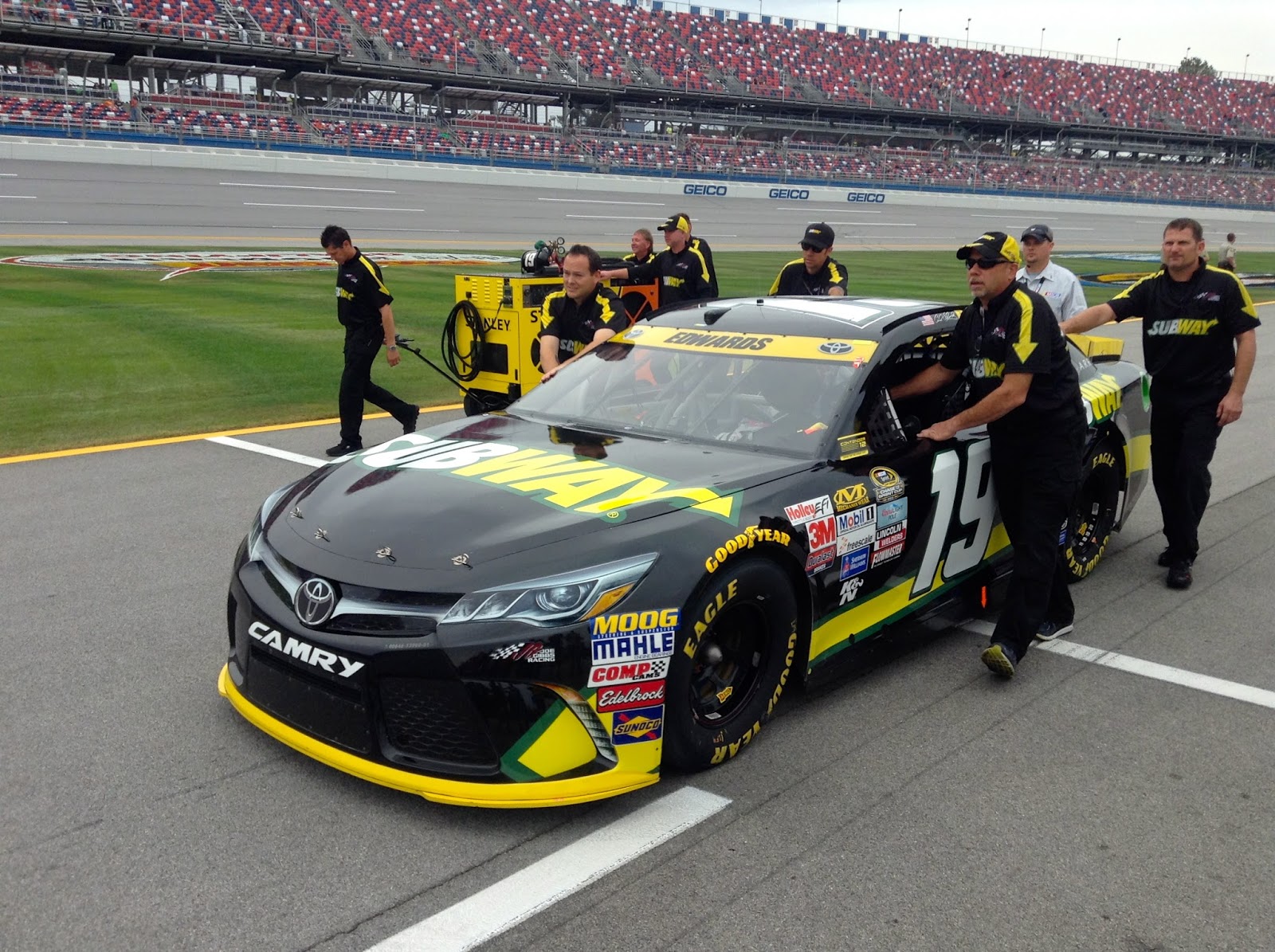
Rolling Carl Edwards' number 19 car into place for Sunday's race.
What Also Worked: Qualifying / Pit Pass

As much as I thought and think NASCAR races are a total waste of time and resources, there's a part of me that can get into watching, hearing and smelling a car hurtling around a track at almost 200 miles per hour. I mean I am a guy after all and I do own a sports car. I know there's something deep inside me that feels a small thrill when I feel the power in my 350Z as soon as I press down on the accelerator. And the vehicles we watched racing in Alabama have a lot more of that horsepower than my car does.

For me, the most valuable way to experience the power underneath the hoods of these cars ended up being during qualifying just after the super disappointing green-white-checker finish in the truck race. Qualifying is a pretty simple concept: each car takes two laps of the track and the car with the fastest second lap time gets the first spot in the race, or the pole position. The rest of the field stacks up behind the pole sitter in order of second through 43rd lap time.

The first lap average speed for the cars was about 150 miles per hour; the second lap was much faster, topping out at just over 190. There is something thrilling about watching a car drive solo around a wide open banked racetrack at a very high rate of speed that is very different to me than watching a whole group of cars all bunched up together in a pack doing the same thing collectively. The time for a 2-2/3 mile long lap by the way is less than 60 seconds. Wow! I'd sit through qualifying a lot if I lived near a track. But I'd probably skip most of the races.

Pit boxes in their pre-assembled form...
If you want to get a closer look at these machines, you can spend some time (and $50) a few feet from them if you invest in a pit pass, which allows you access to Pit Road prior to the Sunday race. And you can bet if I'm spending a bunch of money to get down to Alabama and rent an RV for a weekend, I'm forking over an additional $50 for a pit pass. After all, I spent over $100 just on shirts to make me seem like a credible race fan for this trip. No way was I missing out on this experience. Even though I expected it would be a total waste of money. And like my expectations for an exciting race finish, I was wrong again. It was so worth it. Those were words I never thought I'd write.

If watching the cars race around the track from a distance in qualifying was awe inspiring, seeing them up close doing absolutely nothing was equally enlightening. On the outside, these things are precisely engineered works of art. There are small fins, spoilers and other sorts of clear plastic attachments all of which (I'm sure) are designed to minimize air resistance and maximize performance. On the inside, they are pretty much completely empty. There are of course no dashboards with things like CD players and GPSes (I mean why would you need it to turn left 564 times?) but there are also no back seats, no passenger seats and no speedometers. I knew some but not all of this before I set foot on pit road but it was still pretty cool to look inside the cars. They are literally just built to go as fast as possible around an oval-ish track. That's it.

The other part of the pit experience that was fascinating to me was the opening and construction of the pit boxes. During the race, each team has an assembly to the left (as the car travels) of their pit area with a raised platform for the crew chief to coordinate race activities for their driver, including communications, repairs and strategy. On the platform with the crew chief are a series of monitors, satellite receivers and some chairs among other things; below the platform is a box which holds all the tools the crews need to repair vehicles during pit stops.

I assumed these assemblies were delivered to these spots in their race ready form but that's not true at all. Each crew's area starts out as an approximately four foot by eight foot by six foot high box and everything that goes into making the assembly for the race is inside this box. And by that I mean everything. The platform and canopy that sits on top of the box, the monitors, the antennas, tools, ladders, American flags and lots and lots of advertisements. It was like a super complicated puzzle packed into a little container. I guess doing it this way is easier to transport but it was for sure a ton of work to put these things together.


and now fully assembled.
What Really Didn't Work: The Flag

The flag I'm talking about here (which I will not post a picture of) is the red one with the blue diagonal cross with a bunch of stars, otherwise known as the Confederate flag that the seceding states adopted as their national banner during the Civil War. Now in case we need reminding (and please don't debate this without thinking about this thoroughly), the war between the states in the 1860s was purely about slavery, which is of course about one group of people (rich white men) owning another group of people (black men, women and children) as property to be bought, sold, worked, killed or whatever else they chose to do. It's a disgusting and hateful concept.

NASCAR is a sport rooted deeply in the south and southern culture which is of course precisely why I wanted to watch a race in Alabama. Earlier this year, NASCAR to its credit banned the Stars and Bars at all of its racetracks. But understanding there's only so much enforcement that can go on in a property in the south that covers many many acres, I expected to see one or two of these flags here and there. But I'd like to throw out some thoughts for the owner of the flag which had "Heritage Not Hate" written on it which I saw on my way to the shower at the track each morning.

I get that people are proud of being southern. There's something powerful about identifying yourself with a local region of the country; we see people everywhere who do that, whether they are from the west coast or the midwest or California or Boston or New York or Hawaii or anywhere else. The United States is an incredibly diverse nation in many ways and each part of it is worth celebrating. But picking a flag invented by a group of rich white men committed to preserving slavery is probably not the way to celebrate your culture and heritage. I don't think slavery is what the modern south is about, but to some people, that flag will justifiably never mean anything else. I just wish there was some other way that person could express their southern pride. That's probably enough said on this subject for this little post about my vacation.


In October 2015, I watched my second NASCAR race in person. It was way different and way better than my first race in Dover, Delaware in 2002. I still spent four hours or so with a bunch of race crazed drunk 20s to 50s white men sitting outside in the stands but it took a lot less time to get on the road than the four hours it took at Dover, mostly because we were able to leave the next morning. Our time at Talladega lasted from Thursday afternoon to Monday morning and it was not a completely forgettable experience.

I'm glad I went down south to watch this race and to spend time with good friends for a few nights in an RV. But just like I resolved in 2002, I swear I'll never go back to another NASCAR race again. We'll see how strong my commitment to that statement is this time. If I make it just 13 years without going, I'll live with that. But if I ever do get convinced to make it to another one of these things, I'm renting an RV and I'm buying a pit pass. And no way am I missing the qualifying. And I'm bring these guys below with me. Onward!

Thursday, August 1, 2013

Not A Cars Guy


By my own admission, I am not a cars guy. In fact, I am nowhere close to thinking about becoming a cars guy. I don't like dealing with them, I hate when things go wrong, I don't understand how they work and I don't follow what's going on in the automotive world. I can put a key in a car and make it go and that's about it. So it's understandable that one of the vacation stops I was looking forward to the least on my recent trip to Munich was the BMW Museum. My dragging my ass out to the Museum and the adjacent BMW Welt (essentially a massive showroom of BMW and Mini cars) was purely for my friend Bryan's benefit.

Having admitted I am not a cars guy, I will say that every so often a car comes along that I absolutely love. When I say that please understand my love of cars is based strictly on the design of the car. It has nothing to do with the performance, efficiency, importance, power or anything else. So throughout the years I've been driving, I have gravitated towards cars whose designs I love: the old Honda CRX (had two but never got the yellow one I coveted), the new Volkswagen Beetle (got a yellow one of those) and my current blue Nissan 350Z (not giving that up for a while). Other than those four cars, the only other car I considered mine was our family's old 1979 Buick Century station wagon with fake wood siding. I loved the power and mass of that car but little else.


I know Bryan loves his BMW. I am not positive, but the day he got that car may have been one of the happiest of his life. I have never liked BMWs. They all look like boring sedans to me and I can't tell one from the other. 3 Series, 5 Series or whatever...I just don't get the appeal. We sat in some BMWs in the BMW Welt that retail for over 100,000 Euros. Totally not worth it. But on my way through the BMW Museum, I actually found another car that I love and it is (or was) a BMW.

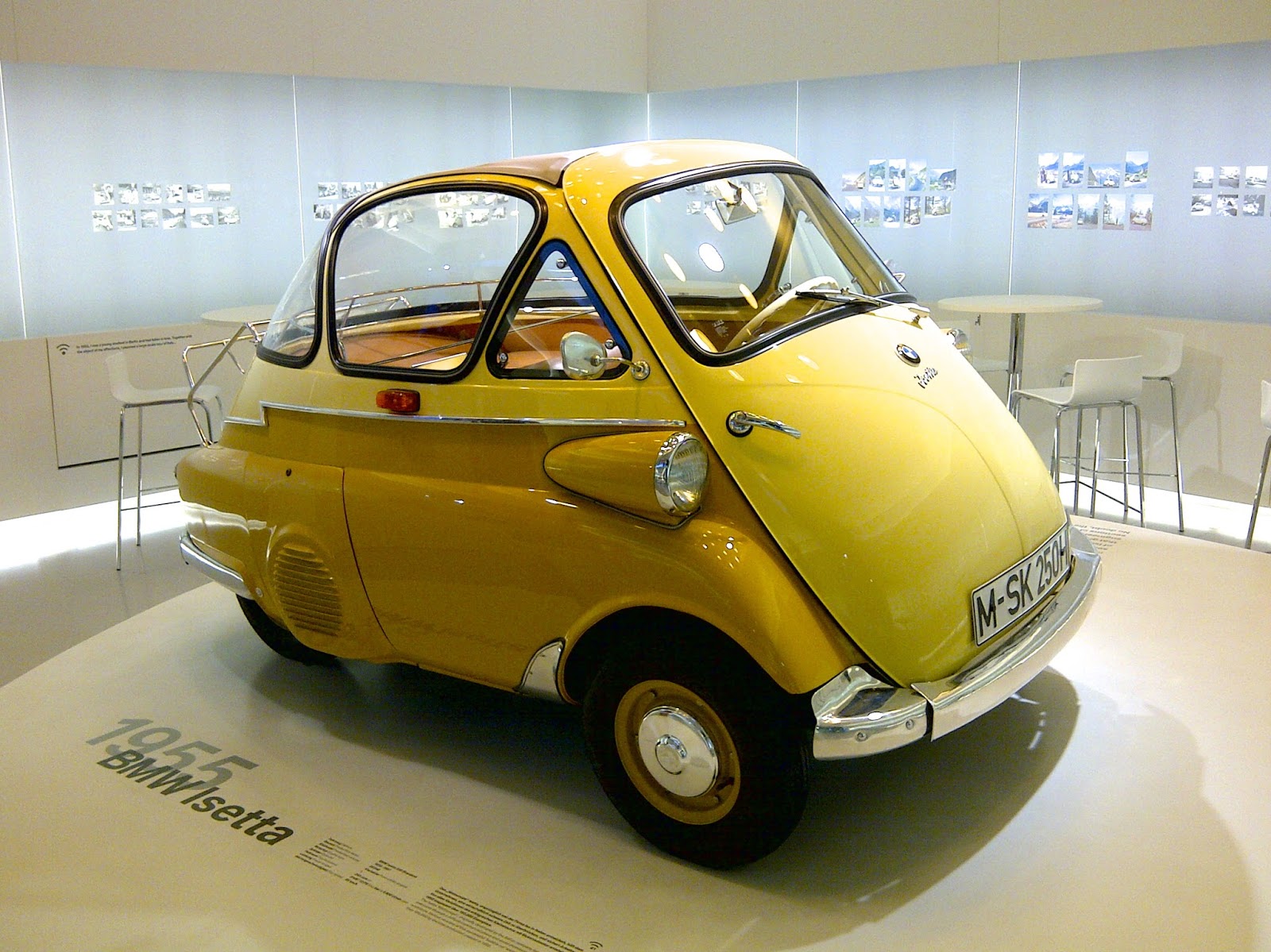
The BMW Isetta, also known as the "bubble car" was produced from 1955 to 1962. It is the world's top selling 1-cylinder car, with almost 162,000 units sold. The car was designed by a company in Italy that manufactured refrigerators, scooters and three wheeled trucks and licensed them for production in several countries, but BMW was the company that really made the car stick in Europe. There are photos all around the car in the Museum of families (or should I say couples?) with their Isettas.

The car is a two seater, just like my 350Z, but it is totally unlike my car in every other way. The two seats are actually a combined bench seat with a shelf behind for storage (so no trunk space at all really). There is one door to the car which is the entire front panel of the car. There is a handle on the passenger side of the front panel of the car used to open the door, which includes the steering wheel and instrument panel. We were fortunate enough to be hanging around the model in the Museum when a guided tour passed by (guides are apparently allowed to open the cars on display) and we managed to shoot the picture below.


This car is pure 1950s to me, which is probably why I love it so much. It looks like what someone in that decade may have thought of as a futuristic car, just like the Jetsons' vehicles and some of the furniture designed in that period. The shape of the car is about as un-aerodynamic as you can get and it looks like you practically have to wind it up to get it to go. I love the externally mounted headlights and especially the chromed accents, from the wire exterior luggage rack to the lightning bolt accent on the side of the car.

I love how life brings the most unexpected surprises sometimes. I realize the discovery of this quirky little car is not going to change my life, but somehow it makes me happier. In the four weeks since I returned home from Germany, I've checked ebay for Isettas and there are actually some on the market. If only I had an extra parking spot... Maybe it's time to move.