Showing posts with label Puffins. Show all posts

Saturday, July 18, 2026

Blackbird Singing In The Dead Of Night


Photo post time!

Before our late May trip to the United Kingdom, we'd taken just two very short trips in 2026: a long weekend in northern Arizona and a work-from-hotel most-of-a-week in New Orleans. For each of those trips, I pre-blogged an introduction to what I planned to be two incredible, multi-site birdwatching experiences. I was thinking roadrunners, condors and evening grosbeaks in Arizona and painted buntings, roseate spoonbills and pelicans in New Orleans. I even started one of those two posts with a question if every trip from now on needed a birdwatching post.

They didn't happen. Don't get me wrong, we birdwatched on both trips. But for whatever reason (and truth be told one of the reasons was that the main trail in Bayou Sauvage National Wildlife Refuge in New Orleans was closed), we didn't have an incredible birding experience in either spot. So no birdwatching post in Arizona and no birdwatching post in New Orleans. Nature doesn't always cooperate.

That had to change in England and Wales. No way was i going birdwatching away from home on three straight trips without having a treasure trove of bird pictures that I could no way, no how get at home. So I adopted a strategy that I thought could not fail: go birdwatching a lot. Like seven birdwatching excursions in a 16 night trip. It worked!!!

Rose-ringed parakeet, near Wormwood Scrubs, London.
Taking time out of a trip to go birdwatching seven times in a single vacation may seem like a lot, but most of these were either early morning walks or nice-to-haves on our agenda. Meaning we would squeeze them in if we could on an already packed day's schedule. Clearly we did some squeezing, although we had to swap out a couple of spots that were more local to our hotel and likely less productive overall. You can't always get what you want, right? 

Having said that, among the days "climbing" mountains, exploring castles, walking sheep and navigating canals in Wales, we did plan one full day dedicated to birdwatching on Skomer Island. This was our intentional birdwatching splurge on this trip requiring a two hour drive each way (including a "required" 30 minute early arrival time) and a boat trip from the mainland to the island itself. 

Let's start our birdwatching narrative with Skomer.

So what's so great about Skomer? Puffins are what's so great about Skomer. Like 52,000 plus puffins. And yes, I know we've been puffin watching in both Maine (not great) and Scotland (awesome!) in 2021 and 2022 but we can't resist a day seeing puffins. There's no way you can take a bad picture of a puffin. It's just not possible. These birds are so tame. They have no fear whatsoever of humans so it's not unusual to have a puffin land inches from where you are standing and head to their burrows. Or even just stand around right next to you. It is a super, super intimate experience. It took us walking like more than half of Skomer island (the perimeter loop on the island is about 6 kilometers) to find the right spots, but once you get there, it's completely worth it.

Skomer, by the way, is a commitment. You get dropped off in the morning and your return boat is five hours later. So don't get bored after about an hour because you are not coming back to the mainland for a while. There's also no food and limited water and bathrooms on the island. Be prepared with Tesco meal deals or whatever else you need to keep yourself going.


Puffins. No bad pictures. It's not possible. I'm telling you. 
Puffin-wise, I'd put Skomer below Lunga Island in Scotland that we visited in 2022. The puffin population on Lunga, while smaller by far, was more concentrated in a single spot which meant you never missed an awesome opportunity. On Skomer, things were a lot more spread out. More puffins total but over a much bigger area. We were also about three or four weeks later on in the year at Lunga when there was far more puffling-feeding going on and meant puffins flying back from the sea with mouthfuls of sea eels. Not so much of that at Skomer. Still, by the few pictures above, clearly we found some good looks at puffins. 

Where there are puffins on an island, there are inevitablly guillemots (what in the United States we call common murre) and razorbills and for sure there were plenty of those on Skomer as there were on Lunga four years ago. But Skomer's much bigger size and geographical diversity separated itself from our time on Lunga in one significant way: more total bird species. We found a treasure trove of other birds on the island, including sedge warblers, northern wheatears, meadow pipits and a white wagtail, along with a pile of various gull species. 

There are also about 350,000 breeding pairs (not a typo) of manx shearwaters on ths island. That's more than half the worldwide population of manx shearwaters on a single island off the coast of Wales. So did we see a ton of these birds? No, we did not. In fact, we didn't a see a single live manx shearwater during our time on the island because they are nocturnal and live underground. The island is riddled with burrows requiring a strict stay-on-the-path rule on the island, lest we end up crushing a manx shearwater burrow so we felt their presence because it governed where we could go. No winging it and walking wherever we wanted on Skomer. And unfortunately, we did see a number of dead shearwaters on the island.

Trips like the one we took to Skomer may seem like a slam dunk in terms of birdwatching but we actually got super lucky here. We were told on the boat that this was the only day that whole week that passage to Skomer was even possible. 


Skomer birds (top to bottom): razorbills, sedge warbler, meadow pipit, northern wheatear and white wagtail.
OK, so that takes care of Skomer. What else stood out? I'd say Teifi Marshes Nature Reserve about 25 minutes south of Aberaeron (a good there-and-back early morning trip before breakfast was over at our hotel) in Wales and Hyde Park smack dab in the middle of London. We had not great (meaning Welsh on-and-off rain) weather at Teifi Marshes but the place is set up for success, with a number of excellently placed bird blinds and a good mix between wetlands and non-wetlands environments. We were also effectively alone, seeing (if I'm remembering correctly), just two other people in our time there. Hyde Park was totally different. We had awesome weather on that London morning but we also had a lot of company in tourists and joggers everywhere. Hyde Park, though, is stocked full of interesting birds.

I will say that a lot of the value we got out of both places (and other spots we visited) was in birds that are foreign to us but possibly very common to people who live in England and Wales. At both places we geeked out over blue tits, a bird I know as not in any way rare from my time growing up in England in the 1970s. But we don't have them in the United States and they are gorgeous little blue and yellow birds which are a treat to see. We spent a lot of time tracking them in Teifi Marshes and went way off the beaten path in Hyde Park when we sleuthed out a nest in a cavity of a tree. 

I have a feeling that if I lived in central Wales, I could go back to Teifi Marshes a lot. I feel we just scratched the surface of that spot. We saw some birds (like coots and mallards) that we can see locally here in the United States but I think spending some time in those blinds might reveal more than what we saw before breakfast on the day we visited. There were also a lot of trails that we left unexplored and we were there for over an hour.


Teifi Marshes birds (top to bottom): moorhen, grey heron and bullfinch.
I used to be amazed at the kinds of birds you can find in the centers of cities but not any more. We went birdwatching a few years ago in New York's Central Park and found a surprising amount of birdlife. London's Hyde Park was a similar experience. I guess birds have to live somewhere and while most cities have trees sprinkled all over street corners and small squares and parks dotted all over the urban landscape, really large city parks have a tendency to attract multiple species of birds, especially when there are water features. 

Hyde Park was maybe a 10 minute walk from our London hotel to the edge of the Park and entering the Park didn't immediately get us a lot of birds. But our experience definitely improved when we got to the water. Our walk from the north side to the main portion of The Serpentine (which is the largest body of water by far in the Park) in the south made us start to question our decision to visit the Park. But as soon as we hit the water, we saw ducks, swans, plenty of coots and some great crested grebes, a gorgeous waterbird that we haven't really seen many of up close before. It's a treat to find these in an urban environment on vacation (we also found some later in the week in Cardiff's also urban Bute Park).

But Hyde Park kept going and kept revealing more and more birds, including rose-ringed parakeets that are not native but are now definitely resident all over London parks these days. We saw a few elsewhere in London on this trip (picture above) and spent some time looking at them in St. James's Park on our trip to England in 2024.


Hyde Park birds (top to bottom): marsh warbler, grey wagtail, great crested grebe and blue tit.
If these three spots were the stars of our trip, there was a great supporting cast. Wormwood Scrubs in London. Cardiff Bay Wetlands Reserve. Bute Park in Cardiff. RSPB Conwy. We visited all with camera, binoculars and the Merlin app in hand. The quality and quantity of bird sightings at each place varied significantly. We definitely visited at least one at the wrong time of the day but if I know anything about visiting any place wild to see wildlife, it's that a place that seems empty on one day can be the best place you have ever been the next. 

If there was a disappointment in our birdwatching in England and Wales, it was the almost complete lack of birds of prey in our birdwatching trips and the lack of kingfishers, particularly considering how much time we spent next to water. On the raptor side of things, we did manage a look at an eastern buzzard while walking our sheep and we saw plenty of red kites in the skies all over Wales but only when we were driving around the various back roads from one place to the next. On the kingfisher sightings (or lack thereof), Merlin heard one at Teifi Marshes and we may have seen a flash of common kingfisher orange and blue in Cardiff. But those common kingfishers were certainly not common for us.

I won't blow-by-blow the complete bird list we came home with from the UK. But bear with me for three small stories that meant something. 


There are species of birds in the United States and elsewhere in the world that share the same name but which look significantly different than they do in the United States. I guess these three quick stories have that issue in common. 

If there's a signature English backyard bird for me, it's the European robin. It's a small sparrow-ish sized bird with an orange-red patch extending from its face to halfway down its breast. Here in the U.S. our American robins are larger with the orange-red color extending over its entire breast but not up to the face. Robins in England are cuter. They just are. But despite my childhood memories of them, they were not super common in the spots we visited.

But we found one in our time at RSPB Conwy that was utterly unconcerned with our presence and decided to hang out on some branches which were about mid-thigh height for me. We got to within less than six feet of this bird and it would not leave where it was sitting which allowed us to get a signature look at the bird I associate most with England (although admittedly, we were in Wales). These five minute or so looks like this that you get every so very rarely are always super intimate experiences. This one was no exception. It was like watching a puffin.


Next bird named similarly on both sides of the Atlantic Ocean? The goldfinch. We have goldfinches in the United States. They are very, very yellow with black on their wings and head. They are without question gold. European goldfinches look like the picture above. We'd never seen one before this trip. We were a bit astonished at the lack of gold.

For our last intentional birdwatching outing of this trip, we visited Cardiff Bay Wetland Reserve. The weather was terrible. It started out OK but it ended up pouring rain for about 20 minutes and we got soaked. The birdwatching was difficult. The wind before the rain clearly was making birds take cover for the coming rains and at one point I told Sophia that I'd be happy just getting a good picture of a goldfinch out of this trip. Nothing else. Just a goldfinch. And Boom! One landed in a tree right in front of us during a break in the weather when it was sort of sunny. Perfect picture pretty much. So fortunate but so much of photographing wildlife is being in the right place at the exact right time. We were.

I still don't get the gold thing. This is an attractive, interesting bird. I love the deep, deep red on the face and I love the flash of gold on the wing. But goldfinch? I don't know. Not what I would have named it. I assume it was named that before people who named all the birds of the world found the American goldfinch.


Birdwatching often comes with a soundtrack. If there was one bird which was sort of the universal background music for all our time in Wales and England (and not just when we were birding) it was the blackbird. Like robins and goldfinches, we also have blackbirds in the United States but ours locally are either red-winged backbirds (tons in the wetlands and swamps) or rusty blackbirds (which are just not that common). They do not live near our house.

If we heard tweeting in the United Kingdom, almost guaranteed (with a bit of an apology to the wrens in London) it was a blackbird. I just heard a bird! Blackbird. What was that song? Blackbird. That birdsong was really loud and clear! Blackbird.

Because they were so common, I didn't really focus on taking pictures of them until the very last day when I thought that I should have something to remember all the serenading they had done for us for the two weeks we were in country. The above picture is the best I got on our very, very last birdwatching excursion in Cardiff's Bute Park. I'm sure I could have done better if I had tried harder earlier in the week. Blackbirds made part of our experience in England and Wales. Including a picture is super appropriate in this post.

That wraps our England and Wales birdwatching story. I'm not sure we are going to get much in the way of blogworthy birding experiences in our last two significant trips of 2026 and the weather in the D.C. area for at least the next month or two is going to make it rough getting out to see birds for the rest of the summer. But rest assured we will keep going. As I finish writing this post I can hear one of the pair of catbirds that have nested in one of our trees in the back yard just furiously cheeping away. I never knew catbirds were such whistlers until we had a pair living right next to our house. Wildlife continues to reveal surprises which is why we will likely continue to chase it until we are no longer able. That day is hopefully a long, long way away.

Wednesday, August 3, 2022

Lunga

One of the things we realized pretty early about Scotland when we were researching itinerary ideas was that this country seemed to offer some amazing opportunities to go seabird spotting. And I don't mean like one or two birds at a time. I mean hundreds or thousands at a time. Our trip planning had established a rough agenda of about a week in Glasgow, Inverness and Edinburgh and the other week in the Hebrides, the islands off the west coast of Scotland. For our island time, we picked Lewis (for the Standing Stones of Callanish) and Islay (for whisky) but we needed a third. We decided we should emphasize seabirds for our final island.

Enter the Isle of Mull, an island at the bottom of the Hebrides a little bit south of the Isle of Skye. I mention Skye not because it's a marker that I expect everyone to know, but because it's likely the most popular island for tourists to visit in the Hebrides, probably because you can just drive across a bridge to get there and don't have to take a ferry. 

Skye was, in fact, our original choice for a third island in the Hebrides. But when we started looking closer at our Scotland guidebook, Mull seemed like it was too good to pass up. I have no idea whether Skye is wonderful and if we missed out on something better than Mull, but Mull was the best place we went on this trip in my opinion. It was wild. It was remote. There were sheep seemingly everywhere. The roads were maddening because most of them were two-way and one-lane at the same time. Tobermory was the perfect village to stay in with some great places to eat and drink. It was absolutely a gorgeous place to be. I can see people falling in love with a place like that.

Off the coast of Mull there's an island called Lunga. And it's about the easiest and most ideal seabirding destination you could imagine. And they have tons of nesting puffins. But only in summer. Come late August these birds will be out at sea on their own until next May or June. We were there in June. Let's go!!


I don't know quite what it is that makes me keep pursuing the same things on vacation again and again. Maybe it's a quest to get an experience just perfect. Maybe I just have a narrow range of interests (not sure that's right) or I just like what I like and lots of it (that's probably closer to the truth). Who knows? But I do tend to do it a lot. Last year we went to Maine and saw our first wild puffins. It was awesome but it was fleeting. It honestly wasn't a great opportunity to watch and take pictures at the same time. Pick one or the other. On Lunga, we'd have a chance to correct that experience and move closer to that perfect puffin encounter. And more.

I believe you can get a boat to Lunga from a number of spots on Mull. You certainly can catch one from both Tobermory (where we were staying) and Fionnphort (where we caught our boat). The trip there is about a 45 minute boat ride from either location, so not too bad a ride once you get on board. I think our decision to depart from Fionnphort was well intentioned (we wanted to spend some time on Iona after our trip to Lunga and the boat stopped there) but that drive to the boat was an adventure. It's all of 48 miles but the road requires rapt concentration every second of the ride (which is almost two hours long, by the way). The scenery was just gorgeous and I can't believe someone actually built a road (one-lane, two-way of course) in some spots on that drive but it is not for the faint of heart. Not regretting our decision, exactly, but it would have been much quicker from Tobermory.

So an almost two hour drive; 15 minutes or so to walk to the dock and climb on board; a little wait for absolutely everyone who signed up for the trip (why are people late to these things...); 45 minutes or so on the water followed by a pretty cool docking with a floating gangway (who knew these things existed?) that the boat pushed to the shore to allow us to disembark; and we were on Lunga. For two hours and 40 minutes. That sounded like a long time. 

It flew. But it was also a really good amount of time. Sort of the sweet spot, I think. Just right. On our own for almost three hours with a ton of seabirds, most of whom are puffins. Cool.


Our docked boat. And the (main) object of our search.
The quest for puffins (and other birds, I guess...) on Lunga starts with an uphill climb. I mean our landing point on the island was pretty much at sea level (where else would it be?) and puffins nest in burrows on top of cliffs. So the first task after getting onto land was to climb up to the top of the cliffs where the puffins are. What else would we do?

So of course, there's a rush, right? Everyone wants to be the first one to the top, as if all the puffins were going to fly away and never come back or as if there might not be enough puffins for all the people on the boat (and other boats, keep in mind...) to see and we'd end up stuck with a guillemot or something. There's excitement and there's a little bit of desperate near-panic. It's exhilarating. It's frenzied. It's like Christmas morning as a kid. And all of that I guess sometimes causes the first one to the top of the hill, which happened to be me, to miss the point entirely. Which I did. When I got to the top of the first cliffs, I kept going up (because I could) rather than making a beeline for the cliffs where the birds are.

It didn't matter. We had more than 2-1/2 hours, after all. There was plenty of time. And it didn't take long for me to recover. Being fifth or tenth or whatever to get to the clifftops didn't really matter in the end. 

But that first puffin you see up close is magical. The one that doesn't move when you approach. You have to capture the moment. You have to get the camera out and snap, snap, snap. This moment in time you've never had before. This was nothing like Maine. It is right there on solid land and it's like two feet away. What if there are no more on the entire island? That first one. Just wow.


Of course, people don't take a 45 minute boat ride and climb up a big hill to see a single puffin, especially if it took them about two hours to drive to the boat dock. Focus off that first puffin and there's another one right close to the one that you've taken about 15 photographs of. Then another couple a few feet away. Then five or so more beyond those. And ten or a dozen or so on the next cliff. There is no shortage of puffins on Lunga. Not at all.

They literally do not move when you approach by the way. We were told by our boat crew that the puffins actually like humans walking around them because it protects them from the gulls. Apparently gulls enjoy a little puffin for lunch sometimes. Not nice to think about that but you know...nature.

So once you realize that there is plenty to see, the whole situation calms down. Breathe...these things are everywhere. There is a sort of trail that leads from one end of the island to the other. It's muddy and it's messy and it's slippery and your pants will get dirty even if you are wearing boots (trust me!). It will lead you along the edge of the cliff past nest after nest after nest up hills and down slopes clambering over rocks both ways. It also gets you looks at all sorts of puffins and other birds flying, fishing and nesting. It's a little chaotic and it's awesome.

I suppose the trail might go around the whole island. It looked like it headed up a steep hill at the opposite end of the island and continued along the island's ridge back towards our docking point. We didn't do the whole loop; we turned around at what we saw as the "other end", content with knowing there couldn't be more puffins on the other side of Lunga than the one we had just scrambled across. After all, we didn't really see any on the way past that side on the boat.


So about those other birds. Yes, there are birds on Lunga that are not puffins. I know, I know, not as cute, but they are there. We saw a good number of black and white razorbills and guillemots, both of which resemble some sort of penguin. They are decidedly NOT penguins, mostly because both species fly, but they look remarkably similar if you are not paying attention. These birds, which are about puffin-sized, both seemed to be interspersed with the puffins on the clifftops that we first climbed to. Definitely not as numerous as the puffins on the beginning part of our hike but noticeably there.

They caught up in numbers later on. At the spot we turned around and headed back to the boat, we stopped at an enormous rock on the end of Lunga that was covered in guillemots. Not exaggerating. Like thousands and thousands packed together. They looked like insects covering the ground there were so many. We'd seen images like this on nature programs before (penguin nesting sites actually come to mind here) but never in person. It's amazing that they can even find their mate amongst all the other guillemots. I mean, they all look the same. But they probably think the same thing about us.

We also passed a few shags, which I'd sort of describe as cormorants on steroids. These birds are large, way bigger than their smaller cormorant cousins who we have seen all over the world and their plumage is absolutely gorgeous. All four species we saw on Lunga (the shags, puffins, guillemots and razorbills) are all very well put together; they barely look like they have feathers at all they are so smooth. But the shags have this patterning to their feathers that almost looks like have scales rather than feathers. It's quite impressive and not something we could see very well until we got super close to these birds. There's value in getting close.

Shags were the scariest nest defenders on the island, by the way. We didn't really get near any nests while on our walk but we also didn't get any sort of warning signs from the puffins, razorbills or guillemots. Not so with shags. They seemed to nest in, amongst and below rocks and when you pass too close they stick their necks out of the holes between the rocks and sort of hiss-squawk at you with their mouths wide open, displaying what I remember as some yellow and blue sort of striping from within their mouths. Their beaks are pretty scary too. I definitely don't want to ever tangle with a shag after seeing that.


One shag, two razorbills and a whole lot of guillemots.
Our trip on Lunga ended with about 45 minutes or so of standing on those first cliffs we found that I almost sprinted by. At this point, we were determined to watch intently, rather than filling up the camera memory stick with as many images as we could pack on there before our boat picked us up again. We knew that we'd have plenty of time to just watch and observe.

The puffins obliged by behaving like puffins, taking off towards the sea by just jumping off the cliffs and spreading their wings and then returning and landing so clumsily with a mouthful of shiny silver sand eels, either on the land and then shuffling quickly towards their burrow or just diving right into the burrow itself in a way that seemed more graceful that puffins could handle. It was a constant conveyor belt of food delivery to their chicks (or pufflings...not kidding, that's their name). We never saw the pufflings, by the way. Apparently the chicks are so vulnerable to predators that they don't come out during the day. They learn to fly at night until one day they just take off and never come back. Until they need to start raising pufflings of their own.

I spent my time on this portion of our landing trying to get pictures of puffins doing something other than just standing around. I had an informal goal for the day to get some good pictures of a puffin or two with some sand eels dangling from their mouths and I think I accomplished that goal. I also wanted to capture puffins in flight and landing. Not so successful there but I think overall we got some great looks and some great pictures.

I came to the Isle of Mull in Scotland looking for the perfect puffin encounter. I can't believe it could get much better than this. Maybe more time? I don't know. I think being in a spot for almost three hours with unfettered access to these birds is pretty much perfect as far as I'm concerned. At the risk of posting too many pictures of puffins in this post, I'm emptying the rest of my favorites album from this day and displaying them all below. The last puffin picture below was taken from about two feet away. You really can get that close!


Yeah, I think we probably had our perfect puffin day.

But there is one more story to tell. When the boat drops you off, you are standing on a narrow portion of the island pointed towards a cliff. On that cliff is a large painted white arrow. It's where you are supposed to go to see the puffins (and other birds). Just follow the arrow is what we were told by the crew on our boat before we landed.

Now, some people didn't seem to get the message because as soon as they set foot on Lunga, they started spreading out on the island walking towards the water, which is decidedly NOT where the puffins are. We got the message from the crew and took off straight for the arrow. And while I may have made it to the top of the cliff first, my wife, wearing her green wool hat that we picked up at the Cliffs of Moher in Ireland a few years ago, was definitely setting the pace towards the cliff early on. 

But other travelers on our boat couldn't figure it out. Maybe it was a language thing or something. Ultimately it got so bad that we heard an annoucement from the boat's speaker system: "Follow the lady in the green hat!" 

Good advice. I intend to do that for a very long time. As long as she'll let me, anyway.

Puffins done! Now about those flamingos and penguins...

Follow the lady in the green hat (lady in green hat not pictured).


How We Did It

There are at least two tour companies (and probably more) that run day trips to Lunga from the Isle of Mull. We picked Staffa Tours because they had an early morning cruise and because they departed from Fionnphort, which would give us a chance to stop at the Isle of Iona on the way back. Our tour took us to both Lunga, where we saw puffins, and Staffa, where we stopped at Fingal's Cave, a rock formation formed of hexagonal basalt columns which is supposed to be the other end of the mythical Giant's Causeway. We spent part of a day at the Causeway in Northern Ireland a few years ago.

I can't say anything but good things about Staffa Tours. There was plenty of time to do everything we needed to do on both our stops on Lunga and Staffa and the boat ride was great. Couldn't ask for anything more. I'd highly recommend taking a tour with them.

Unfortunately in 2022, avian flu has decimated bird populations on islands around Britain in what has become a bit of an epidemic. Lunga, it seems, is no exception, because tours are suspended on the island for the rest of the summer as of this writing. I guess we got super lucky here. A few more weeks and we'd have missed this experience entirely. I've lamented our misses with various types of wildlife several times on this blog. I'll have to remember this as one time we got lucky and got it right.


Tuesday, July 27, 2021

Puffins

We went to Maine this year with two missions: (1) learn about (and eat) lobsters and (2) see some puffins. Maybe if we got a little greedy we'd add in see some humpback whales breaching and feeding (that's not too much to ask, is it?) and do a little sightseeing in Acadia National Park. But lobsters and puffins were for sure must sees (and eats). Couldn't go home without checking those boxes. No way!!

To take care of all our missions (and a greed list item), we booked three cruises in our three full days in state: a lobster tour out of Bailey Island close to Portland; a puffin cruise out of Milbridge; and a whale watch boat ride out of Bar Harbor where we were staying three of our four nights. We had an awesome plan. Just perfect.

But things did not go according to plan. We found ourselves on Sunday morning (the last full day we were in Maine) having not set foot on a single boat. Lobster tour? Cancelled due to the captain recovering from surgery. Puffin cruise? Cancelled due to fog. Whale watch boat? Cancelled due to winds. Maine was shaping up to be the 2020 of our 2021 vacations. Nothing was going our way. We did manage to reschedule the lobster tour but didn't whale watch at all and were left with precious few last minute options to find puffins.

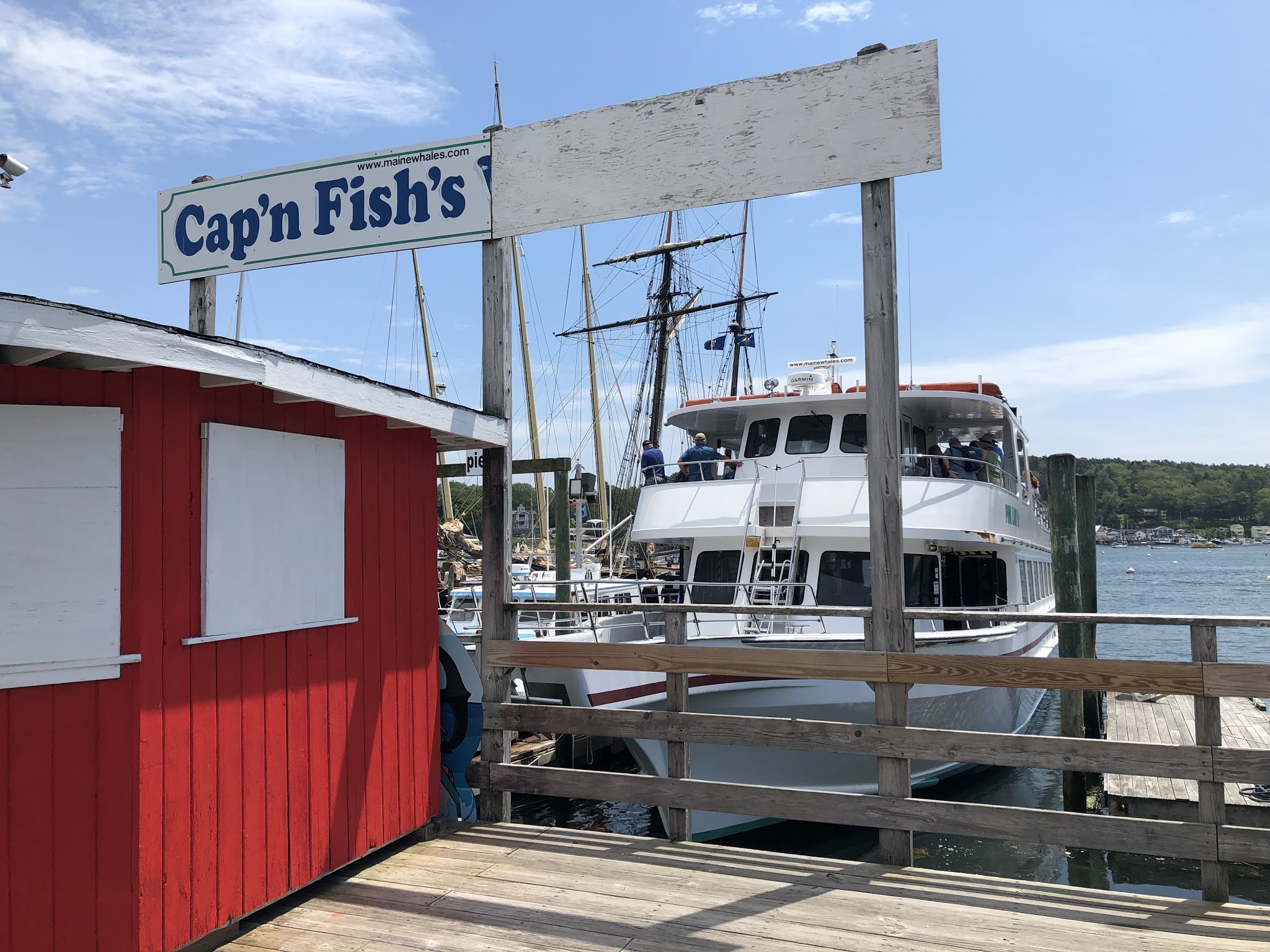
So we pivoted. We moved (for a small fee) our noonish flight out of Bangor to a 5ish flight out of Portland and we told Avis we'd be bringing the car back to PWM instead of to BGR (for another small fee) so we could squeeze in a 10 a.m. puffin cruise out of Boothbay Harbor. A 6:15 a.m. departure out of Bar Harbor got us there with an hour to spare. And at 10 in the morning on the last Monday in June, with our flight home about seven hours away, our hopes of seeing puffins on this trip rested in the hands of a tour operator called Cap'n Fish. Here went nothing. And everything.


This was not the first time puffins have eluded us on vacation. We hoped for some in Iceland in 2013 without understanding at that time that there was no way we'd see a puffin in December on land. We also missed nesting puffins (after we understood puffins only come ashore to nest and they only nest in summer) by a few weeks at the Cliffs of Moher in Ireland two years or so ago. Third time we hoped was a charm. The start didn't look too good.

Our target that Monday morning was Eastern Egg Rock, a small island (or maybe rock in the ocean is a better term) about an hour's travel by Cap'n Fish boat from Boothbay Harbor. With 60 minutes travel each way and  a 2-1/2 hour total tour time, that would give us about 30 minutes or so at the Island itself to observe hundreds upon hundreds of puffins swimming, flying, nesting and eating. Or so we hoped.

Maybe a few words about puffins is useful at this point. 

Puffins are a true pelagic bird, which means they spend most of their time at sea alone looking for food. Yep, these milk-carton-sized birds that look like footballs with wings spend nine to ten months each year on the open ocean traveling and eating without setting foot on land. The other couple of months or so (providing they are old enough), they spend mating and nesting, which pretty much has to be done on land. Which is why we went to Eastern Egg Rock in late June this year.

There are four species of puffin in the world. We went to Maine in search of some Atlantic puffins and suffice it to say for the purposes of this blog post that the Atlantic puffin is the cute one; the horned puffin is close to the Atlantic on the attractiveness scale but the tufted puffin and rhinoceros auklet just pale in comparison. There are a total of about 10 million or so Atlantic puffins in the world today. About 90% of the age-eligible puffins who mate each year do so in various spots in Europe. Most of the remaining 10% end up in Canada somewhere. But a precious few spend their nesting time on a couple of islands off the Maine shore, which is the only spot in the United States where you can spot the Atlantic puffin.

And yes, we saw some, because there are pictures right below. But there's more worth writing and reading, I feel.


Our original puffin trip was scheduled out of Milbridge, Maine about an hour east of Bar Harbor. If we had taken that trip, we'd have been on board a pretty small boat with a captain and just six passengers total. It would have been pretty intimate, which appealed to me in a number of ways. Our trip with Cap'n Fish's was on a lot bigger boat with a lot more people, which does not necessarily mean it's a less desirable experience. In fact, in rougher seas, a larger boat performs a lot better than a smaller boat and if you know where to stand (hint: THE BOW!!!!) on the larger boat, you can get some great looks at whatever you are on the boat to see.

But our Cap'n Fish boat came with an ace in the hole: an Audubon naturalist who was there to narrate our entire experience. And she told us quite a few things that we didn't know. Say hi to Emmylou, although our connection with Emmylou was purely over the boat's sound system because there was no way we were leaving the bow to check out the pictures in her bird-spotting narrative on our trip out to Eastern Egg Rock. Although I'm sure we definitely missed some things.

The most important thing we learned on this boat trip about Eastern Egg Rock was that if we had made this trip 120 years ago, we would have been traveling to a completely puffin-less island because at that point man had completely wiped them out on that rock except for one nesting pair and it's tough to sustain a future population in the wild off just a single set of parents.

Turns out that man had been interfering with the puffin population on the island for quite a long time. Man's original interference with these puffins was through the practice of stealing eggs from the puffin nests for food. As invasive as that sounds, apparently when conducted on 300 or so nests, the egging (as it was called) of Eastern Egg Rock was actually sustainable. The eggs stolen, and I guess the distance involved, did not have an adverse effect on the bird population on the island.

The death knell for this particular puffin population was the "need" for feathers (or sometimes whole stuffed birds) to adorn hats in the late 1800s and early 1900s. Puffins on Eastern Egg Rock could survive a few stolen eggs. But wholesale killing of adult birds in the name of fashion was devastating. By 1901, there was a single pair of puffins left.


Seventy years later, there were still no nesting puffins on Eastern Egg Rock.

So in the 1970s, the Audubon Society launched Project Puffin in an effort to restore nesting pairs of puffins to the island. The theory here was that since man had played such a huge role in extinguishing the birds from the island, man also needed to play a huge role in restoring them. If there was one thing that 70 plus years of no nesting puffins proved, it was that nature wasn't going to just "right itself". Humans needed to be involved.

There was just one problem: puffins return to nest on the land where they were born. No hatching on Eastern Egg Rock, no adult puffins to return there because they broke through their shells elsewhere.

The solution? To put it simply...birdnapping. It was determined that pufflings (that's a baby puffin and yes, that's actually what they are called) would register their birthplace as Eastern Egg Rock if they were relocated there within the first couple of weeks of their lives. So that's just what naturalists did. Right after hatching, they swiped the pufflings from another location, brought them to Eastern Egg Rock, put them in artificial burrows (puffins nest underground) and hand fed them until they grew strong enough to leave. 

Then they waited for them to come back and nest. For five years. Because puffins don't mate until they are five. In those first years, the puffin chicks could be anywhere in the world. The world wouldn't know if the experiment worked for five years. In the meantime, they repeated the exercise four more times.


In the late 1970s, puffins hatched on Eastern Egg Rock began returning to nest. What they found there when they did was an artificial puffin colony, complete with puffin decoys (to make the returning puffins feel like it was OK to be there, I guess); mirrors (to multiple the decoy and actual puffins); and speakers projecting puffin sounds (which according to Emmylou sounds like a cross between a cow and chain saw). It worked. Today, Eastern Egg  Rock boasts about 300 nesting pairs.

By the time we got underway from Boothbay Harbor, we felt pretty optimistic about seeing puffins that day. When we parked our car, the employee who took our money made sure to tell us there was no guarantee that we would see puffins and then quickly told us he couldn't remember a trip ever NOT seeing puffins. Plus we noted the ticket booth had a disclaimer about the likelihood of not seeing whales on a whale watch but there was no such warning about not seeing puffins. Emmylou's narrative only made us more positive that we'd be successful. And sure enough, when we got close to the island, we saw dozens of puffins floating in rafts (yes, that's the term) together. Mission accomplished.

There is something completely satisfying about seeing the object of a single species quest that is indescribable in its fulfillment. I went to see bison in Yellowstone in 2011 and alligators in the Everglades in 2014 and the first encounter with each of those animals was joyous, only to be overcome with waves after waves of the same species that made the pilgrimage to those two places completely worth it. Puffins in Maine got me that same thrill, although admittedly, we could not stick around for hours and just watch the way I did with my first bison and alligator experiences.


These birds are like little dolls or porcelain versions of birds or something like that. They are absolutely completely so well put together and they look perfect when floating on the water in great numbers or standing up, usually all in a line, on the rocky shores.

But in the air, not so much. The description that I used above about footballs with wings (I copied that from multiple sources; not taking credit for that one) is so accurate. They are awkward flyers who beat their wings up to 400 times per minute and look like they need to do that to stay aloft. I can't imagine how much energy these little birds expend in their nine or ten months out on the open ocean. We watched albatrosses (another pelagic bird species) down in New Zealand glide effortlessly over the open seas; puffins seemed like the antithesis of the albatrosses we saw and completely ill-suited to months away from land.

Admittedly, puffins use their wings not just to stay airborne but also to swim. They can dive up to 200 feet below the surface of the water using their stubby wings to power their compact bodies deeper into the seas than many other species of birds. It's still difficult to imagine them out to sea for months at a time.


If it seems like we got some great looks at puffins by the pictures posted here, I agree, I think we did. Truth be told our in person viewings of the puffins were actually better and worse than the pictures posted here. And yes, we took all of them ourselves. 

We got some amazing looks at puffins on the water and in the air. More, by far, than I ever imagined we would. These things were literally everywhere. But it is extremely difficult to take good, fully focused pictures of puffins in action (meaning landing on or taking off from water or in flight) while on a boat on seas with some pretty good swells. There are many, many almost awesome pictures where the subjects were thrown to the bottom or top of the camera viewfinder by the roll of the ocean. The picture below is the most frustrating near miss. The puffins at the top of the image, victims to a dip in the ocean that cause me and the camera to drop unexpectedly, would have made an awesome picture if they were center frame.


By contrast, we were hard-pressed to see puffins with any sort of detail while they were on the land. There were some standing on a series of rocks that were visible to the naked eye pretty well on our last pass around the island but other than that, it required binoculars (which we didn't bring) or the camera with the zoom all the way out which we used to great effect in the pictures department albeit with the same limitations that being on the open ocean in four foot (or whatever they were) high swells brought. I actually had thoughts prior to setting out that I'd be able to get super detailed pictures puffins with fish dangling from their mouths. Yeah...no.

In real time, our looks through the camera were fleeting and we were unable to focus in any sort of detail on the on-shore subjects before the sea yanked the camera lens away from our viewing point. There are a lot of blurry or unfocused images of rocks and sky that show absolutely nothing. On the other hand, the furious snapping of the camera got us some pretty decent looks at what we had difficulty seeing really well with the naked eye.

The downloading of the pictures from the camera after the cruise itself gave us a chance to re-live the experience itself as we looked at what we had actually taken pictures of. I especially love the picture below because we got a puffin in mid-landing. They really are like little compact bombs ill-equipped to fly for any sort of duration when you see them like that. This is my favorite picture of the day, despite the hazy background.


We've been on our fair share of nature themed trips or parts of trips over the last eight years or so and I've been on others, just maybe not as frequently, before my 45th birthday that kicked off this blog. It is always an endeavor that might on any day bring zero results. If I needed any reminder of that fact this year, I only have to remember our cancelled whale watch trip. We didn't stand a chance of seeing humpback whales this year because we never made it out anywhere near far enough into the ocean.

We got super unlucky with the weather on this trip. The fog and the wind looked like it would cancel any chance we would have to see these funny birds we'd been chasing for a little more than seven years. But we sometimes we manage to make our own luck. I don't like paying for moving flights and returning rental cars to different locations, but the money we spent doing that was definitely worth it. It got us probably THE signature experience of this trip and definitely cost us way less money and time than it would have to come back to Maine. 

Not that I'm ruling out a return trip to Maine, but we can easily add a whale watch to a number of locations I'd like to visit. We just can't do that for puffins. We had to make this work. I'm so thrilled that we did. Definitely worth the later flight home. Box checked. And in such an amazing way.


How We Did It

What can I say about Cap'n Fish's Cruises, other than they saved our trip to Maine big time? These guys are seriously awesome, the boat is great and they don't seem overly booked up in sort of out of the way Boothbay Harbor. Things completely worked out for us with this company so I can't recommend them enough. The Audubon naturalist on board is a huge plus too. Their puffin cruise leaves from Boothbay Harbor daily at 10 a.m. The boat will circle Easter Egg Rock and give both sides of the boat an equally good chance of seeing puffins. Stand on or near the bow and you can probably switch sides each time the boat turns around and double your chances of great puffin sightings.

Parking at Cap'n Fish's parking lot was expensive: $30!!! After all the frustration we had with cancelled boat trips in our long weekend in Maine, we happily paid it to be super close to the dock. It appeared to us driving into town that there were probably other, cheaper options within walking distance of the boat. 

One of the places we had on our itinerary was the Audubon Project Puffin Visitor Center in Rockland, Maine. It seemed like the perfect companion stop to our Cap'n Fish cruise. Unfortunately, they were closed during our time in Maine. But it sounds like they would be worth checking out. 

Finally, when you are in Boothbay Harbor, I'd recommend lunch immediately following your puffin cruise at the Blue Moon Cafe. Their website says they have the "best view in town" and I couldn't agree more. Their deck overlooks the harbor which is just picture perfect gorgeous. Sit outside and head there right after the cruise docks. We did that and watched a bunch of other people pile into the restaurant after we'd ordered and we'd already snagged a prime spot on the deck.