Showing posts with label Acropolis. Show all posts

Saturday, October 12, 2024

The Acropolis Marbles


This post is about one room in a museum. I promise it's not that simplistic. Let's get right to it...

Actually...let me say one more thing first. 

I debated using an apostrophe after the word "Acropolis" in the title of this post. I think it's correct but ultimately, I think it looks better without. I do, however, think that there should be an apostrophe. Sometimes you can't have it all. It's not the first time I've bent the rules of grammar or punctuation based on how I think things should look. Oxford comma. That's all I really need to say on that subject. NOW, let's get right to it...

Last fall we visited Greece. Or maybe more accurately, last fall we visited Athens. As an architect, a trip to Athens was a long time coming for one reason and one reason alone: the Acropolis, the hilltop site in the center of the city which includes the most perfect Greek Doric temple of all time, the Parthenon. Look, the Greeks pretty much invented architecture. Finally laying eyes on one of their masterpieces (if not THE masterpiece) was super exciting.

Our whole experience at the Acropolis was incredible. I mean it really was as impressive as I'd been promised for decades. Our understanding and appreciation of the 2,500 or so year old temples on top of the hill was only enhanced by our visit to the Acropolis Museum right after we descended back down to Athens proper. But our visit to this site wasn't really complete, and that's because a good portion of the sculpture and carvings that used to be on the Parthenon are neither on the building itself nor are they in the Acropolis Museum. 

Now, this is not some huge mystery regarding what happened to them. It's not like they are lost or locked away somewhere. Everyone knows where they are. They are in the British Museum in the middle of London. So after visiting Greece and not seeing them there where they started out, and this year finding ourselves in England and more specifically London, we couldn't not go see these things and make last fall's trip to Greece more complete. 

Make sense? It made perfect sense to us.


Let's address the most obvious question about what I've written so far, shall I? Why is a part of the Parthenon in London and not in Athens where the rest of the mostly intact ancient temple is? It's a simple question, right? Maybe there's a simple answer. And I think there is. The simple answer is that they were removed from their original location by Thomas Bruce, the 7th Earl of Elgin, in the early 1800s. The truth, from at least one side of the table, would be argued as more nuanced than I've just described. So, not being one to mince words (or facts, in this case) let's just dig into that whole history for a minute.

Greece has not existed continuously as a country (or even as a collection of truly independent city-states) since the time of the Parthenon. It's evolved or devolved from a relatively successful series of independent cities to quite a bit less than that before pulling things together and establishing an independent nation. In between the Parthenon times and now (and like most places on this planet of ours) parts of modern day Greece at one time were under foreign control. In the early 1800s when this part of the story takes please, the city of Athens happened to be part of the Ottoman Empire. 

Now two plus centuries ago, much like today, nations appointed ambassadors to other nations to provide a personal touch in maintaining diplomatic relations. In the year 1800, the British ambassador to the Ottoman Empire was one Thomas Bruce, 7th Earl of Elgin. And I guess this appointment caused Bruce (I'm going to switch back and forth between Bruce and Elgin in this post when referring to the man) to turn his attention to the carvings that once adorned (or still did adorn in some cases) the Parthenon on the northern side of Athens' Acropolis. He decided he would use part of his time in his new post having some folks under his employment make some plaster casts and drawings of the remaining sculpture still hanging around the site. For posterity, I'd imagine.

Elgin approached the British government to see if they'd like to cover the cost of his idea and the answer was apparently a hard no. So he decided to do it himself. He hired himself a crew and they started working. To make a long story short and I'm sure I'm skipping a ton of details, at some point, this effort switched from making plaster casts and drawings to just removing the items from Athens entirely and bringing them to London where they just became the property of Lord Elgin. I know, I know, I skipped a lot of the story.

For his part, Elgin claimed to have the permission of the Ottoman Empire to abscond with some of their treasures and even produced a signed document from the Ottomans endorsing the removal. Apparently, the Ottoman Empire have never publicly confirmed the legitimacy of the document but Bruce had his story. 


The treasures of the Parthenon are not, today, in the possession of the descendants of Lord Elgin. They are (as I've already mentioned) in the British Museum. How did the British museum get them? Well...they bought them in August of 1816 for tidy sum of £35,000. 

Isn't it kind of sketchy for the British government to purchase some artwork that clearly originated at the site of another nation's national treasures and that were removed under some circumstances that appeared to be less than wholly legitimate? Apparently, the answer to that question was "yes" and to avoid the appearance of impropriety, in February 1816, the House of Commons conducted an investigation into whether the pieces of the Parthenon were removed legally or not. Today, there are questions about the document Elgin claimed was issued to him by the Turks and (assuming that document was genuine) whether removal of sculptures and carvings from the site are covered by that document. But in early 1816, apparently it was good enough for the House of Commons. Purchase approved! 

Today, all of the treasures gathered by Elgin sit in a special room on the west side of the British Museum. The room is dumbbell shaped and you enter the room at the center of the "handle" and are greeted by a carved sign that reads "These galleries designed to contain the Parthenon sculptures were given by Lord Duveen of Millbank 1939", although 1939 is written out in Roman numerals. These things are a big deal to the Museum. They are very valuable and important, even though they have absolutely nothing to do with anything to do with Great Britain or the British Empire other than some dude who was British removed them from their original location and sold them to the Museum.

Dionysus. Perhaps drinking wine at one time? Maybe?
The entire current "Elgin Marbles" collection includes three series of sculptures: (1) statuary from the east and west pediments of the Parthenon (the pediments are the triangular pieces at each end of the building); (2) 15 metopes or carved panels from the outside of the building which were located just above the perimeter columns; and (3) a good portion of the frieze that was installed on the exterior of the interior cella. The cella basically formed the two rooms of the temple, one of which housed the long lost statue of Athena. 

Of all the sculptures and carvings in the collection, the metopes (which show a battle between a group of centaurs and a peoples known as Lapiths at the wedding of Pirithous and Hippodamia) and the frieze (which shows a celebration procession for a festival honoring Athena) are clearly the best preserved of the artifacts in the room. They are actually largely intact, particularly the many panels of the frieze (there is about half of the total length of the frieze from the Parthenon in the British Museum) which are generally two-dimensional carved panels and have little to be knocked off because of the complete lack of three dimensional objects in space. If they are damaged, they are often broken at the corners.

The centaurs and Lapiths on the metopes are less intact, mostly a product of arms or legs or heads of centaurs and Lapiths being carved in the round away from the panels. In some cases, the heads are out there. Just not in London. Or Athens either. One of the description cards next to one of the metopes informed us that the missing head of the Lapith about to be hit with a pitcher by a centaur is in a museum in Copenhagen. Why? Why does some museum in Copenhagen need a part of that panel?

As a bit of an aside here, the centaurs and Lapiths are fighting because at the wedding that both groups were invited to, the centaurs tried to kidnap some of the Lapith women. Don't invite centaurs to your wedding is a lesson learned here for me.

Headless metope. Want to see the heads? Go to Copenhagen.
The most important and most visible, but also the least well preserved, sculptures in the Museum are the figures from the pediments at the ends of the Parthenon. These things are in some cases little more than fragments. Dionysus reclining among the figures that used to occupy the east pediment is probably the most intact, just missing his right arm and his left hand. I'm assuming at least one of those missing hands was holding a cup of wine. Heck, maybe even both were. 

I assume the reason that these particular sculptures are in such poor condition is that they could fall off or be knocked off the building and the result of such a fall would pretty much shatter the statues to bits upon impact. I remember seeing an animation in the Parthenon Museum last year showing Christians up on the pediments throwing the heathen god statues to the ground and smashing them. For some reason that animation stuck with me. Maybe learning in museums does work after all. 

The biggest thing that struck me about seeing the marbles from the pediments, though, was not their condition or their lack of completeness. It was the fact that they were carved on the back sides. Here are these figures that were installed way above ground level 2,500 or so years ago and the back sides will never, ever be seen. I mean, never. They have to know that, right? Yet the hems and folds of what the gods and titans and whomever else was wearing up there a long way from anyone being able to see anything really are detailed in stone by some stone carver who spent their time embellishing a piece of marble in a way nobody was ever intended to see. It's impressive. 

Or maybe they knew one day some English lord would swipe what they carved from where they were supposed to be and stick them in some museum where someone like me would marvel at the attention to detail. I guess we'll never know which of those versions of the story is true.


The back side of the east pediment statuary.
So let me just say this one small but pretty important thing about this whole setup: these things would have a whole lot more meaning back in Athens in the Acropolis Museum which sits directly at the bottom of the Acropolis and in sight of the actual, still there in place, Parthenon.

Are the statues and carvings in the special room in the British Museum impressive in their own right? Sure they are. They look incredible for being 2,500 years old. Even to me, and let's just assume I know nothing about the quality of ancient Greek sculpture, they look like pretty darned impressive specimens of sculpture from the fifth century B.C.

But can they be understood the same in London as they can be in Athens? Not to me, they can't. Maybe there are people out there a lot smarter about this stuff than me but there's no emotional connection, no sense of understanding the place from which these things were created. Our trip to the British Museum to see the Parthenon marbles was not my first viewing of these sculptures. I'd been twice before to the Museum to see these masterpieces. The meaning of these panels and figures didn't hit home until I actually set foot in Athens and went to see the place where they started out for myself. It would just be a lot more meaningful to have them back where they started. Why deny people who have made the pilgrimage to the Acropolis the opportunity to see all of it? Why make people go to London after they have been to Athens to really understand the whole picture?

And to be a completist, I guess you'd at least have to go to Copenhagen as well to see the heads of some of the Lapiths and centaurs from the metopes. And maybe some other places too. Why aren't they all in one spot??

I will say that we went through something like my past British Museum experiences a couple of years ago. Knowing that one day we'd want to visit the ancient site of Ephesus in present day Turkey, we went to see the sculpture from that site that is housed in the Ephesos Museum in Vienna since we happened to be in Vienna to visit a few Christmas markets. My reaction to what we saw in that museum was the same as my first two viewings of the Parthenon sculptures at the British Museum. Cool ancient sculptures, but lacking any emotional attachment because I haven't actually been to the site they were swiped from. I guess I'll have to likely go back to Vienna if we ever make it to Ephesus. Oh well...I suppose we might have missed a thing or two in Vienna.


Let's not kid ourselves. These things are not going back to Greece any time soon. And it's not because the Museum had a special room built to house them back about a century ago. These works are valuable. They are prestigious. They bring people to the building to spend money (although admittedly, admission is free or at least optional which most people interpret as free). The British Museum has a very long and detailed explanation about the legality of their possession of their works on their website along with a standard disclaimer about a willingness to loan items out to other institutions in accordance with their standard loan procedures. 

All of that hasn't stopped the Greeks from trying to get them returned. They have made formal requests either directly to the British government or through UNESCO all the way back to 1836 and as recently as 2013 and there have been talks between the two countries ongoing up to the year 2022 but with absolutely no change in the ownership status. It's never going to happen.

The British side of the argument seems to center on three issues. First, they were obtained legally. Second, they are in better condition now as a result of their being in the United Kingdom for the last two plus centuries than they might have been had they remained in Athens. And third, if Britain started turning over antiquities based on an "it's better to have them in the place they were made originally" doctrine, then they would have to return a lot of stuff in their museums.

Here's my take. 

For me, legal or illegal ownership means nothing. Who cares? I know I said these artifacts are super valuable but they are way more valuable to everyone visiting Athens than they ever will be in London. If you want to say something about this, go to London then go Athens and then go back to London and tell me where they are more valuable. Until you have been to both, you don't really know.

I also don't care about what might have happened if they had remained in Athens. There's no proof that they would have been lost or destroyed or stolen by someone else and there is some evidence that cleaning methods used by the British Museum might have damaged some of the metopes and panels of the frieze. Where an item is better protected from damage is not an argument for thievery. 

I get the third point. However, I don't think giving the Acropolis Marbles back would cause some landslide of return of objects from all sorts of museums to their original locations. It certainly doesn't have to. One exception does not make a rule. There would have to be a way to rationalize keeping artifacts in museums that are in a different spot than the items originated.

Surely there must be a way to reunite these sculptures and carvings with the building they were removed from. Can't the United Kingdom and Greece find a way to work out a fair and equitable form of compensation even if it's exchange or rotation of artifacts with a huge and sincere acknowledgment to Britain for keeping them safe in times of strife or war in Greece? I'm not holding my breath. All I know is that people who visit the Parthenon in Athens would be better off being able to see these works of art at the site where they were originally installed. Travel is about discovery. It would be helpful for a monument as important as the Acropolis that the discovery be able to occur there and not on the other side of the continent.

That's all I have on this one. This third viewing (for me) of these marbles was the best and most important. But only because I understood where they came from based on our visit to Athens last year.

Lapiths and centaurs: still battling it out at the wedding. Just don't invite them...

Monday, November 13, 2023

The Acropolis


When we first started looking at a fall shoulder season trip for 2023, we centered our search pretty quickly on Croatia and Greece. I figured we'd pick one and save the other for some time later maybe five or six or more years from now. Hey, you can't always do everything you want with the limited amount of time off from work we get here in the United States so you have to make some tough choices in life sometimes.

But when we started digging into the itinerary a bit, it became apparent that we could probably do both in a nine-night trip if we just confined the Greek portion of our trip to the Athens area. I mean, if we can do Madrid, Barcelona and Marrakech in nine nights in 2014, it made sense to me that we could do Split, Dubrovnik and Athens in the same amount of time. So Croatia OR Greece became Croatia AND Athens.

I'll be honest here. The first thing I thought about when we settled on some time in Athens was that I was finally going to make it to the Acropolis. That was it. Nothing about the souvlaki and the baklava. Nothing about sailing on the Aegean Sea. Nothing about open-air movies. The Acropolis. First thought. Nothing else.

Dionysus (on the right) with a pitcher of wine. Acropolis Museum.

So, I get it. This is completely the thought of an architect (which I am). For as long as I can remember being taught anything about architecture, I've been told two things about Greek architecture. First, the Greeks were the civilization that pretty much invented architecture as a profession. Nobody before the Greeks really elevated and celebrated the architect as an individual like they did in Greece. Second, of all the buildings anywhere in the places that used to be called Greek, the most perfect manifestation of Greek architecture is the Parthenon, which is the main attraction on the Acropolis, the temples-on-a-hill complex right smack dab in the middle of the city of Athens. 

I HAD to go to the Acropolis. Finally.

So after splitting five nights in Croatia between Dubrovnik and Split, it was time to head to Athens. We landed at the airport at about noon on a Thursday afternoon. The very next morning at about 7:45, we were standing in lines (yes, lines) at the gate to the Acropolis waiting to get into what was for me the most obvious and essential thing to do in the city of Athens. Tell me I'm in the wrong here. You can't. Because I'm not.

Looking from the Acropolis back towards to propylaea. 

For me, everything about visiting Athens centered around Greek architecture. Sure, we did want some souvlaki and some baklava. And yes, we also wanted to get to an island off the coast of Athens. And we really did have seeing a movie in the open air on our list (we never got to that one...). But it was really all about the architecture. Love it or hate it, Greek architecture is pretty darned important to the history of building design since the time of the Greeks. 

The Greeks were for sure master builders and they spread their carefully considered and well-thought-out vocabulary of columns and capitals and pediments and triglyphs and metopes all over the Mediterranean as they spread their influence around the region. When their civilization declined, the Romans picked up what they had created and commandeered it for use in a prolific but sometimes clumsy way which spread the Greek architectural gospel even further. 

The collapse of the Roman Empire and the ensuing Dark Ages did no favors for the profession of architecture but what the Greeks had created popped up again during the Italian Renaissance, whose architects revived and re-interpreted what they learned from Greece and Rome. Eventually, those ideas would spread to places like London and the United States, where architects insisted on using what the Greeks had invented for just about everything, including most of the Federal buildings in Washington, DC to courthouses and banks and all manner of structures all over American small towns. This stuff lasted and there's a reason for that. Maybe the American version isn't always faithful to the original but it's out there.

So every so often, it helps to go back to the beginning. Not just with architecture necessarily but that's what I'm referring to here. And for the profession I chose as the means to making my way in this world, the Acropolis is effectively the beginning. So, since we were in Athens, we had to see how to do Greek architecture correctly.

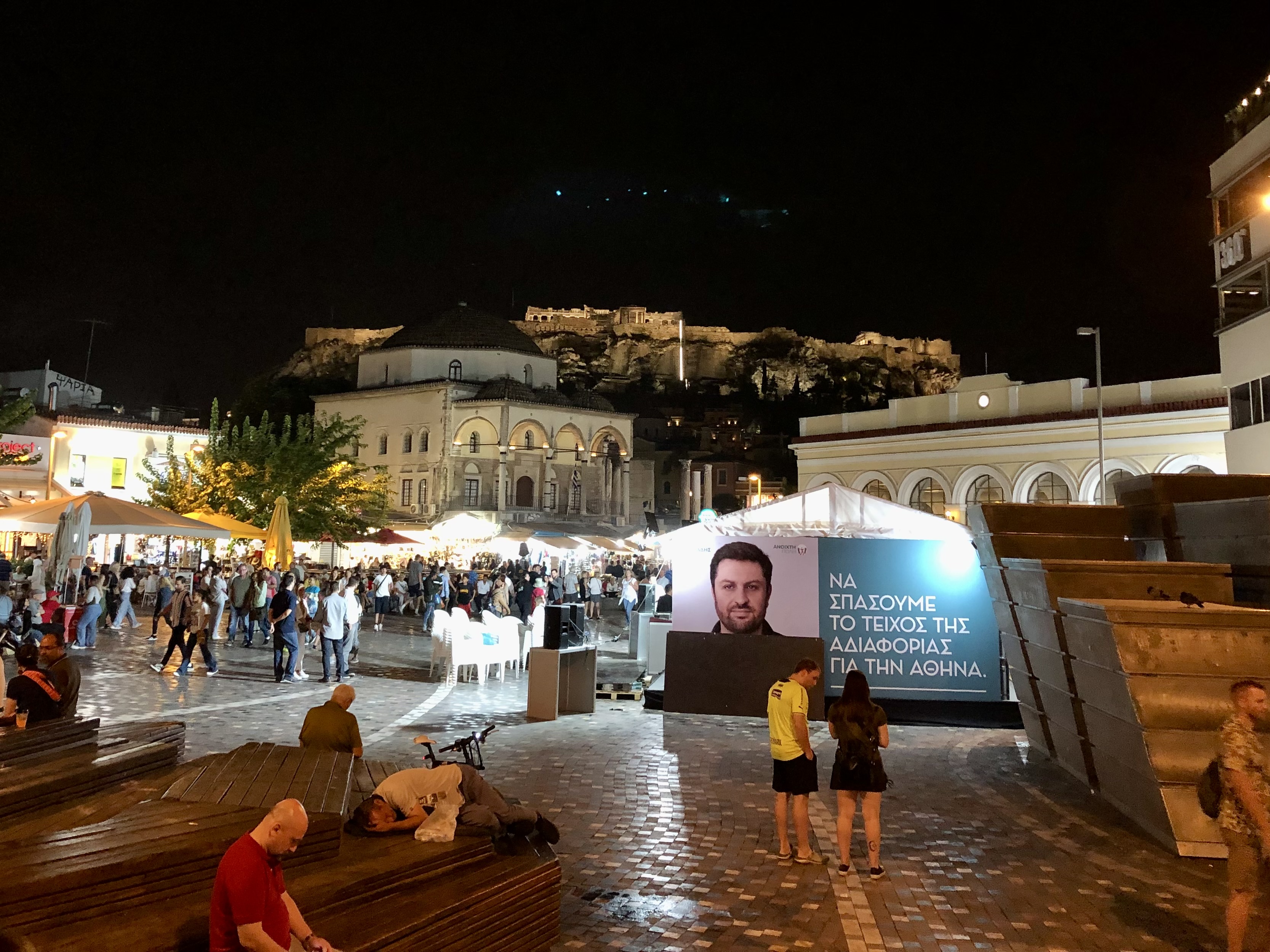
The Acropolis at night as seen from Monastiraki Square.

Before we arrived in Athens, we set ourselves up for as many looks at the Acropolis that we could think of. We found an open-air movie theatre (I know...we should have gone...) with a viewshed to the lighted acropolis at night. We booked dinner at a restaurant that promised framed views of the Acropolis. We even considered staying at one or two hotels with rooftop views to the Acropolis before we checked out the per night price and passed. In short, we conjured up every way we could think of to get a glimpse here and there.

Here's the thing about all of that: you can see the Acropolis from pretty much everywhere in the city center of Athens. The view is amazing and special but it's certainly not rare. Athens is pretty much a flat-ish bowl or plate of a city with one or two very prominent unobstructed hills, one of which is the Acropolis. Seeing it around corners and through gates and in alleyways or over ancient ruins is not an infrequent sight. That doesn't mean it's not special because it certainly is. It's just not rare, that's all. 

We cancelled the dinner reservation with the Acropolis view by the way and ate Souvlaki for less than $10 total for two including drinks. Greek food is cheap. But that's a story for another time.

The Odeon of Herodes Atticus.

I honestly expected big things out of the Acropolis and especially the Parthenon. I mean this place had to be special considering the advance press that I had been fed in like every history and architecture class that I've attended that dealt with ancient architecture. Despite all the anticipation, though, I really expected that I would find it a bit boring. I mean we are talking about a gabled roofed building surrounded by the exact same columns over and over again with just two rooms under the roof. How good could this really be? It's not like we are dealing with anything complicated from a spatial point of view or anything. When it comes right down to it, I'm just not a classical architecture guy.

I shouldn't have doubted. And I'm shocked to be writing that despite how I opened the last paragraph. Maybe that was obvious from the way I finished the last paragraph. The whole Acropolis and especially the Parthenon were just an awesome couple of hours experience. You can't enter the buildings in any way. All you can do is look at the outside. They aren't even all there and all the ornamentation and color is gone. And it was just awesome anyway.

At its simplest level, there's not much to the Acropolis. There's a gate at one end (the propylaea) which you pass through on your ascent up the last part of the hill and when you pass through there are two temples facing you: the Erechtheion on the left and the Parthenon on the right. You are looking at the front corner of the Parthenon and the side wall of the Erechtheion. The side wall in view is the one with the famous caryatids, the six columns carved like women holding up the roof above the porch off the side of the temple. 

After all this time. After learning about this place more than 35 years ago for the first time, that's it. That's all there is. It wasn't always that way but that's how it stands today. There's nothing else up there once you pass through the propylaea other than a small, raised podium at the opposite end of the hill which has some awesome views looking back across the Acropolis. 

And I guess to Athens. I don't know about that last part. I was there to see the Acropolis, not Athens. Didn't even look.

The east side of the Parthenon. Built 447 to 432 B.C.

Before we set off for Athens, I made a list of everything I wanted to really check out at the Acropolis. I figured I'd focus in advance. That list was pretty short. It included the Parthenon, the Erechtheion and the Temple of Athena Nike. Little did I know that my list included everything on the top of the hill except for the propylaea. And that was OK, really. Picking those three was enough to focus on. There's plenty of other stuff to check out on the south slope of the Acropolis and there are lots of bit and pieces of other former structures at the top of the hill of you want to be more of a completist. I am sure you could spend days there looking at every piece of stone or partially complete temple or theater. Focusing on what I saw as the three signature buildings is enough for a first time visit, I feel.

It took a little bit of time to find Athena Nike by the way. She's actually located on a pedestal in front of the propylaea. I saw it before we climbed the last part of the hill and didn't even realize what I was looking at. But we found her once we circled the Parthenon and before we took a closer look at the west side of the Erechtheion.

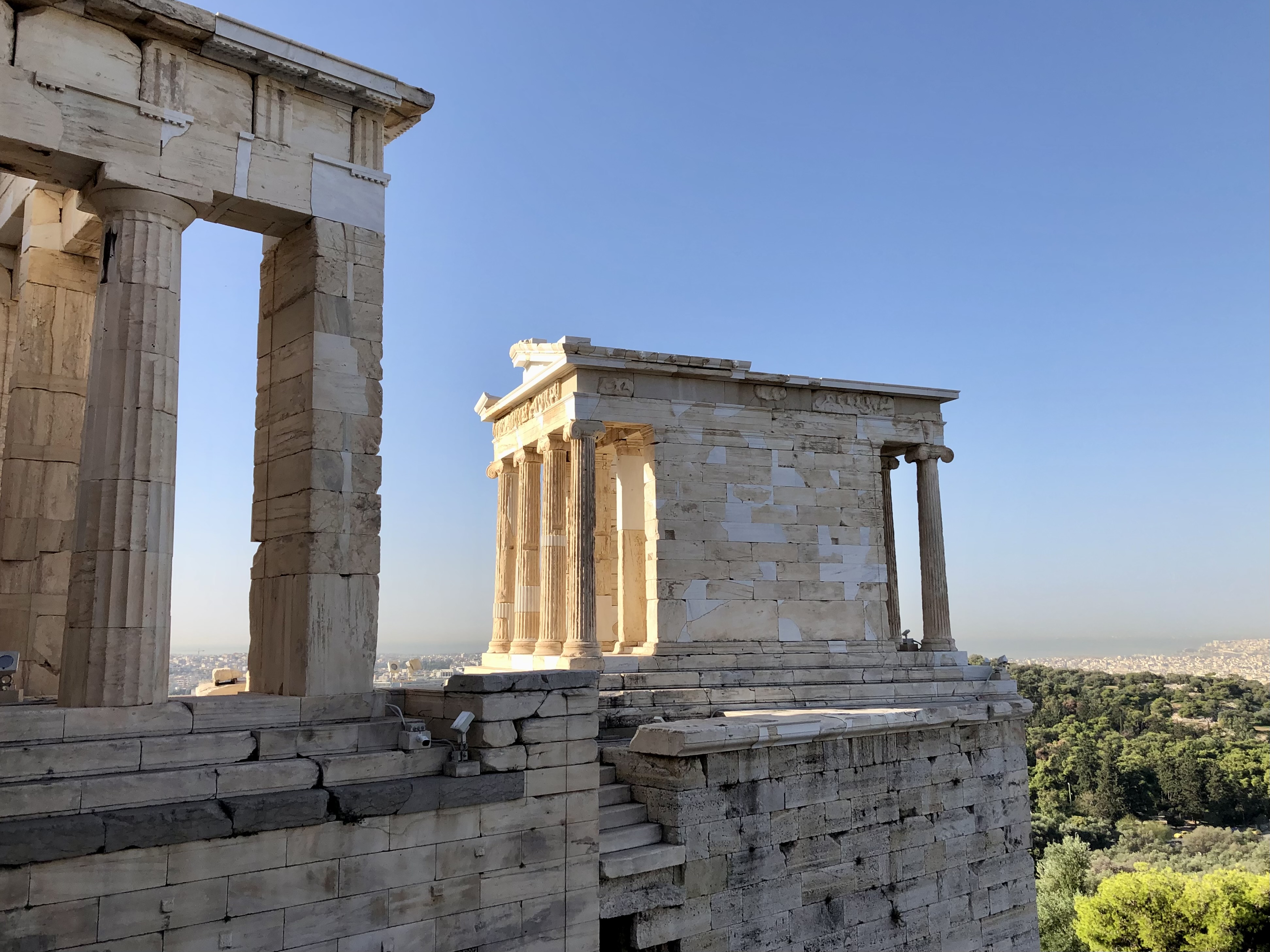
The Temple of Athena Nike. Built 449 to 420 B.C.

Of the three temples I had on my list, I really had them ranked before we set foot in Greece as follows: (1) Athena Nike, (2) the Erechtheion and (3) the Parthenon. Construction was started on all three of these buildings within a 30-year span in the fifth century B.C. One (the Parthenon) was built using the Doric order, one of the three signature orders of Greek architecture. The other two used the Ionic order. When it comes to orders, I'm an Ionic guy all the way. The Doric is too plain for me and Ionic is overall just more elegant and lighter. 

And yes, just to be clear, on the basis of orders alone, I put the Parthenon, the thing that is supposed to be the most perfect Greek temple ever, in last place. Sometimes I'm not that smart, although ultimately any evaluation of "best" ends up being pretty subjective. The Parthenon, however, was the most impressive.

In my defense here, the Temple of Athena Nike is a little jewel box of a building. It's a tiny little one-roomed temple perched on a huge pedestal with four Ionic columns on the east and west faces. The pediment on the east side is about two thirds intact with some of the original frieze intact (or restored, I guess). But you can't get very close to it. As a building to visit, you have to admire from afar. There's no other option really.


Temple of Athena Nike (top). The Erechtheion; built 421 to 406 B.C. (bottom).

The Erechtheion is quite a bit more complicated. The reason it was on my list ahead of the Parthenon was because of the side porch of the temple with with roof supported by the six caryatids. They are spectacular, even though you cannot get really close to see them at all. This is a theme at the Acropolis by the way: lots of awesome stuff to see but cannot get really close to see it. 

If you get up the Acropolis and feel upset at all about not being able to get close to the caryatids, don't worry too much because they are not the originals. Most of the originals, including just pieces of one of the six which was destroyed by a stray Ottoman cannonball, are in the Acropolis Museum at the bottom of the south slope of the hill.

The Erechtheion is supposedly built on the spot where Athena and Poseidon battled to be the god of choice for the city of Athens. As a quick recap of that contest, both gods produced gifts to the citizens (I assume it wasn't called Athens then since Athens was named after Athena...) for their consideration. Poseidon produced salt water from a spring at a spot struck by his trident; Athena went with an olive tree. Clearly, Athena won.

Architecturally, the Erechtheion is the most complicated and confusing of the four buildings on the Acropolis (I'm counting the propylaea as a building here). Its main entrance is from the east via a six-columned front facade but it also has a couple of porches on the north and south and really the one on the north is like an annex with a separate portico and wholly different floor level. The star of the whole building is the porch with the caryatids to the south although it's not a porch in the sense we think of porches probably. There's no spatial connection to the main building; it's really just preserving space above the tomb of Kekrops, who was a mythical king of Athens.

I'm not completely positive how a tomb of a mythical king works. I assume it's just cermonial? I mean if there was a body, he wouldn't be mythical. Does that sound right? Kekrops, by the way, is one of two mythical kings of Athens whose tomb is at the Erechtheion. The other is Erechtheus.


Front (top) and porch (bottom) of the Erechtheion.

So then there's the Parthenon.

How is a building this simple actually this good? It's a rectangle in plan with just two rooms inside. There are eight Doric (read: very plain) columns on the short sides of the rectangle and seventeen on the long sides. Part of the south side of the building is collapsed (a result of Christian bombardment when the building had been converted to a mosque by the Ottomans) and most all of the sculpture that adorned the outside of the building (including within the pediments) is long gone (most of it's in London, of all places). Of the two rooms, one used to hold an enormous ivory and gold statue of Athena but that's long since been cannibalized for other purposes so that doesn't add to the luster of the building at all.

Maybe I'd been brainwashed by my education. I looked for the entasis on the columns (essentially meaning the columns "bulge") that makes them look like they are bearing weight. I looked for the entablature above the columns not being purely horizontal. I looked at the spacing between columns. I looked for the columns leaning slightly inward. And I'll confess, that almost all of these were impossible to see but I "knew" they were there.

I will say for the record that I am rarely impressed with architecture (and maybe I should have capitalized that) that is this old and (no judgement here) this primitive. But the Parthenon is truly impressive. Yes, it's simple. Yes, I looked for and believed everything I had been told that makes this building so remarkable. But there is also a very pleasing proportionality to admire and the details made all the difference. They are sophisticated. This is clearly not the first time a Doric temple has been built. I think the relationship between the column capitals and the entablature and the reduction in spacing at the end columns were really important to me.

Maybe it was the details. Maybe it was Athens. Maybe it was the anticipation. Maybe it was the sun. Maybe it was finally getting there. Maybe it was all of it.


Sunny side of the Parthenon in the morning, including a look at the columns and entablature.

The siting of these temples on the top of the Acropolis, by the way, is phenomenal. If there is one takeaway I took away from Greece, it was that that Greeks really know how to place a building on a site to gain the maximum impact on the visitor. 

When you are walking up to the propylaea, you can't see any hint of what is beyond really. If you are sharper than me, you'll notice the Temple of Athena Nike for what it is but really you can't see anything else. Once you emerge through the gate that is the propylaea, you are faced with the Parthenon on the right in perfect perspective. You can see the front facade and also gauge the entire size of the building by also being able to see its broad side. This kind of denial of view following up by revealing of objects or spaces has been a key element of architectural design for centuries.

At the height of its glory, you would have seen before you a giant status of Athena just ahead of you and maybe bit to the left. But beyond that on the left would have been the Erechtheion showing you it's most gorgeous feature (the caryatids) but not showing you its front face. To get to that, you'd have to be drawn into the plaza between the two buildings, taking in the full length of the Parthenon as you walked before you could circle around to the front of the smaller temple. I know there are just two things up there after the propylaea and how difficult is it really to put two things on a flat hilltop but these two really are sited perfectly.

I don't get this impression just from the Acropolis. We visited at least two more ancient Greek temple sites where the views of the main attractions were concealed, teased and revealed in epic fashion. And yes, that means there are two more blog posts about temples in Greece coming.


First view of the Parthenon (top) and sacred olive tree outside the Erechtheion (bottom).

If I can offer a pro tip from a one-time visitor to the Acropolis (is that even possible? a should it be an amateur tip?), it's get there early and beat the crowds. When we visited, they appeared to be testing out a timed entry policy that appeared to be either loosely enforced or not enforced at all to reduce crowding but there are for sure crowds. We got there at opening time and stood in line for about 15 minutes for tickets and then maybe 2 or 3 additional minutes to get our tickets scanned. 

The first place you come to after you pass through the property gates is the Odeon of Herodes Atticus, an open-air theater of what used to be an indoor theater donated to the city by Herodes Atticus, an early benefactor of the arts in Athens. My advice is to skip this upon entry and hit it on the way out. Get to the Parthenon and the Erechtheion before the hordes get there. Maybe you'll get lucky and get a sense of the place (and some pics) without a mass of people milling around.

Our route at the Acropolis took us through the main gate; up through the propylaea to the top of the hill; back through the propylaea; past the Odeon of Herodes Atticus; and down the south slope past four or five additional structures in various states of standing. At the bottom of the hill is the Acropolis Museum.


Floods of tourists (top) and the Theater of Dionysus with the Acropolis Museum (bottom).

If we could have spent days checking out everything on the top and sides of the hill that is the Acropolis, I am convinced you could spend an equal amount of time studying every object and watching every video simulation inside the Acropolis Museum. The amount of material in that place is daunting. I am sure all of it has value on some level. We couldn't handle it all so we focused (again) on material related to the three temples we targeted on the actual Acropolis along with any information that explained the development and evolution of the site. 

And maybe one or two other pieces that caught our eyes along the way. I love the sculptured panel of Dionysus that I've included as the second picture of this post. I don't know how exactly it fits into the Acropolis because I don't remember the caption next to the exhibit but I think it's really well done. I am sure its condition and the giant (and i do mean GIANT) cup of wine that Dionysus is holding in his right hand helps my appreciation of this piece.

One of the most valuable displays inside the Museum is a series of models representing the buildings on top of the hill at a few different points in time. The Parthenon we see today is not the original Parthenon. That building was destroyed by the Persians in 480 B.C. The new Parthenon was also co-opted by both the Ottomans as a mosque and by later Christians as a church. All these permutations are represented in a series of models which show the site in different conditions over time. 

These models, combined with the video presentation on the upper floor of the Museum which shows the construction and adaptive re-use of the Parthenon over time really paint a pretty complete picture of what was going on atop the hill for the last 3,000 plus years. Adaptive re-use here means everything from the construction to the destruction of "pagan" sculpture by Christians to destruction of the south side of the building by cannon-fire (also by the Christians) to looting of the sculpture by Britain's Lord Elgin (which is how most of the Parthenon's original art is in London). I guess Elgin was a Christian too. Those Christians...

Model of the Acropolis, 5th century B.C. Notice the giant statue of Athena.

As far as the actual pieces of stone inside the Museum, the stars are clearly the original caryatids. These alone are worth the price of admission to get this close to pieces of sculpture this important to the site. And you can get to within inches of them and they are not behind glass or anything. We for sure spent more time looking at these five ladies than anything else in the Museum. I got disappointment when I saw how far from the Erechetheion's porch we have to stand on top of the Acropolis. That was easily overcome when we found them in the Museum.

And yes...five. Not six. The sixth was swiped by Lord Elgin when he stole all the Parthenon's sculpture from the site and it sits in the British Museum along with the rest of the loot he made off with.


The five (not six) caryatids in the Acropolis Museum.

I don't know how many pieces of sculpture we skipped in the Acropolis Museum. There was just too much to take in. I will say that some of the pieces still have some of the original paint on them and (as faded as it is today) that was extremely gratifying to see. It's awesome to see paint that's survived 2,500 years on a piece of stone when the stone has not been treated with care for a lot of that time.

I don't know what else to say about this museum other than I'm glad we went to the Museum after we visited the site. I found it easy to make connections to what we'd just seen. I doubt I would have made the same connections in the opposite order. I especially appreciated the sculpture (some of it replicas) from the Parthenon being in the same orientation in the Museum as it is on the actual site, particularly because you can see the actual Parthenon when you are looking at some pieces of the sculpture.

Sculpture from the Parthenon in the Acropolis Museum with the actual Parthenon visible through the windows.

One of the things I love most about travel is that it gets you to places that you have longed to go to that you have learned about without actually ever having been there. Setting foot in foreign (or domestic) lands to make your own judgements about places is thrilling to me. It can be perspective-changing or it can validate what you already thought you knew. Usually, there's a little of both but it's rarely exactly what you thought before you actually arrive there. It's not virtual reality. It's real life. Being there matters.

We didn't spend much time at all in Athens but I'm convinced we were right to devote a good portion of our time there to what is unquestionably the number one tourist attraction in the city. When you are standing in the city of Athens looking up at the Acropolis, it seems like a long way up. It's not too bad, but you do have to walk up there yourself. There's no funicular or elevator. Take it slowly if you have to and it's cooler in the morning. That Athens sun can get hot.

Also, it's not pronounced Acropolis in Greece. The word is feminine and the "s" isn't pronouced. It's Acropoli. Do with that what you will.

Southeast corner of the Parthenon. Not sure how Elgin missed plundering this part.