Showing posts with label Bald Eagles. Show all posts

Tuesday, November 10, 2020

From The Tetons To Yellowstone


It is very strange for us to spend an entire week of vacation the way we spent a week in Grand Teton and Yellowstone National Parks. Generally speaking, we crave variety when we travel and spend our days rushing from one different thing to the next different thing to take in as much as possible. Call it attention deficit disorder or a fear of being bored or impatience or wanting to suck the marrow out of life every day we are not at work, but the notion of spending a week focused on just two National Parks is craziness for us. But that's just what we did. 

Not that Yellowstone and Grand Teton are lacking in variety.

We definitely had an agenda. Elk. Moose. Bison. Geysers. We felt pretty sure we'd get all of these and we were right, although the quality and quantity of moose sightings exceeded our expectations and was definitely very much appreciated. But we also didn't want to be too myopic on this trip and lose sight of the big picture. We wanted to see more wildlife than just elk, moose and bison. We wanted to exist in a place that man has left largely untouched. We wanted to be awed and relaxed and forget about how badly our species has messed up this planet. At least for a week.

We got all of that.


One of the reasons we could stand to spend a week out in northwest Wyoming was simple: these places are enormous. There's just a whole lot of territory to cover. And that means that filling a day is easy, especially when some drive times to the places we wanted to go are 2-1/2 hours or more. I knew this before I went out there because I'd spent a little more than a day in Yellowstone nine years ago and missed a ton. But it really hit home when we spent the better part of two days in the Tetons and pretty much four whole days in Yellowstone and STILL missed a ton. Maybe MORE than a ton.

I asked some friends before we left for this trip for some advice on must dos in Grand Teton. A boat trip across Jenny Lake sounded like a can't miss thing to put on our list and then check off at some point in our couple of days in the Tetons. But honestly, we just didn't have time. And it was probably due to the hours we spent down Moose-Wilson Road watching moose and bears. We also missed about half the length of Antelope Flats Road, all of Mormon Row in the same area and a whole bunch of turnoffs and side roads that could have really been worth exploring. We also didn't do any hiking in the Tetons.

I think we did a better job of covering ground in Yellowstone, although we didn't drive between Lake Village and West Thumb (in favor of another pass through Hayden Valley) and the road between Canyon Village and Tower-Roosevelt was closed to all traffic (it's closed all of 2020 and 2021). We missed a side road here and there I'm sure, especially when we were in thermal areas information overload mode. It makes sense we'd cover Yellowstone more comprehensively. We did spend almost three times as long in that Park than in Grand Teton.

I could easily have spent probably two more days, most of it in Grand Teton, than we did. I'm shocked to be writing those words. 

The Teton Range looking west from the Mormon Row area.

The Grand Canyon of the Yellowstone, Yellowstone National Park.

So how did we spend our time? Mostly driving around and gazing at the scenery and the wildlife.  Pretty simple.

On the scenery side of things, Grand Teton is dominated by the Teton Range on the west side of the Park. These peaks are so striking and they seem to be visible from just about everywhere you go in the Park. They form a sort of staged backdrop to the incredible landscape in the main part of the Park and they are reflected in the Snake River and other bodies of water you encounter as you make your way around the loop in the south section. They are without doubt the singular most distinct memory I have of Grand Teton.

Yellowstone is completely different. Whereas the Tetons are fairly homogeneous, Yellowstone is like a theme park with different worlds seemingly invented by a park designer to get the visitor the maximum range of landscape experiences. Geyser basins, valleys, rivers, canyons, mud pots, cliffs, mountains, scorched vistas, water containing multicolored collections of microscopic organisms and one really, really big lake. Yellowstone has all of that and way more.

We traveled most of Yellowstone for the first time in the dark, getting up before dawn to get to Hayden Valley or Lamar Valley before the wildlife got moving off the wide open spaces and into the Park's forested areas. It was astonishing to see some of the places we'd driven and how close to the edges of roads with some sheer drops. It sounds like a stupid statement but Yellowstone is way more varied than it looks at night but one of the aspects of Yellowstone that I found fascinating was the fact that we traveled through such diverse landscapes in the dark without realizing it.

The Teton Range reflected in the Snake River near Schwabacher Landing, Grand Teton National Park.
First mountain goat I've seen in the wild. Yellowstone National Park.
The river valleys in both Parks were some of my favorite places to hang out. This year has in many ways been one where we've visited river after river all over the west of the United States and the Snake and Yellowstone and Madison Rivers we saw out in Wyoming were just as striking as any others we've seen. I love the way the valleys are so broad with a lazy waterway winding its way down the middle with mountains or forests on one or both sides. It also doesn't hurt to have a bison or elk or two or three or ten dotting the valley.

I also appreciated the mountains. I mean we were in the Rockies for crying out loud. I loved the very small mountain area of Yellowstone for a number of reasons, not the least of which is we managed to spot a couple of mountain goats hanging out among the rocks. And it's difficult not to gaze in wonder at the Tetons at every opportunity. These things look like God just deposited a series of perfectly crafted peaks on a great plateau in the Rockies. We couldn't help taking picture after picture of these mountains from about every spot in the Park we could see them.

And of course, nothing could be further from the truth about how the Tetons got where they are. They came from below through tectonic action, not from above by divine act.
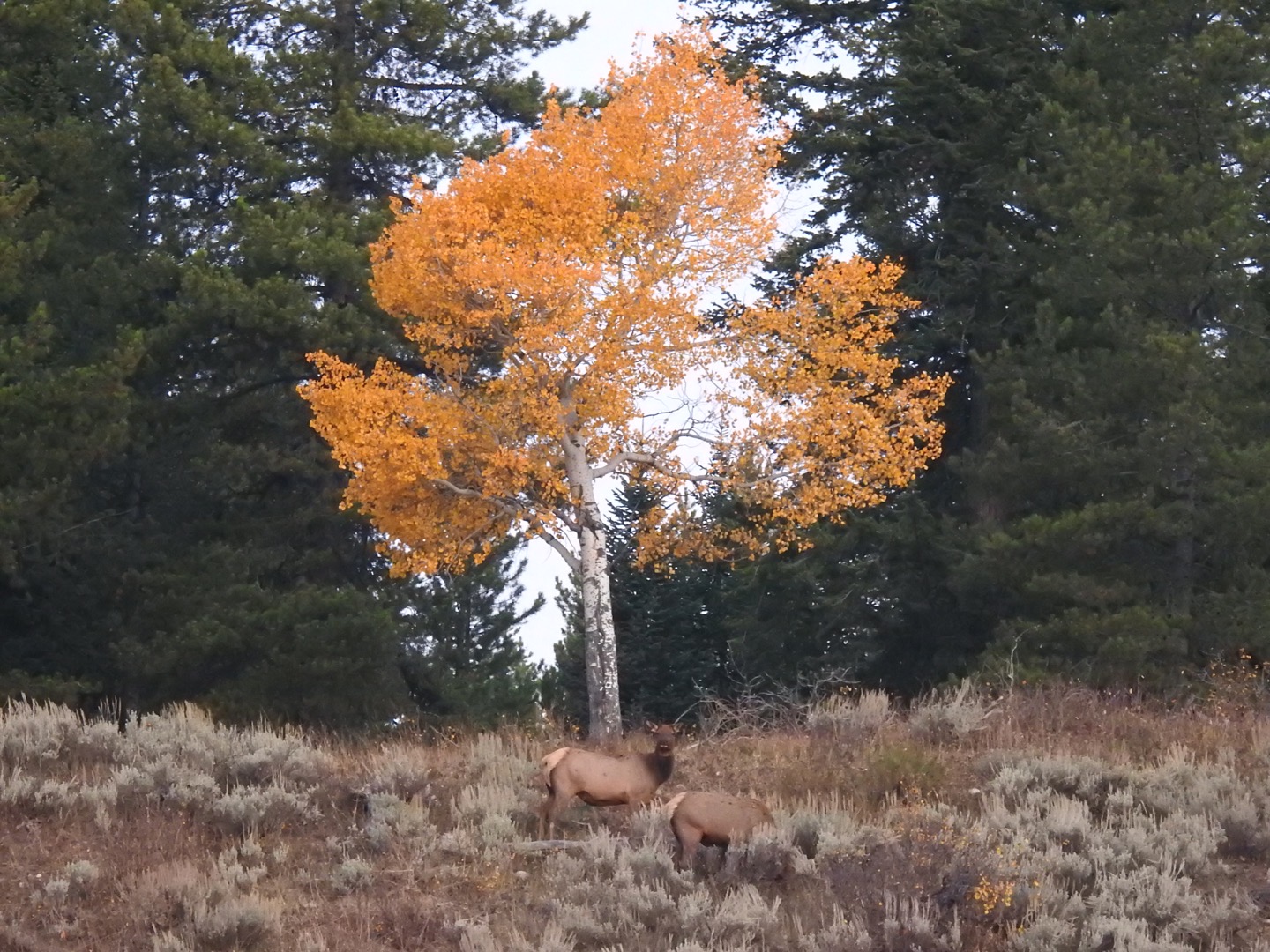
Fall colors with two elk. Grand Teton National Park.
Coyote. Lamar Valley. Yellowstone National Park.

I also think that visiting in the fall helped our trip. The last time I was in Yellowstone it was as green as can be from the grass in the valleys to the evergreens and deciduous trees everywhere else where anything could grow. In the fall, there are trees here and there with bright oranges and yellows to inject a dash of color into the sameness in the forests and the grass in the valleys is a pale straw color, which among other things is perfect for hiding coyotes.

I don't know why I am still amazed at nature's camouflage. I have watched lions the color of grass and leopards in trees in Africa and marveled at how the colors and shadows of their natural environments hide those animals. I've also written just last month how the color of the bark and the darkness of the trees in Yellowstone obscure animals as massive as elk. I guess I just didn't expect coyotes to be so invisible in the fall grasslands of Yellowstone. Maybe it's the Road Runner cartoons.

Ultimately, we did spend the majority of our time in both Grand Teton and Yellowstone either watching wildlife or moving from one place to the next in hopes of seeing wildlife. I've already written about the moose, elk and bison we saw last month in separate posts because those were the most visible species. But that wasn't all we saw. 

Bald eagle in flight over the Snake River. Grand Teton National Park.
Bear no. 2. Grand Teton National Park.
If there was a hope we had in our animal search in Yellowstone and the Tetons, it was that we would see plenty of bears. By plenty here, I don't mean plenty like we saw plenty of elk or bison. Maybe 10 was a stretch goal? We saw three earlier this year in Rocky Mountain National Park in a single day in a park where bears aren't that common. I felt I was being realistic in hoping to exceed that total in six days in a place where there are more bears. And by that I mean more total quantity (although the precise numbers in RMNP aren't known) and more species (two vs. one). There are more than 700 grizzly bears in Yellowstone alone; Rocky Mountain likely has less than 1/4 of that total number of just black bears. Of course, it's a bigger area. Much bigger.

If there's one thing we pretty much counted on not seeing, it was wolves. Wolves were re-introduced to Yellowstone in 1995 and their numbers as of the date of our visit were reported to be 99 total. I'd seen every species we hoped to see in Grand Teton and Yellowstone before with the exception of mountain goats and wolves. No way did I hope to see either. I didn't even realize there were goats in Yellowstone or the Tetons, or at least not visible from a car, but we saw our first couple ever. But wolves? The odds seemed stacked way against us. Yellowstone was full of surprises.

There were really no disappointments on this trip but if there was an unpleasant surprise, it was that we only saw two bears in the whole week we were roaming around the Parks. They were both pretty poor looks. The best photograph we got of either bear (and frankly they may have been the same bear in the same area of Grand Teton at two different times) is above. We struck out entirely in Yellowstone.

I know. I know. I'm whining. Or Crying. Wahhhh!!!!! I didn't see more than two bears on my week trip to one of the premier destinations in the United States. But it's true. We wanted more bears. We thought we'd see more than two. For the record (and based on the narrative of people around us who may or may not know what they were talking about), it was either a grizzly and a black bear or two different black bears or the same black bear twice. Personally, I'm leaning towards a grizzly and a black bear, although the best photographic evidence of bear no. 1 (the "grizzly") is below. That bear, by the way, was moving fast. Good thing it was a good distance away.

Grizzly or black bear? I'm leaning towards grizzly.
But we did see wolves.

I know I've already said this but I thought there was no way we were going to see any wolves whatsoever. We're talking 99 dogs in an area almost twice the size of Rhode Island. What are the odds?

But we didn't just see one or two wolves. We saw a lot of wolves. On three different days in two separate locations in Yellowstone National Park.

My first tip for seeing wolves in Yellowstone based on our very, very limited exposure is to visit the Lamar Valley in the northeast corner of the Park. I know, it's remote and if you are staying in West Yellowstone, Montana (like we were), you'll need to get up super early to get over there when the wolves are still active in the morning (we left one morning at about 5:30 a.m.). But we were two for two in Lamar. Two visits, two sightings of multiple wolves.

Admittedly, both sightings were at a very great distance. Probably at least half a mile away. The animals were like ants on the landscape, even when using binoculars or the zoom lens on our camera which we have been so impressed with in the past. But they were clearly wolves and it was remarkable to see them move across the landscape as a pack, not in a group like I expected but single file with a really good amount of space between them. I think one of the most remarkable benefits of observing wildlife with your own eyes in a natural environment is seeing behaviors that wouldn't necessarily stand out if you were told about those behaviors in a TV show or something like that. How wolves move is indelibly stamped on my brain from our visits to Lamar Valley.

If you do go to Lamar Valley, or anywhere else in the Park really, be prepared to share space with people with some fantastic and very large zoom lenses and telescopes. Their equipment dwarfed what we thought was the ultimate travel camera for seeing and photographing wildlife. Their gear was much better than ours. Although I wouldn't want to lug their stuff on a plane as cabin baggage. 

Wolves in Lamar Valley. Yellowstone National Park.
Lone wolf. Hayden Valley. Yellowstone National Park.

My second tip for seeing wolves in Yellowstone is to get lucky. I know...it's a terrible tip. But in a way it applies to all wildlife watching. We didn't get lucky with bears. We got super lucky with wolves.

We always have an itinerary for our trips. Most of the time, we follow those agendas to the letter and build in enough float to linger or improvise. Sometimes, we read the conditions on the ground and decide to go a different way. We did the latter in Yellowstone and it completely paid off. Our original plan for Yellowstone had one trip to the Hayden Valley, but after driving through once, we not only adjusted our route back to our hotel to take another pass on the same day but we decided an early morning visit on a different day might pay off somehow. That's where we got to see a wolf at a distance of about 20 feet.

There were a number of wolf false alarms (or was it crying wolf?) in our time in Yellowstone. There were at least four or five or maybe more times when we heard someone calling a coyote a wolf. So on our second day in the Hayden Valley we were not quite ready to believe that the dog-like creature trotting about ten feet off the road just before the sun was really up was a wolf. But after a second or two lapse of brain processing time, it was.

Right there in front of us (and a caravan of 15 or so cars) was a yearling wolf separated from her pack. Super close. Way closer than the 100 yards of separation recommended by the Park for this kind of an animal (although that doesn't really count when you are in a car). Honestly, this was such a thrilling sight that for the 20 minutes or so we followed this wolf, we forgot all about the whole no bears thing. This is one of the apex predators in the Park and it's right there in front of us.

This was absolutely amazing. So amazing in fact that our fellow tourists stopped their cars as close as they could and piled out of their passenger side and driver and back seats to snap the best possible pictures. I'd love to say that we exercised a little more caution (and I think we did - keeping the car between us and the wolf or opening the door but standing on the step of our SUV) but it's super easy to get excited and lose track of what the rules are. I mean it's a wolf less than 30 or maybe even 10 yards away.

Wolf. Carcass. Hayden Valley. Yellowstone National Park.

If there has to be a singular experience that represents this trip (and I'm not sure there has to be), this was it. To get this good a view of a wild wolf is something that's not going to happen each time you visit Yellowstone. It truly was so lucky, although getting up early was definitely a part of making our own luck.

We don't have great pictures of our lone wolf. The lighting was not ideal and she moved pretty fast which made taking amazing pictures with our camera a little difficult. I still think we got a couple of pics that I'm proud of for us to remember what we saw.

Two Parks. Six days. It's still crazy to me that (1) we spend this much time doing sort of the same thing over and over again and (2) that we still missed so much. No hikes. No Jenny Lake. No bears (well...two), no Tower-Roosevelt, tons of missed side roads and drives. But wolves, fighting elk, moose, herds of bison, geysers, multicolored pools and those gorgeous Tetons in the fall? Tremendous. What a week. 

Everyone should go to Yellowstone at least once in their life. If you go, make your own luck. Get up early and stay for multiple days.

One last look at the Tetons. From Mount Moran Turnout. Grand Teton National Park.

How We Did It

Both Grand Teton and Yellowstone National Parks are open all year round but access to certain parts of both Parks are severely limited in the winter season. Check their websites for current conditions by clicking the names of each park earlier in this paragraph.

Both Parks charge admission, although there are days of the year when admission is waived. You might also save a few bucks by purchasing U.S. Parks Annual Pass which will get you into all National Park Service properties and a whole host of other sites for free. The Pass, which we purchased last November, costs $80 as of this writing. The 2020 entrance fee for Grand Teton is $35 and you can add another $35 for Yellowstone. It won't take but one more Park visit somewhere else to make buying a Pass worthwhile. The $35 admission fees to both Parks are good for seven days each.

Note there is a large amount of territory in the south end of Grand Teton that is outside of the entrance gates so depending on where you want to go, you might be able to visit Grand Teton for free. You can get to our favorite moose and bear watching spot down on Moose-Wilson Road without paying. Or at least you can if you are traveling from the south.

We found the best places to see wildlife in Yellowstone to be Lamar Valley and Hayden Valley. Get up early for the best sightings or stick around until dusk. We considered hiring a guide for a day to help us find wolves but found pricing to be north of $500 per day. We took our chances on our own and I think we made out pretty well. We actually followed a couple of guided tours in Grand Teton for a while and they didn't seem to have any better luck finding animals than we did. I guess a huge advantage of being with a guide is that they likely have better gear than you do. I'm happy with the $500+ that's still in my bank account.

We also found it really useful to ask what people were looking at. We got a lot of help from strangers pointing out what they were focused on when we were just lost. You might not have that long to see some of these animals. They have a way of disappearing into forests quickly. Ask for help.

You can see that gorgeous Teton mountain range from just about any spot in Grand Teton south of Jackson Lake.


Sunday, September 10, 2017

Alaskan Wildlife


If visiting Denali National Park was the primary objective of our Alaska trip (and it was!) then getting a quality look at a ton of wildlife both at Denali and elsewhere in the state was one of our primary secondary goals. Alaska has a collection of wild animals that is probably unrivalled by any other state in the union and we were determined to see as much as we could see in our time both on land and on the water while there.

To that end, we made two decisions prior to embarking on this trip. First, we made sure our focus at every stop we made on our trip up the coast from Vancouver, British Columbia to Seward, Alaska was to make animals the number one priority. So before we made landfall at Ketchikan, Icy Strait Point, Juneau and Skagway (in that order), we made sure we had some kind of wildlife viewing excursion planned and booked.

The second decision we made wasn't related to the destination, but how we might get better looks at, and photographs of, the animals we hoped we'd see. Quite simply here, we bought a new camera.

Two harbor seals along the Lynn Canal near Skagway, including one doing his best rock impression.
Since I started this blog in 2013, I've been photographing pretty much everything everywhere I've gone with an iTouch, iPad, iPhone or the old Blackberry Torch that I clung to for far too long like some really weird security blanket (it's still to this day my alarm clock at home). In other words, I've been working for the last four plus years with some pretty low horsepower cameras. For most posts I've written on this blog, this hasn't mattered. These portable devices are good enough in most circumstances for me to get by.

But I really felt the deficiency in the camera department when we visited Africa in August of 2015. The kinds of details I wanted to get in photographing the gorgeous wild animals we saw on that trip just wasn't possible with the hardware I brought along. We also saw briefly the power of using a real camera to get closeup views at animals a long way away when a family we were on safari with us showed us just how good their camera's zoom was. They got some incredible shots of a lion yawning that we could barely see with our naked eyes.

So with a second safari trip on the horizon (so excited!!!) and our Alaska trip immediately in front of us where we hoped to get great views of bear, moose, wolves, whales and all sorts of other stuff, we decided to spend a little money on a new camera. What we ended up with was the Nikon COOLPIX P900. I don't usually promote products through this blog but we think the results are pretty incredible. It made our experience in Alaska so much better by allowing us to see and photograph details of animals at a distance that we couldn't possibly make out without the camera. To that end, all the shots on this post were taken with our new camera. Enough about that for now.

The best look we got at a coastal brown bear in the Spasski Valley. Thanks to our driver, Buddy, for the spot.
If you thought you could see all the wildlife in Alaska in Denali National Park, you'd be wrong. In fact, we didn't see any significant wildlife (magpies don't count) outside of Denali that we saw inside Denali except for a single moose by the side of the road. And that was on the drive south from the Park to the Anchorage airport. There are two main reasons for this: (1) there's no ocean near Denali and there are some creatures that just can't live away from the sea and (2) Denali has no salmon, and there are some animals that rely on those fish returning to their spawning ground to survive.

If there was a quality wildlife sighting we got in profusion all the way up the Alaskan coast, it was the bald eagle. There are an estimated 70,000 of these birds in all of North America with 30,000 of them being in Alaska. Consider that these birds need to be near places well stocked with fish like the sea, rivers or lakes, and it's no surprise there are a ton of them along the Alaska coast. We saw so many, in fact, that by the time we got to our last port of Skagway we were almost ready to ignore them, move on and see something else. Spoiled, I know.

If there's one thing we were taught early and often about bald eagles on this trip by our wildlife guides, it was how to spot them. The universal instruction at each stop was look for "golf balls" in the trees. Remarkably, this worked. Find a small white speck in the tree that makes up the Alaskan rainforests and nine out of ten times it will be a bald eagle. Do the zoom thing on the camera on a white spot and it usually ended up being one of these birds.

Bald eagle in the Alaskan Rainforest Sanctuary in Ketchikan.
Bald eagles are territorial, meaning you will only see a pair in about every mile or so of coast, although based on what we saw a bit inland, territories either overlap or are just plain ignored when it comes to scavenging for salmon heading upstream somewhere. Eagle pairs mate for life and keep returning to the same nest year after year. They also manage to supplement the materials used to build those nests every time they come back. We were told by our guide that picked us up in Icy Strait Point that after a while these homes can get to weigh a lot, like over 1,500 pounds, and can even collapse from their own weight. We saw a few pretty large ones on our way up the coast and I'd believe they can get to be pretty heavy.

In addition to bald eagles all along the length of the coast, our two best wildlife spotting days were on a whale watching trip just outside of Juneau and a stroll in the Tongass National Forest just south of Ketchikan, although we did manage to see one coastal brown bear very quickly in the Spasski Valley and got a great look at a number of harbor seals in the Lynn Canal (which is not a canal at all; it's a fjord) near Skagway.

Our trip to watch whales near Juneau was not my first whale watching trip. I've done that as recently as last year in Hawaii and before that off the coasts of Iceland, California, Seattle and Boston. Whale watching is above all an exercise in patience. Be prepared most trips to see very little and wait a long time between sightings that can ultimately be disappointing. Every once in a while you may get lucky and see some splashing or a full body breach or a feeding frenzy (which quite honestly is awesome!) but if you are humpback watching, you will likely have to settle for some back arching and then some flukes every once in a while before a deep dive. If you are unlucky (like we were in Iceland), your whale watch will ultimately end up just being a ride on a boat.

Two whales coming up for air near Juneau.
We were not unlucky in our whale watching off of Juneau. In fact, we saw a ton of humpback whales in the couple of hours we were at sea. The humpbacks come to Alaskan waters in the summer to feed on the enormous schools of krill and herring that populate the ocean just off the coast during the summer months. They arrive from, of all places, Hawaii, having spent the winter months mating, giving birth and beginning to nurse their young calves.

The problem with Hawaii? There's absolutely nothing for these whales to eat. So they just can't stay down there for very long. As soon as their newborn kids are ready to make the 3,000 mile journey to the feeding grounds they set out for the long trip north. And yes, they do it without any food. Well, not the newborns; they suckle on their mother's milk during the trip. But the adults go without and simply live off their fat reserves that are built up during the prior summer's feeding off Alaska. Must be awful and nice at the same time. As much as I love food, I'd love to be able to live off my personal fat reserves some days instead of bothering to eat. And rest assured, I have fat reserves.

Most of the whale sightings we got in our couple of hours at sea were fairly typical humpback sightings. That is keeping an eye out for spray emanating from the water then watching around that spot for some more spray and maybe the tiny dorsal fins that the humpbacks sport (see the photograph above for the typical look). There were clearly a lot of whales in the waters along with our boat which was exciting. We got some great looks at some flukes when they decided to dive, like the picture below and saw groups of up to three whales together, which was pretty cool. Although as usual, you don't get to see much of the whale at all.

Humpbacks can get up to 50 feet in length, which on a cold rainy day at a good distance is difficult to perceive. Whales are the largest mammals (or animals for that matter) on the planet. See one of these creatures up close and you really get a sense for how huge these things really are. At the distance we were at that day, we didn't get a chance to appreciate that.

A great look at the top side of a humpback whale's fluke. These are the signature looks on most whale watches.
Most whale watching trips usually get you a look at some other species of marine fish or mammal and our excursion that day was no exception. When we were heading back to port we got an awesome look at some Steller sea lions lounging on a buoy. These sea lions are the largest variety in the world (apparently walrus do not qualify as sea lions) and got their name (which is not misspelled) from, Georg Wilhelm Steller, who was the first (white man) to describe them in 1741.

I'm guessing the seven animals crowed onto the buoy below are likely younger males who are not full sized. Either that or they are further away than I realized or on a much larger buoy than I perceived because they don't look larger than some of the sea lions I've seen in other parts of the world. Sea lions are a great bonus animal on a whale watching trip. I've seen other species on other trips but never the Stellers, which are apparently in near threatened status, which is troubling but probably not alarming since sea lions all look similar but also appear to be all over the place.

Steller sea lions crowded onto a buoy in the waters off Juneau.
As exciting as our looks at whales, coastal brown bears and eagles (I think the picture of the eagle along the Lynn Canal near Skagway at the top of this post is my favorite; I love the eye) were in our last three stops in Alaska, I think our favorite day was the few hours we spent at the Alaska Rainforest Sanctuary just south of Ketchikan on our first day ashore. The rainforest's signature residents are their black bears, which would be the only black bears we would see on this trip. We got some fantastic looks at these creatures on that day, along with some other mammals and birds (and of course more bald eagles).

The Sanctuary is privately owned and just 10 acres in size but running through their property is a river which is a salmon spawning run. That means the land attracts both bears and birds looking for some food during the time of the year that the salmon are heading upstream to their birthplaces. The property had an existing sawmill which is still in place (although no longer used for that purpose) and the folks that bought the property have installed some elevated wooden walkways to allow humans to wander (with an escort) around the place while keeping them separated from the bears, which is good. As cuddly as black bears look, I'm in no hurry to surprise one of them in the woods. 

Other than the couple of new walkways, the place has been left as to allow the wildlife to have freedom to roam wherever they please, including off property if they so desire. It's not a zoo and it is not fenced.

Black bear siting up after a feed on some fresh salmon. 
The Sanctuary offers two tours. We signed up for the Bear Country & Wildlife Expedition which totaled about a little more than two hours on site with about a 30 minute bus ride from downtown Ketchikan on each end. It was one of the best things we did on our Alaska vacation, including being in Denali National Park.

I think it's always good to keep your expectations low on wildlife viewing excursions, especially when dealing with solitary animals rather than herd animals. Bears are for sure solitary; you will not find a pack of bears roaming around the woods together unless it's a mother and a couple of cubs and even then three probably doesn't constitute a pack. It's difficult to say whether we got lucky on this tour or whether the kind of sightings we got occur every day but the bear viewing was fantastic. As soon as we showed up we caught a glimpse of a female bear catching a fish before retreating purposefully but quickly out of sight. Without a chance for even a quick picture.

Turns out there would be plenty more opportunities that morning. This bear was obviously hungry, because we watched her come back for two more salmon later in the day. The last of the three provided us probably the greatest pictures. Not only did she walk right below the edge of the elevated walkway (you can see the claws in pretty good detail in the photograph below), we also got to watch her pick up a salmon and take it into the woods and eat it about ten feet from us. That feast didn't yield a great picture because the trees were in the way, but it was an opportunity to watch a bear feeding in a way that you don't encounter every day. At least I don't.

Close up look at the first bear we saw at the Alaskan Rainforest Sanctuary...
and walking with a salmon in her mouth. Yes, the salmon is huge!
That bear was the first of two we would see in our time at the Sanctuary. The other was a little larger and spent her time walking along the side and middle of an inland forest stream before retreating into the woods with a fish she just caught. We did get some pictures of that bear also but the best bear pictures we got were clearly of the first bear so I have not posted any here. 

As excited as we were about the bears, we were equally thrilled to see three or four bald eagles and a family of river otters. It was our first look at bald eagles on our vacation and we probably got some of our signature looks at these birds at this location, including the one below of one of these birds standing on a rock in the rain.

The great thing about the bald eagles we saw at the Sanctuary was that they were doing something fundamentally different than we observed at other locations. Instead of nesting, sitting in trees and flying over the open water, the eagles near Ketchikan were scavenging in relative comfort, meaning they felt at ease on the ground feeding on half eaten salmon, some of which were possible bear kills. It was the only time we ever saw them on the ground so we got to see how they moved on their feet rather than by using their wings.


Bald eagle in the rain. I love how the rain is captured on camera.
So about that camera again...

Our visit to the Alaska Rainforest Sanctuary and all the other stops all the way up the coast were just amazing opportunities to spot wildlife up close or from afar but I wouldn't have the memories I have now without our new camera. I've decided to show the best few on this post but we for sure have tons more of eagles, bears, whale tails and the same river otter family in addition to the animals and birds we saw in Denali later on in the week.

Just a couple of more plugs for this camera before closing. Obviously we are thrilled with the performance. It was cold and rainy some days we were out looking for wildlife and it stood up to these conditions well. It is also super light and super easy to use after a bit of practice. This for sure is going to serve us well on our early 2018 safari in East Africa.

But sometimes it's the small things that put you over the top in situations like this and one of the best features of the camera is that it has its own wifi, meaning we can (and did) download pictures from the camera to our phones and iPads on the fly, allowing us in the case of the iPad downloads to check out how good the pictures we were taking turned out in an instant. I'm definitely looking forward to getting a lot more use out of this thing in the future. It's going to make blogging a whole lot more fun too knowing I can get some really great images to go along with my writing. I'll stop endorsing now. I hope you like these pictures as much as we do. Many more to come.

River otters. Check another species off my "never seen" list.