Showing posts with label Birmingham. Show all posts

Wednesday, June 23, 2021

Southern Food


The above photograph is the truth.

Now that we are through the Civil Rights blog posts that formed the basis of our trip to the American South, let's talk about something we were really looking forward to out of our May vacation: the food. I'm serious. I've never really explored southern food in its element and this trip was an opportunity to do just that. We were prepared for some down home, finger-licking, butter-filled, deep-fried, artery-clogging goodness. Well, maybe not goodness in the artery-clogging department but we were looking forward to eating some stuff that tasted super good at just about every meal. Tons. Of. Flavor.

I went south with a list. Fried green tomatoes. Fried chicken. Biscuits. Greens. Barbeque. And maybe a few other things mixed in there that I either for sure loved or felt pretty darned confident that I would love. I did my research on where to eat online, on Netflix, in guidebooks and from memory, and laid out what I thought would be a pretty good list of places to stop and chow down.

I was right. We had some amazing eats. We also had some misses both in terms of restaurants serving what I thought were sub-par versions of foods that we sought and in terms of restaurants that we would never return to based on our one stop there. It was bound to happen. There are too many different opinions and palates out there; not everybody is going to agree on what the best food is. Here are a few words about the best stuff I thought we ate in in our 10 days in Tennessee, Mississippi, Alabama and Arkansas. I'm highlighting the best of each type of food we had as I go.

And spoiler alert: there's no banana pudding on this list. I'm not going anywhere and deliberately eating anything banana flavored. Except maybe when it comes to actual bananas, and then only in the tropics but definitely in Ecuador.

Biscuits

I have to tell you, there are some foods in this world that I just don't get what all the fuss is about. And biscuits are on that list. If there was a redemption story possibility for a food on this trip, it was the biscuit. I took a trip to Texas in 2013 to see if I really did actually like barbeque (turns out I do!); this trip had the potential to do for the biscuit what Texas did for BBQ in '13.

I still don't get the fuss. I used to make biscuits at home on weekends and have them with jam for breakfast and I thought those were pretty good. Every other biscuit, including most on this trip: meh! I find them stodgy and heavy and that's about it. And if you want to make them worse for me, throw on some sausage gravy. I had some gravy on this trip at a somewhat famous restaurant in Memphis that was like paste. Paste is not good.

This trip didn't save biscuits for me. However, I did find one that I would try again. Best biscuit: Nashville Biscuit House, Nashville, TN.

Fried Chicken

The best meal we had on this trip (hands down) was at Gus's World Famous Fried Chicken in Memphis. The second best meal we had on this trip was also at Gus's.

By my count, I had fried chicken eight times on this trip, including twice for breakfast, in a sandwich, in wing form, twice in a biscuit and twice at Gus's. There is just one I'd go back to in a heartbeat and that's (obviously) Gus's. I don't know how they make the batter so light (with that hint of hot sauce) and keep that chicken so juicy. It's pretty much perfect. If there's a better piece of fried chicken out there, I don't know what it is. This stuff is the best.

OK, so truth be told, I'd been to Gus's before and I knew it was good. I just didn't know we'd end up there twice in a five night stay in Memphis. Best fried chicken: Gus's World Famous Fried Chicken, Memphis TN. And it's not even close!! I do feel that Saw's Soul Kitchen in Birmingham, AL deserves a shout out here. I had the fried chicken sandwich and I'd eat it again although I will say there's more tolerance for lack of perfection with a sandwich than a piece of chicken by itself. But I'd still order it again.

Fried Green Tomatoes

Yeah, yeah, yeah, I know, the picture above looks like a burger. That's because it is.

If there's one food I convinced myself I would love on this trip, it was fried green tomatoes, despite not having really any experience with this southern staple. Looking back on things, I'm thinking maybe I confused fried green tomatoes with pickled green tomatoes. 

I ate fried green tomatoes twice in sandwiches (including the burger shown above and an actual fried green tomato sandwich) and once as a side on this trip. For the sake of accurate comparison, I did remove the FGTs from the two sandwiches so I could taste them on their own.

I have to say I'm not thrilled, although the ones on the burger above had the most flavor and the most tanginess. Maybe a little heavy on the batter but still with good flavor. The other two just tasted like oil. Soft pass on these things in the future. Best fried green tomatoes: Cahawba House, Montgomery, AL. Yes, it's the burger above.

Barbeque

There are a ton of barbeque traditions in this country and they all have their own distinct tastes. Go to North Carolina or Texas or Kansas City or St. Louis and you'll find dishes that have a common theme (meat cooked slowly over wood or coals) but have completely different taste profiles. We managed just two true barbeque meals in our time down south and both were in Memphis, which happens to have both dry (meaning dry rubbed with spices and served with or without sauce) and wet (meaning flavored with sauce during the cooking process) varieties of barbeque.

We chose two barbeque joints in Memphis. One offered both dry and wet options; the other had only wet. And like Gus's, I had been to one of these two (the one with the dry and wet options) before.

Barbeque is inherently messy. Sauce gets everywhere. So a dry-rubbed and smoked rack of ribs is refreshingly non-messy. Being able to strip meat off a rack of pork ribs with your teeth while getting incredible flavor and no sauce all over your hands and face is a good thing. A really good thing. I have to say that my memory of dry rubbed barbeque in Memphis from my trip in 2018 was better than this year but I'd still opt for dry over wet any day. Best barbeque: Central BBQ, Memphis, TN.

Greens

I don't know what it is that makes greens so good. I mean this is about the least appetizing side in the world. It's just chopped up leaves in liquid. But it can be so, so good.

I made it a point of pride on this trip to eat greens whenever I could, which meant I discriminated not at all. There was no advance research on best greens in the four states we visited, I just jumped in every time I found them. I didn't keep track of the number of times I ate greens on this trip (and it was mostly collard greens by the way) but I'm pretty sure it was close to the number of times I had fried chicken, although admittedly I didn't eat greens for breakfast.

If I had to describe my perfect greens, I'd have them made them juicy and rich and slightly bitter with a little spice thrown in via maybe some red pepper flakes. The greens in the photograph with the ribs two pictures up matched that description and maybe because I'd already had them at Central BBQ three years ago that way, they became a self-fulfilling prophecy as my ideal greens (turnip greens, by the way; the only ones we found on this trip). But I was surprised once in our week down south to be served some collards that were decidedly sweet (the photo above) in downtown Montgomery. Totally different than Central's turnip greens but equal in a completely alternate universe way. When I think of greens from this trip, those are the two dishes I remember best. Best greens: Central BBQ, Memphis, TN and Cahawba House, Montgomery, AL.

Tamales

Why are there tamales in the South east of the Mississippi River, you might ask. Well, apparently the story is that Mexican immigrant workers brought tamales with them when they came to work in the fields in the Mississippi delta after the end of the Civil War and they caught on. So these days there are tamale shacks all over Memphis and down into Mississippi. You won't find them in corn husks like the traditional versions in Mexico. More likely you'll get them in wax paper which works just as well for steaming.

A tamale is a pretty simple dish: it's just corn masa with some kind of meat filling. In our pre-vacation planning research we found a lot of ground beef and ground turkey tamales and not much else. We opted for our single meal of tamales at Doe's Eat Place in Little Rock, which I realize is not in the delta but the original's Doe's is. We figured a franchise of an original classic would deliver the same experience and Doe's is legendary in Little Rock, with photos of celebs and politicians (including Bill Clinton, who we have followed culinarily before in Iceland and Germany).

We opted to share a dozen beef tamales with chili at Doe's. They were hot and filling and corn-y and we found the chili essential to counter the density of the tamales. This is comfort food. I'd go back if I were ever in Little Rock. We also managed to stuff down some corn fritters and hush puppies (I can highly recommend both). This was not a healthy meal. Best Tamales: Doe's Eat Place, Little Rock, AR. This is not a by default rating; these things were good.

Pimento Cheese

Let's get one thing out of the way right away in this section of this post. I LOVE pimento cheese. I know it's not a natural food and I don't care. This stuff is so cheesy and spicy (and how is there really anything much better than that) and honestly, I'm not sure I've ever had pimento cheese that I didn't like. I still remember one of my best meals ever as a pimento cheese sandwich in Bardstown, Kentucky and that meal was nothing more than a cold sandwich on plain bread. The pimento cheese is everything.

Not familiar with pimento cheese? Three mandatory ingredients: some sort of cheddar, mayonnaise and pimento, which is generally a roasted red pepper cut small. It sounds amazing, right? Even if it doesn't, it is. Trust me.

My pimento cheese on this trip was confined to one state: Alabama. It was worth the wait. I had it on a sandwich, on a burger (see the fried green tomato section above) and in pure unadulterated way-more-than-I-should-have-eaten form with some flatbread (that's the picture above). The spiciness definitely came through the best when I ate it just by itself but that may have been because there was nothing else competing with the pimento cheese gorgeousness (or it may have been some cayenne in the mix). Best pimento cheese: EVERYWHERE! But specifically Saw's Soul Kitchen, Birmingham, AL; Central Restaurant, Montgomery, AL; and Cahawba House, Montgomery, AL. The picture above is from Central.

White Chocolate Ducks

OK, so there's no way chocolate mousse-filled white chocolate ducks were on my list before arriving in Memphis. But on our first morning in town we hit up the Peabody Deli & Desserts for breakfast and these things caught my eye. And after a couple of more breakfast stops, I figured we may as well spring for one each of these on our last night in the hotel. It's not every day we stay at the Peabody so why not.

So, honestly, how could this not be really good? While the white chocolate was not as sweet as I'm used to, the mousse was a perfect filling for the duck. These are overindulgent and overpriced but I'd honestly suggest anyone staying at the Peabody spring for one if you deserve a treat while in Memphis. Best white chocolate ducks: Peabody Deli & Desserts, Memphis, TN. Duh!!!

Fried chicken sandwich with pimento cheese and collard greens. Pretty much the perfect dish.

That's my food report for this trip. Almost. There are a few last odds and ends to address.

If there's one regional specialty that is a glaring omission from this list, it's macaroni and cheese. I absolutely love mac and cheese and for some reason we ate zero of this dish on this trip. None. Not a single forkful or bite. Too distracted by the greens, I'm guessing. I didn't miss it in any way. And I'm shocked to be writing those words. 

Despite the absence of mac and cheese, we did have a couple of pasta dishes on the trip and I'll never be able to understand the appeal of spaghetti with barbeque sauce. Who knows, maybe there's only one restaurant in the world that serves this dish but if that's true, we went there and I just don't get it. Barbeque sauce does not belong on spaghetti in any world that I can imagine.

Finally, I think a shoutout is appropriate to a spot where we didn't expect to find anything good food-wise and that's Tupelo, Mississippi. We hit up Tupelo to visit the Elvis Presley Birthplace on the way from Memphis to Birmingham. Our plan was to grab a sandwich from the Peabody Deli and stop somewhere along the way at a park or picnic table somewhere but we decided not to do that and instead stop wherever we got hungry. That place turned out to be Tupelo.

By sheer chance, we picked pretty much the first place we came to and that was Kermit's Soul Kitchen (formerly Kermit's Outlaw Kitchen). The lunch we had here was amazing and Kermit himself was serving up food when we walked in. If we'd known about this spot, I'd have even considered staying in Tupelo just so I could eat a couple of times here. I'd love to explore the rest of Kermit's menu based on the one meal we had.


How We Did It

There are ten photographs in this post from seven separate restaurants (I'm not counting the Peabody Deli & Desserts). Here's the scoop on each one. Click the name of each to visit their website.

Gus's World Famous Fried Chicken (photos one and three): Gus's is located just a bit off Beale Street in downtown Memphis. It's worth the walk (twice) to get their chicken. There might be a wait. Give them your number, sit on one of the benches outside and wait for a text. You won't regret it.

Nashville Biscuit House (photo two): We didn't really visit Nashville on this trip. We just flew there and drove straight to Memphis. But we needed breakfast and stopped at the Biscuit House. It's on a sketchy looking road with lots of similar businesses with bars on the windows. It looked deserted from the outside but we found it packed on the inside. Can't explain that quite.

Cahawba House (photos four and six): That messy looking burger was almost just that. I don't understand the Texas toast instead of the bun. It doesn't do the same job as the bun in terms of keeping the filling between the bread. But I'll give them a pass based on the fried green tomatoes, the pimento cheese and the greens. Cahawba House is my one food regret from this trip. Their breakfast menu looks amazing. We just ran out of time to start our day there one morning.

Central BBQ (photo five): The whole plate of food at Central BBQ was awesome. The ribs. The onion rings. The greens. All of it. I'd go here every time I was in Memphis if I visited the city often (and after I had at least one meal at Gus's, of course). Central BBQ is a block away from the National Civil Rights Museum. Highly recommend a visit here. You can even leave the Museum and go back in after a meal if you want. We did. 

Doe's Eat Place (photo seven): The original Doe's is located in Greenville, Mississippi. We considered making the trip to Greenville on our Mississippi day but knew we'd have to cut out a couple of things on an already really long day if we did so we figured we'd wait until Little Rock. There are a number of other Doe's all around the area.

Central Restaurant (photo eight): We picked Central (not to be confused in any way with Central BBQ) as our fancy restaurant on this trip. We ate out back in the alley, which was definitely a great place for a meal if we didn't have to see the undesirable political flags on the deck of an adjacent building. If you order the pimento cheese appetizer, share it with someone. I didn't and it was really way too much food.

Saw's Soul Kitchen (photo ten): There are several Saw's restaurants in Birmingham. We picked the Soul Kitchen in the Avondale section of town (which took us past the awesome Sloss Furnaces site) based on their menu. The food here was good. I mean I had pimento cheese on fried chicken with greens on the side. After we were done at Saw's, we grabbed a couple of beers at the adjacent Avondale Brewing. If you have this same idea, I'd think twice. I thought both beers were forgettable.


Monday, June 7, 2021

Hallelujah, I'm A Travelin' (1961)


As I've been writing about the history we learned about and saw on our visit to the American South this past May, I've been adding a year (in parentheses) to the title of each blog post. That's not to suggest that what I'm writing about in each post is a discrete event confined to just that year. More often than not, events in the 1950s and 1960s that moved the Civil Rights Movement incrementally forward were years in the making. But they did ultimately result in an end point of some sort, and hence the date attached to each post. 

Plus it allows me to keep the timing straight in what I find to be a confusing and complicated chronology. Which brings us to 1961. And the Freedom Rides.

Just like my posts about the murder of Emmett Till and the disgraceful reaction to some high school children trying to get a better education in Arkansas, this post about the Freedom Rides is full of what I consider to be shocking, vicious and just out and out cruel and hate-filled violence towards strangers really doing nothing to anybody at all. It also unfortunately contains a good amount of courtroom ennui. Bear with me on that last part. Again. 

Let's handle that courts stuff first, shall we?

In 1896, the United States Supreme Court dealt an enormous blow to non-white people in this country by ruling that states, cities and towns that segregated facilities on the basis of race were not violating the Fourteenth Amendment to the United States Constitution, which provided equal protections under the law regardless of race. The case of Plessy v. Ferguson argued before the Court was specifically about train cars in New Orleans based on a law passed by the Louisiana Legislature six years earlier, but the ruling allowed widespread segregation everywhere immediately. Anything and everything white people didn't want to share with black people got separated. The Court's ruling specifically addressed separate "but equal" accommodations, but local jurisdictions didn't worry too much about the equal part of it.

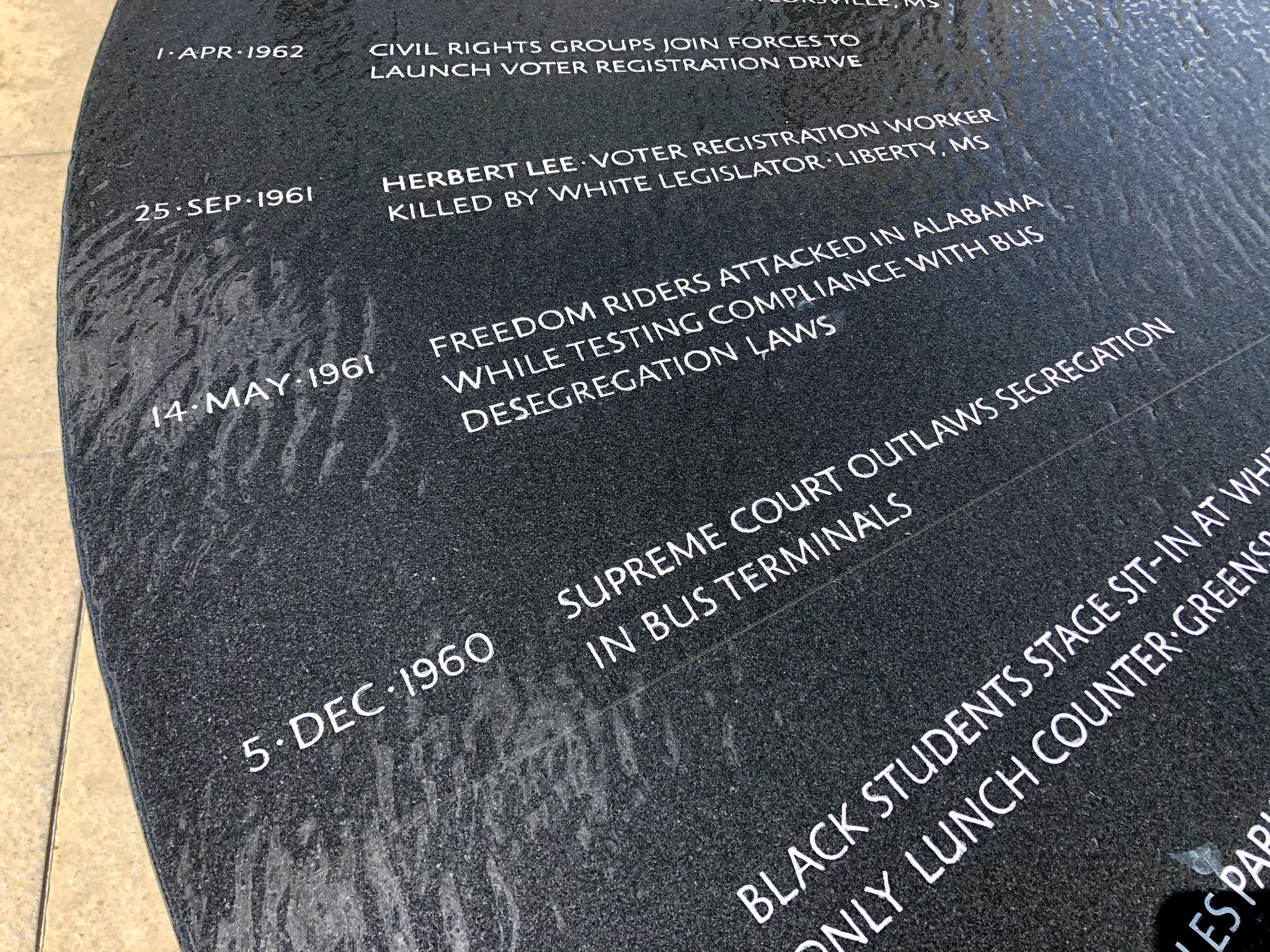
Civil Rights Memorial. Montgomery, Alabama.
I think one of the things about the South's history of segregation that is the most upsetting for me is this history of separate but equal (but really unequal) accommodations for white and black (or "colored" as the signs back then would say) people. Drinking fountains. Hotels. Restaurants. Entrances to buildings. Waiting rooms in bus stations. You name it. It is a concept that is laced with passive aggression that continually let one group of people know they were not in any way in charge. It's uncomfortable. It's demeaning. It's obviously not right. We saw some of this in museums, particularly in the Birmingham (Alabama) Civil Rights Institute. The only place we really saw this in person was in our time chasing the story of the Freedom Riders. But we'll get to that soon.

Eventually, other lawsuits not related to states and towns and the Fourteenth Amendment (since there was already legal precedent from Plessy v. Ferguson) started to make their way through the legal system and some of these also found their way to the highest court in the land. In 1946, in the case of Morgan v. Virginia, the Supreme Court agreed with the NAACP's argument that segregated seating sections on a Greyhound bus that crossed state lines (key distinction there) violated the Interstate Commerce Clause of the Constitution. As of that ruling, separate but equal or unequal or just plain separate seating sections based on race on interstate buses were no longer legal anywhere. Problem solved, right? 

Not so much. A decision of the United States Supreme Court was one thing. Actually getting states to change the rules was another. Nothing changed. Because nobody forced any change.

Fourteen years after Morgan v. Virginia came Boynton v. Virginia. The ruling by the Supreme Court in that case held that separate eating facilities in bus stations serving interstate travel violated the Interstate Commerce Act. So in addition to separate seating areas on buses being illegal, so were separate accommodations in stations, including waiting areas, restaurants, bathrooms and drinking fountains. Now the problem was solved, right? 

Still no. Nothing changed because nobody in the south was inclined to change anything. States from Virginia on south continued to enforce separate facilities based on race just because that's what they were accustomed to and it was what they believed was right. And the Federal Government wasn't really inclined to make them change.

The corner of Fourth Avenue and 19th Street North, Birmingham, AL.
So if the Feds weren't going to do anything, the Congress of Racial Equality (or CORE), a civil rights organization founded in Chicago in 1942, thought it might be a good idea to force the hand of the Federal Government a bit by deliberately complying with the rulings of Morgan v. Virginia and Boynton v. Virginia. That would mean sending black and white volunteers into the South sitting side by side on buses crossing state lines. And having black volunteers sit up front where custom dictated only whites should sit. And when they got to bus stations in the South, they would ignore the illegal separate accommodations and use the same waiting areas and eat at the same restaurants and use the same restrooms.

On May 4, 1961, 13 volunteers (including future United States Congressman John Lewis) boarded two buses (one Greyhound bus and one Trailways bus) in Washington, D.C. bound for New Orleans. Those 13 were the first Freedom Riders. They passed through Virginia, North Carolina, South Carolina and Georgia before crossing into Alabama. Things got bad when they got to Alabama. Not that there weren't incidents before that. But when they passed into Alabama it got really bad.

Those first Freedom Riders were a deliberately diverse group. They were black and white, men and women and ranged in age from 18 to 61. That diversity was important. This was not one segment of society taking a stand. Plus they needed people of different skin colors to they could deliberately sit next to one another.

The first stop in Alabama was in the town of Anniston. The Ku Klux Klan lay in wait; they were determined to not let the Freedom Riders leave the state of Alabama, which really meant they intended to kill them. For riding a bus.

When the Trailways bus arrived in Anniston, eight Klan members boarded the bus and beat some of the Freedom Riders unconscious. Just like that. Hand to hand beating of some people who didn't fight back until they were no longer conscious. The Greyhound bus and its riders weren't so lucky. That bus had its tires slashed in Anniston and was stopped a bit outside of the town. 30 to 40 cars (!!!) worth of Klan members following the bus threw a firebomb into the disabled vehicle and then barred the door so the Riders couldn't escape. It didn't work; everyone got out. But the Klan intended to burn people alive inside a bus for doing absolutely nothing except riding that bus. 

We didn't visit Anniston. We just didn't have time. But in the aftermath of the bombing, a 12 year old girl got the Freedom Riders some water after they escaped the bus. The Klan discussed retribution against the girl but ultimately decided she was too young. It is a measure of the character of the people in the KKK, I think, that they even had a discussion. How many years too young was she for a group of grown men in hoods to hold off punishing her? One? Two? I'm thinking it's not much more than that. And what would be the punishment? Lynching? The Klan liked lynchings. Or maybe burn her parents' house down? That was another Klan favorite.

Burned out Greyhound bus. National Civil Rights Museum, Memphis.
There is a marker on the corner of Fourth Avenue and 19th Street North in Birmingham to mark where the Trailways bus from Anniston arrived in Birmingham. It is an ordinary street corner in a city today. But when the bus carrying the Freedom Riders arrived there in May 1961, it was the scene of one of the more vicious confrontations in the whole Civil Rights Movement. A group of Klansmen was waiting for the Freedom Riders with baseball bats, pipes, bicycle chains and if nothing else just their fists. And the Klan just beat the Freedom Riders near to death when they exited the bus.

I can't wrap my brain around how you attack another person with this level of violence for doing nothing except riding a bus with someone of a different skin color who you happen to feel is unequal. I don't know what makes someone continue to beat another human being who is not fighting back at all. To the point of death if necessary. 

Eventually, the Birmingham police showed up. They had coordinated with the Klan to allow them 15 minutes to do whatever they wanted to do to the Riders. The FBI had infiltrated the Klan in Alabama and also knew what was going to happen and did nothing. Let me repeat that: the FBI knew there was going to be an attack on defenseless people doing nothing more than following a federal law that Anniston and Birmingham were refusing to endorse and they didn't stop it.

I think we often think of John F. Kennedy as a progressive, compassionate, forward-thinking president. And maybe he was for his time. The press coverage of the attacks in Anniston and Birmingham forced him to act but he wasn't happy about it. He considered the Freedom Riders unpatriotic and resented that the Riders were making the United States look bad on the world stage. He tried to make it go away by convincing those organizing the Freedom Rides to stop. They wouldn't. The first Freedom Rides did stop in Birmingham after the attacks in Anniston and Birmingham but less than two weeks later, 20 students from Nashville boarded a Greyhound bus in Birmingham bound for New Orleans. Kennedy arranged for the Alabama State Highway Patrol to provide an escort.  

The old Greyhound bus station in Montgomery, AL. Now the Freedom Rides Museum.
When the bus reached the Montgomery city limits, the escort disappeared. The Montgomery police, which had promised to protect the Freedom Riders, were not at the Greyhound station when the bus arrived there at 10:23 a.m. on Saturday, May 20. But a lot of white people were. John Lewis described the scene this way:
"Out of nowhere, from every direction, came people. White people. Hundreds of them...as if they'd been let out of a gate. They carried every makeshift weapon imaginable. Baseball bats, wooden boards, bricks, chains, tire irons, pipes, even garden tools - hoes and rakes."
Of course the result was the same as it was in Birmingham: white people beating black and white bus riders who were offering no defense. Jim Zwerg, a white college student from Fisk University, was beaten unconscious and had his teeth knocked out. When John Siegenthaler, an assistant to United States Attorney General Robert Kennedy who was sent to Montgomery by the Kennedy administration, attempted to intervene to assist two of the Riders, he was knocked unconscious by a man with a metal pipe.

There was one difference between Birmingham and Montgomery: the press was out in force in Montgomery. So the crowd took care to smash any equipment that would record the events that happened outside the Greyhound station before they started their assault. Then there was no difference between Birmingham and Montgomery. Although Montgomery lasted longer.


The beatings encountered by the Freedom Riders in Montgomery on May 20, 1961 was the last of its kind. After that day, the Kennedy administration made a deal with the governors of Alabama and Mississippi whereby law enforcement would protect the Riders from mob violence in exchange for those states being able to arrest the Riders for breaking local laws. Yes, you read that right. The federal government agreed to allow people breaking local laws (that were in violation of federal laws) to be arrested.

Standing in the Freedom Rides museum in downtown Montgomery today learning about all this history is just crazy. It's crazy that any of it had to happen at all but the hatred involved and the sheer viciousness in these attacks is just shocking. It's also incomprehensible to me that the federal government has to agree to let states violate federal law just to stop violent mobs beating people doing no harm and complying with the law.

The other perspective I gained from the Freedom Rides Museum is standing in a place that was once segregated and being able to see where white people were allowed to go that black people were not. When you first walk into the Museum there is a floor plan of the original bus station on the wall. From that spot you can see where the white waiting room was and the "colored" waiting room was. You can do the same for the bathrooms. Just feeling where those invisible barriers were that were rigorously enforced was pretty creepy. This was less than 60 years ago that this stuff was in place. 

If you look at the front facade of the old Greyhound station today, there is an entrance door just to right of the center of the building covered with a canopy. To the left of that there is another opening that looks like it has been closed up. You can still see the stone trim that defined the edge of the opening. That was the "colored" entrance (no canopy of course). Different skin color. Different door. It's craziness. All to let one group of people know that they were inferior in the eyes of those making the decisions in our society. We got this perspective nowhere else on our trip. Nowhere else did we feel this aura of separation from 50 or 60 years ago in quite the same way.

The former "colored" entrance to the Montgomery Greyhound bus station.
After May 20, the Kennedy administration wanted the Freedom Rides to go on hold for a while. Just sweep it under the rug for a while. CORE and SNCC (or Student Non-Violent Coordinating Committee) didn't agree. They continued to send Riders throughout the summer and most all of those people ended up unjustly arrested and held in Parchman Farm, Mississippi's maximum security prison. 

I think it's worth thinking about the situation the Riders were putting themselves in. At best, they'd end up arrested and sent to prison. And a really dangerous prison at that. At worst, they would end up being beaten within an inch of their lives or actually dead. Some of them actually made sure they had an up to date last will and testament in place in the event they were killed. For riding a bus. The reward was ending desegregation in bus stations in the South. For this, they were willing to die.

On November 1, 1961, under threat of demonstrators descending on Washington, D.C., and after CORE and SNCC had sent hundreds of Freedom Riders into Mississippi prisons, the Interstate Commerce Commission finally issued direction to desegregate bus stations. Who knows how long it would have taken for this to happen if the Kennedy administration and the federal government had convinced the Freedom Rides organizers to pause or stop. Finally those signs in bus stations in Virginia and points south separating people by skin color would be coming down. I imagine the days those signs actually were removed felt like a little bit of a victory.

I keep thinking about what the atmosphere on those buses must have been like. Think about it. When and how and where was the next attack coming from would be all I'd be thinking about. And if I'd make it out alive or be sleeping in a hospital bed that night. And how much pain I'd be in after being beaten. These are not things I want to think about. There is a long list of people associated with the Civil Rights Movement whose courage I admire. The people that took those bus rides into the South in 1961 knowing they might never come back are definitely on that list. 

The Freedom Riders sang songs on the buses to help them through the rides and (I'm just speculating here) put off some of those thoughts that I would be wondering about while seated on one of those buses. One of those songs was called Hallelujah, I'm A Travelin' which is why it's the title of this blog post.

How We Did It

A search for sites related to the Freedom Riders is not going to turn up a whole lot. Sure, there are exhibits in museums like the National Civil Rights Museum in Memphis and the Birmingham Civil Rights Institute that cover the subject matter and provide essential background. In many ways, a tour of multiple cities and sites (and museums) in a few days reinforces stories like the Freedom Rides where little physical evidence of what took place actually exists. There is a brand new (as of this writing) Freedom Riders National Monument in Anniston with two sites (the old Greyhound station and the location where the bus was firebombed) but neither site right now is anything more than a drive by.

We chased the Freedom Riders in two cities: Birmingham and Montgomery, both in Alabama. There is little more in Birmingham than the Freedom Riders sign shown in the blog post above but if you are in town anyway to visit the Civil Rights Institute, Kelly Ingram Park or the 16th Street Baptist Church, it's worth a stop for a quick picture.

In Montgomery, we spent some time walking through the Freedom Rides Museum on South Court Street about a half a mile from the Alabama State Capitol. The Museum is open Tuesday through Friday from 11 a.m. to 4 p.m. and noon to 4 p.m. on Saturday. It's a pretty small museum; really just one room with a series of narrative exhibits. But the real value for me was standing in a building still bearing the evidence (albeit very difficult to interpret) of a segregated station. I found it way worth the visit for that sensation alone.