
Over the past almost six years, I've taken some amazing trips into nature. Some of these trips have involved exploring the natural features of our planet like forests or glaciers or mountains or even white sand dunes. Others have focused on wildlife, most notably in sub-Saharan Africa, the Galápagos Islands or here at home in Alaska (bears and bald eagles among others) and North Dakota (bison!). But I've never taken a birds-only focused trip. That is, until we went to New Zealand.
Now, I've never been much of a bird watcher. Call me unimpressed with the birds that have lived around me everywhere I've lived. Sparrows, robins and starlings? Can't go for these small, brown non-descript birds (I get that the robin has some red on it). Blackbirds and crows? Yawn! Sure every once in a while there's a cardinal or a hawk or something but the birds in suburban England, Connecticut and Washington D.C. never got me that excited.
But in the past couple of years, some things have changed about my appreciation of bird life on our planet. First, I saw my first in the wild toucan two years ago while eating breakfast down in Mexico. If there's a bird I love more than the toucan, I don't know what it is. The one we saw near Chichen Itza was right at the top of a palm tree so our look at it wasn't amazing. I have to find a way to get more of these birds in some future trips.
Then last year I made my second (of many, I'm thinking...) trip to the southern half of Africa and my eyes were opened. Not by the ostriches and the marabou storks and the secretary birds that I had on my must-see list but by the smaller birds: the fish eagle, the carmine bee-eater, the lilac-breasted roller and even, perish the thought, the vultures. These are some impressive creatures. I started to warm to the idea of bird watching. Enter New Zealand.
 |
| A variable oystercatcher on the beach of Ulva Island. |
But New Zealand went one better here; there are also no land mammals endemic to any of the islands which make up this country, meaning the birds there were at the top of the food chain. And that led to some unusual things happening. Like birds there being the top dogs. Many, many species just got so complacent about the lack of danger that they just ditched their ability to fly. Heck, in some cases they lost their wings entirely. That's not to say that all birds in the country don't fly. Some certainly do and some are master aviators. But there are a ton that don't.
So where does one go to see birds in New Zealand? Well, seemingly anywhere you want but there are enough sanctuaries scattered throughout the nation that you are bound to be close to at least one. I'd suggest you go and see what this country has to offer. Even if, like me, you've never even been interested in something like this. There are no more 12 foot high flightless moas around (the Māori took care of wiping them out) but trust me there's a lot that's interesting. Maybe by the end of this post, you'll want to go find some of these things too.
 |
| This is the only kind of Moa you'll see outside of a museum in New Zealand these days. Good stuff! |
It seems like the appropriate place to start when talking about birds in New Zealand is on the ground with maybe the country's most famous avian resident, the kiwi. I'm not going to do that because I've already written an entire post about our epic night quests to find these funny birds. But there are plenty of others that can't fly like the takahē, the pukeko and the weka. And yes, there are penguins, but we'll come back to them.
 |
| The motto of flightless birds everywhere. Rotoroa Island. |
There used to be nine species of flightless moa on New Zealand. Go to the Auckland War Memorial Museum and you can see skeletons and reconstructions clad with emu feathers on some of them to get an idea of their shape and size. There is no accurate record of exactly what these birds looked like. By the time people with an interest in preserving that kind of record got to New Zealand, the birds were all gone. I'm sure there are probably other species that perished along with the moa. Those that survived were either lucky or fast or isolated or cute enough that people started caring about that they might be destroying before it was too late.
There are two critically endangered species of flightless birds in New Zealand: the kakapo, a comical looking flightless parrot (which we did not see) and the takahē (which we did). Want to find either of these birds in person? Get off the main islands, because all the known specimens are now isolated to predator-free islands off the main coast of New Zealand.
It is likely that there are fewer than 200 living kakapo today but at one time, the takahē wasn't so lucky: it was actually declared extinct in 1898. I guess some folks refused to believe this declaration, figuring that New Zealand was unexplored enough that there might be one or two last ones out there. They were right; 50 years after the last known member of the species died, a group was found in the Murchison Mountains in Fiordland National Park. All 347 alive as of October 2017 are descended from this single group.
 |
| Takahē, Rotoroa Island. |
The takahē definitely owe their survival to luck and isolation (the kiwi probably fall into the cute enough to care category). One of the other birds we found on Rotoroa, the weka, probably owes its existence to adaptability, healthy breeding (up to four broods of chicks per year!!) and speed. Weka are not as remarkable physically as the takahē, sporting speckled brown feathers on a two foot long body, but they are for sure fast. We were warned of the weka's curiosity and penchant for theft when we landed on Rotoroa and seeing some around the island I can believe their speed did enough to keep enough of them alive when they didn't have the Department of Conservation looking out for their welfare.
 |
| Weka, Rotoroa Island. |
So what kind of birds can you find on Ulva Island? Well, it all depends on where you are. Spend time on the beach and you are liable to find orange and black (all the way down to the eyes) oystercatchers poking around between the rocks in search of food. You might also hear (and you are much likely to hear before seeing) the whooshing sounds made by a New Zealand wood pigeon or two (or three) trying to get the attention of a mate. These are the biggest (and likely most attractive) pigeons I'd ever seen in my life and their mating ritual, which involves flying noisily about maybe 10 feet above the forest and then seemingly falling straight down into the woods like bags of wet cement was the strangest way I've seen to garner the attention of the opposite sex. Although we humans do some pretty odd things too.
But if you want to get a good look at an incredible array of gorgeous species, most of which are about impossible to photograph, head into the woods. We missed out on good pictures of fantails, tūī and saddlebacks, although we got blurry ones of the latter two. These things move too darned fast and won't sit still for us tourists. What are they thinking?
 |
| New Zealand wood pigeon. That is not a small tree. These things are bigger than your average pigeon. |
But we did get some great looks at some parrots and some parakeets and that was worth missing out on a good picture of a fantail here and there. Parrots, you say? Aren't those birds found in the tropics, which New Zealand and particularly Ulva Island at almost 47 degrees south latitude (the tropics end at 23.5 degrees), are most definitely not? Well I'm sure they are but New Zealand boasts three species of parrot as well. We saw the kea on our trip to Milford Sound scampering up our car windshield. On Ulva Island, we hoped to see the kãkã, a mostly brown parrot with hints of red and orange on the head.
And see them we did. They are all over the place, sometimes in twos and threes in the canopies overhead. The trees admittedly make it difficult to get a good look at these birds because they tend to stay in the highest branches which makes you look about straight up through tens of different limbs to see a darkish colored bird clambering about a long way from the where you are on the ground.

But stay after it and you might find one from the right angle on one of Ulva Island's paths to get a great look and some good pictures. We managed to do that with the bird shown above, who we watched clamber about the branches of trees for about 15 minutes until he or she decided to stop and strip some bark off the limb above, presumably in search of food. The lighting in the back of the kākā almost makes it seem like I've pasted the bird into the photograph but that's not true. Thank goodness for the fantastic camera that we brought with us. The Nikon COOLPIX P900 we bought a couple of years ago continues to pay dividends.
This is the first trip I have ever taken where I've seen parrots in the wild (and yes, we also saw some parakeets on our day trip to Ulva Island) and while the kea and the kākā do not have the colors that some of the more famous parrots from Central and South America, it was something I wouldn't have expected to see this far south on the globe. Need to make sure I make a note to see some of their cousins on a future trip, right below the toucans on that same list.
 |
| New Zealand parakeet or kākāriki, Ulva Island. |
I've seen plenty of seabirds on any number of trips out to watch whales or on ferries or fishing boats (I was way younger when that happened) or even on a massive cruise ship off the coast of Alaska and Canada. Heck, I've even seen plenty of them from the shore in many locations including most recently off the coast of Washington state. But I've never seen anything like we saw off the coast of New Zealand this past March.
All told, we spent about 90 minutes way out on the ocean off Oban in a small boat with a skipper, two other passengers and a giant orange bucket of chum. No, we were not out searching for sharks or something like that but we were looking for something with a voracious appetite. We also deliberately went on a windy day because the windier it is, the greater the chance of seeing some of the largest birds on our planet: albatrosses.
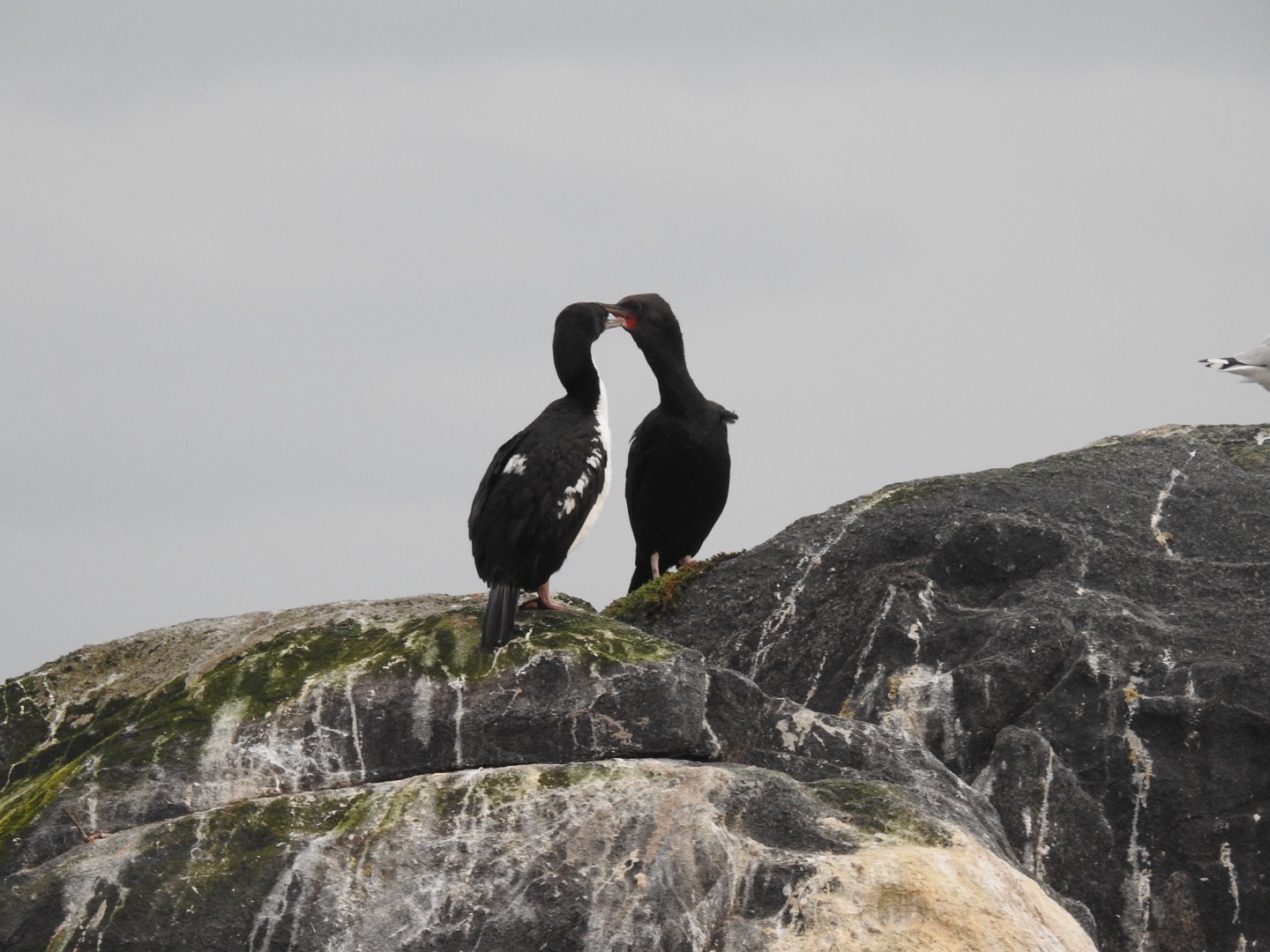 |
| Not an albatross. Two shags on the way out to find the albatrosses. |
There's a romanticism to the life of an albatross. I'm sure some of my personal fascination with these birds comes from one of my favorite poems ever, Samuel Taylor Coleridge's The Rime of the Ancient Mariner, where the protagonist of the tale shoots and kills an albatross, a traditional bringer of good luck, with his crossbow and brings ruin upon his whole crew and himself. I was pretty sure we were in for none of that on our couple of hours ride out of Stewart Island.
Outside of the mythology surrounding Coleridge's slain albatross, these creatures are the ultimate ocean flyers. They can stay for months out on the open water, flying as much as 100,000 miles or more in a single year. Basically when they are not breeding or raising chicks, they are in flight or at rest on the open ocean. And that's over the course of 40 plus years for some individuals, meaning over a typical lifespan, they can travel 40 million miles or more. And they are enormous. Royal albatrosses can reach wingspans of about 12 feet.
I've been on a number of nature trips where the conventional wisdom was that we would see tons of whatever type of animal or bird we were hoping to spot and found instead pretty much nothing. If there's a bird that symbolizes this sort of futility, it would be the flamingo, a bird I've chased on three continents without a close look at the species in mass. It would not be that way with the albatross this past March. After all, we had a bucket of chum consisting of some choice blue cod scraps. What could go wrong?
 |
| All eyes on the chum. 11 albatross waiting for a free snack. There are others off camera. |
I hate the notion that I am participating in any activity that turns wild animals into beggars but let's face it, that's pretty much what I did on this day. I guess we fed a good number of birds but we also did it to get a close up look at them, including the way they squabbled over the fish thrown into the ocean.
The albatross we saw that day were primarily lesser albatrosses or mollymawks, although we did see maybe one or two Buller's albatross. The mollymawks are not the giant albatrosses we had hoped to find but with a wingspan of about six to eight feet they are not tiny either. When they are at rest on the ocean, these birds are about the most serious looking, well put together animals out there. There is not a feather out of place on their entire bodies, but particularly on their heads. It's almost as if they have been made up super precisely. The eternally furrowed brow and the horizontal line each bird has on the sides of their faces almost makes it seem like their beaks are held on with string which has made an indelible mark on the birds' heads. They also all look exactly the same, although I'm sure all humans look the same to the albatrosses.
 |
| Is this a serious face or what? |
Our boat was followed by a number of different species of birds that morning. After all, it wasn't just the albatrosses that wanted a free meal. Some of these birds, like the shags and cormorants and gulls, worked hard to keep up, flapping their wings furiously to keep pace with the speed at which our engine was propelling us through the water. The albatrosses cruised, barely moving their wings while managing to easily outpace any other bird trying way harder than they were.
This was truly amazing to see. Sure there was a wing flap here and there with the albatrosses but by and large, they floated on the wind in a way that was embarrassing to pretty much every other species of bird out there.
Floated isn't really the right word because it's not like they hung in the air in one spot. They dove and soared closer and further from the water and sped up and slowed down as they wanted to without seemingly moving their wings at all. Now I'm sure that's not quite true. I am positive there were minor adjustments imperceptible to me, that took advantage of warmer and cooler air and strong and weaker currents, or something like that. Their bodies are so extremely well adapted to live in the air on the open oceans. At one point we watched an albatross chasing the boat for what seemed like five minutes (but was probably about three) and the bird didn't flap once. He (or she) just hung and followed. Fast.

If the wind had been stronger that day, maybe we would have seen some larger birds. While the albatross is a gorgeous bird in flight, its landings and takeoffs leave something to be desired. When you get up to 12 feet of wingspan it's pretty much impossible to take off from the surface of the ocean without a pretty strong gust of wind. We were told it would need to be much windier to make the largest albatrosses come close enough to get some free fish. Or we'd need to go much further out to sea.
Before I close this post...a word about penguins. Actually much more than one word. If there was a flamingo of this New Zealand trip, it was the penguin. And you know that doesn't mean anything good.
 |
| Yellow-eyed penguin. The one we saw. And eyes closed of course. :) |
There are a few species of penguin living in New Zealand, predominantly the little blue penguin, the yellow-eyed penguin and the Fiordland crested penguin. We visited Fiordland. We didn't see penguins.
Stewart Island was the furthest south we went in New Zealand so we figured we would have the best shot at seeing penguins there so we asked around when we arrived: where do we see these things?
The answer in the town of Oban from everyone that we talked to (and I really do mean EVERYONE) was that you can spy little blue penguins returning from their day of fishing at dusk down by the town dock. It sounded like a sure thing. We spent three nights on Stewart Island at a hotel not far from the dock so we spent every evening from anywhere from an hour to 30 minutes before dusk to when we couldn't see anything any more alternately scanning the harbor and staring at the rocks near the shoreline looking for any sign of penguin activity.
Know how many penguins we saw down at the town docks? Zero. And we weren't the only people down there. There was a crowd anywhere in size from 10 to 20 people each night. And nobody saw a thing. We are convinced the entire permanent population of Oban watches and laughs at all the tourists each night when they send us all down to the town docks.
 |
| Penguin watching. Or more accurately not penguin watching. |
Now admittedly, we did see two different species of penguin in those seven or so individuals: one yellow-eyed penguin and about six or so little blue penguins. The yellow-eyed penguin was a solitary individual standing on a rock with his eyes closed. Not that we were close enough to see the yellow eyes anyway, but I'm taking our captain's word for it on this species identification. The picture is above. He looks fluffy because he's molting. I assume the rest of the family was out fishing.
And the little blue penguins? Just heads in the water while they were out in the ocean, alternately visible and then invisible as the waves rolled and the boat turned. Never saw a whole one in the three days we were down on Stewart Island. The best look we got at these birds is shown below. The look was so poor that I had to post a picture with a piece of my finger in the upper left corner.
 |
| Two little blue penguins. |
We came to New Zealand to see birds and we obviously saw tons. It is rare that I include 16 pictures in a single blog post but this one has that many (admittedly one is of a glass of beer) which I think is a testament to the quantity and quality of bird sightings we had. And I had to leave some pictures on the cutting room floor. We saw pretty much everything we wanted to see in New Zealand except for tons and tons of penguins. And even then, we did see penguins. By every account this trip was fantastically successful from a bird watching standpoint.
I'm not sure when the next bird watching trip is. It certainly isn't likely to be in 2019 with our trips for the rest of the year planned. But one thing is for sure: what started in Africa got stoked here a little in New Zealand and I now have one or two more birding trips in me I'm thinking. Got to get some more toucans at least into my future.
How We Did It
Our birdwatching activities in New Zealand ranged over the entire country but were pretty much concentrated in two spots: Rotoroa Island and Stewart Island. I've already detailed how we got to Rotoroa Island when I wrote about tramping in New Zealand so I'll refer you to that post for how we did it.
We stayed on Stewart Island for three nights which made our trip to Ulva Island and our morning albatross-watching trip convenient for us. We took the Ulva Island Ferry over to Ulva Island first thing in the morning (at 9 a.m. if I'm remembering correctly) and took the 2:15 p.m. ferry back which gave us about five hours on the Island itself. I'd say that was about the right amount of time over there. If you go over lunch, take your own and bring everything back with you; there is no food for sale on the island and you shouldn't leave any trash over there. The Ulva Island Ferry leaves from Golden Bay. Check the Stewart Island website for the latest schedule and cost before you go. There are precious few places to buy lunch to go first thing in the morning but the Four Square grocery store in town sells pre-made sandwiches.
There are also water taxis available from Stewart Island if you want to go on your own schedule. I can't recommend those because we didn't take one except as noted below.
For our albatross and penguin (barely) watching trip, we booked ahead before our arrival with a company who cancelled the trip on us due to weather. Or more accurately said they were thinking about cancelling and then never texted us as they promised. We switched to Rakiura Charters and booked their half day Pelagic Bird Tour which was outstanding. Everyone we interfaced with at Rakuira Charters was fantastic and our captain, Mack, took great care of us while we were out on the water. I can't say enough good things about this company. The cost of the tour wasn't cheap, but then neither is any other tour on Stewart Island. If you need a water taxi to Ulva Island, Rakiura can take care of that for you also.
Our birdwatching activities in New Zealand ranged over the entire country but were pretty much concentrated in two spots: Rotoroa Island and Stewart Island. I've already detailed how we got to Rotoroa Island when I wrote about tramping in New Zealand so I'll refer you to that post for how we did it.
We stayed on Stewart Island for three nights which made our trip to Ulva Island and our morning albatross-watching trip convenient for us. We took the Ulva Island Ferry over to Ulva Island first thing in the morning (at 9 a.m. if I'm remembering correctly) and took the 2:15 p.m. ferry back which gave us about five hours on the Island itself. I'd say that was about the right amount of time over there. If you go over lunch, take your own and bring everything back with you; there is no food for sale on the island and you shouldn't leave any trash over there. The Ulva Island Ferry leaves from Golden Bay. Check the Stewart Island website for the latest schedule and cost before you go. There are precious few places to buy lunch to go first thing in the morning but the Four Square grocery store in town sells pre-made sandwiches.
There are also water taxis available from Stewart Island if you want to go on your own schedule. I can't recommend those because we didn't take one except as noted below.
For our albatross and penguin (barely) watching trip, we booked ahead before our arrival with a company who cancelled the trip on us due to weather. Or more accurately said they were thinking about cancelling and then never texted us as they promised. We switched to Rakiura Charters and booked their half day Pelagic Bird Tour which was outstanding. Everyone we interfaced with at Rakuira Charters was fantastic and our captain, Mack, took great care of us while we were out on the water. I can't say enough good things about this company. The cost of the tour wasn't cheap, but then neither is any other tour on Stewart Island. If you need a water taxi to Ulva Island, Rakiura can take care of that for you also.


