Showing posts with label Greece. Show all posts

Thursday, December 28, 2023

The Oracle

I can imagine running a city is a tough job. The administration. The politics. The bureaucracy. Endless requests from constituents. Keeping everything operational. Making tough decisions that are instantly questioned by just about everyone. Where do rulers or mayors or governors or doges or kings or dictators or whomever is in charge of these places go for some good, sound advice? It must be really challenging. 

I am sure these days that advice comes from everywhere and everyone whether it's sought after or unsolicited. Well maybe not for dictators, but everyone else probably. I'm guessing a bit on that one. But I do know that it didn't always work that way in Greece. And by Greece, I mean Ancient Greece. Like 2,500 years ago ancient. Maybe a bit more recently too. Like maybe 1,600 years or so ago.

If you were in charge of Athens or Naxos or Corinth or some other city-state back in the day (the day here being the roughly span of years cited above), there was a place you could turn to get some advice on whatever might be troubling you. Wondering when to plant crops? Or if you should start a war with a fellow city-state? Or maybe had some personnel dilemma going on in your life? Go to Delphi. Go see the Oracle.

Need a frame of reference here? Think The Matrix. Remember when Neo visited the Oracle and she told him he wasn't the One even though he turned out to actually be the One? Same deal. You wanted a prophecy or some advice in Ancient Greece then you visited the Oracle at Delphi. The Oracle, by the way, was the place, not the person. The person was a Pythia. 

Now, if you decided to make the trip to Delphi, you'd have to do more than just show up and ask for some counsel. First, you'd need to sacrifice an animal. Go get yourself one of those and throw some cold water at it and see if it shivered. It did? GOOD! It's suitable for sacrifice, but maybe not completely good enough to get some of your questions answered. For that, the organs of the animal would need to get checked out by a priest. Cleared that hurdle? GREAT! Now you can ask some questions.  

The questions answering though...not really a straightforward exercise. You wouldn't likely get a simple answer. It might be cryptic. It might be a series of words that could be arranged in different sequences to mean different things. It might seem to be completely useless. But what would you really expect from the Pythia, a woman who was inhaling methane or ethane or something else coming out of the ground that was addling her brain and making her barely coherent. Not kidding. That's the way the system worked. Remember the Oracle in The Matrix. Same deal. Well, except maybe without the gases but who knows really what went on before Neo knocked on the door.

Sounds like a crazy way to make important decisions, right? Is it any crazier than taking advice from the MyPillow guy? Think about that carefully before you answer.

Nobody really knows when the Oracle at Delphi was founded. There is a good amount of certainty that the place was around and fully functional in the 8th century B.C.E. but some feel it was founded a full 600 or 700 years earlier than that. But whenever it was actually established and like most things Ancient Greek, there's an origin story or myth that explains the whole thing. And of course, it's totally believable. Totally.

Apparently, around about the time the sanctuary was founded (whenever that was) the god Apollo had an idea that it was about time he had a physical location for the center of his cult. Good idea, right? First step: lay out the foundations of a temple in Delphi. The only problem was he didn't have anybody to staff the place. So he hijacked a ship full of sailors from Crete by appearing to them as a dolphin at first and later (after a divine wind pushed their ship where Apollo needed it to be) revealing himself as a deity and ordering them to serve him. I guess that sort of thing worked for gods. Temple complex staffed! I guess the Pythia came a little bit later. 

Totally believable, right?

The Oracle was shared by 12 different Greek city-states, which took turns maintaining the sanctuary in any particular year on an as-voted basis. I guess the original crew of sailors only lasted so long. Most, if not all, of the city-states that chipped in to maintain the place considered that location to be so important that they regarded it as the center of the world. There's a stone called the navel right at the bottom of the path which begins the ascent to the Temple of Apollo and marks the exact center spot. This place was a pretty big deal. As strange as it seems to think that officials from cities would travel to a temple to listen to the babbling of a drugged-up woman, it happened. Regularly and seriously. 

I mean what I wrote in that last paragraph purely factually, by the way, with no judgement whatsoever. I mean it's not like she chose this path as a career, although I'm sure the idea of the position appeared to be prestigious, if not exactly that healthy. You know...the inhaling gas thing.

The cone-like thing in the foreground is the navel.

The location, by the way, is stunning. It is built most of the way up Mount Parnassas in front of this wall of porous pink and grey jagged rock that serves as this magnificent backdrop to the approach to the Temple (and the Temple itself once you are behind the actual building). Look back the way you came down the hill and it seems like you can see mountains forever as you look out over the rest of the range that you climbed to get there. Pick your amazing view. There's definitely more than one choice at Delphi.

We made this climb in October of this year. But our climb was done in a bus. A very large bus traversing what seemed like impossibly small roads through mountains and here and there through the odd town where it seemed like the roads were even more impossibly small. It took us probably three hours to get there from Athens, which I imagine is one of the closest ancient city-states to Delphi. In the centuries long past? No road and no bus. Horse, donkey or walk. Or sail and then horse, donkey or walk. The time to get there with those modes of transportation? Two days or so, depending on the weather. You can actually see the port from the Temple itself. It seems far away but our guide told us it takes about two hours to walk it.

If there was any sort of silver lining to walking or donkeying or sailing back in the old days, it was that you might not have had to bring your own sacrificial lamb (or other animal of choice). The first stop we made on our tour of the site at Delphi was at the remains of an old storefront where you could pick up an animal to sacrifice. Convenient, yes? And if you couldn't afford a sacrificial animal? Well, according to our guide, the shops also sold small animal figurines that served the same purpose. No word on how the organs were examined.

I know what you are thinking by the way. It's that this can't be real. Somehow the centuries have obscured what really happened at Delphi and have replaced the truth with some fabricated nonsense. But apparently, it's true. The whole thing was documented by the historian and writer, Plutarch, who also happened to be a priest at Delphi. If I were a skeptical person, I'd wonder if he made it sound more fantastical that it really was but for the purposes of this post, I'm going with Plutarch. I don't really have much other choice. 

The remains of the old Roman Stoa, where back in the day you could pick up an animal for slaughter.
When the Oracle first started accepting visitors and dispensing advice, they used to receive visitors just once a year, on or about March 9. I know this sounds borderline crazy but the vapors or gases or whatever it was that the Pythia was inhaling coming out of the rock inside the Temple of Apollo were either toxic or damaging or both and really and truly, some rest between sessions was the best thing for the Pythia to stay alive long-term. 

That last nugget is a theory, but there is other evidence that suggests it might be true. And it's not my theory.

The ritual was more strange than I've made it sound by the way. The full story we got on our tour involved not only inhaling of gases and speaking words in random order that had to be examined after the fact to find out what they really meant but there were beans (for reading) and laurel leaves (for chewing) involved. I mean this was a full-on, chemical-induced bender. No other word for it. And people and officials of cities paid for the privilege of an audience.

Eventually, maybe the money got to be too much to hold readings or audiences just once per year. Demand was up and so the schedule moved from once a year to once a month, to coincide with Apollo's birthday, which was on or about the 7th of some month. Then sessions became perhaps even more frequently than that. So what happened to the poor woman who needed time to recover? Well, they diversified their workforce and expanded their staff. What else would they do? They added Pythia to keep up with demand and not kill their most valuable publicly-facing asset. Although maybe it wasn't enough to keep them all upright and breathing. More speculation there.


Eventually, it must have gotten pretty crowded in Delphi, what with the increased opening hours and the demand from all 12 city-states that funded the place and even more visitors beyond that. I can't imagine how long some of those lines on the busiest days must have been. What was an enterprising city-state to do to get some more exclusive access? 

Well, that sort of thing was possible. And of course, it involved more money. Or more precisely, the giving of high profile gifts, or maybe (if you were really enterprising) the establishment of a treasury right on site funded by your city-state. Think of it as a frequent flyer benefit. Or a Fast Pass, for you Disney aficionados. Needed to get to the front of the line and get those beans read? Make sure you give a lot. Or keep a stash right on site. Money talks. Hopefully that's not a surprise. 

So what did the sanctuary do with all these gifts? Well, they built. A lot. There is a model of the entire site at its height in the nearby Delphi Archaeological Museum and the place is huge. For its location, the main Temple of Apollo is gigantic, with thick Doric columns six across on the front and back and 15 deep at the sides. It's also spectacularly located about halfway up the last part of the mountain, with its long side the focus of a procession that must have been awe-inspiring for the first-time visitor considering the lore of the place. 

The Temple is not the only thing that the sanctuary built. Once you got to the part of the site where the Temple was located, you'd find other buildings to support the activities at the site including a full theater for performances. Take all that on top of the treasuries and sculptures and tributes that lined the path to the Temple and the place must have been impressive back in the day. 


The Athenian treasury (top). Model of the site in the Museum (bottom). Note the treasuries in the model.

Today most of what made up the Oracle complex is gone. All that's left of the Temple itself is the front six columns that formed the main entrance. Other buildings at the site are largely less complete than the Temple, although the theater is still more visible than that since those kinds of structures in ancient Greece were usually built into the side of a hill. The most intact structure is the treasury erected by Athens, which is standing pretty much complete on the path up to the Temple. Or complete as we think of Greek temples today, completely naked with no additional ornamentation other than the carving of the pieces of stone that make up the building.

Even with most of the buildings missing from the site, you can still get a really good sense of what the Temple must have been like at its height. I know I've said this in every other Greek temples post I've written (meaning two...) but the Greeks were really, really expert at siting a temple on a piece of land. The approach to the Temple of Apollo is masterful and it is obvious how powerful it could have been even with most of what used to be there long, long gone. You can tell from walking up to the Temple front today that the broad side and entrance of the Temple must have been teased and removed from view as you ascended to the plaza right in front of it which must have made that final reveal and arrival seem like a huge payoff. It happens today, just without the long side of the Temple being there. You can see the front all the way up the hill but just not very well until you actually arrive there.

The one thing you don't get from walking up to the Temple today is how big it actually was. Not even when you are standing in front of it do you understand its size. That missing long side really does hinder your ability to do that. But walk a little bit further up the hill and the true size is visible in the entirety of the excavated podium that that Temple sat upon. It's really impressive. That, for me, was the reveal at modern day Delphi that blew me away, especially set against the backdrop of the pink and grey wall and the mountains that went on forever. It is a stunning site.


What's left of the main entrance to the Temple of Apollo (top). View from above (bottom).
What you will find in and around the temple and the treasuries and other ruins today are an assortment of odd stones here and there. Some are decorated and carved, others are not. If you have ever been to a temple site in Greece, I am sure you will have found the same sort of thing. We visited temples each of our four days in and around Athens and found bits and pieces of building fragments at the Temple of Zeus Olympian, the old Athenian Forum, the Acropolis and two temples on AeginaI guess the theory here is that the folks that are excavating and preserving the site are keeping all these things around in case they every get around to putting them all together someday. 

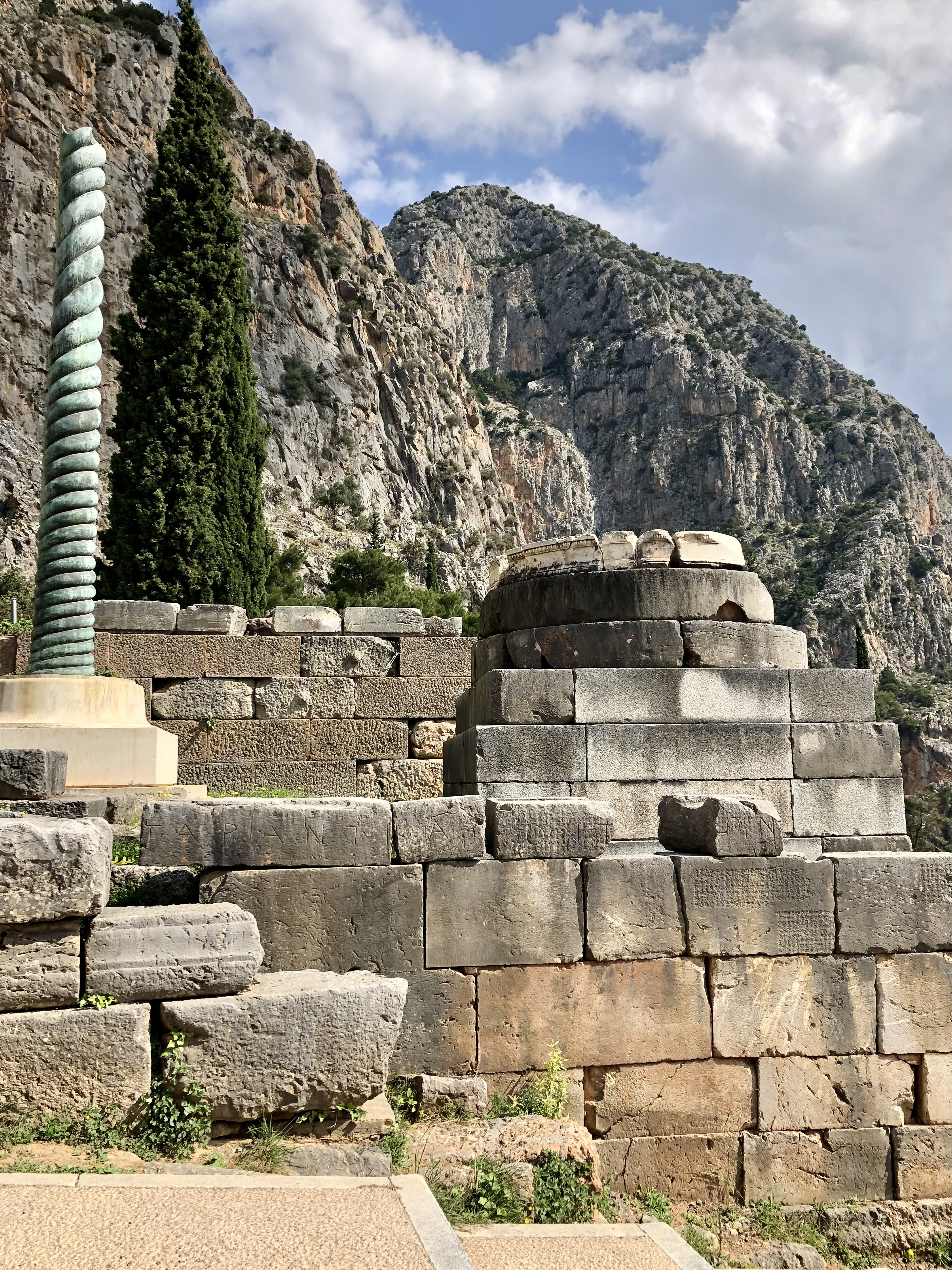
What you won't find in and around the temple and the treasuries is much of the intricately carved ornamentation that covered the site when the Oracle was fully operational. Some of that I assume, like at every Ancient Greek site, has been pilfered and taken elsewhere. Sure, there are one or two notable pieces like intricately worked column capitals or a spiral metal column that used to have a trio of serpent heads at the top are out there near the treasuries. But a good amount of it, including some of the most important pieces, is still at Delphi at the nearby Delphi Archaeological Museum. 

If the Museum held nothing but the model of the reconstructed site when the Temple was at its most successful, it would be worth the visit. But there are a ton of important and mostly intact pieces in the building along with the model. The best piece is a metal charioteer that really shows off the skill of the metalworkers in Ancient Greece but there are pieces of statutes from the pediments of the main Temple of Apollo and life-size statues of men and women from around the site. 

But the most impressive piece for me was the sphinx that stood atop the column right in front (meaning on the side) of the Temple of Apollo. I don't know what it is about sphinxes. Maybe it's the fact that there's a famous one in Egypt (the one at Delphi is not Egyptian) that's on my non-existent list to see at some point in my life. Maybe it's that I don't see them very often (although we did see one earlier on this same trip in Split and that one was Egyptian). Maybe it's that this one is mostly intact and restored to what it would have looked like when it was sitting on top of the column. I don't know exactly but this was my favorite piece. I think it was important to the site and I was glad to see it in the museum.

The sphinx by the way was a Fast Pass item. Placed there by the good citizens of Naxos.


I don't know how we'd have made it to Delphi without joining a bus tour. I suppose you could drive but it would have been a serious effort to get there and the roads are pretty challenging to navigate I'm sure. Easier just sitting in the second to last row of a bus looking out the window and letting someone else do the work. The downside, of course, is that we were on a strict schedule and only had as much time at each stop as the tour company allowed. 

Given the choice and considering we had enough time in my opinion to get the big picture at Delphi with enough detail to make the experience meaningful, I'd opt for the bus ride there and back, even if there was more bus-riding (4-5 hours) than walking around (about 2 hours). It's not like if we had driven ourselves that we would have had more time at the site than driving.

While I was writing this post, I Googled "oracle delphi" (and yes in all lower case letters because that's how I search on Google). Of the first four search results, two came with a picture of a ruined temple similar to the view below. Why am I noting this? Because the view below is not of the Oracle of Apollo (or any other sort of oracle for that matter) at Delphi. But for some people out there, this is the first thing they think of when they think of the Oracle at Delphi. But it's not.

Consider that last part a public service announcement of sorts. 

This is the last of my four posts from our time in Greece. It was altogether too short but considering we combined it with five nights in Croatia we made the most of it. If there was a downside to our time in Greece it was that we did pretty much the same thing every single day (visited Greek temples); if there was a definite upside to our time in Greece it was that we maximized our time at historic sites while also making it to an island and finding a lot of amazing food. I'd go back to Greece and I'd go back to Athens, but I'd definitely prioritize a return trip to Athens as a jumping off point to explore the islands in the Aegean Sea. On to 2024 and new places. Can't wait for the new year.


Wednesday, December 6, 2023

I Am A Rock

There are places in this world that I have spent a lot of time searching the internet trying to figure out the best way to visit for the first time. Not too many places but there are a few that I've come back to again and again. I've definitely game planned Turkey, Easter Island, Southeast Asia, some islands in the Caribbean and maybe one or two other spots ad nauseum. Greece would definitely be on that list. Now, it's no longer on the list because I just got back from there in October of this year.

For my what-if scenario planning for Greece, my debate was always would I island hop for a week and a half between places like Crete and Santorini and Mykonos or would I spend time in Athens and do a bit less island hopping. As it turns out, neither of those scenarios happened. We ended up with four nights in Athens as the end of a week plus in Croatia. No Aegean Sea. No island-hopping.

But I felt I couldn't go to Greece and not set foot on any islands and with Athens being a port town, I figured there must be some way to get out to one relatively close to the city. I figured we'd head down to the Port of Piraeus, jump on a boat of some sort and head out for a half or three-quarters day trip and get a little taste of what I had imagined my first trip to Greece would be like.  

The ferry Antigone, presumably named after the daughter of Oedipus.

We settled on Hydra. We thought the idea of exploring a car-free island would be a cool concept. Until we checked out what there was to do on that island and decided we'd pretty much go out there, eat and come back. Hey, we're not beach people. So, we found one with some temples. Aegina. And it's about to close as Athens as you can get. 

Now, I realize I already posted another blog post that detailed a visit to some temples (the Acropolis). Yes, we had to have more and spoiler alert, there's one more temple post coming. We were in Athens for four days and we visited at least one Greek temple on every day. Aegina was our last. And when I wrote this little island of just 33 or so square miles has some temples, I really mean it. There are two. On that tiny island.

Sometimes it is difficult for me to imagine a geopolitical world that is substantially different from the way it looks today. Today, Athens is the capital city of a country that also includes Aegina. But at one time (like 2,500+ years ago), Athens and Aegina were two separate entities competing with one another. I understand that there was no such country as Greece the way we know it today way back in the centuries before Christ's time. I'm also aware of the fact that Athens and Sparta and Corinth and other places that exist in modern Greece were at one time individual city-states whose people identified as Greek but as citizens of their city first and as Greek second. I just didn't imagine that a tiny island just 17 miles off the coast of Athens would support a society with its own king, its own coinage and that was a successful and flourishing sea power. These things happened back then. The world was a bigger place, I guess. Or is it smaller?

While historical records from the time of the height of Aegina's power in the region are spotty and incomplete at best, their rise to prominence as an important player in the Mediterranean seems undoubtedly related to (1) their ability to field a powerful navy; (2) the abundance of agricultural products on the island, including grains, grapes, almonds, olives, figs and particularly pistachios; and (3) their location along naval trade routes between Greece, Egypt and Asia Minor. Their crops were likely cultivated using significant amounts of slave labor. Just throwing that out there for consideration. Greek society relied heavily on slave labor.

Some of the recorded successes from Aegina are truly astounding. They were the first city-state to issue coins in Europe and they invented one of the two standards of weights and measures in existence in the Greek world. These might seem like small accomplishments but they were actually huge. Think about how essential money and a system of weights and measures were in a world where goods were the primary source of income for most everyone. Aegina was flourishing in the ancient world. Which is probably why they started building more than one temple. 

One of the many, many pistachio stands in the port of Aegina. This one was pretty good.

It's pretty easy to get to Aegina today. So easy, in fact, that we didn't book in advance, and we ALWAYS book in advance. We woke up without an alarm, left our hotel, hopped on Line 3 of the Athens Metro and got off at Piraeus. From there we found a ferry ticket office and bought a ticket on the next available ferry. About 75 minutes or so later, we were about the first people off at Aegina, meaning both the island and the town. The ferry ride is over the Saronic Gulf, by the way. No Aegean on this trip. Maybe next time.

The debarkation point of our trip from Piraeus was the port of Aegina, largest town on the island and the tourist center of everything. The harbor is this picturesque Mediterranean looking harbor with boats of every size; souvenir shops; buildings that serve the residents and visitors to the town; pistachio stands; and an enormous amount of restaurants all fronting opposite the harbor with outdoor shaded seating areas and (at least in the case of the one we picked...) the best Greek salads you've ever had in your life. Everything that happens tourist-wise on the island of Aegina likely starts in the port of Aegina.

The pistachios, by the way, are incredible. We brought a bag back home with us and they are the most delicate, most delicious and lemony nuts I've ever had in my life. I try not to have (or maybe at least try not to dwell on) regrets in life but I have to tell you, I regret not bringing more of these pistachios back home with us. They lasted over a month and I'm proud of the restraint we showed. But if I can get my hands on more of these things, I would in a heartbeat.

The Temple of Apollo's one mostly intact column.

We laid eyes upon the first of the two temples we sought out on Aegina before we ever set foot there. As you approach the island there is a spur of land pointed towards Athens with what looks to be an obelisk fashioned out of some sort of quarried stone. It's not. It's the last surviving column of what used to be the Temple of Apollo, built sometime in the 6th century B.C. 

This particular temple is not much to look at today. Its foundation is completely excavated as are the foundations and remains of surrounding buildings that together made up some sort of Acropolis. It's walkable from the port and is certainly worth the very quick walk out there. I think it took us less than 45 minutes to walk out there, walk the site, take a tour of the nearby museum and then get back to the town. There are certainly ways you can spend a lot more time out there. 

For us, this was about getting a sense of the second temple on our list for the day. I think we got two things out of our very quick visit. First, you can get a lot closer to this ruin than most any other that we visited in our four days in Greece. You can actually walk on top of the base of the Temple itself. Second, when this thing was built and operational, it must have been a spectacular site on the edge of the sea facing out towards the water, welcoming travelers and traders while simultaneously showing off the wealth and might of Aegina. I've said this before (in my Acropolis post) and I'll say it again: the Greeks really knew how to locate a building on a site. It must have been glorious back in the day, before time and particularly the saltwater took its toll on the place. 

But Apollo was not why we came to Aegina. We went to visit the Temple of Athena Aphaia and that would not be walkable from the port. 

Looking from the back of the ruin of the Temple of Apollo to the front and the Saronic Gulf beyond.
The Temple of Athena Aphaia is about as far as you can get on the island of Aegina from the port where we arrived on the island. The island is roughly triangular in shape with the north edge of the island forming one side of the triangle and the two other sides meeting at a point all the way in the south. The port is all the way on the northwest corner. The Temple of Athena Aphaia is about on the northeast corner on the top of the highest point around.

As a bit of an aside here, if you were to draw a line from Athena Aphaia to the Temple of Hephaestus in Athens and another to the Temple of Poseidon in Sounion, the lines would make an almost perfect isosceles triangle, meaning two of the three legs of the triangle are identical in length. Some historians view this as no accident. The Greeks were famous mathematicians (remember Pythagoras and his theorem?) and cartographers so were certainly capable of pulling this off. Check it out on a map. There's no doubt it's true.

Athena Aphaia is supposed to be part of a second isosceles triangle formed between it, the Parthenon and the Temple of Apollo at Delphi. This one I don't see. But the other one? Totally true. No idea if it was intentional. If it was, it's a heck of a feat.

First view of the Temple of Athena Aphaia.
We researched our visit to Aegina pretty thoroughly, despite the lack of an advance reservation on a ferry. We read about some unreliable public transportation that could get us out there if we were willing to work a little. We also looked over some information about scooter and car rental. But the consensus advice to get to the Temple seemed to be to take a cab. Now, you can't very well take a cab out to somewhere like where the Temple is located and then just catch another one back. So the advice was negotiate with a cab driver to take you out to the Temple, have him (or her, I guess) wait for 30 minutes and then have him take you back to the port.

When our ferry docked, we were pretty much the first ones off the boat; made a beeline for the cab stand; asked the first cabbie how much for the Temple, a 30 minutes wait and a ride back; and shook on a rate of 35 Euros, which included a stop at the Monastery of Agios Nectarios. We'd never heard of the Monastery but I had a top price in mind of 40 Euros so something else thrown in for below our top price seemed like a good idea. We might find something we loved, although the promised stop time at the Monastery was just 5 minutes.

About 15 minutes after our ferry docked, we were in a cab on the way to Athena Aphaia.

I have to say I have no idea how you would get to this site any other way than in a cab. The road to the Temple is by no means a straight line and the roads are twisty-turny most of the way. I have no idea if public transportation actually exists to take you from the port to the Temple but if it does, there's no way it's taking you on your schedule. The cab advice was good advice.


When you get to the Temple, there's a small parking area and a ticket booth and pretty much nothing else. Or at least that was the case when we got there. No other buildings, no traffic, no noise and no people. In great contrast to our visit to the Parthenon a few days earlier, there was absolutely nobody at Athena Aphaia when we arrived. Not a soul. There's nothing like getting to an ancient site and having it all to yourselves. We got there just after noon and that's the way we found it. It was pretty awesome.

It's probably been that way for a while. It is thought that the Temple was built around 500 B.C. and it's quite likely that there was not much more there then than there is now. This version of the Temple was built on top of the ruins of a prior temple, which was also built on top of some even older ruins.  The whole place was built as a sanctuary so it wasn't just a temple when it was complete but it's likely whatever was built near it to support the Temple functions didn't house a ton of people.

The Temple today is approached from the parking area to the south. I have to assume the approach in ancient times was the same, otherwise there would be a very steep climb to reach the place from...well, pretty much the sea. The front of the Temple is pointed out towards the gorgeous green-blue of the Saronic Sea and pretty much totally indifferent to the approach of the visitor. Your view of both the Temple front and the water is continually denied until you reach the top of the hill and can all of a sudden see both. Of course, the water is the most enticing and draws the eye immediately, delaying your frontal view of the building.

Every Greek temple I have described on this blog from this trip is the same story. The relationship to the site and to the procession to the temple itself teases and reveals in the same sort of way. It's simple but brilliant. The Parthenon. The Erichtheion. Athena Nike. Apollo on Aegina. Athena Aphaia. All of them the same. It's like they really knew what they were doing. And yes, I know I already said that in this post.


Side view of the Temple, with assorted building parts in the foreground (top); the view from the hill (bottom).
Ultimately, the building itself is pretty simple. It's a straightforward Doric temple (albeit a very well executed one) with six columns on the short side and 12 on the longer face. It's not spatially complex inside (are any of them?) and other than the fact that it's on top of a hill with no obvious way to get materials (and by that I mean giant pieces of stone) up there, there's not a ton to admire or look at. Sure it's well detailed and the location is amazing and the fact that it's still there is a testament to the soundness of the construction. But it's still impressive. Perhaps more so because there's no scaffolding to interfere with the view.

The thing that really gets me here is what this place must have been like back in the day when it was a fully functioning religious sanctuary. I mean how much work was it to even get up there and what would it look like fully painted with a full complement of statuary all over? Yeah, I know, it was all probably just a ruse like most religions are (cynicism there...sorry) but it still must have been so incredible. It must have reflected the might and the wealth of Aegina. These things are emotional to think about.

The sculpture that used to be at the Temple, by the way, is now in Munich. Why? Well, other than the fact that it was stolen by the Germans.

30 minutes. That's what we had at Athena Aphaia. I think the time was the right amount. There's not a ton to see, and 30 minutes allowed for the proper reflection about the history of the place and how gorgeous the place is today. And I know I already bragged about the lack of other people while we were there but we did just miss a tour bus that just pulled into the parking area and dumped its human contents onto the Temple grounds right as we were leaving.

View of some of the inner structure of the Temple of Athena Aphaia.
True to his word, our cabbie got us five minutes at the Monastery of Agios Nectarios on the way back down the hill. I'm not much of a monastery guy but if we had any doubt about the importance of monasteries in the Middle Ages before we took this trip, our stops in Croatia and particularly Dubrovnik (where we saw at least three monasteries) erased all those doubts. Monastic life must have been some sort of sanctuary from a world where everything was a constant struggle. I'm not suggesting that life in a monastery in the middle of the second millennium C.E. must have been a cakewalk but I can appreciate the importance they occupied in life at that time and the dedication that it would have taken to leave your whole world behind to achieve some sort of inner peace.

The monastery on Aegina that we visited was not that. It was built in 1904 but it looks much older and seriously Byzantine. It's not. I guess it's worth a visit. It's impressive as a structure. I especially loved the medallion details over the colonnade on the front face. It was a nice throw in for free but our 30 minutes at the Temple blew away the five at the monastery.

On Aegina, Athena Aphaia was the thing.

The Monastery of Agios Nectarios.

Our trip over to Aegina took us about 75 minutes. I know I already mentioned that. Our trip back to Piraeus lasted a bit more than half that time. On our trip to the island, we noticed a much faster ferry catching and then passing us and we decided right there and then that we'd rather take that one back, even if there was a bit of an extra cost (there was...the ferry there cost 12 Euros each; we paid an extra 7 Euros each coming back). I have to say that the quick trip back was welcomed after a hot day roaming around some temples, particularly the Temple of Apollo in the early afternoon Greece sun.

But sometimes, it pays to take the slow route. I'm glad we didn't know about the high-speed ferry on the way out there because we probably would have taken it both ways. But here's the thing: you can stand on the outside decks on the slow boat; you can't on the high-speed boat. And sometimes standing outside on the deck of a boat gets you a little bonus (I know...I've already covered a bonus for this post but there were actually two). This may seem stupid but our (second) little bonus here involved a half-dozen or so gulls.

Gulls...if there were a type of bird I'd totally be up for skipping watching at all, it would be these birds. I see little value in these things, particularly the really, really common herring gull that seems to be virtually everywhere every time we spend any time at the ocean or sea. Not interested in checking these things out really at all.

Except on this ride to Aegina. We first noticed one or two of them vying for control of the top of the mast on the front of the boat. They must have wanted a free ride on a spot where they could see a lot. I don't know. Eventually, we noticed maybe six or seven more trailing alongside the boat and then dive all at once down to the water. So we looked overboard and noticed tiny little fish jumping out of the water in the frothy churn caused by our ferry and these gulls were diving down and plucking them out of the air. Not fishing. Just skimming the sea and gobbling up those fish that were unlucky enough to decide to exit the water.

I am sure this happens all the time. Probably every day. But we had never seen it. And we wouldn't have seen it at all without taking the slow boat. Sometimes it pays to take the slow boat.


Herring gulls fishing.

Wednesday, November 22, 2023

Say Feta


OK, so I didn't really plan on writing a blog post about the food in Greece. I know. I know. I've written plenty of food blog posts over the ten plus years I've been doing this so it's not like a food post is an unusual occurrence. Japan got one. England got one. New Zealand got one, for crying out loud. I've written about pizza in Italy and cheese in Paris and egg custard pastries in Portugal. Why can't Greece have one too? Well, it can. It's getting one. 

I start this post that way for two reasons. First, it's a get out of jail free card on the photos in this post. I didn't plan on writing a Greek food post so I didn't consciously take pictures to support a narrative. That's not a comment on our expectations for Greek food. I just didn't plan one. 

Second-ly, and way more importantly, the food in and around Athens was quite honestly amazing. Greece deserves a food post. When people ask me where I've traveled and have had the best food, I always say Japan. My answer may now be Greece. It was that good. No joke here. It was incredible. And way, way, way cheaper than Japan.

So before I continue and finish blogging about Greek temples...here goes a food post about Greece. With sub-par photographs.

Souvlaki, anyone?

So, a few big picture themes here: (1) lots of the best feta I have ever had in my life (and I already LOVED feta before this trip); (2) lots of olives (kalamatas, the BEST kind of olives); (3) lots of souvlaki; and (4) lots and lots of history and influences from other cultures that put Greek cuisine where it is today. Combine all of that with an awesome street food scene; low, low, low costs; and good and cheap Greek wine (I'm partial to the malagousia) and honestly, I could spend weeks roaming around Athens eating the food that the locals cook. Seriously impressive.

Now, for sure, we were serious about getting some good Greek grub before we arrived in country. I definitely had feta, pastries made from phyllo, souvlaki and baklava (I know...also made from phyllo) on my list along with a resolution to find the best I'd ever had of each of those foods. I also thought the food was important enough in this part of our Croatia and Greece trip to book a food tour on our arrival day in Athens. We've done this in a few places around the globe and have found they not only get us a good sampling of the local fare, but also get us a feel for neighborhoods around wherever we are traveling in addition to making connections locally and regionally through the history of what's eaten where we happen to be.

None of that makes any sense with my I-wasn't-planning-on-food-blogging statement but whatever. 

Our food tour idea (Greekality's Athens Street Food Tour, if you must know) totally worked as intended. It got us deep into the casual food and street food scene (and I really love some street food) around Syntagma and particularly Monastiraki Squares and gave us a place to head back for both lunch and dinner over the next couple of days. Our guide, Antonia, also gave us advice and tips for our next three days in town and also walked us through the history and some of the etymology of both the places we were visiting and the foods we were enjoying. She also below away some preconceived notions about food in Greece, particularly some things we get wrong over here in the USA.

Let me drop a couple of word origins here to get things going: any word with "aki" on the end is likely a diminutive of the original meaning (Monastiraki Square is a smaller version of an open space near the monastery in that part of town) and the addition of "pita" on the end of a word typically means a pie, particularly if it's a phyllo pie (spanakopita comes to mind here). Antonia also informed us about the dropping of the "s" on Acropolis and metropolis (it's pronounced Acropoli and metropoli in Greek) due to those two words being feminine in gender.

Our guide, Antonia, with some cheese (meaning feta, of course) pie.

So about that food. Let's start with dessert, shall we? I mean, why not. Dessert always comes last. Why not put it first for a change. 

If there was a dessert we had to have in Greece, it was baklava. Layers of phyllo sandwiched over and below layer after layer of finely chopped pale green pistachios and then the whole thing drenched in honey? Yes, please. Sad though it may sound, my measuring stick for baklava was a stall at London's Borough Market and I knew I was bound to get something better than that in Greece. So on the first night in Athens as the last dish of our food tour we were presented with a plate of baklava with orange cake and ice cream.

So was it a better version of the roll of baklava I had in London? No, it was not. And that's because it wasn't the same kind of baklava. The Greeks don't make their baklava with pistachios. They make it with walnuts. The Greeks also throw in a healthy dose of cinnamon when they are making their baklava. But honestly (and despite pistachios being superior to walnuts), it was really, really good. It was actually better than the stuff in London. By a lot. 

That's not to say that there isn't pistachio baklava out there that's better than the walnut variety that we had in Athens but this couple of bites was really good. We did actually find some pistachio baklava on the island of Aegina but that was not as good as the walnut and cinnamon stuff.

In case you were wondering, the Turks make the pistachio baklava. 

Baklava, orange cake and mastika ice cream.

Baklava was just one of four desserts we had on our first night food tour (I'm counting the orange cake and the ice cream as two separate desserts...). The ice cream that filled the left side of the baklava plate was made with mastika, a resin produced by the mastic tree on the Greek island of Chios. Apparently, despite the mastic tree existing in many places in the world, it only produces resin on the Chios just west of the coast of Turkey. I am betting we never find mastika ice cream in any other country in any of our future travels. The stuff you learn when you leave home...

The first dessert we had that night was the most disappointing...something called lukumades, which are deep fried balls of dough with honey topping (think donut holes but a bit larger). I found them too deep fried. They were crunchy when I expected soft and they left me with a greasy aftertaste in my mouth. But they came with a small dose of history: apparently they were served as prizes for the ancient Greek athletes at the first Olympic Games in 776 B.C., which I guess makes the Greeks the inventors of the donuts, at least until someone tells us about an earlier version.

A "single bite" in Arabic is lukma, by the way.

The Lukumades napkin. In many ways better than the actual food.

More food, anyone? With or without history? For sure! The sampling of spanakopita and just plain cheese (meaning feta) pie we started our tour with was the best phyllo with spinach and cheese or just cheese that I've ever had. I don't know how anyone could eat a whole portion of one of these pies but I guess people do. Way too rich and buttery but awesome in single bite form.

The best we had on our first night, though, was a peyrnirli. I know what you are thinking...a WHAT? It's essentially a Greek pizza shaped like a boat, but there's an awesome and sad historical backstory.

The peyrnirli is not Greek. It's Turkish. Shocker, I know. The Turks! Again!

Apparently in the late nineteen-teens and early 1920s the Greeks and the Turks got into a bit of a war. The Greeks started it when they invaded western Turkey in 1919 and the Turks ended it when they kicked the Greeks back to Greece three years later. The Greeks invaded because they claimed the Greek-speaking Orthodox Christian population living in western Turkey needed protection from the Turks. So when the war was over, the two countries agreed to swap parts of their population: the Turks sent 1.1 million Christians to Greece and the Greeks sent 400,000 Muslims the other way. When that happened, the peyrnirli made its way from Turkey to Greece. And in 2023, a couple of peyrnirli made their way from a table to my stomach.

I know it shouldn't shock me because it's happening still all over the world today, but what kind of leaders of nations want to send residents of their own countries away to an enemy and force people in their enemy's territory to uproot their lives and move to a new place? I guess maybe it would be welcomed if those people felt threatened where they lived but why would a nation allow that either? I know there are no good answers here. 

But that's apparently how the peyrnirli got to Athens. It's effectively a pizza in a different shape, right? Although (and I know you can't tell from the picture below) there's no tomato sauce. I love pizza, especially ones with pillowy soft crust that deflates gorgeously when you bite into them like these peyrnirli did. The olive ones were the best. Hey...we were in Greece.

Mushroom and truffle peyrnirli.

This post was never intended to be a blow by blow of our opening night food tour so while there's still time, let's make sure I don't do that.

We got amazing food pretty much everywhere we went in Greece. Whether it was street food or food in a restaurant or eaten outdoors or indoors, we generally loved everything we ate. Maybe not so much the koulouria, or Greek bagels (they were too dry, even when filled with cheese and bacon), but everything else hit the spot pretty much as soon as we bit into it.

It might be odd to reminisce about something as simple as a Greek salad but I'm telling you, the one we had in our four days in Greece was sublime. Tomatoes, cucumbers, feta, capers, red onions and fall-off-the-pit kalamata olives have never tasted so good in a bowl to me. It was so incredible that I ate all the cucumbers (which I do NOT like) without a care. Oh...and no lettuce. Get it right, America.

The best Greek salad ever. EVER.

But after all that, the food that will stick out as intimately tied to our experience in Greece was souvlaki. That's probably because we ate souvlaki four times in four days. It was the main course at dinner on our food tour and it was lunch, lunch and dinner the next three days. 

Let's start with the word, shall we. It ends in "aki" so if Antonia is to be believed, it's a diminutive of some other term. And sure enough, the Greek word for skewer is souvla. Souvlaki, therefore, is a mini skewer. Could be chicken, could be pork, could be beef and lamb mixture. If it's chicken or pork, sometimes it's cut off a rotating vertical spit and it might be called a gyro. If it's beef and lamb mixture, it's ground and cooked on a (small) skewer but it's never cut off the vertical spit and it's never called a gyro. Not in Greece. Not since a ban on beef importation in the late 1960s. No beef gyros in Athens.

If it's served as a sandwich, it's coming in a pita. If it's not, it's just on a plate with some sides. Rice and potatoes, maybe. Not rice OR potatoes. Rice AND potatoes. One starch ain't enough here. Throw in some tomatoes, some sauce (tzatziki) and some red onions and you got a meal. And yes, the sides come in the pita, too. Just not the rice. But for sure the potatoes in French fried form. And maybe a bit of paprika.

Souvlaki, anyone?

I don't think souvlaki was necessarily my favorite dish in Greece, but it certainly had me coming back again and again. There's nothing that's not good about this sandwich. It's quick, it's relatively healthy (ignore the fries) and it's super cheap. Our last meal of the trip was a couple of chicken souvlakis, a water and beer and it cost us less than $10. That's American dollars after conversion, not Euros. Less than $10!!!

If there are three memories from Greece about food, it's the feta, the olives and the availability and frequency of souvlaki meals. This is not complicated stuff. There's not a lot of advanced techniques required to make anything that we had to eat in Athens or in the area around the Greek capital. It's solid ingredients in the place where they are produced that have been paired together successfully over centuries. Other than the food tour, we made about zero effort to find the best Greek food around Athens and it was all fantastic. We've been eating kalamatas and feta every week for the month and a half we've been back from Greece. Can't get enough of this stuff. 

Better than Japan? Best food ever? Maybe. Our range was narrower than it was in Japan, if for no other reason than we spent 3-4 times as long in Japan. But next time someone asks me where is the best food I've ever had on our travels, it's at least Japan with a nod to Greece. 

One last Greek food tidbit. There are olive trees growing in downtown Athens. Greece leads the world in per capita consumption of olive oil. 17 liters per person per year. Serious stuff.

Last souvlaki in Greece. For this year, anyway.

Monday, November 13, 2023

The Acropolis


When we first started looking at a fall shoulder season trip for 2023, we centered our search pretty quickly on Croatia and Greece. I figured we'd pick one and save the other for some time later maybe five or six or more years from now. Hey, you can't always do everything you want with the limited amount of time off from work we get here in the United States so you have to make some tough choices in life sometimes.

But when we started digging into the itinerary a bit, it became apparent that we could probably do both in a nine-night trip if we just confined the Greek portion of our trip to the Athens area. I mean, if we can do Madrid, Barcelona and Marrakech in nine nights in 2014, it made sense to me that we could do Split, Dubrovnik and Athens in the same amount of time. So Croatia OR Greece became Croatia AND Athens.

I'll be honest here. The first thing I thought about when we settled on some time in Athens was that I was finally going to make it to the Acropolis. That was it. Nothing about the souvlaki and the baklava. Nothing about sailing on the Aegean Sea. Nothing about open-air movies. The Acropolis. First thought. Nothing else.

Dionysus (on the right) with a pitcher of wine. Acropolis Museum.

So, I get it. This is completely the thought of an architect (which I am). For as long as I can remember being taught anything about architecture, I've been told two things about Greek architecture. First, the Greeks were the civilization that pretty much invented architecture as a profession. Nobody before the Greeks really elevated and celebrated the architect as an individual like they did in Greece. Second, of all the buildings anywhere in the places that used to be called Greek, the most perfect manifestation of Greek architecture is the Parthenon, which is the main attraction on the Acropolis, the temples-on-a-hill complex right smack dab in the middle of the city of Athens. 

I HAD to go to the Acropolis. Finally.

So after splitting five nights in Croatia between Dubrovnik and Split, it was time to head to Athens. We landed at the airport at about noon on a Thursday afternoon. The very next morning at about 7:45, we were standing in lines (yes, lines) at the gate to the Acropolis waiting to get into what was for me the most obvious and essential thing to do in the city of Athens. Tell me I'm in the wrong here. You can't. Because I'm not.

Looking from the Acropolis back towards to propylaea. 

For me, everything about visiting Athens centered around Greek architecture. Sure, we did want some souvlaki and some baklava. And yes, we also wanted to get to an island off the coast of Athens. And we really did have seeing a movie in the open air on our list (we never got to that one...). But it was really all about the architecture. Love it or hate it, Greek architecture is pretty darned important to the history of building design since the time of the Greeks. 

The Greeks were for sure master builders and they spread their carefully considered and well-thought-out vocabulary of columns and capitals and pediments and triglyphs and metopes all over the Mediterranean as they spread their influence around the region. When their civilization declined, the Romans picked up what they had created and commandeered it for use in a prolific but sometimes clumsy way which spread the Greek architectural gospel even further. 

The collapse of the Roman Empire and the ensuing Dark Ages did no favors for the profession of architecture but what the Greeks had created popped up again during the Italian Renaissance, whose architects revived and re-interpreted what they learned from Greece and Rome. Eventually, those ideas would spread to places like London and the United States, where architects insisted on using what the Greeks had invented for just about everything, including most of the Federal buildings in Washington, DC to courthouses and banks and all manner of structures all over American small towns. This stuff lasted and there's a reason for that. Maybe the American version isn't always faithful to the original but it's out there.

So every so often, it helps to go back to the beginning. Not just with architecture necessarily but that's what I'm referring to here. And for the profession I chose as the means to making my way in this world, the Acropolis is effectively the beginning. So, since we were in Athens, we had to see how to do Greek architecture correctly.

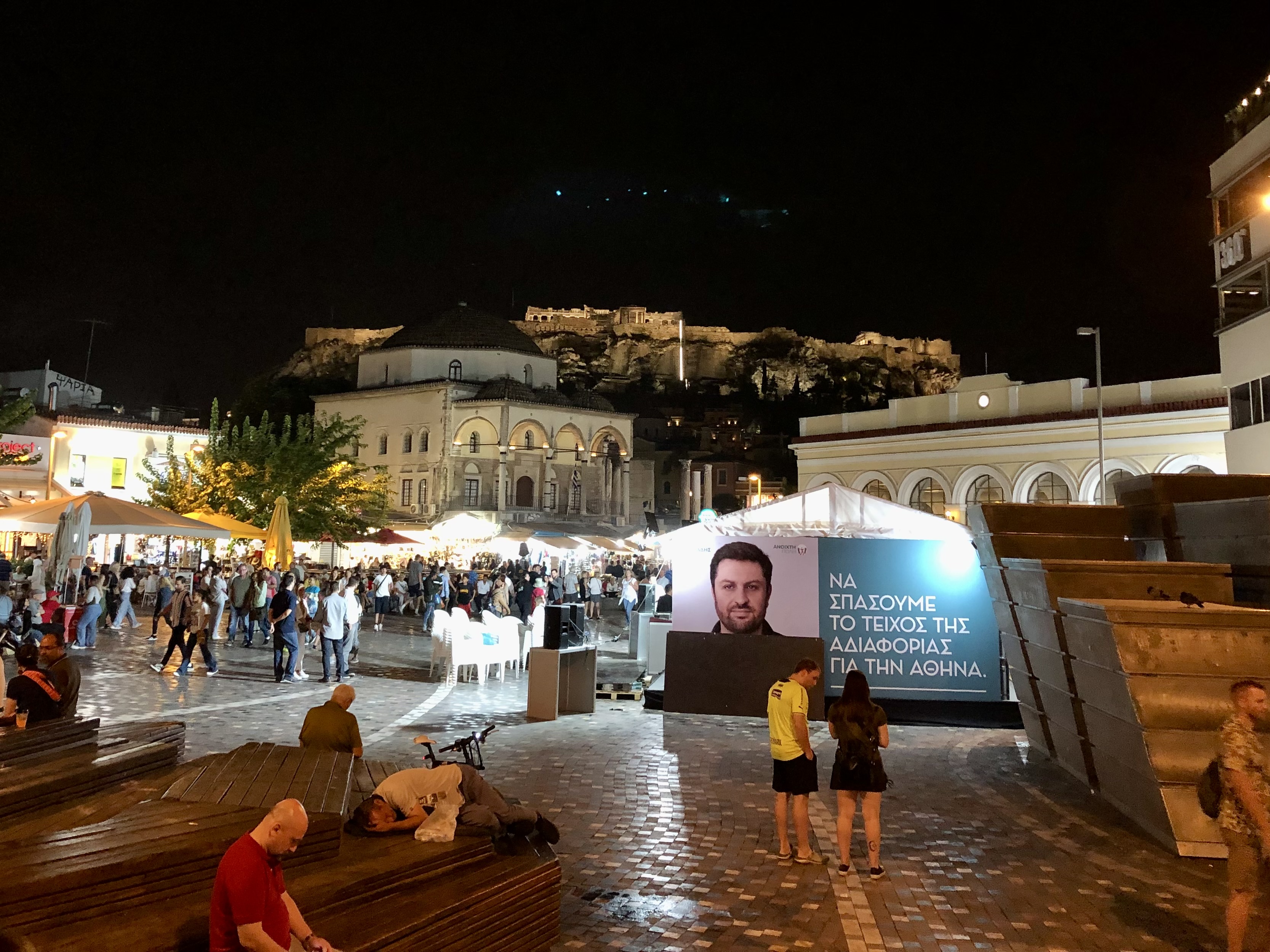
The Acropolis at night as seen from Monastiraki Square.

Before we arrived in Athens, we set ourselves up for as many looks at the Acropolis that we could think of. We found an open-air movie theatre (I know...we should have gone...) with a viewshed to the lighted acropolis at night. We booked dinner at a restaurant that promised framed views of the Acropolis. We even considered staying at one or two hotels with rooftop views to the Acropolis before we checked out the per night price and passed. In short, we conjured up every way we could think of to get a glimpse here and there.

Here's the thing about all of that: you can see the Acropolis from pretty much everywhere in the city center of Athens. The view is amazing and special but it's certainly not rare. Athens is pretty much a flat-ish bowl or plate of a city with one or two very prominent unobstructed hills, one of which is the Acropolis. Seeing it around corners and through gates and in alleyways or over ancient ruins is not an infrequent sight. That doesn't mean it's not special because it certainly is. It's just not rare, that's all. 

We cancelled the dinner reservation with the Acropolis view by the way and ate Souvlaki for less than $10 total for two including drinks. Greek food is cheap. But that's a story for another time.

The Odeon of Herodes Atticus.

I honestly expected big things out of the Acropolis and especially the Parthenon. I mean this place had to be special considering the advance press that I had been fed in like every history and architecture class that I've attended that dealt with ancient architecture. Despite all the anticipation, though, I really expected that I would find it a bit boring. I mean we are talking about a gabled roofed building surrounded by the exact same columns over and over again with just two rooms under the roof. How good could this really be? It's not like we are dealing with anything complicated from a spatial point of view or anything. When it comes right down to it, I'm just not a classical architecture guy.

I shouldn't have doubted. And I'm shocked to be writing that despite how I opened the last paragraph. Maybe that was obvious from the way I finished the last paragraph. The whole Acropolis and especially the Parthenon were just an awesome couple of hours experience. You can't enter the buildings in any way. All you can do is look at the outside. They aren't even all there and all the ornamentation and color is gone. And it was just awesome anyway.

At its simplest level, there's not much to the Acropolis. There's a gate at one end (the propylaea) which you pass through on your ascent up the last part of the hill and when you pass through there are two temples facing you: the Erechtheion on the left and the Parthenon on the right. You are looking at the front corner of the Parthenon and the side wall of the Erechtheion. The side wall in view is the one with the famous caryatids, the six columns carved like women holding up the roof above the porch off the side of the temple. 

After all this time. After learning about this place more than 35 years ago for the first time, that's it. That's all there is. It wasn't always that way but that's how it stands today. There's nothing else up there once you pass through the propylaea other than a small, raised podium at the opposite end of the hill which has some awesome views looking back across the Acropolis. 

And I guess to Athens. I don't know about that last part. I was there to see the Acropolis, not Athens. Didn't even look.

The east side of the Parthenon. Built 447 to 432 B.C.

Before we set off for Athens, I made a list of everything I wanted to really check out at the Acropolis. I figured I'd focus in advance. That list was pretty short. It included the Parthenon, the Erechtheion and the Temple of Athena Nike. Little did I know that my list included everything on the top of the hill except for the propylaea. And that was OK, really. Picking those three was enough to focus on. There's plenty of other stuff to check out on the south slope of the Acropolis and there are lots of bit and pieces of other former structures at the top of the hill of you want to be more of a completist. I am sure you could spend days there looking at every piece of stone or partially complete temple or theater. Focusing on what I saw as the three signature buildings is enough for a first time visit, I feel.

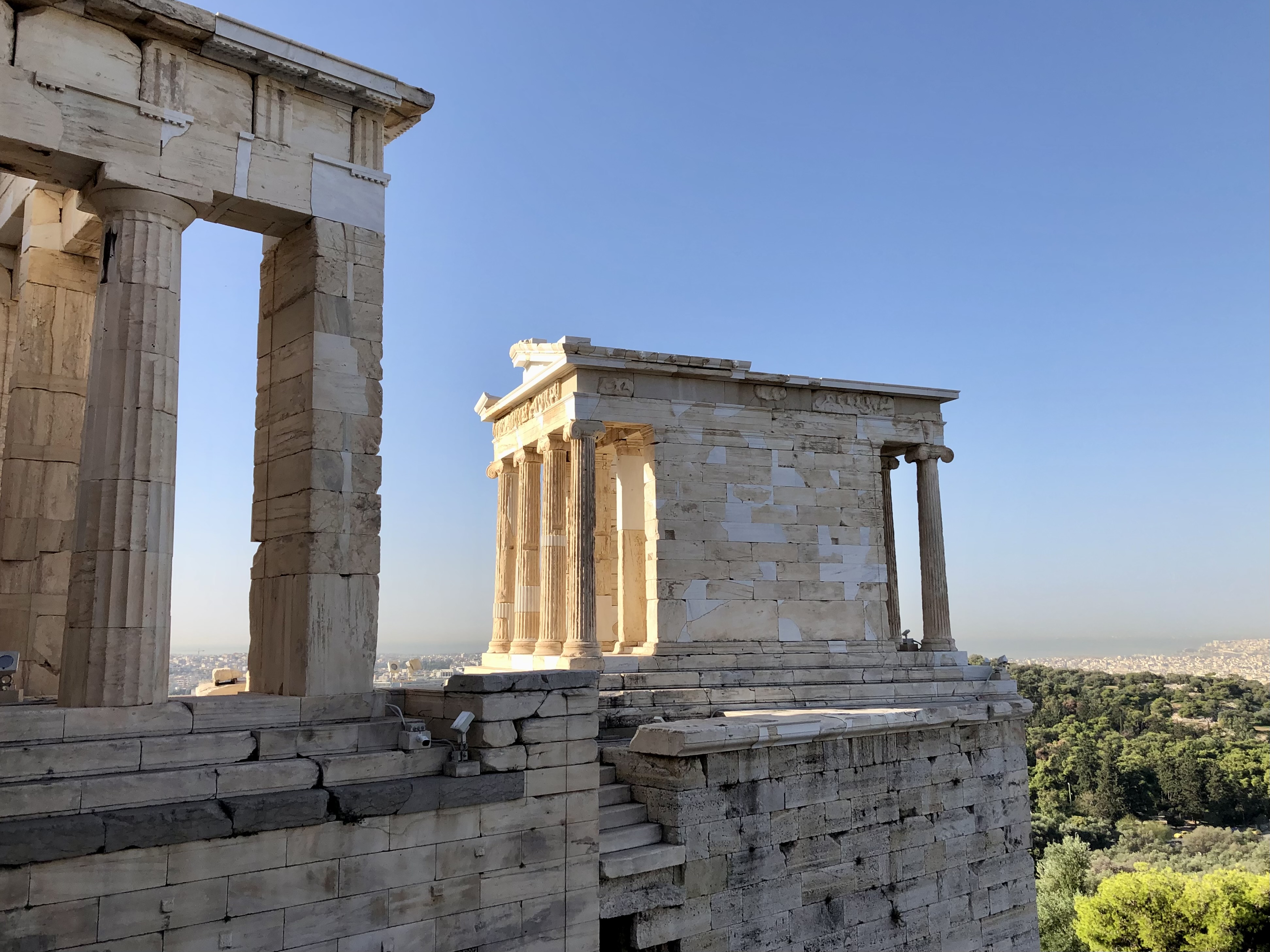
It took a little bit of time to find Athena Nike by the way. She's actually located on a pedestal in front of the propylaea. I saw it before we climbed the last part of the hill and didn't even realize what I was looking at. But we found her once we circled the Parthenon and before we took a closer look at the west side of the Erechtheion.

The Temple of Athena Nike. Built 449 to 420 B.C.

Of the three temples I had on my list, I really had them ranked before we set foot in Greece as follows: (1) Athena Nike, (2) the Erechtheion and (3) the Parthenon. Construction was started on all three of these buildings within a 30-year span in the fifth century B.C. One (the Parthenon) was built using the Doric order, one of the three signature orders of Greek architecture. The other two used the Ionic order. When it comes to orders, I'm an Ionic guy all the way. The Doric is too plain for me and Ionic is overall just more elegant and lighter. 

And yes, just to be clear, on the basis of orders alone, I put the Parthenon, the thing that is supposed to be the most perfect Greek temple ever, in last place. Sometimes I'm not that smart, although ultimately any evaluation of "best" ends up being pretty subjective. The Parthenon, however, was the most impressive.

In my defense here, the Temple of Athena Nike is a little jewel box of a building. It's a tiny little one-roomed temple perched on a huge pedestal with four Ionic columns on the east and west faces. The pediment on the east side is about two thirds intact with some of the original frieze intact (or restored, I guess). But you can't get very close to it. As a building to visit, you have to admire from afar. There's no other option really.


Temple of Athena Nike (top). The Erechtheion; built 421 to 406 B.C. (bottom).

The Erechtheion is quite a bit more complicated. The reason it was on my list ahead of the Parthenon was because of the side porch of the temple with with roof supported by the six caryatids. They are spectacular, even though you cannot get really close to see them at all. This is a theme at the Acropolis by the way: lots of awesome stuff to see but cannot get really close to see it. 

If you get up the Acropolis and feel upset at all about not being able to get close to the caryatids, don't worry too much because they are not the originals. Most of the originals, including just pieces of one of the six which was destroyed by a stray Ottoman cannonball, are in the Acropolis Museum at the bottom of the south slope of the hill.

The Erechtheion is supposedly built on the spot where Athena and Poseidon battled to be the god of choice for the city of Athens. As a quick recap of that contest, both gods produced gifts to the citizens (I assume it wasn't called Athens then since Athens was named after Athena...) for their consideration. Poseidon produced salt water from a spring at a spot struck by his trident; Athena went with an olive tree. Clearly, Athena won.

Architecturally, the Erechtheion is the most complicated and confusing of the four buildings on the Acropolis (I'm counting the propylaea as a building here). Its main entrance is from the east via a six-columned front facade but it also has a couple of porches on the north and south and really the one on the north is like an annex with a separate portico and wholly different floor level. The star of the whole building is the porch with the caryatids to the south although it's not a porch in the sense we think of porches probably. There's no spatial connection to the main building; it's really just preserving space above the tomb of Kekrops, who was a mythical king of Athens.

I'm not completely positive how a tomb of a mythical king works. I assume it's just cermonial? I mean if there was a body, he wouldn't be mythical. Does that sound right? Kekrops, by the way, is one of two mythical kings of Athens whose tomb is at the Erechtheion. The other is Erechtheus.


Front (top) and porch (bottom) of the Erechtheion.

So then there's the Parthenon.

How is a building this simple actually this good? It's a rectangle in plan with just two rooms inside. There are eight Doric (read: very plain) columns on the short sides of the rectangle and seventeen on the long sides. Part of the south side of the building is collapsed (a result of Christian bombardment when the building had been converted to a mosque by the Ottomans) and most all of the sculpture that adorned the outside of the building (including within the pediments) is long gone (most of it's in London, of all places). Of the two rooms, one used to hold an enormous ivory and gold statue of Athena but that's long since been cannibalized for other purposes so that doesn't add to the luster of the building at all.

Maybe I'd been brainwashed by my education. I looked for the entasis on the columns (essentially meaning the columns "bulge") that makes them look like they are bearing weight. I looked for the entablature above the columns not being purely horizontal. I looked at the spacing between columns. I looked for the columns leaning slightly inward. And I'll confess, that almost all of these were impossible to see but I "knew" they were there.

I will say for the record that I am rarely impressed with architecture (and maybe I should have capitalized that) that is this old and (no judgement here) this primitive. But the Parthenon is truly impressive. Yes, it's simple. Yes, I looked for and believed everything I had been told that makes this building so remarkable. But there is also a very pleasing proportionality to admire and the details made all the difference. They are sophisticated. This is clearly not the first time a Doric temple has been built. I think the relationship between the column capitals and the entablature and the reduction in spacing at the end columns were really important to me.

Maybe it was the details. Maybe it was Athens. Maybe it was the anticipation. Maybe it was the sun. Maybe it was finally getting there. Maybe it was all of it.


Sunny side of the Parthenon in the morning, including a look at the columns and entablature.

The siting of these temples on the top of the Acropolis, by the way, is phenomenal. If there is one takeaway I took away from Greece, it was that that Greeks really know how to place a building on a site to gain the maximum impact on the visitor. 

When you are walking up to the propylaea, you can't see any hint of what is beyond really. If you are sharper than me, you'll notice the Temple of Athena Nike for what it is but really you can't see anything else. Once you emerge through the gate that is the propylaea, you are faced with the Parthenon on the right in perfect perspective. You can see the front facade and also gauge the entire size of the building by also being able to see its broad side. This kind of denial of view following up by revealing of objects or spaces has been a key element of architectural design for centuries.

At the height of its glory, you would have seen before you a giant status of Athena just ahead of you and maybe bit to the left. But beyond that on the left would have been the Erechtheion showing you it's most gorgeous feature (the caryatids) but not showing you its front face. To get to that, you'd have to be drawn into the plaza between the two buildings, taking in the full length of the Parthenon as you walked before you could circle around to the front of the smaller temple. I know there are just two things up there after the propylaea and how difficult is it really to put two things on a flat hilltop but these two really are sited perfectly.

I don't get this impression just from the Acropolis. We visited at least two more ancient Greek temple sites where the views of the main attractions were concealed, teased and revealed in epic fashion. And yes, that means there are two more blog posts about temples in Greece coming.


First view of the Parthenon (top) and sacred olive tree outside the Erechtheion (bottom).

If I can offer a pro tip from a one-time visitor to the Acropolis (is that even possible? a should it be an amateur tip?), it's get there early and beat the crowds. When we visited, they appeared to be testing out a timed entry policy that appeared to be either loosely enforced or not enforced at all to reduce crowding but there are for sure crowds. We got there at opening time and stood in line for about 15 minutes for tickets and then maybe 2 or 3 additional minutes to get our tickets scanned. 

The first place you come to after you pass through the property gates is the Odeon of Herodes Atticus, an open-air theater of what used to be an indoor theater donated to the city by Herodes Atticus, an early benefactor of the arts in Athens. My advice is to skip this upon entry and hit it on the way out. Get to the Parthenon and the Erechtheion before the hordes get there. Maybe you'll get lucky and get a sense of the place (and some pics) without a mass of people milling around.

Our route at the Acropolis took us through the main gate; up through the propylaea to the top of the hill; back through the propylaea; past the Odeon of Herodes Atticus; and down the south slope past four or five additional structures in various states of standing. At the bottom of the hill is the Acropolis Museum.


Floods of tourists (top) and the Theater of Dionysus with the Acropolis Museum (bottom).

If we could have spent days checking out everything on the top and sides of the hill that is the Acropolis, I am convinced you could spend an equal amount of time studying every object and watching every video simulation inside the Acropolis Museum. The amount of material in that place is daunting. I am sure all of it has value on some level. We couldn't handle it all so we focused (again) on material related to the three temples we targeted on the actual Acropolis along with any information that explained the development and evolution of the site. 

And maybe one or two other pieces that caught our eyes along the way. I love the sculptured panel of Dionysus that I've included as the second picture of this post. I don't know how exactly it fits into the Acropolis because I don't remember the caption next to the exhibit but I think it's really well done. I am sure its condition and the giant (and i do mean GIANT) cup of wine that Dionysus is holding in his right hand helps my appreciation of this piece.

One of the most valuable displays inside the Museum is a series of models representing the buildings on top of the hill at a few different points in time. The Parthenon we see today is not the original Parthenon. That building was destroyed by the Persians in 480 B.C. The new Parthenon was also co-opted by both the Ottomans as a mosque and by later Christians as a church. All these permutations are represented in a series of models which show the site in different conditions over time. 

These models, combined with the video presentation on the upper floor of the Museum which shows the construction and adaptive re-use of the Parthenon over time really paint a pretty complete picture of what was going on atop the hill for the last 3,000 plus years. Adaptive re-use here means everything from the construction to the destruction of "pagan" sculpture by Christians to destruction of the south side of the building by cannon-fire (also by the Christians) to looting of the sculpture by Britain's Lord Elgin (which is how most of the Parthenon's original art is in London). I guess Elgin was a Christian too. Those Christians...

Model of the Acropolis, 5th century B.C. Notice the giant statue of Athena.

As far as the actual pieces of stone inside the Museum, the stars are clearly the original caryatids. These alone are worth the price of admission to get this close to pieces of sculpture this important to the site. And you can get to within inches of them and they are not behind glass or anything. We for sure spent more time looking at these five ladies than anything else in the Museum. I got disappointment when I saw how far from the Erechetheion's porch we have to stand on top of the Acropolis. That was easily overcome when we found them in the Museum.

And yes...five. Not six. The sixth was swiped by Lord Elgin when he stole all the Parthenon's sculpture from the site and it sits in the British Museum along with the rest of the loot he made off with.


The five (not six) caryatids in the Acropolis Museum.

I don't know how many pieces of sculpture we skipped in the Acropolis Museum. There was just too much to take in. I will say that some of the pieces still have some of the original paint on them and (as faded as it is today) that was extremely gratifying to see. It's awesome to see paint that's survived 2,500 years on a piece of stone when the stone has not been treated with care for a lot of that time.

I don't know what else to say about this museum other than I'm glad we went to the Museum after we visited the site. I found it easy to make connections to what we'd just seen. I doubt I would have made the same connections in the opposite order. I especially appreciated the sculpture (some of it replicas) from the Parthenon being in the same orientation in the Museum as it is on the actual site, particularly because you can see the actual Parthenon when you are looking at some pieces of the sculpture.

Sculpture from the Parthenon in the Acropolis Museum with the actual Parthenon visible through the windows.

One of the things I love most about travel is that it gets you to places that you have longed to go to that you have learned about without actually ever having been there. Setting foot in foreign (or domestic) lands to make your own judgements about places is thrilling to me. It can be perspective-changing or it can validate what you already thought you knew. Usually, there's a little of both but it's rarely exactly what you thought before you actually arrive there. It's not virtual reality. It's real life. Being there matters.

We didn't spend much time at all in Athens but I'm convinced we were right to devote a good portion of our time there to what is unquestionably the number one tourist attraction in the city. When you are standing in the city of Athens looking up at the Acropolis, it seems like a long way up. It's not too bad, but you do have to walk up there yourself. There's no funicular or elevator. Take it slowly if you have to and it's cooler in the morning. That Athens sun can get hot.

Also, it's not pronounced Acropolis in Greece. The word is feminine and the "s" isn't pronouced. It's Acropoli. Do with that what you will.

Southeast corner of the Parthenon. Not sure how Elgin missed plundering this part.