Showing posts with label Bridges. Show all posts

Sunday, November 28, 2021

Two Bridges


The first thing we did when we got to Porto was walk downhill. There was really not much other choice. We were staying most of the way up the hill that Porto is built on and our first destination in the city was on the south bank of the Douro River. Which is decidedly not at the top of the hill.

The journey down the hill to the Douro is quite the walk. In most places the hill seems to go about straight down. It is so steep in most spots that paving the path with a sloped surface from point A to point B won't work. Switchbacks and curves and lots and lots and lots of steps are required. And big steps too. Walking down is an awesome voyage of discovery combined with a pretty good workout. But at least it's down. And luckily there are plenty of mechanical contraptions to get you back up to the top on the way back. Thank goodness.

As we made our way down to the Douro while keeping an eye or two firmly on where we were stepping, we caught glimpses of the river and Vila Nova de Gaia on the south bank, home to the region's many Port cellars. And if we were pointed in the right direction at the right time on our trip downhill, we could see pieces of a very large metal arch bridge: the Dom Luís I Bridge.

The Dom Luís I is one of six bridges spanning the Douro connecting Porto to the south side of the river. There are a number of boat tours which leave from the north and south banks of the river that will take you to see all six up close. But the Dom Luís I is one of the best you'll see on that tour. And you don't need to get on a boat to experience it.

First sighting of the Dom Luís I Bridge, Porto.
The Dom Luís is a pedestrian, automobile and Metro bridge. The top deck is reserved for the Metro and pedestrians, and the lower level accommodates automobile as well as more people on foot. The bridge itself is an iron arch supported from massive concrete piers on either end with vertical iron trusses extending upwards from the arch to support the upper deck and downward to support the road and sidewalks of the lower level. 

Its importance to both Porto and Vila Nova de Gaia cannot be understated. It is THE main thoroughfare allowing people whether on foot, Metro or car to cross the Douro River and get from one side to the other. Each time we crossed it (four times, if you must know) it was packed. I'm sure a ton of those people crossing were tourists like us but I'm guessing there were a fair number of locals also. 

But it is not just functional. The bridge is also visually stunning. Not only is it sort of a true expression of its own structure with the clear span arch so obviously supporting the two decks via the connecting trusses, but the top deck is also narrower than the roadway, which causes the arch to pinch at its top and splay out towards the concrete piers. It's impossible to notice this in elevation; the bridge just seems the same width for the whole span. But catch it on an oblique view and you can see the splayed arch that captures lateral loads on the bridge and transfers them to the support piers. The best view of the bridge seemed to me to be from the top of the Teleférico de Gaia, or cable car, which connects the pedestrian areas of Vila Nova de Gaia to the top of the south side of the Bridge.

It's also a bit of an engineering marvel. When construction was completed in 1886, it was the largest clear span iron bridge in the world at nearly 1,300 feet across. It is a treat that this bridge is so accessible during a visit to Porto and Vila Nova de Gaia. It takes literally no extra effort to visit and interact with the bridge, which has become one of the most recognizable symbols of Porto.

View of the Dom Luís I Bridge from the debarkation point of the Teleférico de Gaia.
The engineer of the Dom Luís was Théophile Seyrig, a German engineer who was all of 38 years old at the start of construction of the Bridge. I am pretty confident you've likely never heard of Seyrig. I hadn't. Not that I'm some authority on bridge designers or anything. But I have heard of his mentor and former partner, Gustave Eiffel, who has a tower of some sort in Paris named after him.

Eiffel actually submitted a design for the Dom Luís but lost the competition to Seyrig. But Eiffel also has a bridge that spans the Douro also and it looks remarkably like the Dom Luís. Only better. His bridge is the Maria Pia Bridge.

First sighting of Gustave Eiffel's Maria Pia Bridge.
Like the Dom Luís, the Maria Pia is an iron arch with vertical iron trusses extending upwards from the arch to support the deck above. When it was built, the Maria Pia was the largest clear span iron bridge in the world at 525 feet. Or in other words, both bridges have pretty much an identical form and both pushed the limits of clear span engineering when they were built. And, like Seyrig, Eiffel was relatively young when he designed the bridge, just 43 years old. It's not really a coincidence, right?

Eiffel's commission for the Maria Pia Bridge was the result of a competition run by the Portuguese Railway Company in 1875 (it was constructed from January 1876 to October 1877). The central engineering challenge of the competition was to span a river which had never before been crossed by a bridge and which was known to be completely unsuitable for bearing on the bottom of the river. Eiffel proposed a cantilever construction method to construct the bridge from either side of the river and have the two sides meet in the middle.

Now at the time of the competition, nobody really knew who Eiffel was. There was no body of work to support his construction idea or his price tag, which was a third less than any other entry into the competition. The Railway accepted his proposal, but they ran a good background check first, and kept a close eye on him during the design and construction. It's ironic considering what would come later but every engineer starts out with no experience, right?

The Maria Pia Bridge, seen beyond the adjacent São João Bridge.
Unlike the Dom Luís Bridge, the Maria Pia is not in the middle of Porto. It was built for rail trafffic only and there's no really good reason why anyone would run a freight railway through the center of a city. It's a good ways up the Douro River either on foot or by boarding one of those boat tours that spend all day every day chugging up and down the River to show the tourists each of Porto's famous bridges up close and personal-like. I'm not panning these tours. We boarded a boat in the early morning of our only full day in the city and saw Eiffel's bridge just that way. Although we also saw it on the drive into the city.

We didn't spend a lot of time in Porto. Just about a day and half over two nights. Because our time was limited, my wish list had to also be limited. And it was: at least one Port cellar and laying eyes on the Maria Pia Bridge. Not the Maria Pia and the Dom Luís. Just the Maria Pia. Eiffel's bridge is better. And yes, I know I already wrote that.

It's all about the arch. Or more precisely, the support of the arch.

Both these bridges are arches which support a top horizontal truss on a series of vertical trusses. In the case of Seyrig's bridge, those trusses also run to the bottom deck hung from the arch. But whereas Seyrig's arch is thinnest at the center span and highest point and thickest at the supports on either side of the River, Eiffel's is not. His arch is thickest at the top and center and tapers to a point at the two sides where it connects to solid ground.

Seyrig's arch terminates at a buttress. Eiffel's ends in a point or pin connection. The overall effect of the Dom Luís is one of solidity. The overall effect of the Maria Pia is lightness. And it all comes down to the supports.

The support of the Maria Pia at the north side of the Douro. 
It's this lightness (the pin connection does not transfer moment to the supports on the banks of the river) that makes Eiffel's bridge more pleasing to my eyes and why it, and it alone among the six bridges spanning the Douro, was one of the two reasons I wanted to visit Porto. Quite frankly, I find Eiffel's bridge almost in defiance of gravity and absolutely breathtaking. It is for sure well worth the visit to Porto and a quick boat trip down the River, as ephemeral as that experience turned out to be.

I've been to Paris three times and have laid eyes on the Eiffel Tower in that city on all three trips and find the Tower to be overly heavy and a little clunky. I didn't get that from the Maria Pia. I have not sought out many of Eiffel's works (the structure supporting the Statue of Liberty doesn't count) but I might based on this experience. This bridge truly is remarkable, even if it is difficult to get to. Definite top five bridge ever for me (and I'm honestly not sure what the other four would be so I'm guessing a little bit here). Go to Porto. Eat sardines in a riverside cafe. Drink some Port. And go see these bridges. But especially Eiffel's.

The Dom Luís looking south towards Vila Nova de Gaia.


How We Did It

It is super easy to see and cross the Dom Luís I Bridge. It is pretty much one of the central focuses (or foci, I guess) of the pedestrian experience along the Douro River in Porto and Vila Nova de Gaia. We crossed the bridge the first three times on the sidewalks of the road on the bottom deck and then took the cable car to the upper deck on our fourth and final passage. I recommend you cross it on both decks for the full experience. The cable car stops running at 6 p.m. although if you are in line with a ticket at that time, you are guaranteed one way passage.

The Maria Pia Bridge is more difficult to get to. We took a boat operated by Tomaz do Douro, who got us there just fine. There is no bad seat on the upper deck of the boat where we sat the entire time. The bridge is no longer used for rail traffic. As best I can tell from searching on the internet (always dangerous, I know...), it appears the bridge either wasn't designed or constructed or maintained (not sure which) to accommodate rail travel at a reasonable speed long term. And yes, I get the irony of a bridge which looks super light not being able to accommodate the purpose for which it was built. It still looks incredible.


Saturday, June 13, 2015

Vaporetto No. 2


Of all the places in Italy I visited this past April, I was most looking forward to getting to Venice. There is honestly no other place on Earth like this city for one simple reason: how you move around the city. There are no cars in Venice. There are no motorcycles in Venice. There aren't even any bicycles in Venice. Walking is OK; so is traveling on the water in some sort of craft. Literally the only way to get from point A to point B in Venice is by boat or on foot and you will likely go over or under four or more bridges to get to any one spot. It's been this way since it was founded in the fifth century and it isn't changing any time soon.

While there are no definitive records of Venice's origin as a city, it is generally accepted that people started settling there in a meaningful way during the early 400s as a means of escaping repeated waves of Germanic and Hun invaders on the Italian mainland. Hiding in the islands in the lagoon off the coast of what is now northern Italy provided protection for permanent residents in the area and eventually they started forming a council to govern the city which would end up in 697 appointing a doge or leader. The city of Venice would be governed by a council of the wealthy with an elected doge at their head until 1797 when Napoleon Bonaparte and his army conquered Venice.

Venice is made up of 117 individual islands grouped together into six areas or sestiere. Between each of the islands there is water which makes up the "streets" of the city and 409 bridges connect island to island so folks can get around on foot. On every island and over every bridge, there is an amazing city to discover which you can't find anywhere else. Not even at the Venetian hotel in Las Vegas, in case you were inclined to argue that point.

If the water in Venice is the street, Venice's main street is the Grand Canal. It's the widest, longest, most traveled and best appointed waterway in the city. Most all of the notable and fabulous bridges cross the Grand Canal; there are more gondoliers rowing passengers about the city on the Grand Canal; and all the most spectacular residences and commercial buildings face on to the Grand Canal. It is without question one of the premiere destinations in the city and as a first time visitor, I had taking a ride along the length of the Canal super high on my list. So high, in fact, that I ended up taking two.

Traveling down the Grand Canal is an education in most all things Venetian and is a great way to orient yourself to the city. Fortunately for the frugal tourist, Venice has public transportation which will take you down the entire length of the Canal for an extremely affordable price of seven Euros. When I think public transportation, I typically think of trains or buses; of course in Venice the public transportation are boats, or as they are called in Venice, Vaporettos.

Vaporetto Nos. 1 and 2 both travel from one end to the other of the Grand Canal. No. 1 is the slow boat, making multiple stops and taking about 45 minutes to an hour, depending on where you get on and off; No. 2 moves a little bit quicker, making the whole trip in about 30 minutes. My two trips along the Canal were both on Vaporetto No. 2. My first voyage was on a packed boat standing up in a dense crowd the whole way after getting off the train from Florence. The only thing I remember from that first trip was the wonder of finally being in Venice but mostly facing the wrong way so not being able to see much.

The second trip was way more enjoyable and we did it right. In most Vaporettos, there is an indoor seating area toward the back of the boat and an outdoor standing room only spot in the center where you better hang on if you are not used to traveling on boats even though the ride is relatively smooth. But the best spot to see the Grand Canal is at the front of the boat, in one of the seats right at the bow where you can see everything unobstructed. On my second trip, we managed to snag the two front seats on the port side of the boat. This is the way to see Venice.


This blog post is the story of a trip down the Grand Canal from Venice's train station (Ferrovia) to Piazza San Marco. I'm covering this part of Vaporetto No. 2's route for two reasons. First, it's the route we took to get to our hotel when we first got to Venice. And second, because on our second ride, I managed to slip into the front row when some other American tourists got off the boat to get to the train station. The second ride was way better.

Venice is in many ways a city of bridges and when you first embark on your No. 2 experience, you are likely staring straight at the Ponte degli Scalzi (translated as Bridge of the Barefoot Monks), one of only four bridges to span the Grand Canal. As bridges over the Grand Canal go, this is probably the least interesting. It was erected in 1934 to replace an iron bridge in the same spot. If it's interesting in any significant way, it's because it is one of only four things that does what it does. But it's great to see a bridge when you first get to Venice. You'll see two of the other three later on your ride.

If you look out of the back of the boat, you might catch a glimpse of the Ponte della Constituzione, the newest of the Grand Canal bridges. This bridge was designed by noted architect and structural engineer Santiago Calatrava, an architect who at one time was one of my absolute favorites. That bridge is generally reviled by residents of Venice, although I'm not sure I understand why from visiting it when I was in the city. I believe they dislike it so much because it's so different in a very visible spot.

I think Calatrava designed the thing intelligently, introducing a new bridge vocabulary into Venice with a curvilinear plan arrangement, glass railings and frosted glass walkways while respecting the proportions and materials used in other bridges in the city. I especially like the use of marble nosings on the stairs of the bridge to match many many other older bridges  Having said all that, I think there are problems with it. Some of the glass walkway panels were covered over (presumably broken) and the bridge swayed a little, which is never a good thing for a bridge to do in a noticeable way.


Pass under the Ponte degli Scalzi and you are now in Venice proper. This is what I wanted to see: centuries old buildings sitting right on the water, some with docks right at the spot where the water meets the buildings. There is nowhere else that you can get this sort of experience and it's what I came all the way to northern Italy to see. I wouldn't have missed this for the world.

Other than the types of boats on the water and the prominent tower crane almost dead center of the picture, I imagine the view shown above is just as Venice would have looked centuries ago when the Doges were in power supported by the Great Council and the safety of the city was ensured by the Council of Ten. While I'm sure life in Venice 800 or so years ago was a day to day search for survival for most people, especially when things like the Bubonic Plague or Black Death came to town (which it did brutally in Venice a few times), it all sounds so idyllic and romantic.  You can even see the spire of the Campanile of Basilica San Marco just to the right of the tower crane.


Turn the corner of the Canal and you will get your first look at the Ponte di Rialto. It is the oldest bridge that spans the Grand Canal, completed in 1591. It was designed by Antonio da Ponte (appropriately enough) and is named after the Rialto market that is just at the south end of the bridge. The Ponte di Rialto is extremely wide; there is actually a series of shops along the center of the bridge with a pedestrian walkway on either side.

This is not the original bridge on this site. It's actually the third such structure built by the Venetians. The first was a pontoon bridge built in the late 12th century. The Rialto market developed after the bridge was installed to such an extent that foot traffic proved too great for the temporary bridge to sustain so it was replaced with a wooden bridge in 1255. After that bridge collapsed under the weight of the crowd standing on it in 1444, a stone bridge was proposed and rejected. Only after the bridge collapsed a second time in 1524 was the current design executed.

The Ponte di Rialto is a must see in Venice. It's crowded and some folks are there just to see or walk over the bridge itself. If you go just to see the bridge it's worth it. This is the oldest famous bridge in the city. Don't miss it. The market on the south side has some amazing looking pasta and other foods.


After you pass under the Ponte di Rialto, you are into heavy gondola territory. These are the long flat-bottomed boats that you see being rowed about pretty much every canal in Venice. They are there now strictly to cater to the tourist industry. There is no point taking a gondola for a ride if you are looking for the fastest way to get anywhere in the city.

Taking a gondola ride ain't cheap but if you come to Venice for the first time and don't take a ride in one, then you either can't afford it or are sort of missing part of the point of being in Venice. 30 minutes is going to cost you a cool 80 Euros, and that's without musical accompaniment which is typically available at an additional cost of something I didn't even consider when I was in town. Don't bother arguing about the price; it's all fixed. If you can pile a bunch of people into the boat then good for you; the price won't change. Although I assume that is a bit less romantic.

We took our one obligatory gondola ride starting just to the east of the Ponte di Rialto. We went up the Grand Canal and down some side canals to get back to where we started. The ride is honestly not going to get you to see much more of Venice than you can see on your own but just to say you've taken a gondola ride in Venice was important to me. And I think we got a good gondolier. He gave us some good tidbits about the history of the city, we got to understand a little more about life there from talking with him and we even got some serenading for free as he broke into song on the way back to the dock. Two enthusiastic thumbs way up. I won't do it again, but I wouldn't have wanted to miss it for anything.


After passing under the Ponte di Rialto, you also start to see some classic Venetian Gothic architecture. This style of architecture is characterized by the traditional Gothic pointed arch and quatrefoil openings above. It is a style which merges European Gothic architecture with Byzantine and Moorish influences which represents how cosmopolitan and powerful the city of Venice was in the 14th and 15th centuries.

Venice during the late middle ages was truly a power to be reckoned with. It was a city of water in an age when exploration and trade by sea made cities, nations and city-states extremely powerful. And its connections with Constantinople and trade routes to the east only enhanced its wealth. The height of Venetian Gothic architecture can be seen in the Palazzo Ducale or Doge's Palace right on Piazza San Marco. You'll get there if you ride Vaporetto No. 2 to the S. Marco stop. You are not going to see this kind of architecture anywhere but Venice. At least not done this well.


Next up: the Ponte dell'Accademia, the third bridge of the ride and the last you will pass under on the Grand Canal. This bridge holds a special place in my heart because I built a model of it during my senior year in college as part of a group site model for a design project. My chipboard probably 1/16"=1'-0" scale version of the bridge looked approximately but not really like the real thing but I loved it. I loved it more than my own design project that I placed on the imaginary vacant site next to the bridge. If there's another bridge I've longed to see in person for over 25 years, I'm not sure what it is.

The current Ponte dell'Accademia is relatively new, built in 1985, just five years before my cardboard version was built in Ann Arbor, Michigan. It is named after the Galerie dell'Accademia, one of Venice's most famous museums. It is the third such bridge erected at this location. The current version replaced an almost identical but not as sturdy version placed there in 1933; that bridge replaced the original 1854 steel structure.

The Ponte dell'Accademia is built out of wood, which is comforting in an age when we rarely turn to wood to span bodies of water as large as the Grand Canal. Wooden bridges, like wooden roller coasters, are throwbacks to the way we used to do things. They are softer and more natural than stone, steel or concrete. It's good to use wood every once in a while. I love this bridge, even more now I had walked across it several times. I wish they didn't have to hang a banner right in the center of it.


After the Ponte dell'Accademia, you are in the home stretch distance wise but there is so much incredible stuff to see from this point forward. The first thing you see when you pass under the bridge is the dome of Santa Maria della Salute. This is the church that I most associate with Venice because it's in all the famous 18th and 19th century paintings of Venice, including those by Canaletto and Joseph Mallord William Turner.

There are a lot of churches in Venice. Like a ton. Everywhere you turn you seem to see another. We visited six or eight in our three days there and even heard a Vivaldi recital in one. If you told me there were more than 100 I wouldn't be surprised. But for me, the two best are the Salute and the one you are going to see traveling down the Grand Canal when you start to enter the lagoon. Just hold tight on that one right now.

Santa Maria della Salute was commissioned as a response or solution (depending on how you view it) to the latest invasion of the Bubonic Plague into Venice in 1630. The church is dedicated to the Virgin Mary and based on on how deep your faith goes I suppose, you will likely believe that it saved the city from the Black Death or did absolutely nothing or anywhere in between. Nonetheless, the city is blessed with a church that is an unremovable fixture in the city. It was completed in 1681, a year without any sort of plague in Venice. Take that as you will.


Just beyond the point where you first see the Salute, there is a palazzo on the right of the Canal which is decorated with scenes made up primarily of gold mosaic tiles.  The effect is brilliant and honestly sort of astonishing that it's still intact. I have no idea how long this display has been in place but it is reminiscent of the gold mosaic tiles in the Basilica San Marco at the east end of Piazza San Marco, which is at the end of this ride.

If there was a place I thought was a check the box exercise in Venice that truly amazed me, it was the Basilica San Marco. I mean it's just a church with some mosaics inside. But the brilliance of the artwork made up of all those tiny tiles is impressive. And you know as old as it is the only way they could make gold color back then was to use actual gold. Go see it. It's free and it's totally worth it. With the money you have saved on admission, maybe you can afford a drink or two at Caffe Florian nearby.


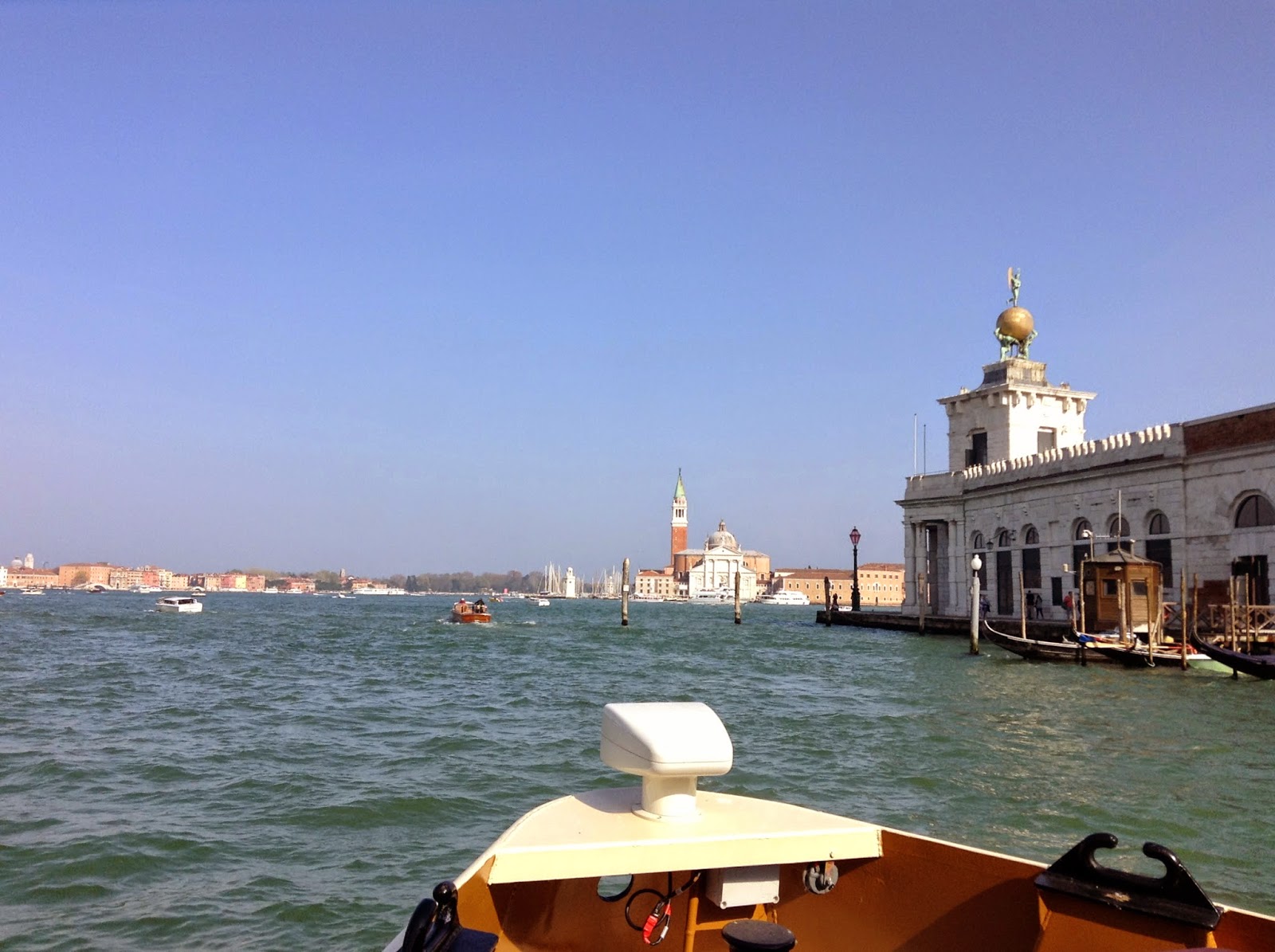
Finally the end of the Canal is in sight and as your line of sight clears the last building on the right, you see the basilica of San Giorgio Maggiore, a church and monastery on its own island in the Venetian lagoon. The church was built between the years of 1566 and 1589 according to the designs of Andrea Palladio, one of the most influential architects in history.

This was my first Palladio building, and I can't honestly think of a better place to start. The church has a glimmering white marble facade which is relatively uncomplicated by change in planes. The first thing you notice about the church is its austerity and simplicity but somehow there's an elegance of proportion. The campanile (well worth the few Euros admission for the view of Venice alone) is to the rear and left of the church and is almost an exact duplicate of the Campanile of Basilica San Marco.

But the thing that amazes me most about this church is the way it is sited. First of all, it presents a frontal orientation to travelers coming out of the Grand Canal, which is absolutely the best way to site the building; it's a nod to the Grand Canal as the main street of the city. But more remarkable is the building's relationship with the water, which is really what Venice is all about. Palladio designed the facade of the building to sit on the plaza in front of the church which ends up being a couple of feet above the water level. This effect makes it appear like the floor of the building is literally sitting on the water level, especially from far away. The truth of the matter is that there are a few steps up to the church door right before the face of the building, protecting the interior from flooding (which will happen). Stay on the Vaporetto No. 2 after the San Marco stop and it will take you to San Giorgio and take the elevator up the Campanile; just leave when the bells ring.


The final stop on both my Vaporetto rides down the Grand Canal was S. Marco or Piazza San Marco, a place Napoleon Bonaparte once referred to as the "drawing room of Europe." Your approach by boat to the S. Marco stop displays the campanile of the Basilica San Marco and the Palazzo Ducale in all their finery.

Piazza San Marco is without question one of the most important, if not THE most important spaces in Venice. It is a vast square with the most important church in the city and the old seat of government at the east end of the square. Lining the sides of the square are cafes with musicians and in the center of the place are a mass of pigeons and people, some of who have pigeons perched on them. No idea what these folks are thinking; I mean, pigeons are swimming with disease, right?

Piazza San Marco was one of my can't miss destinations in the city and honestly, I expected it to be half flooded due to high tide and packed solid with people and pigeons in a scene emblematic of how overcrowded the city had become. It was neither. Maybe I got there at the right time but there was no suggestion of Venice sinking, although somehow empirically I know this to be true. Similarly, while there was no doubt a significant human and avian crowd in the place, there was really tons of open paved space. My time in Piazza San Marco was mostly reserved for sitting at Caffe Florian (the oldest cafe in operation in the world) listening to the musicians while sipping some Venetian beer and eating macaroons and other snacks. Be prepared to pay a pretty good price but it's worth it once. I'm now part of a list of visitors that stretches back to 1720. 

The S. Marco stop is not the end of the line for Vaporetto No. 2, but it was for me both times I traveled the Grand Canal and it is for the purposes of this post. Whether you understand the history or not, what you take in with your eyes on a trip down the Canal will be worth it, even if you just have to turn right back around and go back the way you came. Take the ride. And one day keep going to San Giorgio Maggiore. Venice wouldn't have been the same for me without doing both.

The city of Venice seen from the campanile of San Giorgio Maggiore.