Showing posts with label Black Rock Lodge. Show all posts

Saturday, February 22, 2025

Black Rock


In my first post about our Belize trip last month, I wrote that we went to Belize to see Mayan ruins and toucans. That was true, but that alone is not the whole truth. Sure, we did want to see both those things, and we did. Very comprehensively on the Mayan ruins side of things and well enough on the toucan side of things. But that wasn't all. We went to see the landscape and the barrier reef and eat local food and meet people we'd never met and snorkel and swim and learn about everything we could in the limited corridor of the country we decided to explore in 2025.

We also had no intention of stopping our bird quest at toucans. We wanted to see much, much more. And Belize is an amazing place to do so.

To further that goal, we decided to take a bird watching tour on one of our three full days in the jungle in western Belize. We picked a place called Black Rock Lodge which is about eight miles and about 30 minutes into the Belizean rainforest right along the Macal (which used to be macaw) River. It was a pretty incredible choice. Our guide, Richard Harris (but not the actor, obviously), goes to Black Rock on his on his days off to go birdwatching. On his days off!!!

To be clear here, we are not first time bird watchers. Over the past few years, we've spend many, many weekends roaming around our home state of Virginia looking for birds. We've also spent significant time in the United States and overseas seeking out local species of birds, most notably in Kenya, Tanzania, New Zealand, Singapore, Cambodia, Costa Rica, Uganda, New York, Oklahoma and Seattle. And I'm sure with that list I've missed many, many spots.

From here on out, this post is mostly a photo dump but I think some of the pictures we gathered on this day are just gorgeous. There's a little bit of an explanation here and there but mostly, this is a pretty pictures post. Enjoy!

Tanagers
We found two species of tanager at Black Rock: the yellow-winged tanager (it's really just a flash of yellow on the wing) and the summer tanager. The male summer tanagers are very, very red. The last picture below is the female summer tanager.  


Manakins
There are two species of manakin in Belize (the white-collared manakin and the red-capped manakin). We found them both at Black Rock Lodge. Manakins are just exquisite little birds. The red-capped manakin is a bit out of focus but that shot was taken through a window between a series of leaves and branches that required some body contortions (by me) to get properly. A second or so after taking this photo, it was gone.


Aracari 
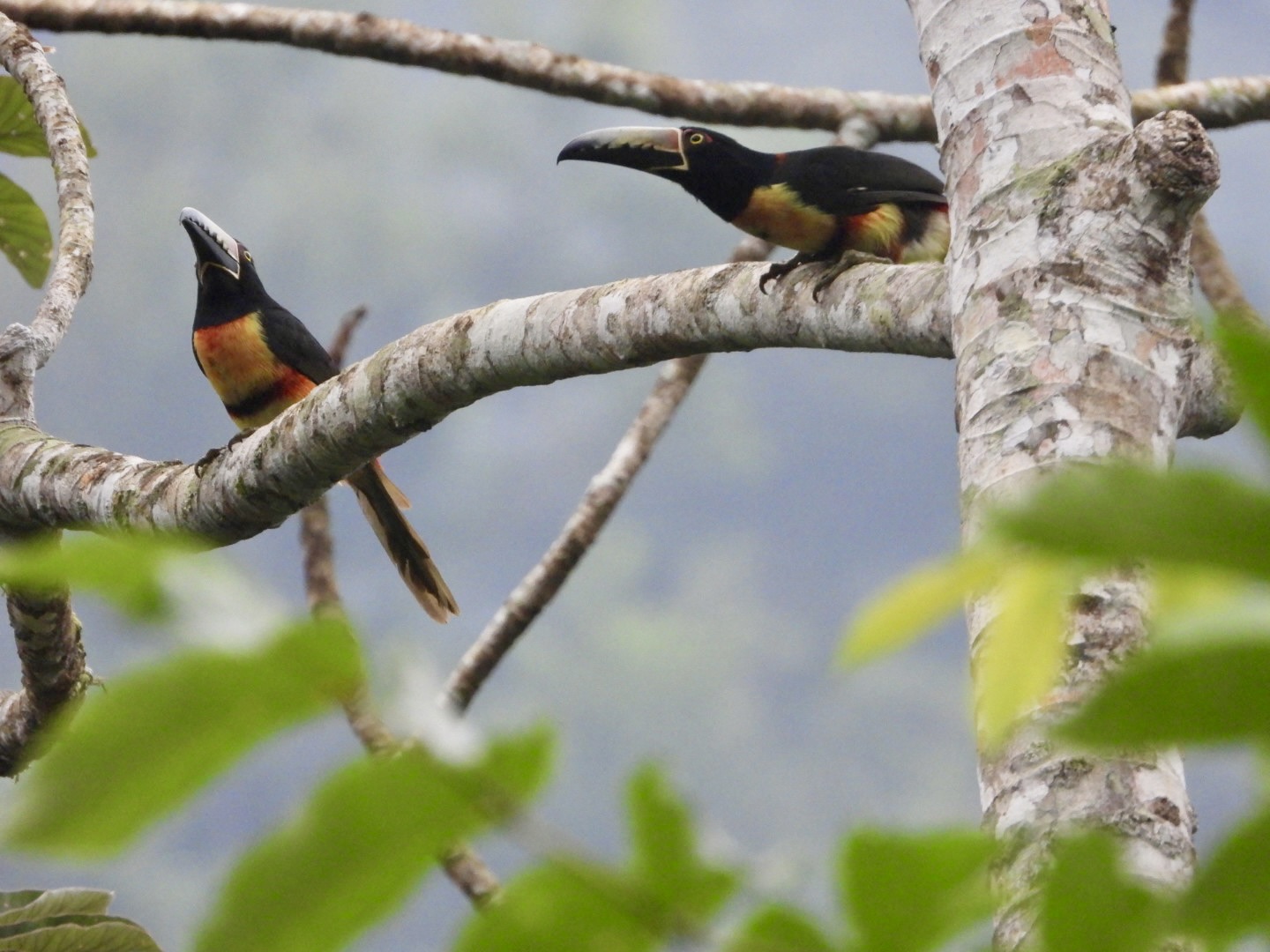
A bit more than two years ago we visited Costa Rica and were dying to find some toucans. We did, but barely. One of the bird highlights of that trip was finding a couple of flocks of collared aracari, technically toucans but not FULL toucans. I was thrilled with those sightings in late 2022. We found a ton more at Black Rock and in a familiarity-breeds-contempt type moment, collared aracari became a species I was ready to move on from and find something new. Been there, done that?

I do still love the colors on the collard aracari. It's like someone spray-painted some red spots and bands on a bird which is really just yellow on its front and blue-black on its back. Of course, that's not what happened. I love how well you can see the red tail feathers that are also present on the keel-billed toucan (one of the collareds' cousins) in the second photograph.


Seedeaters 
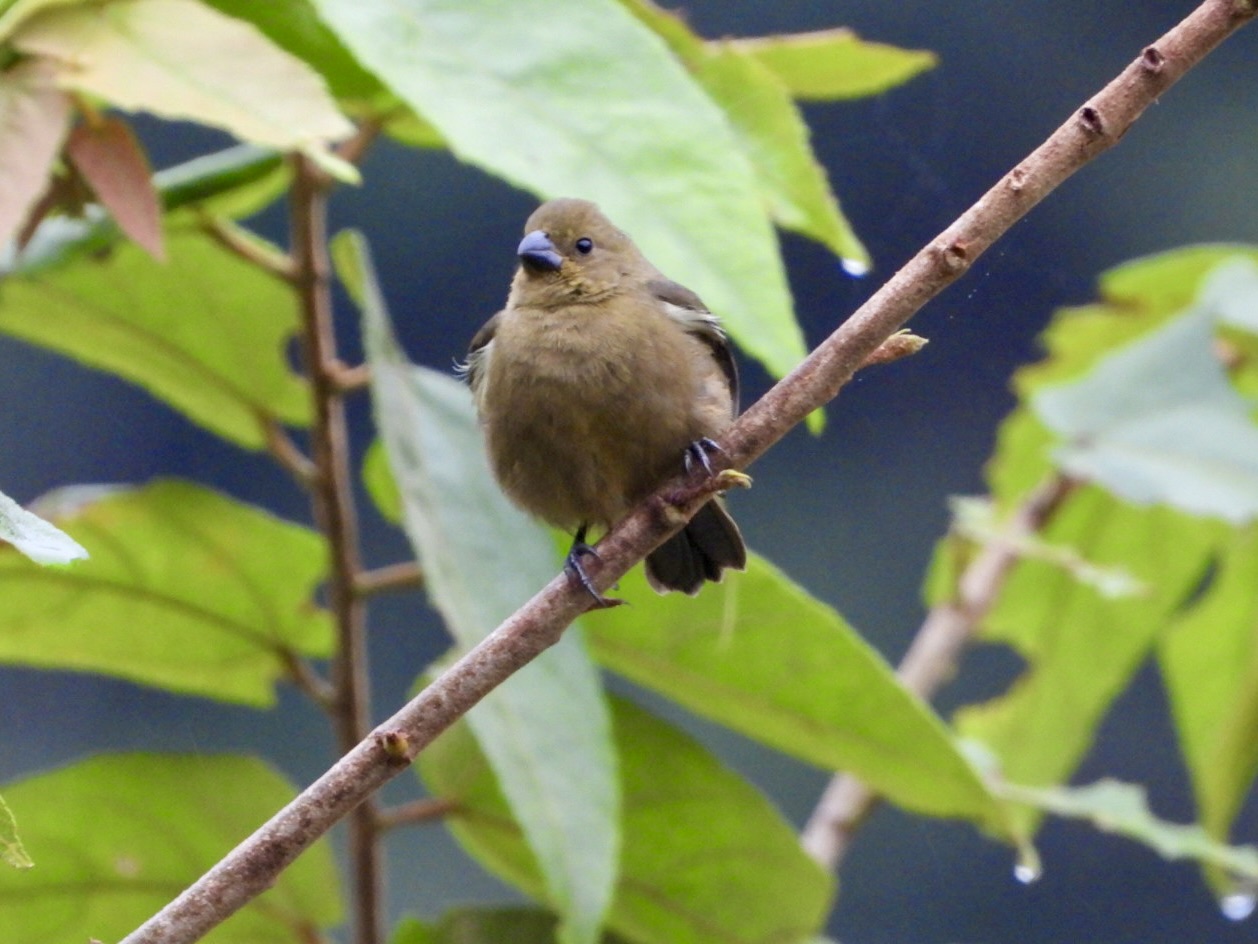
Certainly not the most colorful birds we saw in our few hours at Black Rock but definitely worth including for one reason and one reason alone: I don't think I've ever seen a seedeater in person before. The top one is a Morelet's seedeater. The bottom two are male (black) and female (brown) variable seedeaters.



Gartered Trogon
We saw two (or was it three?) species of trogon either at or on the way home from Black Rock but the only good pictures we got were of this singular gartered trogon. You may marvel at the colors on this black, white and yellow bird but it's probably one of the least colorful trogons out there. 


Great Kiskadee
Speaking of black, white and yellow birds, we saw great kiskadees in a number of spots in western Belize. 

Maybe. 

The first afternoon we were in country after arrival at our hotel, we found some yellow and black birds at play on our hotel property. Our Merlin app variously identified the birds we saw and heard (with the pictures we sent to Merlin and the sounds picked up by the app) as great kisakees, social flycatchers or tropical kingbirds. Which ones were those on our hotel grounds? Probably social flycatchers according to our guide, Richard. Kiskadees, he explained, are bigger (without having seen any of the birds we saw two days before we met him).

The one below, though, he felt pretty sure was a kiskadee. I'm still confused.


Chestnut-Sided Warbler
OK, so this is probably the least spectacular picture in this post but it's here because every time I get a halfway decent picture of a warbler, I feel some measure of success. We can find warblers near our home in Virginia but it's only for a brief window in the spring and fall and these birds do not sit still. I must have taken 15 or 20 pictures of this chestnut-sided warbler before it flew off. This one is the best I got. I know, it's not great.


Hummingbirds
OK, so this is hummingbirds with for sure a lower case "h" because neither of the birds below actually have "hummingbird" in their names.

When we got back to Black Rock Lodge after our hours-long walk around their property, we found pretty much every spare tree covered with slices of fruit and every hummingbird (lower case, again) feeder filled to the brim with some sort of sugar water (I'm imagining). These hummingbirds don't play. They are territorial and they chase rivals away. Cool to see. Been a long time (Ecuador, 2016, I'm thinking) since I've seen this many hummingbirds in one spot.

The bird in the top picture is a white-necked jacobin. The bird in the bottom picture is a wedge-tailed sabrewing.


Cattle Egrets
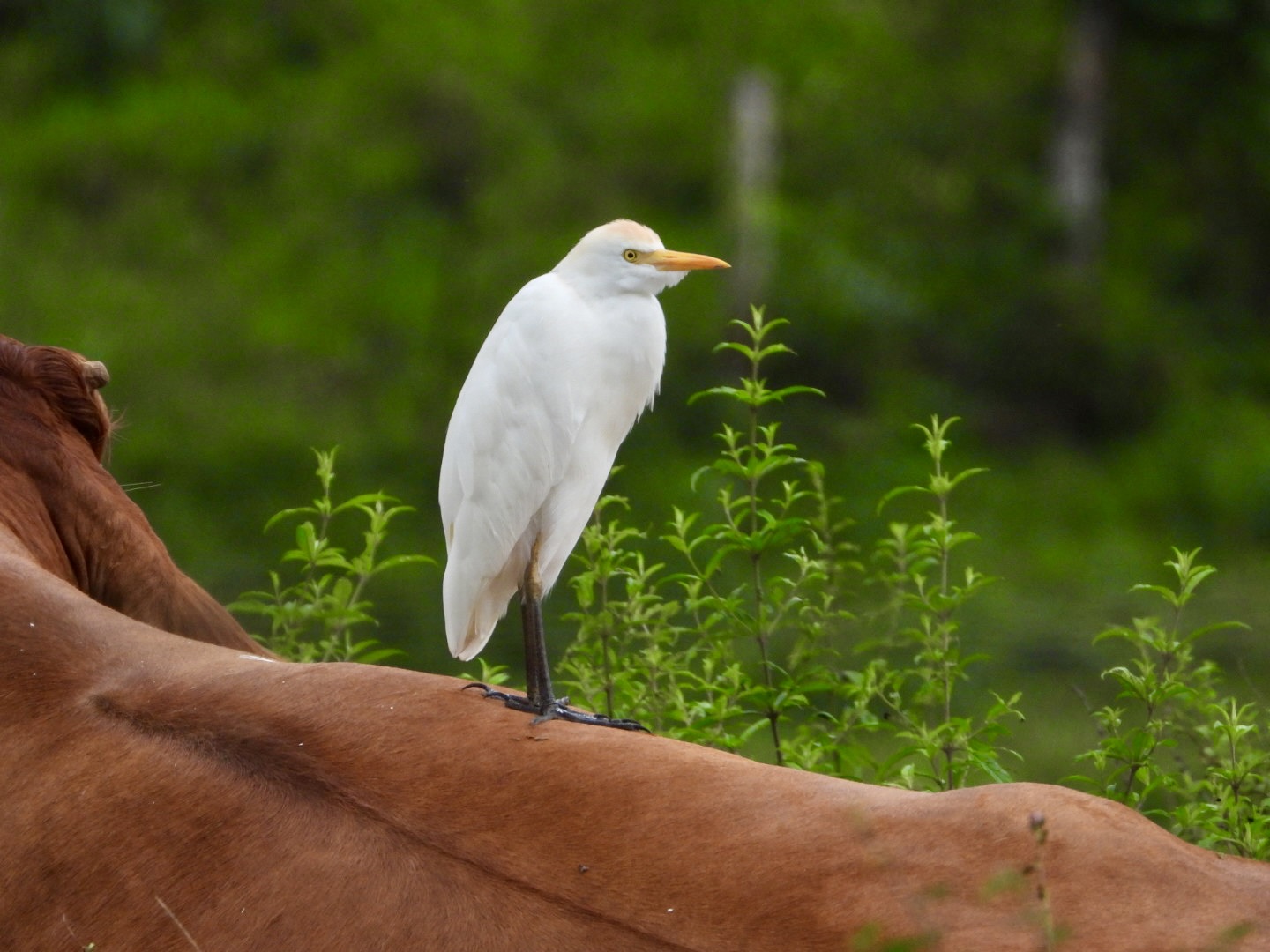
How did I not know about cattle egrets before I visited Belize? We have cattle and egrets in Virginia, just maybe no cattle egrets maybe? Yes, that sentence deserved two maybes.

So cattle egrets are just what they sound like: egrets that hang out with cattle. I guess they pick the bugs of the cows. And sure enough, pretty much every time we saw a field of cattle when we were being driven around Belize, we saw a corresponding number of cattle egrets hanging out with the cows. We saw a large flock of cattle egrets flying down the Macal River when we got back to San Ignacio. No solitary birds at all, unlike other species of egret we have seen nearer to home.

Yellow-Throated Euphonia
OK, so we are almost done here and we are getting into the mind-blowingly gorgeously colorful species. I had no idea what a euphonia was before we got to Black Rock Lodge. In fact, I had no idea what a euphonia was when we got back to Black Rock Lodge after our birding walk. Now I do. These little sparrow-sized birds are spectacularly maize and blue colored. Well, except the females (the bottom pic).


Honeycreepers
Before we departed for Belize, I did a little homework. Or, depending on your perspective, I cheated. I wanted to get some idea of what birds we might see in country so I peeked at a list of Belize birds, including checking out the ebird list for Black Rock Lodge. One bird caught my eye: the red-legged honeycreeper. These brightly-colored blue (or is it more indigo?) birds with the contrasting red legs were a bird we just had to see. HAD to. So when Richard asked us what birds we were hoping to see, we answered "toucans". And then we answered "red-legged honeycreepers". We really wanted to say "male red-legged honeycreepers with mating plumage" but didn't want to appear greedy, I guess.

I did not expect that we would see these birds. Yes, I know I just said they were on the ebird list for Black Rock Lodge but there are plenty of birds on ebird lists in Virginia that we never see despite multiple trips to the same locations in different seasons. My hopes were low here.

I should be more optimistic. Not only did we get some great looks at the males which we knew were the bright blue with the red legs but we also saw females (second picture below) and a molting male. This could not have worked out more perfectly.

And...we saw some green honeycreepers too. Bonus!!!! That's the first photo, in case that wasn't reasonably inferable. 


That's it! That's all I got but I think what I got is a whole lot. This has to be (and I know I'm doing this in a completely understated way) pretty much the best day of birdwatching ever. No hyperbole there. I'm serious. Can't wait for the next day this good. No idea when that can even possibly be but I'm up for it when it happens. Until then, I'm satisfying myself with Virginia birds, not that there's anything wrong with that. They are just going to be a bit less colorful.

Saturday, February 1, 2025

Five Cans


Most of the travel I've done over the past 11 plus years has been what most website surveys would classify as "couples" travel. You know...me and my girlfriend (in the past) or wife (now and way better) exploring whatever corner of the planet we happen to have selected for the long weekend, few days, week or fortnight (or more) that we have decided to get away for.

But every so often we travel with friends. Alaska. Japan. London. Ireland. Costa Rica. Oklahoma (yes, Oklahoma). Los Angeles. Maybe a few more places than that. Adding another person or two or more is sometimes welcomed. Traveling with others brings a different perspective that you might not recognize while traveling as a couple. I don't want to do it every trip but every now and then, it definitely makes trips better. Remember...I did say "sometimes welcomed".

Group travel can do the same thing, by the way, but it's way more of a crap shoot. WAY more.

I think most of our ideas about travel with friends either evolve from casual conversations with mutual interest or are driven by us (meaning..."we have decided to go somewhere, do you want to come with"). But last year, our friend Bryan mentioned he wanted to go somewhere that we probably wouldn't want to go. Where is this place, we asked? 

"Belize", was the answer. 

Are you kidding me? Belize? Mayan ruins and toucans? We're in! Let's go!!!

Mayan ruins in Belize? Yep, they got 'em. At Caracol.

So we did. We booked four nights in the jungle before heading to the beach for the same amount of time. And I was completely serious about the Mayan ruins and toucans, both of which were very definitely jungle activities. I knew I had a lot of control over visiting a Mayan ruin or two but maybe not so much about the toucans. Here's the thing: I REALLY wanted to see some toucans. 

It should be noted here that Belize would not be our first attempt to see Toucans in the wild. We had expectations around seeing these birds in October 2022 in Costa Rica. And like wildlife quests every so often, we predominantly failed, assuming you don't count seeing exactly one at the top of a tree from a boat for about 15 minutes as "seeing toucans". I don't, although I will admit that encounter was one of the most intimate wildlife experiences I have ever had in my life. 

I also didn't count the aracari we saw in Costa Rica. Close...but not true toucans. I am only dealing with the full species here.

Costa Rica is home to two separate species of toucan. Belize is home to just one. I try to keep my expectations low in situations like this but look...the keel-billed toucan is the national bird of Belize. The northern cardinal is the state bird (or is it commonwealth bird?) of Virginia and we see those birds all over the place near where we live. Belize and toucans had to be like the same thing, right? Right??

Collared aracari, Black Rock Lodge. NOT a true toucan. 

We were told that we might see keel-billeds on our hotel property in San Ignacio or even at the Mayan ruins at Caracol which we visited on our first full day in-country. But two days in to this trip, we'd seen them in neither location. Were they there? We believe they were. At least at Caracol. We heard keel-billed toucan noises, which are like two serrated wooden boards being rubbed together, at that ancient Mayan site, and a guide who caught up with our party told us that she had seen them near the parking lot. Curses!!! We were the first ones at Caracol and headed straight for the jungle to find ruins and howler monkeys after a quick bathroom stop. No toucans at Caracol for us.

That noise, by the way...it's not like any sort of bird noise I'd ever heard. If we hadn't been told that's what these creatures sounded like, we wouldn't have known. It was a far cry (pun intended, I guess) from the yellow-throated toucan we'd heard calling over the jungles of Costa Rica a couple of years or a bit more ago.

If there was any doubt about the possibility of a toucan sighting on our first two days in Belize (and there was), all of that should have disappeared on day three, which we dedicated to birdwatching. And not just by ourselves. We had an expert guide who we felt pretty confident would find us a keel-billed toucan or two in some great location with amazing lighting highlighting all the colors on their beaks and bodies to make for some great photographs for this blog and whatever other purposes we could have possibly considered.

We were even asked by our guide just after our 5 a.m. pickup what we most wanted to see that day (spoiler alert: we said toucans first). This had to be like asking Santa for some loot for Christmas, right? Surely our guide, Richard, would deposit us right in front of a tree full of amazing looking toucans when we got where we were going, right? Right???

It didn't work. We looked. We listened for those boards rubbing together. We saw and heard nothing. Well, not nothing. Just nothing toucan-wise. We searched the parking lot, around the lodge that we were visiting, along the river banks, in the jungle and everywhere else for hours and hours. Seven hours if you must know. Zero toucans. We got the squadoosh and nothing more.

Until the very, very last minute. Or hour, really I guess.

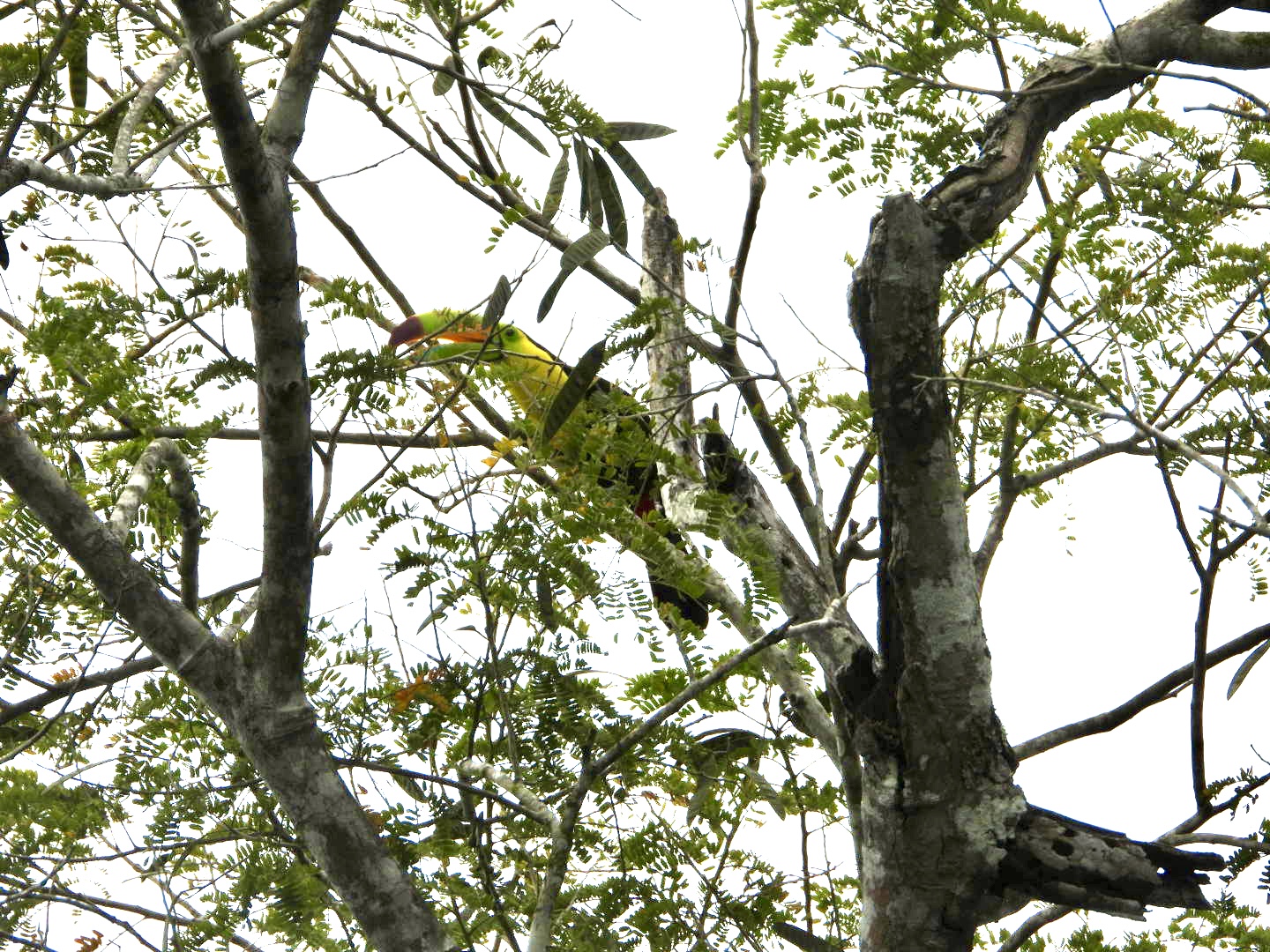
Keel-billed toucan number three. Or three-can if you prefer.
On our way home, we got to a spot on the road too narrow for two cars to pass and while sort of pulling over to allow enough passing space for the vehicle coming the other way to move past us, Richard said something to the effect of "there's a keel-billed toucan in this tree." It's go time! He laid out the plan: pull over in the car; let the oncoming vehicle pass and hope it didn't scare off the bird; get out of the car quickly and quietly so we wouldn't scare off the bird; and watch.

I was the first out of the car (I was sitting on the driver's side on the same side of the road as the tree); spotted the multi-colored bill and the red feathers on the body; focused the camera on the mass of branches in front of the bird; and before I hit the button, it flew. Scared off. We'd never get any closer.

But it wasn't alone. If we did our math right and followed our birds correctly, there were two others and we got the picture above, which was the third we spotted. Was that picture worth all the hard work? All the looking over 2-1/2 days in the hot jungle of western Belize? Yes? No? Maybe? 

Didn't matter. That's all we got. It's out of focus, it's very over exposed or some term that means there's too much light in the background but it's clearly a keel-billed toucan. It was not the encounter we had in Costa Rica. It was nowhere near as personal and the picture, while clearly showing more of the actual bird, is of inferior quality.

We headed back to the hotel; said goodbye to Richard along with a tip for his efforts; and walked back to our rooms knowing we were down to our last day in the jungle side of Belize. And there, right behind our rooms, were two keel-billed toucans in a tree. Right on our hotel property.


How amazing was this? It was pretty cool. I'm not going to lie. We watched them bob their heads, make absolutely no noise whatsoever, hop around a bit between the branches and that was about it. This was certainly not what I imagined. It was fleeting and the lighting was and is pretty terrible. Overcast sky with ton of very light gray backlighting and a whole ton of branches between us and the toucans. Bobbing and hopping. That was it.

Was it better than Costa Rica? Probably not in the wholistic sense of the experience. Sitting on a boat scanning the treetops for a lone yellow-throated toucan calling out over the jungle? Nope, not better than that. But despite the leaves obscuring most of the two birds, this look and these pictures (see below) are better than Costa Rica.

These birds are just incredible-looking. They are very definitely one of my favorite birds on Earth. The colors are just fantastic, and it's not even just about the bills. It's the throat and the eyes and the red feathers on their body (which are not at all visible in the pictures above or below). Although where the bills are concerned, I love the little patch of blue which you can see in the second photograph below.

There's some satisfaction in going somewhere to see something that you might not see and finding it anyway. Am I satisfied to the point where I'm done toucan-searching forever or even for a long time? No way. Not at all. But I don't feel cheated by this experience. I feel like we got them and that's going to have to be enough for this year. I know I'm not done in Central America. I still have Panama to check out and Costa Rica has at least one more visit in her.

I feel like I got what I came for in these five toucans. I'm good this year. The last picture of this post is my favorite. Thanks, Belize.