Showing posts with label Wildebeest. Show all posts

Saturday, December 6, 2025

Kruger Mammals

Photo dump time! 

Our four full days in Kruger National Park was the best concentrated safari experience we have had in a single Park ever. The variety of wildlife and the quality of the sightings was just incredible. There was so much to see and other than maybe one or two times in the late morning / early afternoon when we started to feel that 5:15 a.m. departure time, we were engaged every minute of every day. The wildlife sightings were pretty much continuous.

I've covered some of our Kruger highlights in the past few weeks with posts about our number one species target (painted dogs), the Big Five (or four, as it turned out) and the amazing amount of birdlife we encountered in the Park. I'm done with lengthy written posts about what we saw there. 

But...I do think there is room for one more photo post showing off some of the looks we got at Kruger's mammals which are not painted dogs, elephants, buffalo, lions or leopards. So here goes. With minimal commentary. At least I've tried to make it minimal.

These photos do not show every species we saw in Kruger. Go out there and explore for yourself if you want that.

Giraffes

The first time I saw a giraffe in Botswana I was thrilled. This was was safari was all about. Tallest mammal on the planet! A few years later, we got an incredibly intimate look at these animals at Lake Manyara in Tanzania. They are still amazing to behold. So huge with a kick that can kill a lion. Our guide, Gareth said that he hated giraffes. We were shocked and asked why. "They are always looking down on me" was the response. Dad jokes. Who knew we would get these on safari?


Hippos

My former favorite African species. Their lack of social interaction has them way down on the list in 2025 but any time I get a chance to see them with their tusks showing, I want to take a picture. Still terrifying to me to be chased by one of these things in a small boat (Chobe River, 2015). Thankfully none of that in Kruger.


Impala

Impala are everywhere in Kruger. When we asked Gareth what we were going to see in the afternoon every day after lunch, his response was inevitably "impala!" and sometimes that declaration was amended with a guarantee. We DID see a ton of impala all over the place. We learned to call these animals "McDonald's of the bush" in Botswana in 2015 for their abundance and M-shaped markings on their hind quarters.

Shocker of the trip: who knew that impala smooched? At one of our impala stop, we watched a couple of these antelope alternately lick each other repeatedly on the neck. I have new respect for impala based on the smooching. Smooching is good.


Vervet Monkeys

Vervets are my favorite monkeys ever. They are just the most straightforward-looking, typical monkeys and I love that. As someone born in June 1968 (year of the monkey), I have an affinity for monkeys as a personal mascot. I have a monkey charm we picked up in Japan that goes on my backpack everywhere I go. The charm isn't exactly a vervet but in my mind's eye it is. If I had a spirit animal, it would be the vervet monkey.

Monkeys are mischievous and will steal stuff, especially food. Vervets are very adept at swiping grub. We saw it in Botswana in 2015 and again this year. Keep an eye on EVERYTHING you own around all kinds of monkeys but probably especially vervets.


Baboons

On the opposite end of the favorite monkeys spectrum...baboons. Just don't like them. I think it's the fangs and the fact that while vervets are mischievous, baboons look vicious. Baby baboons, however, are excessively cute.


Hyenas / Black-Backed Jackals

Shall we continue with the less-than-favorite African animals? Let's! 

Hyenas. Not good. Sneaky. Hunter-scavengers. Trying to steal from a lion or painted dog kill one minute but strong enough and organized enough to take down something big the next. And those faces. Ugh! UG-LEE! We did manage to see an almost newborn hyena playing with a stick on this trip but no pics. I just missed it with the camera and the moment was gone quickly.

I've included the black-backed jackal in this section not because there are loathsome to me (they are not) but because in the lineup at a kill, they slot right behind the hyenas. There's always one hanging around it seems looking for some scraps ahead of the vultures.


Warthogs

Done with ugly creatures for this post? Umm...nope. One more. Warthogs. Not pretty. But I do think if you are looking for a good picture of a warthog, these two are pretty darned good.


Zebra

When we first saw zebras in Kenya in 2018, we were thrilled. These animals are more impressive in the hundreds than in ones and twos and fives or so. The group below may have been the largest we saw on this trip. For a black and white animal, they really do blend in with the beige bush pretty well. This camouflage thing is amazing.


Kudu

Of all the antelope out there, kudu may be my favorite. It's the horns. I love these horns and these antelopes so much that I picked up a shirt from SENQU on our way back from safari one day. These are spectacularly gorgeous animals. Always excited to see kudu. We've only ever seen these animals in Southern Africa. It had been a full ten years since we'd seen any kudu I believe.


Wildebeest
 

Excited about wildebeest? Not me. Not usually. But we were stopped in Kruger when these four wildebeest below started walking towards our vehicle. I waited until they got close enough to take a good picture and then waited a bit more for as many of the four as possible to hold their heads up. I got three. I like this picture. It's one of my favorites from this trip. And it's of a typically un-exciting subject. For me. I'm glad I watched and waited here. Sometimes it's cool when a species you are not necessarily always focused on surprises you with a cool moment.


Photo dump done! I feel better now. I'm glad these photographs can see the light of day.

My last picture note is about the cover photo of this post. It was taken at a rest area within Kruger. We stopped at a series of these during our four days in the Park. They were welcome because they had snacks, hot drinks, lunch (at mid-day) and most importantly...toilets. Way better to use the toilet in a rest area than just out in the bush. Most of the rest areas we stopped at were completely fenced with a heavy-duty gate at the entrance with daily opening and closing times prominently displayed. But on Kruger Day Four, we stopped at an un-fenced rest area and found the sign at the top of this post. Yeah...there's no way I want to be ordering a cup of coffee or tea and look over to find a hyena standing close to me with nothing between it and me. Nothing happened. Not on our stop. I need to see wildlife when I'm in the car, not on foot. 

That's all I have for this post. Apologies to the klipspringers, bush bucks, water bucks, nyala and everything else that we saw that didn't make it into this post. That's a wrap on safari posts for this year, but not for Africa posts. A couple of more of those to go.

Sunday, May 6, 2018

Ngorongoro


After almost two weeks and about 25 to 30 hours of riding in safari vehicles between various stops, we got to our final destination of this vacation, Tanzania's Ngorongoro Crater. Earlier in the trip, at Lake Nakuru National Park in Kenya, we'd come across what the members of our party referred to as our first "Jurassic Park moment". On the way to our lodge the one night we stayed in that Park, we saw an open grassy plain with multiple species of animals moving in herds toward some unseen destination and it reminded us of the scene in the movie where Alan Grant and Ellie Sattler see the recreated dinosaurs for the first time. Ngorongoro blew away Lake Nakuru in Jurassic Park-ness. For me, Ngorongoro was Jurassic Park. Without the dinosaurs, of course.

The Crater, a 100 square mile circle which sits within the larger Ngorongoro Conservation Area, was formed between two and three million years ago when an active volcano exploded and then collapsed in on itself. It is the largest intact extinct volcanic caldera in the world, a site made most impressive to me because of its near perfectly level floor and rim elevations. It looks like a lush green bowl 2,000 feet deep stocked with wildlife that are for the most part captured within.

There is a road which leads roughly around the perimeter of the Crater offering glimpses to the floor below every so often. We first saw the entire Crater on a pitstop en route to the Serengeti National Park. I took the photograph above to memorialize the occasion. It is the most gorgeous national site I have ever seen (albeit with perhaps limited experience). I cannot think of a single place that filled me with more wonder, and that includes the Grand Canyon. Maybe it was the picture perfect day we had on our restroom and scenic view stop but I think this place is simply spectacular. It got more amazing when we descended into the place a couple of days later.
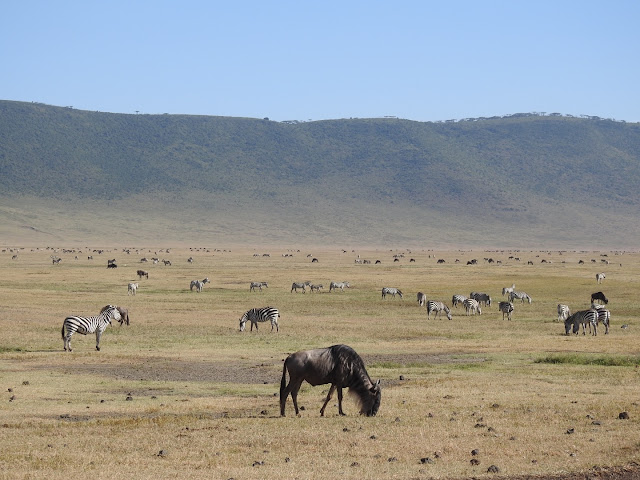
Wildebeest and zebra dotting the floor of Ngorongoro Crater.
To get down to the floor of the Crater, you have to take a twisty, turny, one-way road that seems not wide enough or stable enough at some points. Sit on the left side of the vehicle you are traveling in if you want the best, but sometimes breathtaking in a good and not-so-good way, view as you descend. The dark dots which are the wildebeest, lions, zebra, ostriches, gazelle and other animals get more defined as you get closer to the bottom. Maybe it was the day we visited but in my view the wildlife was more spread out than in the other places we had visited rather than gathered together in small or large groups. When you hit the bottom, you are faced with an almost flat landscape to explore before you take the similarly but different twisty, turny, one-way road out at the end of the day. The way out is the same road used by the elephants to get in and out. It might be a long drive if you have to wait behind a herd of elephants.

Over the two weeks in East Africa before Ngorongoro, we got the best look at cats in Masai Mara; the best look at rhinos at Lake Nakuru; the best elephant sightings at Amboseli; the most intimate extended experience with any animal (giraffe) at Lake Manyara; and a sense of what the great wildebeest migration might be like at the Serengeti National Park. Ngorongoro didn't top any of those individual experiences, but for me, Ngorongoro completed the entire safari. It filled in the little gaps that the other five parks together, for all the amazing sightings, missed. And where it duplicated an experience from another park, I was able to focus on the periphery of the event rather than the main attraction.


On the simplest of levels, Ngorongoro did two things: (1) it got us our best look at one of the animals that was on my top 10 never seen in the wild list (ostrich was number six on that list) and (2) it checked the last box for sure on my personal Big Five list. The picture above showing two male and two female ostriches is one of my favorite of the trip. I love the different poses, the spacing between the birds and the way some are looking right at the camera and others are not. We were close to the edge of the Crater at the time we saw these four so the wall of the collapsed caldera behind forms a back canvas to fill in the background of the shot. My only regret with ostriches on this trip is that we didn't get closer than maybe 100 feet or so but I'm glad Ngorongoro got me this picture.

The Big Five is a name traditionally given by big game hunters to describe the five species of African animals that are the most difficult to hunt on foot. They are not the largest five animals on the continent (sorry, hippo and giraffe). In our first trip to sub-Saharan Africa in 2015, we managed to lay eyes on the African elephant, lion and African buffalo but came home missing the last two spots. Earlier on this trip, we checked the leopard off that list in Masai Mara and Serengeti. That left only the black rhinoceros unseen. Our Kenyan guide, Joe, insisted that one of the rhinos we saw at Lake Nakuru was a black rhinoceros but it was so far away and disappeared so soon after we saw it that we didn't get any chance for a good look.

Ngorongoro fixed that. Black rhinos are scarcer than their white cousins that we saw at Nakuru. While there about 20,000 white rhinos in the wild, there are just 5,000 black rhinos. There can't be many of these animals in Ngorongoro but we were able to spot two and get a photograph or two of one of them. In marked contrast to the ostrich picture above, the photograph we managed to get of the fifth of the Big Five is not a spectacular picture because it was taken at a distance that stretched our camera's range. But we got him (or her). This was a big thing for us.

A solitary black rhinoceros. The last of the Big Five we saw on this trip.
Ngorongoro also gave us glimpses at the entire cycle of life. We saw what was probably the youngest animal we'd seen on our trip even before we'd finished the descent down into the Crater. On the right side of the road we were traveling down was a Grant's gazelle with its mother and it can't have been much more than an hour old and maybe that's on the high side of its age. It was so wobbly on its legs that the location where it was walking on a bit of a hill far away really from any other animals made sense from a keeping safe from predators standpoint.

That baby Grant's was not the only calf we saw. We also found a lot of baby wildebeest (February is birthing season for wildebeest) that we'd been hoping to see in all the parks we'd visited but which until Ngorongoro had largely avoided us. The wildebeest occupies a not so celebrated spot on the unofficial Ugly Five list (along with the lappet-faced vulture, warthog, marabou stork and striped hyena) for its less than pleasing appearance and is sometimes referred to as the "spare parts animal" because it seems to be made up of different not so attractive parts from other animals.

But the wildebeest babies? Well, not so ugly. In fact, they might be called cute. The beige coat looks way better than the grey-brown color the adults sport; the hunched back has not yet set in nor has the hair on the neck grown out; the awkward looking horns haven't shown up (I guess childbirth could be painful if the babies came with horns); and the tail works way better with the short hair. These things were plentiful at Ngorongoro, always sticking close to mom. Hopefully most of them survive until adulthood.

Mom and what was probably the youngest animal we saw on our trip trailing gingerly behind.
Baby and mom. Cute, right? 
Speaking of survival, we saw some death at Ngorongoro just like we did at Serengeti. And just like Serengeti, we didn't see the deed done but instead came upon the aftermath which involved a hyena and a whole lot of vultures. Our guide's opinion was that the African buffalo that was the object of all the attention here died from more natural causes rather than having been taken down by a single enterprising hyena. The idea of one hyena killing an animal as large as a buffalo didn't make sense, even if it could enlist the assistance of the two black-backed jackals hanging around the site to feed when they got the chance.

Since we'd seen a sight like this one just a couple of days earlier, I tried to focus on the behavior and flight of the vultures which kept descending and taking off again and again as the hyena chased them away. I think I'm fairly satisfied with the resulting photographs that get me a decent capture of these ugly birds in flight.

Vultures being chased from the kill site by the hyena...
and pouncing on the carcass after the hyena left the scene.
In between birth and death? A whole lot of conflict, right? Whether you are a human or any other sort of creature on this planet, conflict and fighting is inevitable. We'd seen a couple of zebra sparring at Lake Manyara earlier in the week before we got to Ngorongoro but that was at a good distance. Ngorongoro managed to get us some better looks at a spat or two.

I'm not sure if the Grant's gazelles (shown below) we saw locking horns right after we entered the Crater were fighting for real or just practicing, but the proximity to our car and the careful way they engaged one another was a sight to see. They almost seemed civilized in their fighting. I mean here's this animal with these sharp horns going at another member of his same species and instead of going right for the jugular, they keep the fight confined to their headgear only. Seems like a very gentlemanly way to go about establishing dominance over a fellow gazelle.

The hippos we saw tussling in the water later on that day? Not so gentlemanly. Ignoring the fact that these two animals appear to our human eyes to have huge smiles on their faces, the scratches on the skin and particularly the gash on the hippo on the right makes me think these big beasts are fighting in a little less friendly way than the Grant's gazelles. There were three or four pairs of hippos engaged in this same kind of display in the pool as we watched so I'm really not sure if this was a serious contest or just the start of something more serious to come. I believe either animal had the capability to do great harm to the other with those huge tusks in their mouths. Hippos continue for me to be the scariest African animal out there.

The almost civilized contest between two Grant's gazelle.
The less civilized hippo battle.
But after the best sightings of some species ever, the completion of my own personal Big Five list, birth, death and some fighting in between, I'll remember Ngorongoro as the closest I've ever come to an adult male lion and the way it made me feel.

Most of the animals in the parks we visited in our two weeks on continent are pretty immune to being concerned about the cars us tourists drive around in. Every so often, you'll hear about an elephant or rhino charging a car that got too close or a cheetah getting inside one of the open-topped cars that are everywhere (including both of the vehicles we used on this trip) but for the most part, the animals don't care about the humans. Unless you are an elephant, the cars are generally bigger than you and they never hurt you so the park residents just ignore them. Which sometimes allows us to get really really close to the wildlife.

After having seen most of what I've written about above, we came across a few vehicles stopped dead in the road. This sort of scene generally means something more exciting than a zebra or mongoose. In this case, there was a male and female adult lion slowly walking down the road in between lying down sessions. Since off roading in the Crater is prohibited, the only way to get this close to a lion is to find one right by the side of the road. This was an opportunity that we couldn't pass up.

We'd seen lots of cats on this trip and even found lions on the roads in other parks and followed them at a distance while they hunted (without results) but none of those lions was an adult male. This was going to be a different sort of lion encounter. Neither the male nor the lioness in this encounter seemed to show the slightest bit of interest in moving off the road although they did seem eager to walk around all the cars, including ours. And very very close.


In the two weeks we'd been on safari, we'd only twice been asked to close the windows in our car. Once due to the dust that was kicked up by our vehicle and other vehicles passing in the opposite direction and once when we were following a lion on a hunt and she (or he) decided to slow down a little. In Ngorongoro, the request came strongly and swiftly from our guide. The fact that our driver had already closed his window quickly made this request pretty real.

The male lion stopped on our right side near the back of our vehicle, closest to the seat I was sitting in. There were maybe three feet between my eyes and his and he was looking straight at me. I've never felt any real danger in a wheeled vehicle in a park in Africa (boats are a different story) including in the open-sided vehicles that we used in Botswana a couple of years ago, but I have to tell you I was wondering how high these animals could jump. Remember we are in a car with an open top. Yes the roof is popped up so it's not like there's a huge hole in the top of the car but there is about 18" or two feet of space that something can crawl through. Is that big enough for a lion to fit? I thought it might be for a lioness.

I will not soon forget those orange eyes looking into mine as if wondering what kind of a meal I would make. It honestly paralyzed me a bit despite the admittedly flimsy single pane of glass in between him and me to such a degree that I didn't take a picture of how close we were to each other. This is remarkable because all I'd been doing the entire trip was taking as many pictures I could of the animals. Now I get closer to the most feared cat on Earth and all I can do is stare back? What can I say, sometimes the moment takes over. I'll have to settle for the picture above taken by placing the camera part way out of the top of our safari vehicle. I didn't want to tempt the lion, after all.

Lions in Ngorongoro Crater. These ones stayed away from the car.
Shortly after our closeup lion encounter, we ate a late lunch out of the boxes of food we'd brought from the hotel that morning. We stayed in the car to eat because we'd been warned by our guide, Filbert, about eating outside with black-tailed kites hanging around. We'd actually seen what might happen to someone who was not sufficiently warned or ignored the warning (we weren't sure which) earlier in the week when one of these birds of prey had snatched some food along with a bit of finger from an unsuspecting tourist. 

That lunch was the last meal we'd eat in a park together on this trip. It wrapped a week in Tanzania with four fellow tourists and our Tanzanian guide, Filbert, and driver, Samson, after a week in Kenya with three of the four tourists and our Kenyan guide, Joe, and driver, Peter. We'd made it to the end and it was too soon at the same time. I couldn't have been happier with the company on this trip. There were no disagreements, everyone showed up on time each morning and we shared with each other. I think we were lucky and I was glad to have such compatible companions. Getting the wrong group could have been a disaster.

We came back to Africa this year to see elephants. We ended up getting something a lot different than we did the last time we visited the Dark Continent including not really getting the same quality sighting of elephants we got back in 2015. If we had done the exact same things we did last time it honestly wouldn't have been as good an experience. These two weeks in Kenya and Tanzania was the trip of a lifetime (so far) and certainly the signature trip of this five year long (for now) blog.

But as we ate our last lunch in Ngorongoro, we were treated to a family of elephants making their way slowly towards our stopped vehicle. It was a true family, complete with matriarch, dominant bull and mothers, juveniles and babies, including a couple of younger males involved in some fighting that was eventually stopped by the matriarch. Everyone in the car got out to watch despite the proximity to the herd and the very real possibility of being charged if the mood of one of the elephants turned (we left the doors open just in case we needed to flee). In the end, we got what we came back to Africa to see because of that last lunch. That show over a meal and indeed the whole two week adventure should tide us over for a while or at least for a couple of years. Then I'm sure we'll find our way back to Africa again. To resist would seem to be futile.

Six crazy kids and their guides. Ngorongoro Crater, Tanzania.
Lunchtime entertainment. The baboon eventually moved. Everything moves for elephants.

Tuesday, April 24, 2018

Serengeti


Before I start this post for real, let me say that Toto got it way wrong. Kilimanjaro does not rise like Olympus (or anything else for that matter) above the Serengeti. Mount Kilimanjaro is about 200 miles, give or take 10 or 20, from the closest point to the Serengeti National Park. It's impossible to see the Mountain from the park, no matter how clear the day might be. Glad I could clear that up.

With that said, welcome to park number five in this blog. I'm sure if you've read all the other posts about our two week trip to Kenya and Tanzania that you must be thinking I can't possibly have any new stories to tell. I mean haven't I by this point seen and written about pretty much everything there is to see in East Africa? Nope. Not yet.

Serengeti National Park is one of the most famous game reserves in East Africa, if not the world. It's also massive. We were awed by the size of Masai Mara National Reserve in Kenya at 580 square miles in size. Serengeti is ten times as big as Masai Mara. It's bigger than the state of Connecticut. Go ahead if you must and make fun of the size of my home state but I'm telling you a park devoted to wild animals (and maybe a few Masai as well) that size is pretty darned huge. Serengeti is enormous. There's no way in two days we could cover anything near the whole area of this Park. But we spent the maximum amount of time that we could giving it a shot.

Leopard chilling in a tree.
Serengeti, which means "endless plain" in the Masai language, was established in 1951 as a haven for the area's cats, elephants, giraffe, African buffalo and any other species of animal or bird in the area. Its boundaries preserve about half of the Serengeti plain's total area as an undeveloped environment which bears an uncanny resemblance to the Masai Mara Reserve we were driving around just a week prior to our stay in the Serengeti. There's a really good reason for that: they are the same place. Masai Mara lies north of the Kenya / Tanzania border; Serengeti is just south of the border.

As you might expect, a great deal of the wildlife we saw was very similar to what we found in Kenya. We got some amazing looks at cats in Masai Mara and we did exactly the same in Serengeti. The lions were more active, the leopards were less active and we got an incredible closeup view of a cheetah which was doing little more (although enough, really) than the five we saw earlier in our trip at Masai Mara. We saw two more failed lion hunts (targeting zebra this time), some leopards in trees thanks to our eagle-eyed guide Filbert and a pride of lions so stuffed after gorging on a recent kill that I exclaimed that one female must be about to give birth she was so pregnant. But then again, so were the others, including the males. Lions can eat I guess. A lot.

Lion on the hunt. Failed, again.
The best cheetah pic we got on the trip. May have strayed off the path here. Thanks, Filbert and Samson.
We also stayed in our first ever unfenced camp which happened to be located smack dab in the center of the Park where I suppose buffalo, impala and, yes, lions and leopards might roam. Concerned about that at all? Don't be. After all, we are staying in a tent made of fabric. Why would we be worried about any noises we hear at night after being walked to our tent by a Masai with a flashlight and being directed not to leave the tent at night without calling on our walkie-talkie?

To make matters worse, we ended up in the very last tent. Not the last free one available. The last one in the row. Meaning closest to the grassland and potential lions or herds of stampeding elephants that would surely flatten a tent quickly. That walk to our tent at night was long, even with our Masai with flashlight (and nothing else) leading the way. Because surely a flashlight will help a lot. Although if it acts like a laser pointer with a house cat, maybe it would be just what we needed to fend off a lion attack.

The camp had its lovable perks and quirks. We got a wakeup call each morning with our prearranged hot shower, they had the best bar on the trip (an open tent facing the savannah with plentiful Kilimanjaro and Safari beers) and the tents were each named in Swahili after African animals. The shower had to be prearranged because they had to boil the water to get it hot; the wakeup call was a dude shouting through the tent "your shower is ready!"; and for what it's worth our tent's name was Pimbi, which means "rock hyrax" in Swahili. Other people got Twiga (giraffe) or Chui (leopard); we got rock hyrax. Cool!

Our row of tents taken from our morning stroll to breakfast hoping there were no lions behind us.
Pimbi, or rock hyrax. Fearsome, no?
But enough about awesome cat sightings and lying in bed wide-eyed with fear of attack from some predatory or territorial animal. I said Serengeti had it's own story and it did. And it wasn't about rock hyrax, although admittedly it was the only park where we saw these creatures. Let's talk about the real story, shall we? The sleep I got at Serengeti was, by the way, at no time restless. After a week hearing hippo, hyena and other sorts of noises, I wasn't concerned, even if we were told the noise that we heard one night were lions.

Serengeti National Park is home to one of the world's great spectacles. Each July through September it is host to the great wildebeest migration, the annual 1,000 mile trek north by between 1.5 and 2 million wildebeest accompanied by almost half a million Thomson's gazelle, just more than a quarter of a million zebra and some other hangers-on. If you can afford to go to Tanzania and Kenya in the summer months to see it, and can stand the crowds of tourists while you are there, it's apparently one of the most spectacular sights on our planet.

We didn't go in July through September so we didn't expect to see huge herds of wildebeest on our trip. In fact, I think we only saw two wildebeest in our first two days of the trip when we were in Masai Mara and those two were on our way out of the Reserve. That's about what I expected to see.

What I hoped to see wildebeest-wise on that later parts of this trip were babies, since February is generally the calving month for this species. I expected those in Ngorongoro Crater, which was our stop after the Serengeti National Park. At Serengeti I was focused on hoping for some kind of lion or cheetah or leopard or hyena or something killing something else. 

Then we came around a bend on our dirt trail and saw the scene below.


That's a whole lot of wildebeest in a field. And they were moving as a herd along with slightly fewer (but not much fewer) zebra.

We'd seen herds of wildebeest and zebra before on this trip. But I'd say at most we'd seen groups of 20 maximum at any one time in either Amboseli or Lake Manyara. Nothing like the hundreds and hundreds of animals that we saw in our first view out over the open field shown above.

When we first laid eyes on these animals, all we could see was that they were in a part of the Park on the other side of a river. But as we drove on, it was apparent that they weren't just on the other side of the river but were on our side too. And there were many many more wildebeest and zebra than we first saw. They were everywhere. On both sides of the river and on both sides of our vehicle. They were almost in perpetual motion, pouring down the river banks and across the water that appeared to me to be not a whole heck of a lot different than where they had come from so who knows why they thought they needed to cross at all.

When they weren't in motion, they looked nervous as they stood still, as if they were determined to determine where they needed to go next before doing the whole thing over again. There were black and white stripes and hoofs and horns and beards seemingly as far as the eye could see and as close to the car as about ten feet away. There was no other kind of animal in sight and it was impossible to not be fixated on the hundreds and hundreds of skittish looking prey milling about so close to where we were.


It kept on going. And it got more chaotic as it did. After the scene above we headed down to the bank of a saltwater lake and watched wildebeest and zebra cross from left to right in what seemed like a panicked rush. When they'd finished crossing the shallows of the lake, kicking up water and mud by young and old creatures alike they headed up a small hill at the other side of the lake and up on to the savannah. 

Then, and for a reason not entirely discernible to us, they all headed back the way they had come, a torrent of hoofs pouring down to the lake again and then rushing two by two or in threes or single file back to where they had just came from. Bulls. Cows. Calves. All for no obvious reason now running back in front of us from right to left. No prey followed the end of the herd. They just went back to where they had come from just some maybe 15 or 20 minutes earlier.

I don't know exactly how many wildebeest and zebra we saw that afternoon because it's just difficult to estimate numbers when they are in such herds but let's say it was maybe 30,000 animals and even that seems too high to me. I can't imagine what a herd of more than two million animals would look like. It was exhausting watching this hurried parade for maybe close to an hour. I can't imagine how many animals would be in a herd of the sizes they can get to in the summer months. Our guide told us in July or August the herd of wildebeest would be kilometers long. I just can't believe how spectacular it would be to experience that number of animals flying by at top speed. It must be staggering.

I had absolutely no expectations that we would see something like this so to find what I can only refer to here as a dress rehearsal for the summer months was such a treat. These animals are not social in the way elephants or cats are. I would imagine this parade of thousands is about as spectacular as it gets with zebra and wildebeest. 

Zebra and wildebeest streaming down the hill single file (mostly).
Running in a pack. Not sure where to but there was lots of running.
Single zebra in full gallop. My best wildebeest pic is the cover photo of this post.
At least one zebra didn't make it though.

I don't know if the zebra and wildebeest we saw that afternoon running in large herds were on the run from predators but shortly after we left the shore of the lake where we watched our zebra crossing scene we got a very real reminder that predators are out there. No, we didn't see a kill like we'd been hoping to see but we didn't miss it by much.

What we found was a dead zebra presided over by a single hyena and at least 20 or so vultures. It was a scene not for the faint of heart necessarily but we were far enough away that we couldn't see much of the details or smell any of the smells. Our new super duper camera served as both our binoculars and as a recorder of the event for the better part of the next hour.

When a lion or cheetah or leopard kills its prey, the death will be fairly clean and fairly quick. They'll generally go for the jugular (literally) and make it a last as little time as it can last. Then they can get on with the eating the way they want to. Dogs, like African wild dogs, jackals or hyena, are not so efficient, probably because they lack the size and agility of the cats. They may take several bites at an animal to weaken it or even might use their nails on their paws to slash at the stomach area. Sometimes this last strategy might not kill the target of the hunt but might debilitate the animal almost completely. In this case, the hunters might actually start eating their prey before the animal is even dead.

What I've just described is typical of a pack hunt, where a number of pack members might be attacking a single animal. I'm not sure how the hyena we came across actually killed the zebra we saw it with, but I can tell you what it did after we came
 upon the scene.

The hyena with the kill. I guess the zebra behind are making sure they keep an eye on him.
We watched two things for what seemed like a very long time in this part of the park: (1) the hyena tugging at the carcass of the zebra as if it was looking for something specific and (2) the hyena vigilantly chasing away the encroaching vultures again and again and again. There's absolutely no way that hyena was letting those vultures anywhere near his meal, except maybe when they grabbed and fought over what was probably some entrails off to the left of the carcass, lending credibility to my theory about the hyena having slashed open the stomach of the zebra.

As far as I am aware, hyenas only have paws and a set of bone crunching jaws with which to open up an animal and get at what they want. But from afar, it seemed like the predator here was carefully peeling back the skin of the zebra to get at what it wanted. I'm not kidding, it appeared to be expertly skinning the animal (see the photo at the end of this post). Once the hide was separated from the rump of the zebra, we could see the ribcage of the animal and the hyena kept going. At this point, we began to speculate about what was likely a quest for some organ meat, right before the hyena emerged with what I can only assume was the liver of the zebra. It was bigger than the head of the hyena and when it had it between its jaws, it left the kill site to go feast. 

The final extraction all happened so fast that all I have to show for the this event is the picture below, which I debated including in this post because really the vultures are the only creatures in focus but ended up doing it because it shows the relative size of what the hyena was looking for all that time and it's just stunning to me still that this animal would get that size chunk of meat out of a zebra. Note some of the vultures are either enthralled by what the hyena has in its mouth or are actually just making sure that he's leaving the rest of the zebra for them.


What happened next represented the most voracious feeding frenzy I have ever seen in person. As soon as it was obvious that the hyena had abandoned the enormous fresh kill, about 20 or 30 vultures pounced on it with a kind of bloodlust that can only really be brought about by the opportunity to gorge on something while hungry knowing that the moment to get your fill would soon pass. The ferocity of the mass of feathers, beaks, necks and dust was shocking. It was every bird for itself and it didn't seem that they cared what they were tearing and jabbing at or what they were climbing over or stepping on to get at what might end up being a tiny scrap of food.

There were so many birds on top of the fresh zebra that you can barely see any tiny piece of what seconds earlier was a kill that had been touched only by the jaws and paws of a hyena. You can only just see a portion of the zebra's front legs in the photograph below and even then it is obscured by the dust that is being whipped up around the scene by flapping wings and talons tearing at anything they can get a hold of. The only vulture not focused on the carcass is the one in the foreground and that's because it clearly has a piece of zebra innards in its beak.

To see this happen live was impressive. I've never witnessed a scene so opportunistic as those vultures tearing at that zebra. It imparted in me a new kind of respect for these birds. Like a healthy respect that I don't ever want to go against a pack of these things in the wild. 


I'll say this: the vultures were right to act with the kind of urgency that they showed because pretty soon after the hyena had eaten just what he wanted out of the liver (or whatever it actually was), he was back chasing them off again, I guess back for seconds or to just hoard the kill for himself (or herself) for a while. We'd had enough. It was getting close to 6 p.m. and there was a Kilimanjaro or Safari beer (or both!) with my name on it back at our camp. We figured we'd seen all we could see in our time there and had to get back before dinner.

Five parks; five unique African experiences. Cats at Masai Mara; Rhinos at Lake Nakuru; Elephants and Kilimanjaro at Amboseli; birds and giraffes at Lake Manyara; and now a mini wildebeest migration, and the most gory kill site we'd seen to date, at Serengeti. This portion of the world is so rich in wildlife that I'm sure despite everything that we'd seen in the first five parks we visited in February, we haven't even scratched the surface. I know I could do this sort of thing every day for a month or more on end. I don't think I'd ever get tired of this place.  Unfortunately at this point, the end was in sight. One more park to go. After another night in our unprotected pimbi tent at the end of the row.

"Your shower is ready!"

Up and at 'em, a quick breakfast and off to Ngorongoro.

One last look at the hyena and its kill. Check out the way the skin is peeled back off the carcass.