Showing posts with label Key West. Show all posts

Friday, February 6, 2015

Key Lime Pie

The best key lime pie I had in Key West, with the Christmas lights above us reflecting in the tabletop.
One of the things I love the most about traveling is eating. With the virtual shrinking of our planet and the availability of just about every kind of food anywhere on the Earth, it's difficult to remember that many, if not all, foods are connected to cities, countries, regions and ultimately people that came before us. Sometimes enjoying foods in their places of origin, made and served by people in those places that first conceived of the dish, is incredibly special.

I've been fortunate in most every way in my life but I've been very lucky in the last year and a half to have eaten well in the places I've visited. And by eaten well, I don't mean that I managed to eat a lot, although let's face it, sometimes it has worked out that way. In the last 18 months since I started this blog, I've savored or wolfed down pretzels and sausages in Bavaria; apple strudel and schnitzel in Austria; meat soup in Iceland; tapas in Madrid; tagine in Morocco; paella in Barcelona; and fish and chips in England. Not all of this stuff has been what I expected but it all meant something to me. It connected me more to the place I was at the time.

Everything I listed in the previous paragraph occurred outside the United States but America has its fair share of regional specialties, maybe more than any of the countries I listed above just due to its sheer size. I've taken vacations before to explore food, most notably my trip a couple of years ago to Texas to find out if barbeque is any good at all (turns out it is). My trip last month to Florida offered me the opportunity to renew my American food experience and sample one of my favorite desserts in the place where it was invented: key lime pie in Key West, Florida.

Key lime pie is a dessert made from condensed milk, egg yolks, lime juice and, of course, a pie crust, which is typically made from graham crackers. The pie is a no bake dessert; the chemical reaction between the acidic lime juice and the sweetened condensed milk causes the pie filling to thicken naturally. Its origin can be traced back to the early 20th century in the Florida Keys, although I am not convinced by any of the stories I have read to believe in a single originator of the recipe. The pie filling is traditionally made with key limes, which are native to the Florida Keys (perhaps obviously) and are tarter than the more common Persian limes.

Of all the fruit groups in the world, the citrus fruits are my favorite so my key lime pie quest was something I looked forward to with great anticipation. My bar was set high here and I was hoping Key West would not disappoint. Here's what I found.


Kermit's Key West Key Lime Shop

First stop on my key lime pie tour: Kermit's Key West Key Lime Shop. There are two Kermit's stores located in Key West. We elected to stop in to the one at the corner of Greene and Elizabeth Streets near the harbor. If there's anything you want that can possibly be key lime flavored, you can get it at Kermit's. Key lime fudge. Key lime curd. Key lime barbeque sauce. Key lime salsa. Key lime peanuts. Key lime candy. Well, I'm sure you get the point by now. If something key lime flavored can be jarred, bottled or packaged, Kermit's has it.

A store with the array of key lime products that Kermit's offers is a can't miss Key West stop in my book. Now imagine it gets better. Imagine you can sample pretty much every key lime product they make. Stop in Kermit's sometime and your dreams will come true. I swear you don't need to pay for dessert in Key West. Head over to Kermit's and eat one of everything in the store and then buy something to go and you are likely to save money and have something to take back to your hotel or as a souvenir when you head back home. I love this place. I can't tell you how many times I've been tempted to mail order some key lime peanuts in the last month and a half.


Now when it came time to grab a piece of key lime pie at Kermit's, I opted for the chocolate dipped key lie pie on a stick. While it may seem odd for me to elect to go with a non-traditional pie on the very first stop, the little research I did ahead of time about pie in the Keys led me to believe this was the only place I would get it on a stick. Throwing caution to the wind and knowing I would likely get a couple of additional shots at key lime pie on the trip, I ordered a piece and headed outside into Kermit's courtyard, which is an awesome place to eat a piece of pie at any time of the day, dipped or non-dipped.

I may have made the wrong call. Of all the products I ate at Kermit's, the chocolate dipped pie was likely one of the least tasty. That's not to say it wasn't good. But what I really wanted was great. I mean I'm in the Keys for crying out loud. Overall I found the pie a little dull and a little bitter; I'm assuming it lost some of it's citrus-y flavor when it was dipped and chilled. I've found in my own cooking that dishes with fresh lime or lemon are best immediately after cooking. Waiting just doesn't do it justice. I had some great stuff at Kermit's. The pie on a stick just wasn't one of them.


Key West Key Lime Pie Company

Bobby Flay used to have a show on the Food Network called Throwdown. The premise of the show was that he would travel around the country in search of folks who cook a classic American dish in its most authentic, traditional or absolute best incarnation and then challenge them to see if he could best their version in a one-on-one cooking competition. He most always lost because of course he's no expert at cooking the selected dish and they presumably are. When it came time for him to throw down with a key lime pie expert, he (or whoever picks these places for him) chose the Key West Key Lime Pie Company. I figured that was as much of a tacit endorsement from the Food Network as I would get and so chose this place for my second key lime pie experience of my trip.

The Key West Key Lime Pie Company is located on the corner of Greene and Ann Streets in downtown Key West. Since it was about a block from the location where the Doubletree shuttle bus dropped us off each time we headed into town, we had walked by the place four or five times before we decided to stop in for an afternoon snack after visiting the Dry Tortugas and before taking a couple of hours nap back at the hotel. I guess it was technically dessert after our meal of almost the best ever fish tacos at the Hog's Breath Saloon about a block west and north of there.


The restaurant itself features a large seating area with the kitchen and prep area to the left as you walk in and the serving counter to the rear of the shop. Pretty much each time we had walked by the store prior to stopping in to sample the wares, the scene in the place looked pretty similar to the picture above, although sometimes instead of having one dude in a lime green t-shirt checking his phone at an empty table there was absolutely nobody eating pies in the restaurant. Danger sign? Maybe. We bought a slice to go, not being able to stand the atmosphere and wanting to get back to the bus stop to get back to the hotel. That nap I referenced above was calling, after all.

I realize standing at a bus stop eating a piece of key lime pie while waiting for a bus probably didn't enhance my impression of this pie but I'd say it was disappointing all around. I'd offer three basic criticisms here. First, the pie was not acidic enough. There was an option in the store to get the extra tart version which I declined. This may have been a mistake. Second, the whipped cream adorning the pie was sweetened and tasted more like whipped topping than actual real dairy cream. Finally and most importantly, the texture was off. The pie filling was way too stiff. It felt artificial. I'm fairly sure (without checking at all) that there was some gelatin added to this pie.

If there's anything nice to say about the Key West Key Lime Company's pie, it's that the crust was sweet and tasty. It would probably have been a nice complement to the tartness of the pie, except that it wasn't tart. There are a ton of places to buy key lime pie in Key West. I'd pass on this one in the future.


Pepe's

There's perhaps (remember I said perhaps) only so much key lime pie you can eat in a day and a half in Key West but after the first two experiences fell a little to a lot flat, I had to keep going. On the advice of a friend and some websites I'd found before setting off for Key West, we decided to eat our last dinner of the trip at Pepe's. I'd already checked their website ahead of time and knew they had key lime pie on the menu, so I also knew this was my last chance to get some pie in the town that made it famous.

Pepe's honestly looks like a roadside shack (their website says "joint"). It's a wood framed building on Caroline Street where folks have been eating food since 1909, making it the oldest restaurant in Key West today. The main restaurant (the right half of the building in the picture above) features a few inside tables and booths. The adjoining semi-covered patio (the left side of the building behind the fence in the picture above) has the majority of the seating area and the bar. It's just the kind of place I look for when I travel: local, a bit out of the way and serving fantastic food.

Pepe's was so good for dinner that we went back for breakfast the next day before getting out of town. But the first night after a delicious meal of mahi mahi and grouper entrees, we saved just enough room (or maybe not - might just have been piggy here) for a slice of key lime pie, the last of the trip. The untouched portion is the photograph at the top of this post.

Pepe's saved my key lime pie experience in Key West. The pie was tarter than both Kermit's and the Key West Key Lime Pie Company's pies, which above all was what I was looking for. But there was more than that. The crust was tasty, probably less sweet than the Key Lime Pie Company's version but striking a nice balance between sugar in the crust and the tart in the filling. The cream was also real fresh whipped cream, which cooled off the acid from the lime. And it felt more homemade than the other two places and ultimately that mattered. Above all in this regard, the crust was obviously hand formed because there was a little more at the meeting between the bottom and sides of the crust. The fresh lime wedge on top for an extra squeeze of juice was a nice touch too.

I don't imagine I will ever get back to Key West. I'm not a guy who goes back to the same place year after year (Las Vegas and New York are exceptions). I could be wrong here. And if I am mistaken and I get back there one day, I'm up for some more key lime pie. I'll definitely stop by Pepe's, maybe more than once, for both a meal and some pie for dessert. I'll hit up Kermit's too for some key lime food, especially the peanuts and the curd, but I'm liable to look elsewhere for the pie. There are a ton more places in the Keys to get it. I'll read this post right before I head down again if there's a next time.
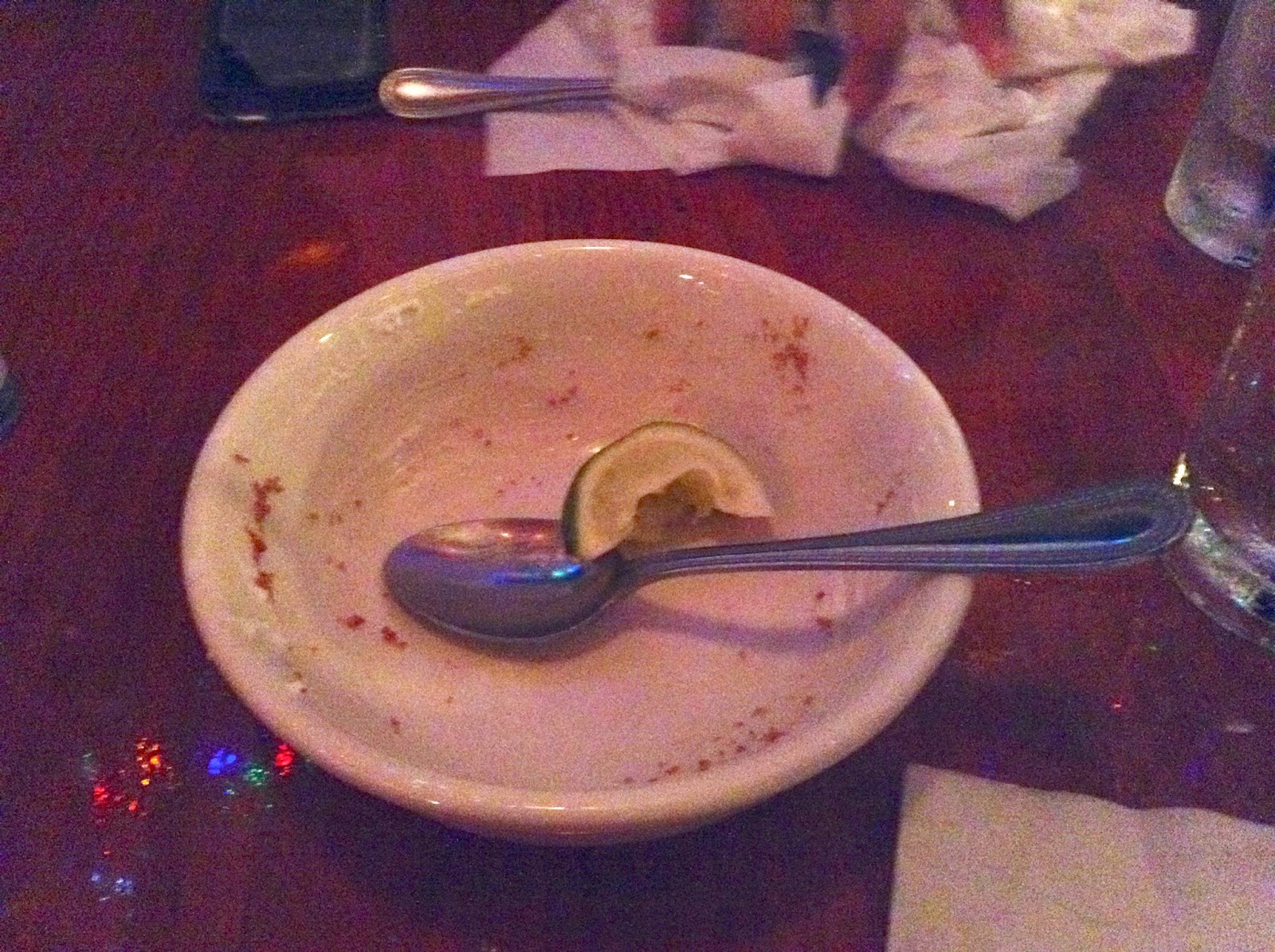
Pepe's: the "after" picture.

Friday, January 30, 2015

Chickens


When I started this blog in the summer of 2013, I never in my wildest imaginings thought I would be devoting a whole post to chickens. Nonetheless, that's exactly what I'm doing, even though the length of this post is succinct by my standards. I guess if my trip to Key West last month taught me anything, it's to be ready for anything in life and just go with it. I guess I didn't really learn that necessarily in Key West, but I imagine I would have if I stayed there long enough.

I think that one of the best things about stepping off your front doorstep and going someplace new is that every so often, you find something truly surprising or curious. In heading south to Key West for a couple of days I expected to find gorgeous scenery, good food and maybe a bar or two and I think I found all of that. But what I also found when we stepped off the Doubletree Hotel shuttle bus on our first trip downtown was a number of chickens roaming free. And I'm not talking about one or two or a fowl which should have been in someone's yard that got loose, these things are regular encounters on the streets of Key West. I found that both surprising and curious. And worth spending few paragraphs on.

When I'm in a strange place and I encounter wild chickens on the streets, I always ask the locals what the deal is here. Turns out they don't necessarily know. At least the ones we asked. The information offered to us was very non-specific. We were told by some of the vendors that we asked that the birds might be escaped captive chickens once kept as farming birds and that they might have been brought to Key West to combat the insect population. We were also told that "they've always been here." I'm doubting that last one. Maybe our sights were set too high. I can understand the convenience store clerk not knowing too much but we stopped in a Key West chickens themed shop and asked. I would think the woman in there would have been some sort of authority.

Now because I'm a curious guy, I had to find out the skinny on these things when I got back home. Turns out the internet doesn't necessarily know a whole lot more than the folks we asked on the island do. If there's one thing the internet seems to agree on, it's that the chickens are an introduced or feral species. There are no natural chicken predators on the island and the birds seem to be especially adept at controlling both the native cockroach and scorpion populations, which folks generally don't seem to mind. When the birds actually were brought to Key West seems to have the internet in a bit of a spot. Some reports I read claimed the chickens were brought to the island during the Great Depression as a sustainable way of putting food on the table; other articles claimed the chickens arrived with immigrants in the 1800s, maybe from Cuba who brought them not just for food but also for sport (meaning fighting each other). 

There doesn't seem to be any explanation as to why there are so many roaming free other than that's what chickens do in Key West. The initial reason is what I was after. I can accept that maybe a person or two released or lost a pet chicken every so often. But to get the quantity of chickens that you encounter in Key West must have required some sort of fowl freeing epidemic. I guess maybe it's one of those things lost in history. I've accepted after a few sessions of searching that I'm not getting to any sort of sure thing answer. Maybe I should be softer on the locals that we talked to.

I'm sure the chickens are great for the tourists. I mean they don't really affect our lives other than having to wait for one to cross the road (insert joke here) every so often when you are trying to get to the next bar. They are super colorful and generally harmless. I suppose if I were staying right in town, I might have been annoyed when I was awoken at sunrise by the crowing of a rooster, but fortunately our property out at the Doubletree was mercifully cockerel free. Anyway, that's all I have to say about these things. If you ever get to Key West, expect to see some chickens. I didn't.

Tuesday, January 27, 2015

The Last Keys


Hop in a car in Miami and drive south on U.S. Route 1 and you will eventually come to the end of the Florida mainland. Your drive time to the point will be about an hour or so and along the way you will pass strip mall after strip mall selling souvenirs and towels to tourists that almost exclusively seem to define the streetscape of southern Florida. Strip malls. Asphalt and concrete roads. And traffic lights about every quarter of a mile. The traffic lights are there to get you a better look at your surroundings by forcing you to stop every few minutes. It's not very pretty.

If you decide to make the drive and can persevere beyond the strip malls, you will come to one last traffic light and leave all that behind. Beyond that final traffic light, which is about 45 minutes or so into your drive, the road becomes a single lane each way bordered by a ten foot high barbed wire topped chain link fence with lush greenery beyond the fence. At this point, you are driving through the Everglades, the slowly-moving-southward water that is southern Florida outside of the strip malls and asphalt and concrete roads.

The barbed wire atop the fence on either side of the road is tilted out away from the road to keep humans on the highway and (if the signs on the side of the road are to be believed) crocodiles in the swamp and off the road. I think the fence is probably there for a reason. I would think the last thing you want to do on a single lane road is wait for a crocodile to cross in front of you, especially when the concrete median in the center of the road will likely make it turn back. All very slowly, I don't doubt.

When you reach the end of the mainland, U.S. Route 1 does not stop. Not even close. It keeps going for another couple of hours, stretching along an archipelago known as the Florida Keys all the way from Key Largo in the east to Key West where you will find the zero mile marker of Route 1. Before spending a couple of days exploring the Everglades last month just before Christmas, we made the trip past the strip malls, past the last traffic light on the mainland and all the way to the end of the road. My initial intent in planning this trip was to go see what all the fuss was about in Key West, which has at various times threatened or claimed to secede from the United States as the Conch Republic. While researching this quick vacation, I found reasons to go beyond Key West, and going beyond made this whole trip worthwhile.

The drive through the Keys on the Overseas Highway.
The Florida Keys stretch out across the gap between the Atlantic Ocean and the Gulf of Mexico known as the Florida Straits. This waterway is critical to the naval defense of the southern United States and therefore the Keys being in the way is pretty darned convenient. They were originally inhabited by native Americans and were "discovered" by Juan Ponce de Leon on his quest for the fountain of youth in the early 1500s. For a while in the 1800s, Key West was the largest town in the entire state of Florida, supported almost entirely off an industry know as wrecking, which as the name suggests involved the recovery of valuable stuff from the many ships that unsuccessfully navigated the Florida Straits and wrecked.

For centuries, the Keys remained inaccessible to man except by boat. Then about 100 years ago, an overseas railway was built to connect Key West and all the Keys in between with the Florida mainland. If a railway made from steel or iron crossing saltwater in an area prone to violent hurricanes sounds to you like an accident waiting to happen, you'd be correct. In 1935, a Labor Day Category 5 hurricane wiped out an enormous section of the railway. For good as it turned out.

Following the 1935 hurricane, the remains of the railway were either abandoned or converted to the Overseas Highway, an extension of Route 1 that remains to this day. The drive from the U.S. mainland to Key Largo and down Route 1 to Key West was something I've wanted to do for a few years. I've seen movies with this lone concrete road supported from the sea floor with water on either side of the road as far as the eye can see and wanted to experience it for myself. The reality of the road did not live up to my anticipation. You can't really see anything over the sides of the highway. Yes, it's obvious that you are surrounded by the Atlantic Ocean and Gulf of Mexico but you don't get the sense you are driving over a large area of seawater, probably because the land areas are really close together.

Other than a stop for lunch in Key Largo for my first grouper sandwich of the trip, our drive through the Keys was fairly uneventful, although driving down the only road leading to Key West, you can't help thinking about what a complicated exercise a hurricane evacuation from these islands might be. There's only one road to get out by. I imagine planning needs to happen way in advance of that sort of event. As cool as the life in Key West may be, that's definitely not for me. I'm good visiting in December. I'll stay away during hurricane season.

Eventually Route 1 will end at the corner of Fleming and Whitehead Streets and you'll find yourself in Key West. Find a hotel, ditch the car and start walking around town is my recommendation. There's enough to see and do here to kill a couple of days and nights, although beyond that point I don't know. Key West has turned into one of those towns where drinking is a number one reason for most visitors being there so naturally there are collections of drunks walking up and down Duval Street acting stupidly just because everyone else is. Without all those people there, it would be an amazing place to visit.


Don't get me wrong, Key West definitely has its charms. Ernest Hemingway lived there for a time and his house is now preserved as a museum (we didn't visit - not much of a Papa fan) and we had some excellent fresh caught grouper, mahi mahi and snapper in every restaurant we visited. In fact, the food was just fantastic; I didn't know I liked fish so much before I was in Key West for a couple of days.

Key West is also the southernmost point in the continental United States and there's a red, yellow and black painted monument of sorts with some interpretive history signage around it to commemorate that fact, although I should point out it's not at the actual southernmost point on the island. The actual southernmost point is at Whitehead Spit, which is a few hundred yards west in the not-accessible-to-the-public Naval Air Station Key West.

But ultimately the reason I was in Key West was not to see the town but to actually head further west. You see, Key West, despite its name, is not the westernmost island in the Florida Keys. In fact, there are seven more islands that complete the Keys about 60 miles into the Gulf of Mexico. The largest of these, Garden Key, is open to visitors as a U.S. National Park but you can't drive there. This island, otherwise known as Dry Tortugas National Park, was my destination and it made my couple of days in the Keys totally worthwhile.

Dry Tortugas National Park is centered around Fort Jefferson, a six sided fortification which began construction in 1846 to provide the United States with a strategic military position in a critical shipping lane between the Atlantic Ocean and the Gulf of Mexico. The Fort, which is constructed from over 16 million bricks and is the largest masonry structure in the United States, was in active use from its completion until the late 19th century when the invention of the rifled cannon rendered its fortifications useless.

Dry Tortugas from the air.
The island is completely surrounded by saltwater, which along with the complete isolation from the U.S. mainland, must have made life for the up to seventeen hundred soldiers (in earlier years) and five hundred or so soldiers plus 500 inmates (in later years when the Fort was used as a prison) extremely challenging. The Fort incorporated a series of cisterns within the fortified walls to capture and store rainwater. Today, supply boats running once a week keep the Park Service rangers stocked with supplies. I'm thinking in the mid 1800s that the supply boats were significantly less regular and feeding a couple of thousand soldiers then is way different than a couple of park rangers today.

The useful life of the Fort was relatively short, just about 40 years or so, for a place that must have taken a significant investment of labor and capital to build. Nonetheless, the place has some real notable history. In 1865, the four co-conspirators (other than John Wilkes Booth) in the assassination of Abraham Lincoln were confined there. At least one of the four died in a yellow fever epidemic on the island before the Fort was abandoned by the military and turned over to the Marine Hospital Service as a quarantine station in 1888.

As a tourist in Key West, your options in getting to Dry Tortugas are fairly limited. Driving is out of the question. There are absolutely no roads that get you out there or really anywhere close. Mile Marker 0 of Route 1 might be about the closest automobile accessible point to the island. There's a ferry that leaves Key West at about 8 in the morning and takes a little more than two hours to get there. I'm sure the ride is very scenic and relaxing out there. I'm just not sure I want to take the same ride back to the main island beginning at 3 pm. At that point the excitement at the journey itself is probably gone.


The other option is to fly there. On a seaplane. It's a little more expensive than the ferry but not inordinately so (the ferry ain't cheap!) and it's way faster. The ride on the plane one way is about 40 minutes and journeys are offered as a half day (morning or afternoon) or full day package. Given the limited amount of time we allocated to spend in the Keys and slightly unsure of the appeal of spending a whole day out in the middle of the Gulf of Mexico, we opted for the half day package. And being a firm believer in the early bird getting the worm, I bought way in to the morning departure.

I've flown on a small plane before. When I was 16 I flew into the Grand Canyon in what I remember as a six seater but was just as likely something different. But I've never been on a plane that would land and take off from the water so at this point anything new like that in my life is exciting. I bit the bullet and bought a ticket.

There are immediate advantages to taking the plane. First of all, it's just cool as anything to take a plane out across the water. The flight altitude is about 500 feet all the way out there so you can really get a good understanding of the topography of the sea floor. You can see sea turtles swimming near the surface of the water, there are a couple of wrecked ships between Garden Key and Key West and every so often, you can catch a glimpse of a shark swimming in the shallower waters. It's obviously way quicker and the sea keeps my attention for just more than a half hour in a totally different way than it would for two hours plus. I'd recommend if you ever take this trip in the morning to sit on the left side of the plane on both the way out there and back. I sat on the right side. Awesome on the way out but the midday sun was brutal on the way back.


Our flight that morning was full, meaning a pilot and ten passengers, and fortunately everyone was early, meaning we got to leave early (the ferry is not leaving early, believe me) and spent an extra ten minutes or so on the island. This is not a commercial flight so don't expect the comforts, if you can call them that, of a jet airplane. Headsets are mandatory to drown out the engine noise and your ventilation control is rotating a quarter sphere shaped piece of plastic connected to a hole in the window next to your head. The sensation of landing on water is really pretty cool as is the takeoff on the way back. I'm not sure I'll ever get this chance again, although you never know.

When you take the early plane to the island, you arrive at a place that has just two or three park rangers and maybe a handful of overnight campers, meaning you are 60 miles out in the Gulf of Mexico with about 15 or so other people and a whole lot of pelicans on a glorified sandbar with an historic pre-Civil War era fort. It was just like being marooned on a secluded desert island, albeit with a cooler full of bottled water, some snorkeling gear and a promise from our pilot to be back to collect us in three and a half hours. Once the plane leaves, you are there almost alone.

The Fort today offers a number of activities for the curious tourist. There are coral reefs with a number of species of fish to explore with a face mask and a pair of flippers. There are a ton of pelicans and other species of birds, which I have to say I cannot identify, to check out both on Garden Key and the adjacent bird sanctuary. There's the Fort to explore on a self-guided tour. And there are seemingly endless expanses of water to gaze out over and imagine what life must have been like for some teenage or early 20s soldier when the Fort was in active duty.


I'll say a couple of things about the place. First, my swimming skills have atrophied over the years and snorkeling was difficult after about a half an hour in the water. My teenage self that spent hours in our backyard pool each week in the summer would be embarrassed. The fish spotting in and around the old coal pilings on the north side of the island was good but it's not like the kind of variety you can get in the Caribbean, which to this novice snorkeler, was about as amazing as I think I will ever see.

Walking around and through the Fort was fantastic, whether it was strolling around the sea wall that formed a sort of moat around the Fort while watching sergeant majors and other sorts of fish searching for food in the sea right below your feet or exploring the inside of the Fort learning about how the place operated about a century and a half ago. The best part was probably on the ramparts climbing over the old cannons and around the lighthouse with the light blue Gulf waters all around about 50 feet below.


Fort Jefferson from the ground...
….and from the top of the rampart.
But the best part of being on the island for a little more than three hours or so, which was just a little too short (I could have used maybe another hour) was the absolute silence of the place. It's a rare thing for me to get to a spot where there are precious few other humans and where cell phone towers are mercifully out of range. I know there were maybe 15 or so other folks out there with us but honestly I didn't notice. It's definitely big enough that you can spread out. Listening to the waves breaking on the sea wall and our footsteps on the beach or paved surfaces within the Fort with no other sound was amazing. It almost felt like we should be whispering because the quiet we experienced out there is so rare in our lives today.

While the silence was without doubt the best part, which still seems sort of strange, if we had taken the ferry or even the afternoon flight, we wouldn't have experienced this and our trip would not have been so special. From atop the Fort's wall at about 11:15 that morning, we watched the ferry arrive and discharge its entire 150 people or however many the ferry holds passenger load onto the island. Right then the experience would never be the same. Fortunately at that moment, our return ride home had arrived and it was time to go, although we still found about 15 minutes or so to watch pelicans dive into the water in search of food after climbing down from the walls of the Fort.

Dry Tortugas is one of the least visited U.S. National Parks. The Great Smoky Mountains National Park (the most visited) boasts over 9,000,000 visitors per year; Dry Tortugas manages about 60,000 per year, about three days' worth to the Smoky Mountains. It's not easy to get to, but the trip there is well worthwhile. The Keys definitely wouldn't have been as enjoyable without getting on a plane and flying out there for a morning. There's a lot to like about Key West, even with all the drunks and the seemingly endless Jimmy Buffett music, but the Keys wouldn't be the same without exploring all of them, all the way to the real key west.


Our ride home. The plane, not the pelicans.
King of the world!