Showing posts with label Signs. Show all posts

Saturday, May 4, 2024

Don't Do It

When we decided on Singapore as the hub of our Southeast Asia vacation earlier this year, we finally had something to get excited about and plan, other than some temple time in Cambodia, that is, which was the main point of this trip. Oddly enough, one of the first reactions we got from a number of people about our choice of destinations was "don't break the law; don't they cane people there?"

Why...yes they do cane people. And we had exactly the same thought. 

Now, ordinarily, the last thing we would think about doing on a trip is breaking the law, but Singapore has some mighty strict laws so there were definitely some obscure and seemingly benign rules that we could easily and inadvertently find ourselves on the wrong side of. Did you know chewing gum is illegal there? It is. And it's not the only thing. Who knows what else is forbidden. I'm don't know what the punishment is for chewing gum in Singapore but I know for damn certain I didn't want to find out.

So why did people (including the two of us) have this reaction? Well, in September of 1993, an American teenager named Michael Fay decided to have some fun in Singapore and spent a few days stealing some road signs and vandalizing some cars. Good fun? Maybe for some. Good idea? Mmm...probably not. Not for him. Not in Singapore. He was convicted of violating Singapore's Vandalism Act. The punishment? Six lashes with a cane. 

Some people in the United States freaked out. Corporal punishment? For a little minor theft and a little damage to some cars? How dare Singapore do this to an American citizen? And just a teenager at that.

Hey...don't do the crime if you can't do the time. His reduced sentence (four lashes) was carried out on May 5, 1994. I'm guessing he never stole any more signs or vandalized any more cars again. At least not in Singapore, anyway. Singapore don't play with crimes.

Now, to be clear here, I am not equating chewing gum to vandalizing cars and I am confident in stating (without actually looking it up) that the Singapore judicial system doesn't impose caning sentences for chewing gum. But gum IS, without question, prohibited. It's on the Immigration and Checkpoints Authority list of prohibited items to bring into the country.

Know what else is on that list? I mean I'm sure you don't so I'll tell you: concealed weapons; all manner of nicotine products including snuff, chewing tobacco and e-cigarettes; obscene publications; endangered species; controlled drugs; and seditious materials. To me, gum is clearly the odd man (or odd thing, I guess) out on this list. Nonetheless, we discarded any gum (read: contraband) we had in our possession before we boarded our plane for SIN at Haneda Airport just outside of Tokyo. No rule breaking for us. Not in Singapore. No way!


So I don't know if the hype before this trip made us extra sensitive to rules in Singapore, but I'm sure it helped us pay attention to a lot of posted signs in a way that we wouldn't have if Michael Fay hadn't been caned 30 years ago. There are a lot of rules in that city all over the place. I'm sure there are in any major city, but we looked extra hard I am sure and we found some guidelines that we wouldn't necessarily see at home.

Like what, you may ask?

Like no durian (that famously stinky tropical custardy fruit that some say smells like rotten meat) on the subway system. This wasn't a surprise to us necessarily because we had been told that durains are forbidden on public buses in Zanzibar when we were there last year. I do think it's interesting that the no durians rule on the subway is posted next to no smoking, no eating/drinking and no flammable goods and that all three of those offenses carry fines but having a durian doesn't. I guess just don't walk around with durians is the message. 

There were certainly lots of other rules posted everywhere.

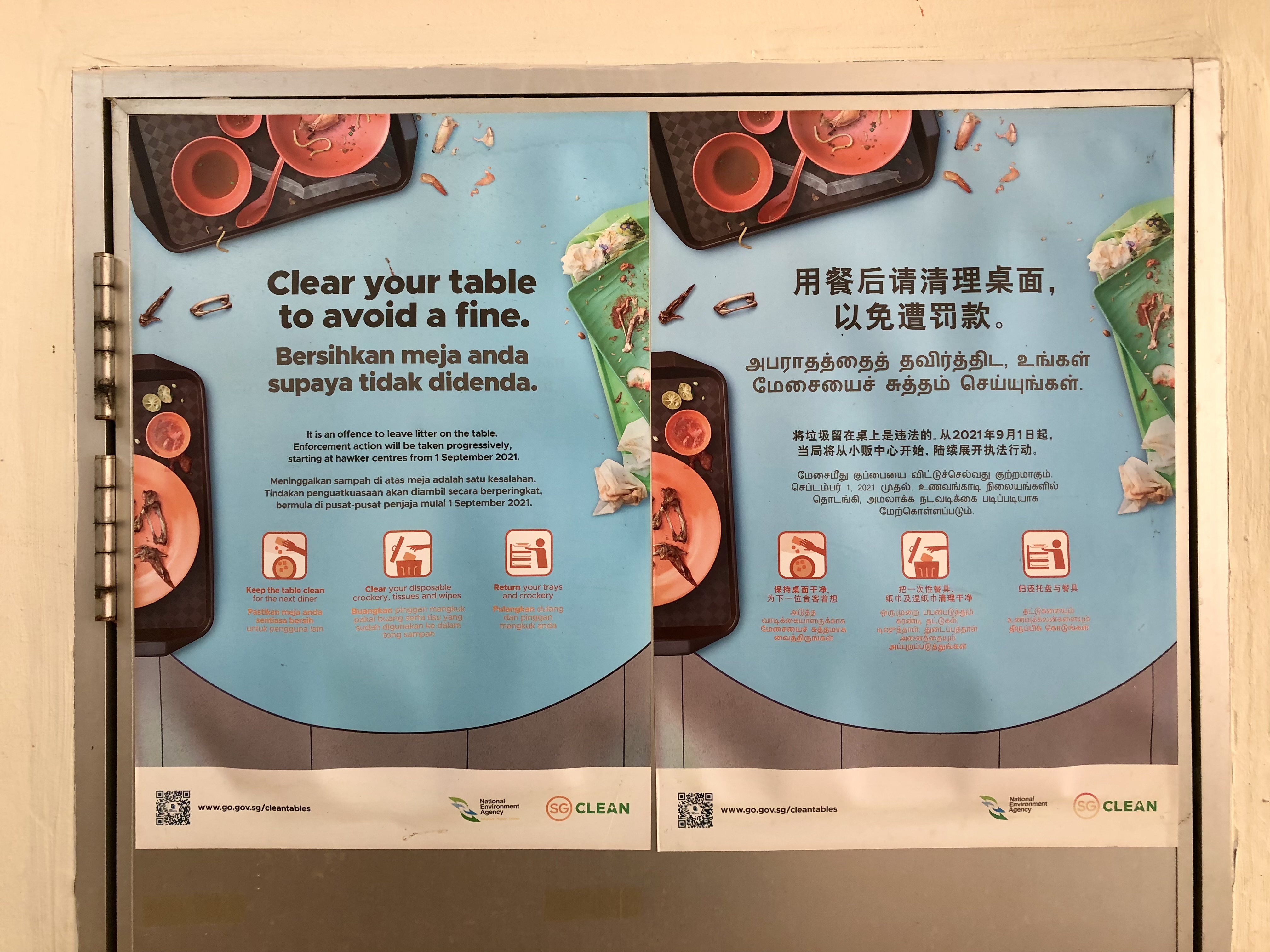
No admittance. No chasing the otters. No feeding the monkeys. No jaywalking. Although actually, it's STRICTLY no jaywalking. Fines for not clearing your tables at the hawker markets. No fighting (or "voluntarily causing hurt", if you prefer). No exercising in groups (individual exercise seemed to be fine). And definitely, definitely, no gum, although we didn't actually see any signs prohibiting gum. Or spitting, which is also apparently illegal, although I'm not sure why you would spit in Singapore because it's so hot there I would think you'd need every but of saliva to hydrate your body.

There were some scary signs there, too, like those that had images of a person with their hands up with another person pointing a rifle at them. These signs prohibited photography of the building behind the fence that the sign was attached to and also directed us to not even take a picture of the sign itself. And not wishing to incur the wrath of the Singapore government (coming home un-caned matters to me), I did not take pictures of those signs.


By the way, I think our favorite rule from this trip is the "Exercising in groups is not permitted in this area" sign. I think every time we have been out in a park or just on the street since we came back from Singapore and we've see a bunch of people jogging or doing yoga or whatever, we ask each other if exercising in groups is permitted wherever we happen to be.

You know what we didn't see in Singapore? Cops. I guess everyone knows how to behave, maybe? The citizens of Singapore must have normalized law-abiding behavior to preserve harmony in their communities in a way that most American towns or villages or cities never would. I love that. The yearning for absolute and complete freedom to do anything at any time even if it threatens or makes others uncomfortable is subjugated so that society as a whole is more orderly, safer and good for everyone. I'm a fan. Take notice, America.

But seriously, we honestly didn't see really any police presence at any normal time in our time in Singapore. Sure, there were cops hanging around the subway system during Lunar New Year's Eve (and the early morning of Lunar New Year's Day) but they seemed to be there more to direct people as to where to go than to arrest folks for crimes. And yes, we also saw some (again in the subway system) before and after the opening ceremony of the River Hongbao event at Gardens By The Bay. But that was it. 

Now, I have no doubt that people are watching. Just check out the picture below taken at an entrance to one of Singapore's subway stations. There are plentiful cameras around and I think everyone there knows they are at risk of being on tape at any moment. You might think it's sinister or big brother-y but I didn't feel it. I like law and order. I like rules, even if it means we have to give up chewing gum. I have no issue with anything that Singapore permits or prohibits. But then again, we weren't looking to (and didn't) break any laws. No caning for us!

Tuesday, February 1, 2022

Fossil Fuel Fossils


Sometimes when I am researching what to do or see or visit on a trip, I come across something so intriguing, so enticing or so unique that it just can't be passed up. I mean just absolutely no way, no how would I ever skip an opportunity to visit. An absolute can't miss, if you will. Sometimes these places are close to where we are roaming anyway which makes it all the more rewarding. Sometimes they require an effort to get there. But no matter how near or how far, whatever it is, it's usually way worth it. 

On our New Mexico trip last December, that place was Embudo, New Mexico. Elevation 5,824 feet. Population 444. 18 acres in size. 43 miles mostly north from Santa Fe on the low road to Taos. Drive the speed limit and you'll get there in just a bit less than an hour. Embudo. Blink and you'll miss it. We didn't blink. We were not going to miss Embudo.

So what's in Embudo, you ask? Well maybe a better question is who's in Embudo. And the answer to that question is Johnnie Meier. Johnnie's the reason we visited Embudo.


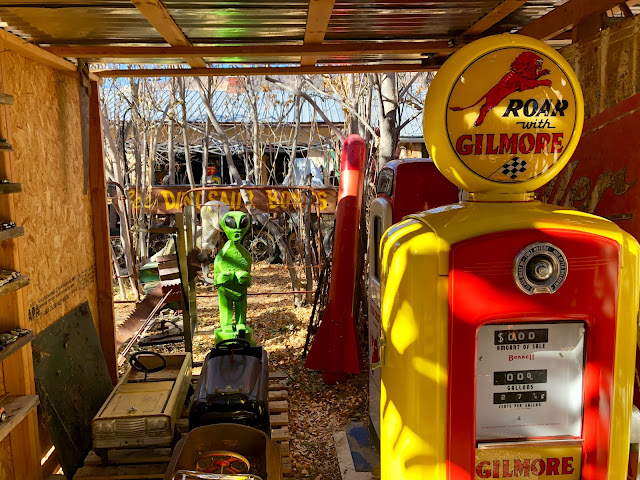
Johnnie owns a place in Embudo along New Mexico Route 68 just across the road from the Rio Grande. Yes, the river the Rio Grande. Johnnie's place is a former gas station. A Frontier gas station, if I'm taking a guess based on the large advertising sign on the side of the road. His place is a single story building with three old gas pumps out front with the whole thing set back just far enough from the road for a car or truck to pull into the lot and fill up. Were the gas station still operational, that is. And when I say old gas pumps, I really do mean it. Like from a time before I was old enough to remember gas pumps that look quite like the Frontier models on Johnnie's lot.

The three pumps in front of the old building aren't the only old gas pumps on the lot. In fact, there might be a hundred or more hanging around in one spot or another, lined up and away from Route 68 or shoved under a shed roof attached to the station or just standing around the perimeter of the lot in rows of four or five. Some of these pumps remind me of what I first saw at gas stations when we moved to the United States in the late '70s: leaded and unleaded pumps with dials that clicked around showing the amount of fuel pumped and the total price to be paid. Others are clearly older than that, with clear cylinders on top of the body of the pump or circular signs that illuminate at night.

Johnnie Meier is a collector, which I totally respect (having the collecting gene myself). And what he collects is old gas station stuff. Pumps, signs (both neon and non-neon), oil cans, old maps, iceboxes, bottle openers, anything and everything that you might have found at one time at a gas station or service station. And a lot of it is all out there for anyone driving down Route 68 to pull over and have a look. How could there be anything much more intriguing, enticing or unique than this? Johnnie's Classical Gas Museum was a can't miss stop for me.


Now, if you know anything about me, it's if there's one thing that is a sure bet to draw me into somewhere, it's blatant American commercialism. I mean like mid-20th century over the top, as bright and colorful and loud and look at me as it can possibly be. The Classical Gas Museum has all that. It is striking to see it all set against the gorgeous New Mexico desert and mountains beyond. I think that contrast makes it better.

The collection of stuff (some, I'm sure would call it junk and they would be wrong for sure) on Johnnie's lot is truly impressive. Huge metal signs from old gas stations that no longer exist. Gorgeous old chrome plated gas pumps with not a spot of rust on them. Almost everything super clean and sparkling. Johnnie takes care of his collection. It helps I guess that his lot is in one of the driest places in the United States but the love in what's out on his lot shows. And he's willing to share with anyone for absolutely nothing. There's no admission to get onto the lot. Just wander on and start poking around. We spent maybe 20 minutes or so checking out everything we could and taking as many pictures as we wanted.

Then Johnnie showed up.


Now we'd get some insight into this collection. 

Johnnie's been building his collection over about 30 years or so, ever since he got tired of restoring old automobiles and decided to direct his passion into something else. In winter, he gets maybe three cars a day pulling over to look at his collection. In summer, it surges to about 20 or so. Not a huge volume of people making the stop on the low road. It's not obvious that you should stop unless you know what's there.

Johnnie refers to the stuff we'd been ogling outside as his "rusty stuff". It's glorious. It really is. But the jewels of his museum are not outside. They are inside the old office of the gas station. Johnnie calls what's inside his "shiny stuff". And it blows what's outside away. No contest. You need to make sure you get a look inside. We didn't do anything to make sure Johnnie would be there when we were there (although honestly, I'd read that he's usually around on weekends). We wouldn't know what we'd missed if we hadn't gotten a look at his shiny stuff.


What is inside that old gas station building is just incredible.

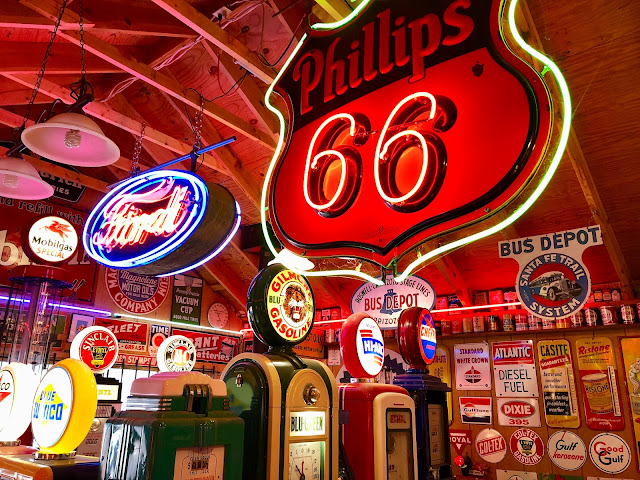
I guess gas pumps used to have these glass globes on top of them that were lit up at night. At the Classical Gas Museum, they are lit up during the day. But only if you get inside the old building. The condition and variety of the collection that Johnnie has inside that place is astonishing. I mean just gorgeous, beautifully restored artifacts of a time now long gone. I don't know what his utility bills are like on days when he lights his whole collection up for people like me but it is a thing of wonder.

You will undoubtedly recognize some of the signs inside the place. Conoco. Chevron. Gulf. Phillips 66. Sinclair. The Mobil Pegasus that used to be the iconic symbol of that brand (go to Dallas and you'll see the Pegasus all over that city). All stuffed into a tiny space on the walls and hung from the ceiling but displayed perfectly.

There are also a lot of signs I didn't recognize. It's staggering how many gasoline brands there used to be out there and how American capitalism has dwindled that list down from a list of many to a precious few. Valley. Mutual. Frontier. Malco (the BEST logo, by the way). Magnolia. Knight. Walk through this museum and you'll spot many more, I'm sure.


I don't know what else to say about this place. Hopefully the pictures posted here speak volumes. I know they do for me. Johnnie Meier's place is quirky, obscure, over the top, absolutely completely unique and beautifully curated. From our talk while I was in the Museum, I know Johnnie is concerned about the legacy of this collection. This is every bit as important to preserve as any place documenting the history of the United States in the mid to late 20th century.

We visited a lot of sites in our week in New Mexico. I'm sure some of those like the Georgia O'Keeffe Museum and the ABQ Holiday Market and the Indian Pueblo Cultural Center draw a ton of visitors. Way more in a day than the Classical Gas Museum draws in a month or maybe three months or more. This place was every bit as good as all those other spots. Beyond the actual objects preserved on property, the care and love that Johnnie Meier shows for what's on his piece of land in Embudo is important and is so valuable.

And if you go, you are likely to be the only people in the place when you are there. There's a lot to be said for that.


How We Did It

Honestly, here we just headed out of Santa Fe on the low road to Taos and knew we'd hit the Classical Gas Museum eventually and stopped when we got there. We went on a weekend because (and I know I've already mentioned this) we'd read on some websites that there was a greater likelihood that Johnnie would open the place on weekends. It clearly worked for us. Maybe we got lucky.

We were literally the only people on the lot waiting to get into the building to see the shiny stuff. There was one other dude walking around on site who told me he was hoping to get a hold of Johnnie to buy some old pumps from, but other than him we really had the place to ourselves. In this tourist-centric, Instagram-crazy society we live in these days, being the only people in a place like this is honestly pretty special. It didn't take us a long time to get through the whole Museum but we really felt like we got an intimate look into someone's passion for three plus decades. When it's done this well, that's a special experience. 

I regularly use Atlas Obscura as a guide when I'm visiting places like this. There's no contact information on their web page for the Classical Gas Museum but I think their link is worth posting.


Thursday, November 5, 2020

West Yellowstone Motels

Every so often a trip throws me an unexpected curveball. Sometimes those curveballs lead to disappointment; sometimes they end up being really nice surprises. I never would have imagined I would have found one of the latter when we pulled into West Yellowstone, Montana to check into our second of three hotels on our Grand Teton and Yellowstone swing. But that's exactly what happened.

I may have mentioned once or twice on this blog that I am somewhat obsessed with neon and signs, either separately or together (together is very definitely better). So when we left Yellowstone National Park's West Entrance and turned right onto Boundary Street in West Yellowstone, I thought I'd about died and gone to heaven. Staring straight at me in the early evening light were three vintage motels with their neon ablaze. It was glorious.

My expectations for our time in West Yellowstone were pretty low. I am not trying to put the place down but I figured this was a place where we'd just eat and sleep and get out back into the National Park as quickly as we could. I expected that the place would exist solely to cater to tourists wanting exactly what we wanted at the lowest possible price and I think I was pretty much right. There is little reason for the town of West Yellowstone to offer deluxe accommodations or cutting edge food. The attraction that's going to keep people coming back is the Park, not the town. And the Park's not going anywhere any time soon.

But that reality is probably precisely what has kept in place what I found when we turned on to Boundary Street. No way would these motels with their glimmering, multi-colored, straight-out-of-the-mid-20th-century neon stick around for what is probably 50 or 60 years if West Yellowstone was constantly replacing their hotels with bigger and better and more modern establishments.

Boundary Street is a bit of a tease. We explored the town looking for more than those first three motels we saw when we made that right turn and failed. We found a couple of more motels worth writing about but they were not lit up in the same way. Although one motel could be, they just need to turn the lights on.

So let's start with those couple...

Beyond the initial three motels we saw, we found the Ho-Hum Motel, with the neon owl sign above affixed proudly to the North Canyon Street end of their main block of rooms, and the non-neon Pony Express Motel shown below. I know the Pony Express is not immediately impressive to the eye but there's one piece of fading Americana that amuses me to death every time I see it. We'll get to that.

I photographed the Ho-Hum owl during the day because for some reason (and I'm assuming it was not just the two nights that we checked), the motel does not turn on the lights at night. I would have loved to have seen this sign's colors, even if it had been just the owl lit up (since the rest of the sign does not appear to illuminate). This was super disappointing to me. Maybe it's broken? 

As a side note before we move to the Pony Express here, who names their Motel "Ho-Hum"? It literally means "boring". I'm assuming the name does not affect the occupancy rate.

So about that Pony Express sign...

When we moved to the United States in 1979 and started taking family vacations, I remember seeing the same sign at many of the hotels and motels we stayed at on our trips: "Color TV". Yes, at one time it was common to find only black and white sets in motel rooms (just like we used to have at home when I was growing up) and having a color box could be a real differentiator. Now, of course, the notion today of having anything but a color flat screen television in a motel room is ridiculous. But some motels still have the sign hanging around and I love it when I find these relics.

I know you can't see it well in the photograph below but the Pony Express' "Color TV" sign is in awesome condition, features different colored letters to emphasize that they are really serious about their color television and to top it all off the sign includes "by RCA" at the end. I love this. But like the Ho-Hum owl, it also doesn't light up. So like the Ho-Hum photo, this one is also taken during the day.

Those first three motels we saw when pulling in to town were Al's Westward Ho Motel, The Dude Motel and the Round Up Motel. From a multiple colors of neon perspective, Al's and The Dude are the two best signs in West Yellowstone. Al's mixes script and block capital letters into a simple sign that works well next to the simple, gable-roofed motel office. I love the simplicity of execution here, especially the top of the sign where the "Al's" is featured against what I can only assume is a hat-shaped background.

The Dude sign is better than Al's. It is difficult to argue against the beauty of a sculpted neon sign and while the majority of The Dude's sign is non-neon flat backlit translucent, the dude himself is a work of art in neon tubing. This is by far my favorite sign in West Yellowstone. There's no comparison. I would need the Ho-Hum owl to get lit up to enter any semblance of argument about that issue.

And then there's the Round Up. If there's a better argument for what neon can do to fancy up a place than the Round Up Motel, I'd love to see it. The Round Up's office is about as unremarkable a building as you could find. The only way it could really be less well thought out as a piece of architecture is if whoever designed this thing just left out the windows. But stick an L-shaped (in plan view) neon sign next to and over the top of the brick box and it becomes something to look at and appreciate. 

I love the simple lettering on this sign and the way the "Round Up" is slightly angled and encircled by a lasso rope, reinforcing the name itself. I'm sure this sign cost a pretty penny when it was installed and for me, it's money well spent. It makes the whole building sing.

West Yellowstone will likely never be much more than it is today. It's a town of 1,200 permanent residents serving up to 12,000 tourists per day. But I was wrong about this town. I expected to find a place not worth mentioning in the story of my travels. Ho-hum, if you will. But these motels represent the best of what we found just outside the West Entrance of Yellowstone National Park. And with that statement I'm not setting a low bar. I love these motels. They are a well-preserved throwback to a different time in American history. I hope they keep these things lit for a long, long time.

One more appreciation to close this post. Our last three trips have been mostly focused on nature and I've written a lot about the American landscape and wildlife this year. I appreciate these buildings and these signs tapping into a love of writing about design. Definitely worth a post. Thanks, West Yellowstone!

Close up of The Dude sign with that fantastic neon.

How We Did It
Since we didn't expect to find what we found in West Yellowstone, this post required no planning whatsoever. It was one of those awesome discoveries that we never expected.

Four of the five hotels highlighted in this post are on Boundary Street, although only one (Al's Westward Ho Motel) has that street address and two of the hotels are actually the same property. At some point, the Round Up and The Dude, merged into a single property called The Dude and Round Up Motel. If you make that same right we made coming out of Yellowstone's West Entrance, the Pony Express is the last of the four you'll come to.

The Ho Hum Motel is not on Boundary Street in any way. It sits on West Yellowstone's main drag of North Canyon Street. Click on the name of any of the hotels in this How We Did It section to visit the hotel's website. The Ho Hum link will take you to their Facebook page; their profile pic is the neon owl all lit up. And all in red, which is surprising.

We didn't stay at any of these places. I'm a Best Western and Hilton guy so we opted to stay at the Best Western Weston Inn, which was fine but decidedly way less exciting in the neon department. Plus, I didn't know these motels were here in the first place.


Sunday, June 30, 2019

Scritti Politti


I guess this makes two posts in a row where I'm writing about walls in Peru. Very different kinds of walls. But walls nonetheless.

I have so many great memories of my week in Peru. Some of those are perspective-altering, monumental experiences I will carry with me for the rest of my life. Seeing Machu Picchu, the lost city of the Incas, for the first time, and then exploring it the next day. Hiking almost eight hours on a path laid down by the Incas more than a half a millennium ago. Exploring a farm that's been extracting salt from the same stream for hundreds of years. Flying over the Andes and then driving and walking on them the next day. Eating foods that I've never heard of and some that I certainly can't get on a menu at home. Alpaca, anyone?

And then there are some others that are, shall we say, a little more pedestrian, but which nevertheless form an essential part of my memory and an enduring image of Peru. Dogs roaming the streets in packs of two to five animals; apparently pets let out for the day but the best behaved dogs I've seen maybe in my life. Pairs of tiny clay bulls or "toritos" on the ridgeline of every house you drive by; ages-old idols to protect against lightning hurled down from the gods above. And walls just about everywhere painted with political party slogans and logos and names of candidates. I thought they were cool works of art although I may just have a signs fetish. So here's blog post number two in a row about walls in Peru.

The rainbow flag has been adopted as a symbol of the Andean people and can be seen everywhere. 
Politics seems to be a pretty popular topic of conversations with Peruvians. We got an earful from every taxi driver and tour guide we seemed to run into or walk with or ride a bus with. And with good reason. They have to have one of the most dysfunctional governments that is still a legitimate democracy.

I know that if you are American you have to be laughing right now. I mean how could any society really have a system more broken than the one we have in Washington right now? I mean literally, nothing is getting done right now. One half of Congress is passing bill after bill and the other half is just refusing to take any action at all. It's insane that we are paying these people to work for us.

Anyway...think we got problems? Talk to a Peruvian taxi driver.

Tired of a two-party system? Try more than 30. Fed up with politicians taking money from special interests instead of representing the people that elected them? How about having all your living ex-presidents in jail for money-laundering, bribery and corruption? Does that sound bad? It is. And it's not like there's just one ex-president still alive. There are three! And one of them has his wife in jail with him.

The yellow house with the pink roof is one of my favorites, often with Elvis right next to it. Assuming not Presley.
It actually gets worse. There would have been a fourth living ex-president in custody right now if he hadn't killed himself earlier this year to avoid arrest. All told, there have been six presidents since 1986 in Peru (not counting the current president) and five of the six were indicted or arrested or convicted or jailed or something. The only one that wasn't was an interim president whose only job in office was to find the next president. Where's all this bribery come from, you might ask? Apparently...Brazil. It's a real problem.

Emotions run deep here. And not in the ways you might think. Some people actually feel that some ex-presidents despite obvious wrongdoing should be walking free. Especially when it comes to Alberto Fujimori who served as head of the country for 10 years from 1990 to 2000. In his time in office, Fujimori legitimately did some good for the country, especially in stabilizing the economy and defeating insurgent groups within Peru, most notably the Shining Path, a Maoist revolutionary army of sorts. 

But apparently Fujimori was a little too zealous in his pursuit of wiping out the rebels because he got some non-rebels killed in the process. Which led to human rights violations accusations, a self-imposed exile in Japan, an impeachment, an arrest during a trip to neighboring Chile (I mean, why go to Chile when you are wanted in Peru?), a conviction, jail, a pardon by a successor president and an overturn of that pardon by the legislature which kept him in jail which is where he is today. And despite all that, there are a significant number of Peruvians today with a positive opinion of Mr. Fujimori, including the driver that took us from the airport to our Lima hotel and think he's done enough good to offset the whole corruption thing. Politics is complicated in Peru.

But that's not what this post is about. Not really.

Avengers Party? Not really, although at least two of our guides made reference to the A meaning that in jest.
So about those 30 plus political parties, which seemed chaotic at first but which I might welcome right now based on how stagnant our government here at home is. One of the benefits of having that many parties in Peru for someone infatuated with painted signs is that there are a whole lot of different colored signs by the sides of the road to look at and take pictures of. And they are not just here and there. Once we left the historic city center of Cusco they seemed to be everywhere. And I do mean everywhere. 

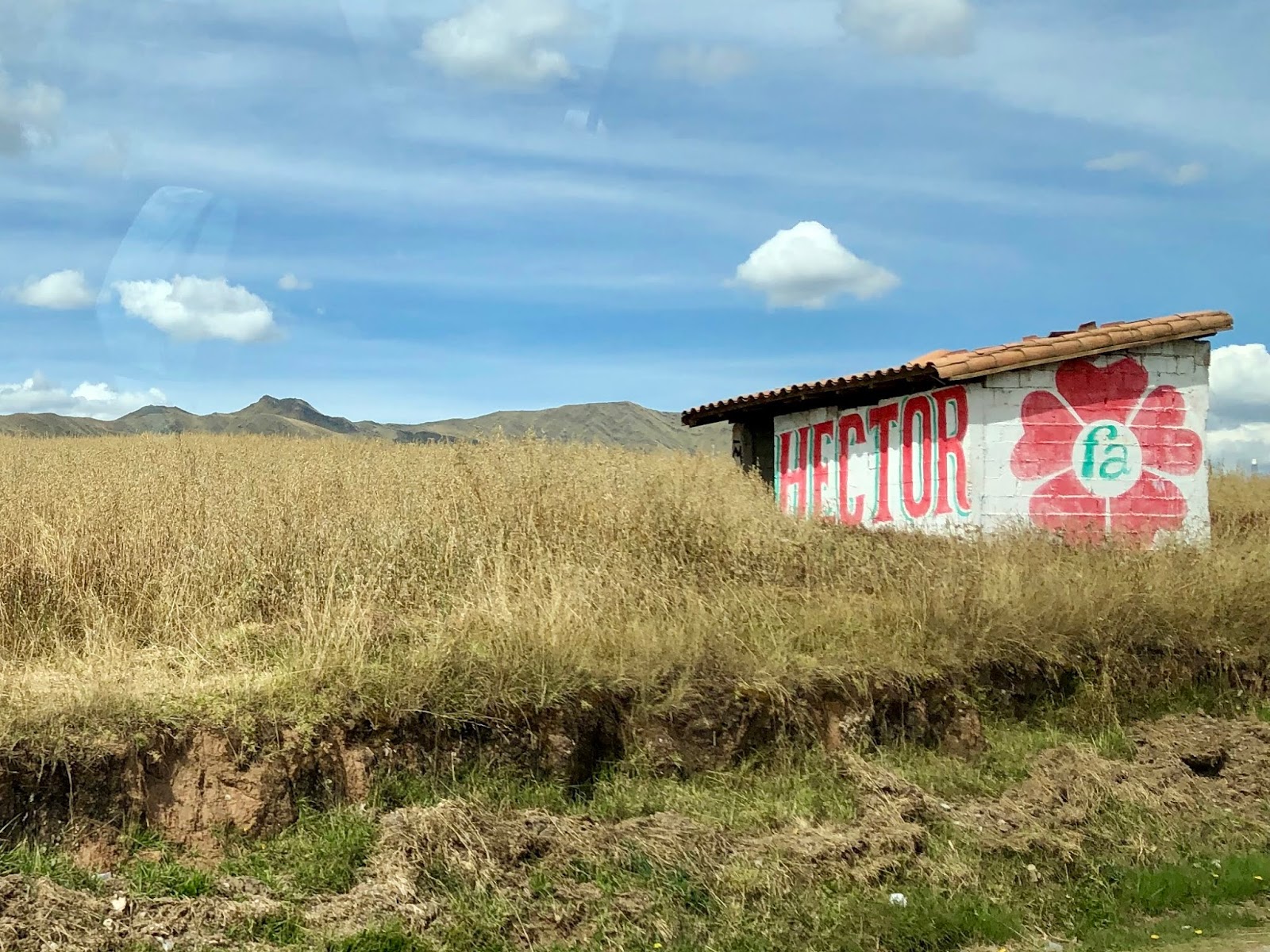
As graphic statements a lot of these signs are simple and powerful. Most feature the name of one or more political candidates along with a symbol of the party they represent. The names are always written (or painted really I guess) in the exact same colors and font. The symbols next to the names vary: a football (meaning soccer ball) or a shovel or a flower or a rainbow flag or an Andean head or a heart or any other sort of symbol that might become enough of a brand that could become associated with a name.

Football behind the lamppost.
I love how simple and straightforward the designs are and how different parties use different colors so that every color in the spectrum is collectively represented (although I guess all you need there is the rainbow flag sign to really do just that). They have to be simple so that they can be replicated over and over by many different people painting their own houses. And yes, that's what happens. Apparently people willingly decide to go to the hardware store (or wherever one buys paint in Peru) and buy their own paint so they can make the wall of their house or garden into a political advertisement. We were told that most people hope for favors after their candidate wins. Not sure how that works out.

There's also a story about the symbols. As attractive and graphically powerful as they are, they sort of seem unnecessary, unless you consider that significant parts of the population of the country are illiterate. Can't read your candidate's name? Just vote for the shovel! Or the rainbow flag or whatever else it is. How this process works on election day I'm not quite sure. Does the ballot have names and symbols next to the names? Didn't ask that question I guess.

I know, I know, all this sounds very complicated, right? Why wouldn't someone just not bother voting and take their chance with whatever party gets elected? I mean the odds that one of the more than 30 parties will get a majority is astronomical, right? There has to be a coalition or consensus of some kind to get things done, right? Surely someone sitting out a vote every now and then because they can't read couldn't hurt, right?

Wrong! Voting is mandatory in Peru. If you don't vote, you get fined. How awesome is that? Some politicians go to great lengths in my country to make it extremely difficult for some people to vote. Peru made it a requirement. Love it! Thus the flower and the football and everything else.

Vote for the flower!!!! Whatever that means in terms of the candidate (Hector, I guess?) that would be elected. 
I didn't actually take the time to track down what each sign meant or how things worked on election day with the whole pictures thing. I figured that would spoil the whole magic of this entire experience for me. Once I start getting entangled with politics, I'm not sure anything could save me. Better that I just appreciate these signs for their graphic quality. That's what drew me to them in the first place after all.

It is rare that I encounter something unexpected that intrigues me like this. Far too often on trips, I think of writing about these things too late (still regret missing the boat on the Yule Lads in Iceland...) so I'm glad I didn't let this opportunity slip by this time. 

Some of the pictures in this post are less perfect than I would want. If you'd noticed that (or more likely you hadn't) it's because I took every one of them from inside of a moving vehicle with a pane of glass between me and my subject. I'm pretty happy with the way they turned out even if I missed a few (regrets on missing the shovel especially...). But realistically, how many pictures of these signs could I have really posted? In case you think six is too few, here are two more to close this post.

I'm not exactly sure the llama logos (hidden behind the tuk-tuks in the last photo) are part of a political campaign. I didn't see these anywhere other than in the town of Chinchero. But they were one of my favorites so I couldn't pass up sharing them. May your next trip be full of surprises that bring you joy the way these did for me. 


How We Did It
Take a ride in any sort of vehicle outside of the historic center of Cusco and you are bound to find one or two of these signs. Keep going and you'll find more. Keep going further and you'll find more still. The best part of this part of our trip? It didn't cost us anything extra. If you want better photos than I got, ask you driver to stop and let you out. Just ask them to wait for you though. Happy hunting!


Saturday, April 23, 2016

Walking In L.A.


If there is a place on Earth that I fell in love with at first sight, it is Los Angeles. From the first trip I ever took there in 1993 when I explored the Hollywood Hills looking for Frank Lloyd Wright houses, I've been smitten by the City of Angels. It was the first exception to the "I've been there once, I don't need to ever go back!" rule that I use to push myself to seek out new sights and experiences. L.A. is an exception quite simply because there's so much to do out there. And because there is, I keep going back. I arrived at LAX earlier this month on my fifth trip and I'm still picking things off my wish list. I absolutely LOVE Los Angeles.

One of the unchecked boxes on my L.A. list was to see the Hollywood Sign closer than I ever had before and as it turned out, 2016 was the year to start working on that. I know, what's the big deal, right? In its simplest form, the Sign is a series of nine long-ago, hastily erected 45 foot high plain white letters sitting on a hill without much of a flat spot which causes the word to look a little crooked. But on the deepest of deep levels, the Hollywood Sign represents the City of Los Angeles and symbolizes the hopes and dreams of everyone who's ever moved out west to make it big and become a star. The Hollywood Sign IS the city. It's some pretty complex stuff.

Now I had for sure seen this thing before on one or more of my vacations to the left coast but I never really spent much time trying to get near it or give its history much thought. Yes, I knew it was originally a sign that read "Hollywoodland" to advertise a housing development somewhere in the hills north of town and I could maybe pinpoint the date of its creation to sometime in the first half of the twentieth century, but I'd struggle to tell you much more than that. Now I can tell you a whole lot more (and will, if you read on) including how to get a spectacular view of the front of the Sign without a whole lot of effort.


The story of the Sign began in 1923, when Los Angeles Times publisher Harry Chandler dropped $21,000 to have sheet metal, pipes, telephone poles and 4,000 20-watt bulbs hauled up the top of Mount Lee by a series of mules to cobble together a lighted sign that would spell out Hollywoodland. At night, the sign flashed alternately "HOLLY", "WOOD", "LAND", "HOLLYWOODLAND" and those bulbs burned out frequently so Chandler and his partners hired someone who lived nearby to go change the bulbs whenever they kicked. Good gig if you can get it I guess.

Of course, once the Sign was up, it needed maintenance, especially considering the flimsy nature of the materials used to put the thing together in the first place. And maintain it the owners of Hollywoodland did. Well, until 1939 when they just stopped altogether. Something had to be done.

In 1949, the ownership of the Sign was transferred to the Hollywood Chamber of Commerce (which still owns the licensing rights to this day) and they tore down the last four letters to make it into the first true Hollywood Sign. They also restored the "H" a little bit and then let it sit for a couple of decades. By the early 1970s, it was in sad shape. The last "O" was gone, the first "L" looked like an "I" and a few of the other letters were looking pretty ragged. 

Enter Hugh Hefner, Andy Williams, Alice Cooper, Warner Brothers, Gene Autry and a couple of other characters who banded together to save the Sign and make it what it is today. Each paid for the complete reconstruction of a single letter. First the Sign was on the edge of collapse, then it was gone and then it reappeared looking shiny and new. The Hollywood Sign Trust was formed to make ongoing repairs to make sure the sign never looked anything less than brand new from then on.


When I first contemplated getting a closer look at the Sign, I of course turned to the internet. And found relatively little in the way of good directions. Sure, there are a series of amateur bloggers like me who have written about their personal quests as well as the odd newspaper article that gives some tips for a good view. But everything I read either seemed to show a whole bunch of contextless photos of dirt trails and trees; close up pictures of signs; or two dimensional maps of a place on this planet which is decidedly not two dimensional. Hopefully this post can be clearer than most of the other advice I combed through before heading west.

If there was a consistent theme about how to get a better look at the Sign, it was take a hike in Griffith Park starting near the Griffith Observatory. That was perfect for me: even if my journey didn't get me a good look at some letters, I'd never been to Griffith Park and I'd also never taken a hike in Los Angeles. Who knew you could even do that? Nobody walks in L.A., right?

The detail behind the advice I read about Griffith Park was pretty consistent: walk up Mount Hollywood starting at the Charlie Turner Trailhead for a view of the Sign and get there early to find parking. The Hollywood Sign, funnily enough, is not on Mount Hollywood; it's on Mount Lee, which is one hill over to the west (or left if you are at the Observatory parking lot looking toward the Sign). And the advice about getting there early is correct. Very correct. We got there at about 6:45 on Saturday morning and the lot was already full. We only got a parking spot because someone was leaving, having already finished their morning hike or workout, I guess. Get there early is very good advice. You can park further down the hill but a couple of hours later, all those spots will likely be gone too.

Once you find a place to leave your vehicle, it's time to find the trail and start walking. This, I thought, might take some searching. The only directions I'd found to the trail, which I imagined as a barely visible path marked only by a small blue sign, was that it was somewhere towards the north of the parking lot. Well, it is in the north end of the parking lot but it's impossible to miss. As it turns out the Mount Hollywood Hiking Trail is the only trail we could find up at the top of Griffith Park and it's about fifteen feet wide, is glaringly obviously a trail and full of people. The north end of the parking lot, for those of you who might be directionally challenged, is where you enter the lot. Time to take a walk.


Roughly speaking, a walk to the top of Mount Hollywood up the very wide and very well used trail involves walking straight for a while; then hanging a hard left and walking uphill; pulling a uey then climbing straight to the top of Mount Hollywood. It's an easy hike so it's not really surprising so many people were out in Los Angeles early in the morning doing it. But even though that's exactly what we came to do and we were right there, we never did get to the top.

The closest you can get to the Hollywood Sign on the Mount Hollywood Trail is at the spot where you make a U-turn, which is sponsored by Tiffany & Co. (it is officially the Tiffany & Co. Foundation Overlook). Our objective that day was to get as close to the Sign as possible. If we kept going to the top of the hill, we would be a lot further away than we were at the Overlook and that didn't seem to make a whole lot of sense. So we didn't do it. Looking north from the Griffith Observatory, you can just about make out the trail and the point where it doubles back. I've highlighted that spot with a blue arrow in the photograph above.

When you get to the blue arrow in real life, it's pretty obvious that you shouldn't keep going to get closer to the Sign. In fact, it looked like the best spot to get a great view was a rocky peak much lower and directly in front of Mount Lee. That peak, which is accessed via a path which looks exactly like what I thought I'd be looking for when I got to the Observatory parking lot (i.e. about two feet wide and not in any way flat), is really just a rocky outcropping. But it's probably the best closest view of the Sign you can get in Griffith Park. It's shown using a red arrow both in the photograph above and below.


Getting over to the red arrow takes some doing. The path that the two dudes in the photograph above are walking down runs along a ridge; it's narrow and uneven and ends in a pretty big slope (shown below) that features a chain link fence to catch rock slides (I guess although it might also catch you). We made it fine but we were careful going down and back up the slippery slope. Before you descend, remember you have to go back up.


From there, all you have to do is cross a paved road (watch out for traffic); walk around a chain link fence which is clearly in place to keep people out but which people have clearly found an obvious way around; make your way along a slightly more treacherous ridge; and finally up a gap in the rocks to the graffiti tagged top of the hill. Your reward is the view of the Hollywood Sign in the second photograph above and a spectacular look at Los Angeles to the west (shown below).


If all that seems like a lot of effort for not much of a payoff, you'd be correct. If you want a walk in Griffith Park and an amazing look at the city of L.A. drive to the Observatory, park and take a walk up to the top of Mount Hollywood. If you want a close look at the Hollywood Sign without a lot of effort, don't do what I've written above. There's a way easier way to get an awesome view. And it's so simple.

Folks living in the Hollywood Hills aren't exactly crazy about Sign seekers. Depending on how hard you are willing to look, you'll find signs like the one at the top of this post or makeshift barriers stretched across residential streets with "Road Closed Locals Only" signs and gaps barely wide enough for a single car. I guess I can understand that to a certain degree. You don't want tourists traipsing around your neighborhoods in their cheap rental cars. On the other hand, don't buy a house in this part of town if you want to get away from tourists.

But there's one spot really close to the Sign that they can't keep you out of: Lake Hollywood Park and the roads leading to it. It's a public park, after all.

The original gates to Hollywoodland.
Type "Lake Hollywood Park" into Google Maps or whatever (less effective) mapping program you opt to use and the spot pops up easily. Getting there from Griffith Park (where we happened to be) involves a quick 5.8 mile drive, although for the best views of the sign, you actually want to park before you get to the Park and walk a little bit back the way you came. Hang a right on Los Feliz when you exit Griffith Park and merge onto Franklin before making another right turn onto Beechwood Drive. Now you are heading for the Hills.

Stay on Beechwood for a bit and you'll pass through the original gates to Hollywoodland, two masonry structures on either side of the road just before it jogs left a bit and starts the climb. The structure on the left is a simple arch; the more elaborate tower with a plaque describing the historic significance of the place you have just passed through is on the right. Stop if you want and if you can find parking; it's kind of cool but you aren't going to be hanging out here too long. Besides, the real prize is coming up.

Take a left off Beechwood onto Canyon Lake Drive and things get really good. If you've never driven throughout the neighborhoods in the hills surrounding Los Angeles, you are in for a surprise. Even if you have but have not been on these roads, you might still be in for some treats. Roads and houses shouldn't be in these hills. It's completely unnatural. They are far too twisty and narrow to make any sense at all and around every other bend are views of housed perched precariously on some tiny spot of flat ground or more often than not on some silly looking columns braced nine ways to Sunday to prevent the whole enterprise coming crashing down in an earthquake. All this for a great view and a place away from riff raff like me.


After what seems like a crazy amount of twists and turns, you'll finally see the Hollywood Sign. And it's really really close. It's about three times closer than the closest point we stood in Griffith Park. Unfortunately, when you first see the Sign this close, there's nowhere to pull off and park. After all, you are still driving on a street probably a bit too tight even for two way traffic.

Keep going. About a half mile further just before you reach Lake Hollywood Park, there are places to dump the car in a parking lane on either side of the road. And there's a sidewalk heading back up the hill. Pull over, take a quick pic like the one above and start hoofing it. It's a really easy walk and pretty soon, you'll be standing in front of what you have traveled however far you have traveled to see.

From our spot on the side of the road, we got an amazing view of the front of the Sign. It's in some ways not very impressive at all. It is, you might say, just nine letters. But I'm a believer in symbolism and objects meaning way more than they appear to be. From the location we walked to we were close enough to see the letters in detail and the structure behind. We could also see far better the crazy way the letters are arrayed over the otherwise untouched slope of Mount Lee. More than all that, we were standing in front of an American icon. And that's what we came for. All of this was way worth the three or so hour investment. One more Los Angeles box checked!

From our spot on the side of the road, we could see people above the Sign looking at its back. There's an official way to hike there and probably a few more non-official ways but we didn't have time on this trip. Maybe next time we'll do that or just ignore the Locals Only signs in the roads. If you are fascinated with the Hollywood Sign and don't have a lot of time to spend finding it, I'd suggest you do what we did and head to Lake Hollywood Park. It's the best, easiest way to get a great look.

The money shot!