Showing posts with label Munich. Show all posts

Wednesday, August 28, 2013

Bavarian Food And Beer

Beer kegs at the Paulaner brewery.
I'll start this post with some statements I never thought I would make. The beer in Bavaria was almost universally disappointing and was without doubt the part of my recent trip to Europe that fell farthest below my expectations. The food in Bavaria, on the other hand, was absolutely amazing; I loved almost every serious meal I ate while I was on vacation there. If you had asked me to describe my expectations for beer and food before I boarded my flight to Germany two months ago, I would have said I was looking forward to the beer more than most aspects of my trip and I was dreading the food. Something strange happened between the time I took off from Dulles Airport and arrived back in the United States ten days later.

When I arrived in Frankfurt and presented my passport to enter through immigration, I was asked the purpose of my visit. When I responded that I was on vacation, the follow on question was if I was visiting to drink German beer. I responded enthusiastically that I intended to drink a lot of German beer. About eight hours later, I was downing my first liter of dunkles beer at the Hofbrauhaus near the Marienplatz in Munich feeling a little let down and hoping that the rest of my beer drinking experience in Bavaria would be better. It was, but only a little.

Munich is surrounded by breweries; there are at least nine world renowned breweries in or near the city. The rest of Bavaria is not much different; there are breweries almost literally everywhere. Each brewery in Bavaria generally brews three types of beer: a helles, which is essentially a beer which tastes like Bud Light but with about twice the alcohol content; a dunkles, which is a little deeper in flavor and color than helles because of the roasted malt used in the brewing process; and a weissbier or German wheat beer, which is a chewy citrusy wheat beer.

My first mug of beer in Bavaria (in the foreground).
In addition to the breweries, Munich and the rest of Bavaria is full of bars and beer gardens. Each bar or beer garden is usually aligned with a single brewery meaning two things: you have no choice of beer brand when you sit down to drink and you typically have three types of beer to choose from: helles, dunkles and weissbier. That's it. That's all you can get. There are some exceptions to this rule. Sometimes, you can find a bar that serves a helles and dunkles brewed by one brewery and a weissbier brewed by a second but you still end up with three choices. Pretty daunting, especially if you consider it's impossible to find non-Bavarian beer in Bavaria. It made me realize the kind of creativity and variety in beer we can now get in the United States. It has to be one of the premier beer brewing nations, unconstrained by strict adherence to brewing tradition.

Before you lament my dilemma with only three beers to choose from, let me say that I really like German weissbier. It has a ton of delicious flavor with not too much yeast taste and the texture and body of the beer is wonderful. Think Samuel Adams Summer Ale if you need a point of comparison. It's so much more satisfying than Belgian style witbier, which I generally find watery and sometimes lacking in taste. Of all the weissbier I had on my trip, I thought the König Ludwig and Munich's Augustiner Bräu were the best although not by a lot. If you like the taste of weissbeer, I don't think you can really go too far wrong in Bavaria. But drinking weissbier for nine straight days was not why I came to Bavaria. 

Now because I like to work hard at finding good beer, I refused to let the situation presented to me keep me down. So I worked at it (meaning I kept drinking). Where I was frustrated with the limited beer selection in bars and beer gardens I visited, I found greater variety at breweries' official beer gardens. Hofbrauhaus offered four beers to choose from but Paulaner, Andechs Abbey and Hacker-Pschorr all offered at least five and the selection beyond the ubiquitous helles / dunkles / weissbeer choices were worth seeking out.


Both Hofbrauhaus and Hacker-Pschorr's beer gardens served a summer beer, which is a medium colored unfiltered lager with good body and far more taste than the helles or dunkles beer but without the sweeter yeasty taste you get from a weissbier. The Nockherberg beer available at the Paulaner beer garden had a similar profile and was perhaps the better of those three beers. I also found a bottled Hacker-Pschorr keller beer at the end of our Paulaner brewery tour (ironically) that was far tastier than the helles beer we were assaulted with at other places. I'd liken it more to a full bodied pilsener beer than the standard light German style lager we found elsewhere. Sometimes hard work pays off.

And then there's the food. If I had to give my impression of Bavarian food prior to my trip, I would have described it as meat and potatoes based and would have displayed very little enthusiasm for it at all. Add in to the equation an experience I had at an Alsatian restaurant in Paris on a trip I took in 2004 where I was served blood sausage and my piece of pork still had the pig's hair on it and I would say I was positively dreading the food possibilities on this trip. I've loved English, Dutch, Belgian and Finnish food on trips to Europe. I was absolutely not looking forward to food on this journey.

Spaetzle at Hacker-Pschorr's beer garden in Munich.
But I was surprised. And very pleasantly so. Of the first seven days I was in Bavaria, I think I ate sausages at some point on six of those days, before varying my diet just a bit the last three days. The sausages in Germany, be they frankfurters, bratwurst, knockwurst or whatever, are unlike American versions of those same foods. The grind on the meat is super fine, the casings snap and the taste is amazing. There's no gristle or hard crunchy things when you bite into them. I hate to say it was like eating hot dogs every day because the sausages tasted so much better but that's my only point of comparison. I do love hot dogs by the way. I would eat them every day if I thought it was healthy.

Sausages are eaten hot and cold in Bavaria. The cold salami I ate at Andechs Abbey and the weisswurst I ate on a beer and food tour in Munich were equally as good. And each type of sausage is paired with their own spicy or sweet mustard which improves the overall taste of the meat. I didn't see any blood sausage at any of the places I visited, although that's probably because I didn't visit the right (or wrong) places.

The best meal of the trip: pretzels and sausages at Andechs Abbey.
Besides the sausages, other highlights of Bavarian cuisine that I will long for include pretzels and spaetzle. The only real exposure I had to pretzels before this trip was at sporting events (think rock hard brown pretzels with tons of salt) and Rock Bottom Brewery (think fresh baked brown pretzels with tons of salt which get rock hard quick). The pretzels in Germany are works of art: crusty and slightly salty on the outside with warm doughy bread on the inside. And they are served with raw sliced white onion and a spiced cream cheese and butter mixture that is out of this world good. I would kill for some of that stuff right now. Also, for the record, raw white onion makes pretty much everything better. Call me crazy on that one.

I only managed to have spaetzle once on my trip, so the sample size is admittedly difficult to rely on, but the cheese spaetzle I had at the Hacker-Pschorr braureihaus was incredible. It was like a lighter, fluffier version of macaroni and cheese and it was absolutely delicious. If I ever go back, I'm having more spaetzle, if I can give up the sausages and pretzels.

Apple strudel in Salzburg.
Finally, a word about dessert. I'm not much of a dessert guy but I did have to have some apple strudel in both Germany and Austria (especially Austria). If there was a food I thought would be incredible but wasn't, it's the apple strudel. I found the three servings I had to be pleasant, with a lot of apple, but the traditional vanilla custard served with the strudel didn't do much for me and the plates I had were ultimately a little disappointing.

My advice to traveler seeking out good food and beer in Bavaria is this: find the kind of beer you like and drink your beer at brewery beer gardens if you have to; eat plenty of sausages and pretzels; and when presented a chance to eat cheese spaetzle, take it and don't look back. If you don't like it you can always order some more pretzels. Oh, and if you ever make it to Andechs Abbey, get some of the pork roast or convince a friend to get some and steal some of the crispy pork fat. Delicous. Prost!

Tuesday, August 13, 2013

Munich

Tombs in the side wall of St. Peter's Church.
For all the nights I spent in Munich hotels on my recent trip to Europe (seven nights of nine total), I spent remarkably little time exploring the city of Munich itself. As a base for exploring the rest of Bavaria, Munich was perfect. It is about two hours by train or bus from the Alps, Salzburg and Kloster Andechs and it's even closer to significant brewing and historical sites. At night, the city offered us enough to do in the way of eating, exploring beer culture and people watching that it never got boring. I think I could have spent a couple more days in and around Munich but I had to cut it off somewhere. I mean at some point, money and getting back to work come in to play here.

So after all the day trips and overnight trips to all sorts of places around Munich, I reserved the last two days of my time this year in Europe to explore the city that had housed us. Even though we had strolled through the city's altstadt and visited the Hofbrauhaus for the first time the day we got to Munich and took a beer and food tour the very next day, the last two days, Friday and Saturday, of our trip were spent being tourists close to our hotel rooms. Here are three things I did in Munich that I'd recommend for anyone spending time in that corner of the world.

Olives! How did I ever not love olives?
The Viktualienmarkt
One of the things I love most about visiting Europe is the markets. Sure we have farmers' markets all over the United States but it's not the same cultural institution as a market in a European city. I mean this market has existed since 1807. It's not just a place to buy food; it's also a meeting place and an integral part of the city's culture. One of my fondest memories of Finland when I was there in 2000 was strolling through the market in each city we visited. I still have visions of stall after stall of chanterelles. They looked amazing.

Munich's Viktualienmarkt was no exception to my European market experience although this market of course distinguished itself from other cities' markets by the enormous beer garden right in the middle. We spent Saturday's lunch here roaming between butchers, cheese stalls and all manner of fruit and vegetable stands. Lunch consisted of some mozzarella and oil poached tomatoes on a stick followed by 100g (about a quarter of a pound) of citrus olives. I'm so deliberate about shopping for food and cooking that I know I could never do this, but I imagine how amazing it would be to grab fresh ingredients at random from the market and whip up something incredible at home. I could snack all day here.

The monk statue in the Paulaner Wirtshaus beer garden.
Paulaner Brewery and Wirtshaus (Beer Garden)
Modern Munich beer culture has been dominated by the big six breweries: Augustinerbrau, Hacker-Pschorr, Hofbrauhaus, Lowenbrau, Paulaner and Spaten. There are other smaller breweries in the country around Munich like Weihenstephaner, Eridinger and Ayinger but the big six are clearly dominant in Bavaria. One of my must sees in Munich was to take some kind of tour of at least one of these breweries in my time there. Surprisingly, this task proved pretty difficult, but I found decent tours at appropriate times for both Paulaner and Spaten.

I ultimately opted to go on the Paulaner tour for two reasons: I like Paulaner's wiessbeer a lot and Spaten is owned by InBev, a worldwide brewing consortium which now owns Stella Artois and Anheuser-Busch among other companies. Spaten was just too big. The Paulaner tour was nothing special; I've been on countless brewery tours in my life and the story they told was nothing unusual or different although admittedly the beer tasting definitely stood out since they served a whole meal with the tasting. But the beer garden after the tour was great. The brewery is a little out of the way of the city center so it was a little more peaceful and Paulaner was one of the few places in Munich where we found excellent beer. Definitely a good choice.

Ironically even though the narrative of the tour wasn't different than other brewery tours, this tour was special because it was in German. Of 20 or so total people on the tour, Mike, Bryan and I were the only three who didn't speak German, which meant that the few minutes the tour guide agreed to talk to us at each stop became a private tour of sorts. Pretty cool for a place this big.

Hang ten, dude! Surfing on the Isar (no, this is not me).
English Gardens
Just to the north of the Marienplatz or the main plaza in Munich is a large public garden called the Englisher Garten or English Gardens. The park was established in 1789 and was one of the first large scale public parks in the world.  The Garden was created by Sir Benjamin Thompson, an American who fought on the side of the English during the Revolutionary War. It was originally conceived as a military garden to be used by soldiers but soon after its establishment was changed to serve the population of Munich.

This place is huge. Areas of places, whether inside or outside, are something I struggle to grasp but the English Garden is about 15 percent larger than New York's Central Park, which in my mind makes it enormous. The park is designed in the English landscape style (hence the name) complete with meadows, lakes, winding paths and follies at strategic locations, all designed to look very natural. It's all in all a very European garden except for the surfing.

Yes, you read that right. A portion of the Isar river is diverted through the park and at several locations throughout the park, underwater baffles are placed below the river causing eddies and rapids in the river which are now used by surfers in Munich. And not just one or two. This is some serious business. There are lines of people waiting to surf from one side of the river before either being tossed aside or abandoning their wave. It's worth a trip to see the surfing alone. I wish I had visited the park earlier than the last day on my trip. There's (of course) a very large beer garden in the park. I think it would have been fun to knock back a liter or two there one night.

So those were my favorite three things I did in Munich in addition to spending a lot of time in beer gardens; visiting the BMW Museum; exploring the Oktoberfest museum as part of a food and beer tour; and watching the Glockenspiel on the Marienplatz. The Glockenspiel tells the story (much abbreviated I am sure) of the marriage of Duke Wilhelm V to Renata of Lorraine. The performance, which lasts about ten minutes, is conducted three times a day in summer in the tower of the New Town Hall on the Marienplatz. While not incredibly exciting (you have to watch closely to see the excitement in the joust), it's the ultimate tourist attraction in Munich and so is worth spending a quarter of an hour waiting and then watching.

The Rathaus, or New Town Hall on the Marienplatz.

Thursday, August 1, 2013

Not A Cars Guy


By my own admission, I am not a cars guy. In fact, I am nowhere close to thinking about becoming a cars guy. I don't like dealing with them, I hate when things go wrong, I don't understand how they work and I don't follow what's going on in the automotive world. I can put a key in a car and make it go and that's about it. So it's understandable that one of the vacation stops I was looking forward to the least on my recent trip to Munich was the BMW Museum. My dragging my ass out to the Museum and the adjacent BMW Welt (essentially a massive showroom of BMW and Mini cars) was purely for my friend Bryan's benefit.

Having admitted I am not a cars guy, I will say that every so often a car comes along that I absolutely love. When I say that please understand my love of cars is based strictly on the design of the car. It has nothing to do with the performance, efficiency, importance, power or anything else. So throughout the years I've been driving, I have gravitated towards cars whose designs I love: the old Honda CRX (had two but never got the yellow one I coveted), the new Volkswagen Beetle (got a yellow one of those) and my current blue Nissan 350Z (not giving that up for a while). Other than those four cars, the only other car I considered mine was our family's old 1979 Buick Century station wagon with fake wood siding. I loved the power and mass of that car but little else.


I know Bryan loves his BMW. I am not positive, but the day he got that car may have been one of the happiest of his life. I have never liked BMWs. They all look like boring sedans to me and I can't tell one from the other. 3 Series, 5 Series or whatever...I just don't get the appeal. We sat in some BMWs in the BMW Welt that retail for over 100,000 Euros. Totally not worth it. But on my way through the BMW Museum, I actually found another car that I love and it is (or was) a BMW.

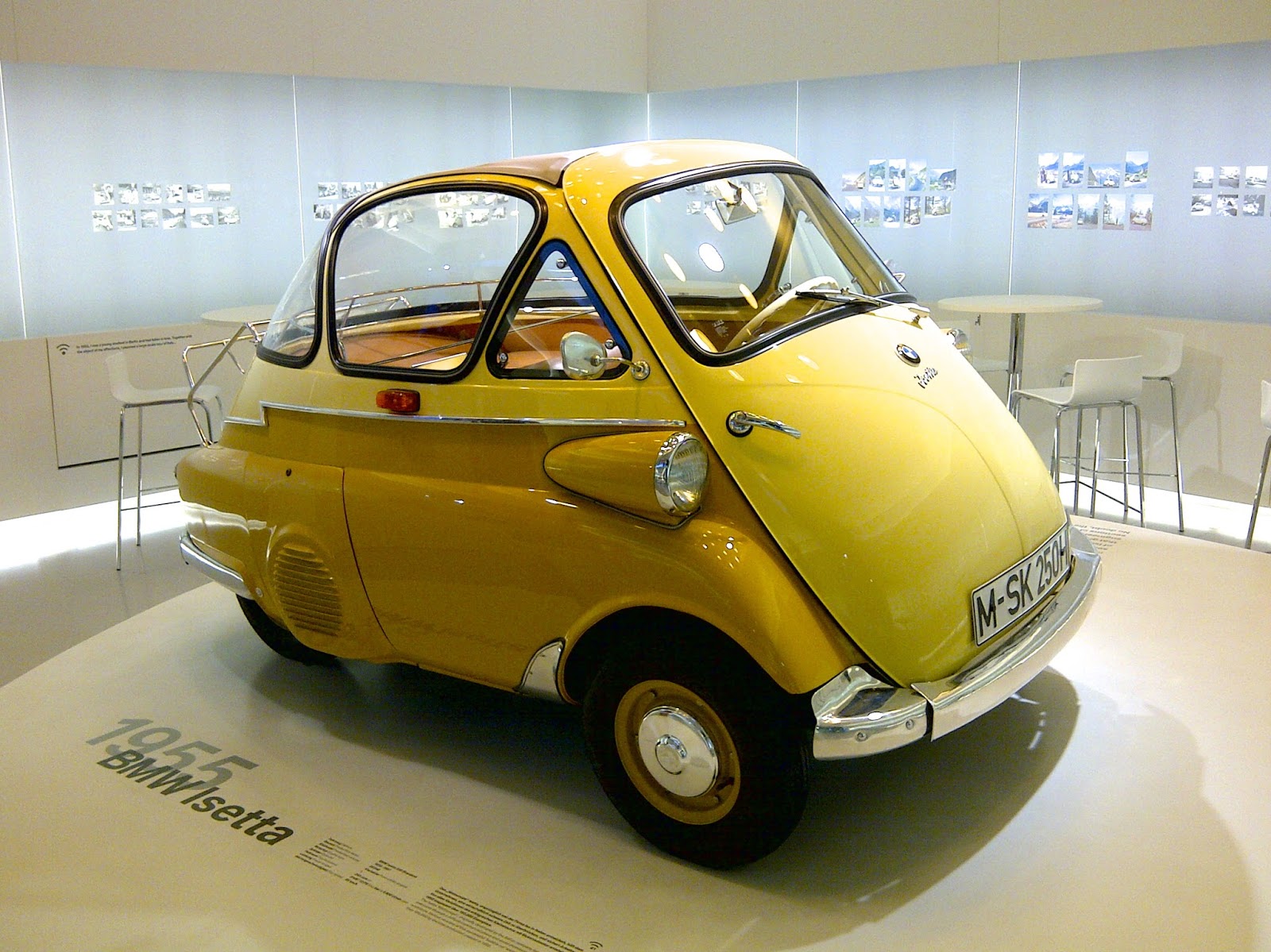
The BMW Isetta, also known as the "bubble car" was produced from 1955 to 1962. It is the world's top selling 1-cylinder car, with almost 162,000 units sold. The car was designed by a company in Italy that manufactured refrigerators, scooters and three wheeled trucks and licensed them for production in several countries, but BMW was the company that really made the car stick in Europe. There are photos all around the car in the Museum of families (or should I say couples?) with their Isettas.

The car is a two seater, just like my 350Z, but it is totally unlike my car in every other way. The two seats are actually a combined bench seat with a shelf behind for storage (so no trunk space at all really). There is one door to the car which is the entire front panel of the car. There is a handle on the passenger side of the front panel of the car used to open the door, which includes the steering wheel and instrument panel. We were fortunate enough to be hanging around the model in the Museum when a guided tour passed by (guides are apparently allowed to open the cars on display) and we managed to shoot the picture below.


This car is pure 1950s to me, which is probably why I love it so much. It looks like what someone in that decade may have thought of as a futuristic car, just like the Jetsons' vehicles and some of the furniture designed in that period. The shape of the car is about as un-aerodynamic as you can get and it looks like you practically have to wind it up to get it to go. I love the externally mounted headlights and especially the chromed accents, from the wire exterior luggage rack to the lightning bolt accent on the side of the car.

I love how life brings the most unexpected surprises sometimes. I realize the discovery of this quirky little car is not going to change my life, but somehow it makes me happier. In the four weeks since I returned home from Germany, I've checked ebay for Isettas and there are actually some on the market. If only I had an extra parking spot... Maybe it's time to move.