
OK, so to start with here (and yes, I'm addressing some of the Americans...), it's pronounced past-y not paste-y. The second one is something different. Got it? Good!
Strap in for this post. We'll end up covering more than just pasties but just wanted to get the whole pasty pronunciation thing out of the way first. Now that's done, let's move on, shall we?
In late August, we made our way to Great Britain for the fifth time in the last ten years. It would have been six but COVID-19 had other ideas for our travel plans in 2020. Suffice it to say that we've spent a good amount of time over in England and Scotland since I started writing this blog so I can remember what I've done and seen and felt (and smelled and tasted I guess) while I've been trotting all over this globe of ours. Our travels in England have been focused in two spots: Yorkshire (where family lives) and London. We figured this time, we'd explore somewhere else. Somewhere else I'd never been, even though I was born in England. That somewhere else turned out to be Cornwall. Time to head south and west about as far as we could without falling into the sea.
The first thought I had when we decided to spend some time in Cornwall was Cornish pasties. Not Land's End or cute seaside harbors or winding country roads or art galleries or cream tea. Cornwall = Cornish pasties. That was mission one in Cornwall. We'd figure out the rest later.

So let's start with pasties and maybe we just need to start with what is a Cornish pasty. Quite simply it's a pastry crust, crimped shut by hand on one edge and filled with beef, potato, swede and onion and then baked. It's a portable dish that one can take on the road or on a picnic or just eat at home piping hot from the oven. Today, of course, it's available with all sorts of different fillings. Beef is by no means the only option whether you are making these things at home or buying one at your neighborhood pasty shop.
Cornish pasties are nothing new for me. I've been eating these things for the majority of my life, although there was admittedly a huge non-Cornish pasty period between the time I left home for college and pretty recently. Maybe not quite as recently as our few days in Cornwall but pretty close. I will admit I have not been a big consumer of Cornish pasties over the last 40 (wow, is that number right?) years or so. Despite that history, I was looking forward to seeing what we could find in Cornwall.
My mother's Cornish pasties that I ate growing up, by the way, resembled the pasties in the cover picture of this post with the crimp on top. And they were served with gravy and (I'm assuming here since my memory is not that good) a vegetable side. I'm guessing peas. I seem to remember peas.
We ended up spending four nights total in Cornwall, meaning three full days. We ate a Cornish pasty on each of those days: one at Land's End; one in St. Ives; and one at the Lost Gardens of Heligan. They were all good and (at least the ones I had) differently flavored: chicken, bacon and leek at Land's End; steak and stilton in St. Ives; and cheese and onion at Heligan. No gravy at all. Kills the portable thing, I think.
I am a strong believer in the quality of the pastry making a dish like the Cornish pasty into something exceptional. And hands down, the best pastry we ate was wrapped around the steak and stilton filling and handed to me across the counter at the St. Ives' Bakery. It's not the only thing I appreciate about this type of meal but the quality of the pastry means a lot here. The St. Ives' Bakery pastry was flaky and delicate and buttery (butter counts for a lot here).
The filling in the St. Ives' Bakery pasty also had the best potato and swede but the complete lack of stilton was a bit concerning. This last issue likely placed the filling in this pasty behind the Land's End pasty, which was to me the most flavorful. I'd eat all of these again. But I'd get something other than cheese and onion at Heligan.
 |
| Consuming a pasty on the streets of St. Ives, which really just looks like I'm eating a paper bag. |
So that's it, right? End of blog post? Nothing more to see here. Hello, Cornwall...thanks for the pasties...see you later?
I don't think so. I told you this post wasn't just about the pasties. We needed and wanted more out of England's most southwestern county. Yes, we wanted to connect with Cornwall's historic, iconic food but we also wanted to explore something else about Cornwall's soul. Hey, we weren't just there for the food. But as it turned out, the Cornish pasty was actually the connection between the food and the history.
So let's do a little history. Starting with the history of the Cornish pasty itself.
Nobody today knows when these things were invented but there seems to be some degree of consensus that wherever they started out being baked, it was pretty likely for sure NOT in Cornwall (they were likely a French import). But at some point in the history of food in England, the concept of the pasty took off some how, some way down in Cornwall. There are references to Cornish pasties in print going back to the 1840s. These things have been in vogue for a couple of centuries.
At some point, some (likely) Cornish woman put two and two together and started packing pasties as a lunch for the men (or at least her man) working in the fields all day doing whatever kind of farming was going on in the season when this idea first took root. This concept took off; soon pasties for lunch were a thing. They were easy to carry; filling; provided energy; and I guess stayed warm through lunchtime. Although (and I'm assuming here...) no gravy.
This whole local-dish-turned-portable-while-working thing is not unique to Cornwall and the Cornish pasty. We've heard stories like this in Naples (pizza) and Key West (key lime pie). I'm sure there are many, many more.

When Cornish men started taking their pasties to work for their midday meal, they didn't all take them to the farm. That's not because some of them left their pasties at home; it's because not every Cornish man was a farmer. Cornwall has the longest coast of any county in England so certainly fishing was every bit as important to staying employed and staying alive as was working in the fields. I feel pretty confident that many a Cornish fisherman throughout the years has taken a pasty on board whatever size fishing vessel they were using to haul in a load of fish on any given day.
There's one other place that Cornish men took their pasties: underground. That's because Cornwall has a history of mining that is about as long as the Cornish have been farming and fishing. That industry is intimately entwined with the Cornish character and the history of the area. So when we made our final Cornwall itinerary we had two must-sees on the list: eating some Cornish pasties and visiting a Cornish mine.
And there is a connection between the two, although the connection may be at best a myth. We'll get to that.

Mining in Cornwall has been going on for centuries. Seriously. The history of extracting metal from that part of England goes back all the way to the Bronze Age. That's like 4,000 years ago in case you don't have your stop and start dates on all the Ages memorized.
Bronze is an alloy made up of two metals: copper and tin. And Cornwall had and has plenty of both close to the surface of the Earth so it could be pretty easily extracted without a lot of effort. As easily as hard rock mining could get before the deposits got too deep in the ground and out of reach, that is. Mining minerals like copper and tin is not like mining for softer stuff like coal. I'm sure mining of any kind is not easy in any way, but I'm sure it's a lot more difficult if the stuff you are trying to get at is harder than the rock it is sitting between.
But men kept at it over the centuries, pulling that metal out bit by bit, until someone invented ways to get at the valuable stuff easier, which eventually (of course) they did. The Industrial Revolution provided men with new ways of separating the lode from the rock (some involved explosives); getting men in and out of very deep holes (not always super safely); moving ore up to the surface for processing; and keeping water out of the mine.
Once someone figured out how to do all those things, mining in Cornwall really took off. When it becomes easy to extract valuable things from the Earth with a ready supply of willing and cheaply paid labor with few regulations in place, these things tend to happen. By the turn of the 19th century, Cornwall was the largest supplier of copper in the world.
So...pasties and mine. The first one was really pretty easy. The second would require a little more effort. But there are some mines that you can visit in Cornwall. We picked a tin mine called Geevor.
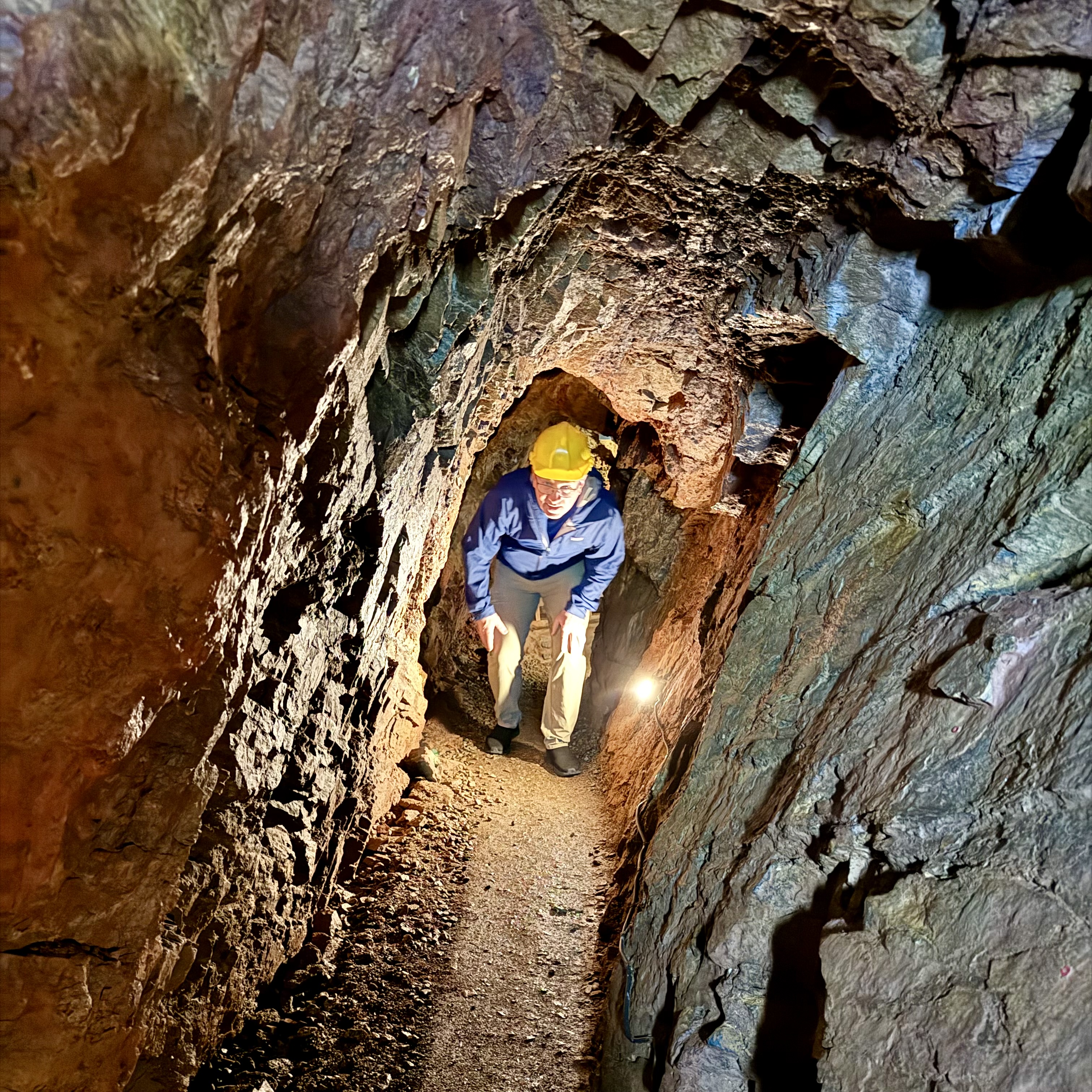 |
| In the Wheal Mexico mine. |
The Geevor Tin Mine is all the way on the west coast of Cornwall close to the Atlantic Ocean. And by close, I mean really, really close. Like ON the Ocean (check out the second to last picture on this post). If tin were discovered in that location today, I have to believe the property would be more valuable as unspoiled oceanfront land than as a mine. But when mining started in earnest in that area in the late 1700s, tin was more valuable than an ocean view and it likely stayed that way through the mine's heyday in the early and mid-1900s. Ot at least I'm supposing.
I am by no means any sort of authority on mining means and methods or the history or the extraction or rock and minerals from the planet but I am pretty sure there must have been, over man's history, many, many different ways of removing valuable stuff from below the surface of the Earth. At Geevor, they used a method called stoping.
Pulling tin from below ground at Geevor first involved drilling a vertical shaft near a seam of the precious metal, and then digging six foot wide by seven foot high tunnels (called development drives) stacked on top of one another but spaced every 100 feet vertically. From there, teams of two men (called stopers, and hence the name of the mining method) would drill vertically upwards from a lower development drive to the one immediately above, allowing the broken ore-containing rock to fall below them which they then would use as their drilling platform.
Does this sound safe in any way? Drilling up and allowing rock to fall past you and then using that potentially unstable deposit as a place to stand while doing the same thing again? Clearly, this kind of thing could only be used in places where removing rock below wouldn't cause the whole thing to collapse but still...I guess if you have no control over your economic situation and it's either drill into rock above you while that same rock falls past you and then serves as a not-so-firm footing for doing that same thing over and over, I guess you do what you have to do.
Geevor Tin Mine is no longer operational. And no, it's not because the whole operation for the miners was universally unsafe. It closed in 1986 after the price of tin crashed worldwide a few years earlier and made mining in a place like Cornwall a non-profitable business. Today it's a museum to preserve the history of this important Cornish industry, which of course is how we ended up being able to visit.
 |
| Model of the shafts and development drives that made up Geevor and two nearby mines. |
Geevor today from the ground up looks (I would imagine) just like it did when it was operational, although I guess with a lot fewer employees. All the buildings necessary to operate and sustain a viable mining enterprise are still there, but they have all just been turned into museum spaces. The Winder House. The Compressor House. The Mill which housed all the machinery that used to separate the ore from the rock. The Dry where the miners changed before and after their shifts underground. All still in place and completely inoperable. Or maybe not completely, but certainly inoperable right now.
This was not our first visit to a former mine. We did something similar in a former coal mine back in 2014 in Yorkshire near where my parents grew up and met. The stories that stuck with me on that visit were not the tales of the technology that pulled the coal from the ground, but the human stories. The stories of what men and women and children had to risk and endure to go down into some very scary and confined and sometimes completely unsafe situations because, ultimately, they had a choice between doing that and starving to death.
Those same sorts of thoughts came back to me at Geevor. I was completely uninterested in the equipment that supplied compressed air to all the tools used by the miners in their everyday work or the diameter of the steel ropes that lowered the cages holding the men down the shaft and into the mine. I was more concerned about thinking about the people going through the process of mining than I was about the technology. And those thoughts started in the Winder House with the cages that the miners used to stand in to be lowered into (and pulled out of, I suppose) the mine.
Do you know how tight these things are? Being packed into these metal mesh cages with enough other large men to fill the entire enclosure and then being suspended down into some dark, wet, dangerous place every day must have been incredibly demoralizing. And being hauled out was likely just as bad. Sure there was the fact that you were returning to the surface of the Earth and fresh air and all that but the smell of those other miners (there were no bathrooms in the mine) at the end of the day must have been horrendous. You can read all about this sort of stuff in books I guess but there's nothing like standing next to the actual old cages to hammer the point home.
All that lowering and hoisting is assuming everything worked just fine, by the way. I'm sure towards the end of the life of the Geevor Tin Mine that the operation was pretty safe but there are for sure stories of mine collapses that killed men and orphaned children in significant numbers in a single event.
 |
| The cages. Imagine having to jump up and down in these things. |
The history of Geevor is told from the first building you walk into (which houses the main museum) all the way through every building on the site. It is told by walking around the property and visiting the places where men risked their lives and their health every day in the mine, in the mill or operating any variety of equipment to pull that tin out of the ground.
And at the end of the whole thing, you get to go underground. Not into the deep parts of the mine where the stopers worked (we did that sort of depth in Yorkshire 10 years ago and it was truly chilling), but into an older, shallow mine called Wheal Mexico. And no, nobody knows why it's called Wheal Mexico. At least nobody we talked to and asked that question.
The Wheal Mexico mine dates from the late 1700s and it can't be located more than 30 feet (that's a total guess since the mine is tunneled into a hill) below the ground. But walking through its limited length is remarkably perspective-altering. First of all the sensation of being below a massive amount of soil that theoretically could crush you is daunting. I'm sure it's totally safe and secured now but that can't have been the case back a couple of centuries ago.
Second, the access (or lack thereof) to light and air, particularly in a mine that was active and being worked by teams of men (rather than being completely empty) must have been extremely claustrophobic and possibly panic-inducing. The atmosphere today is fine. There's plenty of fresh air and the whole tunnel is well lit with LED lights. But when you get to the shaft that brings air into the tunnel, it becomes obvious that there haven't been near or past too many (or any of those) in the mine to that point.
Pulling tin out of a tunnel that you can't easily and often stand up to full height in? Not for me thanks. And yes, hardhats were mandatory on this whole tour and yes, I hit my head like four of five times while underground.
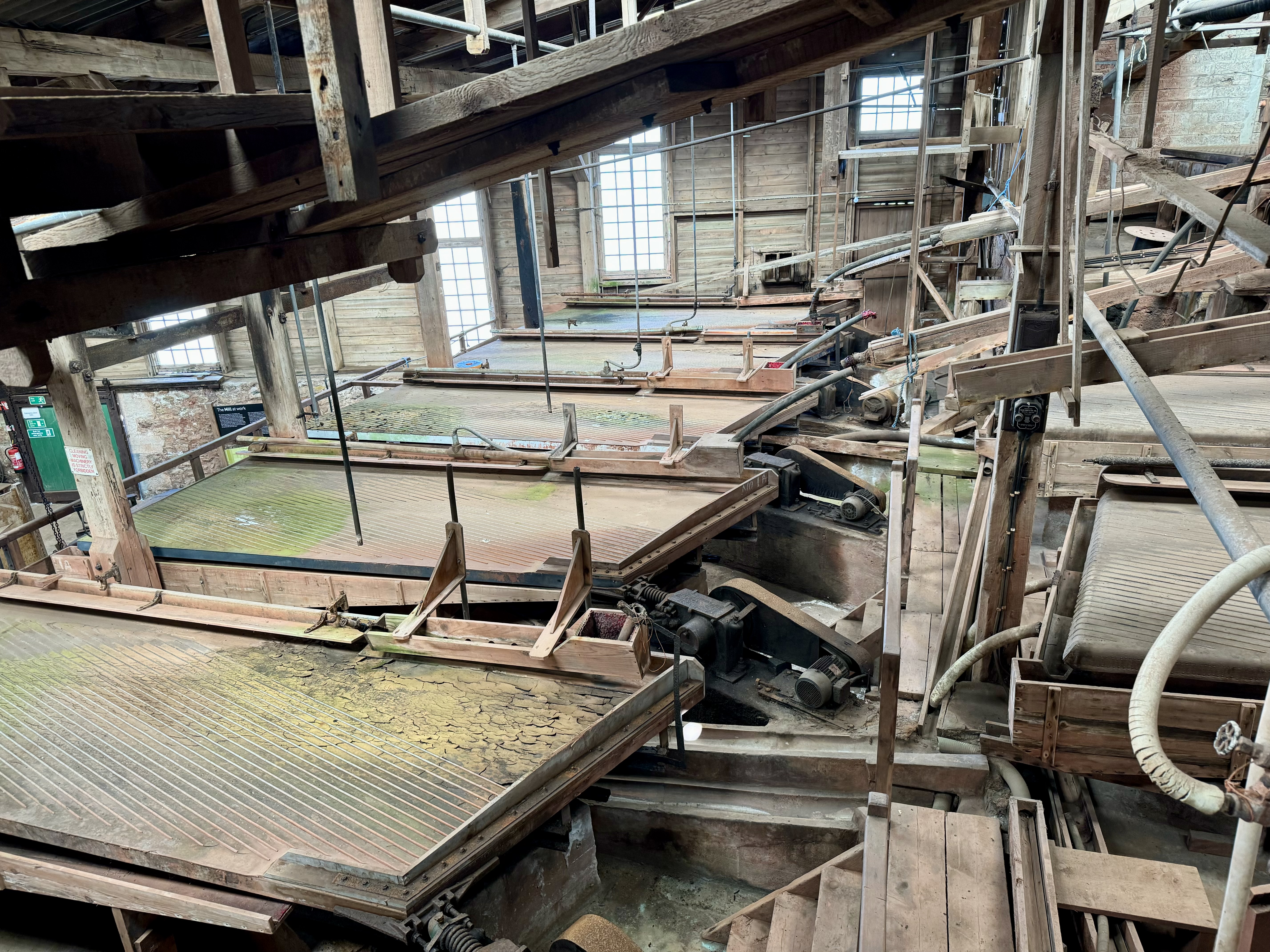 |
| The machines that sorted the ore from the non-ore. |
But none of that was the best part about Geevor. The best part was the talk with a miner (Eddie) who actually worked the place.
Sometimes when you travel, you get lucky. We've been plenty of places that haven't worked out the way we planned over the last 11 or so years. We've also visited countries and cities and towns and the middle of nowhere where things have worked out spectacularly. Geevor was one of those in the spectacular category.
I don't mean to sound melodramatic here but there are only so many men walking the face of this planet that used to work down in mines like Geevor and you don't get to talk to those sorts of people every day to hear tales of what they have lived through. I know, there are men and women who go down into the pit every day in the United States and all sorts of other places in the world today and I'm not wondering around places like West Virginia or somewhere like that to hear mining stories. But if what was written in the museum or on cards or displays in the museums taught me a thing or two, it was nothing compared to what I was told by someone who had really been there.
I'm not transcripting it. But here's what I heard from Eddie and remembered.
Hernias. Cancer. Heart surgery. Multiple hip replacements. May as well start with what mining can do to a man. This is not a healthy occupation.
The cages used to stick on the way down and when they did, the miners used to jump up and down to un-stick them. Yes, those same cages that I couldn't imagine being crammed into sometimes stuck. I don't know if it is worse to be stuck in a cage or down in the mine, but stopers were paid on a production basis, not an hourly basis. Being stuck in the lift didn't pay. You jumped.
You could be working over holes 1,000 feet deep below you and could not even know they were there. Water was dangerous. Safety equipment could save your life but sometimes it got in the way of your work and you needed to take it off. Eddie did once and fell and remarkably didn't get seriously hurt. That accident apparently was not one of the hip replacements or hernias.

 |
| Pictures from The Dry: lockers and clothes drying on hot steam pipes. |
The talk took place in The Dry, where the men changed into their mining clothes at the beginning of their shift and changed back at the end of the workday. Sometimes Eddie was so dirty at the end of a shift that he showered fully clothed and then just threw his soaked gear over one of the hot steam pipes in the changing room. If he was lucky, it would be dry in the morning. If not, he'd be wearing wet clothes in a cold and wet mine.
The men weren't the only things alive in changing room. The mice used to eat the men's soap. Worse than the mice were the ticks. The ticks used to eat the men.
Speaking of food (were we?), eventually Eddie stopped taking food down into the mine. He used to eat a big breakfast and then just take liquids on his shift. Food caused cramps. And besides, there were no bathrooms down in the mine anyway.
I can't imagine doing what these men did down in the dark every day of their lives for money that probably wasn't really worth it. But then again, what choice did they have.
 |
| The Cornwall coast. Chimneys against the Atlantic Ocean view. |
So...pasties and a trip down a mine. That's not all we did in Cornwall. There were, after all, gardens and multiple cream teas and art galleries and museums and a huge domed botanical garden. But those two things are definitely part of our core Cornwall experience.
Before we ate our first (real, genuine) Cornish pasty and before we arrived at Geevor, we heard a Cornish tale about pasties and mining that may or may not be true. And it's all about the crimp really.
It is a well-established historical fact that pasties have been feeding working men at their jobs in Cornwall for decades, if not centuries, including in mines. Well maybe a century or a century and a half anyway. Tin mining is a hazardous occupation. And I'm not talking about the hernias or the falling or the mice or the ticks or the getting stuck in the cages. A byproduct of the tin mining process is the production of arsenic. And arsenic is, of course, poisonous.
So eating in a mine where arsenic is in the air isn't exactly a great idea. I mean you don't want to accidentally ingest a bunch of toxic dust while you are taking a break from work (assuming you decide, unlike Eddie, that you still eat lunch down in the mine), right?
Here's where the crimp comes in. Those grubby, arsenic-laden fingers can hang on to the crust on the edge of the pasty while you eat the pastry around the meat and veg and then you can just toss the crimp when you are done with lunch. Other than being totally scary that men are potentially ingesting arsenic (which I am sure went on anyway), it's a cool story right? Food evolving to meet the needs of society or something like that?
It's apparently a myth. Or a legend. Or maybe it's totally true and someone has artificially debunked it. That's all I got on this one.
 |
| Last bite of the chicken, bacon and leek pasty. |


