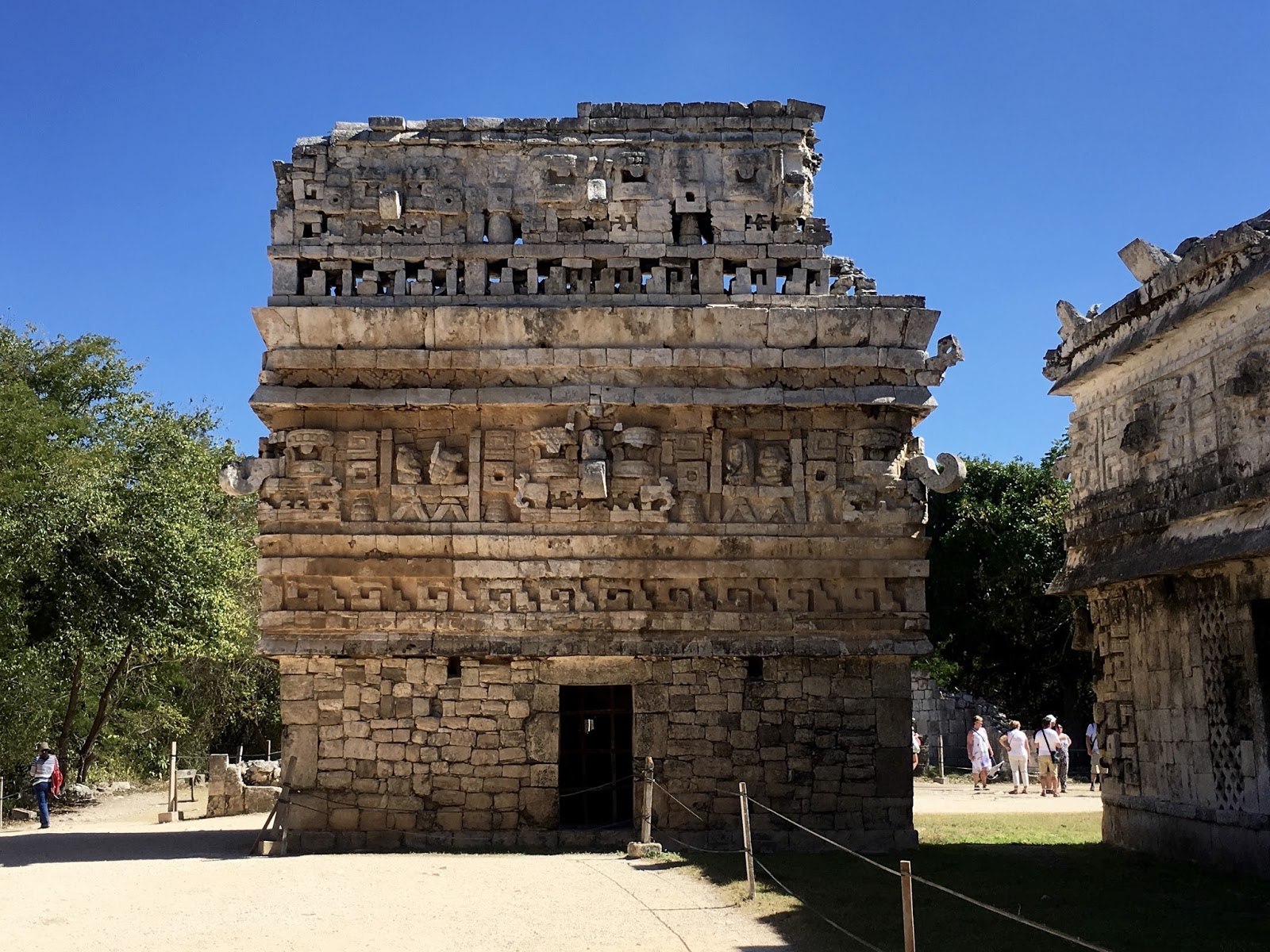
Showing posts with label Mayans. Show all posts

Sunday, February 16, 2025

Yavin 4


We went to the Belize jungle in search of Mayan ruins and toucans. Yes, I know, I started the last post on this blog with those exact same words. We found both in western Belize, but if I was going to traipse all the way to San Ignacio to find these two things, you better believe I was going to push just a little further into Guatemala. Not just to add a new country to my countries list (I'm NOT collecting countries) but to get to Tikal.

I am nothing close to a Mayan scholar. At best, I'm an enthusiast and that may be giving me more credit than I deserve. But in my uneducated mind, the three premier Mayan sites that are known and reasonably accessible to tourists like me are Chichén Itzá and Palenque in Mexico and Tikal in Guatemala. And Tikal is a couple of hours ride and a quick border crossing from San Ignacio, Belize where we were camped out (not literally...) for four nights this January. I had to make it to Tikal. When else am I going to be this close?

We visited Tikal two days after our day at Caracol, one of the most famous (and potentially the best) Mayan ruin sites in Belize. We did this deliberately. I expected Tikal would blow Caracol away, and I didn't want to go to the best of our two Mayan sites (on this trip) first and then be disappointed by the second. It made perfect sense to me to do Caracol, then Tikal. Tikal would certainly be way better than Caracol.

I believe we were right to do Tikal after Caracol. But not for the reason I thought. Don't get me wrong, I thought Tikal blew away Caracol and it wasn't even close. But Tikal also wouldn't have been as amazing as it was without us first visiting Caracol.

Temple II (left) and Temple I (right) as viewed from the Central Acropolis.
When you visit two Mayan sites in the space of three days, there is inevitably a compare and contrast exercise that goes on to try to make sense of the relationship between the two places. Let's do that now in this blog post, shall we?

Big-picture wise, Caracol and Tikal were founded, flourished and declined at about the same time in history. Based on our two tours, it appears Caracol may have gotten a head start on the initial settling between the two places by a couple of centuries but by the time both sites were being built up and out in a significant manner, they were doing it at the same time. History timing-wise, that's from a few hundred years BCE all the way to about 900 CE or so. Both cities were around in a meaningful way for around about 1,000 years or maybe a bit more. That's a significant length of time.

Both cities also supported a significant population over that time. We heard numbers of 120,000 to 180,000 when we were being guided around Caracol. At Tikal, it was about 150,000. Nobody really knows for sure, but those two figures are close enough for me to being identical for the purposes of history. This stuff is an approximate science at best. There was no census back in the Mayan world or if there was, it's been lost to history. Approximate is good enough.

So...we have two fairly large and spectacular cities of about the same size in relatively close proximity to each other in the jungle of what is now Central America. They had to be friends, right? Trading partners? Sister cities? Intermarried and grew together? In harmony?

Of course not! They are humans and humans inherently want to destroy each other so of course they fought. The word I heard when our guides were talking about these two cities was "war". Not disagreements, not skirmishes, not battles. War! These two places did not care for each other for a significant period of time.

Tikal is full of temples like this, uncovered enough to be partially overgrown again.
Because the history of the two places is so similar, it would make sense that the tourist experience today would also be fairly alike. Go with me here a bit. Old city. Jungle. Same time in history. Same people. Same technology. Similar size. Were in contact with one another. Makes perfect sense that you might get the same sort of thing in both places today, right? After visiting both sites in the span of three days, I believe this was true. I also believe it wasn't true. 

Both Caracol and Tikal are fairly good-sized sites with a significant amount of structures for the 21st century visitor to gaze at and climb on with enough variety to keep things interesting. Temples. Pyramids. Reservoirs. Palaces. Tombs. Observatories. Stele. They both have plenty of all of that sort of stuff and it's all good. On a volume basis, Tikal definitely has more. When we visited Caracol, we were told that about 8 to 10 percent of the entire place was uncovered, with the rest being still buried below mounds of soil. The same is true of Tikal, but the uncovered number at the Guatemalan site is about 20%. Were there two to two-and-a-half times more structures at Tikal? Probably. Tikal appears to be bigger, probably because of what's been uncovered.

On this point, Caracol may eventually catch up. Excavation is still going on at Caracol (admittedly slowly) while at Tikal, it has stopped. Apparently they found at Tikal that the uncovering of structures was causing irreparable damage to them. For now (at least), the Tikal site is frozen in time the way it is.

Mayan carvings. Original (but protected) at Tikal. Not like Caracol.
The progress on the excavation of the two sites is really a product of the discovery and accessibility of the two sites and these concepts may actually be intertwined. And the discovery is as much about who as when. When I wrote about Caracol, I wrote about the road to the place and how recently it has allowed the accessibility to the site to be improved significantly. There's a road to Tikal also, but it's a short-ish modern paved road off another larger, much longer significant Guatemalan road. It takes way less time to get from where people live today to Tikal that it does to make the same sort of trip to Caracol. Access to the site from an excavation point of view I'm sure is important. 

Why are things this way? Well, I don't know for sure the history of the development of paved infrastructure in Guatemala and Belize. I also believe that Caracol is actually further into the jungle than Tikal is, but there is something about the "discovery" of these two sites worth considering. Caracol was stumbled upon by a man named Rosa Mai looking for mahogany trees in 1937. Before then, Caracol was largely lost to time. Tikal was "discovered" by the Wrigley family looking for gum trees to use to make chiclets to fill their gum vending machines in the United States. When they found out about Tikal (it was already known to the locals via myths passed down through abuelas) they started funding the excavation of the site. Is it any surprise that Tikal is ahead of Caracol here? 

Tikal became a national park in Guatemala in 1955, if you need any more convincing here. Inaccessible places in the middles of jungles don't generally become national parks.

One last difference / similarity before I talk about what it was actually like at Tikal. Neither site is known today by their Mayan names. Caracol is named after a Spanish word for a snail shell. Tikal is a modern Mayan word meaning city of voices (eek=place; al=voices). 

Mayan ball court, with Temple I in the background.
Earlier in this post, I stated two things. First, Tikal blew away Caracol; we'll get to that one. Second, our experience at Tikal from a learning standpoint was improved by the stories we heard at Caracol. That is because we either heard the same thing twice or we heard it told in a slightly different way. Let's hit that concept now. And it's about the ball courts and the sudden decline and subsequent death of Mayan cities. Let's do that last one first.

When we visited Chichén Itzá in 2017, I of course followed that visit up with a blog post. The narrative that I presented in that post about the history of that site was that the Mayan city was absorbed into the Toltec culture and continued to flourish until about the year 1200. I assume I found that story in a book or online somehow and vetted it against other sources before writing it all down as what appears to be fact. That history was different than what we heard at Caracol and Tikal and legitimately, there may be two histories, one for the northern Yucatan Mayan cities and one for those in the south of that same area of the planet. The geological and climactic conditions were different in those two areas for sure.

What we were told at Caracol and Tikal was that the Maya simply exhausted the ability of the land to support their population. The jungle in Central America is a rainforest. Rainforests produce life by housing animals and growing plants but they do that by capturing and retaining the rain water so that it lasts much longer than that moisture would stick around if the rainforest weren't there. Water is life is the principle here and it's absolutely true.

The Maya were farmers. Most societies that at some point stop hunting and gathering and decide to stay in one place become involved in agriculture. But you can't grow crops in a rainforest. The sunlight required to grow plants won't reach to the fields you have plowed and planted. So that rainforest had to go. They started clear cutting. They needed space for crops. They needed space to build. They needed space to create places in their rapidly growing cities.

Welcome to the jungle: there's something big and Mayan below every mound like this at Tikal.
When the Mayans took away the rainforest, the rain started to disappear. Open land doesn't retain moisture the way a dense concentration of leafy plants does. Water is essential for life (I know I just wrote that above) so no water, no life. Even if you don't use it to grow crops, you still need to drink it. No rainforest, no water. 

The Mayans clearing the forest did something else to affect their food supply: take away the habitat for animals whose meat used to sustain you in addition to your crops (during growing season) and in absence of your crops (if something went wrong with the harvesting season) and you take away the creatures themselves. Animals that the Mayans hunted for food needed the forest for shelter and protection and (in the case of carnivores) to prey on other animals for food. Take the rainforest away and the tapirs and agoutis and whatever else you might hunt aren't just going to stand around in open space. The animals are going with the forest. Hunting trips become longer or just too far. No rainforest, no wildlife.

There is also evidence that human waste got into the water supply because the Mayans over populated the land to the point where the soil could no longer absorb the waste coming out of their bodies. The sickness caused by this issue started to take its toll on the population. There are many accounts of diseases brought by Europeans to the new world wiping out indigenous peoples. The Spanish never found any people at Tikal to wipe out. The Mayans' own over-use of the land did it for them long before the Spanish arrived. We heard this at Caracol and we heard it at Tikal. I think it was the reservoirs and their close-ness to the city and potential human waste disposal sites at Tikal that made this issue hit home. It was definitely re-iterated more at Tikal than Caracol by our guide.

It's ironic that we as a planet are faced with the same issue that killed a lot of the Mayans off almost 1,200 years ago. We won't learn, will we? 

Mayan stonework. Not the precise cut block we see in some Mayan temples reconstructed by archaeologists. There's a carving in the gap also.
While Mayan society was flourishing, they had time to do more than just survive. Agriculture tends to start to create time in the day to do something other than search for food as the only activity you engage in. For the Mayans, this meant making art; watching the night skies; recording numbers; serving the ruling class (you think those guys ever searched for any food?); and recreation. Yes, there were spectator games in Mayan societies and we found ball courts at both Caracol and Tikal. Their game of choice? Pok ta' pok.

We walked through and around ball courts at both Caracol and Tikal. These features were in important spots in both cities, including in close proximity to caana at Caracol and right next to Temple I at Tikal. Now admittedly, Temple I is a 20th century moniker and I suppose there's a chance that specific temple might not have been the most important temple in the city but it is in an important spot and it was found with a particularly important altar signifying its importance. Ball courts located near these places seems to imply that the ball courts were important. We had also seen these things years ago when we visited Chichén Itzá (although we did that site without a guide).

A pok ta' pok court looks like a strip of grass flanked by what look like short, steep ramps and vertical walls on the long sides. At the midpoint or so of each long wall, there is a vertical stone hoop. The game is played by teams from two to five people with a single ball which weighs about eight pounds or so and is solid rubber. The aim (like most games) is to score more points than your opponent. The goal is to drive the ball to your opponent's end zone by keeping the ball aloft using only your hips, knees and elbows. How anyone figures all these rules out from whatever the Mayans left behind is anyone's guess but since the story we were told at both Caracol and Tikal was relatively similar, I'm accepting it as the truth.

Pok ta' pok court. This one is at Caracol.
But there's more. 

It is unclear whether these games were played for recreation (like was there a professional pok ta' pok league?) or something more important, like to commemorate religious events or playing a game of pok ta' pok as a substitute for actual war between two cities (this last point seems to have some merit). It is also unclear as to whether there was any sort of sacrifice component for either the losers or the winners of the contests. There are rumors (or should it be uncertainty based on the archaeological record?) of both scenarios. The explanation of the winners being sacrificed seemed to have some "guarantee" of eternal happiness in the afterlife. I mean, otherwise, why would you try to win?

It was also unclear to me while we were at Caracol as to how this game was actually played. I mean, an eight pound or so solid rubber ball is super heavy. How on Earth do you keep something that heavy from hitting the ground, especially with just two players on a team and the other team presumably trying to disrupt your efforts? Our guide at Caracol, Jason, showed us some still images (OK, so they were really artist's renderings) of people playing this sport. I still didn't get it. Maybe I wasn't paying attention properly. I was admittedly taking notes.

There is, by the way, a shortcut to winning the game and that's putting the ball through the vertical stone hoop. No clue how this would be done with knees, elbows and hips only. We didn't see hoops at either Tikal or Caracol, but they are still intact or are restored to intact at Chichén Itzá. There's a pic below. Tell me how you get a dense rubber ball through a vertical hoop using your hips.

Then Reggie stepped up. Reggie was our guide at Tikal. During the ball court part of the tour, Reggie didn't show us any pictures. He did, however, step on the sloped part of the call court and demonstrate how pok ta' pok players might (emphasis for me on might here) strike that eight pound ball. Watching Reggie show us how to elbow and knee that ball by stepping onto the sloped portion of the court made a lot of sense. It helped tremendously. Still no clue how you'd hit the hoop.

Ball court hoop. Chichén Itzá. 2017.
None of all that explains why I thought Tikal blew away Caracol.

It was the height. Plain and simple. 

The height of the temples at Tikal was just overwhelmingly impressive. And the "s" on the end of temples isn't a typo. Caracol had caana, the tallest manmade structure in all of Belize at 43 meters high. Tikal had at least four and maybe five or six taller than that. I hate to boil this down to "size matters" but it did. Tikal is temple after temple after temple and they are all impressively huge and tall and that's the magnificence of this site in a nutshell. 

I won't stop there.

The back side of Temple I from the drop-off point.
The first temple we laid eyes on at Tikal was Temple I. We saw it right after we got unloaded from the open bed truck with a cage on it that transfers people from the parking lot all the way up the hill to the site (and believe me, despite the sketchy nature of the transportation, it was much welcomed). Temple I is the only temple on the site that is fully restored which translates to "archaeologists have supplemented the condition they found it in by adding pieces of stone to make it look whole".

It's not just the height. Yes, Temple I is tall. But it's also the angle at which the temple was built. The slope of the steps at Caracol's caana is maybe 45 degrees (and probably less). Tikal's Temple I has to be a good 60 degrees. So in addition to actually being tall, it looks even taller because its footprint is appreciably smaller than less-tall temples we saw just two days before.

Walk around the front side of Temple I to the Gran Plaza and you'll find it facing Temple II, which is also tall and steep. Not quite as tall as Temple I but the difference is negligible. Plus you can climb a wooden staircase and platform assembly around and atop Temple II to get better looks at Temple I and the faces carved on top of Temple II. There's nothing like this at Caracol. Let alone two facing each other.

Temple II. Also known as the Temple of the Masks, erected as a mortuary monument to the ruler's wife.
Temple I as seen from the top of Temple II.
Temple II's "mask" at the top of the front face.
Did it get better than the Gran Plaza bookended by Temples I and II? Yes, it did.

Temple III is immediately behind Temple II and it's taller than II. It's not fully excavated and unless they find a way to excavate without damaging what's still below the soil and plants that have found their way onto the remaining uncovered 1,000 structures, then it's always going to be that way. But its top is visible. Here's this green pyramid completely covered with vegetation except for the very tip above the tree canopy where its white limestone is completely visible. You know it's there because you can see it clearly from the ground level. And it's immensely tall.

Move on to Temple IV and it's even better. Meaning bigger. Temple IV is the tallest structure on the site. It's a full 70 meters high. That's 60% taller than Caracol's caana (I know, I'm obsessed with size here still...). And you can climb it by walking step by step up the wooden staircase and onto a platform at the front of the temple. 

Tikal is impressive from the ground level. What the Mayans built all those centuries ago is just amazing at this site. But get above the tops of the trees and it gets even better. The view of Temples I, II and III from the top of Temple IV is so romantic. You are in the middle of the jungle on top of this ages-old Mayan temple and all you see is a tree canopy punctured by three additional temples that the same people built. What a testament in that view to what Mayan architects and builders have achieved. It's absolutely one of the best views I've had in all my travels in all my life. 

There's a pyramid on the site (the South Acropolis, if I'm remembering correclty) where you can get a similar view of all four temples poking above the forest canopy which is comparable but maybe not quite as spectacular as the view from Temple IV. Sure there are more temples but the viewing platform is not quite as high. I'd rate the top of Temple IV view as better.


The views from Temple IV (top) and the South Acropolis (bottom) at Tikal.
There is some irony here. These incredible views would never have been visible quite in the same way when Tikal was a thriving Mayan city. And I don't mean because regular folks never would have been able to climb to the tops of the temples.

When Tikal was an active city, all of the jungle that these temples are sitting in would have been clear cut. What I saw in my day at Tikal is all second growth forest. It is only in its ruined and unexcavated state that these views can be experienced. But all that is what made Tikal, for me, the most impressive Mayan site of this trip. The understanding of the decline of the Maya and the insight into how pok ta' pok was possibly played were invaluable. But the real take-your-breath-away-this-is-absolutely-incredible experience was these temples in the jungle. Just spectacular. 

Oddly enough, both people I traveled with to Belize and Guatemala this January preferred Caracol to Tikal. They both thought the guide was better at Caracol (he was); they both thought Caracol was less touristy (it was for sure); and they loved the fact that you can climb on the main structure (caana) at Caracol (I actually think we should NOT climb on caana although it would admittedly kill the experience at Caracol). One size does not fit all in travel. Even when we travel with others, our experiences can still be so different at the same place on the same day. Tikal for me was absolutely spectacular. 

Now I just need to get to Palenque.

Some final notes on Tikal. First, I'm dumping some random pics below. The last one is my favorite. It's Temple I with a "tourist tree" next to it. The tourist tree (not its real name) gets this name because the bark looks like a sunburned white person's skin.

Lastly, if you are a big Star Wars fan, the view from Temple IV is in the original Star Wars movie (Part IV, A New Hope). Tikal was used as the location of the rebel base on the fourth moon of Yavin. Part of me has wanted to see that view in person for a long, long time. And for most of my life, I didn't think there was any way I'd ever get there. The real thing was way better than I could have imagined.


Top to bottom: the truck that took us to the site; some Mayan stele; coatamundi on top of Temple IV; and Temple I / "tourist tree".

Sunday, February 9, 2025

Run Through The Jungle


We went to the Belize jungle in search of Mayan ruins and toucans. We found both, although I know that I still have that signature toucan encounter somewhere out there in my future after a satisfactory, but ultimately not completely satisfying, toucan spotting experience

We did better with the Mayan ruins. That's likely in part or really probbaly in whole due to the ruins standing still; being really large; and not being hidden behind Belize's vegetation, at least not the ruins we chose. We looked around some before finalizing our choice of ruins. We flirted with Lamanai a bit; halfway considered a stop at Altun Ha (the ruin on the Belikin beer label); but eventually settled on Caracol for two reasons: (1) it was pretty close to San Ignacio where we ultimately decided to spend four nights in and (2) it was supposed to be the best ruin in Belize.

We didn't get ourselves to Caracol. We took a tour. Pickup at 6:30 dark and early with arrival time about a couple of hours later. Maybe a bit quicker than that. And yes, I know I said in the last paragraph that Caracol was pretty close to our hotel and I meant it. It wasn't the distance that took us that long; it was the road. Plain and simple, it's just not finished yet. 

Now, you might wonder why the government of Belize wouldn't prioritize construction of a road to a super important cultural resource, right? Here's the deal: Caracol isn't the only Mayan site in the country of Belize. The Mayans didn't just build one or two settlements here and there. They built a ton. The population of what is now Belize is about 400,000 people or so. When the Mayans were around and building (to be fair, the Mayans are still around), it was four to five times that number. And most of what they built are still buried in the jungle of Belize, Mexico and Guatemala. There's a lot of choices to make about spending dollars to build roads to access Mayan sites. Give the government of Belize a bit of slack here.

For perspective, two days after our Caracol visit, we made a pilgrimage to Tikal in Guatemala. We were told that of the 39 known Mayan sites in Guatemala, only three are accessible via road. The rest involve multi-day treks on foot through the jungle. This is some untamed land, folks.


The road, paved and unpaved. You can see the paving layers in the top picture at the side of the road.
So about that road. 

We made our way to Caracol over pieces of finished roads, stretches of packed dirt and every sort of construction in between those extremes. Apparently, the Belizeans are prioritizing the least navigable parts first to allow the greatest chance for the greatest number of people to visit. We visited during the dry season, meaning the dirt parts of the road weren't sloppy and muddy to ankle depth apparently. 

The benefits of the road? Cutting about an hour and a half off the time to get from San Ignacio to Caracol and eliminating the need for a military escort on the last piece of the road. That's right: military escort. Apparently before the road, there were poachers and robbers and bandits (they may all actually be the same people) who would fell trees across the mud / dirt road and when passengers got of their vehicle to move the tree, they would be robbed of everything. Nice, right?

Even today, the military clears the park of all visitors and follows the last people out at about 3 pm every day. We made our way out a bit before that. No desire to get any necessary military protection involved on our day. The road mitigates the need for military escort. Mostly.

I was grateful for the road.

View from the top of the south acropolis at Caracol. Those specks down on the ground are people.
Caracol is not my first Mayan ruin. It is, in fact, my fourth visit to a place that the Mayans used to call home. Tulum just south of Playa del Carmen was my first in 2009, followed by Chichén Itzá and Ek Balam in the northern part of the Yucatan in January of 2017. Tulum was a distraction, a way for me to get outside the perimeter of an all-inclusive resort and do something different. Chichén Itzá (and to a lesser extent, Ek Balam) was a pilgrimage, a chance to learn about the history of these people who flourished so long ago for so many centuries and who excelled at so many things. Building. Astronomy, Mathematics (they invented the concept of zero). Agriculture. And more.

Chichén Itzá will always be a touchstone for Mayan sites for me, mostly because of it's immaculate-ness and completeness. The Mayans started inhabiting Chichén Itzá around about 150 B.C. Development really took off in the middle of the sixth century C.E. before its decline and collapse in about the mid-900s or so. In Mayan terms, Chichén Itzá was a solid Classic period site built at the height of the Mayan civilization and supported a population around 35,000 or so. And legitimately, the ruins today are spectacular, with a number of impressive structures excavated and reconstructed and adorned with original carvings from back in the day.

Caracol is not Chichén Itzá, and I don't mean that in a way to put Caracol down. It is older (first settlement about 1200 B.C.); lasted way longer at its peak (700 B.C. to about 900 C.E.); and was significantly bigger, with a population in the city proper of about 100,000 and an estimated additional 20,000 to 80,000 in the greater Caracol metropolitan area. In many ways, it was more important to the history of the Mayan peoples. This was a serious settlement. No kidding around here.

I know I already wrote this, but Belize today is 400,000 people. Caracol held 1/3 to 1/2 as many as that towards the end of what is now recognized as the first millennium after the birth of Christ. I can't even imagine that many people in the middle of the jungle in one spot. The amazing thing is Caracol had neighbors. The Mayans were a big deal!

The name Caracol, by the way...not the Mayan name. Caracol is a Spanish word meaning snail shell, a reference to the site's circulation path. 

The Raleigh Group, the first structures we came to at Caracol.
We spent about 5-1/2 hours at Caracol. With an allowance of about 30 minutes for lunch, that meant we were roaming around learning about and taking in the place for about five hours. That is nowhere near long enough to absorb everything about the city that used to be there and I'm not going to try to even be anywhere close to comprehensive in this blog post about Caracol's history and importance. Heck, I'm not even going to blow-by-blow what we saw, heard, smelled, touched and sensed in our time there because to do so doesn't make sense. I'm not trying to create a transcript of the day.

I believe places like Caracol have stories to tell and I believe what I am doing in this blog for most all of my posts is writing down my story about where I've been. Caracol definitely had a story for me and that was about three things: the caana, the steles (and I suppose the lack thereof) and the ceiba tree. 

Did we see more than that? Sure we did. Was some of it really important? Sure it was. But it didn't resonate enough with me to make a huge impression, so most of all of that is left at the site for someone else to pick up. Although I will come back to one or two more Caracol nuggets in a later post. For now, let's get through Caracol's story.

In our five or so hours on site, I believe we covered about every part of Caracol that you can see at the site. We may have missed one or two points, but I'm not going to nitpick. If you make it to Caracol one day and do what we did this past January, you might feel like you've seen the whole place. Don't. We were told that despite everything there is to see at Caracol, what's standing before you from 1,200 plus years ago is likely only 8 to 10 percent of everything that is still there. The other 90 to 92 percent is still buried. And that's not even including all the non-permanent structures that have been lost to time. Caracol was and is huge. 

Of what has been revealed so far (and excavation is still proceeding every year, just really slowly), the star of the entire site at Caracol is clearly the caana, or the sky palace. It was built as a royal residence for the rulers of the city and is topped by three temples, each dedicated to a different family member. 

Mayan society generally had three class tiers: (1) the upper class, or the royalty who were in charge of the whole place; (2) the middle class which were generally artisans and skilled workers; and (3) the lowest class who were relegated to manual labor and working the fields to provide for the other two classes. Most of what is visible to the visitor today at Caracol was built for the upper class. Yes, there are some foundations here and there for the middle class but most of what it really super impressive and lasting today was built out of limestone for the royals. The rest of the place was wood and vegetation and that stuff just won't stick around long.

Caana is THE showpiece at the site. It stands at just a bit more than 43 meters high (or about 140 feet in height) and is the tallest manmade structure in Belize today. Not tallest manmade Mayan structure. Tallest manmade. Nothing in the entire nation is taller than this thing. That's astonishing, I think. All that time since this pyramid was built and nothing has topped it. I guess Belize doesn't have a need for high rise buildings.

Caana, Caracol's sky palace.
What do you do when you come to this architectural wonder at Caracol today? Well, if you are feeling adventurous, you might climb it. 

We were feeling adventurous.

I am not entirely sure how I feel about me being able to climb all over a centuries-old monument that's over 1,000 years old. Shouldn't we really be staying off these things and protecting them? We weren't allowed to climb at Chichén Itzá (although we were at Ek Balam) which made sense to me. But when it came right down to it, what difference is one more person (me) climbing up this thing if everyone else is doing it? I'm not succumbing to peer pressure or anything there, but yes, I did it. I mean, I had to. 

Caana was built in layers. Three layers to be exact. It was likely built this way as materials and funds became available. Our guide, Jason, offered the opinion that the pyramid was likely built in three stages, with each build about maybe 40 to 60 years apart. The climb is really only possible from the front, or from the south of the building. So we climbed, one step at a time. 

Yes, there are steps, but it's not exactly an easy climb. These are no seven or eight inch high steps like we find in our houses or offices or anywhere else we find stairs in our lives. I'm guessing about two feet or so. When you are 56 and probably 20 pounds overweight, this is some work. And not just going up. In many ways, it's much more treacherous coming down. It's achievable, but it's work, especially with that Belizean sun starting to pound down in the late morning.

I appreciated three things about this climb. First, I'm glad we did this in the morning and not the afternoon; Jason claimed he was about the only guide that didn't save Caana for the end of the tour and I appreciate him making us do the hardest work first when it was super-marginally cooler. Second, there are some intact interior rooms at the top level of the building where ceilings are constructed using the Mayan corbeled arch; it was cool to see this in person and intact from all those centuries ago.

And third, the view is spectacular. Being on top of that pyramid is gorgeous today. It must have been even more so when Caracol was at its height of development. Although let's face it, most all of the citizens of what we now call Caracol would never have made the climb up the staircase like we did this past January. At least not without permission. I'm thinking no permission, no survival and I don't think I'm wrong.

The view from the top of caana. Looking down on the top level of the structure and the ground level beyond that.
On the top level of caana, we stopped and looked at some carvings in the side of one of the three upper temples. The Mayans, like many civilizations (including our own) were big fans of carving images into stone panels (known as stele) as memorials or to tell stories of historical events or depict myths and gods that the society believed in, revered and feared. 

Before we started our climb, we found a couple of stele much larger than what we found on top of the temple, two huge panels taller and wider than me depicting rain gods, a jaguar, some deer and men. I love Mayan carvings. Like a lot of societies, they employed an abstract representational method of portraying gods and animals and figures that is far more compelling to me than a strictly lifelike resemblance of the same sorts of imagery used by the Greeks and Romans, to name a couple of peoples / empires whose art I see as less graphically imaginative.

Mayan stele at Caracol. Dark and weathered but the detail is read-able.
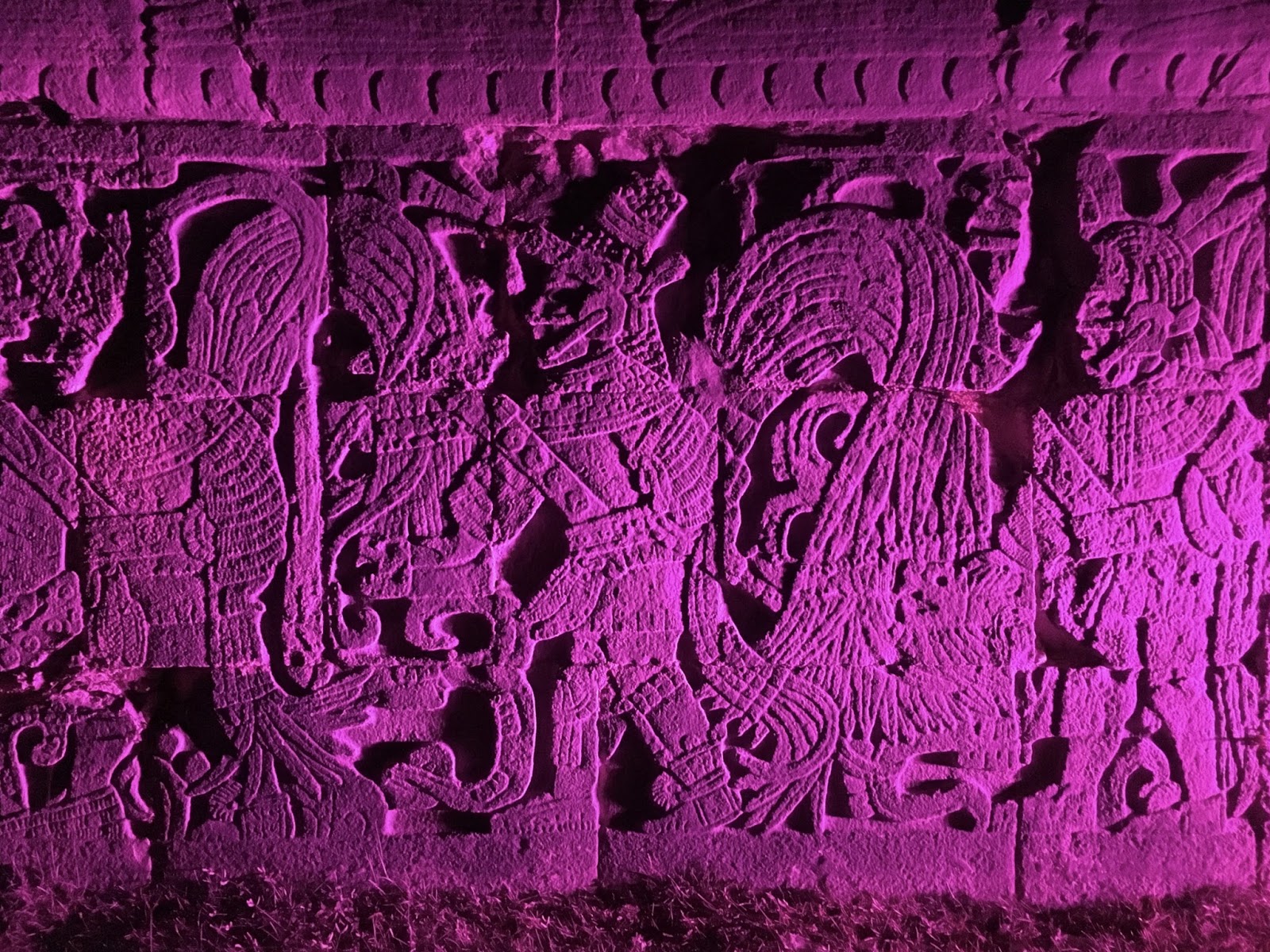
The stele we found at Caracol were rare, reserved for one or two spots on the entire campus. This is a great contrast to Chichén Itzá, where we found stele almost everywhere on the site in the form of large detailed panels with complex representation and imagery which were only improved by a night visit and some creatively colored illuminations. Not so at Caracol. These things were few and far between. And yes, I know I said earlier that in comparing Caracol to Chichén Itzá, I was not putting down Caracol but in the carvings department, Caracol was a bit disappointing, although I'd soften my stance on this issue by the end of this trip.

Those carvings also sounded hollow when tapped upon, which we were encouraged to do.

So, yes, the stele that you see at Caracol. for the most part, are not real. Well, they are real, just not authentic. They are fiberglass reproductions of the original carvings, which are now on display in museums and other locations in Belize and elsewhere in the world. There's even a small open-air museum near the site's entrance and parking lot, with maybe 15 or so original stones on display near where they were originally found. 

Mayan carvings are really pretty special things. They are one of the aspects of Chichén Itzá that make that site so special. It's worth stopping at the end (or beginning, I guess) of your time at Caracol to see these works of art. The story we got while on site is that these objects were deliberately relocated and replaced in kind with replicas because the weather and environment was eroding the originals. I'm cool with moving these thing to preserve them for future generations but I do feel it's a little strange that a number of these priceless artifacts are on display in an open air, non-secured building in the middle of the jungle, particularly given the discussion we had while on site about a military sweep of the property being required at the end of each day. Don't the poachers that the miliary is looking out for know how valuable these things are?


Mayan stele on display on site at Caracol.
The other aspect of a visit to Caracol that bears discussion here is the presence of a couple of ceiba (pronouced say-buh) trees. And to be frank, whereas we could have taken away some appreciation of caana as a structure and the stele as works of art on any sort of visit to Caracol, we would not have understood the ceiba trees to the level we now do without a guide to describe what these things were all about.

Ceiba trees are pretty distinctive looking. They are tall trees with naked trunks topped by a full canopy that gathers the sunlight necessary to keep growing and feeding the entire tree. I'm not much of a tree guy. I've tried a little here and there to get better. I can spot oaks and maples and baobabs and ginkos but I sort of get beyond my repertoire pretty quickly after that list. But I can now add the ceiba tree to that list because of their unique trunks where the trees meet the ground, which can probably best be described as buttress-like, large vertical fins which can easily be taller than me and that anchor the rest of the tree into the ground below it.

For the Maya, these trees are sacred. Back in the day, they had a really practical use. The fibers that the tree produces were historically used as bedding. I am not entirely sure what a typical middle class or lower class Mayan bed looked like because these things are long lost to the centuries but we saw some stone beds at caana that the rulers of Caracol used every night (sitting upright, if you must know) and I can tell you that I'd much appreciate any sort of padding between my body and that stone if I had to sleep there even once.

Caracol's twin ceiba trees.
But more than for bedding and other parts of life that required something soft, the ceiba trees were a literal representation of the tree of life for the Mayans. We learned about this concept when we visited Chichén Itzá but it was drilled into our heads on this trip by pretty much everyone who drove or escorted us anywhere around western Belize, including Alex who drove us from the airport to our hotel (Alex was a pretty deluxe cross-country chauffeur, if you ask me).

The Mayans believe in an underworld and a heaven. Below the ground, they believe that there are nine levels to the underworld. The heavens above have 13 layers. You might this this is just pure optimism that there are more positive layers than negative (yes, I'm viewing the underworld as negative) but the two number really represent the number of hours of light in a day and dark in the night. I know it adds up to 22. The Maya didn't count the one hour of dusk and dawn as either day or night.

The Mayans also believe that the underworld and heaven are represented by a tree of life, which also ties into the creation story of the Mayan people. The ceiba tree is that tree of life. It represents the heavens and Earth and what lies below. The Yucatan peninsula where the Maya lived is full of caves. The Maya believe that the stalactites in the various caves all over where they called home are actually the roots of the ceiba tree and that the water dripping off the stalactites is holy and sacred. 


Once we saw the ceiba trees at Caracol, we started seeing them everywhere. Isn't that always the case? These trees really are super special to the Maya even today. There are stories out there about Mayan peoples today clear-cutting forests for work but leaving whatever ceiba trees they come across standing in place. They revere them. I'm sure they don't need them for bedding any more but I'm not wholly confident in that assertion.

When we arrived at Caracol, we were the first ones there and there can't have been many more than 150 or so tourists total on site that day (I'm judging this by the amount of people seating under the picnic table shelter for lunch). That emptiness was, I believe, a direct result of its inaccessibility and the scarcity of tourists translated into a super accessible and intimate experience. Caracol was an awesome Mayan site visit (I also believe the quality of our guide was a significant contributing factor to this days' awesomeness).

So how does a visit this amazing only yield some stories about a big solid building, some fiberglass reproductions of ancient carvings and a couple of paragraphs about a tree? Well...it doesn't. There is more, but I believe that two of Caracol's stories are best told in a future post. Just wait and trust me on this. 

A Mayan roof; still intact using a corbeled arch.
But there is actually a fourth bonus story about Caracol worth relating before I wrap this one up.

So we arrive at Caracol. Deserted parking lot. First ones there (very cool). Bathroom break. Spotted a slaty-tailed trogon (also very cool, but no toucans). Site orientation talk while gathered around the sign that shows the map of the place. And we are off. Walking from the parking lot to the first stop on our tour, the Raleigh Group.

Before we get there, there is this absolutely bone-chilling roar that sounds like a dinosaur from Jurassic Park. I'm not kidding. It was like exactly the same as T-Rex in that movie. What the HELL was that?

Apparently...howler monkey.

We have heard howlers before. In Costa Rica. At like 4 o'clock in the morning. They woke us up every morning. From a distance. Emphasis on that last part: From. A. Distance. Hearing a howler monkey in a tree right next to you is way, way different that some remote spot in the jungle. I can't imagine the first time a man (or even better, some conquistador from Spain) heard that sound. What on Earth would they think? I mean this sound was other worldly scary. It sounded like it was made by something very, very enormous, very, very close and very, very dangerous.

I feel confident saying that this noise could have been about the scariest noise I've ever heard and if we didn't have a guide right there next to us to say "howler monkey" as soon as it sounded, I'm not sure exactly what my reaction would have been. I mean, I'm sure deep inside I knew there was no reason to panic but if our guide had said "jaguar really close" with the right tone of voice, I could have believed it.

And no, I don't have some super-amazing photograph of a howler monkey. I have some really dark ones, one of which is below.

Caracol. Climbing the largest manmade structure in Belize. Ancient hand-carved works of art. Stories about sacred trees and creation. Howler monkeys. And two stories to be told later. Caracol was worth the two hours each way and the five plus hours on site. This was the perfect first day in Belize for us.

There are mounds all over Caracol. Each one holds buried treasure. 90-92% unexcavated.
Best howler monkey picture. I know, it's not great and it looks like a cat. It's not a cat.

Saturday, February 18, 2017

The Maya


When I first decided to go back to Mexico last month, my idea for an itinerary was fly to Cancun, stay at an all inclusive resort property on the east edge of the Yucatan Peninsula for a few nights, take a day trip to the ancient Mayan city of Chichén Itzá and then kick back and chill for the rest of the time. Sounds fun, right? Especially when it gets me out of cold Washington, D.C. in late January.

But the more we started looking into the value of visiting the Yucatan, the more we became convinced that the right thing to do would be to immerse ourselves in the old land of the Maya and take in as much as we could in our three full days there. That meant swimming in some cenotes which first allowed the Maya to settle in the area; chasing some pink birds before visiting the ruins at Ek Balam north of Valladolid; and spending three nights right outside what we hoped would become the crown jewel of our trip: the old city of Chichén Itzá. 

This was not my first visit to this part of Mexico. I was down there about eight years ago doing exactly what I originally planned to do on this journey, namely spend time at the beach drinking all included beer and margaritas and taking a quick car ride down to some old ruins (Tulum, on that trip). But after that first trip, I regretted not going to Chichén Itzá, thinking at the time it was too far to go for the day. I think my regret was understandable. After all, it's supposed to be one of the new seven wonders of the world; it had to be pretty good, I assumed. 

This year, I found out. 

Looking west toward the Platform of the Tombs. The platform of Venus is beyond that.
The earliest origins of the Mayan civilization can be traced back to about the third millennium B.C. At its height, there were Mayan villages and cities all over the Yucatan in present day Mexico; throughout Belize and Guatemala; and into parts of Honduras and El Salvador. The glory days of the civilization started around 250 A.D. and continued for about 675 years when they were discovered (and conquered) by the Toltecs from present day central Mexico and absorbed into the Toltec culture. 

The Mayans were incredible people (notwithstanding the whole human sacrifice thing). They emerged from a nomadic hunter-gatherer culture and spread across the jungles and plains of central America. They studied the stars extensively and understood the relationships between our planet and the cosmos, particularly the planet Venus, which they knew synched with the Earth's orbit every eight years. They used their knowledge gained from the study of the skies to tell them when to plant crops and when to harvest.

They also were skilled mathematicians and keepers of time. They were the first known peoples to conceive of the concept of zero and they kept a remarkably accurate calendar, consisting of 18 twenty day months with a remaining five days each year reserved for celebrations and rituals. And for sure they could build. The pyramids and other structures they left are scattered all over central America and are still standing today.

I'm writing here about the Maya as if they no longer exist. Indeed, they are still around today and enriched our own journey this year. I expect that most of the employees of our hotel and the many many taxi drivers that carted us around the region identify themselves as Mayan.


Mayan peoples started living around the site of Chichén Itzá as early as 150 B.C. In the formative centuries of the Mayan culture, the groups living in the southern area of their territory developed faster, having plentiful building materials in the jungles of what is now Guatemala to create shelter. But as technology and building techniques advanced, the proximity to large amounts of available limestone (the Yucatan Peninsula is essentially an enormous limestone shelf) allowed the people located in the north to build the Maya's greatest cities.

Chichén Itzá started to be developed in a serious way in the middle of the sixth century A.D. and about 150 years later it had become established as an important political and economic city. But its real heyday started with its absorption into the Toltec culture by the Itzae peoples who arrived in the year 918 (before their arrival the place was named something different; Chichén Itzá means "at the mouth of the well of the Itzae"). Later that same century the Itzae consolidated Chichén Itzá as the capital of their empire, which I suppose accounts for its impressive size. 

The city's importance outlasted the independence of the Mayan empire but at around the year 1200 the site was abandoned for good. Nobody understands exactly what happened but it is most often thought that the Itzae were defeated in battle as the result of some dispute with one of their neighbors. Regardless of what exactly occurred it seems pretty certain that around the turn of the 13th century the old city of Chichén Itzá started to be absorbed back into the jungle. 

Serpents' heads at the base of the north stair of the Ossuary, or Tomb of the Great Priest.
As the base for our Mayan pilgrimage, we elected to stay at the Lodge at Chichén Itzá, which is located directly adjacent to the property. So close, in fact, that they have their own private entrance to the ruins. For a full Mayan experience, this place was about as perfect as we could have wished for. Sure the backdoor to Chichén Itzá was fantastic but beyond that the property was lush, the staff were great and we could see the old Mayan observatory from the hotel bar where we ate a couple of meals and kicked back with a Sol beer or two (or three). Definitely worth the price of admission.

We elected to get right to it the day after we arrived, entering the Chichén Itzá property just 30 minutes after opening time at 8 a.m. Our walk that morning took us along a path through the jungle and into the main space of the city dominated by the massive pyramid called El Castillo. Our first impression was that the place was huge. Way bigger than similar ancient places we had been like the Roman Forum, Stonehenge or Herculaneum. After a couple of hours walking around about half of the property, we were wrong. It's not huge; it's whatever bigger than huge is. We wouldn't leave the place for five hours.

As a generalization, Chichén Itzá is pretty much a ring of temples arrayed around an extremely impressive and remarkably still together central pyramid. But spend some time exploring and you'll find more than that, including warehouses, an observatory, markets and steam baths. These folks that built this place were pretty sophisticated. We often praise the Romans for their advanced technology when it came to construction; the Maya were pretty close to that standard.

One of the difficulties of visiting cities like this one is that the only buildings remaining are civic in nature, presumably because private homes or shelters were constructed from less permanent materials. That's exactly what you will find at Chichén Itzá. Usually the buildings at these sites have been looted at some point and everything of value or aesthetic interest has been stripped away for repurposing or sale to some antiquities collector or museum. But here Chichén Itzá is different; there are an extraordinary amount of still in place carved panels throughout the property that give us glimpses into Mayan life. It's actually really impressive the amount of intact carvings. I guess that's what happens when you build a city in the middle of the jungle and then abandon it there for centuries.


So what did we do in almost five hours at Chichén Itzá? Well for one thing, we saw everything they would let us and maybe one building beyond that. We started at El Castillo and walked west to the Temple of the Warriors and beyond before circling back counterclockwise to the sacred cenote where human sacrifices by drowning were offered to the gods. After managing to avoid buying anything (well almost anything; couldn't resist the necklace with my Mayan zodiac symbol on it) from the gauntlet of vendors on the way to and from the cenote, we hit the Temple of the Jaguars and its adjacent ball court before heading south to the observatory and the buildings around that structure.

In between all of that, we visited every building between those monuments; hydrated; watched iguanas scamper over the ground and sun themselves on the ruins; and managed to wander down a closed to the public path and found the Akab Dzib, one of the oldest buildings on the site.


One of the things I found most confusing about visiting the old Roman Forum when we visited there in 2015 was the overlapping and overwhelming nature of the narrative around the site. There was everything from foundations to partially intact buildings of every century that the Romans had built and rebuilt near the Palatine Hill. It was very difficult to get a complete picture of what the site was like at any one time because they have tried to represent every building ever standing in that spot, even if some buildings were demolished and replaced by others in the exact same locations.

Not so at Chichén Itzá. What you find here is a snapshot in time of what the place was like at the end of the 13th century. The relationship between buildings and spaces is so clear because most of what was built there was done in a really permanent way and is still there for you and me to see today. As an architect and someone interested in history, I was impressed by a number of things about the old city.

First, I find it impossible not to be awed by the sheer size of the place. All told, there are about 30 large to very large structures on the site in various degrees of ruin from a few columns on a foundation to the three pyramids on the property which looked to me to be either completely intact or maybe just a little bit less than that. There is a lot to see here.

Secondly, the quantity of carvings at the site are incredible, most notably the skulls at the Tzompantli shown at the top of this post, the jaguars and eagles on the nearby Platform of the Eagles and Jaguars and the warrior carvings which ring the immense ball court. The jungle must have kept people who would have been inclined to steal these things from taking them, either by just hiding them completely or by making it so difficult to transport really heavy stone panels over a hundred miles through dense brush that they just didn't even try. There's a lot of carvings to see, including at the more recent, Toltec-built Group of the Thousand Columns near the Temple of the Warriors.


But as awesome as the size of the property and the intact carvings are, the star of the show is clearly El Castillo, the massive pyramid around which everything else revolves and the single building most associated with the name Chichén Itzá. Rarely do I fall for the most popularized building on a site like this but here I can't help it.

El Castillo translates into English as "the castle" but the real name of the pyramid is the Temple of Kukulkán, the winged serpent which served as one of the primary deities in Mayan mythology. It stands 24 meters (or just shy of 80 feet) high which is clearly the highest building on the campus. Each side of the pyramid has 91 steps; multiply 91 by four sides and add a common top step and you get 365, which is the number of days in the Mayan calendar. 

The north side of El Castillo is the most intact today which is fortunate because it is the most important of the four sides. At either side of the stair on this facade is a stringer with a carved serpent's head at the bottom. This is an important design feature. The structure is aligned with the sun such that the stepped sides of the pyramid cast a shadow on the stringers during the spring and autumnal equinoxes that make it look like there is a serpent on the sides of the stairs on this side of the building.

The Temple of Kukulkán can be seen throughout the ruins of Chichén Itzá. It was clearly the singular focus of life one millennium ago. There are a couple of smaller pyramids on site that have a similar form as El Castillo but nowhere near as impressive, although the serpent's heads on the Ossuary just to the south are probably better preserved. I was shocked by the impression the Temple made on me. This alone was worth a trip.

The observatory with the Temple of the Carved Panels, and a Mayan arch, in the foreground.
As impressed as I was with El Castillo, I think it's worth spending a paragraph or two on the observatory at the south end of the site. This was the first part of Chichén Itzá we saw on our arrival at our hotel stunningly framed by the front door opening. My first thought here was "Why does it look like a modern observatory? It's not like they had telescopes way back then, right?"

My first thought was correct; the Maya did not have telescopes. And I had that thought all the way through our day on the property. But one of the advantages of traveling rather than reading a book or watching TV is how you gain information from the place which reinforces what you see. In the case of the observatory, our learning came from an unlikely source: a planetarium style presentation about Mayan mythology located on our hotel's property. It cost $9 U.S. per person and took just 30 minutes but it was enormously valuable. It described both the Mayan creation myth and the importance of the stars and planets in their annual cycle of life.

But most importantly, it told us that the observatory was built to observe the planet Venus. It is aligned 27.5 degrees north of west which corresponds to the direction where Venus is at its highest point in the night sky. Marks related to the movement of Venus have been found in Mayan buildings in a number of locations and the cycle of Venus corresponds to the death and resurrection cycle of Kukulkán. 

The Mayans were almost obsessed with the planet Venus and built an entire observatory just to track it and its relationship to the seasons and their own myths. If I wasn't impressed with the Mayan calendar and the equinox serpent on El Castillo (I was), I sure was impressed with this dedication to study of the night sky. It all hit home that night towards the end of dusk when we walked to the hotel bar and saw the observatory outlined against fading light and Venus shining bright up in the sky. Never would have understood all this without being there.

The observatory at dusk-ish; Venus is the bright dot in the upper left.
When I think back to that first trip I took to the Yucatan back in 2009, I no longer regret not visiting Chichén Itzá. In fact, I'm glad I didn't. After the full day on site and the couple of extra days staying nearby rather than at some all inclusive resort on a beach somewhere, I'm glad I decided all those years ago it wasn't worth a day trip. Because ultimately, it isn't worth a day trip; it's worth a whole day and more. Being able to come back to the hotel each night and see the observatory with Venus high overhead is worth way more than a few hours sandwiched between a two hour plus each way bus trip. Chichén Itzá is best when explored for more than a rushed guided tour.

Before I end this post, I thought it worth sharing a few final thoughts on Chichén Itzá.

First, the ride from the Cancun airport to Piste (which is right near the ruins) was a long one. It's about 200 kilometers from the airport to the site which takes about two and a half hours in a Mexican cab. On the surface of things, that's not an overly long period of time and it's also not that expensive (about $120-165 U.S.). It's the road you have to travel that makes it long. The highway is the same all the way from the airport until about 5 kilometers from the hotel: straight, flat, empty and bordered by about 25-30 foot high trees on each side. No breaks, nothing different, nothing to see. Just monotony all the way. I think if I were doing it over again, I'd try to fly to Mérida on the western side of the Peninsula rather than Cancun on the eastern. It's a little closer and maybe there's more to see?

Take a cab from the Cancun Airport to Chichén Itzá and you are in for 2-1/2 hours of this view.
Secondly, when we checked into our hotel, we were offered the opportunity to hire a guide for two hours to show us around Chichén Itzá for a $45 U.S. fee. After a few minutes thought, we decided to pass on this offer. As luck would have it, we picked up a guide book called "Chichen Itza History, Art and Monuments" at the hotel gift store for M$136 (that's about $7 U.S.) which served us just as well as a guide if not better. Also, I don't know how fast we would have had to walk or how much we would have had to skip to get through the whole property in two hours because it took us between four and five to do it with our guidebook we picked up for seven bucks. I think declining the guide was completely the right call for us.

Closing point three: Mexico is hot. So get an early start. I imagine this comes as no surprise to those of you who have been to Mexico before. I remember it being hot in Tulum when I visited there in 2009 but that was in May. We went this year in January! By the time it got to 10:30 in the morning, it was hot. By the time noon rolled around, it was pretty unbearable. I was moving from the shade of one tree to another very quickly and then resting while in the cool spots. I wouldn't start my visit Chichén Itzá at any time other than early in the morning.

El Castillo at night.
Finally, there's a nighttime light show at the property which is interesting. The gates open at 7 p.m. and it's about $20 U.S. per person. Your $20 gets you into the property after dark to view the place on a controlled route lit up with L.E.D. lights which change colors. That self guided walk is followed by a video projection directly onto El Castillo which details the history of Chichén Itzá while also relating it to the Mayan creation myths.

Two things here. First, the audio of the projection portion is all in Spanish. We'd already studied up on Mayan mythology in our hotel so we could follow along pretty well. Secondly, the actual presentation starts at 8. We didn't understand this so we rushed through the self-guided walk and ended up sitting in our seats for about 30-40 minutes waiting for everyone else to finish. If we'd have known the show was starting an hour after the gates opened we would have taken our time in the first part of the activity or showed up a little later.

I'm not sure the light show was worth the full $20 but what else are you going to do at night when you are in the center of the Yucatan Peninsula? I think it's worth it to do once. If nothing else it shows the friezes around the property in dramatic lighting which improves their readability and there's a part of the projection which shows El Castillo overgrown with virtual jungle which makes you think about the condition it must have once been in. It was definitely cool enough to do once. And again, what else do you have to do at night in Pisté?

Frieze at the ball court lit up at night. Improves the carved detail in my opinion.