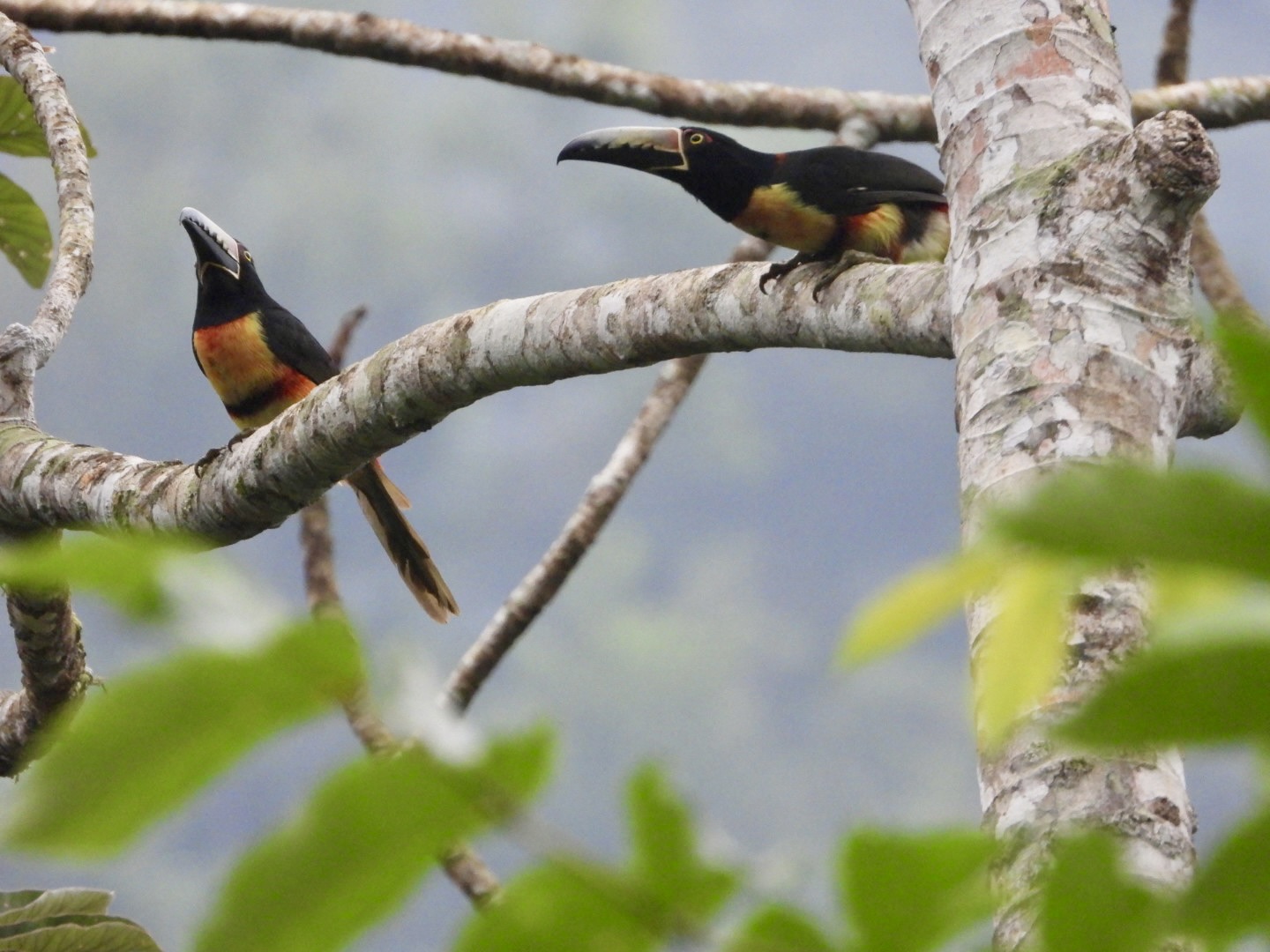
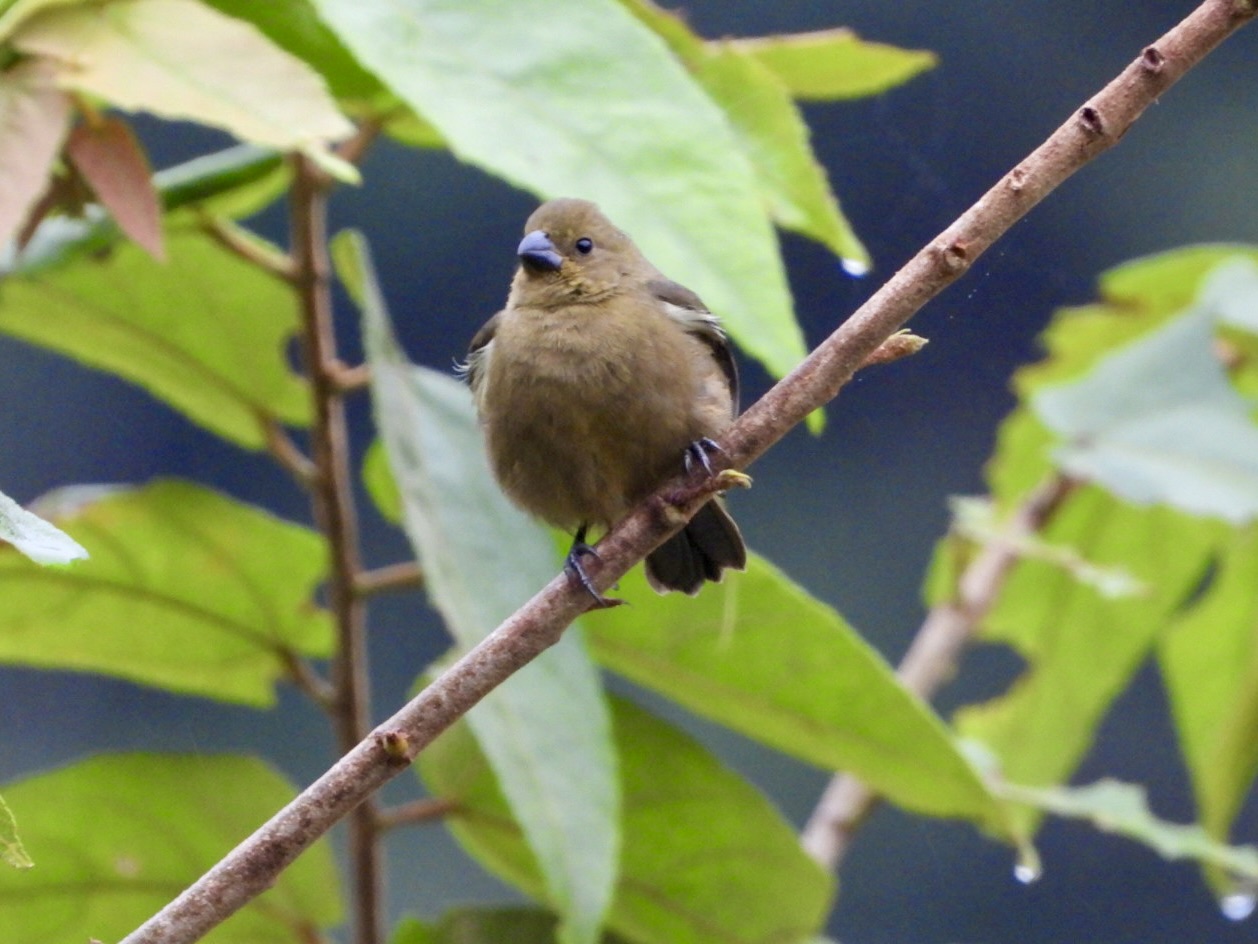
We went to the Belize jungle in search of Mayan ruins and toucans. We found both, although I know that I still have that signature toucan encounter somewhere out there in my future after a satisfactory, but ultimately not completely satisfying, toucan spotting experience.
We did better with the Mayan ruins. That's likely in part or really probbaly in whole due to the ruins standing still; being really large; and not being hidden behind Belize's vegetation, at least not the ruins we chose. We looked around some before finalizing our choice of ruins. We flirted with Lamanai a bit; halfway considered a stop at Altun Ha (the ruin on the Belikin beer label); but eventually settled on Caracol for two reasons: (1) it was pretty close to San Ignacio where we ultimately decided to spend four nights in and (2) it was supposed to be the best ruin in Belize.
We didn't get ourselves to Caracol. We took a tour. Pickup at 6:30 dark and early with arrival time about a couple of hours later. Maybe a bit quicker than that. And yes, I know I said in the last paragraph that Caracol was pretty close to our hotel and I meant it. It wasn't the distance that took us that long; it was the road. Plain and simple, it's just not finished yet.
Now, you might wonder why the government of Belize wouldn't prioritize construction of a road to a super important cultural resource, right? Here's the deal: Caracol isn't the only Mayan site in the country of Belize. The Mayans didn't just build one or two settlements here and there. They built a ton. The population of what is now Belize is about 400,000 people or so. When the Mayans were around and building (to be fair, the Mayans are still around), it was four to five times that number. And most of what they built are still buried in the jungle of Belize, Mexico and Guatemala. There's a lot of choices to make about spending dollars to build roads to access Mayan sites. Give the government of Belize a bit of slack here.
For perspective, two days after our Caracol visit, we made a pilgrimage to Tikal in Guatemala. We were told that of the 39 known Mayan sites in Guatemala, only three are accessible via road. The rest involve multi-day treks on foot through the jungle. This is some untamed land, folks.
 |
| The road, paved and unpaved. You can see the paving layers in the top picture at the side of the road. |
So about that road.
We made our way to Caracol over pieces of finished roads, stretches of packed dirt and every sort of construction in between those extremes. Apparently, the Belizeans are prioritizing the least navigable parts first to allow the greatest chance for the greatest number of people to visit. We visited during the dry season, meaning the dirt parts of the road weren't sloppy and muddy to ankle depth apparently.
The benefits of the road? Cutting about an hour and a half off the time to get from San Ignacio to Caracol and eliminating the need for a military escort on the last piece of the road. That's right: military escort. Apparently before the road, there were poachers and robbers and bandits (they may all actually be the same people) who would fell trees across the mud / dirt road and when passengers got of their vehicle to move the tree, they would be robbed of everything. Nice, right?
Even today, the military clears the park of all visitors and follows the last people out at about 3 pm every day. We made our way out a bit before that. No desire to get any necessary military protection involved on our day. The road mitigates the need for military escort. Mostly.
I was grateful for the road.
 |
| View from the top of the south acropolis at Caracol. Those specks down on the ground are people. |
Caracol is not my first Mayan ruin. It is, in fact, my fourth visit to a place that the Mayans used to call home. Tulum just south of Playa del Carmen was my first in 2009, followed by Chichén Itzá and Ek Balam in the northern part of the Yucatan in January of 2017. Tulum was a distraction, a way for me to get outside the perimeter of an all-inclusive resort and do something different. Chichén Itzá (and to a lesser extent, Ek Balam) was a pilgrimage, a chance to learn about the history of these people who flourished so long ago for so many centuries and who excelled at so many things. Building. Astronomy, Mathematics (they invented the concept of zero). Agriculture. And more.
Chichén Itzá will always be a touchstone for Mayan sites for me, mostly because of it's immaculate-ness and completeness. The Mayans started inhabiting Chichén Itzá around about 150 B.C. Development really took off in the middle of the sixth century C.E. before its decline and collapse in about the mid-900s or so. In Mayan terms, Chichén Itzá was a solid Classic period site built at the height of the Mayan civilization and supported a population around 35,000 or so. And legitimately, the ruins today are spectacular, with a number of impressive structures excavated and reconstructed and adorned with original carvings from back in the day.
Caracol is not Chichén Itzá, and I don't mean that in a way to put Caracol down. It is older (first settlement about 1200 B.C.); lasted way longer at its peak (700 B.C. to about 900 C.E.); and was significantly bigger, with a population in the city proper of about 100,000 and an estimated additional 20,000 to 80,000 in the greater Caracol metropolitan area. In many ways, it was more important to the history of the Mayan peoples. This was a serious settlement. No kidding around here.
I know I already wrote this, but Belize today is 400,000 people. Caracol held 1/3 to 1/2 as many as that towards the end of what is now recognized as the first millennium after the birth of Christ. I can't even imagine that many people in the middle of the jungle in one spot. The amazing thing is Caracol had neighbors. The Mayans were a big deal!
The name Caracol, by the way...not the Mayan name. Caracol is a Spanish word meaning snail shell, a reference to the site's circulation path.
 |
| The Raleigh Group, the first structures we came to at Caracol. |
We spent about 5-1/2 hours at Caracol. With an allowance of about 30 minutes for lunch, that meant we were roaming around learning about and taking in the place for about five hours. That is nowhere near long enough to absorb everything about the city that used to be there and I'm not going to try to even be anywhere close to comprehensive in this blog post about Caracol's history and importance. Heck, I'm not even going to blow-by-blow what we saw, heard, smelled, touched and sensed in our time there because to do so doesn't make sense. I'm not trying to create a transcript of the day.
I believe places like Caracol have stories to tell and I believe what I am doing in this blog for most all of my posts is writing down my story about where I've been. Caracol definitely had a story for me and that was about three things: the caana, the steles (and I suppose the lack thereof) and the ceiba tree.
Did we see more than that? Sure we did. Was some of it really important? Sure it was. But it didn't resonate enough with me to make a huge impression, so most of all of that is left at the site for someone else to pick up. Although I will come back to one or two more Caracol nuggets in a later post. For now, let's get through Caracol's story.
In our five or so hours on site, I believe we covered about every part of Caracol that you can see at the site. We may have missed one or two points, but I'm not going to nitpick. If you make it to Caracol one day and do what we did this past January, you might feel like you've seen the whole place. Don't. We were told that despite everything there is to see at Caracol, what's standing before you from 1,200 plus years ago is likely only 8 to 10 percent of everything that is still there. The other 90 to 92 percent is still buried. And that's not even including all the non-permanent structures that have been lost to time. Caracol was and is huge.
Of what has been revealed so far (and excavation is still proceeding every year, just really slowly), the star of the entire site at Caracol is clearly the caana, or the sky palace. It was built as a royal residence for the rulers of the city and is topped by three temples, each dedicated to a different family member.
Mayan society generally had three class tiers: (1) the upper class, or the royalty who were in charge of the whole place; (2) the middle class which were generally artisans and skilled workers; and (3) the lowest class who were relegated to manual labor and working the fields to provide for the other two classes. Most of what is visible to the visitor today at Caracol was built for the upper class. Yes, there are some foundations here and there for the middle class but most of what it really super impressive and lasting today was built out of limestone for the royals. The rest of the place was wood and vegetation and that stuff just won't stick around long.
Caana is THE showpiece at the site. It stands at just a bit more than 43 meters high (or about 140 feet in height) and is the tallest manmade structure in Belize today. Not tallest manmade Mayan structure. Tallest manmade. Nothing in the entire nation is taller than this thing. That's astonishing, I think. All that time since this pyramid was built and nothing has topped it. I guess Belize doesn't have a need for high rise buildings.
 |
| Caana, Caracol's sky palace. |
What do you do when you come to this architectural wonder at Caracol today? Well, if you are feeling adventurous, you might climb it.
We were feeling adventurous.
I am not entirely sure how I feel about me being able to climb all over a centuries-old monument that's over 1,000 years old. Shouldn't we really be staying off these things and protecting them? We weren't allowed to climb at Chichén Itzá (although we were at Ek Balam) which made sense to me. But when it came right down to it, what difference is one more person (me) climbing up this thing if everyone else is doing it? I'm not succumbing to peer pressure or anything there, but yes, I did it. I mean, I had to.
Caana was built in layers. Three layers to be exact. It was likely built this way as materials and funds became available. Our guide, Jason, offered the opinion that the pyramid was likely built in three stages, with each build about maybe 40 to 60 years apart. The climb is really only possible from the front, or from the south of the building. So we climbed, one step at a time.
Yes, there are steps, but it's not exactly an easy climb. These are no seven or eight inch high steps like we find in our houses or offices or anywhere else we find stairs in our lives. I'm guessing about two feet or so. When you are 56 and probably 20 pounds overweight, this is some work. And not just going up. In many ways, it's much more treacherous coming down. It's achievable, but it's work, especially with that Belizean sun starting to pound down in the late morning.
I appreciated three things about this climb. First, I'm glad we did this in the morning and not the afternoon; Jason claimed he was about the only guide that didn't save Caana for the end of the tour and I appreciate him making us do the hardest work first when it was super-marginally cooler. Second, there are some intact interior rooms at the top level of the building where ceilings are constructed using the Mayan corbeled arch; it was cool to see this in person and intact from all those centuries ago.
And third, the view is spectacular. Being on top of that pyramid is gorgeous today. It must have been even more so when Caracol was at its height of development. Although let's face it, most all of the citizens of what we now call Caracol would never have made the climb up the staircase like we did this past January. At least not without permission. I'm thinking no permission, no survival and I don't think I'm wrong.
 |
| The view from the top of caana. Looking down on the top level of the structure and the ground level beyond that. |
On the top level of caana, we stopped and looked at some carvings in the side of one of the three upper temples. The Mayans, like many civilizations (including our own) were big fans of carving images into stone panels (known as stele) as memorials or to tell stories of historical events or depict myths and gods that the society believed in, revered and feared.
Before we started our climb, we found a couple of stele much larger than what we found on top of the temple, two huge panels taller and wider than me depicting rain gods, a jaguar, some deer and men. I love Mayan carvings. Like a lot of societies, they employed an abstract representational method of portraying gods and animals and figures that is far more compelling to me than a strictly lifelike resemblance of the same sorts of imagery used by the Greeks and Romans, to name a couple of peoples / empires whose art I see as less graphically imaginative.
 |
| Mayan stele at Caracol. Dark and weathered but the detail is read-able. |
The stele we found at Caracol were rare, reserved for one or two spots on the entire campus. This is a great contrast to Chichén Itzá, where we found stele almost everywhere on the site in the form of large detailed panels with complex representation and imagery which were only improved by a night visit and some creatively colored illuminations. Not so at Caracol. These things were few and far between. And yes, I know I said earlier that in comparing Caracol to Chichén Itzá, I was not putting down Caracol but in the carvings department, Caracol was a bit disappointing, although I'd soften my stance on this issue by the end of this trip.
Those carvings also sounded hollow when tapped upon, which we were encouraged to do.
So, yes, the stele that you see at Caracol. for the most part, are not real. Well, they are real, just not authentic. They are fiberglass reproductions of the original carvings, which are now on display in museums and other locations in Belize and elsewhere in the world. There's even a small open-air museum near the site's entrance and parking lot, with maybe 15 or so original stones on display near where they were originally found.
Mayan carvings are really pretty special things. They are one of the aspects of Chichén Itzá that make that site so special. It's worth stopping at the end (or beginning, I guess) of your time at Caracol to see these works of art. The story we got while on site is that these objects were deliberately relocated and replaced in kind with replicas because the weather and environment was eroding the originals. I'm cool with moving these thing to preserve them for future generations but I do feel it's a little strange that a number of these priceless artifacts are on display in an open air, non-secured building in the middle of the jungle, particularly given the discussion we had while on site about a military sweep of the property being required at the end of each day. Don't the poachers that the miliary is looking out for know how valuable these things are?
 |
| Mayan stele on display on site at Caracol. |
The other aspect of a visit to Caracol that bears discussion here is the presence of a couple of ceiba (pronouced say-buh) trees. And to be frank, whereas we could have taken away some appreciation of caana as a structure and the stele as works of art on any sort of visit to Caracol, we would not have understood the ceiba trees to the level we now do without a guide to describe what these things were all about.
Ceiba trees are pretty distinctive looking. They are tall trees with naked trunks topped by a full canopy that gathers the sunlight necessary to keep growing and feeding the entire tree. I'm not much of a tree guy. I've tried a little here and there to get better. I can spot oaks and maples and baobabs and ginkos but I sort of get beyond my repertoire pretty quickly after that list. But I can now add the ceiba tree to that list because of their unique trunks where the trees meet the ground, which can probably best be described as buttress-like, large vertical fins which can easily be taller than me and that anchor the rest of the tree into the ground below it.
For the Maya, these trees are sacred. Back in the day, they had a really practical use. The fibers that the tree produces were historically used as bedding. I am not entirely sure what a typical middle class or lower class Mayan bed looked like because these things are long lost to the centuries but we saw some stone beds at caana that the rulers of Caracol used every night (sitting upright, if you must know) and I can tell you that I'd much appreciate any sort of padding between my body and that stone if I had to sleep there even once.
 |
| Caracol's twin ceiba trees. |
But more than for bedding and other parts of life that required something soft, the ceiba trees were a literal representation of the tree of life for the Mayans. We learned about this concept when we visited Chichén Itzá but it was drilled into our heads on this trip by pretty much everyone who drove or escorted us anywhere around western Belize, including Alex who drove us from the airport to our hotel (Alex was a pretty deluxe cross-country chauffeur, if you ask me).
The Mayans believe in an underworld and a heaven. Below the ground, they believe that there are nine levels to the underworld. The heavens above have 13 layers. You might this this is just pure optimism that there are more positive layers than negative (yes, I'm viewing the underworld as negative) but the two number really represent the number of hours of light in a day and dark in the night. I know it adds up to 22. The Maya didn't count the one hour of dusk and dawn as either day or night.
The Mayans also believe that the underworld and heaven are represented by a tree of life, which also ties into the creation story of the Mayan people. The ceiba tree is that tree of life. It represents the heavens and Earth and what lies below. The Yucatan peninsula where the Maya lived is full of caves. The Maya believe that the stalactites in the various caves all over where they called home are actually the roots of the ceiba tree and that the water dripping off the stalactites is holy and sacred.
Once we saw the ceiba trees at Caracol, we started seeing them everywhere. Isn't that always the case? These trees really are super special to the Maya even today. There are stories out there about Mayan peoples today clear-cutting forests for work but leaving whatever ceiba trees they come across standing in place. They revere them. I'm sure they don't need them for bedding any more but I'm not wholly confident in that assertion.
When we arrived at Caracol, we were the first ones there and there can't have been many more than 150 or so tourists total on site that day (I'm judging this by the amount of people seating under the picnic table shelter for lunch). That emptiness was, I believe, a direct result of its inaccessibility and the scarcity of tourists translated into a super accessible and intimate experience. Caracol was an awesome Mayan site visit (I also believe the quality of our guide was a significant contributing factor to this days' awesomeness).
So how does a visit this amazing only yield some stories about a big solid building, some fiberglass reproductions of ancient carvings and a couple of paragraphs about a tree? Well...it doesn't. There is more, but I believe that two of Caracol's stories are best told in a future post. Just wait and trust me on this.
 |
| A Mayan roof; still intact using a corbeled arch. |
But there is actually a fourth bonus story about Caracol worth relating before I wrap this one up.
So we arrive at Caracol. Deserted parking lot. First ones there (very cool). Bathroom break. Spotted a slaty-tailed trogon (also very cool, but no toucans). Site orientation talk while gathered around the sign that shows the map of the place. And we are off. Walking from the parking lot to the first stop on our tour, the Raleigh Group.
Before we get there, there is this absolutely bone-chilling roar that sounds like a dinosaur from Jurassic Park. I'm not kidding. It was like exactly the same as T-Rex in that movie. What the HELL was that?
Apparently...howler monkey.
We have heard howlers before. In Costa Rica. At like 4 o'clock in the morning. They woke us up every morning. From a distance. Emphasis on that last part: From. A. Distance. Hearing a howler monkey in a tree right next to you is way, way different that some remote spot in the jungle. I can't imagine the first time a man (or even better, some conquistador from Spain) heard that sound. What on Earth would they think? I mean this sound was other worldly scary. It sounded like it was made by something very, very enormous, very, very close and very, very dangerous.
I feel confident saying that this noise could have been about the scariest noise I've ever heard and if we didn't have a guide right there next to us to say "howler monkey" as soon as it sounded, I'm not sure exactly what my reaction would have been. I mean, I'm sure deep inside I knew there was no reason to panic but if our guide had said "jaguar really close" with the right tone of voice, I could have believed it.
And no, I don't have some super-amazing photograph of a howler monkey. I have some really dark ones, one of which is below.
Caracol. Climbing the largest manmade structure in Belize. Ancient hand-carved works of art. Stories about sacred trees and creation. Howler monkeys. And two stories to be told later. Caracol was worth the two hours each way and the five plus hours on site. This was the perfect first day in Belize for us.
 |
| There are mounds all over Caracol. Each one holds buried treasure. 90-92% unexcavated. |
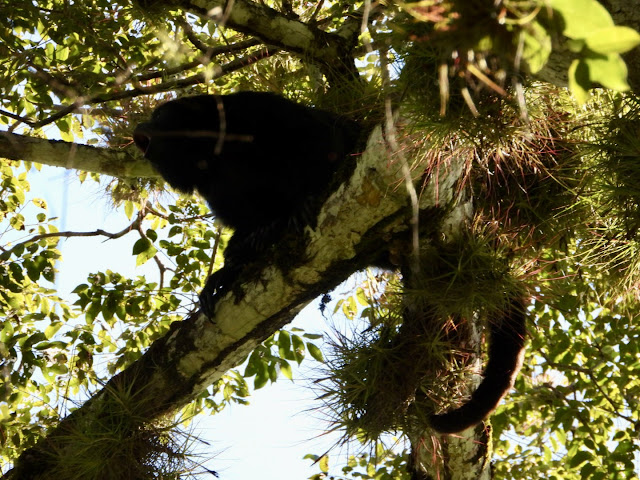 |
| Best howler monkey picture. I know, it's not great and it looks like a cat. It's not a cat. |