Showing posts with label Germany. Show all posts

Monday, October 8, 2018

All About The Magi


I went to Cologne to do two things: drink some kölsch and see the Cathedral. That's it. One day. In and out. The first one didn't work out so well. Despite sampling six different types of Cologne's endemic beer, I found the stuff mostly forgettable. The Cathedral, or Dom (in German), on the other hand was anything but. From the moment we stepped off the train from Düsseldorf to the second we stepped back inside the station on our way home, we barely lost sight of the Dom. And it was worth going to Cologne from the first sighting to our last goodbye early Sunday morning.

Cologne is an old city. The oldest in Germany actually. It was first settled along the west bank of the River Rhine by the Romans in the first century B.C. About 100 years later (around 40 A.D.) they got serious about building a real permanent type of town on the spot and about four decades after that, they brought water into the city by building an aqueduct. It grew from there, becoming a regional capital of the Gallic portion of the empire and eventually having a pretty good sized population of about 20,000 people. 

As the Roman empire started to crumble around its edges, the city of Cologne was sieged and sacked and reclaimed by Rome and then sieged and sacked by an entirely different group of people. After about 100 years of that sort of stuff in the year 455, it was claimed by the Salian Franks and enjoyed a little bit of peace for a few hundred years. That is, until the vikings burned the whole place to the ground in the late ninth century. 

The west face of the Dom at night.
The first cathedral in Cologne was built in the fourth century on a spot pretty much right where the Dom stands today. It was eventually replaced by a second cathedral before gothic cathedral fever started to sweep over Europe and Cologne decided it had to have one too. I'm sure the previous sentence is way understating the gravity of the decision to build a new cathedral in the middle ages. Cologne had been an important city in the church hierarchy for centuries and just after the turn of the new millennium they found (or maybe stole is a better word) a really good reason to start building themselves a swankier church. I do think there was a little gothic cathedral envy driving their decision though. It's a personal theory, I know.

The first foundation stone of the current Dom was laid on August 15, 1248. Like most gothic cathedrals around Europe, construction was not rapid. The eastern side of the cathedral was built first; that took 84 years. Not bad, actually, for gothic cathedrals. What they got for four score and four years was a functional church, courtesy of a temporary wall to enclose what was already built. 

They kept going, starting on the magnificent western front in the middle of the 14th century and getting as high as the belfry on the south tower before stopping in the year 1473. And boy can they stop work in Cologne. They left it that way, with the crane still atop the tower, for 400 years until the citizens of Cologne decided enough was enough and raised the funds to finish the building. Work recommenced in 1842 and in just 38 short years, construction was complete. 632 years for one cathedral!

The result is magnificent. Cologne Cathedral is by far the biggest building in the city. And if that statement is untrue (which it may very well be; I mean I didn't do any research here), it acts like it's the biggest and most important structure around. How does a building act that way, you might ask? It's just there. It's huge. It's as if it landed in the middle of the altstadt (or center city) like it was placed there from above. Everything around it is clearly less important. The Dom is the biggest, the widest, the most ornate thing in sight. It carries itself as if Cologne itself belongs to the Cathedral, not the other way around. It helps that it's black as night I guess. It's pretty freaking badass, if that's in any way appropriate to write about a house of worship.

Tallest building in the world 1880-1884.
Let's talk some stats, shall we? The nave of the Dom is 142 feet high, which is good for 11th tallest in the world. Not impressed by that? The highest (Beauvais which we visited just a couple of years ago) is just 14 feet taller. Not a lot in it. The towers on the west facade of the Cathedral though place better than the nave does. At 516 feet, the two spires were the tallest structure in the world from the time it was completed until it was surpassed four years later by the Washington Monument. On the list of tallest churches in the world, it still places fourth and it's only 14 feet shorter than the tallest. This thing's pretty big and it shows. Particularly on the exterior.

The black, by the way, is not dirt. It's caused by the reaction between the sandstone that the Cathedral is made out of and the acid (sulphuric) rain that falls on the city. It makes it look really...well, gothic.

Before we head inside, it should be noted that the south tower of the Dom is open for visitors and who could pass up climbing to close to the top of one of the tallest gothic cathedrals in the world? Well, not me certainly. After making it to the top of Notre-Dame de Paris and Chartres earlier in my cathedral climbing history and scaling both St. Paul's in London and the Duomo in Florence, there was no way I wasn't climbing Cologne Cathedral.

I'll say right now, it's a tough climb. The lower portion is all spiral staircase in a tight stone (and of course graffiti covered) circle. You might need to rest once or twice or maybe even three times. Make sure you climb on the inside of the stair, since it's about impossible to make folks coming down do that; let them have the outside. The initial climb takes you to the bells level. Two climbs further, including the second on a self supported stair in the center of the open tower, and you get to the top.

The view from St. Pauls is gorgeous. The view in Florence is magnificent. You can see the gargoyles up close at Notre-Dame and the French countryside from the top of Chartres. Cologne is not as good as any of these.

Looking up into the south tower of the Dom.
That's not to say that there's no value in climbing the Dom and that's not to say that Cologne is not a gorgeous city. You can still get some great views but the openings in the tower are really so small that your looks are really more like glimpses. That and the scaffolding on the north tower and the fencing preventing you from jumping off on the south tower either blocks the openings right in front of you or shrouds the sculptures on the adjacent tower.

You can look back over the entire Cathedral and see the rail bridge that connects the west side of the Rhine to the rest of Germany which for me was important because that's how we entered the city the night before. You can also get some very oblique looks at some of the angels carved in the other tower. Whoever made the angels obviously used a different kind of stone because they are not the same inky black as the rest of the tower. The bells of the Cathedral are pretty cool too, if you are into that sort of stuff.

From the south tower looking east.
Looking down from the south tower to the angels on the north.
But the real treasure of Cologne Cathedral is inside, and I mean treasure in every sense of the word. Apparently, and I'll address the plausibility of all this in a couple of paragraphs, the Cathedral has the remains of the three wise men (Gaspar, Balthasar and Melchior) who visited Jesus in Nazareth while he was swaddled and lying in a manger. That acquisition was, in fact, the entire reason why the folks in Cologne decided they needed a new house of worship. How did they get these precious relics, you might ask? Well the same way any self-respecting house of worship gets its relics: by stealing them.

Way back in 1164 the Archbishop of Cologne was handed a package by Frederick Barbarossa who at that time was the Holy Roman Emperor. The package was of course whatever was left of Gaspar and company. Where did the emperor get these remains? Apparently in northern Italy, from the Basilica of Sant'Eustorgio in Milan. And I assume they weren't gifted to him out of generosity, if only based on the fact that Cologne has since seen to it that some (but not all) of the remains have been returned.

There are so many questions here for me. First, how did all the remains of the magi end up in one spot? After the first one died, was he buried or were his remains somehow stored somewhere? And if they were stored, who kept them? Was it the two remaining wise men (assuming they were even together) or someone else? And who would keep the remains of a dead person hanging around? Granted...the importance of the bones (or whatever constitutes remains here) would be understood at the time of death I guess.

More questions. Was one person responsible for collecting the bones of all three men? What a gruesome assignment that would be if it was true. And did he (assuming it was a he) have permission to do so? Was the collection contested by the family? Or did someone go around collecting (i.e. exhuming) these things years later? And if so, how do we know he got the right remains? I mean, that's a question overall, right? How does anyone know these things are legit? I'm assuming there's no chain of custody documentation on these.


I don't think my questions are going to be answered and I guess they don't really need to be if I can suspend belief and just appreciate the imagery related to these three men all over the Dom. They occupy central positions in the stained glass windows on the south side of the building (shown above) and in carvings in the back of the altar (shown way above in the first pic of this post). They are also represented in a gold (and I mean real gold not just gold colored) box in the apse at the west end of the Cathedral. Of course, that box and the contents of it is the reason why this place is so important as a church for Christianity today. 

You can get relatively close to this box containing the relics, but rest assured, your views will be from the other side of a really high and really sturdy looking fence and what I am sure is a pretty heavy and thick plexiglass or maybe better box. There's no need to take chances with this kind of thing. I took the photograph below by sticking my hand through the railing and clicking the button with my finger. It's awesome that we have these devices to take these kinds of pictures that make it look like we are a glass case away from something this important.


The bones, or whatever they are, of the three wise men aren't why we went. I pledged to get to Cologne Cathedral a long time before I even realized the Dom had anything to do with the magi. For us, the predominance of the wise men in the building just ended up being a bonus. We found some other surprises along the way.

First, there are some incredible mosaic floors in this place. They run pretty much the entirety of the ambulatory at the west end of the Cathedral from the crossing on the north side to the same point on the south side. The tiles that make up the pictures on the floor are super-small in spots but also involve limited mortar. The result of that combination are some super crisp images made up in the floor, including a couple showing a model of the Cathedral and a plan (shown below). The whole image below is maybe six feet in diameter meaning the plan of the Cathedral which is super detailed is actually just about 18 inches to two feet high. It's not alone in its intricacy.

Mosaic floors in the Cologne Cathedral.
St. Sebastian, on the right, in pre-martyred status.
We also found some old friends in the stained glass, like at least two St. Georges (who we previously found most memorably at San Giorgio Maggiore in Venice) and St. Sebastian, who we ran into a lot around Rome, particularly in the catacombs bearing his name on the Via Appia Antica. St. Sebastian is one of those figures who keeps cropping up again and again and again in many places we've been over the past few years, usually in random art galleries. He's a lot easier to spot with a bunch of arrows sticking out of him which is how he was almost martyred (he survived the arrows but not the clubs later on in life). We needed the English language self-guided tour brochure to help us in the Dom as Sebastian is mercifully arrow free in their windows. I love it when reminders of past trips crop up on subsequent trips.

Cologne for us lasted about 36 hours. We didn't leave the altstadt except to come in from the airport and get out to the (different) airport. We came to drink beer and love it. We didn't. We also came to see the Cathedral and we ended up on some level I think loving it. Our visit to the Dom took probably about three hours but in many ways our entire visit was about the Cathedral. I don't think there was a single spot where we couldn't see just a little of it, usually one or both of the very distinctively vertical towers on the west front. We could see it from just outside our hotel, we could see it from the furthest point we went from the Alter Markt and we could even see it from inside the train station. This building's presence is like few others I've seen in any place. It was truly impressive.

I'm glad we went. We will probably never go back to Cologne. The list of places to see is just too long and the beer and the food were just not worth it. But we took a little piece of Cologne with us by picking up a green and blue pop art-like image of the Dom which now sits on our mantel at home. We also have a set of three wise men Christmas ornaments that we found in the Cathedral gift store. We couldn't resist. Those stylized likenesses of Gaspar, Balthasar and Melchior will remind us of that city each holiday season. Cologne and those three figures are forever linked for me.

The Dom at night from the west.
From the east looking at the rear at just before sunset.
One last look from Platform 10 at the Cologne Hauptbahnhof.

How We Did It
The Dom is located slightly north of center of the altstadt or old city of Cologne on the west bank of the Rhine. However you make your way to the city, it's pretty much impossible to miss the Cathedral. 

Opening hours are 6 am to 7:30 pm in winter (that's November to April) and 6 am to 9 pm in Summer (which is the rest of the year) Monday through Saturday. Sunday tourist hours are shorter (1 pm to 4:30 pm). The Cathedral is closed or partially closed during services and services are not only on Sundays. There was one just starting as we were on our way but we were told (in English) that we were welcome to stay. The best thing to do is probably to check their website

Admission to the Cathedral is free. Guided tours are available, including in English, at 2:30 pm daily and additionally at 10:30 am Monday through Saturday at a cost of €8,00 per person. We skipped the guided tour in favor of the self-guided tour brochure that you can pick up near the front doors of the Cathedral for a mere €1,00 which we thought was awesome. I don't know what else the guided tour would have told us and it probably wouldn't have been at our own pace. 

If you decide you want to climb the south tower on the west front of the Dom, the climb up the tower will set you back €4,00 per adult and it's probably worth it. Far be it from me to discourage anyone from climbing a building.


Sunday, September 23, 2018

Kölsch


Two posts in a row about beer. I swear I don't just travel to drink. Well, not always anyway.

Sometimes when we travel, we find out what is on the other side of the city or state or country or ocean or world isn't quite what we thought it would be. Travel is, at its heart, an exercise in discovery with no guaranteed outcomes. It's all personal and we have to go to find out for ourselves what it's like away from home. On our best trips, we experience something more amazing than we could ever imagine. In the worst of these situations, we hope we learn and don't repeat our mistakes. 

And then sometimes we may end up going back to Germany to find the exact same thing that disappointed us in the first place. Some of us may learn slower than others.

On the very first trip I took right after I started this blog in 2013, I made my very first trip to Germany. Or more precisely, Bavaria, the epicenter of Germany's grand beer brewing tradition. Sure, there was some history and some nature and some food on the agenda but let's be honest, it was mostly about the beer. Again, I swear I don't just travel to drink.

I didn't like it so much. Not Germany. Or Bavaria. They were fine. I mean the beer. I just didn't like it much at all. I found it bland, unimaginative and, worst of all, consistently available with very little to no other choice. I was shocked. Here we are in one of the world's great brewing spots and we are struggling to find something with taste that we could actually appreciate drinking. If there was any silver lining to this lesson, the food in Bavaria was fantastic. We may have been disappointed by the beer, but not by what we ate. Surprise on both counts. If I came home with one lesson from that trip, it was that German beer was not worth traveling for.

Fast forward five years and I've booked a flight and a couple of nights hotel in Cologne, Germany on the end of a week or so in the United Kingdom. Why am I visiting Cologne? Well, basically to see the cathedral and drink beer. Yes, I went back to Germany to drink German beer. What am I thinking? I'm thinking beer in Cologne is better than beer in Munich and there's only one way to find out.

Bottles of Sion Kölsch in the refrigerator in our hotel lobby with the silhouette of the Cathedral on the label.
In my defense here, I didn't go to Cologne just to drink beer. I went to Cologne to drink kölsch, and kölsch is not Bavarian-style beer. And if there's a traditional style of German beer that I like, it's kölsch. When I first got the notion of spending a day in Cologne I imagined a bright sunny summer or fall day with me sitting in a cafe along the Rhine River with a full glass of delicious kölsch gazing with wonder at the city's Dom, or Cathedral. Sounds pretty cool, right?  And I figured all I would need was a single day. Then I could go home happy.

So what's so special about kölsch? Well, of course I have something to say about that.

Elsewhere in this blog, I've written about what I consider the three great brewing traditions in the world. The Belgian and English brewing traditions are largely ale-based (meaning top-fermenting yeast that produces foam on the top of the brew while it converts sugar to alcohol and carbon dioxide) while the German brewing tradition is largely lager-based (meaning bottom fermenting yeast). Ale yeast generally works at milder to warmer temperatures; lager yeast generally works at colder temperatures. 

For most of all recorded brewing history, most beer brewed in the world was either brewed as an ale or a lager with the appropriate and corresponding yeast and fermentation conditions. Most beer except the beer in western Germany, that is, where folks brewed beer using top-fermenting ale yeast but after the initial fermentation stored it below ground in colder cellars to age (or lager). In Cologne where this process started, they eventually called this beer kölsch. It is one of only two types of beer in the world that is traditionally brewed this way. The other is altbier which is native to Düsseldorf, Germany just about 25 miles from Cologne. There's a connection but I won't go into that here.

Very happy people with a 5 liter tower of kölsch at Brauhaus Sünner im Walfisch. With 5 liters, I'd be happy too.
All this may seem like some awesome science, that the residents of Cologne decided hundreds and hundreds of years ago that they would go out to buy some top fermenting yeast at their local homebrew store and start cooking up a batch of homemade suds. Not so much at all. The fact of the matter is the first beers were accidental. There were likely bread mixtures left out and forgotten and then tasted (I mean why would someone do that?) and whoever was doing the sampling found out they liked how it made them feel. 

From there, folks just started leaving cooked grain and water mixtures out exposed to the open air and by magic they just turned into beer. It was only later when yeasts were discovered that brewers really started to refine and control how they made their product. Beer producing nations stuck to their traditional styles for centuries. Eventually, like today, brewers began experimenting and hybridizing all sorts of different brewing traditions. You can now find all sorts of different varieties of beer in locations very far from each style's origin. I guess that's probably a good thing. But there's a lot of value for me in drinking beer types where they were invented. Thus...Cologne.

So what does all this top fermenting / cold cellaring do to a beer? Well, the kölsch beer that is produced and consumed in Cologne is a straw colored, lightly hopped, easy drinking session beer. It's likely very similar to what most people think of when they think about having a mass produced American beer but the ale yeast used in the production should give the beer a softer and fruitier finish. In its best versions, it's absolutely delicious to drink, particularly as a refreshing beer on a summer day.

Despite all that history, people haven't been drinking beer with the kölsch name for all that long. The Sünner brewery in Cologne was the first to use that name in 1918 to describe a beer they had been serving at that point for the prior 12 years. These days, the name kölsch is supposed to be confined to beers of that style brewed in Cologne. Or so said 24 brewers in that city in 1986. The rest of the world seems to have not noticed that much.

Filling the kölsch glasses at Brauerei Päffgen.
All that clear? Good. No more history, I promise. For this post.

There is a wonderful romanticism to drinking beer in Germany. In Munich and Bavaria, it's the idea of sitting in the summer or fall under canopies of chestnut trees drinking oversized mugs of helles or dunkles or weissbier and talking with friends while munching on a fresh pretzel with spiced cream cheese and raw onions. Indeed one of my favorite memories from that 2013 trip was sitting in the lower beer garden at Andechs Abbey doing just what I described above. It was absolutely idyllic. Except for what we were drinking, which had about no taste whatsoever.

In Cologne, the joy of beer is related to the ritual associated with the serving and drinking of kölsch. You won't find beer gardens at every brauhaus in the city and you certainly won't find chestnut trees to sit beneath. You also won't find mugs of any sort. Kölsch is not served in mugs; it's served in 200 milliliter glasses (that's about 6-3/4 fluid oz or just more than half a standard bottle or can of American beer). You can only get it in this size. There's no small, medium or large sizes. Just 200 ml.

Doesn't that make for quick drinking? you might ask. Why, yes, it does. And here's where the ritual comes in. The servers are constantly prowling the floor of the brauhaus with trays of kölsch to replenish the thirsty drinker's supply of beer. And by trays, I mean specially designed circular vessels with a central handle (for easy carrying) and about a dozen or so spots to hold a 200 ml glass of sweet kölsch. These glasses are filled directly from the keg by the waiter or bartender (depending on the establishment) and are run right out into circulation to keep their thirsty customers quenched.

There are a couple of other finer points to this ritual that make it even better. Don't know how to order a glass of kölsch? Don't worry, you will typically not have to order. You will just get a glass popped down in front of you on a coaster and marked with a hash in pencil. Each hash marks a beer served. Glass empty? Don't worry about that, either. The next time your server comes by your table, you'll get a fresh one. You won't have to order anything at all. When you have had your fill (or just want a rest), just take a coaster off the table and leave it on top of your glass. That means you are done. Or done for now. All of this is what I wanted in Cologne and I wanted the beer to taste amazing.

More kölsch? Why yes, don't mind if I do. Got to keep the customer satisfied. Brauerei zur Malzmühle.
Earlier in this post I described my ideal Cologne experience, as imagined before I actually visited the city. There were a few problems with that dream, the first one being (as I have already described) that kölsch is not served in regular sized glasses. There would be no leisurely nursing a glass of beer in Cologne for really very long at all. It's more of a shooter experience. Not that there's necessarily anything fundamentally wrong with that.

I also wasn't going to be drinking beer in a cafe along the banks of the Rhine while checking out the Cathedral from afar. Two reasons for that: (1) there didn't seem to be any cafes along the banks of the river and (2) the Cathedral also isn't on the river. I didn't know either of those things. Now that I've been there, I do.

So with all of that wanderlust killed...was the beer in Cologne really that much better than the beer in Munich? Unfortunately, the answer is no, it is not. I told you I was a slow learner.

So of course the real truth is not that black and white, right? Did we find some beer worth drinking in Cologne? Sure we did. Did we find some beer I'd be happy to never have again? Yep, we got that too. There are a good number of breweries in Cologne and we managed to make our way to four different brauhauses and find time to drink a couple of bottles of kölsch in our less than two days in town. I can tell you are impressed with how thorough I'm trying to be about this subject.

The sign for the Sünner brauhaus on Salzgasse near the west bank of the Rhine.
I won't waste a whole lot of words on the kölsch I didn't find appealing but in the interest of public safety, I feel it's my moral responsibility to warn other unsuspecting beer fans off the stuff.  The kölsch on the top of my list prior to my setting foot in Cologne was Päffgen. I'd read that their brew was a little hoppier than others you might find in the city so we made our way out to their brewery on the west side of the altstadt (or old city) on our second night in town. I was honestly intrigued by the concept of hoppy kölsch and I have to say after downing three or four with my schnitzel at Brauerei Päffgen I still am intrigued because I still haven't tasted any. The only thing worse than the beer at Päffgen was the service. 

We had a little better luck at Pfaffen (I didn't intend to find similarly named establishments, although honestly when I entered this place I was looking for Päffgen) just a bit south of the Cathedral, although quite frankly, it may have been the exact same beer served under a different name. There was a note on the coasters in the place about Pfaffen serving Päffgen beer, although it was in German so I really don't know what it says exactly. This was the first kölsch we had a couple of hours after landing in Cologne and I was disappointed in something I'd waited so long to drink in its city of origin. If it was the exact same beer, maybe the service made it taste better.

On the bottle side of things, if you find yourself in a Cologne convenience store facing a choice between a €1,10 bottle of Früh and a €1,10 bottle of Sion, I'd go with the Sion. I'm not saying Sion is great but Früh was honestly the worst kölsch I had in Germany (or anywhere else for that matter). No beer with that kind of a bite or kick is worth drinking very much. I would drink Sion again willingly although maybe not if there was a good amount of choice. Sion vs. Früh or Miller Lite? I'll go with the Sion.

And yes, pretty much all kölsch is priced the same. Head to a corner market and you'll find everything for €1,10. Spend time brauhaus hopping and you'll be investing in a lot (and I do mean a lot) of €1,90 200 ml glasses of straw colored beer. Water by the way is €2,50 in most places. Beer is cheaper than water. Finally I find a place where beer is cheaper than water and it ends up not being wonderful. The irony.

Brauerei Sünner im Walfisch. The best atmosphere of any brauhaus we visited in Cologne.
There were a couple of places I'd go back to. I thought the kölsch at Brauerei zur Mahlzmühle (the top photograph of this post) just south of the light rail tracks past the Alter Markt was light and pleasant tasting. I could tell I was drinking beer a little when I was about 2-1/2 tiny glasses of beer into my lunchtime drinking with food session (also known as lunch). I also found the lower level of carbonation (than American beers that is) conducive to some heavy session drinking, although I stopped at four or maybe five. I guess Bill Clinton was here in 1999; it's never a bad thing to follow in Bill's footsteps food- or beer-wise I guess.

I can't necessarily recommend the food at Malzmühle although I did manage to exorcise a regret from five years ago. I have few regrets in life or about my travels but I do have a few and one is that when I was in Munich I chickened out on eating one of their famous local dishes (pork knuckle). I was determined on my return trip to Germany not to do that and sampled the local specialty called Himmel un Ääd (or Heaven and Earth) which is apple (the heaven) with potatoes (the Earth) served along with several slices of black pudding or blood sausage. It wasn't terrible but I won't be having it again. No regrets, though.

Ask me to go kölsch drinking at Brauerei zur Malzmühle and I'm in! I may stop for a doner kebab or curry wurst on the way but I'll be there and be good for at least five or seven or nine 200 ml glasses.

Ask me if I'd rather go somewhere else, though, and I'll respond in the affirmative. We stopped into the Brauhaus Sünner am Walfisch for a couple of glasses of afternoon kölsch and we should have stayed longer. We found Sünner (which happens to be the oldest brewery still around in the city and the originators of the kölsch name) down a side street or alley just off the Alter Markt south of the Cathedral.

If there's a big difference in quality between Sünner's kölsch and the Mühlen Kölsch I helped down my Heaven and Earth with, I couldn't articulate what it is. But it was a smooth drinking beer with a pleasant taste which I think would go down great in summer in Cologne or anywhere else. The brauhaus is small but well organized, with a main dining room and a small (and I do mean like holding 10 people small) bar area to the right of the main door as you step inside. The service at Sünner was better than we received anywhere else so combine that with the intimate interior and the good tasting beer (which comes in towers up to 5 liters high!!!) and you have the place I'd rather go back to in Cologne than any other place we drank.

After two trips to Germany to drink beer, I hope I have learned my lesson. I've been pretty down on kölsch in this post just like I was about Bavarian beer five years ago. It's honestly not all that bad. You just have to work hard and get through all the unpleasant beers to find something you really like. I'd rather go drink beer someplace with a hit rate greater than one in three (or less). Call me picky I guess.

I'm glad I went to Cologne. The city is gorgeous, especially the squares with cafe after cafe lining what seems like all four sides. I'm just not longing to go back any time soon either to drink the beer or just be in Germany. I couldn't know that if I never went. Now I do. Germany's probably fully checked on my list now. And this time without the great food.

Yes, they have coasters with Bill Clinton on them at Brauerei zur Malzmühle. 

How We Did It
There are various ways to get to Cologne. We flew into Düsseldorf Airport and took a train south then flew out of Cologne/Bonn Airport. The train service from Cologne/Bonn is super easy and super quick (just 14 minutes). It's also super inexpensive at €2,90. Coming from Düsseldorf isn't a whole lot more cost but the train ride takes about 40 minutes. 

It isn't very difficult to find kölsch once you are in the city. Just walk south from the Dom or Cathedral down through the Alter Markt or Heumarkt and you'll find cafe after cafe where you can find the stuff. Some are brauereis or brauhauses owned by the various brewers of kölsch still resident in the city and others are independently owned restaurants. 

Brauerei zur Malzmühle is located south of the Alter Markt at Heumarkt 6. They are open at 11:30 am daily and serve until midnight on weeknights (Monday through Thursday); 1:30 am Friday and Saturday and just 11 pm on Sundays. They have a website in English. I didn't find it very helpful. They also have a hotel next door.

Brauhaus Sünner am Walfisch is just east of the Alter Markt at Salzgasse 13. They have both indoor and outdoor seating areas and are open from noon to midnight every day. Look for the sign of the whale and hops if you are approaching from the north. Their website is in German and so proved of little use to me. Walking in worked just fine.

Choose to go anywhere else and you are on your own. I'd love to hear if anyone out there found something else worth drinking.

Monday, September 16, 2013

Arbeit Macht Frei


It's been a few weeks since my last Bavaria post and almost three months since I set out on that one week plus journey but I still have one more to post to get through and it hasn't been easy to write. This will be the last one I publish about Bavaria unless I return someday in the future to that corner of the world.

Overall our trip was a great trip. I learned a lot about the history of the region; changed my opinion of German food (for the better) and beer (for the worse); and saw gorgeous countryside in and around the Alps. But it featured two of the most uneasy days I've ever spent on vacation in Dachau and Berchtesgaden.

One of the darkest chapters in 20th century history occurred in Germany from 1933 to 1945, beginning when the National Socialist German Workers' Party (more commonly know as the Nazi Party) took power in that country until they were defeated at the end of World War II. While I don't usually seek out unpleasant holiday destinations, I thought I owed it to myself and to everyone killed in that war to visit some sites connected with the Nazi regime to remind at least myself of what we collectively should never allow to happen again. It was worth it, but it was chilling.

We arrived in Munich on a Friday afternoon and the next morning boarded a train for the town of Dachau, a typical German town about 20 kilometers northwest of the city. Only not so much. Dachau was selected by the Nazis as the site of the first concentration camp to house persons that the Nazis thought should be removed from society. And there were a lot that the Nazis thought should be removed from society.

The camp was established in March 1933 on the site of an abandoned munitions factory to hold communists, trade unionists and other opponents of the Nazi party. Eventually, other groups were brought to the camp, including Jehovah's Witnesses, gypsies, homosexuals and, after Kristallnacht in November 1938, a significant number of Jewish men. In 1937, the camp became a work camp, first demolishing the old munitions factory and then enlarging the very place that would hold and work many until their death. The place remained a work camp until liberation by American forces in 1945. Dachau was not officially a death camp, meaning there was no mass extermination in gas chambers (although there was one built), but for sure there was plenty of death in this place.

A guard tower and poplar tree at either end of one of the barracks' foundations.
When we first got to the site, my first impression was that the place was huge. It was just way bigger than I expected. This was not a place that held a few people against their will; it was massive. We walked the site from the south end of the complex to the north, starting at the prison and then moving through the administration block (which is now a museum), past the barracks and the memorials and chapels on the property before ending up at the crematorium. That was probably the right sequence. There is no doubt the crematorium was the toughest spot to visit.

As I walked through the place, it was impossible not to be affected by so much that was there and had happened. Overall, I was struck by the abject cruelty of the entire enterprise. There was a vision of hatred put forth by Adolf Hitler and Heinrich Himmler that truly applied to everyone not like them and it was clear from the exhibits that it would have been all but impossible for most people to avoid their persecution. The camp was truly there to work people to death. There was no constructive purpose behind some of the labor that the prisoners were forced to endure. Some work details simply moved rocks or piles of sand from one location to another before just being made to move them back to their original locations.

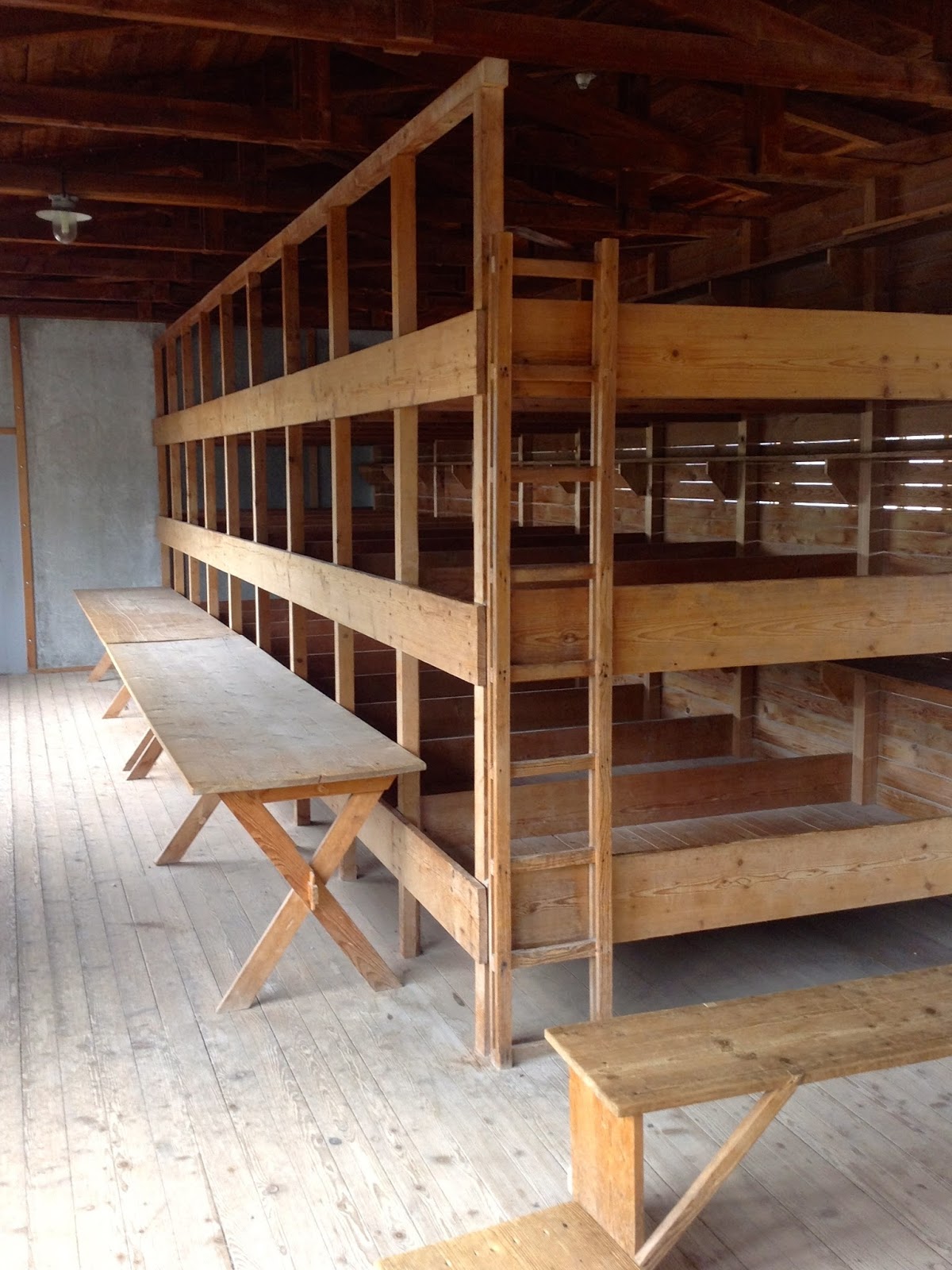
Reconstructed barracks.
Originally the camp had 40 barracks, each constructed to hold 200 men. At the camp's highest occupancy, there were up to 2,000 men squashed into any one barracks. Walking through the two reconstructed barracks at the south end of the site, it is unthinkable that that many men could be packed into the bunks inside. Different types of bunks are depicted in the two barracks and none of them seems any better than the other. I can't imagine how awful it was to be kept here. In many ways it is remarkable that the prisoners didn't rise up against the guards. I guess there was true belief despite all that was happening around them that the intent was not to work everyone to death.

After passing through the barracks, you are faced with the foundations of 38 other housing units, each numbered to seemingly remind you of how many there were and how many men were kept here, divided by an allée of beautiful poplar trees, who were witness to such cruelty for the first years of their lives. It's a long walk and that walk makes you think even more about the hell that the people here must have endured.

The path then directs you to the west, through the barbed wire fence atop the deep perimeter ditch and to the crematorium. As amazing as it sounds, the crematorium initially in and of itself was not that difficult to visit. This was the place where the bodies were burned, not where people died. But once you get to the gas chamber, it's absolutely incomprehensible why man would want to do this to another man. I've read and seen stories of the Nazis building gas chambers to look like showers so I expected the "shower heads" above me as I passed through the space. But the attention to detail was absolutely disgusting. There are drains in the floor which serve no purpose since no liquid would ever pass through there. It was literally one of the most horrifying spaces I have ever been in. It was never used at Dachau and that's little comfort to me. It was designed to be used. That's enough.

As if the gas chamber weren't enough, the path from the crematorium takes you past the shooting range, where the guards used prisoners as practice. For me the fact that the gas chambers were never used mattered when I got to this place. People were gunned down here for sport by men. It was truly sickening.

Looking south between the poplars to the administration building.
I can't imagine how the German people come to terms with what their ancestors have done in this place and the guilt about what happened here is obvious. After the war, the barracks were used to house refugees until 1965. Only in the 1970s did Germany start to make any effort to recount what happened here. There is so much here that is new or recently discovered, from memorial chapels and sculptures to roads and guardhouse foundations recently unearthed. It is patently obvious that this history has been avoided in some measure. Thank God it appears there is progress being made.

Dachau is perhaps the worst place I have ever been on vacation. Despite that I suggest you go if you ever find yourself in Munich. The world needs visitors to see and remember what happened here. The main gate to the camp features the words "arbeit macht frei" which loosely translated means "work shall set you free." It's horrifying to think that whoever hung that gate honestly believed those words.

Four days after our visit to Dachau, we visited the Berchtesgaden region. Our agenda for the day featured a boat ride in the gorgeous Berchtesgaden National Park in the morning and then a trip up into the Alps to visit the Kehlsteinhaus in the afternoon.

The Kehlsteinhaus, or Eagle's Nest, was built as a gift for Adolf Hitler's 50th birthday. It is a diplomatic entertainment spot designed to show the benevolence and love for nature demonstrated by the Nazi party. It was built in just 13 months, an incredible feat considering it is sitting on top of a mountain accessible by a one way road (which had to be built before construction on the building could be started) and a gold plated elevator built into the heart of the mountain. This place is clearly a demonstration of what the Nazis could build if they set their mind to it. 


When I was planning this trip to Germany, I knew I wanted to visit the Eagle's Nest. Quite honestly, I expected the place to be a typical wooden chalet like the kinds you imagine exist in the Alps. Indeed, the trip south to the Berchtesgaden takes you by a number of picturesque chalets. But the Eagle's Nest is nothing like that. It is an ashlar masonry structure with (appropriately enough I guess) very little warmth whatsoever.

It honestly feels like an executive conference center which I guess in many ways it absolutely was. Other than its size (it's huge), it doesn't seem excessive at all. There are no Nazi motifs on the building or any sort of celebration of German power. Other than the fact that it is built on top of a mountain and you have to take a gold plated elevator to get there, it doesn't seem that impressive. I guess it would have in the first half of the 20th century.

Once you are on top of the mountain, the site is really amazing. It is not quite on the top of a mountain but the peak is just a short walk from the building. The views are incredible. It's difficult to imagine the type of men who built this place in a spot so beautiful.

While walking around the Eagle's Nest, I found myself torn about the continued existence of the place. This building and this site are reminders of Nazi power and excess and I would have no qualms about wiping it off the face of the Earth. I feel this is different than Dachau. A site like that needs to remain to remind us of what we should not become again. I don't feel the same way about the Eagle's Nest. On the other hand, there doesn't seem to be any purpose to razing it.

I do think there was an opportunity that was missed by the German government. The Eagle's Nest today is a tourist spot and a cafeteria style restaurant. The reasons why the building exists and what it symbolized are relegated to what used to be an outside porch type corridor, squirreled away off the main path of travel by the bathroom. I'd be much more accepting of keeping the place around if it was a museum to what the Nazis had done to the people of Germany and Europe, rather than as a beer and food place on top of a hill.


The Eagle's Nest is not an easy place to get to. From Salzburg, we took three buses there and three back (eight total with our trip to the Berchtesgaden National Park) in one day. I recommend you try though. Despite the sinister reason for it being there, the view is incredible.

It seems odd that I would devote two of my nine vacation days to these sites but I thought it was extremely important. Despite the reminders that these two places represent, we keep allowing dictators to persecute their own people. I guess we can't take on all the world's problems but it's awfully difficult standing by.

Sunday, August 18, 2013

Eight Things I Learned In Bavaria

Please please explain to me what this sign means. No playing soccer in the street next to your house with cars around?
Every time I travel outside the United States, I end up realizing that the rest of the world is not like it is at home. Not that I really ever forget that being an immigrant to this country myself but the history, culture, food and behaviors abroad can vary wildly from my sheltered little life close to the capital of one of the biggest and most prosperous nations on Earth.

In many ways I guess it's not just an international phenomenon. The same could be said for traveling in the United States itself; they don't do things in Texas or Boston or South Dakota like they do in Washington, D.C. And all of that is a good thing. Why bother traveling if everything were the same the world over?

Having said all that, I always travel with the particular biases I carry from the place where I live. No matter how savvy I think I am, I always learn something about or from the places I go. Some of the things I learn help me get around and will benefit me on future trips; some are refreshing; and some are just plain baffling or downright amusing. Here are eight things I learned in Bavaria.

1. Carry Cash
The United States is without question a credit driven nation. How else would most people in this country have all the great and glorious stuff they have without the power of credit card debt. On the contrary, cash is definitely king in Bavaria. The opportunities to pay with credit over there are few and far between. You have to carry cash pretty much wherever you go!

The best part of this cash first society for me is the waiters and waitresses in beer gardens and restaurants. When you pay, your cash is not taken to the register to make change. Each server carries a massive wallet full of all variety of Euros and Cents and makes change, seemingly for whatever sum you lay out, right at the table. It's thrilling and amazing. ATMs are plentiful. Hit one as soon as you land and you'll be OK.

Wild boar sausages over potatoes in Salzburg. Lots and lots of sausages. Yummy!
2. Where's The Bacon?
For all the pork I ate in Germany and Austria (mostly in sausage form), I didn't eat a single solitary piece of bacon. And it wasn't by choice because let's face it, no way would I actually voluntarily opt out of eating bacon. I mean, who would? And it's not like we didn't look either. Our last hotel had an incredible breakfast buffet with cereal, eggs, croissants, jam, yogurt, ham, salami, herring (yes, herring), cheese and pretty much everything else you could want for the first meal of the day except, that's right you guessed it, bacon.

Now this would be just unthinkable in the United States but, again, that's why we travel. I guess I can exist for nine days without bacon if I can get the incredible sausages they have over in Bavaria. Just for nine days though.

3. Google Translate Really Works
While I was planning our trip to Bavaria at nights, on weekends and the occasional lunchtime at work, I found a lot of websites (particularly in Germany) that did not offer English translations which I found annoying for a while until I turned to Google Translate. This tool is absolutely amazing. Other than a few words here and there, I found it to be mostly foolproof.

And it really helped with non-English menus (ran into one of those here and there) to determine what exactly we were ordering before something showed up in front of us. I wanted to make damn sure we didn't end up with cow's brains like Brenda and Donna when they went to Paris on Beverly Hills 90210 so I used it religiously in those situations. It's always fascinating to consider what sort of vocabulary I come back with from foreign speaking countries. My Finnish vocabulary from my trip in 2000 consists of hei (hello) and kittos (thank you). Thanks to Google Translate, I know how to say whipped cream (schlagobers) and trout (forellen) in German but I have no idea how to say please.

4. Advance Planning Pays Off
I'm a big believer in advance planning. If there's one thing I've never been accused of, it's not putting enough thought into a trip in advance. I usually know what's important to see; exactly how to get everywhere I need to go; and when museums and other attractions are open and not open.

Having said that, there were some situations in Bavaria where I would have benefited from planning at home before landing in Germany. The train schedules and ticket options are a lot clearer on the Deutsche Bahn website than they are on the ticket machines in the stations. We bought tickets to Hohenschwangau before we got to Germany and saved a ton of money; by contrast, misunderstanding the ticket machines cost us about 30 extra Euros each to get to Salzburg and back.

I also wish we had dug into the bus websites a little more to know that day passes are available which can save a lot of money and time. Fortune favors the prepared mind!


5. Germans Love Long Words
If there's one thing that astonished us about the German language, it was the length of the words. Some words seem to be nouns appended by adjective after adjective which end up in multi-multi syllabic nightmares. I ordered one meal called fleischpflanzerlschmaus which somehow means beef croquette with mushroom sauce and cheese spaetzle. Delicious by the way!

I think the longest words we found on our trip were 27 letters long. The word above (one of the 27 letter words we found) means tax advice firm, although Google Translate doesn't know that (I said "mostly foolproof"). The upside of long words is sentences with few words. I guess it doesn't help if you can't pronounce the words though.

6. Bus Drivers Make Change
The first couple of days of our trip to Bavaria were spent hoarding Cents and Euros so we would have exact change for all the bus rides we needed to take. We religiously paid with large bills for small transactions so we could accumulate massive pocketfuls of change. When buses approached, we swapped and pooled money so we would each have the exact fare and wouldn't overspend. That's the way Metro works in D.C. Why would we think anything different?

Eventually a few days into the trip we got to a situation where we just didn't have the right change and were forced to plop way more than the fare down in the tray in front of the bus driver, feeling foolish that we were overpaying for a bus ride and we hadn't managed to successfully manage our group coin pot. Then something amazing happened: he made change for our bills and it changed our world. Apparently we learned nothing from the number 1 above. Can't see Metro adopting this. Thank God for SmarTrip.

House next to a tree this way? Anybody got any better meanings for this?
7. I Don't Understand German Street Signs
I love signs. Advertisements, wayfinding signs, neon signs, whatever. You name a type of sign and odds are I love it. One of my favorite types of signs are street signs. They are absolutely essential to the driver and pedestrian alike. I find it amazing the kinds of messages that can be conveyed using pictograms and a few words or no words at all.

European signs are often very different from signs in the United States and sometimes take a bit of time to understand their exact meaning. The sign at the top of this post makes no sense unless you understand there's a version of the sign without the red line through it. I believe it's telling you when you can and cannot let your kids play in the street. Despite my best deductive reasoning, there were a few signs in Bavaria that I just didn't get. I can't for the life of me figure out what the sign above means, which we found near a bus stop in Salzburg. The only meaning I can ascribe is that there's a tree next to a building to the left. I cannot figure out why I would care. Can anyone help me out here?

8. Schedules Work
If there's one stereotype of the German and Austrian people that I had before heading overseas this summer, it's that things would run on schedule. Our travel plans on some days in fact counted on it. We worked out day trips where trains or buses leaving early or late would have been major inconveniences. One day, we had to take eight buses to get from place to place.

And do they ever. I think just about every train or bus we waited for came at the appointed time (except of course when I was trying to recover my iPad and depending on a bus to get me back to the hotel for checkout time - hitchhiking works in Germany, although that's not a lesson I'm willing to post as learned). If I'm waiting for a Metro bus in D.C., I know I just have to wait until it decides to get there. It could be early or late or buses 20 minutes apart may arrive five minutes after each other. But Bavarian transportation is clearly different. I spent a lot of time on the Regionalverker Oberbayern website before leaving the United States looking for bus schedules to shore up our plans and it definitely paid off huge. The website, by the way, is not in English. See number 3 above for help.