Showing posts with label Venice. Show all posts

Friday, May 29, 2020

The Archives


Any post on this blog that starts with a closeup of a glass of beer has to be a good post. This is certainly not the first and likely won't be the last post that's started that way. Shocker, I know! This delicious pint of Fuller's Black Cab Stout in the matching glass (the way it's supposed to come) was captured on film (or maybe not film, exactly)  and then downed lovingly at The Hydrant pub in London right near The Monument in 2016. Yummy! Give me English beer over any other nation's beer any day!

It's now been more than nine weeks since my cancelled trip to Costa Rica was due to depart but didn't, a casualty of the global pandemic we now still find ourselves in more than two months after I was supposed to board a southbound flight at Dulles Airport. Last week, I cancelled my second trip of 2020, a long weekend in New Mexico visiting a site that I should have visited 19 years ago but which I missed because I just didn't get how big the Land of Enchantment is. Go figure! I guess now it's going to be 20 years at least.

Since I've been grounded, I've been combing through my picture archives from the last almost seven years that I've been traveling in a deliberate way and writing about it in this blog. I thought it might give me some hope for the day I can go somewhere new on this rock of ours if I posted some pictures of a great past memory. I've been doing that on Twitter every day since March 26, the day I was supposed to go to Costa Rica. As of today, I'm up to day 65. I'm going to keep going until I take my next trip, whenever and wherever that might be.

Some of the pictures I've posted over the last couple of months have appeared on this blog. Others have not. For whatever reason, they ended up on the cutting room floor, likely because I either elected not to write about that day or moment in time that I took the picture or just couldn't find a way to work them into a post. I miss writing about traveling, so for this post (and since I'm not going anywhere right now), I thought I'd write a few words about some of the photographs I've unearthed this spring. They are presented in the order I tweeted them. And, no, I'm not covering all 65 days.


Hawaii (2016)
One of the most disappointing experiences we've had over the last seven years was in Hawaii. I know, right? Who'd have thought? I sound completely spoiled. But it's true. 

We decided to spend the better part of one of our days on the island of Maui in February of 2016 by driving from Kahului to Hana on a road appropriately named the Road to Hana. It's a twisty, turny highway right along the ocean front with tons of pullouts and scenic views and secluded hikes to waterfalls along the way. It sounded cool as hell, especially when we had rented a Jeep Wrangler to get there.

It sucked. Honestly for us it was almost a complete waste of time. Sure we enjoyed a hike into the woods but other than that it was literally just a drive to a hardware store. A long, long drive to a hardware store. And I really do mean a hardware store. That's what's at the end of the road. Seriously. And nothing else. We got there, were supremely disappointed and headed back, without stops on the return journey.

So why am I reminiscing about a day that was almost a complete waste of time? Because "almost" is the key word. Along the way we stopped at Aunty Sandy's, a roadside stand selling hot, fresh banana bread, for breakfast. We walked down to the ocean and sat while we ate our loaf of banana bread and looked out at the view above. If there's ever been a breakfast I've eaten with a better view, I can't remember it. We were literally in paradise. We got nothing out of that drive except that view. And ultimately, that was enough because I'm remembering it four years later.


Venice (2015)
If there's something every first time tourist has to do in Venice, it's take a gondola ride along the Grand Canal. Sure it's overpriced, too short and a little cheesy. A complete tourist trap in other words. We did it anyway. How could we not? The Grand Canal is one of the great boulevards in Europe, albeit the only one made out of water. We have a picture in our house of us in the gondola with our gondolier smiling giving us two thumbs up after our ride. It was completely awesome, despite the fact that it's a total tourist trap.

When I was paging through my old directories of past trips, I found the picture above, which shows a series of gondolas in the foreground and Andrea Palladio's San Giorgio Maggiore church in the background across the water. For me, that church and those boats bring me back to Venice instantly. They are enduring symbols of that city. To find a picture with both in them at once brought back the three days we spent there in vivid detail. This photograph must have been taken late in the day because the gondolas are closed up for the day and the sun is hitting the west side of the church as it is setting.

I loved Venice. I thought it would be flooded and overcrowded with both tourists and pigeons. It was none of those things. I could have spent a week or more just wandering around the canals and streets of this place. It's definitely on the would love to go back list. But then again, so are a lot of places.


Brú na Bóinne, Ireland (2019)
Every so often I write almost an entire blog post about a place and then discard it. My post about Brú na Bóinne from the end of last year is the latest one of these posts to be started and never see the light of day. Sometimes I lose inspiration about a post or can't find enough to say or am just forcing things and decide to give up rather than completing something that's not worth the time and effort. With Brú na Bóinne, it just came down to not many interesting photographs. 

I've been to some pretty ancient places over the last seven years or so. Prehistoric petroglyphs in the American southwest. All sorts of Roman ruins. Stonehenge. Machu Picchu. I never would have thought the most ancient site with construction at the hand of man would be in Ireland but Brú na Bóinne beats all those other places handily in the age department. 

What we saw that day in the Irish countryside was a passage tomb, a stone structure beneath a mound of earth that's stood in place for 3,200 years. Stepping inside this place and hearing our guide talk about the history of the place and its relationship to the solstices was just amazing. The amount of labor that must have gone into putting this place together so precisely must have been staggering.

I love this picture as a reminder of what we experienced that day but I also love it because it's about the most green photograph I've ever taken in my life. It's perfect as a memento of Ireland which shone so brightly on some days and disappointed us so badly on others. A day at Brú na Bóinne was not one of the disappointing days.


Mount Fuji, Japan (2017)
When I first made my list of must sees for my one and only (so far) trip to Japan, it needed some serious editing. There's often a dilemma with me between getting into one spot in a country super deep vs. moving around and seeing a lot at the risk of spreading myself too thin. In the end, I think I sort of split the baby on Japan. Mount Fuji made the initial list and survived the cut down.

There's not much to a visit to Mount Fuji unless you are intending to take a hike right to the summit, which in mid-May we weren't planning doing. We hopped on a bus for an hour or two and got dropped off about halfway up the slope on the north side. There's a store and some food vendors and (of course) a Shinto shrine but not much else. You just sort of do what you can until the next bus shows up to take you home or wherever the next stop is that you have a ticket for.

But there's something about Fuji. It's a picture perfect single volcanic peak and its shape couldn't be a more idealized cone shape. It's like a cartoon image but its presence and meaning in the lives of the Japanese is huge. It was important to me to stand on the mountain on my first visit to Japan. So we did. 

The day we were there it was about impossible to photograph the mountain either because of the cloud cover or we weren't standing in the right spot or there was some object or human in the way. This picture is my favorite of the day, taken from the front steps of the Komitake Shrine where I purchased what is now my niece's goshuin-cho and then half filled it with goshuin, the calligraphy and temple seal artworks that you can collect from each temple or shrine you visit in the country. To me, this picture reminds me of how cold and isolated and spiritual it was on Fuji and it also shows off the peak of the mountain which I love.

I can almost guarantee the reason why this picture hasn't appeared on this blog before this post is that it has a portrait orientation and plain and simple I usually use landscape orientation or square photographs in this blog. Today, that doesn't matter.


Roosevelt Island, New York City (2019)
I am pretty sure without really checking too closely that I've visited New York City more than any other destination in the past seven years. I don't think there's really any need to check. I just know it's true. Despite all the time I've spent in the Big Apple, I've only written one post about my experiences there, a 2015 visit to the Statue of Liberty's crown.

The reason for this is simple: we are usually in New York to do the same things we love doing over and over again and by that I mean Broadway shows, trips to Kalustyan's to stock up on spices and chutney and our new tradition of dinners of chicken skewers at the excellent, excellent Tori Shin restaurant in Hell's Kitchen. Simply put...New York is where we would live if we could afford to live in the manner we want to live there. We can't. So we don't.

Every so often I do something in New York that approaches post-worthy status. My trip to Roosevelt Island in the middle of the East River last year almost made it. As many times as I've been to New York, I'd never been there before last summer to see the ruins of the old smallpox hospital and Louis Kahn's Four Freedoms State Park, which was executed posthumously (and therefore in my opinion not the way Kahn would have done it; the great architects always tweak during construction). It's totally worth a trip.

One of the best parts of this day was getting to the island, which can be visited by bus, Subway or ferry. Or you can take the tram, which takes you above the city from 2nd Avenue to the middle of the East River. You'll get some killer views of the City as you ride alongside the Queensboro Bridge for the low, low price of a Subway ride. The picture above shows the tram approaching the Roosevelt Island terminal. Do this if you are in New York, even if you turn right back around and go back to Manhattan.


Ollantaytambo, Peru (2019)
Last year we spent about a week deep in the heart of the Andes exploring the cities and towns and citadels of the Incan Empire. Our trip took us from Lima on the coast of Peru up to the Incan capital of Cusco and then over to a spot where we hiked for a day to the royal retreat called Machu Picchu.

When the Spanish conquistadors "discovered" the Incan Empire in 1526, they took what they wanted almost from day one. The Incas proved no match for the Spanish from the very first engagement although it was really the horses that they couldn't compete with. A man who has never seen a horse before in his life is no match for a trained and heavily armed soldier on the back of a 2,000 pound animal. Almost every engagement the Spanish had with the native Peruvians resulted in a victory for the Europeans except one: Manco Inca's stand at Ollantaytambo, a fortified hilltop between Cusco and Machu Picchu.

Today Ollantaytambo is one of many sites with ruined but mostly intact Incan masonry structures, a testament to the timeless quality of Incan construction. And like some of those other sites, the remains of building at Ollantayambo are in what seem like the most remote and most inaccessible locations you can possibly imagine. 

This photograph of some abandoned grain warehouses is my favorite of our partial day stop in town. I appreciate the way these old buildings are just clinging to the most precarious of slopes and blend in perfectly with the mountainside. We didn't have time that day to explore these ruins but I got as far as I reasonably thought I could from our tour group to get a picture I thought I'd be happy with. And I am.


Kyoto, Japan (2017)
I know, I know, I already put a picture of Japan on this post. What can I say? Japan was simply one of the most amazing places I've ever been. I can't wait to go back. And yes, it's ahead of Venice. Way ahead.

It's difficult to describe all the ways I love Japan from my week and a half or so there in 2017. It's a place with so many details. Tradition. Respect. Humility. Incredible food. Gorgeous nature. Spiritualism. Cutting edge modern anything. Boozy late nights of karaoke. The markets. The temples. The bars. Cleanliness. Order. Speed. Crowds. There are so many sights and smells and tastes and sounds to take in.

As we walked around Kyoto, which is the traditional capital of shogun-era Japan, I couldn't help but notice these red paper lanterns with birds on them. They seemed to be everywhere in that city as we roamed the streets and alleys in search of geishas or gyoza or street markets or temples. I took this picture because I wanted to find one of these lanterns in a store and bring it back and hang it in our home. We never found a paper lantern store. But this is still one of my favorite details of Kyoto.


Serengeti National Park, Tanzania (2018)
We've been fortunate in the last five years to have taken two safari trips to sub-Saharan Africa. We spent less than a week in primarily Zimbabwe and Botswana in 2015 to get our feet wet and then really did it right a couple of years ago by spending a week each in Kenya and Tanzania. The diversity of wildlife and the almost completely untouched environment is like no other place on Earth I've been.

In 2015 we didn't know what to expect. We were happy to see anything that we'd only ever previously seen in a zoo somewhere. Fortunately, elephants, hippos and lions featured heavily. In 2018, I went with a top 10 list of species that we hadn't been able to find on our first trip. I think we got seven of the ten. Maybe eight.

Never in my wildest imaginings would I have expected to find the birds in Kenya and Tanzania to be one of the more fascinating aspects of that trip. I've never been much of a birds guy (ostriches and storks and things like that don't really count here) but those two weeks in eastern Africa, particularly at Lake Manyara and Serengeti National Park, really opened my eyes and I fell in love. Who knew lilac-breasted rollers and carmine bee-eaters could be so interesting? The picture above shows four superb starlings. I love how the colors pop against the thorny gray tree (always with the thorns in Africa...) they are roosting in and I love that I got a group of four all in one shot. I have no idea how this didn't make my Serengeti post. Too focused on the wildebeest and zebras in that location I guess.

One day soon, I'm hoping that I'll be writing again about some new places I've visited. I have to find a way to do some low risk traveling sometime in the next three months and hopefully I won't be cancelling any more flights or hotels. I'll leave this post with a black-backed jackal at Lake Nakuru in Kenya. Haven't posted this one to Twitter yet but I'm sure it's going to be there if this thing goes on long enough. Stay safe out there.

Tuesday, June 23, 2015

In The Ghetto


Following a couple of hours train journey from Florence, a 30 minute or so trip down the Grand Canal on the Vaporetto No. 2 and about another half hour walk over three bridges and the paved streets in between, we finally hung a left and found our Venetian hotel. After we dragged our luggage through the front door and checked in, we were handed a map of Venice and given a quick orientation to the city by our hotel clerk opening up the map and drawing lines, scribbling words and circling the sights that he thought we might want to take in while we were in the city.

I'm sure this is not an uncommon exercise; I'd be willing to bet the staff at our hotel and pretty much every other hotel in the city does the same thing for each new guest. Indeed, I'm sure this happens in most all vacation spots in Europe. There must be tons of maps with the Rialto Bridge, Piazza San Marco and the Peggy Guggenheim Collection handed to tourists every single day in Venice. And I'm sure it helps a ton of people immeasurably.

I think the guys at our front desk did a pretty good job hitting the high points, but they missed one spot in the Cannaregio sestieri in the northwest corner of the city that there was no way I was going to miss: the Venetian ghetto. Yep, you read that right. A can't miss spot for me in an historic city in Italy was the ghetto. Read on. It will make more sense. I promise.

If you had asked me a year ago what the word "ghetto" meant to me, I would likely have described an impoverished, crime-ridden area of some United States city in the 1960s or 1970s where the poverty cycle kept generation after generation of families all but imprisoned by an economic system which they could not escape or conquer. I'd have seen images of people of African or Latin descent in housing projects which are dangerous to the point of deadly for most all of the people who are forced to live there. Most importantly, the association of that word would have been strictly American.

Today, it is not. Today, it's all about Venice. In fact, if it wasn't for Venice, we probably wouldn't have ghettos at all. Don't get me wrong, we'd still have dirt poor areas of cities and countries where the people with money herd all the people who are different from them. We just might not call it a ghetto. I learned that from Venice, while also being reminded again of how hateful and cruel the people running things can be towards those who are not them. I think it's important we continue to talk about this issue and so the ghetto gets a post all to itself.


Long long before white settlers in what is now North America were driving native populations from the lands they had hunted or farmed for generations and a couple of centuries before wealthy mostly southern white plantation owners started buying humans from slave traders to tend their fields in exchange for inhumane treatment and the possibility of no freedom ever, people in power all over the rest of the world were engaged in discrimination and persecution of ethnic, religious and racial groups that were different from them. It has been going on since the beginning of time and it's still going on today all over the world. Yes, even here in the land of the free and home of the brave.

During the early days of the Roman Empire, just after the B.C./A.D. turnover, one of the most persecuted peoples in what is now Italy were those folks identifying themselves as Christians. This new religion, whose followers strangely worshipped only one god, rejected things like sacrifice as a means of pleasing the gods and insisted on burying, rather than cremating, their dead scared the Romans. So they made sure to pass laws forbidding the practice of Christianity. Sometimes they did more than just pass laws; they killed the people for their faith. The first five to six hundred years of the Empire were tough centuries to be a Christian in Europe.

But then something fortunate happened: the emperor Constantine decided to convert to Christianity and directed the rest of the Empire to do likewise. While I'm sure things didn't change overnight, the Christians were now running the show so to speak. And now that they were no longer being officially picked on for their religious practices, and apparently forgetting how much they disliked being discriminated against, they started looking about for a group of people to persecute; to take their former place if you will. They picked the Jews.

The story of discrimination against Jewish people in Europe varies from country to country from century to century but there's one thing for certain: it happened a lot and it happened everywhere. And don't think it isn't happening today since World War II. It is. The story of Venice's persecution of Jews is told today each day week and year by the Museo Ebraico (or Jewish Museum) which is located right in the heart of the Venetian ghetto, the spot the guy at our hotel front desk didn't circle when we checked in. In our first full day in the city, we started out early to discover this history for ourselves.

The walk from our hotel to the ghetto was a good 30 to 40 minutes, depending on the pace of our walk and how often we got lost. I came to Venice armed with large scale printouts of maps from Google Maps with every street identified. Add to those maps my free front desk map and I figured I was set. Yeah, not so much. I don't think I even got maybe one or two islands away from our hotel before I was a little lost. But the sun was shining and I didn't get turned around too badly so I was able to make my way generally north and west until I found a street in person that appeared on my maps. From there it was pretty easy. We'd allowed some float in our schedule and rolled in to the center of the ghetto about when we planned to.

The final bridge we crossed before arriving at the ghetto nuovo.
Venice was founded sometime in the 400s when people fleeing the invading Huns and Germanic tribes began hiding out in the many islands in the Venetian Lagoon. A couple of hundred years later, the wealthy merchants in the city formed a system of government made up of elected councils and a doge, or nobleman leader, which would form the basis of ruling the city for 1,100 years, from 697 to 1797. Under the leadership of the doges, the city became wealthy and powerful. Yet until the year 1385, there were no Jews living within the city of Venice.

That is not to say that there were no Jews in Venice before 1385. There were. They just couldn't live there. The Christians in charge of Venice needed certain services that their faith somehow prevented them from performing so for these jobs, specifically money lending and selling of second hand goods, they turned to the Jews. These were two of the only three occupations Jews were allowed to hold. The other was as a doctor. I'm assuming they allowed Jewish doctors not because the bible forbids Christians to be doctors, but because they needed skilled people to keep them alive, and they didn't mind who did it as long as it worked. This is an unresearched off the cuff opinion but it seems right to me.

Then in 1385, three Jewish money lenders received authorization to live in Venice. A year later, there was a Jewish cemetery established within the city limits. It seemed like things were getting a little better, even if Jews were still forced to wear first an "O" on their clothing (up until 1496) then a beret (yellow until 1500; red thereafter) at all times to identify themselves while in the city. I can't really imagine what it would be like to be forced to wear an identification mark under penalty of fine in the city where I call home; maybe I'm kidding myself in writing that things were actually getting better. But there is no doubt there were more rights afforded to Jewish people between 1385 and 1515, even if those rights seem like basic things people everywhere should be entitled to.

Then on March 29, 1516, everything changed. The merchants who ruled Venice had been debating whether or not to permit Jews to remain as residents of the city. They decided not to expel the Jews, but instead resolved to confine them to an undesirable area of the city. They picked an island formerly used as a copper foundry which was abandoned in 1434 when the fire hazard was deemed too great and all operations were moved away from the city. The Italian word for foundry was geto sometimes spelled ghetto. The pronunciation of the word was "jet-o" but many of the Germanic Jews pronounced the word like we say ghetto today, because their natural tendency was to pronounce the word with a hard G sound. Just like that a legacy was born.

The specific resolution passed by the governors of Venice translates roughly as follows: "The Jews must all live together in the Corte de Case that are in the ghetto at San Girolamo; and so they do not move around at night…let two doors be built which are to be opened each morning at the Marangona and to be closed each night at 12 p.m. by four Christian guards…paid by the Jews at a fee deemed fair by our College." The Marangona refers to the bells of San Marco whose ringing marked the start of the working day. Just so that resolution is clear, not only did it confine all Jews in the city to a single island (later known as the ghetto nuovo because it was the site of one of the newer foundries in Venice) but it required that doors be installed which would be locked each night by guards paid for by the people imprisoned there.  That is tough. Not only are you persecuted, but you are paying for the privilege of it.

Eventually the Jewish population in Venice got too big to stay on the one island allocated to them in 1516 and so they expanded to another former foundry location to the south (the ghetto vecchio) but the rules of confinement remained pretty much the same. In fact, while the tide of the kind of imprisonment imposed on them ebbed and flowed a little over the years, they never really enjoyed any substantial sort of freedom until 1797 when Napoleon Bonaparte invaded the city. If you are counting on a guy like Napoleon to increase your freedom, you know you have very little of it to begin with.

A seven story Venetian skyscraper in the ghetto vecchio. You won't find these any other place in Venice.
When we first arrived in the ghetto on a sunny Saturday morning this past April, the place looked so peaceful and picturesque. What we saw were well maintained, centuries old buildings sheltering an irregular shaped square that must have been the center of Jewish life for generations. What we didn't realize of course, but know now, is that the final bridge we walked over to get to the ghetto was one of the bridges closed at night to all traffic and guarded to keep the residents of the ghetto in the spot assigned to them. Pretty chilling.

What we didn't see from the spot where we entered the ghetto nuovo was any sign of a synagogue. To get a glimpse into religious life in the ghetto from 1516 on, we turned to the Museo Ebraico, which was a few paces away from where we entered the square. The Museo tells the story of Judaism in Venice in two ways: through a museum containing artifacts which interpret the history of life in the ghetto and through a one hour or so tour of some of the five ancient synagogues in the ghetto nuovo and the ghetto vecchio. On the way to and through these synagogues, you get a sense of what life must have been like and how the people there created community, learning and wealth in the city they were reluctantly permitted to occupy. The tour is why we came.

Our tour took us to three of the five synagogues total in the city: two in the ghetto nuovo and one in the ghetto vecchio. There are a total of three synagogues in the original ghetto and each was built by a different ethnic group. The German Synagogue was founded in 1529 and is the oldest of the three. The French, or Canton, Synagogue was started just two years later. The Italian Synagogue was the last of the three, being built in 1575. We managed to visit both the German and French Synagogues on our tour and each is an exquisite jewel box in its own way. The gold in the German and the gold and red in the French shine despite the lack of light coming through the shuttered windows in the exterior walls. We were not permitted to take photographs in any of the three spaces we visited so you'll have to live with my paltry description or go find what they look like online.

The darkness in these places is deliberate. Shuttering and hiding the synagogues was smart when the entirety of the city you lived in hated you for no good reason other than you practiced religion differently. While we didn't know it when we entered the main square of the ghetto nuovo, we could actually see all three synagogues. We just didn't know what to look for or where to look. 

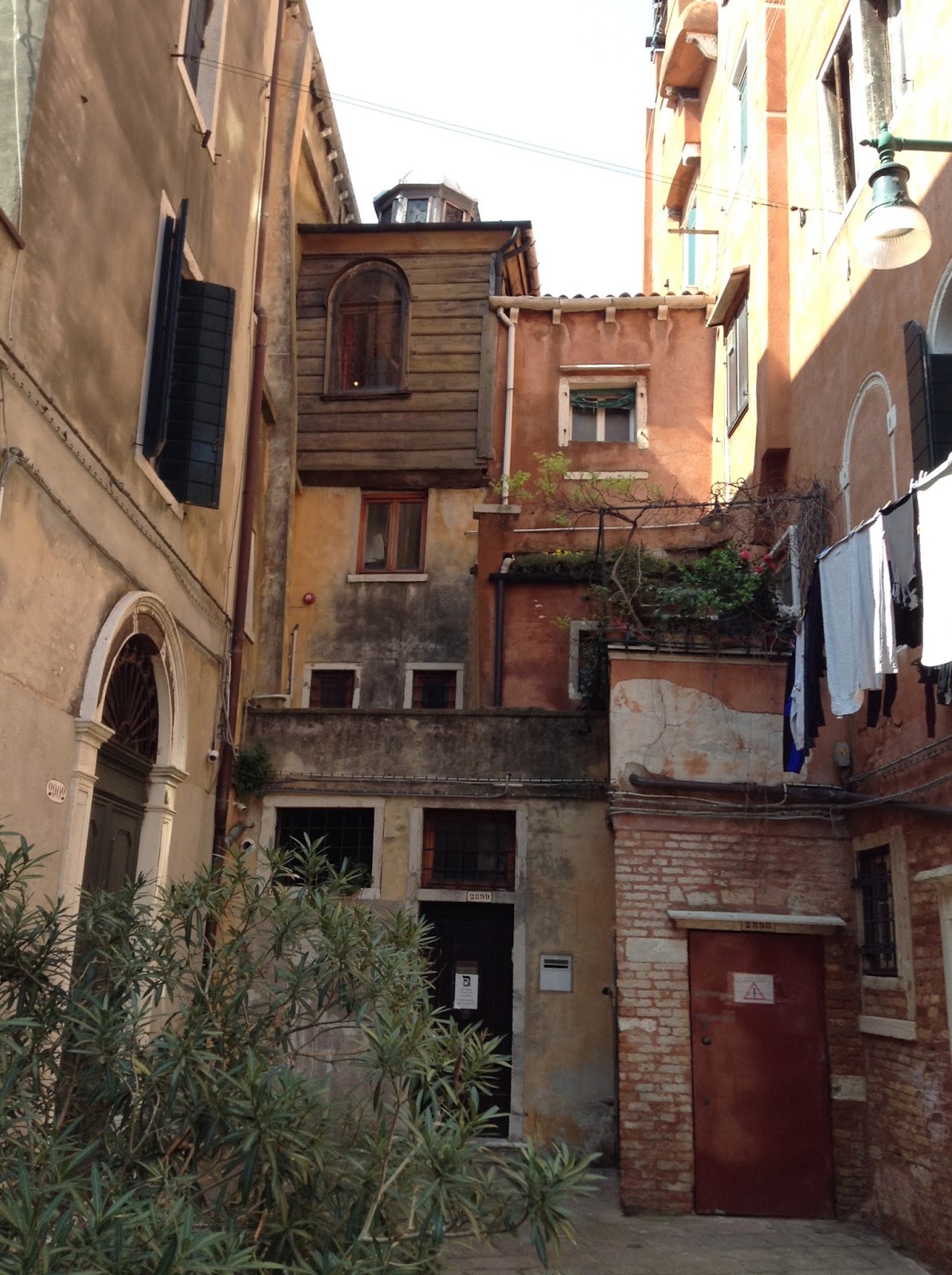
Because space was so tight on the island assigned to the Jews, there was not enough land  to place the synagogues on the ground because the land was needed for housing and their faith forbids living above a synagogue. Therefore they did the only logical thing they could: they built the synagogues as the top floor of their residential buildings. In the photograph at the top of this post, the German Synagogue occupies the fourth floor of the beige colored building just to the right of the red building on the far left. The French Synagogue is tucked into the recess just to the left of the red building with the green canopy in the center of the picture. And the Italian Synagogue is behind the five arched windows in the beige building to the right of the same green canopied building. The French Synagogue is also shown below.

The French Synagogue is the brown building with horizontal wood boards at the top of this photo.
After touring the two older synagogues, we made our way south to the ghetto vecchio, where the Levantine, Spanish and Portuguese Jews settled from their home countries and brought with them more money than most folks in the ghetto nuovo would ever possess  As a result, the two synagogues in this portion of the ghetto, the Levantine Synagogue (founded in 1541) and the Spanish Synagogue (founded in 1584) are larger and more luxuriously appointed. These people had money and felt it was important to spend it on their houses of worship.

The two synagogues in the ghetto vecchio are the only ones used for worship today. The Jewish community is so small that there is no need for multiple temples to operate so they just use the two largest. The Spanish synagogue is open in the summer and the Levantine in the winter. The tour run by the Museo takes you to whichever one is not in use at the season when you visit. We visited in the early spring and got to see the Levantine. The difference between this space and the two in the ghetto nuovo is striking. The German and French Synagogues look like they stretched every ducat; the spaces are rich but restrained. There is no such restraint in the Levantine; there's obviously been some money spent here. It doesn't even sit above any of the former residences.

On the way to the last two synagogues, we passed a number of what can only be referred to as high rise buildings. While not especially tall, the number of floors packed in to each building is astounding. What might be a four or five story building elsewhere in Venice turns into a seven story building in the ghetto. This construction speaks to the lack of space available to fit an enormous number of people and to the willingness of the Jewish community to take care of its people and make sure everyone was housed, even if it meant a little sacrifice.

Finally and extremely unfortunately, no discussion of Jewish history in Europe is complete without a mention of the Holocaust. The increase in freedom for the Jewish people in Venice as a result of Napoleon Bonaparte's conquest was short lived compared to their centuries of confinement. In the 1940s, Hitler and the Nazis were determined not to segregate the Jews but to exterminate them. Germany's occupation of Venice began in 1943 and deportations to Auschwitz followed in three waves. The last two deportations were the residents of the Jewish elderly home and the hospital which is just sickening. The names of all those deported and sent to death are in a memorial on the north wall of the main square of the ghetto nuovo. It all seems so pointless.

It may strike you as odd that I continue to visit sites which are less than uplifting on vacation. Two years ago, I spent a day at Dachau Concentration Camp in Germany and came across a story similar but ultimately way worse in its inhumanity than I found in the Venetian ghetto. I visit these sites not because they are fun but because I think it's important that we support and maintain the memory of what happened so that maybe, just maybe something quite like this never happens again. I am sure this is not the last unpleasant place I will visit on a vacation in my life. I think it is worth being a little uncomfortable to preserve these kind of memories.

Saturday, June 13, 2015

Vaporetto No. 2


Of all the places in Italy I visited this past April, I was most looking forward to getting to Venice. There is honestly no other place on Earth like this city for one simple reason: how you move around the city. There are no cars in Venice. There are no motorcycles in Venice. There aren't even any bicycles in Venice. Walking is OK; so is traveling on the water in some sort of craft. Literally the only way to get from point A to point B in Venice is by boat or on foot and you will likely go over or under four or more bridges to get to any one spot. It's been this way since it was founded in the fifth century and it isn't changing any time soon.

While there are no definitive records of Venice's origin as a city, it is generally accepted that people started settling there in a meaningful way during the early 400s as a means of escaping repeated waves of Germanic and Hun invaders on the Italian mainland. Hiding in the islands in the lagoon off the coast of what is now northern Italy provided protection for permanent residents in the area and eventually they started forming a council to govern the city which would end up in 697 appointing a doge or leader. The city of Venice would be governed by a council of the wealthy with an elected doge at their head until 1797 when Napoleon Bonaparte and his army conquered Venice.

Venice is made up of 117 individual islands grouped together into six areas or sestiere. Between each of the islands there is water which makes up the "streets" of the city and 409 bridges connect island to island so folks can get around on foot. On every island and over every bridge, there is an amazing city to discover which you can't find anywhere else. Not even at the Venetian hotel in Las Vegas, in case you were inclined to argue that point.

If the water in Venice is the street, Venice's main street is the Grand Canal. It's the widest, longest, most traveled and best appointed waterway in the city. Most all of the notable and fabulous bridges cross the Grand Canal; there are more gondoliers rowing passengers about the city on the Grand Canal; and all the most spectacular residences and commercial buildings face on to the Grand Canal. It is without question one of the premiere destinations in the city and as a first time visitor, I had taking a ride along the length of the Canal super high on my list. So high, in fact, that I ended up taking two.

Traveling down the Grand Canal is an education in most all things Venetian and is a great way to orient yourself to the city. Fortunately for the frugal tourist, Venice has public transportation which will take you down the entire length of the Canal for an extremely affordable price of seven Euros. When I think public transportation, I typically think of trains or buses; of course in Venice the public transportation are boats, or as they are called in Venice, Vaporettos.

Vaporetto Nos. 1 and 2 both travel from one end to the other of the Grand Canal. No. 1 is the slow boat, making multiple stops and taking about 45 minutes to an hour, depending on where you get on and off; No. 2 moves a little bit quicker, making the whole trip in about 30 minutes. My two trips along the Canal were both on Vaporetto No. 2. My first voyage was on a packed boat standing up in a dense crowd the whole way after getting off the train from Florence. The only thing I remember from that first trip was the wonder of finally being in Venice but mostly facing the wrong way so not being able to see much.

The second trip was way more enjoyable and we did it right. In most Vaporettos, there is an indoor seating area toward the back of the boat and an outdoor standing room only spot in the center where you better hang on if you are not used to traveling on boats even though the ride is relatively smooth. But the best spot to see the Grand Canal is at the front of the boat, in one of the seats right at the bow where you can see everything unobstructed. On my second trip, we managed to snag the two front seats on the port side of the boat. This is the way to see Venice.


This blog post is the story of a trip down the Grand Canal from Venice's train station (Ferrovia) to Piazza San Marco. I'm covering this part of Vaporetto No. 2's route for two reasons. First, it's the route we took to get to our hotel when we first got to Venice. And second, because on our second ride, I managed to slip into the front row when some other American tourists got off the boat to get to the train station. The second ride was way better.

Venice is in many ways a city of bridges and when you first embark on your No. 2 experience, you are likely staring straight at the Ponte degli Scalzi (translated as Bridge of the Barefoot Monks), one of only four bridges to span the Grand Canal. As bridges over the Grand Canal go, this is probably the least interesting. It was erected in 1934 to replace an iron bridge in the same spot. If it's interesting in any significant way, it's because it is one of only four things that does what it does. But it's great to see a bridge when you first get to Venice. You'll see two of the other three later on your ride.

If you look out of the back of the boat, you might catch a glimpse of the Ponte della Constituzione, the newest of the Grand Canal bridges. This bridge was designed by noted architect and structural engineer Santiago Calatrava, an architect who at one time was one of my absolute favorites. That bridge is generally reviled by residents of Venice, although I'm not sure I understand why from visiting it when I was in the city. I believe they dislike it so much because it's so different in a very visible spot.

I think Calatrava designed the thing intelligently, introducing a new bridge vocabulary into Venice with a curvilinear plan arrangement, glass railings and frosted glass walkways while respecting the proportions and materials used in other bridges in the city. I especially like the use of marble nosings on the stairs of the bridge to match many many other older bridges  Having said all that, I think there are problems with it. Some of the glass walkway panels were covered over (presumably broken) and the bridge swayed a little, which is never a good thing for a bridge to do in a noticeable way.


Pass under the Ponte degli Scalzi and you are now in Venice proper. This is what I wanted to see: centuries old buildings sitting right on the water, some with docks right at the spot where the water meets the buildings. There is nowhere else that you can get this sort of experience and it's what I came all the way to northern Italy to see. I wouldn't have missed this for the world.

Other than the types of boats on the water and the prominent tower crane almost dead center of the picture, I imagine the view shown above is just as Venice would have looked centuries ago when the Doges were in power supported by the Great Council and the safety of the city was ensured by the Council of Ten. While I'm sure life in Venice 800 or so years ago was a day to day search for survival for most people, especially when things like the Bubonic Plague or Black Death came to town (which it did brutally in Venice a few times), it all sounds so idyllic and romantic.  You can even see the spire of the Campanile of Basilica San Marco just to the right of the tower crane.


Turn the corner of the Canal and you will get your first look at the Ponte di Rialto. It is the oldest bridge that spans the Grand Canal, completed in 1591. It was designed by Antonio da Ponte (appropriately enough) and is named after the Rialto market that is just at the south end of the bridge. The Ponte di Rialto is extremely wide; there is actually a series of shops along the center of the bridge with a pedestrian walkway on either side.

This is not the original bridge on this site. It's actually the third such structure built by the Venetians. The first was a pontoon bridge built in the late 12th century. The Rialto market developed after the bridge was installed to such an extent that foot traffic proved too great for the temporary bridge to sustain so it was replaced with a wooden bridge in 1255. After that bridge collapsed under the weight of the crowd standing on it in 1444, a stone bridge was proposed and rejected. Only after the bridge collapsed a second time in 1524 was the current design executed.

The Ponte di Rialto is a must see in Venice. It's crowded and some folks are there just to see or walk over the bridge itself. If you go just to see the bridge it's worth it. This is the oldest famous bridge in the city. Don't miss it. The market on the south side has some amazing looking pasta and other foods.


After you pass under the Ponte di Rialto, you are into heavy gondola territory. These are the long flat-bottomed boats that you see being rowed about pretty much every canal in Venice. They are there now strictly to cater to the tourist industry. There is no point taking a gondola for a ride if you are looking for the fastest way to get anywhere in the city.

Taking a gondola ride ain't cheap but if you come to Venice for the first time and don't take a ride in one, then you either can't afford it or are sort of missing part of the point of being in Venice. 30 minutes is going to cost you a cool 80 Euros, and that's without musical accompaniment which is typically available at an additional cost of something I didn't even consider when I was in town. Don't bother arguing about the price; it's all fixed. If you can pile a bunch of people into the boat then good for you; the price won't change. Although I assume that is a bit less romantic.

We took our one obligatory gondola ride starting just to the east of the Ponte di Rialto. We went up the Grand Canal and down some side canals to get back to where we started. The ride is honestly not going to get you to see much more of Venice than you can see on your own but just to say you've taken a gondola ride in Venice was important to me. And I think we got a good gondolier. He gave us some good tidbits about the history of the city, we got to understand a little more about life there from talking with him and we even got some serenading for free as he broke into song on the way back to the dock. Two enthusiastic thumbs way up. I won't do it again, but I wouldn't have wanted to miss it for anything.


After passing under the Ponte di Rialto, you also start to see some classic Venetian Gothic architecture. This style of architecture is characterized by the traditional Gothic pointed arch and quatrefoil openings above. It is a style which merges European Gothic architecture with Byzantine and Moorish influences which represents how cosmopolitan and powerful the city of Venice was in the 14th and 15th centuries.

Venice during the late middle ages was truly a power to be reckoned with. It was a city of water in an age when exploration and trade by sea made cities, nations and city-states extremely powerful. And its connections with Constantinople and trade routes to the east only enhanced its wealth. The height of Venetian Gothic architecture can be seen in the Palazzo Ducale or Doge's Palace right on Piazza San Marco. You'll get there if you ride Vaporetto No. 2 to the S. Marco stop. You are not going to see this kind of architecture anywhere but Venice. At least not done this well.


Next up: the Ponte dell'Accademia, the third bridge of the ride and the last you will pass under on the Grand Canal. This bridge holds a special place in my heart because I built a model of it during my senior year in college as part of a group site model for a design project. My chipboard probably 1/16"=1'-0" scale version of the bridge looked approximately but not really like the real thing but I loved it. I loved it more than my own design project that I placed on the imaginary vacant site next to the bridge. If there's another bridge I've longed to see in person for over 25 years, I'm not sure what it is.

The current Ponte dell'Accademia is relatively new, built in 1985, just five years before my cardboard version was built in Ann Arbor, Michigan. It is named after the Galerie dell'Accademia, one of Venice's most famous museums. It is the third such bridge erected at this location. The current version replaced an almost identical but not as sturdy version placed there in 1933; that bridge replaced the original 1854 steel structure.

The Ponte dell'Accademia is built out of wood, which is comforting in an age when we rarely turn to wood to span bodies of water as large as the Grand Canal. Wooden bridges, like wooden roller coasters, are throwbacks to the way we used to do things. They are softer and more natural than stone, steel or concrete. It's good to use wood every once in a while. I love this bridge, even more now I had walked across it several times. I wish they didn't have to hang a banner right in the center of it.


After the Ponte dell'Accademia, you are in the home stretch distance wise but there is so much incredible stuff to see from this point forward. The first thing you see when you pass under the bridge is the dome of Santa Maria della Salute. This is the church that I most associate with Venice because it's in all the famous 18th and 19th century paintings of Venice, including those by Canaletto and Joseph Mallord William Turner.

There are a lot of churches in Venice. Like a ton. Everywhere you turn you seem to see another. We visited six or eight in our three days there and even heard a Vivaldi recital in one. If you told me there were more than 100 I wouldn't be surprised. But for me, the two best are the Salute and the one you are going to see traveling down the Grand Canal when you start to enter the lagoon. Just hold tight on that one right now.

Santa Maria della Salute was commissioned as a response or solution (depending on how you view it) to the latest invasion of the Bubonic Plague into Venice in 1630. The church is dedicated to the Virgin Mary and based on on how deep your faith goes I suppose, you will likely believe that it saved the city from the Black Death or did absolutely nothing or anywhere in between. Nonetheless, the city is blessed with a church that is an unremovable fixture in the city. It was completed in 1681, a year without any sort of plague in Venice. Take that as you will.


Just beyond the point where you first see the Salute, there is a palazzo on the right of the Canal which is decorated with scenes made up primarily of gold mosaic tiles.  The effect is brilliant and honestly sort of astonishing that it's still intact. I have no idea how long this display has been in place but it is reminiscent of the gold mosaic tiles in the Basilica San Marco at the east end of Piazza San Marco, which is at the end of this ride.

If there was a place I thought was a check the box exercise in Venice that truly amazed me, it was the Basilica San Marco. I mean it's just a church with some mosaics inside. But the brilliance of the artwork made up of all those tiny tiles is impressive. And you know as old as it is the only way they could make gold color back then was to use actual gold. Go see it. It's free and it's totally worth it. With the money you have saved on admission, maybe you can afford a drink or two at Caffe Florian nearby.


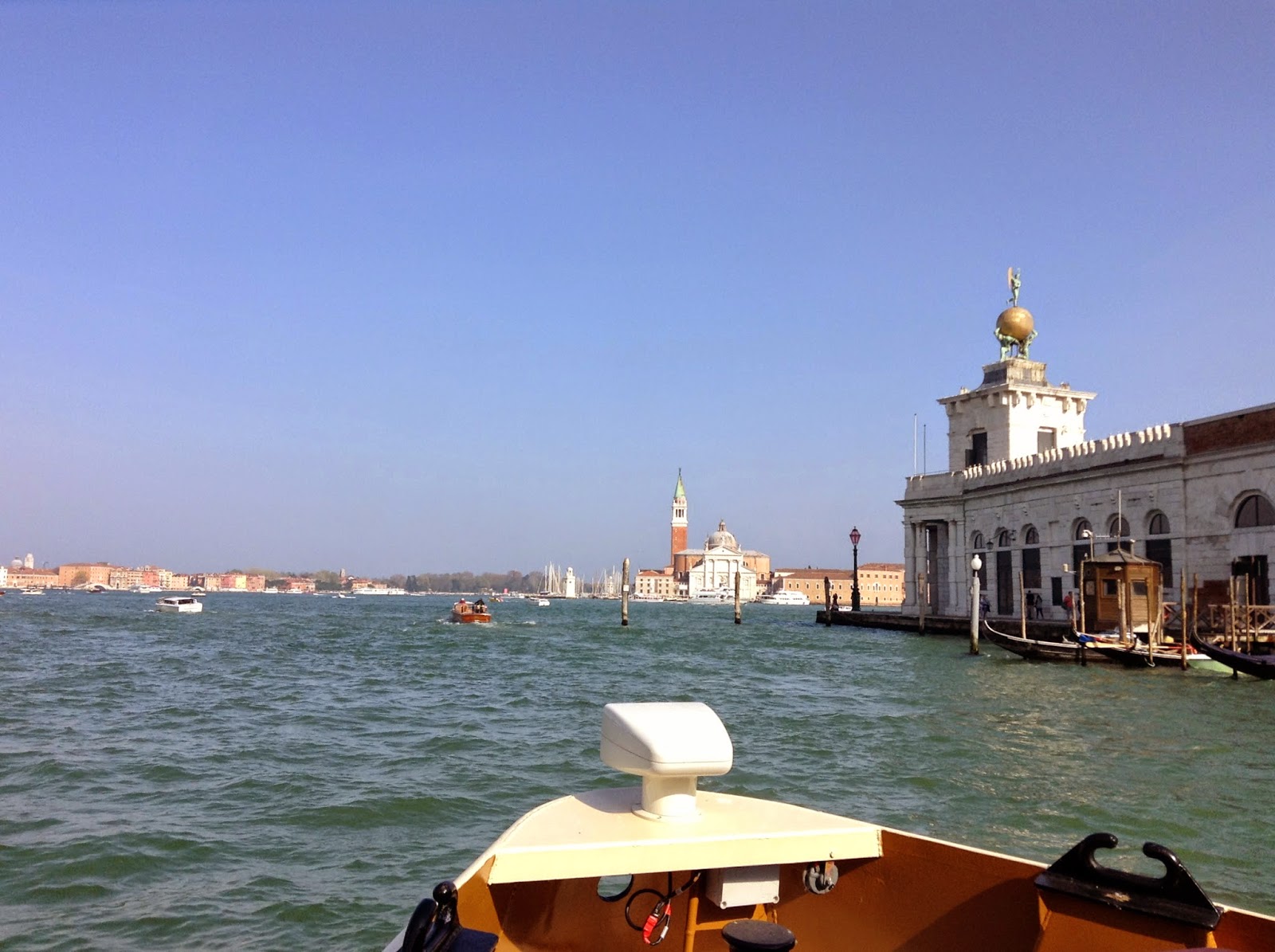
Finally the end of the Canal is in sight and as your line of sight clears the last building on the right, you see the basilica of San Giorgio Maggiore, a church and monastery on its own island in the Venetian lagoon. The church was built between the years of 1566 and 1589 according to the designs of Andrea Palladio, one of the most influential architects in history.

This was my first Palladio building, and I can't honestly think of a better place to start. The church has a glimmering white marble facade which is relatively uncomplicated by change in planes. The first thing you notice about the church is its austerity and simplicity but somehow there's an elegance of proportion. The campanile (well worth the few Euros admission for the view of Venice alone) is to the rear and left of the church and is almost an exact duplicate of the Campanile of Basilica San Marco.

But the thing that amazes me most about this church is the way it is sited. First of all, it presents a frontal orientation to travelers coming out of the Grand Canal, which is absolutely the best way to site the building; it's a nod to the Grand Canal as the main street of the city. But more remarkable is the building's relationship with the water, which is really what Venice is all about. Palladio designed the facade of the building to sit on the plaza in front of the church which ends up being a couple of feet above the water level. This effect makes it appear like the floor of the building is literally sitting on the water level, especially from far away. The truth of the matter is that there are a few steps up to the church door right before the face of the building, protecting the interior from flooding (which will happen). Stay on the Vaporetto No. 2 after the San Marco stop and it will take you to San Giorgio and take the elevator up the Campanile; just leave when the bells ring.


The final stop on both my Vaporetto rides down the Grand Canal was S. Marco or Piazza San Marco, a place Napoleon Bonaparte once referred to as the "drawing room of Europe." Your approach by boat to the S. Marco stop displays the campanile of the Basilica San Marco and the Palazzo Ducale in all their finery.

Piazza San Marco is without question one of the most important, if not THE most important spaces in Venice. It is a vast square with the most important church in the city and the old seat of government at the east end of the square. Lining the sides of the square are cafes with musicians and in the center of the place are a mass of pigeons and people, some of who have pigeons perched on them. No idea what these folks are thinking; I mean, pigeons are swimming with disease, right?

Piazza San Marco was one of my can't miss destinations in the city and honestly, I expected it to be half flooded due to high tide and packed solid with people and pigeons in a scene emblematic of how overcrowded the city had become. It was neither. Maybe I got there at the right time but there was no suggestion of Venice sinking, although somehow empirically I know this to be true. Similarly, while there was no doubt a significant human and avian crowd in the place, there was really tons of open paved space. My time in Piazza San Marco was mostly reserved for sitting at Caffe Florian (the oldest cafe in operation in the world) listening to the musicians while sipping some Venetian beer and eating macaroons and other snacks. Be prepared to pay a pretty good price but it's worth it once. I'm now part of a list of visitors that stretches back to 1720. 

The S. Marco stop is not the end of the line for Vaporetto No. 2, but it was for me both times I traveled the Grand Canal and it is for the purposes of this post. Whether you understand the history or not, what you take in with your eyes on a trip down the Canal will be worth it, even if you just have to turn right back around and go back the way you came. Take the ride. And one day keep going to San Giorgio Maggiore. Venice wouldn't have been the same for me without doing both.

The city of Venice seen from the campanile of San Giorgio Maggiore.

Sunday, May 17, 2015

Gelato


Most vacations I take usually include a food component, a quest to explore and consume as much as possible of some local specialty of wherever I happen to be in the short time I am away from home. Now you may ask, are you really going to "consume as much as possible"? The answer is yes, I really mean just that; I honestly want to eat meal after meal of local food, even if it means eating the same sorts of things every single meal of every single day. After all, I only have so much vacation time. Why waste it eating stuff I can get at home?

My recent trip to Italy was no exception to my food rule. I don't think this would come as a surprise to most people. Italian food is revered in the United States, perhaps too much sometimes in my opinion given the quality of Italian food we get here at home. There's a ton of good stuff in the Italian kitchen. Pasta, prosciutto, pizza, salami, olives, lardo, tomatoes, sopressata, squid, other cured pig products that I haven't already mentioned, basil, tiramisu. I wanted all of it in the nine days I was in country. As much as possible. Please.

If there is one food that kept coming up as a must have while I prepared for my time in Italy, it was gelato. Every guide book I read and every person I talked with that had spent time in Italy pretty much said the same thing: eat gelato because it's just amazing. Now I've never been much of an ice cream guy. Don't get me wrong, I love a scoop in some sort of dessert once every couple of months at a restaurant and I've been known to make a killer key lime pie, bourbon or rum raisin ice cream every now and then but if you open my freezer at any random time, chances are you will not find a tub of ice cream in there. But I was determined to find out what the fuss was about gelato just the same, so I made gelato my food quest for this vacation, vowing to my mom before I left that I intended to eat gelato at least once a day.

Before I get to what I found, maybe I should spend a few words on what gelato is. Plug the words "ice cream" into Google Translate and it will spit back the word "gelato." Indeed, gelato is actually the Italian word for ice cream. But there really is a difference between the two products that is worth understanding.

Start making some ice cream at home and you'll need some heavy cream, maybe some milk, some sugar and some egg yolks in addition to whatever flavoring you are shooting for. You'll need to make a custard and when the custard is cooled a bit, or if you have a better ice cream maker than I do, you'll need to churn the custard for a while at a fairly high speed to freeze it while breaking up the ice crystals that are forming as small as possible to literally intertwine the fat molecules from the cream with the ice. The result is a softish, smooth, creamy product that has grown a bit by adding air as the product has churned. For what it's worth, the USDA Standard for Ice Cream dated October 29, 1977 requires ice cream to have a minimum of 10 percent milkfat. That should start you thinking about working out right after you eat some.

The first step in making gelato also starts with making a custard, but instead of using a ton of heavy cream and egg yolks, you'll need a higher proportion of milk and maybe no yolks at all. Gelato is simply lower in fat than ice cream. While the USDA has no standard for gelato, most gelatos have between 4 and 8 percent fat content. If that seems not that much lower than the minimum 10 percent set by the USDA for ice cream, but remember the 10 percent is a minimum. Many ice creams have fat contents of 20 percent or higher. Now you are really thinking about working out after that scoop, right?

There's one more significant difference between ice cream and gelato. Gelato is generally churned at a lower speed than ice cream, which introduces less air into the product, meaning when you eat gelato, you get more flavor right away because you are tasting the product itself, not a bunch of air (or fat). Less air also means a higher freezing temperature. Ice cream is generally served at 10 degrees F. If gelato was served at that temperature it would be rock solid because of the lack of fat and air in the water heavy custard base. Gelato is therefore served at about 15 degrees warmer, yielding a smoother, softer sometimes gooier elastic treat with a much lower fat content.

So after all that science, let's get to the good stuff. Here's my blow by blow account of my Italian gelato experience from Rome to Venice.


White Chocolate Basil, Gelateria del Teatro, Rome

Go ahead and think it…what on Earth am I doing picking White Chocolate Basil gelato as my first foray into my Italian ice cream experience? Good question. I have no idea. It was not a good choice and if I had it to do all over again, I'd do it way differently.

I hit Gelateria del Teatro on my first day in Italy after seeing the Spanish Steps and on my way to stare at Castel Sant'Angelo from across the Tiber. It was, based on my research, the gelateria I was looking forward most to stopping by. It seemed to be rated very highly on every "best of" list from legitimate news and travel outlets to blog posts about gelato in Rome written by folks like me. I thought I couldn't go wrong with my flavor selection. I may have erred here. I can always blame it on the delirium of a few hours sleep in my coach seat on the way over to Europe from the United States  the night before.

If they had called this just Basil, I wouldn't have disagreed. I got a lot of herb on my palate throughout my quick experience at Gelateria del Teatro and almost no white chocolate. I was hoping for that almost cloyingly sweet cocoa butter taste to balance out the basil and it just wasn't there. Overall I found this gelato a little watery and lacking in richness. Not a good start.


Whiskey, Il Gelato di San Crispino, Rome

I know, I know. If I was disappointed in my first gelato selection as a non-traditional flavor, why would I do it again? Again, I'm not really sure. Although to be honest, I really wanted to compare this stuff to my own homemade bourbon ice cream, which is absolutely delicious.

Il Gelateria di San Crispino was the gelateria where Julia Roberts' character in Eat Pray Love found gelato nirvana. Or so I'm led to believe. I haven't actually seen the movie, mostly because I'm not really a Julia Roberts guy. I expected this place to be packed with wannabes trying to follow in her character's footsteps so I was grateful to find it almost completely empty after a day traipsing around town looking at 2,000 year old or so Roman ruins and my body in desperate need of a sweet treat.

This was a step up from Gelateria del Teatro, and not just because I picked a flavor closer to the mainstream than White Chocolate Basil. I found this scoop creamier and eggier than my first gelato experience, which was gratifying. I was getting a little nervous that the lack of fat would render most gelato thinner than I would have liked but my faith was restored a little here. I also got a nice hint of whiskey from the spoonfuls I shoved in my mouth. Not bad. My bourbon ice cream is better.


Dark Chocolate Grand Marnier, Gelateria dei Gracchi, Rome

What better way to follow a morning audience with the Pope and a trip to see early Christian catacombs than with a small tub of gelato? I couldn't think of one. So after running to catch the 660 bus at the south end of Via Appia Antica, I pulled out my Metro day pass (a bargain at seven Euros) and headed back towards St. Peter's Square and into Gelateria dei Gracchi.

Finally I think I'm on the right flavor track. This was the first chocolate gelato I tried and with one small exception, I never strayed much from that theme for the rest of my trip. This stuff was really good. The sinfulness and bitterness of the dark chocolate paired well with the orange flavor from the Grand Marnier and I got a delicious chunk of candied orange peel in one of my spoonfuls as a delicious bonus.

This was by far the best gelato I had in Rome. I appreciated the fact that the chocolate offset the thinness of the gelato mix but the fact that I still found this stuff a little watery concerned me. I left Rome with my confidence shaken but I was determined to persevere.


Chocolate Hazelnut, Vivoli, Florence

All the doubts I had about gelato from my experience in Rome were removed as soon as I shoved a spoonful of the only gelato I ate in Florence into my mouth. The gelato from Vivoli was without a doubt the best I had in Italy. I don't know if it was the right moment or I just chose the perfect flavor but this stuff was fantastic. It was noticeably runnier than all the other gelato we ate in Italy (just check the pictures). Maybe that had something to do with how good this was.

It was also far sweeter than all the gelato we ate in Rome which was an instant upgrade. The sugar took away any hint of wateriness that we found in Roman gelato and which had me worried until this point. The gelato was infused with small pieces of hazelnut which added some welcome texture and I even got a whole hazelnut in my small cup which was awesome. The chocolate was less aggressive than the dark chocolate gelato I got from Gelateria dei Gracchi which was not surprising and it was simply amazing paired with the hazelnut. Chocolate's definitely the way to go.


Caramel, La Bottega del Gelato, Pisa

Yes, I just wrote the words "chocolate's definitely the way to go" and then the very next day I get a non-chocolate gelato. I love caramel. I'd eat caramel in whatever form I could for dessert with every meal or just for snacks if I thought that was in any way healthy. So after climbing the Leaning Tower of Pisa (an interesting experience walking alternately down backward leaning and forward leaning stairs) and finding caramel gelato at our selected gelateria, I couldn't pass it up.

Like the gelato I had at Vivoli, I found La Bottega's gelato pleasantly non-watery like the stuff we had in Rome. I thought the caramel flavor was a reasonable choice - it had a faint burnt flavor on the caramel which was not unwelcome - but chocolate would probably have been better. This stuff was sweet like the chocolate hazelnut I had in Florence, although not quite as sweet. Vivoli's was better in this regard.


Chocolate Hazelnut and Stracciatella, Gelateria Il Doge, Venice

In Rome, Florence and Pisa, I noticed people getting two different flavors of gelato in a single cup or cone but I resisted this temptation, preferring to sample a single flavor uncluttered by a rival. Something about purity was my reasoning I'm sure. That all changed in Venice, for no real reason other than I just felt like it. In Venice, I never ate a single flavor from any one gelateria.

My first taste of gelato in Venice came a couple of islands north of the Ponte Accademia on our first afternoon in town. Since chocolate hazelnut had worked so well for me in Florence, I decided to opt for that again and paired it with a stracciatella which is a white ice cream dotted with dark chocolate pieces.

This gelato was good. In fact, I'd say it was the second best I had in country, likely due to my growing preference (based on two tastings) for chocolate hazelnut. It was nowhere near as good as Vivoli; it was not as sweet and had no pieces of hazelnut in it. The stracciatella was a nice pairing. The gelato was clean, tasting pretty much like slightly sweetened milk and the chocolate chips provided a nice crunch. I'd go back for some more gelato here.


Chocolate and Peanut, Gelateria Alaska, Venice

Gelateria Alaska is located just a five minute or so walk from the Ponte degli Scalzi near the main rail station in Venice. The route to get there involves going over a couple of bridges (of course) then cutting down an alley under a building that is about five feet off the ground. Needless to say, ducking is required.

So the idea behind my choice of gelato flavors here was Reese's peanut butter cups in gelato form. Didn't work. Not even close. And I suppose that made my experience at Gelateria Alaska a poor one. Not connecting the reality with your expectations has a way of yielding that result.

The texture of the gelato here was good and the resulting flavor was not watery like we found at some other gelaterias. But the chocolate wasn't sweet enough and the peanut was neither sweet nor salty. I, of course, wanted a little bit of both. Overall, this experience was like eating slightly sweetened chocolate milk with an unsalted peanut in ice cream form to go along with it.

And just like that, my Italy trip was over. I know, there are only seven gelato reviews above when I told my mother I was going to eat gelato at least once a day for the nine days I was overseas. I couldn't make it. There were just two days where our schedule didn't allow even a small cup of gelato. Maybe it's just as well. Despite all that gelato eating, I managed to lose five pounds on my trip, although that had way more to do with the walking than the gelato. Maybe I'd be only down four if I'd had those extra couple that I missed.

As you can tell, my gelato experience varied in Italy. Some were fantastic, others I would never eat again. The above commentary is not intended to be a ranking of the best gelato in Italy or even the best top to bottom of where I ate gelato in Italy in April of 2015. It's just a narrative of what I ate. If I had picked a different flavor at Gelateria del Teatro or Vivoli, the lows and highs of my experience might be reversed. But I do know one thing: when in Italy, eat gelato. Some of this stuff was otherworldly good.