Showing posts with label Cusco. Show all posts

Sunday, June 30, 2019

Scritti Politti


I guess this makes two posts in a row where I'm writing about walls in Peru. Very different kinds of walls. But walls nonetheless.

I have so many great memories of my week in Peru. Some of those are perspective-altering, monumental experiences I will carry with me for the rest of my life. Seeing Machu Picchu, the lost city of the Incas, for the first time, and then exploring it the next day. Hiking almost eight hours on a path laid down by the Incas more than a half a millennium ago. Exploring a farm that's been extracting salt from the same stream for hundreds of years. Flying over the Andes and then driving and walking on them the next day. Eating foods that I've never heard of and some that I certainly can't get on a menu at home. Alpaca, anyone?

And then there are some others that are, shall we say, a little more pedestrian, but which nevertheless form an essential part of my memory and an enduring image of Peru. Dogs roaming the streets in packs of two to five animals; apparently pets let out for the day but the best behaved dogs I've seen maybe in my life. Pairs of tiny clay bulls or "toritos" on the ridgeline of every house you drive by; ages-old idols to protect against lightning hurled down from the gods above. And walls just about everywhere painted with political party slogans and logos and names of candidates. I thought they were cool works of art although I may just have a signs fetish. So here's blog post number two in a row about walls in Peru.

The rainbow flag has been adopted as a symbol of the Andean people and can be seen everywhere. 
Politics seems to be a pretty popular topic of conversations with Peruvians. We got an earful from every taxi driver and tour guide we seemed to run into or walk with or ride a bus with. And with good reason. They have to have one of the most dysfunctional governments that is still a legitimate democracy.

I know that if you are American you have to be laughing right now. I mean how could any society really have a system more broken than the one we have in Washington right now? I mean literally, nothing is getting done right now. One half of Congress is passing bill after bill and the other half is just refusing to take any action at all. It's insane that we are paying these people to work for us.

Anyway...think we got problems? Talk to a Peruvian taxi driver.

Tired of a two-party system? Try more than 30. Fed up with politicians taking money from special interests instead of representing the people that elected them? How about having all your living ex-presidents in jail for money-laundering, bribery and corruption? Does that sound bad? It is. And it's not like there's just one ex-president still alive. There are three! And one of them has his wife in jail with him.

The yellow house with the pink roof is one of my favorites, often with Elvis right next to it. Assuming not Presley.
It actually gets worse. There would have been a fourth living ex-president in custody right now if he hadn't killed himself earlier this year to avoid arrest. All told, there have been six presidents since 1986 in Peru (not counting the current president) and five of the six were indicted or arrested or convicted or jailed or something. The only one that wasn't was an interim president whose only job in office was to find the next president. Where's all this bribery come from, you might ask? Apparently...Brazil. It's a real problem.

Emotions run deep here. And not in the ways you might think. Some people actually feel that some ex-presidents despite obvious wrongdoing should be walking free. Especially when it comes to Alberto Fujimori who served as head of the country for 10 years from 1990 to 2000. In his time in office, Fujimori legitimately did some good for the country, especially in stabilizing the economy and defeating insurgent groups within Peru, most notably the Shining Path, a Maoist revolutionary army of sorts. 

But apparently Fujimori was a little too zealous in his pursuit of wiping out the rebels because he got some non-rebels killed in the process. Which led to human rights violations accusations, a self-imposed exile in Japan, an impeachment, an arrest during a trip to neighboring Chile (I mean, why go to Chile when you are wanted in Peru?), a conviction, jail, a pardon by a successor president and an overturn of that pardon by the legislature which kept him in jail which is where he is today. And despite all that, there are a significant number of Peruvians today with a positive opinion of Mr. Fujimori, including the driver that took us from the airport to our Lima hotel and think he's done enough good to offset the whole corruption thing. Politics is complicated in Peru.

But that's not what this post is about. Not really.

Avengers Party? Not really, although at least two of our guides made reference to the A meaning that in jest.
So about those 30 plus political parties, which seemed chaotic at first but which I might welcome right now based on how stagnant our government here at home is. One of the benefits of having that many parties in Peru for someone infatuated with painted signs is that there are a whole lot of different colored signs by the sides of the road to look at and take pictures of. And they are not just here and there. Once we left the historic city center of Cusco they seemed to be everywhere. And I do mean everywhere. 

As graphic statements a lot of these signs are simple and powerful. Most feature the name of one or more political candidates along with a symbol of the party they represent. The names are always written (or painted really I guess) in the exact same colors and font. The symbols next to the names vary: a football (meaning soccer ball) or a shovel or a flower or a rainbow flag or an Andean head or a heart or any other sort of symbol that might become enough of a brand that could become associated with a name.

Football behind the lamppost.
I love how simple and straightforward the designs are and how different parties use different colors so that every color in the spectrum is collectively represented (although I guess all you need there is the rainbow flag sign to really do just that). They have to be simple so that they can be replicated over and over by many different people painting their own houses. And yes, that's what happens. Apparently people willingly decide to go to the hardware store (or wherever one buys paint in Peru) and buy their own paint so they can make the wall of their house or garden into a political advertisement. We were told that most people hope for favors after their candidate wins. Not sure how that works out.

There's also a story about the symbols. As attractive and graphically powerful as they are, they sort of seem unnecessary, unless you consider that significant parts of the population of the country are illiterate. Can't read your candidate's name? Just vote for the shovel! Or the rainbow flag or whatever else it is. How this process works on election day I'm not quite sure. Does the ballot have names and symbols next to the names? Didn't ask that question I guess.

I know, I know, all this sounds very complicated, right? Why wouldn't someone just not bother voting and take their chance with whatever party gets elected? I mean the odds that one of the more than 30 parties will get a majority is astronomical, right? There has to be a coalition or consensus of some kind to get things done, right? Surely someone sitting out a vote every now and then because they can't read couldn't hurt, right?

Wrong! Voting is mandatory in Peru. If you don't vote, you get fined. How awesome is that? Some politicians go to great lengths in my country to make it extremely difficult for some people to vote. Peru made it a requirement. Love it! Thus the flower and the football and everything else.
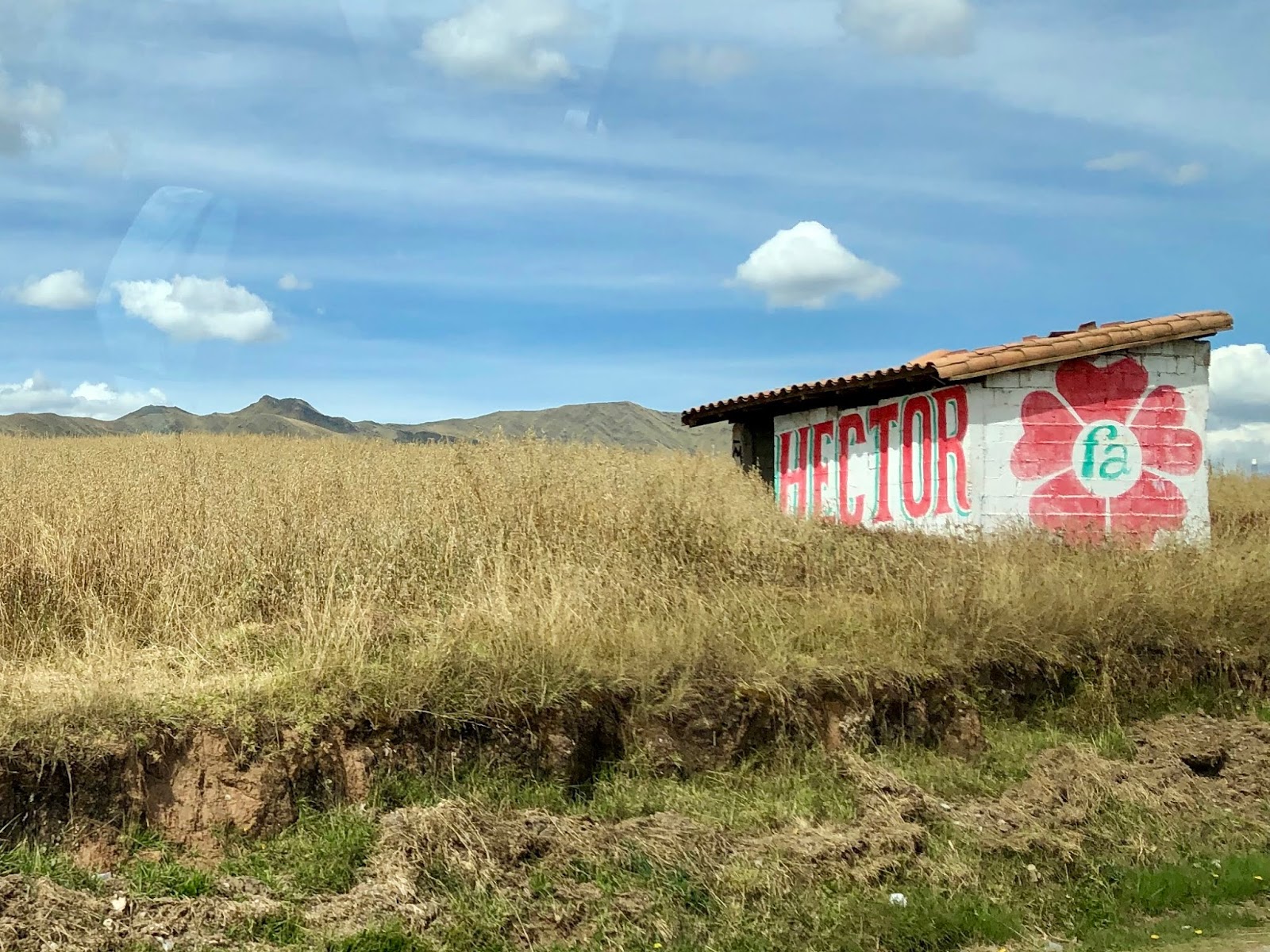
Vote for the flower!!!! Whatever that means in terms of the candidate (Hector, I guess?) that would be elected. 
I didn't actually take the time to track down what each sign meant or how things worked on election day with the whole pictures thing. I figured that would spoil the whole magic of this entire experience for me. Once I start getting entangled with politics, I'm not sure anything could save me. Better that I just appreciate these signs for their graphic quality. That's what drew me to them in the first place after all.

It is rare that I encounter something unexpected that intrigues me like this. Far too often on trips, I think of writing about these things too late (still regret missing the boat on the Yule Lads in Iceland...) so I'm glad I didn't let this opportunity slip by this time. 

Some of the pictures in this post are less perfect than I would want. If you'd noticed that (or more likely you hadn't) it's because I took every one of them from inside of a moving vehicle with a pane of glass between me and my subject. I'm pretty happy with the way they turned out even if I missed a few (regrets on missing the shovel especially...). But realistically, how many pictures of these signs could I have really posted? In case you think six is too few, here are two more to close this post.

I'm not exactly sure the llama logos (hidden behind the tuk-tuks in the last photo) are part of a political campaign. I didn't see these anywhere other than in the town of Chinchero. But they were one of my favorites so I couldn't pass up sharing them. May your next trip be full of surprises that bring you joy the way these did for me. 


How We Did It
Take a ride in any sort of vehicle outside of the historic center of Cusco and you are bound to find one or two of these signs. Keep going and you'll find more. Keep going further and you'll find more still. The best part of this part of our trip? It didn't cost us anything extra. If you want better photos than I got, ask you driver to stop and let you out. Just ask them to wait for you though. Happy hunting!


Wednesday, June 26, 2019

Inca Walls


Ready for a blog post that has tons of close up pictures of masonry walls? Good. This is the definitely the post for you!

Building with masonry, or small units of material generally stacked on top of one another, is a technique that most human societies mastered early on in their development. As soon as man was able to gather or quarry stone or make bricks out of mud or clay or any other material conducive to being formed into block-like shapes, he started building structures more permanent than grass or wood or whatever else was used before building with masonry was discovered.

The tradition of masonry building goes back centuries upon centuries and takes many, many forms. Giant stone Gothic cathedrals all over Europe; stone walls dividing farmlands into plots (or separating the Romans from the future Scots) in Great Britain; mud walls to shelter Masai tribes from the African elements (and wildlife); giant pyramids in the Yucatan peninsula; the list could go on and on and on. 

Some of these walls and structures are designed as monuments to form simple barriers and are not so concerned about keeping the weather out; the masonry in these walls or buildings is sometimes loose laid, which makes construction easier and quicker but does no good for making a comfortable interior environment. Other walls are designed to be waterproof and need to be sealed, so the gaps between the masonry units are filled with mortar or covered with a thin layer of applied material like stucco; the mortar or surface application has the added benefit of generally making the walls themselves stronger.  

Mortar is the stuff that allows masonry construction to be a practical endeavor for buildings today. Not only does it seal out the exterior environment and make the wall stronger but it allows the mason to work around imperfections in material manufacture or in craftsmanship. There's no realistic way to set stones on top of one another fitting together perfectly and sealing the building envelope without mortar. It makes a loose laid pile of stones or bricks or blocks into a building. Walls that have any sort of permanence just don't work the way they are supposed to without mortar.

Unless, that is, you are an Inca.

Calle Awaqpinta, Cusco.
One of the great unsolved historical mysteries is how the Incas built their walls. Because while the rest of the world was off using mortar to compensate for material imperfections and less than precise workmanship from craftsmen, the Incas were doing something different. They were building mortarless walls without gaps between the blocks on an astounding scale. 

Not impressed by masonry in the cover photo of this post from Machu Picchu? Good! You weren't supposed to be. I was sort of setting you up. Just because the Incas could build walls with perfectly fitted joints between blocks of stone, doesn't mean they always did. There was definitely a time and place to pull out all the stops and build a perfect looking wall. I assume it took a whole lot more effort than the alternative and maybe (and I'm totally speculating here) only certain masons could lay the best walls.

I came to Peru half ready to be blown away by the skill of these workers and half prepared to be supremely disappointed. I mean I've seen some pretty amazing craftsmanship, masonry and otherwise, in my day job as an architect. Surely some walls built 500 or more years ago by people who didn't have metal tools (gold, silver and copper don't count; the metal isn't hard enough to really make crisp edges on stone blocks) wouldn't be that fascinating.

Inca walls at Machu Picchu. The Temple of the Sun is at the top of the hill.
I was wrong. These walls are really very impressive. We started the Inca portion of our trip in Cusco and there are Inca walls all over the place in that city. The Spanish generally tore down every significant structure in Cusco when they took over the place but they didn't knock down the Inca foundations; they recognized how well built they were and just decided to erect their own buildings on top of the existing walls. The first day we were there we found a pedestrian street called Calle Awaqpinta with old Inca walls on both sides of the street: one a rough uneven stone wall and one of the finest Incan masonry work.

The side of the street with the finer masonry work (which used to be Cusco's Temple of the Sun) was pretty incredible. The blocks are so uniform and smooth and there is literally nothing between the stones themselves. They are perfectly fitted together and I wouldn't be surprised if the wall was perfectly plumb. I did not carry a level with me to Peru so I couldn't check; but my money's on plumb.

So what's the big deal, right? What's so special about this whole Incan stonework thing? Surely someone working long enough at a craft could be able to do this, especially if they made it their life's work, right? So it was 500 years ago. Who cares?

Check out those joints!!!
All those are good thoughts. And sure, I guess if someone whittled away at a piece of stone long enough they could get them close to perfectly rectangular, although they aren't quite that way in the photograph above, which actually makes it harder to fit together because each stone's neighbor needs to be just non-rectangular enough to match up with the adjacent block (it's complicated, right? we'll get back to that idea). Still, I can see it being done. To me, that's not the most impressive part.

These walls are generally built from quarried granite. Granite is pretty darned hard. To cut, carve, shape and polish granite, you generally need a material harder than granite (this applies to all materials, not just granite) and the Incas didn't have one. No tungsten carbide, no diamonds, no hardened steel. Nothing. We were told that the builders at Machu Picchu drove wood wedges into cracks of the rocks and then used water to swell the wood to split the rock. That all sounds good but did that technique really produce rocks that were almost perfectly rectangular and of the same size that would stack perfectly? Seems doubtful to me. We were also told at Machu Picchu that sand was used to polish the individual stones to the smooth surfaces that most have today. How long did this take? Seriously? Sand?

So what we were told about the structures at Machu Picchu was that with somewhat primitive techniques and no materials harder than the stones themselves being carved that the Incas could produce relatively uniform and geometrically perfect blocks which could be stacked on top of each other perfectly and stand in place for centuries. Sounds farfetched.

But you know what? I can buy it. Even with all the doubt I just sowed, I'm on board. We were told the Incas used interlocking blocks for stability rather than just stacking rectangles of loose laid stones on top of one another and we saw an example at Cusco's Inca Museum (shown below) of the type of shapes these stones were made to make these Incan walls. And you know what? They are big but not enormous. I can believe a team of workmen might be able to spend enough time getting that kind of a surface on a block and then laying it (along with hundreds of others like it) in place to make a finished, perfectly assembled wall. 

I can even get behind the idea that these same workmen could pull off something like Machu Picchu's Temple of the Three Windows, which uses less regularly shaped stones but with few enough that with enough time and sufficient motivation, a team of Inca workmen could have made it work.

Inca stone, maybe? At the Museo Inka, Cusco.
Temple of the Three Windows, Machu Picchu.
And then we went to Chinchero. And it blew everything away that we had seen in the whole week.

Chinchero is a small town in the Sacred Valley of the Incas about a 45 minute drive north and west from Cusco. Today at first glance it looks like a typical Inca town taken over by the Spanish hundreds of years ago: some farming terraces, some walls that are obviously Inca era, a church right in the center of town and paved streets with troughs or gutters (the Incan aqueduct) for the distribution of fresh water. 

On second glance though, Chinchero doesn't look anything like a typical Inca town. The whole place is laid out with its major planning axes oriented directly east-west and north-south and at the top of a hill with tremendous views to all sides. This place looks and feels important. And when I say east-west and north-south I mean exactly; we checked on the iPhone and it was spot on. 

It is thought today that Chinchero used to be a royal retreat or country home for the emperor Tupac Yupanqui who was the son of Pachacuti, the emperor thought to have built Machu Picchu. It makes total sense given the siting of the place. And in a place this important, you better believe the Incas were building their best walls. And they did. They are absolutely spectacular.

Chinchero.
At Chinchero you will not find stacked stones of similar size. In fact, you may not be able to find any stone identical to any other. These blocks are all custom cut and fit in such intricate patterns that all my acceptance of stories of quarrying, cutting, polishing and fitting are overcome by what you are faced with. I cannot even begin to explain how these things were put together.

Our guide, Paul, however did take a shot at this. First, he let us know that he didn't believe the whole wood wedges in rock cracks story we'd been told over at Machu Picchu. He also didn't let us blame the whole thing on aliens (we tried; believe me, we tried) or introduce a now extinct race of people who had metal tools capable of carving and shaping rock precisely like I have read in some accounts since I returned from Peru.

So story number one is that the Inca were gifted from the gods two plants that allowed them to manipulate stone. He even tried to show us a stone that was "bent" rather than carved as proof of this theory. I didn't buy it. Nor did I buy the second theory that said that once upon a time there was a bird in Peru that had a beak so sharp that it was able to cut stone easily and did so for the Incas. Although honestly, the second theory is way more fun and lacking any other credible explanation, I'm inclined to believe that one rather than nothing at all.


Just take a look above at the ridiculousness that is the Incan walls in Chinchero. How did they make these things? They are like jigsaw puzzles made of blocks of granite that weigh up to probably 300 or 400 pounds or more. Not something that any old regular person can pick up with one hand or two. And the joints are so precise and tight; I've actually seen real jigsaw puzzles that fit together worse than these walls and jigsaws are generally cut out of a single sheet of cardboard.

Find me two blocks in the wall above that are identical. You can't, right? Some of these things have seven sides and fit perfectly with their neighbors. It's an amazing construct. I can't imagine some workmen 500 or 600 years ago putting these things together in the field after hammering away (or whatever they really did to get stones shaped this way) in a super precise fashion to get these stones just the way they wanted them.

Want to be more impressed? Some of these things turn the corner. Yep, not only do you have to get one face of a stone block fitted perfectly to the stones around, above and below each block, now you have to make sure the sides of the stones match too.

Turning the corner. Not difficult enough to match one face perfectly? Try it with two.
I have nothing here. We walked around these things for 30 minutes or so trying to figure out how this was done. We were even able to see the backs of the walls and they were in most spots as perfect as they were on the front sides. It's honestly beyond my powers of comprehension to figure out how this was accomplished. If I can put aside all my doubts about the walls in Cusco and believe they were constructed by master craftsmen with skills beyond what modern science can explain, I can't do it with the walls in Chinchero.

Before I wrote this blog post, I tried to do some research into what the scientific community had to say about all this. The most credible explanation I found was that the Inca used byproducts of their mining operations to separate the stones when placed and that somehow this layer of iron mineral melted the edges of the blocks after placement so that they fit perfectly without appearing to have any material between each piece. I guess maybe that's a logical explanation but honestly it sounds to me no less farfetched than the bird with the sharp beak theory (which I still love).

If the Spanish that took over the Incan empire ever knew how these walls were built, they sure as heck never wrote it down. Who knows, maybe they were too preoccupied with conquering the Incas that they never thought that they would have anything to add to the history of construction or anything else. Their legacy is a series of walls all over the country that nobody can say for sure how they were actually put in place. 


We can replicate Incan walls today. I'm sure of it. I'm also sure that we'd have the wall cut out by tools controlled by computers off a model that would be built specifically for the purpose of each wall. I'm also not sure that the walls we'd build to day would withstand at least five centuries of earthquakes in an area of the world with significant seismic activity. These walls are impressive at Machu Picchu and Cusco. They are mind-blowing in Chinchero. Very cool stuff.


How We Did It
Our trips to Cusco and Machu Picchu were arranged for us by our favorite tour company in the world, G Adventures. I am sure you can do both on your own. If you get stuck, I'm sure you can get a little help here and there from any number of tour companies.


We went to Chinchero on our own, which is to say that we engaged the services of Inkayni Peru Tours to drive us there and provide us with a guide to take us around Chinchero and two other sites (more on one of those two other ones to come later) on their Maras-Moray-Chinchero half day tour. We found these guys through Viator but there's no reason you need to go through that website. Just save the cost of the service charge you'll pay to Viator or better yet, tip your guide or driver or both a little extra. 

Based on our one day (or half day I guess) experience with these guys I'd highly recommend their service. The best part about this tour is that it's private so you don't have to share it with anyone else. There is an entrance fee for Chinchero which is not covered in the cost of the tour which is 70 Soles (about $21 US as of this writing). That entrance fee gets you into Chinchero and Moray (which was also on our tour) along with sites at Pisaq and Ollantaytambo if you choose to get to those some other way.

Saturday, June 8, 2019

The Air Up There


I knew that some kind of elevation sickness was a risk in traveling to Machu Picchu. Not so much at the site itself; after all, it sits just a bit less than 8,000 feet above sea level and that's not much higher than somewhere like Santa Fe, NM. But I knew we'd have to go through Cusco to get to the old Incan citadel and Cusco is a little bit higher up in the Andes. Like 3,200 feet higher. I just didn't think it would happen to me as badly as it did on that first night in Cusco.

People are generally susceptible to altitude sickness when they travel above 8,000 feet. I'd been there a few times before. Most recently, I'd spent four nights in the Ecuadorian capital of Quito at 9,350 feet above sea level in 2016 and earlier that same year I'd driven straight up two volcanoes in Hawaii, topping out at 10,023 feet at the summit of Haleakala which was the highest I'd ever been with my two feet planted firmly on the surface of the Earth. 

Although maybe not so firmly; walking around at that elevation when having been at sea level less than an hour earlier was disconcerting. I was dizzy and needed to step slowly. Holding hands helped. My experience in Quito was better, although the first night I was there I woke up halfway through the night gasping for breath. My lungs just weren't getting enough oxygen I guess. I figured I'd be OK in Peru but there was admittedly a little concern to be had.

My first night in Cusco was worse than either Quito or Haleakala. I was curled up in bed like a baby with a severely upset stomach and a crushing headache right at the base on my skull. It came on all of a sudden after being fine most of the day. We'd been warned that altitude sickness would feel like the worst hangover you've ever had. I've had some pretty bad hangovers in my life and thankfully this wasn't like those. But a headache this bad and an upset stomach would make the rest of the week awfully inconvenient.

There are mountains all around in Cusco and everywhere else you go around there.
The traditional Andean cure for altitude sickness is to stuff a few leaves of the coca plant in your cheek and chew away a little bit. The leaves are rich in chemicals (calcium, potassium and phosphorus) and vitamins (B1, B2, C and E) which I suppose helps in staving off the effects of the high elevation when it gets into your saliva and absorbed into the body. The guides who showed Hiram Bingham the "undiscovered" ruins of Machu Picchu way back in 1911 apparently had cheeksful of coca leaves during that trek for just general well being and we saw an estimate that 360,000 kilograms of the stuff were consumed during the building of that site all those centuries ago, although I have no idea how anyone surmised that with any degree of accuracy.

If you want to study up on all the benefits of the coca leaf while you are in Cusco, there's a whole museum dedicated to this plant. The Andean people used this stuff for way more than just countering the effects of being way way above sea level. Headache? Yep. Nosebleeds and cuts? Sure (the chemicals in the leaf do actually constrict the blood vessels). Malaria? No problem. Ulcers? That too. Digestion issues? Apparently handles that easily. Painkiller during skull surgery? Got that covered but yikes! I don't necessarily believe you are covered completely here for all these ailments with a single leaf but it has been proven to have beneficial effects.

Of course, it's also the source of cocaine which makes its production banned in certain areas. The Museo De La Coca covers all this stuff, including its use in Coca-Cola, the known first case of sniffing cocaine in 1919 (it was in the United States! surprise!) and a little something about famous cocaine users. This section includes Diego Maradona, Amy Winehouse and Freddie Mercury along with a little narrative about their use of the drug. There's also a diagram about how to make cocaine from the raw coca leaf. I took a bunch of pictures in the Museum but declined to snap one of that display. No way was I coming back from South America with a diagram of how to make cocaine on my phone.

The Museo De La Coca, Cusco.
So I can imagine what you are wondering: why didn't I just stuff a wad of coca leaves into my mouth and have done with it and get rid of that nasty headache and upset stomach? Well, I did. Sort of. Our hotel lobby had a pile of remedies for altitude sickness just sitting around waiting for folks to use, including a big dish of dried coca leaves, an always full canteen of coca leaf tea and even an oxygen tank on standby complete with (perhaps less than sanitary) mask for sucking some extra air into your lungs. And earlier that day I'd crunched on a coca leaf (kind of bitter and eating a dried leaf isn't pleasant) and had three or four cups of coca tea (sort of like green tea). 

It didn't work.

I'm sort of willing to admit that the upset stomach was caused by our meal that night of Peruvian junk food, including Inca Corn (Carolina BBQ flavor, if you must know), Chitzos and Tor-Tees but I don't know that for sure. And my private theory is I overdid it on the coca leaf tea entirely. I'd just have to wait until the morning to see if it was still there. So I slept it off, like I would any good hangover.

Pick your altitude sickness cure: coca leaves, coca leaf tea or oxygen. Taypikala Hotel, Cusco.
Miraculously, sleeping it off worked. We'd descend out of Cusco that next morning into the Sacred Valley of the Incas and then to Machu Picchu. The headache and stomachache never came back, despite our return to Cusco later that same week and a day trip to the town of Chinchero, which at 12,360 some feet above sea level is my new high point for having my feet on solid ground.

I'm assuming it was just acclimatization and I just needed a day or so to really get used to the higher elevation. I certainly didn't have any issue in Quito three years ago after the first night and that pattern held for our time in Peru. But it is difficult to breathe there. Despite the lack of noticeable effects after night number one, every so often I'd need to take a deep breath of air into my lungs to make up for the shortfall of oxygen available in my however many prior regular length breaths. This sort of thing went on all week. It's unnerving and the deep breath solution comes with its own concerns because taking a deep breath in the Andes is not like taking a deep breath somewhere lower down. There's just not enough air. Remembering to breathe is a funny concept. 

And running or climbing stairs? Do it slowly. I got winded easily. I know I'm not the fittest individual but the lack of oxygen was noticeable here. As it was when bending over and standing back up. Head rushes were never so painful.

I am supremely grateful that I was fortunate enough or healthy enough to not have breathing issues at altitude last week, particularly because the best thing we did while in Peru was to hike for a day in the Andes. I saw a woman in our hotel lobby who had to go for the oxygen tank and she seemed to be sucking down that air forever, at least as long as we were waiting for whatever we were waiting for. I stayed off the oxygen tank entirely and after that first day, I refused all coca based altitude treatments as well. I did just fine after that first night.

I can't imagine I'm heading anywhere higher than Peru any time soon. I'm certainly not heading to Everest base camp or anything silly like that. But if I do head back there, I'll at least know I can breathe on my own. And I guess that's comforting.

Chinchero, Peru. My new highest point above sea level. After a few days at altitude, I felt no ill effects.

How We Did It
There's not much to doing what we did in this post. Go climb up a mountain and see what happens. But if you do find yourself in Peru, there's plenty of help available. We saw altitude sickness remedies all over the place in Lima, Cusco and elsewhere.


If your hotel doesn't offer coca leaves or coca leaf tea (I think there was coca leaf tea available in every hotel we stayed at including in Lima although the bowl of leaves was unique to Cusco if I'm remembering right), you will find a couple of alternate cures. We did buy altitude sickness pills in Lima just in case we needed them when we traveled to Cusco. We bought them at a pharmacy over the counter after some pointing and writing of numbers on pieces of paper (we needed help with the dosage) but ended up not using them. They are not super expensive.

There are also coca based candies, including chocolate and gum. We did buy some gum but I can't speak to its efficacy because (a) I didn't use it and (b) other than a little shortness of breath there was nothing I needed curing. I certainly wouldn't rely on anything I've written in here to help you through your own altitude sickness issues. Talk to someone more qualified than me if you really want to know what to do to make sure you are healthy in the mountains.

The Museo De La Coca is located at 618, Cuesta de San Blas on a small square in the San Blas area of Cusco. It's not going to take you long to get through the place and it's not going to cost you much either (10 soles or about $3.00 US as of this writing). I found it worthwhile I guess and it got us to a part of town that we wouldn't have gone to anyway which I guess is always good to do. Skipping it is not going to hurt you much either.