
Before there was New Zealand, there was Aotearoa. Before Abel Tasman first spied land east of Australia and named it after part of his Dutch homeland and before that name was Anglicized into its current spelling, the islands had been given another name by people already living there, master mariners of Polynesian descent who called themselves Māori. This final post about New Zealand (for now) is about those people. And because they called the land Aotearoa, I will only refer to it that way in this post after this paragraph. OK so there's one exception.
When we left San Francisco on March 1 bound for Auckland on a very long flight over the Pacific Ocean, we hoped we were heading to a nation which celebrated the people who were there before the European explorers and settlers. After all, people of Māori descent make up over 15% of the total population. We hoped there would be a lot to learn and appreciate so we deliberately tailored part of our agenda to focus on Māori sites, particularly on the north island. I don't think we were disappointed by what we found. I hope that comes through in this post.
But before we get started in earnest on this post, let's clear up some pronunciation. Before setting foot in Aotearoa we were halfway convinced the correct way too say Māori was "mao-ri", not "may-or-ee" as we'd heard some people say. We were almost right. It is "mao-ri" but with a roll of the tongue on the r syllable. Glad I could clear that up. Let's move on.
 |
| Māori warriors, Tamaki Māori Village, Rotorua. |
The islands of Aotearoa were one of the last spots on Earth to be inhabited by man. It shouldn't seem that way to me. There are many many pieces of land way smaller than the nation's two main islands pretty close to them in that part of the Pacific that were settled by men many centuries before. I would assume the biggest islands would always be settled first because they are the easiest to spot. Maybe not when you are as far south and east as Aotearoa. I'm sure the ocean's way bigger than I imagine it is.
So how late in history did man first land in Aotearoa? How about really late? Like about the year 1300? Seem too late? It did to me too. I assume mankind has inhabited every reasonably-sized, at least temperate speck of land on the whole planet for a couple of millennia at least. Not so down in the part of the world where the Māori decided to stake their claim.
Maybe we should delve into a little big picture history. Isn't that always useful, after all?
Before European settlers were taking their ships out of sight of their homelands and still believing the world was flat, Polynesian people were sailing across the biggest ocean on the planet (what is now known as the Pacific Ocean) exploring our world. While most of the entire Roman empire was still intact, there were men and women sailing in relatively tiny boats from the Marquesas Islands in French Polynesia all the way to Hawaii. And not by accident. There is evidence that once they got there, they successfully traveled back and forth to home deliberately. Across a distance of over 2,300 miles. As long ago as the year 300.
They didn't stop there. By the year 1200 they had reached Rapa Nui or what is now known as Easter Island, almost 2,300 miles in the opposite direction down the Earth from the Marquesas. Then by the end of the 1200s, historians believe the Polynesians had discovered Aotearoa (which means "long white cloud") and had decided to stay. More than 3,400 miles from home. In dual-hulled catamarans way smaller than we really could imagine crossing a stretch of water that vast. While Europeans were about to start exploring the seas, the Polynesians had been there, done that for about 1,000 years. And with a lot more success.
For about 400 years, the Māori lived in Aotearoa (which at the time was a name applied to the north island only) untouched and undiscovered by any other men. Then in December of 1642, the Dutch explorer Abel Tasman became the first white man to find the islands and meet the Māori. Apparently it didn't go that well for the Dutchman. He failed to reach the shore, beaten back by the inhabitants.
27 years later, England's Captain James Cook found the islands and the Māori in a substantial enough way that he was able to place a guess on the population of 100,000, a figure which today is believed by historians to be accurate. It was the first contact between the Māori and the English, who had already claimed neighboring Australia to the west as a territory. There's some foreshadowing there.
After Cook came the whalers. And the sealers. Then the missionaries and the settlers and the miners and the ranchers and the loggers. And the whalers and the sealers and the missionaries and the settlers and the miners and the ranchers and the loggers brought with them muskets, which allowed whichever Māori tribes got their hands on these weapons first to wage more efficient war on their rival tribes. They also brought diseases that became the number one killer of Māori who were powerless to stop what they could not see. And eventually they brought requests and demands to share the land. Why wouldn't they? They had done it everywhere else.
In 1840, the Māori and the British signed the Treaty of Waitangi. If you go souvenir shopping today, you will find the date 1840 printed on all manner of trinkets and t-shirts (I have one with 1840 on it) claiming that's the date the nation was founded. Call me skeptical on this one. For the British, it was a chance to grab Aotearoa for the crown; for the Māori, it came with a promise of protection against the French and guaranteed British citizenship, whatever that meant.
It came with immediate problems. First, not all the Māori signed the document despite representatives of the British government spending seven months transporting various copies of the document around the island. So it was by no means accepted by everyone. Second, the Māori didn't understand land ownership in the same way the British did. For those of us in the United States, this has to sound familiar.
Disputes over land started less than 10 years after the Treaty was signed. New rules were introduced. The British wanted proof of land ownership from the Māori (which of course they couldn't produce). Any land not in obvious use by the Māori automatically became property of the government. Any Māori deemed rebellious by the government forfeited their lands. Troops were brought in to enforce laws and eventually the line between enforcing laws imposed by an all-white parliament and unlawful treatment of the natives got blurred. Homes were destroyed. People were evicted from their land. Eventually there were arrests and what seem to be to be unjustified killings. Ring any bells here my fellow Americans?
This went on for more than 100 years. It would be the 1980s until any real meaningful balance was brought to the relationship between the Māori and the British, which by that time was the New Zealand (not using Aotearoa here because it's just not appropriate) government.
Told you there was an exception.
So back to our trip.
We started and ended our exploration of Māori history and culture this past March in museums, hitting up the New Zealand Maritime Museum and the Auckland War Memorial Museum in Auckland and Te Papa Tongarewa in Wellington. I found the Maritime Museum to be a great introduction to the history of Polynesian exploration in the Pacific; I honestly had no idea that these people ranged so far in such small craft so long ago. It is useful to stand next to replicas of the catamarans and imagine nothing but water as far as the eye can see. Stunning and a little scary actually.
Both Te Papa and the War Memorial Museum have incredible collections of Māori art, artifacts and watercraft and both places have a full size Māori meeting house for you to walk into (without shoes). If I had to give a nod to one over the other, I'd go with the War Memorial Museum. Their collection seemed much more tied to an historical timeline of the Māori and they allowed pictures, whereas Te Papa does not. I also got a lot more perspective on the relationship between the Māori and the European settlers in Auckland.
If you need one reason to go to each place, hit up the War Memorial Museum for the carvings. The cover photo of this post is from that museum. And Te Papa? I found the most valuable exhibit to be the life-sized Māori storage house that you could poke your head up into from below. It provided a touch to an aspect of Māori life that we got nowhere else.
Think we just visited museums, though? Come on! Seriously? In between the start and end of our Māori exploration, we spent three days in Rotorua, the Māori capital of New Zealand. And there we learned a whole lot more.
Rotorua is located a couple of hours drive from Auckland in what is known as the Bay of Plenty area. Like most all of the land in Aotearoa, the area in the Bay of Plenty was formed by volcanic eruptions; unlike most of the rest of the country, volcanic influence is still present and affects life in the area every single day. The Māori settled Rotorua in the 14th century and found a place with built in central heating for keeping warm, a reliable source of hot water for bathing and an ability to cook food without fire. What else could you ask for in the 1300s?
In Rotorua, the Māori are not squirreled away in a museum with stories on walls describing their history and what the Europeans did to them. Instead, they are living their lives in their own town and sharing their culture with visitors. We spent time in two places with the Māori in Rotorua: at Whakarewarewa just south of town and at the Tamaki Māori Village quite a bit south of town. Both these places are Māori owned and feature the opportunity to learn about Māori culture and history in addition to being entertained for a couple of hours.
Tamaki Māori Village is a nighttime affair, featuring a welcome ceremony where elected chiefs from the three busloads of tourists are challenged and ultimately allowed to enter in peace and ending with a traditional hangi, a celebratory feast of meat and vegetables slow-cooked below ground on red hot rocks. It's similar to a luau in Hawaii (if you've attended one of those) and so the experience could be decried as something invented to cater to tourists from outside Aotearoa.
Maybe.
I didn't see it that way.
So, sure, the food was served at long picnic tables buffet style next to people generally from North America and Europe. And there was pavlova, which is decidedly not a traditional Māori food. The food wasn't the highlight of our night. It was everything leading up to that point.
The Māori are perhaps most famous for the haka, a ceremonial dance with plenty of loud chanting, body slapping and facial contortions including widening of the eyes and sticking out of the tongue. This dance was performed before battles a long time ago, either to demonstrate strength to their opposition or just psych themselves up for the skirmish. Today, most kiwis can identify this dance by watching their national rugby team, the All Blacks, who perform the haka before rugby matches to the same effect that their ancestors used it centuries before.
The haka was performed for us before we entered the village, right after our chiefs for the night offered ceremonial silver ferns and stood their ground in the face of wide eyes and wagging tongues. Determined to neither show aggression nor fear before a wall of Māori warriors, the simultaneous showing of respect without terror by us, the visitors, was a palpable throwback to the past. I am sure centuries ago that I would have been more than a little unnerved by the possibility of doing the wrong thing and getting my head bashed in by a jade club but the seriousness of the interaction came across nonetheless.
After admission to the Village itself (and without being attacked by jade club or spear-wielding warriors) we went through some Māori history lessons, including talks about the development of their weapons, their expertise in watercraft, their storytelling traditions and their use of the poi balls.
Poi balls, you say? Yes. Poi balls. These balls on strings, which were originally rocks wrapped in bullrushes attached to a length of rope likely made from the flax plant, are used in a ritual dance. Their ancient purpose though was to teach young warriors coordination in the art of weapon use. They stopped this practice when the Europeans imported the musket. All of a sudden, hand to hand combat with sticks and clubs was rendered absolutely useless. Those muskets changed the Māori way of life suddenly and irreversibly.
The men in our tourist group were also forced (or maybe peer-pressured is a better term) to perform the haka dance as a group activity. A couple of things here. While the dance is marked by the same activity over and over again, it's not so easy to pick up when you have like a couple of minutes to learn it before having to make your debut in front of your fellow tourists. I got the tongue thing down (I mean who doesn't love sticking out their tongue?) but failed to coordinate it with the big eyes. The rest was just a mess.
Second, I'm sure it's way more intimidating wearing Māori warrior gear rather than a bright blue Patagonia rain coat. I could be wrong here but I doubt it. There is photographic and video evidence of all of this that will not be shown on this blog. I haven't even brought myself to watch the video yet. I can tell you it's a lot easier to pick up jumping with the Masai in east Africa than it was to do the haka, although i'm convinced if I could be better at one, it would be the haka. My knees and legs aren't made for getting any serious air in Africa, if they ever were. I'm convinced I can scream and slap my body loudly and I'd likely get the tongue coordinated with the eyes eventually.
Before we went to Tamaki Māori Village, we visited Whakarewarewa (pronounced fa-kar-e-wa-re-wa; the wh in Māori produces a ph sound), a town constructed right on top of one of those volcanic hotspots found all over Rotorua. If our experience at the Tamaki hangi was a polished, scripted affair which is abandoned for the night once all the tourists are gone (not being derogatory here; it just is what it is), Whakarewarewa was anything but. This is a living, breathing town where people sleep at night, leave to go to work, leave their kids to go to school and then come home at night, bathe, eat some thermally cooked food and then do it all over again.
Just like at Tamaki, Whakarewarewa offers a guided tour; some lessons about this history and culture of the Māori; a performance featuring a haka, poi ball demonstrations and singing; and some food cooked underground. Only here, the food isn't placed on hot rocks in an excavated hole, it's just dropped into one of the few plywood boxes located about the property above a high temperature vent in the Earth and left there all day. Raw food goes in at the beginning of the day; hot cooked food comes out at the end. No fires to start, no gas to turn on, no electricity costs, just good cooked food. We'd seen this same sort of thing years ago in Iceland when we ate some rye bread baked in the hot soil around a sauna. That was a gimmick. Whakarewarewa is the real deal.
Today there are about 25 families living in Whakarewarewa (the full name of the village by the way is Tewhakarewarewatangaoteopetauaawahiao; they shortened it so tourists could pronounce it reasonably easily) which represents typically between 65 and 75 people. At its height, it housed 500. Availability of utilities which are more reliable and predictable and seeing what the hot steam venting from the ground does to wood framed houses (it's not good) likely caused most of the village's residents to accept remoter but maybe more homey settings.
Because the village is a real genuine Māori community, they have a meeting house that's actually in use towards the center of the property. The front of the Māori meeting houses are a metaphor for a man, with a face at the top of the gable end, the slopes of the roof representing the arms spread over the community and the vertical supports symbolizing the legs. The most celebrated houses are adorned with carved patterns and images of tikis, sometimes with their tongues extended as if right in the middle of a haka.
Because the missionaries that came after the whalers and the sealers did a pretty effective job of converting the Māori to christianity upon their arrival to Aotearoa, there's a cross next to the meeting house in what looks like either a mixed message or a blending of two very different worlds which are now both embraced at Whakarewarewa.

Overall, the feeling I got at Whakarewarewa is one of genuine-ness and refusal to compromise all the Māori traditions even in the face of life which might be just more convenient and comfortable if they just ditched the village and lived like all the European settlers today. I think this is probably a good thing. It certainly seems like there's room enough for both traditions in the country today. I can't imagine how noisy those geysers are at night though. I suppose you get used to it.
So about that equality thing. I mentioned that it got to be all the way into the 1980s before the Māori started to get any sort of acknowledgement from the descendants of the Europeans in Parliament that their rights as a people were just as important as the rights of the invaders from Britain and other parts of the other side of the globe. A minute or two to review that is probably appropriate.
In 1977, a group of Māori occupied a piece of land called Bastion Point near Auckland as a protest. The land had been confiscated from the Māori in 1886 under the pretense that the land was needed for defense of Auckland harbor. The land wasn't developed for the purpose claimed by the government but they never returned the land. In 1976, it was decided that the land could be sold to a developer for high-income housing. The Māori disagreed and unsuccessfully protested, ultimately being evicted from the land again just as they were some 90 years prior.
But the land was never sold, and in 1985, the Waitangi Tribunal was set up to examine past wrongs on the part of the government related to Māori lands. At first the Tribunal concerned itself with recent wrongs, including the Bastion Point dispute of the mid-1970s. But eventually they examined more historical land seizures and have recommended land be returned to the Māori with compensation and apologies. And in some cases, the lands have been returned.
While I'm not celebrating the Waitangi Tribunal as a righter of all past wrongs (I mean, how could they possible repair the lives destroyed or taken away outright decades ago?), it is notable in contrast to our own history with Native American peoples here in the United States. The United States government brutalized the Native American tribes in this country, exterminating them with violence and disease, much as the Europeans did to the Māori in Aotearoa. They also forced migrations off their native homelands then coveted by whites to a spot in the U.S. territory less desirable to whites.
Once the tribes were relocated, they were sometimes relocated again, driven off lands promised or established by treaty as belonging to them in perpetuity. As It turned out if the white man wanted some place occupied by Native Americans, the white man won, even if it meant breaking a promise or tearing up a piece of paper. Words were cheap and unreliable.
The same kinds of broken promises and forced relocations happened in Aotearoa. Let's make no mistake about that. But some lands have been returned to the Māori. And no, it's not anywhere close to all the land confiscated. But it's infinitely more than has been returned to the tribes that occupied the nation where I call home when Europeans arrived on these shores. Maybe I'm reading too much into my own emotions about my experiences with the Māori over a couple of weeks in early March 2019, but I feel the relationship between the Māori and Parliament is far, far better than the analogous situation in my own country. And I think that's really too bad that the United States hasn't done more to repair those past wrongs. Maybe one day. In the meantime, I understand a little more about Māori culture and will honor the time I spent learning this year.
So how late in history did man first land in Aotearoa? How about really late? Like about the year 1300? Seem too late? It did to me too. I assume mankind has inhabited every reasonably-sized, at least temperate speck of land on the whole planet for a couple of millennia at least. Not so down in the part of the world where the Māori decided to stake their claim.
Maybe we should delve into a little big picture history. Isn't that always useful, after all?
Before European settlers were taking their ships out of sight of their homelands and still believing the world was flat, Polynesian people were sailing across the biggest ocean on the planet (what is now known as the Pacific Ocean) exploring our world. While most of the entire Roman empire was still intact, there were men and women sailing in relatively tiny boats from the Marquesas Islands in French Polynesia all the way to Hawaii. And not by accident. There is evidence that once they got there, they successfully traveled back and forth to home deliberately. Across a distance of over 2,300 miles. As long ago as the year 300.
They didn't stop there. By the year 1200 they had reached Rapa Nui or what is now known as Easter Island, almost 2,300 miles in the opposite direction down the Earth from the Marquesas. Then by the end of the 1200s, historians believe the Polynesians had discovered Aotearoa (which means "long white cloud") and had decided to stay. More than 3,400 miles from home. In dual-hulled catamarans way smaller than we really could imagine crossing a stretch of water that vast. While Europeans were about to start exploring the seas, the Polynesians had been there, done that for about 1,000 years. And with a lot more success.
 |
| Feel like a 3,400 mile ride on this? New Zealand Maritime Museum, Auckland. |
27 years later, England's Captain James Cook found the islands and the Māori in a substantial enough way that he was able to place a guess on the population of 100,000, a figure which today is believed by historians to be accurate. It was the first contact between the Māori and the English, who had already claimed neighboring Australia to the west as a territory. There's some foreshadowing there.
After Cook came the whalers. And the sealers. Then the missionaries and the settlers and the miners and the ranchers and the loggers. And the whalers and the sealers and the missionaries and the settlers and the miners and the ranchers and the loggers brought with them muskets, which allowed whichever Māori tribes got their hands on these weapons first to wage more efficient war on their rival tribes. They also brought diseases that became the number one killer of Māori who were powerless to stop what they could not see. And eventually they brought requests and demands to share the land. Why wouldn't they? They had done it everywhere else.
In 1840, the Māori and the British signed the Treaty of Waitangi. If you go souvenir shopping today, you will find the date 1840 printed on all manner of trinkets and t-shirts (I have one with 1840 on it) claiming that's the date the nation was founded. Call me skeptical on this one. For the British, it was a chance to grab Aotearoa for the crown; for the Māori, it came with a promise of protection against the French and guaranteed British citizenship, whatever that meant.
 |
| The three articles and The Treaty of Waitangi. Te Papa Tongarewa. |
Disputes over land started less than 10 years after the Treaty was signed. New rules were introduced. The British wanted proof of land ownership from the Māori (which of course they couldn't produce). Any land not in obvious use by the Māori automatically became property of the government. Any Māori deemed rebellious by the government forfeited their lands. Troops were brought in to enforce laws and eventually the line between enforcing laws imposed by an all-white parliament and unlawful treatment of the natives got blurred. Homes were destroyed. People were evicted from their land. Eventually there were arrests and what seem to be to be unjustified killings. Ring any bells here my fellow Americans?
This went on for more than 100 years. It would be the 1980s until any real meaningful balance was brought to the relationship between the Māori and the British, which by that time was the New Zealand (not using Aotearoa here because it's just not appropriate) government.
Told you there was an exception.
 |
| Māori tiki, Rotorua. |
We started and ended our exploration of Māori history and culture this past March in museums, hitting up the New Zealand Maritime Museum and the Auckland War Memorial Museum in Auckland and Te Papa Tongarewa in Wellington. I found the Maritime Museum to be a great introduction to the history of Polynesian exploration in the Pacific; I honestly had no idea that these people ranged so far in such small craft so long ago. It is useful to stand next to replicas of the catamarans and imagine nothing but water as far as the eye can see. Stunning and a little scary actually.
Both Te Papa and the War Memorial Museum have incredible collections of Māori art, artifacts and watercraft and both places have a full size Māori meeting house for you to walk into (without shoes). If I had to give a nod to one over the other, I'd go with the War Memorial Museum. Their collection seemed much more tied to an historical timeline of the Māori and they allowed pictures, whereas Te Papa does not. I also got a lot more perspective on the relationship between the Māori and the European settlers in Auckland.
If you need one reason to go to each place, hit up the War Memorial Museum for the carvings. The cover photo of this post is from that museum. And Te Papa? I found the most valuable exhibit to be the life-sized Māori storage house that you could poke your head up into from below. It provided a touch to an aspect of Māori life that we got nowhere else.
Think we just visited museums, though? Come on! Seriously? In between the start and end of our Māori exploration, we spent three days in Rotorua, the Māori capital of New Zealand. And there we learned a whole lot more.
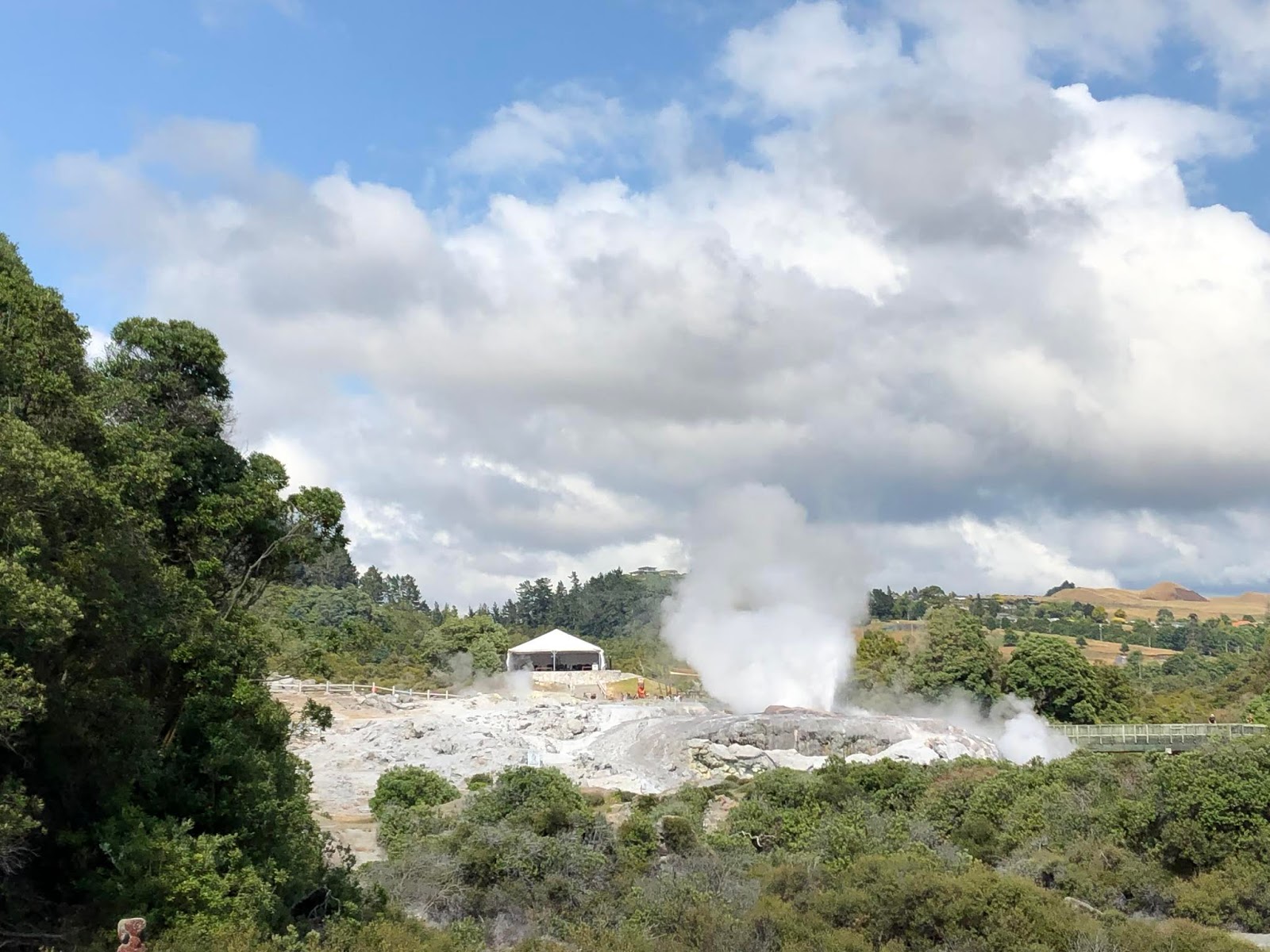 |
| Te Puia geyser, Rotorua. As seen from Whakarewarewa. |
In Rotorua, the Māori are not squirreled away in a museum with stories on walls describing their history and what the Europeans did to them. Instead, they are living their lives in their own town and sharing their culture with visitors. We spent time in two places with the Māori in Rotorua: at Whakarewarewa just south of town and at the Tamaki Māori Village quite a bit south of town. Both these places are Māori owned and feature the opportunity to learn about Māori culture and history in addition to being entertained for a couple of hours.
Tamaki Māori Village is a nighttime affair, featuring a welcome ceremony where elected chiefs from the three busloads of tourists are challenged and ultimately allowed to enter in peace and ending with a traditional hangi, a celebratory feast of meat and vegetables slow-cooked below ground on red hot rocks. It's similar to a luau in Hawaii (if you've attended one of those) and so the experience could be decried as something invented to cater to tourists from outside Aotearoa.
Maybe.
I didn't see it that way.
 |
| The unearthing of the hangi. The lamb was the best part of this meal. |
The Māori are perhaps most famous for the haka, a ceremonial dance with plenty of loud chanting, body slapping and facial contortions including widening of the eyes and sticking out of the tongue. This dance was performed before battles a long time ago, either to demonstrate strength to their opposition or just psych themselves up for the skirmish. Today, most kiwis can identify this dance by watching their national rugby team, the All Blacks, who perform the haka before rugby matches to the same effect that their ancestors used it centuries before.
The haka was performed for us before we entered the village, right after our chiefs for the night offered ceremonial silver ferns and stood their ground in the face of wide eyes and wagging tongues. Determined to neither show aggression nor fear before a wall of Māori warriors, the simultaneous showing of respect without terror by us, the visitors, was a palpable throwback to the past. I am sure centuries ago that I would have been more than a little unnerved by the possibility of doing the wrong thing and getting my head bashed in by a jade club but the seriousness of the interaction came across nonetheless.
 |
| Learning about Māori weaponry... |
 |
| and the use of the poi balls. |
Poi balls, you say? Yes. Poi balls. These balls on strings, which were originally rocks wrapped in bullrushes attached to a length of rope likely made from the flax plant, are used in a ritual dance. Their ancient purpose though was to teach young warriors coordination in the art of weapon use. They stopped this practice when the Europeans imported the musket. All of a sudden, hand to hand combat with sticks and clubs was rendered absolutely useless. Those muskets changed the Māori way of life suddenly and irreversibly.
The men in our tourist group were also forced (or maybe peer-pressured is a better term) to perform the haka dance as a group activity. A couple of things here. While the dance is marked by the same activity over and over again, it's not so easy to pick up when you have like a couple of minutes to learn it before having to make your debut in front of your fellow tourists. I got the tongue thing down (I mean who doesn't love sticking out their tongue?) but failed to coordinate it with the big eyes. The rest was just a mess.
Second, I'm sure it's way more intimidating wearing Māori warrior gear rather than a bright blue Patagonia rain coat. I could be wrong here but I doubt it. There is photographic and video evidence of all of this that will not be shown on this blog. I haven't even brought myself to watch the video yet. I can tell you it's a lot easier to pick up jumping with the Masai in east Africa than it was to do the haka, although i'm convinced if I could be better at one, it would be the haka. My knees and legs aren't made for getting any serious air in Africa, if they ever were. I'm convinced I can scream and slap my body loudly and I'd likely get the tongue coordinated with the eyes eventually.
 |
| Sulfur pools in front of houses at Wharekarewarewa. |
Just like at Tamaki, Whakarewarewa offers a guided tour; some lessons about this history and culture of the Māori; a performance featuring a haka, poi ball demonstrations and singing; and some food cooked underground. Only here, the food isn't placed on hot rocks in an excavated hole, it's just dropped into one of the few plywood boxes located about the property above a high temperature vent in the Earth and left there all day. Raw food goes in at the beginning of the day; hot cooked food comes out at the end. No fires to start, no gas to turn on, no electricity costs, just good cooked food. We'd seen this same sort of thing years ago in Iceland when we ate some rye bread baked in the hot soil around a sauna. That was a gimmick. Whakarewarewa is the real deal.
 |
| The world's least expensive and most efficient oven. |
Because the village is a real genuine Māori community, they have a meeting house that's actually in use towards the center of the property. The front of the Māori meeting houses are a metaphor for a man, with a face at the top of the gable end, the slopes of the roof representing the arms spread over the community and the vertical supports symbolizing the legs. The most celebrated houses are adorned with carved patterns and images of tikis, sometimes with their tongues extended as if right in the middle of a haka.
Because the missionaries that came after the whalers and the sealers did a pretty effective job of converting the Māori to christianity upon their arrival to Aotearoa, there's a cross next to the meeting house in what looks like either a mixed message or a blending of two very different worlds which are now both embraced at Whakarewarewa.

Overall, the feeling I got at Whakarewarewa is one of genuine-ness and refusal to compromise all the Māori traditions even in the face of life which might be just more convenient and comfortable if they just ditched the village and lived like all the European settlers today. I think this is probably a good thing. It certainly seems like there's room enough for both traditions in the country today. I can't imagine how noisy those geysers are at night though. I suppose you get used to it.
So about that equality thing. I mentioned that it got to be all the way into the 1980s before the Māori started to get any sort of acknowledgement from the descendants of the Europeans in Parliament that their rights as a people were just as important as the rights of the invaders from Britain and other parts of the other side of the globe. A minute or two to review that is probably appropriate.
In 1977, a group of Māori occupied a piece of land called Bastion Point near Auckland as a protest. The land had been confiscated from the Māori in 1886 under the pretense that the land was needed for defense of Auckland harbor. The land wasn't developed for the purpose claimed by the government but they never returned the land. In 1976, it was decided that the land could be sold to a developer for high-income housing. The Māori disagreed and unsuccessfully protested, ultimately being evicted from the land again just as they were some 90 years prior.
But the land was never sold, and in 1985, the Waitangi Tribunal was set up to examine past wrongs on the part of the government related to Māori lands. At first the Tribunal concerned itself with recent wrongs, including the Bastion Point dispute of the mid-1970s. But eventually they examined more historical land seizures and have recommended land be returned to the Māori with compensation and apologies. And in some cases, the lands have been returned.
 |
| The haka as performed at Whakarewarewa, Rotorua. |
Once the tribes were relocated, they were sometimes relocated again, driven off lands promised or established by treaty as belonging to them in perpetuity. As It turned out if the white man wanted some place occupied by Native Americans, the white man won, even if it meant breaking a promise or tearing up a piece of paper. Words were cheap and unreliable.
The same kinds of broken promises and forced relocations happened in Aotearoa. Let's make no mistake about that. But some lands have been returned to the Māori. And no, it's not anywhere close to all the land confiscated. But it's infinitely more than has been returned to the tribes that occupied the nation where I call home when Europeans arrived on these shores. Maybe I'm reading too much into my own emotions about my experiences with the Māori over a couple of weeks in early March 2019, but I feel the relationship between the Māori and Parliament is far, far better than the analogous situation in my own country. And I think that's really too bad that the United States hasn't done more to repair those past wrongs. Maybe one day. In the meantime, I understand a little more about Māori culture and will honor the time I spent learning this year.
 |
| Māori meeting house detail, Whakarewarewa, Rotorua. |
How We Did It
It's fairly easy to find and enter the three museums referenced in this post.
The New Zealand Maritime Museum is located right on the waterfront in Auckland at the corner of Quay and Hobson Streets. It's open every day except Christmas Day from 10 am to 5 pm. There are many many more stories to explore in the Museum other than the history of the Māori although we found that most compelling.
The Auckland War Memorial Museum is located in Auckland Domain Park. It's a little far from the center of the city for a walk, especially on a hot day. We took the Auckland Train Network's Southern Line to Parnell and walked across the Park and we taxied back to town fairly cheaply. In addition to Māori exhibits they also have moa skeletons. The Museum is open daily from 10 am to 5 pm.
Te Papa Tongarewa is right in downtown Wellington and unlike the other two museums, it's completely free. Woo hoo! It's open daily except Christmas Day from 10 am to 6 pm.
Tamaki Māori Village offers tours and hangi feasts nightly. In warmer months, they offer 6:15 and 7:30 shows. We generally book these types of activities early and would have preferred the later show (figuring the haka would have been more atmospheric later on) but found it sold out at that time. The Village offers hotel pickup which is great if you don't have a car in Rotorua (we didn't). The ride can get long. We were picked up before 4 pm for our 6:30 show. The pickup vans take you to their downtown office where you board larger buses after a wait. The ride home was much quicker.
Whakarewarewa can be reached by taxi or bus. We took the Number 11 bus from downtown. Get off right after the bus turns on to Sala Street. It's a quick walk south from there. Guided tours are offered several times each day either preceded or followed by a cultural performance. There are also a series of geothermal nature trails on the property. We skipped these in favor of making our way to the Redwoods Treewalk. The Village is open every day except Christmas from 8:30 am to 5 pm.
It's fairly easy to find and enter the three museums referenced in this post.
The New Zealand Maritime Museum is located right on the waterfront in Auckland at the corner of Quay and Hobson Streets. It's open every day except Christmas Day from 10 am to 5 pm. There are many many more stories to explore in the Museum other than the history of the Māori although we found that most compelling.
The Auckland War Memorial Museum is located in Auckland Domain Park. It's a little far from the center of the city for a walk, especially on a hot day. We took the Auckland Train Network's Southern Line to Parnell and walked across the Park and we taxied back to town fairly cheaply. In addition to Māori exhibits they also have moa skeletons. The Museum is open daily from 10 am to 5 pm.
Te Papa Tongarewa is right in downtown Wellington and unlike the other two museums, it's completely free. Woo hoo! It's open daily except Christmas Day from 10 am to 6 pm.
Tamaki Māori Village offers tours and hangi feasts nightly. In warmer months, they offer 6:15 and 7:30 shows. We generally book these types of activities early and would have preferred the later show (figuring the haka would have been more atmospheric later on) but found it sold out at that time. The Village offers hotel pickup which is great if you don't have a car in Rotorua (we didn't). The ride can get long. We were picked up before 4 pm for our 6:30 show. The pickup vans take you to their downtown office where you board larger buses after a wait. The ride home was much quicker.
Whakarewarewa can be reached by taxi or bus. We took the Number 11 bus from downtown. Get off right after the bus turns on to Sala Street. It's a quick walk south from there. Guided tours are offered several times each day either preceded or followed by a cultural performance. There are also a series of geothermal nature trails on the property. We skipped these in favor of making our way to the Redwoods Treewalk. The Village is open every day except Christmas from 8:30 am to 5 pm.


