Showing posts with label Isle of Lewis. Show all posts

Thursday, August 25, 2022

Don't Pay The Ferryman

Our trip to Scotland in late June and early July of this year lasted almost exactly two weeks. I mean that quite literally. We spent 14 days there almost to the hour from the time we crossed the Scottish border heading north to Glasgow to crossing the same line heading back south to England. That's about 336 hours of time, if you are inclined to do the math. Clearly, I was.

Of those 336 hours north of the border, we spent an awful lot of time on boats. Like an astonishing amount of time. We sailed (sailing here means a boat with a motor; there were no actual sails involved on this trip) on small boats with about 10 other people to massive boats seemingly capable of spending long hours at sea in all sorts of weather. We left the shore in search of puffins, gannets and other sorts of birds; floated past world famous whisky distilleries right on the shoreline; and roamed around the largest loch in Scotland (and largest body of water by far in Britain) in search of monsters that never bothered to have the common courtesy to surface right next to our vessel and make us internationally famous.

But of all the boats we set foot on during this trip, we spent by far the most amount of time on ferries moving us back and forth between the mainland of Scotland and the Hebrides, the string of islands on the west coast of the country. By my count, we spent about 16 hours either on these ferries or waiting to get on these ferries. And they were worth pretty much every minute of it, and not just because we needed them to take us and our trusty Honda Jazz to some amazing places. 

So I'm thinking the ferries deserve a post, right? I mean almost 5% of our total trip was spent on these things. I wrote a post about gannets and our looks at those birds lasted less than an hour. And to be completely frank, we probably spent more than 16 hours with the wait times. We are always early, after all.


Early morning sail from Islay to the mainland (top); and leaving Ullapool en route to Lewis (bottom).

So honestly, if we really wanted to go to the islands of Islay, Mull and Lewis (and we did), we pretty much had to take ferries to get around. Sure, we could have flown to each island, leaving our car at whatever airport on the mainland we flew from and picking up some sort of transport on the islands, but that seemed way more complicated. The ferries (all of which were operated by Caledonian MacBrayne, or CalMac for short) were an essential part of our trip that ultimately probably crossed that line from necessary commodity to beloved travel partner by the end of our time in the Hebrides.

Maybe "beloved" is a bit of stretch but there was for sure a special kind of kinship with the CalMac ferries that we picked up during our first week in country. Part of that love (or whatever it is) is the romance associated with certain types of travel. Most of our time getting away is probably spent in planes and cars, two decidedly non-romantic types of travel, unless we are talking about a seaplane or something like that (like the one that took us to Dry Tortugas National Park in 2014). But if we start talking about moving from place to place on a boat or a train, now we are talking about a mode of travel that definitely makes me happier and more relaxed. 

There is something about being on a boat on the open water (and to clarify, we are talking calm water here) that is relaxing and peaceful. Just the ocean or sea as far as you can see with specks of land in the distance marking your departure point and destination or just an island or shore that you are passing by. It's slow. It's serene. It's exhilarating being out on deck watching it all. It's amazing.


I know...it's not a sailboat. It's a ferry. It has a pace to it that's plodding and unexciting on the surface. And those big engines are working hard and probably using all too much energy to get us from port to port. 

But there is a throwback quality to ferries that appeals to me. They are not fancy but they are the ultimate short and mid-distance people movers on the water that have been around for a long, long time. It's even better if you get to drive your car on and off them (which we did on six of the seven CalMac ferries we rode). There's something cool about putting your entire vehicle onto a boat and just driving it off on the other side. For all the places I've ever been, I'm not sure I've ever driven a car onto a ferry. That sounds crazy but I think it's true. Although, not any more.

About that driving onto the boat, though. You definitely need to pay attention when you are doing it. Most of the ferries we took had a single level of parking for cars; getting on and off those was pretty straightforward. The ferry between Ullapool and Stornoway (on the Isle of Lewis), though, had a second level of parking in its hold on each side of the boat towards the exterior. The second deck was accessed by a ramp on each end that was raised after it was full and then lowered to allow disembarkation. 

We were unlucky enough to park on the upper deck both ways on that trip. I say unlucky here because they let the upper decks off last; it's kind of difficult to lower the ramps to the upper decks when there are cars below. But we were not as unlucky as one person next to us who managed to drive their front wheel off the side of the ramp down from the upper deck. I don't know how long that mess took to get sorted out because we got off as soon as we could. Just watch where you are driving when getting on and off ferries is the message here.


The ferry to Islay opening up their vehicle "door" (top); and driving on at Ullapool (bottom).

One of the great things about boat travel is there is generally enough room to move around some (or a lot) and there's usually some stuff to do. Exploring a boat this size can take some time and we are not talking about open ocean travel here so there's typically something to look at while you are going wherever the boat is taking you. Plus, if you need a meal, there's a full galley. None of this is like a plane or train where you are confined to a relatively small space for the duration of your journey. More room is better.

We did manage to see some pretty amazing things looking overboard, from a very fleeting look at some dolphins (or maybe they were porpoises); to lots of birdlife, like gannets plunging into the water in search of food; to seaside distilleries on Islay; to a few ruins or a lighthouse or two or maybe even a castle. There are some great views of Duart Castle on Mull from the CalMac from Oban to Craignure. Duart is not a medieval castle; it was re-built in the early 20th century. But you still get a great view from the water. People pay for tours to see these sights. You get it all on the ferry for free.

And that food? Pretty good. At least for breakfast. We actually ate breakfast twice on the ferries. I'd highly recommend the bacon and tomato breakfast sandwich. I'll also say that we got the sense that the staff working in the galley really cared. If your order wasn't ready at the counter then someone would find you in the dining room and bring it. I got the sense that the job is not viewed as a stepping stone to something else. We saw when we got back home that the BBC is making a reality series about life working on the CalMac ferries. HAVE to find a way to watch that when it gets released next year.

Oh, there's also a full bar on board in case you need a dram of whisky. Just not at breakfast time. Islay is well represented, appropriately enough.
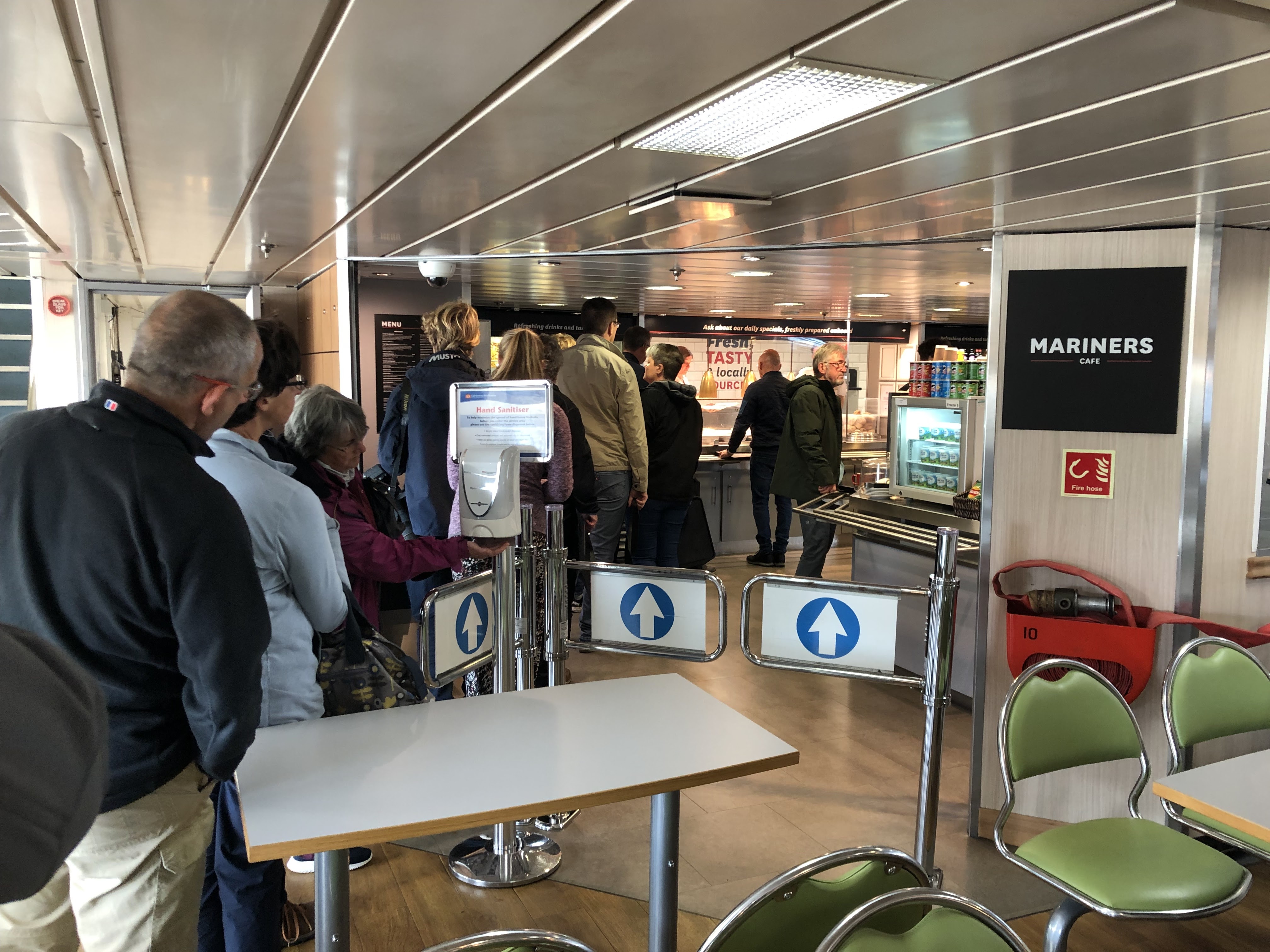

Waiting for breakfast (top) and I'm counting six types of Islay whisky at the bar (bottom).

As I've already said, we pretty much had to take these ferries to get where we were going but there is actually a benefit to getting to some of the departure points. These places could be seen as a necessity to get where we really wanted to go on the other side of the water, but we used the opportunity to explore a bit and appreciate the drives that it took to get there, wherever there happened to be.

We left for Mull from Oban, which is a bustling ferry hub. There are boats coming in and out of there all day so it would stand to reason that there would be something going on. Our destination here was lunch, which turned out to be a bite to eat at the sketchily named Oban Seafood Hut, a green painted stall right on the water. The shrimp sandwich was great but I'd steer clear of the rubbery whelks. It's the animal, not the place of business. Who likes whelks? I can't imagine.

Our other two points of departure (Kennacraig and Ullapool) took us by some of the best scenery we drove past on this trip. The road to Kennacraig took us past the shoreline of the west coast of Scotland. The road to Ullapool took us through the highlands. Both were amazing drives and the best part was they were just a bonus. We weren't there to drive through spectacular scenery at all; they were just throw ins for free on a drive of necessity. 

Ullapool, where we departed to Lewis from, is a gorgeous little town of rowhouses lined up facing the harbor. I can't imagine what people in Ullapool do for work because it seemed to be utterly remote, but the place is really well put together. I suppose the ferry brings a lot of business to the town. We ate at the local chippy here before we boarded and found a couple of Scottish fish and chip shop delicacies that we had no concept of what they might actually be. We stuck to the fish but looked up the king rib and the red pudding later. Glad we got the fish.


Scenes from the ferries: Port Ellen, the islands on the way to Stornoway, and Duart Castle.

The longest ferry we took on this trip was between Ullapool and Stornoway which was two and half hours (or maybe just a bit longer on the way there) each way. The shortest we took was from Iona to Fionnphort on Mull which was all of 15 minutes long. The ferry from Iona was mercifully short but the ferry to Stornoway was probably the best ride we took, despite the length. The weather was perfectly sunny on that 7 p.m. trip and the islands we motored past were just so picturesque. It was almost worth the price of admission for that view alone.

Speaking of admission and despite the title of this post (I have to search for song titles, right?) we did pay the ferryman here. And before we got to the other side. These things are not cheap, particularly with a vehicle to pay for. We were whale watching (or more accurately staring at the water) in the morning on Lewis talking to a dude from Salisbury, England and complaining about the cost of the ferries. He summed it up well (and I'm paraphrasing here): the cost of taking a car on the ferries is not cheap, but if you want to get to what's on the other side, you just have to pay for it. He was right. The CalMacs got us to some incredible places. I can't imagine doing it any other way.

The menu at Deli-Ca-Sea Fish and Chip Bar, Ullapool. Red pudding anyone?


How We Did It

The Caledonian MacBrayne ferries run all throughout the islands off Scotland's west coast, from Arran in the south to Lewis in the north. There are about 30 different routes in total and they operate at different times on different days of the week. Their schedules also vary by season. We were in Scotland right near the summer solstice so I assume the ferries were running much more frequently that time of year than during the winter months. Check their website for their most current schedules.

You will likely find that most routes require passenger arrival in advance of departure time, typically 30 to 45 minutes ahead of the actual departure. We were told by the hotel owner in Stornoway that we should not be late on these arrival times or else we'd risk being left behind. We planned on being early anyway (we are always early) but there were signs at some ferry terminals listing what happened to late cars. If I'm remembering right it was that you get put to the back of the line, but I suppose risk of being left behind might be real in some situations.

I like to think that I make travel reservations far in advance but I honestly almost got caught with no ferry reservation to Lewis. I bought ferry tickets on April 4 for that trip on June 25 and two of the three ferries to Stornoway that date and one the next day back to Ullapool were sold out. Fortunately, neither of the ferries we wanted to take were booked solid. Just don't count on last minute availability.

And not kidding about the breakfast. Or the BBC series. The food is good and I can't wait for that series to be released.


Saturday, July 16, 2022

The False Men


Before my last trip to Scotland in 2007, I hastily tried to add something to my agenda at the very last minute. I'd seen a picture of a circle of stones somewhere, somehow in some book or on some website about Scotland and decided it would be cool to visit an ancient site like that on one of our few days in country. I assumed these things were everywhere and so logically there must have been one somewhere close to where we would be driving. 

It didn't work. We ended up at some ancient burial mound site somewhere in the Scottish Highlands and it was not very satisfying. Nothing like the image I'd seen. No circle of stones. No stones at all if I'm remembering right. Just a couple of tombs that looked like mounds of soil. That's what I get for trying to jam something into an itinerary at the last minute.

The real reason my last minute wish list item didn't work, of course, is that my logic was just wrong. The stones that I'd seen are NOT everywhere in Scotland. What I'd seen was something called the Standing Stones of Callanish, and as it turned out, they were nowhere near the Edinburgh-to-Inverness-to-Glasgow route I drove on my 2007 trip. In fact, they are not even on the Scottish mainland. They are on the Isle of Lewis, one of the most remote islands off the coast of Scotland that are not the Orkneys or the Shetlands. It would not have been easy to add them to an already full agenda in 2007 or any year. Or even, for that matter, an itinerary with some holes. It would take some effort to get to see these things. No surprise at all that we missed them in 2007.

Fast forward 14 years or so and we are thinking about a trip to Scotland. My first thought was of the Isle of Lewis. If I was going back to Scotland, I was going to the Isle of Lewis. No way was I missing these stones again. They were the first thing I added to our 2022 itinerary.


So what's the big deal? It's a series of stones that are just standing upright in the Scottish landscape? Like Stonehenge? What's so special about that?

Well, no, not exactly. And yes, sort of like Stonehenge. But different.

Both the Standing Stones of Callanish and Stonehenge are circular formations. Stonehenge is actually a double circle and the Standing Stones are a circle embedded in a cruciform formation. Both have evidence of some sort of burial within their rings (at Callanish this is a cairn near the center of the circle). Stonehenge is massive. It's way bigger overall and its stones are significantly larger than those at Callanish. They are taller, thicker and way, way heavier. They look like a major construction project. Whoever built Stonehenge made a concentrated effort to invest a lot of time, labor and effort into making something really enormous. It is also clearly made by man very consciously and carefully. It's impressive. Like really impressive. 

So why, you might wonder, having already been to Stonehenge, would I want to go to Callanish and having seeing something way bigger in every respect. 

Good question. Sometimes it's not about the size.


The central circle (top) and the top of the central stone (bottom).
Callanish is different. Yes, it's smaller overall. Yes, the pieces of stone are smaller. But the effect is different. The stones at Callanish look like someone very large and powerful (let's say God...or maybe A god...) hurled giant fragments of rock down onto the Isle of Lewis with a ton of force. And they stayed there. It's way more romantic than Stonehenge even though Stonehenge clearly took way more effort to construct. I'm sure they didn't actually get planted in the ground this way but it's the image that comes to mind. More romantic, I'm telling you.

I also suspect the wildness and remoteness of Lewis helps a lot with this romanticism. It is difficult to imagine Stonehenge truly in the middle of nowhere like it must have been when it was built. Despite being on a great grass plain, it's near enough to the town of Salisbury that it's not that far from civilization and the nearest pub. The Standing Stones are truly remote. There is nothing resembling a town really anywhere near them.

There are a couple of other things about Callanish. First, nobody really knows how these things got there or what they were used for. Seriously. There is no substantial evidence of where these stones came from or how they were placed where they are still placed about five millennia or so after they were planted into the Earth. And the reason for putting them there? Total mystery.

I know, I know, there are similar sorts of questions (like the how they were erected and exactly what its purpose was) about Stonehenge. But, we do know at least where Stonehenge's raw materials came from and there is a lot of circumstantial evidence about Stonehenge's relationship to the sun on the solstices. Callanish? Not so much.


The cairn (or tomb) within the main ring of stones is visible in the top picture.
According to the signage near the Stones themselves, the central ring of 13 stones have been in place since about 3000 B.C.E. (there is a visitor center near the stone circle and I'm sure it's packed with more information but it's not open on Sundays and we visited on a Sunday so we had to live with the signage near the stones). That's about the same age as Stonehenge. The cairn or tomb was added later, just like the evidence of burials at Stonehenge seems to have followed the actual building of the henge. But the similarity between what's known (or what feel pretty sure about what we know) about the two sites stops pretty much there.

The biggest question is about the point of it all. There are a ton of theories about the purpose and design of the Standing Stones, some of which seem to be clinging to hope and based purely on coincidental evidence. There are ideas about some (but not all) of the stones being oriented according to true north. There are other notions about stones being rotated to align with cardinal directions. But the most popular theory seems to be something about alignment with a lunar phenomenon known as the "maximum standstill" which occurs every 18.6 years. Really? 18.6 years? Is that really intentional? I get that the concept of years as we measure them might not have existed 5,000 years ago, but really? I can't see it. Seems like grasping at straws.

The Standing Stones of Callanish with a scale figure. Big enough to not move easily.
The other thing about Callanish is how intimate your experience can be. This post is not intended to be a comparison between Callanish and Stonehenge (although I guess it totally is), but as accessible as Stonehenge is, the volume of people visiting that site has forced the actual circles of stones to be fenced off. Its popularity has also ensured that you will never be alone. Just to get there, you have to pass through a visitor center and board a tram to visit the actual stones. And you can only do that during opening hours.

That's not how it works at the Standing Stones. They are just there in a field. And they are open 24/7. They are never closed. We visited at a reasonable time in the morning (we did think about getting up at sunrise but since sunrise was at about 4:30 a.m. when we were there that idea got put aside pretty easily) and had the place to ourselves. OK, so that's not exactly true. There was another couple just leaving and there were a ewe and lamb standing on the path when we got there. I think I can deal with two other people and two sheep in a place this impressive. 

You can also walk right up to the stones and lay your hands on them. I tried not to but honestly I had to just touch one for a few seconds. I know it's a little irresponsible but I just had to. These things have been standing upright in this location for 5,000 years. It is difficult to stand next to these stones and not wonder what these monuments have seen over all the time they have been in this place. Lewis is a wild place. The weather is harsh and I am sure building materials like stone are in short supply. It's amazing they are still even there. 

This visit to the Standing Stones of Callanish represented 15 years of pining for a lost opportunity. It was different than I imagined it. I thought they would be a little bigger, to be honest. But the remoteness and the ancient-ness is what I wanted and the payoff was huge. Sometimes the struggle to get somewhere makes the reward of actually being wherever "there" is totally worth it. The remoteness of Callanish definitely fit into that category.

The crazy thing is, they are not the only ones there. 


Callanish II. The Standing Stones are barely visible between the two full stones in the top picture.
If you make it to Callanish, you might find the famous circle of stones that I've been posting pictures of on this post so far referred to as "Callanish I". That's because there are several other stone circles within a five mile radius of THE Stones. And some are really, really close. We decided since we came all the way to Lewis that we would have to try to see at least one more of these circles and we found Callanish II super close to the main circle down a lane or driveway and a quick walk across some sort of field. And there, sure enough, are five more stones (NOT the size of the main circle) just standing in the middle of another flat piece of Lewis.

Callanish III is visible from Callanish II, although after we'd seen II and found out it had none of the pull of the Standing Stones, we passed on the walk over to III. How amazing is it that there are all these stone circles spread all over on part of the Isle of Lewis still there so long after their creators made them? I think it's super awesome. We might have spent more time seeking more circles out but there was other stuff to see (including some incredible looking sheep) and a ferry to catch. And no way did we want to be late to the ferry!!!

I have found that there are stone circles in other parts of Scotland. I'm not sure exactly where they are but you don't have to go to Lewis. But I'd totally recommend it. I may never get to a spot this remote in Scotland again. It cost us time and money to get there, but it was completely worth the 15 year wait.

Our sheep guides. They quickly climbed over the stone wall to the left. Who knew they could do that?
The title of this post is a reference to a local legend about the Stones. Seems that when the Christians were trying to get people to convert to Christianity, they invented a story (read: they lied) that they told the local peoples to convince them to join their flock. Their origin story of the Stones in this lie was that the rock pillars in the field were actually giants who were turned to stone when they refused to convert to Christianity. They called these giants in stone form the false men. I feel bad using a lie told by Christians (and God knows, Christians can lie with the best of them and always have been able to) to fool local people as my title here, but the name is just so good that I had to use it.


How We Did It

It takes a lot to get to the Standing Stones of Callanish. They truly are in one of the most difficult places to reach that I have been. Having said that, it was pretty easy relatively speaking if you have a car. But it's not quick to get there.

There are two ways to get to Lewis: by air and by sea. If you opt for the air route, you'll have to take a flight to Stornoway from one of four other places in Scotland: Edinburgh, Glasgow, Inverness or Benbecula. I had to look up where Benbecula is; it's an island to the south of Lewis. If you fly, you'll still need a car to get to the Standing Stones. They are about a 20 minute drive from Stornoway. The drive is remarkably easy. We found driving on Lewis to be pretty simple compared to some other places in Scotland (like the Isle of Mull); the roads are generally two lines wide (meaning one lane each way; not all Scottish roads have a lane for each direction of traffic) and there's pretty much nobody there.

We (meaning the two of us with our car) took a ferry from Ullapool on the mainland to Stornoway. This ferry runs twice per day round trip. Our original plan was to day trip to Lewis from Inverness by taking the ferry to Lewis; driving to see the Stones; and catching the next ferry back. The problem with that is the turnaround time for the ferry most days is just one hour in Stornoway and you have to check in 45 minutes before departure time. The turnaround time on a Saturday is 2-1/2 hours which might make a day trip possible but it is still really pretty tight. We elected to stay overnight since we were not visiting on a Saturday.

That Ullapool to Stornoway ferry information, by the way, is only applicable from late March to late October. In winter, the frequency of the ferries drops. Check the Caledonian MacBrayne website for the latest information. The ferry from Ullapool to Stornoway is 2-1/2 hours each way.

Also, the ferry isn't cheap, especially for cars. We talked to a dude from Salisbury (ironically) looking for wildlife at Tiumpan Head on Lewis after we visited the Stones (we were at Tiumpan Head looking for whales which of course did not appear) who complained about the cost of the ferry and then acknowledged what choice to you have but to pay if you want to visit. He's right. There's pretty much no choice. It's pricey to get to Lewis. The good news is that it's not pricey once you get there. If you don't want to take the ferry from Ullapool to Stornoway, you can get to Lewis by taking a ferry to the Isle of Harris (although not from Ullapool) and driving to Lewis.

There is a visitor center near the Standing Stones. It's open Monday through Saturday 10 a.m. to 5 p.m. We visited on a Sunday so I can't vouch for how good it is. You don't need to visit the center to visit the stones. We parked at the visitor center parking lot. Not sure if that is kosher when they are open but there was clearly nobody there to care when we showed up. It did appear that there were other spots nearby to park a car.