Showing posts with label Tokyo. Show all posts

Wednesday, June 4, 2025

Gashapon


This is my last Japan post from our 2025 Tokyo trip. Here's hoping it won't be another seven years before we make it back over there. But then again, there are so many places to go...

Let's start this post in a place that is decidedly not Japan.

I first set foot in the United States in July of 1979. I was an 11 year old kid born and raised in England who was suddenly taken from the only country I had ever lived in and moved an ocean away. Lest this sound like some sort of kidnapping, let me assure you this move was entirely consensual. My parents asked the opinion of both me and my sister and I (at least) was all in from the get go.

Being moved from the United Kingdom to America as a child in the late 1970s involved a good amount of complete culture shock. I know, I know, today there are a lot of similarities between the two places when it comes to things kids care about. But back then? Not so much. American candy bars were inferior. Comic books in the U.S. told a story that lasted months rather than a single page. The crisp selection in the States was miserable. And I'd never even been to a McDonald's. Fast food? What's THAT!?!? OK...so fast food was an upgrade.

Then there were trips to the grocery store. On the way out, there were these machines near the exit doors. What were these? Gumball machines? Didn't have those in England. How awesome are these, especially ones that dispense toys in little plastic capsules rather than gum? Put in a quarter and rotate that handle and some stickers or a miniature (American) football helmet or some sort of other toy comes out? I'm sold! This is definitely an upgrade to my 11 year old life.

Gashapon store near Sensō-ji Temple.

While I certainly didn't know it at the time, vending machines like the ones I found in American supermarkets in the late '70s have been around since the late 1800s. They have been used to sell gum and postcards and tobacco and soft drinks and all sorts of other products. Eventually at some point between the late 19th century and the 1960s, these things branched out and morphed into automated purveyors of small plastic toys for kids to take their chance at dropping a coin into a slot, turning a crank handle and finding something to play with. I fell in love on sight, even if I couldn't really afford to put too much money into these things.

Apparently, I wasn't the only one in the world not from the United States who was fascinated with these things. In the 1960s, they were introduced to Japan. And like some things when the Japanese get a hold of them, being in Japan elevated these little toy-containing plastic capsules into what can only be described as an artform combined with a bit of a national obsession. They called them gashapon, apparently named after the sound that the crank handle makes (gasha) combined with the "pon" sound (whatever that is...) when the capsule drops into the dispenser place. It's an onomatopoeia. Remember 6th grade English? If not, Google it!

Gashapon machines in Japan are not confined to grocery stores. They can be found just about everywhere. What does everywhere mean? Try stores crammed into any sort of available space. Try in train stations. Try on street corners. Or jammed between buildings off of streets. Pretty much anywhere appears to be fair game for gashapon machines. 

We dabbled in these things a bit in Akihabara in 2017 and then again in Singapore last year. With our second full trip to Japan, we had to go find some of these things in a serious way. We were on a mission.

Train station gashapon.

Maybe a terminology check is in order before I continue. I should mention that there are a variety of different spellings and pronunciations of gashapon. Google "gatchapon", "gachapon" or "gasha gasha" and you'll find they all mean the same thing. I'm sticking with gashapon. 

So why do I want a whole series of little pieces of plastic out of gashapon machines? Well, I don't necessarily, but I have a niece who is 12 years old who's a little enamored of these things and Japan's culture in general. With this quest, I decided to combine my desire to do something completely and uniquely Japanese with an ability to make someone other than me happy as the end result.

Her request? One Piece. Demon Slayer. Dandadan. Anime / manga series that she watches. We found a ton of One Piece stuff last year in Singapore so we figured we'd be pretty much good there. The rest? Well...we'd just have to see. 

Clearly, by the cover picture of this post, we found some One Piece stuff.

Three. Thousand. Gashapon.
I will say that on this trip, we spent a surprising amount of time looking around gashapon stores, if that's even the correct term. We bought from machines on the street. We bought from machines in an open air place that can only reasonably be described as an L-shaped dead end corridor. And we shopped but didn't actually buy at a gashapon-packed (and I DO mean PACKED) room near Tokyo's famous Sensō-ji Temple. 

But we figured if we were really serious about this whole gashapon quest, we needed to visit somewhere that had more of these things than any other place on the planet. Fortunately for us, that place exists in Tokyo. It's in the Sunshine City Mall. Want to go shopping for gashapon? Go visit a place that has 3,000 of them in one very tight corner of a shopping mall. Think there's a typo there? Let me spell it out more clearly: Three. Thousand.

So let me say that I don't get some of this. Did we buy some things for my niece? You bet we did. Did we buy some things for ourselves? Oh yes, I fell for one of the miniature historic temple / shrine torii and we went in hard (meaning like the equivalent of all of $10...) on Sanrio's "Ate Too Much" toys. But I have to tell you, I don't get some of it. And yes, I acknowledge that I am not the target audience for some of this stuff.

I can understand the Sanrio stuff and the One Piece figures and the Miffy stuff. I actually think the One Piece figures are super well executed and detailed; the couple of things that we picked up last year in Singapore (and shown below) are just exquisite. I can even understand (and I can't believe I'm writing this...) the miniature Honda Civic wheel rims key rings. It's a custom car street racing thing, right? Like Fast and Furious? Maybe?

Look...I'm 56 years old. I'm allowed to be a little out of touch.

Last year's One Piece haul from Singapore.
So honestly, and accepting the Japanese have a fascination with like all things miniature and particularly food-related things, I struggle with at least a couple of the machines in the 3,000 machine gashapon store. I can't blow-by-blow this stuff but let me use two things as an example of my confusion.

First (and I know this has nothing to do with food but I'll get to that part), there was a machine that sold miniature folding stools. Like step stools that are in their real-life, full-size versions like eight inches high and let you get all of eight inches above the floor level by taking one step up onto them. And yes, when they are not needed they fold into like a two inch vertical piece of plastic. Folding stools. We have a couple of these at home and they serve their purpose just fine when we need to reach that highest shelf in a closet. 

Why does anyone need this in miniature form? Why? What do you do with this? And assuming part of the fun here is to collect the whole set...why on Earth do you need six different miniature folding stools?

Same question really but different machine: the miniature Johnsonville brats machine. Like brats like bratwurst. The sausages that people put on their grills in summer and feel like they are eating something really amazing from Wisconsin. Why do you need a packet of six tiny sausages? Is there some Japanese collector culture where people accumulate a collection of packaged groceries of a specific scale? These also, by the way, come in different flavors. Is the expectation the someone out there keeps putting yen into these machines until he or she owns all five flavors of tiny Johnsonville brats? 

Really? Can anyone help me out here?

By the way, I can totally believe there's a Japanese collector culture centered around miniature food of a specific scale. Absolutely no doubt about that.

Who needs six (or one, even) tiny folding stools?
Maybe the intricacies of gashapon culture are not to be explored and known by a middle-aged gaijin. After all, we were sent to Tokyo with some marching orders. We needed to track down these anime / manga souvenirs. And the Sunshine City Mall was our best hope.

There's no map, by the way. I don't mean to the Mall. Google Maps got us there just fine. But once you get inside the store, there's no map. There's no index or grid that shows what is where. You are just faced with 3,000 identical looking machines in row after row as far as you can see punctuated by displays showing (and I'm guessing a bit here...) some of most popular gashapon toys in their full set form. You know...so you can want it.

So after walking around for a bit we did what we would in any other place...we asked for help. OK, I didn't ask for help since I'm a dude. WE asked for help. In English of course. In Japan. It wasn't the easiest conversation but honestly considering we would have stood no chance of having this exchange in Japanese, it was pretty effective. There was some looking at a sort of a map of the store, some reference to "boys' machines" and a direction to go towards the back of the store.

What did we do in the back of the store? Asked again. 

Dandadan? Nothing. 

Demon Slayer? One machine. One is better than none. 

We found One Piece just fine on our own. No shortage of One Piece machines. Heck, they have an entire One Piece store in the Mall. One Piece is somewhat popular in Japan.

Gashapon store display showing sets of gashapon toys. Miffy in the lower right. One Piece is top shelf.
Three new One Piece machines. One Demon Slayer machine. Yen in. One from each machine. Guaranteed no duplicates. We were traveling light. And how many of these things can you really collect anyway? Especially after we almost emptied the Sanrio Ate Too Much machine later in the week. And admittedly, that was for us. 

Was it worth traipsing halfway across Tokyo to go to a gashapon machine store? Absolutely. No doubt about it. I feel more connected to a Japanese obsession now. Was it everything I intended it to be? Probably not. I had visions of us coming home with unique souvenirs that spoke to us and encapsulated our entire 2025 trip symbolically. Aiming a little high there. But we did have fun and we accomplished our mission. I won't be doing this again (meaning heading to Sunshine City Mall for this) but I'm always going to sneak a peek at what we might be able to get by turning that gashapon machine wheel just like I used to do when pushing the grocery cart our of the store in 1979 Connecticut. 

That fascination will never grow old. It's just a lot more fascinating in Japan than what I can find at my local Safeway.

Japan posts over. Now I need to get on the road again.


Most of our 2025 haul: 3x One Piece; 1x Demon Slayer (top). Miniature torii (bottom).

Tuesday, May 20, 2025

Goshuin-Cho Update


Warning: complaining coming.

For as long as I can remember in my life, I have been a collector. Football cards. Comic books. Stamps. Star Wars figures. Baseball cards. Coins. Records. CDs. Bobbleheads. Art. Autographs. Funko Pops. Funko Pop Incredible Hulks. I am sure I could go on and on and on and on.

A lot of my collections are long since abandoned (NOT, I should note, the Funko Pop Incredible Hulks) but in 2017, I picked up the start of a new collection: Buddhist temples and Shinto shrines. This collection started on the slopes of Mount Fuji in May 2017 and continued as recently as this past April in Tokyo. While my collection of Japanese temples and shrines is very much experience and memory based (since I'm not ACTUALLY acquiring the actual properties), there is a physical manifestation to this collection: the goshuin.

Goshuin are temple seals, stamped images which are then personalized with calligraphy by the monks resident at the property you are visiting. A collection of goshuin is traditionally kept in a goshuin-cho, or temple seal book, which opens accordian-style to record your memories. Or I guess to allow others to record your memories would be more technically correct. Fill your goshuin-cho with a series of stamped and written souvenirs and you create a keepsake which is likely unique in this world. It really records your personal journey throughout Japan.

Since we had a few temple and shrine visits on our agenda for this trip, we brought the goshuin-cho we purchased at the Komitake Shrine on Mount Fuji all those years ago to get that volume a bit closer to being filled up.

But this year, collecting goshuin did not go as planned. We found a few things that were different.

What we had found at every temple and shrine we visited before this year was that you got a goshuin in exchange for about 300 yen. Sometimes we had to wait if the property was mobbed with people but that wasn't really a big deal. We'd just drop off our goshuin-cho as soon as we got to the temple or shrine and pick it up 20 minutes or so later.

The first temple we visited on this trip was Gotōkuji Temple west of the city, a veritable celebration of the waving cat (or maneki-neko) that populates Japanese and other sorts of Asian restaurants all over the United States and I'm sure the world. We found the temple shop, entered, inquired about a goshuin, handed over 300 yen and got a pre-stamped, pre-calligraphed (is that actually a word?) sheet of paper just a bit smaller than our goshuin-cho handed back to us.

What is this? A pre-printed sheet of paper? That's not what we wanted. What are we supposed to do with this? Glue it in the book? Really? Is this a cutback on labor? Are the monks who write out the goshuin out to lunch or just not working that day? It was pretty confusing. And no, we didn't pepper the dude behind the counter with all these questions. He didn't seem super engaged. 

This was shocking. And it was not the last time it happened. We purchased another pre-printed sheet at Kita-in Temple in Kawagoe and found no handwritten-on-the-spot option at Hikawa Shrine (also in Kawagoe) or at the cemetery of the 47 rōnin at Sengaku-ji. We stopped buying after Kita-in. Couldn't come to terms with whole thing, especially after discovering the second piece of paper we were handed in exchange for our yen was larger than our goshuin-cho. Disaster. What are we supposed to do with a piece of paper bigger than the actual book that it goes in?

Now admittedly, this did not happen at every temple and shrine we visited. We did get some actual goshuin written and stamped in our goshuin-cho. And because I've been recording in this blog which goshuin came from which site, I am doing the same thing here. The three pictures below record the filling of one side (minus one page) of our Komitake Shrine goshuin-cho. As usual and because it's Japan, I'm listing the goshuin right to left.

Sensō-ji Temple, Tokyo (right) from 2024; Gotōkuji Temple (preprinted), Tokyo (left).
Meiji Jingu Shrine, Tokyo (right); Fukagawa Fudō-dō, Tokyo (left).
Kita-in Temple (preprinted), Kawagoe (right); Matsuchiyama Shoden Temple, Tokyo (left).
I love the green stamp on the goshuin from Fukagawa Fudō-dō by the way. This is our second goshuin with different colored stamps (after Tomioka Hachiman last year). I'm also a little disappointed that the Matsuchiyama Shoden goshuin doesn't have a big old radish in it but I'm probably projecting 21st century western sensibilities there.

After our visit to Matsuchiyama Shoden, we were left with one blank page in our original goshuin-cho and we had just one more temple left on this trip: Sengaku-ji. Since the story associated with Sengaku-ji was so powerful for me (read about it here), we decided to go ahead and retire our Komitake Shrine goshuin-cho and buy a new one with an image pertinent to Sengaku-ji on the cover. Is this just blatant consumerism? Maybe. We wanted a new book and the right one was available. It's the book with the green paper sleeve in the cover picture of this post and immediately below.

And yes, I know that means we have a book with one page on one side of the book blank and had the whole other side entirely empty. Deal with it. We are.


Our new goshuin-cho is gorgeous. The front and back cover are yellow-gold in color and the front features what I can only assume are 36 of the 47 rōnin that avenged Lord Asano Naganori's death a little more than 300 or so years ago. It is different than the first goshuin-cho that we bought way back in 2017: the cover is paper (and not cloth) and the book is a little larger (which may explain why the pre-prepared goshuin we picked up in Kawagoe is bigger than the only goshuin-cho we owned at that time.

I mentioned earlier in this post that there were no on-the-spot goshuin available at the cemetery at Sengaku-ji but we still got our goshuin from our visit because there are actually two available at this temple. Although I will admit, I am disappointed that I couldn't get a temple seal from the very spot that the 36 rōnin (I guess 47 wouldn't fit?) on the cover are resting forever.

The goshuin that the monk who sold us our new goshuin-cho added to our new book was very different in one respect from all the other goshuin we have collected: it was free.


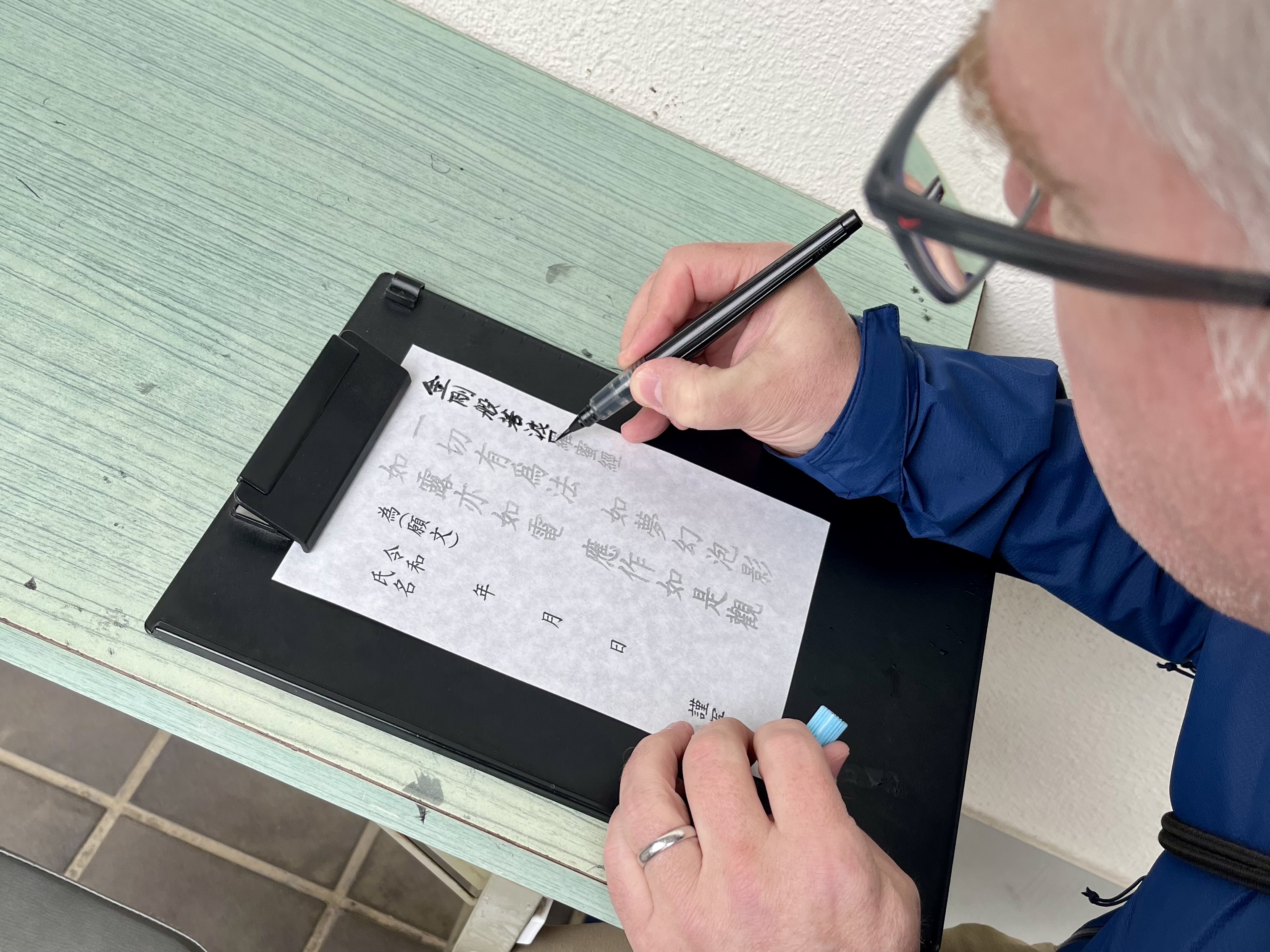
So that previous statement isn't exactly true. It's true that we didn't pay cash or credit for our goshuin at Sengaku-ji. But it wasn't completely free. It required the copying of a sutra or a piece of scripture by me while we were on property. And it's all in Japanese.

This could have been challenging. I mean I've never written in kanji before so I imagined my effort would be very, very sloppy as I copied a few dozen or more Japanese characters using a calligraphy pen from an example sheet to a brand new piece of paper.

They didn't make me do that. I was directed a series of drawers which contained different sutras, all printed on the back side of what looked to me like a sheet of vellum. I was simply required to trace over the letters with my pen. I am sure my attempt was less than perfect but it looks pretty impressive in the photograph above. I'm sure I flagged at the end and got a little sloppy. There are a lot of characters to copy.

It got me the goshuin below, the first entry in our brand new goshuin-cho which is now ready for more filling. When are we headed back to Japan again?

Saturday, May 17, 2025

More Temples, More Shrines


Yes, the cover picture of this post is a stack of daikon radishes. Read on!

On each of our first two visits to Japan (I'm counting last year's 18 hour layover on the trip home from Singapore as "a visit to Japan"), we have spent a significant amount of time visiting Shinto shrines and Buddhist temples. I like to think that it is a measure of respect that we have for the country of Japan and its residents that we do this. There is a spirituality about the entire nation and a sense of ritual and peacefulness and tranquility at each of the shrines and temples that we have visited, whether it's a major temple of national importance or a local shrine. There is a specialness in being at these places that is restorative. 

Does this strike you as odd or weird? I mean, would people visit 12 or 13 churches in Europe on a ten day trip like we did with these places in Japan in 2017? Actually...I think they would. I've certainly visited my fair share of churches on trips to Paris or London before and not given it a second thought. I see nothing wrong with this, particularly if there is some history about these places that is significant. Because after all, I do love me some history.

By the way, if you are questioning how we spent a "significant amount of time" at Shinto shrines or Buddhist temples on our 18 hour layover last year...consider this: we were in country for less than 18 hours, which included a full night's sleep in a hotel and getting to Haneda Airport at least two hours before our flight and we still visited one shrine and one temple. I'd say two in 18 hours total with a night's sleep in there and transit to and from the airport is significant.

Vermilion torii at Nezu Shrine, Tokyo.
Now, legitimately, these things are major tourist attractions and some of the most incredible experiences I've had in Japan have been seeking out and visiting these Shinto and Buddhist houses of worship. Admittedly, part of the attraction sometimes has little to nothing to do with religion. If you are ever in Kyoto, I'd highly recommend spending a few hours (yes...hours!) walking around Fushimi Inari Shrine. And if you make it to the island of Miyajima, you should definitely visit both Itsukushima Shrine and the Lovers' Sanctuary most of the way up Mount Misen. These are two incredible hikes but the shrines definitely improve the experience.

So how did we decide where to visit, exactly? Well, on our first visit to Japan, we went with a sort of "Top 10 Temples and Shrines in Kyoto and Nara" and visited every one because some guidebook or webpage recommended we do just that. It was awesome. For someone who knew nothing about Japan, it provided an incredible introduction to one part of the Japanese character. Last year, we went with a mini curated list (I mean it was just two in 18 hours...) and picked one of the most important Buddhist temples in the nation (Sensō-ji) and the Shinto shrine (Tomioka Hachiman) which can claim direct lineage to today's Grand Sumo tournaments. The latter was an awesome tie-in to one of our best experiences on our 2017 trip.

So when it came time to create an itinerary for a week in and around Tokyo in 2025, of course we had to visit some temples and shrines. But we wanted a list that included some of the most important properties in the nation and some that spoke to us and our experience and biases as well. In short, more curating was in order. 

Hundreds (or maybe thousands?) of maneki-neko at Gōtokuji Temple, Tokyo.
Before we get to what we found this year...maybe a quick refresher about Shintoism and Buddhism is in order. 

Shintoism is basically the O.G. religion of Japan. By and large, it has mostly stuck in Japan and not really spread elsewhere (Japan has a way of retaining an odd amount of exclusivity on Japan-originated things). The religion is centered around the worship of supernatural entities called kami which represent different aspects of life. Want to go visit a Shinto house of worship? Head to a shrine.

Buddhism is not a Japanese original. It started in India maybe a couple of hundred years before it showed up in Japan somewhere around the 600s and is based on the teachings of Siddhartha Gautama (the O.G. Buddha). The religion is centered around achieving a state of enlightenment which will either free you from an endless cycle of rebirth or allow you to stay enlightened and help others achieve the same thing. No shrines in Buddhism. Temples only.

This year's tally for a week mostly in and around Tokyo was five new temples and three new shrines. We took it easy. Although admittedly, we did make a repeat visit to Sensō-ji, although that was more of transit through visit with a stop at the bathroom. 

Decorated, straw-covered sake barrels. Meiji-Jingu Shrine, Tokyo.
So what did our curating this year do for us? Well first and foremost, it allowed experiences to stick in my head. Maybe it's early old age ADHD setting in or something, but I feel like I need visits to these houses of worship that are unusual and memorable, rather than just hitting up property after property with graveyards and pagodas and torii at every property entrance. Because for sure, there's plenty of that sort of stuff to go around.

What stuck with me this year? Well pretty much everything, from the hundreds or maybe thousands of maneki-neko (the waving cats that you see at some Japanese restaurants) to 500 unique statues of Buddhists in Kawagoe to a couple of hundred sake barrels decorated and offered to the spirits that inhabit the property today to walking through many, many donated vermilion torii (although not as many as at Kyoto's Fushimi Inari) and fishing for our own fortunes contained within miniature (and not real) red snappers. All I can really say about those sake barrels at Meiji Jingu Shrine is those are some lucky spirits. I hope a year's allotment lasts all 12 months.

And we also found a temple that goes through a ton of daikon radishes each day. That would be a place on a hill right alongside the Sumida River called Matsuchiyama Shoden. Walk into the property from pretty much any direction and you'll find buildings and lamps and ornaments decorated with full bags of cash and daikons of all size and color (although mostly golden). Both symbols are important to the temple although you have a much better chance at picking up a radish or two than finding a spare fortune or two lying around. 

Matsuchiyama Shoden. Radishes and bags of money.
What's the deal with the radishes? Apparently they are representative of our minds trapped in ignorance emanating poison and anger. By offering a daikon as sacrifice in front of the altar, then just like that the poison within us is apparently purged from the soul. Enter the main temple space and right there front and center before the altar is a pile of radishes. Where do people get all these radishes from? Well, they are for sale at various spots in the tiny, tiny temple property for 300 yen per radish. That's about two U.S. dollars in 2025.

Now, if we had realized this before taking off our shoes and trying to keep our socks dry all the way into the inside of the temple, we likely would have bought a radish or two so we could get the poison purged from our soul. Since we didn't do this, we ended up just gawking at the giant pile of veg and the incredible dragon on the ceiling of the temple. We often meet dragons when we are in Asia. This one was one of the best.

Radish temple. Worth the visit. And no, it doesn't appear that the temple recycles the daikons. Once it's bought and offered, it doesn't get moved back outside into the unsold radish boxes for more people to buy. Not sure what they do with all of them at the end of each day. I mean there are only so many footlong radishes one can eat, right? 

The best part about our temple and shrine visits this year wasn't the cats or the fish or the sake barrels or the statues in Kawagoe. It also was not (surprise, surprise) the giant radishes. Nothing that I've written above was the best part. The best part was the fire and the 47 masterless samurai who committed suicide over a blood oath. 

Although one of the 47 ended up better than the other 46. Or so I assume. Although I may be applying western values to my judgement here.

Close up of one of the 500 statues of the followers of Buddha at Kita-in Temple in Kawagoe. Beer or wine? 
It seems like most all countries or peoples out there around the world have a national epic or two that permeate through the centuries and provide a sense of national pride or commonality of purpose or history for their populations. These epics can have various forms. Some are written as poems or books; others are just folklore handed down orally from generation to generation, although I assume in today's day and age those are also written down somewhere.

Japan is no stranger to epic stories. One of their most famous is a tale of devotion, courage, betrayal, swordplay, pride, anger and revenge. And the best part is that's it's all true.

Here's the story.

In the year 1701, a young nobleman named Lord Asano Naganori was sent to the Imperial Court of Shōgun Tokugawa Tsunayoshi to learn court etiquette and protocol from one of the Court's tutors, Kira Yoshinaki. Apparently, Kira wasn't always the ideal teacher for every student. He had a bad habit of behaving like a bit of a bully when his students didn't show the expected level of reverence and our young Lord Asano fell into the not-showing-enough-respect category. After a couple of months of ill treatment from Kira, Asano snapped and attacked his tutor, leaving Kira with a wound on his face.

This was not good for Asano. The Shōgun got word of the whole situation and ordered Asano to commit suicide (or seppuku) the very day of the attack. Being an honorable lord, Asano did what he was commanded and killed himself. Aged 26. Gone. As were his family's land and standing and titles. All gone. All taken away.

Asano's act of aggression and suicide meant that the samurai who were tied to him no longer had a master to follow. In losing their master, they became rōnin, a term used to describe a masterless samurai. By tradition, rōnin were obligated to commit seppuku like their master. But these rōnin didn't. They disbanded and transformed their lives, becoming merchants or monks or (in the case of their leader, Ōishi Yoshitaka) a drunken debaucher. 

What does all this have to do with temples and shrines? Keep reading. I'm getting there.

Sengaku-ji Temple, Tokyo.
It was all an act. The 47 rōnin that appeared to have moved on with their lives after the death of their lord were doing nothing of the sort. They plotted revenge on Kira the day Asano died and kept working on a plan of deceit for almost two years so that the Shōgun would no longer suspect any sort of retribution was in the works.

Then on December 15, 1702, when everyone's guard was sufficiently down, the 47 rōnin gathered and made an assault on Kira's house. It was successful. Kira managed to escape his bedroom and hide in a hidden courtyard but he was discovered and when the rōnin found him, they cut off his head. They then took the decapitated head to Asano's grave on the grounds of Sengaku-ji Temple in tribute to their fallen master.

Got the temple connection, now? Good.

The murder of Kira didn't go any better for the ronin than it the attack on Kira did for Asano. All 47 rōnin were sentenced to commit seppuku for their dishonorable act. 46 ended up doing it, as young as teenagers and as old as late 70s, and were all buried next to their master at Sengaku-ji. And no, the 47th didn't refuse to kill himself; he was pardoned by the Shōgun. I'm not clear if the remaining one felt lucky or unlucky.


47 rōnin graves. The one with the incense burning in the top photograph is Ōishi Yoshitaka. 
Because of this story, this epic national tale, we had to visit Sengaku-ji. Not just to visit Asano, but to visit him, his wife and all 47 rōnin, who are all buried next to their lord in the cemetery inside the temple grounds. 

I believe it is a measure of the Japanese reverence for loyalty and honor that the seppuku deaths of both Asano and his 47 followers (OK...46) was accepted as a just punishment. They all committed some breach of honor against a peer or superior and therefore had to take their own lives. And they did. Without protest (ignoring the year and half gap between Asano's death and their revenge I guess). 

By the same token, the act of loyalty to avenge the death of their Lord (and look, is a little scratch on the cheek really punishable by death?) is revered to this day. They committed some terrible crime against honor but they did it in the most honorable way. At least that's my take.

Our visit to Sengaku-ji was stirring. Here we are in 2025, 300 plus years after all this happened and the very people who were the principal actors in this amazing story are still visited and respected. As a sign of offering today, you are supposed to purchase a bundle of incense sticks and place a few at each grave, although I guess when it's raining the ash becomes difficult to remove when it's mixed with water so we were requested to place our lit sticks of incense only at the four covered graves. We did as we were told.

A stone and plum tree at Sengaku-ji. Both allegedly stained with the blood of Asano Naganori when he killed himself.
Sengaku-ji wasn't the best temple we visited this year.

There is a buddhist temple on the east side of Tokyo called Fukagawa Fudō-dō where the monks in residence perform a loud and smoky and intense fire ritual. It's both primitive and sophisticated and intense and uplifting and cleansing all at the same time. And they perform this thing five times each day. Every day.

Get to the Fukagawa Fudō-dō on the odd numbered hours between 9 in the morning and 3 in the afternoon and you can witness this ceremony. No reservations, no fee, no questions, no exclusions and no shoes. Just walk in off the street and spend about 30 minutes with some buddhist monks and a whole lot of fire.

Here's how it works. And because it all took place inside the temple...no pictures. 

Shoes off. Place them in a bag. Walk to an empty spot on the tiered seating areas and sit down. What you'll be looking at if you have a relatively clear view of the main temple space is an altar on a stage in front of an empty space (that's where they will burn stuff) backed by an enormous black-lacquered wood wall with gold decorative accents. The wood wall has a series of very shallow shelves upon which are standing a series of thin pieces of wood decorated with kanji writing.

Towards the front of the stage you'll notice a couple of very, very large drums. I'd guess about two to three feet in diameter and maybe five to six feet deep. The drums are laid on their sides with the massive drum heads facing the audience. They aren't the only drums on the stage, but they are certainly the most obvious and noticeable. 

The street side approach to Fukagawa Fudō-dō. This is NOT the pit for the fire ritual.
At the top of the hour, the lights in the temple dim and the music starts. Gongs. Clanging. Some sort of strange horns that honestly looked like gourds in mesh nets. I'm not confident that my description of these last instruments isn't spot on by the way. The players are monks and they process across the stage in different colored robes which seem to be related to the seniority of the monks. No drums. Not yet. Let's wait for the fire before we get to the drums. 

The flames are lit and the ceremony builds. The sticks with kanji writing are taken down from the black wall and passed over the flames each in its turn by a monk who holds his sleeve carefully back from the flames. Safety is important. Incantations and chanting accompany the ritual as it builds. This is a mystical, mysterious act, made all the more exotic to us because if the monks were speaking in Japanese, we certainly couldn't understand it. It was like speaking in tongues to us, although the rest of our fellow spectators may have understood more. Or everything.

Then the drums start. I have never seen drums played like I heard and saw in that temple. The young monks braced themselves at what seemed like a 45 degree angle just before they started pounding on those skins, as if the bounce back from the mallets they were using would knock them over. And who knows, it might. With the flames dancing as high as they were allowed making the smoky-smelling space even smokier, those drums were hit hard. And it mattered. 

As the flames died down, the audience was invited to proceed up to the embers in the fire pit and hand their bags or whatever else they would like the monks to purify above the still hot ashes. One dude had his iPhone purified; another handed some coins over. What good this does is beyond me but it's part of the thing and the ritual is important.

After the purification and a quick speech from one of the monks (again...in Japanese), we filed back out into the rain.

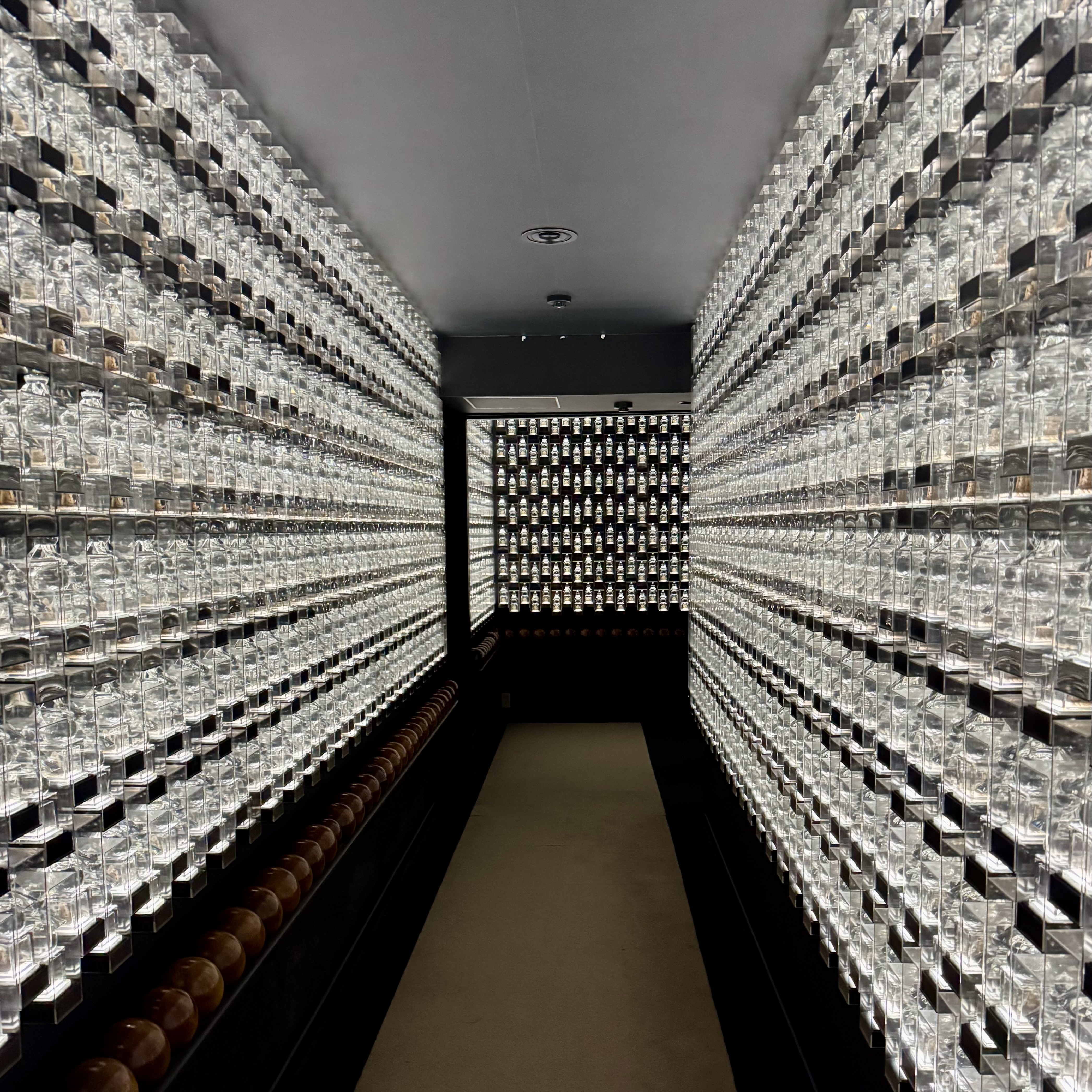
Lighted, individually-dedicated, miniature crystal buddhas in the corridor wrapping the main hall of Fukagawa Fudō-dō.
When I was planning this trip to Japan, I had a notion to get to some traditional Japanese theater. I debated and flirted with both kabuki and bunraku before dismissing both as either too long or creepy (it's the puppets in the bunraku) or both, and made worse by the fact that either performance was completely in Japanese. 

Honestly, I can't imagine either being better than the fire ritual we witnessed at Fukagawa Fudō-dō. This was a legitimately professional and passionate and intense and intimate spectacle and it was concise and pretty much free. It was definitely the best thing we experienced at any temple or shrine we visited on this trip and it was the best performance of any sort that we found in eight days in Tokyo. 

And it's "pretty much free" because you should (and we did) give some offering to the temple as part of the ritual of watching this spectacle. 

I imagine our next trip to Japan will feature more temples and shrines. I think our idea to pick some places that are more relevant to us than a likely gorgeous and well maintained series of spiritual buildings with little to set one apart from the other was a smart one. We'll have to remember this and work similarly hard with some temples outside of the metropolitan Tokyo area on our next visit. After all, it worked so well this year. I am sure there are others out there which will amaze and excite us the way some of these did this year.

And next time, I'm spending a couple of hundred yen and buying a radish. Who knows...I might need some poison purged from my body and I clearly missed my shot this year.

One last rōnin graves picture, with glipses of modern Tokyo beyond. What would they think of this place?

Wednesday, April 30, 2025

Inkan / Hanko


Sometimes when I am getting prepared to travel, I read books about wherever I am headed to get myself psyched up or in the mood or whatever you want to call it to ensure that I'm good and ready for what I'm about to discover wherever I happen to be heading. Most often, these books are non-fiction and centered around some theme of the trip that I am about to take. It could be the history of the Incan people before heading to Peru or a book about surfing before landing in Hawaii or an account of trying to save a population of scarlet macaws before visiting Belize.

To get ready for this year's trip to Japan, I read Will Ferguson's Hokkaido Highway Blues: Hitchhiking Japan, a late 1990s account of the author's quest to hitchhike all the way from Kyushu to Hokkaido while following the blooming of the cherry blossoms (or sakura) from south to north of the country. Appropriate, right? I mean, we went to Tokyo this year to see the sakura, although admittedly without the hitchhiking. 

No hitchhiking on vacation. Except in Germany. And then only once. And it really wasn't hitchhiking. I was offered a ride and I accepted.

At one point in the book, Will gets arrested (hitchhiking is illegal in certain places in Japan like on highway entrance ramps) and taken to a police station where he is ultimately released with a written warning which he is required to sign. Will's account of that simple signature act in his book reads as follows:

The older officer typed out an arrest report on his word processor, gave me a copy, and asked me to sign it. When I pulled out an inkan instead, he raised an eyebrow. The Japanese do not sign things. When they formalize an agreement, cash checks, draw up contracts, or hand in office reports, they use inkans, little sticks with their names carved on one end. They use these to stamp their imprint on the paper in red ink. Some are made of cut stone, or even ivory, but most inkans are plain bamboo.

Whoa. Whoa! Whoa!! Whoa!!! WHOA!!!! What is this? An inkan? What??? Never heard of one of these before but I definitely for sure absolutely need one for my own. I mean, I HAVE to have one. They still make these things, right? 

Checks internet immediately...they do still make them. 

I'm getting one.

Hanko Land, Shinagawa City, Tokyo.
Apparently inkans are a thing in Japan. Like a big, major deal. Emperors and Shoguns (or is the plural of Shogun just Shogun?) have had them. Celebrities have had them. Regular people have them. They show up on Japanese money. They are a seriously serious part of modern life that people in Japan have to have. I needed one too. Even though I have no part in modern Japanese life, really.

So, I know what you are thinking: where does one get an inkan made while on vacation? Don't these things take a while to get fabricated? I have a whole series of stamps that I use (or I guess "used" is a better word) to sign and seal construction documents as a professional architect and those took a week or so to come back from the stamp shop or wherever our office used to order them from after we submitted a request and payment. Can you really get an inkan while you are on vacation in Tokyo for a week? 

Of course, the answer is "yes". Why would I even be writing this post if it wasn't? Inkans are sometimes called hankos (in fact, the more common name for these little personal, official seals may actually be "hanko" rather than "inkan") and if you want a hanko made up quick-like, head to Hanko Land (I mean...where else?). It's located in Shinagawa City in southern Tokyo. They make them in an hour. An hour!!! 

Pick the style of hanko that you want (I will after this point just refer to these things as "hanko"s since we bought ours at Hanko Land). Pick the material. Pick the exact characters that you want to appear on your official seal and an hour or so later...BOOM! Your very own hanko.
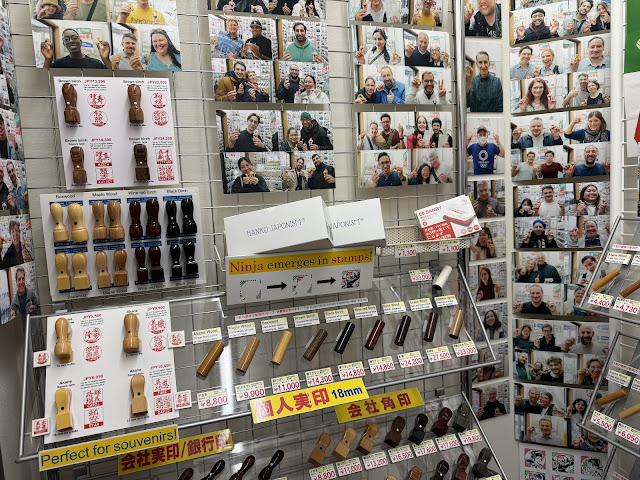
Choices, choices, choices. Inside Hanko Land.
Now...I thought long and hard about what I wanted on my hanko before we set off for Japan. This was a complicated exercise. Bear with me for a couple of paragraphs.

The Japanese system of writing has no alphabet which is analogous to the English alphabet. Traditional Japanese kanji writing uses a series of symbols which correlate to specific words (so there may be a kanji character for "house" and another for "person") rather than having words made up of individual letters as we think of words being constructed in English. To accommodate new words in their language (like words imported from other languages), the Japanese have a phonetic-based writing called katakana, which allows construction of words using syllables. 

I am confident I have probably butchered the meaning of kanji and katakana but that's the best way I can articulate both systems of writing. I'm hoping I'm at least 85% correct.

When it comes to getting hankos made (and let's fact it, most tourists, including me, buy these things as souvenirs), westerners usually get steered into getting a hanko made for them that spells out their first name phonetically using katakana. Sometimes, they get their English name added to the hanko so you can see the Japanese phonetic spelling and know exactly what the characters sound like. Hanko Land calls this multi-lingual hanko a dual hanko.

Hanko case and pouch...

I didn't want that. I wanted something written solely in kanji. And to do that, I figured I'd get a hanko that represented my last name which is made up of two actual words ("hop" and "wood" if you don't know me) stacked vertically on top of one another. I did some research on the internet, found words that closely represent the words "hop" and "wood", screenshotted them from my computer and then just took them with me on my phone to Hanko Land.

It worked! The result is the cover picture of this post and the pictures immediately above and below this section.

Now, technically, I think my hanko says "jump wood" or "bounce wood" or "leap wood" since there is really no kanji character which represents "hop" as a distinct and separate action from jump or leap or bounce or spring up. I'm OK with that. We learned a long time ago (in Iceland of all places) that the English language has far more words that mean approximately the same thing as similar other words than any other language. I'm chalking this situation up to that theory. It still means Hopwood to me. I love this thing.

So what am I going to do with a small piece of maple wood bearing a kanji approximation of my last name other than keep it in its very cool carrying case with integral red ink stamp pad which fits so neatly into the embroidered fabric pouch that came free with my purchase? I don't know exactly and it doesn't really matter. I know I already said this but I love this thing. I feel like I have something exclusively Japanese even if I can't use it in quite the same way people in Japan use it.

Why I have a hanko is way less important to me than what I am going to do with it for the rest of my life. I'll find uses.

For the record, so far I've stamped every book I've read in 2025 in the upper right of the first page with my hanko and I also used it to stamp the anniversary card I gave my wife instead of signing my name. As far as I'm concerned, I never have to sign anything again, although the law of the United States and financial institutions may differ on that opinion.

...with hanko and integral stamp pad inside. How freaking cool is this???
But that's not the whole story. This story isn't complete without mentioning Fumikazu "Bun" Matsuzaki. He's the greatest person we met in Japan on this trip.

To get to Hanko Land, we took the subway to Ōimachi Station and then walked a few blocks in the rain, heads down to stay as dry as possible (this was before we bought umbrellas on this trip). When we reached Hanko Land it appeared that its storefront filled the entire width of the building we were entering so we assumed we'd be stepping into a full-size store when we slid open the entrance door and crossed the threshold. 

Sliding doors in Japan are also a thing. I'm assuming it's a space issue.

What we found instead on the other side of the sliding door was a store maybe five feet deep (maybe...) with a small counter at the far end (maybe eight feet from us) with Bun Matsuzaki standing behind it. Bun is the third generation owner of Hanko Land and on a rainy Tuesday afternoon he was waiting in his store for us. He got us hooked up with what we needed (two hankos) and told us to come back in about 90 minutes and they would be ready. 

I know I said earlier there's an hour turn around time but we were buying two hankos here so it's actually 45 minutes per hanko. Payment? When we come back.

We got back like right on the 90 minute dot. We ate lunch and were just ran out of other stuff to do. We hoped his time promise was good.

It was. He was ready. 

Here's the hanko. Here's the case. The gold dot on the hanko is the top of the seal; the red dot is the bottom. Use one or the other to guide placement. The case is a right handed case and the part of the clasp with the grooves in it is the part you open with your right thumb. Make sure you hold it the right way up or the hanko will fall out. Need a pouch for your case? That's free. Pick one. Want to know more about Japanese printmaking? A book for that purpose is also free, along with the ability to create a couple of DIY multicolored seal pictures using part of Bun's collection (his work - making things to print - is also his hobby).

Along the way with all this, Bun asked our names, where we were from, how we found Hanko Land, what did we know about wood block printing and can he take our pictures for his wall. We told him everything, including that we knew pretty much nothing about wood block printing. He didn't mind.

We figured we'd need a spare stamp pad. That's also free. BUT...you have to play a game first and you have to win.


As it turns out, Bun is not just a professional hanko-maker and hobbyist printmaker. He also collects vintage, mid-20th century Japanese toys. You know, the kind they used to make before batteries came with things or before video displays connected to the internet. And for us to get a spare stamp pad for the price of "on the house", Bun wanted to play a game. A game from the middle of last century.

He reached into his back room and pulled out a toy dohyo (or sumo ring) complete with temple roof (sumo contests originated in Shinto shrines a long time ago) and four rikishi (or sumo wrestlers) with different colored wamashi (it's the belt around their waist and privates). We picked a rikishi, he picked a slightly smaller rikishi, he removed the temple roof because it would be in the way, and he showed us how to play.

The object (just like in sumo) is to toss your opponent out of the dohyo. To do that, you need to use your fingers to make the dohyo move and vibrate to topple your rival's rikishi (and likely your own). First contest? A draw. Both fell out of the ring. Second contest? We lost. Third contest? Also a loss. At which point Bun clarified that he intended to play until we won and he could give us more free stuff. Which we eventually did and he eventually did. 

Stamp pad secured...we left Hanko Land for good. Although we saw Bun one more time when he ran down the street to give us some red bean paste buns. Random, I know. But the point here is he wanted us to have more Japanese culture. The buns from Bun were great.

The toy dohyo. Note the containers for water and salt in the corner of the toy, just like in a real tournament.
We went to Hanko Land to buy a couple of souvenir stamps with our names (or reasonable facsimiles thereof) on them. We got all that, along with a whole lot of free swag that we didn't expect. 

But what we also got was a crash course in Japanese printmaking and a glimpse into Japanese toy making history that we could not honestly have found anywhere else in the city if we had looked for it. Meeting Bun was an extraordinary experience. I highly recommend anyone going to Tokyo and wanting an authentic, personalized Japanese souvenir head to Hanko Land for a hanko (or inkan). What you will get is so much more than what you will pay for. 

I am super thrilled with my hanko. But I'm way more thrilled that I got to spend 20 minutes or so with Bun-san learning from him about everything he told us. I hope the picture of us turned out just great and he's got us up on his wall along with a bunch of other past customers from what looks like all over the world. Now I just need to find more uses for this hanko. I'm going to need that spare stamp pad at some point.

Me and Bun-san. With the winning and losing rikishi.