Showing posts with label Stewart Island. Show all posts

Sunday, May 5, 2019

New Zealand Birds (But Not Kiwis)


Over the past almost six years, I've taken some amazing trips into nature. Some of these trips have involved exploring the natural features of our planet like forests or glaciers or mountains or even white sand dunes. Others have focused on wildlife, most notably in sub-Saharan Africa, the Galápagos Islands or here at home in Alaska (bears and bald eagles among others) and North Dakota (bison!). But I've never taken a birds-only focused trip. That is, until we went to New Zealand.

Now, I've never been much of a bird watcher. Call me unimpressed with the birds that have lived around me everywhere I've lived. Sparrows, robins and starlings? Can't go for these small, brown non-descript birds (I get that the robin has some red on it). Blackbirds and crows? Yawn! Sure every once in a while there's a cardinal or a hawk or something but the birds in suburban England, Connecticut and Washington D.C. never got me that excited.

But in the past couple of years, some things have changed about my appreciation of bird life on our planet. First, I saw my first in the wild toucan two years ago while eating breakfast down in Mexico. If there's a bird I love more than the toucan, I don't know what it is. The one we saw near Chichen Itza was right at the top of a palm tree so our look at it wasn't amazing. I have to find a way to get more of these birds in some future trips.

Then last year I made my second (of many, I'm thinking...) trip to the southern half of Africa and my eyes were opened. Not by the ostriches and the marabou storks and the secretary birds that I had on my must-see list but by the smaller birds: the fish eagle, the carmine bee-eater, the lilac-breasted roller and even, perish the thought, the vultures. These are some impressive creatures. I started to warm to the idea of bird watching. Enter New Zealand.


A variable oystercatcher on the beach of Ulva Island.
In the world of birdlife, New Zealand has a unique history so we actually planned several items on our itinerary specifically to watch birds. Crazy, I know! New Zealand was one of the last places on Earth to be discovered and occupied by man, meaning avian life on the two main islands and the various smaller ones around the perimeter were free to evolve without any interference from the world's number one predator and destroyer of species and the natural environment (that would be you and me). 

But New Zealand went one better here; there are also no land mammals endemic to any of the islands which make up this country, meaning the birds there were at the top of the food chain. And that led to some unusual things happening. Like birds there being the top dogs. Many, many species just got so complacent about the lack of danger that they just ditched their ability to fly. Heck, in some cases they lost their wings entirely. That's not to say that all birds in the country don't fly. Some certainly do and some are master aviators. But there are a ton that don't.

So where does one go to see birds in New Zealand? Well, seemingly anywhere you want but there are enough sanctuaries scattered throughout the nation that you are bound to be close to at least one. I'd suggest you go and see what this country has to offer. Even if, like me, you've never even been interested in something like this. There are no more 12 foot high flightless moas around (the Māori took care of wiping them out) but trust me there's a lot that's interesting. Maybe by the end of this post, you'll want to go find some of these things too.

This is the only kind of Moa you'll see outside of a museum in New Zealand these days. Good stuff!
Our bird watching itinerary took us from north of Auckland to south of Invercargill, meaning we pretty much covered all the way north of the north island to all the way south of the south island and many parts in between. 

It seems like the appropriate place to start when talking about birds in New Zealand is on the ground with maybe the country's most famous avian resident, the kiwi. I'm not going to do that because I've already written an entire post about our epic night quests to find these funny birds. But there are plenty of others that can't fly like the takahē, the pukeko and the weka. And yes, there are penguins, but we'll come back to them.


The motto of flightless birds everywhere. Rotoroa Island.
I can't imagine how scary it would be to be a flightless bird evolving in peace on your own private island (well, with other birds I guess) and then having some large biped bring over a bunch of rats, dogs, stoats, weasels and pigs that will seemingly systematically hunt you and your chicks and your eggs down for sport or a quick snack. And that's not even considering the bipeds might just kill you out of boredom. There is absolutely no way you can possible defend yourself against that kind of attack. You'd need another several millennia to evolve again. The problem is you don't have that amount of time. Not with a stoat on the hunt in your neighborhood.

There used to be nine species of flightless moa on New Zealand. Go to the Auckland War Memorial Museum and you can see skeletons and reconstructions clad with emu feathers on some of them to get an idea of their shape and size. There is no accurate record of exactly what these birds looked like. By the time people with an interest in preserving that kind of record got to New Zealand, the birds were all gone. I'm sure there are probably other species that perished along with the moa. Those that survived were either lucky or fast or isolated or cute enough that people started caring about that they might be destroying before it was too late.

There are two critically endangered species of flightless birds in New Zealand: the kakapo, a comical looking flightless parrot (which we did not see) and the takahē (which we did). Want to find either of these birds in person? Get off the main islands, because all the known specimens are now isolated to predator-free islands off the main coast of New Zealand. 

It is likely that there are fewer than 200 living kakapo today but at one time, the takahē wasn't so lucky: it was actually declared extinct in 1898. I guess some folks refused to believe this declaration, figuring that New Zealand was unexplored enough that there might be one or two last ones out there. They were right; 50 years after the last known member of the species died, a group was found in the Murchison Mountains in Fiordland National Park. All 347 alive as of October 2017 are descended from this single group. 


Takahē, Rotoroa Island.
We were lucky enough to see a family of four takahē roaming about Rotoroa Island, which is located in the Hauraki Gulf north of Auckland. They stand a little taller than knee-high when fully grown and have this gorgeous iridescent blue-green plumage and red bills. Apparently they pack quite a bite according to our Rotoroa guide, Toni, who's had the pleasure, and they also seem totally unafraid of people by our interaction with them. It's easy to see why they might fall prey to an animal looking to do them harm. We feel fortunate to have seen more than 1% of an entire species in one day. Think about that...

The takahē definitely owe their survival to luck and isolation (the kiwi probably fall into the cute enough to care category). One of the other birds we found on Rotoroa, the weka, probably owes its existence to adaptability, healthy breeding (up to four broods of chicks per year!!) and speed. Weka are not as remarkable physically as the takahē, sporting speckled brown feathers on a two foot long body, but they are for sure fast. We were warned of the weka's curiosity and penchant for theft when we landed on Rotoroa and seeing some around the island I can believe their speed did enough to keep enough of them alive when they didn't have the Department of Conservation looking out for their welfare.


Weka, Rotoroa Island.
If you are looking to find some birds that actually fly, I'd recommend a trip down to Ulva Island south of the town of Oban on Stewart Island. Here you'll find weka but you'll also find plenty of birds that actually use their wings to get airborne. It's a quick ride on a water taxi or ferry and we spent the better part of a day from early morning to mid-afternoon exploring the 3-1/2 hours of trails on the island (the Ulva Island guide available for $2 at the dock measures the trails in minutes, not miles). 

So what kind of birds can you find on Ulva Island? Well, it all depends on where you are. Spend time on the beach and you are liable to find orange and black (all the way down to the eyes) oystercatchers poking around between the rocks in search of food. You might also hear (and you are much likely to hear before seeing) the whooshing sounds made by a New Zealand wood pigeon or two (or three) trying to get the attention of a mate. These are the biggest (and likely most attractive) pigeons I'd ever seen in my life and their mating ritual, which involves flying noisily about maybe 10 feet above the forest and then seemingly falling straight down into the woods like bags of wet cement was the strangest way I've seen to garner the attention of the opposite sex. Although we humans do some pretty odd things too.

But if you want to get a good look at an incredible array of gorgeous species, most of which are about impossible to photograph, head into the woods. We missed out on good pictures of fantails, tūī and saddlebacks, although we got blurry ones of the latter two. These things move too darned fast and won't sit still for us tourists. What are they thinking?


New Zealand wood pigeon. That is not a small tree. These things are bigger than your average pigeon.
I'm disappointed we didn't get even a reasonably bad picture of any of the many, many fantails we saw on Ulva Island (in addition to the ones we saw on Rotoroa Island and in Te Anau). While not brightly colored like some other species we saw, these birds as their name suggests are able to spread their tail feathers like a fan to draw attention to themselves. For me, they were one of the enduring images on New Zealand. Unfortunately, they flit from branch to branch so quickly that it's impossible to get a camera lens on them. I need to be a better photographer. 

But we did get some great looks at some parrots and some parakeets and that was worth missing out on a good picture of a fantail here and there. Parrots, you say? Aren't those birds found in the tropics, which New Zealand and particularly Ulva Island at almost 47 degrees south latitude (the tropics end at 23.5 degrees), are most definitely not? Well I'm sure they are but New Zealand boasts three species of parrot as well. We saw the kea on our trip to Milford Sound scampering up our car windshield. On Ulva Island, we hoped to see the kãkã, a mostly brown parrot with hints of red and orange on the head. 

And see them we did. They are all over the place, sometimes in twos and threes in the canopies overhead. The trees admittedly make it difficult to get a good look at these birds because they tend to stay in the highest branches which makes you look about straight up through tens of different limbs to see a darkish colored bird clambering about a long way from the where you are on the ground.


But stay after it and you might find one from the right angle on one of Ulva Island's paths to get a great look and some good pictures. We managed to do that with the bird shown above, who we watched clamber about the branches of trees for about 15 minutes until he or she decided to stop and strip some bark off the limb above, presumably in search of food. The lighting in the back of the kākā almost makes it seem like I've pasted the bird into the photograph but that's not true. Thank goodness for the fantastic camera that we brought with us. The Nikon COOLPIX P900 we bought a couple of years ago continues to pay dividends.

This is the first trip I have ever taken where I've seen parrots in the wild (and yes, we also saw some parakeets on our day trip to Ulva Island) and while the kea and the kākā do not have the colors that some of the more famous parrots from Central and South America, it was something I wouldn't have expected to see this far south on the globe. Need to make sure I make a note to see some of their cousins on a future trip, right below the toucans on that same list. 


New Zealand parakeet or kākāriki, Ulva Island.
If you make it all the way down to Stewart Island and Ulva Island, I'd suggest one more bird-watching trip and that's to hop in a boat and head out to sea a little. There are some pretty impressive birds out there on the right sorts of days.

I've seen plenty of seabirds on any number of trips out to watch whales or on ferries or fishing boats (I was way younger when that happened) or even on a massive cruise ship off the coast of Alaska and Canada. Heck, I've even seen plenty of them from the shore in many locations including most recently off the coast of Washington state. But I've never seen anything like we saw off the coast of New Zealand this past March.

All told, we spent about 90 minutes way out on the ocean off Oban in a small boat with a skipper, two other passengers and a giant orange bucket of chum. No, we were not out searching for sharks or something like that but we were looking for something with a voracious appetite. We also deliberately went on a windy day because the windier it is, the greater the chance of seeing some of the largest birds on our planet: albatrosses.
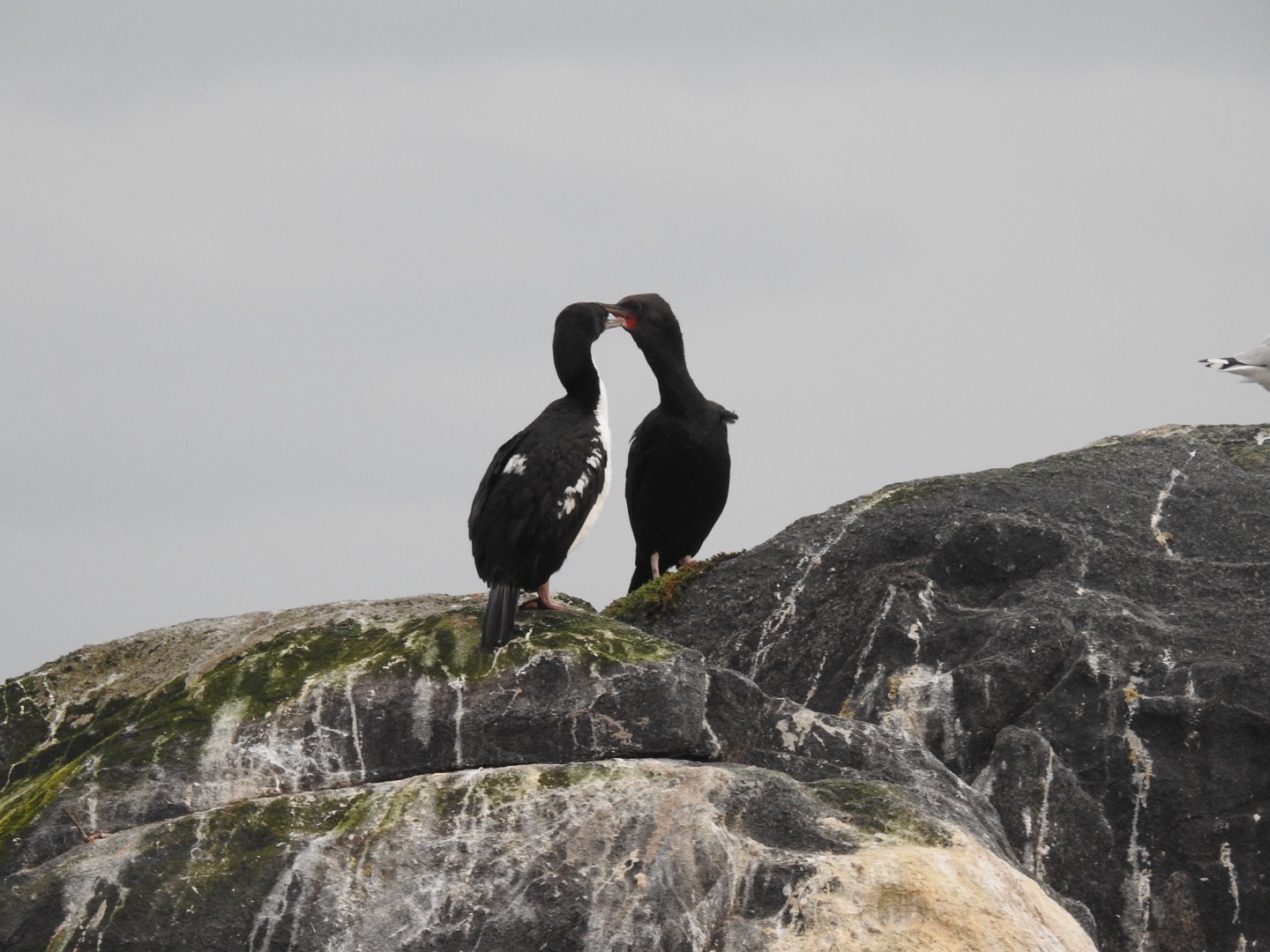
Not an albatross. Two shags on the way out to find the albatrosses.
New Zealand was not the first place on the planet I'd been where we had the chance to see an albatross in person. There are a species of these birds in the Galápagos Islands but unbeknownst to us when we booked that trip they are only found on one of the islands. And it wasn't one of the ones we were visiting.

There's a romanticism to the life of an albatross. I'm sure some of my personal fascination with these birds comes from one of my favorite poems ever, Samuel Taylor Coleridge's The Rime of the Ancient Mariner, where the protagonist of the tale shoots and kills an albatross, a traditional bringer of good luck, with his crossbow and brings ruin upon his whole crew and himself. I was pretty sure we were in for none of that on our couple of hours ride out of Stewart Island.

Outside of the mythology surrounding Coleridge's slain albatross, these creatures are the ultimate ocean flyers. They can stay for months out on the open water, flying as much as 100,000 miles or more in a single year. Basically when they are not breeding or raising chicks, they are in flight or at rest on the open ocean. And that's over the course of 40 plus years for some individuals, meaning over a typical lifespan, they can travel 40 million miles or more. And they are enormous. Royal albatrosses can reach wingspans of about 12 feet.

I've been on a number of nature trips where the conventional wisdom was that we would see tons of whatever type of animal or bird we were hoping to spot and found instead pretty much nothing. If there's a bird that symbolizes this sort of futility, it would be the flamingo, a bird I've chased on three continents without a close look at the species in mass. It would not be that way with the albatross this past March. After all, we had a bucket of chum consisting of some choice blue cod scraps. What could go wrong?


All eyes on the chum. 11 albatross waiting for a free snack. There are others off camera.
One of the things albatross have come to realize is that where there are boats, there are fish. So they have a habit of finding fishing boats and following them hoping to snatch their catch or benefit from the discarding of the undesirable (to humans) fish parts. There is every chance the boat we were on has been and is used for fish so naturally we drew some attention from a couple of birds. But once we stopped the engine and started tossing fish parts into the water, we drew a pretty good sized crowd.

I hate the notion that I am participating in any activity that turns wild animals into beggars but let's face it, that's pretty much what I did on this day. I guess we fed a good number of birds but we also did it to get a close up look at them, including the way they squabbled over the fish thrown into the ocean.

The albatross we saw that day were primarily lesser albatrosses or mollymawks, although we did see maybe one or two Buller's albatross. The mollymawks are not the giant albatrosses we had hoped to find but with a wingspan of about six to eight feet they are not tiny either. When they are at rest on the ocean, these birds are about the most serious looking, well put together animals out there. There is not a feather out of place on their entire bodies, but particularly on their heads. It's almost as if they have been made up super precisely. The eternally furrowed brow and the horizontal line each bird has on the sides of their faces almost makes it seem like their beaks are held on with string which has made an indelible mark on the birds' heads. They also all look exactly the same, although I'm sure all humans look the same to the albatrosses. 

Is this a serious face or what?
But we didn't travel all that way to see an albatross sitting on the water. We wanted to see them fly. And when they did it was truly amazing.

Our boat was followed by a number of different species of birds that morning. After all, it wasn't just the albatrosses that wanted a free meal. Some of these birds, like the shags and cormorants and gulls, worked hard to keep up, flapping their wings furiously to keep pace with the speed at which our engine was propelling us through the water. The albatrosses cruised, barely moving their wings while managing to easily outpace any other bird trying way harder than they were.

This was truly amazing to see. Sure there was a wing flap here and there with the albatrosses but by and large, they floated on the wind in a way that was embarrassing to pretty much every other species of bird out there.

Floated isn't really the right word because it's not like they hung in the air in one spot. They dove and soared closer and further from the water and sped up and slowed down as they wanted to without seemingly moving their wings at all. Now I'm sure that's not quite true. I am positive there were minor adjustments imperceptible to me, that took advantage of warmer and cooler air and strong and weaker currents, or something like that. Their bodies are so extremely well adapted to live in the air on the open oceans. At one point we watched an albatross chasing the boat for what seemed like five minutes (but was probably about three) and the bird didn't flap once. He (or she) just hung and followed. Fast.


If the wind had been stronger that day, maybe we would have seen some larger birds. While the albatross is a gorgeous bird in flight, its landings and takeoffs leave something to be desired. When you get up to 12 feet of wingspan it's pretty much impossible to take off from the surface of the ocean without a pretty strong gust of wind. We were told it would need to be much windier to make the largest albatrosses come close enough to get some free fish. Or we'd need to go much further out to sea.

Before I close this post...a word about penguins. Actually much more than one word. If there was a flamingo of this New Zealand trip, it was the penguin. And you know that doesn't mean anything good.

Yellow-eyed penguin. The one we saw. And eyes closed of course. :)
We had high hopes in the birds department for this trip. I hope that's obvious. By and large, they worked out well. Kiwis? Check! Flightless (land) birds? Plenty of those. Parrots? Yep, two of the three available species sighted. Wood pigeon? Didn't know there was a pigeon that big but yes, got it. Albatross? Very happy with the results. We just needed a few penguins here and there. And by a few, I mean a lot. Like tons. Expectations too high? Maybe. Thinking big with nature doesn't always work out.

There are a few species of penguin living in New Zealand, predominantly the little blue penguin, the yellow-eyed penguin and the Fiordland crested penguin. We visited Fiordland. We didn't see penguins.

Stewart Island was the furthest south we went in New Zealand so we figured we would have the best shot at seeing penguins there so we asked around when we arrived: where do we see these things? 

The answer in the town of Oban from everyone that we talked to (and I really do mean EVERYONE) was that you can spy little blue penguins returning from their day of fishing at dusk down by the town dock. It sounded like a sure thing. We spent three nights on Stewart Island at a hotel not far from the dock so we spent every evening from anywhere from an hour to 30 minutes before dusk to when we couldn't see anything any more alternately scanning the harbor and staring at the rocks near the shoreline looking for any sign of penguin activity. 

Know how many penguins we saw down at the town docks? Zero. And we weren't the only people down there. There was a crowd anywhere in size from 10 to 20 people each night. And nobody saw a thing. We are convinced the entire permanent population of Oban watches and laughs at all the tourists each night when they send us all down to the town docks. 


Penguin watching. Or more accurately not penguin watching.
Our last shot at penguins was our boat ride that was so successful with the albatross sightings and legitimately we did see some penguins. Like seven or so. At a great distance. Am I disappointed? Yes. Do I have any right to be? No way. Absolutely not!

Now admittedly, we did see two different species of penguin in those seven or so individuals: one yellow-eyed penguin and about six or so little blue penguins. The yellow-eyed penguin was a solitary individual standing on a rock with his eyes closed. Not that we were close enough to see the yellow eyes anyway, but I'm taking our captain's word for it on this species identification. The picture is above. He looks fluffy because he's molting. I assume the rest of the family was out fishing.

And the little blue penguins? Just heads in the water while they were out in the ocean, alternately visible and then invisible as the waves rolled and the boat turned. Never saw a whole one in the three days we were down on Stewart Island. The best look we got at these birds is shown below. The look was so poor that I had to post a picture with a piece of my finger in the upper left corner. 


Two little blue penguins.
I shouldn't complain like this. I know how fickle and unpredictable nature can be and I've said so many times on this blog. 

We came to New Zealand to see birds and we obviously saw tons. It is rare that I include 16 pictures in a single blog post but this one has that many (admittedly one is of a glass of beer) which I think is a testament to the quantity and quality of bird sightings we had. And I had to leave some pictures on the cutting room floor. We saw pretty much everything we wanted to see in New Zealand except for tons and tons of penguins. And even then, we did see penguins. By every account this trip was fantastically successful from a bird watching standpoint. 

I'm not sure when the next bird watching trip is. It certainly isn't likely to be in 2019 with our trips for the rest of the year planned. But one thing is for sure: what started in Africa got stoked here a little in New Zealand and I now have one or two more birding trips in me I'm thinking. Got to get some more toucans at least into my future. 

How We Did It
Our birdwatching activities in New Zealand ranged over the entire country but were pretty much concentrated in two spots: Rotoroa Island and Stewart Island. I've already detailed how we got to Rotoroa Island when I wrote about tramping in New Zealand so I'll refer you to that post for how we did it.

We stayed on Stewart Island for three nights which made our trip to Ulva Island and our morning albatross-watching trip convenient for us. We took the Ulva Island Ferry over to Ulva Island first thing in the morning (at 9 a.m. if I'm remembering correctly) and took the 2:15 p.m. ferry back which gave us about five hours on the Island itself. I'd say that was about the right amount of time over there. If you go over lunch, take your own and bring everything back with you; there is no food for sale on the island and you shouldn't leave any trash over there. The Ulva Island Ferry leaves from Golden Bay. Check the Stewart Island website for the latest schedule and cost before you go. There are precious few places to buy lunch to go first thing in the morning but the Four Square grocery store in town sells pre-made sandwiches.

There are also water taxis available from Stewart Island if you want to go on your own schedule. I can't recommend those because we didn't take one except as noted below.

For our albatross and penguin (barely) watching trip, we booked ahead before our arrival with a company who cancelled the trip on us due to weather. Or more accurately said they were thinking about cancelling and then never texted us as they promised. We switched to Rakiura Charters and booked their half day Pelagic Bird Tour which was outstanding. Everyone we interfaced with at Rakuira Charters was fantastic and our captain, Mack, took great care of us while we were out on the water. I can't say enough good things about this company. The cost of the tour wasn't cheap, but then neither is any other tour on Stewart Island. If you need a water taxi to Ulva Island, Rakiura can take care of that for you also.


Wednesday, April 24, 2019

Porridge, Pies & Pavlova


It's been a couple of years since I've written a country-wide post about food so I think it's about time. The last trip that yielded one of these was Japan in 2017 and honestly the places we've been since then were either uninspiring from a food standpoint; repeats of past trips; or filled with not quite enough awesome eats to fill a whole post. New Zealand broke that mold.

Not familiar with New Zealand food? Neither was I. I quite frankly wouldn't have been able to intelligently articulate anything about food from that country more than maybe six months ago. But some advance research, some paying attention along the way and refusing to back down from anything that sounds like I've never heard of it before got me some interesting meals and snacks. So here are a few words about food and drink from our latest excursion. OK, maybe more than a FEW. And the drink is not what you think, I'm guessing.


Porridge

I'm starting with breakfast, I guess. If the above picture isn't the prettiest bowl of porridge you've ever seen, then you didn't grow up in England in the 1970s eating Ready Brek.

At its most basic level, porridge is ground starch or grains of some sort mixed with milk or water. Before New Zealand my experience with the stuff was limited to instant oat cereal made with hot milk and maybe a dollop of jam on top for some flavor other than the standard sugar that could be sprinkled all over the top to sweeten it up a little. The kiwis are taking this stuff to a whole new level. Polenta porridge with lime and macadamia nuts? Yes, please! Yummy!! And with a iced chocolate drink on the side. What a way to start the day.

As frou frou as this bowl sounds (edible pink flowers? really?), it was actually delicious and I would have loved more but it was honestly pretty difficult to find porridge on menus. An internet search for the stuff yielded some advice on where to head including a dedicated porridge restaurant which it appeared had closed. I mean, I might have had a craving for the stuff while we were in country but I don't see a restaurant surviving long exclusively serving this dish. If my one New Zealand bowl was the last one I have, I'm happy with my lifelong porridge experience. 


The Dairy

Ever since I visited Japan, I've been curious about convenience stores all over the world. If you have no idea what I mean by this, go to Japan and spend some time in a 7-11 or FamilyMart. Tell me you can't walk out of either one of those places with like eight or ten delicious food items.

In New Zealand, the convenience store is more often known as the dairy, even though it has nothing to do with milk or cheese or anything else related to dairy production. Some of the things we found here were purposeful pilgrimages; others were accidents. I think a quick couple of sentences or so is worthwhile for each item that we found there.

I hate to keep bringing up Japan like it was one of the best trips of my life (although it was) but one of my favorite Japanese snacks are strawberry Pocky Sticks, thin sticks of cookie coated with oh so delicious faux strawberry creme. Imagine my surprise when I saw what looked to be a dead on knockoff in boxes of Lucky Stick. The cookie sticks are thicker, meaning the cookie to strawberry ratio is higher. I'm in it for the strawberry; higher cookie ratio is bad. Just one box here for me.

I cannot explain Chocolate Fish being marshmallow covered in chocolate but I'd eat these things occasionally in the U.S. if they made their way stateside. I mean who doesn't love flavored marshmallow and chocolate? If they did ever make their way to America, they'd have to lose the "as kiwi as jandals" slogan. Don't ask. I cannot explain this either. 

Any hankering for dark chocolate with orange candy shells? See, you didn't even know these things existed but I got you thinking now. Jaffas were probably the hit of our dairy exploration. Dark chocolate and orange is a classic combination. Or maybe fake orange if you prefer me to be more accurate. Good stuff.

If there was a supreme disappointment in New Zealand convenience store fare, it was Pineapple Lumps. Yes, I know the name sucks. Who would really want to eat anything called "lumps"? But pineapple flavored whatever coated in chocolate? On the scale of awesomeness, how could this do anything but rate "supremely awesome"? 

It wasn't. Honestly, I felt like I was chewing chemicals eating these things. Totally disgusting and totally disappointing. The most disappointing thing about New Zealand by far. I threw half of the bag away. And I really had to choke down the first half. I take notes when I travel. My notes about Pineapple Lumps read "gummy and unpleasant". And there was such possibility...


Lemon & Paeroa 

Sure, I could have put this in the same section as the rest of the delicacies and disgustingness I found at the dairies but I decided not to. L&P is the only drink I'm featuring in this post and it deserves its own spot. You thought I was going to write about beer, didn't you?

I would describe Lemon & Paeroa as a cross between lemon-lime soda (although no lime really) and cream soda, but with the cream soda backed off to like 15 or 20% of cream soda-ness. Just a hint of that bite that cream soda sometimes has. I don't drink soda really ever, and certainly not non-diet soda, but I had three L&Ps when I was in New Zealand. If I could find this stuff locally, I'd buy some every now and then. I'd put it in the same soda category as Faygo Rock & Rye and Vernor's ginger ale. And yes, that's some high praise.


Pies

If there's a kiwi food that deserves a special place in the food of the world pantheon, it's New Zealand's hand pies, mobile hot pockets of savory deliciousness. Now, this is not the first time I've written about the joy of pies. I had plenty of steak and ale and chicken and mushroom and every other kind of pie in England in 2014 and 2016 (even if I didn't write about it that last year). But whereas you need a knife and fork and plate and plenty of gravy and some time to digest what you've eaten in a pub in Britain, New Zealand's pies are an on the go food.

How's that work, you might ask? Well, folks that make these things have made the insides solid enough (yet still moist) so that you can bite into them without the whole filling (or even a part of it) dripping out and onto the floor, sidewalk or, worse still, you. Does that inhibit the flavor? Not as far as I can tell. At least two of the pies I ate in New Zealand were some of the finest bites I had on this trip.

Mince and cheese pie in Rotorua. Almost gone and no mess. Genius!!
These things are pretty much everywhere. We found them in supermarkets just waiting to be taken away and eaten (I did), in dairies ready for a quick meal while walking to wherever you are going (we didn't do this), in dedicated pie shops (so good...) and in honest to goodness full blown restaurants. The variety is astonishing but they are generally flavored in the British style but lighter, meaning beef and chicken with mushrooms and even butter chicken (albeit the kiwis somehow dump a ton of sugar in their butter chicken; not sure why) but without all the artery clogging fat or suet in the crust. Or at least I like to think so anyway.

The other great benefit of New Zealand pies? The smaller size means they are cheaper. The best pie I had during our two weeks in country cost me just $4.90. That's $4.90 New Zealand dollars, meaning about $3.25 U.S. These are the one food I miss on a weekly basis since we got back. Someone in the Washington, D.C. area needs to open a New Zealand pie shop and quick!


Hokey Pokey Ice Cream

I don't normally eat ice cream when I travel. Not that I don't like it or anything; it's just not part of my regular diet. True, I spent pretty much all of my time in Italy four years ago looking for gelato, but never since. 

Until New Zealand. I knew about hokey pokey ice cream before we landed in New Zealand and pretty much the first time I saw an ice cream stand the day we got there I was over at the counter checking to see if they had some. They didn't. But we found some on day two in country after a tramp to the top of One Tree Hill. There's a creamery at the bottom of the hill, in case you are interested.

Hokey pokey ice cream is vanilla ice cream with small pieces of honeycomb toffee to provide some crunch (and which WILL get stuck in your teeth) and some extra flavor when you are working your way through a cone or bowl of plain vanilla. It's apparently the number two selling flavor of ice cream in New Zealand after (you guessed it) vanilla. It's a rite of passage to get some I guess. I settled for one bowl while I was over there, although we did get some on the airplane ride home across the Pacific.

Fun facts: hokey pokey was apparently a slang term for ice cream sold by street vendors in New York City during the 19th century. It's also the generic term for anything honeycomb in New Zealand. My beloved Crunchie candy bars that I get every time I go to England are also available in New Zealand but instead of the wrapper advertising honeycomb covered in chocolate, it's hokey pokey covered in chocolate.


Pavlova

So after working your way through Chocolate Fish, a box of Lucky Stick, maybe some hokey pokey ice cream and some Jaffas but definitely no Pineapple Lumps, are you finally done with the sugar in New Zealand? Not until you've had some pavlova, you aren't. 

Pavlova was invented either in New Zealand or Australia (yes, there's a debate about this) to celebrate a visit by the Russian ballerina Anna Pavlova to the two countries in the late 1920's. It's pretty much completely made out of meringue and whipped cream with a little fruit scattered on top or around the sides (to make it seem healthy I guess?). The trick with this dessert is getting the ingredients and the bake right to have the meringue crisp on the outside and the cooked to the texture of marshmallow on the inside. The whipped cream can then be piled on top to complete the effort.

This stuff is pretty darned good. I'll take this over a trip to the dairy or some almost vanilla ice cream any day. Plus the fruit makes it healthy, right?


Muttonbird and Paua

No trip to a foreign country would be complete without at least a little bit of adventurousness at the breakfast, lunch or dinner table. If there's something I've never heard of or a vegetable or animal I have heard of but have never seen on a menu, I'm mostly all in. I've tried springbok in Zimbabwe, guinea pig in Ecuador, runny and mold-covered cheese in Paris and who knows what it was I ate in Marrakech. In New Zealand, it was muttonbird and paua. Not together.

So I get that neither of these dishes was particularly out there on the strangeness scale but you have to work with what you are given. Muttonbird is the name given to the meat of the sooty shearwater seabirds that make their home on the islands around New Zealand. The meat apparently tasted to someone like mutton and hence the name. If you find some on a menu like we did way down on Stewart Island, give it a try but know that the bird has been harvested as a baby from the nest while its parents are off fishing for food for the day. Nice, right? The meat is dark with a deep flavor of red meat, albeit it a little dry like most wild meat tends to be. This is a truly New Zealand dish; I'm not sure you are getting young sooty shearwaters on too many menus outside the country. The image above is a plate of muttonbird artfully arranged with some side vegetables.

Paua, on the other hand, is a type of mollusk. If you remotely play tourist in New Zealand, you will find the iridescent shells of the paua for sale in pretty much every city you visit. Paua is a Māori word for the giant sea snails that live close to the shore of the country; in other places in the world, they might be called abalone, if that means anything to you. I had my one plate of paua in a restaurant in Wellington the first night we were in that city. I am not sure the dish I had was representative of the general quality of this meat; if it is, I can't imaging a lot of people would eat it all that often. I'd characterize its texture as rubbery, not unlike poorly cooked squid. I'd take muttonbird over paua, but I'm not really hankering for either as I write this.

A dish of paua with clams. The paua are the mushroom looking things. If only they WERE mushrooms...
So that's my food report on New Zealand. No it's not the culinary wonderland that is Japan, but there's enough here worth seeking out even if it's just a pie washed down with an L&P and finished with a big plate of pavlova.

The cover picture of this post is me downing a colossal cream and caramel donut at the Thursday Night Market in Rotorua. While the food there is not particularly New Zealand specific, the atmosphere, the choice of dishes and the prices made Thursday night in the Māori capital of the country one of the more enjoyable food experiences we had while we were over there. I'd recommend scheduling a Rotorua trip around Thursday night just for this market.

How We Did It
I am fairly sure that if you visit New Zealand you can find some of the kiwi delicacies in this post with just a little searching, if you even have to exert that much effort. Although maybe not the muttonbird. In the interest of giving credit where credit is due, however, we felt the following places served us outstanding food while we were in country and we would recommend you seek these places out if you are in the neighborhood and have a hankering.

If you are in Rotorua and you want a great pie, head over to Gold Star Bakery at 89 Old Taupo Road. These were definitely the best pies we had in our two weeks in New Zealand. And at just $4.90 NZ, they were also the cheapest. I can highly recommend the Mince & Cheese. If I lived or worked in Rotorua, I'd eat here a lot. Like four or five days a week.

The only other pie spot I'd recommend (and I know this is a total curveball) is the food counter at the Invercargill Airport. I know it sounds really weird to have airport food endorsed but the chicken, mushroom and leek pie was amazing. And don't worry about which food counter at the airport I'm talking about; there's only one. Just like there's only one door to the runway.

If you want the prettiest bowl of porridge ever shown above, make your way to Chuffed Coffee at 43 High Street in Auckland. There's only one porridge option offered there and I can't speak to the rest of the menu (because we both got the porridge) but that dish was pretty darned good. I'd definitely eat it again even with the bananas which are not by any means my favorite fruit (in fact I pretty much avoid them everywhere...except in Ecuador).

Seeking some good pavlova? We got some at the South Sea Hotel on Stewart Island and took the picture in this post above. We might have more pavlova recommendations (because honestly who doesn't like meringue and whipped cream making up 90% of their dessert) if we could have found it more often. The picture above represents exactly half of the pavlova we ate. I definitely would have tried more if it was available where we ate.

Finally, because I know it's probably not going to be on most menus in New Zealand, I just wanted to give a quick shout out to our hotel, the Church Hill Lodge, for serving mutton bird on their menu. This is the only place we found this dish. If you are in Stewart Island, I'd recommend a meal here, especially because there are like three places to eat dinner on the entire island. Make a reservation.

And if it didn't sink in the first time. if you are ever in Rotorua, go to Gold Star Bakery. You will not regret it. Will not. 

Monday, April 1, 2019

The Bird Is The Word


Standing in the middle of a grass field with no lights at about 10 p.m. on a Tuesday evening seems like a strange thing to be doing on vacation but that's where we were. All seven of us. Standing dead still trying not to make any noise, although the morepork (think: owl) in the distance hooting away didn't seem to be understanding the rules of the game. It was just about five minutes earlier that we passed through the quarantine gate and into this particular field because we just weren't finding what we wanted outside the fence. Pretty creepy and sketchy stuff if you ask me.

Now, no lights isn't exactly accurate. There was a quarter moon shining somewhat brightly and there were what seemed like hundreds of stars in the sky including Orion blinking high up above us and the Southern Cross less visible but still there down towards the horizon. It was a similar picture to what played out the night before up at the airfield. No quarantine gate on Monday but we did just open up the airport's "no access" gate and drove on through like we had the right to be there and started poking around in the high grass with our red light flashlights (or torches, if you will). Pretty impossible to see without them after all although it's not all that bright with them.

Monday night the company for our mission was one larger, but the goal was the same: find a knee high (at most) ball of feathers weighing all of six pounds when fully grown. That's it. It's not a pest and it's not really threatening to us and we weren't out there to kill it or for sport or to gather food. All we wanted to do was get a look at one. And maybe follow it for a bit. Just one kiwi bird is all we wanted. Rare? Sure. But if they weren't rare this wouldn't be worth it. We'd come a long way and invested a good amount of money to get there so we were clearly serious about what we were doing. This had to pay off. Had to!

Quarantine sign: keeping rats out and away from kiwis and other birds not able to withstand an attack.
The where in this whole quest was Stewart Island, the third largest island of New Zealand and the only one other than the largest two that stands any sort of chance of showing up on an average sized map or globe. It's an island with a single town (Oban), 98% of the land devoted to a national park and about a 50 to 1 kiwi bird to kiwi human ratio. If there's any place in the country that you have a good chance of spotting one of these birds, Stewart Island or Rakiura (as it was called by the Māori) is it. 

Oh, and it's all sorts of out of the way of everything. We had multiple New Zealanders tell us that they had never been there when we told them we were going or had been. I feel lucky knowing that. But it took some effort to get there.

Stewart Island was the second to last stop of our trip. We'd landed in Auckland and bounced between Rotorua and Wellington and Queenstown and Fiordland National Park by plane, taxi, light rail, smaller plane, boat, bus, car and even smaller plane to get there. We'd placed all our expectations and the majority of our allocated trip funds into this one place. When I wrote earlier this had to pay off, I meant it. No way would we be happy coming all that way to strike out and not see New Zealand's most famous natural resident. No way could we go home without seeing a live, in the flesh kiwi.

Truth be told, we cheated a little bit here. Yes, we may have focused on Rakiura (it means glowing sky in Māori) as our great hope to see a kiwi bird, but we did have a safety net which we'll get to in a few paragraphs. You can call me overly cautious or accuse me of spoiling the excitement of searching for one under the stars (it didn't spoil the excitement for what it's worth) when we get down to that point in this post but we made darned sure we'd see a live kiwi earlier in the week. I don't like to be disappointed. What can I say?


Of all the largish reasonably habited land masses in the world, New Zealand perhaps remained isolated from human contact the longest. The first Māori settlers arrived from elsewhere in Polynesia in the second half of the thirteenth century and European explorers didn't "discover" the islands until 1642, almost 400 years later.

What the Māori found when they arrived in New Zealand (or Aotearoa as they called it) was likely a forested landscape filled with unique species of birds and zero mammals. Well, zero land mammals anyway; there were some bats. And because of the lack of mammals to prey on the native birds and particularly their eggs, the birdlife on the islands had evolved to be significantly flightless. After all, if there are no predators at all on the surface of the Earth, why bother flying any more? Several species of moa (now all extinct), the pukeko, the takahē and the kakapo were just some of the strange land-bound birds found by the Māori. Oh, and of course, the kiwi.

Man changed all that and quickly. The Māori hunted the moa to extinction. They also brought pigs and rats, as did European settlers after them. When rabbits introduced by white men started multiplying beyond reasonable numbers, they introduced stoats, ferrets and weasels to kill the rabbits. Pigs eat bird eggs. But then again pigs eat everything. They are also and fortunately not necessarily equipped to get into all sorts of birds' nests. Burrowing protects from pigs. But rats? Nope. Stoats, ferrets and weasels? For sure not. All of a sudden these predators found themselves with foods they love right on the ground level and a native population ill-equipped to fight them. 

Native bird populations started to decline. Fast. As of October 2017, there were an estimated 347 takahē in the world (this after they were already and accidentally declared extinct). The kakapo wasn't so lucky as that (although it hasn't been declared extinct yet); their numbers dwindled down to double digits and likely number between 100 and 200 today. There are way more kiwi than takahē or kakapo but that doesn't mean they are not endangered. About half of all kiwi eggs laid are hatched and chicks hatched in the wild have a 5% survival chance in the first six months they are alive.

Today, the kiwi are getting a helping hand. There are kiwi hatcheries spread around New Zealand including right across the road from our hotel in Rotorua (called, appropriately and simply enough, The National Kiwi Hatchery). So knowing we wanted to see a kiwi in our two weeks in country, we had to stop by this place. It was right next to our hotel, after all. 

I know, it's sort of cheating. But we HAD to see one.

Our first kiwi sighting. His name's Bennett. And, yes, he is in a box.
We try our very best not to visit zoos, aquariums or aviaries or anything like that sort of thing but we figured The National Kiwi Hatchery was likely doing some good to save a species, so we made an exception. We are glad we did, although seeing the mercifully small enclosure that their three permanent resident kiwi live in was admittedly very discouraging.

The National Kiwi Hatchery is located within the Rainbow Springs Nature Park. We didn't spend much time in the zoo-like part of the Park, opting to spend all our quality time within the Hatchery itself. This is definitely the place to spend your time. And if you are determined to take a picture of a live kiwi while you are there, you have to do it in the Hatchery. But only when you are told it's OK.

I mentioned earlier that 95% of the kiwi hatched in the wild won't make it six months out in the big bad world. When they hatch, they are pretty much left to themselves. They are genetically programmed to hunt for themselves as soon as they get out of the egg so dad leaves them alone to have at it. And fend for themselves. And yes, it's dad who sits on the egg or eggs; mom splits as soon as she's laid the egg. You might too if you'd just laid an egg which weighed 20% of your body weight. And if you laid two, you definitely would take off.

The Hatchery flips the script on the survival rate, turning the 5% survival rate into a 98% one. Pretty awesome, right? How do they do that, you ask? Well, quite simply they steal the eggs from dad as soon as mom does the deed and takes off. They can tell when dad is incubating based on his movements from the geotracking tags they've got on him so they swoop in before he can get too emotionally attached to the egg to give the kid a way better chance at life. And yes, the doing it before he gets too attached is for real. Dad will give up on a missing egg after about six days and go look for a lady kiwi to breed with again.

Bennett the kiwi, everyone!! No longer in his box.
Once the Hatchery poaches the egg from the nest (yes, pun intended) they make sure it hatches then they take care of it until the chick is ready to enter the wild and defend itself, although they do release them into predator free environments. Getting to the release process takes about four to six weeks after hatching. Generally speaking they wait until the kiwi reaches its birth weight before letting him or her go. Kiwis are born with part of the egg yolk still in their body; they absorb it for food while they are getting their feet under them which causes their weight to drop. Once they are confident finding insects to eat, their weight starts to go back up again.

The Kiwi Hatchery releases about 120 chicks back to the wild per year. If they were left to nature, about six of those 120 would survive. Using the Hatchery's numbers, that number goes up to about 117. A pretty significant difference, right?

I feel pretty good about visiting the Rainbow Springs Nature Park even if it is a sort of zoo. The work they are doing to increase the kiwi population in Aotearoa is important and the education we got in the Hatchery portion of the Park was important to us. We learned a lot. The kiwi is a strange bird, and I mean that in the nicest possible way. It's almost a sort of missing link kind of species: they are the only birds that have marrow in their bones and umbilical cords, traits otherwise reserved on this planet for mammals. Strange stuff.

Scene from a night walk. What's that round thing? Could it be? Is it? It's got to be, doesn't it?
Speaking of strange stuff, let's get back to that night adventure we were on shall we?

So kiwi walks at night are a sort of a thing on Stewart Island. I know I didn't mention it but the kiwi is nocturnal, in case that wasn't reasonably inferable. Tuesday night, the one with the whole quarantine fence, was a bust. We struck out on our kiwi walk entirely. We spent about 90 minutes roaming around a beach being assaulted by thousands of sand hoppers (insects) and then tramping around some random fields in the pitch black with green and red flashlights and saw nothing. Well, that's not exactly true. We did see a few rats. Ironically. Although they were on the right side of the quarantine fence. I guess that's good. At least the fence works.

It's also not exactly true that we saw no kiwis that night either. We saw one on the drive home but I (and not our guide) spotted it. It was visible for maybe 20 seconds in the car headlights before our tour operator turned them off and broke out the flashlights. Poof! It was gone before that switchover happened.

But up at the airfield the night before? Yeah, we saw some. And it was pretty amazing.

There is an excitement about seeing a wild creature in its natural environment that seems to never get old for me. Whether it's coming across a bear or a bison somewhere in North America or a lion or elephant in Africa or a blue footed booby or shark in the Galapagos, there's a spark there each time it happens. I think it's knowing that this is not a concocted experience, that it's not guaranteed and there are no certain outcomes. Now I'm not going to sit here and write that the first time I saw a kiwi in the wild was as exciting or memorable as a whole herd of elephants but there was something special about this encounter because it was at night. Nope I wasn't going to get gored or eaten by a kiwi bird, but I was wholly not equipped to see them in the pitch black, flashlight or no flashlight.

Night photos by flashlight with an iPhone. This is about as good as it gets with the picture quality.
From the time we exited the van we were riding in (after passing through the "no access" airport gate; we apparently had permission...) it look us about 20 minutes to find our first kiwi and it literally looked like a fluffy ball. See the second photo above. While it's easy to believe that we could have walked right by this thing if it had stood still, that's really not true. First, there's no way our guide would have let us but second, it just didn't look like part of the landscape. It was clear it was not a plant.

Apparently we had spotted a three month old kiwi bird. Cool. Later on, we'd stumble across a larger bird, likely aged about 18 months. The second one was clearly bigger than the first but neither was full grown. It takes about three years for that to happen.

So what does a kiwi do when it's out in it's natural environment, you might ask? Well from the maybe an hour tops of checking these creatures out by flashlight I have two things. First, they poke around in the ground with their extremely long beaks. They are looking for insects and worms in the ground and really nothing more. They didn't seem skittish or concerned much about eight humans watching them because they don't really have any natural predators. So they did a lot of poking around while we watched dumbfounded about having found a bird looking for worms. 

I'm not downplaying this experience by saying this. It was awesome. But that's what they were doing.

Last red photo, I promise. Pretty much the same as the last one but further away so less grainy. Maybe.
Now if you get just a little bit too close, they will flee but they obviously don't fly away like most other birds that you get too close to. They don't even flap their wings, which have evolved to be so small as to be completely vestigial and actually non-visible. Instead, they run. This is the second thing. And let me tell you these animals are comedic runners. How nobody has ever made a successful cartoon about the kiwi bird running is beyond me. The roadrunner has nothing on these birds.

I don't know how to put this delicately so I won't. It's a like a butt with bird feet (no legs; just feet) and a spherical head with a beak at least 1.5 times as long as the head is round. Don't get me wrong, they can move. Fast. But the way they do it is hilarious. It's like a bobbing scamper. I've never seen any other creature move quite this way.

So does a trip about to the other side of the world and then traveling right to the north end to the south end (like right to the south) of a country to spend like an hour watching a bird eat and run sound like a worthwhile effort to you? If it doesn't I don't particularly care. It was worth it to us. There is literally nowhere else on Earth that you can check out a kiwi in the wild other than in New Zealand. And there's a better chance of doing it on Stewart Island than anywhere else in the country. It's also not like this is the only thing we did on our trip; it was just a component of the journey. Live dreams, even if they are small ones.

All told, we saw five kiwi in New Zealand: one in the National Kiwi Hatchery; one in the nocturnal part of Rainbow Springs Nature Park right next to the Hatchery; and three on Stewart Island. We placed a lot of faith in Stewart Island to pay off as the centerpiece of our New Zealand trip. It delivered, for the kiwis and everything else we hoped it would be.

Inevitably in a lot of these guided tours we take there is a "let's find out where everyone is from" moment at the beginning. What ensues is a country naming exercise by everyone in the group. We had one of these on our National Kiwi Hatchery visit and when our guide found out we were from Washington, D.C. she told us there is a kiwi in Washington. Who knew? It's apparently at the National Zoo. We won't be visiting. We no longer go to zoos and it won't be like Stewart Island anyway. And that's the whole point of actually being there.

How We Did It
Rainbow Springs Nature Park is located in Rotorua about two miles north of downtown. Drive or take a taxi (for about $20 NZ) or take the number 1 bus (super easy!) and get off at Skyline near the Volcanic Hills Winery. There's a bus stop about across the street from Rainbow Springs. I would recommend the Kiwi Behind the Scenes tour when you get to the Park. The menu of pricing is confusing but we said we only wanted the Kiwi tour and somehow we got ours for $20 NZ each. I'm not sure we were supposed to get admission to the Park for this price but we were told we could walk around anyway.

Getting to Stewart Island is not the easiest trip in the world but we found it so worth it. Fly or drive or bus down to Invercargill airport (where you can get on the pilot-plus-eight-passengers three times daily Stewart Island Flights) or to Bluff (where you can take the Stewart Island Ferry) to make your way down there. We took the plane there and the ferry back (keeping it fresh...) and both worked well although the flight is faster and way more fun, although I'm not sure I'd want to be on that plane in windy weather. I would highly recommend a trip to Stewart Island.

All told, we spent three nights on the Island. We went kiwi spotting on two of those three nights: once with Ange from Beaks and Feathers and once with somebody else. Ange was recommended by our hotel and we got good words from everyone we met on the island when we mentioned we were going kiwi spotting with her. We (or should I say she) found kiwis pretty quickly and she clearly knows these animals both in general and the specific individuals we found that night. I'd highly recommend calling or emailing her as soon as you decide that seeking out kiwis on Stewart Island is for you. Click on Beaks and Feathers earlier in this paragraph for the website.

I will not mention the "somebody else" we went with on the second night we were on the Island. We spent about two hours for 20 seconds of kiwi time and as I mentioned that was based on spotting one on the drive home. We were disappointed but then again we may have just picked the wrong night. The tricky thing about nature tours is sometimes nature doesn't cooperate.

If you decide to spent a night or more on Stewart Island, I'd recommend looking and booking early. We started looking for hotels a little more than five months ahead of our visit and found extremely limited availability. And by that I mean some backpacking places, a couple of Air B&Bs and one hotel. We ended up price comparing between the hotel and the Air B&Bs and decided that there wasn't much difference in cost between the two. We ended staying at Church Hill Lodge which was expensive but way worth it for us. I'd recommend looking for a hotel as soon as you know you will be traveling to Stewart Island.