Showing posts with label Sumo. Show all posts

Wednesday, April 30, 2025

Inkan / Hanko


Sometimes when I am getting prepared to travel, I read books about wherever I am headed to get myself psyched up or in the mood or whatever you want to call it to ensure that I'm good and ready for what I'm about to discover wherever I happen to be heading. Most often, these books are non-fiction and centered around some theme of the trip that I am about to take. It could be the history of the Incan people before heading to Peru or a book about surfing before landing in Hawaii or an account of trying to save a population of scarlet macaws before visiting Belize.

To get ready for this year's trip to Japan, I read Will Ferguson's Hokkaido Highway Blues: Hitchhiking Japan, a late 1990s account of the author's quest to hitchhike all the way from Kyushu to Hokkaido while following the blooming of the cherry blossoms (or sakura) from south to north of the country. Appropriate, right? I mean, we went to Tokyo this year to see the sakura, although admittedly without the hitchhiking. 

No hitchhiking on vacation. Except in Germany. And then only once. And it really wasn't hitchhiking. I was offered a ride and I accepted.

At one point in the book, Will gets arrested (hitchhiking is illegal in certain places in Japan like on highway entrance ramps) and taken to a police station where he is ultimately released with a written warning which he is required to sign. Will's account of that simple signature act in his book reads as follows:

The older officer typed out an arrest report on his word processor, gave me a copy, and asked me to sign it. When I pulled out an inkan instead, he raised an eyebrow. The Japanese do not sign things. When they formalize an agreement, cash checks, draw up contracts, or hand in office reports, they use inkans, little sticks with their names carved on one end. They use these to stamp their imprint on the paper in red ink. Some are made of cut stone, or even ivory, but most inkans are plain bamboo.

Whoa. Whoa! Whoa!! Whoa!!! WHOA!!!! What is this? An inkan? What??? Never heard of one of these before but I definitely for sure absolutely need one for my own. I mean, I HAVE to have one. They still make these things, right? 

Checks internet immediately...they do still make them. 

I'm getting one.

Hanko Land, Shinagawa City, Tokyo.
Apparently inkans are a thing in Japan. Like a big, major deal. Emperors and Shoguns (or is the plural of Shogun just Shogun?) have had them. Celebrities have had them. Regular people have them. They show up on Japanese money. They are a seriously serious part of modern life that people in Japan have to have. I needed one too. Even though I have no part in modern Japanese life, really.

So, I know what you are thinking: where does one get an inkan made while on vacation? Don't these things take a while to get fabricated? I have a whole series of stamps that I use (or I guess "used" is a better word) to sign and seal construction documents as a professional architect and those took a week or so to come back from the stamp shop or wherever our office used to order them from after we submitted a request and payment. Can you really get an inkan while you are on vacation in Tokyo for a week? 

Of course, the answer is "yes". Why would I even be writing this post if it wasn't? Inkans are sometimes called hankos (in fact, the more common name for these little personal, official seals may actually be "hanko" rather than "inkan") and if you want a hanko made up quick-like, head to Hanko Land (I mean...where else?). It's located in Shinagawa City in southern Tokyo. They make them in an hour. An hour!!! 

Pick the style of hanko that you want (I will after this point just refer to these things as "hanko"s since we bought ours at Hanko Land). Pick the material. Pick the exact characters that you want to appear on your official seal and an hour or so later...BOOM! Your very own hanko.

Choices, choices, choices. Inside Hanko Land.
Now...I thought long and hard about what I wanted on my hanko before we set off for Japan. This was a complicated exercise. Bear with me for a couple of paragraphs.

The Japanese system of writing has no alphabet which is analogous to the English alphabet. Traditional Japanese kanji writing uses a series of symbols which correlate to specific words (so there may be a kanji character for "house" and another for "person") rather than having words made up of individual letters as we think of words being constructed in English. To accommodate new words in their language (like words imported from other languages), the Japanese have a phonetic-based writing called katakana, which allows construction of words using syllables. 

I am confident I have probably butchered the meaning of kanji and katakana but that's the best way I can articulate both systems of writing. I'm hoping I'm at least 85% correct.

When it comes to getting hankos made (and let's fact it, most tourists, including me, buy these things as souvenirs), westerners usually get steered into getting a hanko made for them that spells out their first name phonetically using katakana. Sometimes, they get their English name added to the hanko so you can see the Japanese phonetic spelling and know exactly what the characters sound like. Hanko Land calls this multi-lingual hanko a dual hanko.

Hanko case and pouch...

I didn't want that. I wanted something written solely in kanji. And to do that, I figured I'd get a hanko that represented my last name which is made up of two actual words ("hop" and "wood" if you don't know me) stacked vertically on top of one another. I did some research on the internet, found words that closely represent the words "hop" and "wood", screenshotted them from my computer and then just took them with me on my phone to Hanko Land.

It worked! The result is the cover picture of this post and the pictures immediately above and below this section.

Now, technically, I think my hanko says "jump wood" or "bounce wood" or "leap wood" since there is really no kanji character which represents "hop" as a distinct and separate action from jump or leap or bounce or spring up. I'm OK with that. We learned a long time ago (in Iceland of all places) that the English language has far more words that mean approximately the same thing as similar other words than any other language. I'm chalking this situation up to that theory. It still means Hopwood to me. I love this thing.

So what am I going to do with a small piece of maple wood bearing a kanji approximation of my last name other than keep it in its very cool carrying case with integral red ink stamp pad which fits so neatly into the embroidered fabric pouch that came free with my purchase? I don't know exactly and it doesn't really matter. I know I already said this but I love this thing. I feel like I have something exclusively Japanese even if I can't use it in quite the same way people in Japan use it.

Why I have a hanko is way less important to me than what I am going to do with it for the rest of my life. I'll find uses.

For the record, so far I've stamped every book I've read in 2025 in the upper right of the first page with my hanko and I also used it to stamp the anniversary card I gave my wife instead of signing my name. As far as I'm concerned, I never have to sign anything again, although the law of the United States and financial institutions may differ on that opinion.

...with hanko and integral stamp pad inside. How freaking cool is this???
But that's not the whole story. This story isn't complete without mentioning Fumikazu "Bun" Matsuzaki. He's the greatest person we met in Japan on this trip.

To get to Hanko Land, we took the subway to Ōimachi Station and then walked a few blocks in the rain, heads down to stay as dry as possible (this was before we bought umbrellas on this trip). When we reached Hanko Land it appeared that its storefront filled the entire width of the building we were entering so we assumed we'd be stepping into a full-size store when we slid open the entrance door and crossed the threshold. 

Sliding doors in Japan are also a thing. I'm assuming it's a space issue.

What we found instead on the other side of the sliding door was a store maybe five feet deep (maybe...) with a small counter at the far end (maybe eight feet from us) with Bun Matsuzaki standing behind it. Bun is the third generation owner of Hanko Land and on a rainy Tuesday afternoon he was waiting in his store for us. He got us hooked up with what we needed (two hankos) and told us to come back in about 90 minutes and they would be ready. 

I know I said earlier there's an hour turn around time but we were buying two hankos here so it's actually 45 minutes per hanko. Payment? When we come back.

We got back like right on the 90 minute dot. We ate lunch and were just ran out of other stuff to do. We hoped his time promise was good.

It was. He was ready. 

Here's the hanko. Here's the case. The gold dot on the hanko is the top of the seal; the red dot is the bottom. Use one or the other to guide placement. The case is a right handed case and the part of the clasp with the grooves in it is the part you open with your right thumb. Make sure you hold it the right way up or the hanko will fall out. Need a pouch for your case? That's free. Pick one. Want to know more about Japanese printmaking? A book for that purpose is also free, along with the ability to create a couple of DIY multicolored seal pictures using part of Bun's collection (his work - making things to print - is also his hobby).

Along the way with all this, Bun asked our names, where we were from, how we found Hanko Land, what did we know about wood block printing and can he take our pictures for his wall. We told him everything, including that we knew pretty much nothing about wood block printing. He didn't mind.

We figured we'd need a spare stamp pad. That's also free. BUT...you have to play a game first and you have to win.


As it turns out, Bun is not just a professional hanko-maker and hobbyist printmaker. He also collects vintage, mid-20th century Japanese toys. You know, the kind they used to make before batteries came with things or before video displays connected to the internet. And for us to get a spare stamp pad for the price of "on the house", Bun wanted to play a game. A game from the middle of last century.

He reached into his back room and pulled out a toy dohyo (or sumo ring) complete with temple roof (sumo contests originated in Shinto shrines a long time ago) and four rikishi (or sumo wrestlers) with different colored wamashi (it's the belt around their waist and privates). We picked a rikishi, he picked a slightly smaller rikishi, he removed the temple roof because it would be in the way, and he showed us how to play.

The object (just like in sumo) is to toss your opponent out of the dohyo. To do that, you need to use your fingers to make the dohyo move and vibrate to topple your rival's rikishi (and likely your own). First contest? A draw. Both fell out of the ring. Second contest? We lost. Third contest? Also a loss. At which point Bun clarified that he intended to play until we won and he could give us more free stuff. Which we eventually did and he eventually did. 

Stamp pad secured...we left Hanko Land for good. Although we saw Bun one more time when he ran down the street to give us some red bean paste buns. Random, I know. But the point here is he wanted us to have more Japanese culture. The buns from Bun were great.

The toy dohyo. Note the containers for water and salt in the corner of the toy, just like in a real tournament.
We went to Hanko Land to buy a couple of souvenir stamps with our names (or reasonable facsimiles thereof) on them. We got all that, along with a whole lot of free swag that we didn't expect. 

But what we also got was a crash course in Japanese printmaking and a glimpse into Japanese toy making history that we could not honestly have found anywhere else in the city if we had looked for it. Meeting Bun was an extraordinary experience. I highly recommend anyone going to Tokyo and wanting an authentic, personalized Japanese souvenir head to Hanko Land for a hanko (or inkan). What you will get is so much more than what you will pay for. 

I am super thrilled with my hanko. But I'm way more thrilled that I got to spend 20 minutes or so with Bun-san learning from him about everything he told us. I hope the picture of us turned out just great and he's got us up on his wall along with a bunch of other past customers from what looks like all over the world. Now I just need to find more uses for this hanko. I'm going to need that spare stamp pad at some point.

Me and Bun-san. With the winning and losing rikishi.

Saturday, June 15, 2024

The Layover


I will admit that I have a travel fantasy. It's nothing outrageous or risqué or complicated or anything like that. It's actually pretty simple: that one day, some way, somehow I'll have a connection between very long flights to distant points on the globe that will be long enough for me to actually leave the airport and do something in my connection city. Yes, it's a layover fantasy. It's like adding a little bonus trip for free! Who wouldn't want that?

Told you it wasn't very complicated. And I should point out that this is not a one time fantasy thing. I hope for this frequently when I travel and I'll keep wishing for them no matter how many I actually get. I just want one every so often. Is that too much to ask?

Apparently it is, because it rarely happens. More often than not I'm making a tight connection rather than being blessed with a layover so long that I can get through customs and immigration and make my way from the airport to something and then do the whole thing in reverse and get to the gate in time to go to the next stop. That's a lot to do, and you better be pretty darned confident all that can fit in your layover window. It's not an easy thing, for sure. 

And OK, OK, it's happened once. In all my years of flying all over the planet, I've gotten one layover where I could go explore somewhere. On our return journey from Africa in 2018, we managed to get an eight hour or so connection in Amsterdam that allowed us to stuff our backpacks in an airport locker and go visit the Van Gogh Museum and maybe a souvenir stand or two. But that's it. Just once.

Until this year. Our flight home from southeast Asia this year had a layover that was a sure thing for the bonus excursion in a country that wasn't even on our itinerary. Kuala Lumpur to Tokyo's Haneda Airport then 18 hours before heading back to Dulles and home. 

Bonus trip time!

Family Mart egg sandwich on white bread with the crusts cut off. Breakfast can't get better.

So...what to do? Well, first of all, the 18 hours we had were from about 9:30 on a Saturday night to 3:30 on a Sunday afternoon. That meant we needed to get some sleep in that window and that meant a hotel. So 18 hours isn't 18 hours of doing stuff. There's traveling to the hotel, checking in and getting some sleep. So realistically speaking, we had the morning to about noon or maybe a bit later because we'd need to stop back at the hotel to pick up our carry on baggage on the way home. That meant our options were really pretty limited.

Now, we've been to Tokyo before. We know a thing or two about the place and what our options might be. We figured two meals (breakfast and lunch) and maybe one or two quick attractions, and they would have to be open pretty early if we wanted to squeeze two things in. Things like karaoke, museums and samurai lessons would just be totally out of bounds. Not enough time or not the right time. We'd also need to pick something that was fairly close to public transportation lines and not too far from the airport. We'd have very little choice of location. We'd have to pick something that would be in a spot we could get to and then get back and catch our flight. 

We settled on a couple of Buddhist temple or Shinto shrine visits. These things are everywhere in Japan so there was bound to be one or two or five or forty close to our hotel and a train line and they are open early so we could definitely squeeze two in and still get breakfast and lunch. Our itinerary was set!

There was one more motivation behind visiting a couple of temples and/or shrines: we could add a couple of new temple seals (or goshuin) to the goshuin-cho that we picked up in 2017 on our first visit to Japan. These miniature works of art are perfect mementos of our trips to Japan and a record of all the temples and shrines we have visited in our life.

Giant lanterns hanging at Sensō-ji.
Before we go on, can I just say how amazing Tokyo is? I mean, it's the absolute best. 

It's about 10:30 p.m. or so and we are checked in to our hotel and on the streets of Tokyo in search of a bedtime snack and maybe a birhu or two. The hotel is cheap and close to the airport. It's actually a JAL (Japan Airlines) hotel. It's nothing fancy and the room is small. But it's absolutely immaculate in how it presents itself to us. The room is perfectly made up. There are pajamas and slippers available for us, there's a super efficient spot for everything in the room and, of course, there's a bidet built into the toilet seat and there's a long shoehorn. This has nothing to do with the hotel or the hotel staff. It's Japan. It's Tokyo.

Out on the streets, there's a 24 hour ramen shop across the street from the hotel and there is a 7-11, a FamilyMart AND a Lawson Station within very, very close walking distance of the hotel. Moreover, the place is just perfect. Everything is in the exact spot it should be. Everything is clean. Everything is safe. Everything works. There's whatever you need when you need it and it's all there for everyone. This has nothing to do with the neighborhood we are in and it absolutely has nothing to do with chance. It's Japan. It's Tokyo. 

I'm telling you...this place is the best. Better even (and I hesitate to say this because it's apples and oranges for sure) than New York City. I have no idea how we haven't been back to Japan for seven years. Crazy!

Spoiler alert: we already have our next Japan trip booked.

The torii at Tomioka Hachiman, marking the threshold between the sacred and the secular.

So a quick and quiet night's sleep and we are ready for some breakfast, a couple of temple or shrine visits and some lunch before back to the airport and home.

Breakfast was easy. It's convenience store time. Given the choice between 7-11, FamilyMart and Lawson Station, there's only one real choice: it's FamilyMart. Egg salad sandwich on white bread with the crusts cut off. Maybe I go to 7-11 or Lawson Station or try something else at FamilyMart if I have more than one day...but honestly, one day in Japan for breakfast and FamilyMart egg salad sandwich is a no brainer. I'm a FamilyMart guy all the way.

Next up: temples. The question here is...which two?

So, I've actually been keeping a list of temples and shrines which seem cool so I can plan around them on a future trip to Japan. The only one on my list that was close enough to public transportation close enough to Haneda Airport was the Tomioka Hachiman shrine. That was the first to make the list.

Why this shrine? Well quite simply because once upon a time (340 years ago), the first ever sumo tournament that became the current sport was held at the Tomioka Hachiman shrine and the first thing we did on the first day of our first trip to Japan was to head to a Grand Sumo Tournament for a day. This place was sure to be a great addition to that experience. 

The second? Well, it had to be close to Tomioka Hachiman so we had some choice but not a ton of choice. We decided to go big and choose Sensō-ji, which is the oldest Buddhist temple in Tokyo (dating back to 645). List done. Egg sandwich eaten. Time to tourist.

Many, many people at Sensō-ji.

Did you know that Sensō-ji is one of the most visited religious sites in the world? That's WORLD, not just Japan. According to the temple's Wikipedia page, as many as 30 million people have visited the shrine in a year. 30 MILLION! No? Didn't know that? Neither did we.

Needless to say, the place was packed when we arrived there in late morning. Maybe I'm getting too old or something but crowds...not for me. Not everywhere. I love visiting popular tourist destinations and there is for sure a time and a place to have an engaged and large crowd (Chinese New Year's Eve this year in Singapore is a perfect example of when you need a lot of people at an event or attraction). But a temple in late morning where jostling is required to get to what there is to see? I'd rather go somewhere a little less populated where silence and contemplation that seem appropriate in a temple or shrine can occur.

Don't get me wrong here, the place is gorgeously designed and maintained and the campus is huge, meaning there are a lot of different spaces to experience both inside and outside. I'm glad we went to Sensō-ji and got it on our books (literally...but we'll get to that). The oldest Buddhist temple in Tokyo is definitely worth a visit. Just not if you want to spend time in a spiritual place where you can contemplate.

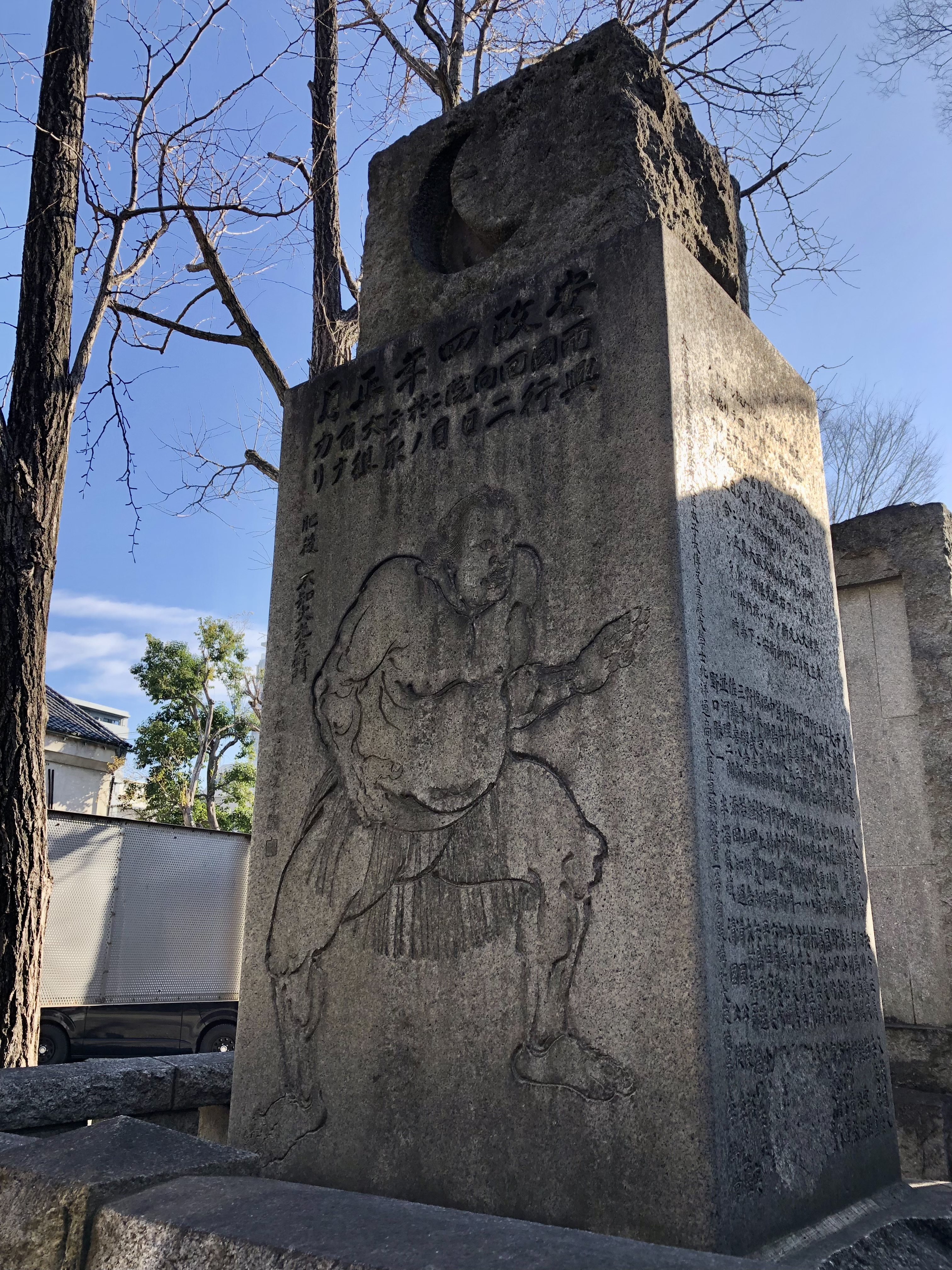
One of the two Yokozuna stones, Tomioka Hachiman Shrine.

Tomioka Hachiman is what we were looking for. 

The Tomioka Hachiman shrine was established in 1627. What is standing today is not the original shrine. I'm not sure how many times it has been rebuilt (Japanese temples and shrines have a history of being burned to the ground) but I do know that the building was destroyed during allied bombing during World War II and it was rebuilt for the last time (for now) after that. 

So about that sumo thing. Sumo was not invented at Tomioka Hachiman. The origin of sumo as a sport is so old that it cannot be reasonably traced back to a particular date or site. It may have evolved from Shinto rituals or superstitions but the actual facts have morphed to folklore or myth or legend or something less reliable. However, it does seem that there is some connection to Shintoism. In case the notion of a religious shrine decided to host a wrestling tournament sounded odd.

Another thing to note: Tomioka Hachiman was also not the first place where a formal sumo tournament was held. There is evidence of emperors hosting such tournaments at the royal court as far back as the 700s. But the notion of a regularly occurring event held multiple times a year (twice) every year was established at Tomioka Hachiman in 1684. Over time, other cities held similar tournaments and eventually all these events merged or morphed or whatever you want to call it into the current sumo grand tournament format: six tournaments held in the odd numbered months. Three of the six are held in Tokyo. The other three are held elsewhere in Japan. 

All of this began with a shogun-sanctioned tournament at Tomioka Hachiman in 1684. Cool stuff. I think it's awesome to find the spot where things that we have traveled a great distance in the past to see began.

The main shrine at Tomioka Hachiman.
Tomioka Hachiman is not vastly different than most other temples or shrines we have visited in Japan. There are two torii marking the entrances to the property and the threshold between sacred and secular space. There is a main shrine; a fountain; a couple of statues; vending machines here and there; and a small garden area or two for reflection. In fact, other than the scale and the massive crowd, it's not a whole lot different than what we experienced at Sensō-ji. 

Except for the peace and quiet that is. Whereas Sensō-ji was mobbed with pilgrims and tourists, Tomioka Hachiman was absolutely deserted. Sure, we went there first and likely got there at 8:30ish or so in the morning but if there were 10 people on site when we were there at any one time, I'd have been shocked. You get to feel the spirituality through the peace and silence and experience a little bit of what places like these mean to the country of Japan and its people.

In addition to the overall vibe, there was one thing we had to stop by and visit tucked away in the back of the property to the right side of the main shrine: the Yokozuna stone.

Tomioka Hachiman. The circle with the three symbols inside is everywhere. 
The Yokozuna stone is there to honor those sumo rikishi (basically a term equated with any professional sumo wrestler) who have achieved the highest rank in the sport. Elevation to this rank is not easy. Typically it takes a successful career and an achievement like winning two grand tournaments in a row, although there is no set criteria for being named a Yokozuna. In the history of sumo, only 73 rikishi have achieved this rank and only six have earned the distinction in the 21st century. It's not something that happens every year. We were fortunate to see one of those 73 when we attended our first (and to date only) sumo tournament in 2017.

The stone was placed at the shrine by Jinmaku Kyügorō, the 12th Yokozuna, in the year 1900. Since that time, the name of each subsequent Yokozuna has been added to the stone when each new member is added to the club. There's a special ceremony held at the shrine for each of these additions. Definitely worth a visit.

There's a reason why sumo is so special to us. One of the most notable (if not THE most notable) interactions we have ever had with a stranger while traveling happened in May of 2017 at our first tournament. At that tournament, we sat next to a younger man who was a huge sumo fan, and during a break in the tournament he left his seat, went to the souvenir stand and came back with a poster showing all the Yokozuna in history that he presented to us to as a souvenir of our visit. It was an amazing gesture and we now have that poster framed and hanging in our house.

Based on that interaction with someone we will likely never ever see again, sumo, sumo tournaments, Japan and the Yokozuna will always occupy a special place in our travel history. Visiting Tomioka Hachiman added another piece to that already remarkable history in our lives. The point for us to go to Tomioka Hachiman was really to lay eyes on that stone and remember that connection back to 2017.

Our goshuin-cho with newly acquired stamps from Tomioka Hachiman (right) and Sensō-ji (left).

A few last things about this layover. First, I wish these things could happen more often. There's not a lot you can do on a hours-long layover but there is a real opportunity to add a special unexpected memory to a trip. I know that happened here in Tokyo. It also made us long for Japan and book our next trip there.

Second, we did get two new goshuin added to our goshuin-cho that we picked up years ago at the Komitake Shrine on the slope of Mount Fuji. They are displayed above. Each time we do this, our temple and shrine visitation path diverges from all others that are similar. It is truly a unique memento tied directly to us as two people. This book is likely like no other in the world. I think that's cool. I also love the green ink on the Tomioka Hachiman seal. First time I've seen multiple colors. 

Third, we did eat two meals in our half day plus in Tokyo. And like our choice of breakfast spots, there was really no debate on where we were going for lunch. One of our last meals in 2017 in Japan was eaten at a spot called CoCo Curry House. I have no idea if this chain restaurant is like Denny's to the average Japanese citizen but we love this stuff and we couldn't set foot in Japan without dipping a spoon into a bowl of brown Japanese curry next to some rice on a plate. This is really like the most visually unappealing meal we have ever eaten (twice) but it's so, so good. Had to stop here. I expect that a trip to CoCo Curry will be on our 2025 Tokyo itinerary. 

Lastly, let's talk about the cover picture of this post. There are many enduring images and memories from our first trip to Japan seven years ago. One of those is (believe it or not...) vending machines. I'm serious. These things were everywhere in 2017 and so we were not surprised in any way to find a few at the Tomioka Hachiman shrine. One of the great joys about Japanese vending machines on our first visit was that most stocked beer. That's right, you could walk up to a vending machine, drop some yen in and come away with a cold birhu. 

Now, we didn't really expect to find beer in the vending machine at a Shinto shrine. But the surprise was that we didn't find beer in vending machines anywhere, not even in the hotel. That's because in late 2017, Japan banned beer in vending machines. Not because kids were buying them and drinking them (come on...it's Japan) but because local businesses were complaining about the loss of money due to vending machine beer sales. 

Things change. Japan is still awesome. This was a such a treat at the end of our epic Southeast Asia journey. Can't wait to go back here next spring.

Sunday, June 11, 2017

Sumo


In the year 1684, the Tomioka Hachiman Shrine in Tokyo decided to hold a wrestling tournament. If this seems like a strange thing for a Shinto shrine to do, consider that the origins of wrestling in Japan can be traced back centuries to Shinto dance rituals, so part of the ceremony involved in each bout was ultimately derived from a religious rite. The 1684 tournament was the first in what would become a series. From that point on, tournaments were held twice yearly at the Shrine under the protection of the shogun, or military dictator, of Japan. The Tomioka Hachiman Shrine called their 1684 tournament kanjin zumo; today, we call the sport that originated at that tournament "sumo".

Sumo, or sumo wrestling if I wanted to be redundant, is likely a familiar sport to some people, although their impression of what really happens in a bout might be very different from the reality. To most, I think sumo could be summed up by two fat Japanese men in diapers running into each other at top speed until one surrenders and the other one wins, however exactly that might happen. Before I set foot in Japan determined to see this sport in person, I might very well have fit into this category, although I likely wouldn't have used the words "fat" or "diapers". Now I see things differently.

The origins of sumo can be traced back centuries. And I don't mean about three and a half centuries to the year 1684. I mean CENTURIES. Like a couple of millennia. There is evidence of rituals which might suggest sumo all the way back to the start of our Common Era or about the year zero. It may have stemmed from festivals which included references to Shinto myths in which spirits were summoned and fought by men for the entertainment of the gods.

As the Japanese began to record their history more rigorously, we know that sumo was definitely performed at the royal court for the entertainment of the emperor. There is evidence that sumo tournaments featuring the finest wrestlers in Japan were held prior to harvest time during both the Nara Period (710-794) and the Heian Period (794-1185) as a way of securing favor from the gods for a successful crop. During the Nara Period, the royal court (or capital) was located in Nara, a city about 300 miles west of present day Tokyo; during the Heian Period, the court was moved to Heian-kyo, which is present day Kyoto, about 25 miles north of Nara.

While sumo's history goes back 2,000 years, the origins of today's professional sport can be traced to that 1684 tournament at Tomioka Hachiman. Over time following 1684, rules of the sport were codified; the notion of tournaments spread to other parts of Japan (particularly Osaka); and the bouts moved out of shrines and into secular buildings constructed strictly for sumo tournaments. In the early 20th century, there were two prominent sumo organizations in the country, one based in the east of the country in Tokyo and the other in the west in Osaka.

In 1926, these two organizations merged, agreeing to hold four tournaments per year which would alternate locations between the east and west. The east tournaments would be hosted in the custom-built-for-sumo Ryogoku Kokugikan building in Tokyo; the west tournaments would be held in either Osaka, Nagoya or Fukuoka. Today, there are six grand tournaments held annually in the odd numbered months: the January, May and September tourneys are held in the Ryogoku Kokugikan and the March, July and November contests are scheduled for Osaka, Nagoya and Fukuoka respectively. They still alternate between east and west.

Banners hanging in the Ryogoku Kokugikan train station let you know you are near sumo.
If there was a single reason I visited Japan last month, it was to watch sumo in person. To be clear, that was not the ONLY reason I visited Japan but sumo certainly determined the timing of my visit. I had to be in Tokyo at least one day between May 14 and May 28, the start and end dates of the May Grand Sumo Tournament at Tokyo's Ryogoku Kokugikan, the high temple of sumo. Sumo was the first thing on my planning list and we bought tickets for Sunday, May 21 as soon as they went on sale (thanks, Larry, for that). We were on our way.

Before I go on, perhaps a little terminology check is in order. First of all, there's no need to call it sumo wrestling. Sumo means wrestling; saying both is redundant. I won't do that here anymore. The big fat guys in the ring at the center of all the action are rikishi and they are not doing battle in a ring, it's a dohyo (not to be confused with dojo; we'll get to that sort of stuff eventually in this blog, just not in this post). They are also not wearing diapers. The belts they wear are referred to wamashi. Got all that? Good. I won't confuse you with any more vocabulary right now but I do think it's worth mentioning here that sumo is the only type of wrestling in history where the combatants wear garments that can be held onto; we'll come back to that concept.

Each Grand Tournament, or honbasho, held in Japan spans 15 days. Each rikishi participating in the  top divisions of the honbasho wrestles once per day. The riksihi with the best record after the 15 days is declared the winner. Pretty simple, right? Now since it is possible for two rikishi to make it through the honbasho with the same record, even if they are undefeated, there is a provision for a playoff to determine a single champion.

At the food lines inside the Ryogoku Kokugikan. Rikishi got to eat too.
Each day's docket features a schedule that starts with the lowest divisions, where rikishi wrestle about once every other day, and then moves into the two top divisions, starting with the juryo, or intermediate division, before proceeding to the makuuchi, or senior division, towards the end of the day. In the juryo and makuuchi divisions (and perhaps in the lower ranks too although it wasn't obvious to us) the rikishi are divided into two teams: the higashi (or east) and the nishi (or west). There are no weight classes in sumo. It's all based on skill. You can be as heavy or light as you want to be in a division. You just need to be competitive.

There is no time limit on a sumo match. There are also no rounds or innings or quarters or periods. The match starts when the referee declares the match started and it ends when one rikishi is either forced out of the dohyo or touches the ground with some part of his body other than his feet. Most matches are incredibly quick. The fastest we saw was probably on the order of about 5 seconds or as long as it took one riskishi to run straight across and out of the dohyo past his opponent who had simply stepped aside. 5 seconds is sometimes all it takes for a day's work in sumo.

Our sumo adventure began on the first full day we were in Japan. After an uneasy night's sleep (Tokyo is 13 hours ahead of the timezone I usually live in) and a very early wakeup time followed by a walk around the Shinjuku neighborhood we were staying in, we got ready to head out. We knew the doors at the Ryogoku Kokugikan opened at 8 am and the day would go for about 10 hours but decided early on we didn't want to sit through all of that. A 10:30 or 11 am arrival time seemed good to us, early enough to get the lay of the land and figure out maybe something of what was actually going on before the top matches got started.

The Ryogoku Kokugikan is pretty easy to get to from Shinjuku. Just a 25 minute ride on the Japan Rail Chuo-Sobu line to the stop named after the arena. From there it's a five or so minute walk past the multicolored flags and maybe a rikishi or two wondering in the street to the front door. Entering the building is like entering a temple. For sports fans, or at least for me, I think visiting a hallowed ground in sports has it's own special significance. Setting foot in this mecca of sumo for me was like watching basketball at Madison Square Garden or college football at the Rose Bowl or something like that. It is clearly a special place.

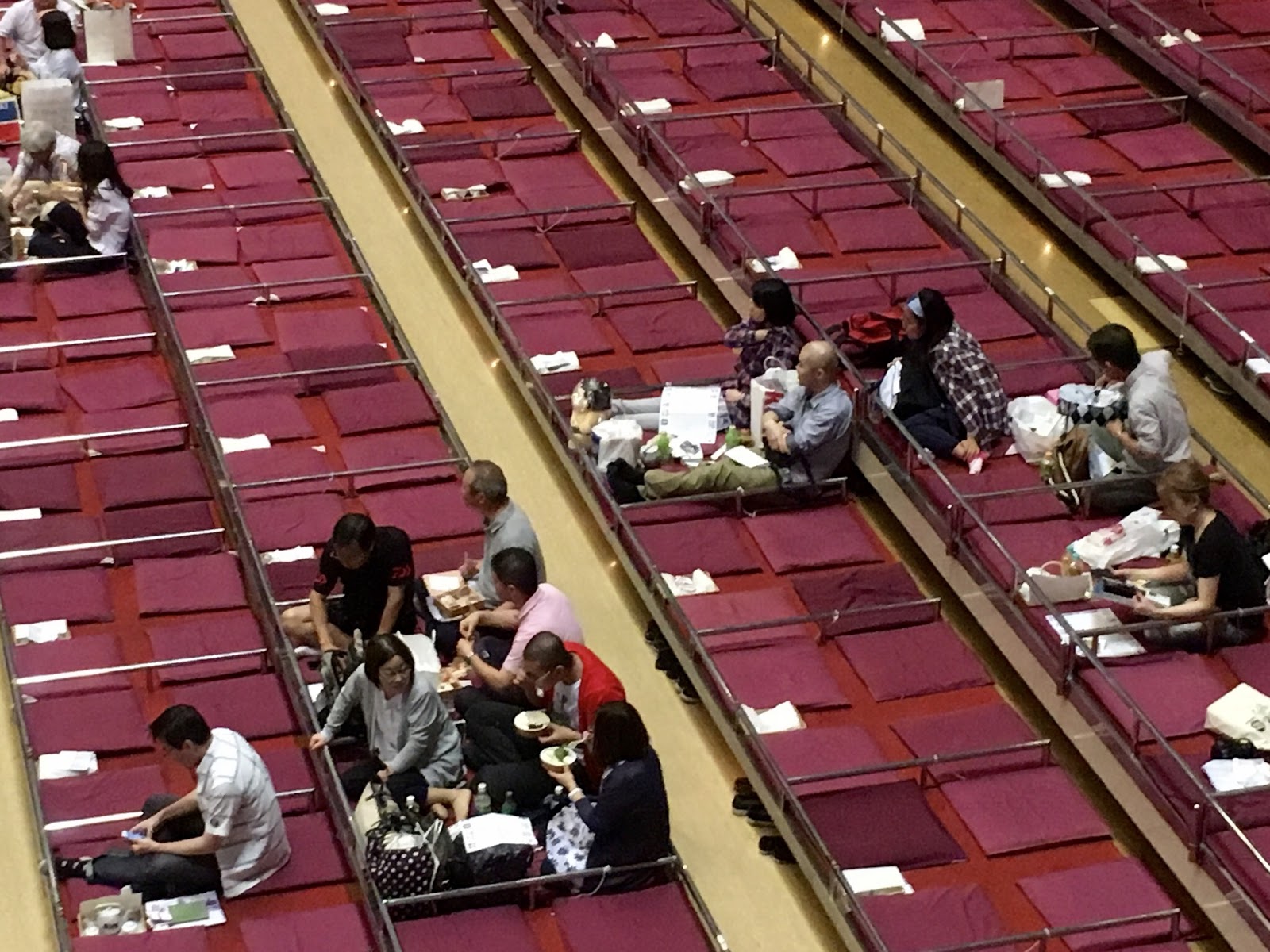
The arena is constructed especially for sumo and it's obvious. The main hall is square to mirror the raised platform where the dohyo is located. Above the dohyo is a suspended roof structure made to evoke a Shinto shrine to reference the sport's history and it's significance as a descendent of a religious ritual. The arena has two levels. The lowest consists of a series of four-person boxes containing mats for the spectators to sit on; the upper is built with western style seating. The prospect of sitting crossed-legged or on my knees for hours on end in a confined area which would need to contain at least two people significantly larger than the average Japanese man in addition to two others made my seating choice easy. I'd be sitting upstairs thanks.

Do these seats look comfortable? Not to me they didn't.
Both levels of the arena have a perimeter corridor circling the entire building for accessing each individual seating area. This same concourse has stores selling sumo souvenirs and a variety of snacks and drinks that would provide everything we needed for a full day of watching sweaty men banging into each other. Bento box? Check. Yakatori? Check. Red bean paste buns? Check. Grab some skewers of chicken meatballs, maybe some rice crackers and a couple of cans of Morinaga sweet sake (an apparent bargain at 320 Yen or just a shade less than $3) and head to your seats ready for some action.

From my one time attendance at a honbansho I can tell you if you get there before noon, there's going to be plenty of space to spread out. Need a better seat than what you bought? You can probably get one pretty easily if you are prepared to move once the rightful owner shows up. The matches at that time of the day usually move pretty quickly. There's not a lot of fuss between bouts like there will be later in the afternoon; just two men pitted against one another trying to get the other one to touch the ground with an illegal body part or to exit the dohyo. This time for me allowed me to get my head wrapped around some of the strategy for the sport before examining the finer points of the whole experience when the good stuff started.

Let me say that a sumo bout is anything but a friendly interaction. As cordial and respectful as the Japanese are to each other (including rikishi to rikishi before and after the bout), this is a violent act. Each match starts with an explosion of two 300 or more plus pound men launching themselves towards one another. Most times, they are not just letting their bodies collide. Most matches feature a barrage of face slaps and throat punches and any other way a man can make contact with another in rapid succession. In addition to the shock of having a large man hit what is usually an equally large body, these head shots have to hurt.

If both men are left standing inside the ring after this initial assault then there is likely some grappling and pushing and twisting coming as the two rikishi try to force the other out of the dohyo. And if your opponent gets a handful of your mawashi and you can't get a piece of his then look out. The ability to get a big hand on your opponent's belt seemed to be a key advantage in winning a bout.

The interior of the Ryogoku Kokugikan. Shrine roof over two rikishi and a brightly colored referee in the dohyo.
Each match starts with a singing introduction from some sort of ring official and is ended with the referee (who is outfitted in some fancy brightly colored costume with an odd hairdo which makes him look like some sort of elf or sprite) waving his paddle towards the winner before the victor leaves the arena. Before the juryo division, these things come rapid fire, which both passes the time rapidly and gives the novice sumo spectator a lot to study.

Before we get to the main events, let me say that the biggest guy doesn't always win. There is definitely a size/stamina/nimbleness balance to a rikishi's success in the dohyo. The biggest size mismatch we saw looked like a complete and utter destruction waiting to happen; to my untrained eye there was no way the smaller guy, who probably ranged between 250 and 300 pounds, was going to outmatch his opponent who by my estimate had him by at least 200 pounds and that is not an exaggeration. The whole thing seemed incomprehensibly unfair to the little man, a term which I use lightly here. But sure enough and in a match that lasted into the minutes in duration, the smaller man won. It was obvious just seconds into the contest that the larger rikishi had no ability to move with any sort of agility and after a long while for a sumo match that proved to be his undoing.

Before showing up at the Ryogoku Kokugikan, I had read and heard stories of the pre-match rituals involved in sumo matches. The foot stomping. The throwing of salt to purify the ring. The squatting. The staring. But in the morning and early afternoon matches there was none of this. It was assembly line sumo; in and out as fast as possible. That all changed when the juryo and makuuchi took the ring.

One half of the makuuchi division, pre-bout introductions.
The juryo and makuuchi matches start with an introduction of the competitors, first the east and then the west (or vice-versa, it wasn't clear who was first). All of the rikishi for a particular side of the country enter the arena and parade around the dohyo in an elaborate kesho-mawashi, a kind of apron in bright colors with logos or writing on them (sponsorship information as I understand it). Once all are present and accounted for, they perform a facing and clapping ritual after being announced over the PA system.

After the parade of kesho-mawashi wearing rikishi (say that ten times fast along with the name of the building) at the senior level, there were three rikishi that entered individually for a solo stomping and display ritual. We assumed these three were the reigning champion and the two leaders of the honbansho to that point in the tourney, although we may be way off here. Each of these three sported white cloth or paper (difficult to tell from so far away) zig-zag shaped ribbons hanging from their mawashis. You can see these ribbons in the second photograph above and in the last photograph in this post. You can also see them around Japan at the many many Shinto shrines you can visit when you are in country. 

During both these ceremonies, the crowd is totally into everything with whooping and hollering for individual rikishi and the group as a whole. I didn't even notice it really but the empty arena that we found when we showed up was no longer empty. There was hardly an empty seat or mat to be spotted in the building.

Finally, it's time for the individual juryo or makuuchi bouts and here the rituals of sumo are on full display. There will be no more quick match after quick match. From this point forward, there is going to be a lot of pre-match posturing and ceremony. Think of it as the kind of stuff that batters in baseball go through when they step to the plate. If you watched much baseball in the early 1980s, Mike Hargrove's at bat routine when he was with the Cleveland Indians is about as close as I can get to an American sports analogy. Suffice it to say that there's a lot of time to wait before things actually happen after the rikishi appear to be ready to battle.

So what exactly happens here? Let's start with the pre-match stomping which is done facing the crowd with some yelling. Then move on to the mouth rinsing, similar to the kind of thing you yourself can do at a Shinto shrine elsewhere on your trip to Japan. Maybe some squatting and staring at your opponent? A glare or two to get him nice and intimidated? Follow with some sand kicking and maybe we are ready to go, right? 

Not even close. Time to pull out and throw some salt, in mimicry of an old Shinto purification ritual. Sometimes the salt throw is dramatic; sometimes it's almost lazy. But it was the most exciting part of the pre-match posturing. And not because the match could start after that. Still not there. Maybe some more sand kicking, some more squatting and staring and then maybe a wipe all over (including the very sweaty armpits) with a towel before maybe some more salt along with some belt or flesh slapping. It's all good. After all, the match is probably lasting less than 30 seconds. 

The end of one of the makuuchi matches. Note how crowded the place is.
This is all part of why I came to see sumo. There's no other sport you can get quite this amount of showmanship. Eventually we got through match after match this way. I like to think by the end of the day we could pick up some of the subtleties of the sport through some close watching and comparing strategies used by individual rikishi in their matches. 

We were also able to make sense of who was whom in the east and west thanks to our new friend Hirohite (at least that's what his name sounded like; apologies if I got it wrong) who was sitting next to us. Pointing; broken English and Japanese; and some furious typing and speaking into the Google Translate app worked wonders here. Hirohite also helped us understand why about half the spectators in the building kept taking pictures of the banners depicting rikishi behind us. In the Ryogoku Kokuigakan they hang full body banners of each of the past hanbansho champions and apparently Kisenosato (who won the past two and who we saw in his own introduction) is a pretty popular guy.

After six or so hours in the building, I believe I can say I understand sumo a lot better than I did when I entered. There is some skill in this sport and these guys, despite their massive size, are true athletes. I believe we got a sense of the strength of the rikishi, particularly in their legs, which must endure terrible stress from carrying all that weight. I also appreciated the balance that some of these guys had. Time after time, it looked like some matches were going to end very quickly and a rikishi was able to recover with a quick and amazingly nimble re-shuffling of the feet. 

On the fan side, I can say I get it. I'd sit through another one of these if it came to that. Although I'm not sure I could be a fan of one particular rikishi. Imagine sitting through an entire day's sumo for 10 or 15 seconds of action from the guy you have posted up on your office wall. There would seem to be very little payback for a true fan of an individual, although I'm admittedly open to changing my mind here since I have about as little experience as I could possibly have with this sport.  This day was worth it.

A few final thoughts on my one day sumo experience.

First, it's a good thing we bought tickets the day they went on sale. I checked a couple of days after and the whole tournament seemed to be sold out. There certainly were very visible signs when we got to the arena that there were no tickets available.

Secondly, while I didn't get much of a sense of this, being in sumo is a demanding and rigorous endeavor. There are sumo stables all over Tokyo for the rikishi to practice in with understudies for the next day's match. Some are even open to visitors, although we couldn't find time in our schedule to do that. Maybe next time.

Thirdly, at a number of times during my week and a half in Japan, I was struck by how generous and welcoming the Japanese people were and we got another glimpse of this through our new friend Hirohite. Through our Google Translate-heavy conversation, he asked if this was our first sumo experience which of course we responded that it was. The next time we look over he's gone but he returns minutes later with a box for us containing a poster displaying the history of the yokozuna, rikishi who have achieved the highest rank possible in sumo by securing victory in a Grand Tournament. Included on that poster is both crowd favorite Kisenosato as well as a yokozuna named Hakuho, the winner of the tournament we attended and the most decorated of all yokozuna. It's my favorite souvenir of Japan because it came from the heart and it will soon be framed and hanging somewhere in my home. What an amazing gesture from a total stranger.

Finally and perhaps most importantly is some advice for you if you plan to make your own first sumo pilgrimage. Pass on the sweet sake; get a Sapporo or Kirin instead. You'll thank me for it. 

Me and what I assume are life-size cutouts of everyone's favorite rikishi.