Showing posts with label Gorillas. Show all posts

Saturday, April 22, 2023

Top 10 Species List

When we embarked on our first sub-Saharan African safari trip in 2015, we didn't know what exactly to expect. I mean, sure, we knew we'd see some animals. Elephants, hopefully. Giraffes and lions, maybe. I don't know what else. Buffalo? Leopards? Hippos? We didn't really think too much about what we'd see in specific because at that point we hadn't seen anything ever outside of some sort of zoo. The first elephant we'd see would be the first wild elephant we'd ever seen. Same for giraffes, lions, buffalo, leopards, hippos and everything else on the entire continent of Africa. In essence, we were ready to take what we could get and we'd be perfectly happy with whatever we saw.

That changed with our second safari trip. On our 2018 vacation to Kenya and Tanzania, we had a top ten list of animals we'd never seen in the wild. I'm not sure of the exact order but (and I'm going from memory here), I believe we had leopard, rhino, zebra, painted dog, ostrich, secretary bird, cheetah, gerenuk, hyena and pangolin on the list. We saw seven of the ten and went home extremely happy, missing only the painted dog (extremely rare in Kenya and Tanzania), the gerenuk (not where we went in 2018) and the pangolin (nocturnal). Seven out of ten ain't bad as far as I'm concerned.

So fast forward to 2023 and our trip to Uganda, a trip we had scheduled for October 2020 before the world and viruses had other ideas. And OF COURSE, we had another top ten list. After all, doing it one time in 2018 meant we couldn't back off and not do it this time, right? 

Here's how we fared against this year's top ten list. Spoiler alert: we didn't do quite as well as we did in 2018.

1. Mountain Gorillas

OK, OK, so this is a complete softball of sorts. I mean gorillas were the main attraction on this trip. We couldn't NOT see these primates up close and personal, could we? That's like going to see Taylor Swift and having the show end after beabadoobee and Gracie Abrams are done with their sets. 

And yes, I had to look at who was opening for Taylor Swift and no, we didn't get tickets. 

So of course, we did see gorillas in Uganda from feet away on foot with nothing between us and them and it was amazing. The intimacy was just all around. There was real creature to creature connection here, and by that I mean connection between human creatures and some of the nine gorillas we trekked to see. The trip delivered what it promised to deliver. Nature sometimes throws you a curveball and you don't get to see what you came to see. Fortunately, that wasn't the story on this trip. Number one checked off!

2. Chimpanzees

Yep, also a bit of a softball, here. Our chimpanzee trek in the Kibale National Park was incredible and totally unexpected in its awesomeness. No, it didn't beat seeing the gorillas in the wild from feet away but that day, I wondered how seeing gorillas could possibly be better than seeing chimpanzees.

Before we left home for Uganda, I actually didn't consider seeing chimps in the wild a slam dunk. I did actually think we could strike out (to continue the mixed sports allusions) on this walk and see absolutely nothing whatsoever. I loved this day. The intelligence and human-ness of the chimpanzees we got close to really shone through in a way watching few other species could possibly have done.

I love the picture of the chimpanzee above by the way. I see it as very Planet of the Apes like. The smarts absolutely come through loud and clear.

3. Shoebills

OK, so three for my first three. This one was not a gimme and we only saw one but we did lay eyes on one of these giant birds in person in the Mabamba Swamp. While there was absolutely a very high chance we could venture out on our shoebill day and not see a single one of these creatures, the shoebill was third on my list because we made a specific trip to see this bird. That was sort of a theme on this trip; we took three species-specific safari days, one each for gorillas, chimpanzees and shoebills. These were the top three things we targeted on this trip that we had never seen before. We got lucky and got all three.

Considering we saw maybe about seven or eight gorillas, thirty or so chimpanzees and just one shoebill, I know we had some luck on our side this day. Never feel like you are entitled to a show when nature is involved.

4. Painted Dogs

No picture on this one because quite simply, we didn't see any. No encounter, no picture. That's how this post is going to roll. Yes, this is a repeat (and a miss) from 2018.

When we first visited sub-Saharan Africa, we had no idea there was such a thing as a painted dog (sometimes called African wild dog). We saw one of those yellow, diamond-shaped road signs warning of the presence of painted dogs on our way from the Victoria Falls airport to our hotel on the first day we ever spent in sub-Saharan Africa and we actually mocked it (like...who wants to see a painted dog?). How stupid and ignorant were we back then? But legitimately, we didn't understand what these things were. Never heard of them.

Painted dogs are for sure an apex predator in Africa. They are not the same as hyenas, which sort of fill a role somewhere between hunter and scavenger on the savannah. These things are fast, intelligent, coordinated, aggressive pack hunters who relentlessly pursue their prey until they kill it. They are impressively scary. But they weren't where we went in Uganda. Nowhere close really.

That sign that we saw in Zimbabwe in 2015 was maybe not the closest we got to seeing these animals live. We actually went on two off-road wild goose chases looking for painted dogs on our way to and from Chobe National Park on that trip with neither yielding a sighting for me (although our guide claimed he'd seen some in the headlights on the night off-roading adventure). 

5. Gerenuks

No gerenuk picture either on this post. A gerenuk (also on my 2018 top 10 list) is often called a giraffe-gazelle, so named because it's a gazelle with a long neck (duh...). Its neck length allows it to reach medium-hanging leaves that animals like impalas and kudus can't reach because their mouths never get to that height off the ground. If its neck weren't enough of an advantage, the gerenuk can also stand on its hind legs to get even more elevation.

Because these lists of species that I make are often emotional, I didn't check out if all the animals that made the list actually live in the places we were traveling. There are no gerenuks in Uganda. Their range is further east in eastern Kenya, eastern Ethiopia, Somalia and northeastern Tanzania. I'm definitely not putting them on any future list (if there ever is one) unless I'm in one of those spots in the future. 

FYI, Somalia is not on any sort of travel list for me at all. 

6. Great Blue Turacos

So from what I just wrote about gerenuks not being anywhere close to where we were headed, I may have given the impression that I pulled together this list without any research whatsoever. Not exactly true. Some of my wish list was emotional and impulsive (hence, the gerenuk and yes, rare for me, I know) but I did do a little homework ahead of time, although much of that didn't extend beyond studying the East African Birds pamphlet shown in the cover picture of this post. But that is how I found the great blue turaco.

There are not a ton of super-colorful medium to large birds in Africa, so when I saw the great blue turaco in our wildlife guides and the noticed they live in forests where we'd be heading for the first time in Africa ever, I thought there might be a chance. The great blue turaco is a bit more than two feet from head to tail when fully grown so we are not talking about a small bird here. It's brightly colored from the tip of its beak to the tip of its tail so this seemed like a bird worth looking out for.

We didn't really have to do much looking out. While we were wrapping up lunch after our chimpanzee trek, we saw five or six or these birds fly into a tree right next to the gazebo where we were eating. The lighting wasn't great. It was about high noon and the sun being almost directly overhead didn't allow me to take any pictures that weren't significantly backlit. Still...great blue turaco sighting in the books.

We did actually see a few more of these birds right after lunch when we took a stroll around the Bigodi Swamp but the lighting on that spotting was even worse than at lunch.

7. Kingfishers

I've been a little kingfisher fixated lately. We saw three different species down in Costa Rica last October and it whetted my appetite for some more sightings on this trip to Africa. I put kingfishers on the list here because I knew we'd be taking two boat rides on this vacation that might get us a look or two. It worked. We found these birds on both of those boat rides and on safari in the middle of Queen Elizabeth National Park. No shortage of kingfisher sightings on this trip. We even saw one at our hotel on Zanzibar one afternoon.

We managed to lay eyes on three different types of kingfisher in Uganda. On our trip to find shoebills in the Mabamba Swamp, we came across the black and white pied kingfishers both in the Swamp and over Lake Victoria along with the multi-colored malachite kingfishers when we arrived at the Swamp. The bird above is a woodland kingfisher that we found in the middle of Queen Elizabeth National Park nowhere near water. These birds eat fish to survive. No idea what it was doing in the middle of landscape populated almost exclusively by candelabra cacti. 

According to the Encyclopedia Britannica, there are about 90 species of kingfishers distributed throughout the world. I have a lot of work to do. That also means there's a lot of places where I can find these things in the future.

8. Bee-Eaters

The place where I really fell in love with small birds, and which made me into an avid birdwatcher wherever we've been since, was Lake Manyara National Park in Tanzania. Among the many birds we saw in that Park was a carmine bee-eater. I managed to capture one sitting on a thorny branch of a tree and it's one of my favorite photographs from that trip. I thought since we saw one in Tanzania, maybe we'd be able to see some in Uganda also. We did.

Bee-eaters are little, brightly colored birds with curved beaks and a stripe that extends from their beaks to the back of their heads. They are quick and acrobatic flyers which eat (perhaps quite obviously here) bees, wasps and hornets. We only saw bee-eaters on one day on our trip but we did see two different species. The one above is (I believe) a blue-cheeked bee-eater which is generally found in northern Africa and the Middle East but which sometimes winters further south between the tropics.

Appropriately, the bee-eater above is sitting in a thorny tree. Always with the thorny trees these birds in Africa. 

9. Pangolins / 10. Aardvarks

Pangolins (like painted dogs and gerenuks) were on my 2018 list so I had to carry it forward, right? I knew there was basically no chance of seeing this nocturnal anteater so I thought I'd double down and add another nocturnal anteater, the aardvark, to round out the list in the number 10 spot. Yeah...didn't see either. I mean not even close.

So...10 species. Six seen, including multiple species of kingfishers and bee-eaters. I don't think that's too bad considering this was our third safari and we've pretty much seen every animal and bird that's an obvious and well-known African species. Sure we are missing some from the list above and there are some species of some animals (notably hyenas and zebras) that we haven't yet seen, but we've covered all the big and famous stuff by now.

I see a few more safaris in our future. I'd say at least two more on mainland Africa. Maybe more. Who knows. At least something that touches South Africa in some way and maybe a trip through the Namib Desert. Those would be my top two.

When and if either of those two (or a different one) happens, I'm not sure I'm going with a top ten list of species we want to see. I think going forward I'd prefer to take a trip to find a specific species that is missing off our list and we'll take whatever else we can see while we are on that trip. So I think the next one of these we take has to target the painted dog in a serious way. That's the one species we long to see more than any other. Sure there are some experiences we'd like to see like lions finishing a hunt or a leopard carrying a dead impala or something like that up a tree but we can't guarantee those things happening even if we see those animals. Next safari trip to Africa: painted dog has to the be target.

But that's the future. For 2023...six of ten on our list seen. I'll take that.

Malachite kingfisher, Kazinga Channel, Uganda.

Saturday, April 8, 2023

Mission: Gorillas


We went to Uganda to see animals. Yes, that's three posts in a row starting with that sentence. I will stop now. I promise. But we did go to Uganda to see animals.

The last full day of our time in Uganda was devoted to spending time with gorillas. It was without a doubt the marquee attraction of the entire trip. Despite everything else we had seen and done that was amazing and spectacular in our time in country, this was clearly supposed to be the highlight, the thing that we would end up treasuring the most. Indeed, even before we left, when everyone we talked to about this trip asked "what are you going to do in Uganda?" our response was "we are going to see the gorillas". No responses about safaris or chimpanzees or exploring local culture or finding out something about ourselves. We are going to see the gorillas. That's it.

Now, in my last blog post about our chimpanzee trek on this same trip, I expressed some indignation about the lack of advance fanfare on the part of our tour operator and everyone else around our day walking in Kibale National Park looking for chimpanzees. Gorillas? Main attraction. Chimpanzees? Just another half a day on a week-long trip. No mention of the fact that humans share more DNA with chimpanzees than with gorillas. No fuss made about the longer time we'd spend with the chimpanzees than with gorillas. Nothing about the large number of chimps we'd see vs. the small number of gorillas.

When we emerged out of Kibale National Park after three plus hours with chimpanzees in the forest, I thought there was no way the gorillas would top that day. 

But they did. By quite a bit.


The gorillas we tracked on our last day in Uganda are mountain gorillas. They only live in the area of the world where Uganda, Rwanda and the Democratic Republic of the Congo (or the DRC) come together in central Africa. Not surprisingly, they live on mountains, which considering the mountains in that part of our planet are volcanoes which are not embedded in an extensive mountain range, simultaneously limits their range of habitat and keeps them in one spot. That's good for us as tourists but it has not necessarily been historically good for the gorillas themselves.

There are two separate populations of mountain gorillas in central Africa: one living in the Virunga Mountains and one living in the Bwindi Impenetrable Forest. The Virunga gorilla population is centered around three national parks: Mgahinga National Park in Uganda, Volcanoes National Park in Rwanda and Virunga National Park in the DRC. The Bwindi gorilla population lives in Uganda's Bwindi Impenetrable National Park in Uganda and the Sarambwe Reserve in the DRC. Despite the two groups being just 50 kilometers (or about 31 miles) apart, they remain separated from each other.

Mountain gorillas are endangered. As of the 2018 mountain gorilla census, there were just 1,063 total alive in the wild, 604 in the Virungas and 459 in Bwindi. Despite these astonishingly low numbers, the population has actually expanded significantly in the past 30 to 35 years. In the 1980s, the population in the Virungas was established at just 240 individuals. Not a typo. 240. Censuses are taken every 5 to 10 years so we are either due for another one this year or there's one coming in about 5 years.

To be clear here, mountain gorillas are not the only gorillas on our planet. There are two species of lowland gorillas. One of these species, the western lowland gorilla, is estimated to number around 100,000 in the wild. Not a great number, but certainly a lot larger than 1,063.

The decline of the mountain gorilla population is generally attributed to five factors: (1) poaching; (2) habitat destruction; (3) diseases introduced by interactions with humans; (4) war; and (5) gorilla-human conflict with local indigenous peoples. Although let's face it, all five of these are really humans are killing them. 

Poaching historically has taken a number of forms. Some gorillas get stuck in traps intended to capture other species for meat; baby gorillas are sometimes stolen from their families for zoos or private animal collections, with collateral deaths to other gorillas; and at one time, it was fashionable to own gorilla skulls or make ashtrays out of gorilla hands. I can't begin to explain the twisted logic of those last two.

The recovery of the mountain gorilla population over the past four decades is largely (and legitimately) credited to the work of Dian Fossey, who in 1966 went into the mountains of Rwanda to effectively live with and protect the gorillas. Fossey was able to raise the international awareness of the gorillas' very human-induced plight and mobilize people and governments in efforts to save them. Fossey's work led to protection of habitats; the rise of tourism as a significant source of income to incentivize further protection of the gorillas and their environment; and ultimately to her own death in 1985, which was never solved. Fossey was the first person to habituate gorilla groups to human presence, which allows people like me to visit these animals safely on foot today. Ironically, Fossey was not a proponent of gorilla tourism. 

The pre-walk briefing.
Our gorilla trek took place in Mgahinga National Park, about 4 kilometers from the border of Rwanda and 7 kilometers from the DRC. Our goal that day was to make it to the spot where one of the 22 habituated groups of gorillas in Uganda had set up camp for the night and were spending the day mostly eating. Mountain gorillas don't stay in one spot too long. They move around to find food as led by their dominant silverback, so named because of the gray hair on their backs which appears silver. There is no set time length for a gorilla hike. The start point is always the same; the end point varies based on just where the gorillas happen to be. We'd need to do some walking.

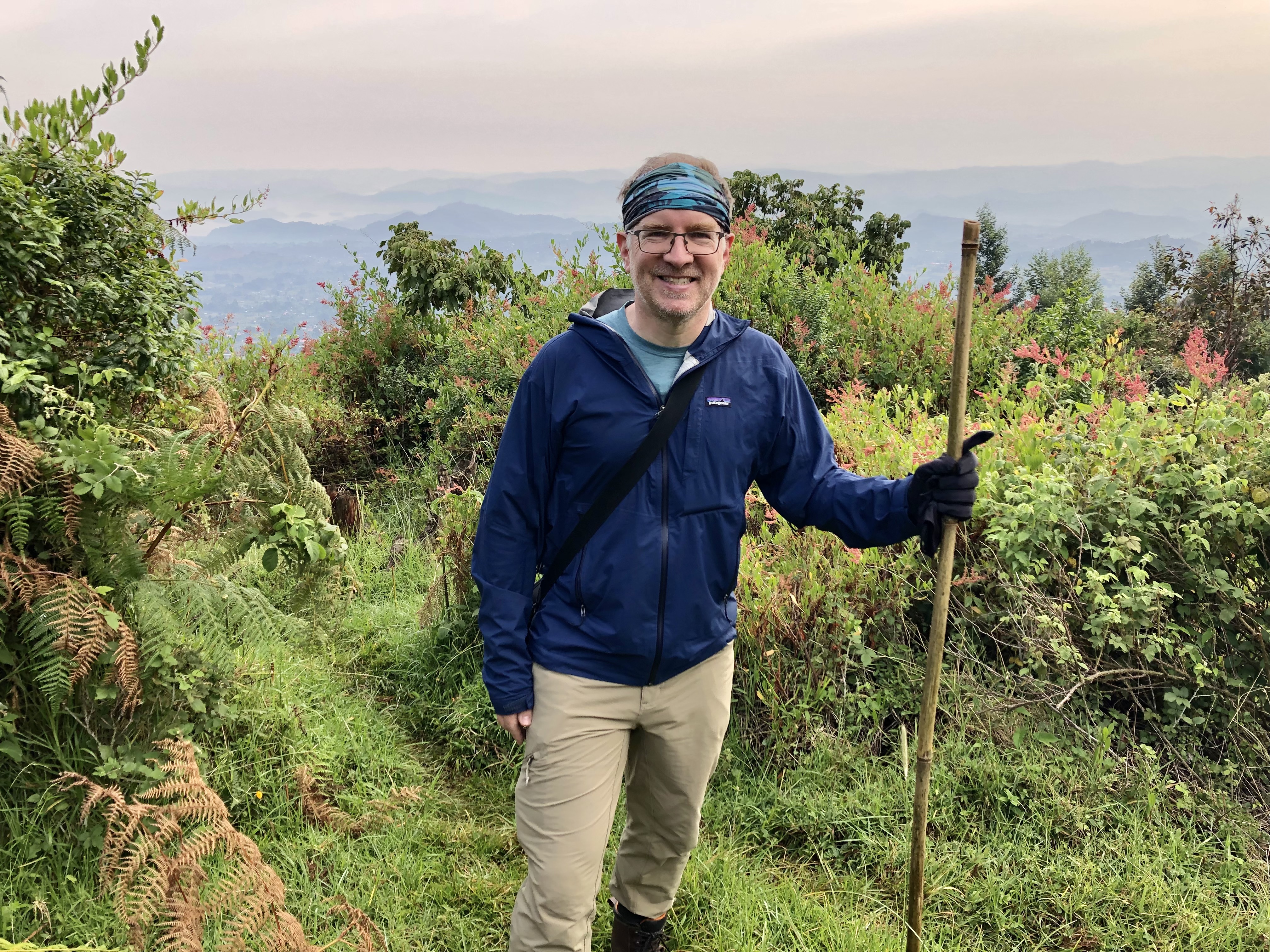
Walking an uncertain distance to find wildlife would mean another early start for us. 5:30 breakfast, 6 o'clock departure from the lodge and a 7:20 a.m. briefing after a short introductory hike to get the blood flowing. Bring water, rain gear, gloves and sunscreen. Lunch would be provided. 

Oh, one more thing. Mountain gorillas live on mountains, remember? So, the hiking was at elevation. According to the iPhone altimeter, our briefing was at an elevation of 7,600 feet above sea level. We'd climb about 600 feet higher than that to get to the gorillas. We'd also climb quite a bit to get to the briefing spot itself. We were told during our pre-trek briefing that the climb to the briefing location was the toughest walk of the day. I take notes during our travels, and I wrote in my notes "we shall see" when we were told this. They were right. It was the toughest part of the walk.

Now, of course, we wouldn't be going out on our own to find the gorillas. We'd be following the directions of our lead guide, Hashim, and be accompanied by two guys with very powerful looking guns. The guns are not for killing anything and they are not for protection against the gorillas, because that sort of protection is not needed. They were carried strictly to scare off buffalo and elephants which are sometimes encountered on these hikes and which are decidedly not habituated to the presence of humans. I did see one of our guards raise his gun once before he realized what was moving through the forest was a bushbuck. The gun was quickly lowered.

Hashim and our guides were not the first people on the mountain that morning. Before we even got out of the vans and started our first uphill climb, there was a team of trackers, most of whom are former poachers who had been convinced to abandon those habits in favor of more virtuous pursuits, out in front of us to actually locate the gorilla family we'd be visiting that day. We didn't need to be just wandering around aimlessly trying to find some gorillas. We had an advance scout team working hard for us.

Our group also had a few additional people with us. Porters. But I'll come back to those guys later.

Briefing done. Last real bathroom visit for a while. Start following Hashim, who dubbed our day "Misson: Gorillas" and pegged us with an 85% chance of success. He also gave us a mantra to keep us going: never give up.


The hike to the briefing point (top) and me looking very confident in my hiking skills in the morning (bottom).
So about those gorillas...

Our goal that morning was to find a family of nine gorillas with individuals ranging in age from a 45-year-old dominant silverback named Mac to a 2-1/2-year-old baby gorilla name Ndisa. Mac was named after the first person to track this group. Ndisa was named after the place where she was born. Both are common ways of naming gorillas. The prospect of seeing a baby gorilla was exciting. I mean who doesn't love animal babies? Plus maybe she'd be more active than the other older gorillas. Yeah...that's some foreshadowing, there.

By the way, I'm sure I'm going to mess up the spelling of names here. I'm trying to duplicate pronunciation from Hashim but I may not be that effective. Not that it really matters that much to the story, I guess. And not that anyone who reads this thing is really going to be able to fact check me. Mac. Ndisa. Maybe those are spelled right. Maybe not.

Our group of nine gorillas (which Hashim claimed was the best group in all of Uganda, Rwanda AND the DRC) features two other silverbacks in addition to Mac and it is somewhat unusual that three adult males can co-exist peacefully. Eventually Mac (who stands a good chance of making it to 60 years of age, apparently) will step down as the dominant male and will either stay with the family in old age or move on and be by himself. The group already has a successor named Dungesi (I know...maybe it's spelled that way but maybe not) lined up to take over if everything goes to plan. Personally, I'm pulling for Mac to stay with the fam and not have to go live by himself in exile. I wouldn't want to go off and die alone. I don't want Mac to either.

We were told that if we actually found the gorillas (85% chance, remember...) that we'd likely see a lot of eating. Mac eats an estimated 25 kilograms (that's 55 pounds) of vegetation per day and eating that much takes a lot of his non-sleeping time each day. There is also, by the way, plenty of sleeping. Gorillas are mostly fueled by leaves but also eat mushrooms and termites and ants to supplement their diets. They also get most all of the water they need from leaves. Gorillas have been known to go three months without actually drinking water. Random gorilla facts from our hike. Just saying.

Mac. This is a very large primate.
Here's the timeline of our morning.

7:45ish a.m.: We grab a walking stick each and start walking. It may have been as late as 8ish. I didn't write the precise time. A rare miss on the documentation on this trip. Taking it slow. Steady climbing. Following Hashim. Always following Hashim here. Well, until we got very close to our destination anyway. We will stop along the way for rest and water. It's not a fast pace here and it's gorgeous country. I mean, just spectacular.

It's about an hour up slopes and below limbs of trees and over dry river beds until...

8:37 a.m.: Gorilla poop sighting. Right there on the trail. Round balls of vegetation filled poop. Baseball sized at most. And fresh. That's hopefully the most in depth description of poop I'll ever write on this blog. This seemed like a good sign. Fresh poop is good, right? Means we are close. There's a chance, right?

8:48 a.m.: Hashim checks in with the trackers. They have found the gorillas. Hashim raises our chances of seeing the gorillas to 90%. He's a glass half empty guy, clearly. I mean the trackers are there with the gorillas. Surely, it's 100% at this point, right? Nope. Just 90.

9:07 a.m.: We stop to check out a dark green fruit on the ground. It's a pumpkin that grows on trees. They are poisonous to humans, but elephants love them. Apparently, they make the elephants tipsy. Elephant beer! Cool! I do not want to meet a tipsy elephant.

9:17 a.m.: We meet up with the trackers. Walking sticks down. Masks on. Gloves on. Watch what you are grabbing on to from this point on. Hashim raises our chance to 100%. Hallelujah! From here we have an hour. One hour. That's it. Make it count from here on. This is what we came here for.


Gorilla poop! (top) and stopping to look at elephant beer (bottom).
To this point we'd been walking on a trail that had been made by humans so the path was roughly a human wide and other than a couple of really tricky and very, very vertical spots, pretty navigable. After we met the trackers, there was no trail. It was crash into the mountain brush freshly beaten back with machetes to basically the width of a person or so. And also about as vertical as we could walk up. This is just virgin forest at this point. There's no path at all. Climb, cling on to whatever and get up there and use as much help from the trackers as you can get.

And there it is: a very, very large silverback gorilla. Mac. All 400 pounds or so of him and he's munching on leaves. Right there like 12 or 15 feet away. Just sitting there. A wild gorilla with nothing between me and him. He's not looking our way so there's no need to avert our gaze or anything. He's just there. Just right in front of us. It's incredible.

And he's not the closest one. There's another in the tree to our right just feet from where we are standing. There's just a foot visible. Of a wild gorilla. Hanging out in a tree. Like three or four feet away. Are you kidding me? Is this even safe or wise or happening, even?

The whole first look? Breathtaking. Like my breath is taken away breathtaking. Never done anything like this. Not even with the chimps in Kibale. Just not close. There's no comparison on the size. These animals are just ginormous. There's no other way to put it. And just to reiterate...we are on foot and there's nothing between us and them.

Gloves off, camera out, iPhone out, snap, snap, snap, snap, snap. As quickly as possible. We only have an hour, after all. My best pictures from that first encounter are below. Yes, they are not very good. But that's what we saw.

The footing here, by the way, is not super stable. I mean it's a mountain, for crying out loud. Grabbing on to plants and vines works to stop you from falling but remember those gloves when reaching out for something with thorns. My first grab was glove-less. I'm taking pictures after all. Thorns hurt and cut. Minor flesh wound. Won't do that again.


Mac's silver back (top) and gorilla foot (bottom).
Once it set in that I was there in front of these very large (and honestly, very indifferent to our presence) animals, I started feeling the pressure of the clock. Sure, we had finally seen what we came to see and snapped 40 or so pictures of something that honestly was not a good look at anything spectacular photo-wise, but now I wanted some clear looks and was aware that was not in front of me but maybe a little further down the hill. I had to make my way down there and look before the 60 minutes were up, right? And why are other people in our group down there and not me?

Sliding down the hill and with two of our 12-person party in front of me, I could see a large silverback in plain view munching on grass. Clear as day, no obstructions, just a fantastic sighting. Dungesi. The heir apparent. This was what we came for. This was what this day was all about. Just watching a very large primate leisurely shove leaves into his mouth. In a lot of respects, this is what we were prepared for and this is what we expected. But it was so close and so unobstructed that it was incredible. It was like time was standing still. And in many respects, this is where I started to understand that the hour we had here was going to last a while. We wouldn't have to rush for fleeting sightings. There was an opportunity to sit and watch and take in every detail.

By "sliding down the hill" in the prior paragraph, by the way, I really meant that. After grabbing that branch or vine and planting those couple of thorns into the heel of my hand, I no longer felt the need to stay upright while moving around. I was all for sliding and sitting and inching on the butt. No shame in getting a bit dirty here.

Dungesi was an incredible sight to behold, even if he was just eating. At this point we hadn't seen the full mass of Mac head on (we would later) and the size of this ape was more than enough to take in, even if just chewing on leaves. These animals truly are massive. I wasn't exaggerating earlier when I pegged Mac's weight at 400 pounds. Gorillas are some large beings. 

As I waited my turn at the front of the line (and it would come), there was some activity in the top of the tree in front of us. Someone was waking up and that someone turned out to be very small (for a gorilla). Ndisa. Sleepy-headed rolling around on the top of a tree to see what was up. Seeing this little gorilla wake up and turn over to see what today's group of tourists would look like was a treat. When she really got her energy up, she ended up being the star of the show. But that would have to wait about 50 minutes or so. 


Dungesi. Dungesi. Ndisa.
Is it possible to tire of watching an adult male gorilla eating leaves after a few minutes when you have never seen something so magnificent in your life? Actually it is. Even with time standing still a bit. So with Dungesi still eating breakfast or maybe a mid-morning snack and with Ndisa temporarily lost from view but with a good part of our tourist group still rooted to the spot in front of where we'd first encountered these two, I figured I'd go find something different. So I climbed.

An essential part of our up-close gorilla experience was the advance team of trackers that set out before us and found our family of nine for us to spend an hour with. Their work didn't stop when they found the apes. They spent every minute with us, trying to get us better looks at each family member in the forest. And when I wanted to move away from Dungesi, there was one of our trackers to pull me up a hill and get me close to a gorilla perched on top of the highest tree around.

If there was a dream photograph for me to take on this hike, it would have been to get a snap of a gorilla sitting on the top of a tree with nothing but the mountains behind him or her. This quick hike got me that view, which is at the top of this post. A solitary gorilla sitting on a nest looking out over the treetops while a solitary human (go with my imagination and sense of romance here a little...) watches her (I believe it was a her) contemplating her place in the world. Or at least the forest she has just woken to.

Now, I guess I could hide the fact from you that the tracker who got me up the hill got the gorilla's attention by throwing twigs at her, but I won't do that because that's exactly what happened. Probably not totally kosher there but she seemed to like the attention. 

Two things I think are notable about this part of the hour for me (other than the just general wonder of the whole thing watching a gorilla wake up with the misty volcanoes in the backdrop). First, it's incredible how a very heavy gorilla (I'm guessing 150 pounds or so?) can sleep on top of a tree. It appears they do nothing more than mash down or knit a few branches into place to form a sort of flat spot. And it somehow holds them up. I'm sure there's something I'm missing here.

Second, the footing of these trackers is just otherworldly. These guys are out here in the jungle wearing wellies and are as sure-footed as mountain goats. I'm in my best hiking Timberlands and I slipped and fell twice going up to see this gorilla in the tree. I get that the trackers have a lot more experience (like every day!!) than I do but it was still very impressive.


When we first started the up close and personal experience part of our day with this family of gorillas, I think most of us were very cautious about our behavior. I know I was. No sudden movements. No loud noises or any noises at all really. Maintaining a respectful difference. Figuring out where to go if one charged (like I could even outrun one or get out of the way even...). Trying not to make eye contact. Just very submissive behavior. 

Some of this had merit. I'd read that looking a male gorilla right in the eye might constitute a threat. I'd also read that sometimes gorillas on these treks may opt to approach and even touch you. But DO NOT touch back unless you want to risk some aggressive display or actual behavior from the silverback.

I think we did a pretty good job of minding our manners and being careful when we first started our experience. But eventually after you've spent 30 minutes or so with no threats of anything bad happening, some cautions might get thrown to the wind a bit. You start to get comfortable. After I'd spent time with my lone gorilla at the top of the hill, I circled back down the slope to below a spot where Ndisa was sitting right on a natural ledge of sorts as our whole group passed by and furiously filled our phones with more images.

But she didn't look steady. And as I paused to take a picture I heard someone behind me say something to the effect of "Move now!" as she tumbled down the hill. Yes, I moved. Right before she landed right where my feet had been like 5 seconds earlier. No joke. I definitely did not want a baby gorilla crashing into me. She landed, then moved down the hill. From this point on, the rest of our 60 minutes were focused on this baby gorilla. Every single minute for every single one of us.


It is difficult to not love a baby animal. But when that baby animal is standing four feet (no joke) from you and you are on foot with no separation and she is staring at you with those big eyes clearly understanding that you are there and she's taking it all in with apparent wonder? Well...that's kind of irresistible. There's no way little Ndisa wasn't going to end up as the center of attention as long as she remained visible to 12 out of towners. Of course, she did, because in many ways she was as curious about us as we were about her.

Our last encounter of our hour with the gorillas came after Mac swept through a flat area to get to a sleeping spot and Ndisa followed behind until she was front and center before everyone in our tour group. She just showed off a bit, clinging to and biting down on a vine with bits of vegetation stuck in her curly hair on her back and on the top of her head, until she was joined by one of the younger gorillas in the group but who was clearly way older than Ndisa herself. We wrapped up our time with these animals as the two gorillas pushed and wrestled each other while trying to get up and swing on the vine Ndisa had been chewing a few minutes earlier. 

This whole scene, which featured so much action and exuberance, was really the best way to wrap this encounter up before we headed back home. When we got there, we were super excited to see any tuft or bit of black or silver hair. About an hour later, we were totally comfortable among this group of giants. The action coming at the end when we felt acclimated a bit to the whole scene was a perfect end. Better to get a sight of the playing when we were at our most comfortable. 

The way the ease with our surroundings came to us was really I think our whole group getting lost in the moment. In our last minutes watching the two younger gorillas play with each other there were some crashing noises made by something very large in the trees and bushes to our right. I half-feared the whole scene would be interrupted by a 350- or 400-pound gorilla exploding from the jungle and wiping out everyone. It didn't happen. But for a moment I wondered about it.


I saw our 60 minutes or so with these gorillas in four different scenes: (1) first sighting; (2) Dungesi eating / Nidsa waking up; (3) the treetop gorilla; and (4) the two younger gorillas playing. Sprinkled in there was a magnificent look at Mac (the frontal photograph above) and some some other looks through vegetation at Ndisa and maybe one other. I consider that pretty good considering the time constraints.

This trek into the jungle to see this family of gorillas was no doubt the highlight of my week in Uganda. I had doubts after we came out of Kibale National Park earlier in the week after spending three plus hours with chimpanzees but I do think the gorilla trek eclipsed the chimpanzee trek. Both were extremely intimate encounters, driven primarily by the proximity and the human-ness of the animals we went to see those two days. But whereas our time with the chimps involved spending time with a whole variety of individuals on their way from one spot to another, our time in Mgahinga with the gorillas had us focused on the same gorillas over and over again. I thought the variety would make the chimpanzee trek better; it actually had the exact opposite effect. I felt like we were getting to know each gorilla. This was truly one of those days that was an all-time memorable travel experience. No doubt about it.

Our trip back from where we visited the gorillas proved significantly faster and easier than the trip there. Something about heading downhill, I'm thinking. Although the last bit, walking down a rustic stone staircase with very larger risers, was extremely tough on these 54-year-old knees of mine. As advertised during our initial briefing, this was the worst part of the hike, although I think Hashim was referring to the walk up, not the walk down.

Marching with us every step of the way both there and back were a group of porters, men hired by us mzungus just for the day and who generally live in the local town of Kisoro right next to where we started walking. Engaging a porter was optional. We saw it as a necessity. I'm not sure we would have made it either there or back without these guys. 

On a basic level, our porter was there to carry our stuff. Walking up a mountain is tough work and there's a lot of stuff we planned to take with us. Rain jacket. Camera. Water. Lunch. Better that someone else hoist our bags for us. Plus, there were two of us, so it's really two rain jackets, two water bottles (plus extras...so maybe four or five really) and two lunches. As demonstrated by my two slips and falls in front of the gorillas, it was difficult enough to stay upright while carrying nothing on this trip. I didn't need a heavy bag hanging off my back to throw me more off balance.

Before we started out to see the gorillas, we met Ronald, who agreed to be our porter for the day. He's a local farmer who lives right near where we parked the vans that morning who porters about once a week. I'm guessing a bit here but I imagine doing this puts actual money in his pocket better than what I imagine is mostly subsistence farming. Ronald was not just a dude carrying our stuff. He was an integral partner in our hike that day. There were genuinely treacherous parts of the climb that I would have had to have navigated on hands and knees or by scrambling through brush with risks of small falls. Ronald got us past those spots efficiently and safely, offering a helping hand or tug or push whenever he felt we needed it. And he was always right. We wouldn't have made this hike as safely or as quickly without Ronald. I appreciated him every minute of the way up and down.


The advance tracking team (top) and me with one half of our armed guard (bottom).
Three last things here.

First, we got more than an hour. Going by the timestamp on the first and last pictures taken on my iPhone, we got an hour and eight minutes. That's a 13% bonus. I think that's pretty good, even though it seemed like we got less than an hour. Despite seeing a lot, it was ultimately a brief encounter.

Second, one of the historic threats to the survival of the mountain gorilla, human-gorilla conflict as the gorillas were forced into areas occupied by man as they were driven out of their habitat by deforestation, happened in Mgahinga. One of the initiatives to solve that issue was to relocate the indigenous pygmy peoples in the Park to Kisoro. It's kind of a shame that had to be done. It's not like the pygmies caused this problem, but probably better relocate the people than risk losing the gorillas entirely.

Finally, I think just about every dude in our group got a picture with one of our guards with his gun. I'm not usually one for that sort of stuff but when am I ever going to get this sort of a picture again?

How We Did It

Our day visiting gorillas in Mgahinga National Park was one stop on our Gorilla Treks & Safari Drives tour package through Uganda and into Rwanda with G Adventures, who we have over the years found to be a valuable travel partner to get to places where we find arranging all the details to be just too complicated. We pretty much just showed up when we were told to.

Despite the difficulty we had in a couple of spots on the walk, I found the majority of the hike to get to the gorillas' resting spot to be quite manageable. For those spots that weren't, our porter Ronald solved that issue for us. I cannot recommend hiring a porter enough. Not only does it make the whole endeavor way easier, it also gets you valuable access to understand what life is like in that part of Uganda and it puts money into the local economy by giving it directly to the people who live there.

The last thing I'll say about this day is remember to bring tip money. That's not just for this day but for every day you spend in places like Uganda, where you have a real opportunity to affect people's lives by handing them money in thank you for service. I know it may seem like there are a lot of people to tip some days. We tipped Ronald and our guides (including our armed escorts) and the advance trackers on this day. They all earned it and I know if we can travel all the way to Uganda, we can afford to part with a little extra cash in appreciation of the people who take care of us.