Showing posts with label Évora. Show all posts

Tuesday, November 9, 2021

The Aqueduct

Over the I don't know how many centuries of millennia that man has been building things, we have, as a species, managed to pull off some amazing feats. Whether it's a simple hut for shelter or 2,000 foot plus tall skyscrapers or packed dirt roads or cable-stayed bridges, at some point (and I'm sure someone will prove me wrong very soon here), we've covered pretty much any kind of structure you could possibly conceive of on, above or below the surface of this planet that we live on.

One of the most important things man has ever built which operates on the most simple principle but that was a huge effort to build was the aqueduct. Now, I know we have underground aqueducts even today. I'm not talking about those. I'm talking about the ones that I always think of when someone says aqueduct. You know, the long, linear stone things consisting of arch after arch after arch stretching across miles and miles of countryside. Think Romans, even though they were not the first to come up with such a notion.

Think about it. These things were built with the express purpose of bringing water to somewhere that had a lot of water to somewhere that humans lived that didn't have enough water. That's all they did. But water is essential for life. It's pretty much as important as things on the importance scale get in this world. 

The engineering of getting the water from points A to B was pretty simple. You just sloped the top of the aqueduct down. It's just gravity. But over a long distance, that's not so simple. You typically have to start with a pretty tall structure so that the top can slope down over miles and miles, even when the terrain slopes up. These things were engineering marvels. Essential, simple and complicated.

I don't think I've spent a lot of time in my life checking out aqueducts. That's not for a lack of desire. The Pont du Gard in southern France has to be on my non-bucket-list bucket list. I'm sure there are others out there as well. But in all the places I've traveled, I just don't think there's been anywhere that I've been that has had a notable aqueduct of any kind of size or scale. I remember a single arch of a ruin in Barcelona but other than that, I can't remember any.

And then we went to Portugal, where we saw three. Now admittedly, one (in Lisbon) was from the window seat of our inbound flight and another (in Coimbra) was from from the back seat of a taxi while we were searching for a COVID test to allow us to come back home. But we also spent a couple of days in the city of Évora in Portugal's Alentejo Region and managed to get up close and personal with one of these things. The opportunity could not be passed up.

Évora's aqueduct, just inside the northern wall of the city.

Évora is an old place. Recorded history of human settlement there goes all the way back to the Celts and the second century B.C., although there are prehistoric cave paintings and at least one odd stone circle that suggest that man has been around the site where Évora sits for much longer than any written record suggests. Over the last two millennia, the city has been occupied, built and modified by the Romans, the Visigoths, the Moors and now the Portuguese. In the Middle Ages (starting in the 15th century), Évora became the preferred place of residence for the royal family, elevating what now looks like a tiny town to second city importance in the nation.

It is actually staggering today to think that Évora would ever be a place of importance to something like a whole nation. In the 21st century, it is just an historic town in the middle of nowhere. There's no obvious mode of travel there other than whatever you drive on a road or other paved surface and it is surrounded by acres upon acres of farmland. It's gorgeous but it's also barren and not obviously important. But it was. Something about trade routes if I'm remembering right.

When the Romans occupied Évora, they built an aqueduct stretching about 11 miles north of the city to bring water all the way to the city's main square. I have no idea how the residents of the town had access to water before that time. Maybe it wasn't big enough to need a bona fide source and they survived on wells, although all of that is complete speculation. Anyway, for whatever reason, the Romans felt the city needed one, so they built one. The Romans had a tendency to do that.

The Praça do Giraldo, Évora. 

The aqueduct the Romans built is not the one standing in Évora today. In the early 1500s, the entire length of the aqueduct was re-built according to the designs of Francisco de Arruda, who happened to be the royal architect (I'm sure that was quite the gig) at the time. Francisco de Arruda made a pretty big impact on Portuguese built history. We visited his Tower de Belém earlier in the week before we made our way to Évora. I'm sure there are more than two of his works still standing but if it somehow were just two after almost 500 years, that ain't too shabby.

The new aqueduct took about six years to complete from 1531 or so to 1537 and was named the Água de Prata Aqueduct, or (translated into English) the Aqueduct of Silver Water. It started in the same spot as the Roman aqueduct and ended at the fountain in the Praça de Giraldo, also matching the Roman version's end point. Inside the city walls, it served a series of fountains that allowed citizens of Évora to gather fresh water.

The aqueduct today doesn't provide the city of Évora with fresh water. I guess they figured out a better way to do that over last almost 500 years. I'm not surprised at all by that fact. But I was surprised to learn that the aqueduct did provide Évora with water until 1979 and that the structure still supplies water to farms outside the city wall today. I'm shocked any place is using a water system with this kind of aqueduct for anything in 2021. It's actually kind of cool.

Today, there is a path alongside the aqueduct that stretches a little more than five miles outside the north wall of the city. Considering the limited time we had in Évora and the fact that if we walked out any sort of distance, we'd have to walk the same distance back, we decided not to do that. Instead, we took a walk outside the north wall of the city and then traced what is left of the aqueduct from the north wall all the way to the city's main square. It's not a continuous path so following the aqueduct is a bit of a treasure hunt. Quite simply, it's just gone in certain spots.


The aqueduct along the Rua do Cano. Why build your own outside wall when there's an arch already there?
The longest continuous stretch of the Água de Prata aqueduct by far is just inside the north city wall along the east side of the Rua do Cano. You can't miss it as you walk east from the Porta da Lagoa. It's an enormous arched structure that dominates the street view. It is so impressive to stand near to those tall arches that have been standing for about 500 years. Think about how impressive the construction must have been back then. Or even more impressive...in Roman times some 1,500 years before that. 

We took a guided tour of Évora after our walking self-guided tracing of the aqueduct. Our guide on that tour told us the Roman version of the aqueduct was three times as high as the one there now. While I'm not doubting the expertise of our guide, that seems pretty implausible and pretty well unnecessary. I mean there's no need to improve the performance of a working aqueduct and the one at its current height seems to have done the job well enough for four plus centuries.

Rua do Cano, like so many other streets in Portugal everywhere, slopes up. Évora, like most towns and cities built a long time ago, was built on a hill for defensive purposes (I'm guessing there a little bit). Thus, the very tall aqueduct. Can't feed the tallest spot in the city by gravity without starting at a significant elevation. 

As tall as the aqueduct is at the north end of Rua do Cano, by the time you get not very far along the street, you'll find that you can stand on your toes and reach the top of the aqueduct pretty easily. Towards the north end of the Rua, the locals have taken full advantage of the fact that there is an intermittent sturdy stone wall in place by building the exterior walls of their houses and shops in between the supports of each arch. Hey, if there's something there already, may as well save some time and money by making the aqueduct a part of your own outside wall.

Best shot I could get of the top of the aqueduct. At the top of Rua do Cano.
As you walk south down the Rua do Cano, You might lose the aqueduct as it disappears into the hill and the buildings built around it. Keep going and keep checking the streets on your right to pick it up again. If you hit the Rua de Avis, you've gone too far. If you care about completeness in sequence, go back. Otherwise walk right down the Rua de Avis and you'll find it pretty easily.

At the bottom of the Rua de Avis, there is a well-preserved, freestanding part of the aqueduct that makes a hard right and then a hard left. It's the best corner of the aqueduct in the city and it's kind of cool to see how de Arruda handled the corner. You are closer to the end of the aqueduct at this point than you are to the city wall. You'll lost sight of the arches as you head south into the Praça de Sertório but take the alley on the left of the Praça and you'll find it again easily enough.

Down the alley, it is worth a stop at the top of the Rua Nova to take note of a couple of things around you. At the west side of the intersection, there is a stone structure with a series of slim, Tuscan columns. The structure was a water-storing reservoir (might be a bit redundant there) with the remains of a fountain on its front. This was one of the publicly accessible spots for citizens of Évora to gather water.

It is also the most renaissance-y part of the aqueduct. You can mistake the rest of it easily for a Roman structure. Except at this point. This is all 16th century.

Bottom of the Rua de Avis and top of the Rua Nova.
Speaking of the Romans, at this very same point in the city, there is a portion of the old Roman city wall. It's on the south side of Rua Nova at this intersection and it's standing next to a piece of wall built during the 16th century. I've added a picture of that wall below.

If there were ever any doubt about the Romans' superiority in building walls, buildings and pretty much anything else they touched, just look at the picture below. The right hand side of the photograph is the Roman wall, about 2,000 years old. The left side of the picture is a much newer wall. Say about 500 years old. The Roman wall is built of ashlar masonry carefully quarried and shaped with relatively uniform mortar joints both horizontally and vertically between the stone blocks. The other side...maybe not so much. There's very little sense of regularity whatsoever and pieces of stone are jammed in wherever they are needed to make the wall look like a whole wall.

There are times in my travels that I come across Roman walls or buildings or roads that I wonder how we could have lost the science and technology and skill that the Romans brought to building. I guess we did go through a period of time in Europe known as the Dark Ages, but still...it's amazing how we forgot. The Romans were good at building. I mean, not quite the Incas, but pretty darned good all the same. 


Walking down Rua Nova. Take a left at the bottom and you are in the Praça do Giraldo.
From the Roman wall, it's a quick walk down Rua Nova; past the dispensary on the right with its doorway inside another of the aqueduct's arches; and left at the bottom of the hill and you get to the center of the town, the Praça do Giraldo. 

In times way before the 21st century and with both versions of the aqueduct, the show would stop here. The main plaza of the city was the end point of the silver water. If you were lucky enough to have a reservoir or fountain near your home on the 1500s version of the aqueduct, you could get water close to your home. Otherwise the main city square was it.

Just like the path of that water all those years ago, our journey following the Água de Prata aqueduct stopped at the Plaça do Giraldo also. I loved taking less than an hour in our day in Évora and doing this walk. It was not only fascinating and fun to follow the aqueduct itself, but it also took us past a whole host of interesting views and spots. It's not just walking alongside a work of engineering, it's exploring the history of the city itself. 

I've tried in this post to concentrate on the path and structure of the aqueduct itself and not get to get distracted by other things along the way. But there is one more spot that I think is worth mentioning as a stop along the length of the journey. Between the bottom of the Rua de Avis and the top of the Rua Nova, there is a small fenced in opening with some sort of temple ruin behind it. I'm assuming it's Roman but I have not been able to find the name of the place online. I guess I should have asked the guide who took us on a tour of the city but I just plain forgot.

This is not the first time we've been to a city and latched onto a tour of ruins as a marker of the past on one of our travels. We did something similar in Barcelona with the city wall in 2014 and there's a link to that story earlier in this post just after the second picture. This one was different. It got us to parts of Évora that we likely wouldn't have visited any other way. Without the aqueduct, we probably would have just visited the Roman temple, the Cathedral and the public gardens. We did those anyway (and so should you if you are in Évora). The aqueduct was a great complement to those more popular tourist sights. 

Now...onto the Pont du Gard. Sometime.

Ruin of a Roman temple? Need some help on this one.


How We Did It

As soon as I knew that Évora had a centuries old aqueduct ruin running through the town I was determined to trace its entire path from the city wall to the main square.

The difficulty I found was that there was no real good online resource showing how to do it. I found a couple of blog posts and some travel sites describing the Água de Prata but no maps or turn-by-turn directions. I was actually concerned that we would not be able to do it, although having now been to Évora I'm convinced I could have walked every street in the place in the time we spent there. But let's face it, that would have taken a long time.

Fortunately, our hotel in Évora (the Vitoria Stone Hotel, if you must know) had an excellent map of the city showing the exact route of the aqueduct. I found the map to be perfect for what we were looking to do so I'm posting it below. We maybe had to backtrack once or twice (there are not enough street names to do it right the first time) but we did the whole thing from outside the city wall to the Praça do Giraldo in about 45 minutes. Get some chestnuts or some cork souvenirs or a pastry somewhere after that. You deserve all three.

Enough said about all that. Follow the map. The aqueduct is at number 11 and stretches to the north and south.


Saturday, October 30, 2021

Cork Oaks


Head deliberately south and mostly east out of Portugal's capital city of Lisbon and you'll eventually find yourself in the country's Alentejo Region. It's a different world. As you pass across the Tagus River over the massively long Vasco da Gama Bridge, the hills and the trams and the fado and the really, really excellent pastéis de nata fade away and are replaced with what I'd classify as decidedly more Mediterranean surroundings. Green and brown landscapes created equally by the sun's warmth. History reaching further back than Lisbon can possibly take you. Agriculture. Vineyards. Olive trees. Cattle. Amazing stuff. Things you don't find at home. At least not my home.

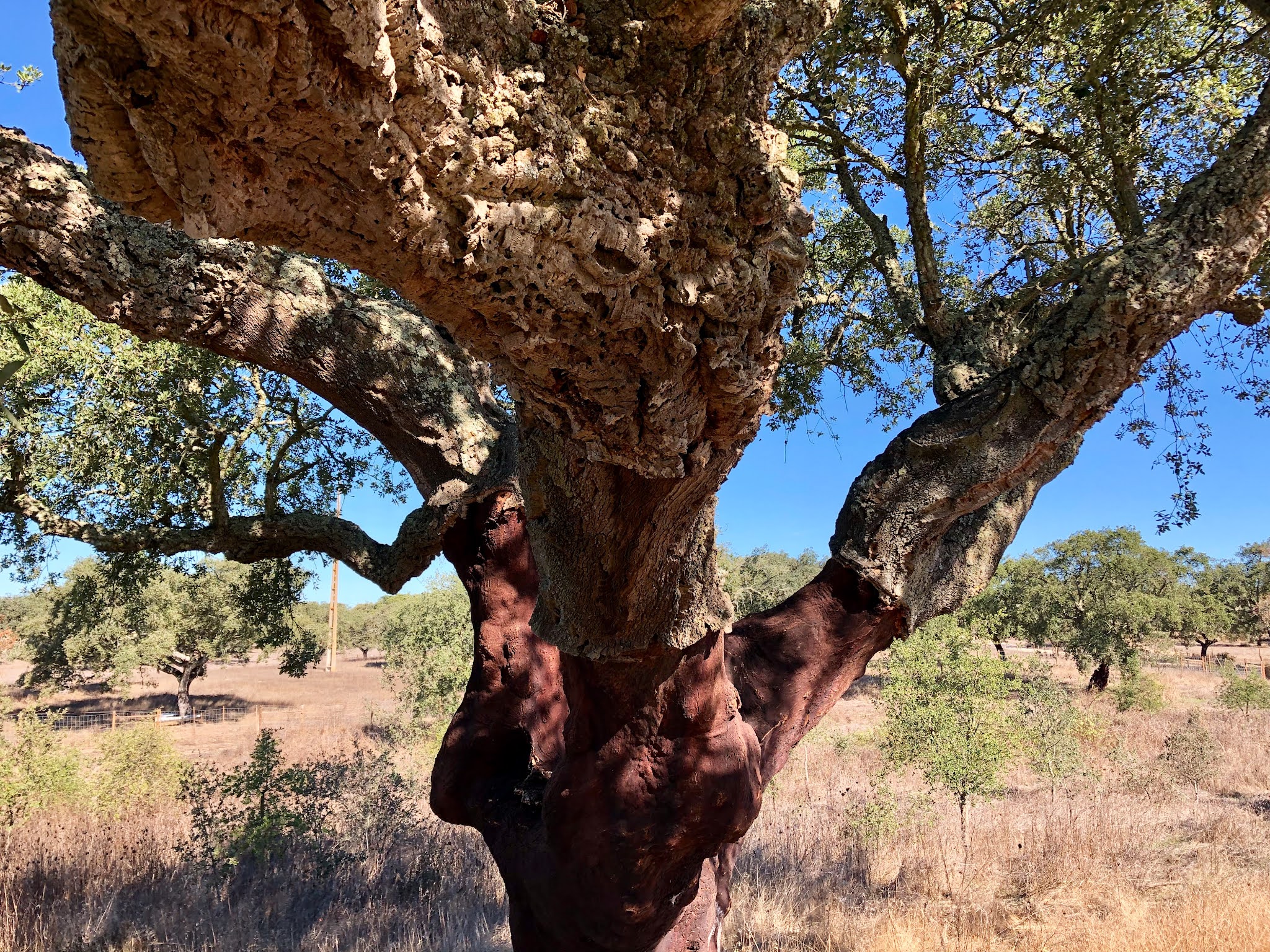
Stare out the window of your car or bus or whatever other type of transportation is taking you out of Portugal's capital city into a more relaxed world and you might notice a sight that will likely cause you to do a double take. There are groves in the Alentejo like no other that I have ever seen. Trees with naked rust red or scorched black trunks topped by gnarled branches that look like they are coated with knitted coverings. Seriously, it looks like someone has covered the limbs of the trees about six or seven feet off the ground with something to keep the trees warm in the night. And every so often, there are digits painted on the nude trunks. 

It's a bizarre sight. But not entirely unexpected.

Knitted coverings. I'm telling you...
One of the reasons I was so looking forward to spending time in the Alentejo Region was the opportunity to see cork trees (or cork oaks as I found out on this trip) in their natural state. It didn't take long for me to realize on our van ride from Lisbon to Évora that those strange groves of trees I was seeng in between the vineyards and cattle and olive trees had to be cork trees. I knew enough to know that cork is harvested by the bark being stripped from the tree, so putting two and two together had to mean that I had found from my van window seat what I wanted to see in the Alentejo. 

And soon after we got there, it was time to get up closer and personal-er.

Before I go further, I have to say that seeing cork trees up close was for me the most anticipated activity on our Portugal itinerary. I know it sounds kind of crazy, but it's totally true. It completely didn't measure up to what I envisioned it might be and yet it was awesome just the same. I'm fascinated by these trees. You could drop me off in a cork oak forest and just leave me there for hours. And maybe I say that now considering that is NOT what happened to me in Portugal. Not even close, as it turns out.


Portugal and cork have a special relationship. There are essentially seven cork producing countries in the world and Portugal's output beats all of the other six combined. This tiny little country on the Atlantic produces more than half of the entire world's cork!! How amazing is that? Now granted, the best climate for growing cork (based on the other six cork-producing countries - Spain, Italy, Morocco, Tunisia, Algeria and France) is pretty much right in the area of the world where Portugal is located, but Spain is like four times the size of Portugal is a distant, distant second place. 

Cork is some serious stuff in Portugal. In 2020, exporting cork generated more than $1.8 billion (with a B) of revenue for the country. And in case you are wondering...yes, it's pretty much all centered around the wine industry. All the best cork is used for keeping wine in bottles (although I guess there are other alcoholic beverages that use cork stoppers also), with the lesser quality stuff and the leftovers used for thinks like building products, shoes and all manner of souvenirs sold in and around the town of Évora. Cork is definitely the thing in the Alentejo.

To get a better look at this stuff, we got up one morning, boarded a bus that had about six or seven times as many seats as there were people on the bus, and visited a farm. Yes, a farm.


What's happening down on the farm? A lot as it turned out.
There is such irony here. If you texted me or called me one morning and asked if I wanted to go to a farm in the United States somewhere near where I live, I would likely laugh and then respond with something like "why would I ever want to go to a farm?" But a farm on vacation? Yes, please!!!! It's crazy, I know. It was, I assure you, all about the cork oaks.

Now, I will say that I thought we were going specifically to see a cork farm. Turns out that wasn't true. But I'd do it again anyway.

After a 45 minute or so bus ride west of Évora to the town of Montemor-O-Novo, we found ourselves at Herdade do Freixo do Meio, a 600 hectare cooperative farm supported by the patronage of more than 150 local families. The farm has been operating for over 30 years and today grows vegetables and fruit; raises chickens, sheep, cows and the Alentejo's famous black pigs; and harvests olives and, of course, cork from their own orchards.

The cooperative is completely organic, but lately they have taken their farming beyond organic. Our guide, Bernardo, made the point that you can use all organic farming methods and still irreparably damage the land that's producing food to keep you alive. To avoid doing just that, they are rotating crops and grazing to allow the land time to recover. He took us to an egg-producing chicken coop with six separate sides and six separate yards attached to it. The chickens feed in each section in succession, allowing the other five to rest while the birds are elsewhere.

Bernardo told us that the farm is operating on renewable two year leases and has been for its lifetime. The lease payment is essentially nothing but there's a lot of sweat and hard work and money invested in this place. While the risk of their landlord pulling the plug seems remote, I can't imagine how devastating it would be if they did. No way I'd be comfortable with that level of risk.


So we are gathered in a plaza of sorts at the farm and get introduced to Bernardo and Racquel who are going to show us around the place before setting us up with a traditional farm lunch, and they ask us what we want to see. Sensing the real possibility that we might get enough votes in our group for chickens or pigs or olives or something to consume all our time on the property (and still not completely disabused of the notion that this is not just a cork farm visit), I offer that I'd like to see a cork tree. Cool. Got my request in and acknowledged. We set out to see a cork tree first. Specifically, the cork tree above; the one with a big zero painted on its trunk.

This is where we learned about the oaks thing. Cork trees are acorn bearing.

With the benefit of hindsight, Bernardo's question about what we wanted to see was strange, because from my perspective we saw the entire farm with some time to spare. Maybe it was a translation thing...

The cork oak we stood in front of that day was likely between 100 and 150 years old. The main trunk of the tree was pretty much naked, having been stripped of its very own home grown cork cover the prior year (2020). That explained the zero on the tree; cork trees are stripped every nine years and rather than keeping a log of when each tree was last harvested, the tree owners just have a number painted on the trunk corresponding to the last digit of the year that the tree was last harvested.

I imagined that we would be treated to some sort of demonstration here. I was way wrong. Cork harvesting or stripping is not a spectator sport. It's a highly skilled, highly paid job that can only be done in a few months of the year, namely the summer. And it was not the summer when we were there.


Cork souvenirs, anyone? There's plenty of selection in Évora, including whole piece of bark.
Generally speaking, as much cork as can be stripped from a tree in large pieces is removed during a season. It's a delicate balance: large pieces of cork are more valuable than smaller pieces and sometimes leaving smaller branches still covered can yield larger harvests later on. And then removing too much might also kill the tree. Considering it will take 40 or 50 years of growth to get the first harvest, killing a tree would be bad. 

You might be able to see in the second photograph above evidence of earlier harvests. The bark on the left of the photograph is clearly older than that in the middle. The prior harvest of our tree cut off way more than the 2020 harvest did.

Herdade do Freixo do Meio does not harvest their own cork. They subcontract it all to a band of axe-wielding cork strippers, which is completely appropriate because handheld axes with a sharpened chisel-like implement on the end of the axe handle is the tool used to strip cork off trees. Removal starts by chopping around and down the tree trunk and using the back of the axe head to tap on the bark to loosen it. From there, the end of the axe is used to wedge the pieces of bark off the tree, usually in a single sheet.

The cork is taken off site to be processed while the tree is labeled with a big white number so everyone know the year it was unceremoniously denuded. Our tree's trunk was a pale pink in color. I don't understand how the colors change as the cork grows back but we did see fields of trees labeled with a "3" that were so black they looked burnt.


Cork tree on a street corner in Évora.
Getting close to a cork tree isn't all about the learning and the visual, though. There had to be some touching. And there was. After all, this bark begged to be touched. 

I hate to say that it felt like cork because, well duh, that's exactly what it was but honestly, it felt like cork. It was a little squeaky like cork is. I know this stuff would likely end up a bottle of wine one day keeping that precious liquid inside and I know it's harvested for that exact purpose but it's still weird to touch a tree wrapped in cork. It's wild!!! Seriously. It doesn't seem real. All other trees have scratchy bark. Cork trees have spongy, squeaky cork. Strange stuff. Really odd.

The farm we visited elects to have all their trees stripped in a single year. I guess that makes it a lot easier to keep track of and to get folks on and off the farm. It must provide such a boon to the farm's fortunes every nine years (followed by eight way leaner years, I guess). It seemed like from our bus or van seats riding around Portugal that most orchards opted for a similar strategy. When we saw stripped cork trees they all seemed to be in the same state of nakedness or coverage.


The lobby of our hotel in Évora, with decorative cork bark and cork stools.
There are a couple of blurry to very blurry pictures in this post. They are that way because they were taken with an iPhone from the seat of a bus through a tinted window while traveling at anywhere from 30 to 60 or maybe more kilometers per hour. They are not intended to be artistic, although I wouldn't debate that there's a certain graphic quality I like to at least the cover photo of this post.

One of those blurry pictures (the one a couple of pictures up from this paragraph) shows the yard of a cork processing plant. I had no idea we'd be driving past one of these things but I'm glad we did and I'm glad I had the iPhone at the ready. This place was enormous. I was thinking it was like a giant Lowe's store with a parking lot like three times the size of a typical parking lot and there were stacks of cork everywhere but that doesn't even do it justice. It was even bigger than that. The amount of cork just sitting around outdoors waiting to be processed was staggering.

I know I already said that I was looking forward to our cork farm day more than any other on this trip. I also know that I said it was awesome (and it was!!!) despite the fact that we really got to see just one tree up close at the farm and a couple more on a street corner in Évora. It was not what I expected. I wanted to see cork removed by professional cork strippers in front of our very eyes. There was absolutely no way that was happening. Having said that, this was a still one of my best memories of Portugal. I will never remove a cork from a bottle of wine again without thinking of Portugal. It's the squeaking. I'm telling you.

Remember we were promised lunch by Bernardo and Racquel? Yeah, we ate that. It was a cozido, or Portuguese stew made up of boiled meats and vegetables. We ate a lot of great food in Portugal. Sure, some of the bacalao croquettes were better than others and I can say that about the pastéis and the sardines also. The cozido? I'm not trying to appear ungrateful but I'm not longing for that dish as I write this. 

The vegetables? Pretty good. The sausages? Also not complaining about those, despite the meat having, shall we say, a rougher grind than I prefer my sausages to have. Acorns? Yep, acorns. And they were good. Maybe they were cork acorns? Maybe not. But I'd eat them again, I guess. 

Portugal is a little famous as an offal eating nation. I don't think we had any of that in our cozido but there was definitely a piece of meat that was maybe a piece of ear? And a huge lump of fat like about an inch long. I ate the stew. It was hot and filling. But I left enough in the bowl so it wouldn't look like I deliberately was avoiding eating the fat, the potential ear and the one other questionable piece of meat or cartilage or whatever it was. 

Loved the cork trees. Those will stay with me forever. The cozido? Maybe I'll drop that one from the memory banks. The cork was enough. Well enough. I'm telling you...drop me off in a field of cork trees some afternoon and I'm a happy guy. Just pack me a lunch without fat and ear.

The large piece of fat is on the left in the front. Not touching that. And yes, I know I'm a baby.

How We Did It

We didn't pick Herdade do Freixo do Meio as a destination. We decided to take our trip to Portugal with G Adventures, who we have loved from Ecuador, Kenya, Tanzania and Peru, and the farm was on their itinerary. Honestly, I have not figured out how to get there on our own but the farm does have a website and it's in both Portuguese and English. They also have rooms to rent if you wanted to stay on property. Click on the link on the first iteration of their name in the body of this post.

If you can't make it to a farm with cork trees or can't just stop on the side of the road and gaze at them from afar, there are two cork oaks in the city of Évora on the southwest corner of the traffic circle right outside the Porta do Raimundo in the city wall. If it makes no sense to be directed to a corner of a circle, I hope clicking the link in this paragraph makes more sense. They are in the southwest corner, I swear.

Finally, if you want to watch an awesome video of cork being stripped from some trees, watch this.