Showing posts with label Elk. Show all posts

Friday, October 16, 2020

Rack 'Em

This year started out looking like an amazing year for wildlife watching. With trips planned to Costa Rica in March; Yosemite in June; and Rwanda, Uganda and Zanzibar in October, it looked like my hard drive would be packed with all sorts of new pictures of wildlife being wild in jungles and forests and grasslands. But if you've read any of my blog posts recently, you'll know through all my whining and complaining that things didn't go as planned this year. No Costa Rica. No Yosemite. No Africa.

Despite all that, we did get some quality wildlife sightings in 2020, albeit all in the United States. Sure it was nowhere near as good as trekking and kayaking through a jungle in Central America or tracking gorillas on foot in the mountains of Africa but in traveling for an overview of large mammals in the United States, I think we got some great looks at some animals. And let's face it, everything I've done this year would have been on my list eventually at some time. Why not do it now when travel options are limited?

Our vacation to Yellowstone and Grand Teton National Parks this month had its roots in our trip out to Colorado and Utah earlier this summer. We ended that trip with a day plus in Rocky Mountain National Park and got super lucky with some quality viewings of moose, elk, black bears and particularly bighorn sheep, which have been eluding me for many, many years. 

While those two days in RMNP sated my lust for bighorns, it also teased me with moose and elk. I saw more of both of those species on that trip than I had ever seen and I kept thinking about them over the summer. When it came time to decide if we were going to even go anywhere to replace our 2020 Africa trip, eventually Yellowstone and the Tetons started to make sense as a way to finish what we started in Colorado in June.

The elusive and solitary moose...
and the not so solitary, but sometimes equally elusive, elk.
Why teased, you may ask? Well, honestly, it was all about the headgear here. And we didn't see what I wanted to see in Colorado. What we saw in Rocky Mountain were moose and elk with developing antlers. Not because they were young animals or anything but because these two species of animals grow their antlers every year for mating season, and mating season (or the rut as it's more commonly known) occurs in late summer and fall. That means smaller, velvet-covered antlers in late June and larger (or much larger) and significantly more dangerous racks later on in the year. This is what I came to see. This is what I'd been thinking about this summer.

A fully grown set of elk antlers can weigh as much as 40 pounds and they look downright lethal. The early summer softer rounded ends of the antlers are transformed into sharp points for the rut and they are used in combat against other elk bulls for competition for their very own harem of cows. Moose go a little bigger on the headgear but with the same goal of competing for cows, although moose tend to eschew the harem in favor of loving and then quickly leaving a single cow. Moose antlers top out at about 60 pounds. Can you imagine carrying 60 pounds of antlers around at the end of the summer after growing them all year?

Let's go see if we can find some antlers!!!
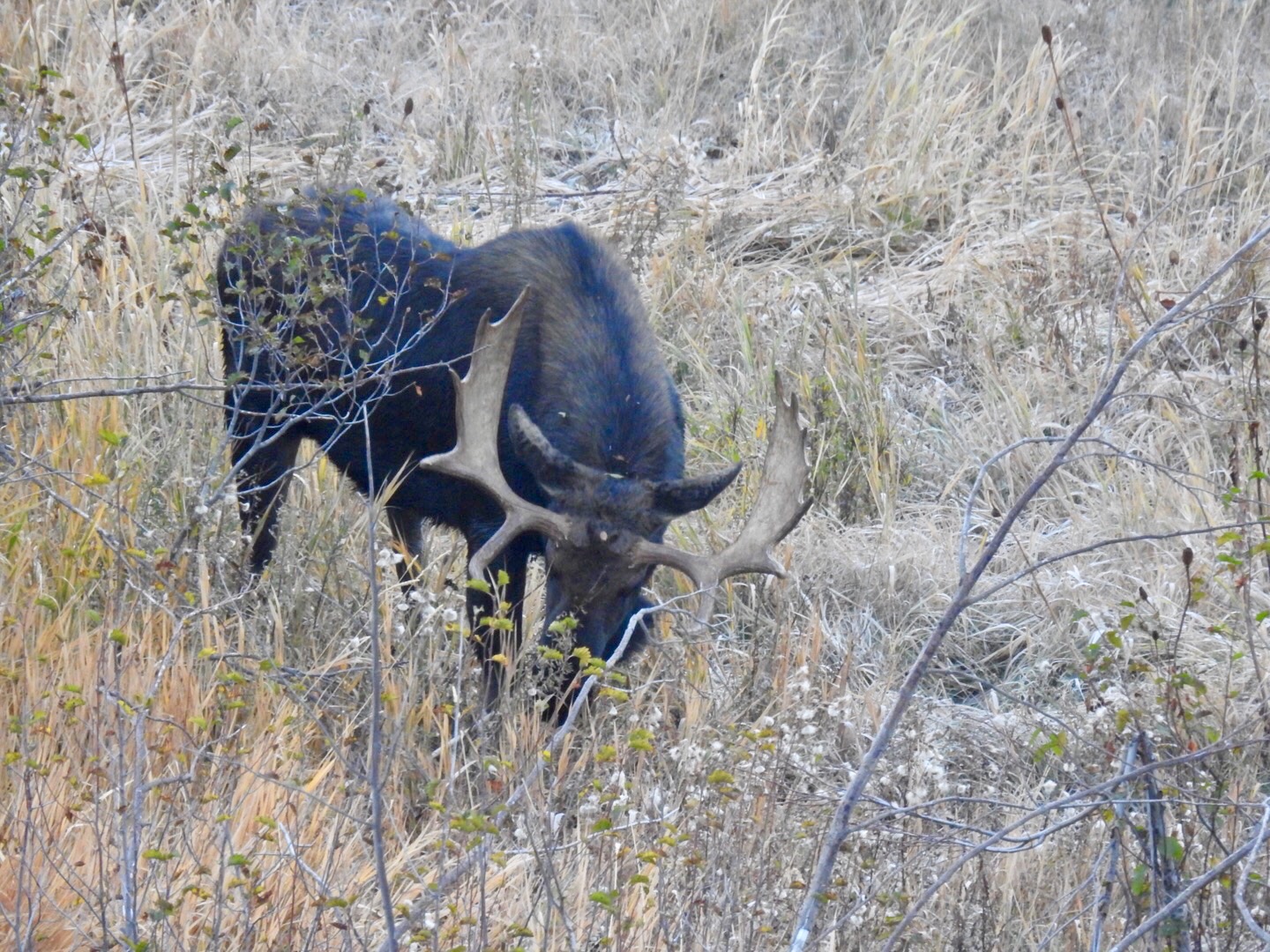
This is exactly what I came to see: moose antlers...
and elk antlers.

We started this trip in Salt Lake City and drove up to Jackson, WY, which meant our first shot at either species would come in Grand Teton National Park. It would be on to Yellowstone National Park after that. Oddly enough, from a moose and elk perspective, these two parks were polar opposites. Perhaps it's to be expected with about four times the moose in Grand Teton than Yellowstone and about double the number of elk in the Tetons up in Yellowstone but the contrast was clear and obvious. We got some awesome moose sightings in Grand Teton but only the most fleeting of elk viewings there. In Yellowstone, elk were easy to spot, but moose...not so much. 

Our task at hand would need some early wakings. Both moose and elk are most active at dawn and dusk. We spent seven nights out west and used an alarm to wake ourselves every morning, although admittedly the last one was to get to the airport. We knew we needed to be up before sunrise and head out to where we guessed and had read we might lay eyes on these species. The sun comes up in early October at around 7:30 a.m. or so. That meant alarm times anywhere from 5 a.m. to 6:15 a.m. depending on the day and our destination. I guess we could have slept in and just shot for the dusk movement but why cut our chances in half? Alarm every morning, please!

It was completely worth it. Yes, we came home tired and a bit sleep deprived but the looks at these species and the other animals we saw in the Parks were way worth it. There is something about seeing animals live and in the wild and observing their habits that sticks with you in a way that reading something in a book or seeing something on TV doesn't. Watching behaviors in person sinks in. I'll never forget watching elephants eat grass along the banks of the Chobe River in 2015. There are some moose and elk (and bison) behaviors I won't forget from this trip. And of course, we saw some antlers.

Moose in the early morning light in Grand Teton National Park.

Bull elk bugling along the banks of the Madison River in Yellowstone National Park.

We used West Yellowstone, Montana as a base for our explorations through Yellowstone. The town is right outside the West Entrance of the Park and our hotel, which was deep into the town, was all of a mile from the Park gate. Pretty darned convenient, I'd say. We generally spent the early morning and mid-day somewhere in the almost 3,500 square miles of the Park itself before exiting for a quick early dinner and then heading back to the Park for sunset.

Because we'd been driving around for up to nine hours earlier in the day, we wanted our dusk trips to be short and sweet. Fortunately, we found that the Madison River valley, which parallels the road to the West Entrance, is a great spot to watch elk. There were herds every night along the banks to the south of the road and in the trees along the north side of the same road. And always with a bull with some good sized horns.

Elk are some massive creatures. They are way, way bigger than the deer we sometimes see along the roads in Northern Virginia. But they are amazingly quiet when they want to be and they blend into the Wyoming forests in a way that I guess I should expect but which is astonishing anyway. In the early morning or late evening light, their lighter coats almost perfectly mimic the colors of the bark on the lodgepole pines that make up the forest, and the darker portions of their fur recedes in the shadows between the trees. You can't even spot their antlers because they so closely resemble the branches sticking out from the tree trunks.

We got great and clear looks at elk when they were out in the open along the river. It was a lot harder to pick these animals out when they were buried in the woods. I am sure we probably drove within 20 feet or so of many elk that we didn't even see. But of those we did see along the Madison, we got some great looks at some pretty good-sized antlers. This is what we came to see.

Elk in the forest along the road to the West Entrance, Yellowstone National Park.
Bull moose spotting a cow, Grand Teton National Park.

Our Yellowstone strategy of finding somewhere close to the hotel to see wildlife in the evening worked equally well at dawn and dusk earlier in the week in Grand Teton. I'm all for getting up early but not any earlier than I really have to. It took us maybe 10 or 15 minutes to get to a prime elk viewing spot in Yellowstone in the evening; we found an equally desirable spot in Grand Teton about 20 minutes from our hotel in Jackson.

Where was this magical spot, you might ask? Moose-Wilson Road. If there was ever a spot to spy moose, it had to be road with the word moose in it, right? I know, I know, we visited a road informally named Moose Alley earlier this summer and saw nothing. But we didn't go to Moose Alley first thing in the morning or right before dark.

I have probably spent too few mornings in my life watching the sun come up. Doing it twice in a row in Grand Teton National Park was amazing. Both times it was pitch black when we arrived at our spot along the creeks that feed the Snake River and it was so still. There were stars and likely Venus or maybe another planet (we didn't bring our star chart along on this trip) overhead and we were not alone. 

By "not alone" I don't mean that the forest was packed full of wildlife. I mean other humans beat us to the parking area along Moose-Wilson Road. And of course, in the black of pre-dawn, they claimed to see moose. It's pitch black and we are looking into a shaded (were there any light at all, of course, which there was not) valley at animals with dark brown to black hides. A cow and calf by the water and a bull a bit further back from the shore. I know I have poor eyesight but there's no way these people can see dark moose in the black of night!

On morning number one, they were right. I mean, of course, they were right. As the darkness receded and gave way to the light, there were revealed to us three moose right there in front of us. Eating and poking around in the willow thickets without a care about our presence. We could see on the first morning there that the young bull moose (shown in the top photograph above) had some ideas about how he'd like to get to know the cow a little better, but she seemed totally disinterested and he didn't pursue anything. Just kept eating and walking and (in between some excitement about a bear) eventually we'd move on and seek more moose elsewhere and come up empty. We'd seen our first moose antlers. They weren't as big as we thought they might be.

Day two played out in much the same way. Get up early. Drive 20 minutes. Park in the dark. People already there. Tall tales about moose here or there which turned out to be totally accurate. Only this time with two bull moose. And the newcomer was quite a bit bigger, with a much more impressive rack. He's pictured right above. This was more like it.

I don't know why I'm obsessed with antler size in this blog post. Maybe it's because this feature of the elk and moose give identity to these creatures in a way their body shape or faces or hoofs or whatever else it might be cannot do. Who can grow the biggest, most massive set of prongs on top of his head? That's what I wanted to see. I was happy to see the second moose. 

Like the smaller bull the day before, he also had some designs on the cow, complete with some moose catcalling (is that a thing? it wasn't exactly the bugling of the elk). But as soon as he started looking her way she moved away from him. Her reaction was completely different from the advances of the smaller of the bulls. She moved into cover by the water quickly, followed by him. Nothing happened, I swear, but how three massive dark-colored moose (remember there's a calf) disappear into willow thickets which are not that dense is beyond me. But that's just what happened. Poof! They were gone. Right before our eyes. This camouflage stuff, folks...pretty impressive.

The only other thing I can say about the moose we saw in the Tetons is talk to your neighbors. "Surely," some folks next to us said, "you must have seen the three very large moose on the way into the Park by the Visitor Center that morning." Very large moose? We're gone!


We didn't find three moose. But we did find the guy above. And I'm just putting these pictures up for your enjoyment. I am sure there are moose with larger antlers in this world, but this guy is real and he is spectacular. This is some impressive stuff. I'm happy now. Enough about moose.

But not enough about elk.

Moose at a distance are awesome to see. So are elk. I love these creatures. Most of our looks at moose in the Tetons and elk along the Madison River came from a football field or two or more distance away. But nature is so much more intimate when it's closer. 

There are many, many places in Yellowstone National Park where you can see elk, but one of the best spots to see these animals is in the town of Mammoth. For most of the year, elk cows sit around in the town 24 hours a day and graze and sleep. But it's a little bit more exciting during the rut. Where there are female elk during mating season, there is at least one testosterone laden, sex-crazed bull around. If there's more than one, get ready for some fireworks and get ready to move out of the way quickly.

Two elk bulls during the rut equals trouble.

I never really felt like I was in any danger from wildlife in Yellowstone but there were a couple of times that the adrenaline surged in response to wildlife moving a bit too fast and a bit too close. One of those two times was in Mammoth with the two boys above: a younger bull on the left (known as 24 for his ear tag number) and the slightly larger dominant male on the right who had already claimed the town's harem of cows.

They bugled at each other and to the cows. Bugling is a long higher-pitched-than-it-seems-like-it-should-be noise used to ward off competitors and signal availability for mating to a partner or partners. They chased females. They chased each other. And they actually came to blows, locking antlers twice quickly in a test of strength before separating and splitting up. Each time over the course of an hour or so, 24 lost. He didn't bugle loudly enough or he lost an antler fight or he was chased away. No matter how many times he came back, he was run off. And every time he did, the team of six or eight Park Rangers moved gawking spectators like us out of anything resembling a straight line between the bulls and another elk.

We never saw an elk bigger or closer with a rack like the bull who had installed himself among Mammoth's cows. The antlers on this male were majestic and enormous. If they had been intact, they would have had a full 12 points, although some past skirmishes had clearly knocked off a tine or two. When he bent his head to graze, his antlers stretched above the top of his back, a good four and a half to five feet tall. There are signs all over Yellowstone posting warnings about how fast or dangerous or both the wildlife in the park are. If you want to see some very large animals with very sharp things on their head move very fast, spend some time in Mammoth during elk mating season. Scary dangerous. But oddly enough somehow completely safe.


It seems odd to see elk in the middle of a town but these things are wild and dangerous.

We spent a total of about five and a half days in Grand Teton and Yellowstone. If we came to see just moose and elk, we had checked that box quite securely. I can't imagine getting any better looks at these animals in the short time we spent spread all over these two parks. No complaints at all here from me. Almost no moose sighted in Yellowstone? Who cares. We got them further south. No elk to speak of in the Tetons? That's what Yellowstone is there for. There's no real way that I could have expected more here.

Two days after our first elk encounter in Mammoth, we passed back through the town. 24 was there. The other bull was not. 24 had run him off. Life comes at you fast. Be prepared.

24, ruler of Mammoth. Do not approach elk, folks. Don't mess with those antlers!


How We Did It
We found the most reliable spots for elk watching in Yellowstone National Park to be along the Madison River and in the town of Mammoth.

The Madison River runs just to the south of the road connecting the Park's West Entrance to Madison Junction. There are a number of pullouts with parking lots along this road to stop and gaze out over the fields on the banks of the River, although if there are any sorts of animals roaming around, you'll likely see a ton of stopped cars and people standing by their vehicles with cameras and binoculars. We had some amazing success along this road in the early morning and just before sunset. According to the Park map that you get handed when you enter the Park, the road along the Madison River is closed from early November to mid-April.

The town of Mammoth is just south of the North Entrance to the Park. The primary attraction in this area is Mammoth Hot Springs but both times we drove through the town we saw a ton of elk and right in the middle of the day. Don't stop in the road to take pictures. Park and get out of your car and obey the directions of the Park Rangers at all times. They are there to keep us safe. Elk are dangerous.

For moose spotting in the Tetons, I can't recommend the Moose-Wilson Road enough. We spent both our sunrises and our one sunset in the Park at the exact same spot and we saw moose all three times. To get there drive north from Jackson, take a left at the Moose Junction sign, drive past the Craig Thomas Discovery and Visitor Center and take a left. After a little while you'll come to a noticeable slope up. There's a parking area on the left just beyond that slope. Look behind you further up the hill towards the treelike and you might see some elk. We also saw two bears in this spot. Definitely a good spot for wildlife.

Two final and likely totally irrelevant details. First, if you love elk so much that you want to try having some for dinner, I can totally recommend the Elk Burger at the Slippery Otter Pub in West Yellowstone, Montana. I thought it was seasoned and cooked perfectly. Second, if you want to drink a beer with a moose on the can, I'd enthusiastically recommend you pick up some Big Sky Brewing's Moose Drool. It's about the most delicious brown ale I've ever had (and I don't typically drink brown ales because I find them lacking in flavor). If you are in West Yellowstone, pick some up at the liquor store portion of Bullwinkle's or it's also available at the Market Place grocery store at 22 Madison Avenue.


Tuesday, September 22, 2020

Yellowstone

It's been almost three years since I've pre-blogged about a destination. I figure it's about time for one of those posts in advance of next month's travel plans.

In 2011, I spent two weeks with my friends Mike and Bryan driving across the United States from my home in Arlington, Virginia all the way to Portland, Oregon. It was the first time I'd ever driven across the entire continent and it's a kind of trip that I won't likely ever make again. 

I actually probably shouldn't make statements like that. If there's one thing that 2020 has taught me, it's that things I never expected to happen will happen whether I like it or not. So yeah...never say never or even won't likely ever.

One of the highlights of that long distance drive was a two night stop at Yellowstone National Park. We arrived there in the afternoon from the east after traveling 12 plus hours from Deadwood, South Dakota, and left maybe about 40 hours later to the west en route to Seattle. With so far to go in just two weeks, there just wasn't much time to linger, but we did think it was important to get in a whole day in the Park. That meant two nights.

In our one full day there, we set out first thing in the morning from our hotel in Lake Village and headed north and counter-clockwise around the Great Loop, hitting the Grand Canyon of the Yellowstone, the Tower-Roosevelt area and Mammoth Hot Springs, before heading south to Old Faithful and then back around to the hotel. If there's one thing to be said about our time in Yellowstone, it's that we didn't run out of sights to see. 

The main reason we didn't run out of stuff to do in a single day is Yellowstone National Park is massive. At almost 3,500 square miles, it's bigger than the entire state of Delaware by about 40% and it's more than twice the size of Rhode Island. Maybe you don't think of Rhode Island and Delaware as being big but we're comparing the size of an entire state to the size of a single National Park. This place is big. Too big, in fact, to cover in a single day. One day I figured I'd have to go back and do it right.

The Grand Canyon of the Yellowstone.

2020 has been littered with cancelled trips. Costa Rica in March. New Mexico in May. California in June. Maine in July and (again) in August. England later in August. And most recently we made the decision to give up on a trip to Rwanda, Uganda and Zanzibar in October. That last one hurt, but there was really no other option.

It hasn't all been doom and gloom this year. We have both been healthy all year long and we've been able to transform some of those cancelled trips into reasonable facsimiles of the original intent. A national parks trip to California got morphed into a national parks trip in Utah and Colorado. Maine got replaced with Vermont, although Maine was really a substitute for Costa Rica so Vermont didn't stand a chance of coming close to the original deal there. New Mexico and England? Well...some other time maybe.

But when it came time to think about if we should even try to replace a trip where we'd be trekking into the mountains to see gorillas in the wild, driving around Queen Elizabeth National Park on safari and walking through the jungles of Zanzibar looking for monkeys, we were a little lost. We thought about a trip up to Churchill, Manitoba to see polar bears but the fact that Canada is not admitting Americans to their country right now killed that one pretty quickly. Ultimately, we decided if we were going to replace an animal watching trip with something similar that had to be in the United States, we should head out to a place where we could see the greatest collection of wild wildlife in our country. And that meant just one place: Yellowstone. Looks like that return trip I thought about in 2011 is happening this year.

This time we are doing it right. No 40 hours in the Park this year. We are dedicating three whole days plus whatever time we can squeeze in from a fourth day driving up through Grand Teton National Park starting early in the morning. We'll be hitting parts of the Park like the North and South Entrances, but most especially the Lamar Valley, that I didn't get a chance to visit in 2011. I have to say I'm pretty excited about that last part.

When I visited Yellowstone in 2011, my greatest hope was that I'd see a bison. Just one would have been enough. At that time I knew precious little about the Park, including that seeing a bison was pretty much a sure thing. We saw one strolling down the middle of the road in front of our car within the first half hour we were in the park. After that, we saw them everywhere. Our car was even surrounded by them on the way out of the west entrance. I need not have worried about seeing a bison. 

I was incredibly casual about looking for animals back then. I didn't make a deliberate effort to find the spots with the greatest concentration of wildlife or go out looking at dawn or dusk when I now know the chances of spotting creatures is the greatest. We just roamed at a time that was convenient for us. And honestly, while we saw a grizzly bear and tons of bison, we really didn't see much else. There are supposedly more elk in the park than any other mammal species and we saw one. And at a great distance at that. I'd forgotten we spotted a coyote until I looked through my pictures from that trip while writing this post. The 2011 trip to Yellowstone was all about that one grizzly and the many, many bison.

This year will be way different. I'm certain. Or at least I'm hoping since I'm way, way more prepared. There's no way we aren't seeing much, much more wildlife this time around. 


2011 in Yellowstone: grizzly bear, elk and coyote. And a whole lot of landscape.

Wildlife wasn't the only reason I put Yellowstone on our 2011 westward journey. I also went for the scenery and for the volcanic action, including a stop to watch Old Faithful geyser erupt surrounded by hundreds if not thousands of other people. Here again, we just scratched the surface nine years ago. I was impressed by the colors and landscape at our stop at Mammoth Hot Springs and the Rockies are amazing. But in the last month I found out we missed as many impressive spots as we saw, if not more, including Grand Prismatic Spring. No way are we missing that this year, not even if its guarded by a few grizzlies and a pack or two of wolves. 

I might chalk the animals and the geysers and hot pools we missed up to a mistake or two. But honestly, we didn't have any time to spare in our one day anyway. Three whole days seems much more sensible. 

2011 is a long time ago. I've changed so much in the way I travel since nine years ago, from the knowledge I carry with me, to my travel habits, to the technology that I've embraced. I've gathered together the most spectacular photographs from nine plus years ago that I could for this post and I'm not thrilled. My photos of animals likely stretched the capabilities of my Blackberry to the max and my landscapes aren't much better. I even managed to cut the top of Old Faithful off with my beginner camera skills. 

There were also fewer than about 30 total pictures to choose from. If there's one definite improvement I've made in my picture-taking habits, it's to take pictures in bunches. If I come back from this trip with fewer than 500 pics of Yellowstone I'll be surprised.

I'm lucky to be able to have a second shot at Yellowstone, even as I continue to whine about being (mostly) confined to the United States. I get that our country's government has badly bungled the response to this global pandemic and by the time it's all over or close to it, I'll have abandoned international travel for 12 months or probably more. Yellowstone won't be Rwanda, Uganda and Zanzibar but it will likely still be an incredible natural showcase. I'm excited to see it again and for a lot longer and in a different season. And not just for the wildlife. I know we missed some incredible sights or made short stops at others in 2011 which are now on my list for this year.

Yellowstone in an American icon. And I think it's going to be spectacular the second time around.

Sunday, August 2, 2020

Rocky Mountain High


In November of last year, we took a long weekend trip to Colorado. It wasn't a vacation, but we tacked on an extra day to our itinerary to allow us to spend a day seeing something new. That something new was supposed to be Rocky Mountain National Park. Frontier Airlines, however, had other ideas, and in what has to be one of the top two miscommunication experiences I've ever had with an airline, we never made it to our extra day. Rocky Mountain would have to wait. 

So will Frontier for my business any time soon. Possibly forever. 

As it turns out, the Park didn't have to wait long. Less than nine months later, we took in what we missed the first time. And quite honestly, we probably did it way better than we would have done in November. We used Rocky Mountain National Park as our anchor on this trip (and I mean that in only positive terms). It served as a reason to fly into and out of Denver and it ended our trip with what we hoped would be a "saved the best for last" type deal. Our hopes were correct.

Our plan for Rocky Mountain National Park was to start in the southwest corner of the Park near Grand Lake and drive the entirety of the length of Trail Ridge Road through the mountains to over 12,000 feet and end up at Estes Park just outside the northeast corner of the Park. With a few side trips and what we hoped would be many, many stops, we figured that would take us about all day. Now, because we are more than a little obsessed with seeing bighorn sheep in the wild, we planned a second morning in the Park around Bighorn Mountain and Sheep Lakes, hoping that those spots would live up to their names and get us a look at some of these animals just after dawn on the day we flew home.

I don't know what it is about bighorn sheep. I mean they are just sheep with big, curly horns. But there is something there. Maybe my patronus is a bighorn sheep or something.

The Colorado River, Rocky Mountain National Park.
Part of the attraction of Rocky Mountain was the landscape. Being able to drive through those peaks capped with snow while just days earlier having hiked under brutal 100 degree blazing sun was really appealing. I was really looking forward to driving up the side of a mountain likely with a steep drop-off on the side of the unprotected road (that part was true) and seeing for miles and miles over mountains. 

I was also eager to see more of the Colorado River after having driven alongside it and over it and seen it wind its way as far as Canyonlands National Park. I imagined where we'd be driving that the Colorado would be much, much smaller both in width and depth. That part was particularly true. The river in Rocky Mountain looks nothing like it does at Canyonlands. It's peaceful and slow, winding its way through a bucolic setting looking way clearer and fresher than it does downstream. Or downriver I guess.

All of those hopes here came true. The mountains were amazing and seeing the Colorado close to its source knowing what it would be come later was just what I wanted to see. The difference is so striking. It seems so young at its source.

All of that was fine and good and amazing and wonderful and whatever else you can say about that sort of nature. But what we really wanted out of Rocky Mountain was to see some wildlife. And not just some, like a lot. I mean, why not aim high, right? No bison or wolves or grizzlies in the Park but there are black bears, elk, moose and (of course) the coveted bighorn sheep. Our plan was to see all of these "big four" (that's our term, not anything official). No idea how we'd do it except for that whole Bighorn Mountain and Sheep Lakes thing but we were determined to dream here. 


But before we get to all that, let's talk tundra and the rodent "big four" (again, our term). 

One of the biggest surprises for me was that part of Rocky Mountain National Park contains significant areas of alpine tundra, areas above the treeline where the only plant life growing is moss and lichen and smaller greenery. There's no better place to see this sort of an environment in a National Park because you can climb higher (climb here means "drive"; there are actually higher peaks in other parks) in Rocky Mountain than any other Park in the country. And there are a ton of areas that look just like the picture above, barren rocky landscapes with anything that's growing really low to the ground to avoid the wind.

You might think that these areas would be devoid of other life. We were up there in late June and there was still a ton of snow on the ground. You'd be wrong to think that. We found plenty of marmots and pika, two of the four rodents we found in many, many spots while driving around on our day plus there. We saw one or two marmots a couple of years ago up at Crater Lake National Park in Oregon but these fat ground squirrels were all over the tundra area. 

Keep an eye on marmots by the way; apparently they like to eat radiator hoses and wiring in car engines.

Scattered among the marmots were the pika, small rodents that look sort of like a cross between a rabbit and a hamster. Together with the ground squirrels we saw all over the lower elevations (no, it's not a chipmunk...) and the Utah prairie dogs we saw in some of the prairie (duh...) areas, I'm labeling these four rodents as the rodent "big four". They are presented below for your viewing pleasure.

Clockwise from top left: marmot, pika, Utah prairie dog, ground squirrel.
Mountains. River. Rodents. Tundra. All well and good. Let's get to the good stuff. And no need to be coy here but we got good to great looks at every species we hoped to see. Honestly, we really couldn't have hoped for a better wildlife experience at Rocky Mountain, despite how it may have seemed at one or two spots in our drive. This was just an awesome experience. Let's go in the order we saw each species.


Moose
When I wrote earlier in this post that we had no idea how we'd see all the animals we wanted to see, that wasn't quite true. We did have some sort of plan or insider tips for some species. On the moose front, the Park website suggested we look for these big deer along the Colorado River on the west side of the Park. Noted. We also knew that moose are crepuscular, meaning they tend to be active at the beginning of the day and towards the end of the day. We'd need an early start, which is why we chose to stay close to the southwest entrance of the Park. We made it there by just after 6 a.m.

If you drove start to finish at the speed limit through Rocky Mountain National Park I'm guessing you could do the whole thing in about an hour and a half, assuming there were no slower cars on the road holding you up. I'm also pretty certain you wouldn't see much in the way of larger wildlife. You have to get off the main road and search. While we didn't know this for sure when we entered the Park, we guessed pretty quickly and took the first left we saw just a little bit after passing the Grand Lake Entrance Station. We were not the first ones there, although we didn't see anyone looking at the moose lying down in the field to the left of the road as we pulled in.

Yep, that's right. We saw a moose on the first road we took to look for one and we didn't even have to stop the car or anything. We'd stay here for the next half an hour or so. 


There wasn't just one moose either. There were three. Two never stood up in our time there but one (that we are assuming was male) did.

Sometimes nature isn't that exciting. All this moose did was eat and walk. Nothing to get too worked up about maybe. But sometimes nature is exciting enough just being there in front of us and this was probably one of those times. We haven't seen a lot of wild moose in our lives. In fact, I think we'd only ever seen one other moose outside of captivity and that was a female eating by the side of the road in Alaska in 2017. So the three we saw that morning in Rocky Mountain represented a threefold increase over and above the most moose we had seen before and the largest set of antlers we'd ever seen on a wild moose.

Not impressed by the large antlers? I know, they are a work in progress but we were thrilled with this sighting. For about 30 minutes. The moose were near the Colorado, by the way. The picture of the River above was taken maybe 1/4 of a mile from where we spotted our moose.

Moose at Sheep Lakes. Rocky Mountain National Park.
But that wasn't it for the moose in Rocky Mountain National Park for us. We managed to see a fourth (assuming it was not the same moose we saw in the morning) in the opposite corner of the Park later that same day after dinner. Sure enough, it was getting towards night and the moose started moving. 

We got to watch this one drinking and running. I know...thrilling, right. But it was. These things can move fast even though they look like they are just ambling along at a leisurely trot. Long legs cover ground I guess. I am positive this thing could have been on top of us in less than a minute from about a quarter to half mile away. Fortunately, it looked like it was really after water, because it stopped for a drink when it got to the lake before moving along again at a similar clip in a different direction.  By the time that happened, there were other animal sightings afoot that took our attention away from a lone moose drinking and running.

The antlers on the running moose were about the same size as the one we saw in the a.m. so we are still looking for one of these creatures with some massive headgear. Still, four moose in one day? Pretty satisfied here. Long way to go in the future with these beasts I'm hoping.


Elk
For all the National Park visits I've made over the years in this country, I'd only seen one elk in the wild in Yellowstone in 2011. And that was from a long distance. Obviously by the photograph above, we out-did that experience easily on this trip. 

The pro tip from Rocky Mountain National Park for spotting elk was look for them above the treeline (so on the tundra, pretty much) in summer. Didn't work. We looked at a lot of wide open spaces above the treeline in the park and didn't see so much as a single elk out there. We did, however, find elk in a couple of spots where we headed to see other wildlife. 

First of all, our strategy of just taking lefts at every turnout off the main road on the west side of the park like we used to find moose worked equally well for elk. We found two individuals apart from each other but generally off along the line of the woods by stopping at the Coyote Valley Trail and found the group of four above just about a half an hour later at Beaver Creek Picnic Area. Ironically, we saw no coyote at Coyote Valley nor did we see any beaver at Beaver Creek. Or anywhere else in the park for that matter. But elk? Yeah we saw them there, albeit at a pretty good distance away.

It does not take anywhere near a half an hour to get between the two spots discussed above on a straight drive and that's because we got a pretty up close and personal encounter with a group of three elk about 20-25 feet off the side of the road to our right between Coyote Valley and Beaver Creek.


This group of three (two of which are shown above; I believe the second picture is of the one on the right in the first picture)  would be the closest we'd get to this species in our day plus on the road here. We might honestly have missed them if it weren't for the couple of cars stopped in the opposite direction looking up on the hill right above our northbound lane. They were difficult to see because where they were standing was pretty much straight vertical from our position and out of our direct line of sight. But once we found them they were super close. And with a gorgeous backdrop of trees to add to the sighting.

Stopped cars are great on wildlife trips by the way. They are the universal symbol for I see something, no matter where you are looking for creatures.

I've sometimes had a tendency to dismiss elk as uninteresting. After all, they are just big deer with antlers that very much resemble those of the deer we have all around us in the woods at home. But elk aren't big, they are massive. And there's nothing like an up close encounter with these things to reinforce that fact. These are really big and powerful creatures.

If there's a feature of elk that adds to the impression of power, it's a fully developed antler rack because on a full-grown elk, these things are sharp and it shows. All the elk we saw at Rocky Mountain had velvet antlers, meaning they are still growing and developing. I guess the elk really need fully grown headgear when they get into rutting season in September and October and they may need to use these things as weapons.


The other spot in the Park where we managed to find some elk was just to the west of Sheep Lakes and down the road to Alluvial Fan. Each of our sightings here were solitary elk but they both showed off some impressive antlers. There was some kind of crazy tourist trying to get as close as he possibly could to the one shown immediately above for a good picture. And he was on foot. If that thing had charged...

Don't get close to wildlife, folks. There's "wild" in the name after all. Nothing bad ended up happening. The tourist spooked the elk eventually causing it to move off away from us.

By Rocky Mountain standards, the kind of elk sightings we had might have actually been relatively modest. There are frequently fairly large herds of these animals to be found. All the individuals we came across I assume were solitary bulls or bachelor herds. I imagine the larger groups are made up of does and fawns. Still, considering I was at one wild elk before entering the Park, I was more than content with the five or six different occasions where we got to observe these creatures, and super happy with the closest look we got.


Bighorn Sheep
There are a few species on this planet that seem to be really good at eluding me. Flamingos, penguins and bighorn sheep come to mind here. I've been looking without many good results for bighorn sheep for probably about 10 or so years and it seems like every other year or so I look and find nothing. We did get a glimpse of these animals in Utah in 2015 and saw a herd a couple of years later in New Mexico. After Rocky Mountain National Park, I'll continue to look for them when I travel but I don't think they are avoiding me anymore.

As I wrote earlier in this post, it seemed to us that the logical places to start looking for bighorn sheep were Bighorn Mountain and Sheep Lakes. I mean, why name these places like that if there were no bighorn sheep there? They are, by the way, right next to one another. Apparently the sheep come down off the mountain, cross the road and then head to the watering hole. We didn't know that before we visited the Park.

As soon as we pulled into the parking lot near Bighorn Mountain, we noticed a family of about five or six people hurrying away from their picnic table. Six bighorns had just run by and, cameras in hand, the humans were in hot pursuit across a sheep poop infested field. Seemed like a good sign but chasing across a field to follow sheep running in a forest is not a winnable war. We got there too late. No sheep.

Now if we had known the part about the sheep leaving the mountain and heading for the lakes, we'd have just hopped in the car and driven down to the parking area near Sheep Lakes. But we didn't, so we lingered at Bighorn Mountain, figuring if six sheep can come down the mountain, why can't some more. They didn't. Not while we were there.

Have I mentioned how lucky we were on this trip?


We finally did make it to Sheep Lakes and fortunately we were blessed with the sight of four rams drinking from one of the lakes. Finally, a clear, long look at this species!! There was no hurry and they didn't go anywhere for the hour that we spent there watching them. You read that right: an hour!

Now they were pretty far away but we did bring our super duper Nikon COOLPIX P900 camera with us which usually serves double duty as our binoculars and long distance camera which allowed us to get some terrific shots of the sheep. And yes, it must have been molting season or something. These are some shaggy sheep.

So we didn't see them scaling the mountainside on an impossibly steep slope or battling for dominance with their horns. This was a quality sighting all the same.

Then it got better.

There are two lakes at Sheep Lakes: one to the south of the parking lot and one to the west. While we were looking south, more sheep had arrived to the west. 


By more sheep, I mean about 20 to 25 ewes and lambs.

This was just an incredible sight. I'm assuming the four rams we were looking at were a bachelor group of sorts. The moms and kids were a huge bonus here and we could see them closer than the rams and in superb detail thanks to our camera. The sum total of all the activity here was getting a drink of water and having the moms make sure their lambs were staying put and staying safe. We've seen mother and baby scenes in the wild before but I'm not sure I've seen a group this big where every mother seems to have a child to look after.

It seems odd to get crazy enthusiastic about a few mothers and children going for a drink but this is what nature's about. Survival, raising young...this is life. This is it!

We appreciate just how lucky we got here. We've searched and earned this. By all accounts from the people around us and the ranger on hand, this was a great sight to see. We met a family from California later that night in the same spot (long after the sheep had gone) and talked to a guy who'd been hoping to see bighorn sheep for years including in Rocky Mountain and had pretty much failed spectacularly. We know we were super fortunate. We'll take it. We had some disappointments earlier in this trip. I'll take those too considering this payoff.

Since we had a ranger around and no inkling as to where to look for bears, we thought we'd ask. We didn't get a good answer, just that probably not near Sheep Lakes. She said she hadn't seen any bears in that location for two years.


Bears
After we had checked moose, elk and sheep off our wish list, we discussed the likelihood of us seeing bears on this trip. My response here was I thought we would; I was feeling it. Big time! Call it bravado but I felt good about it. And I was right. And it was at Sheep Lakes.

There's something a little thrilling about seeing animals in the wild. Any animals I mean. But ultimately when it comes down to it, the predators are more thrilling than the prey. First, they are generally more scarce; they just don't multiply and live the way grass eaters do. Second, and this may just be me, but I think predators are much more resourceful and strategic about the way they live. After all, you don't have to think about how to eat grass or leaves; you need to up your game if you are hunting, even if it's just the diet of a black bear.

So I'm all into this moose running across this field, right? I mean really feeling pretty great about seeing another moose. 

Then my wife yells: "BEAR!"

Of all our wildlife encounters in Rocky Mountain, our look at a momma bear and two cubs were the least clear, the most rushed and the least well photographed. But if we hadn't been chasing bighorn sheep for over a decade, it would have been the best.


We'd seen a scene similar to this one a few years ago at Denali with a grizzly bear and her two cubs. Just another day in the life of a bear, really: moving from one place to the next searching for something to eat along the way while mother keeps an eye on the kids who really just want to mess around at least half the time. 

It is difficult to get any sort of detailed look at anything watching wildlife from the distance we were at that night. But right after I took the first bear photo in this post, mom tossed aside a rock probably about a quarter her size probably looking for grubs or something. A rock a quarter the size of an adult bear isn't small and I have to tell you that thing got tossed aside like I was moving the couch cushions looking for loose change. It moved! And quick. It really gave me a sense of the strength of this animal that it could move something that heavy so easily.

Shortly after that, they were gone.

And I don't really toss aside the couch cushions to look for change. It was the best analogy I could think of. 

Bighorn Mountain. Where the sheep come from.
If we had scripted a day and a bit at Rocky Mountain National Park, I'm not sure I could have done it any better than it actually happened. Literally everything we wanted to see we saw. And the weather was gorgeous. What else could we want? We did not make it to Bear Lake (the parking lot was full and we didn't feel it was prudent to shuttle bus out there) but I can't see how being at Bear Lake would have enhanced our experience at all.

It is also awesome to end a trip on a high note like this, particularly when I wondered before we left home if the trip we planned to take (to California) would be better than the one we actually took. I'm not sure I have any complaints and I'm sure a big reason for this was our experience at Rocky Mountain. I know I went home with nothing left on the table which is an awesome feeling.

I'm also glad we missed this place last fall, despite my frustration with Frontier Airlines on the day we were supposed to be leaving. I know if we'd have visited in November, we likely wouldn't have had a day anywhere near this awesome and we never would have gone back. Now, it's part of my best travel memories.

If you go and if you have a spouse or a friend with good eyes, take that person. Of all the wildlife we saw in this park, I think I only spotted one of these animals first. My wife did all the hard work here. But that's no surprise to me.

When you get the chance to stand on a pile of snow in late June, I say go for it!

How We Did It
Rocky Mountain National Park is open every day of the year. But there are a couple of buts.

Right now in the summer of 2020 if you plan to enter the Park by car between the hours of 6 a.m. and 5 p.m. you need a reservation which will allow you to enter the park in a two hour window. Details about how to reserve a spot can be found on the Park's website. We reserved passes as soon as they went on sale for our times on June 26 and 27 of this year. If you plan to enter the park before 6 in the morning or after 5 in the afternoon, no reservation is required.

We entered the Park just after 6 a.m. on June 26 at the Grand Lake Entrance Station and found nobody around to check our reservation so we just drove in. The next day we entered just a bit later at Fall River Entrance Station and found the gate fully staffed and reservations being checked.

Also, part of Trail Ridge Road is routinely closed from mid-October through Memorial Day so making the same drive we made inside of that window isn't possible. We also saw notifications that the road was partially closed just a couple of weeks before we visited based on snow. Yes, in mid-June. Keep an eye on the status of the Road if you plan to visit pretty much outside of July and August.

We stayed in Winter Park southwest of the Park and in Estes Park northeast of the Park. Both towns were great for us, with plenty of dining options in both locations.