Showing posts with label Spain. Show all posts

Thursday, August 28, 2014

Death In The Early Evening


Just like I did with my trip to Germany last year, I've saved my most (and I guess only) disturbing post about my trip to Spain and Morocco until the very end. Last year, it was my trip to Dachau that I reserved for last; this year it was my trip to Las Ventas bullring to watch a series of bullfights, if you can call them that. Whether you agree with the practice or not (and after having seen one in person I have to say I see little value in this), the experience of attending a bullfight is undeniably Spanish and that's the reason I had to see one for myself. I can only truly judge for myself that which I have seen in person. Like me or dislike me for that if you will.

Based on my experience at Las Ventas, the short story behind bullfighting from my totally uneducated point of view is this: man armed with sword gets together with his friends (who are also armed with knives on poles or other sharp instruments) either on foot or on horseback to torture a confused and scared animal before they finally decide they have had enough fun with the beast so they just kill it. It seemed cruel at the time and it still does two months later. But what happened in the bullring that night in Madrid was confusing to me, so I thought I would research and write down the rules, then write about my experience. And then never repeat that experience.

As I have come to understand a bullfight is a ritual which is ordered and structured and the various men involved in the event each have specific roles to play. This doesn't change the cruelty of the thing; I'm just explaining. The entire event is a corrida and the corrida is carried out by a group of men known as toreros, consisting of a matador and his cuadrilla. The matador is the lead man charged with fighting (and mostly killing) the bull. The cuadrilla is his entourage, consisting of two picadors and a group of banderilleros. A corrida consists of several bullfights, six of which (two per matador) are supposed to result in a bull's death.

An individual bullfight is divided into three parts; generally speaking it's a beginning-middle-end sort of thing (the entrance followed by the fight followed by death). I guess I could have figured this tripartite structure out by sitting in the stands that night but it was very confusing at first figuring out what was going on. The first couple of bulls we saw didn't die but were instead ushered out by a herd of cows after what I now understand as the first part of the event, whereas others were tormented further before ultimately being put to death.

Las Ventas Bullring
Bullfighting is all but dead in Europe. There are only three countries where this sort of thing continues: France, Portugal and Spain. Of all the bullrings in Europe, the Las Ventas bullring in Madrid is the most prestigious. And of all the times to visit Madrid to see a bullfight, the best time to go is during the Festival of San Isidro, an annual event starting in mid-May celebrating the patron saint of Spain's capital city. The Festival is celebrated by a month of bullfights which are held each day at Las Ventas and which draw the best matadors to the bullring during those 30 some nights. As it turned out, my trip to Spain happened to coincide with the Festival, so I guess I had plenty of nights to choose from and the so-called best matadors.

Las Ventas is an historic building which seats about 25,000 people. It was opened in 1931 after the previous main bullring in the city proved to be of inadequate size. It is constructed mostly of brick and is decorated in the moorish style with ceramic tile accents. The place is no luxury arena. The seats are stone and you are packed in really really tight on all sides. The stone seats were actually pretty comfortable; the lack of space in front and behind is not. You really have to sit bolt upright in your spot to avoid kneeing the person in front of you in the back and to prevent the person behind you from doing the same to you.

Seats in the arena are generally priced based on proximity to the ring and whether the predominant exposure of the seat is in sun, shade or both. The seats closest to the ring in the shade are the most expensive, with the exception of a few luxury box type seats in the rear of the arena. I guess those folks don't sit on stone or one of the cushions available for rent at the arena. We opted for shaded seats and I'm glad we did. I would not have wanted to bake in that place under the hot Spanish sun. We also found the process of purchasing tickets on line very confusing. We ended up getting seats from a ticket broker just because it was way easier to understand.

The opening ceremony of the corrida.
Since this was going to be the only bullfight of my life, I made sure to get there early so I could take everything in. The place filled up slowly but sure enough by the time the first fight started, the entire arena was pretty much filled. My emotions at the start of the fight were a mix between anticipation and dread. I'd prepared for my trip by reading most of Ernest Hemingway's book Death in the Afternoon, which is his non-fiction account of how wonderful bullfighting is. Some of his descriptions made an impression on me but I honestly couldn't see myself feeling the same way he did in his book. I'm pretty confident I would not get along with Hemingway.

The only other notion I had before sitting down and watching a bullfight was that I would pretty definitely be rooting for a spirited showing by the bull complete with a goring or two of the matadors. But my vision of what might happen was significantly different than what actually happened. The majority of the bulls really stand no chance. They are totally set up to fail. As I mentioned before, there is a spot in the event where a bull can be ushered out of the arena by a herd of cows (and presumably spared?) but the euphoria of one bull getting away with its life is quickly dashed by the bullfight organizers as they throw another animal out into the ring. Eventually, there's going to be one that's not that lucky.


An individual bullfight starts with the entrance of the bull and the initial sparring, for lack of a better term. Even though we were sitting several rows back in the stands, I could tell these animals are big. Like really big. And at the beginning of the fight they are barely wounded and pretty darned angry. I hestitate to use terms like bravery to describe what happened on the night of May 25 at Las Ventas but I know from watching that night that I don't want to ever come across an angry 1,000 pound bull when it's just me and him in a dusty circle. There is real danger for the banderilleros, even if they do have some gates in the outer wall of the arena to duck behind.

This part of the bullfight was actually the most enjoyable to me, probably because it almost seemed fair and actually involves some skill. At a couple of points, two of the younger banderilleros obviously looking to prove themselves took on mostly healthy bulls solo in the center of the arena, guiding the bull past their bodies with their pink capes. Hemingway discussed the obligation of the bullfighters to stand still when guiding the bull past them. Moving is not an option in the eyes of the audience. And thinking about that proposition could actually cause some admiration.

Does seven on one seem like a fair fight?
After a short while getting the bull to chase their pink capes, the banderilleros retire for a time and the picadors enter the ring on horseback. The picadors are the first men in the fight to draw blood and from here on (unless somehow they are spared) it is really all downhill for the bull. But the bull does have a moment of hope, unfortunately at the expense of the horses. Compared to the banderilleros which have toyed with the bull to this point of the fight, the mounted picadors represent a significantly larger and less agile target for the bull to attack and after the tormenting so far, the bull is good and ready to attack something and hit it. The horses are blindfolded (which I guess prevents flight at the horns of a massive pissed off animal) and heavily padded, which prevents them getting disemboweled by the bull. I'm not kidding on that last point. Hemingway described the disemboweling of the horses in his book. I am sincerely glad they wear a significant amount of padding these days. That would be something I do not need to ever see.

Each picador is accompanied by a banderillero and the reason why became obvious in a fight when the bull raced towards one of the mounted picadors only to have the pink cape waved in front of him right before he hit the horse. I am quite confident there would have been significant damage to horse and rider if this hadn't happened. As it was, the second bull of the night had a horn snap right off when hitting the horse and we saw a horse almost toppled by a bull. These bulls are fast and they dip their horns low when reaching their target and swipe up when they hit; it's easy to imagine a horse being ripped right open by a bull's horns. I can't imagine how painful it is for a bull to lose a horn all at once but I really don't want to imagine how painful a disemboweling is.


Ultimately, the picadors have their effect and serve their purpose and they leave the bull in a hurry, with blood streaming down its back. At this point, the animal is confused, scared, frustrated and tired. It was not uncommon to see the animal just move away from all the men in the ring just to get away only to be led back into combat through repeated pestering and taunting. Most of the animals were breathing heavily in obvious discomfort and a few urinated likely out of just sheer terror.

That marks the end of the first part of the fight and at this point there seems to be some sort of judgment made by the crowd on the bull's fate. I should mention that (unlike us) the crowd was not just sitting there in shocked silence. I guess maybe you get numb to this sort of stuff after a while? The manipulation of the animal's movements by the banderilleros and a few falls by one or two of the bulls yielded applause and jeers from the crowd. But after the picadors left, there was a general buzz around the arena directed to a ceremonial box in back of where we were sitting. The man at the center of the box it seemed was the determiner of the bull's fate at this point by waving a handkerchief. Red for death; green for life.

It's odd to talk about sparing a bull's life based on its bravery like you see gladiators being judged by the emperor of Rome in Hollywood movies but honestly that's what happened. Those bulls that were spirited and challenged the banderilleros were cheered by the crowd and I believe the people around us were asking for the bull to live (such as I understand from my non-Spanish speaking perspective). A green hanky wave meant the release of a herd of cows to entice the bull to leave the arena and I guess freedom. Five of the nine fights we saw that night resulted in the bull leaving the ring alive. I'm not entirely sure what happens to these bulls, but I hope they live.


A red handkerchief meant something entirely different and much grislier. If a bull was deemed fit to fight on for the amusement of the crowd, the fight continues to the second part. The second act of the fight involves men on foot sticking the bull with sharpened pointed blades attached to brightly colored sticks. These things are called banderillas (not to be confused with banderilleros). The men who stick these items in the bull's back stand directly in front of the bull and entice it to charge at them. When the bull gets really close, they step aside and jab the bull with the banderillas, which remain in the bull's back looking colorful and drawing blood continuously until the end of the fight. This process was repeated until the bull had anywhere from two to six of these things in its back. Now it's even more confused and hurt and I have to imagine it's feeling the night is not going to end well. So ends part two.

From this point on, the matador takes center stage and it is his responsibility to finish off the bull. For this phase of the fight, the matador abandons his large pink cape and swaps it for a smaller red one and a sword, which at the beginning of the fight is ceremonial. Notwithstanding the fact that they are facing a weakened animal, the stuff these guys do in the ring is insane or inane, whichever you prefer. These guys stand so close to the bulls with the capes so close to their body and control the animal's every movement. If there wasn't blood flowing from the bull's back and I didn't know this part of the fight would end in death for the bull, I'd actually be impressed by the skill displayed.

The abilty of the matador to focus the bull's eyes on him but not allow him to charge and then make the animal concentrate on the cape and make him charge was impressive. I don't understand why this isn't the event. It would be a hell of a lot more dangerous and entertaining and it wouldn't result in the senseless death of an animal. In the most brave/foolhardy display that night, one of the matadors actually passed the cape behind his body and kept the animal feet from him and then made him charge once the cape was free of his body. It was actually somewhat amazing.

As dangerous as this part of the fight is for a matador, we eventually understand that this just wouldn't last that long and that eventually the matador would change his toy sword for a real one. When he does that, the task is to stand in front of the bull (like in the photo above) and make him charge, sidestepping the charge at the last possible moment and slide the sword down into his body and kill him in one stroke. Only one of the bulls we saw killed that night died that way. The others took multiple attempts, which was really sad to see. Once that killing stroke is rendered, the final kill is delivered with a small blade to the brain and it's all over. The animal being dragged out of the arena is honestly one of the most cruel things I have ever seen.

Then the whole thing is repeated. After a while, it's upsetting and numbing and you just don't want to sit through any more. I don't get why people don't stay away. They couldn't be all tourists like me.


It's difficult for me to say that I was glad I went to a bullfight while in Spain. It wasn't exactly enjoyable. A large part of me can't imagine why this sort of stuff still goes on in the twenty first century. It is completely senseless and brutal and serves absolutely no purpose. I do think, however, that I got to see something uniquely Spanish and from that point of view, I considered it sort of a rite of passage that I couldn't miss. I am also quite confident when I say that I will no way in hell ever do that again.

Our bullfight experience that night lasted two hours and 20 minutes. We left early; enough was enough after the fourth kill. I probably didn't need to see that many but we honestly thought it would be over once each of the matadors had one kill and we just didn't split quickly enough after the third kill. I suppose that there were two more bulls killed after we left. 

I will say that we got some of what we were hoping for. We were pleased to see some spirited showings and one of the bulls did actually outsmart the matador and draw blood. After one of his last charges past the cape, he whipped his head around and caught the matador in the leg, knocking him to the ground. He then went for the kill but his attempts to further wound the matador were foiled by him rolling and a pack of banderilleros coming to his aid. Too bad, I suppose. Although seeing a matador get killed wouldn't make me any happier.

I imagine that was the last corrida I will ever attend. But before I close I would feel remiss if I did not memorialize the bulls who died that night. Some of the bulls are named in the program handed to you upon entering Las Ventas so we recorded the names of three of the four killed. We didn't get the fourth. I hope that Astillo, Aguacero and Costurero are resting in peace along with the one whose name I didn't quite get.

Tuesday, August 12, 2014

Churros Con Chocolate


In my first year writing this blog which records my five year plan to see more of the world, I visited Europe three times. In June and July of last year, I visited Germany and Austria for a little over a week. Five months or so later, I took a three day trip to Iceland, which is an interesting spot to visit around the winter solstice. Then this past May, I took a long overdue journey to Spain. Not too shabby for a 12 month period. I picked up more stamps in my passport in the last year than I did in during the lifetime of my previous two passports combined.

In an odd twist of fate, each of my trips to Europe in the past 15 months has featured some sort of touchstone junk food related experience. I use the word "odd" because I generally think of junk food as some sort of uniquely American phenomenon. Turns out I'm sort of wrong. In Germany, I had the best pretzels I have ever had, gorgeous crusty outside but delicious inside lightly salted twists of dough served alongside a scrumptious spiced cream cheese mixture. The best I had were at Andechs Abbey about two hours south of Munich. They alone are worth the train ride and taxi ride to Andechs. If your taxi driver is listening to a radio station that plays "Macarena" back to back with Eddie Rabbitt's "I Love a Rainy Night" well that's just a bonus.

In Iceland, my junk food fix was satisfied at a hot dog stand where an estimated 50% of all Icelanders have eaten at some point in their lives. I love hot dogs; I'd eat them every day if I thought it would be remotely good for my health. And this one was good. I could have had another two or three. My 4 pm in the dark (after sunset) snack with all the trimmings in downtown Reykjavik made me feel like a native, especially with a  little snow floating in the air close to the freezing cold harbor after a fruitless whale watching (or not watching) trip.

Quite often, food forms the basis of some sort of focus when I travel but I swear I don't seek out junk food specifically. But sure enough, in Spain it happened again. One thing I had to try in Madrid was a breakfast of churros, which is essentially the Spanish version of a donut, although not so much. And if you are looking for churros in Madrid, the place to go is apparently Chocolateria San Gines.


Now you don't have to go to Spain to get some churros. The first time I ever heard of these things, which are essentially extruded pieces of dough fried in hot oil, was at a doubleheader in San Francisco's Candlestick Park featuring the home Giants against the (now Washington Nationals) Montreal Expos in May of 1998. My friend Steve and I were playing hooky from the AIA Convention for the afternoon and, from our sheltered existence in upstate New York, had no idea what the churro vendor was shouting about. We didn't try churros that day, but I'm sure they would have been good. I think the last time I had churros in northern Virginia where I live, it was at a grocery store, and they were pretty forgettable.

There's a big difference between a NoVA grocery store churro and one in the heart of Madrid, or so I hoped. I picked Chocolateria San Gines as my churro vendor of choice because they have been making these fried sticks of dough for over a hundred years. Since 1894 precisely. That's right, folks: this place has been cooking churros, which are basically their principal dish (their online menu features chocolate with six churros and chocolate with two churros and that's it!), since before Utah, Oklahoma, New Mexico, Arizona, Alaska and Hawaii were admitted to the union. They have survived a couple of world wars (although admittedly there was not a lot of conflict in Spain during those wars) and an almost half century long dictatorship. They must be doing something right. So in my first full day in Madrid, I headed out early for some breakfast.

Churro eating strategy: early and late.
Chocolateria San Gines is located on Pasadizo San Gines, right around the church of the same name. The journey south from our hotel on the Gran Via was itself an endeavor which made the churros waiting for us at the other end that much more rewarding. Madrid is not a gridded city so the 20 minute or so trek south featured a series of lefts and rights, some backtracking and a whole lot of map consulting to get to the street where we would ultimately find the Chocolateria. The last left we took onto the street revealed the view at the top of this post: a narrow alley with a simple neon sign above a doorway advertising the restaurant.

A short walk down the alley (there's really no other word for it), a right and a quick left into the restaurant revealed a white tile and dark wood room packed full of customers with waiters hoisting trays of churros with chocolate and cups of coffee either around the main room or out to the street to tables with hungry customers in the alley. To the right is a winding staircase down to a basement level and seeing no available tables, we hurried downstairs into the cellar to grab a seat and waited to be served. Soon after we were seated, we were presented with two orders of six churros with a cup of hot chocolate each.

The churros I've had in the United States are sweet, like most desserts over here I'm finding. They are typically rolled in sugar and occasionally cinnamon right after frying, which gives them a taste which needs nothing extra to make them usually delicious. But the ones at Chocolateria San Gines are not rolled in anything; they stand on their own as fried dough and rely on the hot chocolate for the full churro experience. Now, just like the churros, the hot chocolate is not the drink we get at home but instead is a sort of bittersweet chocolate dip or thin syrup used to coat the churros before eating. You don't want to be sipping on this stuff; think about drinking a cup of nacho cheese or something, but not quite as disgusting. The combination of the unsweetened dough and the less than American type sugary chocolate is a decidedly less sweet breakfast than we would ever get back home. Not what I was expecting exactly but a fantastic start to the day without being overly cloying or filling.

The process of getting maximum value out of your churros con chocolate requires some thought. At the beginning of the meal, the cup of chocolate is full, meaning dunking your churro in the liquid yields a generous two to three inches of chocolate covering the eating end of the churro. But as you dunk and dunk, the liquid level goes down (and there's nobody there offering refills) so getting maximum chocolate value in each bite requires a different strategy, namely breaking of pieces of churro and saturating them in chocolate before each bite. I figured they gave you a spoon for a reason and this is probably it. This is the part of the meal that is the best and if I'd been thinking about it, I would probably have just eaten all the churros this way. Hopefully the dozen or so people reading this can learn from my mistake.

My churro experience in Madrid was brief but it somehow felt authentically European. Maybe it was the tight cellar packed with people eating the exact same dish in some strange show of solidarity or something. I'm convinced that I fared better underground; it made the place feel more rewarding after the treasure hunt type journey we took to get there. I'd recommend a trip and then a lot of walking to work off the six sticks of fried dough before you are ever really awake. I swear I'm not looking for junk food, but I'll be happy if every trip to Europe features one of these types of experiences.

The line when we left. Somehow I seem to have a knack for getting ahead of lines. No wait when we got there.

Sunday, August 3, 2014

Francisco Jose de Goya y Lucientes

Pilgrimage to San Isidro's Fountain
My trip to Spain this past spring was a long time coming, but it ended up being a lot different than I imagined it would be. I had contemplated (without doing any research, which is always dangerous) a few days in Barcelona to see Antoni Gaudí's buildings, followed by maybe a few other cities. Madrid, Bilbao and Seville probably with maybe a day trip to Tangier, Morocco. As it turned out, the only city other than Barcelona that survived the planning process was Madrid.

When I made the decision to spend three days in Madrid, the only attractions I could highlight as must sees were Pablo Picasso's Guernica and the Museo Nacional del Prado, which I probably conceived as the same thing. They aren't; Guernica is in the Museo Nacional Centro de Arte Reina Sofia about a 10 to 15 minute walk south of the Prado. But in researching Madrid and art in Madrid in particular, it became obvious that I should go see some of the works of Francisco Jose de Goya y Lucientes (hereafter in this post just referred to as Goya), one of the great Spanish masters whose work has not traveled far from Madrid. 

If there's a place in the world you can get immersed in Goya's work, it's the Prado. So knowing absolutely nothing about what I would find there, but armed with what I like to think is some understanding of the history of western art, I set out for the Prado on the first day I arrived in Spain, which happened to be a Saturday night when the museum is open until 8 pm. The Prado itself is not an enormous museum but it's big enough. It is arrayed as a series of enfillade rooms along a floor plan which is about four to five times as long as it is wide. My arrival at the museum just before 6 pm revealed a line of people almost the entire length of the building and my heart sank a little. I'm English and so queuing is sort of in my blood but the length of this line was ridiculous; it would likely take forever to get in.

Turns out the Prado is free after 6 pm and once the hour hand struck the bottom of the clock the line disappeared quickly; it took all of maybe 10 minutes to get from the back of the line to the building entrance. They were just handing out free tickets as fast as they could. For an unknown museum that held works by a guy I may or may not like, this was a great start. The first thing I did when I got through the door was to grab a map and find out where the Goyas were hung. It appears from looking at the Prado this morning while writing this post that the Prado is no longer free after 6, but is instead half price. I feel even luckier now than I did the day I visited.

The main spine of the Prado on the entrance level runs from the circular entrance hall down almost the full length of the building to an octagonal room, before the sequence of travel deflects the visitor into a series of side galleries. The first encounter with Goya's work is in the aforementioned octagonal room, with the next five galleries off that room also dedicated to Goya. So not wishing to waste any time, I fast forwarded past all the rest of the art hanging in the building and headed down the building to see what the Goya fuss was all about.

The Family of Charles IV
The centerpiece of the octagonal room at the south end of the Prado's first level is the painting The Family of Charles IV. The painting hangs on the wall that terminates the building's axis so it is the most prominently displayed work for anyone entering the room. The remainder of the walls hold vignettes or studies of some of the family members in the main painting; practice sketches if you will for the final work. The date of the final work (shown above) is the year 1800.

So re-stating the fact that I like to think I have some understanding of western art...what's the big deal? I had read that one of the hallmarks of Goya's works was the warts and all nature of his painting; that he refused to deliberately edit or change his works to cater to someone else's idea of what should be shown. From written accounts, this seemed to be especially true of his depictions of historical scenes when Madrid was briefly under Napoleon's rule in the early 1800s; his paintings showing the struggle between Napoleonic troops and ordinary Spanish citizens were allegedly shocking because they refused to sugar coat what really happened those couple of days.

Knowing all that, I expected his paintings of Spain's elite to be less beautiful and composed and I imagined any physical defect of his subjects would be pronounced. What I saw on the wall of the octagonal room was a nice painting of a royal family. To me, this was not worth raving about. Maybe among his contemporaries in the late 18th and early 19th centuries, Goya employed techniques heretofore undiscovered in depicting light and shade and the human form but to me, this was not brilliant. I moved on hoping to find something better.

The series of five galleries to the south of the octagonal room holding The Family of Charles IV are completely devoted to Goya. Almost all of the paintings in these five galleries are portraits or religious or allegorical works and almost all were commissioned. In these commissioned paintings, I found nothing that I was hoping to find, namely a move away from strict representational paintings of people or imagined biblical figures.

There were, however, a few non-commissioned paintings in these five galleries that showed something different; they were small works depicting carnival characters in slightly surreal surroundings. There were also hints in the captions near each work that Goya's mental state was becoming less stable with age, brought on by the onset of deafness or maybe something more severe. I headed downstairs, hoping to find something great, or at least the gruesome scenes of the cruelty of Napoleon's forces exerting their power over the residents of Madrid.

The Third of May, 1808
The Third of May, 1808 (shown above) is one of Goya's most famous works and it can be found in the Prado's zero level in the southeast corner of the building. It shows the execution of some of Madrid's citizens by French troops and was painted in 1814, right after the French had been sent back north. The painting has a companion piece, The Second of May, 1808, which shows the events of a day earlier, a scuffle between the same French troops and some Spanish citizens who objected to the rough handling of the Spanish royal family in their removal from the royal residence. That scene, like the one on May 3rd, ended in French troops killing Spanish men.

Like the religious and portraiture works by Goya that I had seen earlier in the day, The Third of May, 1808 was a commissioned work, in this case for the government of Spain, and while I'm sure the image was shocking in the early 19th century due to the gore on full display, I was not impressed. I am sure the actual scene was far worse. I am also pretty sure that Goya was not on hand to witness it. Another disappointment.

Now in my rush to get to the highly anticipated anti-Napleonic works, I had bypassed gallery 67 of the Prado, which is the last Goya gallery in the building and therefore my last chance to be impressed. In backtracking to visit that gallery, everything I thought about Goya from my visit so far changed instantly.

Duel With Cudgels
I had learned earlier in my visit to the Prado that deafness and maybe some other diseases or conditions had changed Goya's mental state. An acquaintance of Goya's at the time reported the painter hearing voices as his hearing deteriorated and modern day post mortems attribute Goya's conditions to one or more of a series of strokes, paranoid dementia, brain trauma or even lead poisoning. This change in mental state is reflected in a series of paintings labeled Fantasy and Invention, a few of which I had seen in an earlier gallery upstairs at the Prado (the carnival folk in slightly surreal settings).

In 1819, Goya bought a house outside of Madrid and effectively retired, isolating himself from the world and pretty much everyone he had ever known. The house was known as Quinta del Sordo and was named after the previous owner but the rough translation to "house of the deaf man" fit Goya perfectly. Although he retired from public life, he didn't stop painting. While living in his new house until his death in 1828, he painted a series of 14 paintings directly onto the plaster walls of the houses. These works, known as the Black Paintings for both the predominance of that color and their dark nature, are in gallery 67 of the Prado. And they are absolutely amazing.

Pilgrimage to San Isidro
The Black Paintings remained at Quinta del Sordo until the 1870s when they were removed from the walls of the house and transferred to canvas and hung in the Prado. Understandably, the works were damaged when transferred and repairs were necessary which some feel irreversibly changed the paintings. Nonetheless, the contrast between these works and the rest of Goya's paintings in the Prado is striking and obvious. The realistic portrayal of the human form is gone; figures are hunched or twisted or otherwise grotesquely displayed. In some cases, they are levitated unnaturally.

The overall demeanor of the paintings is restrained chaos and emerging madness, a reversal of the calm, heroic, stately nature of the rest of Goya's paintings hanging in the galleries. The range of emotions on the figures' faces in many of the paintings is astonishing: I read insanity, laughter, confusion, fear, rage and hatred rather than any other emotion which speaks to the higher nature of humanity. There is conflict, shame, horror and a sense of things ready to go horribly wrong in these works, even in the painting depicting a dog swimming in water; the sense is that the creature is in the middle of the ocean and there's no way he's going to make it to shore.

The Dog
There are two paintings depicting pilgrimages to San Isidro among the 14 paintings. In both works the train of pilgrims seems like they are either being driven cruelly by some unknown tormentor or that they are caught up in something they don't quite understand. The faces of some of the people seem confused, or blissfully happy but totally unaware of what they are doing. There is another painting which depicts two men beating each other with clubs. It is plainly obvious by the expressions on the two men's faces that one of them is not going to escape the fight alive.

In perhaps the most famous of the 14, Saturn Devouring His Son, the titan Saturn is engaged in cannibalism of his son in response to a prophecy that his own son would one day overthrow him. The action makes no sense; it is so extreme a response to a prophecy that Saturn himself seems halfway between madness and rage and at the same time we sort of pity him. The eyes popping out of his head and his hands clenched with rage around the body of his own child are terrifying.

Saturn Devouring His Son
My favorite of the 14, The Great He-Goat or Witches' Sabbath, is completely fantastical. A great crowd is gathered to look at a half-man, half-goat figure who is depicted only in shadow profile, so it's actually unclear if the figure is a mix of man and beast or in fact a man just wearing some sort of goat mask. The crowd appears to be variably venerating and fearing the figure; some can't seem to look away despite being shocked and horrified while others seem to be in comfortable adoration. It's dark and creepy and sinister and everything the earlier Goya works in the Prado are not. The transformation of an artist's subject matter in a few years is amazing.

The exact date of these paintings is of course unknown because nobody actually saw the progress of these works except Goya himself but they were obviously painted between 1819 when he bought his house and his death in 1828. As works of art, these paintings are so far ahead of their time. They are truly modern in the sense that they aren't strictly representational. The figures painted are not depicted necessarily physically correctly and their facial features are often distorted or their bodies merged through the painting technique with those of their neighbors. But the emotion, again mostly very dark emotions, are there throughout.

I honestly had no idea what I would find at the Prado and my expectations for any artist painting in the late 1700s and early 1800s were very low. But I'd go back to see these again, and not just when the museum is free or reduced price or whatever the admission policy on a Saturday night is nowadays. These works truly made an impact on me. I'm putting these works on my favorites list. Gallery 67. Remember it when visiting.

The Great He-Goat or Witches' Sabbath

Saturday, June 14, 2014

Barcino


Living in the United States, it's often difficult for me to conceive of cities existing and being inhabited for millennia. The oldest continuously occupied settlement in the United States is generally acknowledged to be either Taos or Acoma Pueblo in New Mexico, depending on what source you read and whom you choose to believe. But since most of us don't spend a whole lot of time hanging out in Pueblos in the American southwest (although I have visited both), our historical context for the places we live and work is generally one to five hundred years old. I am a little shamed by my lack of historical awareness; after all I spent the first 11 years of my life in England surrounded by towns and cities far older than the oldest white settlements in this country.

Compared to Barcelona, most of England and all of the United States, including Taos and Acoma Pueblos, are babies. 1,000 years or 1,500 years of history is nothing to Barcelona which was founded in the third century B.C. by the Roman Empire, although none but the very prescient likely referred to the founding year of the city in quite that way. Barcelona (or Barcino as it was known Roman times) remained under Roman control from its founding in about 218 B.C. until sometime around the year 415 when the Visigoths occupied the city, ultimately forcing a partnership between the Visigoths and Rome for control of the city resulting in, among other things, the marriage of the daughter of Emperor Theodosius I to the Visigoth chief Ataulf.

Walking around Barcelona today, especially north of the Gran Via where our hotel on Carrer de Mallorca happened to be, it's difficult to see the city as existing 2,200 plus years ago. The city looks just as modern as somewhere like New York; there are boutique shops seemingly everywhere and the fabric of the city looks like somewhere planned well into the late 1700s or later. So when I read in my Lonely Planet guidebook that there were sections of the old Roman wall constructed in the fourth century still intact around the Barri Gotic, I knew I had to see some piece of that old wall for myself.

Roman wall and defense towers, Carrer Sots Tinent Navarro.
So after a day and a half of racing around to see the works of famed Art Nouveau architect Antoni Gaudí and a quick siesta after a lunch of chorizo sandwich and a typically bland Spanish beer, it was off to find a piece of the wall. I targeted the west side of the old city because there appeared to be three sections of the wall pretty close to each other. I figured these things would be difficult to find and if I missed one or two, maybe I'd get lucky and see the third.

As it turned out, finding the first piece of the wall we targeted was very easy. While it was down a pretty deserted single lane alley (for lack of a better term), the presence of a wall 16 centuries old seemed to be pretty obvious. But even better than finding the first piece of wall, there was interpretive signage next to it describing the history of the particular section and a map (below) showing all the other pieces. Turns out the Roman ruins are a legitimate tourist attraction. What started as a check the box, one off exercise suddenly became an afternoon treasure hunt. After all there were only eight pieces of the wall in a fairly compact section of the city. Surely it wouldn't take too much time to see them all. Having nothing to do until dinner, we set off.


The first part of the wall we visited was section number 6 on the map above. That piece of the wall was a section featuring some of the original defense towers constructed to keep the barbarians trying to sack the city at that time away from the inhabitants within the wall (ultimately of course this didn't work). Other sections of the wall are substantially similar. There is a corner piece of wall that shows a circular defense turret and a portion of the main city gate and aqueduct that brought water into the city from the north. Not all that exciting in and of themselves other than their age.

What is fascinating about these relics is the way the wall exists today. In some cases, the wall is free standing, like some of the defense towers. In other locations, it is actually used as the lower section of exterior wall of some later building or an arch in the old wall makes up a window of a newer structure, so the wall becomes in a sense a palimpsest of sorts, having its own story to tell through its own incompleteness. And the people around these historic sections of antiquity seem unfazed or unaware, strolling by on the way to some other business or having coffee in some alley cafe shaded by a wall generations and generations old while some tourists from America gawk at the pretty much completely unattractive rubble walls.

Roman aqueduct and old city gate, Placa Nova.
Cafe shaded by a section of the old Roman wall (on the left),
The star of Roman Barcelona and of our own mini scavenger hunt, though, is deep inside the old city walls and it's much older than the wall itself. The main temple in old Barcino was dedicated to Caesar Augustus and was constructed in the first century B.C. It sat on the main square of the city on a ten foot high stone podium and was one of the most important and imposing buildings in the city at that time. The exact history of the temple since Roman times is not exactly known, although there are accounts which imply the temple was intact in as late as the eleventh century. At some point in time, likely during medieval times, much of the temple was demolished to make way for other buildings. But not the whole thing.

As buildings were constructed in the middle ages, it seems that demolition of whatever was in the way was conducted selectively. If it didn't need to go, I guess you just took down what you needed to build on your own plot and left the rest intact. The process of man re-shaping the city eventually eliminated all but three of the columns in the southeast corner (or rear) of the old temple. At some point the columns turned from trash to treasure. They were reunited with a fourth column that had been relocated to elsewhere in the city and preserved in the courtyard of a residential neighborhood. The space that holds the columns is now open daily to visitors. This is the real deal.

If the existence of pieces of the wall next to cafes and as parts of churches amused me, finding these four columns intact and preserved was absolutely astonishing. There's only so long I can stare at four columns and a piece of architrave in a confined space, so after reading about the temple and its history, I was on my way. I believe the Roman wall and temple are the most complete Roman buildings I have seen to date (pathetic I know) and I feel the couple of hours spent tracking down each of these pieces was well worth it. I feel I understand a little more about the city of Barcelona for my troubles.


The Temple of Augustus, or what's left of it anyway.
The search for Roman ruins had one other side benefit. Since I didn't really plan on seeing all of the pieces of wall and the temple, I didn't really map out my route that well. Indeed, I never even marked all the spots on the hotel-provided map I'd been using to get around the city. Instead, I found everything by taking a picture of the map on the interpretive signage and then walking down the unmarked streets on that map while looking at the image on my iPod. The resulting route was a little chaotic and definitely one of discovery.

On our way from the temple to wall piece number 3 (which makes up the first ten feet or so of the south wall of a much newer building), we stumbled upon Gaelic BCN, a tiny but cool looking bar in an alley (appropriately called Carrer del Paradis) advertising good tap beer and tapas. After completing the Roman ruins quest, we made a beeline for this place as the first stop for dinner. We needed some food but I was especially impressed by the place advertising beer. I hadn't seen that much in Spain so I hoped my hunch paid off.

It did. In the hour plus we spent here, in addition to some lively conversation with our Columbian bartender, I had some of the best beer in my time in Spain. Barcino Brewers and Barcelona Brewing Company are two Barcelona-based microbreweries brewing beer in the spirit of the American craft brew movement. While at Gaelic BCN, I sampled Barcino's Gotic Pale Ale and Barcelona's La Bella Lola and Cerdos Voladares, a blonde ale and IPA respectively. All were good but if I'm having only one again based on my first bottle, I'll go with the Gotic Pale Ale. I love the label too. 

I like how the unexpected turns on vacations often lead to some of the best experiences. I'm sure this place wouldn't have been the same if we'd planned to go rather than just happening by. It's now one of my best memories.

Barcino's Gotic Pale Ale (empty) and Barcelona Brewing's La Bella Lola (in the glass).

Monday, June 9, 2014

Gaudí

Casa Batllo at night. My first Gaudi building close up.
At about 7:30 pm on Friday, May 30, I finally made it to Barcelona to see some of the works of architect Antoni Gaudí for myself, the last major stop on my 20 year long, but admittedly very discontinuous, Art Nouveau tour of the world. About an hour later, I had already stumbled upon Casa Milà and Casa Batllo blocks from our hotel and the trip was already worth it. The next day and a half would be spent exploring Gaudí's masterworks in a pretty intense crash course in Catalan Art Nouveau with some stops for tapas of varying quality and Spanish beer of consistently low quality along the way.

My journey from Washington DC to Barcelona had already taken me through Madrid and Marrakech on five planes, a few trains and a couple or three cars over the previous week. The first day of travel on this vacation featured a full out sprint to the wrong gate at the Frankfurt airport followed by a slower run to the right gate and a very nice granting of a request by the Lufthansa desk personnel to the pilots to open up the plane to let us on. The last day traveling to Barcelona found me in the old, cramped Casablanca airport on a four hour layover biding time until they finally let us out of there. I was a little freaked out by the fat guy and his friends who downed a half bottle of duty free Scotch with lunch in the food court. It takes all sorts...

This trip to Barcelona for me was all about architecture. Back in the day (all of about a decade ago), I used to take at least one of these kinds of vacations per year, exhaustively combing through architecture reference books and old magazines from my bookshelves to assemble the most comprehensive building list possible in each place I planned to visit. Holidays at that time were full on architecture geek tours. I even used to produce bound volumes of research on buildings so I could study up before going and have a record of what I'd seen afterwards. These spiral bound books and thousands of slides are still in my condo, proof of my passion for those trips.

But over the years, my enthusiasm for architecture has waned as I have developed other obsessions and interests. I was pretty sure I wouldn't be falling on my knees like I did in Paris in front of August Perret's apartments on Rue Franklin or bouncing with joy like I did when I first saw Charles Rennie Mackintosh's Glasgow School of Art, but I was extremely excited nonetheless to see Gaudí's works. The late 19th and early 20th centuries represented a period of enormous change as architects abandoned traditional architecture based in classicism and adopted new materials and manufacturing processes and developed new ideas about how to form spaces to produce Modern architecture. It is the period of architectural history that I am most interested in and Art Nouveau played a key role in the evolution. Despite my loss of fervor for my profession, I remain passionate about that period of architectural history.

Before I really start writing about all the places I visited, let me say two things. First, the architecture tourist in Barcelona has it good. Gaudí produced three true modern masterworks (Casa Milà, Casa Batllo and the Expiatory Church of the Sagrada Familia) and they are all open to the public. His most important landscape work, Parc Güell, is also open to the public. That's pretty extraordinary.

Secondly, these places are packed with tourists. And I don't just mean architects. The city of Barcelona has done an amazing job of promoting these treasures and getting people to their city to visit them. I've been on countless modern architecture house tours all over the United States and Europe and I've never seen the number of people in a place like there were in Casa Batllo the Saturday I visited. And these places are expensive. It costs 21.50 Euro to get into Casa Batllo. That's almost $30! How cool is it that people are spending some serious money to visit modern architecture sites? Very cool is the answer.

The very long line to get in to Casa Mila.
My strategy for visiting Gaudí sites in Barcelona was to hit what I thought would be the most popular places early in the two days I was in town, meaning Parc Güell and the Sagrada Familia, and fill in the rest of one of the days with his private residences Casa Batllo and Casa Milà, which I figured would be less popular. I was right and wrong in this strategy. I bought timed admission tickets for Parc Güell and the Sagrada Familia in advance for the first time slot of the day. By the time I left the Sagrada Familia, the place was packed; I'm definitely glad I got in first. Not so much at Parc Güell. While the Parc was filling about an hour after I entered, I think I could have visited later and had a similar experience as I did at 8 am. Plus I guess I could have grabbed an extra hour of sleep.

In addition to Parc Güell being not so crowded early in the day, my thinking that the other two sites on my list would be less crowded was dead wrong. Both of these places were pretty full too. Casa Batllo was probably the more crowded of the two but the place was small enough that good pictures could be taken if you just waited a bit for people to get out of the way, and most visitors were courteous enough to wait while I snapped a pic or two. Casa Milà was less crowded except at the roof level, which is really the signature portion of that building. It was absolutely impossible to capture the roof terrace level without a pile of tourists in the way. If I had to do it all over again in two days, I'd definitely buy early morning tickets for Sagrada Familia but spend the second day first thing at Casa Milà. Live and learn.

All told, I managed to get to five Gaudí sites: the four mentioned above plus Palau Güell, a private residence for the family of Gaudí's most loyal client, Eusebi Güell, an industrialist who managed to profit greatly from a number of businesses established during the industrial revolution. Among his many business interests, he established the first Portland cement company in Barcelona. Hey, that's a big deal for me. The Palau Güell, designed and constructed from 1885 to 1890, was an early work of Gaudí's but the last of a half dozen or so building commissions he would receive from Güell. Gaudí graduated from architecture school in 1878 and his partnership with Güell started that same year. He sort of struck it rich with Güell right away.

The Palau Güell is located less than one block off Barcelona's famous La Rambla. Compared to Casa Milà and Casa Batllo, which are modernist compositions of rooms that rarely have a straight line in them, Palau Güell is decidedly un-Gaudí-like. The rooms in the Palau are all rectilinear and the prevailing mood is medieval and Gothic. Wooden coffered ceilings in several of the major spaces look like they are pulled out of old castles and the Gothic tracery in the windows in the front of the Palau facing Carrer Nou de la Rambla speak to one of Gaudí's original architectural inspirations. The use of materials is also clearly not consistent with later works. There is wood in the Palau just like there is in his later works but it's overly dark and the leather that shows up throughout the building will be gone from Gaudí's works 20 years later.


The dome of the Palau Guell.
More than anything else though. the Palau Güell is a useful study in what is to come later. The shutter mechanism custom designed by Gaudí for the Hall of Intimates foreshadows the mullion-less window and atrium ventilation systems at Casa Batllo. The use of leaded glass and wrought iron appears in spots. And the catenary curve, such a signature of Gaudí's work in a number of later buildings, makes an appearance in the main floor antechamber and visitors' hall but more prominently in the catenary hyperboloid dome over the chapel. The dome is broken on four sides, allowing light into the center of the house from above.

But the real treat is on the roof, where it's almost like Güell told Gaudí to just do whatever he wanted. As he did later in the Casa Milà and Casa Batllo, Gaudí made works of art out of every chimney on the building (and there are a lot of chimneys in this building), using the trencadís technique native to Catalonia, a process of decoration using a mosaic of broken tile shards. When we entered the Palau, we were informed that the terrace and roof were not accessible due to the rain falling when we purchased tickets. But the rain had abated when we reached the roof and thankfully, we were able to walk around up there. It would not have been the same without the roof access. If you go, make sure you make it to the roof. Wait for the rain to pass if that's the issue.

The roof of the Palau Guell.
The Palau Güell was the second Güell commission I visited on my trip. I spent the first couple of hours that same morning at the Parc Güell, a public park north of the city that started life as a luxury housing development, the brainchild of Eusebi Güell. The idea was to develop the site into sixty houses each on its own lot. The site was situated next to some  existing upper class housing developments and the view from the site and it's remoteness from Barcelona's factories at the end of the 19th century must have made the site seem like a no brainer for housing development. Ultimately, only two houses were ever built on the site and the park was eventually turned over to the city for use as a public space.

While Gaudí was awarded the commission some years before, the park was first developed in 1900 and the first Gaudí buildings, the two entrance pavilions, one intended for use as the property porter's house, were completed just before the end of 1902. The remaining Gaudí contributions to the park were completed before the end of the first decade of the 20th century, likely closer to 1907, and they stand today very much the same as they did then.

Parc Guell's porter's house.
The two entrance pavilions flank the main gate to the park. The gate and the south wall of the park are Gaudí designed and the wall features the words "Parc" and "Güell" numerous times on alternating medallions of trencadís tile work. Beyond the gate lies a series of steps leading up to a plaza supported by a field of columns also designed by Gaudí. The plaza was conceived as the main public space in the housing development and the main water tanks for the entire estate were located below the plaza so the space was both functional from a social and utilitarian perspective.

Halfway up the first flight of stairs is the famous dragon sculpture, again covered with trencadís just like the walls of the plaza above, with water spouting from his mouth. This sculpture, which is sold in miniature form in all sorts of souvenir stores all around Barcelona, has become an icon of Gaudí design and is worth a pic or two or at least a selfie. My early 8 am start time allowed me to get a good look at this sculpture without anybody else around; an hour later the steps were mobbed with a tour group and every last one of them it seemed had to get themselves a picture with the dragon.


All the Gaudí works at the park are in the Monumental Zone of the park, which requires a timed admission ticket. The park is a good walk from the Metro and it's all uphill. Be prepared for some walking and take the exterior escalators to save some steps. Barcelona is the only city I've been to that has exterior public up escalators next to sets of steps. You'll be glad when you get to them. The porter's house at the entrance of the park is open as a museum, with a series of exhibits about the park's construction, including a very informative time lapse projection show describing the history of the development.
After the first couple of hours at Parc Güell it was on to Gaudí's two most important residential commissions, Casa Batllo and Casa Milà (also known as La Pedrera), both designed and constructed in the first decade of the 20th century. Both were multi family dwellings. Casa Batllo featured the residence of the Batllo family on the main floor with a major outdoor space on a private terrace and a series of two per floor apartments above the main floor. The roof of the building was developed as a shared rooftop terrace. Casa Milà on the other hand was entirely an apartment building. Each floor of the building featured four luxury apartments with a shared light well between each pair of apartments. The roof terrace, just like at Casa Batllo, was developed as a shared amenity for the building. Casa Batllo was a renovation of an existing building; Casa Milà was a new building completely designed by Gaudí.

The front facade of Casa Batllo.
Casa Batllo (pronounced "buy-oh") is a classic modern residence museum. It allows you to tour through all the spaces in the Batllo family residence in addition to climbing the stairs of the building to the roof around the central split double lightwell which is the pivotal organizing element in the building's design. Along the way up to the roof, you pass the front doors of each of the former apartments and get to walk through the attic space, which is an important service space in the Casa Batllo constructed with catenary vaulting. The catenary vaulted attic space can also be seen in Casa Milà, where it becomes much more important. Casa Batllo as a museum is all about itself, which considering the subject matter is entirely appropriate.

Casa Batllo is a building constructed seemingly out of a madman's fantasy. There are no straight lines in the rooms of the building at all, either in plan or section. Each space in the building seems to have grown rather than been built but along the way it all seems to make some sort of perverse sense. The spacious lightwell, which is brilliantly designed by Gaudí with its own custom drainage and ventilation system, is the component which makes the whole design work. The lightwell is twice the size of the one in the original building before Gaudí started the renovation which allows natural light into the interior spaces of the building all the way on the ground floor.

The design of the building is definitely adventurous and I can imagine the Batllo family must have been extremely trusting in Gaudí to allow him free reign in the design. We do not get a really good sense of what it must have been like to live in the building because there are some pieces missing. The outdoor terrace structure, allegedly a catenary curve construct which shaded the Batllo family's private outdoor space, is gone. And unfortunately, all the rooms in the building are devoid of furniture. I am sure these two omissions have as much to do with the amount of people in the building as anything else. The visitation numbers would likely have to be cut in half if they had left these pieces in the building.

The grand front facade windows in Casa Batllo.
Despite what is not there, I did get a sense that Gaudí's design did work from a livability point of view. Allowing temperature and ventilation control from the lightwell via hand operated baffles between the well and the apartments must have been welcome at the beginning of the 20th century in what must have been cold and dirty winters when the only means of heat were burning fuel in your own residence. I also thought the system of mullion-less windows Gaudí designed in the undulating window wall at the front of the building were brilliant. I wish they had been open when I visited; I would have loved to see the entire front of the building opened up around the bone-like columns in the building's facade.

The roof terrace, just like at the Palau Güell was also a special experience. Similar to the Palau Güell, Gaudí groups the chimneys in the building together to form rooftop sculptures complete with trencadís tilework. But the most wonderful feature of the roof terrace is the roof over the building's water tanks at the front of the building. It's almost as if there is a dragon sleeping on the front of the roof with shimmering orange, green and white tilework making up the scales and back ridge of the beast. It's at once an allusion to St. George, Barcelona's patron saint, as well as making the whole facade of the building feel alive, from the gaping maws of the skeletal window openings to the scaled body of a mythological creature on the roof.

The roof terrace of Casa Batllo with the lightwell in the foreground and the dragon's back roof behind.
Detail of the dragon's back roof with a four armed cross next to it.
Despite the missing furniture, Casa Batllo was my favorite Gaudí building that I visited in Barcelona. It seemed to me that the architect was allowed complete control of all design decisions at the height of his creative powers and that everything came together perfectly. It really was a masterwork developed with the full support and endorsement of his client. After finishing up at Casa Batllo, it was on to Casa Milà, a mere three blocks up the street.

If there was an immediate disappointment with Casa Milà, it was that the whole outside of the building was under some sort of reconstruction, was completely covered with a fine mesh with the facade of the building printed on it and was therefore not visible to us. The construction activity also affected the quality of light inside the building. It was therefore difficult to understand how full of light the place would be; it all seemed sort of dull inside. Oh well. These things happen I guess.

Casa Mila, covered with a construction tarp featuring a silk screened image of Casa Mila. Sneaky!
The portions of Casa Milà that are open to the public include (in this order) the ground floor of one of the main atria, the roof terrace, the attic of the building (which doubles as a museum) and two of the apartments on one floor, one of which is fairly intact, complete with furniture (much appreciated after the Casa Batllo experience) and the other of which is partially converted to the gift store. Every place has to have at least one store, right?

Overall the design of the Casa Milà proved to be more restrained than that of Casa Batllo, presumably because the client was interested in leasing apartments than getting a masterwork of one of the world's great Art Nouveau architects for their own residence. The rooms in this building do actually have some straight lines in plan and elevation and the detailing is much more conservative. There are sinuous curves in the doors and transoms and some nature like sculpting in the plaster ceilings but the spaces look less cave-like (for lack of a better word) than the rooms at Casa Batllo. I think it was interesting that the apartments, which are enormous - complete with maid's quarters, are presented with decidedly non-Art Nouveau furniture. I imagine that presentation was pretty close to reality.

The interior of the apartments at Casa Mila.
The roof of the Casa Milà is similar to the roofs at the Casa Batllo and Palau Güell, with grouped chimneys with mosaic trencadís. But unlike the other two properties, the ground plane of the Casa Milà undulates, adding a third dimension to the experience that combined with the chimneys opens up vistas and conceals monuments around the property as you move around the roof. The roof on a gorgeous spring day just after lunch was packed with visitors. It was difficult to get a good shot of the terrace without throngs of tourists.

The structure that allows the roof surface to undulate is a series of catenary vaulted arches in the attic space below, similar to the Casa Batllo but way more complicated. Instead of a single row of consistently shaped arches, the arches at Casa Milà grow and shrink to define the walking surface above. The attic space at Casa Milà doubles as a museum and contains a wealth of information about many of Gaudí's buildings. The museum shows videos, early studies and models of his designs, including images of the weighted models Gaudí created to study the use of catenary curves in building structure, and a before and after model of the Casa Batllo. The transformation is astonishing. I think I got just as much out of the attic space at Casa Milà as I did out of the rest of the visit.

The roofscape of Casa Mila. Above...
...and below. Showing the catenary curves made of Catalan tile.
At this point, day one of my Gaudí tour was in the books. One day, four Gaudí properties. This was a bit of a packed agenda but totally achievable in a single day. Start early. The only major work left to see was the Expiatory Church of the Sagrada Familia. Just like day one, day two featured an early start, a 9 am entry time into Gaudí's most significant and visible work. The early start was definitely worth it on day two.

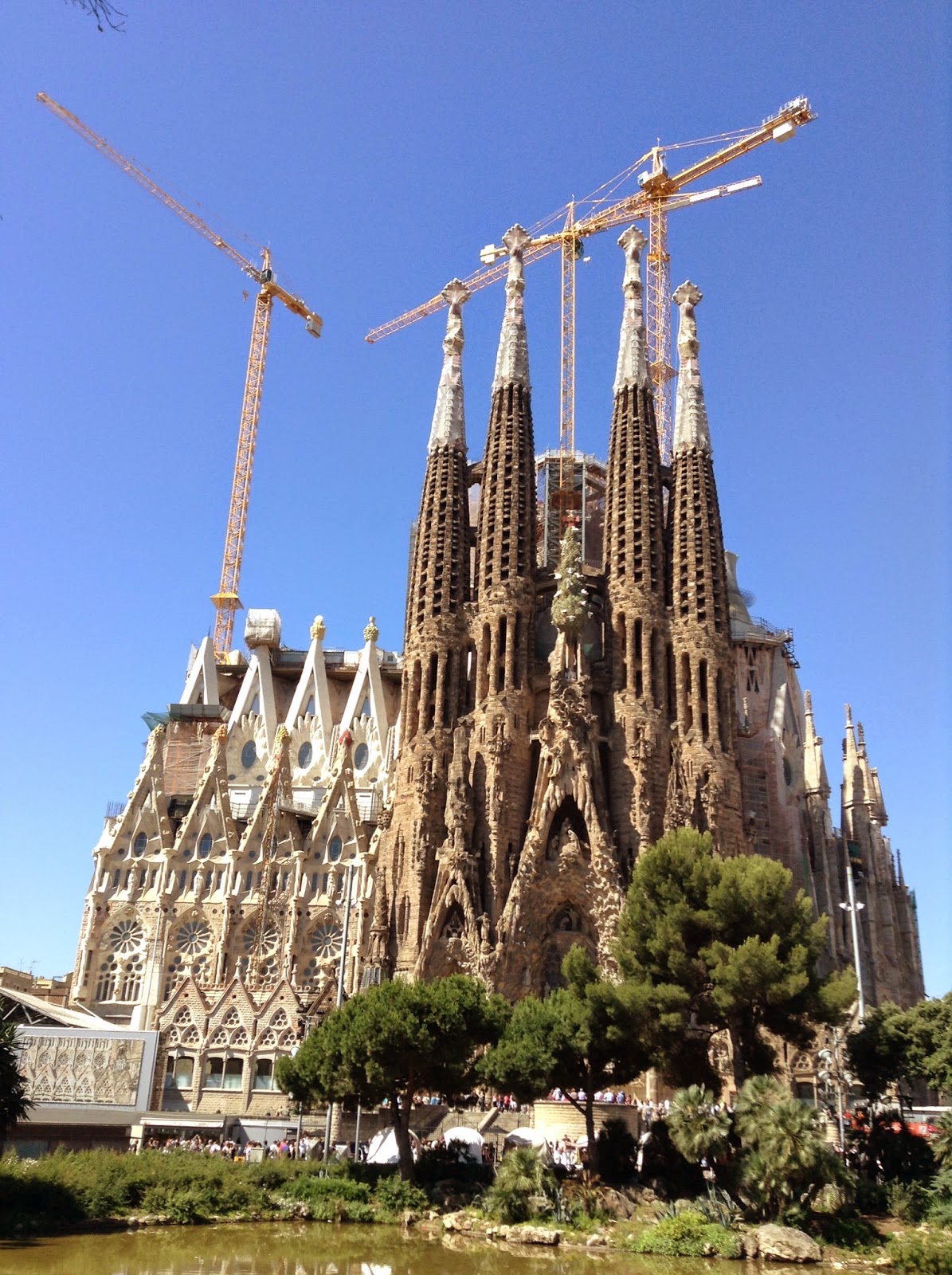
Sagrada Familia, with cranes.
Construction on the Expiatory Church of the Sagrada Familia began in 1882. Its projected completion date, depending on which graphic you believe in the church itself, is somewhere between 2020 and 2030. Antoni Gaudí became involved with the project in 1883, when he was 31 years old; it consumed the rest of his life and ultimately has kept going far beyond his death 88 years ago. The fact that we are still building this church based on his models and studies is a testament to the lasting power of his genius. The church was finally consecrated in 2010 as a minor basilica, the same year the building was enclosed.

At the risk of repeating myself (even though that's exactly what I am doing), let me say again that I am stunned at the amount of visitors this place receives. I opted for the admission with tower visit (I picked the nativity towers since those were completed by Gaudí) but didn't get the audio guide. All that cost me the tidy sum of 19.30 Euros, which is a little more than $26. $26 to visit an unfinished church. I'm amazed non-architects pay that much in such quantities. Again, hats off to the Barcelona tourism folks and good for architecture! I visited two Gothic churches in the city in my couple of days in town. Both were constructed primarily in the 1300s and both are free. Enough ranting.

The Sagrada Familia is at its heart a Gothic church, because pretty much all churches in western civilization are based upon that sort of model. But when it's finally finished, this church is going to be super complicated. At the time of Gaudí's death, only four of the 12 facade towers were complete. These towers, on the nativity facade, can be seen in the photograph above. They are darker brown in color. At the present time, four similar towers have been completed on the passion facade, which is on the other side of the building from the nativity facade. The final four towers on the glory facade have yet to be completed. The glory facade towers are the most complicated and will, when complete, define the entrance to the church. The twelve towers in total represent the twelve apostles.

Those twelve towers, however, are the smallest of the towers on the church. The main tower over the crossing of the church is almost double the height of the facade towers. Around the main tower there are planned four additional intermediate towers which will be about 1.5 times the height of the facade towers. Based on the photo above, there is a lot of work to do. When the building is complete, the towers already completed, which look so huge today, will seem small when compared to the final product.

View of the nave of the Sagrada Familia.
Despite my ranting that I can't believe people pay a lot of money to visit this church, it is pretty amazing. It is really a modern version of a Gothic church. It's at once the same and completely different from those amazing buildings constructed all over Europe in the middle ages. The form is obviously pretty much identical and without looking closely at a photograph of the main nave of the church (like the one above), one might think it is a building straight out of the 1300s.

But start to look closer and you will start to see subtle differences that make all the difference. Gaudí's understanding of forces and structure was far more sophisticated than the master builders of six or seven hundred years ago. Columns in the old Gothic cathedrals, which are straight up and down although they have lateral forces to resist in addition to gravity loads, are canted in Gaudí's church. The Gothic builders accommodated the lateral forces with flying buttresses. The Sagrada Familia doesn't have any because it doesn't need them. 

The shape of the vaults is also purer in the Sagrada Familia. Gaudí's three dimensional force models informed his design of catenary vaults, structurally far more efficient than other forms used in Gothic cathedrals. A catenary is the natural form of a hanging cable; equally distributed loads on structure can be most efficiently resisted with a catenary curve.

Gaudí also takes advantage of concrete construction, a material poured into a negative form, to create a new vocabulary for individual structural components. Columns are no longer similarly shaped stones laid on top of one another. Instead, columns can twist to resemble plants and other natural forms. Vaults no longer need to be ribbed and laid by hand. Instead hyperbolic paraboloids can be used, taking advantage of less material to generate structurally more efficient vaults. The medieval builders didn't stand a chance.

The evolution of the church's design and the model based methodology used by Gaudí are on full display in the museum in the church's basement. You could honestly spend a day or more in this museum and learn more than you probably ever wanted to know about the building. The most informative part of the museum to me was seeing the way Gaudí's influence changed the original concept of the church from Gothic to something else so thoroughly and suddenly. There are three side by side large scale sectional models that illustrate this transformation pretty effectively.

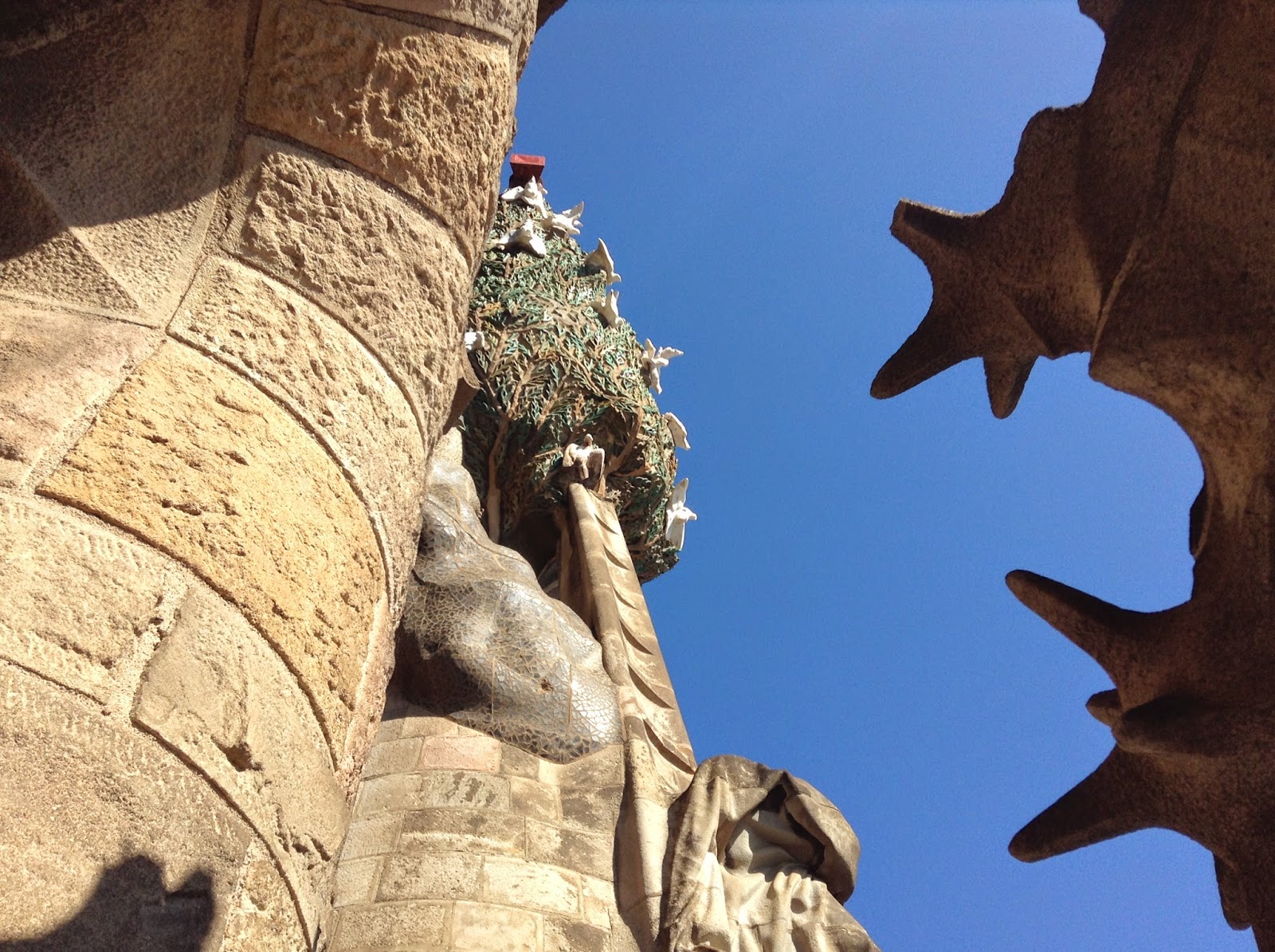
The imagery in the stained glass and sculptures adorning the building is consistent with the church's antecedents  religious themed stories from the Bible abound. Gaudí does, however, wrap more natural motifs into the facade, introducing trees and birds which give a more Art Nouveau feel to the building. These are very well seen from the nativity facade towers, which I would recommend adding to the cost of your admission, even though when I visited the upper sections of the towers were closed.

View of the tree in the center of the nativity facade, from the facade's towers.
The stair of the nativity towers.
I'm glad I visited the Sagrada Familia as the last piece on my Gaudí pilgrimage. But perhaps more than the church itself, I was most excited about seeing the school house on the property. Also designed by Gaudí, the building consists of only three rooms but boasts an amazing hyperbolic paraboloid roof constructed of straight wooden beams with a layer of Catalan tiles for the roof structure. I've tried at least twice to use the roof of this building as a model for a canopy design in a school, once at my first job in upstate New York and once with my current employer years and years ago (I failed both times). It's rare that I get to see an actual building that directly inspired my design thought process on a project.

The school of the Sagrada Familia.
With my visit to the Sagrada Familia school, my Gaudí journey was almost complete. I definitely appreciate the contributions that Gaudí left to this world. It took me way too long to get here but at least I made it. There's one less bucket list architecture trip to undertake now. The final stop on my Gaudí journey was to the crypt of the Sagrada Familia. In the far side of the crypt nearly beneath the nativity facade towers is the grave of Antoni Gaudí. Definitely worth the last stop on the trip.

The final resting place of Antoni Gaudi.