Showing posts with label Food. Show all posts

Sunday, April 5, 2026

Memory Of Water


Last month we spent a long weekend in Northern Arizona visiting a canyon. And of course by "a canyon" I mean the Grand Canyon. What else could I possibly be talking about? 

It feels like a long time since I've been to a canyon. It's not something that I seek out for visits very often. I'm not sure I can even remember the last time I went to anything resembling a canyon, let alone named a canyon. I'm thinking maybe Zion National Park in 2015. Does Hovenweap's mini canyon in 2020 count? I'm not sure. Canyons are just not my thing, I guess.

So how did we spend the day after our trip to the Grand Canyon? Well...by visiting another canyon. What else? Grand Canyon done. Time to visit Antelope Canyon.

Now, there is the very real possibility that you have no idea what I'm talking about when I write Antelope Canyon. But believe me, there's a very real possibility you know Antelope Canyon, even if it's just through online pictures of sinuous red-orange carved rock lit magnificently through cracks and crevices by the hot desert sun. You know...like the pictures above and below this introduction. Somehow, somewhere, you've likely seen some pictures of Antelope Canyon.

And it's very likely that you have been wowed by the photos.


I wanted to take and have pictures like you (and I) have seen online. But more than just the pictures, I wanted to find out more about this thing. It's not a canyon in the sense that the Grand Canyon is a canyon. And by that I mean a giant, gaping place in the planet way wider than it is deep. The Grand Canyon is a mile deep and at its widest point 18 miles wide. Antelope Canyon isn't like that. It's way smaller. It's also a slot canyon.

What's a slot canyon, you ask? I had to look it up. And just so you don't have to look that same information up...

A slot canyon is a canyon with a depth to width ratio of anywhere 10 to 1 to 100 to 1. That's a canyon that's between ten times deep and 100 times deep as it is wide. At its widest point, the Grand Canyon has a depth to width ratio of 1 to 18. Not 18 to 1; 1 to 18. If the Grand Canyon had a 10 to 1 depth to width ratio, it would be a tenth of a mile wide and a mile deep. That's pretty deep and skinny. If it had a 100 to 1 depth to width ratio, it would be 1/100th of a mile (or 53 feet) wide and a mile deep. THAT is a slot canyon.

The Grand Canyon was formed by the slow action of the Colorado River carving it's way through the Earth over millions of year. Not so with Antelope Canyon. Slot canyons are formed by sudden torrents of water moving at a very high rate of speed through soft rock (like sandstone). These sudden torrents of water are flash floods, which are typically only common enough to create something like Antelope Canyon in very dry locations where there is effectively no way for the land to absorb sudden large rainstorms. The carving of the rock is caused by the water moving at extreme speed and the fact that the water is carrying abrasive dirt and sand. Water carves out both large open canyons like the Grand Canyon and tall thin canyons that are slot canyons. But the action and the result is totally different.

Those flash floods, by the way, are still doing their work. If it rains at the wrong time, Antelope Canyon can be flooded with water to 25 or 30 feet deep in a heartbeat. Sound dangerous? Well, if there's nobody watching the weather, then I guess it is. But they typically only happen during monsoon season in July and August.

To get to Antelope Canyon, you need to do two things: (1) drive to the Navajo Nation in northern Arizona and (2) book a tour. You need to do the first because Antelope Canyon is on land owned by the Navajo. You need to do the second because since 1997, taking a guided tour is the only legal way to visit. 

Before 1997, the Canyon was just open to anyone who could get themselves there. And there were side effects of that completely open availability. That meant trash, graffiti and those pesky and extremely dangerous flash floods. Since '97, it's been guided only. 

We booked our tour through Roger Ekis' Antelope Canyon Tours who took us out into the desert to visit Upper Antelope Canyon. And, yes, there IS a Lower Antelope Canyon (and more). We picked our trip based on reviews off TripAdvisor and figured we didn't need to do both Upper and Lower Antelope Canyons. Aren't they pretty much the same? We don't know that answer to that question necessarily. 

When we checked those TripAdvisor reviews, by the way, most were super positive, but some were overly critical about what I will sum up as the staged photography nature of the tour. More than one review complained about what I interpreted as a scripted tour where everyone on the tour was tutored in photography of the canyon so that everyone would emerge with the best (and presumably the same) pictures of the place. I'm not a huge fan of believing negative reviews, particularly when the majority of the reviews of any experience are very positive. Still, there were concerns there.

Don't get me wrong, I wanted those best pictures. But I also wanted freedom to take more than the classic photographs that everyone went home with. I hoped I'd get that.

I also just wanted find out what this place was really like. The images that are shown online are completely context-less. How do you get to the Canyon? How do you get into it and out of it? What's it like to walk through? How tall is it? Are there ever any people in this thing because there are never any photos with people in them it seems. I assumed I'd get this.


Antelope head in the top photo. The bottom is the sunrise and sunset scene.

So first of all...yes, the tour we took was heavily focused towards a series of what I'll call classic views of Upper Antelope Canyon. We were advised how to set the screen brightness and the filter on whatever version of the iPhone or Android phone that we happened to have with us and in a couple of spots, our guide actually took the same picture for each group on the tour. We have a vertical panoramic shot of us standing at the entrance to the Canyon and color and black and white versions of a spot where if you take the photo just right, it appears that you have angel wings. So does everyone else on our tour.

There's also a face in one spot, a couple of bears, an antelope, a sunrise / sunset scene and an alien. And the tour stops so everyone can take the exact same pictures. Everyone.

But you know what? If you didn't want to do any of that, that was fine too. If you wanted to do your own thing and take whatever pictures you like, you could. And so we did. We took part in most of the staged photographs but we also took pictures of whatever the heck we wanted. Our guide, Cindy, was just awesome. She was patient and thorough and even gave a very effective demonstration using water and the sand near the canyon of exactly how it was formed. The tour was honestly fantastic. And I think we emerged with some amazing photos.

But I really wanted to find out what the deal behind this canyon was. And we did that too.

The Grand Canyon is a large, long gash in the surface of the Earth. When you are standing outside the Grand Canyon you are on a very large and very flat high desert plateau and to look at the canyon you stand on the edge and look down. Want to walk into the Grand Canyon? Find a trail and walk down.

Antelope Canyon isn't that. It's effectively a very large sandstone lump (I was going to use the term boulder but it's way, way larger than a boulder) sitting on the surface of the Earth with a very large and not necessarily straight crack running straight through the middle of it. It honestly looks like some secret cavern or hideout from some fantasy or science fiction movie or series. I'm thinking Star Wars, Game of Thrones or Dune here. It's astonishingly different than the Grand Canyon. It's in fact probably as dissimilar as an experience as you could possibly get from two places with the word "canyon" in their names.

It's a heck of an entrance. And I swear I've never seen this is any of the pictures online.

The Navajo call Upper Antelope Canyon Tsé bighánílíni or "the place where the water runs through rocks". But they also refer to it as "The Crack", which is appropriate because that's exactly what it is.

The entrance to Upper Antelope Canyon.
Once you step into Antelope Canyon, you are in the world that shows up in the pictures online. You don't have to walk 20 minutes or so or even into the second "room" of the Canyon. Step in and you are in. All the way in. The sand path and light ahead of you hints at the way through the Canyon but look up and that rock just hangs over you like billowing sails frozen in time. The colors and the shapes are just amazing. Something that really only nature can create while it's almost unbelievable at the same time that nature can actually do this. 

It's tall. We were told 120 feet tall at its deepest point. You are dwarfed by the rock but you also don't feel like you are at the bottom of something really deep, particularly because you can rarely look straight up to the sky because the rock twists and turns above you. You don't feel like you are in a canyon in the traditional sense. 

It is also tight. There are places you can spread your arms and touch the smooth and at the same time rough rock walls (which are decidedly not anywhere close to vertical) on either side of you. Having said that, our group was I'd say 15 in size and I really didn't feel cramped for space that often. Touching, by the way, is encouraged.

The Canyon is tall.

The time we were allotted in the Canyon itself was about 30 minutes. It honestly felt longer. This experience was not rushed in any way, although I'm sure it helped that we were on the last bus from the tour company we selected and I'm sure Cindy allowed us a little latitude to dawdle a bit.

We walked through the entire length of the Canyon. I'm guessing it was between a quarter and a half a mile long, then we walked out of the back side of the Canyon, up a sandy hill and back over the top of another piece of rock that was to the left of The Crack as we entered. 

Did we see Lower Antelope Canyon while we were there? No we did not. We drove by it on the way to Upper Antelope Canyon but it's really nowhere near the place we visited. It's a totally different lump of rock with some sort of vertical fissure created by flash floods, rock and sand. There are apparently four additional parts of Antelope Canyon you can visit but it's not like they are contiguous or anything. They are likely just different sandstone canyons that look a little different. That's not what I imagined at all. I figured they would all be connected. Physically that is, not metaphorically.

Looking up at the branch of a tree in Upper Antelope Canyon.

This place is magical. It is as breathtaking as the pictures I saw before I got here. And by breathtaking, I really do mean it. That first room that you step into is astonishing. It is simultaneously gorgeous in its form and awe inspiring in its structural beauty. I can't really remember feeling this same way recently about a place we've visited that wasn't built by man.

I can also confidently say that there's no way I want to be in a place like this during a flash flood. As we walked through the Canyon, we saw limbs of trees wedged into the crannies of the Canyon above us. And not like at eye level or on the ground. Try like 25 or 30 feet above us. That means the water level during a flood is really that high. Can you imagine the force of a 25 foot high wall of water coursing through a narrow slot canyon all of a sudden? I'm not sure I want to.

On the name...we didn't see any antelopes when we visited. Antelope Canyon is located near Page, Arizona, which was established in the 1950s when Lake Powell was formed by when a dam was built nearby. When the Lake was formed, it interrupted the travel patterns of the pronghorn that lived in the area. Proghorn are often referred to as antelope but are really no such thing. That wouldn't be the only misnomer out there about wildlife in the American west.

Exiting Upper Antelope Canyon.

But...that's not the whole story. There are three more things. Yes, I know, three is a lot more things. I'll try to be brief.

First thing: The time.

When we booked our tour with Antelope Canyon Tours, every confirmation and reminder email we received (and there were a lot of emails...) prominently reminded us that our tour would operate on Phoenix time and to remember that. We figured this reminder was likely because the state of Arizona doesn't participate in Daylight Saving Time and that if you were coming from Utah (Page is just south of the Utah border) and didn't remember that the state immediately south of you was an hour behind you from March through October, you'd be an hour early.

So we are cruising along Arizona Highway 89 and all of a sudden the time on Waze jumps forward an hour. Arrival time is now 10:05 a.m. for a 9:50 a.m. tour time. What the heck? Did we somehow get delayed? Did we actually leave Flagstaff later than we thought we left? We were a little freaked out. We can't be late for this tour, can we? We checked the time in Flagstaff and in Page and both locations showed an hour earlier than Waze (which was really operating off the phone time) showed.

So we decided to check the time zone map of Arizona. As it turns out, not all of Arizona refuses to participate in Daylight Saving Time (see map below borrowed from the Department of Transportation website). The northeast corner of Arizona DOES observe Daylight Saving Time. But not the WHOLE northeast corner; there's a little piece of the northeast corner that is not connected to the rest of the non-DST-observing part of Arizona that also refuses to acknowledge Daylight Saving Time. And we happened to be traveling from the DST-denying portion of Arizona and through the DST-compliant piece of Arizona to the smaller DST-denying portion of the state. 

We weren't late. The time changed back to Phoenix time 1.6 miles from Antelope Canyon Tours' office. But as people who don't like to be late EVER, this was a little freaky.

Second thing: The bags.

The other reminder that we received (over and over and over again) in emails from Antelope Canyon Tours before we showed up in Page was that no bags were allowed on the tour. Check that...no opaque bags. Clear bags are cool. And they DO sell clear bags in the gift store.

We run into this kind of thing when we attend sporting events and we assume it's so people can't bring bottles of alcohol into the event but why would anyone bring booze on a Canyon tour in the middle of the day? So we asked when we checked in. The answer? People sometimes bring their trash and leave it up at the Canyon. This made no sense to us. It's OK for me to bring trash in a clear bag that I might leave for good out in the Canyon but it's no good if the bag in not clear?

But when we boarded the bus, we were reminded no non-clear bags and we were also asked to shake our water bottles. Huh?

As it turns out, the issue isn't trash, it's ash. Like ashes of deceased loved ones. Why anyone who is not Navajo feels like they should bring their dead relatives' remains out to this place is beyond me. But apparently people do it. And when they do, the Canyon has to be closed, cleaned and blessed before it can re-open. Don't bring human remains here, people. Please!!

Navajo Taco, Hope's Frybread.
Third thing: The frybread.

This trip had one more foray into Navajo culture and history besides just visiting Antelope Canyon. On our way up to the Flagstaff area, we stopped for lunch at Hope’s Frybread, a Navajo-owned restaurant in Mesa, just east of the Phoenix airport. I’ve had frybread before, most notably on my 2001 vacation to Arizona in the fall of that year. I can still remember the frybread topped with pineapple I had outside the San Xavier Del Bac Mission on the Tohono O’odham reservation just south of Tucson on that trip. Frybread is basically flour and water made into a crude dough and then deep-fried in oil. It was invented by the Navajo in the 1860s but it is very decidedly not an historic native American food. It was invented out of necessity based on cruel treatment of the Navajo by the United States government.


The Navajo, like many (or is it all?) Native American peoples, were eventually confined to a non-traditional territory by the government of the United States. “Non-traditional” in that previous sentence really means pretty much undesirable and way smaller than lands they had previously lived off. The best parts of their former land, of course, were taken for use by American settlers of European ancestry. Confinement meant just that: don’t leave the assigned area. But some Navajo didn’t want to obey rules they had no part in making, which brought punishment from the men (usually Army officers) assigned to keep the Navajo in their assigned spot in the new American southwest.


The punishment for 10,000 Navajo for a few of their people leaving their assigned territory against the Army’s orders? A forced 300-mile march from the west side of what is now New Mexico to the east side of that same state with a subsequent internment for about four years. It’s now referred to as the Long Walk of the Navajo. Of the 10,000 forced to walk across the southwestern desert, approximately 35% of those died either during the Long Walk or during captivity.


A major cause of death was starvation, a result of the inadequate rations provided by the government to the Navajo. Part of the meager provisions made available to the Navajo were flour, lard and sugar, which Navajo women used to make a kind of dough from flour and water which they could then deep-fry in the heated lard. That frybread is the origin of the stuff we ate on our way to Flagstaff and is regarded as a symbol of Navajo resilience. Rather than allowing the substandard ingredients they were forced to live with, the Navajo women in the 1860s turned those raw materials into something that allowed their people to survive. I see it as an eff you to the United States Government and I love that.


So before we headed north to Flagstaff and Upper Antelope Canyon, we had a Navajo Taco at Hope's. Ground beef, beans, cheese, lettuce, tomato and some kind of spicy sauce atop bread improvised from substandard ingredients. It kept me fed and nourished until Flagstaff.

Thursday, August 28, 2025

Poutine


Word association time: Canadian food.

You said poutine, right? 

I know you said poutine. No way do you think anything else when you hear "Canadian food". The most recent season of Top Chef (best show on television, by the way) was staged in Canada and when the chef contestants were asked what they thought when they heard "Canadian food", they all (to a person) said poutine. 

Poutine is it. Poutine = Canadian food. And I know it's a bit insulting to Canada but it just it what it is.

Before we headed up north to Canada in late June, I did some snooping on menus in the two towns we were staying on this trip (Golden, BC and Calgary) and it seemed to me that there was a lot of poutine on the menus of a lot of restaurants that we might entertain going to. You can even upgrade your side of fries or salad or whatever comes with your meal to poutine at most places. I was looking at Canada as poutine wonderland. Plain and simple, I was pretty darned stoked for this experience.

Maybe some words about poutine are in order? In case the cover picture (which of course is a dish of poutine) of this post doesn't speak for itself.

Poutine is not a complicated dish in any way. It's French fried potatoes topped with gravy and cheese curds. Sure...I get it, these days you can get it with all sorts of other toppings but if you boil it down to its essence, it's fries with gravy and cheese curds.

The dish was invented in Quebec in the late 1950s. Of course, like most food origin stories (the Philly cheesesteak and the French dip sandwich come to mind here), there is a healthy amount of debate about the one true originator of the dish. So sure, Le Roy Jucep in Drummondville, QC has a copyright registration certificate for the dish issued by the Canadian Intellectual Property Office but that might just mean the owner of the place got to the Office first. 

It appears that the earliest appearance of poutine on a menu may have been at Le Lutin Qui Rit in Warwick, QC but that place apparently didn't add gravy until a few years after they put in on the menu. So is it really poutine, then? There's a third restaurant in the mix but suffice it to say for the purposes of this blog post poutine is a dish from Quebec. No real debate there. If I ever make it to Quebec, maybe I'll do a more exhaustive examination than just lazily checking Wikipedia.

I have had amazing poutine before our trip this summer. I had some incredible poutine with pastrami in some restaurant that I can no longer remember the name of in Toronto and I had some awesome straight up poutine (maybe with some chives added) at The Vanguard in Milwaukee a few years later. But a whole week in Canada to explore poutine? Surely this would add to my appreciation of this Canadian dish immensely.

Lebanese poutine? Topped with chicken shawarma. At Beirut Street Food, Calgary.

Now, I can concede that one issue I might have run into here is that British Columbia and Calgary are really nowhere near Quebec and that the quality and authenticity of poutine might diminish as you get from from its point of origin. Now, granted...Toronto and Milwaukee aren't really that close to Quebec either but they are a whole lot closer than Calgary, not to mention points west.

On the fourth day of our trip, I was four dishes of poutine into my 2025 poutine quest and I was not particularly impressed. I'd eaten poutine in everything from a Lebanese restaurant to a dedicated poutinerie. I'd eaten it topped with chicken shawarma and hot peppers intentionally and with green onions accidentally despite mostly trying to stick to pure simple poutine. I'd had poutine served twice in aluminum foil dishes that are way too big (and are also the small size). And I'd had poutine with lightly battered French fries and with gravy that looks congealed but was actually pretty tasty (see picture below). 

As an aside, why do people lightly batter fries? Why? Just leave them alone. They are fine as just fried potatoes. 

The part that was just not impressing me on my poutine food tour on day four was the gravy. And it's really a pretty simple issue: why is it always so salty? All those variations of poutine noted a couple of paragraphs before this one...really, really salty gravy. And that honestly sort of ruined every dish. I'd say maybe in a pinch, if I was really, really in need of some poutine and didn't mind the heavy-ish amount of salt in the gravy, I'd cave and order some poutine from The Wolf's Den in Golden (cover picture). But the rest? Not particularly interested.

The Wolf's Den is the place with the battered fries, if that tells you anything about my opinion of the other three dishes I'd eaten to that point.

It was at this point that I took a poutine break. It wasn't intentional. We just ended up at some places to eat where I wanted something that didn't go particularly well with poutine or one place may have just been a bit too fancy. And by the time I really realized it, I found myself down to my last full day in Canada and I still hadn't had some poutine that I would consider as good. This was not going well.

Our last full day in Canada was spent at the Calgary Stampede, a rodeo / agricultural fair / amusement park / celebration of heritage / biggest thing all year in Calgary that is way better than all those things put together. Maybe they would have a poutine stall? Other than breakfast at the hotel and lunch in an airport lounge, this would be my last poutine shot of this trip. And yes, they did have a form of poutine on the breakfast menu but that dish was conspicuously absent from the reduced-but-totally-free menu for Hyatt Globalists. And there's no way I'm spending money on breakfast when there are other free options that are likely just as good.

So sure enough, when it got to about lunch time at the Stampede, we looked for the word poutine on a food stall in the food area. And sure enough, right there next to a burger place that also sold poutine was a place called La Poutinerie. This had to be it. This was the place I was getting my last poutine of the trip. I guess it was encouraging that it sounded French. Maybe.

One order of "poutine" please. No hot dog poutine or Greek poutine or maple bacon poutine or shepherd's pie poutine. Just straight up poutine. Fries. Gravy. Curds.

La Poutinerie's poutine. Calgary Stampede.

You know what? This worked. This was what I needed. It was hot. The fries were correctly cooked and not battered in any way. The cheese curds were melty enough around the edges, even on top of the dish. And the gravy was beefy and not overly salty. There! How difficult was that? I mean, just look at the color and consistency of that gravy in the picture above. The best poutine I had in a week in Canada (admittedly far, far from Quebec) was from a stall at the Calgary Stampede. 

If I'm going to gripe at all, I could have used some more cheese curds. The guys working in the La Poutinerie stall were just placing them on top of the dish so by the time I got to the bottom half it was just fries and gravy. Maybe that's my fault for not mixing them in if that's the way I wanted it.

This is for sure one of the least scientific and casual food quests I have ever been on but I'm satisfied. Thank you, Calgary stampede. Next year we are heading to Winnipeg and other parts Manitoba for a week. I'm not going to be as fanatical about the poutine next year but you know I'm having it somewhere.

This is my "this is some good poutine" face.

Thursday, April 24, 2025

Ramen


The last time I spent a week or more in Japan, I came home and wrote an almost unconscionably long post about all the food we ate: gyoza, sushi, French pastries, okonomiyaki, convenience store food, Japanese omelets, so much more. Japan is a food paradise, with so many incredibly delicious types of food which are (with the possible exception of high-end sushi omakase meals) mostly super cheap and abundantly available. I'd rather eat in that country than any other place I've ever visited. Greece was maybe close, but maybe not so much at all now that I've just visited Japan.

I am not going to write a giant, comprehensive food post to wrap up our 2025 Tokyo trip. Part of the reason I'm not going to do that is because the trip was shorter and we didn't quite get to the full range of food types we would have liked to have sampled. But the larger reason is we decided to spend more time this trip focusing on one of Japan's most famous dishes: ramen. And I AM going to write a blog post about that.

Chicken ramen, Tokyo.
Let's get some ugly truth out of the way right away, shall we? Before I visited Japan in 2017, I had never eaten a bowl of ramen. I'm serious. Not a one. Not even instant. 48 years old and not a single bowl of the stuff. Not even in college when my fellow students were possibly eating Maruchan Ramen and Cup O' Noodles as about the cheapest form of sustenance they could find. I was utterly and blissfully unaware of the existence of ramen.

Shall we talk about more dirty truths? And this one may be a little more scandalous...ramen is not really a Japanese dish. Seriously. Shocked? Those ramen shops you see all over Tokyo and other cities all over Japan? Not using noodles that were invented in country. The broth tradition might have been developed over the better part of two centuries in Japan. But not the noodles. No sir, no way! The noodles are Chinese all the way. Like mid or late 19th century Chinese.

Now you might be thinking here...am I telling you that the Japanese didn't have noodles until they started importing Chinese-made ramen in the 1800s? No, I am not. Udon and soba noodles were developed in Japan. But ramen noodles, which are made with lye water, are a Chinese invention. And while there may be one-off stories of individual Japanese people partaking in Chinese ramen dishes all the way back to about the year 1700, the large scale introduction of ramen to Japan started in 1858, when Japan eliminated a 200 year old ban on foreign visitation and opened its ports to the world for trade and foreign relations. And part of that trade involved the importation of Chinese ramen noodles. And Chinese cooks. Japan was ready for the birth of ramen.

Reconstruction of the restaurant Rairaiken, Japan's first ramen shop.
The demand for ramen dishes in Japan was initially driven by the nation's Chinese immigrant population, most of them students sent to study in Japan. With Chinese people came a desire for Chinese food, including noodle dishes. As noodles were made and shared in Japan, the knowledge of how to make Chinese noodle dishes started to spread beyond the Chinese community. 

In 1910, Japan's first ramen shop, Rairaiken, was opened in the Asakusa neighborhood of Tokyo. The owner was Japanese but the 13 cooks he hired were all Chinese. Finally ramen was available to anyone who could afford to spend a little money and buy a bowl. But the dish was still very much Chinese in flavor and conception. 

Then in the 1920s, the first ramen shop in Hokkaido was opened by a man named Shoji Ohisa to sell noodles to the 180 or so students enrolled at Hokkaido University. Ohisa started to work with his Chinese cook to make a lighter broth of pork and scallions to pair with the popular noodles. Finally, ramen started to develop in a serious way and in a Japanese way. The lighter broth appealed way more to the Japanese palate.

The word ramen, by the way, was apparently borrowed from a noodle shop called Hao Ra Men, a phrase of mixed Japanese and Chinese origin meaning "the noodle dish is ready". So appropriate that the dish which is Japanese and Chinese was derived from a phrase mixing the two languages.

Ramen at Tsuta, the world's first Michelin-starred ramen shop.
How do I know all this? Why is my knowledge of the origins of ramen so encyclopedic, you might ask? Well...it's not really. You shouldn't be impressed. It's not like I did a whole bunch of research or anything like that. We just prioritized a visit to Yokohama's Shin-Yokohama Ramen Museum. Ramen museum, you say? Is there really such a thing? Ummm...yeah, there is. I mean, it's Japan. And amazingly, it's not alone. But we'll get to that.

The top (ground) level of the Ramen Museum features a wall chronicling the history of the development of ramen along with other ramen-related graphic displays; some replicas of historic moments in ramen history (first Japanese ramen store plus a ramen cart); the gift store; and a spot where you can assemble your own custom-flavored instant ramen bowl to go. The lower level of the museum contains the museum's star attraction, a series of historically-based ramen shops which have either resurrected famous lost ramen recipes or which collectively trace the development of ramen over the decades through different concoctions of noodle dishes. The bowls of ramen are smaller sized bowls to allow you to try two or three different flavors of ramen on your visit.

The history display, by the way, goes all the way up to the 21st century, covering how the post World War II black markets popularized complex ramen dishes made with throwaway parts of animals and vegetables which forced greater effort to develop that umami; the development of instant ramen by Momufuku Ando in 1958; and all the way up to the issuance of the first Michelin star for a ramen restaurant (Tsuta) in 2015. Momofuku Ando later developed the Cup Noodles product (known in the United States for a while as Cup O' Noodles) which I referenced earlier in this post. And if you want to know more about that whole thing, there's also a Cup Noodles Museum in Japan and it also happens to be in Yokohama. Bonus!


The world's first instant ramen (top); and statue of Momofuku Ando holding a packet of Cup Noodles.
So about that lower level ramen shop main attraction in the Ramen Museum. Yeah...we didn't do that at all. Skipped it entirely. Didn't even order a single bowl of ramen. It sounded really good. I was pretty intrigued to try the resurrected recipe from Rairaiten (it's now closed) but we never even ordered. We were too full. Couldn't eat another bite.

Why would we show up without an appetite to a museum about ramen whose star attraction is consuming ramen dishes throughout history? We didn't, I swear. The Museum actually has one more room in it where you can participate in a make your own ramen class. Which of course we had to do. And after the class? Well...we ate the ramen we made. What else would we do? Am I sorry we missed out on all sorts of different ramen in the Museum? Sure I am. But when else am I going to make my own ramen noodles? 

Full disclosure here, we only made the noodles. We didn't make our own broth or cook or own pork or even assemble the dish. Just the noodles in the class. That was enough.

The Shin-Yokohama Ramen Museum's historical food court.
So making your own ramen noodles in the Shin-Yokohama Ramen Museum takes about an hour. Maybe a little less. Add some ramen eating time and you are looking at just shy of a 90 minute commitment. Our class time started at 11:30 in the morning which was about perfect for lunch. And fortunately, it was conducted in both Japanese and English.

Ramen making at the Museum is a three step process: (1) make the dough and let it rest; (2) roll out the dough; and (3) cut the dough into noodles. The first part involved mixing our packet of spelt flour with our measuring cup of lye water or kansui (remember we are making ramen so we need the lye water) and then a lot of pressing and folding and pressing and folding while some small Japanese man yelled at us "no pain, no gain" and "I want you, I need you, I love you". With this last part I am fairly sure he was projecting what we should be saying to the noodle dough and not making a declaration of love to us personally. At one time I swear he said "te quiero" but I couldn't be absolutely sure. The yelling was not exactly stressful but it was distracting.

Two things about this step. First, I am not sure if there was anything other than spelt flour in the bag that we used. The dough we were making never developed any gluten so I assume ramen noodles are an un-yeasted product but I'm not sure there was even any salt already added into our baggies. Second, there are two options for flour type in the class: spelt and Japanese flour. But you are not allowed to request Japanese flour unless you have done this sort of thing before. And there's no faking it. You have to cite the prior class that you attended. I'm confident someone's checking.

Demonstrating the pressing of the dough. I want you. I need you. I love you. Te quiero.
Onto step two (after a 10 minute rest - for the dough, and us): the rolling of the dough.

I know what you are thinking: how exciting is rolling out dough? Oh but it is. This is the best part of the whole ramen making experience because we are not using any old handheld rolling pin for this step. Ohhhh no!!! For this ramen class, we are required to use the ancient technique of aodake-uchi, which involved the use of a giant piece of bamboo (the aodoke) to roll out and flatten the dough. And by giant piece of bamboo, I mean like 6-7" in diameter and probably about 5 feet long. A giant piece of bamboo.

The rolling out process is really just a flattening process. You lift and lower the piece of bamboo onto the roll of dough over and over until it becomes flatter and flatter. There's some folding in there but it's flattening after flattening here. You only use one end of the bamboo; the other end is jammed against a wall on the opposite side of the table with a piece of wood above it to prevent the aodoke from flipping over when you press your side of the bamboo lever down onto the table. 

If you need some extra leverage in this part, you can sit on the aodoke and bring more of your weight down onto the dough to get it flatter quicker and just plain flatter. I don't know really quite how to describe how to do this so in accordance with the "picture is worth a thousand words" axiom, I'm just going to show you in two photographs below. One professional and one amateur. It is definitely more effective to do it this way, assuming you don't fall over. I didn't.


After it's flat enough...cut the folded dough into noodles using a chopping board and a giant cleaver attached to some sort of ratcheting mechanism which moves the cleaver down the board and (in theory at least) gets you uniform and correctly sized ramen noodles. As long as you don't get your fingers under the blade, this process which sounds somewhat dangerous is really relatively risk free. 

However, it wasn't as foolproof as you might think on the ending up with uniform-width strips of dough front. I had a little difficulty with the dough remaining flat on the board so my noodles weren't as uniform as they should have been and I also clearly didn't jam the blade down on the board hard enough because I ended up with some noodles that weren't cut through. But...we didn't use all the noodles in the bowl of ramen so I could afford to use the best of the bunch and not worry about the rest. 

After we cut the noodles, we got to eat. I've cooked all sorts of food over the years for myself, including pasta on an occasion or two maybe, but I've added ramen to the list now, although admittedly just a part of the whole ramen experience. Was it worth skipping the Museum's signature food court-like attraction to eat our homemade noodles dipped into broth made by the chef in the noodle kitchen? It was. When am I going to do this again? I mean, sure, I can make ramen at home including the broth, the noodles and everything else, but I'm not doing it with a giant piece of bamboo in our kitchen at home. This was definitely worth getting away from sakura searching for a couple of hours to do. I'm honestly surprised at the lack of fancy technique to get from flour to cooked noodles but the self-advancing knife certainly helped a ton, I'm sure. 


Homemade ramen (top); outside of the Shin-Yokohama Ramen Museum (bottom).
Our lunch in the Ramen Museum was the third best ramen meal we had in our week in Tokyo. Any guess as to how many meals of ramen we had while in Japan this year? Hint: it's more than two and less than four. That's not to say that our museum-made ramen (which we certainly had plenty of help with) was not tasty or not good. It was. It was perfectly good and fine. But it was not the best ramen you can find in Tokyo, I'm sure. 

We did make a little bit of an effort to find some really good ramen and made a reservation at Tsuta, the aforementioned restaurant which was the first ever Michelin-starred ramen shop. It was certainly a cut above what we cobbled together in our late morning and early afternoon of pounding and cutting dough into noodles. The noodles were certainly way better and the broth was more complex and it was cool to watch the chef and sous chef working in the open kitchen assembling bowl after bowl. We both got the soy sauce ramen and it's going to sound somewhat stupid but the bamboo shoots here were awesome. 

Technically, Tsuta's noodles may be soba noodles but they use the term ramen so I'm jumping in that leaky boat and counting it as a ramen dish.

But Tsuta wasn't the best ramen we had in Japan this year either.

The best ramen we had in Japan. 
When we got back home, I asked Sophia what she thought was our best meal in Japan this year. She said the chicken ramen we got over by the Tokyo Tower after our day trip to Kawagoe. I agreed. It was a place called Ramen Thank Daimon and it was a chicken ramen place. I have no idea whether the name of the restaurant that I've just written is some sort of lost in translation name or if it actually is called Ramen Thank Daimon to Japanese people but the food and particularly the atmosphere was just incredible. This was the best meal of our trip, not the best ramen. Best. Meal.

I am quite confident there are tons and tons of places just like Ramen Thank Daimon all over Tokyo: small ramen shops which are probably mostly underground in long spaces with a kitchen in the back and an ordering machine in the front. And I am sure that most of them are really good. Open the door, punch in your order into the machine. Some ramen with options, maybe a large birhu or two and possibly a Calpis. Pay and go sit down where you are shown to sit, crammed into a space close to other patrons who are eagerly slurping down noodles out of (in this case) chicken-y broth.

This is absolutely the best way to eat ramen in Tokyo. There might be a wait but you won't wait long (we didn't wait but there were people waiting when we left). The dishes look well-used and the chopsticks are not wrapped in paper to be discarded after the meal but instead look worn smooth by thousands of cycles in the dishwasher. And there are even paper bibs to help with the splashing of the broth. The ramen is hot and delicious and if you are lucky, it's a bit cold outside and the hot dish will keep you going with warmth in your belly until you make it to the Metro.

And on top of all that, it's cheap. We have a couple of favorite ramen shops in the D.C. and New York areas but they don't have the same feel as underground ramen joints in Tokyo. There's nothing like them. I will always go for ramen in Tokyo or any other city in Japan. And don't think I'm done with Japan by any means. 

We went to Japan. We ate ramen. We made ramen. We love ramen. Until next time.

Toothpicks. Ramen Thank Daimon, Tokyo.

Saturday, June 15, 2024

The Layover


I will admit that I have a travel fantasy. It's nothing outrageous or risqué or complicated or anything like that. It's actually pretty simple: that one day, some way, somehow I'll have a connection between very long flights to distant points on the globe that will be long enough for me to actually leave the airport and do something in my connection city. Yes, it's a layover fantasy. It's like adding a little bonus trip for free! Who wouldn't want that?

Told you it wasn't very complicated. And I should point out that this is not a one time fantasy thing. I hope for this frequently when I travel and I'll keep wishing for them no matter how many I actually get. I just want one every so often. Is that too much to ask?

Apparently it is, because it rarely happens. More often than not I'm making a tight connection rather than being blessed with a layover so long that I can get through customs and immigration and make my way from the airport to something and then do the whole thing in reverse and get to the gate in time to go to the next stop. That's a lot to do, and you better be pretty darned confident all that can fit in your layover window. It's not an easy thing, for sure. 

And OK, OK, it's happened once. In all my years of flying all over the planet, I've gotten one layover where I could go explore somewhere. On our return journey from Africa in 2018, we managed to get an eight hour or so connection in Amsterdam that allowed us to stuff our backpacks in an airport locker and go visit the Van Gogh Museum and maybe a souvenir stand or two. But that's it. Just once.

Until this year. Our flight home from southeast Asia this year had a layover that was a sure thing for the bonus excursion in a country that wasn't even on our itinerary. Kuala Lumpur to Tokyo's Haneda Airport then 18 hours before heading back to Dulles and home. 

Bonus trip time!

Family Mart egg sandwich on white bread with the crusts cut off. Breakfast can't get better.

So...what to do? Well, first of all, the 18 hours we had were from about 9:30 on a Saturday night to 3:30 on a Sunday afternoon. That meant we needed to get some sleep in that window and that meant a hotel. So 18 hours isn't 18 hours of doing stuff. There's traveling to the hotel, checking in and getting some sleep. So realistically speaking, we had the morning to about noon or maybe a bit later because we'd need to stop back at the hotel to pick up our carry on baggage on the way home. That meant our options were really pretty limited.

Now, we've been to Tokyo before. We know a thing or two about the place and what our options might be. We figured two meals (breakfast and lunch) and maybe one or two quick attractions, and they would have to be open pretty early if we wanted to squeeze two things in. Things like karaoke, museums and samurai lessons would just be totally out of bounds. Not enough time or not the right time. We'd also need to pick something that was fairly close to public transportation lines and not too far from the airport. We'd have very little choice of location. We'd have to pick something that would be in a spot we could get to and then get back and catch our flight. 

We settled on a couple of Buddhist temple or Shinto shrine visits. These things are everywhere in Japan so there was bound to be one or two or five or forty close to our hotel and a train line and they are open early so we could definitely squeeze two in and still get breakfast and lunch. Our itinerary was set!

There was one more motivation behind visiting a couple of temples and/or shrines: we could add a couple of new temple seals (or goshuin) to the goshuin-cho that we picked up in 2017 on our first visit to Japan. These miniature works of art are perfect mementos of our trips to Japan and a record of all the temples and shrines we have visited in our life.

Giant lanterns hanging at Sensō-ji.
Before we go on, can I just say how amazing Tokyo is? I mean, it's the absolute best. 

It's about 10:30 p.m. or so and we are checked in to our hotel and on the streets of Tokyo in search of a bedtime snack and maybe a birhu or two. The hotel is cheap and close to the airport. It's actually a JAL (Japan Airlines) hotel. It's nothing fancy and the room is small. But it's absolutely immaculate in how it presents itself to us. The room is perfectly made up. There are pajamas and slippers available for us, there's a super efficient spot for everything in the room and, of course, there's a bidet built into the toilet seat and there's a long shoehorn. This has nothing to do with the hotel or the hotel staff. It's Japan. It's Tokyo.

Out on the streets, there's a 24 hour ramen shop across the street from the hotel and there is a 7-11, a FamilyMart AND a Lawson Station within very, very close walking distance of the hotel. Moreover, the place is just perfect. Everything is in the exact spot it should be. Everything is clean. Everything is safe. Everything works. There's whatever you need when you need it and it's all there for everyone. This has nothing to do with the neighborhood we are in and it absolutely has nothing to do with chance. It's Japan. It's Tokyo. 

I'm telling you...this place is the best. Better even (and I hesitate to say this because it's apples and oranges for sure) than New York City. I have no idea how we haven't been back to Japan for seven years. Crazy!

Spoiler alert: we already have our next Japan trip booked.

The torii at Tomioka Hachiman, marking the threshold between the sacred and the secular.

So a quick and quiet night's sleep and we are ready for some breakfast, a couple of temple or shrine visits and some lunch before back to the airport and home.

Breakfast was easy. It's convenience store time. Given the choice between 7-11, FamilyMart and Lawson Station, there's only one real choice: it's FamilyMart. Egg salad sandwich on white bread with the crusts cut off. Maybe I go to 7-11 or Lawson Station or try something else at FamilyMart if I have more than one day...but honestly, one day in Japan for breakfast and FamilyMart egg salad sandwich is a no brainer. I'm a FamilyMart guy all the way.

Next up: temples. The question here is...which two?

So, I've actually been keeping a list of temples and shrines which seem cool so I can plan around them on a future trip to Japan. The only one on my list that was close enough to public transportation close enough to Haneda Airport was the Tomioka Hachiman shrine. That was the first to make the list.

Why this shrine? Well quite simply because once upon a time (340 years ago), the first ever sumo tournament that became the current sport was held at the Tomioka Hachiman shrine and the first thing we did on the first day of our first trip to Japan was to head to a Grand Sumo Tournament for a day. This place was sure to be a great addition to that experience. 

The second? Well, it had to be close to Tomioka Hachiman so we had some choice but not a ton of choice. We decided to go big and choose Sensō-ji, which is the oldest Buddhist temple in Tokyo (dating back to 645). List done. Egg sandwich eaten. Time to tourist.

Many, many people at Sensō-ji.

Did you know that Sensō-ji is one of the most visited religious sites in the world? That's WORLD, not just Japan. According to the temple's Wikipedia page, as many as 30 million people have visited the shrine in a year. 30 MILLION! No? Didn't know that? Neither did we.

Needless to say, the place was packed when we arrived there in late morning. Maybe I'm getting too old or something but crowds...not for me. Not everywhere. I love visiting popular tourist destinations and there is for sure a time and a place to have an engaged and large crowd (Chinese New Year's Eve this year in Singapore is a perfect example of when you need a lot of people at an event or attraction). But a temple in late morning where jostling is required to get to what there is to see? I'd rather go somewhere a little less populated where silence and contemplation that seem appropriate in a temple or shrine can occur.

Don't get me wrong here, the place is gorgeously designed and maintained and the campus is huge, meaning there are a lot of different spaces to experience both inside and outside. I'm glad we went to Sensō-ji and got it on our books (literally...but we'll get to that). The oldest Buddhist temple in Tokyo is definitely worth a visit. Just not if you want to spend time in a spiritual place where you can contemplate.

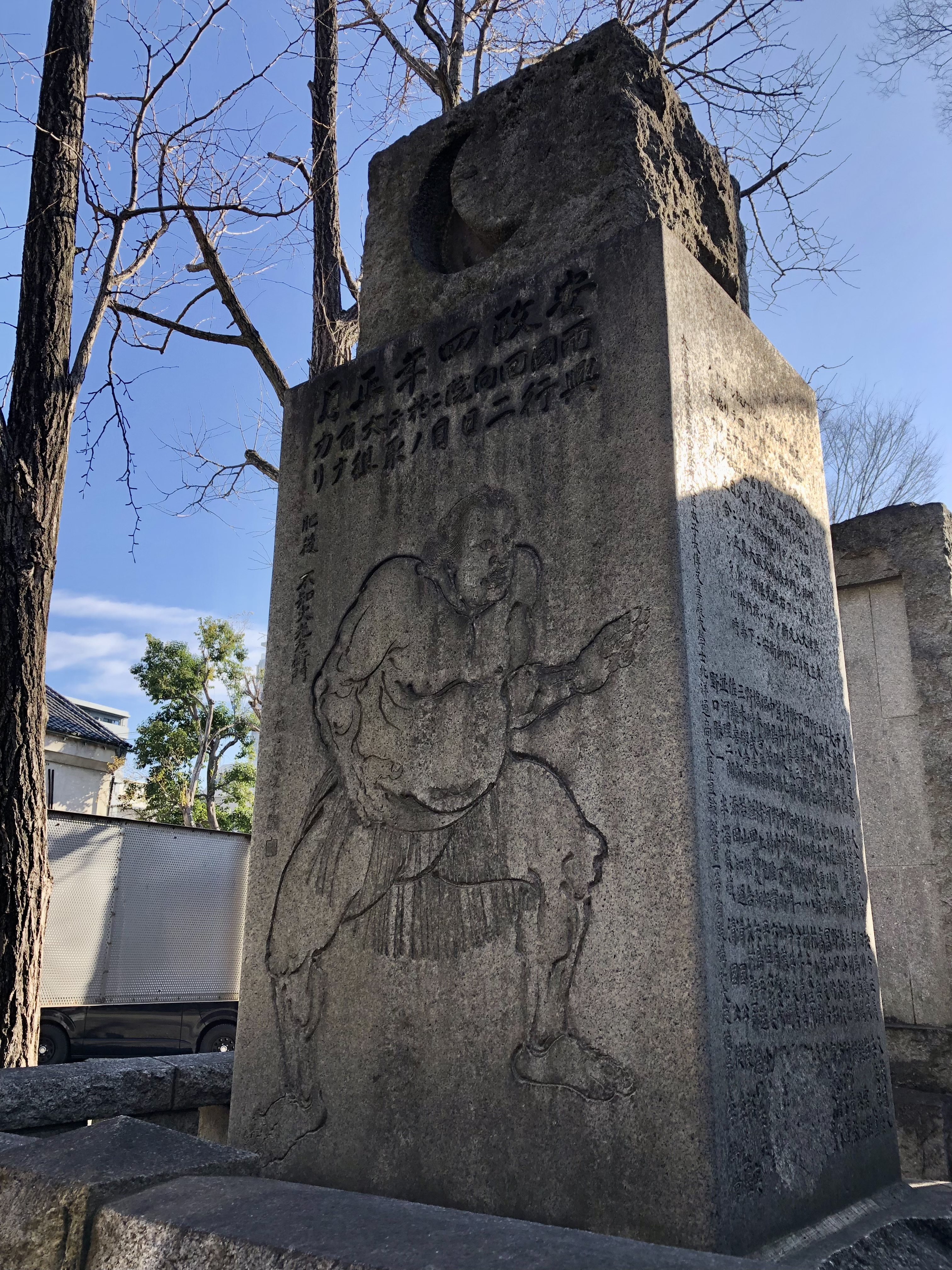
One of the two Yokozuna stones, Tomioka Hachiman Shrine.

Tomioka Hachiman is what we were looking for. 

The Tomioka Hachiman shrine was established in 1627. What is standing today is not the original shrine. I'm not sure how many times it has been rebuilt (Japanese temples and shrines have a history of being burned to the ground) but I do know that the building was destroyed during allied bombing during World War II and it was rebuilt for the last time (for now) after that. 

So about that sumo thing. Sumo was not invented at Tomioka Hachiman. The origin of sumo as a sport is so old that it cannot be reasonably traced back to a particular date or site. It may have evolved from Shinto rituals or superstitions but the actual facts have morphed to folklore or myth or legend or something less reliable. However, it does seem that there is some connection to Shintoism. In case the notion of a religious shrine decided to host a wrestling tournament sounded odd.

Another thing to note: Tomioka Hachiman was also not the first place where a formal sumo tournament was held. There is evidence of emperors hosting such tournaments at the royal court as far back as the 700s. But the notion of a regularly occurring event held multiple times a year (twice) every year was established at Tomioka Hachiman in 1684. Over time, other cities held similar tournaments and eventually all these events merged or morphed or whatever you want to call it into the current sumo grand tournament format: six tournaments held in the odd numbered months. Three of the six are held in Tokyo. The other three are held elsewhere in Japan. 

All of this began with a shogun-sanctioned tournament at Tomioka Hachiman in 1684. Cool stuff. I think it's awesome to find the spot where things that we have traveled a great distance in the past to see began.

The main shrine at Tomioka Hachiman.
Tomioka Hachiman is not vastly different than most other temples or shrines we have visited in Japan. There are two torii marking the entrances to the property and the threshold between sacred and secular space. There is a main shrine; a fountain; a couple of statues; vending machines here and there; and a small garden area or two for reflection. In fact, other than the scale and the massive crowd, it's not a whole lot different than what we experienced at Sensō-ji. 

Except for the peace and quiet that is. Whereas Sensō-ji was mobbed with pilgrims and tourists, Tomioka Hachiman was absolutely deserted. Sure, we went there first and likely got there at 8:30ish or so in the morning but if there were 10 people on site when we were there at any one time, I'd have been shocked. You get to feel the spirituality through the peace and silence and experience a little bit of what places like these mean to the country of Japan and its people.

In addition to the overall vibe, there was one thing we had to stop by and visit tucked away in the back of the property to the right side of the main shrine: the Yokozuna stone.

Tomioka Hachiman. The circle with the three symbols inside is everywhere. 
The Yokozuna stone is there to honor those sumo rikishi (basically a term equated with any professional sumo wrestler) who have achieved the highest rank in the sport. Elevation to this rank is not easy. Typically it takes a successful career and an achievement like winning two grand tournaments in a row, although there is no set criteria for being named a Yokozuna. In the history of sumo, only 73 rikishi have achieved this rank and only six have earned the distinction in the 21st century. It's not something that happens every year. We were fortunate to see one of those 73 when we attended our first (and to date only) sumo tournament in 2017.

The stone was placed at the shrine by Jinmaku Kyügorō, the 12th Yokozuna, in the year 1900. Since that time, the name of each subsequent Yokozuna has been added to the stone when each new member is added to the club. There's a special ceremony held at the shrine for each of these additions. Definitely worth a visit.

There's a reason why sumo is so special to us. One of the most notable (if not THE most notable) interactions we have ever had with a stranger while traveling happened in May of 2017 at our first tournament. At that tournament, we sat next to a younger man who was a huge sumo fan, and during a break in the tournament he left his seat, went to the souvenir stand and came back with a poster showing all the Yokozuna in history that he presented to us to as a souvenir of our visit. It was an amazing gesture and we now have that poster framed and hanging in our house.

Based on that interaction with someone we will likely never ever see again, sumo, sumo tournaments, Japan and the Yokozuna will always occupy a special place in our travel history. Visiting Tomioka Hachiman added another piece to that already remarkable history in our lives. The point for us to go to Tomioka Hachiman was really to lay eyes on that stone and remember that connection back to 2017.

Our goshuin-cho with newly acquired stamps from Tomioka Hachiman (right) and Sensō-ji (left).

A few last things about this layover. First, I wish these things could happen more often. There's not a lot you can do on a hours-long layover but there is a real opportunity to add a special unexpected memory to a trip. I know that happened here in Tokyo. It also made us long for Japan and book our next trip there.

Second, we did get two new goshuin added to our goshuin-cho that we picked up years ago at the Komitake Shrine on the slope of Mount Fuji. They are displayed above. Each time we do this, our temple and shrine visitation path diverges from all others that are similar. It is truly a unique memento tied directly to us as two people. This book is likely like no other in the world. I think that's cool. I also love the green ink on the Tomioka Hachiman seal. First time I've seen multiple colors. 

Third, we did eat two meals in our half day plus in Tokyo. And like our choice of breakfast spots, there was really no debate on where we were going for lunch. One of our last meals in 2017 in Japan was eaten at a spot called CoCo Curry House. I have no idea if this chain restaurant is like Denny's to the average Japanese citizen but we love this stuff and we couldn't set foot in Japan without dipping a spoon into a bowl of brown Japanese curry next to some rice on a plate. This is really like the most visually unappealing meal we have ever eaten (twice) but it's so, so good. Had to stop here. I expect that a trip to CoCo Curry will be on our 2025 Tokyo itinerary. 

Lastly, let's talk about the cover picture of this post. There are many enduring images and memories from our first trip to Japan seven years ago. One of those is (believe it or not...) vending machines. I'm serious. These things were everywhere in 2017 and so we were not surprised in any way to find a few at the Tomioka Hachiman shrine. One of the great joys about Japanese vending machines on our first visit was that most stocked beer. That's right, you could walk up to a vending machine, drop some yen in and come away with a cold birhu. 

Now, we didn't really expect to find beer in the vending machine at a Shinto shrine. But the surprise was that we didn't find beer in vending machines anywhere, not even in the hotel. That's because in late 2017, Japan banned beer in vending machines. Not because kids were buying them and drinking them (come on...it's Japan) but because local businesses were complaining about the loss of money due to vending machine beer sales. 

Things change. Japan is still awesome. This was a such a treat at the end of our epic Southeast Asia journey. Can't wait to go back here next spring.