Monday, November 13, 2023

The Acropolis


When we first started looking at a fall shoulder season trip for 2023, we centered our search pretty quickly on Croatia and Greece. I figured we'd pick one and save the other for some time later maybe five or six or more years from now. Hey, you can't always do everything you want with the limited amount of time off from work we get here in the United States so you have to make some tough choices in life sometimes.

But when we started digging into the itinerary a bit, it became apparent that we could probably do both in a nine-night trip if we just confined the Greek portion of our trip to the Athens area. I mean, if we can do Madrid, Barcelona and Marrakech in nine nights in 2014, it made sense to me that we could do Split, Dubrovnik and Athens in the same amount of time. So Croatia OR Greece became Croatia AND Athens.

I'll be honest here. The first thing I thought about when we settled on some time in Athens was that I was finally going to make it to the Acropolis. That was it. Nothing about the souvlaki and the baklava. Nothing about sailing on the Aegean Sea. Nothing about open-air movies. The Acropolis. First thought. Nothing else.

Dionysus (on the right) with a pitcher of wine. Acropolis Museum.

So, I get it. This is completely the thought of an architect (which I am). For as long as I can remember being taught anything about architecture, I've been told two things about Greek architecture. First, the Greeks were the civilization that pretty much invented architecture as a profession. Nobody before the Greeks really elevated and celebrated the architect as an individual like they did in Greece. Second, of all the buildings anywhere in the places that used to be called Greek, the most perfect manifestation of Greek architecture is the Parthenon, which is the main attraction on the Acropolis, the temples-on-a-hill complex right smack dab in the middle of the city of Athens. 

I HAD to go to the Acropolis. Finally.

So after splitting five nights in Croatia between Dubrovnik and Split, it was time to head to Athens. We landed at the airport at about noon on a Thursday afternoon. The very next morning at about 7:45, we were standing in lines (yes, lines) at the gate to the Acropolis waiting to get into what was for me the most obvious and essential thing to do in the city of Athens. Tell me I'm in the wrong here. You can't. Because I'm not.

Looking from the Acropolis back towards to propylaea. 

For me, everything about visiting Athens centered around Greek architecture. Sure, we did want some souvlaki and some baklava. And yes, we also wanted to get to an island off the coast of Athens. And we really did have seeing a movie in the open air on our list (we never got to that one...). But it was really all about the architecture. Love it or hate it, Greek architecture is pretty darned important to the history of building design since the time of the Greeks. 

The Greeks were for sure master builders and they spread their carefully considered and well-thought-out vocabulary of columns and capitals and pediments and triglyphs and metopes all over the Mediterranean as they spread their influence around the region. When their civilization declined, the Romans picked up what they had created and commandeered it for use in a prolific but sometimes clumsy way which spread the Greek architectural gospel even further. 

The collapse of the Roman Empire and the ensuing Dark Ages did no favors for the profession of architecture but what the Greeks had created popped up again during the Italian Renaissance, whose architects revived and re-interpreted what they learned from Greece and Rome. Eventually, those ideas would spread to places like London and the United States, where architects insisted on using what the Greeks had invented for just about everything, including most of the Federal buildings in Washington, DC to courthouses and banks and all manner of structures all over American small towns. This stuff lasted and there's a reason for that. Maybe the American version isn't always faithful to the original but it's out there.

So every so often, it helps to go back to the beginning. Not just with architecture necessarily but that's what I'm referring to here. And for the profession I chose as the means to making my way in this world, the Acropolis is effectively the beginning. So, since we were in Athens, we had to see how to do Greek architecture correctly.
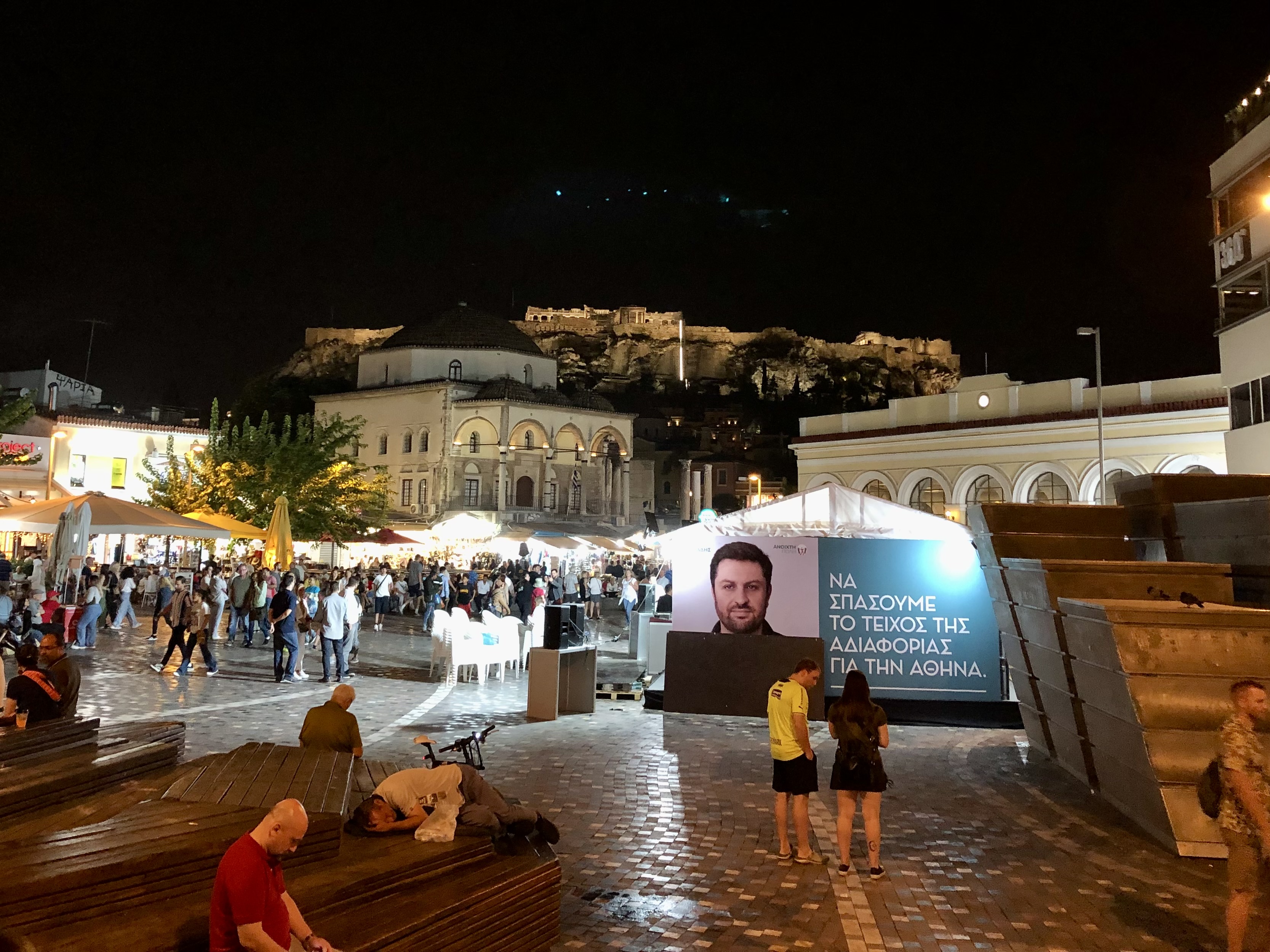
The Acropolis at night as seen from Monastiraki Square.

Before we arrived in Athens, we set ourselves up for as many looks at the Acropolis that we could think of. We found an open-air movie theatre (I know...we should have gone...) with a viewshed to the lighted acropolis at night. We booked dinner at a restaurant that promised framed views of the Acropolis. We even considered staying at one or two hotels with rooftop views to the Acropolis before we checked out the per night price and passed. In short, we conjured up every way we could think of to get a glimpse here and there.

Here's the thing about all of that: you can see the Acropolis from pretty much everywhere in the city center of Athens. The view is amazing and special but it's certainly not rare. Athens is pretty much a flat-ish bowl or plate of a city with one or two very prominent unobstructed hills, one of which is the Acropolis. Seeing it around corners and through gates and in alleyways or over ancient ruins is not an infrequent sight. That doesn't mean it's not special because it certainly is. It's just not rare, that's all. 

We cancelled the dinner reservation with the Acropolis view by the way and ate Souvlaki for less than $10 total for two including drinks. Greek food is cheap. But that's a story for another time.

The Odeon of Herodes Atticus.

I honestly expected big things out of the Acropolis and especially the Parthenon. I mean this place had to be special considering the advance press that I had been fed in like every history and architecture class that I've attended that dealt with ancient architecture. Despite all the anticipation, though, I really expected that I would find it a bit boring. I mean we are talking about a gabled roofed building surrounded by the exact same columns over and over again with just two rooms under the roof. How good could this really be? It's not like we are dealing with anything complicated from a spatial point of view or anything. When it comes right down to it, I'm just not a classical architecture guy.

I shouldn't have doubted. And I'm shocked to be writing that despite how I opened the last paragraph. Maybe that was obvious from the way I finished the last paragraph. The whole Acropolis and especially the Parthenon were just an awesome couple of hours experience. You can't enter the buildings in any way. All you can do is look at the outside. They aren't even all there and all the ornamentation and color is gone. And it was just awesome anyway.

At its simplest level, there's not much to the Acropolis. There's a gate at one end (the propylaea) which you pass through on your ascent up the last part of the hill and when you pass through there are two temples facing you: the Erechtheion on the left and the Parthenon on the right. You are looking at the front corner of the Parthenon and the side wall of the Erechtheion. The side wall in view is the one with the famous caryatids, the six columns carved like women holding up the roof above the porch off the side of the temple. 

After all this time. After learning about this place more than 35 years ago for the first time, that's it. That's all there is. It wasn't always that way but that's how it stands today. There's nothing else up there once you pass through the propylaea other than a small, raised podium at the opposite end of the hill which has some awesome views looking back across the Acropolis. 

And I guess to Athens. I don't know about that last part. I was there to see the Acropolis, not Athens. Didn't even look.

The east side of the Parthenon. Built 447 to 432 B.C.

Before we set off for Athens, I made a list of everything I wanted to really check out at the Acropolis. I figured I'd focus in advance. That list was pretty short. It included the Parthenon, the Erechtheion and the Temple of Athena Nike. Little did I know that my list included everything on the top of the hill except for the propylaea. And that was OK, really. Picking those three was enough to focus on. There's plenty of other stuff to check out on the south slope of the Acropolis and there are lots of bit and pieces of other former structures at the top of the hill of you want to be more of a completist. I am sure you could spend days there looking at every piece of stone or partially complete temple or theater. Focusing on what I saw as the three signature buildings is enough for a first time visit, I feel.

It took a little bit of time to find Athena Nike by the way. She's actually located on a pedestal in front of the propylaea. I saw it before we climbed the last part of the hill and didn't even realize what I was looking at. But we found her once we circled the Parthenon and before we took a closer look at the west side of the Erechtheion.

The Temple of Athena Nike. Built 449 to 420 B.C.

Of the three temples I had on my list, I really had them ranked before we set foot in Greece as follows: (1) Athena Nike, (2) the Erechtheion and (3) the Parthenon. Construction was started on all three of these buildings within a 30-year span in the fifth century B.C. One (the Parthenon) was built using the Doric order, one of the three signature orders of Greek architecture. The other two used the Ionic order. When it comes to orders, I'm an Ionic guy all the way. The Doric is too plain for me and Ionic is overall just more elegant and lighter. 

And yes, just to be clear, on the basis of orders alone, I put the Parthenon, the thing that is supposed to be the most perfect Greek temple ever, in last place. Sometimes I'm not that smart, although ultimately any evaluation of "best" ends up being pretty subjective. The Parthenon, however, was the most impressive.

In my defense here, the Temple of Athena Nike is a little jewel box of a building. It's a tiny little one-roomed temple perched on a huge pedestal with four Ionic columns on the east and west faces. The pediment on the east side is about two thirds intact with some of the original frieze intact (or restored, I guess). But you can't get very close to it. As a building to visit, you have to admire from afar. There's no other option really.
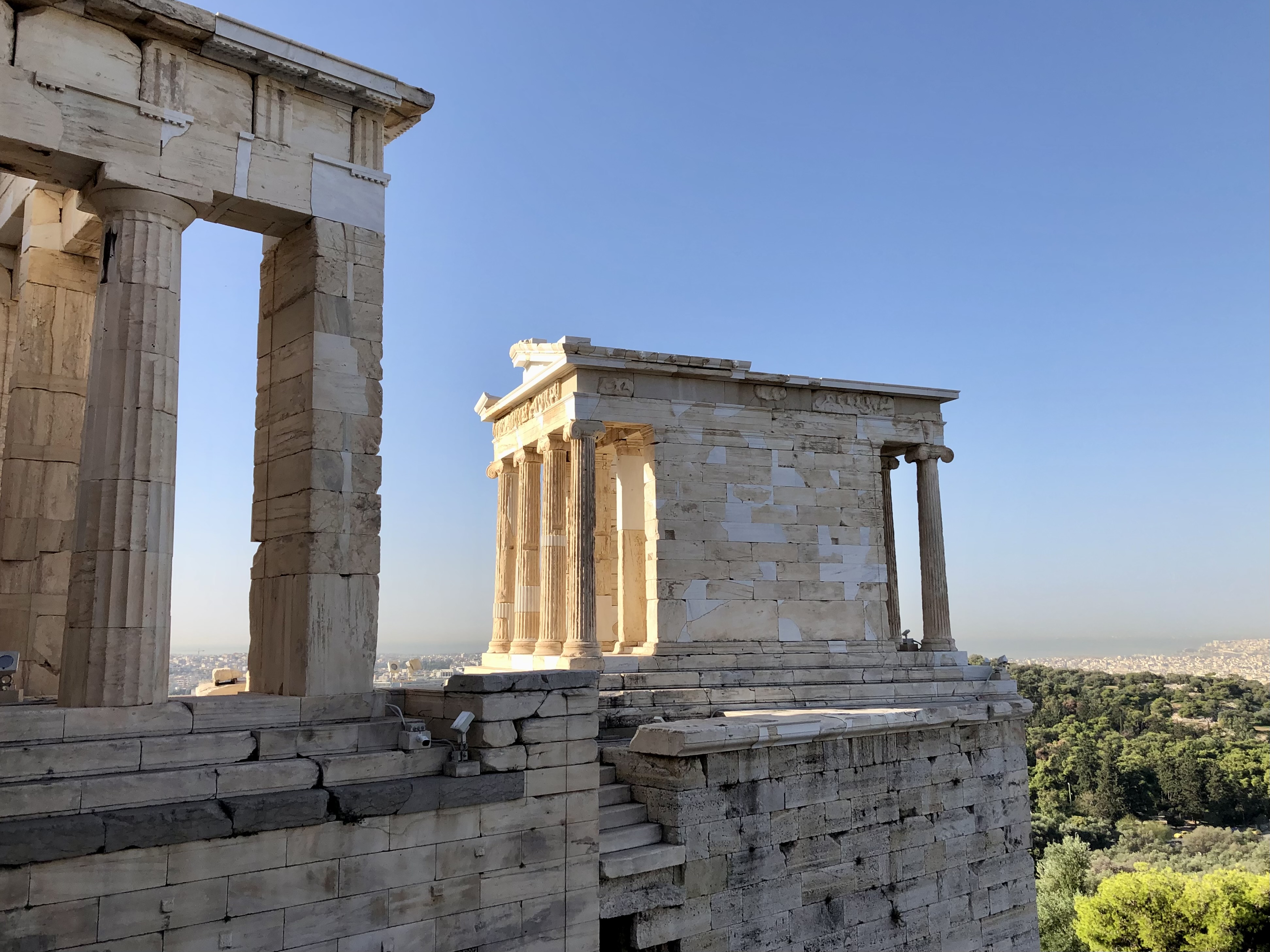

Temple of Athena Nike (top). The Erechtheion; built 421 to 406 B.C. (bottom).

The Erechtheion is quite a bit more complicated. The reason it was on my list ahead of the Parthenon was because of the side porch of the temple with with roof supported by the six caryatids. They are spectacular, even though you cannot get really close to see them at all. This is a theme at the Acropolis by the way: lots of awesome stuff to see but cannot get really close to see it. 

If you get up the Acropolis and feel upset at all about not being able to get close to the caryatids, don't worry too much because they are not the originals. Most of the originals, including just pieces of one of the six which was destroyed by a stray Ottoman cannonball, are in the Acropolis Museum at the bottom of the south slope of the hill.

The Erechtheion is supposedly built on the spot where Athena and Poseidon battled to be the god of choice for the city of Athens. As a quick recap of that contest, both gods produced gifts to the citizens (I assume it wasn't called Athens then since Athens was named after Athena...) for their consideration. Poseidon produced salt water from a spring at a spot struck by his trident; Athena went with an olive tree. Clearly, Athena won.

Architecturally, the Erechtheion is the most complicated and confusing of the four buildings on the Acropolis (I'm counting the propylaea as a building here). Its main entrance is from the east via a six-columned front facade but it also has a couple of porches on the north and south and really the one on the north is like an annex with a separate portico and wholly different floor level. The star of the whole building is the porch with the caryatids to the south although it's not a porch in the sense we think of porches probably. There's no spatial connection to the main building; it's really just preserving space above the tomb of Kekrops, who was a mythical king of Athens.

I'm not completely positive how a tomb of a mythical king works. I assume it's just cermonial? I mean if there was a body, he wouldn't be mythical. Does that sound right? Kekrops, by the way, is one of two mythical kings of Athens whose tomb is at the Erechtheion. The other is Erechtheus.


Front (top) and porch (bottom) of the Erechtheion.

So then there's the Parthenon.

How is a building this simple actually this good? It's a rectangle in plan with just two rooms inside. There are eight Doric (read: very plain) columns on the short sides of the rectangle and seventeen on the long sides. Part of the south side of the building is collapsed (a result of Christian bombardment when the building had been converted to a mosque by the Ottomans) and most all of the sculpture that adorned the outside of the building (including within the pediments) is long gone (most of it's in London, of all places). Of the two rooms, one used to hold an enormous ivory and gold statue of Athena but that's long since been cannibalized for other purposes so that doesn't add to the luster of the building at all.

Maybe I'd been brainwashed by my education. I looked for the entasis on the columns (essentially meaning the columns "bulge") that makes them look like they are bearing weight. I looked for the entablature above the columns not being purely horizontal. I looked at the spacing between columns. I looked for the columns leaning slightly inward. And I'll confess, that almost all of these were impossible to see but I "knew" they were there.

I will say for the record that I am rarely impressed with architecture (and maybe I should have capitalized that) that is this old and (no judgement here) this primitive. But the Parthenon is truly impressive. Yes, it's simple. Yes, I looked for and believed everything I had been told that makes this building so remarkable. But there is also a very pleasing proportionality to admire and the details made all the difference. They are sophisticated. This is clearly not the first time a Doric temple has been built. I think the relationship between the column capitals and the entablature and the reduction in spacing at the end columns were really important to me.

Maybe it was the details. Maybe it was Athens. Maybe it was the anticipation. Maybe it was the sun. Maybe it was finally getting there. Maybe it was all of it.


Sunny side of the Parthenon in the morning, including a look at the columns and entablature.

The siting of these temples on the top of the Acropolis, by the way, is phenomenal. If there is one takeaway I took away from Greece, it was that that Greeks really know how to place a building on a site to gain the maximum impact on the visitor. 

When you are walking up to the propylaea, you can't see any hint of what is beyond really. If you are sharper than me, you'll notice the Temple of Athena Nike for what it is but really you can't see anything else. Once you emerge through the gate that is the propylaea, you are faced with the Parthenon on the right in perfect perspective. You can see the front facade and also gauge the entire size of the building by also being able to see its broad side. This kind of denial of view following up by revealing of objects or spaces has been a key element of architectural design for centuries.

At the height of its glory, you would have seen before you a giant status of Athena just ahead of you and maybe bit to the left. But beyond that on the left would have been the Erechtheion showing you it's most gorgeous feature (the caryatids) but not showing you its front face. To get to that, you'd have to be drawn into the plaza between the two buildings, taking in the full length of the Parthenon as you walked before you could circle around to the front of the smaller temple. I know there are just two things up there after the propylaea and how difficult is it really to put two things on a flat hilltop but these two really are sited perfectly.

I don't get this impression just from the Acropolis. We visited at least two more ancient Greek temple sites where the views of the main attractions were concealed, teased and revealed in epic fashion. And yes, that means there are two more blog posts about temples in Greece coming.


First view of the Parthenon (top) and sacred olive tree outside the Erechtheion (bottom).

If I can offer a pro tip from a one-time visitor to the Acropolis (is that even possible? a should it be an amateur tip?), it's get there early and beat the crowds. When we visited, they appeared to be testing out a timed entry policy that appeared to be either loosely enforced or not enforced at all to reduce crowding but there are for sure crowds. We got there at opening time and stood in line for about 15 minutes for tickets and then maybe 2 or 3 additional minutes to get our tickets scanned. 

The first place you come to after you pass through the property gates is the Odeon of Herodes Atticus, an open-air theater of what used to be an indoor theater donated to the city by Herodes Atticus, an early benefactor of the arts in Athens. My advice is to skip this upon entry and hit it on the way out. Get to the Parthenon and the Erechtheion before the hordes get there. Maybe you'll get lucky and get a sense of the place (and some pics) without a mass of people milling around.

Our route at the Acropolis took us through the main gate; up through the propylaea to the top of the hill; back through the propylaea; past the Odeon of Herodes Atticus; and down the south slope past four or five additional structures in various states of standing. At the bottom of the hill is the Acropolis Museum.


Floods of tourists (top) and the Theater of Dionysus with the Acropolis Museum (bottom).

If we could have spent days checking out everything on the top and sides of the hill that is the Acropolis, I am convinced you could spend an equal amount of time studying every object and watching every video simulation inside the Acropolis Museum. The amount of material in that place is daunting. I am sure all of it has value on some level. We couldn't handle it all so we focused (again) on material related to the three temples we targeted on the actual Acropolis along with any information that explained the development and evolution of the site. 

And maybe one or two other pieces that caught our eyes along the way. I love the sculptured panel of Dionysus that I've included as the second picture of this post. I don't know how exactly it fits into the Acropolis because I don't remember the caption next to the exhibit but I think it's really well done. I am sure its condition and the giant (and i do mean GIANT) cup of wine that Dionysus is holding in his right hand helps my appreciation of this piece.

One of the most valuable displays inside the Museum is a series of models representing the buildings on top of the hill at a few different points in time. The Parthenon we see today is not the original Parthenon. That building was destroyed by the Persians in 480 B.C. The new Parthenon was also co-opted by both the Ottomans as a mosque and by later Christians as a church. All these permutations are represented in a series of models which show the site in different conditions over time. 

These models, combined with the video presentation on the upper floor of the Museum which shows the construction and adaptive re-use of the Parthenon over time really paint a pretty complete picture of what was going on atop the hill for the last 3,000 plus years. Adaptive re-use here means everything from the construction to the destruction of "pagan" sculpture by Christians to destruction of the south side of the building by cannon-fire (also by the Christians) to looting of the sculpture by Britain's Lord Elgin (which is how most of the Parthenon's original art is in London). I guess Elgin was a Christian too. Those Christians...

Model of the Acropolis, 5th century B.C. Notice the giant statue of Athena.

As far as the actual pieces of stone inside the Museum, the stars are clearly the original caryatids. These alone are worth the price of admission to get this close to pieces of sculpture this important to the site. And you can get to within inches of them and they are not behind glass or anything. We for sure spent more time looking at these five ladies than anything else in the Museum. I got disappointment when I saw how far from the Erechetheion's porch we have to stand on top of the Acropolis. That was easily overcome when we found them in the Museum.

And yes...five. Not six. The sixth was swiped by Lord Elgin when he stole all the Parthenon's sculpture from the site and it sits in the British Museum along with the rest of the loot he made off with.


The five (not six) caryatids in the Acropolis Museum.

I don't know how many pieces of sculpture we skipped in the Acropolis Museum. There was just too much to take in. I will say that some of the pieces still have some of the original paint on them and (as faded as it is today) that was extremely gratifying to see. It's awesome to see paint that's survived 2,500 years on a piece of stone when the stone has not been treated with care for a lot of that time.

I don't know what else to say about this museum other than I'm glad we went to the Museum after we visited the site. I found it easy to make connections to what we'd just seen. I doubt I would have made the same connections in the opposite order. I especially appreciated the sculpture (some of it replicas) from the Parthenon being in the same orientation in the Museum as it is on the actual site, particularly because you can see the actual Parthenon when you are looking at some pieces of the sculpture.

Sculpture from the Parthenon in the Acropolis Museum with the actual Parthenon visible through the windows.

One of the things I love most about travel is that it gets you to places that you have longed to go to that you have learned about without actually ever having been there. Setting foot in foreign (or domestic) lands to make your own judgements about places is thrilling to me. It can be perspective-changing or it can validate what you already thought you knew. Usually, there's a little of both but it's rarely exactly what you thought before you actually arrive there. It's not virtual reality. It's real life. Being there matters.

We didn't spend much time at all in Athens but I'm convinced we were right to devote a good portion of our time there to what is unquestionably the number one tourist attraction in the city. When you are standing in the city of Athens looking up at the Acropolis, it seems like a long way up. It's not too bad, but you do have to walk up there yourself. There's no funicular or elevator. Take it slowly if you have to and it's cooler in the morning. That Athens sun can get hot.

Also, it's not pronounced Acropolis in Greece. The word is feminine and the "s" isn't pronouced. It's Acropoli. Do with that what you will.

Southeast corner of the Parthenon. Not sure how Elgin missed plundering this part.

Monday, November 6, 2023

Power Is Power

I'll start this post with what may seem like a stupid statement: I'm not sure we end up in Croatia in 2023 without having watched HBO's series Game of Thrones.

It sounds stupid, right? Croatia is this picturesque, coastal country right on the Adriatic Sea with the most gorgeous crystal-clear blue-green waters and spectacular historic cities and we are there because we watched some television show. The food is incredible. The people are amazing. The weather is idyllic. The cost of living (or tourist life, I guess) is super affordable and we are there because of some fantasy show that broadcast altogether too few episodes over too long a period of time. 

It's true!

There are a lot of motivators behind our choice of travel destinations. Family. History. Culture. Food. Wildlife. Architecture. Spirituality. Connections with different types of people. Epic walks. The outdoors. I could go on and on and on. For Croatia, it was Game of Thrones. At least that's where it started.

Stupid. You can go ahead and think it. Or say it even.

Dubrovnik's Fort Lovrijenac.

Now to be fair here, 30 years ago Croatia was at war over its secession from the Socialist Federal Republic of Yugoslavia and nobody wants to go to a country either at war or recovering from a war and sometimes these thoughts stick. But 30 years ago is a long, long time and recovery and stability can occur within a span of time way shorter than that pretty quickly. Croatia was poised for success as a tourist magnet along the shores of the Adriatic Sea. Its coastline is no different than those of Greece and Italy and France and Spain. It just needed to separate from the rest of Yugoslavia to realize its full potential. Unfortunately, that took a war and an eventual recovery. 

Ultimately, it took Game of Thrones to turn our attention to Croatia. Good thing we watched Game of Thrones. Croatia was a revelation. 

I do think it's peculiar, by the way, that we visited not one, but two (Rwanda - which I did not blog about), countries this year that were involved in some sort of civil war or conflict with allegations of genocide in the 1990s. It's scary how quickly things can change. In the case of Croatia and Rwanda, things are much, much better than they were 30 years ago. But there are other places where the opposite is true.

View from Klis Fortress looking back down towards Split.

When we first started looking seriously at Croatia as a destination, we focused on the historic city of Dubrovnik, which was adapted in Game of Thrones into King's Landing, the capital city of Westeros. Our intent was to stop the Game of Thrones stuff there, quickly seek out some sights in and around Dubrovnik where some scenes were filmed and then enjoy the rest of Dubrovnik for what it is today: a city filled with history and culture and character. 

It became apparent pretty quickly that Dubrovnik wasn't going to keep us busy for more than a half a week. That would mean we'd need to find someplace else in Croatia to keep us occupied, either as a day trip or as a separate overnight stay. Eventually, we found Split, a city a couple of hundred kilometers up Croatia's coast which was founded with the construction of the retirement palace for the Roman Emperor Diocletian. And lo and behold, scenes in Game of Thrones were filmed in Split, too.

Split. Dubrovnik. It had to be Game of Thrones tour time. HAD to be! And yes, we took two GoT tours on this trip, one in Dubrovnik and one in Split. Never accuse us of doing anything halfway. See Vienna if you doubt me.

Dubrovnik at night, looking north from the steps outside St. Ignatius' Church.

So we've been here before. Northern Ireland. 2019. Call it our first Game of Thrones pilgrimage (I think Croatia will likely be our last...). We spent a day with one of the extras in the show tracking down random locations where the series was filmed that we never would have thought of going on our own. We committed to the mission. We wore cloaks. We answered trivia questions. We brandished swords. It was an awesome fun day out. 

That was not our Croatia experience. It wasn't better. It wasn't worse. It was just different. No cloaks. No swords. No random locations. In Northern Ireland, we went where we were taken. In Croatia, we used our GoT tours to get to some places we wanted to go which would have been difficult to get to on our own. Yes, we wanted to see spots where dragons breathed fire or where slave masters were killed or where plots were hatched, but we also wanted to get out of town in Split and Dubrovnik. Our Game of Thrones tours both did that for us.

When we started planning our Croatia jaunt, we found hotels right in the heart of (or just outside) the historic city centers of both places. In Split, that would put us right in the middle of what used to be Diocletian's Palace. In Dubrovnik, we'd be a five minute walk to the Pile Gate at the west side of the city. Couldn't get any better locations. We'd get a ride from the airport (in Split) or the ferry terminal (in Dubrovnik) and be close to most everything we wanted to see. No fuss, no how-do-we-get-to-the-city, no car, just a walk away.

And yes...MOST everything. We had a couple of other spots on our list in the Klis Fortress (outside Split) and the Trsteno Arboretum (outside Dubrovnik) that we wouldn't be able to get to unless we got a taxi and had the driver wait or we spent a lot of time on buses to more buses and then waiting for return buses. Lucky for us, Klis Fortress became the city of Meereen in GoT and the Trsteno Arboretum was the gardens of the palace at Kings Landing in the series. Let's just knock these both out by booking a GoT in each spot and there will be no public transportation logistics to coordinate and we'd get to see where some of our favorite scenes in the series were shot.

So that's what we did.

Our GoT guide in Split, Luka, showing us where the dragons were kept in Mereen.

For me on these two tours, the best places inside the cities that we visited were Fort Lovrijenac, the 11th century fort that sits just west of the city of Dubrovnik, and the substructures of Diocletian's Palace (which later became Split), built to both support the private quarters above for the former emperor and to keep food preserved as long as possible in a relatively cool environment. 

Fort Lovrijenac was built specifically to defend Dubrovnik from attacks either by land or sea from the west of the city. Walking around the Fort today, it is completely believable that in the event of an attack, you'd be safer in that place than anywhere else in the vicinity. It's is an absolute giant of a compound that seems impenetrable from all sides and is accessible from a single point that is easily defended. This place, combined with the thick wall that snakes all around the city itself, were the keystones to the defense of Dubrovnik. It does not take long to explore Fort Lovrijenac. You can definitely get the sense of what happened there pretty quickly. But the walk itself down to the place and back to the city is definitely worth the effort as well. We for sure got the best views of the entirety of Dubrovnik from the Fort.

In Split, the substructures of Diocletian's Palace were the only piece of the place we did not explore on our own (meaning without a GoT tour) but we could have. The underground spaces are so atmospheric. They have an authenticity about them that can only really come from places that are actually authentic. The feeling we got when we walked through the Iron Gate at the south wall of Split when we got to the city just kept happening again and again and again in the substructures. They are a fantastic achievement of engineering to be still standing as constructed a full 1,700 years plus after they were first constructed. 


Our Dubrovnik GoT guide, Daniela, showing us around the Red Keep.

So, of course, since we are on a Game of Thrones tour in both places, we are following a guide (Luka in Split; Daniela in Dubrovnik) holding a notebook with stills from the series to show us what the places looked like on television vs. how we see them today. I know...it's corny and a little stupid but there is something genuinely exciting about being somewhere that such an iconic television experience was created.

So...here goes some of the nerdy stuff.

The substructures of Diocletian's Palace were used to represent the dungeons or cellars (not sure which) of the city of Meereen, a city with three giant pyramids (added by CGI) with an economy built on and driven by slavery that was conquered by Daenerys Targaryen who subsequently freed the slaves held by the rich masters. Two of Daenerys' three dragons, after a couple of shall we say...unfortunate incidents with the third dragon, were confined to the cellars of the city. Or in real life, the substructures of Diocletian's Palace. And sure enough, we were clearly right there where Tyrion Lannister freed the two dragons from their restraints in Season 6, Episode 2. Obviously without the actual dragons, since you know...they don't exist.

According to Luka, they filmed more than 200 scenes in the substructures but used very few. I believe it. There's not a whole lot of footage of this place necessary.

Fort Lovrijenac was primarily used to represent the Red Keep in Kings Landing, the ultimate defensive inner sanctuary for the royal family, but there were so many more scenes filmed there. One of my favorite scenes in the whole series is the "power is power" conversation between Petyr Baelish (a whorehouse owner who somehow has enough clout to be on the King's Small Council) and Queen Cersei Lannister (Season 2, Episode 1 if you must know). And sure enough, with a doubt, that conversation was had in the courtyard of Fort Lovrijenac, with any sort of Catholic iconography or baptismal fonts erased from reality. I'm not going to go so far as to claim that this is goosebumps type stuff (I'm not that into this) but I'll just say pretty cool to have been there.

In the streets of Mereen where the slave masters were killed. Uh...I mean...Split. Of course.

There are a whole lot of other spots in both Split and Dubrovnik where you can discover the actual places where Game of Thrones was filmed, from the alleys in Split where some of the slave masters were killed; to the dock outside of Dubrovnik where character after character after character set sail for wherever; to Cersei Lannister's walk of shame through the city of Kings Landing. This last one is probably the most famous and celebrated scene in the series for people to check out in Dubrovnik.

Two things about this last one. First, the producers of the series wanted to have this scene filmed at the side door of the Cathedral of the Assumption of the Virgin Mary but the local leaders of the Catholic church wouldn't allow a scene with a naked woman to be filmed on their doorstep so they moved the location to the steps outside the Church of St. Ignatius. Second, there are a bar and restaurant at the bottom of the first set of steps where you can get all sorts of shame-themed dishes and drinks. We didn't try them so no endorsement coming on that one.

This series, by the way, seriously disrupted life (and tourism) in these two cities. Fort Lovrijenac was closed for an entire month during on sequence of filming and the entire city of Split inside Diocletian's Palace was closed while the series was being filmed there. Can you imagine showing up on vacation to either of these places and finding significant portions of both cities off limits? 

If you are wondering about loss of income for merchants and restaurants and hotels, apparently HBO covered their expected revenue and more. 


Shame burger or cocktail, anyone (top)? Checking out where Bron trained Jaime to fight left-handed (bottom).

But these GoT tours weren't about seeing stuff we could have walked to from our hotels, right? Let's talk Trsteno Arboretum and Klis Fortress.

For me, Trsteno Arboretum was a bit disappointing. Maybe it was because it was at the end of a long-ish tour or maybe it was because we were focused on the place as a setting for Game of Thrones, but I didn't get a whole lot out of this visit. The drive up the coast is gorgeous but ultimately, it's a garden without a whole lot to discover from my perspective. The plaza along the coast where Bron trained Jaime Lannister to fight left-handed (after his right hand was dispatched with a big knife) was the highlight for me.

But Klis Fortress was awesome.


Occupation of the piece of land where the current Klis Fortress stands dates back to before the time of Christ but construction of something resembling what we might see as a stone fort today dates from the ninth century. The current manifestation of the Fortress was built in the 18th century when that part of Croatia was under Venetian rule. The location of the Fortress is about as spectacular as you can get: it sits on an absolute sliver of a piece of rock high above the neighboring land. The walls behind walls of the Fortress are perched along a knife edge thin length of solid rock with sides of cliffs below the walls that are almost sheer vertical. 

It sits immediately above the town of Klis and has served as a refuge for the population of the town and Croatian rulers in that part of the country for centuries. It seems impenetrable but it has, at a few points in its history, been taken by an enemy, most notably by the Ottoman Empire in the year 1537 (it took the Croatians 111 years to re-take it from the Ottomans in what I assume was not a continuous effort).

I can't imagine how hopeless attacking this Fortress would have been. It's difficult work walking uphill in shorts, a t-shirt and my Skechers. I can't imagine assaulting the place in metal armor with a helmet and heavy weapons while the defenders repel you from above. The layers of defense are obvious and I am sure daunting to an attacking force. Get past the first walls and the defenders of the Fortress would just move back behind the second wall. Then past the third once that layer had been conquered.

There's not a whole lot of context to what you are walking past when you get to the Fortress itself so I was happy to have Luka with us to tell us about the history of the place and guide us all the way to the top of the hill while stopping here and there to tell us some Game of Thrones anecdotes. The top is definitely the highlight. There's a small church (shown below) up there that was a converted mosque built by the Ottomans upon the ruins of the original church that they destroyed when they conquered Klis in 1537.


Of all the places we traveled to see filming locations on our two GoT tours, I understood why they traveled all the way to Klis the least. It seems like such an effort to get a cast and crew and extras up to this place to film pieces of scenes using bits and pieces of this Fortress. Sure, it's an incredible location but the stills that Luka showed us made me wonder if they really couldn't have done these scenes in a studio somewhere. I mean, Meereen looks really nothing like Klis. Meereen is a gigantic place and Klis is decidedly not gigantic. It's actually pretty tiny. I can't imagine housing an army in that place for any length of time. 

Although I guess if faced with a choice of being somewhere altogether too small for comfort and being indiscriminately slaughtered by an invading army, I'm headed to Klis at the first opportunity.

We got about an hour at Klis Fortress. I'm sure it was not enough to get into everything there was to see at the place but I think we saw enough. We walked through the whole entrance sequence, visited the small museum of an armory on the property and visited the cell where prisoners were held (I can't imagine how cold that stone cell on top of that cliff was at night...) in addition to seeing the super spartan church at the top of the Fortress. We also got one surprise in the parking lot, an exposed vertical face of textured rock that seemed to go on and on for a while and served as graphic inspiration for the wall at the north of the north in Game of Thrones.


Standing where HBO actors stood (top) and the inspiration for a certain wall (bottom), Klis Fortress.

I don't know how exactly we would have made it out to Klis without signing up for a Game of Thrones tour. My hunch is we would have deemed it either too much trouble or too expensive to worry about and would have found something else to do in Split. And that would have been too bad, I think. I consider Klis an essential part of our Croatia memories and we wouldn't have done this in all likelihood without of GoT tour. It's a pretty amazing site even if it doesn't take a whole lot of time to walk the entire place. They apparently have evening dramatic performances up there in the summer. There's a small stage with about maybe 50 or 60 seats set up. I bet the view at night is spectacular.

Before I close blogging about Game of Thrones (probably forever...) there are a couple of other spots in and around Split or Dubrovnik to get your fantasy fix. 

There's a small Game of Thrones museum in Split which is all of four rooms big and is probably not worth the €14.50 we paid for admission. It's mostly filled with props (some of which, like an authentic shutter used to cover modern windows, are very underwhelming) and dioramas and costumes and maybe one or two Funko Pops. Enter at your own risk. We're not sorry we went but I also feel we could have skipped easily.

There's also a Game of Thrones exhibit on the island of Lokrum off the coast of Dubrovnik. The place was used as the setting for the city of Qarth and it's about a 10 or 15 minute boat ride from the old Dubrovnik harbor on the east side of the city. Lokrum is worth the trip regardless of any sort of GoT attraction. There are hiking trails and insane amount of peacocks over there. There's also a replica of the Iron Throne. And who can resist getting a picture taken when faced with a replica of that thing.

That's enough Game of Thrones stuff for this trip. Valar Morghulis. 

Thanks to Elite Travel for getting us to all these places.

Saturday, October 28, 2023

Perimeter Walk

There was a time in this world when all cities that had any means to defend themselves had walls. I don't mean like a token wall to define the boundary of the city proper or to distinguish the center of the city from the suburbs. I mean like a heavy duty, keep the bad guys out, tall and thick wall with battlements and large weapons. I mean like something fortified, scaling-and-assault resistant that was maybe behind a moat with large, big drawbridges at one or two gates which men with weapons guarded 24 hours a day to repel any sort of invaders or attackers. A city wall. Something formidable.

In most places today, those walls are gone, if they were even there in the first place. They are gone because quite simply there's just no need for them in today's world. Cities are no longer sieged by armies outfitted in chain mail with pikes and spears and swords and I guess in most places they were just in the way (the walls, not the pikes etc.). Maybe you can visit an historic city here and there that has fragments of the old city wall or in some other places it may be mostly intact. We found bits and pieces of the old wall in the city center of Barcelona in 2014 and we walked through centuries old gates in Marrakech just days before we traced the old Roman wall in Barcino. But most places? Completely gone. Disappeared. No chance.

"Most places" doesn't include the city of Dubrovnik at the south end of Croatia's Dalmatian coast. Dubrovnik is a museum piece of a city, a pre-medieval town that's evolved through the centuries into a densely packed stone town centered around a couple of broad thoroughfares and some important civic buildings. Its character has been affected by every empire it's been claimed by, from the Byzantines to the Venetians to the Ottomans to Napoleon's France. At one time in history it housed 6,000 citizens but today that number is about 1,000, if you don't count the hordes of tourists that pack the city daily and leave after they have seen what they came to see. 

That last category, of course, included us this year, although I like to think there's a difference between us and the packs that pile off buses from cruise ships docked just outside the city. Maybe I'm being a snob.

Dubrovnik is a manageable city for a visitor. I think you could probably walk most every street in a day if you tried, from the main stone streets worn smooth by millions of feet and sandals and shoes and flip flops over centuries of use to the tiniest alleyways with glimpses into restaurants and stores and people's lives. You'd certainly get a great workout if you do. Dubrovnik is hilly, with massive steps taking you from the main squares to the city's edge. There is so much history and food and architecture to find and discover, from the city's most important buildings to the tiny bars clinging to the shores of the rock that the city is built upon.

Oh...and they have a pretty amazing city wall. It's completely intact and it's all walkable. And it's spectacular.


The start of our wall walk. Tower of the Dominican Monastery and the Cathedral dome in the bottom pic.

We knew before we visited Dubrovnik that we'd find ourselves a city with a remarkable wall surrounding it. Even so, when the city first came into view from the back seat of our cab that was taking us from the city's ferry terminal to our hotel just outside the Pile Gate, I was astonished. It was honestly, and I know this is terrible to say (or write), like the real-life manifestation of the Las Vegas Excalibur Hotel. That was the first thought that popped into my head and I know I'm a better tourist than that but that's all I could think of immediately. It was the grossly oversized turrets and walls that went straight up capped by a crenellated wall top, I think. The cartoonish rendering of a castle on the Las Vegas strip I guess is based on reality.

Dubrovnik, of course, is way better than any hotel on the Las Vegas strip. It's real. There's history there. And there is a lot to see and study. The only thing that's better than walking in the city itself is walking around the city from the top of its most impressive wall. Towards the end of our second day in town, we climbed the steps at one of the entrances to the wall walk at the east side of the city and started walking. Counterclockwise. One-way ticket. You can't go the other way.

I'm not putting down Vegas, by the way. I love Vegas and the whole Vegas strip is every bit as good as Dubrovnik but in a totally different way. But one hotel vs. Dubrovnik...Dubrovnik wins!

I've already mentioned Dubrovnik is on a hill, right? So, of course, there's a workout aspect to the walls of Dubrovnik. Two kilometers or 1.2 miles. And obviously it ain't all flat. Wear some comfy shoes that you feel good climbing stairs in. You'll need them.

Headed towards the Minčeta Tower.

There are three access points to the wall in Dubrovnik: one just inside the Pile Gate (pronounced pee-lay, by the way, not pile) at the west of city; one near the Ploče Gate at the east side of the city; and a third just a bit south of the Ploče Gate near the old harbor. We picked the one near the Ploče Gate because we'd been told (if I'm remembering correctly) that it started you out on the upward slope (thus getting the hard part out of the way first) and that we would see the best parts of the wall first.

I guess the logic behind the best parts of the wall being counterclockwise from the Ploče Gate entrance was that you would reach the iconic Minčeta Tower at the northwest corner of the city quickest from that entrance. There is no doubt that as far as parts of the wall go, that stout circular corner tower is by far the star of the show. It looks like the most impenetrable part of the wall and it's more of an identifiable object in the round than any other place on the wall. It's also the highest point in the city and has the most sweeping views. And yes, you can actually climb to the top of that tower from the wall. There's no doubt it's impressive.

But best part of the walk? I don't know about that. After having circumnavigated the city just once, I have a few spots that I thought were better.


Three towers on the Dubrovnik skyline (top); Onofrio Fountain (middle); and the old Dubrovnik harbor (bottom).

To me, the best part of walking the wall was not looking at the wall, it was looking from the wall out over the landscape surrounding the city or inward to the white-walled, red-tiled buildings that are packed within the heavy donut that is the wall. There are some views along the walk that are spectacular and which are far superior (in my opinion) to the Minčeta Tower. For my money, the best part of the walk was along the southern side of the wall. 

That part of the wall starts at the west corner of the city with a picture postcard view of Fort Lovrijenac, the 11th century fort built in three months by the people of Dubrovnik to guard the city from land or sea attacks from the west, and it ends at the eastern corner with a close-ish up view of the island of Lokrum, site of a medieval Benedictine monastery and a fort built by Napoleon's troops in the early 1800s. In between those two points you get unbroken views of the gorgeous waters surrounding Dubrovnik and looking back towards the city, you can see the entire place laid out before you as you look back up the hill towards Minčeta Tower. Yes, I realize I just pooh-poohed the conventional wisdom of Minčeta Tower being the thing to see on the wall. But I guess I really do agree, but I prefer to see it in context of the entire fortress that the wall creates. The place to do that in my opinion is from the southern side of the wall.

There are two other reasons why I loved the southern side of the wall the best. First, the profile of the wall along that edge dips and climbs and is narrow in parts and thickens in others. I can tell you there's no way I'd want to be stationed on the wall along the section just east of the western terminus; it is so thin and unsheltered. There was nowhere to hide on that portion of the wall. You'd be a sitting duck for any well-skilled archer.

Second, one of the cool things about walking around Dubrovnik today is that there are one or two tiny doorways in the sea-side wall for people to sneak through and either access the water or hang out in one of the bars that is clinging to the rocks at the base of the city walls. Not only does the south side of the wall get you great views of the city and of Fort Lovrijenac, you can also spy down on the people hanging out in these tiny watering holes.

And of course, it should go without saying that I don't really want to be on any sort of wall during an attack with missiles of any sort. But there...I just said it anyway.

The front wall of the Church of St. Ignatius.

But that's not even the best part of the wall walk. For me, my enduring memory of Dubrovnik is that it is a city of towers and domes. The wall walk emphasized and reinforced that impression and got me a different perspective on the city to preserve that memory.

Dubrovnik is incredibly homogeneous as a city. It's white stone and red tiles. I know I've already said that a couple of times. 98% or 99% of it is that simple. It is stone buildings crammed inside the wall with the minimum circulation space between buildings necessary for a city to function adequately. When you walk around the city or look down on it from any point on the wall, mostly what you see is red and white. Even the streets are paved with white stone.

But then there are a series of towers that rise above all that and serve as landmarks and guideposts to pull you through the city. Enter the city through the Pile Gate at the western edge of the city and your anchor tower is the belltower of the Franciscan Monastery (construction started in 1317). Standing at the other end of the town's main boulevard is the City Bell Tower (originally constructed 1444) to draw you into the city. At the Bell Tower end of the promenade, you can head north to the belltower of the Dominican Monastery (established in the 16th century) or south to the dome of the Cathedral of the Assumption of the Virgin Mary (12th century, but mostly destroyed in the earthquake of 1667 and rebuilt). The Cathedral is the most important church in the city but it's not the highest point on the south side of the city. That honor goes to the sculpted facade of the Church of St. Ignatius, which from the wall, becomes another iconic high point in the city fabric without actually being a tower.

As you walk around the walls of the city, all five of these towers (I'm counting the Cathedral dome and the front wall of St. Ignatius as towers here...) stand out boldly, get hidden and then reveal themselves anew before being concealed again. There are spots on the walk where you can see all five, but usually at least one is out of sight here and there before popping into view between buildings or when you turn a corner. After the southeast corner of the wall walk, it's a game of hide and seek with the City Bell Tower, Cathedral Dome and wall of the Church of St. Ignatius. It is difficult in a city as dense as Dubrovnik to get good looks at these pieces and parts of these most important structures in the city from the ground level. The wall helps get a different perspective on these things. There are some glorious suprises as you walk the wall.


South wall of the city (top); dome of the Cathedral of the Assumption of the Virgin Mary (bottom).

One of the other things you notice as you walk is that you are clearly transiting past places where people live. Sometimes you might see a couple on an outdoor porch of sorts having a drink or get a glimpse of some garden furniture or a string of laundry hung out to dry. We visit places like Dubrovnik and are astounded by their history and utter contrast with the places we call home; we forget sometimes that these places we spend a week or a few days of our lives are places other people call home. Getting views into their lives as we as tourists tramp around their neighborhood is almost voyeuristic but I have to think it would be cool to have a place to live inside Dubrovnik's city walls. Althought I definitely wouldn't want to contemplate moving furniture in or out or even carrying groceries back home. There's no cars or garages inside the city wall. It's all on foot with bags of groceries. Or furniture.

Some people, by the way, have strung laundry lines from the walls of their homes on one and have used the city wall as the other end. The anchors they have placed in the wall are more than ten or fifteen feet high in some spots. I guess if you have no dryer you have to do this.

There's one other spot on the wall worth stopping and watching and that's near the Pile Gate at the west side of the city. Just inside that gate there is a fountain called the Large Onofrio Fountain. It's not a fountain in the sense that I think of fountains, meaning a large open pool of water with some fancy sculptures and spouts of water shooting everywhere. This one is a large round structure with ports around its perimeter to allow Dubrovnik residents access to clean water. It's purely functional but it's of course not just that because it was built in 1438 and so it's adorned with sculptural elements around the water dispensers and columns equally spaced around its perimeter. It's also topped with a masonry dome which is cool to see. 

The difficulty in viewing the Onofrio Fountain from the streets of Dubrovnik is that you can't take all of that in from ground level. But you can from the wall. From the wall, you can appreciate the whole thing. And do some people watching at the same time if you want.

Walking around the city wall is hot and thirsty work, especially with that Mediterranean sun beating down on you. You might want to fill your water bottle at the Onofrio Fountain before setting out on your two-kilometer hike. There's no doubt you'll need some sort of hydration at some point on that circuit. If you forget to fill up, or if you forget your water bottle entirely, don't worry. There are rest stops along the wall where you can get a drink of water or maybe something more adult. There are actually four bars along the walk, and validating my asseriton that the south side of the wall is the best, two of the four are along that side, with a third being awfully close on the west side near the old harbor.

We didn't stop at any bars along the way. We hustled. We got onto the wall late in the day and knew we'd have to move to cover the whole thing before they kicked us out. We also were getting hungry and had a recommendation on a good spot to get some cuttlefish risotto. All told, our complete walk took us about 65 minutes, with stops at least for a few moments at every spot worth stopping. I'm sure you could take way longer. 


Bars with views. Lokrum Island in the bottom picture.

One of my fondest memories of Dubrovnik (and Croatia in general) were the sounds of the bell towers. The City Bell Tower in Dubrovnik has sculptures of two dudes that actually sound the bell. Their arms pull back and they alternately strike the bell with their hammers. I guess we didn't realize that when we were in the city, but on our last stretch of the wall, we came around a bend and were faced with those two sculptures in that tower about as close as you can get.

The next night we were sat eating dinner in a spot where we could see the hammers hitting the bells at the top of an hour. We might not have watched if we hadn't realized how that worked. We wouldn't have known that if we hadn't have walked the wall. We spent just three nights in Dubrovnik. Every minute was packed. But the wall walk pulled everything together for me and gave me a series of photographs that will help me remember all three days we were there. 

One last note to close this post. Dubrovnik today is a peaceful, calm city on the water along a beautiful coastline. It would be easy to think that the city's wall hasn't kept invaders out in centuries. But that's not true. As recently as the early 1990s the city was shelled by the Serbs after Croatia seceded from what used to be Yugoslavia. Those perfect old buildings were under attack 30 years ago by mortar shells. Things can change so quickly. Appreciate where you are in times of peace and calm. It wasn't always that way. In some places really recently.

City Bell Tower, Dubrovnik.