Thursday, August 1, 2019

Not So Frequent Flying


If you are thinking about heading to New Zealand from the east coast of the United States anytime soon, you might want to save up a little. Two round trip coach tickets to kiwi-land cost around $3,800. Or at least that's what the going rate was when we bought ours in June of 2018 for travel that we completed earlier this year.

We didn't pay $3,800. We paid $148.62. And 160,000 United frequent flyer miles. I'm here today to tell you that if you want to go to New Zealand for less than $150 for two people, you can do this too.

I know what you are thinking and it's probably something like "There's no way! I don't fly that much or consistently on a single airline. It would take me forever to rack up that many points. You can only do that because you travel all the time. You have a travel blog for crying out loud!"

Don't be so sure. 

In the six year span from 2013 through 2018, I earned 29,855 miles through United and their travel partners; in that same period I earned 557,267 miles from United's non-travel partners. What did I do with all those miles? Well, before I booked two tickets to New Zealand, I also bought round trip tickets for two to Tokyo, two round trip tickets to Italy and one round tripper each to Spain and Munich. Later this year, I'll be heading to Ireland for a week for the cost of about $50 each. That all adds up to a whole heap of savings. Still doubting you can do this? Don't. Read on.

Before we go on, I should point out that I haven't just flown on United since I started this blog. While my numbers on that carrier are higher than on any other frequent flyer program, I'm sure if I researched my history on Southwest, Delta or American Airlines (the other three major U.S.-based airlines) the results for that same six year period would show miles earned through actual flights on the airlines dwarfed by non-flight miles. It would also show free flights redeemed to Mexico, New Mexico, London, California, Florida and North Dakota.


So how did I do all this? Well, the answer might be staring you in the face from the seat back in front of you on your next flight. Yep, grab that credit card application with the big number of free miles that the flight crew always tries to sell you and read the details. Carefully.

Before you go to each of your favorite airlines and start committing to getting a bunch of credit cards, let's talk about where to start. And earning and redemption strategies. And risks. Like lots of risks. Let's start with the risks.

First and foremost, do not mess around with credit card debt. Know why there are so many bank commercials on television? It's because banks make a ton of money and their biggest source of income is loaning money. And the best loans they have going are credit cards held by regular people like you and me who spend a little or a lot more than they can afford and end up paying 12, 15 or 20 percent or more interest on the money they owe. If this is you, close this post right now and don't think any more about it. Spending tons of money to earn points to get free flights isn't worth it if you end up paying interest and fees to the banks. You may as well just pay cash for your flights.

Secondly, most cards that will give you airline miles based on your purchases will eventually charge you an annual fee. Maybe it's not during the first year but they will get you eventually. And some of these fees are large, like over $400 large. Please please please understand what you are getting into before you start thinking there are free flights just waiting to be scooped up with no ramifications. There are big risks here. Read the details. Please.

Still interested? Good. You should be. This stuff can really pay off.

Gondola's eye view of the Grand Canal, Venice. Free flight got me there
I'd start by thinking about who you might fly with and how you can get free miles from a credit card partnered with that airline or those airlines. Focus here. I am sure there are credit cards out there that will give you miles on about every airline in the world. Keep in mind miles on most airlines expire if your account is inactive (although Delta miles don't). Don't waste a bunch of time and money getting free miles on a Singapore Airlines credit card if you don't plan on flying to Asia any time soon. Get some miles you actually stand a good chance of using.

Got your eye on a credit card that will allow you to earn some miles? Good. Let's talk about how to earn.

Most credit cards allow you to earn miles two different ways: by spending money every month and by giving you a large lump sum of miles for a minimum spend in a specified period right after you get the card. This is the hook. It's designed to convince you that it's worth the 30,000 or 40,000 or 50,000 whatever it is mile or point bonus to sign up and spend, spend, spend! If you didn't read the caution above about managing your spending, go back and read it again.

The hook is what you want. Maximize it. Use it. This is generally how you can beat the system. But don't just spend money on things you don't need to get a couple of free flights. Wait for a big purchase that you need to make if you must. And then don't be afraid to cancel the card when you get what you want. Two benefits here: (1) if the annual fee is waived for the first year, you can get your miles and then bolt before paying a fee and (2) you can probably do the same thing with the same card in a couple of years; most cards allow you to get the sign up bonus every 24 months. Don't be ashamed to go back to the well. The sooner you quit, the sooner you can get a new card.

Oh...and make sure you keep getting new cards. Yes, seriously. Again, only if you can manage your credit cards and pay them off every month. Otherwise, there's a good chance you will be stuck with 20% plus interest on a loan and in credit card hell. Again, please don't do this. Ever.

How did I get so many airline miles? By doing just what I've described above. And really, I don't really fly that much. But I do fly smart.


Tokyo's Tsukiji Outer Market first thing in the morning. Frequent flyer miles got me there.
So now you've got a card, got your enrollment bonus and these miles (or points) are burning a hole in your pocket, right? I know they would be if they were mine. Let's get a flight booked and go somewhere incredible.

Not so fast. Let's be smart about using these things. Here are some tips.

1. Understand What You Get
Some cards earn you frequent flyer program miles. Some cards earn you points. Some cards earn you points that can be converted to miles. And some cards call the points miles even though they are really just points (we see you Capital One...).

Why is this important? Let's say you get a card with an enrollment bonus of 50,000 points. If they are points, they are generally redeemable for free travel on the card's travel partner site at a rate of one point per penny so your 50,000 points is worth $500. Some cards allow a bonus and 50% is not uncommon so that could boost the value to $750. Sounds pretty good, right? There's a big difference between $500 and $750.

If your card gives you miles, then you have 50,000 miles. Sometimes you can redeem miles for way more than 1.5 pennies per point (like we did traveling to New Zealand) but you also will incur some sort of fee. Sometimes this fee is minor, like the TSA $5.60 per one way journey fee for U.S. domestic flights. Sometimes, as on some international flights (*cough* British Airways), it's significant.

Book flights through a travel website which redeems points and you'll accumulate frequent flyer miles for that flight. You are also not limited to just one airline. Use miles through an airline then you won't and you are.

Ultimately different approaches will work for different people and different situations. The important thing is that you understand the value of what you receive and that the points (if you get actual points) are valuable to you. I'm still searching for ways to use Delta points from an enrollment bonus a couple of years ago. Delta just doesn't go where I go much.

2. Book Early
So this tip really applies most to using miles, not points. Although at some point like with last minute bookings, it also applies to points because the price might spike up. For the record, I am a points guy through and through. I believe I can maximize the value of my credit card rewards by using genuine frequent flyer miles. You can disagree with me on this and in some cases you will get better value using points rather than miles. I'd also maintain that I'd stay away from any scenario where points would out-value miles.

This tip also will apply to all of you who accumulate enough points through flying (even if you do it through booking flights with points) eventually.

Here's the tip: the earlier you book, the fewer points it will cost you. That's because there are only so many 25,000 round trip awards on any given domestic flight and only so many 50,000 point awards on round trip to Europe awards and so forth. After all those spots are gone, the price goes up. Eventually, you'll be using two or three or four times the points you might have to use versus what you would have shelled out if you booked further in advance.

Want the best chance at the best deal? Decide about 12 months in advance where you want to go and stick to it. I know some of us can't plan that far ahead and you will probably get lucky every now and then, especially if your travel dates are flexible. With airline rewards flights, the early bird definitely gets the worm.


Ek Balam, Yucatan, Mexico. Yep, you guessed it: flight here was free too.
3. Maximize Value
As I've already mentioned, there are some points sites where you can get a bonus for point redemption essentially making 1 point worth 1.5 pennies. To make your miles work for you, seek awards that will get you more than 1.5 pennies to the point or mile.

Let's go back to our New Zealand trip. We paid 160,000 points for a $3,650 discount on our round trip tickets. That works out to a return per point of more than 2.25 pennies per point. We for sure got our money's worth there. In case you are wondering how tip number 2 applied here, we booked about eight months ahead of our trip. Domestically, I like to turn my 25,000 points into $400 or $500 tickets. Anything less than that is probably not worth it for me and I'll just pay cash, earn some more miles and camp out and wait for the best deal using miles in the future.

My opinion here (and remember I've already said I'm a miles guy through and through) is that you can maximize value through mileage redemptions rather than points. The downside here is that you may end up paying cash sometimes to build up more miles when you can cash in big. My take on this is that it's totally worth it.

4. Don't Splurge or Take Your Points / Miles for Granted
Let me be very direct here: your miles are worth money to you. You earned them. Don't throw them away.

What do I mean by this? Treat them like cash. I know there's a temptation to use these just to save a few bucks because they might expire or they are free (easy come, easy go, right?). Don't do it. Treasure them. Nurture them. Make sure they don't expire. There are lots of ways to keep your miles alive. Miles used properly can save you some real money. I hope I've made that clear by now.

I also would resist the temptation to use them to upgrade to fares you wouldn't usually purchase just because you can get something for nothing. Ultimately, I don't have a problem with a little indulgence because you feel you've earned it but I would weigh what you might be giving up by going all in on a business class ticket just because you have amassed a ton of miles. I'd make sure you know what you are giving up before you move all your chips into the center of the table.


Oxtail roll, Madrid. One of the best bites of food I've had on my travels. Went to Madrid for free. Just saying...
Got all that? Good.

Ready to jump in with both feet at once? Please do. But please please please don't rack up credit card debt. If you can't afford to pay off your charges monthly, this isn't really worth it. Spend your energy elsewhere, like paying off that credit card debt. If you can manage that issue, this can save you a ton of money. You might even find that you might want to keep a card or two around because there are benefits above and beyond the enrollment bonus. Remember, though, that's the thing you want. That's how you beat the system.

Still not convinced? Concerned you are going to not fly enough? That you will have miles that build up only to expire right before you are ready to use them? Don't be. There are many many ways to keep your miles active. Any posting will do it. If you find you haven't flown your favorite airline in a while and you have  trip coming up that it's just not worth it to book on that carrier, check out hotels or rental cars. Many large national car rental companies or hotel chains allow you to earn airline miles instead of their own points. And any posting to your account will keep your points active. I've even joined car rental or hotel rewards programs just to keep my airline miles current. Again, if you can manage your credit card balance, you should do this.

That's all I have to say on this subject. I'll return to regularly scheduled programming soon. Ireland up next. For free. OK, so $50 each!

Wednesday, July 10, 2019

Salt Of The Earth


Of all the seasonings, herbs and spices man has found to put on food to make it taste better, salt is the most essential. Skip the parsley, sage, rosemary and thyme along with the black pepper and achiote (random, I know...) but don't skip the salt. Not only does it enhance the flavor of pretty much everything, it's also vital for good human health. Low amounts of salt in the human body have been linked to unhealthy levels of cholesterol and triglycerides. We have to have salt in our diets in some way and some foods just don't contain enough so we have to add it from elsewhere. 

And yes, of course, too much and...maybe not so good for the blood pressure.

Salt is easy to get a hold of if you live near the coast. Just capture some seawater and evaporate the liquid to leave the salt behind. But how do you get some if you live in the Andes? Well I guess that involves mining (salts are trapped underground by long ago evaporations of seas and lakes), which is a whole lot more work, or stumbling across a stream that has salt in it and finding a way to extract the salt from the water like they do at the beach. And that's exactly what the Incas and their ancestors did at a place called Maras, about a 45 minute or so drive from Cusco.

I am fascinated by how mankind processes food. The simpler the product, the more I am intrigued. And salt has to be one of the simplest but most necessary foods out there. So with a free day at our disposal at the end of our epic Peru trip, I had to take a trip out to Maras to see how salt is farmed in the Andes. Had to!

The salineras de Maras. The most gorgeous brown landscape I've ever seen.
The town of Maras sits within the Maras District of Peru and it's pretty remote. There are a mere 7,500 or so people living out there in about 53 or so square miles. Most of these people to us seemed to be concentrated in the town center area, which is marked by a series of large but seemingly run down or abandoned mansion sized houses with elaborately carved door frames at their entrances.

The place where the salt is farmed is just a bit north of town in a clay valley. Take the winding road to the salineras and you will come across about the most gorgeous mostly brown landscape I have ever laid my eyes on. At the bottom of the canyon is a series of maybe 3,000 or so mostly rectangular pools of water subdivided with walls, paths and channels to make a giant farm where salt is extracted seemingly from the very Earth itself.

Nobody knows how long these pools have been here. And by nobody I mean I couldn't find it on the internet and Paul, our guide for the day, didn't know either. Paul did offer the opinion that maras might mean salt and mentioned that the Quechua (the language of the Incas) word for salt was kachi. That fact seemed to indicate to him that the site pre-dates the Incas, meaning before 1425 or so. He then dropped a potential origin date of 1000 to 1500 B.C. That's a long time to be farming salt.

Who knows whether the information in the previous paragraph is true or not. I couldn't find any information to refute it. Still, take it with a grain of, well, you know...

The first pool. The rock in the lower left just above the stream is a key.
So how's this whole thing work? Well, first you find a stream that's flowing out of a mountain that tastes salty. And not salty like the sea. Not fishy. And not rotten egg / sulfur smelling salty or laden with iron salty due to those chemicals being present in some mined salts. No. I mean salty, like fresh water mixed with a  little salt ripe for the harvesting. Like the stream flowing out of the southwest corner of the canyon near Maras. Yes, we tasted. And yes, it didn't taste like seawater. It tasted like water in the kitchen that's been salted. Seawater makes me choke sometimes it's got so much salt in it; the salt stream at the salineras de Maras did not.

Oh, and it helps if the stream you find will run for like a couple of three or four thousand years. If you are going to set something up on this scale, it better be worth it.

Stream coming out of mountain. Got that? Good. Not so easy to find but they got one at Maras.

The evaporation part is simple. Just isolate some of the running water into an area where the water can lie still and let it bake in the sun. Eventually, all the water will be sucked away and you'll be left with some salt. Just don't do it so much in the rainy season. Sound simple enough?

How about some questions.

What's the right substrate for the pools so the water doesn't all just leak out? Or soak into the dirt on the bottom and sides? How do you get the water easily and efficiently from a running stream into a still pool? How do you get to the pools to harvest the salt? And when you've got a thick layer of salt sitting in a mud rectangle (or close enough) how do you scrape it all up without getting a whole bunch of soil in there so that folks will want to season their food with it. Salt: good. Dirt: not so good.

The edge of the salineras with the clay cliff beyond.
More salt pools. The one with the wavy lines is in the process of being prepared for filling.
The Andean people who've been living in Maras for a long long time figured all this out.

An ideal material to form the bottom and sides of each pool is clay. It holds water pretty well and as luck would have it, there's a whole hillside of it in the canyon wall facing the pools. We could hear the SLAP! SLAP! slapping of men extracting and then softening the clay while we were there. The pools are resurfaced on the bottom after each harvest. 

To get the water to each pool, you just need a complicated web of canals and sub-canals to feed each and every pool. So that's exactly what's been built. Each pool also has a key or piece of stone wedged into a small channel at its edge which can be removed to allow the constantly flowing water to seep into the empty (and fully prepared for holding salt water) clay-lined rectangle. All full? Replace the stone key and lock out new water, allowing it to continue to serve other pools.

After about a week or so (or three to four weeks during the rainy season), you'll have yourself a cake of salt on a mud bed. Get to it by walking along the walkways which resemble balance beams in some spots and start harvesting, which you do in three levels. 

The first level of salt at the top is fine and can be used in your typical household salt shaker. The level below that is courser; if it were in France it would be called fleur de sel or flower of salt. You can pick up almost 9 oz. of this stuff at Williams-Sonoma for $14.95 plus tax and shipping. Here in the Andes it's called flor de sal and at Maras it costs 2 Soles for a whole 9 oz. In case you are comparison shopping, 2 Soles is about 60 cents.

The third and bottom layer is the stuff that's got the clay in it and it's just not suitable for consumption at the dinner table so it's reserved for medical use according to Paul. We didn't ask what medical use. We were far more interested in the food thing.

The main tourist path with pools on both side. The woman on the right is cleaning salt layer three from a pool.
A typical harvest from one of these family-owned pools yields about 50 to 60 pounds of salt. It doesn't seem like it should be that much but volume is deceiving sometimes. There's a refinery or factory of some sort directly on site which bags the salt into pouches weighing a few ounces to sacks weighing 50 kilograms. 

Some advanced planning, a little work preparing the beds, a week or month or so of waiting, a harvest and some processing gets you salt. In a part of the world completely separated from the ocean by miles and miles across and up. This place was pretty incredible to see. It's so simple and ingenious. It's just science at its most basic level. I would have loved to have seen someone figure this whole thing out.

At one time in human history, salt was worth a fortune. Those mansions I mentioned earlier in the town of Maras? All financed by their salt operation. Those fancy carved door frames? Symbols of their affluence and wealth. So what happened?

Well obviously salt is no longer as valuable as it once was. Now it's a commodity, not a luxury item. We can get more than a pound and a half of salt for about a buck fifty at our local Safeway store whenever we want (ironically still more expensive than what we picked up at Maras, although it's admittedly a quicker trip to Safeway). There's never been a run on salt at the store based on a pending shortage that I know of.

But according to Paul, Maras was a victim of a vicious rumor that alleged the salt from that location caused the growth of goiters (of all things). People stayed away and got their salt elsewhere and the wealth of the town collapsed, leaving those once impressive mansions looking like they do today, abandoned in the middle of a very harsh climate but still radiating a little piece of their faded glory. As with all of Paul's stories, our fact-checking proved useless so those grains of salt I alluded to earlier? Take a lot of them.


We looked pretty hard for a way to fill our free day in the Andes. We considered a trek to the Rainbow Mountain which seemed to leave way too early (like 4 a.m.), involve too much hiking (like a couple of hours) at too high an altitude (like 13,000 plus feet above sea level). We also almost bit at a condor watching expedition before realizing it involved a similar start time and about as much walking in as hostile an environment as the Rainbow Mountain deal. When I saw photographs of the brown pools of Maras I knew we had to go there. It's not often in life I'm drawn to brown but it happens sometimes and sometimes I fall hard.

I have not had much of an opportunity to experience a place like this but I have plenty more spice places on my list which is for-sure-definitely-not-no-way a bucket list. Our time in Maras was short. We were on a schedule and we were hustled out of there. But I'm honestly not sure what else I would have lingered for at this place. Our short time seemed enough. This place is so simple and so valuable at the same time. Now I just need to go somewhere black pepper is grown.


How We Did It 
Maras is an easy drive from Cusco and admission to the property is easy enough. There's an entrance booth where you pay your 20 Soles (about $6 US as of this writing) and from there you can make your way to the canyon and check the place out.

Since we like to drive as little as humanly possible on vacation, we traveled to Maras with Inkayni Peru Tours on their Maras-Moray-Chinchero half day tour. We found these guys through Viator but there's no reason you need to go through that website. Just save the cost of the service charge you'll pay to Viator or better yet, tip your guide or driver or both a little extra. Yeah, I know I already said this exact same thing when talking about the Chinchero portion of that excursion but you can never remember enough to tip when you are on these tours. And don't forget the driver! He's working too!!

Inkayni Peru Tours were great to us and I'd highly recommend their service. The best part about the tour we took is that it's private so you don't have to share it with anyone else.  Sure it costs a little more but it allows you a little bit of control over the agenda. No matter how you get there, I'm confident Maras will be amazing for you.

Saturday, July 6, 2019

Mercado Nro. 1


Before we headed up into the Andes to visit Cusco and Machu Picchu, we spent a day in Lima. Just one. We figured we weren't really going to Peru to see Lima but couldn't just fly in one night and leave the very next morning either. So...what to do in 24 hours in Peru's capital city founded way back in 1535 by the conquistador Francisco Pizarro? Visit the historic center? Get out of town to see the Nazca Lines? Check out some pre-Inca ruins? Go surfing? Swimming with sea lions?

Nah, none of that. We decided to just go to the market and shop for groceries.

So, not really. But sort of. We really signed up for a cooking class. We knew when we booked this activity that we'd be heading to a market to find some foods we'd probably never heard of or seen before and then to a restaurant to prepare some food. We just didn't expect that the restaurant would be right in the middle of the market. Not that there was anything wrong with that. In fact, it might have been better to have stayed in the market.

I've been making latin food for a while now, ever since I taught myself to cook a little in upstate New York with a very limited Central and South American pantry before moving down to the Washington, D.C. area and finding that chiles (beyond serrano and jalapeño) and achiote and banana leaves and things like that really did exist in this country. But Peruvian food? Never really got that far south. I was excited to find some local ingredients and make something more indigenous to Lima.

Gotta have fish for ceviche. A couple of damselfish (or chromis chromis if you want to get technical) please!
Cooking might have been a bit of a misnomer for what we chose to sign up for. We didn't actually use any flames or heat to make our lunch. We also didn't just settle for making a Peruvian sandwich. On the menu? A quick pisco sour, one of Peru's signature drinks, followed by some ceviche, which is probably the dish linked more with Lima than any other. I've made ceviche at home once before, but it was made with a decidedly Mexican emphasis, which is where I've tended to stop more than anywhere else in my cooking adventures. Let's do this one Peruvian style.

But first, some shopping. Welcome to the Surquillo district of Lima. Welcome to Mercado No. 1 (or Nro. 1 in Spanish).


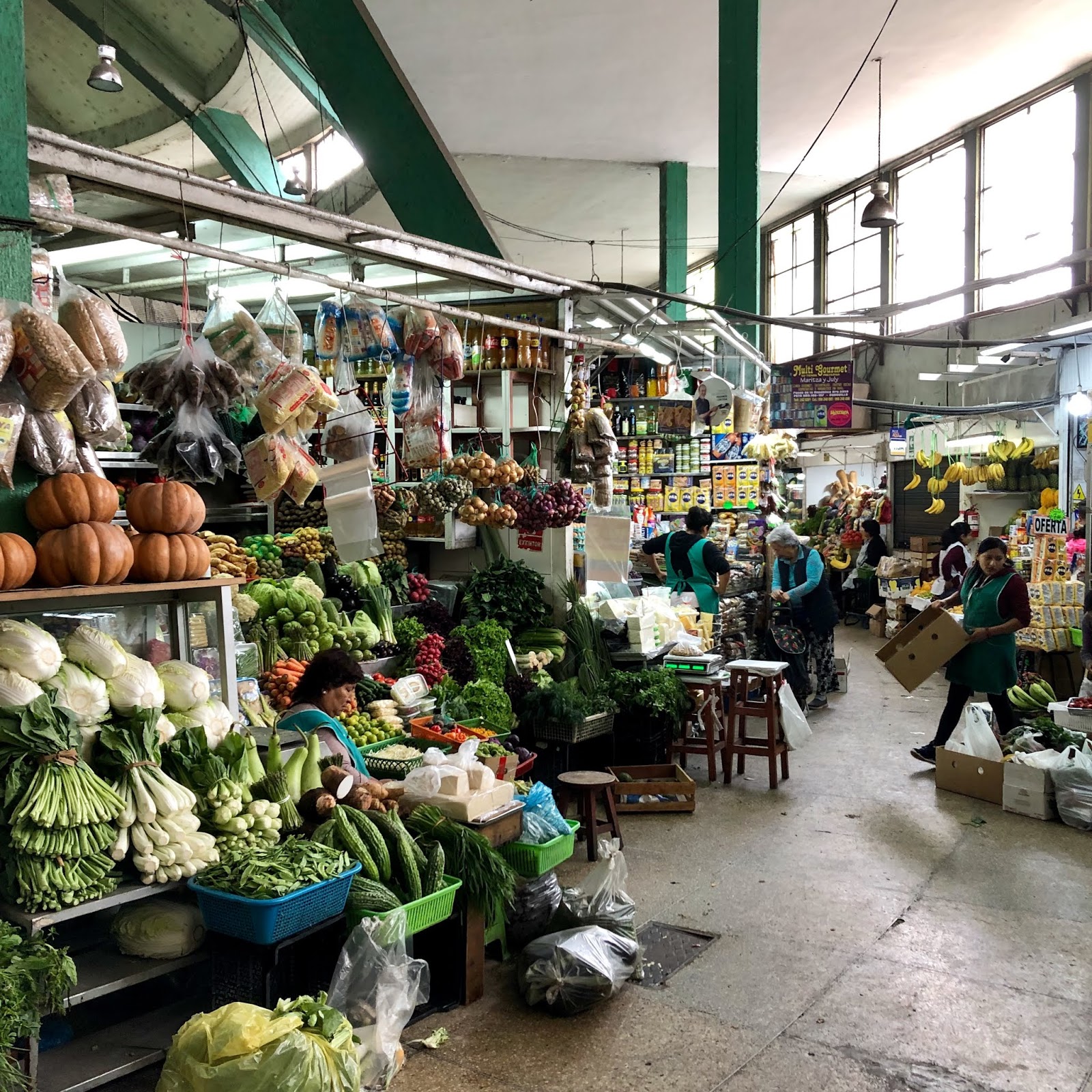
This is definitely not your standard American supermarket. Or even your local farmers' market. For a start, there's a map. I mean I guess it's a good idea because the place is pretty big. Think city block sized with a couple of concentric rings of stalls and stands and restaurants making up the place. And you can get everything there. I think if it walks or grows or swims in or off the shore of Peru, they will have it at Mercado No. 1 at some time during the year.

We didn't buy meat in our quick morning shopping trip but we could have had our choice. Chickens? Got those! With head or without? Which ever way you want. Shellfish? Plenty! Fish fish? Yep, plenty of that too; after all, how else are you going to make ceviche without fish? To clarify here, we did use fish but just didn't shop for it. How about some beef? The only answer here is which part? Because you can get every part of the animal. We didn't check out all the choice cuts suitable for aging in a gourmet steakhouse back home but we did get a good long look at the stomach (tripe), tongue, liver, heart, lungs and some other parts which wouldn't be my first choice for dinner on a weekday. Or any day, for that matter.

But if I was taken aback a little by things that aren't available in the Safeway down the street from me in the butchery, at least I could recognize the animals. The fruits and vegetables were a different story.

Not sure I've ever seen cow lungs (second from left) just hanging from a hook before...
or purple corn. Who knew there was such a thing?
I like to think that the foods that I've cooked and the places I've been to have exposed me to a pretty broad range of things that grow on or under the surface of the Earth as well as on vines or trees. The very first food we tried in the market was a prickly pear fruit (otherwise known as a tuna) and I was proud to raise my hand when our guide asked if anyone had ever eaten one before (I made prickly pear sorbet once a long time ago). It was all downhill from there.

Purple corn? Who knew? Dried mushrooms that I can't recognize. And all artichokes don't look the same? What's up with that? Jars of stevia leaves? That's what goes in the little green packets in the diner, right? The sugar substitute that's not Nutrasweet? Maca? Caigua? I mean...what? Cherimoya? Roots that don't look anything like any sort of root I've ever seen except maybe for taro (which is delicious...yummy taro!). Chiles and citrus fruits that don't look like the ones we get at home. And sweet cucumber? That can't be good if tastes like anything resembling a cucumber. Yuck! to cucumbers. How are there all these foods I've never seen before in this one little market in Lima?

And that wasn't even exploring Peru's 4,000 different varieties of potatoes. 4,000 is NOT a typo!

Pineapples, artichokes, some kind of squash (spaghetti maybe?), aji amarillo, eggplant and a root.
A whole lot of cherimoya.
After a quick circuit around pretty much every stall in the market (with a stop for a taste of some prickly pear tuna!) it was time to stop looking and time to start cooking. One cherimoya, a couple of aji limo, a sweet cucumber (please let it taste good!!!), some cilantro and a couple of red onions (thank God I know what something is that we are dealing with) and were are off to El Cevichano, a ceviche stand in the center of the market, where we met up with our other ingredients for the day: some pre-chopped damselfish, a bottle of pisco (Cuatro Gallos brand, if that means anything to you), a bottle of simple syrup, some eggs and a whole lot of lime juice. And I do mean a whole lot.

When I travel, I usually have a list of foods, drinks and dishes that I want to try. My Peru list had pretty much five things on it: a pisco sour drink, some chicha, alpaca, lomo saltado and ceviche. We were about to make two of those five. The one ingredient I hoped we'd cook with was an aji amarillo, or yellow chile, because it was the only Peruvian cooking ingredient that I could recognize. We saw some, but didn't use them; the aji limo was used instead. Aji,by the way, means chile. Didn't know that. Now I do.

First up: some fruit and a refreshing pisco sour. Pisco is a distilled spirit made from grapes. In other words, a brandy. It's pretty much the national drink of Peru. Or it is in my eyes anyway and it was a must have for me when visiting the country both straight out of the bottle and in mixed drink form. We used the modern 3-1-1 formula for making a sour, meaning three parts pisco to one part each simple syrup (sugar water) and lime. Add an egg white (I was asked if I know how to separate an egg for this like it's a skill that most 50 year old men do not possess), shake with ice, strain and finish with few drops of bitters. One pisco sour coming up!

Pisco, by the way, was invented when the importation of Peruvian wines was banned into Spain because the quality was too high. It was killing the Spanish wine industry. Faced with losing their product in the hot Peruvian summers, the winemakers decided to try their hand at distilling. And pisco was born.

And I do know how to separate an egg. I can't fix hardly anything that breaks around the house but I know how to separate eggs. And much more.

Pisco sour. What I traveled thousands of miles to taste. Had one later at a bar. That one was better than mine.
I thought I might bring myself back a bottle of pisco as a souvenir and a rare foray into the duty free shop on the way home. After a sip of Cuatros Gallos which I'd characterize as a mild flavored liquor that didn't burn on the swallow but didn't leave me craving more, I decided I'd pass. And the pisco sour? The first thing I blurted out was that it tastes like a margarita. Excuse me for being Mexico-centric but it did. It was good. I don't need one any more than I need a margarita. There's a time and a place.

The traditional way by the way to make a pisco sour? 4-1-1. Maybe I should have tried that.

Our fruit with our pisco sour? The sweet cucumber and our cherimoya, also known as the custard apple. Thank God the sweet cucumber was melon-y with very little actual taste rather than cucumber-y. Other than that it was forgettable. But the cherimoya? Pretty UN-forgettable. First, it's soft, almost liquid-like I guess (maybe smooth pear or...could it be custard?) with dense black inedible seeds. The taste is like Granny Smith-Jolly Rancher with hints of pear; sour and very, very intense. I'm not sure I'm eating a whole one of these ever but it was good. Very tasty.

Alejandro slicing into the custard apple. Sweet cucumber on the left.
Now that we were warmed up, it was time to make some ceviche. Our group (the two of us plus three other travelers from Australia and England) teamed up to slice some aji limo and the red onion and pick some cilantro off the stalks we had bought. If there was one dish we tried to track down at a restaurant in Lima and make a reservation before we landed, it was ceviche. I'd read about the many, many cevicherias all over town but found most only operated at lunch time since Peruvians generally choose to eat ceviche for lunch. 

The problem with this is that we'd be cooking during our only noon-time while we were in the city. Lucky then that we'd be making the very dish we were seeking out. Maybe not as good or inventive as we could have eaten in a top cevicheria but there's something about making dishes yourself which is extremely satisfying.

Ready to start making ceviche. The purple liquid in the glass is chicha morada, a drink made from purple corn.
We winged it. We made the whole thing by taste and sight. No recipe. Just trial and error. And I know that if you know me, this made me a little uneasy (HAVE to follow the recipe!). A couple of spoons of damselfish, a little aji limo, some onion, a dash or two or three of garlic-ginger mixture and a sprinkling of salt and white pepper. And lots of lime to cook the fish and some cilantro to finish.

That's right. The lime is our cooking agent here. I already said no flame remember. That's what makes ceviche ceviche. The acid in the lime juice changes the protein of the fish to make it appear and feel like it's been cooked. It took maybe five or six minutes for the fish to turn opaque and look like it was no longer raw. Taste. Adjust. Taste. Adjust. Repeat until just right. Then eat.

Chromis chromis with onions, cilantro, aji and lots of lime.
The fish-chile-onion variant of ceviche is typically Peruvian. No avocado or tomato like you might find somewhere more north like Central America. This is the dish classically prepared in the area of the world where it was thought to have been first invented. I've tried hard to find these types of dishes in my travels. I've just never had one that I've made myself before.

This is the first time I've traveled somewhere and cooked the local cuisine. I consider cooking to be a serious hobby and I'm glad I did this. If there's a complaint to be made, it's that the dish was fairly straightforward and simple. Not that there's anything wrong with that, but I'd love to try this again with something more advanced. 

The big thrill for me here was walking the market and marveling at kinds of foods I either couldn't identify or those that I'd never seen the way they were displayed in Mercado Nro. 1. I sometimes leave a lot of pictures on the cutting room floor when I write these blog posts. Among the ones that didn't get posted were a freshly cleaned pile of cow bones, multiples pictures of chickens hanging upside down with their heads attached or not attached and vats of spicy sauces. I could have done this by myself I guess but it wouldn't have had the same pace and level of discussion. And no way would I have bought myself a custard apple.

Mercado Nro. 1, Surquillo District, Lima.

How We Did It
Mercado Nro. 1 is located in the Surquillo District of Lima. If you are staying in the Miraflores District (where a lot of tourists stay), it's just about an easy kilometer's walk from John F. Kennedy Park. It's open to all and walking around and buying produce was super simple.


If you opt to pick up some groceries, you probably can't sit yourself down and make your own ceviche at El Cevichano like we did unless you arrange it in advance. The only way  I know to do that is to go through Best Bite Peru, which is exactly what we did. While our tour was a little bit different than described on their website (I believe we booked the "Cooking In Local Market" tour), it was nonetheless a great way to spend half a day in Lima. If you get Alejandro as your guide, tell him we said hi.

Sunday, June 30, 2019

Scritti Politti


I guess this makes two posts in a row where I'm writing about walls in Peru. Very different kinds of walls. But walls nonetheless.

I have so many great memories of my week in Peru. Some of those are perspective-altering, monumental experiences I will carry with me for the rest of my life. Seeing Machu Picchu, the lost city of the Incas, for the first time, and then exploring it the next day. Hiking almost eight hours on a path laid down by the Incas more than a half a millennium ago. Exploring a farm that's been extracting salt from the same stream for hundreds of years. Flying over the Andes and then driving and walking on them the next day. Eating foods that I've never heard of and some that I certainly can't get on a menu at home. Alpaca, anyone?

And then there are some others that are, shall we say, a little more pedestrian, but which nevertheless form an essential part of my memory and an enduring image of Peru. Dogs roaming the streets in packs of two to five animals; apparently pets let out for the day but the best behaved dogs I've seen maybe in my life. Pairs of tiny clay bulls or "toritos" on the ridgeline of every house you drive by; ages-old idols to protect against lightning hurled down from the gods above. And walls just about everywhere painted with political party slogans and logos and names of candidates. I thought they were cool works of art although I may just have a signs fetish. So here's blog post number two in a row about walls in Peru.

The rainbow flag has been adopted as a symbol of the Andean people and can be seen everywhere. 
Politics seems to be a pretty popular topic of conversations with Peruvians. We got an earful from every taxi driver and tour guide we seemed to run into or walk with or ride a bus with. And with good reason. They have to have one of the most dysfunctional governments that is still a legitimate democracy.

I know that if you are American you have to be laughing right now. I mean how could any society really have a system more broken than the one we have in Washington right now? I mean literally, nothing is getting done right now. One half of Congress is passing bill after bill and the other half is just refusing to take any action at all. It's insane that we are paying these people to work for us.

Anyway...think we got problems? Talk to a Peruvian taxi driver.

Tired of a two-party system? Try more than 30. Fed up with politicians taking money from special interests instead of representing the people that elected them? How about having all your living ex-presidents in jail for money-laundering, bribery and corruption? Does that sound bad? It is. And it's not like there's just one ex-president still alive. There are three! And one of them has his wife in jail with him.

The yellow house with the pink roof is one of my favorites, often with Elvis right next to it. Assuming not Presley.
It actually gets worse. There would have been a fourth living ex-president in custody right now if he hadn't killed himself earlier this year to avoid arrest. All told, there have been six presidents since 1986 in Peru (not counting the current president) and five of the six were indicted or arrested or convicted or jailed or something. The only one that wasn't was an interim president whose only job in office was to find the next president. Where's all this bribery come from, you might ask? Apparently...Brazil. It's a real problem.

Emotions run deep here. And not in the ways you might think. Some people actually feel that some ex-presidents despite obvious wrongdoing should be walking free. Especially when it comes to Alberto Fujimori who served as head of the country for 10 years from 1990 to 2000. In his time in office, Fujimori legitimately did some good for the country, especially in stabilizing the economy and defeating insurgent groups within Peru, most notably the Shining Path, a Maoist revolutionary army of sorts. 

But apparently Fujimori was a little too zealous in his pursuit of wiping out the rebels because he got some non-rebels killed in the process. Which led to human rights violations accusations, a self-imposed exile in Japan, an impeachment, an arrest during a trip to neighboring Chile (I mean, why go to Chile when you are wanted in Peru?), a conviction, jail, a pardon by a successor president and an overturn of that pardon by the legislature which kept him in jail which is where he is today. And despite all that, there are a significant number of Peruvians today with a positive opinion of Mr. Fujimori, including the driver that took us from the airport to our Lima hotel and think he's done enough good to offset the whole corruption thing. Politics is complicated in Peru.

But that's not what this post is about. Not really.

Avengers Party? Not really, although at least two of our guides made reference to the A meaning that in jest.
So about those 30 plus political parties, which seemed chaotic at first but which I might welcome right now based on how stagnant our government here at home is. One of the benefits of having that many parties in Peru for someone infatuated with painted signs is that there are a whole lot of different colored signs by the sides of the road to look at and take pictures of. And they are not just here and there. Once we left the historic city center of Cusco they seemed to be everywhere. And I do mean everywhere. 

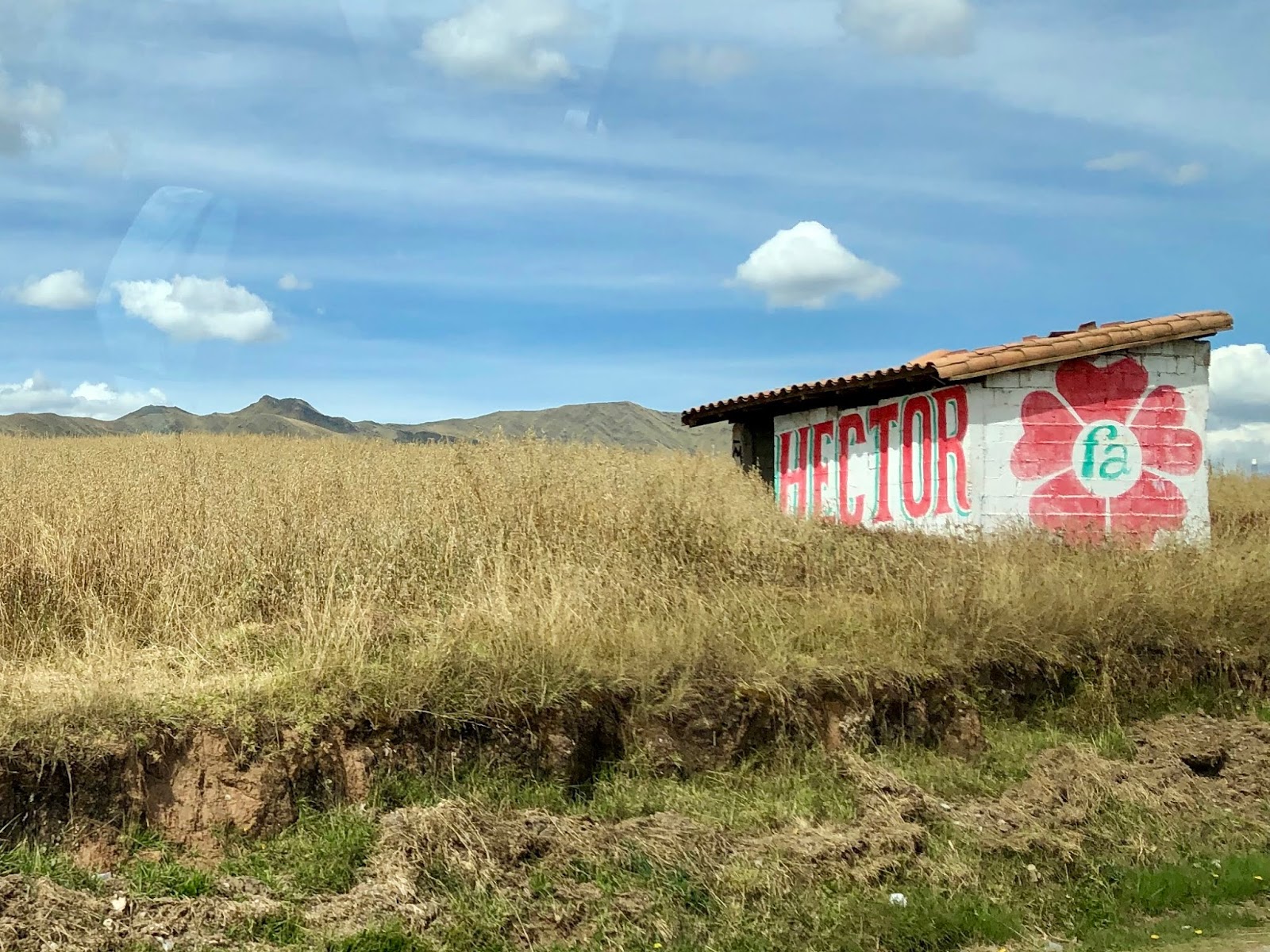
As graphic statements a lot of these signs are simple and powerful. Most feature the name of one or more political candidates along with a symbol of the party they represent. The names are always written (or painted really I guess) in the exact same colors and font. The symbols next to the names vary: a football (meaning soccer ball) or a shovel or a flower or a rainbow flag or an Andean head or a heart or any other sort of symbol that might become enough of a brand that could become associated with a name.

Football behind the lamppost.
I love how simple and straightforward the designs are and how different parties use different colors so that every color in the spectrum is collectively represented (although I guess all you need there is the rainbow flag sign to really do just that). They have to be simple so that they can be replicated over and over by many different people painting their own houses. And yes, that's what happens. Apparently people willingly decide to go to the hardware store (or wherever one buys paint in Peru) and buy their own paint so they can make the wall of their house or garden into a political advertisement. We were told that most people hope for favors after their candidate wins. Not sure how that works out.

There's also a story about the symbols. As attractive and graphically powerful as they are, they sort of seem unnecessary, unless you consider that significant parts of the population of the country are illiterate. Can't read your candidate's name? Just vote for the shovel! Or the rainbow flag or whatever else it is. How this process works on election day I'm not quite sure. Does the ballot have names and symbols next to the names? Didn't ask that question I guess.

I know, I know, all this sounds very complicated, right? Why wouldn't someone just not bother voting and take their chance with whatever party gets elected? I mean the odds that one of the more than 30 parties will get a majority is astronomical, right? There has to be a coalition or consensus of some kind to get things done, right? Surely someone sitting out a vote every now and then because they can't read couldn't hurt, right?

Wrong! Voting is mandatory in Peru. If you don't vote, you get fined. How awesome is that? Some politicians go to great lengths in my country to make it extremely difficult for some people to vote. Peru made it a requirement. Love it! Thus the flower and the football and everything else.

Vote for the flower!!!! Whatever that means in terms of the candidate (Hector, I guess?) that would be elected. 
I didn't actually take the time to track down what each sign meant or how things worked on election day with the whole pictures thing. I figured that would spoil the whole magic of this entire experience for me. Once I start getting entangled with politics, I'm not sure anything could save me. Better that I just appreciate these signs for their graphic quality. That's what drew me to them in the first place after all.

It is rare that I encounter something unexpected that intrigues me like this. Far too often on trips, I think of writing about these things too late (still regret missing the boat on the Yule Lads in Iceland...) so I'm glad I didn't let this opportunity slip by this time. 

Some of the pictures in this post are less perfect than I would want. If you'd noticed that (or more likely you hadn't) it's because I took every one of them from inside of a moving vehicle with a pane of glass between me and my subject. I'm pretty happy with the way they turned out even if I missed a few (regrets on missing the shovel especially...). But realistically, how many pictures of these signs could I have really posted? In case you think six is too few, here are two more to close this post.

I'm not exactly sure the llama logos (hidden behind the tuk-tuks in the last photo) are part of a political campaign. I didn't see these anywhere other than in the town of Chinchero. But they were one of my favorites so I couldn't pass up sharing them. May your next trip be full of surprises that bring you joy the way these did for me. 


How We Did It
Take a ride in any sort of vehicle outside of the historic center of Cusco and you are bound to find one or two of these signs. Keep going and you'll find more. Keep going further and you'll find more still. The best part of this part of our trip? It didn't cost us anything extra. If you want better photos than I got, ask you driver to stop and let you out. Just ask them to wait for you though. Happy hunting!