Tuesday, August 29, 2017

Samurai Life


After reading this post, you can accuse me of just wanting to play with a sword for an hour or so if you want. That's OK. I'm not going to protest too loudly if you do. That part of this post was a lot of fun. :)

For me, a big part of the reason I travel is integral to my interest in history. I use the fact that I'm going to a new place to try to unravel and understand a little more about wherever it is in the world I happen to be heading. Sometimes, I have specific events in mind that I want to explore and learn about. Other times, I'm just locking on to the first thought that pops in to my head.

I have to admit that I knew relatively little about the history of Japan before I hopped on a United flight headed out of Dulles airport in mid-May of this year. In fact, I think I can still admit that I know relatively little about the history of that country even after spending a week and a half there. As such I didn't have any quests to get deep inside any specific part of Japanese history. But there's one idea I latched onto pretty early in my planning process and that was that I had to get myself smarter on the history of the samurai, the warriors that were the mainstay of any battle fought by the Japanese either among themselves or against foreign invaders for a few hundred years.

What I didn't know earlier this year was that the samurai trace their origins back to the late 8th and early 9th century when the emperor of Japan was engaged in a campaign to conquer the Emishi peoples in northern Honshu, which is the main island of Japan today. Rather than raising a national army to march against the Emishi, the emperor called upon the clans loyal to him to send their family members and subjects to fight on behalf of the nation. In return for their service, the emperor granted the title of shogun to the heads of the clans, and the samurai that led the fighting achieved an elevated social status, becoming the military elite that assisted in keeping peace, defending the empire, waging war and assisting with governance. As the power of the emperor declined, the power of the shoguns and their samurai increased to the point where these groups ruled Japan for centuries.

Samurai armor on the first floor of the Samurai Museum.
The fact that the samurai were the social elites who assisted with the administrative aspect of ruling the country is not, of course, what appealed to me. I mean why would it? It's the swords, the armor, the moves, the secret weapons, the overall mystique of these warriors with an honor code so strict that violating that code might cause them to commit hara-kiri, or ritual suicide. What about everything these men did all those years ago was not the stuff of legends?

If there's a spot in Tokyo to get a little smarter on the history of the samurai, I thought it might be at the Samurai Museum in the Shinjuku neighborhood of the city. We hit this place up on our last full day in country when we were staying nowhere near Shinjuku rather than visiting when we were staying about two blocks away earlier in the week. Chalk that up to an agenda that was just too darned full on this trip. It happens sometimes. But hey, we made it there.

If you visit, be prepared for a packed experience. The place is pretty small (what about Japan isn't pretty small?) and is accessible on a guided tour basis only. The experience starts on the first floor which is pretty much just one room with a series of suits of armor lined up next to each other. You can get a sense of the construction of a samurai's battle garb, usually iron or chain mail over cotton or silk, and what seem to be more-elaborate-than-really-necessary helmets made of metal with more often than not some ridiculous, oversized sculptures resting on top.

The helmets were apparently multi-purpose items. Sure their primary mission was to keep the samurai from taking a killer blow to the head and allow the warriors to fight on through combat. But they also represented the samurai's family (family crests were often the motif on top of the helms) and served as a marker so the samurai's superiors would recognize him when he brought the heads of his enemies for credit of a battle well fought. Not kidding on the heads thing, by the way; not so high on the honor thing right now. 

And I know what you are thinking. Didn't the size of those things on top of the helmets inhibit performance in battle? Well, no. While they may look solid, most were made from wood (the decorations not the helmets) and weren't really designed to survive first contact or handicap the wearer in any way. The stuff we learn...


Close-up look at a dragon decoration on one of the helmets in the Samurai Museum's collection.
Move to the second floor of the Samurai Museum and you'll find the good stuff: the weapons. That's right, defense is all well and good but we'd rather hit than be hit, right? You can find plenty of things that do other people harm on floor two, starting with swords and lances and ending up with guns. Yep, at the very end of the samurai's reign, they were packing pistols and shooting people.

The pistols and spears and bows with arrows and stirrups are all really cool (you can even hold a stirrup and a helmet) but if there's an instantly recognizable emblem of the samurai, it's the curved swords, or katana, that they carried everywhere and used in battle. There's something about sword fighting that is incredibly romantic, even though getting run through with a steel blade is in reality anything but romantic. It's the swords that make the samurai. You can claim to be one with a sword and nothing else; you can't really do it with just the armor and no sword.

Ever wanted to feel like you are an actual samurai? Make it to the end of the museum and you can. They have wearable costumes and fake swords which you can use to take some pictures and convince folks that you are a genuine 21st century samurai. You can also check out a live demonstration of some the Museum's staff showing off their samurai and ninja moves. Ultimately these parts of the Museum meant far less to me than the actual exhibits themselves. No surprise there.

Samurai demonstration on the second floor of the Samurai Museum.
One of the most informative parts of the museum for me is a mural depicting the Battle of Sekigahara in the year 1600. The Battle pitted two sides against one another: an Eastern Army under the command of the warlord Tokugawa Ieyasu fighting a Western Army loyal to the leadership of Toyotomi Hideyoshi, and later his son Toyotomi Hideyori. The battle involved almost 200,000 combatants on both sides of the battlefield who were led and directed by the samurai. It's complete carnage in parts, especially on the west (or loser) side of the canvas. There are even circles of samurai committing hara-kiri, as if we needed some evidence that really happened.

The battle is so significant to the history of Japan because it re-unified the country and brought peace to an island that had seen almost ceaseless conflict between small family-based clans for the previous seven or eight centuries. Ironically, the battle where the samurai played the greatest role in their history effectively ended the samurai as a social class. Without unending war, the samurai were doomed to decline.

As a general overview of the history of the samurai, I think the Samurai Museum provided some good background. It's in many ways limited by its size and its collections. The demonstrations and dress up portions of the museum, while fun for some I'm sure, didn't add much to our understanding of samurai life. We would need to go elsewhere to learn more about the samurai.

Of course like all good museums, the way out takes you past the gift store. If you are interested in a cool souvenir of Japan, you can stop there and pick up a replica sword pretty reasonably priced between 7,000 and 20,000 Yen or about $60 to $200. I realize any price in the thousands sounds expensive but a Yen is worth less than a penny or essentially worthless. I'm assuming the swords you can buy in the store are blunt, although we honestly didn't check. How you get one of these things back to the United States is something I haven't researched. If you decide you want one, might want to consider that in advance. 


NOT at the Samurai Museum.
If you are not satisfied with the quality of the swords at the Samurai Museum (i.e. you want one that will actually cut something for some reason), there are certainly places in Tokyo where you can get a more expensive and I assume way way sharper one. To just get a look at some of these (and lots of other samurai paraphernalia) we stopped by Japan Sword, which is located within walking distance of the un-missable red and white Tokyo Tower.

The folks at this store are pretty serious about their weaponry and armor and it shows in both the no photography policy and the price tags affixed to what is on display for sale. Want a top of the line, most expensive sword in the store? That will set you back a cool 10 million Yen. Now I know I just pointed out that a Yen is worth less than a penny but 10 million of them is worth about $92,000 as of the date of this post. Yep, there's really no need to worry about a single Yen but put that many of them together and you are plunking down some serious cash for a curved blade. I'm not sure if these things are antiques or modern reproductions (Lonely Planet says they have both) but I know either way it's way too rich for my blood. And that's notwithstanding I can think of no good use for a sword in my current daily life.

Granted there are cheaper things for sale at Japan Sword, including some more reasonably priced swords (again, no real use for a sword...) for thousands rather than tens of thousands of dollars. The cheapest items we could find in the store were some metal decorations that go under the wrapping on the hilt of the swords and are essentially invisible when installed. They come in all sorts of designs symbolic to the sword owner. We could have picked up a pair (remember it's not just one, but two) for about 140,000 Yen. Which is about $1,300. We passed on everything at this place. We didn't even bother asking how much a suit of armor cost. I mean...why?
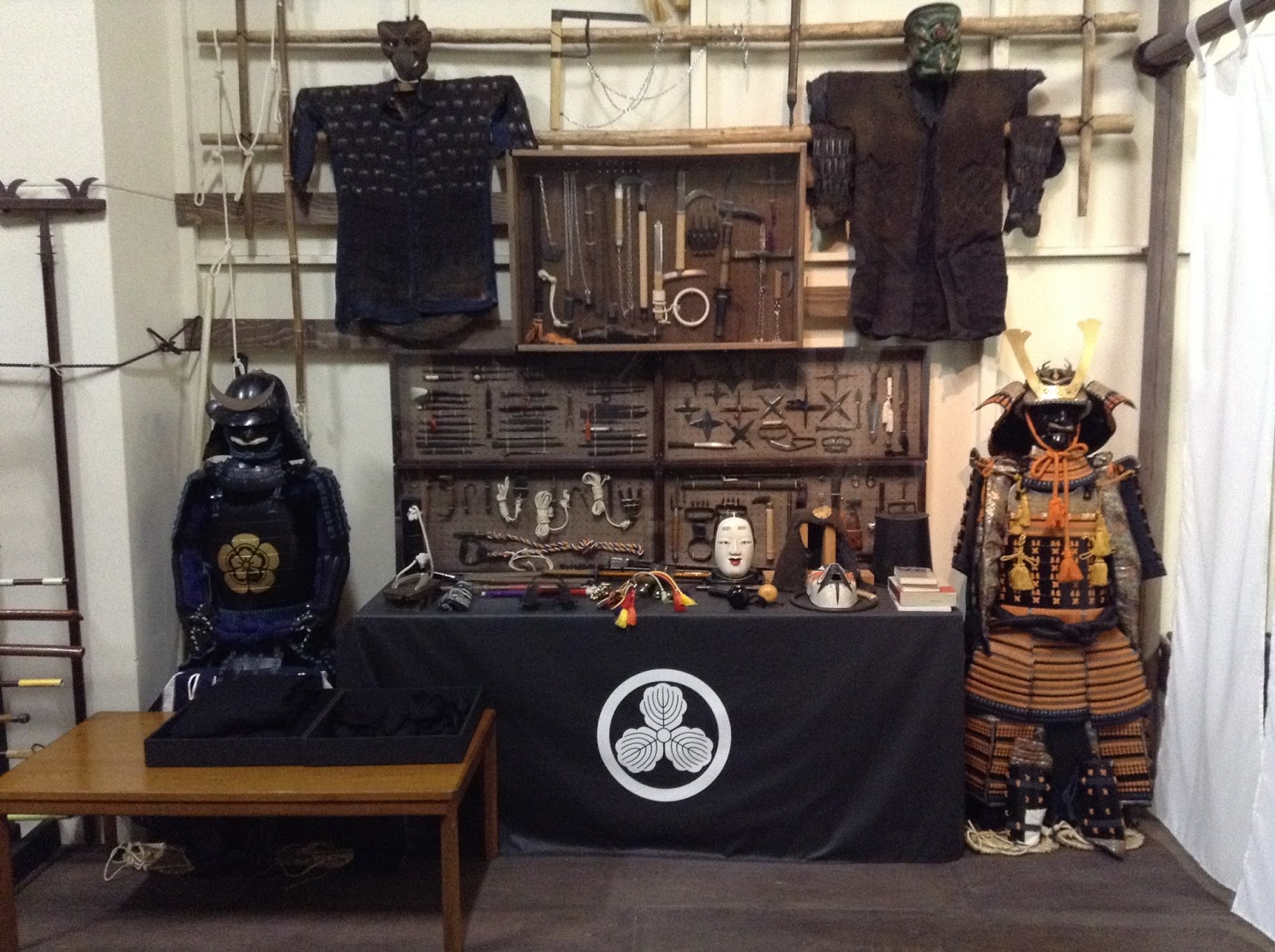
Weapons and armor display at the Musashi Ninja Clan dojo.
Checking out the Samurai Museum and ogling swords I shouldn't really be starting to think about buying (I mean, again, what would I do with it...) is all well and good, but what I really wanted to do was satisfy my yearning to learn a little bit more about these warriors. And I was determined to do that by getting a chance to find out how to wield a sword for myself. Where there's a will, there's a way. Let's get samurai-ing!!!

A little internet searching turned up a lot of results here. Turns out there are many folks just like me who want to do the same thing I wanted to do. Either that or there are a lot of really pretty empty learn-how-to-use-a-katana lessons scattered around Tokyo. The range of choices is almost staggering. Some offer demonstrations then lessons; others offer just lessons. Some use wooden swords; others let you hack tatami mats to bits with a real sharpened sword. Most let you change into traditional costumes; others have you go through the whole experience in your gym clothes. Or you could do the whole thing in full battle armor. There are short lessons and long lessons; pretty affordable and really outrageously expensive lessons; and group classes or private tutorials. Oh the choices.

As tempting and potentially stress relieving as chopping up mats with a really sharp piece of steel might have been, we opted to go a little bit more on the sedate, disciplined side. We found a not cheap but not outrageously priced 90 minute private session centered around the modern martial art of kendo. We'd get to hold an actual sword but just not for the drills we'd be engaged in; for the doing part of the session, we'd be using a wooden replica, which sounded just fine to us and appealed a little more to the usefulness side of this whole exercise. We signed up.

We ended up at the Musashi Ninja Clan dojo in the basement of an office building in Tokyo's Ginza district, right across the street from the same Tokyo Tower that is within walking distance of Japan Sword. Yep, you read that right, we intentionally took ourselves to a space with a pretty good collection of weapons in the basement of an office building. Sounds kind of sketchy, right? What followed was one of our signature experiences of Japan.

Striking the killing blow in an epic sword battle. OK, it's a wooden sword and I'm moving really slowly.
I'm not going to lie to you, the first 15 minutes or so were kind of uncomfortable. Our teacher and master opened our lesson with a series of prayers and invocations (to the gods I guess) in what was an altogether too dimly lit studio space with some sort of makeshift weapons-adorned altar at the front of the room. And all the chanting and praying or whatever he was saying was all in Japanese so we couldn't understand anything at all. 

The chanting and yelling wasn't the uncomfortable part by the way; I had to sit cross-legged throughout all of that and I am no longer built to sit cross-legged any more. Those years are way behind me. Let's be done with that. Lights up. Let's get to some sword fighting!!!!

We didn't learn everything we needed to know in our hour or more lesson about sword fighting, but we learned enough about some basic moves and were able to understand a little more about Japan and its history by doing so.  We started by getting dressed. And I mean that quite literally. We got dressed; we did not dress ourselves. 

For our lesson, we wore the traditional gi, which I guess looks like some sort of elaborate non-absorbent bathrobe but is really nothing similar at all. I don't know why I really expected this garment to loosen throughout the lesson (the only defense here is that bathrobes seem to loosen about five minutes after I put them on) but they didn't. Not a bit. It was amazing how comfortable and securely fitting these robes were. And the belt work was honestly a work of art. I have no idea how the woman who put this on me did it but without any buckles or ties she got that sash perfectly tight but with the smallest opening necessary to secure the scabbard of my wooden katana. Here we go.

Lesson one was drawing the sword. This makes sense. This is also surprisingly difficult. When fully outfitted as a (pretend) samurai, I'm wearing my gi with my kantana on my left side with the blade in what I would refer to as an upside-down position, that is with the curved portion of the scabbard upwards. Drawing the sword is not a matter of simply pulling the blade out and getting ready to chop something; it's too long to do that unless you happen to have really long arms. The act of removing your sword ready for combat involves pulling the scabbard forward and then simultaneously removing the weapon while sliding the scabbard back into its original position. A quick flick of the wrist and you are at the ready with your right hand holding your sword pointing at your enemy.

Being a samurai is not just about swordplay. You need to know how to use throwing stars too.
Lesson two is putting the sword away. Yes, once we had our katanas out and ready for action, the first thing we had to do was put them away. After all, you can't very well just walk around with a drawn sword, can you? The process of re-sheathing the sword involved pretty much the reverse of the drawing motion but with a twist (literally a twist of the scabbard) and a little more care. Remember you are now bringing an extremely sharp piece of metal towards your body; you don't want to miss. After twisting and pulling the scabbard forward, you'll find the top (non-sharp) edge of the weapon with your left hand and guide the blade back towards the opening of the scabbard and re-sheath, all the while moving the scabbard backwards into its original position.

Repeat all that a few times and we were ready to learn how to wield a sword, samurai-style. Over the next 30 minutes or so we went through a series of exercises covering what I am sure are the most basic attack and defense positions using the katana: attacking the head and leg and defending those same attacks. We were taught proper posture while doing this that showed us two things. First, our movements could be streamlined to maximize effectiveness with minimum effort; by adjusting my body based on the instructions from our instructor, my movements felt much smoother and more powerful. The key there is using your whole body while fighting, not just your wrists. Secondly, I have muscles that I don't use effectively at all because some of those poses stretched me in a way that I don't usually experience.
 
We went through almost the entire lesson with a wooden sword before breaking out the big guns: a real katana made of metal and then some ninja throwing stars. No, we didn't use the real sword and as tempting as it was to see just how sharp this thing was, I refrained. But yes, we used the throwing stars. If I were asked to make a list of things I never thought I'd do in life, I am sure I would write down throwing some ninja stars at a wooden plank if I could even conceive of that being on any sort of radar for me. We spent way more time using how to employ correct swordsmanship but I have to say throwing sharpened pieces of metal at a piece of wood was really pretty darned satisfying. The stars worked way better than the pointed metal rods that looked like pencils sharpened on both ends.

Tell me I don't look like a badass here. It's not true; but it LOOKS true.
Before our lesson began, we watched a demonstration by our instructor in a variety of samurai moves or techniques. It went by really pretty fast and my overall impression (go ahead and laugh) was that I wasn't that impressed. After learning exactly two attacking moves and two defensive moves in an hour or so (notwithstanding the whole throwing stars thing) I am now officially impressed. There's no way I can contemplate how long it would take me to learn how to do what we were shown in that five minute or so show. I couldn't even sit comfortably cross-legged for five minutes.
 
I am also extremely confident that I am in no way prepared to fight anyone with a sword anytime soon. Not that I will ever have to. And that's not a reflection on the quality of our instruction in any way. This stuff just takes time. If I was already skeptical of Mr. Miyagi's wax on/wax off, sand the floor and paint the fence instruction of Daniel LaRusso, I am even more so now that I've spent an hour and a half learning just about nothing about fighting. I don't buy the post-fence painting onslaught from Mr. Miyagi that was blocked by Daniel-san perfectly every time. I know, I know, Daniel already had some karate lessons at the Y back in Jersey and he did wax, sand and paint for a day each. I'm still not buying it.
 
Sometimes these crazy notions of things to do on vacation flop for me. Our samurai quest wasn't one of those flops. Learning the basics of just pulling a sword out of a scabbard and understanding a bit more about the place in history occupied by those men who used these things in battle over eight or nine centuries or so was worth it. The instruction in how to use the sword to attack and defend (and of course the throwing stars!!!!) was just gravy. I mentioned earlier in this post that there are a great range of choices on the internet for samurai lessons. I'd pick the Musashi Clan Dojo any day of the week.
 
One more thing before I end my writing about Japan for this year.
 
While walking around Tokyo and Kyoto in our week and a half in country, we noticed most people walking on the left side of the sidewalks and escalators that we used to get around, which was curious because it's the exact opposite of what we do at home. We couldn't imagine why that was the case. The best we could come up with is they drive on the opposite side of the street in Japan. Turns out there's a reason and it's all because of the samurai.
 
While swinging our sword-shaped pieces of wood at each other in the basement of an office building, we wore our scabbards on the left side of our bodies, as did everyone back in the day, even if they were naturally left-handed. Now imagine a society where people walk around with swords attached to their left hips routinely day after day and where hitting a stranger's sheathed sword might cause a deadly conflict. Want to avoid getting into a fight by accidentally bumping swords on the street? Walk on the left. Mystery solved! I'm telling you, the things that we learn on vacation.

The side of Japan Sword. Bring lots of money if you intend to take anything home.

Friday, July 28, 2017

Love The Shinkansen


It is rare that I devote an entire post on this blog to practical travel advice. In fact I think I've only done it once before when I returned from my 2014 trip to England. But in researching and then actually traveling around Japan, we found something that saved us a ton of money. So here's a post dedicated to the Japan Rail Pass. If you are headed to Japan, I'd look into this. It could save you a ton of cash.

Now, I've looked into these sorts of things before, specifically in continental Europe. The various train systems in western Europe participate in what's called a Eurail Pass, a multi-day pass that allows you hop from train to train around Germany, France, Italy and the like all for a single lump sum which varies depending on the duration of the pass you elect to buy. The pass is only available to non-European residents and you have to purchase it before you get there. I've checked this deal out more than once and each time have come to the conclusion that you pretty much have to be traveling long distances on trains every day to make it work out. I've always passed.

The Japan Rail Pass works similarly to the Eurail Pass. You pay a flat fee for either a 7 day, 14 day or 21 day pass and then are able to ride almost any train in the Japan Rail system as much as you want during the period the pass is active. The pass is not available to residents of Japan (just like the Eurail Pass) and you have traditionally been required to purchase the pass before arriving in Japan (although for a limited time you are permitted to purchase the pass in country, albeit at a higher fee). The Japan Rail Pass is similar to the Eurail Pass in most every respect except one: it's a better value.

Japan's iconic shinkansen, or bullet train.
Let's look at the economics using my recent trip as a guide. A 7 day Japan Rail pass retails for 29,110 Yen as of May 2017. That's a little more than $250 as of the summer of 2017. That appears to be a lot, but not if you run the numbers. We knew we were spending time in Tokyo before heading over to Kyoto for a few days then onto Miyajima via Hiroshima before returning to Tokyo. We also knew we wanted to take a day trip to Nara from Kyoto. Japan Rail covers all of these cities. That's a lot of train travel; we figured we'd be spending a lot on rail travel anyway.

A train ticket on the bullet train, or shinkansen, from Tokyo to Kyoto is 13,600 Yen each way. Yes, the Japan Rail Pass works on the shinkansen and that's a round trip cost of 27,200 Yen, which is almost the same as a 7 day Japan Rail Pass. Add in a round trip from Kyoto to Hiroshima at 11,090 Yen each way and we covered the cost of a 7 day pass easily with a savings of 20,270 Yen.

Pile on a round trip to Nara at 710 Yen each way; a round trip from Hiroshima to the mainland Miyajima ferry terminal at 410 Yen each way; and a round trip on the JR Ferry to Miyajima at 360 Yen round trip and my savings were up to 22,870 Yen which is about $200. You can also use the Japan Rail Pass on the JR trains around Tokyo and Kyoto and on the tourist bus that hits the high points in Hiroshima. We used all three and saved a bunch more Yen on I don't know how many train and bus rides. The savings just keep piling up.

One of the Japan Rail lines which you can use to get just about anywhere in Tokyo.
So I know what you are thinking. There's some fine print, right? Well, yes. Or no. Not really fine print. But there are what I'll call some stickier points you need to be aware of.

The first is the "buy ahead" rule that I've mostly discussed already. When you make the decision that the Japan Rail Pass is for you, you need to find someone who sells them because Japan Rail (which is a national company subdivided into six separate geographies) doesn't. Fortunately, there is a list of agents available through a link on their website. For those in North America, you can get to the list of your local agents by using the clickable link in the prior sentence.

What you will purchase through the agent isn't the actual Japan Rail Pass. You need to swap the coupon that you purchase at a designated exchange office. Fortunately, the Japan Rail Pass site also has a link to a list of locations when you can get the actual document. Allow some time for this and make sure your passport has a visitor's visa stamp or sticker. Without it, you cannot exchange the coupon you bought for the actual pass.

Finally, I mentioned earlier that you can take the shinkansen using your Japan Rail Pass and that's true. However, you can't take all the shinkansens using your Pass. There are a number of different types of shinkansen in Japan. The fastest are the Nozomi and Mizuho shinkansen. These you cannot take using the Japan Rail Pass. You'll most likely have to settle for a Hikari shinkansen, meaning instead of traveling at 170 miles per hour, you'll have to make do at a speed 30 miles per hour slower. I think you might be able to handle that if it means saving a couple of hundred dollars, right?

Waiting for the JR Ferry to Miyajima Island, which is included as part of the Japan Rail Pass.
A few final thoughts on this deal.

Google Maps is an incredibly useful app to get from point A to point B, even overseas. I use it a lot here at home to drive places I've never been before. You can also use it to figure out train and bus schedules. Only, it doesn't work that well for trains in Japan because it only shows you the fastest way to get to your destination. For a shinkansen ride, that means it shows you only route and time information for the Nozomi, which you can't use using your Japan Rail Pass. Seek alternate ways of figuring out how long rail journeys will take.

There is a train from Tokyo's Narita Airport to downtown Tokyo called the Narita Express. It costs 4,560 Yen for a roundtrip ticket. The Japan Rail Pass will get you on this train. If your 7 day or 14 day window includes your arrival day or departure day, use the Japan Rail Pass to get to or from the airport. There is a coupon exchange location in the airport. Remember to redeem the coupon for a Pass once you clear customs and immigration.

Finally, this pass offered us a ton of flexibility. If you want to reserve a seat on a train, you can; just take the pass to a ticket desk and get a seat. You can also just walk onto a non-reserved car if you can figure out the schedule on your own. On our return trip from Hiroshima to Tokyo, we knew there was a transfer required somewhere but didn't know where exactly so we made sure to check with the ticket desk and get some seats. 

We ended up with our first train being 62 minutes later but I figured trains probably ran every hour and if we hustled we could make the one two minutes from the time we were handed our ticket. I was right and we really hustled. The Japan Rail Pass allowed us to sit down in an unreserved car and shed an hour off our trip back to Tokyo. Couldn't have made that on the spot decision without the Pass.

If you are moving around in Japan and planning to take trains to do so, I'd look into a Japan Rail Pass. It may be the best $250 or so you'll spend.

Saturday, July 22, 2017

Myth Of Tomorrow


At 2:40 a.m. on August 6, 1945, three United States Army Boeing B-29 Superfortress bombers took off from the North Field airstrip on tiny Tinian Island, one of the Mariana Islands in the western north Pacific Ocean. The three planes, named Necessary Evil, The Great Artiste and Enola Gay, were bound for Japan, which at that time had been at war with the United States ever since the Japanese bombed the naval base at Pearl Harbor in Hawaii on December 7, 1941. 

It was not the first time aircraft had left Tinian Island in 1945 flying towards Japan. The U.S. Army had conducted surveillances and practice bombing runs toward the Japanese mainland earlier that same year. These flights were different. The Enola Gay was carrying a special cargo, a uranium bomb nicknamed Little Boy. It was one of the world's first atomic bombs and the plan that day was to drop it and detonate it, not against just a military target but on a city going about ordinary life (such as it was in wartime) filled with civilians including women and children.

The target that morning was Hiroshima, a city established in 1589 by the feudal warlord Mori Terumoto at a time when the entire nation of Japan was engulfed in a civil war. Terumoto built a castle in the city to serve as his personal stronghold but didn't hold it, or Hiroshima, very long, having it stripped from him for backing the losing side in the Battle of Sekigahara in the year 1600. Over the subsequent almost three and half centuries, Hiroshima had grown into a city of 350,000 people and transformed itself during the industrial revolution in the late 1800s and early 20th century into one of Japan's most important manufacturing cities.

At 8:15 a.m. that morning of August 6, Little Boy exploded at 1,900 feet above the center of Hiroshima. What had taken the Japanese centuries to build was almost utterly destroyed in seconds. Wiped out at the same time as most of the city were an estimated 70,000 people, most of them civilians. And there would be a lot more death to follow. For better or worse, the United States had just ushered in the age of the atomic bomb.

The Atomic Bomb Dome viewed from the southeast, which is generally the direction of the blast. 
I feel one of the most powerful benefits of travel is that it sometimes causes us to challenge how we see the world and its history. Before I visited Hiroshima this past May I had my own opinions about what happened between the United States and Japan towards the end of World War II. Those opinions included my own made up justification for the country that I call home dropping the most powerful bomb ever developed to eradicate a city with less military value than other equally accessible targets.

I use the term "made up" here not to suggest that my impression of what happened was necessarily wrong, but simply that it was based on few facts and a lot of supposition. I feel I know more now. And that day I spent in Hiroshima two months ago for sure caused me to challenge my version of the truth that I had developed. I may still not have it right but I know my new version is based on more information than my past one.

Step off the train at Hiroshima Station today and you'll find a city that looks a lot like all the other Japanese cities that I passed through on my way from Tokyo to get there. Lots of concrete buildings, neat and orderly streets filled with people going about their days and FamilyMarts and 7-11s on just about every corner. I expected this. I also expected that soon after dropping my luggage off at the station's storage lockers I would find some kind of history that was quite different than a typical Japanese city. I was lucky enough to find one of the meipuru-pu buses that take you around the city right when I got out of the station. I hopped on for free with my Japan Rail Pass.

My destination that day was the Hiroshima Peace Memorial Park on the north tip of the island between the Ota and Motoyasu Rivers, a spot maybe a few hundred feet west of the epicenter of the explosion back in August of 1945. The Park is a gathering spot for a number of different memorials and monuments with the overall theme of remembrance and hope that this sort of event never occurs again.

The memorials and monuments vary in type and scale. There is a Peace Bell which you can ring with the hope that we never forget what happened at Hiroshima. There's a pretty grisly burial mound with the remains of some of the victims in addition to a cenotaph honoring all the victims of that day and the aftermath. There's a children's memorial and a memorial honoring the Koreans who were only victims of the bomb because the Japanese had invaded Korea and conscripted them into service.


The main organizing element of the Park is a linear pool of water running north-south that links the saddle-shaped cenotaph (shown above) to a Flame of Peace. Look through the underside of the saddle and beyond the flame and you'll see what is now called the Atomic Bomb Dome, the former Hiroshima Prefectural Industrial Promotion Hall, which serves as an emblem of the type of destruction wrought upon a typical concrete and steel building by the explosion. It is the only building destroyed that day left in a state of ruin as a reminder of what the bomb did.

There's some powerful stuff in the Park, but honestly it is difficult to understand exactly what happened on August 6, 1945 from walking around the city. The words on the plaques and the various memorials all provide a ton of useful narrative both about the consequences of atomic bombs and the need to prevent these kinds of attacks. Even the burial mound failed to adequately convey to me exactly what had happened. And I don't think it's just a lack of imagination on my part or a lack of ability to empathize.

I've visited other sites where people have inflicted inhumane sorts of punishment on their fellow man since I've been writing this blog. I'm thinking primarily of the Dachau Concentration Camp near Munich, Germany and the Civil War prisoner of war Camp Sumter in Andersonville, Georgia. In each of those places, the suffering was personal, meaning it was handed out and witnessed man to man under the supervision of other men, and the remembrances of what had happened were tangible, either through a reconstruction or the actual buildings there at the time. It's not difficult to feel overwhelmed with grief and horror when you are standing in a gas chamber designed to kill people, even if it was never used.

At Hiroshima, you can't get the same kind of experience by visiting memorials. The killing that occurred there was impersonal. The men that did the killing simply dropped a bomb out of an airplane. They never saw their victims. They never understood the kinds of lives they were wiping out and how much people suffered. And there were no discreet sites where the killing happened. It occurred everywhere all at once in a flash. That doesn't make it less regrettable, just less tangible.

Not even the Atomic Bomb dome gets you the same kind of experience. Its presence there almost makes it seem like that building was one of hundreds or thousands left in that state and that during reconstruction its neighbors were either re-built or completely demolished. That's not the case at all; most of the structures in the city in 1945 were not made of concrete and steel but instead of wood and paper and those were annihilated instantly. It's just difficult to understand how completely destroyed everything and everyone was from the Peace Memorial Park today.


Head west to Hiroshima from Tokyo and you may pass by the mural Myth of Tomorrow in Shibuya Station.
But make no mistake, something horrific happened here. After the initial blast killed the first 70,000 people, the survivors were the first in our history to come face to face with the reality of the aftereffects of an atomic bomb. And those realities are terrifying and must have been unbearably painful. There were of course people horribly burned as a result of the fire and heat that was unleashed by the blast. But there were other symptoms that seemed unrelated to the burns: vomiting, diarrhea, hair loss, wounds as small as needle pricks that wouldn't heal, bleeding from the mouth and ears.

A lot of the remedies tried to combat these symptoms didn't work because the doctors administering the sick had never dealt with patients experiencing deterioration and death through radiation poisoning. If someone was exposed to it during the bomb blast they were suffering badly. If they drank the poisoned water in the city after the black rain fell, it was even worse. I can't imagine how confusing, distressing and horrific the days were after that bomb was dropped.

While you can't understand much of this from walking around the Peace Memorial Park, there are places in Hiroshima where you can get this perspective. If you are looking to understand what happened in that city in August of 1945, I would suggest you seek them out. You won't think about this event the same way when you do.

Head to the south end of the Peace Park and you'll find the Hiroshima Peace Memorial Museum. It features exhibits and historical timelines in a sequence on two floors of the building. There's an especially effective "bomb's-eye" view animation sequence that takes you through the devastation behind the initial blast right at the entrance to the exhibit which sets you up well for what's to come. More interesting to me was the narrative embedded in the historical timeline, because it helped change my impression of why the United States actually dropped the bomb in the first place.


Ringing the Peace Bell in Hiroshima's Peace Memorial Park.
It seems to me after visiting the Museum and watching documentaries and reading accounts since I returned from Japan that by the time August of 1945 rolled around the Japanese had little chance of winning their part of World War II. They were being defeated in battle all over the Pacific rim, support for the war was waning at home and the war in Europe had ended which would allow the United States and the Soviet Union to concentrate all their attention on the defeat of the Japanese. And herein seems to lie the crux of the issue surrounding the dropping of Little Boy on Hiroshima and a little later a second bomb on the city of Nagasaki.

World War II significantly shifted the balance of military power in the world out of western Europe and into the United States and the Soviet Union. The theory advanced in the Hiroshima Peace Memorial Museum is that the U.S. dropped the bombs that ended the war on Japan for two reasons: (1) to justify the cost of the research and development of the technology and (2) to send a message to the Russians, who at the time were fighting the Japanese in Manchuria on their way to potentially capturing a cold weather Pacific port that some feared the Soviets would never relinquish.

I can see the economic justification. As disgusting as the concept is, I can imagine politicians struggling to answer why we spent so much on developing a weapon that was never used. But I can also see the perceived need to back the Russians off and quickly. If the Soviet army fought their way through to the Chinese coast, word was they intended to invade Japan and end the war. And I can see that situation, particularly trying to get them out of Japan, being intolerable to the U.S. 

Standing in the Peace Memorial Museum after having walked through a good part of the city that was destroyed, I cannot see how dropping the bomb on that city caused the end of the war. It may have accelerated it and got it done to hinder the Soviets' plans, but I believe the surrender of Japan was inevitable and it seems to me the annihilation of Hiroshima was unnecessary. And I get that it's easy for me to say that in 2017 without understanding what the butterfly effect of not dropping the bomb would have been. But try arguing with me after you have been to the city that the first bomb destroyed.


A small portion of the devastation cause by the bomb, seen in the National Peace Memorial Hall. 
If the Hiroshima Peace Memorial Hall covers the essential history, then the place to understand the destruction wrought on the city and its people is the National Peace Memorial Hall for the Atomic Bomb Victims, which is located just a bit north of the Museum near the Cenotaph.

The building and its exhibits are focused on the people who died in the initial bomb blast and the days, months and years following. People who could have been just like you and me at one time, just going through a war not mandated by the people but by the military leaders who saw Japan's continued existence dependent upon foreign expansion to seize necessary raw materials. The National Peace Memorial Hall is a simple building, just basically a single ramp curving around and down to a circular Hall of Remembrance. The ramp contains stopping points with narratives and exhibitions describing the events leading up to August 6. But the payoff is down below in the Hall of Remembrance.

If there's a spot in Hiroshima where dropping the bomb and destroying a city hit home for me with all the weight that comes with that event, it was in the Hall of Remembrance. The walls of the Hall are a 360 degree photographic depiction of the condition of the city after the dropping of the bomb as taken by United States Army photographers once on the ground. There's almost nothing there. Almost everything is destroyed and in pieces on the ground.

Sure, there are a few buildings, including the Hiroshima Prefectural Industrial Promotion Hall, still partially standing. These structures were likely built in the early 20th century to withstand Japan's earthquakes and they lasted through the blast to some degree. But anything else with any surface area is gone and reduced to a thin layer of rubble on the ground, the rest incinerated on the spot. There are some tree trunks and metal skeletons of radio towers and sadly enough one Shinto torii still upright but all the leaves and small branches on the trees are stripped, having too much mass to withstand the pressure of the blast. 

The effect of these photographs showing a former city as an almost completely denuded landscape on me was shocking. I couldn't have imagined I would have felt quite this way in Hiroshima. I expected to be sad and remorseful and respectful. I didn't imagine I'd see something that would have affected me the way that photographic mural did. When I think back to my time in the Hall, I think about how I would feel if it were my town that was laid to waste that way. I don't want that to happen ever again anywhere.

Before you get too upset with me for second guessing the United States government making extreme choices to end a war started by a country that over the years before the bomb was dropped committed horrific crimes against humanity, let me say a couple of things. First, to their credit, the Japanese are genuinely apologetic about and acknowledging of the fact that they started the war. They also appear to be genuinely ashamed of their former leaders and committed to never allowing this same sort of thing to happen again. Terms such as "mistaken national policy" in the exhibit narratives are real expressions of regret for me. I've been other places where the aggressors of war are not conciliatory; that's not a concern in Hiroshima.

Secondly, let me say I have no idea what the world would be like if the United States hadn't dropped the bombs on Hiroshima and Nagasaki. Maybe there would have been a future war where nations would have already exchanged volleys of nuclear weapons because they wouldn't have seen what these things actually do to people and nations. It's really difficult to second guess history, especially when the result of horrific actions means the end of wars. I'd just encourage anyone before you get too entrenched in your position that dropping an atomic bomb was right to visit the place where it was dropped before getting too argumentative about your position.


Detail of Myth of Tomorrow, showing a skeleton burning from the heat of the blast.
If your trip to Hiroshima takes you through Tokyo, whether before or after, I think it's worth seeking out the mural in Tokyo's Shibuya Station called Myth of Tomorrow. The work is a large scale painting by the Japanese artist Taro Okamoto inspired by what happened both at Hiroshima and later at Nagasaki. It is considered by many people to be the Japanese Guernica, depicting the height of the horrors of war in Japan just like Pablo Picasso depicted the height of the horrors of war in Spain through what the Franco regime did to the city of Guernica.

The mural has a long and complicated history, including being lost for 30 years in Mexico, but is now on display in a public train station for all passing through and by to see. It's worth at least a few moments to stop and look if you are passing through the station. I found it before visiting Hiroshima. Now that I've been to the city, it seems more horrible and brutal and I suppose that's sort of the point. I love visiting places that reinforce my experiences when I travel; I feel the Myth of Tomorrow did that for me. Looking back at the pictures I took of that work reinforces the regret that I feel for what happened in Hiroshima.

The initial blast from Little Boy killed an estimated 70,000 people. By the end of 1945, just five short months later, there were an additional 70,000 dead from the aftereffects. I am proud of the efforts both my birth country of England and my home country of the United States made to fight in and end World War II in both Europe and the Pacific. Visiting Hiroshima for sure challenges that pride. It is difficult to justify wiping out an entire city and almost half its inhabitants when you are standing in the place where it happened. Hiroshima may not be everyone's preferred destination when traveling in Japan but I thought it was important to go here and draw my own conclusions about what happened on the ground. I think it's essential we see complicated issues like wars from the other side. Hiroshima allowed me a little glimpse through a different point of view. I'm sure I don't understand it completely but I'm sure I understand more now.


The Atomic Bomb Dome: Before and after.

Friday, July 14, 2017

Pac-Man Fever


In the beginning, there was Space Invaders. I don't know for sure if Space Invaders was the first arcade video game I ever played but I can't remember playing any other game before it so for the purposes of this blog post, it was the first. Maybe it was at a pizza parlor or a bowling alley (duckpin bowling, of course) or in the back of a drug store. Somehow, somewhere I started playing video games by dropping 25 cents at a time into Space Invaders machines.

I was lousy at it. I never could get used to using buttons to control the direction of my ship. No matter how hard I tried, I couldn't get beyond those buttons. But because there was pretty much no other video game worth playing, I continued to play Space Invaders whenever I had a spare quarter or two. Until something better came along.

Then in either 1980 or 1981, my parents took me and my sister on a trip to Orlando. We hit the Magic Kingdom, Kennedy Space Center and some more off the beaten track attractions like Gatorland Zoo. But one of the big highlights for me on that trip was the arcade at our hotel. I'm not talking one machine here, I mean a whole room full of video games and pinball machines. And in the midst of all those wonderful lights and sounds stood a single Pac-Man machine. My world would never be the same again. Sure I played more than just Pac-Man on that trip, but that was the game that hooked me.

Super Potato: El Dorado or mirage?
Pac-Man was the first video game that I loved. It was simple enough to do relatively well at but difficult enough that if you really got on a roll and cleared six or seven screens you felt euphoric (this was before I learned the game had patterns that could be deciphered and beaten relatively easily) and probably got to enter your initials on the machine when you got a new high score. Above all it had a joystick, not buttons. In the couple of years after that Florida trip, I spent a lot of time playing video games at arcades and I always went for the games with joysticks. Pac-Man. Crazy Climber. Rally X. Donkey Kong. Frogger. Dig Dug. Ms. Pac-Man. Mario Brothers.

Little did I know at the time, but all those games I loved were products of Japan. Taito. Namco. Nichibutsu. Nintendo. Konomi. It's been a long time since I've played any of these games although I admit to sneaking a peak on ebay every so often to see if there's a Crazy Climber or Frogger machine for cheap to be had (if only I had somewhere to put one...) but I thought maybe one of the districts of Tokyo might be crazy enough for me to find one of those machines and re-live a bit of my childhood years.

If this seems like a crazy notion, it's not. While video game arcades in the United States have gone the way of Pac-Man running into Blinky, not so much in Japan. There are Sega and Taito video game arcades all over Tokyo alongside restaurants and shops and 7-11 after 7-11 after 7-11. I thought why not try to find some classic video games to scratch a 35 year old itch while I was in country.

Yes, I get that 3330 is a pathetic score at Galaga but it wasn't all my fault.
Turns out I was in luck. While there was nothing doing for me at Taito or Sega, there's a spot down a side street in Tokyo's Akihabara district called Super Potato which allegedly had what I was looking for. I had to make a stop here, albeit with low low expectations. While in my wildest fantasies I had visions of playing for a couple of hours on all the old machines I loved (and doing very well I might add), I realistically prepared myself for something much less than what I would have loved to find. 

Find Super Potato's storefront (and by the way, how great a name is Super Potato?) and you'll notice it's not at street level at all. This is a condition which in my experience is pretty unique to Japan although let's face it, I'm likely lacking in experience worldwide here. You can't just look at whatever bar or restaurant or store is at street level; there are likely to be five or six more businesses up above the sidewalk. And sure enough, two levels above ground level, there's a sign for Super Potato, with (enticingly enough) Pac-Man himself chasing Blinky and Inky.

Find the front door by walking down a very very beige corridor and taking the twisty windy narrow staircase at the back to the third floor where you'll find the beginning of your Super Potato experience. Third and fourth floors are a video game store so let's skip those after a quick posed picture with the giant Mario statue on three and head right to floor five, which is advertised as the "Retro Game Center." This is what I came 6,500 plus miles to find. The anticipation is palpable at this point.


I am glad my expectations were set suitably low but I did find a small pot of gold. No Pac-Man, no Crazy Climber, no Frogger but there were some games I used to play: a single Galaga machine, one Super Mario Brothers machine and one Donkey Kong machine. Good enough. Let's get to it.

I am no longer very good at video games. My 13 or 14 year old self would not be very proud. I'm embarrassed to say that I could not make it beyond the first level of Donkey Kong or Galaga, although I did manage to get to level 2 in Super Mario Brothers (that Nintendo I picked up after college and played for what might have amounted to months of solid play in Cooperstown helped a lot there I'm sure).

I have some good reasons for my lack of performance and I swear they are not excuses. First, I was never very good at Galaga although I certainly spent my fair share of time beyond the first level. Secondly, the two lives that you start with (rather than the customary three; who starts a video game with two lives??) and the fact that I only played once really killed me. And Donkey Kong was just a case of a malfunctioning joystick which I swear cost me at least one life per game (I gave up after four tries).

30 minutes, four games of Donkey Kong, one game of Super Mario Brothers and one game of Galaga. In the old days I would have played for about two hours with that sort of selection and it would have cost me $1.50 rather than the 600 yen I spent in Tokyo (that's about $5.50; yes, it was about a buck a game). Times have changed and I'm really OK with that big picture. I'm also OK with my time at Super Potato. It wasn't very successful and I for sure hoped for more but it was fun just the same. I'm going to continue to check out the old machines on ebay every now and then.

Another Game Over. It's the joystick, I swear.