Saturday, November 21, 2015

Rubbin's Racin'


A lot of what I have seen and written about in this blog over the last almost two and a half years has been some pretty glorious stuff. History. Nature. Art. Architecture. Food. Culture. Discovery. Adventure. I know when I'm older I'll look back on this and savor almost every word I've written here. And then…well, then there's this post which just isn't like most of those other posts. In fact, it ain't nothing close. But it's part of my story of exploring more of our world, so it's in this blog. Read on! If you dare.

In 2002, I watched my first NASCAR race in person. No, let me amend that. First ever. Either in person or on TV. After a few hours watching cars turn left that day on a track in Dover, Delaware and a few more hours just trying to get out of the freaking parking lot (!!!!), I swore I'd never go back and see another one. Never! Four hours or so with a bunch or race crazed drunk 20s to 50s white men sitting in the sun and just as long trying to get on the road to go home. It took from really really early in the morning to about midnight and was a completely forgettable experience. And I meant it when I swore it off for good.

Now my resolution to never sit through another car race in person should have been a pretty easy one to keep, but time sometimes has a way of changing people and in the last 13 plus years I've changed quite a bit. So a couple of years ago, I decided I could maybe sit through another NASCAR race once more in my life under the right conditions. And for me that meant spending the weekend in the middle of a track somewhere in the south of the United States with some of my closest friends. Somewhere I could get completely engrossed in the NASCAR experience and modern southern culture in its most raw form. For me, there was only one place to go: Talladega, Alabama. So I did.

Standing on the wide open track just before the finish line. A few hours later this would be very unwise.
Getting to the track at Talladega is not necessarily simple when you live near Washington, D.C., want to camp in the infield and don't want to drive the whole way. Our journey involved catching a plane bound for Atlanta in the morning; getting a rental car from the airport; driving to pick up an RV in the suburbs of Atlanta; and then driving both the car and the RV down a series of winding backroads in rural Georgia (including Highway 41 just like in the Allman Brothers' Ramblin' Man) until we hit the interstate. 

From there it was a fairly easy trip. A straight shot to the exit for the track except for a quick stop at Wal-Mart to pick up food that we could cook in a microwave, paper plates, plastic knives and forks, some chairs and a little bit of bedding. And a lot of beer. After all, the RV didn't come with any of this stuff. I've definitely eaten healthier than I did those few days down south. I was craving fresh vegetables by the end of the weekend. Oh, and did you know you can get a pillow at Wal-Mart for less than $4? Neither did I but you definitely can. Best $4 I've spent in recent memory too.

I'll admit I had my fears and hopes about this trip. And yes, those two terms are in the correct order. My worst fear was that I would find myself stuck in four nights of St. Patrick's Day-like hell, with irresponsible drunk people behaving badly and making all sorts of noise at all hours of the night. That didn't happen, although it could have if we had picked the wrong spot to park our RV. My highest hope was that I would appreciate the sport of auto racing to a depth that I couldn't before because I just hadn't been immersed at the right level. That didn't happen either. No way did that happen. 

I'll also admit that before the race I thought NASCAR was pretty much a waste of time and resources. Watching cars with average fuel efficiency of less than 5 miles per gallon circle a 2-2/3 mile long racetrack (longest on the NASCAR circuit by the way) for a few hours seemed pretty pointless to me. I'm not sure my opinion has changed on this matter after my Talladega experience but I'll get to that. But I will say I found some things in northern Alabama that opened my eyes and made this trip worthwhile. I don't think I'm doing this again, but I'm glad I did it in 2015.

Our 32' long Coachmen RV. Home sweet home at Talladega for four nights.
What Worked: The Camping

If you are a camper, forgive me. I know you're going to say staying in an RV doesn't constitute camping. Well, I've never spent a night in a tent in my life so to me, sleeping in a vehicle is camping. Yes, the food selection was pretty limited: lots of Stouffer's, potato chips and cold cuts supplemented with super unhealthy stadium fare from the track's food vendors, but other than that life was pretty comfortable. There's not a whole lot to worry about when you are camped inside a racetrack. Getting a shower without having to wait in too long a line and "when's the ice guy going to come by so we can keep our beer cold?" were probably our top concerns.

A huge part of this trip involved spending time with good friends that I have known for a long time. I met three of my closest friends in life 15 or 16 or so years ago at my job and we've been close since the time we first started hanging out in bars together. Over the past decade and a half we've been all sorts of places partially or wholly together with other people: the Caribbean, the Outer Banks, Europe, Kentucky, all the way across this country and more. But just the four of us had never been on vacation together and considering where we are at in life, it may never happen again. This trip was it.

Admittedly, we didn't do much with our time. Eat. Drink. Watch cars. Read a little. Wander around. Go shower. The $15 chairs we picked up at Wal-Mart got a ton of use and the dual cup holders (one on each arm) came in very handy sometimes. OK, so pretty much all the time. We spent a lot of time staring out into space in silence as our group is often wont to do and we managed to make it the whole way without anyone getting testy or panicky with anyone else. But we also passed the time talking about either where we were in our lives or not much in particular except for the one time Larry insisted on having a deep thought Q and A session. I wouldn't have wanted to do this trip with any other crew and they made this trip more worthwhile than anything else.


What we didn't encounter in our time camping was the four nights of hell I'd feared we'd find. The infield of the track at Talladega is enormous and there are a ton of different areas to camp. We decided to prioritize our spending on this trip by getting the most expensive piece of real estate we could find which in our case was in one of the two Frontrunners Club camping areas for RVs only. Our spot ended up being about a couple of hundred feet from the edge of the track itself.

The St. Patrick's Day atmosphere I'd wanted to avoid was out there. We found it easily one night when we decided to take a walk around the infield. But the spot we bought ended up being effectively in a gated community, complete with 24 hour guards and barbed wire topped perimeter fencing. It was quiet when it was supposed to be quiet and definitely a good choice. If despite reading this blog post you are still inspired to spend a long weekend at Talladega, put your money on a decent parking spot. I'm glad we did.


What Didn't Work: The Races

Our NASCAR weekend included two races: one in the Camping World Truck Series on Saturday (everything has a sponsor) and one in the Sprint Cup Series for cars (told you everything has a sponsor). I knew before I got to the track that there would be a lot of time spent watching cars looping around a track, so the ennui caused by that repetitive activity was expected. But I anticipated a little more excitement as the field got spaced out a bit and cars started lapping other cars. I also expected an exciting finish as drivers jockeyed for position around the last curves and crossed the finish line to take the waving checkered flag. To maximize what we expected would be an awesome finish experience we got some tickets pretty much perfectly aligned with the start-finish line. We wouldn't need to go to the photo finish if there was one; we had the perfect angle to see it for ourselves live.

As it turns out, I was wrong. Dead wrong. Because of something called a green-white-checker flag finish, which I didn't even know existed before I sat through two races that finished that way. Let me explain. Briefly, I hope.

Every so often during a race, there may be unsafe conditions on the track. This is most often caused by a crash or some sort of mechanical malfunction of one of the vehicles which leaves debris or liquid on the road surface. Under these conditions, a yellow caution flag is raised, the pace car comes out and all the drivers travel at a reduced speed until the conditions on the track are cleared and it's safe to travel at 180-200 miles per hour again.

Timothy Peters in the number 17 truck burning rubber on the track after his Fred's 250 "win".
Now during a normal caution, all the laps that the drivers travel under the yellow flag count as part of the 250 or 500 miles. But at the end of the race, this condition changes. If a caution extends to the end lap of a race, then an overtime period, consisting of two laps, is instituted and it's a mad dash to the finish line for those two laps once the race re-starts under a green flag. If conditions in those last two laps caused a caution to be raised again, NASCAR used to do the whole thing over again, up to a maximum of three restarts. If a caution occurred after the third re-start, then the race finish order would be determined by the order of the cars at the time the caution was raised. The remaining cars finish driving around the track but cross the finish line at a reasonable speed in a preset order. This is referred to as a green-white-checker flag finish.

However, for the Talladega race this year, NASCAR decided they would change the overtime rule to allow only a single re-start before the green-white-checker, meaning the first crash or incident after a re-start with a bunch of cars or trucks all jockeying for positions (and therefore very crash prone) would end the race. Not at the finish line where we were sitting but at the spot on the track wherever the incident happened.

Of course, that's exactly what happened. In both races!!! Yep, despite sitting at the finish line (see photo above) for Saturday's race and Sunday's race, we got to see no exciting finish. The truck race ended at the end of the back stretch of the track literally about a mile from where we were sitting. Then the next day, the Sprint race ended about four seconds after the re-start just to our right. The ensuing result is figured out by video replay by the track officials. Talk about disappointing endings. I can't imagine another sport that would end their competitions this way. I get that it increases driver safety, but for a fan in the stands for probably his last NASCAR race ever, this was a total letdown. And yes, this sort of ending will ensure these were my last races ever. Sorry. That might not have been very succinct.
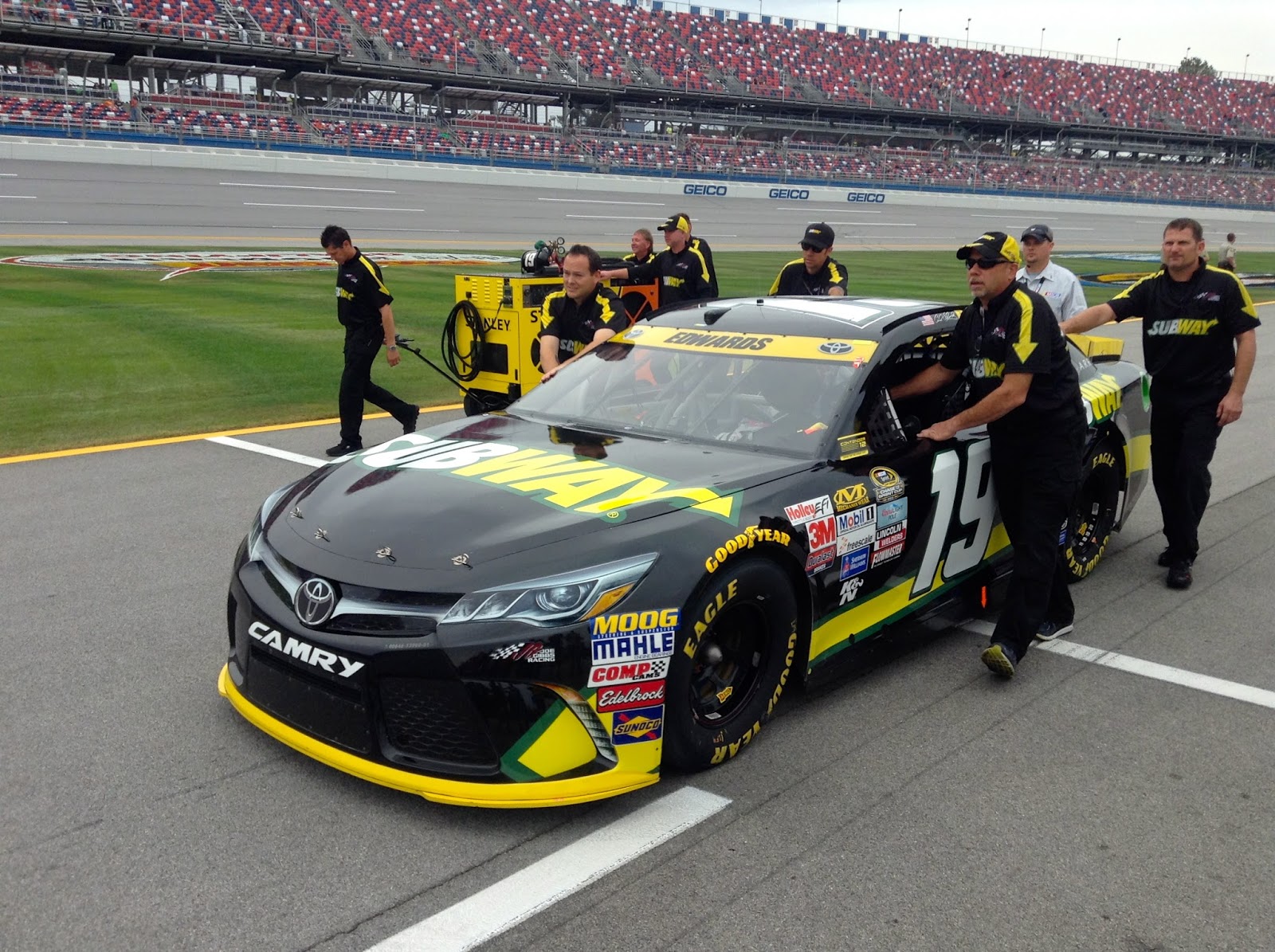
Rolling Carl Edwards' number 19 car into place for Sunday's race.
What Also Worked: Qualifying / Pit Pass

As much as I thought and think NASCAR races are a total waste of time and resources, there's a part of me that can get into watching, hearing and smelling a car hurtling around a track at almost 200 miles per hour. I mean I am a guy after all and I do own a sports car. I know there's something deep inside me that feels a small thrill when I feel the power in my 350Z as soon as I press down on the accelerator. And the vehicles we watched racing in Alabama have a lot more of that horsepower than my car does.

For me, the most valuable way to experience the power underneath the hoods of these cars ended up being during qualifying just after the super disappointing green-white-checker finish in the truck race. Qualifying is a pretty simple concept: each car takes two laps of the track and the car with the fastest second lap time gets the first spot in the race, or the pole position. The rest of the field stacks up behind the pole sitter in order of second through 43rd lap time.

The first lap average speed for the cars was about 150 miles per hour; the second lap was much faster, topping out at just over 190. There is something thrilling about watching a car drive solo around a wide open banked racetrack at a very high rate of speed that is very different to me than watching a whole group of cars all bunched up together in a pack doing the same thing collectively. The time for a 2-2/3 mile long lap by the way is less than 60 seconds. Wow! I'd sit through qualifying a lot if I lived near a track. But I'd probably skip most of the races.

Pit boxes in their pre-assembled form...
If you want to get a closer look at these machines, you can spend some time (and $50) a few feet from them if you invest in a pit pass, which allows you access to Pit Road prior to the Sunday race. And you can bet if I'm spending a bunch of money to get down to Alabama and rent an RV for a weekend, I'm forking over an additional $50 for a pit pass. After all, I spent over $100 just on shirts to make me seem like a credible race fan for this trip. No way was I missing out on this experience. Even though I expected it would be a total waste of money. And like my expectations for an exciting race finish, I was wrong again. It was so worth it. Those were words I never thought I'd write.

If watching the cars race around the track from a distance in qualifying was awe inspiring, seeing them up close doing absolutely nothing was equally enlightening. On the outside, these things are precisely engineered works of art. There are small fins, spoilers and other sorts of clear plastic attachments all of which (I'm sure) are designed to minimize air resistance and maximize performance. On the inside, they are pretty much completely empty. There are of course no dashboards with things like CD players and GPSes (I mean why would you need it to turn left 564 times?) but there are also no back seats, no passenger seats and no speedometers. I knew some but not all of this before I set foot on pit road but it was still pretty cool to look inside the cars. They are literally just built to go as fast as possible around an oval-ish track. That's it.

The other part of the pit experience that was fascinating to me was the opening and construction of the pit boxes. During the race, each team has an assembly to the left (as the car travels) of their pit area with a raised platform for the crew chief to coordinate race activities for their driver, including communications, repairs and strategy. On the platform with the crew chief are a series of monitors, satellite receivers and some chairs among other things; below the platform is a box which holds all the tools the crews need to repair vehicles during pit stops.

I assumed these assemblies were delivered to these spots in their race ready form but that's not true at all. Each crew's area starts out as an approximately four foot by eight foot by six foot high box and everything that goes into making the assembly for the race is inside this box. And by that I mean everything. The platform and canopy that sits on top of the box, the monitors, the antennas, tools, ladders, American flags and lots and lots of advertisements. It was like a super complicated puzzle packed into a little container. I guess doing it this way is easier to transport but it was for sure a ton of work to put these things together.


and now fully assembled.
What Really Didn't Work: The Flag

The flag I'm talking about here (which I will not post a picture of) is the red one with the blue diagonal cross with a bunch of stars, otherwise known as the Confederate flag that the seceding states adopted as their national banner during the Civil War. Now in case we need reminding (and please don't debate this without thinking about this thoroughly), the war between the states in the 1860s was purely about slavery, which is of course about one group of people (rich white men) owning another group of people (black men, women and children) as property to be bought, sold, worked, killed or whatever else they chose to do. It's a disgusting and hateful concept.

NASCAR is a sport rooted deeply in the south and southern culture which is of course precisely why I wanted to watch a race in Alabama. Earlier this year, NASCAR to its credit banned the Stars and Bars at all of its racetracks. But understanding there's only so much enforcement that can go on in a property in the south that covers many many acres, I expected to see one or two of these flags here and there. But I'd like to throw out some thoughts for the owner of the flag which had "Heritage Not Hate" written on it which I saw on my way to the shower at the track each morning.

I get that people are proud of being southern. There's something powerful about identifying yourself with a local region of the country; we see people everywhere who do that, whether they are from the west coast or the midwest or California or Boston or New York or Hawaii or anywhere else. The United States is an incredibly diverse nation in many ways and each part of it is worth celebrating. But picking a flag invented by a group of rich white men committed to preserving slavery is probably not the way to celebrate your culture and heritage. I don't think slavery is what the modern south is about, but to some people, that flag will justifiably never mean anything else. I just wish there was some other way that person could express their southern pride. That's probably enough said on this subject for this little post about my vacation.


In October 2015, I watched my second NASCAR race in person. It was way different and way better than my first race in Dover, Delaware in 2002. I still spent four hours or so with a bunch of race crazed drunk 20s to 50s white men sitting outside in the stands but it took a lot less time to get on the road than the four hours it took at Dover, mostly because we were able to leave the next morning. Our time at Talladega lasted from Thursday afternoon to Monday morning and it was not a completely forgettable experience.

I'm glad I went down south to watch this race and to spend time with good friends for a few nights in an RV. But just like I resolved in 2002, I swear I'll never go back to another NASCAR race again. We'll see how strong my commitment to that statement is this time. If I make it just 13 years without going, I'll live with that. But if I ever do get convinced to make it to another one of these things, I'm renting an RV and I'm buying a pit pass. And no way am I missing the qualifying. And I'm bring these guys below with me. Onward!

Tuesday, October 20, 2015

Elephants


Most people seeking some up close and personal wildlife viewing in the area of the world where Zimbabwe, Zambia, Botswana and Namibia come together at a single point are there to see African elephants. After all, the area within and around the Chobe National Park in northeast Botswana serves as the habitat for about 25% of the planet's population of these animals. According to the World Wildlife Fund, the global African elephant population is about 470,000. The Botswana Department of Wildlife and Parks claims 120,000 of them live within the vicinity of the Chobe National Park. In late August of this year, I made my own trip to that part of the planet to see what I could find.

Despite the numbers in our favor, which I knew pretty well ahead of setting out for Africa, I was hoping I'd see at least one elephant. Just one. That's all I needed. It was for sure keeping my expectations low so I thought I wouldn't be disappointed, similar to me hoping to see at least one bison in Yellowstone National Park four years ago and at least one alligator when I visited Florida's Everglades National Park last year. In Yellowstone we saw tons and tons of bison, and alligators were all over the place in the Everglades. I really hoped my low expectations bar would be greatly exceeded this time too.

It was. No surprise there. We saw our first elephant crossing the Zambezi on a sunset cruise on our second day on the continent and we couldn't have been more excited. Now, I know these animals are big, bigger in fact than any other land animal today, but it walked through the river as if the current wasn't even there. I wasn't prepared to see that kind of strength in an act so simple as walking. These things are really really powerful.

Our sightings didn't stop there. The next day we were sitting at our lunch table on the houseboat that we called home for the middle two nights of our trip and happened to look towards the bow and saw what to us seemed like an astonishing number of elephants. They stretched as far as our eyes could see. It was like that scene in Jurassic Park when Alan Grant first sees the dinosaurs that have been recreated by the park's scientists. There were herds upon herds of animals. And this was the start of the really good part of our trip.


From our lunchtime look forward to the last morning game drive we took in the Chobe National Park, we saw lots and lots of elephants everywhere. We saw them in the water, in the bush and on the grassy islands that appear in the middle of the Chobe River during the dry months. We saw them from big boats, small boats, trucks, the front porch of our tent at the Elephant Valley Lodge and our dinner table at that same property. We watched them walk, swim, eat, drink, growl at each other, squabble, give themselves dust baths, flap their ears and protect and nurture each other. We learned more about elephants in our six days in Africa just from watching and listening to them than I could have ever imagined.

I like to think that I've seen a lot of elephants in zoos in my life and that I would know a thing or two about them, but there's nothing like sitting on a 15 or so foot boat with the motor killed floating just off shore near a herd of elephants to make you pay attention to detail like you never have before. It's so quiet on the river and these animals are so accepting of our presence (while also being wary of us) so you can get super close and look and listen.

We spent about 20 minutes on our first day on the Chobe River watching a herd eat. They methodically pulled the grass out of the Earth, gently but firmly shook all the soil from the roots and then ate. And repeated. Over and over again. The next day we spent about the same amount of time watching and listening to an enormous group drink from the river just before sunset. All the elephants large and small did the same thing (although the smallest were admittedly learning), slurping water up their trunks and then opening their mouths and squirting the water from their trunks down their throats. It was amazing to hear all that in the calm of the late afternoon.


We got lucky on the timing with our family of drinking elephants. We pulled up just as they made their way to the riverbank and stayed until they retreated into the bush. My use of the word family is not an accident. These elephants arrived and left as a unit following the matriarch as a herd. In fact, every herd of elephants we saw go anywhere traveled as a group. Sometimes there would be a lone male along the riverside seeming to protect the herd's flank (in fact I think that's exactly what it was doing) but for sure all the elephants we saw traveled in families.

And just like families, the dynamic within the herd was fascinating, especially around the watering hole near our last stop in Botswana at dinner under the illumination of a floodlight attached to a tree. We were there two nights and, judging by the distinctive tusks of a couple of the bulls, saw the same animals both nights. They visited our watering hole to drink the fresh water from the underground water line the Lodge had installed and to eat the seed pods of the nearby camel thorn trees which elephants apparently love.

Each night the drama played out the same way. The dominant bull and the babies generally received preferential spots at the water before the male moved on to pinch as many of the seedpods as possible, just picking up one after another and popping them in his mouth. Next up were the female elephants who were allowed to drink under the watchful eye of the bull. Each herd we watched had several younger males and every so often they would receive warning growls from deep in the belly of the bull or if they got really too cheeky they would get a nudge, poke or shove. Some of these seemed like legitimate tests of authority and some challenges were punished. Most of the discipline came not through violence but through what appeared to us to be a self imposed "time out" from the challenger, usually turning his back on the herd and remaining there stationary for a few minutes before turning and re-joining the herd. I could have stayed up all night to watch this sort of show if it weren't for the 5:30 a.m. game drive the next morning.


Finally, since I mentioned zoos earlier in this post, I can't finish my story of Africa without an appeal that surely won't be heeded anytime soon. From the first time we saw a herd of elephants moving deliberately but swiftly over the grassland in Namibia to the moment we watched the final departure of a herd at the watering hole, two things were obvious to me about elephants that will not allow me to ever enjoy seeing these animals in captivity again.

First, it seems to me that it is impossible to capture enough land in a zoo or small park to ever duplicate an elephant's natural environment, let alone a whole herd. Without sitting there and watching, you can't imagine how much territory these animals cover in a short period of time. They need vast tracts of open grassland to move through, not small pens or enclosures of an acre or two or four or slightly more. They need thousands of acres. Like miles and miles and miles of land to walk.

Second, most zoos I have visited have two or maybe three elephants. If you get lucky, perhaps there's a baby. And who doesn't like baby elephants? But a family of elephants this will never be. Elephant herds are complex societies and the individual members each play a role in the herd's dynamic. I can't remember any group of elephants we saw that was smaller than 12 or 15 animals and I can't imagine seeing a couple or three in captivity without feeling sadness for the animals. I wouldn't want to be forcibly removed from my family, why do we continue to do this to these creatures?

I get that zoos have played important roles in allowing people to see different species of animals from all over the world and some have been critically important in protecting species that would otherwise be extinct. But there is absolutely no reason on Earth from what I can see that African elephants need to be confined anywhere in the world. There are thousands of them roaming free in Botswana and that's where they really belong. Only in these open spaces in complex family groups can they really be free. I know it's incredibly selfish for me to write these words since I was lucky enough to travel all the way to Africa to see them in person, but after spending four plus days in and around these creatures I can't imagine them anywhere else. I feel so privileged to have been able to see them and I hope I will again.


Wednesday, October 14, 2015

Game Drives


After two nights in Victoria Falls, Zimbabwe and two nights on one of the Ichobezi Safariboats on the Chobe River, our last stop on our quick southern Africa trip was at the Elephant Valley Lodge in Botswana. To that point our trip had been working out perfectly and we were excited to get to see what kind of wildlife watching we could get in on land rather than from on the river. Although in all honesty we couldn't imagine the game viewing being any better than it was from a small boat with an outboard motor that allowed us to get within 20 feet or so of elephants, crocodiles or Cape buffalo.

We were handed off from the Safariboat to the Lodge at the riverside immigration office in Kasane in northern Botswana and were loaded into what looked like a pickup truck on steroids with three rows of seats and a canopy welded to the flatbed portion of the vehicle. After convincing and re-convincing our driver that we actually did only have a single backpack each with us (traveling light on this trip), we were off, down paved roads for about 30 minutes before turning left onto a dirt road (later called "African asphalt" by our guide, Daniel) which we would come to find was going to be the type of road we would spend most of our time on for the rest of our trip.

Following lunch and a few hours of relaxing at the Lodge, it was time for our first safari drive. After hopping back into the truck, avoiding the back row of seats which we were promised would be bumpiest (Daniel calls this experience the "African massage") and driving about 30 minutes over African asphalt, we made it to the gate of the Chobe National Park. After boating along the outskirts of the park the previous two days, we were finally heading inside.


The Chobe National Park is a fenceless park. The government of Botswana has set it up this way deliberately so as not to disturb the natural range of the animals which live in and around the Park. In that capacity it is different than some other national parks in southern Africa which are fenced game reserves, presumably arranged that way to prevent wildlife incurring on nearby human settlements. But while the animals are free to come and go 24 hours a day, vehicles are not. Drivers are required to check in when entering the park and there's a 6:30 p.m. (in winter when we were there) gate closure. And gate closure means gates locked. Find an African asphalt road out if you can beyond that time.

Our first foray into the park included a packed vehicle and by and large these were the same people (including our guide but with the exception of one group of three Britons) with whom we would take all our game drives over the next couple of days. This arrangement is deliberate and it became obvious why by our second outing. If you mix and match groups of people and guides randomly each time, then their priorities can more naturally conflict. Staying together on these drives time after time allows the guide to head to a location in the park where all the tourists want to go. Animals seen in one trip en masse can simply be bypassed in a later trip. It makes a whole ton of sense.

It also becomes obvious pretty quickly that by far the biggest influence on your game viewing experience is your guide, so hooking up with a good one is essential. Get a timid guide or one who doesn't properly communicate with and gather information from other drivers (the "bush Google") and you could be sunk. Our guide Daniel was fantastic. He'd been driving through the Chobe Natonal Park for years and years and really knew where each species of animal congregated at whichever time of day we happened to be in the park. He also got some big props from us for knowing the genus and species of each animal. I realize it's his job to spot creatures but that part was pretty impressive nonetheless.


So now that we know about the Park's closing time, African asphalt, African massages and the bush Google and a little bit about our fellow passengers, we entered the Park for real. Our first trip into the Park was sort of a variety show. We saw most of the herbivores we could have possibly seen either from far away or very much up close: giraffes, elephants, Cape buffalo, waterbuck, impala (the "McDonald's of the bush" due to the fact that they are everywhere and a pretty good snack), sable antelope, kudu and hippos.

It is amazing to me how close we could get to these animals in a car. I found some like the giraffes and for sure the sable antelopes to be pretty skittish but if you are sitting still in the car, impala and kudu grazed feet from our open-sided truck like they didn't have a care in the world. Of course towards the second half of our first drive, a herd of these same two species continued to eat even though some of their family members were warning the whole herd of a leopard or some other predator nearby. Nonetheless, being able to watch from ten feet or so away was incredible. This for sure is not a zoo.

If we had any skepticism about the game drives being better than the boat trips we'd taken the previous two days, that doubt evaporated pretty quickly. There are two distinct advantages to being on land. First, there are far more of some sorts of animals away from the water than near the water. This proved especially true of giraffes. On the boat, giraffes were a cause for some serious excitement; on land, they seemed to be everywhere and they are much more impressive up close than from a distance. The second reason that land excursions were better than boat rides for us was our ability to follow. If an animal heads inland from the water's edge, there's no way you are following in a boat. If an animal decides to head away from you on land, there very often is a way to follow. This proved especially true on our second and third drives.

The McDonald's of the bush, grazing obliviously to any sort of danger.
Driving through the Park is not for the faint of heart or for the ill-equipped driver. None of the roads inside the park are paved and most at one point or another become very sandy or are quite steep and rocky. Most are one way and passing another vehicle which is stopped to view animals involves getting at least one side of the vehicle off the road and into the edge of the bush, which is a couple of feet higher than the main path, causing the vehicle to tilt sideways. There's no question you need a real four wheel drive vehicle with big tires. I couldn't contemplate driving any car I've ever owned anywhere we drove those couple of days.

If I needed any more proof of how inadequate some vehicles would be inside the Park, it came on our way out of the Park on our first drive. It was about 6:15 p.m. and we were about ten minutes away from the Park exit when we passed a "four wheel drive" Hyundai stuck in the sand. And by stuck, I mean buried up to its axle. When we arrived the owners of the car were trying to push it to more solid footing with the help of all the passengers in a nearby safari truck which had stopped to help.

From my view on the side of our vehicle right next to the Hyundai there was no way this thing was moving without another vehicle to tow it. And we didn't have the time or capability to tow this car with no rope on hand. Despite the request of the car owners, we didn't stop. We'd be late if we did and there was nothing we could do anyway. So Daniel told them we'd let the staff at the gate know and we took off. I don't know what happens when someone is stuck this close to closing time. I imagine they spend the night in the park but I really don't know. I just know I'd never think to take something I can rent onto roads like that.

A family of elephants heading away from the river and into the bush towards sunset.
If our first game drive was all about getting an overview of the Park and seeing a variety of species, our second (in the afternoon / early evening) and third (really really early the next morning) drives were all about one thing: cats. We all agreed we'd skip everything non-cat we came across on both of those last two drives in exchange for a good sighting or two of lions or leopards. We were all in. Let's go! While the leopards ultimately avoided us, Daniel would not disappoint with the lions. Not at all.

Cats are way more difficult to spot in the bush than the herbivores and there are a few reasons for this. First and most obviously, there are way more animals that eat plants wondering around than there are cats. The herbivores are essentially the grocery store that feeds the cats. There have to be tons of them around to feed these animals. Secondly, the cats are generally more shy; whereas impala and kudu rely on numbers for safety and elephants and giraffes are just bigger than any other animal to keep predators off, lions and leopards tend to just stay out of the way of anything (i.e. humans) that might kill them. And finally, these things blend in very well with their environment. The lions we found were pretty much the exact same color as the grass in the bush. If they were standing still, it was near impossible to see them.

But thanks to Daniel and the bush Google, we did find lions. First from afar and then way up close. Our searches for lions also produced our second and third "scare the tourists" moments, although just like our first one with hippos, these were not staged and they both worked out OK. But they could have gone wrong.

Early morning lion hunting (with cameras, not guns!). The shadow is our car's. These things were close.
Our afternoon / early evening lion hunt turned out to be mostly an exercise in frustration and patience. Our first lion encounter turned out to be a long distance viewing of a mated or mating pair of lions who were lying in what was likely some sort of depression behind a stand of trees. And if that sounds like we didn't get a good view at all, you are correct. We got a glimpse every so often of the lion's maned head each time he chose to pick it up off the ground and could from time to time see the lioness' tail swishing back and forth in the air. Legitimately, we could only see these animals when they moved and this went on with us standing still for about 35 minutes, from just after 5 p.m. to about 5:35 p.m. I know this because I have a series of photographs in that span showing a dark blob in the distance behind some vegetation. I couldn't even begin to post those here. They are not clear at all.

Eventually, we got tired of this exercise and recognizing how deep we were in the Park, we had to head towards home. Maybe we'd find some other species on the way out. And we did. Four or five giraffes, a couple of angry looking Cape buffalo and a small family of elephants. But when we reached the elephants, we stopped and turned around. Daniel had received a call on the radio telling him that a herd of elephants was likely going to pass close to the two lions we had been watching and might flush them out. It's about 5:55 p.m. at this time and we took off back into the Park, hoping to catch a better look.

We did, but not much. We definitely saw the male leaving his hideout and after circling around the entire area on some side paths, we finally got a decent, although still very far away, view of the two lions lying by themselves in the bush. It was way more exciting that waiting for a head to pop up between trees for a half an hour but it was not a spectacular encounter. Still, I could now feel good that I'd had a fairly respectable look at the most fearsome carnivore on the continent.

The problem? It was about 6:05 p.m. and we were about a 45 minute drive from the gate. Now we are in to "scare the tourists" territory. 

We took off at what seemed like a breakneck speed over the uneven and rocky African asphalt although it was probably only about 35 miles per hour or something like that. Most creatures got out of our way in a hurry. We scattered impala, sable antelopes and got some worried looks from an elephant. We even managed to get a Guineafowl to flap its wings to get out of the way, although the one hippo we passed looked too confused to move. We opted for the African massage seats on this trip, which was a great idea until this race to make the gate because it is seriously rough at the back of these trucks. We found gripping the overhead bars and letting the car bounce us out of our seats worked the best.


At about 6:28 p.m. Daniel turned towards us while somehow still driving and informed us "Two minutes. we are going to be late, but not too late." What the heck did that mean? The gate closes when it closes, right? I mean the Lodge could send another car to get us but this one's staying in the park tonight, right?

Maybe not. Daniel continued talking, letting us know that the best thing to do would likely be to say we had a flat tire and that we got delayed because of it. BUT…don't let them see your phones or cameras. Sounds sketchy but I'm all for anything that gets us out of the park.

6:40 p.m. We finally reach the gate and sure enough, it's locked. And there's nobody around. Now what? Before we knew it, Daniel hopped out of the driver's seat and left us, telling us as he walked away "keep an eye on me in case I get eaten." Har har. Seriously?

Five minutes later, Daniel's back with a key to the gate and we are gone. It pays to have a good guide, I mentioned that, right? I hope if anyone that's reading this post gets one like Daniel. Not only did he get us a maximum viewing experience, but the trip out of the park was a blast. The back seat is the way to go. Way better than a roller coaster. And one more thing…let's get going early the next morning. Like 5:30 a.m. Daniel hates being the second car in the park. And we had more lions to see.

Lions on the hunt.
Our game drive the next morning was literally one of the most amazing experiences of my life. As a kid growing up in England, I couldn't have imagined viewing lions up close in an open-sided vehicle in Botswana. But that's just what happened. I'd never been particularly enthralled with lions before. I am now. In a major way.

If the previous evening's drive finding lions at a distance was exciting, what we found the next morning made that experience completely pedestrian. We found a lioness with four cubs at a distance and watched them walking through the bush early in the morning and longed for a closer look. But about 15 minutes later we got our signature lion experience that will stay with me the rest of my life.

We came across a pride of six lions with about twice that many cars around them that morning at about 7:15 a.m. This is a big part of the reason we came to Africa. I'd never really considered the lion a powerful animal but that impression changed for sure as close as we got that day. These things are all muscle and they are huge. And we got really really close. At one time, I was about 15 feet away from the nearest lion. I can still remember how orange their eyes were as they walked seemingly directly towards me. I fall out of that car or make the wrong move at the wrong time, and I'm done for. We kept the engine running to keep the smell of humans from the lions and I guess that worked. Over the past few days, the only time we hadn't cut the engine of our car or boat was when we were near hippos. That tells me a lot. Lions and hippos were the only animals we didn't view without the engine running.

At our first encounter, our pride of six lions seemed to move about randomly. Who knows, maybe they were groggy and just waking up. But after a bit, they seemed to get organized and started to move in formation from the right side of our vehicle to the left, striding purposefully between the fleet of trucks with admirers with what seemed like a singular focus. We followed and soon found out when we saw a herd of impala (McDonald's of the bush) that the lions we found were hunting.

Closing in on a herd of impala. Past the trucks and with real purpose now.
I'll spoil the ending and let you know right now that we never got to see the kill. The people we were traveling with had to catch an early-ish flight so we stopped watching mid-hunt. But this was impressive. Of the six lions in the hunt, one took the lead, approaching the impala straight on, while two others flanked the herd from the left side and three other lions lay down in the lion-colored grass waiting for the herd to be flushed towards them. It was incredible strategy that surprised me. I'd never seen a pack animal hunt before. They really do know what they were doing. This was way better than some nature special.

Watching lions hunt is not a particularly good spectator sport but for someone who had never seen this sort of thing before, I didn't want to look away. The anticipation is a killer. They are so careful and deliberate, I suppose knowing any sort of sudden movement would be spotted. Eventually we got to the point where the lead lion, who had crept up so stealthily towards the herd, sat up and revealed herself to the impala. When this happened, all the impala watched her and only her, oblivious to the two lions creeping around their flank.

But we had to go. I would have loved to see what happened. I'm not a particularly morbid sort of person that wants to see animals die but witnessing the entire hunt would have been such a rare privilege. The experience stuck. I didn't necessarily want to see a lion take down an impala or two, but my trip would have been more complete seeing that. I can't imagine a better way to spend a Thursday morning in Botswana or any other day of the week for that matter. I want to return to Africa and I want to be in the back of an open-sided truck tracking down lions and other sorts of animals right now. If I wondered if seeing animals from land was better than from on the water, I don't now. Now I know. I will never forget this.


But that's not all.

Early in the morning before we had our incredible lion encounter, we had our third and final "scare the tourists" moment of our trip. The part of the Park we visited that morning to see lions was pretty remote. We had to drive a good distance to get there as the sun rose. And as it turns out, the sunrise wakes a lot of animals, including an enormous hippo on the left side of the African asphalt on our way to the lions. As usual, we stopped the car so we could get a good look and planned to get going again when the animal disappeared into the bush, heading for the safety of the river no doubt.

Only we didn't get going. The engine wouldn't start. Great! We get up early to meet Daniel at 5:30 a.m., managed to be in the first wave of cars into the park and we are stopped dead.  How are we going to get to see more animals. But more importantly, we are stopped dead in a vehicle in the middle of a park full of wild animals, including potential man-eating lions. What the hell are we going to do?

The answer…push.

Yep, that's right, minutes after we chased a hippo off the path we were asked to get out of the car and push. The same sort of hippo that we were terrified of on the Chobe River which provided our first "scare the tourists" moment of our trip. On our way to find lions. Lions, for God's sake! Us seven tourists were expected to get out of the car and push until we got moving enough for Daniel to pop the clutch and get the engine started, just like Daniel LaRusso and his mom did with Ali (with an "i") in the driver's seat on the way to Golf N Stuff in The Karate Kid. Only they didn't have wild animals all around them.

It didn't work. Not at first. Somehow we got another car to stop and help us and those three people were the tipping point, moving our vehicle fast enough backwards to get some speed to pop the engine and we were off and running again. If you had told me before I came to Africa that I would be locked inside a game park and the very next morning that I'd have to deal with an inoperable safari vehicle, I might not have come. But having done all this with no advance warning and having it all work out not just fine but spectacularly amazing, I'd do it all over again. And I might. But I want a good guide.

Thursday, September 24, 2015

Chobe Riverbank Trees


Last month, I took a trip to Africa to see Victoria Falls and the animals I came to love from visiting zoos as a kid in England. OK, so maybe Vic Falls was a detour to someplace that I couldn't miss since I was in the neighborhood; it was mostly about the animals. And I was not disappointed. I got to see a ton of them over the six days we spent in Zimbabwe, Zambia, Namibia and Botswana. It changed my perspective on so many things, and not just about the creatures we saw there. I couldn't have been happier with my latest trip of a lifetime.

We saw wildlife last month from hotel room balconies, front porches of tents and decks of houseboats in addition to passing them a few feet away in the streets of Victoria Falls. But the best up close and almost personal game viewing came from either the back of a modified souped up pickup truck (it really was so much more than that…) or a small 12 to 15 foot long boat equipped with an outboard motor and a cooler of water, sodas and plenty of Tafel beer. It was our time in the small boat that was perhaps the most rewarding of the six days we spent on the dark continent. 

We were in a small boat on a river because we spent our third and fourth nights in Africa on one of the Ichobezi Safariboats cruising up and down the Chobe River which defines the border between Namibia and Botswana. One of the perks of staying in the four cabin houseboat is the exclusive use of one of the tender boats tugged behind the big boat which you and your pilot (David, in our case) could take out a couple or three times in a day to get a close up look at elephants, Cape buffalo, crocodiles and whatever else happened to be on the banks of the river. Not hippos though. We kept our distance there.


Our first trips on the tender boat were all about getting to see the largest possible mammals we could find. Get me to some elephants (check), giraffes (check) and hippos (check and run). We had no time or patience for birds (we can see birds at home), baboons (saw them in Victoria Falls) or anything else. Get us to the good stuff. And David did. We spent some incredible time watching families of elephants graze and some nervous seconds fleeing from a chasing adult male hippopotamus. 

The time we spent on the small boat was so precious and such a luxury. And thankfully we got a lot of it. After our first two hours on day one, we spent over six hours on three separate excursions the next day in addition to a quick journey the day we left the houseboat behind. We were lucky to spend so much time right on the surface of the water and close to the riverbank that we started to appreciate more than just the large mammals and reptiles that we traveled for longer than a day to reach.

By the third tender boat trip on day two, we wanted to find kingfishers in the reeds near the water's edge and African jacanas (or Jesus birds) walking on the lily pads that floated near the shore. We also sought out monitor lizards and vervet monkeys and kudu and puku and spoonbills and vultures. And in that time, I started to look at other living things on the riverbanks like the trees. And I realized that the trees there are absolutely incredible.

A family of kudu and a couple of baboons by the edge of the Chobe River.
We visited southern Africa in the fourth month of five straight without rain. The water we traveled on was therefore really low; so low in fact that a lot of the land we cruised by and watched wildlife standing on would be covered by water during the height of the rainy season. And not just by a bit. the water level in the Chobe River was a good six feet lower when we were there than it would be a few months later.

The banks of the Chobe are made up of a thin layer of soil covering a base layer of hard basalt rock and the trees that grow there use the soil and the water in the soil to grow large. When fully grown, the trees there are 50 feet or more high and provide shelter and habitat for the animals that live on and drink by the shore of the river. But each time the river rises, it washes away some of the soil that covers the layer of rock that is invisible beneath the bank of the river and it takes away what is sustaining these ancient trees on the edge of the river. 

Eventually, the trees nearest the bank of the river are stripped of what gave them their existence, their roots are fully exposed and they are left clinging to the basalt underlayment for dear life. When you cruise by the trees on the shore you can see their desperate struggle to stay upright. They are literally grasping at everything they can hold onto. Eventually, the beautiful scene of these decades old majestic trees is going to come to a tragic end. They collapse and end up providing a new habitat for monkeys and reptiles at the river's edge. Ultimately nothing in Africa is wasted. I found these trees just fantastic to look at. I hope someone reading this post will also and maybe appreciate them on a trip of their own in the future.


This tree eventually lost its battle to survive...
and provided a sunning spot for a Nile crocodile.