Thursday, April 24, 2025

Ramen


The last time I spent a week or more in Japan, I came home and wrote an almost unconscionably long post about all the food we ate: gyoza, sushi, French pastries, okonomiyaki, convenience store food, Japanese omelets, so much more. Japan is a food paradise, with so many incredibly delicious types of food which are (with the possible exception of high-end sushi omakase meals) mostly super cheap and abundantly available. I'd rather eat in that country than any other place I've ever visited. Greece was maybe close, but maybe not so much at all now that I've just visited Japan.

I am not going to write a giant, comprehensive food post to wrap up our 2025 Tokyo trip. Part of the reason I'm not going to do that is because the trip was shorter and we didn't quite get to the full range of food types we would have liked to have sampled. But the larger reason is we decided to spend more time this trip focusing on one of Japan's most famous dishes: ramen. And I AM going to write a blog post about that.

Chicken ramen, Tokyo.
Let's get some ugly truth out of the way right away, shall we? Before I visited Japan in 2017, I had never eaten a bowl of ramen. I'm serious. Not a one. Not even instant. 48 years old and not a single bowl of the stuff. Not even in college when my fellow students were possibly eating Maruchan Ramen and Cup O' Noodles as about the cheapest form of sustenance they could find. I was utterly and blissfully unaware of the existence of ramen.

Shall we talk about more dirty truths? And this one may be a little more scandalous...ramen is not really a Japanese dish. Seriously. Shocked? Those ramen shops you see all over Tokyo and other cities all over Japan? Not using noodles that were invented in country. The broth tradition might have been developed over the better part of two centuries in Japan. But not the noodles. No sir, no way! The noodles are Chinese all the way. Like mid or late 19th century Chinese.

Now you might be thinking here...am I telling you that the Japanese didn't have noodles until they started importing Chinese-made ramen in the 1800s? No, I am not. Udon and soba noodles were developed in Japan. But ramen noodles, which are made with lye water, are a Chinese invention. And while there may be one-off stories of individual Japanese people partaking in Chinese ramen dishes all the way back to about the year 1700, the large scale introduction of ramen to Japan started in 1858, when Japan eliminated a 200 year old ban on foreign visitation and opened its ports to the world for trade and foreign relations. And part of that trade involved the importation of Chinese ramen noodles. And Chinese cooks. Japan was ready for the birth of ramen.

Reconstruction of the restaurant Rairaiken, Japan's first ramen shop.
The demand for ramen dishes in Japan was initially driven by the nation's Chinese immigrant population, most of them students sent to study in Japan. With Chinese people came a desire for Chinese food, including noodle dishes. As noodles were made and shared in Japan, the knowledge of how to make Chinese noodle dishes started to spread beyond the Chinese community. 

In 1910, Japan's first ramen shop, Rairaiken, was opened in the Asakusa neighborhood of Tokyo. The owner was Japanese but the 13 cooks he hired were all Chinese. Finally ramen was available to anyone who could afford to spend a little money and buy a bowl. But the dish was still very much Chinese in flavor and conception. 

Then in the 1920s, the first ramen shop in Hokkaido was opened by a man named Shoji Ohisa to sell noodles to the 180 or so students enrolled at Hokkaido University. Ohisa started to work with his Chinese cook to make a lighter broth of pork and scallions to pair with the popular noodles. Finally, ramen started to develop in a serious way and in a Japanese way. The lighter broth appealed way more to the Japanese palate.

The word ramen, by the way, was apparently borrowed from a noodle shop called Hao Ra Men, a phrase of mixed Japanese and Chinese origin meaning "the noodle dish is ready". So appropriate that the dish which is Japanese and Chinese was derived from a phrase mixing the two languages.

Ramen at Tsuta, the world's first Michelin-starred ramen shop.
How do I know all this? Why is my knowledge of the origins of ramen so encyclopedic, you might ask? Well...it's not really. You shouldn't be impressed. It's not like I did a whole bunch of research or anything like that. We just prioritized a visit to Yokohama's Shin-Yokohama Ramen Museum. Ramen museum, you say? Is there really such a thing? Ummm...yeah, there is. I mean, it's Japan. And amazingly, it's not alone. But we'll get to that.

The top (ground) level of the Ramen Museum features a wall chronicling the history of the development of ramen along with other ramen-related graphic displays; some replicas of historic moments in ramen history (first Japanese ramen store plus a ramen cart); the gift store; and a spot where you can assemble your own custom-flavored instant ramen bowl to go. The lower level of the museum contains the museum's star attraction, a series of historically-based ramen shops which have either resurrected famous lost ramen recipes or which collectively trace the development of ramen over the decades through different concoctions of noodle dishes. The bowls of ramen are smaller sized bowls to allow you to try two or three different flavors of ramen on your visit.

The history display, by the way, goes all the way up to the 21st century, covering how the post World War II black markets popularized complex ramen dishes made with throwaway parts of animals and vegetables which forced greater effort to develop that umami; the development of instant ramen by Momufuku Ando in 1958; and all the way up to the issuance of the first Michelin star for a ramen restaurant (Tsuta) in 2015. Momofuku Ando later developed the Cup Noodles product (known in the United States for a while as Cup O' Noodles) which I referenced earlier in this post. And if you want to know more about that whole thing, there's also a Cup Noodles Museum in Japan and it also happens to be in Yokohama. Bonus!


The world's first instant ramen (top); and statue of Momofuku Ando holding a packet of Cup Noodles.
So about that lower level ramen shop main attraction in the Ramen Museum. Yeah...we didn't do that at all. Skipped it entirely. Didn't even order a single bowl of ramen. It sounded really good. I was pretty intrigued to try the resurrected recipe from Rairaiten (it's now closed) but we never even ordered. We were too full. Couldn't eat another bite.

Why would we show up without an appetite to a museum about ramen whose star attraction is consuming ramen dishes throughout history? We didn't, I swear. The Museum actually has one more room in it where you can participate in a make your own ramen class. Which of course we had to do. And after the class? Well...we ate the ramen we made. What else would we do? Am I sorry we missed out on all sorts of different ramen in the Museum? Sure I am. But when else am I going to make my own ramen noodles? 

Full disclosure here, we only made the noodles. We didn't make our own broth or cook or own pork or even assemble the dish. Just the noodles in the class. That was enough.

The Shin-Yokohama Ramen Museum's historical food court.
So making your own ramen noodles in the Shin-Yokohama Ramen Museum takes about an hour. Maybe a little less. Add some ramen eating time and you are looking at just shy of a 90 minute commitment. Our class time started at 11:30 in the morning which was about perfect for lunch. And fortunately, it was conducted in both Japanese and English.

Ramen making at the Museum is a three step process: (1) make the dough and let it rest; (2) roll out the dough; and (3) cut the dough into noodles. The first part involved mixing our packet of spelt flour with our measuring cup of lye water or kansui (remember we are making ramen so we need the lye water) and then a lot of pressing and folding and pressing and folding while some small Japanese man yelled at us "no pain, no gain" and "I want you, I need you, I love you". With this last part I am fairly sure he was projecting what we should be saying to the noodle dough and not making a declaration of love to us personally. At one time I swear he said "te quiero" but I couldn't be absolutely sure. The yelling was not exactly stressful but it was distracting.

Two things about this step. First, I am not sure if there was anything other than spelt flour in the bag that we used. The dough we were making never developed any gluten so I assume ramen noodles are an un-yeasted product but I'm not sure there was even any salt already added into our baggies. Second, there are two options for flour type in the class: spelt and Japanese flour. But you are not allowed to request Japanese flour unless you have done this sort of thing before. And there's no faking it. You have to cite the prior class that you attended. I'm confident someone's checking.

Demonstrating the pressing of the dough. I want you. I need you. I love you. Te quiero.
Onto step two (after a 10 minute rest - for the dough, and us): the rolling of the dough.

I know what you are thinking: how exciting is rolling out dough? Oh but it is. This is the best part of the whole ramen making experience because we are not using any old handheld rolling pin for this step. Ohhhh no!!! For this ramen class, we are required to use the ancient technique of aodake-uchi, which involved the use of a giant piece of bamboo (the aodoke) to roll out and flatten the dough. And by giant piece of bamboo, I mean like 6-7" in diameter and probably about 5 feet long. A giant piece of bamboo.

The rolling out process is really just a flattening process. You lift and lower the piece of bamboo onto the roll of dough over and over until it becomes flatter and flatter. There's some folding in there but it's flattening after flattening here. You only use one end of the bamboo; the other end is jammed against a wall on the opposite side of the table with a piece of wood above it to prevent the aodoke from flipping over when you press your side of the bamboo lever down onto the table. 

If you need some extra leverage in this part, you can sit on the aodoke and bring more of your weight down onto the dough to get it flatter quicker and just plain flatter. I don't know really quite how to describe how to do this so in accordance with the "picture is worth a thousand words" axiom, I'm just going to show you in two photographs below. One professional and one amateur. It is definitely more effective to do it this way, assuming you don't fall over. I didn't.


After it's flat enough...cut the folded dough into noodles using a chopping board and a giant cleaver attached to some sort of ratcheting mechanism which moves the cleaver down the board and (in theory at least) gets you uniform and correctly sized ramen noodles. As long as you don't get your fingers under the blade, this process which sounds somewhat dangerous is really relatively risk free. 

However, it wasn't as foolproof as you might think on the ending up with uniform-width strips of dough front. I had a little difficulty with the dough remaining flat on the board so my noodles weren't as uniform as they should have been and I also clearly didn't jam the blade down on the board hard enough because I ended up with some noodles that weren't cut through. But...we didn't use all the noodles in the bowl of ramen so I could afford to use the best of the bunch and not worry about the rest. 

After we cut the noodles, we got to eat. I've cooked all sorts of food over the years for myself, including pasta on an occasion or two maybe, but I've added ramen to the list now, although admittedly just a part of the whole ramen experience. Was it worth skipping the Museum's signature food court-like attraction to eat our homemade noodles dipped into broth made by the chef in the noodle kitchen? It was. When am I going to do this again? I mean, sure, I can make ramen at home including the broth, the noodles and everything else, but I'm not doing it with a giant piece of bamboo in our kitchen at home. This was definitely worth getting away from sakura searching for a couple of hours to do. I'm honestly surprised at the lack of fancy technique to get from flour to cooked noodles but the self-advancing knife certainly helped a ton, I'm sure. 


Homemade ramen (top); outside of the Shin-Yokohama Ramen Museum (bottom).
Our lunch in the Ramen Museum was the third best ramen meal we had in our week in Tokyo. Any guess as to how many meals of ramen we had while in Japan this year? Hint: it's more than two and less than four. That's not to say that our museum-made ramen (which we certainly had plenty of help with) was not tasty or not good. It was. It was perfectly good and fine. But it was not the best ramen you can find in Tokyo, I'm sure. 

We did make a little bit of an effort to find some really good ramen and made a reservation at Tsuta, the aforementioned restaurant which was the first ever Michelin-starred ramen shop. It was certainly a cut above what we cobbled together in our late morning and early afternoon of pounding and cutting dough into noodles. The noodles were certainly way better and the broth was more complex and it was cool to watch the chef and sous chef working in the open kitchen assembling bowl after bowl. We both got the soy sauce ramen and it's going to sound somewhat stupid but the bamboo shoots here were awesome. 

Technically, Tsuta's noodles may be soba noodles but they use the term ramen so I'm jumping in that leaky boat and counting it as a ramen dish.

But Tsuta wasn't the best ramen we had in Japan this year either.

The best ramen we had in Japan. 
When we got back home, I asked Sophia what she thought was our best meal in Japan this year. She said the chicken ramen we got over by the Tokyo Tower after our day trip to Kawagoe. I agreed. It was a place called Ramen Thank Daimon and it was a chicken ramen place. I have no idea whether the name of the restaurant that I've just written is some sort of lost in translation name or if it actually is called Ramen Thank Daimon to Japanese people but the food and particularly the atmosphere was just incredible. This was the best meal of our trip, not the best ramen. Best. Meal.

I am quite confident there are tons and tons of places just like Ramen Thank Daimon all over Tokyo: small ramen shops which are probably mostly underground in long spaces with a kitchen in the back and an ordering machine in the front. And I am sure that most of them are really good. Open the door, punch in your order into the machine. Some ramen with options, maybe a large birhu or two and possibly a Calpis. Pay and go sit down where you are shown to sit, crammed into a space close to other patrons who are eagerly slurping down noodles out of (in this case) chicken-y broth.

This is absolutely the best way to eat ramen in Tokyo. There might be a wait but you won't wait long (we didn't wait but there were people waiting when we left). The dishes look well-used and the chopsticks are not wrapped in paper to be discarded after the meal but instead look worn smooth by thousands of cycles in the dishwasher. And there are even paper bibs to help with the splashing of the broth. The ramen is hot and delicious and if you are lucky, it's a bit cold outside and the hot dish will keep you going with warmth in your belly until you make it to the Metro.

And on top of all that, it's cheap. We have a couple of favorite ramen shops in the D.C. and New York areas but they don't have the same feel as underground ramen joints in Tokyo. There's nothing like them. I will always go for ramen in Tokyo or any other city in Japan. And don't think I'm done with Japan by any means. 

We went to Japan. We ate ramen. We made ramen. We love ramen. Until next time.

Toothpicks. Ramen Thank Daimon, Tokyo.

Friday, April 18, 2025

Haiku


When we visited Ireland in 2019, we passed a sign directing us to the town of Limerick, the ground zero of the short form poems that seemed to be the easiest poems to remember when I was a kid. We didn't actually visit Limerick on that trip, but the sign inspired me to write my own version of the town's eponymous poem. It seemed like a fun thing to do at the time.

So now it's 2025 and we've just returned from our second real vacation to Japan. Like Ireland, Japan is also an origin point for a short form of poetry: the haiku. I figured since I delved into poetry six or so years ago, why not do it again this year. If I was inspired by Ireland to write a poem, I pretty much have to be by Japan, which is one of my favorite travel destinations ever (read: way more than Ireland).

Can I squeeze some history in? Which is older? Limerick or haiku? Without looking, I'd have for sure gone with the haiku and it wouldn't have been anywhere close. I just feel Japan is a much more culturally ancient place than Ireland. As it turns out, I am right, but only by about 50 years or so and the name "haiku" dates from the 19th century, later than the limerick was called a limerick. Take that for what it's worth, which is probably pretty much nothing. 

Before I get to my 2025 haiku about the Land of the Rising Sun, let me say two things. First, and in case you didn't know, a haiku is a three-line, unrhymed, often nature-inspired poem featuring five syllables in the first and third lines and seven in the second. I may be Americanizing this rhythm of the haiku because the Japanese language may not recognize quite the equivalent of western language syllables, but it's close enough for this amateur attempt.

Second, this is not the first haiku I have written. I wrote my first in sixth grade and I still remember it to this day. Not because it was especially notable or inspiring but because it was super, super, super simple. Although oddly...completely consistent with the idiom. For posterity's sake, here's my haiku attempt as an 11 year old.

hop hop hop hop hop 
hop hop hop hop hop hop hop 
hop here comes a frog

It's awesome, right? I wanted to clear that low bar this year with my Japan haiku attempt. I hope I succeeded. Read on to judge.

This trip to Japan was very much centered around the annual celebration of the blooming of the sakura or cherry blossom flowers. We deliberately picked that springtime event as the cornerstone and dominant theme of this trip. We spent way more energy and time seeking out sakura sites than we did doing anything else over there. If there's any doubt of our focus on this theme, check out my 31 picture post on this subject from last week.

So if I'm going to sit down and write a nature-themed traditional Japanese poem, it has to be about the sakura, right? Right!

I did Ireland one better and wrote two.

This weeklong trip was very much a tale of two half weeks. The first half of our time in Tokyo was spent in rainy cold weather being frustrated about the lack of glorious sakura sightings. So by mid-week during afternoon tea time at the Grand Hyatt lounge, I'd come up with a framework of the following haiku (which admittedly I finished at home).

Late blossom, drops fall 
Cold winds resist patient spring
Pink blooms crave warm sun

Then the weather turned and we got three (OK, maybe two and a half...) glorious days of sunshine, which opened up the sakura blossoms and inspired a good number of Tokyo-ites to find their blankets or blue tarps at home and head out for hanami time, meaning eating and (for sure) drinking with friends below the cherry blossoms in the sunny morning and afternoon and maybe early evening. It's a rite of spring all over Japan. Some more time in the Grand Hyatt lounge inspired me to write the following.

Gray winter closes
Pink blooms heed warm April's call
Blue tarps now rejoice!

So that's it. That's the whole post. Doing something like this to be creative every once in a while is fun and if it comes with free food and drink at a hotel lounge, then I'm all for this sort of stuff. Back to our regularly scheduled programming soon.

Saturday, April 12, 2025

Sakura


I first visited Japan in 2017 and fell in love. Since the day I returned from that trip, I've been telling people my three favorite places on this planet to visit are Paris, Japan and sub-Saharan Africa (it's really four with New York City, but who's quibbling...). Yet as of the end of 2023, I had not returned for a second visit to Japan. Too many places to go, I guess. There are so many places on the list. Heck, I haven't even been to Paris since 2016, which seems like some sort of crime.

Then last year on the way back from Lunar New Year celebration in Singapore, we had a layover for about 18 hours in Tokyo and all the love that I felt for the place came rushing back. Why had we not been here in seven years? What the heck was wrong with us? We had to remedy that and like now.

So as soon as we returned home, we planned our next Japan visit. We debated a bit about when to go but ultimately we picked cherry blossom season. I mean, why not? Why not go to Japan during one of the most spectacular times of the year? Let's not mess around with off-season or shoulder season or any other sort of non-high season. Let's go during one of the most popular celebrations on the calendar. We live right next to Washington, DC which has its own collection of (Japan-donated) cherry blossom trees which draw visitors from all over the United States and beyond. This time of year has to be better in Japan, right? Right?

The lobby of the Grand Hyatt. Ready for sakura season.

The question is, of course, how do you make an advance reservation to go see something that is weather and/or climate dependent. Peak bloom of the sakura (I'm ditching the cherry blossom term for the majority of this post going forward) does not happen at the same time each year. Sometimes it's in late March, sometimes it's in early April. On rare occasions it might be a little earlier or a little later than those times. Sure we could use last year's peak as a guide, but ultimately, there are no guarantees with this sort of stuff.

But ain't that really the case with most things in life? There are very, very few guarantees out there.

Now, we could have decided to go to Tokyo for a few weeks and just make sure we had the entire possible season covered but like I said earlier...we got tons of places to go. One week. That was it here. So, what did we do? We guessed and hoped for the best. We decided last March that our week in Tokyo this year would cover from March 31 to April 5 with our arrival and departure the day before and after those dates respectively. If we were wrong, well...maybe we'd miss out on the whole thing.

The 70 year old weeping cherry blossom tree at Rikugien Garden. Maybe a week past its prime.
That wasn't really how it was likely going to pan out. The odds on missing the whole thing were really astronomically small.

One good thing about sakura season in Tokyo (or anywhere else on Earth, really...) is that the peak bloom doesn't last one day. It's not like there is one particular day that all the various species of cherry blossoms flower spectacularly and then shed all their petals the very next day. We could probably afford to miss peak day by a few days and still get something that would be amazing.

There also are actually many, many species of sakura in Tokyo and they all flower at slightly different times. There is a sakura forecast that is issued a dozen or so times before late March each year that predicts the peak date for blooms in various parts of the country. But this forecast is based on a particular type of sakura (the somei yoshino) and doesn't match up to the petals opening on all other similar but different species. The point here is that we'd probably be OK if we missed the peak day. There would be something, somewhere for us to see. 

I am telling you, though...we sat and waited for those forecasts to come out. January, February. March. Checking every couple of days pretty much for a while in February and early March. 

They seemed to be working out for us. The first, second, third and fourth sakura forecasts for the country of Japan put peak sakura day within the dates we had picked for our trip. Whew! What a relief!! Eventually, peak day seemed to settle down somewhat on April 1, which was day three of our seven full days in country. Sometimes you guess and you guess right. It sure looked like we did with this one. Bring on the sakura!!!


The Grand Hyatt provides guests with sakura maps (top); sakura at Gotokuji Temple (bottom). 
Of course, it didn't work out that perfectly, but we'll get to that.

One thing to know about sakura season in Tokyo is that there are sakura everywhere. And I do mean like everywhere. Sure, there are famous and favorite large concentrations of these trees in major park spaces in Tokyo, but they also line the side of streets; grow in cemeteries; are found on the properties of Buddhist temples and Shinto shrines; fill the gardens of museums; and are just there pretty much anywhere else you can find small to medium-sized trees growing. Sometimes when you look at a city like Tokyo big picture, all you see is concrete and glass (and a lot of the concrete in Tokyo seems to be an attractive shade of beige or gray...). But look beyond that and you will start to see plant life everywhere, including sakura. These trees really are all over the place in that city.

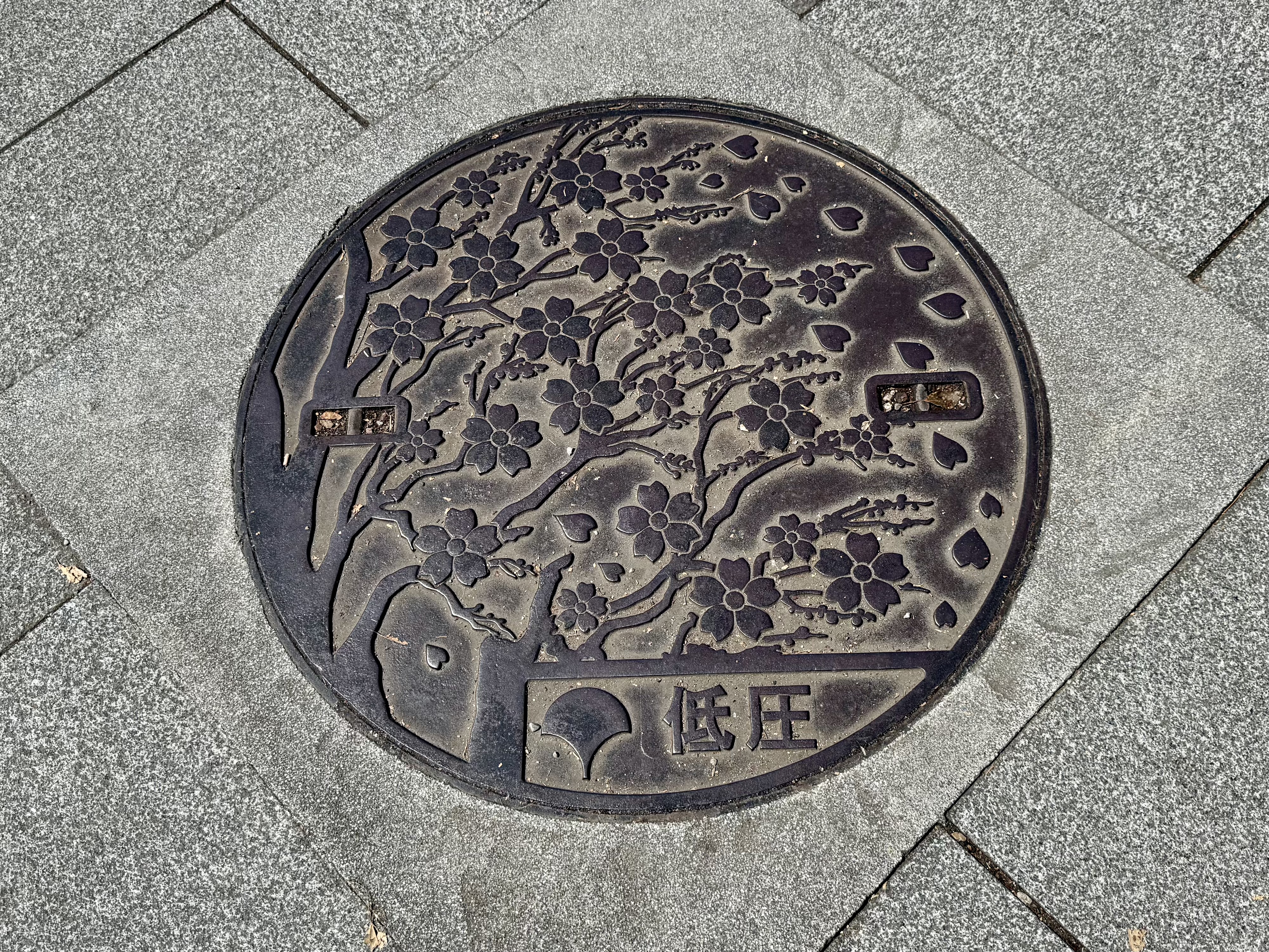
They are also all over the place in other ways. Maybe not the whole trees. Sometimes just the flowers. We found sakura representations or decorations on manhole covers all over town and in fabric patterns on at least one of the Tokyo Metro lines. We also found their shapes on cookies and in bags of rice crackers and potentially used as flavorings in cakes. After a week in Tokyo this spring, I have no idea what sakura taste like despite eating a piece of sakura flavored chiffon cake and some sakura-shaped (but not necessarily sakura-flavored) rice crackers. I assume this food stuff fades away outside of blossom season. We didn't notice any of this when we visited Japan in 2017, but we also weren't really looking for them either.


Sakura in manhole cover, subway seat fabric and rice cracker form, various Tokyo locations.
Having said all that, our sakura watching started on day one of our trip. Not full day one. Before that, in the few hours we stayed awake after landing at Haneda Airport and checking into our hotel. 

There is a sakura-zaka (what I interpret to mean a street lined with cherry blossom trees) about a block from our hotel. First impression? Not great. They didn't seem very pink and they didn't seem like they were in full bloom. But then again, it was after sunset and it was three days before the alleged peak. We had time.

We were looking for two things sakura-wise out of our trip to Tokyo. The first was some amazing, fantastic vista of sakura. I mean, that's why we decided to fly 14 hours direct to Japan for a week. We wanted dense, overwhelming, next-level cherry blossoms all around us. Gorgeous, incredible, light pink, petals-falling-in-the-gentle-breeze stuff. We researched all the top places to find sakura in the city and had many, many of them on our list. Yoyogi Park. Ueno Park. Shinjuku Gyoen. Sumida Park. Meguro River. And tons more. We wanted exactly what we came to see everywhere, but we expected it at least somewhere.

The second thing we were looking for were the famous hanami celebrations, which as we understood it prior to landing in Tokyo in late March consisted of Japanese families and friends sitting under the sakura on blankets or blue tarpaulins in public places consuming food and maybe questionable quantities of sake and birhu (I will forever refer to beer this way when talking about that ambrosia in Japan). In my mind's eye, I pictured this as a cacophony of celebration and lust for life at this time of year.


Aoyama Cemetery. A great start to our sakura-viewing.
The weather didn't cooperate. Our first day in Tokyo was a gorgeous spring day but we found the sakura to be generally the same as our first night in the city, meaning not super pink and not in full bloom. Aoyama Cemetery was an incredible introduction to our Tokyo sakura experience; we got a taste of how spectacular things could be and we saw multiple types of sakura (we think). But then it turned rainy. 

And then it turned cold and rainy. 

And then it continued to be cold and rainy.

The cold and the rain did two things for us or to us. First, I believe the weather pushed the peak bloom day into the future. I have absolutely no scientific evidence for this but the blossoms seemed no fuller on April 1 (the supposed peak day) than they did on March 30 and they DID seem more noticeable the next weekend. That gave us fewer days to appreciate peak bloom.

Second, it made us rearrange our schedule to do all the indoors things we intended to do on the rainy days and push all the sakura viewing to the last two and a half days of our trip. But it was really just one day and few hours because we had an appointment on the Saturday (one of the sunny days) that we couldn't re-schedule. This made Friday our key sakura day. A whole day outside in the sun. We made this into an "all eggs in one basket day" and not by choice. We saved what we thought might be the best spots for this one day, knowing that we'd have a couple of hours in the morning on Sunday if we really needed it.


Sakura at night along the Meguro River. They look super pink because the lighting is pink.
So don't get me wrong here. We still saw plenty of sakura during the rain and the cold days. After Aoyama Cemetery, we saw encouraging signs at Gotokuji Temple, Yoyogi Park, Ueno Park, along the Meguro River, in Kawagoe and in the gardens of the Tokyo National Museum. We just weren't overwhelmed with pink flowers in a way that we wanted to be. We didn't find any place where it was like this is worth traveling halfway around the world to experience.

One of the things we did discover in those first few days is how spectacularly impressive some of the trunks on the older trees are. There's a picture above of some sakura at Aoyama Cemetery. The trees on both sides of the photo are of similar height overall but the trunks of the trees are notably completely different. I'm assuming the species are the same (they looked exactly the same in person) which suggests to me that the trees' maximum height is achieved rather early in the lifecycle of the sakura. After that the trees trunks fatten up and ultimately become twisted and gnarled in the most excellent way, even causing some trees to become unbalanced and requiring manmade supports to stay upright. Cool stuff.

Then it was Friday. Eggs. Basket. Just one basket. Here we go.


Sakura under gray skies along the Oyoko River (top); rain splattered pond at the Tokyo National Museum (bottom).
We started Friday with a visit to Rikugien Gardens, a 300 plus year old established way back in 1695 under sponsorship or at least permission from the fifth Tokugawa shōgun, Tokugawa Tsunayoshi. It's what I would call a sort of classic Japanese landscaped garden, with ponds and bridges and a tea house or two. The gardens are home to a 70-year old weeping cherry blossom tree as well as some other sakura.

The place is spectacularly gorgeous. But not what we wanted. There were barely any blooming sakura and the weeping cherry blossom was clearly way past its prime based on the petals on the ground all beneath its branches. Beautiful, but not what we came to see.

We moved on to Ueno Park, which we had visited during the wettest, coldest day earlier in the week to spend a couple of hours at the Tokyo National Museum. It was so wet that day that we bought umbrellas in the Museum gift store, which is never really a purchase you want to make on vacation. On the way to the Museum, we saw enough light pink in the south half of the property that we thought it was worth a second trip.

There are a lot of sakura at Ueno Park. There are also a lot of people in Ueno Park. The main spine of the park is flanked by a series of sakura on either side under which a flood of sightseers were walking, gawking and taking innumerable pictures of the blossoms and themselves in front of the blossoms. We were also doing exactly that.

Ueno Park didn't do it for us either. It was close, I'll admit. But either the trees weren't full enough or the paths were too wide so that the sakura didn't block out the sky and give us the illusion of being surrounded by cherry blossoms. We are a tough crowd, I know.


Ueno Park. Lots of trees. Lots of people.
I don't how many "best places in Tokyo to see sakura" lists I read in preparation for this trip but suffice it to say that through late Friday morning of our Sunday through Saturday Tokyo visit, we were at a loss to say we'd been blown away by any of the places on those lists that we'd traipsed around the city to see at that point. I'd say we were most impressed (or maybe intrigued by potential is a better way to put it) by the trees at the center of Yoyogi Park (there's a photo below) and the trees along the banks of the Meguro River, which we visited at night on two separate occasions.

But we were not blown away, except by the last two places we visited: Shinjuku Gyoen (on late Friday morning) and Chidorigafuchi Moat (on Sunday morning). If I were writing a blog post about the best place to see sakura in Tokyo (and maybe I sort of am right now...) I'd start with these two and it wouldn't even be close. Am I an expert on this subject? Absolutely not. But these two places made our Tokyo sakura quest. They were head and shoulders above anywhere else we visited.


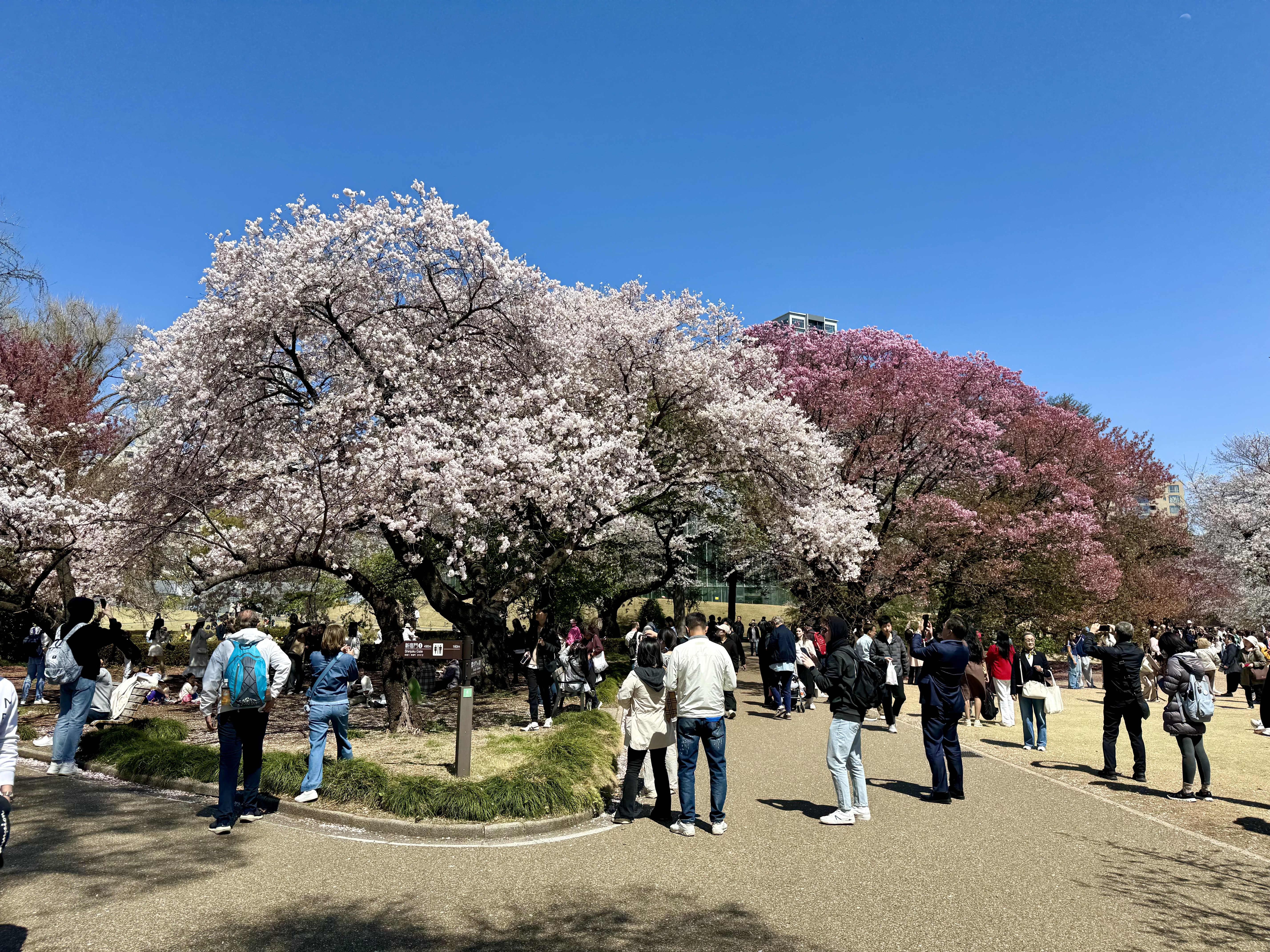
When we first walked into Shinjuku Gyoen, we saw the tree above. Right there, right then, I was sold. This was the most spectacular single tree we had seen in all of Tokyo. It was huge, it was more than just slightly pink-ish and it was in full bloom. It was incredible. Yes, there are a ton of people in front of it. It deserved the attention. Single most impressive tree in all of Tokyo that we'd seen in our almost full week there to that point.

But that wasn't it. The park kept going and going and unlike Rikugien Park, the sakura kept appearing. Individual trees. White trees. Groves of trees. Pinkish trees. Different species of trees next to each other. Full on pink trees. This is what we had been seeking. Were there ponds and bridges and walkways in the park? Sure there were. Were people picnicking on the grass? Sure they were? But the trees...I'm telling you the blossoms were just overwhelmingly gorgeous and just...there. In the full sun and in full bloom, this is what we came to see. They do exist. This would be the peak. It took until the sixth full day of being in Tokyo after walking what was probably about 50 miles (I'm assuming 2,000 steps for a mile, here) of hard city walking, but we got it. We got what we came for.

Shinjuku Gyoen is like an oasis of cherry blossoms in the city. We actually intended to visit the park on the Monday we were in town but noticed right at the last minute that the park isn't open on Mondays. It may have been a good thing that the place was closed, because we may have visited pre-peak and been disappointed. No such thing at the end of the week. Just an amazing place to see sakura.


More Shinjuku Gyoen, including some blossom close-ups.
Two days later, we found the sakura at Chidorigafuchi Moat, which is at the northwest "corner" of the old Imperial Palace grounds. The moat is a boating spot, meaning rowboats and paddle boats, some of the latter shaped like large swans. The grounds slopes steeply down precipitously in some spots to the moat and perched on the grassy lawns at the perimeter of the property are a series of picture-perfect sakura reaching out and down the hill to those people padding with their hands and feet on the water.

For those of us who decided to remain on land in this scene, there is a walkway at the exterior (meaning away from the old Palace grounds) which passes by every overhanging sakura. When we were there that Sunday, they appeared to be in gorgeous full bloom. If we hadn't been short of time (flight to catch later that same day...) we might have boated but it was enough to walk past and gaze. 

Like Ueno Park and Shinjuku Gyoen and well, pretty much every other place, the walkway around the moat was packed with sakura seekers, probably more so than usual because we were there on a weekend. The path was actually restricted to just one way traffic, it was that busy. We had to walk north along the non-sakura part of the path while jealously watching the people having the best time on the sakura side of the walkway. We eventually got there. It was worth getting to the right spot so we could bask in the glory of those trees.

I'm not saying here that the only places worth going to see sakura in Tokyo are Shinjuku Gyoen and Chidorigafuchi Moat but these two spots were definitely the best. They made our sakura quest. I think the pictures prove it.


Chidorigafuchi Moat. Note the manmade prop in the second  photo.
I have a few last things to say about sakura seeking in Tokyo. 

First, we never really got the hanami experience we wanted. I am sure a lot of it was weather-related and the fact that we hit the most hanami-worthy parks first thing in the morning when it wasn't quite late enough to start some morning drinking. We did see some pretty serious picnicking in both Shinjuku Gyoen and on a day trip to Yokohama but we never got the environment I hoped for, meaning groups of Japanese men and women gratuitously day drinking. I had fantasies of being invited to partake in sake drinking as a passerby and I have no idea why I thought that.

We did see a couple passed out on the Metro and speculated that they had been drinking all day at a hanami party. Sure enough, when we inspected them a little closer, we noticed a blue tarp stuffed into their tote bag. Hanami-ing for sure.

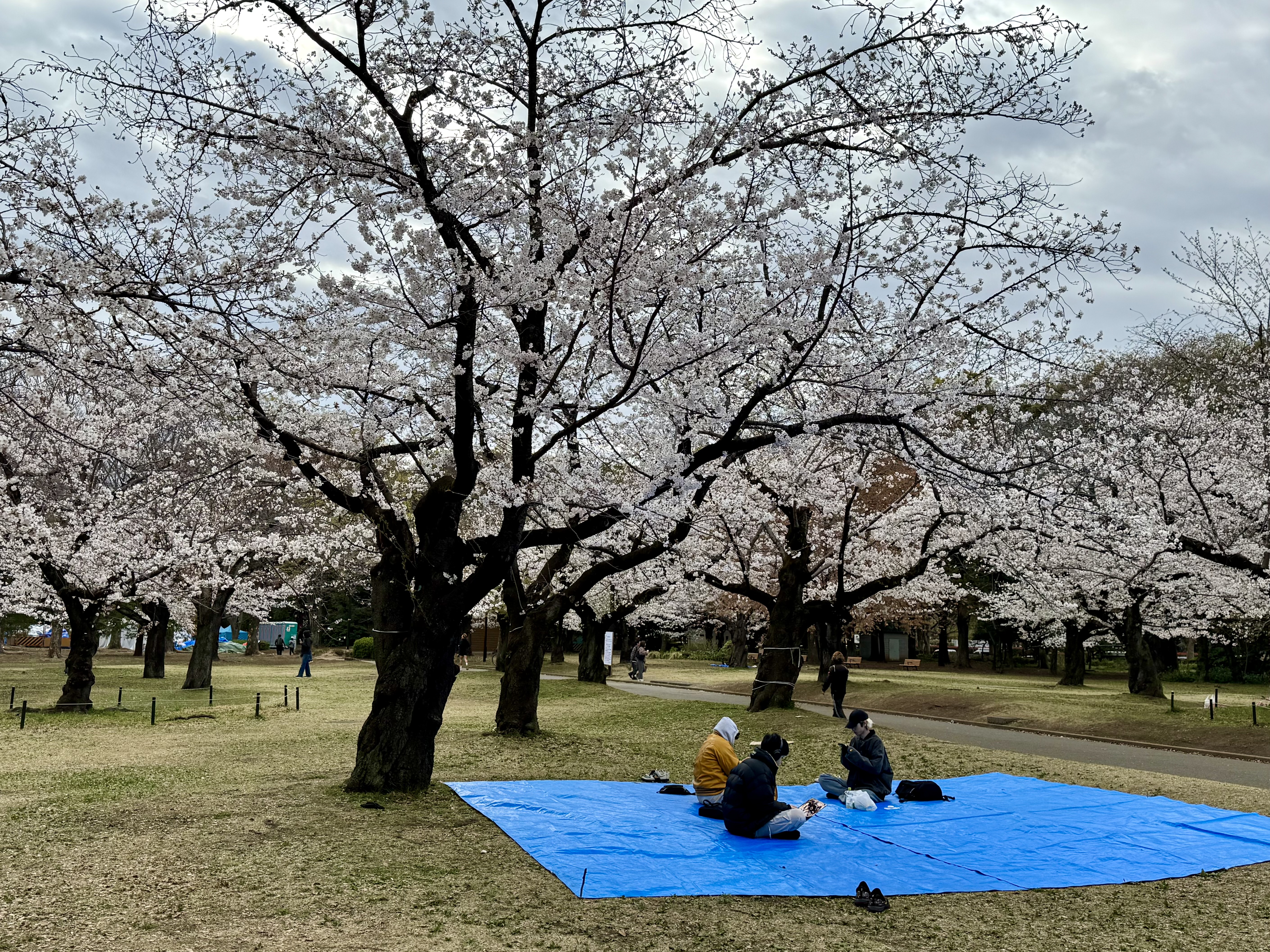
Getting ready for hanami in Yoyogi Park. Note that shoes are not worn on the blue tarp.
Hanami-ing in Yokohama.
Second last thing: the Japanese love to plant these trees along the sides of rivers. I guess this is supposed to create a tunnel of white / pink blossoms when the sakura are in full bloom. We found that the smaller the river was, the more successful this strategy was. We visited Sumida Park and found the Sumida River to be so wide as to negate the intended connection between the sakura on the two shores. We found the effect similar on the Oyoko River (see picture above). 

It worked pretty well along the Meguro River but especially well along the very small Shingashi River in Kawagoe.

Third last thing (there will be four "last things" in this blog post): we had the best intentions of visiting a number of different sakura spots at night to see how spectacularly these trees were illuminated after sunset. We never really made it to all the places we planned to visit, although we did walk past the sakura near the Tokyo Tower and we made it to the Meguro River twice after dark. A number of things un-did us here, including the weather, jet lag and other night-time commitments we made before arriving in Tokyo. There's maybe a regret here. Maybe. I'm not really a regret person so...


Almost hanami time in Oeno Park (top); sakura in Kawagoe (bottom). 
Fourth (and final) last thing: I had some notion that I would be able to pinpoint all the different sakura species around Tokyo after this trip. Why I thought this I have no idea. I guess I figured the information would be readily advertised either online or in the parks we were visiting. It wasn't. I think I can reasonably identify the somei yoshino but I might even struggle with that species in some spots. 

Why would I even mention this? Well, because there's a chance that some of the pictures I have posted are not of sakura at all. I have grave doubts (pun intended) about that gorgeous pink tree in Aoyama Cemetery being a cherry blossom but I just don't know. We generally used the presence of brown-eared bulbuls (they are birds) in the trees eating the seeds as an indicator of sakura-ness but honestly, we didn't wait for a bulbul to land in each tree we saw before taking some pics. Anyway, If there are pics on here that are not of sakura, I apologize.

I'm happy we visited Tokyo in search of sakura this year and I'm pleased with what we found, even if we were disappointed in some of the early returns. I think seasonal-focused destinations that emphasize one focus from the start to finish of the trip are good to take once in a while (I see this trip as similar to our Vienna Christmas market trip). This one worked. 

I'm finishing with a few more pictures of Shinjuku Gyoen which was without a doubt my number one spot here. There are a couple of helpful tips to find some of these things after those last pics.

The cover photo of this post is a detail of a silk kimono from the 18th century. The kimono is housed in the Tokyo National Museum in Ueno Park.


Most all of the sakura we sought out in Tokyo were really pretty easy to find. Wander into a park and they are pretty much right in front of you, or just follow the crowd until you get to something incredible. However, we did have difficulty locating sakura in two spots. Some of this is related to a lack of clarity (I believe) in all online resources that I found. Here goes my attempt to clarify.

We took a cab to get to the Meguro River Cherry Blossom Festival because when we pinpointed the festival location on Google Maps, it was nowhere really near to public transportation. We showed our cab driver where to go and the hotel concierge helped us out by explaining to the cabbie what we wanted to go see. A very animated conversation ensued which I assume (with the benefit of hindsight) was the cabbie telling the concierge that we were asking him to take us to the wrong spot. He ultimately took us to where he thought we should be going, which was more correct that what we asked for.

Now that we've been there twice, we now know the right spot to go to visit the Meguro River Cherry Blossom Festival: take the Tokyo Metro Hibiya Line to the Naka-Meguro Station (Station H-01) and walk towards the river. 

It took us three tries to locate the Chidorigafuchi Moat. Our first attempt was to enter the old Imperial Place via the Hanzomon Gate at the west side of the property and the Moat with all those boats would be just inside the wall. When we got to the gate, we found it closed. It wouldn't have made any difference if it were open: that's not where the sakura are.

Then on our last day in Tokyo, we made another attempt. We took the Metro over to the east side of the Palace and walked in from there, assuming the inner moat was the spot to be. It isn't. The Moat with the boats isn't on the interior of the massive park that houses the Imperial Palace at all. We walked across the entire property before heading north and finding out exactly where the sakura are. 

The sakura around the Chidorigafuchi Moat are at the northwest corner of the Imperial Palace park. Take the Metro to the Kudanshita Station and start walking west on the south side of the street. You can't miss it doing it that way, I swear.


Sunday, March 16, 2025

Golf Cart Day


Our trip to Belize was set up with a perfect balance for a Central American, Caribbean Sea-facing nation: four days in the jungle on the west side of the country and four days at the beach (and Belize's second-world-best barrier reef) on the Caribbean side. We spent our jungle time exploring Mayan ruins (including a sneak into Guatemala) and bird watching and hanging out at our swanky tropical resort while also taking in the local cuisine and maybe a drink or two. 

When we finished our trip for four days on the beach side of the country, our plans included lots of boat and water time. After all, the premier attraction for us was what was below the waves, not on the surface of the land. That meant plenty of time snorkeling looking at species of fish that we just can't see here at home. Not that we go snorkeling around here or anything. I mean the Potomac River and the Chesapeake Bay aren't exactly snorkeling hotspots. 

Our beach accommodations were in the town of San Pedro on an island called Ambergris Caye. Or as Madonna sold it: "La Isla Bonita". So in addition to wanting to focus on that tropical island breeze and all of that nature wild and free in a place where the sun warms the sky, we also wanted to spend some time in the town of San Pedro and on Ambergris Caye. On land.

And to do that, we needed one thing: a golf cart.

Yep, you read that right. The predominant form of transportation on Ambergris Caye is the good old golf cart. Are there cars and vans and motorcycles and bikes on Ambergris Caye? Sure there are. But if you want to get around the island cheaply and conveniently, you must rent a golf cart. MUST. There are tons of rental agencies on the island that will meet you at the airport or ferry terminal or however else you are arriving on the island. And you will not be the only golf cart driving tourists on the island. Everyone is doing it.

Originally, we planned to rent a golf cart for just one day and take taxis or walk to everywhere else we needed to get to on the other three days. But the low, low cost of less than $200 US for all four days convinced us to trade in the freedom of being on foot and having someone else drive us around for what is probably the least powerful gasoline powered rental vehicle I've ever rented. The Nissan Versa Note we got stuck with on Hawaii's Big Island was close but I think it just beat the golf cart out by a couple of horsepower. Just (but not by much).

Is it safe driving around in and parking (especially overnight) a golf cart on Ambergris Caye? Our instructions from Mark who met us at the ferry terminal seemed pretty straightforward. Press the right pedal to go and the other one to brake. Switch between forward and reverse by turning the dial below the seat. Lock the steering wheel using the padlock after you park it. And just don't flip the golf cart. How on Earth do you flip a golf cart? The thing only goes like 15 miles per hour, if that! Mark assured us it could happen. I'm sure he knows.

And yes, driving a golf cart is safe and easy, even when your first task is to un-parallel park out of a very tight space. 


I think one day roaming around the island was about right for us. We made a super long list of every place we could think of that we were remotely interested in and we hit every one with some time to spare. Honestly, we could not have stretched this out to a second day without spending all our time in bars or restaurants nursing a Belikin or two. Or more. Or a lot more. 

Let's start with what was on our list that isn't worth spending a ton of time writing about (shopping) before moving on to the one place that I have a bit to say about that wasn't worth visiting before finishing with the three places that really made this day a great day.

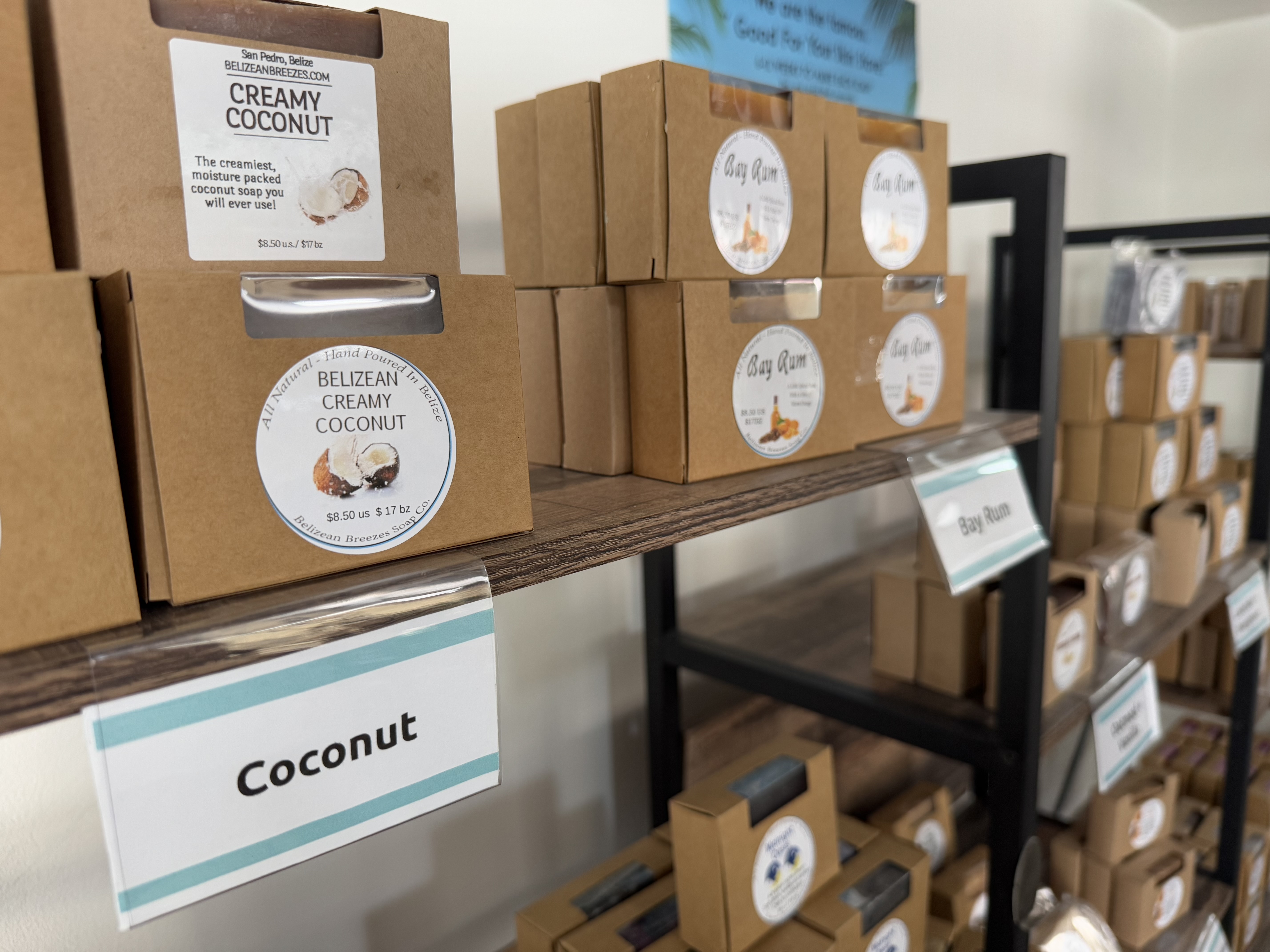
So the shopping...while I am sure that this would be disputed at times by the person I live with, no trip is a great trip without a little shopping. Handicrafts, art, food, cheap souvenirs, flip flops, whatever there is wherever you happen to be. And quite frankly, there's enough decent shopping in San Pedro to kill an hour or so. Highlights: looking for monkey farts soap (and finding it sold out) at the soap shop; picking up some ridiculously low, low priced jewelry; and ending the day with a cup of hot chocolate and some chocolate truffles at the Belize Chocolate Company. This hot chocolate...I swear it was mostly molten chocolate with a little bit of some sort of liquid in it. It was like drinking literal melted chocolate. Two enthusiastic thumbs way up, even if they were out of the chile chocolate.

Is it really able to be called Secret Beach if there's a giant sign to it?

Shopping took place close to our hotel. The furthest we went out of town was a place called Secret Beach, which is really anything but. I guess maybe one day way back when it was actually a secret it was probably pretty cool and very remote, but now it seems to epitomize the growing takeover of Belize's vacant lands by properties catering to tourists that want to spend time on the land and not in the water. And by "not in the water" I mean not snorkeling or diving; I don't mean standing in waist-deep water with a sugary cocktail in each hand.

In a partial defense of Secret Beach, we may have ended up at the property that was about as misaligned with us values-wise as it could have been. I'm not naming names (and partially because it's not worth looking up) but any place that offers every new customer a rum shot from a bottle with a dead fer-de-lance snake in it is probably not the place we should be hanging out. And no, the shots ain't free and there was usually a giant crowd of friends around the one or two dudes dumb enough to fall for this stuff. 

We probably should have shopped around a bit when we arrived at Secret Beach, but we were hungry and just parked at the first place that had an empty parking spot. Live and learn. Although we met up with some new friends later that same night by accident who had a similarly un-rewarding experience at a different place at Secret Beach. Maybe we are too old? That's probably it. 


The signature experience on our Golf Cart Day agenda without a doubt was a visit to ACES Wildlife Rescue north of the bridge that connects the two parts of Ambergris Caye. We spent the most time on our day at this spot (probably about a 90 minute duration total) and it had the most serious and consequential things going on. Not that you have to be serious and consequential on vacation...

ACES is a visit-by-appointment-only wildlife sanctuary that is supposed to be a way station for injured animals to be repaired, patched up, fixed or whatever else they need before being returned to the wild. Supposed to be is the key here, because ACES will do that if they can. Some patients are too badly damaged either physically from their injury or just mentally and behaviorally from being kept as pets and having their wild-ness taken away by the way their owners treated them. In those cases, they become permanent residents and those few animals became our educational tour on the day of our visit.

ACES stands for American Crocodile Education Sanctuary but crocodiles are not all they have on property or all they deal with. They will take all variety of birds, reptiles and mammals and try to do the best they can with the resources they have to get the task at hand completed. And I probably should stop using the term "they" to refer to ACES because there is no they. The whole place is run by one woman (Christina) who is the third custodian of the place and came to Belize with no training in animal husbandry but just fell in love with the island and ACES and stuck around to eventually adopt it as her own. 

It's up to Christina to do it all, whether it's care and feeding of those animals still on site or fixing up and bandaging patients who eventually will live again as wild and free animals. X-rays and basic repair? She's got it. Anesthesia and surgery? Has to be outsourced but Christina still has to find someone to do that and pay for the service. And with an estimated 120 varieties of animals cared for during her time there and a prohibition on transporting animals on or off Ambergris Caye during COVID, I imagine her job has been and is a daily exercise in figuring things out.

Does this place look like paradise or what? ACES' budgie cage with various palm trees.
What's on the tour at ACES? Well, not the animals that are planned for return to the wild. The less contact those species have with humans, the better. They need to be plenty afraid of the greatest killer on the planet once they get released back into the wild. But how about a brain-damaged osprey who flew into a building so hard that he'll never fly again? How about a green iguana (also brain-damaged) who was used as target practice by his owner and who won't run from predators? How about some domesticated Muscovy ducks who were found in such a state of mange that it took nine months of rehab for them to shed their damaged feathers? How about some budgerigars that people just got tired of taking care of and just gave up on? How about a furrowed wood turtle with a foot fetish who isn't scared of anything and just wants to lick toes? 

Is this an island of misfit toys type situation or what? These poor animals were for the most part just blatantly abused or treated like toys to the point that there is no way they can possible survive on their own in the wild. They'd be eaten up by a predator the first time one came across it. Especially poor Turbo the turtle, who would be gobbled up the first time he tried to nuzzle a crocodile's foot. 

Why do people do this? I can understand people wanting pets but you can't give up when you get tired of it. This animal is dependent upon you. You can't just discard it. There's even less excuse for those who were abused. I mean how do you think you have the right to just treat an animal that way? 


Wobbles the osprey (top) and both of Belize's iguana species (green and black spiny-tailed) in one shot.
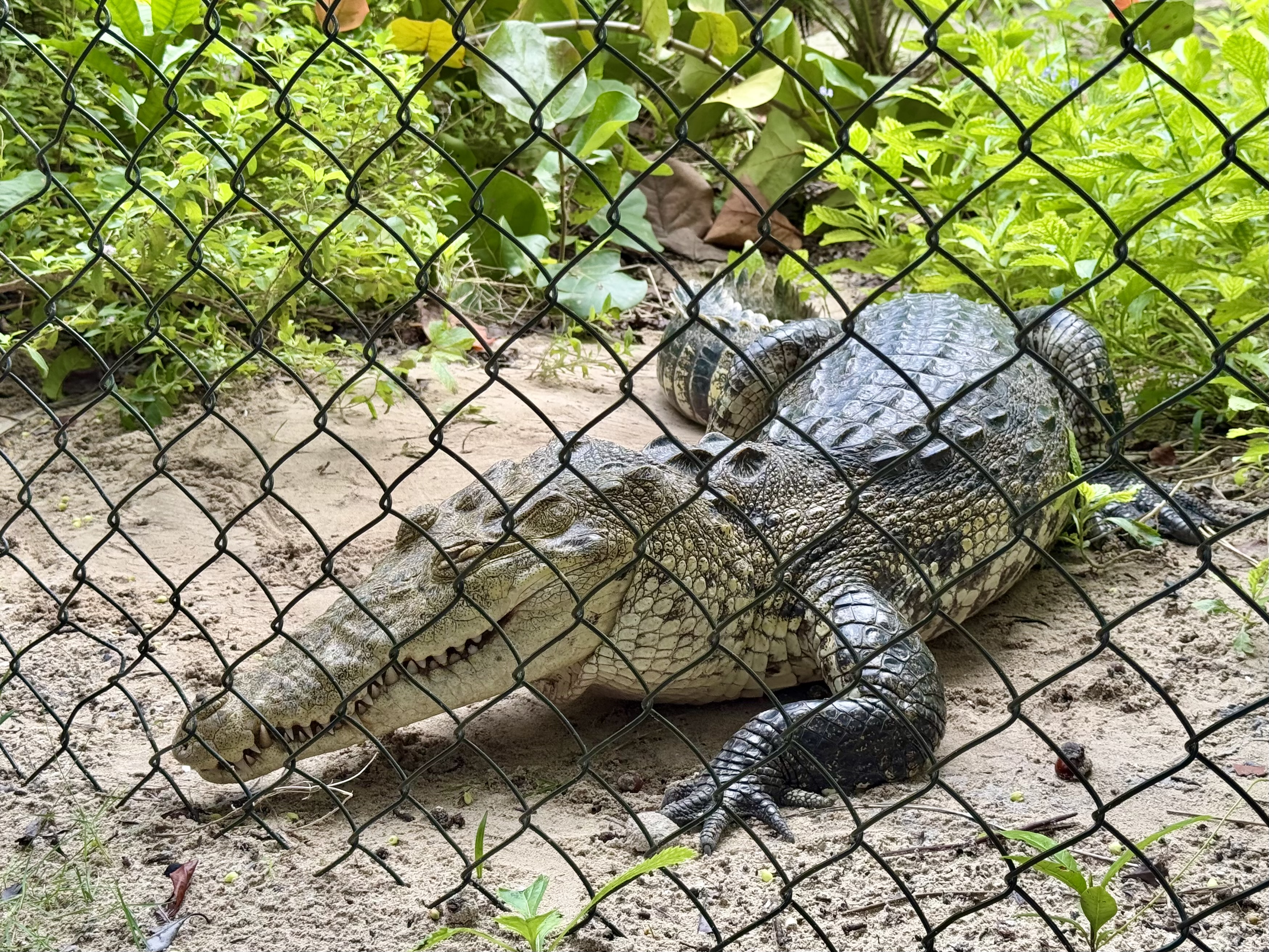
The most unfortunate and heartbreaking stories for me belong to ACES' three resident crocodiles, none of whom will ever truly walk or swim free again. 

Jewels is an American crocodile who was kept as a pet before the people who were keeping her decided maybe having a four foot (and growing) crocodile as a pet wasn't such a good idea. The problem? They trained her to hunt not by lying in wait and striking by surprise (like crocodiles do) but by playing with her and rewarding her with food. Think nature is going to do that for her? Not a chance. She's crippled as a wild animal because of it.

Cecilio is a blind Morelet's crocodile who was caught in a fisherman's trap and couldn't get out. I can't imagine the shock of the fisherman but if Cecilio was released back to the wild as is there is no way he can survive by himself. As if we needed proof of his blindness, he managed to walk right into the chain link fence when he smelled the raw chicken that Christina had for him.

Then there's Phinneas, a 12 foot long croc who had a house built over the top of his territory and who ate the house builder's pet dog because, well, it was right there and available and I guess didn't run away fast enough. What happened next? The house owner trapped Phinneas, wired his jaw shut and was in the process of cutting off his head before a neighbor intervened and stopped the killing of a protected species. I mean what are you even thinking about doing that?

Phinneas was rehabbed after two hours of surgery and released back to the wild but there was a problem: he had a taste for dog and was roaming around neighborhoods looking for more of that tasty meat. It wasn't likely to end well for anyone so Phinneas is now back at ACES and a permanent resident. 

Jewels and Phinneas are at ACES because of human interference in my opinion. Plain and simple. It didn't have to be this way. Luckily for them, a place like ACES exists. I hate that there is a need to keep any animals in captivity but the only other alternative here is death. They won't make it out there alone.


Top to bottom: Jewels, Cecilio and Phinneas.
If you can't make it to ACES on an appointment basis, there's another place that will give you a great opportunity to hang out with some of the green iguanas that populate the mangroves on the perimeter of the island. In fact, even if you do get to visit ACES, you can still hang out with the iguanas (we did!). It's called the Iguana Eco Sanctuary (although it seems to have had a lot of different names over the years based on some internet searching) and it's on the west coast of the main island of Ambergris Caye.

The iguanas (all green but not necessarily actually colored green; the mating males are various shades of orange) that hang out at the Eco Sanctuary are not tamed or caged in any way. In fact, I think they are there solely because the owners of the place put out tons of fresh fruit and vegetables for the iguanas to stuff themselves full of. It's like a reptile buffet. You can get super close to these animals which are hanging out in the veg piles but also in the mangroves. You are not going to kill a lot of time here but it's a cool diversion if you don't get a chance to see green iguanas very often. The first two iguana pics on this post are from our visit there.

Finally, I said there were three places that we found were worth visiting on Golf Cart Day. The last was Gill-E's Pour House, a dockside / beachside casual bar where we got to spend the last hour or so of our day chatting with friends over a Belikin or two. Unwinding is important.

I've complained in other blog posts from this trip about the weather. We actually picked the perfect day to roam around on land. We sandwiched this day between snorkeling days two and three and this day turned out to be the windiest and roughest seas day. Sometimes things do work out.